




Abstract
The United Kingdom has been the most successful of all the nuclear weapon states in terms of creating a minimum nuclear deterrent; in fact, there is reason to believe that the country is considering whether to move toward denuclearization. The authors assess the country’s nuclear forces, providing clear analysis on the British nuclear stockpile and its reductions, the modernization of its nuclear deterrent force, the British–French collaboration on defense and security matters, the country’s nuclear policy, and the country’s nuclear accidents.
Keywords
Of all the nuclear weapon states, the United Kingdom has moved the furthest toward establishing a minimum nuclear deterrent, announcing its plans last year to reduce its total stockpile to no more than 180 warheads over the next 15 years. Though it is considering replacing its ballistic missile submarines, the United Kingdom may even be approaching a decision on whether and how to transition toward denuclearization. Cuts to the defense budget may increase pressure to phase out its costly submarines; on the other hand, cuts to the conventional forces might strengthen arguments to retain a nuclear deterrent, perhaps by converting to a cheaper nuclear delivery platform.
The United Kingdom has a stockpile of approximately 225 nuclear warheads, of which fewer than 160 are operationally available for deployment on four Vanguard-class nuclear-powered ballistic missile submarines (SSBNs). The SSBNs, each of which has 16 missile tubes, constitute the United Kingdom’s sole nuclear platform, and submarine-launched ballistic missiles (SLBMs) comprise its sole nuclear delivery system.
The Royal Navy maintains 50 US-supplied Trident II D5 SLBMs—enough to fully load three of the four submarines. 1 Though a D5 is capable of carrying up to 12 warheads, we estimate each is loaded on average with just three US-supplied Mk4 and Mk4A reentry vehicles, each of which contains a British-produced warhead similar to the US W76. Carrying approximately 48 warheads, one of the four SSBNs is deployed at sea at all times in what is called a Continuous At-Sea Deterrent (CASD) posture. Two of the submarines remain in port and can be deployed on short notice, while the fourth remains in overhaul and could not be quickly deployed, if at all. The patrol SSBN operates at “reduced alert”; that is, its capability to fire its missiles is measured in days, rather than a few minutes (as during the Cold War). Its missiles are also kept in a “detargeted” mode—target coordinates are stored in the submarine’s launch control center instead of in the navigational system of each missile.
British SSBNs, which carry out secondary tasks such as scientific data collection while on patrol, are based in southwestern Scotland at the Naval Base Clyde at Faslane, which has access to the Irish Sea. Non-operational warheads are stored at the Royal Naval Armaments Depot at Coulport, approximately 3 kilometers west of the base.
Nuclear stockpile: Status and reductions
In May 2010, the United Kingdom made an unprecedented announcement detailing the size of its nuclear weapons stockpile. Foreign Secretary William Hague declared, “[f]or the first time, the government will make public the maximum number of warheads that the United Kingdom will hold in its stockpile—in [the] future, our overall stockpile will not exceed 225 nuclear warheads” (Hague, 2010: col. 181). The previous government had declared in 2006 that “fewer than 160” warheads would be “operationally available” (Ministry of Defence, 2006: 12). The balance, 65 warheads, was “to allow for routine processing, maintenance, and logistic management” (Foreign and Commonwealth Office, 2010a).
In October 2010, the United Kingdom declared that it would shrink its stockpile and number of deployed warheads even further. Over the next few years, it will reduce its operationally available warheads “from fewer than 160 to no more than 120,” and the number of warheads on each deployed submarine will drop from 48 to 40. This reduced requirement will, in turn, permit a reduction of the overall stockpile “from not more than 225 to not more than 180 by the mid-2020s” (Office of the Prime Minister, 2010: 38–39).
Knowing the size of the United Kingdom’s stockpile in 2010, its earlier stockpile levels can be reconstructed with the help of a chart from the 1998 Strategic Defence Review that listed “relative numbers” of stockpiled warheads in the 1970s, 1980s, early 1990s, and in 1998 (Secretary of State for Defence, 1998: 113). Assuming that overall stockpile reductions have in the past largely matched reductions to operationally available warheads, it appears that the British stockpile in the 1970s included approximately 520 nuclear warheads—significantly more than the 350 previously estimated
2
(see Figure 1). If the United Kingdom achieves its goal of a 180-warhead arsenal by 2025, then over the course of a half-century, the United Kingdom will have reduced its nuclear weapon stockpile by approximately 65 percent. As today, the United Kingdom will have the smallest arsenal of the five original nuclear weapon states— possibly even smaller than that of Pakistan.
3
British nuclear Weapons stockpile, 1970s–2020s.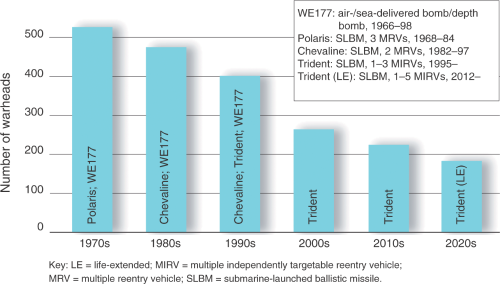
The planned reductions will result in significant changes to the weapons configuration on each SSBN. According to the British government’s 2010 Strategic Defence and Security Review (SDSR), the number of operational SLBMs on each Vanguard-class submarine will be reduced “over the next few years” to “no more than eight,” and the next generation of submarines will be “configured with only eight operational missile tubes, rather than the 16 on the current Vanguard class” (Office of the Prime Minister, 2010: 38–39). This language leaves it somewhat unclear whether the eight operational missile tubes on each Vanguard-class SSBN represent the maximum number of tubes or whether each submarine will have additional non-operational tubes. If additional non-operational tubes were available, missiles could be added if necessary in a crisis. The Submarine Initial Gate Parliamentary Report makes it clear that the reduced number of 40 warheads deployed on each submarine on deterrent patrol will be “carried on eight operational missiles” (Ministry of Defence, 2011: 9).
The decision to deploy 40 warheads on eight operational missiles will require the average number of warheads carried on each missile to increase to five, from today’s average of three. If some of the eight SLBMs were configured with one or two warheads for a sub-strategic mission, the remaining missiles would have to carry more than five warheads each. Increasing the number of warheads loaded on each missile is unusual; the tendency among nuclear weapon states (except Russia) after the Cold War has been to reduce the warheads on each missile in order to make the posture more applicable to limited regional scenarios.
Nuclear modernization
The United Kingdom may be reducing its stockpile, but as the 2010 SDSR makes clear, it nevertheless remains committed to maintaining and renewing its nuclear deterrent force as “the United Kingdom’s ultimate insurance policy in this age of uncertainty” (Office of the Prime Minister, 2010: 5). It plans to maintain a minimum credible nuclear deterrent “out into the 2060s” (Ministry of Defence, 2011: 2, 5)—with a view of 50 years into the future, that’s about the same amount of time as the United Kingdom has possessed nuclear weapons so far.
After the 2006 decision to replace the current generation of Vanguard-class SSBNs, modernization has focused on designing a new nuclear reactor and missile compartment; work on the Common Missile Compartment (CMC) began in 2007 as a joint US–British effort. The baseline of the CMC is a 12-missile-tube unit that can be adapted to either nation’s requirements: The next-generation US SSBN will have 16 tubes, but the British SSBN will have only eight “operational” missile tubes (Ministry of Defence, 2011). The new British submarine, the first of which is scheduled for delivery in 2028, will carry the current Trident II D5 until that missile is retired in the 2040s.
Just as the US Navy has decided to build a new reactor for its next-generation SSBN, so too will the new British SSBN be equipped with the new Pressurized Water Reactor 3 (PWR3), rather than an improved version of the PWR2 now used in the Vanguard- and Astute-class submarines. 4 And similar to the new US reactor, the PWR3 will have a core designed to last the entire life of the submarine (25 years, with an option of at least one five-year extension). As a result, the new SSBNs will avoid the expensive mid-life reactor-refueling overhaul, though they will have to enter dry dock periodically for repairs and upgrades. The core life for the PWR2 is approximately 10 years; the leap to a longer-than-25-year core life for the PWR3 suggests close British collaboration with the United States.
In addition to modernizing its nuclear delivery system, the United Kingdom is also enhancing the nuclear warheads carried on the Trident submarines. The current warhead design is thought to be a modification of the W76, one of two warheads arming US Trident SLBMs (see Kristensen, 2006). The 2006 Defence White Paper stated that the “existing Trident warhead design is expected to last into the 2020s” (Ministry of Defence, 2006: 11), but the 2010 SDSR significantly extends that timeline, stating that “a replacement warhead is not required until at least the late 2030s” (Office of the Prime Minister, 2010: 39).
This warhead-life timeline roughly matches the timeline for the life-extended W76-1 warhead that the United States is producing for its own Trident force. Originally manufactured between 1978 and 1987, the W76 life-extension program increases the service life of the original W76 design for another 30 years and incorporates it into a new reentry body—the Mk4A. The British government has confirmed that that the Mk4A is being backfitted onto its Trident SLBMs (see, for example, Davies, 2009: col. 214W). but until recently it was not known whether the new reentry body would contain the British warhead design or the US W76-1. It appears now that the British SLBMs will carry the US-supplied W76-1/Mk4A combination: Sandia National Laboratory revealed in April 2011 that “the first W76-1 United Kingdom trial test was performed” in 2010 for “UK implementation of the W76-1” (Sandia National Laboratories, 2011: 3). 5
The Mk4A is equipped with a new arming, fuzing, and firing unit that provides increased targeting capabilities. 6 The Guardian quoted anonymous British defense officials privately agreeing that the W76-1/Mk4A package will make British Trident missiles more effective against “hard targets” (Norton-Taylor, 2011).
British–French collaboration
The United Kingdom has cooperated with the United States since at least 1958, relying on its ally to sustain its nuclear deterrent. In November 2010, the United Kingdom expanded its collaborations, signing a bilateral treaty with France to cooperate on defense and security matters, including the maintenance and development of the two nations’ respective nuclear arsenals (Foreign and Commonwealth Office, 2010b). A new joint warhead simulation facility will be built at the Valduc Center for Nuclear Studies (about 45 kilometers north of Dijon), France’s nuclear warhead production plant. The new facility, scheduled to open in 2015, will be used to conduct hydrodynamic tests of nuclear warhead designs to verify performance of existing, enhanced, and new designs. The agreement also provides for the construction of a joint Technology Development Centre at Aldermaston, the British facility that provides scientific and engineering expertise to support the stockpile. The new center will develop simulation technology for the Valduc facility (BBC, 2010; Chuter, 2010). Joint SSBN deployments will not be undertaken, nor will warheads be shared, but deeper British–French cooperation appears to be under consideration.
Declaratory nuclear policy
The British government declared in the SDSR that it was “now able to give an assurance that the UK will not use or threaten to use nuclear weapons against non-nuclear weapon states parties to the NPT [Nuclear Non-Proliferation Treaty]” (Office of the Prime Minister, 2010: 37). This negative security assurance is similar to long-standing British policy, first declared in 1978, that it would not use nuclear weapons against non-nuclear NPT members—“except in the case of an attack on the United Kingdom, its dependent territories, its armed forces or its allies by such a state in association or alliance with a nuclear-weapon state” (Simpson, 2004: J-2).
In 1995, to help secure support for the indefinite extension of the NPT, the British government restated the policy but also broadened the caveat considerably to include “an invasion or any other attack on the United Kingdom, its dependent territories, its armed forces or other troops, its allies or on a State towards which it has a security commitment, carried out or sustained by such a non-nuclear-weapon State in association or alliance with a nuclear-weapon State” (Simpson, 2004: J-3.)
After the United Kingdom retired the last of its nonstrategic bombs in 1998, the Ministry of Defence declared that in order to retain “an option for a limited strike that would not automatically lead to a full-scale nuclear exchange,” the Trident SLBM, unlike Polaris and Chevaline missiles, “must also be capable of performing this ‘sub-strategic’ role.” Trident SLBMs would be “allocated to NATO in both the strategic and sub-strategic roles” but “remain operationally independent and available for use by the United Kingdom alone in case of supreme national need” (Secretary of State for Defence, 1998: 25, 323). NATO’s Strategic Concept from 1999 explicitly referred to this role, committing to retain “adequate sub-strategic forces” consisting of dual-capable aircraft “and a small number of United Kingdom Trident warheads” (NATO, 1999: sec. 64).
The sub-strategic mission was controversial, because it implied a willingness to use nuclear weapons earlier in a conflict, and the 2006 Defence White Paper did not mention the mission. Then-Defence Minister Des Browne explained the change by stating: “Our nuclear weapons are not intended, nor are they designed, for military use during conflict. We have deliberately chosen to stop using the term ‘sub-strategic Trident.’ It was applied previously to a limited use of our nuclear weapons, but we would only consider using nuclear weapons in self-defence and then only in the most extreme of circumstances. We have no plans to develop so-called battlefield weapons” (House of Commons Defence Committee, 2007: 66).
Despite Browne’s careful choice of words, to what extent a sub-strategic mission for British nuclear weapons may still exist is unclear. The 2010 pledge that the United Kingdom will not use or threaten to use nuclear weapons against non-nuclear NPT members could constitute a reduction of the nuclear role by further implying that even if a non-nuclear NPT state attacked the United Kingdom with chemical or biological weapons, nuclear missiles on Trident submarines would not be used to retaliate. At the same time, however, the recent SDSR declared that, “while there is currently no direct threat to the UK or its vital interests from states developing capabilities in other weapons of mass destruction, for example chemical and biological, we reserve the right to review this assurance if the future threat, development and proliferation of these weapons make it necessary” (Office of the Prime Minister, 2010: 37). In other words, the assurance still comes with a caveat that appears to hold the door open for a potential limited nuclear strike against a non-nuclear adversary.
Nuclear weapons: Accidents and incidents
As with other nuclear powers, British nuclear forces are occasionally involved in incidents with potential safety or operational hazards (see Norris and Kristensen, 2005: 79). In February 2009, the Vanguard collided with the French Le Triomphant while at sea. Both SSBNs carried their complement of nuclear-armed SLBMs. Although both British and French authorities insisted that there was no damage to any nuclear system on board either submarine, both subs were damaged enough to require repairs upon their return to port (BBC, 2009a).
Two months after the collision, the Ministry of Defence disclosed that there have been 14 collisions (mostly groundings) involving British SSBNs since 1988, as well as 236 fires. Of the fires on Royal Navy nuclear submarines, 213 were classified as small-scale, while 20 were more serious (the size of three of the fires was not characterized). 7 Two of the collision incidents involved the grounding of nuclear-armed SSBNs: the Repulse in the North Channel off Northern Ireland in July 1996 (the sub was decommissioned the same year) and Victorious on Skelmorlie Bank on the Irish Sea in November 2000 (Ainsworth, 2009; BBC, 2009b). The February 2009 collision of the Vanguard was not on the list.
More recently, in April 2011 the Vengeance was forced to return to port during a training exercise in the North Atlantic due to a loss of power caused by a mechanical problem. The Ministry of Defence said that the accident was not nuclear-related, but the Vengeance’s propulsion system reportedly was affected (BBC, 2011).
Footnotes
Acknowledgements
Jonathan Garbose, an intern at FAS, provided valuable research.
1
The question of who owns the Trident II D5s deployed by the United Kingdom is for some a matter of semantics, though in our opinion, one cannot “own” a rented car, to use an analogy. For more on this, see  . The fact that the United States loans its nuclear missiles to the United Kingdom is, at the very least, an indicator of the special nature of nuclear collaboration between the two nations.
4
An internal Royal Navy safety review concluded in 2009 that the PWR2 has serious safety flaws and recommended a new reactor for the next-generation SSBN. See McFarlane (2009); .
Author biographies
Inquiries should be directed to FAS, 1725 DeSales St., NW, Sixth Floor, Washington, DC, 20036 USA; +1 (202) 546-3300.