




Abstract
Although the Obama administration has highlighted the need to secure fissile material worldwide, domestic efforts to secure highly enriched uranium (HEU) have been sluggish and uninspired. In the post-9/11 era, the United States has tremendous opportunities not only to better secure its dangerous HEU, but to make money by doing so. The authors write that the United States could create a new HEU surplus by designating that which is unnecessary for military needs; reduce the backlog of retired warheads awaiting dismantlement; increase the rate at which surplus HEU is downblended into low enriched uranium (LEU), a form of uranium unusable for weapons but usable as nuclear fuel; and sell that LEU to nuclear power plants for billions of dollars. The slow pace of downblending HEU in the United States poses a security risk to the population, deprives taxpayers of a needed source of revenue, and sends the wrong message to the global community about the US commitment to combating nuclear terrorism, the authors point out, and developing and implementing a new downblending strategy should be a priority.
Keywords
When President Barack Obama took office, he acknowledged that securing nuclear materials is critical to global security. “[W]e know that there is unsecured nuclear material across the globe. To protect our people, we must act with a sense of purpose without delay,” he said (White House, 2009). The president did not overstate the threat. Obtaining fissile material—particularly highly enriched uranium (HEU)—is a major goal of rogue states and nuclear terrorists. 1 With approximately 110 pounds of HEU, 2 which would fit in a shoebox, it is possible to create, within minutes 3 an improvised nuclear device that could produce a blast on par with the one that devastated Hiroshima, Japan (Bunn, 2008a; Bunn and Holdren, 2002; Center for Nonproliferation Studies at the Monterey Institute of International Studies, 2005).
Yet nations around the globe continue to maintain stocks of HEU that pose unnecessary security risks, and the United States is no exception. Although the United States stopped producing HEU in 1992, it still has the world’s second largest stockpile, after Russia (DOE, 2001; International Panel on Fissile Materials, 2009). According to the last inventory made public, it possessed 740 metric tons of HEU in 1996 (DOE, 2001). Since then, approximately 127 metric tons 4 have been truly secured through downblending—the practice of mixing HEU with depleted, natural, or low enriched uranium (LEU) 5 to render the HEU unusable in weapons (DOE, 2010a; Nuclear Energy Institute, 2010; Snider, 1996). Several dozen metric tons have presumably been consumed by the Navy to power its nuclear fleet, and a modest amount has been consumed by research reactors. That leaves approximately 500–600 metric tons of HEU—the equivalent of 20,000–24,000 warheads 6 —kept on hand in nuclear warheads; in secondaries (the term for HEU components added to single-stage nuclear weapons to create a thermonuclear explosion, also referred to as canned subassemblies); and stored, in various forms, at the Y-12 National Security Complex in Oak Ridge, Tennessee. 7 These are estimates; the exact amount of US-owned HEU is classified. 8
In April 2010, to combat the risk posed by unsecured fissile material around the globe, President Obama hosted a nuclear security summit in Washington, DC. While the president can be commended for bringing this issue to the global stage, he has not taken meaningful action to reduce the United States’ own stock of HEU. Not only is the United States not taking steps to reduce its inventory, but new investments in its nuclear weapons complex do not respond to the post-9/11 era in which fissile material is recognized as a liability. A modern complex requires only the HEU necessary to ensure the reliability of the arsenal, and permanently removes surplus HEU so that it does not pose a security threat. True modernization would mean accelerating the current glacial pace of downblending, declaring more HEU surplus to national security needs, and decreasing the backlog of warheads sitting in storage awaiting dismantlement.
Accelerate the downblending rate
The most important step to modernize the nuclear weapons complex is to accelerate the downblending rate of surplus HEU. This job falls to the National Nuclear Security Administration (NNSA), an independent body within the Energy Department. NNSA is responsible for the US nuclear arsenal and for nuclear materials both at home and abroad, including management of the Life Extension Program (LEP) to ensure the safety and reliability of nuclear warheads without explosive testing.
In its fiscal year 2011 request to Congress, the NNSA stated its goal to downblend 217 metric tons of its surplus HEU (DOE, 2010a ). 9 While 127 metric tons of this amount has been downblended, progress for the remaining HEU has unfortunately slowed tremendously: budget allocations for downblending decreased from $39.2 million in 2009 to $34.7 million in 2010, and have shrunk again to $26 million in NNSA’s budget request for FY 2011 (DOE, 2010a); further, due to the low priority assigned to downblending by the NNSA, the administration’s schedule for transforming the approximately 90 metric tons of remaining surplus HEU is being dragged out until 2050. 10 This rate—approximately 2 metric tons of HEU per year 11 —is unnecessarily slow; NNSA downblended 20 metric tons in FY 2004, 14 in FY 2008, and 10 in FY 2009, clearly indicating that a higher rate is possible (DOE, 2005, 2010b). In fact, NNSA has the capacity to downblend significantly more than even 20 metric tons per year.
The Nuclear Operations Group of Babcock & Wilcox (B&W) in Lynchburg, Virginia (B&W-Lynchburg), one of the privately owned facilities with NNSA contracts for downblending, performed almost no downblending in 2009. The company is considering closing its downblending operation because it is not profitable, further impeding US downblending goals. In addition, Nuclear Fuel Services (NFS) in Erwin, Tennessee, which was recently bought by B&W, has a large unmet capacity for downblending, with a number of downblending lines sitting idle. 12
NNSA could clearly operate existing facilities at a far higher capacity, and does not need to wait for a planned new facility to come online. NNSA says a key reason the downblending rate has slowed so much is that Building 9212 (the facility at Y-12 where HEU is converted into a form that can be shipped for downblending) is old (DOE, 2000). As a result, the rate at which HEU is converted into the form necessary for downblending must be reduced so as not to “wear out” the building. However, NNSA’s planned new Uranium Processing Facility (UPF), which will consolidate Y-12’s uranium operations, including its LEP activities, will not modernize NNSA’s approach to downblending.
When the new facility comes online in 2022, NNSA does not plan to increase its rate of downblending from the historic low of 2–3 metric tons per year. While NNSA will not utilize the UPF’s expanded capacity to return downblending rates to their previous rates of 10–20 metric tons per year, let alone ramp up efforts to 20–30 metric tons per year, it projects very high secondaries production targets of 80–200 per year at the new facility (DOE, 2007, 2009; NNSA, 2010). This priority on production demonstrates the imbalance between the LEP activities necessary to maintain the reliability of the arsenal and activities such as downblending that ramp down the Cold War-era nuclear weapons complex. This level of secondary production also seems excessive given that there are already thousands of secondaries in storage, and that a recent study conducted for the NNSA found that the life of the nation’s nuclear warheads, including the HEU secondaries, can be extended safely and certifiably for decades (MITRE Corporation, 2009).
Existing facilities can be better utilized. For instance, at least 50 percent of the processing time at Building 9212 is spent on extracting HEU from scrap material containing less than 1 percent HEU, which should instead be declared waste and sent to the Waste Isolation Pilot Plant (WIPP) in Carlsbad, New Mexico (Alvarez, 2006). Additionally, as of 2004, $400 million had been invested as part of a continuing series 13 of expensive upgrades to ensure Building 9212 remains safe and operational until UPF comes online (DOE et al., 2004). Furthermore, Y-12 itself admits that without UPF, it can support a “baseline throughput of approximately 125 secondaries and cases per year” (DOE, 2009, p. S-11/12). During the B61 (aircraft-launched warhead) life-extension program, Y-12’s Building 9212 successfully remanufactured a part of the HEU component. 14 This follows a pattern of successfully accomplishing its missions: Y-12’s Building 9212 also had the manufacturing capacity to handle the life-extension program of the W87 (Minuteman III), and the current life-extension program of the W76 (submarine-launched warhead). As the ground has yet to be broken on UPF, and a contractor selected, it is not too late to cancel or refocus the project. Renovating Building 9212 may be the more prudent modernization choice than waiting for a new facility to be completed.
One possible reason for the low priority of downblending may be the concern that the United States could negatively affect the international price for LEU by flooding the market (Bunn, 2008b). This is a reasonable concern, but one with clear solutions. Worldwide, there are 435 active commercial nuclear reactors. In 2006, about 60 percent of their fuel, or 66,500 metric tons of uranium, came from mining production. 15 Although enriching natural uranium into usable LEU is a “lengthy, complex and expensive process” (Nuclear Energy Institute, 2010), there are some interests which may not want to see more LEU come from downblended HEU. The World Nuclear Association, for example, which represents the “people and organizations of the global nuclear profession,” including uranium mining, conversion, and enrichment companies, states that “Highly-enriched uranium from weapons stockpiles is displacing some 10,600 tonnes of U3O8 [natural uranium] production from mines each year, and meets about 13% of world reactor requirements” (World Nuclear Association, 2009, 2010).
One option to alleviate fears of flooding the market is to store LEU at a very low cost—much lower than the cost of storing HEU—until market conditions change. Some in the nuclear industry even recognize this supply of LEU as “a friend” as it enables “us to skate over supply disruptions with no one running out of fuel” (Cornell, 2005). The government could also reduce market anxiety by publishing a plan detailing when LEU will be released, in what form, and in what quantity, as suppliers say the market can adjust if it can see the LEU coming. In an effort to address such concerns, Congress has already directed the Secretary of Commerce to review projected demand for LEU and set import limitations on uranium so as not to disrupt the market (House of Representatives, 2009a). And in yet another step to avoid negatively affecting the market, the Government Accountability Office (GAO), in a March 2008 report about depleted uranium supplies in the United States, recommended that the Department of Energy (DOE) complete as soon as possible a comprehensive uranium management assessment so that the DOE can “quickly react to rapidly changing market conditions to achieve the greatest possible value from its uranium inventories” (GAO, 2008: 10).
Estimated US HEU Stockpile*
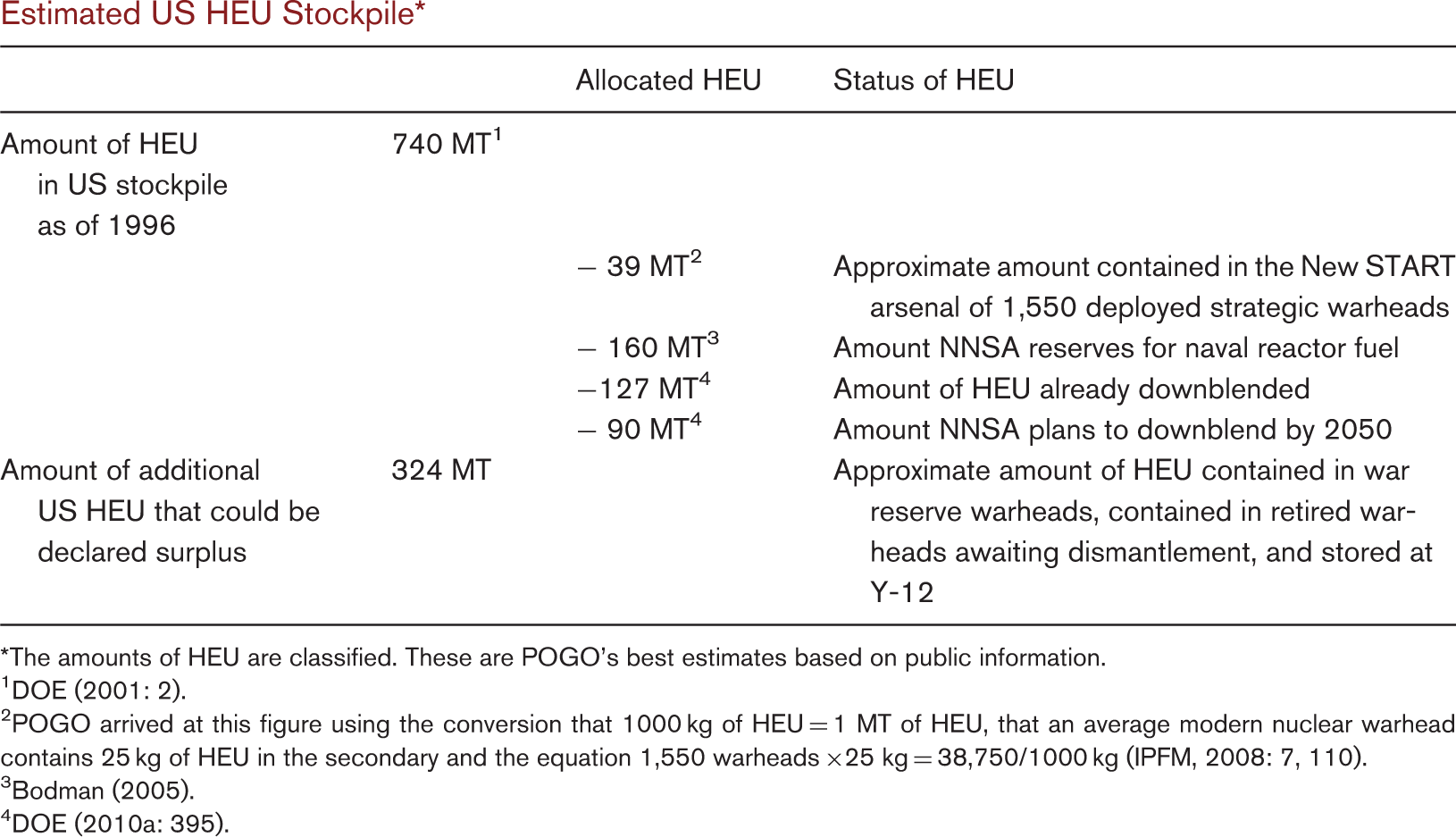
The amounts of HEU are classified. These are POGO’s best estimates based on public information.
DOE (2001: 2).
POGO arrived at this figure using the conversion that 1000 kg of HEU = 1 MT of HEU, that an average modern nuclear warhead contains 25 kg of HEU in the secondary and the equation 1,550 warheads ×25 kg = 38,750/1000 kg (IPFM, 2008: 7, 110).
Declare more US HEU surplus to national defense needs
An essential and genuine step the United States could take to advance global fissile material security is to declare HEU no longer needed for defense purposes as surplus and downblend it. This is an area where the president must take the lead: Only the president has the authority to designate HEU as surplus to defense needs. As with downblending, however, there has not been enough progress—or even interest—in declaring additional HEU surplus. This lack of priority is evident in the language of the NNSA’s FY 2011 budget request: “The funding profile for the U.S. Uranium Disposition program is declining in the future because the large quantities of surplus HEU have already been disposed of or are in the pipeline” (National Nuclear Security Administration, 2010: 396). This statement suggests that the NNSA doesn’t believe there is surplus HEU. In fact, hundreds of metric tons of HEU could be declared surplus because some has been sitting in storage for decades or is contained in warheads that are no longer needed in our arsenal.
The first place to look for HEU that can be declared surplus to US security needs is Y-12. Approximately 200-300 metric tons of HEU is stored at Y-12 in various forms, including secondaries; most of this could be declared surplus. An independent study by the GAO should be conducted to determine how much HEU Y-12 actually needs to be kept on hand for the LEP.
The United States currently has HEU in inventory for military needs, but that amount has yet to be right-sized to fit the reduced arsenal. Although not yet ratified by the US Senate, the new arms control deal with Russia (New START) reduces the number of deployed operational warheads to 1,550 on each side (White House, 2010). The US could designate as surplus the HEU contained in its non-deployed warheads 16 (also referred to as hedge or war reserve warheads), the HEU contained in retired warheads awaiting dismantlement, and most of the HEU being stored at Y-12. In total, more than 320 metric tons that can be declared surplus to US military needs.
Misconceptions surround naval reactor HEU requirements
Decision-makers may believe there is no surplus HEU due to the common misconception that HEU not needed for the US nuclear arsenal is needed to fuel submarines and aircraft carriers. The Navy currently has reserved 100-160 metric tons of HEU 17 —as the Navy uses an average of 2–3.5 metric tons of weapons-grade HEU annually; 18 this is enough fuel supply for the next 28–80 years (Bodman, 2005). 19
To be sure, the Navy will probably one day require more fuel. Yet reliance on HEU is
not in line with the US goal to secure loose fissile material around the globe. The
International Panel on Fissile Materials (IPFM) warns that “it will be
difficult to assure that some HEU withdrawn from safeguards for use in naval fuel
has not been diverted to weapons” (IPFM, 2008: 35). There are also
proliferation risks associated with the continued reliance on HEU as naval fuel, as
asserted in the 2008 IPFM Report: The use of HEU fuel by naval nuclear propulsion programs may make future
nuclear disarmament agreements more difficult. As reductions in the
nuclear-weapon arsenals proceed, the relative size of naval stockpiles of
HEU could increase, and concerns could develop about their potential
conversion to nuclear weapons. (IPFM, 2008: 76)
This concern would be exacerbated if the Navy goes forward with plans to use HEU-powered reactors to propel surface ships (O’Rourke, 2009).
One possible solution would be to design new naval propulsion systems to run on LEU fuel. Although popular wisdom contends that HEU reactors are more efficient than LEU because of the longer periods between refueling, these efficiency claims are challenged by the expense of the HEU refueling process (US Navy, 2009). In both US and Russian submarines, refueling “involves cutting through the submarine hull and removing the core,” which can take years (Ma and von Hippel, 2001). For example, it took more than two years to refuel the USS Alaska (US Navy, 2009). As a result, other nations have switched to LEU reactors, which reduce the refueling time to mere months (IPFM, 2008). 20 The time between LEU refuelings is estimated at 7.5-14 years (Director, Naval Nuclear Propulsion, 1995; Ma and von Hippel, 2001). Both France and China use LEU, enriched at less than 10 percent, to fuel their submarines, and both India and Brazil are currently designing LEU-run naval propulsion reactors (Ma and von Hippel, 2001). It is also possible to power naval nuclear ships with Thorium (House of Representatives, 2009b).
Either option will require independent scientific analysis. (The Navy conducted a study in 1995 at the request of Congress and recommended against the use of LEU because it would be “uneconomic and impractical” (Director, Naval Nuclear Propulsion, 1995). But there have been substantial technological advances in LEU reactors since 1995, as well as increased security concerns about HEU). The study could be conducted by the GAO, which could also seek input from the National Academy of Sciences or JASON, an independent advisory group of scientists based out of the MITRE Corporation.
Accelerate the dismantlement rate
A third step the United States could take toward genuine modernization of its nuclear weapons complex is to accelerate the dismantlement rate of retired nuclear weapons. But this is another area in which US stated goals are one thing and US actions another. In recent years, there has been a dramatic drop in the number of warheads the United Stated has dismantled, thus reducing the amount of HEU available for downblending. While recent dismantlement rates are classified, expert observers estimate the average rate of warhead dismantlement dropped from 1,300 per year in 1990–1998, to the current rate of 350 weapons per year At this rate, the backlog of 4,500 retired warheads will not be dismantled until 2022 (IPFM, 2007; Kristensen, 2010).
Until the retired weapons are dismantled, they can still be used by the United States (or, theoretically, terrorists and rogue states), which sends a mixed message to the nations of the world. Furthermore, the growing backlog of thousands of nuclear warheads in the dismantlement queue raises security concerns because a number of the more secure military storage bunkers are rapidly filling. For example, the Air Force’s most secure facility, Kirtland Underground Munitions Storage Complex (KUMSC) in Albuquerque, New Mexico, is virtually filled. As a result of the New START agreement, there may be thousands of additional nuclear warheads traveling down the pipeline and it remains unclear whether there are adequate secure facilities to store them.
The NNSA defends its current, sluggish dismantlement rate, claiming it is hard to compare rates from year to year because of the varying complexities of warheads. While this complexity may have something to do with the slow rate, it’s not the whole story. For instance, President Obama’s FY 2011 budget request for nuclear weapons-related investments increased by 14 percent, and the request for dismantling retired weapons decreased by 39 percent (Civiak, 2010).
If the president is serious about his stated goal to “ensure that terrorists never acquire a nuclear weapon” and to do so by acting “with a sense of purpose without delay,” he should increase the budget request for dismantlement (White House, 2009). Even if he doesn’t, however, Congress now has a budget request and it could act quickly to deal with the backlog in the dismantlement process by increasing the funds appropriated specifically for that purpose. The NNSA would then be able to employ a second shift at the Pantex Plant for weapons disassembly and assembly in Texas. This second shift would create the capacity to dismantle 800-1,000 weapons per year, and if that capacity were put to use, the backlog of 4,500 warheads could be dismantled by 2015. That would make 112.5 metric tons of HEU available for downblending. 21 The Energy Department could also assign dismantlement activities to the Device Assembly Facility at the Nevada National Security Site, which has the same facilities as those used by Pantex to dismantle weapons.
Conclusion
The United States possesses large quantities of HEU that are not needed for military purposes: More than 320 metric tons is contained in war reserve warheads, in retired warheads awaiting dismantlement, or stored at Y-12. Reducing these stockpiles would yield many benefits. As stated in Securing the Bomb 2010, “incidents around the world make clear that urgent action is needed to improve security for nuclear stockpiles around the world and to keep nuclear weapons and the materials needed to make them out of terrorist hands” (Bunn, 2010: v). 22 Not only would shrinking US stockpiles accomplish this by removing a prime terrorist target, it would also reduce security costs and generate billions of dollars in revenue from the sale of LEU. Russia, for instance, has been downblending 30 metric tons a year and shipping it to the United States since 1995, and expects to earn as much as $12 billion from its partnership with the United States on the “Megatons to Megawatts” program (Holgate, 2005; US Enrichment Corporation, 2010). And LEU is in demand as fuel for nuclear power reactors around the world. In fact, demand for LEU is likely to increase by 38 to 80 percent by 2030 as nuclear power technology improves (Nuclear Energy Agency of the OECD, 2008). The amount of HEU that the United States could declare surplus and downblend could be worth about $23 billion, minus the cost of downblending (Bunn, 2008b).
An additional benefit to declaring more HEU surplus, accelerating dismantlement, and accelerating downblending is that it provides a key diplomatic tool for advancing the United States’ global non-proliferation and nuclear security interests. For example, the United States has had a major effort underway for years to help Russia return HEU from the former Soviet states for downblending into LEU in Russia. As outlined under the HEU Purchase Agreement, Russia is well on its way to downblending 500 metric tons of HEU and has sold most of the resulting LEU to the United States (DOE, 2010b). The Purchase Agreement is coming to a close in 2013, and because Russia will still have hundreds of metric tons of HEU, many experts have pushed for a new agreement (Henry L Stimson Center, 2007; Holgate and Schultz, 2008). However, without a commitment from the United States to reduce its inventory of HEU, the sentiment in Russia will persist that “Russia is one-sidedly reducing its nuclear weapons capability.” ( Uranium Intelligence Weekly, 2008). To facilitate a new agreement, the United States may need to commit to additional downblending to encourage Russia to do the same.
The slow pace of HEU downblending in the United States poses a security risk to the population, deprives taxpayers of a needed source of revenue, and sends the wrong message to the global community about the US commitment to combatting nuclear terrorism. It is particularly troubling that, as the United States has focused more attention on securing fissile materials globally, it has decreased its own rates of downblending and dismantlement. Developing and implementing a new downblending strategy should be a priority. The best way for the US to secure its several hundred metric tons of HEU is by putting it on the path to LEU conversion. The successful strategy will incorporate stringent oversight of weapons dismantlement, careful analysis of how best to maximize existing resources to facilitate the downblending process, a rethinking of naval HEU needs, and transparency in HEU and LEU stock keeping to protect the world’s uranium markets.
Footnotes
1
Project On Government Oversight (POGO) raised awareness about the possibility that the US nuclear weapons complex could be vulnerable to terrorists able to detonate an improvised nuclear device (IND) in its investigative report, US nuclear weapons complex: Security at risk (POGO, 2010). This significant danger has since been recognized by international experts (ElBaradei and Støre, 2006; Ferguson and Potter, 2004).
2
POGO assumes 1 kilogram equals roughly 2.2 pounds.
3
Due to the sensitive nature of information about INDs, POGO’s discussion of the issue is limited to public sources and is described in general terms.
4
In its report to Congress, NNSA combines the number of metric tons of HEU that has actually been downblended with the amount of HEU that has been shipped for downblending, 127 MT in 2009 (DOE, 2010a).
5
Both enriching and downblending uranium involves altering the concentration of U-235, the type of uranium that fissions (the nucleus splits, releasing energy) easily. Natural uranium is just 0.711 percent U-235, the LEU that is employed as fuel usually falls between 3 and 5 percent, and the HEU used in nuclear weapons may surpass a 90 percent concentration. For every metric ton of HEU downblended, between 11 and 19 MT of LEU is produced (Nuclear Energy Institute, n.d.). The ratio of LEU fuel produced from HEU is based on the enrichment level of HEU. POGO determined this range from a sampling of US downblending milestones: the US produced 250 MT of LEU from 20.8 MT of HEU; 220 MT of LEU from 12.1 MT of HEU; and 800 MT of LEU from 46.6 MT of HEU (George, 2009).
6
POGO arrived at this figure assuming 1000 kg of HEU = 1 MT of HEU, and that an average modern nuclear warhead contains 25 kg of HEU in the secondary (600 MT × 1000 kg/25 kg = 24,000 warheads). (IPFM, 2008: 7, 10).
7
As the exact amount of the US-owned HEU is classified, POGO has compiled these numbers from public as well as insider sources. As a result, these are our best estimates.
8
That classification designation is challenged by arms-control advocates. Former Director General of the IAEA and winner of the 2005 Nobel Peace Prize Mohamed ElBaradei and Norwegian Foreign Affairs Minister Jonas Gahr Støre recognized this point in 2006, saying that “to build trust, countries with civilian and military HEU stockpiles should be encouraged to release clear inventories of those stockpiles, and to publish a schedule under which the remaining HEU will be verifiably downblended.” (ElBaradei and Støre, 2006: 16).
9
The NNSA states that 217 metric tons of surplus HEU is to be downblended by 2050. However, according to the amounts of surplus HEU that have been made public, there are only 214 metric tons to be downblended: 174 was declared surplus in 1994; 200 was declared surplus in 2005, but 160 of that was reserved for naval fuel and only 40 tons was to be downblended. POGO cannot account for the discrepancy using the information that has been made public (Bodman, 2005; DOE, 2008).
10
POGO calculated this figure by subtracting the amount of surplus HEU that NNSA has downblended to date from the total amount it plans to downblend by FY 2050: 217 MT – 127 MT = 90 MT.
11
POGO estimated that NNSA’s downblending rate will be approximately 2 MT per year by dividing the 90 MT of HEU that have been scheduled for downblending by the 40 years remaining until the target date of 2050.
12
With its operations limited by a recent shutdown, the NFS has long been under
scrutiny for safety lapses, including some very dangerous incidents, and such
issues must be resolved before increasing its capacity. For a review of its
recent “Inspection Reports and Performance Reviews,” see
Nuclear Regulatory Commission, “Nuclear Fuel
Services—Active Facility.”  .
.
13
NNSA says other “major investments” would be necessary “for continued operations in the existing facilities”; but even those investments are unlikely to even begin to approach the cost of building the $3.5 billion UPF new facility. Investments include such things as “roof replacements; structural upgrades; heating, ventilating, and air conditioning (HVAC) replacements; and fire protection system replacement/upgrades” (DOE, 2009: S-33).
14
We understand that a portion of the canned subassemblies (CSAs) from the B61 (Mods 7 and 11) were sent from Pantex to Y-12’s Building 9212, where the CSAs were dismantled and the HEU cut up.
15
The remaining 40 percent of the fuel came from other sources, including the recycling of nuclear weapons (Nuclear Energy Agency of the Organization for Economic Cooperation and Development, 2008).
16
The Obama administration’s 2010 Nuclear Posture Review is vague on the number of these warheads that will be reduced (Department of Defense, 2010).
17
According to a POGO source, the Navy now has 100 MT of HEU in reserve.
18
The 3.5 MT per year figure comes from POGO inside sources. The 2 MT per year figure comes from Aftergood and von Hippel (2007).
19
POGO determined this range by calculating that 100 MT / 3.5 MT per year = 28 years, and that 160 MT / 2 MT per year = 80 years.
20
France’s LEU-fueled Rubis can be refueled in five months, possibly three months (Ma and von Hippel, 2001).
21
POGO calculated this figure using the formula: 4,500 warheads * 25 kg / 1000 kg.
Author biographies