



Abstract
In nineteenth-century Rome, heavy rains were common, particularly during the autumn. The average depth of rain in Rome during the period 1862-1877 was greater than, for example, London. In Rome there were, however, huge seasonal fluctuations in this value. There was a considerable difference in rain content between the wettest and the driest month of the year, and sometimes extremely heavy rains concentrated in just a few hours. These variations between dry summers and wet autumns/winters presented challenges to the Hydraulic Service of Rome. Since 1870, the city has experienced rapid urban growth accompanied by a process of renewal and building of new vital infrastructure, such as combined sewers, which were intended both to drain the city and to remove the city’s sewage. It was, however, challenging to integrate these two different tasks into a fixed infrastructure in a city with vast seasonal variations in water flow. Rome’s sewers, at times, struggled to cope with the overabundance of water during autumn and winter days with consequent flooding of the lowest parts of the city as pure water was flushed throughout the network to remove waste and sewage during the summer. The paper concludes that the engineering model underlying the construction of Rome’s combined sewers was derived from the experience of cities with a different climate, such as Paris and London, but proved less effective in the context of a Mediterranean city.
How does seasonal fluctuation affect the operation of standardized, integrated combined sewers? In the nineteenth century, municipal authorities, first in Britain and later in Western Europe and North America, began to construct complex infrastructure networks to ensure the regular, predictable, profitable, and safe circulation of water in urban contexts. 1 The engineers responsible for the modernization of Rome sought to channel the flow of people and natural elements in order to make the city operate independently of individual human will and independently from environmental conditions. Combined sewers, together with flood protection walls and drainage facilities, were the material endowment of the modern engineering paradigm of taming and disciplining water and, more generally, nature. 2 The discourse of modern engineering claimed (as it still does) to stabilize urban nature once and forever. But the setbacks and side effects that attend any large infrastructure project, like integrated combined sewers, show how relations between social practices and physical elements are a never-ending, continuous process of adjustment based on social priorities and power relations. 3
Matthew Gandy describes the urban form emerging in Western Europe in the second half of the nineteenth century as the “bacteriological city” to underscore the role of urban infrastructure in mediating between the urban environment and the human body. 4 Water infrastructures changed the relationship between the urban built environment and the body, giving birth to cities that were intended to work in a way akin to the human circulatory system. 5 In this mediation, sewers had the delicate task of managing two key elements of any stable urban form: the physiological needs of the population and the flow of water. The sewage system developed in the metropolitan core of Western Europe was rapidly perceived as a universal model that could be exported and applied to different socio-natural environments. 6 Developed outside its original context, the bacteriological city had, however, several limitations. John Broich has shown how in India and elsewhere in Asia, soil conditions, earthquakes, and the tropical climate posed serious obstacles to the implementation of water schemes designed in Britain. 7 I argue that examining the challenges posed by seasonal fluctuations in Rome uncovers the limits of the bacteriological city in the European context as well. Environmental historians have been able to reveal the drawbacks of large infrastructures in terms of environmental pollution and social inequality. 8 The sewering of Rome demonstrates the contradictions of the modern infrastructural ideal in coping with its own claims of mastering nature in an efficient way. 9
This article explores the hydrology of late-nineteenth-century Rome, its seasonal fluctuations, and its interactions with both the plans for the Tiber River embankment and the construction of drainage and sewer systems. It investigates how attempts at controlling the rhythm of water across urban space never fully succeeded despite the massive amounts of water, capital, labor, and technology employed to protect the city from floods and ensure a self-cleaning network.
Three main factors complicated the ordering of urban water in late-nineteenth-century Rome. First, in 1870, Rome had a daily endowment of 670 liters of water per capita, the highest among European cities of the time. 10 Second, the city experienced significant seasonal fluctuations in rainfall during the period 1870-1900: a huge difference separated the wettest month of the year (November, with 110.44 milliliters) from the driest (July, with 16.78 milliliters). 11 As a whole, Rome received greater annual rainfall than, for instance, London. 12 In both cities, 1872 was the wettest year, but Rome saw 1,050.30 milliliters of rain in 132 days, while London received 860.04 milliliters in 204 days. 13 In years with particularly wet rainy seasons, an enormous quantity of water had to be drained in Rome in a relatively short time frame. Third, from 1870, Rome expanded well beyond its historical boundaries due to its new role as the capital of the Kingdom of Italy. New neighborhoods built during this period had to be integrated into the old urban water network while urban growth simultaneously reduced the area of absorbent ground surface. These facets of urbanization seasonally increased both the volume and speed of water in sewer tunnels. As a result, Rome’s sewers often flooded during the rainy season. When rainfall was low, however, the problem was quite the opposite. During drier periods, the flow of water was not sufficient to flush excreta from the sewers that serviced Rome’s new neighborhoods. The case of late nineteenth-century Rome demonstrates the difficulty of disciplining the rhythm of urban water when sewer infrastructure was designed to deal with potentially dissonant needs, such as seasonal drainage and daily sewage removal. This might not be a problem in places with regular rainfall, but urbanizing Rome struggled to control drainage within Central Italy’s climatic extremes.
The Hydrology and Climate of Modern Rome
Ancient Rome was built over a complex mixture of volcanic and alluvial deposits, which gave rise to a rugged area crossed by the Tiber floodplain. 14 On the west side of the floodplain were steep, though modest, hills, while on the east was a sequence of hills and erosional valleys crossed by streams. On both sides of the floodplain, streams reached the Tiber or contributed to marshy areas. There were also numerous springs in the area. 15
By 1870, almost three thousand years of socio-natural interactions had complicated this picture. The modern city of Rome was built on landfills and the ruins of ancient buildings, roads, and drainage channels. As a result, the ground level of the modern city was six to eight meters higher than that of the ancient one. 16 Consequently, surface water bodies became underground aquifers, whose extent and circulation nineteenth-century Roman geologists and engineers struggled to gauge (Figure 1). 17
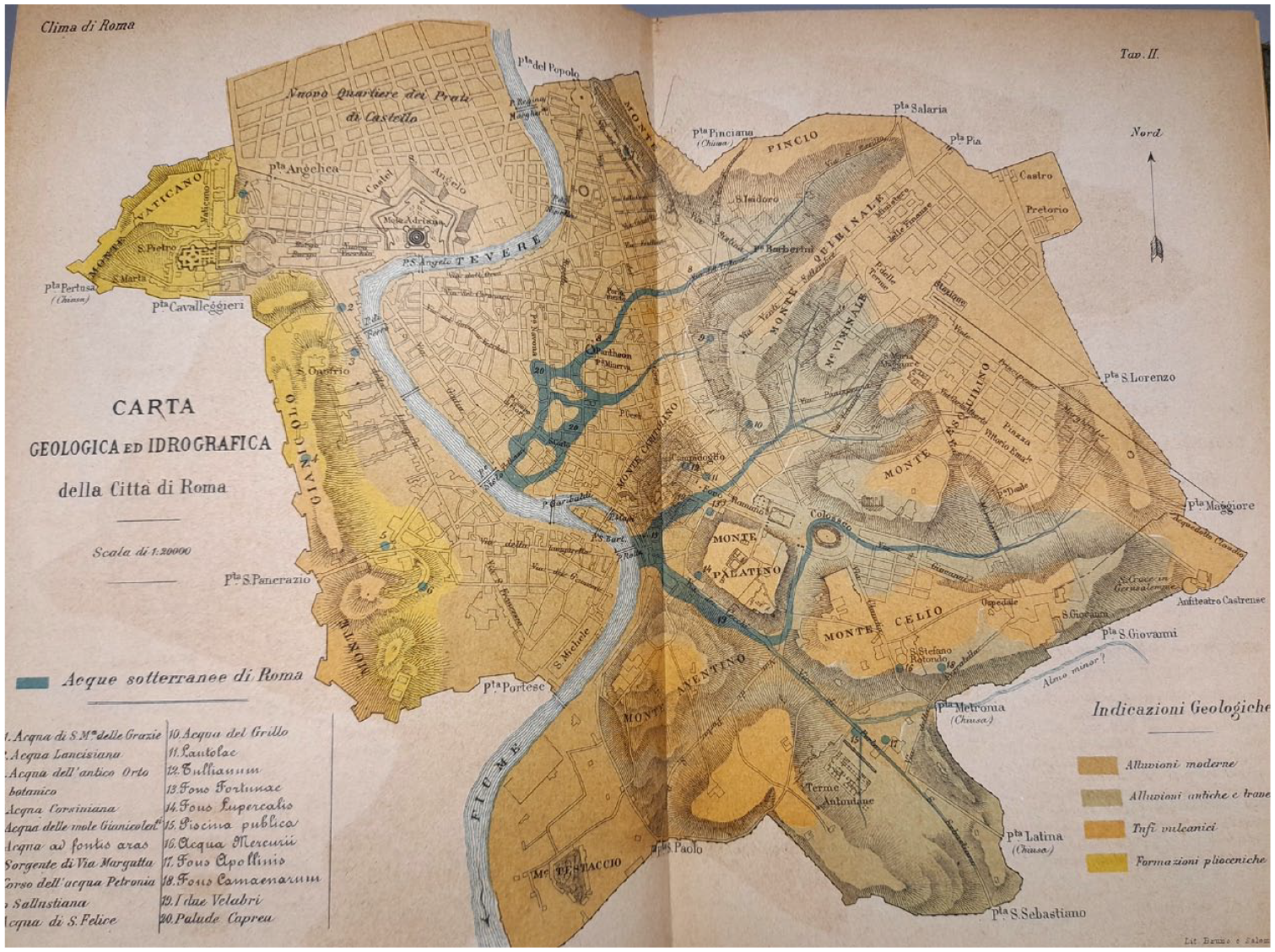
The geology and hydrology of Rome, 1886.
Four aqueducts supplied drinking water to Rome in 1870. Three of them, the Vergine, Paolo, and Felice aqueducts, were the products of the restoration of ancient Roman aqueducts, a reuse achieved under the papal regime during the sixteenth and early seventeenth centuries. 18 The modern Marcio aqueduct, which supplied pressurized water, was built by a private company in 1870. These four aqueducts deliver a daily total of 204,000 cubic meters of water. 19 The Tiber was the final recipient of all natural and artificially supplied water. The Tiber is the third longest Italian river and the second largest in terms of its basin, which covers 5 percent of the country. 20
Nineteenth-century Rome had a temperate but rainy climate. 21 Occasionally, extremely heavy rains occurred over a short period. For example, more than one-third of the rainfall in 1863, a rainy year with 943 milliliters, occurred in only fourteen days during October. 22 Hydrological, geological, and social features have made Rome a nodal point for the flow of water from central Italy to the Tyrrhenian Sea, while its weather was subject to huge seasonal variations. This overabundance of water had unwanted consequences for everyday life in the city.
Exceptional and Seasonal Floods
In December 1870, a few weeks after Italian troops conquered Rome, ending papal temporal power and making Rome the new capital of the Italian Kingdom, the Tiber flooded, causing significant damage in the low-lying area between the Pantheon, Piazza Navona, and Piazza del Popolo. 23 There was heavy rainfall between December 25 and 27 in Rome (eighty-two milliliters) and along the upper Tiber basin. On December 28, water had reached almost the first floor of buildings in the Ghetto and covered the streets and squares between the river and Via del Corso, as well as part of the luxury shops in Via dei Condotti (Figure 2; the area flooded is marked in green). 24 Consequently, the regular flow of Rome’s daily life was disrupted, many people had to leave their homes, food shortages arose, and food from neighboring cities had to be distributed. Buildings and goods were damaged, but some contemporary observers noted that even a few hours before the disaster, the Roman population did not take any measures to preserve even its most precious goods, as if floodwaters were a regular presence in Rome’s cellars and streets. 25 In fact, this was indeed the case. The Tiber flood of Christmas 1870 was one of the worst floods of the river in Rome, a disastrous event that saw streets flooded and major damages caused in the area near the river. Such flooding was not, however, unique. Between 1500 and 1900, this kind of disaster occurred five times per century. Even more significantly, the Roman population was accustomed to seasonal floods, which generally occurred twice a year, usually between October and February, when the Tiber reached its peak ordinary flow. Water flooded the city at these times not just from the riverbanks but from the sewers. 26
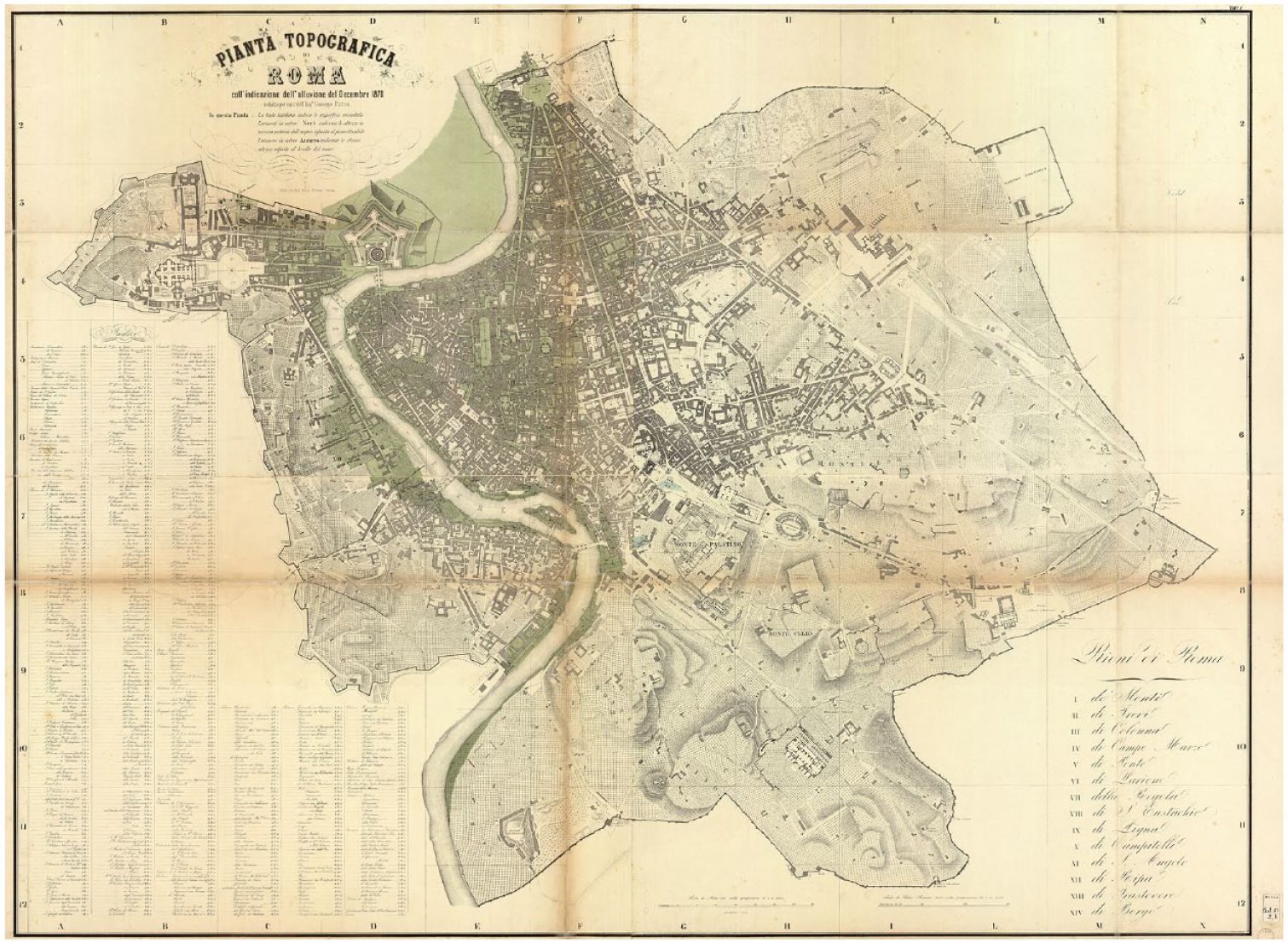
Tiber flood, December 1870.
All of Rome’s private and public sewers discharged their contents directly into the Tiber. According to nineteenth-century engineers, when the river rose, its waters leaked into the city through the sewer outlets. When this leakage occurred, rain and groundwater blocked in their journey toward the river, found their way into buildings’ cellars and ground floors. 27 Seasonal floods, as well as grandiose projects and regulation and flood protection schemes to prevent them, were common in riverine European cities in the nineteenth century. 28 In Rome, the problem was not just that the Tiber overflowed its banks but rather that its water mixed with rain, underground, surface, and run-off drinking water—these combined waters exceeded the capacity of the city’s sewers. This toxic mix characterized Rome’s seasonal floods.
In Rome, damage from seasonal floods included the pollution of infrastructure such as groundwater wells, contamination of goods, and the presence of a dirty mixture of water and worse in both streets and houses. 29 The papal governments required any affected private citizen to undertake a rapid cleansing of their property after such floods. Romans, however, usually waited until the spring to do so, given that in autumn and winter flood events were likely to recur. 30 The citizen of early modern Rome adapted their rhythm of life according to the changing of the seasons, which provided a predictable framework to arrange daily practicalities such as the maintenance of wells, cellars, and courtyards, which usually took place in April, when floods were less likely.
The old sewer system further complicated the problems facing hydraulic engineers in nineteenth-century Rome. Since the Renaissance, wastewater, sewage, and stormwater from the Roman streets had been collected in a set of underground channels. 31 It was not, however, a combined system in the modern sense of the term. Indeed, the old Roman sewers did not have an overarching plan that connected them in an organic way, and the system was the result of partial, contingent works. As a result, larger channels often emptied into smaller ones; the main sewers were small in diameter (seventy to eighty centimeters) and rectangular in cross-section; the pipes leaked at points and were in a state of disrepair; and sewers were connected to buildings by private individuals without precise standards. 32 It was common for the main sewers in the old city to overflow during an average episode of heavy rain (seven to eight milliliters). Cellars, courtyards, and ground floors in central areas such as Via del Corso and the Pantheon regularly flooded due to overflow from manhole covers. 33
With regard to the rhythm of urban life, it is easy to see how the “wet” season created challenges for Romans. This season was also a cost-generator for both private and public actors. This situation was not to be tolerated by the new Italian Kingdom, which aimed at making Rome a suitable capital for a modern state.
The Search for Permanent Regulation of the Flow of Water
On January 1, 1871, a commission of distinguished Italian engineers (the Tiber Commission) was appointed by the Minister of Public Works to study Rome’s flooding and propose a set of improvements to remedy the untamed flow of the river in the new capital. Denis Bocquet has written a detailed micro-history of the proceedings of this commission related to the conflicts between the state and the municipal technical offices. 34 Although a certain friction was evident, the work of the commission and the municipal technical offices was a unified attempt to regulate the flow of Rome’s urban water. In fact, “facilitating the circulation of people,” as well as that of air and water, was the key focus of all the engineers who led the transformation of Rome’s built environment during the late nineteenth century. 35
The Tiber Commission raised two approaches to controlling the river and seasonal flooding. The Commission president, Carlo Possenti, proposed straightening the Tiber riverbed downstream of Rome in order to increase the speed of the river’s flow, resulting in a rapid erosion, and thus deepening, of the riverbed, with a subsequent reduction of flood levels in Rome. He also proposed building two intercepting sewers, with one on each side of the river. Possenti’s project was relatively inexpensive (seven million lire) and could be implemented rapidly. 36 In contrast, engineer Raffaele Canevari drafted an ambitious plan to embank the Tiber by means of protection walls 1.5 meters higher than the level reached by waters in December 1870, build two intercepting sewers running parallel to the walls that would collect all Rome’s urban water waste and discharge it into the Tiber ten kilometers downstream of the city, and construct two large roads, one on each side. 37 The latter project was inspired by the Collecteur Gènèral d’Asnières in Paris, planned by the French engineer Belgrand in the 1850s and 1860s, and by the embankment of the Thames and London’s intercepting sewers. 38
There were significant differences, however, between Rome and its Northern European urban counterparts regarding their rivers. In Rome, seasonal fluctuation was more extreme. The target in Rome’s intercepting sewers project was that of taming nature, imposing a predictable order and continuity upon the existing disorder and unpredictability of water in the city. The project proposed by Canevari aimed to prevent any kind of inundation of Rome, not just of the extraordinary but also of the seasonal type, and to provide for the “embellishment and comfort that any Italian must want for the capital city.” 39 The project was expensive, and Possenti feared that it would take many years to complete.
After months of discussion, Canevari’s project received the endorsement of the other members of the Tiber Commission and, over the objection of Possenti, was submitted to the Minister of Public Works. 40 In 1875, the Italian Parliament approved Canevari’s project in its general outline and provided sixty million lire for its financing. 41 During the years 1880 and 1890, the main part of the work was carried out between Piazza del Popolo and Tiber Island, but the project’s completion took until 1925, and the costs doubled. 42
Throughout the years following the commencement of the project, the issue of riverbank protection walls and their actual impact on flooding remained controversial. In 1887 and again in 1892, the Royal Medical Academy of Rome expressed criticism, contending that protection walls acted as a dam that slowed the flow of underground aquifers and excess rainwater toward the river, thus worsening the conditions in cellars and on ground floors during heavy rains. 43 Canevari, together with other members of the Tiber Commission, replied that local floods were the result of local building abuses and irresponsible behavior on the part of some individuals. Once the intercepting sewers were completed, the overall outflow of urban water would be improved. 44
The intercepting sewers on both sides of the Tiber were to replace the river as the recipients of urban water. It was therefore necessary to calculate how much water they would receive and determine the size of their basins. Rome’s municipal authority appointed an Intercepting Sewers Commission to evaluate these questions. 45 The members originated from municipal technical offices, but the president came from the Civil Service. It quickly became clear to commission members that ensuring the regular outflow of underground aquifers and heavy rains presented a significant challenge. In 1875, for example, the Hydraulic Office was building a new sewer in Via del Babuino, a road connecting Piazza del Popolo with Piazza di Spagna: engineer Vescovali, who led the project and worked on the new sewer system, calculated that, in addition to wastewater and underground aquifers, the channel would have drained forty milliliters of rainwater per hour. Such heavy rains occurred at least once a year, usually in November. 46 The works for this sewer were almost complete by November 13, when a heavy rain of forty-one milliliters in forty-five minutes filled the channel, forcing the men working in it to move quickly. One person was swept 120 meters downstream. 47 It appeared that only two intercepting sewers would be insufficient to drain the entire city. The Intercepting Sewers Commission argued that the right bank would require two main sewers, while the left bank needed three. On the left bank, in particular, the commissioners proposed intercepting water from the higher and middle districts to prevent flooding in the low-lying areas (Figure 3).
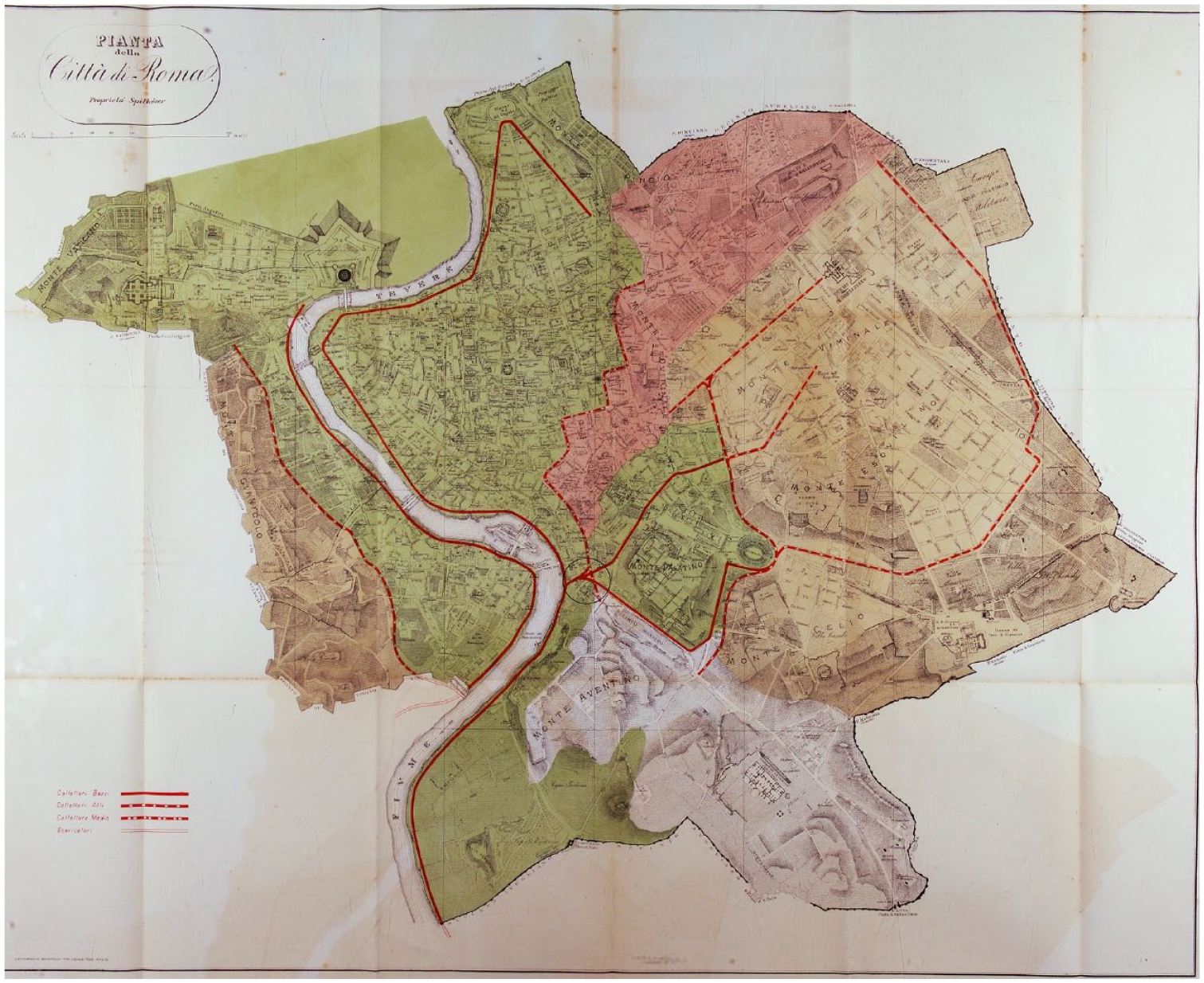
Plan of Rome’s intercepting sewers.
As recent studies on combined sewer overflow have revealed, such systems create a set of nodal points, intersections of different flows and pipes, which are likely to overflow in the case of heavy rains.
48
Piazza Bocca della Verità (indicated in Figure 3 by a black circle) on the left bank of the Tiber was one of these nodal points, where a large amount of water was conveyed toward a single outflow point. There were two main reasons for the location of this nodal point: providing enough pressure for the main intercepting sewers on the left bank to carry waste and sewage downstream; and discharging the water into a small tributary of the Tiber, the canal of Acqua Mariana, and finally into the river itself during heavy rains.
49
In principle, this was an elegant solution. In practice, it proved less so. Piazza Bocca della Verità continued to flood even during seasons with infrequent rainfall, or when the Tiber had an ordinary flow. As the architect of the Ministry of Education argued in June 1900 to the municipal Hydraulic Office, the area was flooded due to the recent rainstorms, and this is something which frequently occurs. I have already drawn the attention of the municipality on this issue before, and now I do it again, with the hope some useful measure is taken.
50
Overall, Rome’s drainage systems, flood protections, and sewer system construction did not eliminate the presence of untamed water in streets and cellars. For example, in October 1899, newspapers and shopkeepers urged the municipal authority to do something to prevent rain from turning commercial streets into streams, which negatively affected trade.
51
One newspaper asked, Have you ever seen Via del Governo Vecchio on a rainy day? Did you see the brook of rainwater that prevented people on one bank from reaching the other side of the street? The zone of the grocery shops, in particular, looks like a dock.
52
Municipal technical offices had built 113 kilometers of new sewers in the city between 1870 and 1902, more than doubling the amount existing in 1870, but something was still not working. 53 The urban growth toward the hills on the east side of the Tiber River, with its consequent soil impermeabilization, combined with the construction of new sewers, conveyed an amount of water toward the lower districts of the city that was greater than the amount in 1870. Despite the municipal offices having improved the old sewers, the movement of water in the underground tunnels was, at times, too fast resulting in flooding of streets and basements. As an engineer of the municipality put it in 1899, regarding the critical junction between Via del Tritone and Via del Corso, “Everyone knows that the Via del Corso’s sewer, during heavy rains, cannot dispose of all the water that flows into it from the Tritone’s sewer; as a result, water can only go out into the cellars.” 54 The engineers concluded, with some resignation, that works made to improve the situation had enjoyed little success, and further improvements were unlikely to take place in the foreseeable future. 55
Although Tiber floods in the last century have not caused major damage to Rome, and much work has been done to tame the river’s flow even upstream of the city, the Italian capital still has a significant amount of territory (1,135 hectares) and population (250,000) at hydrological risk, especially during heavy rains. 56 Engineers and authorities claim that this is partially due to inefficient sewer maintenance. 57 Such perspectives usually lead to the construction of new large infrastructure. Historian Jared Orsi perceives the same logic behind the Los Angeles flood protection scheme: every time flood protection fails, engineers and authorities propose building “bigger, stronger, and better structures,” which solve the problem only until a new flood proves that they are inadequate to cope with the complexity of the urban water cycle. 58 Combined sewers have an additional issue: drainage is not their only function. If water abundance was an issue in autumn/winter, lack of water was an issue in the summer with respect to removing waste efficiently and eliminating its smell. As engineers sought to make sewers operate consistently across a variety of seasons, they created new challenges.
The Dry Side of Rome’s Sewers
As Rome tended to be very wet during late autumn and winter, the fact that engineers of Rome’s Hydraulic Office complained about insufficient water flows into the sewers for disposing of its unpleasant contents may seem surprising. According to the engineering perspective of the late nineteenth century, sewers had the advantage of operating automatically, eliminating human decision, and improving the convenience and cleanliness of cities. 59 For combined sewers, however, this made it necessary to find an equilibrium in the dimensions of tunnels to comply with the twofold task of draining water and removing waste. In terms of drainage, they must be large enough to carry all water present during heavy rains, but overly large tunnels would result in inefficient removal of excreta during ordinary and dry seasons. The urban growth of the late nineteenth century complicated the matter further. In fact, Rome grew in both population and urban built environment from 1870 onward, particularly on the hills east of the Tiber. The socio-hydrological characteristics of these neighborhoods were different from those of the old neighborhoods. Aquifers were deep, there were no significant surface water bodies, drinking water could only be brought in by gravity through the Marcio aqueduct, and population density was low. Water and water users were scarce. For the new districts, the city’s public hygiene commission discussed whether cesspools or removable buckets were viable options, but in May 1871, it asserted that each part of Rome needed combined sewers. 60 The medical rationale that underpinned this choice was based on what historian Jonathan Reinarz has called “odorphobia,” associated with sanitary crises such as Asiatic cholera outbreaks. 61 Combined sewers were planned to remove human waste rapidly before it decomposed, preventing a stench.
In the new districts, municipal offices built the sewers using the most advanced technical principles of the time, giving them an ovoid cross-section, a convenient gradient, and adequate depth to drain all cellars, while their internal section was sufficient to drain heavy rains. 62 However, technical compliance was not the only element necessary for the proper operation of such a system. A substantial amount of water was required to allow the working of the system, as experiences in other European and North American cities demonstrated. 63 Water-carriage waste removal was employed, which meant using wastewater itself as a transporting medium and cleaning agent in the pipes. According to engineer Vescovali, “the combined sewer system requires rapid, continuous water circulation throughout.” 64 Otherwise, pipes would clog, with consequent putrefaction of organic matter, which gave off noxious miasmas. In addition, clogged pipes were likely to overflow in the case of sudden heavy rains.
The problem was that in Rome’s new neighborhoods, wastewater was limited and the main intercepting sewer on the left bank of the Tiber had inadequate water flow to transport all of its inconvenient contents. 65 The internal sections of some of the new sewers and household drainage gutters were large enough to convey all the water present during heavy rains, making their use during dry periods difficult. 66 In short, handling seasonal fluctuations in heavy rain created a new challenge to the operation of combined sewers in drier seasons. Several people and building companies complained about the terrible smell emanating from sewers in the new districts: they feared the outbreak of epidemic diseases, especially during the hot season. 67 As a result, they requested a solution: cleansing the sewers with water. The councilman for public health in Rome, the physician Giulio Bastianelli, also argued that, despite being technically imperfect, older sewers were safer than newer ones due to the quantity of water that cleansed them, removing bad odors. 68 Rome’s chief engineer shared his opinion. 69 Rome’s Hydraulic Office was faced with the contradiction of dealing with flooding in the city’s older districts while simultaneously introducing additional water into the new sewer system.
In 1884, the engineer Vescovali, who had studied the technical solution adopted in France, Belgium, and Britain, argued that “water can never be enough in a city; we, Sirs, must desire that an underground river of water run along the sewer network.” 70 This was not just a metaphor. Vescovali proposed the introduction of three cubic meters of water per second into Rome’s sewers from the Aniene River, a major tributary of the Tiber. Under his plan, the amount of water passing through Rome’s sewer system would increase from 204,000 to 450,000 cubic meters per day. 71 Such a large amount of water would pass through the old sewers that were already incapable of handling enough water (including mud, solid waste, and excreta) during heavy rains. Vescovali’s proposal would have exacerbated the problem. This objection was not made, however. Instead, the plan remained unimplemented because of resistance from local stakeholders who used the Aniene. 72 Between 1882 and 1889, Rome’s Hydraulic Office was forced to install water tanks throughout the new sewers, filled with water from the Marcio aqueduct, that flushed the tunnels periodically to remove solid waste. 73 This was a temporary solution, and Roman engineers hoped that the amount of water supplied to Rome’s buildings would be so abundant as to exceed the bodily necessities of the people, allowing a constant flow of unused drinking water from the buildings to the sewers. How to manage this increased input of water to Rome’s urban system during the wet season remained an open problem.
Conclusion
Despite capital investment and considerable expertise, the engineering rationale that informed the construction of a large, integrated network of combined sewers failed to regularize the flow of urban water in late-nineteenth-century Rome. As the city grew, contradictions between demands for more water, the need to dispatch it rapidly outside the urban fabric, and the removal of excreta were exacerbated. The purpose of combined sewers was to guarantee the regular and consistent functioning of modern urban life by providing reliable, efficient, and hygienic management of waste and water. Combined sewers imposed a mechanical order over two natural rhythms: the rhythm of physiological need, which evoked social anxieties regarding bodily functions, and the seasonal variation of rainfall. In the attempt to regulate these two different rhythms, engineers deployed the most sophisticated technical and regulatory tools available in order to assure the regular, daily operation of the infrastructure.
However, waste and water removal were competing imperatives, which proved difficult to reconcile. The tension inherent in the two main functions of combined sewers was amplified by Rome’s huge seasonal fluctuations. Although Roman engineers tried to adapt sewer design to local conditions, these were too varied to be incorporated successfully into an infrastructure that allowed only a limited degree of variation in the flow of water to function properly. Despite these contradictions, the engineers did not question their model. Instead, they found solutions to specific problems, such as water shortages in the summer. Yet, the interaction between local socio-environmental factors and the solution created by engineering thinking led to new, unexpected challenges for urban water management.
Looking at large infrastructure, particularly sewers, through the lens of seasonality is helpful to decenter and reassess the “success” story of urban infrastructure and the bacteriological city. This narrative is entangled with the cultural, political, and economic global hegemony of Western Europe and North America. Combined sewers and embankments represented power and prosperity for Victorian London and for Paris between the Second Empire and the Third Republic. However, they proved to be a fragile infrastructure in a different context, vulnerable to fluctuations in rainfall and unable to cope with the full range of weather conditions. As a result, in Rome, they became a source of frustration and discontent. The Roman case presented here, although responding to a unique set of historical and environmental circumstances, is illustrative of similar issues faced by many other large cities at the end of the nineteenth century, as they sought to reconcile universalizing hydraulic approaches with local realities.
Footnotes
Acknowledgements
I wish to thank Kara Schlichting and Avi Sharma for all their insightful suggestions and comments on the manuscript. Their support and encouragement have been invaluable since I first presented this work at the European Association of Urban History conference in Antwerp in September 2022.
Declaration of Conflicting Interests
The author(s) declared no potential conflicts of interest with respect to the research, authorship, and/or publication of this article.
Funding
The authors disclosed receipt of the following financial support for the research, authorship, and/or publication of this article: As part of the “The Water Cultures of Italy, 1500-1900” project, PI David Gentilcore, this research has received funding from the European Research Council (ERC) under the European Union’s Horizon 2020 research and innovation program (grant agreement no. 833834). The article reflects only the author’s view and the Agency is not responsible for any use that may be made of the information it contains.