



Abstract
Endorsement of open spaces internalized within residential blocks was an iconic concept promoted by the British garden city movement in the early twentieth century. Advancing various social goals, they were associated within a gendered ideology of domesticity, child safety, local food production, and community-centeredness. This article examines American responses through theoretical reformulation, endorsement, opposition, and uneven practical experiments situated against the maturing science of planned suburban development. Raymond Unwin included these spaces in a seminal morphological exposition, developing the concept of the quadrangle with a variety of uses including agricultural allotments, tennis courts, and playgrounds. Views of leading American community planners are canvassed, split between those promoting agricultural commons, landscaped gardens and playgrounds, and opponents citing upkeep and security concerns. Evolution of the interior park arguably peaked with Radburn which established a new iconic form and narrative of interior parks at a larger scale.
Introduction
The dust jacket of 2013’s Paradise Planned essentialises the ideal character of garden suburbs voluminously assembled inside by Robert A.M. Stern and colleagues with a bird’s eye view over the planned community of Lake Forest in Madison, Wisconsin. 1 The c1917 design for the stillborn suburb by Walter Hegemann and Elbert Peets rounds up the elements typical of site planning on ‘garden city lines’: single family housing plots arrayed in a formal layout, tree-lined streets, generous landscaping, a civic center, and a variety of open spaces. Prominent among the latter are three small parks entirely (or in one case almost entirely) surrounded by housing blocks and invisible from the street. A global assemblage of similar forms is mapped and briefly described in Stern’s sumptuous gazetteer, but their origins, evolution, and rationale are not unpacked in any analytical way. This mirrors the at-best passing coverage in the voluminous literature on the garden city movement. 2 These spaces deserve more attention as micro urban forms that have helped shaped the patterns and purposes of planned suburban development since the late nineteenth century.
Interior shared spaces in residential communities have a long and complex genealogy across centuries and cultures. 3 But from the early 1900s, their signature status in the garden city movement in Britain and worldwide forms a distinctive modern narrative. These spaces were placemaking, community-building, and social-engineering gestures that embodied the mix of aspirations that underpinned the evolving ideology of planned house-and-garden suburbs. Their function was at times ambiguous, their functionality mixed, and their eventual fate often unhappy. But many have endured to the present day, and the urban form is continually being rediscovered, invariably with blissful ignorance of their early incarnations. Most reserves were usually designated or adapted for children’s playgrounds, low-key neighborhood sporting facilities like tennis courts, and informal greenspaces to be used at the discretion of the community.
The idealism of their heyday in the first three decades of the twentieth century was soured by criticisms that maintenance and upkeep were burdensome. More conventional and visible configurations for planned neighborhood greenspaces—street frontage parks—undoubtedly prevailed. The interior spaces did not disappear altogether and were reinvented with the Radburn idea. This paper traces this genealogy in outline, with the core focusing on the early reception to the idea in suburban planning in the United States from the 1910s to the early 1930s. 4 These spaces attracted various labels such as block and inside parks, green commons, and the like. Here, we adopt the generic designation of “internal reserve” to capture their quintessential (sub)urban form.
The article has six core sections: an historical sketch of precedents and origins in connection with the early planning movement (antecedents); a description of the theoretical formulations of the concept as a community planning ideal (archetypes); a reconnaissance of the standpoints of high-profile backers (advocates); examples of implementation in some showcase projects (applications); the problematic critiques which vied with the endorsements (adversaries); and the subsequent evolution of thinking commencing in the late 1920s (adaptation). But first immediately below, we explain further our terms of engagement with the internal reserve.
Approach
The late Jon Peterson highlighted how historical studies oriented to the tangible urban environment have favored an architectural-building perspective. He likened the visual city to a mix of solids and voids, the built and the unbuilt, so recognizably represented in figure-ground analysis. At the same time, he noted that “we know much more about the solids than the voids,” the latter meaning the spaces around, between and enclosed by structures. 5 Expressed as parkland forms, historical trends linking social agency and design have been discerned by various writers, the most impactful being Galen Granz’s typology of ideal-typical park forms in American cities since the 1850s: pleasure grounds, reform park, recreation facility, open space system, and latterly the sustainable park. 6 This classification provides a broad-brush distillation at a macroscale, but as others including Peterson have cautioned, a “host of developments [is] embedded in this history.” 7 Humble internal reserves which could be justifiably claimed as crossing several of these types/phases do not get a look in.
When the lens is lowered somewhat to hover over particular design and social movements, a more fine-grained appreciation becomes possible. The garden city movement has been recognized as a distinctive paradigm in the history of open space planning yet even then treatments have tended to be broad-brush. One influential categorization recognizes “landscape-related” garden city thinking as a “comprehensive planning model” but confines its treatment to the regional scale of green fingers and green belts. Hence its “guiding principle” of “open space encircled by development” is recognized only on a metropolitan canvas. 8
Our analysis is sensitive to microhistory which reduces the scale of enquiry to people, places and phenomena, often seemingly of an inconsequential nature. By magnifying the significance of the small-scale, the intent is to not only do justice to often overlooked subjects of interest but also reveal more about broader historical processes. 9 We adopt what might be termed a “spatial microhistorical” approach to concentrate on a particular type of neglected urban void—the internal reserve—which at the same time informs a much larger set of ideas propelling planned suburban development in the twentieth century. This perspective links social practices “across singular, yet connected sites” over time. 10
In grounding historical processes spatially, nuances and richness of a kind evident in case study research foster understandings surfacing below the mainstream threshold for synoptic studies of historical process. Linked to this is a spatiality informed by the practices of urban morphology, although its under-representation of open-space studies has been attributed to their mundanity, absence of materiality, and vulnerability. 11 Yet open spaces of diverse kinds are recognized as fundamental “urban elements” enhancing livability with the usual suspects of pocket parks, playlots, and playgrounds and other variants of small neighborhood parks. 12 To such lists can be added the internal reserve.
To address the various lacunae recognized above, this study revolves around the distinctive morphology of a particular kind of enclosed open space most obviously associated with the garden city movement that reflects and thus illustrates its broader aspirations, implementation, evolution over time, contestation, stymieing, and endurance. The primary setting for this is, or what it almost inevitably trended toward, the white, middle-upper class garden suburb of single-family housing. Talen’s latter-day socio-economic mapping of nearly 300 American planned suburban communities confirms their dominant character as whiter and more exclusive than the norm and that “they have retained these distinctions over time.” 13
Our primary data derive primarily from contemporary fieldwork, but we also draw upon accessible published accounts from journals, newspapers, planning reports, and government studies documenting both the social aims projected onto internal reserves and their progress on the ground. The account commences with the codification of planning principles within the British garden city movement.
Antecedents
The transatlantic flow of planning ideas in the early twentieth century was facilitated by numerous channels such as conferences, speaking and educational tours, publications, and the reporting of roving progressives. 14 These processes of diffusion drove urban policy transfer, a major thematic focus of planning history. This played out across global pathways filtering, adapting, and rejecting ideas according to cultural and institutional context. 15 American contributions to global discourse revolved around the city beautiful, open space, and city commission governance. Continental Europe proffered an ensemble of ideas ranging across town extension planning, cultured urbanism, and reconstruction. 16 The British town planning movement put house and neighborhood as the centerpiece, or the search for what the instigator of the first town planning legislation of 1909 termed “the suburb salubrious.” 17
Garden city ideas found a receptive though not fervent market amongst both public administrators and private developers in the United States aiming to align urban reform to world’s best practice. As Rodgers observes, American urbanization produced conventional urban places “strong in private spaces but weak in public ones,” 18 while in contrast British garden cities, suburbs, and villages in particular were acclaimed as “blueprints for the resocialized city.” 19 Almost hidden in plain sight in this messaging, and certainly overshadowed by the higher-level dialogue of grand parks, parkways and park systems, was the internal reserve.
The appeal and uptake in the United States were selective and uneven but ultimately helped inspire and shape experiments in new community planning into the 1940s. 20 The radical tenets of Ebenezer Howard’s ideas were less appealing than Raymond Unwin’s innovative suggestions for more community and site-responsive suburban planning. Despite the significant governance differences between American and British approaches to producing new communities, Unwin’s life-long campaign for more homely neighborhoods with a sense of place and community, economy in road building, and attention to the public realm all struck responsive chords. In a seminal 1912 statement, Unwin compared the environmental, social, aesthetic and economic advantages of a garden city layout with conventional “by law” housing—the demonstration by which twelve houses to the acre made its way as a density benchmark into British thinking. 21 His visualization (Figure 1) with its quadrangular blocks and communal “green centers” was a compelling blow against business as usual, albeit with its tacit but ultimately far-reaching requirement for low-density city extension. 22 He would carry through these ideas with several notable projects, notably Letchworth Garden City and the Hampstead and Brentham Garden Suburbs in London.
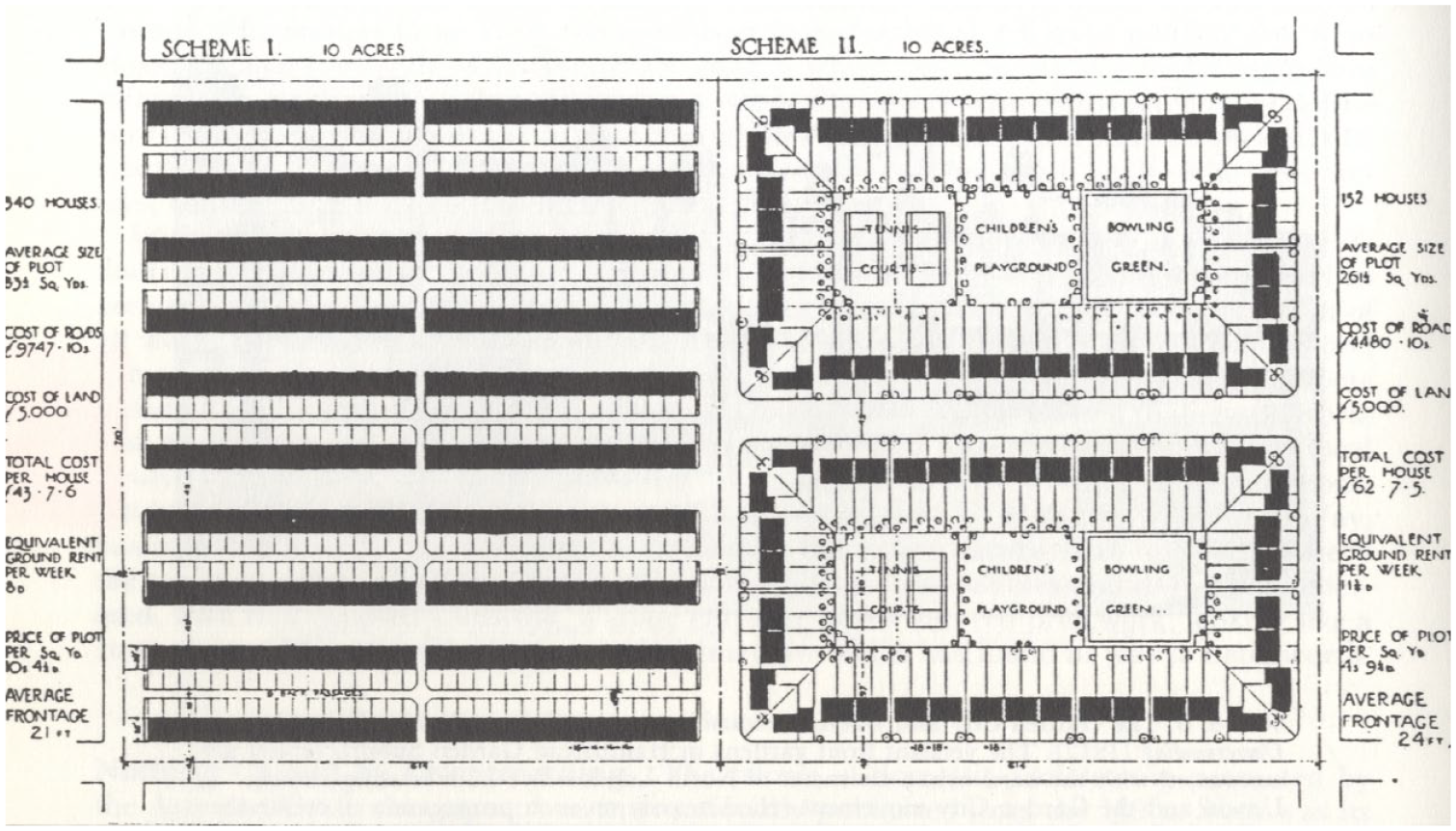
Raymond Unwin’s classic comparison of the amenity and financial advantages of garden suburb development.
The treatment of open space was complementary. U.S. achievements lay in large regional park design, parkways, park systems and well-equipped and supervised playgrounds. British thought was more orientated to civic design qualities and the fusion of town and country. Both sides recognized the rationale of a systematic hierarchical approach to park provision and the importance of small open spaces close to where people lived. At that later level, the British idea of the internal reserve was a distinctive contribution. With varying emphases in different settings, it provided a highly localized breathing and play space to reinforce the domestic ideals of slum-free life, dealt with the threat to public and especially children’s safety from increasing road traffic, adjusted platting in response to the economic drive to standardize allotment sizes and shapes, eliminated any possibility of residual wasted space, and delivered these social and environmental goals at relatively low cost.
The origins of such spaces are deep and braided, and not solely British. Housing compounds, courtyard dwellings, almshouses, medieval commons, secret gardens, and town squares all led the way, but the most influential model for city planners—both the essential idea and the morphology which anticipated Unwin’s treatise—was the organization of allotment gardens in the model industrial village of Port Sunlight, the brainchild of town planning benefactor William Lever. The modern British allotment movement accommodated a spectrum of food needs across the community. 23 Most allotments in British cities were usually scattered around residual and undevelopable land. Ebenezer Howard incorporated them in his initial formulation of the garden city as dotted around “the agricultural portions of the estate” alongside larger farms and sundry other rural and institutional activities. 24 But at Port Sunlight they were inserted with tidy geometric precision into the interior of housing clusters, creating a precursor to latter-day superblocks. This new form of perimeter suburban housing block mirrored the contemporaneous move to insert landscaped courtyards into higher-density apartment blocks. 25
Archetypes
American versions of British demonstrations of suburban planning principles incorporating internal green spaces evolved from the first wave of influence in the 1910s through to the 1930s (Figure 2). Most famously, a competition held by the City Club of Chicago in 1912 for the best way to subdivide “a typical quarter section of land in the outskirts” produced many designs featuring internal reserves. They all register the enthusiasm of progressive designers and represent the earliest highpoint of the idealistic acceptance of this spatial form, dedicated mostly to children’s play areas rather than food production spaces. The guidance offered to competitors included references to mostly garden city movement tracts with Unwin’s Nothing Gained by Overcrowding (1912) top of the list. 26
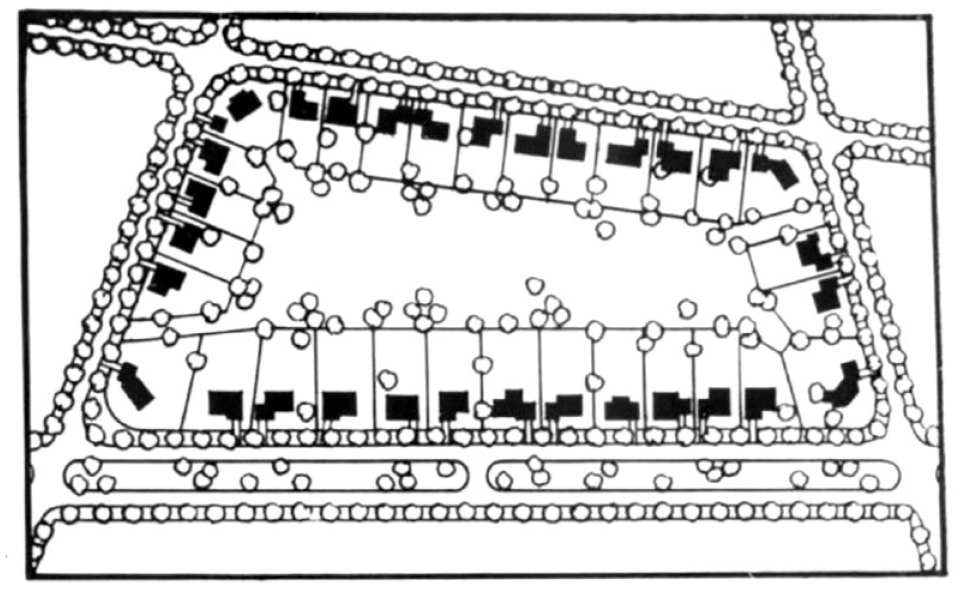
An archetypal internal reserve: “A block turned inside out.”
Internal reserves featured in the top two submissions. The judges commented on a distinctive aspect of Wilhelm Bernhard’s winning plan: One of the best features of the plan is the provision for park, playground, or garden spaces in the interior of most of the residence blocks. Thus the expenses for parking are reduced to a minimum, since there are no extra costs for paving, etc. Moreover, these private parks — private in the sense that they are restricted in their use to the families living in the surrounding residences — afford safe playgrounds for the children and encourage a neighborly spirit among the families in the block.
27
Albert Kelsey in his “aesthetic review” of the plans commented approvingly that the “restricted parks in the center of many of [the] residential blocks would undoubtedly prove exceedingly popular.”
28
Arthur Comey described a comparable element in his scheme which was awarded second prize: Important features in several blocks are the allotment gardens, where near-by residents may rent a plot whenever they feel able to carry it along, but need not be burdened with the permanent responsibility of the extra land. With the low density required (eight families per acre) such means of eking out the family income becomes especially beneficial. Should, however, the demand for these allotments be slight, the land will be almost equally valuable as local playground space.
29
Comey maintained his enthusiasm, subsequently advocating interior spaces in a 1915 report to the Detroit City Plan and Improvement Commission. Such reserves of “interior land,” he wrote, “may come to have a marked influence in improving living conditions, for, in addition to the play area for small children, provision may also be made for allotment gardens, tennis courts and other common interests.” 30 His garden suburb plan for Billerica in Massachusetts, although not fully realized, had demonstrated the practicality of this idea the year before. 31
Many other entries displayed variations of the same idea. Robert Pope executed an impressive perspective of his plan highlighting spacious block interiors to be maintained by the community “so as to be kept uniform” with this rationale: The relation of the houses in surrounding the playgrounds, which in turn are to be well hedged in, makes it possible for the housewife, working in the kitchen, to observe the small child at its play, a relief and in many cases an immeasurable economy in the nervous energy of the mother.
32
This comment illustrates a pervasive and perpetuating “taken for granted” acceptance of home and neighborhood being the domain of women in support of the commuting male breadwinner. 33 The plan by Marcia Mead, the first female architecture graduate from Columbia University, evinced the same gendered orthodoxy. It included internal reserves in every block bar four that were in essence open park, school or playground spaces with “swings, teeters, wading pool, sand piles, various apparatus for gymnasium work, and ample space for games.” The more numerous inserts accompanying “each group of houses” had “common play space, thus providing for an abundance of outdoor life and recreation.” 34 A financial assessment praised the plan’s “intensity of land development” in tandem with the systematic provision of “an interior playground.” 35
An entry by Edgar Lawrence captures the influence of its named advisor: Walter Burley Griffin, who had a connection with the City Club’s city planning committee, with one biographer-amanuensis claiming that he even “initiated” the competition.
36
With its scientifically subsectioned structure and tortuous prose, the submission is not unlike Griffin’s Report Explanatory (1913) explicating the bases of his winning plan for the federal capital city of Australia. The guiding idea was to confine commercial activity to the tract’s perimeter roads and reinforce block interiors as civic, social, and domestic space: As the internal attractions will have to compete with those of the external city, they must be so organized as to raise the popular standards and minimize the evil influences found among a multitude of time-killing pursuits.
37
To that end, an elaborate structure of internal reserves was proposed: an outer ring of large “neighborhood units” reserved for playing fields impossible to find in the “built-up city” and an inner ring of smaller spaces dedicated to “gymnasium courts” also adaptable to different sports and activities.
Landscape architect G.C. Cone used the competition to promote new forms of street layout. Driving this exploration was the view that it was backyards proximate to alleys which were unsafe for mothers and children and not front yards—apart from the “actual physical dangers of the traffic street.” The compromise was a variation on the internal reserve detailed in a plan from landscape designer O.C. Simonds made in connection with an industrial garden subdivision in Beloit, Wisconsin. It depicts a suburban block with an internal greensward offering safe and pleasant opportunities for both active and passive leisure, occasional access for delivery vehicles, and varied outlooks for houses over “the enclosed park.” 38
These ideal schemes paved the way for further codification of principles. In 1927, while working on the Regional Plan of New York, planning consultant Robert Whitten outlined a case for the cost effectiveness of a profusion of small greens in enhancing neighborhood “attractiveness and amenity” rather than a distant larger park. 39 But the most definitive imprimatur came in Clarence Perry’s treatise on the neighborhood unit as a residential planning instrument published in the Regional Plan two years later. 40 Perry did not imagine government would prescribe internal reserves as necessary features, but that their inherent logic and value would become a go-to for private developers. 41 Perry was director of recreation for the Russell Sage Foundation—the originator of Forest Hills Gardens on Long Island—for almost thirty years. He moved to Forest Hills in 1912 and would later claim that its “delightfulness of life . . . suggested many features of the ideal neighborhood unit.” 42
For Perry, “garden spaces” were “features of an ideal suburban community,” and child welfare required schools and playgrounds to be sited “in order that children will not have to cross main traffic arterials to reach them.”
43
Perry reviews two main types of “interior-block play space”: the preplanned version in larger garden suburb blocks and the possibility of retrofitting them into conventional city blocks. The latter delivered “a sense of spaciousness and vistas more attractive than those afforded by the ordinary backyard” and were practical and sensible in higher density communities. The former configuration “enclosing a specialized playground in the middle of a block large enough to accommodate it . . . has much to commend it”: The chief advantage is probably economic. By cutting down the amount of street frontage which is not occupied by structures there is a proportionate saving in the cost of the paving, sewers, and other public improvements usually carried by streets. Such a playfield should be large enough to accommodate properly baseball, football or tennis, or the particular activities for which it is intended. Access to it can be had by means of alleys inserted between the surrounding houses. Its edges should be planted with trees and vines trained on lattices so as to minimize the noise of the players which might disturb the residents. In the regular neighborhood there would need to be only three or four blocks laid out in this fashion.
44
This underlines the case for internal reserves in financial terms, an obligatory strategy for selling city planning innovations to doubting developers and government agencies. A decade later alongside his rejection of the street as a public playground and the risk of juvenile delinquency stemming from lack of local park spaces, Perry elaborated the sound business case when “a few feet taken off from the depth of a number of lots and put together in a playground [serves] all the owners [and] produces a valuable community asset without appreciable loss to anyone.” 45
In the early 1930s, the state of the art of suburban planning featured in several important publications revealing indebtedness to the garden city movement and featuring internal reserves in a variety of morphological permutations. In 1931, Whitten, who had made his reputation as a land economist, calculated that provision of “interior-block play-parks” could cost nothing given the money saved on street improvements. He regarded them as effective for “common use” in low- to medium-income areas with smaller house blocks and deployed both for recreation and siting of community car garages. A comparison of different configurations culminated in a neighborhood unit organized around internal reserves (Figure 3). 46
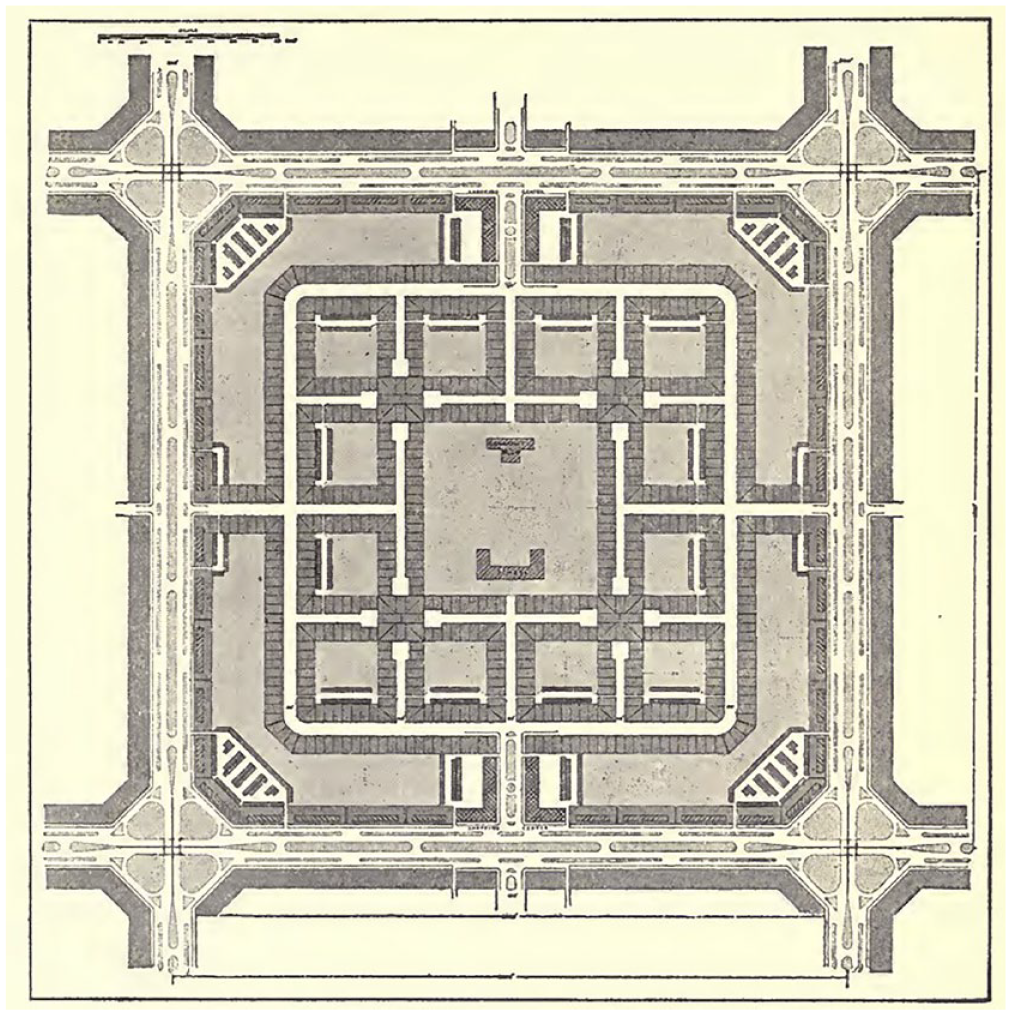
A self-contained neighborhood structured around interior-block open spaces, with a large central park accommodating a school and community building.
In 1932, Herbert Hoover’s “presidential conference” examining home building was also concerned with regular playground distribution, amongst other desirable features for affordable housing estates, and the internal reserve was countenanced by its Committee on Subdivision Layout headed by leading planning consultant Harland Bartholomew: Everybody agrees that parks and playgrounds are essential elements in city-building. No subdivision operation is complete until the subdivider has provided, or arranged for, adequate park and play areas within, or accessible to, the lots which he is selling. It is definitely part of a subdivision project to determine that park and play space will in some manner, with certainty, be made available. These areas, as with the subdivision itself, should be designed to fit into the whole recreation plan and program of the city and the neighborhood. . . It is not always necessary to surround parks and playgrounds with streets; in fact, there is an advantage either in economy or in practical use in having lots back upon such areas.
47
This suggestion was developed further by the Committee on Landscape Planning and Planting chaired by Louise Morgan, wife of the grandson of blueblood financier J. Pierpont Morgan, in discussing provision of open spaces in residential neighborhoods: Interiors of blocks surrounded by separate homes or groups of homes are being recognized more and more as important sources of beauty and livableness. Houses that for generations have been turned as a matter of course to the street are now being reversed and are looking into the backyards and into the middle of the blocks. Blocks of various sizes offer opportunity for interior block development for community use.
48
A series of almost psychedelic subdivision layouts illustrating cost-effective alternatives to the gridiron all featured numerous internal reserves. These were drafted by Walter Baumgarten, a graduate research student and later Sheldon Traveling Fellow with Harvard’s School of City Planning.
In 1934, Scottish-born Thomas Adams, who had been involved in early garden city machinations at Letchworth Garden City and subsequently planning in Canada and the United States, and had partnered with Whitten on Neighborhoods of Small Homes (1931), published his own treatise, The Design of Residential Areas. 49 Adams reinforced the theme that conventional subdivisions involved costly and “unnecessary street area that could be more profitably used for recreational space.” He was mindful that the “usual criticism of interior playgrounds is that of the expense of supervision” but saw a trade-off in the cost savings “from the eliminated streets.” 50 Again, alternative patterns were presented to explore the fiscal and spatial implications, but utterly prosaic when compared to Baumgarten’s kaleidoscopic graphics a few years earlier. With the Great Depression slowing land and housing construction through the 1930s, none of these theoretical models would truly resonate into the private property market.
Advocates
Good things about internal reserves were nevertheless communicated in words and deeds consistently if intermittently from the 1910s into the 1920s. Beyond the theoreticians already canvassed, several protagonists stand out. We start with the leading rhetorician: Charles Mulford Robinson. Robinson was arguably the most dedicated follower and one of the few commentators to explicitly praise the British allotment form. With patrician confidence, he asserted that because most working class men would not readily have the energy to maintain a private garden space at home, the option of tending a small allotment seemed desirable: By preserving for allotments a strip in the middle of certain blocks, behind the houses, it is possible to make the backyards of those blocks as small as the usual city-bred worker could desire or find to his advantage. Then the man who wishes more garden than the backyard offers can have it, by means of an allotment garden. And it will be as near his house as if it had not been set off from his backyard. He can have as much as he can pay for, or profitably work, and no one is compelled to pay for space he does not want. To men whose employment is likely to be irregular, such provision may be of especial value.
51
Active park spaces with bowling greens and quoit grounds as well as playgrounds were two other options through the same pooling of lands enabled by reducing the length of house blocks: There may be gained a middle area of sufficient extent to be, in a region where it is necessary for the community to furnish the recreative facilities, of real value to the people who live on the lots which enclose it. Some other aspects of such action further commend it. In such a section, an area of this kind is almost ideally located for a playground for small children. Not only are the children kept off the street, but in their play they are beyond the gaze of passing strangers and idlers. They are perfectly safe, and are within constant sight and call of the mothers who, in the humble homes, are more likely during the day to be at the back of the house than in the front rooms . . . And when the little children are through with it, how good a place it may offer through the long summer evenings for tired workers to sit out-of-doors in neighborly intercourse!
52
Robinson proved less enthusiastic in incorporating such features in his own city plans, perhaps because of his rudimentary design skills and qualitative approach stressing retention of existing local features.
Other advocates had the opportunities to translate their ideals into practical projects. Walter Burley and Marion Mahony Griffin, life and professional partners from when they met as assistants in Frank Lloyd Wright’s Oak Park studio, were internal reserve advocates of sustained enthusiasm. This commenced around late 1911 perhaps as they contemplated the detail of “domestic communities” for their entry in the Australian federal capital design competition and elaborated around the same time in Edgar Lawrence’s City Club competition entry. The guiding concept was identical: that “family activities may best be directed internally toward the geographical centers of their groups . . . assembled centripetally for effective control and co-operation.” This translated into a spectrum of land use possibilities in “the innermost unit block” including parks, horticultural gardens, even “sanitoria” and “residence hotels” all safely tucked away with “minimum of interference with the traffic of the city.” 53
The childless Griffins consistently placed great store in securing “physical health, mental stimulus and moral enlightenment” for children, as Marion expanded upon in The Magic of America, a voluminous typescript assembled after Walter’s death in 1937. The interior park enabled them to play safely “under the eye of every mother.” Moreover “no street has to be crossed by the children in reaching it,” and: . . .. Since these playgrounds have no street frontage and have not increased the lengths of the streets and service systems, these playgrounds have cost nothing and the money saved by the decreased pavement required can be used for the development and upkeep of these parks.
54
Benjamin McArthur writes of the emergence of the open-air playground in American cities in the late nineteenth century and the growing recognition of the necessity, firstly, of fresh air and sunlight for children and, secondly, that they be kept away from city traffic. 55 The internal reserve addressed both issues perfectly. In their Australian practice, the Griffins would develop a further rationale: the conservation and regeneration of the natural environment.
Into the 1920s, other protagonists from different disciplines pressed their claims for interior block spaces, writing about them in national journals. Landscape architect Ezra Stiles felt that pooling the excess “wasted space” from long lots for “community utilization” would “go a long way toward stimulating a close community interest” and “afford a place of recreation and privacy for young and old” especially where larger parks were inaccessible. 56 City planner Jacob Crane felt that interior parks “maintained cooperatively by the property owners in any given block” were also a logical response to the increasing noise and danger of residential streets. 57 Consulting engineer O.H. Koch endorsed the “greenway parks” in the eponymous neighborhood in Dallas as linear community spaces parallel to the streets and “developed as parks with trees, shrubs, and lawns.” 58
Applications
Despite receiving the backing of leading planning figures over two decades, the internal reserve idea was not universally embraced unlike other garden city elements which were more universally welcomed such as house-and-garden development, distinctive geometric layouts, public community focal points, and aesthetic open spaces contributing to the streetscape. However, the landscape legacy of internal reserves still speaks to the idealism of the early city planning movement, and they are featured in some of the best-known community projects of the early twentieth century.
While the open spaces of Forest Hills Gardens on Long Island might be attributed to Port Sunlight’s or Hampstead Garden Suburb’s influence, they also exemplify the concept’s recalibration. Susan Klaus’ A Modern Arcadia relays a contemporary newspaper report in which the new suburb was heralded as the first American residential experiment “based on the principles of the English garden city” that had produced “small floral paradises” for factory workers. 59 The New York Times described it as one of a few American contributions to the “industrial” and “garden” suburbs promoting equality between classes. 60
The Russell Sage Foundation engaged Frederick Law Olmsted Jr. to prepare the ground plan working alongside architect Grosvenor Atterbury. In 1908, Olmsted made a study tour of Europe visiting Port Sunlight and Letchworth. On his return, he marked out six blocks on the new site “with interior parks accessible through rear garden gates or by a private pedestrian lane, intended for the exclusive use of that block’s homeowners.” 61 Lot holders administered the interior land through corporations, and Olmsted saw a range of potential uses for the spaces: tennis courts, passive recreation, children’s play areas, or gardens. Klaus describes Olmsted’s conception of a system whereby lot holders might lease plots between themselves as convenience dictated. “Further,” she says, “he designed these nonstandard blocks so that an extra street could be opened through the middle of the block, creating additional building lots, in the event that future residents lost interest in keeping up the private park.” 62
Klaus opines that the interior parks were a failure in terms of engaging resident interest. Like Unwin’s Hampstead, Forest Hills Gardens was such a commercial success that the original intention to create an uplift suburb for lower-waged workers was quickly quelled by price inflation. Yet Forest Hills Gardens lives up to most of its promises (Figure 4). Olmsted Jr. was rare amongst garden suburb planners: anticipating internal reserves to be backyard extensions used solely by residents on each block, he did not supply access lanes to surrounding streets, but this only increased exclusivity within the suburb and drastically shrunk and restricted the notion of community.
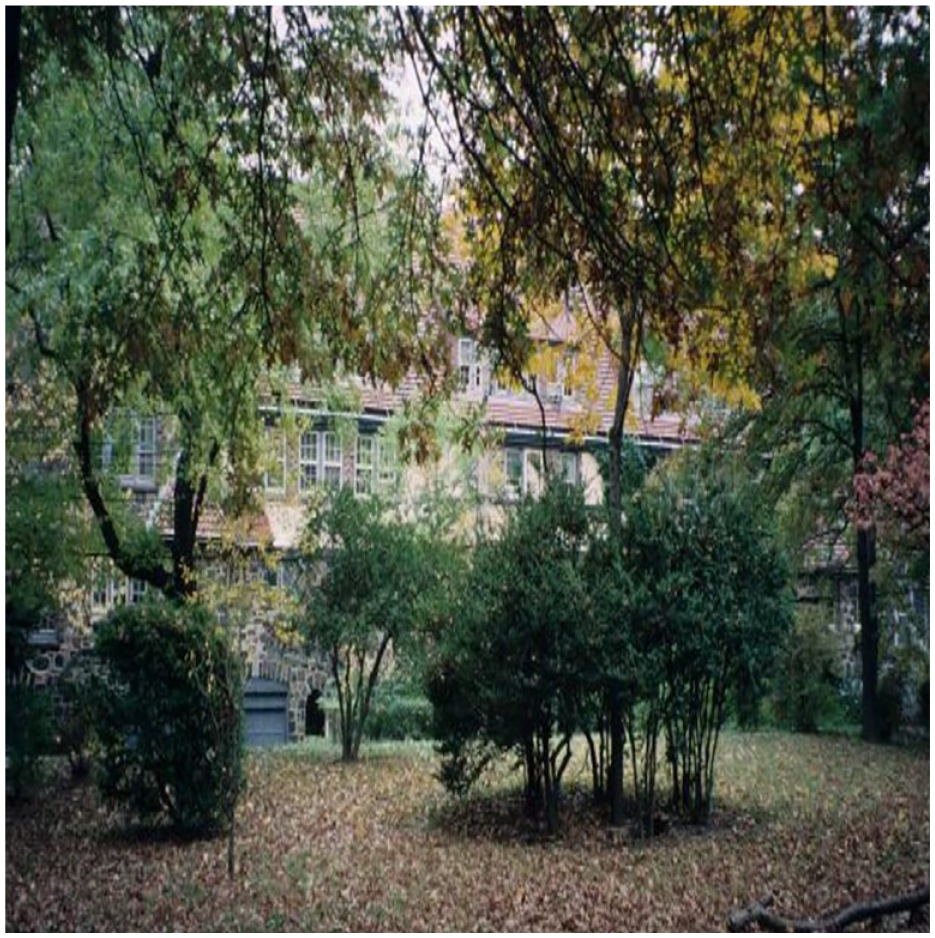
A surviving private communal park in Forest Hills Gardens.
Elsewhere in New York, through a cognate but very different process, older brownstone blocks such as Turtle Bay Gardens on Manhattan’s East Side, were being reconfigured in the 1920s to share an “interstreet garden or central parkway.” The result was described as “Aladdinlike in its rare combination of color planting and landscape architecture.” 63 This idea for “attractive co-operative yards” had been previewed at a planning exhibition of the City Club of New York in 1916. 64
The survival of internal reserves at Forest Hills Gardens is undoubtedly due as much to the difficulty inherent in exploiting them for other uses, and their co-owned status, as any intrinsic value. Many other spaces fared even less well. Some of the estates planned for the Emergency Fleet Corporation at the end of World War One were “imbued with the ‘Garden City Idea’” and featured communal block spaces, notably Yorkship Village in Camden, New Jersey, designed by Electus Litchfield and nearby Noreg Village by Philadelphia architects Bissell and Sinkler (Figure 5). 65 Here the property ethic which drove most projects was elevated to a nation and character-building enterprise; in Litchfield’s words: “these workmen’s towns . . . are a God-given opportunity for combatting Bolshevism.” 66 Virtually all reserves have been erased through later road and infill development. Walter Burley Griffin translated his and Marion’s idealism for communal spaces in residential blocks into a succession of privately commissioned community plans including Trier Center in Winnetka; Rogers Park, Chicago; Ridge Triangles in Evanston; the Kugler Tract in Baton Rouge; and Mossmain in Montana. 67 Relocating to Australia in 1914, Griffin was unable to provide any stewardship of these projects and most of them languished or failed.
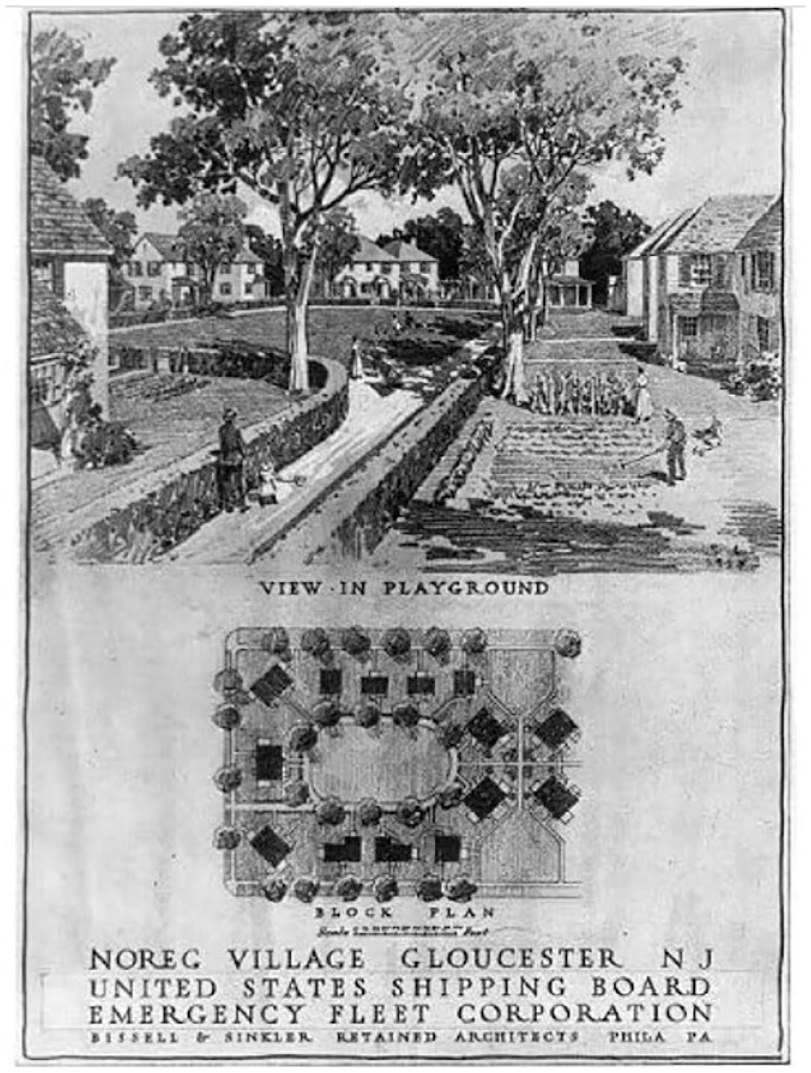
Block plan and artist’s impression of a proposed internal playground in Noreg Village, New Jersey by the U.S. Shipping Board Emergency Fleet Corporation.
John Nolen’s reserves had a little more luck. As a leading city planning consultant, Nolen had first-hand knowledge of British and continental practice from his frequent transatlantic crossings. In 1911, he met Unwin and also Howard for the first time, gaining a deep appreciation in Letchworth and Hampstead Garden Suburb of innovative housing and public space configurations including the contribution of “intimate greens and small parks” to the overall scene. 68 This led him to incorporate internal reserves in his designs where the client brief, scale and topography permitted. He would emphasize their role as children’s play spaces, but there were occasional insertions of allotment gardens, a direct genuflection to British garden cities. 69
From Union Park Gardens (1918) in Wilmington onward, Nolen projects without internal reserves were rare. In many cases, they are at the furthermost point of a plan from the often elaborate city centers and more expansive regional parks, presumably to give some green space access to lower-income families living on the periphery. In his plan for Kingsport, Tennessee for instance, Nolen places two small internal reserves at the northwestern edge of the design. In his plan for Mariemont, the “exemplar” development commissioned by Mary Emery outside Cincinnati in much the same way Olivia Sage initiated Forest Hills Gardens, the two internal reserves—today known as Ann Buntin Becker Park and Patriots Park—were similarly located. These were labeled “allotment gardens” in Nolen’s 1921 plan and brought what contemporary promotion described as a “touch of country” to an apartment precinct providing affordable housing. 70 This was another expression of class-conscious spatial planning and was reportedly welcomed by tenants for some years 71 until the 20 × 40 feet individual plots reverted to open lawns in the mid-1930s. 72 Reflecting the demands of the times, the Mariemont Company built a communal car garage building in what is now Ann Buntin Becker Park (Figure 6).
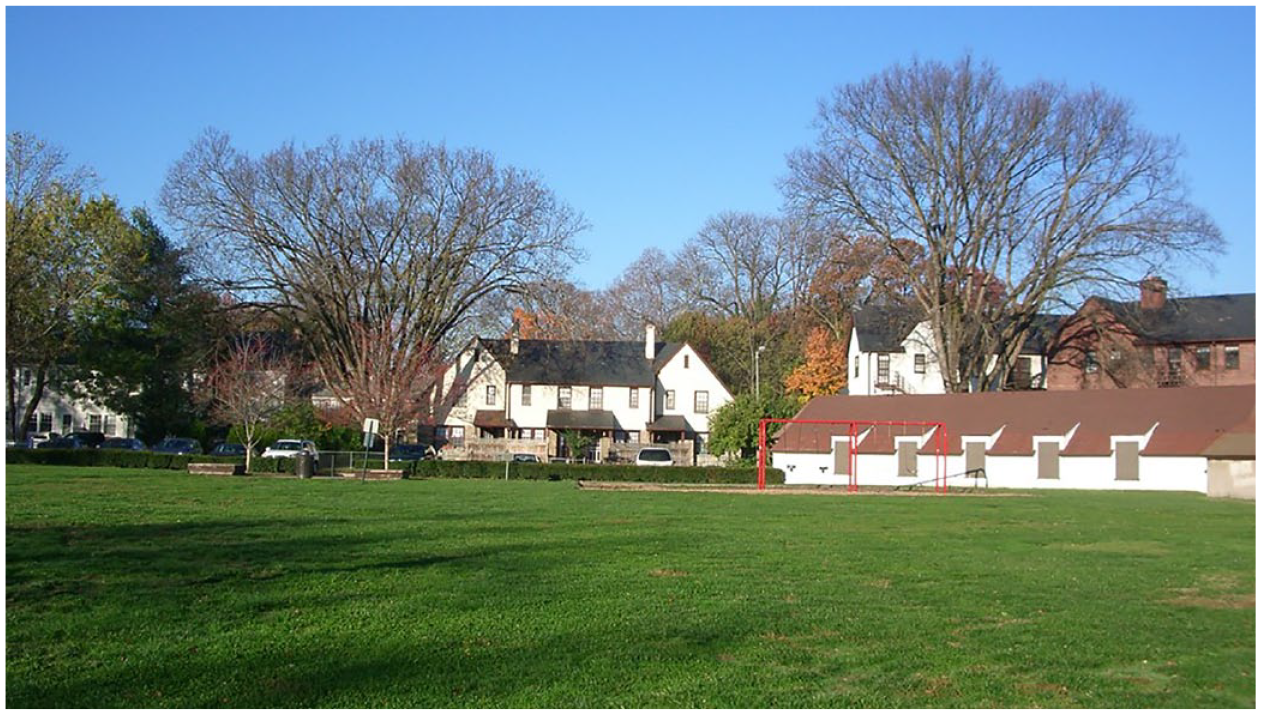
Former interior allotment garden turned informal greenspace with playground and communal garage structure in Mariemont, Ohio.
Nolen spent much of the early-to-mid 1920s engaged in elaborate town plans and extensive resort schemes in Florida when the state’s holiday economy was experiencing a growth spurt. The year 1925 was busy for Nolen’s St Petersburg office. His many community and mostly upmarket plans had elaborate open-space systems featuring internal reserves. Venice, launched in 1926, was no more conceptually ambitious than the other large speculative developments but more ardently promoted. Nolen’s plan incorporated six in various locations, with two near the golf club center labeled as car parks. With some concession to equity, the nearby Harlem Village estate for African-American servants working in Venice also included semi-enclosed open spaces. 73
Adversaries
While small internal reserves were an established if not universal feature of many planned communities into the 1920s, especially when endorsed by some of the leaders of the city planning profession, there were reservations, even amongst some of the proponents. These criticisms would prove telling for a feature that broke significantly from orthodoxy.
The multiplicity of hidden spaces in so many of the designs submitted to the 1912 City Club of Chicago competition worried some commentators. Albert Kelsey, for example, while enamored of Wilhelm Bernhard’s winning scheme with its ample provision for private parks, critiqued other schemes with the same feature. Louis Boynton’s dedication of public space seemed “out of all proportion to what is left for private use” while the Lawrence-Griffin scheme was just misguided: I do not . . . like the way his playfields and courts are detached, hidden and adorned with back yards when they might so easily have contributed to the openness of his plan, without losing much in privacy.
74
An holistic critique came from Romanian-born sociologist Carol Aronovici, who had taken an interest in housing and other urban planning issues since relocating to the United States at the turn of the century.
75
He felt that the predilection for private parks with their “alluring quality” was diminished as a response to the automobile’s rise because of moves toward more effective road planning protecting neighborhood units overall. Moreover, the profusion of such spaces created a “practical impossibility of providing adequate supervision.”
76
He was also unimpressed by allotment gardens as unsuitable in a “highly urbanized community with greatly diversified needs, social make-up, and high land values.” Overall, Aronovici was troubled by the translation of the internal reserve to the American urban environment: The whole question of “shut-in spaces,” whether they be parks, playgrounds or allotment gardens, is one that should be carefully weighed. The line of cleavage between public and private ownership, between public and private maintenance, should be sharply drawn. While I am heartily in favor of extending the bounds of public ownership, I am opposed to common ownership that is not coupled with public responsibility; it is bound to endanger its efficiency in serving the best interests of the people.
77
Even early adherents were questioning their feasibility. Stocktaking his own work in J.C. Nichols’ famed Country Club District in Kansas City, landscape architect Herbert Hare declared the results as not very encouraging with interior spaces mostly reverting “to trash heaps and weed patches” although in a few instances they had been transformed into “vegetable gardens either by common consent or through the initiative of some individual.” 78 His new working rule was to make a few deeper lots rather than accommodate common land. Bit by bit, internal reserves would disappear and all but one was eliminated by replatting within two decades. 79
By the late 1920s, the internal reserve idea may not have fallen totally from favor but there were enough concerns to cement the eclipse of its heyday. Even an enthusiast like Clarence Perry sounded a note of caution: such spaces, he said, however well-planned, require “supervision and maintenance” for “successful operation and up-keep, and it is assumed that an organization adequate for the purpose would be in existence.”
80
Similarly, amidst all his fervor for internal reserves as the key building block of the new American neighborhood, Robert Whitten acknowledged that the record of upkeep of such hidden spaces was problematic, meaning that “in some cases they are considered a handicap and liability rather than an asset to the neighborhood.”
81
Planning academic Karl Lohmann came to the same conclusion in his authoritative textbook published in 1931: The development of internal areas and open spaces set aside in the middle of blocks is ideal in purpose and is becoming more popular. Unless, however, proper supervision and control are exercised and maintenance is afforded by the municipality, the subdivision, or the block concerned . . . these areas will soon denigrate into centers of unsightliness.
82
Adaptation
John Nolen’s 1924 scheme for Belleair in Florida introduced a novel adaptation of the internal reserve idea. This was a scale uplift transforming small pocket reserves into interconnected linear fairways of a golf course but still framed by residential blocks and islands. 83 This was a step toward rethinking the relationships between houses, streets, and open spaces.
In that evolution, Sunnyside Gardens and Radburn in the greater New York region were even more important breakthroughs. While acknowledging indebtedness to British garden city ideas, they also undermined the hegemony of the garden suburb internal reserve and offered a vision to transcend its recognized limitations. The champions in this instance were Clarence Stein and Henry Wright, who had visited Britain in 1924 to inspect the products of the garden city movement. We focus here on Stein whose articulation of open space was central to his community design thinking at all scales.
84
His interest in local internal reserve-styled planning was a combination of his socially progressive ideals and his belief in the power of planning suburban neighborhoods to improve lives for children and families. As early as 1917, he answered his own question “how can we bring the country into the city?” with a solution that he committed to for decades: We can do so to a limited extent by increasing the number of parks and playgrounds; by using our backyards as common playgrounds; by lining our residential streets with trees, decreasing the paved portion of the road, and using the rest for playgrounds.
85
Sunnyside Gardens (1924) in Queens, New York was the breakthrough for both Stein and Wright, also an experimenter in subdivision layout. It represented both an advance in low-rise multifamily garden apartment design and a critical intermediate step toward the Radburn idea. 86 Stein and Wright came to their professional peak with the rising tide of automobilism, evident in many western nations but dramatically space-shaping in the United States. They sought a new ideal of suburban development less beholden to the needs and wants of the motor vehicle. Working with developer Alexander Bing, Sunnyside Gardens was their open air laboratory. The rectilinear shape of the city blocks was nonnegotiable but behind the residences which lined the streets they created open spaces for passive recreation and children’s play. While many disappeared in the 1960s when the original restrictive covenants expired, today the different sizes and shapes of the surviving interior spaces—some reduced almost to laneways with, nevertheless, low fences, and others open park areas—give each block a distinctive character. Nearby, Stein’s Phipps Garden Apartments (1931) captured the more urban solution to enclosed greenspace within a higher rise perimeter block.
Radburn in New Jersey, for which Raymond Unwin was a consultant to Bing’s City Housing Corporation, was more obviously suburban. Billed as a “garden city for the motor age” by Stuart Chase 87 , Radburn was much curtailed to Stein’s dismay by the Depression, but still had a remarkable global impact as much misunderstood and misrepresented as replicated. Along with the cul-de-sacs and double-fronted houses, the defining feature of the original plan was what Lewis Mumford described as a “continuous green core” serving as both “park and pedestrian promenade.” 88 It was a radical rethink of the British-inspired garden suburbs with their traditional small interior parks and allotments yet was descendant from the same ideals to create a safe, convivial and green suburban oasis through advanced community planning. Moreover, it captured more famously than anywhere else a critical transition toward superblocks with interior open space courts and networks that become a fixture of many large-scale urban renewal and public housing projects. 89
Conclusion
The internal reserve takes its place within a wider genealogy of open space typologies, most directly as a micro-scale element of the garden city movement’s promotion of the beneficence of open space and the public realm. The rationale and form of these distinctive spaces migrated internationally with the diffusion of modern town and community planning thought. In theoretical terms, they channeled the multiple benefits of open space at a very localized level. In practice, they were almost always experimental and often suffered from either an identity crisis (what to do with them) or a failure of governance (who was responsible for them). This shortfall between promise and performance is not atypical of many planning innovations.
In the United States, the British-inflected agricultural connotations faltered early, barely surviving the Atlantic crossing. The internal planned allotment was not embraced across the class spectrum as it was in Britain and on the continent. The advocacy of planning spokespersons such as Robinson, Comey, and Nolen could not convince housing authorities, land developers, or the broader public on the relevance of the Port Sunlight model to the American garden suburb. “More generic recreational and open spaces” were preferred. 90 The allotment had more direct connotations to agricultural smallholdings and farm workers’ plots. 91 The rise of community gardens was driven by other social forces. 92
The internal park as open space still seemed for many progressive planners to offer early answers for building community spirit within a conservative philosophy of social relations. As documented, some of the leading names in the emerging city planning profession were enthusiastic. From around 1910 to 1930, these micro-spaces were part of the discretionary planning toolkit but fell from favor when the community began to lose interest given the maintenance and management involved. While conventional parks were welcome, there was also likely a prejudicial perception of hidden spaces that so obviously demanded a cooperative response. Historian Barry Lewis captured this dilemma at Sunnyside Gardens: “communally held property never really struck a chord in this country.” 93 The internal reserve was the hard way to deliver neighborhood parks. A very different culture regarding the space standards of urban life perhaps saw perception of “the sheer abundance of land” in most American cities working against their widespread adoption. 94
While a variety of internal reserve formulations responsive to a changing mix of economic, social and environmental considerations was evident even before the 1930s, the unifying debt to the garden city movement was captured in their characteristic triangular and lozenge shapes tucked discreetly behind a perimeter of suburban family dwellings. That form would certainly persist into the era following World War Two, though often as a surveyor’s solution to avoid awkwardly sized and shaped house blocks or as a quick fix to meet mandated open-space standards rather than in response to the earlier placemaking and community-forming idealism. In the 1960s, their legacy form as “interior enclaves” within the superblocks of urban renewal projects in the Chatham and Baldwin Hills Villages lineage was linked by Jane Jacobs to garden city planners’ “hatred of the street.” She saw them as boring spaces of child socialization compared to the liveliness and learnings from street life, a total reversal of prewar planning ideology. 95 Moreover with most surrounding dwellings orientated away from the rear, they were left “without easy surveillance and access.” 96 The later objection was perhaps more telling in the 1970s with Oscar Newman’s concern with public safety in spaces that were “unassigned.” 97
The Radburn scheme of larger-scale interior parks may have stolen their thunder from the late 1920s, but it also transmuted their spatial form and social logic to a larger scale with a new generation of both proponents (like William H. Whyte in conservation mode) and critics (such as Kevin Lynch wary of stereotypical planning). 98 Radburn was the major conceptual breakthrough in America, a typically more expansive spatial rethinking that generates its own distinct narrative beyond the scope of this article. 99
So there was an early and enduring ambivalence with the internal park caught between an appealing logic in design and idealistic terms versus caution and pragmatism when it came to sustainable implementation and operation. Many of these micro spaces have the right mix of amenity, accessibility, and activation that works and their ongoing reinvention in new developments testifies to a continuing validation in the right setting. Rediscovery through better understanding their history and function can also help enormously. Most of John Nolen’s reserves in Venice were neglected for decades but in recent years several have been rehabilitated as “Nolen Greens” honoring their planner in a local authority-citizen partnership. The largest of them has been reactivated through clearance of debris and waste, removal of a private carport built unthinkingly (and illegally) across a public accessway, elimination of invasive species, and bio-engineering to solve a stormwater problem. 100 They are now celebrated as part of the city’s planning history heritage.
Footnotes
Acknowledgements
The paper builds on three unpublished papers presented to conferences of the Society for American City and Regional Planning History (Philadelphia 2001, Baltimore 2011, and Harlem 2022). We thank the anonymous referees for their constructive critiques of the original manuscript along with the many guides and informants over more than two decades who have contributed so much to our appreciation of garden suburb reserves as a distinctive open space typology.
Declaration of Conflicting Interests
The author(s) declared no potential conflicts of interest with respect to the research, authorship, and/or publication of this article.
Funding
The author(s) received no financial support for the research, authorship, and/or publication of this article.
