



Abstract
“Mother went in to work tonight, how I hate her on Sunday work!,” wrote fourteen years old Kathleen Biddlecombe in her diary, on Sunday, January 13, 1918. Kathleen and her family lived on 6 Cobbett Road, London, in Well Hall Garden Suburb—mostly known today as Progress Estate. Built between January and December 1915, in the first year of the First World War, the estate provided some 1,086 houses and 212 flats for the munition workers of the nearby Royal Arsenal factory in Woolwich. This article examines the First World War history of this housing project, by focusing on the diary of young Kathleen. Using the works of Henri Lefebvre and Michel de Certueau, the article probes the tensions between the ways this space was planned and built—in accordance with the agenda of the Garden City Movement—and the ways it was produced and used by its inhabitants during the war. It uncovers the production of space by the people whose houses were built along the Well Hall Road, where Route 44 of the Tram stopped to take them to and from the munition factory.
Keywords
It was a lovely day. Mother stopped home and celebrated her birthday because she was not well. I went to Woolwich today to buy margarine but both shops were shut. German aircraft were kept off coast several times today.
* * *
January 21, 1918, was another somewhat ordinary day for fourteen-year-old Kathleen Biddlecombe of 6 Cobbett Road, Eltham, London. According to her diary, it was a lovely day—not a common statement for a British winter time—and her mother was at home, celebrating her 41st birthday, two days before the actual date. Kathleen trip to Woolwich, most probably upon Tram Service 44, did not yield the expected result, and she came back empty handed, but the readers of her diary can find some comfort by flipping the pages and seeing that on January 23, her brother Tom was able to get 0.5 lb of margarine without even queuing. The physical threat of the Great War was looming on the horizon, in the shape of German airplanes that were unable to penetrate the British coastal defense. But the war was felt in the urban space of the Biddlecombe family on this day in various ways—from the rare presence of the mother at home, through the lack of margarine and even in the act of going for shopping in Woolwich.
This article examines production of social space in times of crisis through the story of the First World War housing project Well Hall Garden Suburb—mostly known today as Progress Estate—and through the story of one girl who lived there during the war and documented her daily routines in her diary. The first part of the article presents the historical background of Well Hall Garden Suburb, and its strong connection to the Garden City Movement. The second part, in accordance with the ideas of the French philosopher and sociologist Henri Lefebvre, focuses upon the “representations of space”—the conceived space, as it was outlined by its planners—and presents the spatial characteristics of Well Hall Garden Suburb. The third part, which follows, focuses upon another component of the Lefebvrian triad, the “spaces of representations”—the space as it is produced and modified over time and through its use—and does so using the diary of Kathleen Biddlecombe. The fourth and final part of this article combines the outcome of the previous two parts into a discussion of the dialogue between the planners of Well Hall Garden Suburb and its users, and provides an answer to the question that is the center of this special issue: how did the time of crisis shape the production of space in this housing project and its spatial history.
And the crisis is both the beginning of this story and its end.
Historical Background
“Among the Best Achievements of Modern Domestic Building”
No more than sixteen days have passed since the Armistice, the final act of the Great War. Many soldiers were still at the front, probably hoping the end-of-the-war celebrations will not turn out to be in vain. The hospitals were still crowded with the wounded and injured combatants who were brought from the battlefields of Belgium, and noncombatants who were hurt in the British streets that were raided by the German airplanes and Zeppelins. Most of the prisoners of war and civilian internees—the British abroad, and the Germans and others in Britain—were still behind barbed wire, hoping to reunite with their families soon. Britain was licking its wounds from the catastrophic war, its first Total War that was fought both by the soldiers at the different fronts and by the civilians at home. But according to The Building News and Engineering Journal, a major threat was still hovering over the island: a housing crisis. “The generally accepted estimate of the number of houses required varies now between 500,000 and 1,000,000,” was written in the journal on November 27, 1918: The housing problem is admitted by everyone who has ever had connection with it to be an extremely difficult one, peculiarly susceptible to failure in many ways. It is like a set chess problem. The right moves are few, and the wrong move innumerable.
2
The housing crisis was a major issue in Britain—and specifically in London—already before the outbreak of the First World War, and only became more acute during the war and in the years that followed it. “The housing problem is no new thing,” wrote in 1927 the Conservative MP Sir Francis Edward Fremantle, in his book The Housing of the Nation. “What is new is not the problem, but the growing public realization of the problem and the growing demand for higher standards.” 3 The crisis was felt also across the Atlantic Ocean, in the United States. “We must realize that the housing of workers is not a problem peculiar to ourselves or a result of war,” wrote Frederick L. Ackerman, one of the most important American architects of its time, following a visit to Britain—in an essay titled “What is a House?” which was published in December 1917 at the Journal of the American Institute of Architects. “It is, and for generations has been, a Western World problem growing out of industrial systems.” 4
Therefore, in June 1920, when the delegates of the inter-Allied Housing and Town-Planning Congress looked for someone who will know how to guide them in building suitable and affordable accommodation for the working classes, they knew who it should be, and where should they meet him. And so, on the Monday of June 7, 1920, they came to Well Hall Garden Suburb in Woolwich, London—and met Sir Frank Baines. 5
* * *
On the eve of the Great War, London was “a city of unparalleled greatness”—in the words of the historian Jerry White—with a population of 7.25 million. However, while Greater London had added a net of 670,000 people between 1901 and 1911, only 140,000 new houses and flats were built in that decade, and almost all of them were in the city’s suburbs and designed for middle-class occupation. 6 White also noted that in 1914 “the London housing problem was perhaps the city’s most grievous nuisance, on a scale not seen elsewhere.” One-third of the homes in the county of London—335,000—were of one or two rooms only, and they housed no less than 939,000 Londoners. Also, according to the statistics of the London County Council (LCC) in 1912-1913, no less than 750,000 of the Londoners lived at a density of two persons per room or more. 7 Fermantle, in 1927, claimed the housing conditions before the outbreak of the First World War were even gloomier, and that 17.8 percent of the private-family members in London were living more than two per room—in comparison to 9.1 percent in the whole of Britain. 8
The shortage of accommodation did not skip the district of Woolwich, in the borough of Greenwich—home of the Royal Arsenal, Britain’s main munition factory. During the Boer War (1899-1902), there were twenty thousand employees in the factory, but until 1913, this number dropped to eleven thousand. The outbreak of war in August 1914, the outcomes of the first battles, and the growing understanding that fighting will not be “over by Christmas” all led to a growing demand of munition workers—and by February 1915, there were already twenty-eight thousand munition workers who contributed to the British war efforts. At the peak of the production during the war, the Royal Arsenal used the services of seventy-two thousand employees—men and women at various ages—which was more than six times its work strength before the war. 9 In accordance, the population of Woolwich has risen from 117,000 to 140,000 in the first six months of the war—due to the migration of not only the workers but also their families who followed them—but they had no new houses to live in, since the building trade was almost completely shut down at the beginning of the war in all of Britain, and no new schemes were being sanctioned or prepared—to navigate the employees of the building industry either to active service or to munition factories. 10 The outcome of this combination between the growing number of workers and stagnation in the number of houses was clear to the people at the Woolwich Metropolitan Borough Council. “It is practically impossible now for a working class family to find suitable housing accommodation vacant in Woolwich,” was written in its annual medical report, published in February 1915. “Men have to travel some miles to get to their homes.” 11
In the beginning of 1915, London was a city at war, in the middle of a raging housing crisis—perhaps mostly affecting the munition workers of Royal Arsenal, Woolwich. A solution, or at least a partial one, was needed gravely.
And then came Frank Baines.
* * *
In 1892, his last year of architecture studies, Frank L. Baines became an apprentice to Charles Robert Ashbee—founder of the Guild and School of Handicraft, one of the most prominent implementations of the Arts and Crafts Movement. 12 The British Arts and Crafts Movement was inspired mostly by the ideas of the writer John Ruskin and the designer William Morris—along with Ashbee himself—and one of the most prominent urban planners influenced by Ruskin and Morris was Ebenezer Howard. 13 In his most important—and only—book, Garden Cities of To-Morrow, 14 he even quoted from Ruskin’s 1865 Sesame and Lilies about the ideal houses, that should be “strongly, beautifully, and in groups of limited extent, kept in proportion to their streams and walled round,” and “with a belt of beautiful garden and orchard round the walls, so that from any part of the city perfectly fresh air and grass and sight of far horizon might be reachable in a few minutes’ walk.” 15 Accordingly, Howard, as the initiator of the Garden City Movement, wrote in Garden Cities of To-Morrow about a new way to plan an urban space for the working classes, one which do not alienate the “natural” surrounding and generate a feeling of an English countryside. Baines, who shared an ideological genealogy with Howard, received an opportunity to implement these ideas in Well Hall Garden Suburb.
The project of building a new estate in Woolwich, to accommodate several thousand munition workers and their families, was handed to Baines as one of the three principal architects in the Office of Works. The government took the responsibility for the project because the LCC was worried that when the war is over, the workers will leave and the new houses will be left empty. 16 According to Keith Billinghurst, who recently published a study about the history of Well Hall Garden Suburb, there is no evidence that Baines had previously designed houses. 17 Nevertheless, the result was quite impressive: it took him and the Office of Works less than a year to plan and build 1,298 homes, and occupy them with 6,490 people. 18 It was an achievement of a historical scale, since apart from these homes, only thirty other new homes were built in all of London during 1915 and 1916 combined. 19 “The Government Housing Scheme at Well Hall has met with the highest praise both in this country and from its allies,” was written in The Building News on November 27, 1918, 20 another critic wrote that “from a picturesque standpoint the cottages are among the best achievements of modern domestic building,” 21 and the town planner Ewart Culpin wrote that he believe the project can be “easily the first thing in cottage plans and elevations for the whole world.” 22
Representations of Space
“As if it Had Grown and Not Merely Been Dropped There”
The building of Well Hall Garden Suburb—which was renamed after the war, and known until today as Progress Estate—was the response for the housing crisis in London, and specifically around the Royal Arsenal munition factory in Woolwich. The housing crisis was an urban crisis that was augmented by the wider global and local crisis of the First World War. It is fair to assume that neither of the two crises was solved as a direct result of the newly erected estate, which its planning was influenced by the ideas of the Garden City Movement. However, by looking at the ways in which this space was planned and used, we can enrich our understanding of both crises.
This Lefebvrian prism perceive the social space of Well Hall Garden Suburb as a social product—and the society of Well Hall Garden Suburb, like every other society, produces a space, its own space. 23 The Lefebvrian space does not exist “in itself,” but rather produced, and that is the base for the triad of “spatial practice” (the perceived space, “real” space in its physical form), “representations of space” (the conceived space, the instrumental space of engineers and urban planners, the “imagined” space), and “spaces of representations” (the lived spaces, space as it is produced and modified over time and through its use, invested with symbolism and meaning, the “real-and-imagined” space). 24 This part of the article discusses the “representations of space” in Well Hall Garden Suburb—the way in which the space was planned and built, and the ways in which it was perceived by the architects that built it and their colleagues. By analyzing the intentions of the planners, we can understand better the housing crisis—as part of the global and local crisis of the First World War—and how it was perceived by them. The following part of this article, on the other hand, examines Well Hall Garden Suburb’s “spaces of representations”—the experience of living in the estate, from the point of view of a fourteen-year-old girl. Her diary sheds a different light on the experience of living in Well Hall Garden Suburb—and contributes to a metaphoric dialogue between the planners of this space and its users. The final part of the article discusses the outcomes of this dialogue and sums its contribution to the understanding of the historical event.
* * *
The most prominent characteristic of Well Hall Garden Suburb’s plans is beautifully summed in a quote attributed to one of the architects who worked under Baines at the Office of Works, G. E. Phillips. According to the stories, Phillips completed the layout for the estate in one night—without seeing the site himself and using only a topographical map—and despite that explained its concept by saying that it should look “as if it had grown and not merely been dropped there.” 25 Whether he really said that or not is less important because the houses of Well Hall Garden Suburb stand until today as a testimony, at least for the intention to do so. 26 One does not need to be an urban planner to look at Figure 1, an aerial map of Well Hall Garden Suburb, and see its distinguished design. The red lines mark roughly the contour of the western and eastern sides of the estate, and the blue line marks the main road, Well Hall Road, which was the only part of it that existed in the beginning of 1915. Those who wanted to get to Woolwich Arsenal traveled along Well Hall Road up North, for about 4.5 km, and almost until the bank of the Thames river. 27
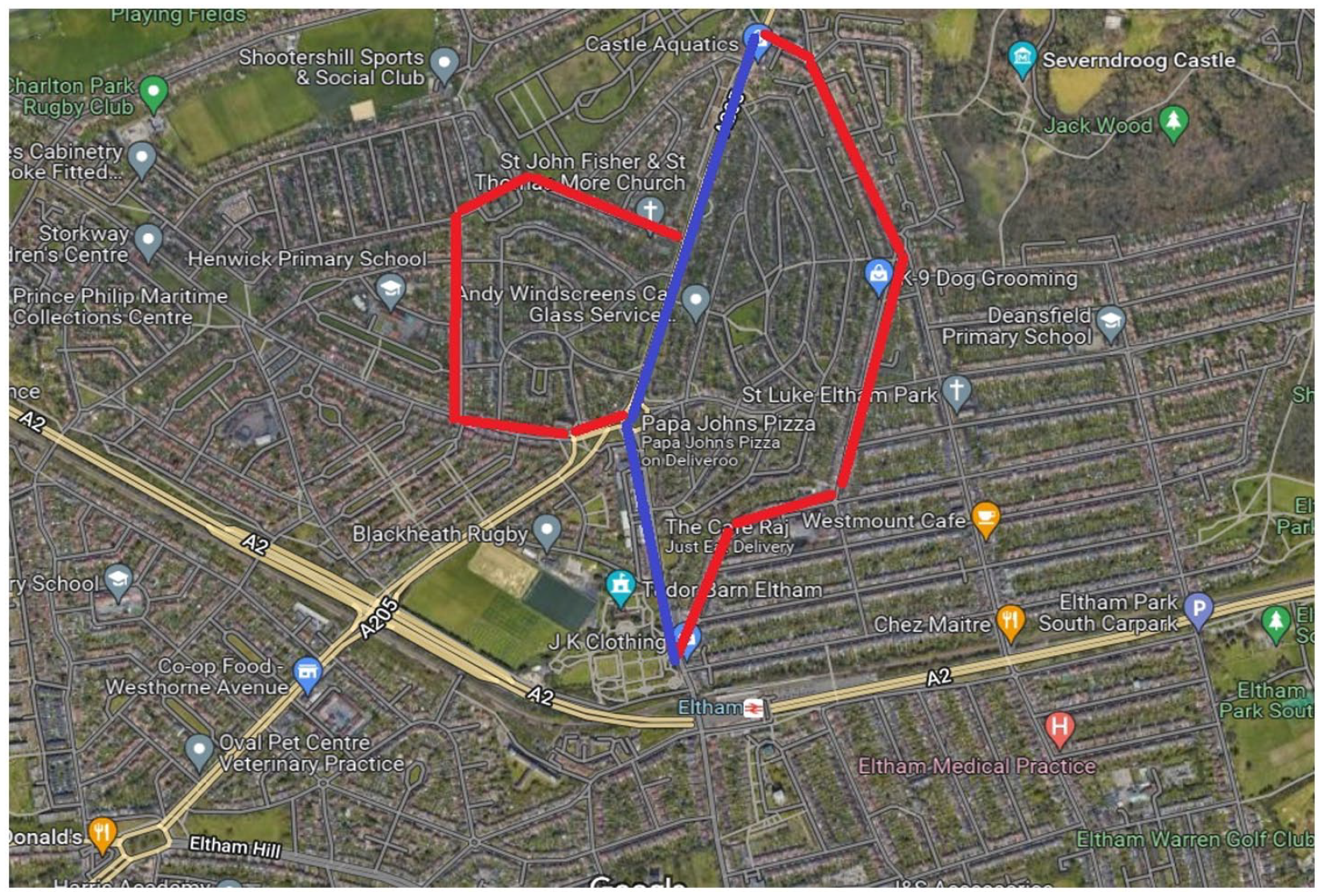
Well Hall Garden Suburb from the air, January 2023.
The houses of Well Hall Garden Suburb are not built in accordance with a gridiron type of layout—but rather planed in adaptation to the irregular topography, in what the town planner Samuel Leslie George Beaufoy referred to as a production of “harmonious composition in visual units.” 28 Billinghurst noted that the roads of the estate were built with minimum excavation, following the natural contours of the site—and while one of the reasons might be an economic one, considering the building took place during the war, it nevertheless correlated Phillips’s vision for the estate and the ideology of the Garden City Movement according to which the layout of the houses should be arranged “in conformity with the land.” 29
* * *
Another important characteristic of the Garden City Movement which can be identified in the planning of Well Hall Garden Suburb is efficiency. The architect Raymond Unwin, one of the most influential figures in the early days of the Garden City Movement, set the ideal proportion at “12 houses to the acre.” 30 The planning of the Well Hall Garden Suburb began with an intention to reach that ratio, but eventually an even better density was achieved, as the average for both sides of the estate was set at 13.5 houses per acre. 31 A total of 6,490 people were eventually housed in 1,298 homes—1,192 dwellings of 1,086 houses and 212 apartments—on an area of ninety-six acres, but it was not accomplished due to a compromise in terms of the inhabitants’ quality of life. There were four classes of houses: Class I (116 houses, weekly rent of 14/6d to 16/6d) included a living room, a parlor, a spare bedroom or dining room, and a scullery on the ground floor, and three bedrooms, bathroom, and WC on the first floor; Class II (357 houses, weekly rent of 12 to 13/6d) included a living room, a parlor, and a scullery on the ground floor, and three bedrooms, bathroom, and WC (Water Closet, a toilet) on the first floor; Class III (613 houses, weekly rent of 10 to 11/6d) included a living room and a scullery with a bath on the ground floor, and three bedrooms on the first floor; and Class IV (212 houses, weekly rent of 7 to 7/6d) was composed of a living room, a scullery with bath, two bedrooms, and offices. 32 Howard’s vision was that “the migration to the towns—the old, crowded, chaotic slum-towns of the past—will be effectually checked, and the current of population set in precisely the opposite direction—to the new towns, bright and fair, wholesome and beautiful.” 33 He, and the architects and town planners that followed him—even those who were only loosely influenced by Garden Cities of To-Morrow—were looking to improve the housing conditions of the urban working classes, and stop crowding them in cramped slums.
In Well Hall Garden Suburb, Baines and his team of architects were able to combine a high ratio of houses per acre with an attractive surrounding—by providing a wide range of designs for houses, along with a minimal usage of semi-detached housing. The 1,192 houses were built out of 576 different designs, that some of them were only used for one house—and this, along with what Beaufoy called “a skillful use of variation in set-back from the street boundary,” resulted in a general feeling of open space with buildings’ scale and proportion in relation to the spaces around them. 34 In addition, the usage of terrace housing system—meaning, a row of houses that each of them shares a sidewall with the houses next to it, unlike semi-detached houses that only share one sidewall—contributed to the compactness of the estate. 35
Another aspect of the planning that should be noticed is one that is usually—and naturally—connected with the Garden City Movement: the communal gardens. The Well Hall Garden Suburb was not a pure Garden City, and its plans did not reflect the importance of communal gardens according to Howard and his most ardent followers. However, along with some communal gardens, the plans also included front (private) gardens, with very little—if any—divisions between them. This, however, was only partially an act of ideology—since it also helped to minimize the effect of Bains’s successful request from the LCC to approve the narrowing of the roads from a width of 40 feet to a width of 30 feet. The haste to build the estate and provide housing for the munition workers was most probably a major reason for the request’s approval. 36
The representations of space in Well Hall Garden Suburb through the beginning of 1915 were a mixture of trending architectural ideology, an intellectual effort to supply a significant number of houses for the working classes in the middle of a housing crisis, and the need to build it within the time and resource limitations of the war economy. By the middle of the year, when the first tenants were welcomed to the housing project, and moreover by the end of the year when it was almost completely populated, a layer of spaces of representations was added—and the metaphoric dialogue between the planners of this space and its users began.
Spaces of Representations
“Mother Goes in Tonight. Balmy”
William Henry Ewens Biddlecombe was born in 1855 in Bridport, Dorset. When he was forty years old, and an owner of a tanning business in his native county, he married eighteen-year-old Edith “Eda” Kate Ewens from Cullompton, Devon. Their eldest daughter, Eileen Violet Alice Biddlecombe, was born on September 1, 1900, and almost three years later, on July 7, 1903, a second child was born: Eda Kathleen Biddlecombe. Her parents and sister—and later, other family members—called her by her middle name, Kathleen. 37
A third child, younger brother to Kathleen, was born on July 21, 1905, and received the name William Holman Elms Biddlecombe—but was known in the family simply as Tom. It took nine more years before the fourth sibling, Mary Berry Biddlecombe, joined the family, in April 1914. Four months later, the Great War broke out, and changed the course of life for the Biddlecombe family, as it did for most of the families in Britain, in some way or the other.
After the war broke out, William and Edith Biddlecombe began working at the Royal Arsenal munition factory. And so, along with their children, they were among the 6,490 people who were selected at the beginning of 1915 to house the newly built housing project in Eltham, Well Hall Garden Suburb. Kathleen was at the age of twelve years when they moved there, and according to the Elementary Education (School Attendance) Act of 1893, she just passed the school-leaving age and was therefore allowed to leave compulsory education. With two parents who were working in shifts at the factory, an older sister who spent most of her adolescence in Switzerland with an aunt, and a one-year-old baby sister who needed to be taken care of, and with a World War raging in battlefields away from Britain but affecting the lives at home, Kathleen opened a new chapter in her young life.
* * *
Throughout the end of the twentieth century and the beginning of the twenty-first century, John Kennett was known in Eltham as the unofficial historian of the district. The history of his family is rooted in the history of Great War Eltham: they were part of the first dwellers at the hutments which were placed close to Well Hall Garden Suburb at the end of 1915. Frank Baines’s housing project was nearing full occupancy, but many more working hands were still needed at the Royal Arsenal munition factory, so the government decided to erect one thousand five hundred wooden huts. The hutments were not part of Well Hall Garden Suburb in any way and were not built according to the Garden City Movement. However, until its removal in 1936, they played a role in shaping of the Eltham life during the First World War and the interwar years. “Ever since I can remember,” recalled Kennett, “the phrase ‘when we lived in the huts’ has surfaced at family gatherings and memories have been jogged and tales told of ‘the old day’ before I was born.” 38
We do not know much about the day-to-day lives in Well Hall Garden Suburb during the Great War—Kathleen Biddlecombe’s diary provides a rare first-person voice of these days, and no other similar text exists in the Greenwich archives. A lot of what we do know about the history of the governmental housing project is based upon the amateur—though quite impressing—work of Kennett, his interviews with other residents of the area, and the personal memories of his family and of his own, which manifested in booklets such as The Eltham Hutments and in articles for collections such as Bygone Kent and Ideal Homes: A History of South-East London Suburb.
It is from Kennett that we know about the first residents of Well Hall Garden Suburb: Sydney and Jane Aylward, who moved into their house in what soon became 238 Well Hall Road, but by then was still an unnumbered house. 39 Like all the other residents that followed them, they received a rent card that instructed them not only about the amount of money they had to pay each week but also about the ways in which they had to take care of their houses—somewhat in accordance with the ideology of the Garden City Movement, which aimed to provide a better accommodation environment for the British working class. The residents of Well Hall Garden Suburb were informed, for example, that “no tenant shall underlet or take in lodgers without the express authority in writing of the Housing Manager being first obtained”—to prevent the replication of the dense and crowded working class lodging. The card also indicated that the residents are expected “to clean their windows at least once a week,” as part of the attempt to improve the housing conditions of the working class. Another two interesting clauses refer for cleaning and order, while stressing the importance of the house’s garden as part of the communal space. “Tenants shall nor erect any structure whatever in the gardens without having first obtained the Housing Manager consent,” it was written, along with another condition, “the back gardens of the tenements shall be the only drying ground, and tenants shall not hang from their windows, or in any way expose to public view, any washing or any unsightly objects whatever.” 40
It is vivid from these conditions that the ideology of the Well Hall Garden Suburb planners was not limited to the construction of the housing project and was intended to shape the daily experience of living in this space. And under these conditions, the Biddlecombe family moves to the house at 6 Cobbett Road.
* * *
“Snow was on the ground this morning,” wrote Kathleen Biddlecombe on January 1, 1918—the first entry of her war-time diary. “Dadda skinned a rabbit for the first time today. It was
It is not a long diary. She started writing in it on the first day of the year, and in the first page of the diary, after she filled the “personal memoranda” section, “Size in Gloves: 9 ½”; “Size in Boots: 4 ¼”; “Size in Hats: 4.” She stopped writing somewhat abruptly, on Monday, June 24, 1918, leaving the rest of the pages empty. She rarely wrote more than a few lines, but she did not miss a day while writing. And her testimony, as honest and full of spelling mistakes as it is, provides us with a rare glimpse of the day-to-day lives in Well Hall Garden Suburb during the Great War—through the eyes of a fourteen-year-old girl.
At the end of the aforementioned first diary entry, Kathleen wrote about her father—“Dadda”—being at home, while her mother was away at work, at the munition factory. That was not unique in any way: in almost all of her entries, Kathleen referred to the presence of her parents at home, or the lack of it, directly or indirectly. As the eldest child in the house—since her older sister, Eileen, was with her aunt Alice in Switzerland—much of the burden of the house chores was put upon her young shoulders while her parents were not home. Also, as a fourteen year old, she was still young enough to simply miss her mother and father whenever they were at work. “Mother went in to work tonight,” she wrote on January 13, which was a Sunday, and added, “how I hate her on Sunday work!.” On another Sunday, February 3, she wrote “So awful mother is on ‘nightwork.’” And two weeks later, on Sunday, February 17, she noted, “So glad mother is home tonight.” Another two weeks passed, and the absence of her mother left Kathleen gloomy again. “Mother on nightwork tonight,” she wrote. “I wish they’d stopp [sic] all night work. Wet and miserable all day.”
Some of Kathleen’s diary entries start or end with a vague mention of the parental employment status, such as “Dadda was late home” (January 2), “Mother home—Dadda on duty” (March 30), “Mother goes into work tonight. Dadda home all day” (April 2), or “Father had to go to work till dinnertime” (June 3). Others reveal more of her feelings toward her parents’ absence, such as “So glad mother is home tonight” (March 17) or “Mother goes in tonight. Balmy” (June 4). But whether it is a simple note or a much more emotional one, it is clear from the diary that the presence of her parents at home or their absence affected Kathleen’s mood, and probably had an effect on her daily chores—as she wrote, for example, that “Mother was home at 12 today and did washing” (February 2) or “Very late dinner because Dadda would go out beforehand” (March 10).
The number of references to her parents being away or at home is significant not only for the domestic history of the Biddlecombe family but also for the urban history of Well Hall Garden Suburb as a space in time of crisis. Well Hall Garden Suburb was planned during the war, for the people who were part of the war industry, to be inhabited in haste for the duration of the war. When we think about the users of the space, we tend to think about the munition workers, the adults, and the parents of the houses. Kathleen’s diary serves as a reminder for what should perhaps have been obvious: the munition workers, for a major part of the days and even the nights, were at the munition factory. The space of Well Hall Garden Suburb was, at least for some families, a space run by the older children, like Kathleen.
This notion raises a question: was the space of Well Hall Garden Suburb planned for the usage of children like Kathleen Biddlecombe? Based upon her diary, at least, it seems that in many ways, it was not. The common gardens and the terrace housing system were supposed, perhaps, to bring the tenants closer to each other, but Kathleen, as a girl who passed the school-leaving age, felt lonely and wished for company. “Mr. Perkins our neighbour moved today,” she wrote on January 2. “I do hope somone [sic] new moves in as I want a friend.” Almost two weeks later, on January 13, she got her answer. “New neighbour next door and I believe they have a girl my age,” she wrote. “Am so glad.” This girl, however, is not mentioned in the diary, nor do other girls and boys apart from Kathleen’s brother and sister. She does mention, though, being afraid in the area. “I never wish to go out in the dark again,” she wrote on February 10. “We heard a young girl was strangled last night in the very spot I went blackberry pickery [sic].”
* * *
From the very few entries about Kathleen’s fear and longing for a friend—and even more so, from the lack of entries about social circles—we can learn about feelings of alienation from the space of the estate, and about the limited social encounters. “No facilities other than houses and two green open spaces were provided,” wrote John Kennett about the early days of Well Hall Garden Suburb, and referred also to social frameworks such as schools. 41
So what did Kathleen do all day? She was in charge of all the house chores, while her parents were away at work. “Yesterday mother was lucky enough to secure a piece of beef, which I salted, and we had it foiled,” she wrote on January 20, and was cooking also on February 7: “Mother bought a fish head today, that I cooked for tea, and made into fish rissoles.” Apart from cooking, Kathleen was mostly in charge of keeping the house clean. “Mother and father home for dinner.” She wrote on March 2, “I cleaned stove [sic] and washed through the passage and kitchen.” On March 18, Monday, she noted, “did Bedrooms washed them and springcleaned them,” and a month later, on April 22, she repeated it, “I did bedrooms (sweep wash dust) etc. my usual Monday occupation.” The cleaning was not just a Monday routine, as can be learned from the entry of May 18: “Had my usual Saturday morn sweep & wash up through the passage kitchen & scullery.”
As the eldest sister in the house, Kathleen was also in charge of her baby sister Mary, who was four years old at the time. As part of that, she took her with her when she went for shopping. “Took Mary with me shopping today,” she wrote on April 26. “Twas a wrecked morn but at noon it gave way to lovely sunshine.” On April 30, she also “took Mary out and did some shopping,” and on May 9, she noted, “Took Mary to get my butter ration. We lucky enough to secure a 2 lb jar of jam.” A week later, on May 16, she wrote, “I had to get some of our rations earlier than usual today—took Mary to Woolwich.”
The reason why Kathleen took her baby sister for shopping in Woolwich is simple: there were no stores in Well Hall Garden Suburb. “It seems strange that this ambitious housing project does not include one or two small shops, for such a village ought to be self-supporting,” wrote the English architect Albert E. Richardson already in 1916 in The Burlington Magazine for Connoisseurs. “As it is, the inhabitants have to make a journey of some distance to buy ordinary commodities.” Richardson’s review of Well Hall Garden Suburb was otherwise very positive—“from a picturesque standpoint the cottages are among the best achievements of modern domestic building,” “the general aspect of the place is that of the 17th century Kentish village”—but his critical remark about the lack of shops and the need to travel away for shopping reflected a problem in the planning of the housing project. 42 “As there were no shops among the houses,” wrote John Kennett in his booklet memoir about the early days of Well Hall Garden Suburb, “the Royal Arsenal Co-operative Society store at Well Hall was used or the nearby shops in Well Hall Parade.” 43
The shops at Well Hall were probably about fifteen-minute walk from the estate, and those in Woolwich probably required a Tram ride along Well Hall Road to the North. This practice of having to leave the newly built and inhabited housing project for any sort of purchase whatsoever testifies for the gap between the way in which the space was planned and the way in which it was used. And Kathleen’s diary shows how this failure was part of the day-to-day experience in Well Hall Garden Suburb. “Queues everywhere today for Meat Cheese Tea and many other things,” she wrote on January 12. “I went to Woolwich to buy some leather today but could get no studs as we wanted.” Her interest in leather and studs is probably because of her father, “Dadda,” who owned a tanning business for many years in Cullompton, Dorset, before the family moved to London, and it is possible he was still handling leather as part of his work at the Royal Woolwich Arsenal. “Went to Woolwich to buy some leather today,” she wrote again on March 16, and noticed, “It’s much dearer!”
Most of Kathleen’s travels to Woolwich, though, were for the purpose of buying foodstuffs. “I went to Woolwich today to buy margarine but both shops were shut,” she wrote in her diary on January 21. On March 1, Friday, she reported that she “went to Woolwich today, and used butter coupons for first time,” and exactly a week later, she once again noted she “went shopping at Woolwich.” In April, she traveled to Woolwich for shopping again, and used the trip—as she did many times, according to the diary—to meet her father. “I went to Woolwich today to meet Dadda,” she wrote. “Oranges are cheaper being only 2 d each.” Two days later, she repeated the voyage, and this time, it ended on a much positive note. “Went shopping today but did not have to wait in queue,” she documented the visit in her diary. “There were several in Woolwich only for cheese I think.” Another four days passed, and on this time, she had to travel North for some bureaucratic arrangements. “I went to the Woolwich Town Hall today to deliver an important form what mother had delayed in filling up,” she wrote on April 9, “referring to number of person [sic] in a house.”
* * *
The people who lived in Well Hall Garden Suburb, among them Kathleen Biddlecombe, helped with their daily actions to produce its space. The instrumental space of the housing project’s planners, the imagined space, did not include—at least in its early days—any shops, and the experience of going out of Well Hall Garden Suburb to buy margarine, cheese, fish, or even leather shaped its real and imagined space. But this space was shaped by the daily experience which derived not only from what it lacked—shops—but also from the change in the usage of one of its most notable characteristics: the gardens.
“Tom started gardening today, and dug a good piece by dinner time,” wrote Kathleen in her diary on February 24, and on March 17, she added that her brother “planted Parsley and Radish seeds today.” On March 23, she proudly wrote, “We bought seeds for the garden today and seed potatoes KING-EDWARD and SHARR’S-EXPRESS.” The following day, she was in a good spirit because of her garden. “A lovely day, for gardening, everybody doing it,” she wrote in her diary. “We planted lupins and chrysanthemum today and made a flower bed in the front.” On April 21, however, the young farmer was much less optimistic. “Rain all day, cold as ever,” she noted in her diary, “bad luck is the lot to him who had put potatoes in, for they will rot rot rot, and fresh ones will have to be sawn.”
The gardens, as can easily noticed from its name, were one of the most important features of the Garden City Movement—but during the First World War, at least some of the tenants in Well Hall Garden Suburb used them in a much more functional way compared to its planners’ original intention. The food supply crisis in Britain, mostly caused by the German U-boat blockages, was partly fought by encouraging the public to grow their own vegetables, fruits, and herbs in their back garden. “When you come to production, every available square yard must be made to produce food,” said David Lloyd George, in his first speech to the House of Commons as Prime Minister, on December 19, 1916. “The labour available for tillage should not be turned to mere ornamental purposes until the food necessities of the country have been adequately safeguarded.” 44 The gardens of the Garden City Movement were never just for “mere ornamental purposes,” but they were also not planned to be used as a tool for assisting to produce stock of potatoes. This is an example of one way in which the war shaped the urban space of Well Hall Garden Suburb.
And the war was always there. Not only because of the war economy—and because the tenants of Well Hall Garden Suburb worked at the munition factory—but also because the war was felt in its most physical way. Like everyone in Britain, the tenants of Well Hall Garden Suburb lived during the First World War under the threat of an airship or an airplane raid. Because of their proximity to the Royal Arsenal munition factory, they were even more in danger than the average men and women of Britain, since in some ways, the war industry was considered to be a more legitimate target for an aerial raid. The bombs did hit the streets of Eltham on one of the war nights; when in the early hours of August 25, 1916, a bomb that was dropped from the L31 Zeppelin killed four people on 210 Well Hall Road. 45 But while a Zeppelin hovered over Well Hall Garden Suburb on one night only, the fear of the German airships and airplanes was part of the entire First World War experience of the tenants—as it is very well reflected in Kathleen’s diary.
“The Syrene went tonight, but luckily no machines got through,” wrote the fourteen-year-old girl on January 3, “and the This evening at 8 o’clock, air raid warnings were given. About 10 mins after bugles sounded and people shouted All Clear but this however was wrong, the Gothas raided London causing many casualties, and not till a quarter to one till the all clear go. We all flew to dugouts under the table.
“The First Blitz,” as the German aerial campaign against Britain during the First World War is often called, was hardly as lethal as “The Blitz” of the Second World War—and that is probably the reason why for many years it had a much lesser place in the research about the war. This, however, does not mean that the war-time experience of Kathleen and other children and adults in Britain during the 1914-1918 was any less affected by the aerial threat—and the fear from the airships and airplanes contributed to the shaping of the urban space of war. For example, it changed Kathleen’s awareness to the weather—because Zeppelins only raided on clear nights. “The weather is on the change unfortunately for Fritz,” she wrote on January 30, referring to the German enemy by its war-time name. “This evening a dense fog hung parts of London. Fritz was on his way, but the fog prevented his coming to England, so he turned round and bombed Paris, for the first time in twelve months.” On February 19, she reported that they “passed a peaceful night, thanks to a fog on the channel,” and added on the following day, “wet, very cloudy and good winds again, we have to thank our unreliable British climate for a quiet night.” On March 17, she declared it was “lovely night for a raid!,” and once again on April 26, “beautiful night for a raid tonight.” The war, despite not being part of the architecture of Well Hall Garden Suburb, had therefore an immense effect on the daily experience of using the space, and in accordance with the ways this space was produced. 46
The Dialogue between Planners and Users
“The Rural Nature of the 44 Route Began to Alter in 1915”
The Well Hall Garden Suburb, mostly known today as Progress Estate, was a space that was planned during the crisis of the First World War, by representations of the government which handled the crisis, and for the people—the munition workers—who worked in the crisis’ industry and were part of the war effort. But the actual day-to-day users of the space were not only the munition workers but also their family members, like fourteen-year-old Kathleen Biddlecombe.
“A space exists when one takes into consideration vectors of direction, velocities, and time variables,” wrote Michel de Certeau in The Practice of Everyday Life, arguably his most influential work. Thus space is composed of intersections of mobile elements. It is in a sense actuated by the ensemble of movements deployed within it [. . .] In short, space is a practiced place. Thus the street geometrically defined by urban planning is transformed into a space by walkers.
47
The space of Well Hall Garden Suburb was indeed a practiced place, produced by its walkers and as a dialogue between its planners and users, the representations of space and the spaces of representations. Kathleen’s diary uncovers this dialogue, as it presents the ways in which the space was used.
The origin story of Well Hall Garden Suburb, its raison d’être, was the war and the need for housing for the munition workers. Based on Kathleen’s diary, this need was well served, as her two parents spent a lot of time—days and nights—at work at the relatively close factory. However, the haste in which the estate was built, and its functional orientation as a housing solution for munition workers, was probably the reason for the lack of social structures for children, and contributed to Kathleen’s feelings of alienation from the space. The space as a whole was part of the space of war not just because of the circumstances that led to its building, but also because of the presence of the war at the home front in its most physical way—the aerial raids. But along with the fear of the German Zeppelins and Gotha airplanes, the war also brought to the space of Well Hall Garden Suburb a major change in its usage—when the private gardens, the jewel in the crown of the Garden City Movement, were used for growing fruits and vegetables; fourteen-year-old Kathleen was, in many ways, the main user of the space of Well Hall Garden Suburb, as she was in charge of all the chores within the house—but the lack of shops forced her to leave the space of the housing project whenever she needed to buy foodstuffs and other commodities, and travel to Woolwich or Well Hall.
* * *
In 2010, as part of an introduction to “The Spatial History Project” at Stanford University, Richard White presented three questions. “What operationally do we mean by spatial experience and what specifically are we studying? How does spatial experience connect to the production of space? And, finally, how are spatial relations constructed?,” he asked: For me, all three of these questions end up having a single answer: movement. I don’t want to be so simplistic as to say that if space is the question then movement is the answer, but I fear that I am nearly that simple.
48
Movement might not be the answer to all the questions raised by Spatial History, but it can certainly be the answer to the spatial question that is raised by the history of Well Hall Garden Suburb. As de Certeau wrote, “a space exists when one takes into consideration vectors of direction, velocities, and time variables”—and these vectors, in the case of First World War Well Hall Garden Suburb, pointed toward Woolwich, where Kathleen’s parents and many other of the estate’s adults worked at the munition factory, and where she had to go for shopping. And they all used the 44 Tram service. “The rural nature of the 44 route began to alter in 1915 when a new estate was built at Well Hall to house some of the thousands of people who had flooded into the area to undertake munition work at the Woolwich Arsenal,” wrote local historian John Kennett in his highly specific booklet Trams in Eltham 1910-1952. “Standing was permitted on the trams and trailers and often there were as many as 130 passengers aboard [. . .] Trailer cars were withdrawn from this route on 27 January 1919.” 49 Tram Service 44 was the main agent of movement in Great War Well Hall Garden Suburb, as it passed along Well Hall Road (marked in blue in Figure 1, p. 5) and brought the tenants to and from Woolwich
Kathleen’s shopping at Woolwich, as it is presented in her diary as a major part of her daily war-time routine, is distillation of a much wider question about spaces in time of crisis. It embodies the gap between the planning of the estate—during the crisis, and for the crisis—and the way it was used, also due to the crisis. It represents the ways in which the crisis shaped not only the functionality of the space but also the way it was experienced. And it is a reminder that wars do not just happen in spaces, when the space serves as a mere background, but rather operate within a spatial context and their experience is shaped by the space.
Footnotes
Declaration of Conflicting Interests
The author(s) declared no potential conflicts of interest with respect to the research, authorship, and/or publication of this article.
Funding
The author(s) received no financial support for the research, authorship, and/or publication of this article.