



Abstract
From 1945 to the end of the twentieth century, the Central Coast region adjacent to Australia’s largest city—Sydney—grew from a population of 30,000 to nearly 300,000 people. This article examines the long-distance commuting that was integral to this growth. By the 1990s, around a third of the region’s workforce was regularly traveling distances of 50 kilometers or more each way to the main body of Sydney. For many, the Central Coast offered new opportunities not readily available elsewhere in the metropolitan area to access housing—whether they sought to buy or rent—within a distinct, increasingly esteemed, coastal landscape. Over time, this commuting was variously encouraged, resented, and problematized. While it had parallels to other parts of Sydney’s “commuter belt,” the region’s experience stands as a notable case study of the diversity of household values across work, housing, and mobility.
Introduction
The twentieth century saw average commuting distances rise in cities around the world. Although some historical analysis has posited universalistic patterns of time spent commuting, most notably “Marchetti’s Constant,” other researchers have found divergences in how people value commuting time. 1 While there may be tendencies in any given society for commuting to reflect particular time use norms, it has been frequently observed that a proportion of people are willing to spend more time commuting so as to travel further distances. The figure of the long-distance commuter, as such, has thus been prominent in many accounts of urban life. As well as usually spending an extended amount of time traveling, these figures have drawn attention through their transcendence of spatial boundaries, and sometimes, suffering. 2
With its physically expansive urbanism, and the prominence of distance and space in its national historiography, 3 Australia occupies a distinct place in the history of commuting across different time periods. As noted in the work of Graeme Davison, Lionel Frost, and many others, Australian urban history after British-led colonization has been characterized by waves of outward suburbanization around its cities. 4 Moreover, Sydney, its largest city both physically and in terms of population for much of the period since colonization, has seen ever-further commuting throughout its history. 5
Against this background, the emergence of long-distance commuting from the Central Coast region to the north of the main body of Sydney (see Figure 1) in the years between 1945 and 2001 stands as a notable case study of household choices around mobility, housing, and work. This article will first contextualize the region’s experience by discussing the broad expansion of urban travel distances in the post-war era, along with the general rise of the coast within Australia’s spatial pattern of urban settlement. While migration to the Central Coast had commonalities with that to other outer suburbs, this article argues that it reflected certain perceived opportunities, revolving around proximity to the ocean, not otherwise available to lower-income households within Sydney’s wider metropolitan housing market. Although government investment in transport infrastructure and metropolitan planning from the 1960s explicitly sought to enable migration, ambiguities remained about the continuing prevalence of long-distance commuting, and the region’s economic development was thus often characterized as deficient, particularly as unemployment and other social challenges became prominent from the 1970s onward. Nonetheless, the region’s experience highlights both the diversity of values held by households and their agency in the currents of Sydney’s social and economic history.
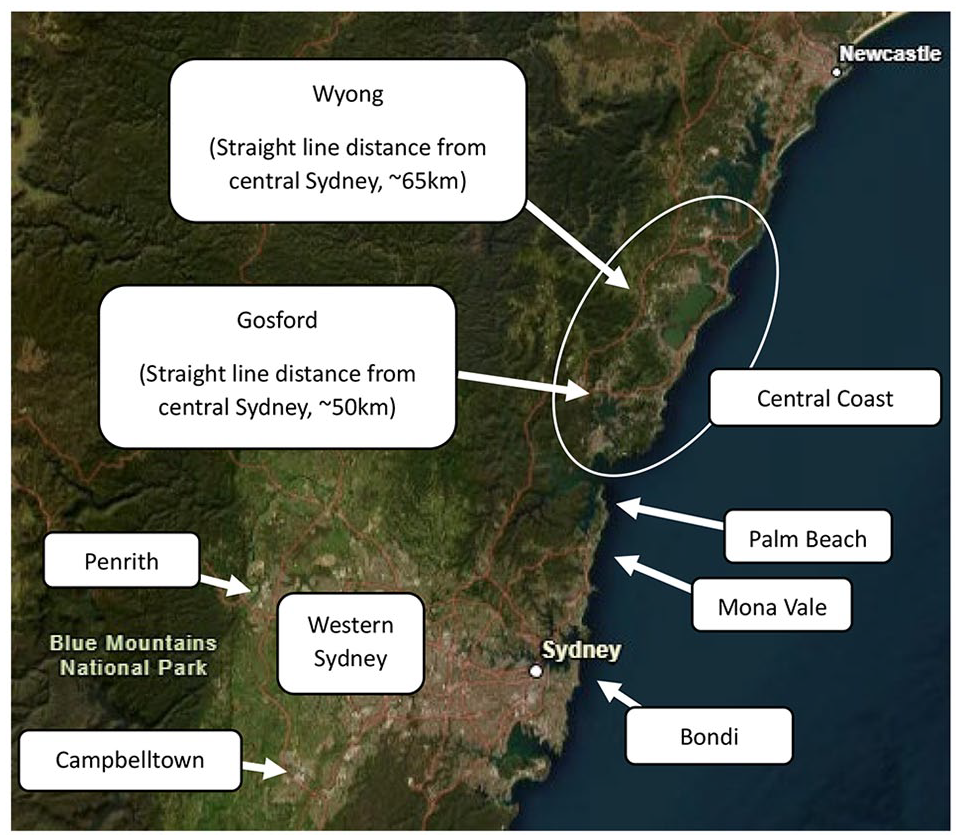
The Central Coast and the Sydney metropolitan area.
Methodologically, the article’s research is primarily based on the review of public affairs reporting and commentary throughout the study period, as well as the critical reading of the region’s literature of local histories and local and state government records.
Journeys to the Shore
While the definition of who might be considered a long-distance commuter varies from city to city and across time, the second half of the twentieth century saw the confluence of factors that encouraged longer-distance urban travel across many societies. 6 In Australia, average annual urban travel more than doubled from less than 6,000 kilometers per person to over 12,000 kilometers per person between the 1940s and the 1980s. 7 However, there were also important differences in gender experiences of travel, including commuting distance. 8 For example, analysis of the United Kingdom has found women’s commutes during the twentieth century to be on average shorter in terms of distance, but that the average time taken was comparable with or higher than men’s until the 1960s, after which men traveled notably further in terms of both distance and time. The division of labor within many households in effect saw men lay earlier claim to the distance-shrinking possibilities of private cars from the 1950s, while commuting by car only became prevalent among women from the 1970s. Broadly similar patterns were also observed in the United States and Australia within wider societal debates around changing forms of domestic life and time use. 9
The factors behind this expansion of urban travel are well known, with developed countries seeing variations upon the roll-out of mass automobility, new investments in transit, and the expansion of suburbanization. In the broadest terms, the comforts of automobility, and sometimes new transit, made longer-distance travel more attractive in many metropolitan areas. Particularly in North America and Australasia, these dynamics were combined with public policy that facilitated wide sections of those societies to purchase detached single-family homes, typically constructed iteratively outward in low-density subdivisions on the edges of cities. Consequently, many cities massively expanded physically with, for example, late-twentieth-century Los Angeles famously being labeled a “100 mile city,” while, in Australia, the conurbation that grew around Brisbane in the same period has been characterized as a “200 kilometre city.” 10
Within these wider currents, Australian urbanism during the era had certain dynamics that accentuated longer-distance commuting. Historically, a small number of major cities—Sydney, Melbourne, Brisbane, Perth, Adelaide, Hobart, and Canberra—occupied a dominant place in economic and cultural life. 11 While there was suburbanization of much industrial activity and retailing after 1945, commuting to a central business district (CBD) or other established centers in these major cities remained imperative throughout the era for accessing many types of employment or services. 12
The growth of the major cities both in terms of population and in a physical sense was deliberately encouraged by governments, with the period between 1946 and 1975 seeing nationally a net migration intake of more than two million persons, from a starting population of less than eight million. This migration was explicitly intended to support the industrialization of the major cities, where most migrants settled, and Sydney subsequently grew from around two million people in the 1950s to a wider metropolitan population of around five million people at the end of the century. 13 Mass automobility and new networks of transport corridors to serve ever-more outward suburbs were an important feature of post-war planning, and during the 1960s and 1970s, linear city plans were created in several jurisdictions that sought to extend development along and around major transport infrastructure spines, whether this might be a major road or rail-based transit. 14 The idea of decentralization also influenced growth management and travel patterns in some locations. Although various subsidies had been provided to businesses to invest beyond the major cities previously, by the late-1960s, it was being suggested that “selective decentralisation” was needed to focus public resources in particular locations to achieve better outcomes. The 1970s thus saw the emergence of metropolitan-adjacent “growth centres” supported by both federal and state investment and which successfully attracted growth relative to more distant target locations. 15
The outer edges of Australia’s major cities thus represented a distinct housing opportunity for many households, particularly for those starting their housing careers. 16 The 1940s and 1950s saw a profound housing shortage accompanied by shortages in building materials and skilled labor in the construction industry, which coincided with increased demand through the international migration noted above and increased family formation (or what has been called a “marriage boom”). 17 Additionally, federal and state government policy both pushed and pulled people into suburban homeownership through the combination of financial subsidies, limiting public housing supply, and disincentivizing either being a private sector tenant or landlord. 18 These drivers aligned with the large-scale availability of peri-urban land for residential use which mass automobility effectively brought into metropolitan real estate markets. Between 1947 and 1966, two-thirds of Melbourne’s growth was accommodated in outer suburbs. 19 Notoriously, it was common through to the 1970s for such land to not have reticulated sewage connections or paved roads, giving them a “cream brick frontier” reputation. 20 Nonetheless, these localities remained the most appealing option available for many households facing the continuing general increase in the real price of housing seen across all major cities through the second half of the century but which was most pronounced in Sydney. 21 Studies of working-class migrants to outer suburbs through to the 1960s have also noted that these residents were attracted to such places in part because they were seen as “free of history and class associations,” and for all their deficiencies were still felt to be better places to live than the decaying inner suburbs left behind. 22
In some locations, outward metropolitan suburbanization gelled with the widespread expansion of coastal migration and development across Australia. This in turn had resonances to the experiences of parts of North America and Mediterranean Europe throughout the twentieth century including, for example, California’s sustained “coastal land rush.” 23 In Australia, what became popularly known as “seachanging” was sometimes associated with people retiring or otherwise dropping out of the workforce. 24 However, in other areas, the option of commuting to an adjacent major city was an important factor for households in deciding to move. 25
Beyond economic motivations, a key impetus for coastal suburbanization was the growing cultural significance of the coast. Seaside resorts emerged around Australia in the Victorian era, while the early decades of the twentieth century saw the rise of a distinct, mass beach culture in Sydney and other cities, centered around ocean swimming and surf clubs. 26 More transient forms of occupying the coast during weekends and holidays, ranging from camping under canvas, through the building of shacks, gave way in place after place to large-scale subdivisions of more conventional dwellings, sometimes reflecting emergent coastal-regional architectural idioms. 27 A certain amount of migration was observed as following a chain pattern, where holiday visitation to coastal locations transitioned into second home ownership and ultimately into permanent residence. 28 As the twentieth century went on, beach and coastal iconography increasingly contended with and partially displaced the inland landscape imagery previously ascendant in popular culture and the visual arts. In sum, the coast became a place of mass play, athleticism, sensuality, and spiritualism, and to live in proximity to the ocean was an aspiration for many. 29
Values and Opportunities
In the above context, the Central Coast—Darkinjung Country—transformed from a population of less than 30,000 people in the 1940s, largely scattered across farms and hamlets, to being a recognizably suburban community approaching 300,000 people by the end of the twentieth century. The region is separated from the main body of Sydney by the wide and deep Hawkesbury River and jagged sandstone country, including large areas of the national park. The completion of the railway between Sydney and Newcastle, and in particular the opening of a rail bridge across the Hawkesbury River in 1889 (which was also the last link in connecting the capitals of the eastern Australian colonies), catalyzed tourism in the area. From the 1890s onward, locations along the ocean shore and other water bodies emerged as hubs of guest houses, camping, and other forms of leisure accommodation. 30 From the turn of the twentieth century, seashore subdivisions orientated toward holiday home builders began to appear. 31 However, their uptake was hampered by the arduousness of travel beyond the train line, with holidaymakers relying on poorly formed roads or boat journeys to carry them to and from stations. Proposals by local boosters in the 1910s and 1920s to build tram lines connecting coastal settlements to the main rail line failed. 32 The 1930s saw the beginnings of the construction of a highway northwards from Sydney’s then urban edge, and in 1946, a road bridge was finally opened across the Hawkesbury. 33
After 1945, commuting and suburban development grew in tandem, with migration to the region primarily being from elsewhere in the Sydney metropolitan area. 34 In the 1950s, around 1,000 people—or 10 percent of the workforce—were estimated as commuting to Sydney. 35 Following the electrification of passenger rail services between Sydney and Gosford—historically the region’s main center—in 1960, 36 a 1966 survey found more than 3,000 people commuted daily to Sydney from stations north of the Hawkesbury River through to Gosford. 37 In 1971, it was estimated that “about 5,000 people commute southwards” out of a workforce of 30,000 (i.e., 17 percent). These commuters were engaged in a range of occupations, with manufacturing being the single largest sector for employment elsewhere. 38 By the mid-1990s, the Gosford City Council observed “over 35,000 people (representing one third of the workforce) commute daily to work outside of the Central Coast, with the majority travelling . . . to Sydney” with other analysis also noting that region had fewer professional and managerial jobs than the state average. 39
Alongside rail electrification, the 1960s also saw the opening of initial elements of a Sydney-Newcastle motorway, including in sections particularly connecting the southern part of the Central Coast with northern Sydney. 40 Both of these major road and rail links were progressively improved so that, by the late 1990s, the northern part of the region was also served by electrified commuter rail services and a continuous motorway connecting to the main body of the metropolis. While individual travel times would reflect one’s particular origin and destination, rail travel times between Wyong (the region’s northern administrative center) and Sydney’s Central Station fell from over two hours in 1960 to an hour and a half in 1997, with shorter travel times from stations to the south. 41 In the mid-1990s, it was estimated that 36 per cent of commuters to Sydney traveled by rail, with 20 per cent working in the CBD and a further third journeying to the city’s northern suburbs. 42 At this time, a “typical daily commute” to Sydney and back was around three hours. 43
The region’s commuting distance and associated travel time were at the outer end of Sydney norms but not without parallel—long-distance commuting also emerged at other places on the metropolitan edge.
44
What the Central Coast offered might be characterized as the confluence of certain perceptions of proximity with the opportunity for lower-income, or thrift-minded households to access housing—whether they sought to buy or rent—within a distinct, increasingly esteemed, coastal landscape that was not necessarily available elsewhere. One government body summarized the region as “one of the most attractive living areas on the east coast of Australia” given that it possessed an “equitable climate, diversity of vegetation, the mouth of a large river flanked by national parks, the beaches, the lakes and lagoons, dramatic topography, and vast state forests. The result is a substantial and diverse natural asset rarely found in such a small area so close to a metropolis.”
45
Real estate marketing and local commentary frequently suggested both closeness and distance, that is, the region was both near enough to Sydney for easy travel but far enough to feel that one had indeed traveled somewhere different. In this vein, 1950s advertising for one beachside subdivision suggested it was “near enough for easy access, distant enough to ensure privacy.”
46
Likewise, a boosting newspaper profile of the region in the 1980s included the reflection of a senior local government official that: You can live in Gosford and still enjoy the benefits of being close to Sydney . . . I still subscribe to the ballet in Sydney. I go to live shows there as often as I did when I lived in Cremorne [i.e. a relatively central Sydney suburb] four years ago.
47
Although beachfront and other water-adjacent land typically came with a price premium, the region generally was viewed as offering value for money within the wider Sydney residential property market. Newspapers and local histories of the 1950s and 1960s tell of Sydney retail clerks buying land on holiday and a waiter who bought sites he hoped for his own restaurants one day. 48 A 1971 profile argued that “land away from the water, beach, or with not so breathtaking views is certainly cheaper than land nearer the city. For this reason, much of the former resort land is being bought by young married people or those planning to marry. They see less of a disparity between the land cost . . . and their ability to start building a house . . . closer to city.” 49
Similarly, a 1986 overview of the local property market suggested “The Central Coast is an area for first-home buyers. Homes cost about $60,000 50 at the bottom of the market.” Angling perhaps at those looking for bargains, the piece also went on to note that such opportunities co-existed with other pricier market segments nearby: “Around Kincumber and Erina land is selling at $25,000 and $26,000 but in the exclusive areas you can pay $200,000 for a waterfront block.” 51
State government statistics for the last quarter of the century suggest that typical residential property purchase prices for the Central Coast were comparable throughout the period to Western Sydney localities, the latter being traditionally the primary location of relatively affordable outer suburban housing within the metropolis, and significantly cheaper than coastal localities in the city’s east. For example, the price of an average three-bedroom detached house in Gosford (Central Coast), Penrith (Western Sydney), or Campbelltown (Western Sydney) in the mid-1970s was around $30,000, with Wyong (Central Coast) cheaper at $26,000 and equivalent to Blacktown in Western Sydney. These prices compared with just under $50,000 for a similar dwelling at Mona Vale on the Northern Beaches and slightly more for Bondi. 52 By 1995, the averages for East Gosford and Wyong were assessed at $150,000 and $125,000, respectively, against $125,000 in Campbelltown and $135,000 in Penrith. Meanwhile, the price of an equivalent dwelling in Mona Vale was more than double most of the comparators at $265,000, and a Bondi equivalent was $400,000. 53
Similar patterns existed within the rental market. At the start of the 1990s, the median weekly rent for a two-bedroom apartment in the Gosford local government area was $135 versus $120 in Wyong. This compared with $140 in Campbelltown and $125 in Penrith. In contrast, the Warringah and Waverley local government areas in Sydney’s coastal east had medians of $180 and $200, respectively. 54 By December 1999, the median rent in Gosford ($175) was somewhat more expensive than that in Wyong ($150), Campbelltown ($155), or Penrith ($140) but was still substantially below the equivalent rent levels of Warringah ($280) or Waverley ($340). 55
Most of the Central Coast’s new housing took the form of detached dwellings and real estate market commentary sometimes identified it as a place where households could obtain more “elbow room” than they would in an increasingly dense Sydney. 56 That said, by the 1970s a distinct market for apartments had also formed, pitched as offering relatively affordable, and lower-maintenance, accommodation in proximity to the shore. 57
While the region might have pricing commonalities with Western Sydney, it was recognized as being qualitatively different. As one late-1960s commentator observed: Already there is much commuting between the city . . . and the pleasant water-bound towns of north of the Hawkesbury River in the Woy Woy and Gosford area as real incomes rise and such areas become more and more accessible. At the same time, people will become more discriminating in their choice of living and with the promise of increased leisure time, and greater affluence and mobility all round, the outer western suburbs [i.e. Western Sydney] will certainly rate poorly as desirable areas for modern living.
58
A 1980s commentator, reflecting on his personal experience of moving from the Western Sydney suburb of Liverpool, similarly found much to like about his new home in the Central Coast suburb of Woy Woy: After living for the past four years in a restful bushland setting overlooking Broken Bay, I have no regrets having left a modern, air conditioned home in the Liverpool district. For 30 minutes’ extra travelling time in peak hour . . . I can now enjoy many benefits compared with living in Liverpool—cheaper car insurance. . .low-priced goods in supermarkets and shopping centres which compete for the custom of pensioners and shoppers on fixed incomes . . . views of neat homes with tidy gardens (retired home owners, with ample leisure time, abound).
59
Equivalencies were often drawn between the two regions in vernacular geographies of Sydney, with the Central Coast coming to be sometimes labeled, for example, “Blacktown by the sea” or “Mount Druitt by the sea,” the latter being two well-known Western Sydney localities. 60
However, these comparisons also sat alongside analogies to Sydney’s most upmarket areas. Marketing of land in one Central Coast subdivision in the 1950s implied that blocks “from £95” could be compared with land at the prestigious suburb of Palm Beach on the northern tip of Sydney’s Northern Beaches priced at £3000.
61
Similarly, 1980s profiles of the region again drew comparisons with Palm Beach. Amid a wave of coverage during the era, the Central Coast’s Pearl Beach was positioned as even “glossier” with “a heavy concentration of writers, artists and media personalities hiding away in unimposing houses overrun by hibiscus, plumbargo, honeysuckle and oleander.”
62
The region’s Avoca Beach was likewise portrayed as a place of “nice people” or a community of finely calibrated proprieties. The latter included, inter alia, driving to the beach (as opposed to walking), church attendance, the consumption of wine in preference to beer, and ensuring one’s house had a television antenna capable of receiving Sydney (as distinct to country) stations.
63
A 1990 newspaper profile made similar upward comparisons from a landscape perspective: Parts of the coast look like Turramurra or Hornsby [i.e. upmarket outer Sydney suburbs] looked about 60 years ago . . . with hills, a few dairy farms, orchids, brick taking over from . . . timber and fibro, overwhelmingly Anglo-Saxon,
64
but with much more water than the North Shore. Other parts, notably Terrigal . . . look like Double Bay [i.e. an upmarket inner suburb].
65
Alongside its opportunities as a place to live, the region also acquired an identity that held over several decades as a prudent investment opportunity benefiting from both uplifts in the Sydney and wider coastal land markets. A 1960 multi-page newspaper feature accompanying the opening of the electrified rail line to Gosford included a piece titled “Dramatic Rise in Land Value” which suggested that “land is now at a premium” and highlighted a case where “one block on the waterfront at Gosford, with a 50-front footage, rose in value from £650 to £2,000 in less than a year.” 66
Just over a decade later, The Bulletin—a major national current affairs magazine—noted that land bought in the 1940s and 1950s along “the coastline stretching 200 miles north and south of Sydney . . . has skyrocketed in price,” particularly in places “taking on the appearance of a dormitory or outer suburb.” Identifying Gosford as a prime example of this, it reported that whereas “in the 1950s run-of-the-mill blocks of land could be had for £20 to £50, and waterfrontages from £300 to £500. Now waterfrontages in the area cannot be had for under $10,000 and top blocks fetch up to $25,000.” 67 Another Bulletin article from the same year, titled “Sydney Prices Spur Gosford Land Boom,” similarly related that “Residential land which could have been bought for less than $1000 a block four years ago is now fetching a minimum of $5000.” 68 Notwithstanding the general upward march of Australian urban and Sydney metropolitan land prices through the period, these were indeed spectacular returns. A 1980s Sydney Morning Herald feature, accompanying the opening of a new motorway section that would significantly enhance the Coast’s connectivity, again anticipated investment opportunities, including by invoking memories of past gains. A long-term resident of the region was interviewed, who recollected that “the area changed dramatically between 1965 and 1975, when land prices doubled and trebled with the activities of speculators and investors. That was the boom period.” 69
Anxieties and Ambiguities
Long-distance commuting thus became an ambiguous element of Central Coast life, being variously encouraged, resented, and problematized. In a newspaper advertisement alongside reporting of the 1960 passenger rail upgrade, the NSW Government Railways made clear that this investment was intended to decisively draw the region into Sydney’s suburban orbit: When the switch is thrown, the line to Gosford will be electrified. On the instant, an era of superior travel service will be available to residents of Gosford Shire . . . and an unparalleled opportunity for homebuilders. The gleaming interurban stainless steel trains and their streamlined schedules will strike down existing frontiers . . . make Sydney suburbs of towns from Cowan to Norah Head. Travelling to work in Sydney will take less time than it takes from Palm Beach by bus . . . the prospect of living anywhere on the glorious Central Coast—and commuting daily to Sydney—becomes a reality.
70
Later visions from public agencies were less ebullient about commuting. Influenced by the decentralization politics of the period, the region was identified in a Sydney metropolitan plan in the late 1960s as a center for growth. 71 This was followed by a state government process leading to the Gosford Wyong Structure Plan of 1975 which ultimately projected a population between 350,000 and 430,000. While the Central Coast was now clearly seen as an integral part of a wider Sydney-centered urban area, the 1975 plan set a principle to “achieve a high degree of economic and social self-containment” noting that “although there are substantial economic and historic linkages with Sydney and Newcastle, the Sector possesses a separate identity. The aim must be to emphasise this identity. Excessive commuting is wasteful of time and resources.” 72 Accordingly, it was hoped that notwithstanding population growth “by the year 2000 only 10,000 people will commute out of the area,” that is, the plan projected only a doubling of long-distance commuters against a five- to six-fold increase in regional population. 73 A 1990s replacement plan for the 1975 Structure Plan was hedged in its directions about long-distance commuting. While recognizing that “many commuters are accepting of this lifestyle,” it was nonetheless viewed as being of “particular concern for the wellbeing of Central Coast communities” and set a goal of a “greatly reduced . . . need for residents to commute outside the region.” 74
The continuing growth in long-distance commuting, both in absolute numbers and as percentage of the region’s working population, came to be seen as a persistent governmental failure as well as a stressor for households. In the 1970s, the endurance of Central Coast commuters gained wider attention as the state parliament seat of Gosford became pivotal in elections during the period. A newspaper piece with a commuter advocate reported that it was not uncommon for workers to spend twelve hours away from home. The advocate suggested that “some of us cope better than others. I know many commuters who, after a couple of years, have become highly strung and nervous. They blow up if a train is cancelled or delayed.” 75 A 1990s survey of commuters found the majority had consciously moved to the region expecting to have to travel to Sydney for work. While most disliked the length of their commute, very few said they were looking for local employment and 55 percent reported that they expected to be long-distance commuters “throughout their working lives.” 76
Commuters thus became a notable political constituency through to the end of the century, with the major parties competing to acknowledge their frustrations and ease their journeys. In the late 1970s, the state government made much of its investments in rail infrastructure improvements, while the main opposition party suggested that it would seek to remove tolls on the Sydney-Newcastle motorway. 77 Ahead of a 1985 by-election for the state seat of Peats, it was reported “that the Government has engaged in blatant pork-barrelling” that included “an $11 million road and bridge program,” while lifting tolls on the motorway to Sydney for cars with two or more occupants due to a rail strike. 78 Before the 1988 state election, the government offered substantial cuts to the prices of weekly rail tickets that would “save Gosford-Sydney rail commuters $270 a year.” 79 Point scoring about the timing of the removal of tolls on the Sydney-Newcastle motorway continued into the 1990s. 80 The Liberal Party’s success in winning the federal seat of Robertson in 1996 was ascribed in part to their candidate’s successful advocacy for reopening the old Pacific Highway as an alternative route to Sydney in the event of motorway disruptions. As part of a subsequent campaign to widen the motorway, he argued that “commuting to Sydney already places huge strains on workers and their families” that was exacerbated by congestion at certain pinch points. 81
A corollary of disquiet about commuting was public debate about local economic development and unemployment. A 1978 newspaper profile noted that there was “massive unemployment in the region. It is currently about double the level in the rest of the State.” 82 A 1984 profile suggested that little had changed and that the issue was particularly entrenched among younger persons, with “unemployed youth wait[ing] resolutely for something to turn up.” In the same article, the local unemployment rate was reported as being over 16 per cent, versus a state average of 11 per cent, with “many of Gosford’s youth spend[ing] their days on the beach, which can be rather more frustrating than it sounds.” 83 Similarly, a 1991 profile for the state parliament electorate of The Entrance reported unemployment again as one of the major local issues, relaying that “unemployment on the Central Coast is 11.8 per cent, but youth unemployment is 25 per cent.” 84 For younger people in particular, commuting to Sydney for entry-level, low-paying jobs was seen as a marginal proposition.
Attracting employers to the region was a major challenge notwithstanding the prominence given to the issue in planning and other government activities. Food processing was one growth sector and tours of a local cake factory were purportedly one of Sydney’s most popular day trips in the 1980s. 85 However, as the urban-rural fringe moved definitively outward the previous locational advantages of plants such as Gosford’s abattoir were lost. 86 As elsewhere across Sydney, the construction industry and general turnover of real estate products was a major economic activity in itself. Some of Australia’s larger property development firms were active and created estates that holistically sought to make new residential communities. For example, the upmarket enclave of St Huberts Island was developed as a canal estate through the efforts of the Rex Hooker group through the 1970s, while parts of Kincumber were sold through the 1980s by the AV Jennings group, another nationally prominent developer. 87 A corporate history of a large real estate business, Willmore and Randell, tells of the organization’s multiple projects in the region over the post-war decades, with its largest developments including “Hakekulani” with 3,000 lots and “Copacabana” with 1,500. In this account, a fundamental task of the business was acquiring bulk supplies of land, often requiring careful negotiations with existing landholders, sometimes consolidating or reviving the stalled schemes of previous developers, and other times outmaneuvering rival developers also seeking to buy up land from farmers, widows, and the trustees of deceased estates. 88 This industry’s supply chain also spanned local building supply firms through to finance institutions. 89
Certain large-scale commercial and industrial projects were mooted but did not proceed, including an oil refinery proposed in the 1950s, and the possible location of Sydney’s second international airport in the region was investigated in the 1970s. 90 The single most significant capital investment in industry came from the state government’s Electricity Commission who constructed Munmorah (1967) and Vales Point (1978) power stations. 91 Major regional malls opened at Erina (1987) and Tuggerah (1995), although these negatively impacted on retailing elsewhere, including notably Gosford’s CBD. 92
While its population still continued to grow, the 1990s saw the region derided as a “cheap, imitation California” and a notable wave of improbable schemes. 93 These included plans by the Wyong Shire Council to expand the airfield at Warnervale to position it as an alternative if the proposed development of Sydney’s second international airport in Western Sydney did not proceed and for the establishment of a private university at Wyong by a Japanese educational organization. 94
Conclusions
The Central Coast’s long-distance commuters were both outliers and ordinary people. Throughout the post-war period, public commentary on Sydney’s growth noted a continuing propensity for some to devote considerable time within their working days to travel. From the 1970s, the Central Coast became established as part of an expansive metropolitan long-distance “commuter belt” that covered much of Western Sydney but also encompassed parts of the Blue Mountains to the west and parts of the Illawarra region to the south. 95
The region’s primary value proposition was that it offered access to housing by the coast that was otherwise not readily available to lower-income households along with transport infrastructure and services that enabled them access work in the main body of Sydney if at the cost of extended travel time. In keeping with long-standing traditions in real estate marketing, it was positioned as both near to Sydney but also distant and environmentally distinct, particularly from Western Sydney. Real estate in the region was also seen by some as an opportunity to buy into a long-term boom. That a significant proportion of the Central Coast’s commuters used public transport—passenger rail—stands as a notable counterpoint to the general rise of car-based commuting across urban Australia during the period. 96
What was perhaps most notable about the region’s long-distance commuting is the ambiguity that came to surround it. Many commentators lamented what they saw as “the lack of an adequate local economy” 97 which in turn made commuting a “forced” choice. 98 Coercion was also implicit in perceptions that migration to the region was driven by pricing in the Sydney housing market. Commentary sometimes described newcomers as “refugees” 99 who were “fleeing” 100 the Sydney property market, which, particularly during its buoyant periods, was seen as “pushing” some people out. 101
However, it is also possible to interpret long-distance commuting as an act of agency, reflective of the diversity of values held by households. Western Sydney’s suburbs were a possible residential alternative for many households who migrated to the region, and indeed, Western Sydney’s absolute population growth was substantially greater than the Central Coast’s during this period. The Central Coast’s development cannot thus be solely explained by people seeking to enter home ownership or affordable rent. In moving to the area, a not insignificant proportion of working- and middle-class households purposefully made decisions that reflected a different weighing of values from the majority. 102 Politically, these decisions were enabled by electoral competition rather than deterred. While critiques of suburbia during the mid-twentieth century often emphasized uniformity or conformity, the households of the Central Coast reinforced the diversity of Australian experiences around work, housing, and time use within suburban lives. 103 Notwithstanding continuing disquiet about long-distance commuting, their agency and the policy ambiguity seen over several decades serve to, respectively, reveal ultimate private preferences and public choices.
Footnotes
Acknowledgements
The author would like to thank Nancy Cushing and Roberta Ryan for their support for this research and the referees for their helpful suggestions.
Declaration of Conflicting Interests
The author(s) declared no potential conflicts of interest with respect to the research, authorship, and/or publication of this article.
Funding
The author(s) received no financial support for the research, authorship, and/or publication of this article.
