



Abstract
Between 1925 and 1928, a fundamental strategy of the Italian fascist regime was the imposition of a political court, the Special Tribunal for the Defense of the State [Tribunale Speciale per la Difesa dello Stato], to control its political enemies and the entire society. One unexplored aspect of the Special Tribunal was its use of long-term surveillance to monitor people brought before the court. Suspects were monitored for long periods even when found innocent or upon release from prison. Blending geographical and historical analysis, specifically HGIS (Historical Geographical Information System), this work contributes to highlight surveillance during the fascist regime, which was less brutal than others not because it was imperfect but because it was sophisticated. Thus, the article also contributes to the understanding of the nature of the Italian fascist regime in comparison to its contemporary counterparts.
Introduction
This article analyzes the spatial and temporal patterning of police surveillance of people arrested and sent to the Special Tribunal in Italy between 1926 and 1928, the early years of the fascist regime. During this period, the fascists acted rapidly to consolidate their power and suppress their opposition. Without changing or reorganizing the existing criminal justice system, the fascist regime created a political court—the Special Tribunal for the Defense of the State [Tribunale Speciale per la Difesa dello Stato]—which was a key element of the fascist takeover. 1 The Special Tribunal was in operation for 16 years, from 1927 to 1943. In 1926, Mussolini completely reorganized the political secret police, granting it additional restrictive police powers. 2
The fascist system of surveillance has attracted growing interest in recent years. In analyzing fascist repressive measures, Mimmo Franzinelli has noted that one of the key steps in implementing surveillance was the reorganization of the Political Police in 1926. 3 This led to the creation of a Secret Police, called OVRA (Organization for Vigilance and the Repression of Anti-Fascism [Organizzazione per la Vigilanza e la Repressione dell’Antifascismo]). 4 The existence of this new body allowed the new government to bypass all existing jurisdictional and administrative levels—the provinces, the regions, the cities—and several layers of police authority, including the State Police, the Carabinieri, and the fascist militia. 5 Historians have studied the role and workings of the Special Tribunal within the fascist state, concentrating on the court functioning and especially on the convictions. 6
Previous studies have analyzed separately the activities of the Special Tribunal and those of the Political Police and OVRA, the newly formed Special Police. 7 This article builds on previous studies and departs from them by studying surveillance during the fascist regime regarding all people involved with the Special Tribunal between 1925 and 1928, regardless of the outcome of preliminary investigation as well as of court decisions. In addition, this study overlaps data regarding people arrested by the police and sent to the Special Tribunal, and the ensuing surveillance operated on the same people under the supervision of the Special Police, often by order of the Special Tribunal.
The results of my temporal and spatial analysis show a sophisticated system of surveillance that was effective in controlling both people and territory for the entire length of the regime. In particular, the Special Tribunal was a repressive institution, and it was also and most importantly part of a system of surveillance and control, as the citizens it controlled were not necessarily convicted as opponents of the fascist regime. These results confirm and strengthen the idea that the system created by Arturo Bocchini, the head of police, made Italy what might be termed “a society of suspicion” in which citizens were continually under suspicion of political disloyalty and in need of continuous monitoring. 8
In historiography, the scope of fascist repression and surveillance was always underestimated, giving rise to a false dichotomy between “good Italians” and “bad Germans.” 9 Indeed, Ruth Ben Ghiat has noted that there is an Anglo-American tradition of caricaturing Mussolini as a “sawdust Caesar” and submissive follower of Hitler, with Italian fascism viewed as a “lesser evil.” 10 Nevertheless, both the fascist and the Nazi regimes relied on policing as a major form of social control. Italian fascism was, of course, “far from the terror-based concept of totalitarianism of Arendt, [fascism] was at least potentially highly repressive and ‘terroristic’ in its persecution of those opposed to the regime and in its overall surveillance of society by way of a myriad of secret police organizations and networks of informers.” 11 My conclusion suggests that during the fascist regime brutality and fear were persistent but not so evident as in other totalitarian regimes like Nazism or Stalinism. My results indicate that the fascist regime was a highly sophisticated totalitarian state, less brutal but not less efficient.
First, this article offers a background on how surveillance worked during fascism. Then, the temporal analysis shows an unexplored aspect of the Special Tribunal: its use of long-term surveillance to monitor people brought before it. The fascists monitored suspects for long periods of time regardless if they were convicted or dismissed: some suspects remained under surveillance for the entire duration of the fascist regime. I also compare times of arrest with times of surveillance. In the third part, the article analyzes data about where the individuals were surveilled, discussing the difference between urban and rural areas, spatial clustering of surveillance, and the spatial patterning of the arrests as well as of the surveillance.
Methodology
This research focuses on records of arrests made in 1925, 1926, and 1927, on trials held in 1927 and 1928, and on the ensuing surveillance which lasted until fascism collapsed, in 1943. 12 I gathered primary sources in Rome’s Central State Archives (ACS [Archivio Centrale dello Stato]), the National Association of Politically Persecuted Italian Antifascists (ANPPIA), and the National Institute of Statistics (ISTAT). I also consulted books and diaries of contemporaries. I created a database by cross-checking information from the Ministry of Justice, the Ministry of Defense, the Political Police Register, and the documents of the ANPPIA. 13
My database contains 2,400 records regarding as many people arrested, their names, gender, date of birth, profession, address, date, place, and reason of arrest, pre-investigation dispositions, court disposition, period of detention, place of detention, and surveillance period. Out of 2,400 records, only 940 records included information on the end date of surveillance.
People under surveillance could not move from their assigned location or place of residence. To determine the surveillance locations, I used residential addresses identified by the police and stored in the Central Political Register (CPC [Casellario Politico Centrale]). The CPC amassed all of this intelligence in files. 14 When the Political Police was created, the CPC became an independent office controlled by the General and Confidential Affairs of Public Security. The dossiers in the archive contained data about education, skills, moods, moral tendencies (i.e., social attitudes, vices, sexual tendencies, weaknesses), psychological characteristics, criminal records, and movements within the country and outside the national borders. The CPC also created profiles of anti-fascist activity in particular regions of the country. All of this information was constantly updated by specialized public servants at the Biographical Service, a unit formed in the early 1930s as part of the criminal investigation police.
My analysis of the spatial pattern of the surveillance is based on K-means clustering that identifies “hotspots” of high concentration where people were monitored. The K-means clustering algorithm allows the research to specify the number of hotspots into which to cluster the data (K). 15 It looks for clusters of hotspots across the study area that overlap as little as possible. Using five clusters, it spanned the entire Italian peninsula with a minimum of overlap, and I was able to consider all of the surveillance sites together.
I also divided the data between urban and rural addresses. Using the administrative geography of that period (census of 1931), I defined all the provincial capitals as urban and all the other sites of surveillance as rural. To examine these two groups, I maintained five clusters for the rural data because that allowed me to span the entire Italian peninsula with a minimum of overlap at the same time. I used three clusters for urban locations because there were relatively few sites to include in the analysis.
Background: How Surveillance Worked
Surveillance was carried over by the Special Police. Special Police chose citizens to be placed under surveillance for two reasons: (1) because they were arrested and therefore involved with the Special Tribunal or (2) based on information gathered by intelligence. The Special Tribunal could convict arrested citizens, dismiss them, or impose milder forms of restriction such as diffida (warning), ammonizione (admonishment), and sorveglianza speciale (special surveillance). These restrictions were determined by an administrative commission at the provincial level. 16
Navigate across the many sectors that dealt with surveillance during fascism is a rather complicated work, as murkiness was part of the system. Arturo Bocchini especially counted on and supported the Special Police. The Special Police was based on the Political Police, with an intelligence role, and the OVRA, the operative sector. Normally, OVRA used two different levels of control. Either the Special Police would act through the State Police (or the Carabinieri) to gather information on surveilled citizens: their address, the people they associated with (most notably if the associates were politically compromised or subversives), job, economic condition, and, especially for the women, their moral conduct. Sometime, the State Police (or the Carabinieri) could search homes without a warrant. If the police deemed a person’s behavior acceptable, they lessened the frequency of surveillance, from a daily report to a monthly report. For example, after 7 years of surveillance of a woman in Rieti, a Perfect noted, “The Francavilla, from that period until today, had good morals and political behavior, belonged to a religious environment [i.e., lived a catholic devoted life], and did not act against the Regime, showing she repented.” 17 The termination of the surveillance of any single citizen was decided first by Bocchini, and then by the Minister of the Interior, Benito Mussolini.
Other than acting through the State Police (or the Carabinieri), the Special Police gathered information through a relevant number of spies and police confidants. The OVRA organized a dense network of informers such as waiters or hotel doormen, taxi drivers, workers, and journalists which followed specific targeted people’s activities or gathered information deemed useful.
Citizens were aware of being under constant control. They knew that they had to pay attention to how and what they said, especially in public spaces but also in their homes. In his autobiography, Guido Leto, one of the most important OVRA functionaries described the fascist period: “Today [1951], we would talk about psychological warfare.” 18 The best estimate about the number of informants is of 12,000 people, spread along the Italian territory belonging to all social categories and professions, such as journalists, businessmen, workers, waiters, unionists, and factory leaders. While the number of agents of the Special Police was not so large, they enjoyed autonomy and a consisted budged to recruit all the people they needed. 19 In addition, the Special Police checked the mail and also began to operate the telephone wiretapping. The idea of Bocchini was the citizens must know that they were under surveillance into the deepest recesses of family life. 20
Who Was Surveilled and Timing of Surveillance
No matter the outcome of their legal cases, citizens involved with the Special Tribunal were put under surveillance for several years and suffered devastating, long-term consequences. They often lost their jobs, could not find new employment, and were frequently ostracized by their communities. Subjects followed diverse trajectories throughout the Special Tribunal system. I calculated the lengths of surveillance of the citizens involved with the Special Tribunal regardless of the gravity of their condition. Out of 940 citizens whose length of surveillance is known, only 19.50 percent people were under surveillance for less than 8 years, whereas 76.20 percent were surveilled for a period ranging between 9 and 14 years. The fall of the regime in 1943 limited the number of people monitored for more than 14 years (4.30%).
In all cases, the period of surveillance was longer than arrest, detention, and exile. Figure 1 demonstrates the lengths of pre-trial detention, prison, exile, and surveillance. It shows that some people were involved in the Special Tribunal system throughout its entire duration. Because the Special Tribunal court was the last step of a long and complex preliminary investigation, there was a progression in the duration of preliminary detention depending on the supposed gravity of the offense. Likewise increased the length of incarceration. Regardless of the importance of the crime, the duration of surveillance reached the fall of the regime. Period of surveillance remained consistent (rows 1, 2, 3, 4, 5) for minor crimes with an average of 11 to 12 years. Naturally, for major crimes (row 6), the duration of surveillance after the periods of pre-detention, exile, or prison—which were necessarily longer than in previous cases—decreased.
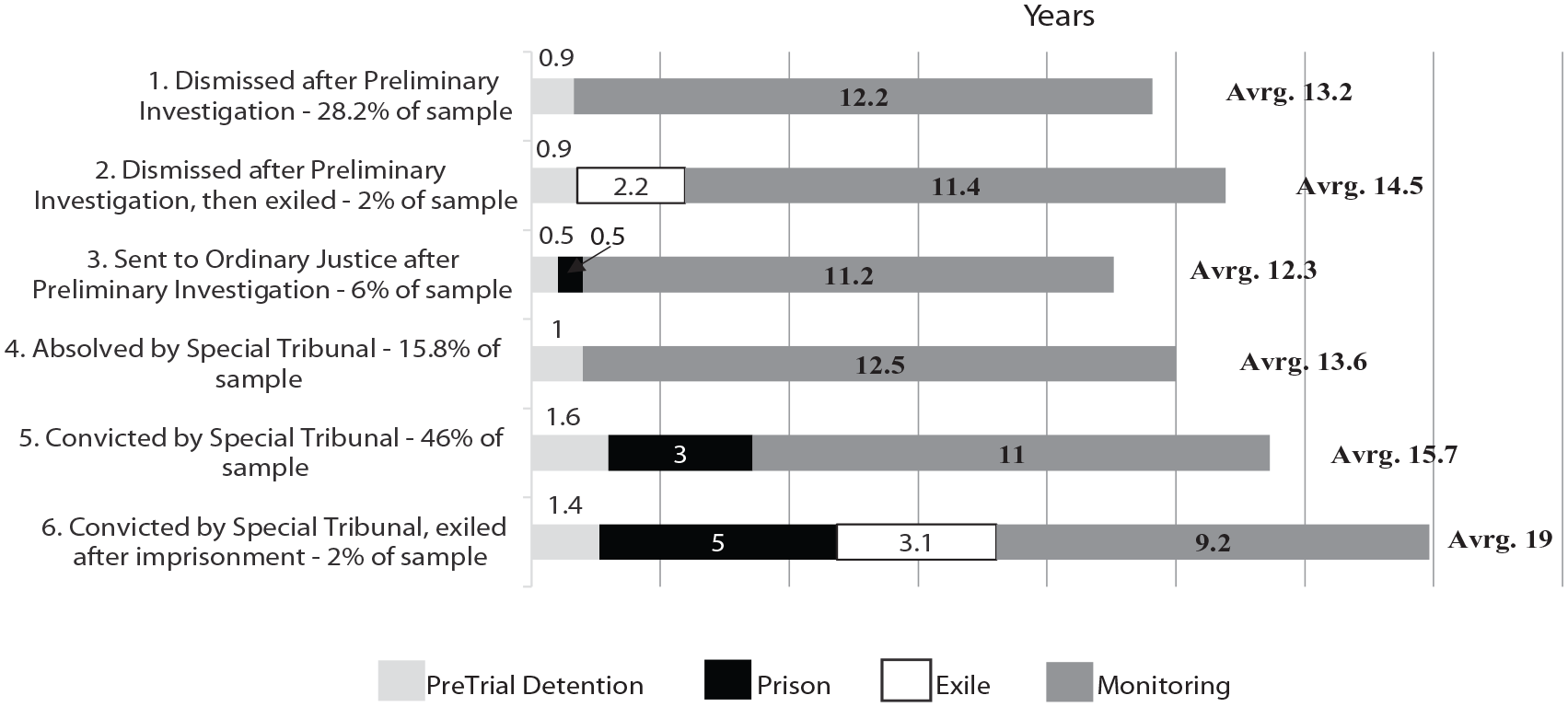
Duration of pre-trial detention, exile, imprisonment, and monitoring. 21 Data are organized according to different paths through the Special Tribunal system. Rows 1, 2, and 3 correspond to the milder sentences, whereas rows 4, 5, and 6 show the pathways of those sent to the Special Tribunal court.
Citizens were surveilled regardless of the crimes they committed or were accused of. Notably, 52% of people who were judged innocent, dismissed, sent to Ordinary Justice or absolved (rows 1, 2, 3, and 4) were subjected to a term of surveillance similar to that of those judged guilty and convicted. A large percentage of citizens whose cases were dismissed after pre-investigation were also surveilled (28.2% plus 2% that had to endure exile). Furthermore, even people convicted by Ordinary Justice courts—that is people not convicted for crimes against the state (6% of cases)—were placed under surveillance. Finally, only 48 percent of the people surveilled by order of the Special Tribunal were convicted (rows 5 and 6).
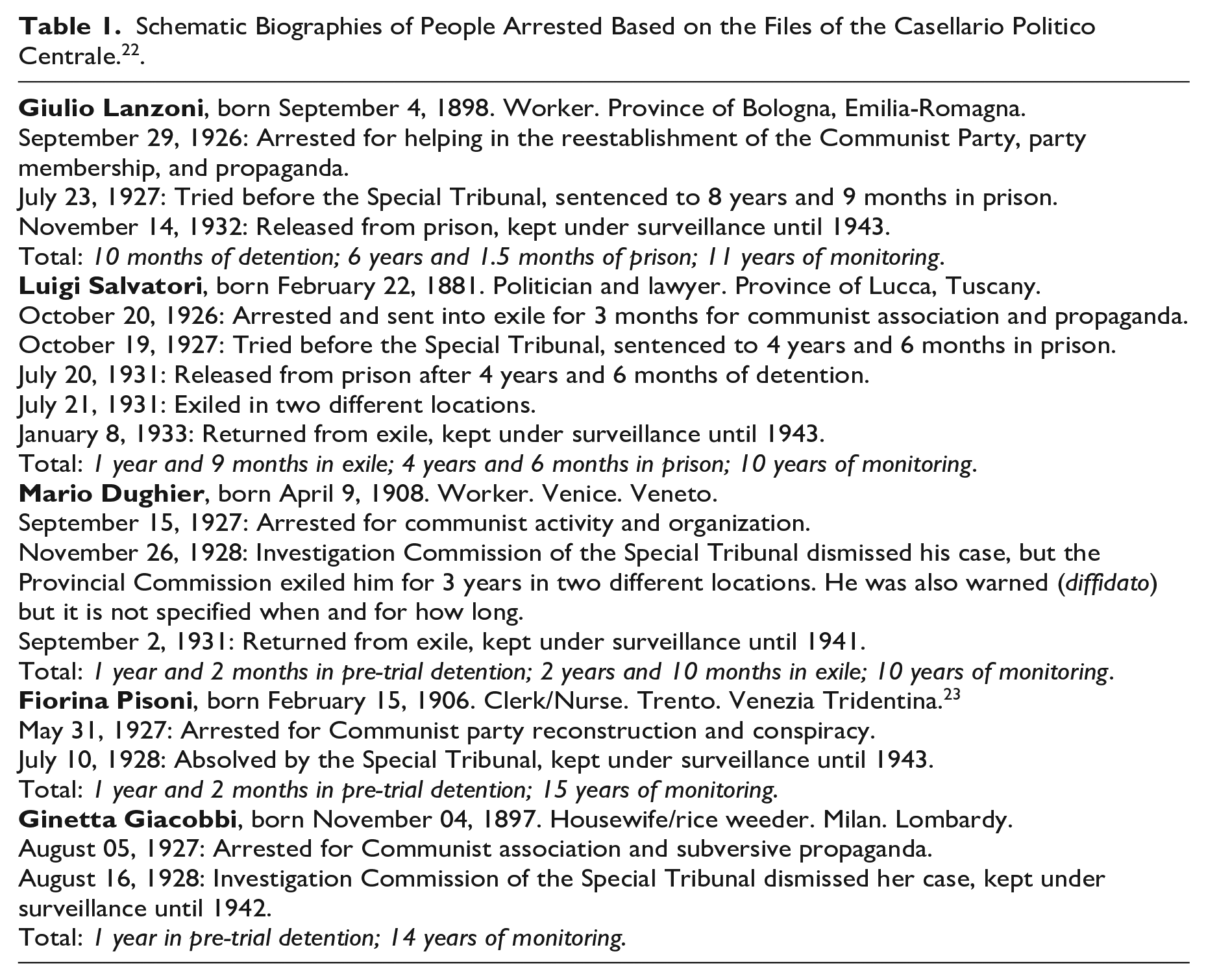
To give a better sense of how the Special Tribunal impacted the life of individuals, Table 1 traces the lives of five people (men and women) to highlight the range of outcomes as well as the length of time that passed between detention or arrest and the end of police monitoring. The majority of the subjects placed under surveillance were men (93.9%), a ratio similar to that of total arrests (93.7%). The average duration of surveillance was 10.8 years, similar for men and women (10.9 for men and 10.5 for women). 24
Schematic Biographies of People Arrested Based on the Files of the Casellario Politico Centrale. 22 .
Private diaries testify for the loneliness and suffering of the condition of people under surveillance.
[. . .] in 1931 I was released still very suffering [for the consequences of the torture]. I was under a special surveillance by police and by the fascist, I was alone without family, I suffered very much from starving even if some comrades at times found a way to reach me and help me, there was also a doctor (that died in a concentration camp in 1944) that treated me for free, with some medicines, and I got better.
25
In her seven-page memoir, Isolina Morandotti, a working-class woman and an active communist born in Milan in 1897, described her experience. Her stream-of-consciousness prose highlights her condition of suffering and isolation after detention. Previously, Morandotti worked secretly for the communist official newspaper l’Unità, which led to her arrest in 1927. She was imprisoned, tortured, and interned in a mental health institute until 1931. Once released, she remained under surveillance until 1943 when the fascist regime fell down.
Similar was the experience of Giovanna Zaccherini Alvisi, a communist activist arrested in October 1927. Liliana Alvisi was 11 years old when her mother was arrested inside their home. During the arrest, the police broke Giovanna’s arm in front of her daughter. Liliana collected and then transcribed her mother’s memories into a book. Liliana described the condition of her monitored mother:
The special surveillance exercised by the police on the offenders did not allow them to move outside the city [Bologna]; they were not allowed to get out their homes after 8 pm and every Sunday they had to go to the central police station to put their signature on the little book of surveillance. She was not allowed to frequent public spaces. However, my mother was sometime able to take a break and go to the movies, the “Roma,” a movie theater close to our home.
26
Giovanna was released in February 1929 and she remained under surveillance until 1942.
The Spatiality of Surveillance
The spatial analysis of the locations where the Special Police monitored the people involved in the activities of the Special Tribunal shows that the fascist regime implemented its system of surveillance across the entire country, rather than concentrating on areas where opposition was stronger. Surveillance patterns included areas larger than the ones interested by arrests.
From a territorial perspective, the activities of the subversives, especially those of communists, concentrated around the so-called “industrial triangle” Milano-Torino-Genova, in the North-East, in Emilia and Tuscany, in Rome, and in some part of Apulia in the South. These were also the areas where oppression reached its bloodiest levels during the first years of fascism, the so-called squadrismo period. 27 Indeed, clusters in Figure 2—which collects all data regarding surveillance—indicate a strong concentration of events in three areas: Turin-Genova, Florence-Bologna-Venice, and Milan. In the Rome region and in Apulia, the concentration of surveillance was more widespread.
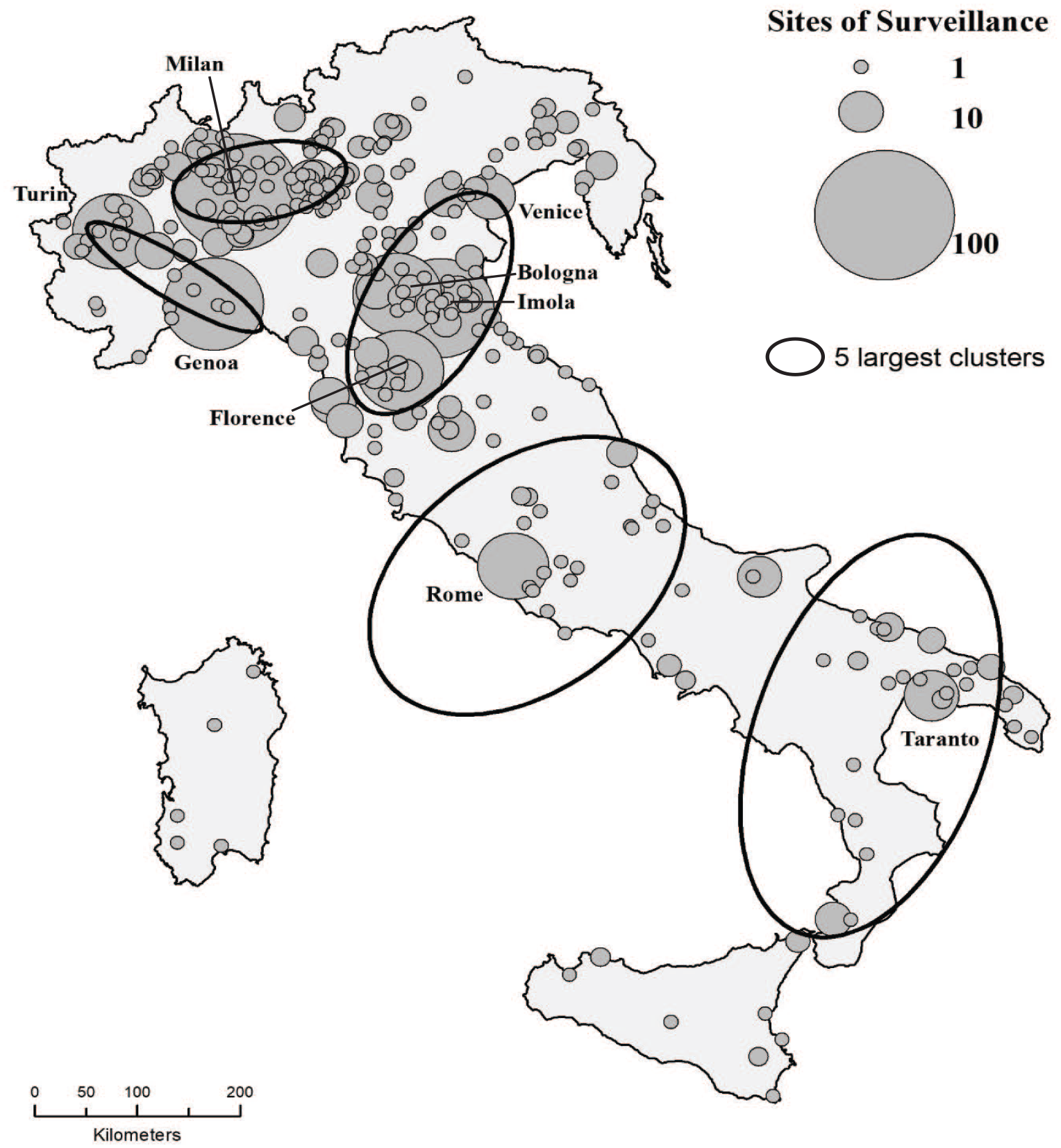
Sites of surveillance for the 940 people monitored after release, or dismissed by the Special Tribunal in 1926-1928. The dots indicate the residential addresses of the people monitored, and they are in proportion to the number of people monitored. The ellipses use K-means clustering to indicate a major concentration of surveillance. 28
Data are broken down on city-rural axes in Figures 3 and 4, which show that the police surveilled people along the entire peninsula, islands included. 29 Figure 3—collecting data only from city surveillance—shows that clusters of surveillance coincide with the same areas of Figure 2 (industrial triangle, Florence-Bologna-Venice, and Apulia). But Figure 4—collecting data only from surveillance in rural areas—shows that concentration was much more widespread across the Italian territory than previously thought. Actually, in Figure 4 new clusters emerge. A new North-Eastern cluster appears stretching from the industrial area of Milan, along the foothills line toward east, until the border with the Kingdom of Serbs, Croats, and Slovenes. In the South, clusters appear significantly different from Figures 2 and 3. One new cluster emerges, including Calabria and Sicily, an area where hostility against the regime was allegedly inconsistent. As expected, the other Southern cluster regards Apulia and Campania. These findings are in line with what Luciano Casali has argued, that dissent was more widespread in rural areas than previously thought. 30
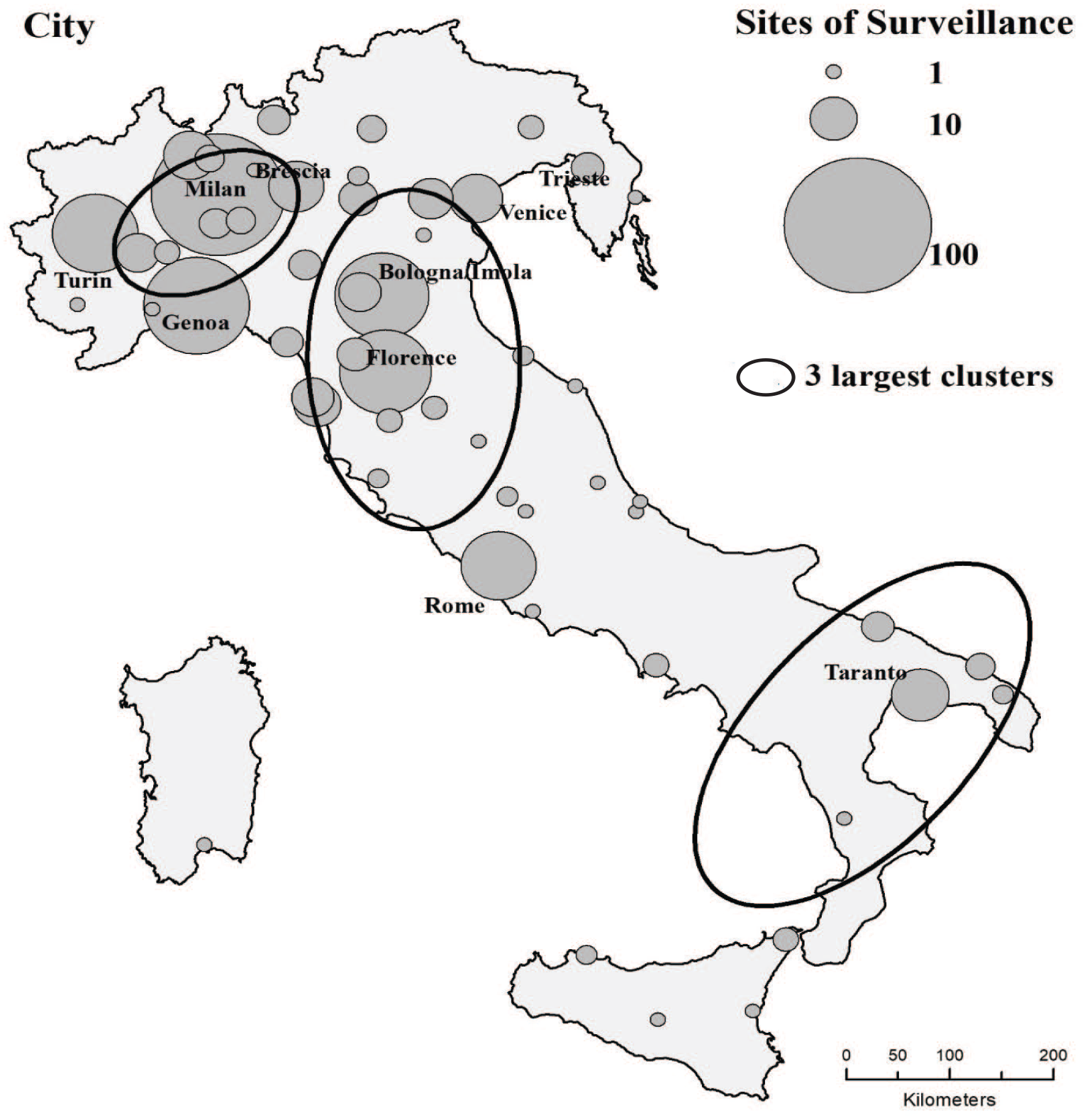
Urban context, cities of surveillance. The dots are in proportion to the number of people monitored. The ellipses use K-means clustering to indicate a major concentration of surveillance.
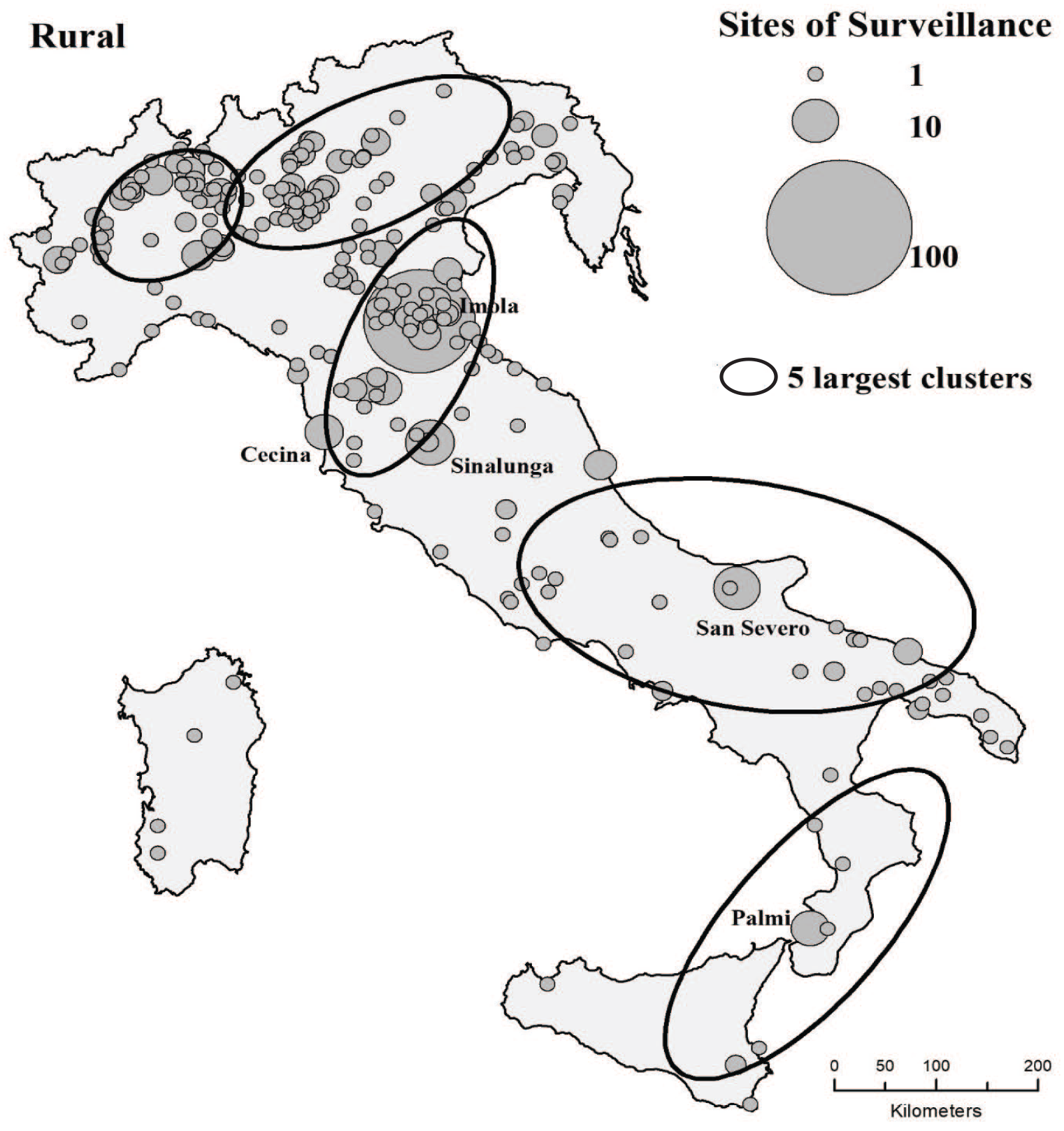
Rural context. The dots are in proportion to the number of people monitored. The ellipses use K-means clustering to indicate a major concentration of surveillance.
A comparison between sites of surveillance and sites of arrests confirms that the entire Italian territory was under surveillance and not just the areas where opposition was more active. In Figure 5a, dots show where people convicted by the Special Tribunal were arrested. Arrests were concentrated in the historical places of dissent. Figure 5b, however, shows that people arrested and then released, acquitted, or sent to Ordinary Justice were much more distributed throughout the peninsula. 31 Figure 5c, showing people surveilled after conviction by the Special Tribunal, and Figure 5d, showing citizens surveilled after arrest, dismissal, or acquittal by the Special Tribunal, also confirm this finding. Surveillance during fascism was unrelated to the Special Tribunal convictions. The Special Tribunal was an institution for repression and surveillance organized by the Italian fascist regime.
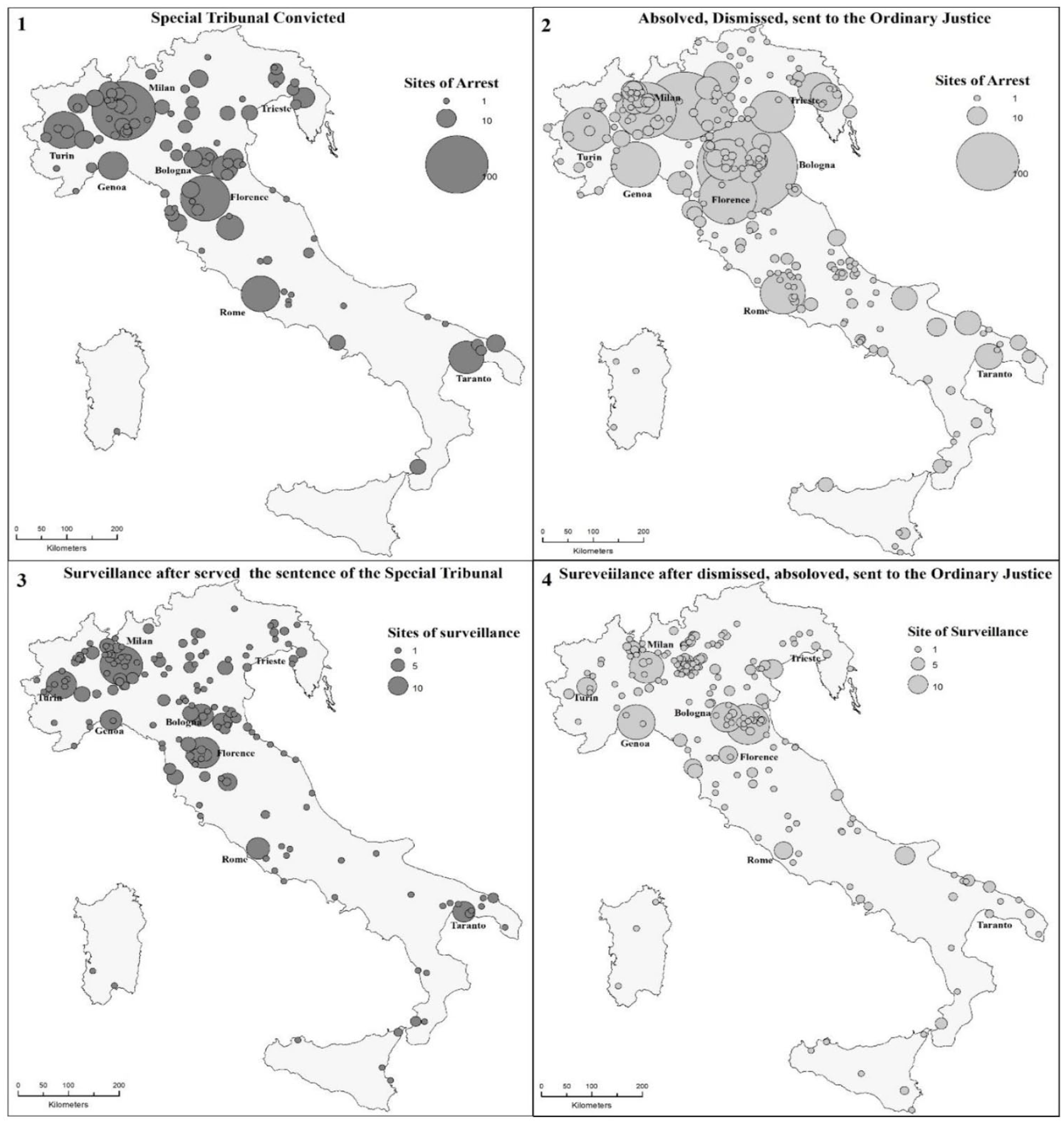
Maps 1 and 2: Sites of arrest of 2,400 people judged by the Special Tribunal in 1926-1928; Maps 3 and 4: Sites of surveillance for the 940 people monitored after released of dismissed by the Special Tribunal 1926-1928.
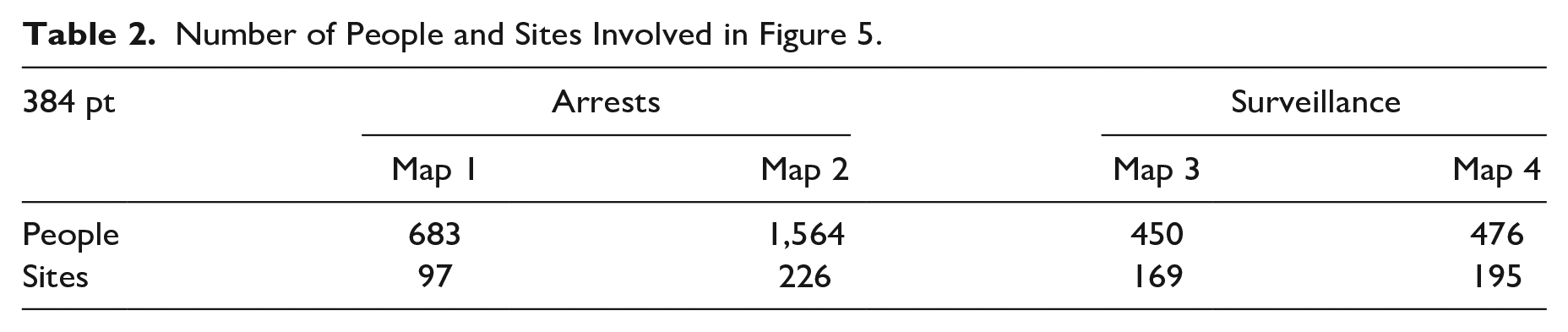
The network of surveillance across the Italian territory was capillary. Table 2 compares the number of citizens arrested with the number of citizens monitored and the number of sites of arrest with the number of sites of surveillance. It shows that surveillance sites were equal or slightly greater in number than places of arrest, despite the fact that the number of data collected for arrests was more than double (2,247) compared with data for surveillance (926). The number of locations surveilled greatly exceeds the sites of arrests.
Number of People and Sites Involved in Figure 5.
Conclusion
In this research, I use techniques drawn from Historical GIS applied to political surveillance in Italy during the rise of the fascist dictatorship in the 1920s using both qualitative and quantitative methods of analysis. The research moves between different spatial and temporal scales focusing the visualization of the geo-spatial arrests on the urban-rural axe as well as sites of arrest and sites of surveillance. These different levels of space are created by geo-statistical-visualization of data depicting how the fascist government created, and maintained, a repressive system. Through HGIS (Historical Geographical Information System), I was able to give a homogeneous dimension to different scales and an overall reading of the establishment of the authoritarian state in the geographical space since spatial visualization is intertwined with the temporal one. HGIS, therefore, combines geography and history, enabling a unitary analysis in space and time of an articulated historical event as the establishment of the Italian fascist dictatorship.
This study counters interpretations that consider Italian fascism as a mild form of totalitarianism. Following Hannah Arendt, Italian fascists were seen as less brutal than their counterparts in other countries. 32 A widespread view among historians deems that Mussolini was unable to achieve absolute power, that in contrast with Nazi Germany the fascist police failed to achieve total control, and the judicial system remained unchanged. 33 Moreover, the extent at which terror was used by the Italian regime was incomparable to the Nazi violence. To prove their interpretation, historians use the relatively little number of death sentences and of years of prison commuted by the Special Tribunal. 34
This study contributes to our understanding of the spatial and temporal dynamics of surveillance in the Italian fascist regime. In addition to squadrista violence and active repression, Italian fascists used administrative systems such as the Special Tribunal and the Special Police to control its political enemies and to surveil the entire society. The fascist government replaced its initial squadrista violence with an authoritarian state in which surveillance became one of the fundamental pillars of social control. Once arrested, people became trapped in this judicial system for years. Many of those arrested in 1925-1928 remained under surveillance until the regime collapsed. The lack of correlation between crimes, sentences, and the length of surveillance is striking. No matter what the crime or outcome of a case, those arrested spent years under surveillance. The arbitrary nature of the sentences and the lengths of surveillance maintained a sense of fear, isolation, even terror, among citizens.
Surveillance has largely been overlooked as an element of the Italian fascist regime. Alongside remarkable studies on the Political Police, and especially on the secret police, my research contributes studying the system of surveillance used by the Italian fascist regime made by the Special Tribunal and the Special Police. 35 My results resolve a previously unanswered question: what happened to people after their release by the Special Tribunal? Many were exiled, but many others just went home, often lost their jobs, and lived in social isolation. Until now, there had been no research concerning the nature of the ongoing relationship between these people and the Special Tribunal. This study fills the gap, uncovering a strong connection between life inside and outside the Special Tribunal expressed in terms of constant police surveillance.
Footnotes
Acknowledgements
I thank Kenneth Foote for his support on this project. I am also indebted to Alberto Giordano for helping me and to Barbara Splendore Di Gennaro for her robust feedback and editing.
Declaration of Conflicting Interests
The author(s) declared no potential conflicts of interest with respect to the research, authorship, and/or publication of this article.
Funding
The author(s) disclosed receipt of the following financial support for the research, authorship, and/or publication of this article: This study was supported by the Research Travel Award of the Department of Geography, University of Connecticut.