




Abstract
The “politics of infrastructure” reproduces inequality, leaving many urban residents without access to water, sanitation, and other basic services. Inner-city residents in Kingston, the capital of Jamaica, have long coped with poor drainage and waste collection that increases flood and health risks. Drawing upon a wide range of sources, this study examines how a system of patronage and partisan politics in Jamaica has helped to (re)produce this infrastructural deficit that has harmful effects on many inner-city residents, from independence in 1962 to the 2020 Atlantic hurricane season, the busiest on record. In doing so, it will enhance understanding of the nature of Jamaican politics at the local level, highlighting that politics of the Kingston and St Andrew Corporation (KSAC)—the municipal council—was marked by a continuous interaction between citizens, councilors, MPs, and civil servants, and that short-term jobs and contracts were the most important avenues of patronage
In the last few decades, an “infrastructural turn” has taken place in urban studies, which views infrastructure as a “complex assemblage of both the social and technical/material,” 1 and uses it “as a critical object of analysis to think through the politics, ecology, social relations and everyday experiences of urban life.” 2 This body of work has shown that the rules, practices, and politics of infrastructure reproduce inequality as they leave many urban residents without access to basic services but also that the material organization of infrastructural networks both reflects and reinforces social orders. 3 Inner-city residents in Kingston, the capital of Jamaica, have long coped with poorly maintained gullies and drains that cause many houses to flood during heavy rains. And they also experience a poor or even absent waste collection service. This causes many inner-city residents to dump uncollected waste in gullies—adding to the risk of flooding—or to burn or bury it, which increases health risks as it causes groundwater, soil, and air pollution and uncollected waste also attracts vermin and can collect water and thus become breeding sites for mosquitoes. This study examines how a system of patronage and partisan politics in Jamaica has helped to (re)produce this infrastructural deficit that has harmful effects on many inner-city residents, from independence in 1962 to the 2020 Atlantic hurricane season, the busiest on record. In doing so, it adds to the “infrastructural turn,” which has increasingly focussed on cities in the Global South but has largely ignored the Caribbean and has also been more concerned with contemporary than with historical urban infrastructures.
Traditional accounts of urban politics have largely ignored infrastructures or treated them as a backdrop. 4 The increasing number of studies that focus on the “politics of infrastructure” have shown that a focus on infrastructure can provide a greater understanding of how urban politics works and how it shapes everyday urban life. 5 Like most other former British Caribbean colonies, after independence Jamaica became a patronage democracy—a democracy in which “citizens, especially those in lower-income groups, are integrated into politics through clientelistic relationships with their political parties.” 6 In return for their support for one of the two parties—the Jamaican Labour Party (JLP) or the People’s National Party (PNP)—low-income groups received jobs, houses, and other benefits, while other supporters were rewarded with contracts and other material and immaterial goods. 7 Clientelism in Jamaica is part and parcel of the fierce competition between the two parties, which started with clashes during the first election held under universal suffrage in 1944 that led to the deep identification of Jamaicans with one party or the other, and has often resulted in political violence.
While local government has always been a bastion of patronage, 8 existing scholarship on patronage and partisan politics in Jamaica, like that of politics in former British Caribbean colonies more generally, has largely ignored governance at the local level. And it has also been more concerned with political violence, which peaked during the 1980 general election when more than 800 people died, and the links between politics and organized crime than with the more everyday ways in which patronage and partisan politics has affected the lives of Jamaican citizens. 9 Drawing upon a wide range of sources, including reports in the Gleaner, Jamaica’s biggest-selling newspaper, this study’s examination of the ways in which patronage and partisan politics in Jamaica has contributed to poor waste collection and drainage maintenance in Kingston’s inner-city communities will enhance our understanding of the complex and intricate connections between local and central government in Jamaica.
More specifically, this study will highlight that politics of the Kingston and St Andrew Corporation (KSAC)—the municipal council—was marked by a continuous interaction between citizens, councilors, MPs, and civil servants, and that short-term jobs and contracts were the most important avenues of patronage. 10 In the two decades following independence, Kingston’s MPs and councilors used state resources to reward inner-city clients with jobs, contracts, and other benefits. But this changed in the 1980s with the onset of the Structural Adjustment Programs (SAPs) imposed by international lenders, which stipulated free market programs and a reduction in fiscal deficit. The SAPs led to fiscal austerity which limited the amount of money available not only for public services, including drainage and waste collection, but also for short-term work programs and other traditional patronage sources. Kingston’s MPs and councilors from then onwards came to rely even more heavily on “criminal Dons”—neighborhood leaders linked to the drug trade—both to provide patronage resources and act as brokers between themselves and their inner-city clients. 11 Or as the political scientist Michael W. Collier has argued, the “alliance of drug dons and political dons” provided the political system with “a lucrative source of patronage benefits” and the political dons became “go-betweens,” disbursing “resources obtained from the drug dons as part of the normal political patronage system.” 12
The remainder of this article is divided into four sections. The first provides a brief overview of drainage and housing in inner-city communities. The second and third sections examine, respectively, poor waste collection and poor drainage maintenance in inner-city communities over time, while the final section summarizes how patronage and partisan politics has contributed to this infrastructural deficit. Before outlining drainage and housing in Kingston’s inner-city communities, a brief note is in place about the term inner-city communities. This term refers to low-income communities in or bordering the urban center and on the periphery of the city. These communities are marked by violence, low levels of education, high population densities, poor service provision, and high unemployment but they differ considerably. Some, for instance, have a relatively high level of home ownership and active community organizations but renting and intra-community tension are common in others. Furthermore, some communities are located close to gullies or banks of rivers and thus at risk of flooding, but others are not, especially many informal settlements on the periphery of the city. And the communities also vary in terms of housing. Self-built homes are common in informal settlements and range in quality from poorly constructed to relatively sturdy. Public housing dominates in inner-city communities in the more central areas. Much of this housing stock was built in the 1960s and 1970s and is now quite run-down but structurally robust.
I
Gullies resemble large ditches and are usually dry except after heavy rain. They are formed naturally because of a fast-flowing stream but can also be man-made. Together with drains in roads, gullies are the main lines to quickly channel rainwater. Today, there are more than fifty mostly man-made gullies in Kingston (see Figure 1), a city of some sixty to seventy square miles with a population of 592,000, 13 but which the exception of a recent article by Rivke Jaffe and Lucy Evans on how gullies have been imagined in literature, music, and visual culture, they have largely been ignored by scholars. 14 Gullies run along an east-to-west axis, starting at the foot of the hills that surround the city and ending in the harbor. 15 Following storms in 1933 that caused major damage to the gullies and which killed an estimated fifty people, many gullies were paved and underground drains were installed. 16 The risk of flooding in the city increased in the decades preceding independence as a result of deforestation in the hills and urbanization. As houses and roads in the city increased, more ground was covered in concrete and asphalt and as a result more rainwater was forced to run off and settle in low-lying areas, where most inner-city communities were located. 17 To reduce the risk of flooding, various drainage projects were undertaken in the 1950s and 1960s, including the extension of the Sandy Gully—the gully that drained most of the flood water from the city. 18 But gully and drain building failed to keep step with increased urbanization. For example, the McGregor Gully was built in 1955 but by the early 1970s it already regularly overflowed because of increased surface run-off caused by the building of numerous houses and businesses in the area. 19 During tropical storm Gilda in 1973, for instance, sixty people living along the gully had to be airlifted when a gully wall collapsed. 20
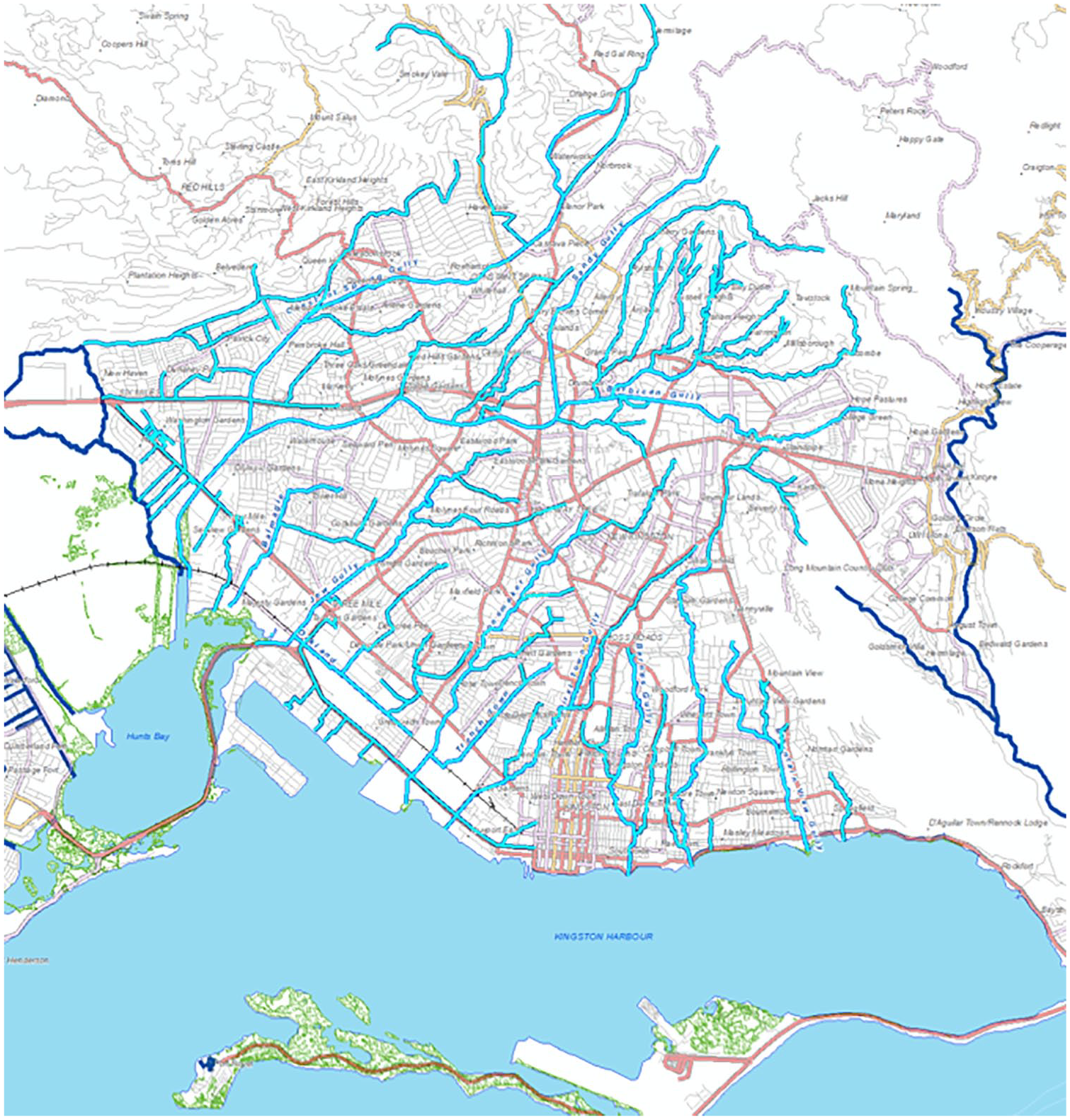
Gully map of Kingston, 2021.
Poor planning goes some way to explain why many houses and other buildings were built close to gullies in the first decades following independence. The Government of Jamaica (GoJ) and developers acquired land for new housing projects when and where it was available, without paying much attention to how building would affect patterns of drainage. 21 For example, in the early 1960s, new housing projects were developed in, among others, Duhaney Park and Harbour View but soon after they were completed roads and houses started to flood during storms because of a lack of channels to lead storm water into nearby gullies. 22 Soon after independence, the role of the KSAC in planning was eroded. The Town Planning Authority (TPA), which fell under the Ministry of Mines and Natural Resources, had responsibility for physical planning in Jamaica. Local planning authorities had to refer planning applications to the TPA, which delegated its functions to the Town Planning Department (TPD). The KSAC was the local planning authority but its role in planning was undermined by the TPD, which issued urban “development orders” that could foster or block growth in certain areas, and regularly “called-in” areas, meaning that they were removed from the control of the local authority. 23
In 1987, central government removed all planning duties from the KSAC as part of a wider process of reducing the autonomy of local authorities and transferred it to the TPD. The KSAC’s planning duties were restored in the early 1990s. In 2001, the TPA merged with the Natural Resources Conservation Authority and Land Development and Utilization Commission to form the National Environment Protection Agency (NEPA), which focusses on environmental permitting and drafting development orders. Alongside NEPA, the Ministry of Local Government and the local authorities are now the main planning agencies, which liaise with a number of agencies regarding infrastructure for urban housing projects, including the National Water Commission (NWC) and the National Works Commission (NWA). 24 Since then the role of the KSAC’s building and town planning department has continued to be overshadowed by central government and this along with staffing capacity has limited its ability to enforce building regulations. 25 As a result of what the Interamerican Development Bank has called a “dysfunctional physical planning system,” 26 in recent decades much building has been approved in disaster-prone areas and little attention has been paid to drainage when authorities have given approval to new housing, industry, and road schemes. 27
But a lot of building in disaster-prone areas in Kingston never had any professional input as there has long been a very active informal sector providing housing to low-income residents. In fact, the number of informal settlements rapidly increased over the years, numbering nearly one hundred in 2008. 28 This rise largely reflects the lack of affordable housing in Kingston. Although not at the levels of the 1930s and 1940s when rural-to-urban migration was at its peak, many rural men and women moved to Kingston in the immediate post-independence period in search for work. Because of a lack of affordable housing, they rented run-down houses with few amenities in overcrowded areas, mostly in downtown Kingston; built their own homes on marginal land; or squatted in vacated buildings. 29 In the 1960s and 1970s, the JLP and PNP governments undertook not only new low-income housing projects but also public housing programs that cleared old housing stock in downtown Kingston and replaced it with new housing. 30 These houses were distributed on a patronage basis to secure votes and soon gave rise to garrison communities: communities where the majority of votes are cast for one of the two parties as a result of intimidation, coercion, and corruption, and which are ruled by Dons, supported by gangs, and aim to secure votes for politicians in return for favors. 31
In the 1960s and 1970s, the politically aligned gangs in garrison communities depended largely on arms and material resources from their political patrons. At a time when international lenders-imposed SAPs reduced the political patrons’ access to state resources, the Dons were able to access new sources of income, including the international drugs trade, extortion rackets, and construction businesses, which changed the relationships between Dons and politicians. According to Kevin Edmonds, the Dons became more autonomous and Rivke Jaffe has added that “their negotiating power vis-`a-vis politicians grew.” 32 In return for the Dons’ support, politicians have tried to shelter them and their gangs from the security forces. There are now nine garrison communities in Kingston, mostly located downtown and controlled by the PNP. 33 According to Amanda Sives, the “declining state resources” in the 1980s and 1990s led to “the partial replacement of the politician by the drug don,” who provides not just “material resources and opportunity to travel but also protection.” 34
Since the 1980s, government has moved away from providing finished housing to making it easier for poor households to obtain a mortgage from the National Housing Trust (NHT)—the main mortgage provider for low-income households—and for those living in informal settlements to acquire land tenure. Because many inner-city residents were not in formal employment, they could not obtain a mortgage from the NHT. 35 As such, they had little choice but to pay high rents for often poor-quality housing or build their own home on marginal lands and/or precarious sites vulnerable to hazards. For example, during tropical storm Gustav in 2008, various houses in informal settlements in the Hope River watershed area and the McGregor Gully were washed away, and in 2015, a major fire broke out at Kingston’s main dump causing massive smog that particularly affected the residents of Riverton Meadows, a largely informal settlement adjacent to the dump. 36
Many residents of informal settlements have tried to obtain land tenure because without legal title they struggle to access basic services. The NWC, for example, has long refused to connect households without land tenure to the water and sewer system, and because informal settlements have not been regarded as part of the municipal jurisdiction they have been routinely bypassed by waste collectors. 37 Some scholars have argued that such “deliberate targeting of infrastructural networks” constitutes “infrastructural violence,” as it marginalizes those left out and can also be “substantially deleterious.” 38 The failure to collect waste in informal settlements and poor collection in other communities has for many inner-city residents endangered their health and for those living close to gullies, also enhanced the risk of flooding. The following section will set out how patronage and partisan politics has contributed to poor or absent waste collection in inner-city communities.
II
Kingston’s gullies have always been dumping grounds for waste. Middle-class commentators have blamed inner-city residents for the state of the gullies. In 1976, for example, Mayor Ralph Brown (PNP) referred to them as “dirty people with dirty minds.” 39 And not so long ago, Gleaner reporter André Wright proposed “behaviour modification programmes” for inner-city residents to address the city’s waste problem. 40 But inner-city residents themselves have blamed the waste services for the state of the gullies. One resident living near the Sandy Gully, for instance, told a reporter in 2018 that because “rubbish truck nuh [not] come, the people them throw things in the gully.” 41 Also it should be noted that, as Figure 1 illustrates, gullies run from the hills to the harbor. Many of Kingston’s wealthier communities are located in or near the hills. Their residents too dump waste in gullies but this affects them little as it streams down to the low-lying inner-city communities. The accumulation of waste and debris in low-lying areas because of the direction of the gullies and poor or absent waste collection has facilitated the marginalization of inner-city residents as they have become associated with dirt, as the quote by Mayor Ralph Brown illustrates. And this association does much to explain why many Jamaican politicians have ignored the welfare of inner-city residents.
As mentioned, most waste collectors did not consider informal settlements part of municipal jurisdiction so waste collection there has always been largely absent. 42 For instance, a 2008 study of 754 informal settlements across the island found that only 37 percent benefited from municipal waste collection and that the remainder resorted to open dumps and open burning. 43 For various reasons, waste collection in other inner-city communities has always been poor, leaving these residents also little choice but to dump or burn or even burry waste. First of all, many roads in these communities, especially those in the more central areas of the city, are too narrow for garbage trucks. Over the years, communal skips have been installed, often with international donor support, but not in all communities. And at times residents have set fire to skips when waste went uncollected for days to stop the smell. 44 For example, as part of the “Inner City Basic Services for the Poor Project,” which was funded by the World Bank and ran from 2006 till 2013, fifty-one skips were purchased for twelve inner-city areas but only thirty were installed because the “streets were too narrow” to place more. 45
Limited fleet capacity has also contributed to poor waste collection. Throughout the period under discussion, many trucks have always been out of service because of a lack of funding to repair or replace them. For instance, in 1969, there were fifty trucks but on most days more than twenty were out of service, and in the early 1990s, most of the time half of the fleet was out of service. 46 Limited fleet capacity and the difficulty of garbage trucks accessing certain communities do much to explain why today only 35 percent of inner-city households experience a weekly collection. 47 In other words, the material organization of Kingston’s waste infrastructure has mediated social outcomes. Irregular collection has affected inner-city households more than others. Many, for instance, have lacked gardens to store uncollected waste for several days. Also, because they have been unable or unwilling to purchase large metal bins, they have used milk crates, cardboard boxes, and other improvised waste receptacles, which have often not been deemed appropriate by waste collectors and thus been left uncollected. 48
And a final reason for poor waste collection in inner-city communities is violence. 49 In the 1960s and 1970s, political inter-community violence led waste collectors to avoid certain areas, or they could not enter certain areas. 50 For instance, in 1976, “tribal warfare” between politically aligned gangs in Rema (Wilton Gardens), a JLP stronghold, and in Concrete Jungle (Arnett Gardens), a PNP stronghold run by the Don “Red Tony” Welch, prevented for weeks the collection of waste in these and surrounding areas, including Jones Town, Rose Town, and Trench Town. 51 And around the time of the 1980 election in many parts of downtown Kingston, residents set up blockades to protect themselves against violence that impeded waste collection. 52 From the 1980s onward, there has been less political but more gang violence in Kingston but this too has at times proved an obstacle for waste collectors. 53 For example, when in November 2002 a shooting occurred in downtown Kingston that killed five and wounded thirteen, waste collectors avoided the area for several days, leaving garbage to pile up along the main thoroughfares in the area. 54 And in November 2019, waste collectors were reluctant to enter Riverton because of a flare-up of crime-related violence there. 55
Limited fleet capacity and lack of communal skips were largely the result of underinvestment in the waste service. Until 1985, the KSAC ran its own waste service—the Public Cleansing Department. On the insistence of lenders, the JLP government in the 1980s began to centralize and privatize public services on the grounds that delivery by local government was cost-ineffective and that centralization would allow for greater fiscal restraint. 56 So in 1985, waste collection in Kingston shifted to Metropolitan Parks and Markets (MPM), a limited liability company directly managed by the Ministry of Local Government, which merged in 2001 with other regional services to form the National Solid Waste Management Authority (NSWMA). All three waste services were mainly funded through local property taxes but because not all homeowners in Kingston paid these taxes—today it is less than 60 percent 57 —their revenue base was limited. 58 To purchase new trucks and make other investments, the three waste services, then, often had to ask central government for additional grants or loans. During economic downturns, central government often refused or did not award the amount requested. 59 Also up to 1985, when the KSAC ran its own waste service, the Minister of Local Government was less likely to honor requests for extra investment when the KSAC and central government were controlled by different parties, as was, for instance, the case in 1969 when the KSAC asked for J$150,000 but was given J$45,000. 60
Over the years, waste collection in Kingston has come to rely on private contractors. While the Public Cleansing Department used private contractors occasionally when there was a shortage of trucks or staff, MPM and the NSWMA largely used private contractors. 61 International lenders saw privatization of public services as a means to limit clientelism as it would reduce state resources available for patronage. 62 The use of private contractors for waste collection, however, has become an important source of political patronage. Before the NSWMA assumed control over waste collection in Kingston, contracts were not put to public tender—loose arrangements were in place and oral contracts were common. 63 Although the NSWMA has tried to follow clear procedures in the awarding of contacts with statements of volume, rates, and standards, it has been subject to investigations by the Office of the Contractor General (OCG) for irregular contracts, which have not only highlighted irregularities in the awarding of contacts, such as the use of non-registered contractors, but also the allocation of contracts on a partisan basis. For example, in 2005, the NSWMA hired for one of its collection zones a former general manager of MPM with ties to the governing PNP party and without going to tender. 64 And shortly after the JLP won the election in 2007, several contracts were ended and replaced by others. 65 Close connections between Kingston MPs and the chairman of the NSWMA have facilitated the allocation of contracts of a partisan basis. Chairman Alston Stewart, for example, admitted in 2005 that two leading figures in the JLP—Edward Seaga, MP for West Kingston, and Delroy Chuck, MP for North East St Andrew—regularly called him and that he would accept their recommendations and address issues they raised about collection in their constituencies. 66
According Michael W. Collier, “the manipulation in the awarding and financing of state contracts” is the “single greatest source of political corruption in Jamaica.” 67 Initially, businessmen and other middle-class community area leaders were rewarded for shoring up party support with contracts, and funds received from the awarding and financing of these contracts went into party coffers to support election campaigns. 68 Since the late 1970s and particularly with the onset of the SAPs, contracts have increasingly been awarded to the criminal Dons, who set up various front firms, including waste collection firms. 69 In recent decades, the GoJ has tightened up on corruption and now has a comprehensive anti-corruption model, which consists of a network of legislation and several anti-corruption bodies, including the OCG and the office of the Auditor-General, which are tasked to uncover government waste and fraud linked to political corruption. 70 But although it is now more difficult to circumvent the procurement system—for example, all bids over a certain amount need to be put out to tender—it is still possible. A common method used is the leaking of bid information by employees of government agencies to contractors so that they submit a tender closest to the estimated value of the project. And in certain instances, direct contracting is allowed, including for waste collection and some other work in communities controlled by Dons because their residents would not hesitate to use violence if a contract were awarded to someone other than the Don. 71 As regular waste collection is crucial for public health, contracts for certain collection zones, then, have increasingly been awarded to firms linked to Dons. Rivke Jaffe has shown in her work on Kingston’s garrison communities that waste collection is one of many benefits that Dons have come to bestow on garrison communities and one of several services they have taken over from the state. 72
Because of poor waste collection, many inner-city residents have ended up dumping waste in gullies. This practice would have posed less of a flood risk if gullies had been regularly cleaned, especially ahead of the hurricane season. The following section will show that limited resources did much to prevent routine cleaning and that gullies in some inner-city communities were cleaned and repaired more often than in others because of political biases.
III
Throughout the period under discussion, Kingston’s gullies and drains were not routinely cleaned, resulting in the build-up of waste dumped by humans, assorted debris flushed during flooding, and vegetation that naturally accumulates. For instance, in 1986, debris and waste that had been building up to almost five feet high had to be removed before a stretch of gully in West Kingston could be repaired. 73 A lack of funds and confusion about whose responsibility it was to clean gullies and drains largely explain the neglect of the city’s drainage system. The KSAC’s Public Cleansing Department was responsible for gully and drain cleaning, except for the Sandy Gully which fell under the NWA. 74 While MPM was supposed to take over all its responsibilities, gully and drain cleaning was not included in its annual budget. As such, the agency had to ask the Minister of Local Government for additional funds to carry out this task and such requests were not always granted, especially during the economic downturn of the early 1990s. In 1993, the Minister of Local Government decided to allocate money to the KSAC for gully and drain cleaning so that MPM could concentrate on waste collection. This seemed to be in line with local government reforms that promised the return of autonomy to local government but it was not a regular arrangement so in years following, the KSAC and MPM each denied responsibility for gully and drain cleaning. 75 Eventually, the KSAC assumed full responsibility but requests for funds to undertake this task were often dismissed or significantly scaled down, especially when central government and the KSAC were controlled by different parties. For example, in 2005, the JLP Mayor Desmond McKenzie requested J$50 million for gully and drain cleaning but the Minister of Local Government only granted J$14 million. 76
When undertaken, gully and drain cleaning was usually done as Christmas work. This tradition of handing out short-term employment over the Christmas vacation started in the 1930s as a means of unemployment relief. 77 Christmas work has continued up to today and provides for many inner-city residents an essential source of income. Initially, central government gave local councils a special budget for Christmas work, which they could spend as they saw fit. But soon government agencies, such as the NWA, were given funds for short-term projects during the Christmas vacation, including drainage work, and Christmas work was also incorporated into funds available for MPs to develop their constituencies. Already in the early 1950s, Christmas work was allocated on a partisan basis and since then has been a major tool used by politicians to get votes from lower-class constituents. 78
The allocation of Christmas work mirrored that of short-term employment on public projects. Councilors and MPs would tell grassroots party activists in their division or constituency what and how many jobs were available for Christmas work. They in turn would contact community area leaders and other “brokers,” including from the 1970s onward the Dons, and together they completed a list of names of people in the area that needed jobs. Councilors and MPs would then recommend these people to local or central government civil servants. 79 Civil servants were usually prepared to respond to these requests because many owed their position to an MP or councilor or would need them for promotion because the civil service itself was a basis of patronage, and the MP or councilor would also be able to pull strings for a family member to get a hospital appointment or some other benefit. 80
In their account of Jamaica in the 1970s, Stephens and Stephens have argued that workers in patronage jobs believed that the job was a “quid pro quo for previous party work” and that “thus no additional work effort” was needed to justify holding it. 81 A 1971 commission investigating the allocation of Christmas work by the KSAC concluded that “little meaningful work was done” on gully cleaning projects. 82 But there is little evidence that throughout the post-independence period drainage work allocated on a partisan basis was routinely of substandard quality because workers saw it as a reward from their patrons for their party support rather than work. It is questionable, however, whether gully cleaning undertaken as part of Christmas work did much to avert flooding, considering it was carried out over a very short period.
To gain party support but also to remedy the neglect of drainage caused by an underfunded KSAC, Kingston’s MPs have over the years used funds that central government has made available to them for constituency work on gully and drain cleaning. In the 1970s, the PNP government set up the Special Employment Program (SEP), which provided work for the unemployed, including gully and drain cleaning over the Christmas vacation. Although attempts were made to allow both parties to recommend workers for SEP projects, most work was allocated to people recommended by ruling-party MPs and councilors. 83 The JLP strongly condemned the allocation of work for SEP projects but did not abolish the SEP when it assumed power in 1980. As Stephens and Stephens have argued, doing so would have been “politically very costly,” as JLP supporters expected a return for their party support after the election victory. 84 In fact, the JLP government increased the resources available to MPs to “buy” the loyalty of their lower-class constituents when it set up the Local Development Fund (LDF) in 1985. 85 Under the LDF, each MP was allocated a sum of money which they could spend at their own discretion and was used by many for gully and drain cleaning. 86 When the PNP took office in 1989, it further increased MPs’ patronage resources by setting up the Social and Economic Support Program (SESP), which aimed to provide a safety net during the economic downturn. 87 Although the SESP could be used for a wide range of purposes, most MPs used it for short-term employment, including gully and drain cleaning. 88 In 2008, the JLP government merged the SESP and LDF into a Constituency Development Fund (CDF) to be used for human and infrastructure development projects. Because the JLP had campaigned on an anti-corruption platform, it was decided that CDF money would not be directly allocated to the sixty MPs but that they would have to submit proposals to be scrutinized by a bipartisan parliamentary committee, and they would have to submit project reports to ensure transparency. 89 Many of these safeguards against partisan allocation, however, were never fully implemented so that the CDF has become a major source of party political patronage. 90
Gully and drain cleaning, then, was largely a political act that served to bind citizens to politicians—offering work to some and removing waste and debris that put a neighborhood at risk of flooding. Because it took place over a short period of time during the Christmas vacation, much waste, debris, and vegetation built up in the months leading up to the hurricane season (June-November), and this could necessitate emergency cleaning ahead of a storm. Because of limited funds, decisions had to be made where emergency cleaning was to take place, and these were influenced by party politics. Constituencies and divisions in the KSAC with an MP or councilor from the ruling party were more likely to be chosen than others. 91 Opposition MPs and councilors regularly complained about this. In 1999, for instance, some opposition councilors thought it was pointless to submit a list of gullies and drains in their division that needed emergency cleaning when it was obvious that ruling-party divisions would be selected. 92 And in 2014, when the KSAC was controlled by the PNP, JLP councilors claimed that most money for drain cleaning had gone to PNP divisions and that only six of its fifteen divisions had been cleaned. 93
If it was already difficult to find funds to routinely clean drains and gullies, it was even harder to obtain funds for essential repairs or to change the course of gullies, necessitated by increased urbanization, especially following the SAPs, when the GoJ spent much on debt servicing, leaving less for infrastructure and social services. 94 Failure to repair minor breaches in gullies often caused significant damage during a storm, necessitating large funds for major repair. For example, following hurricane Gustav in 2008, the NWA, supported by the Caribbean Development Bank, spent J$2.4 billion—the same amount as the total annual CDF budget—on repairing parts of the Sandy Gully. It had planned to undertake further work but its budget, set by central government, did not stretch that far. According to the NWA, this explained why during hurricane Nicole in 2010, a gully wall collapsed that killed six people. 95 This is a clear illustration how the materiality of Kingston’s drainage system has mediated social outcomes.
Because gully and drain repair work was done on an ad hoc basis, reliant on external funding or driven by emergency, it usually required short-term labor and short-term contracts, especially for construction companies. This made it, according to one commentator, an “incomparable source of patronage.” 96 Across the globe, construction has always been one of the most corrupt sectors because projects are complex—involving multiple sub-contractors, suppliers, and workers—and the industry relies heavily on cash because of the type of workers employed and because companies want to avoid tax. 97 In the mid-1970s, the PNP government embarked on a project to repair various gullies damaged by tropical storm Gilda in 1973 and handed this work out to party activists, many of whom were well-known “gunmen”—a local term for gangsters—including “Red Tony” Welch and Dennis “Dasheen” Grant, who were given contracts for the Sandy Gully. 98 Prior to the 1972 election, the party had particularly attacked the JLP government on the issue of corruption, whether the allocation of public housing in West Kingston to party supporters or the corrupt use of office for personal financial gain. 99 Yet when it was in office, it reinforced rather than combatted a culture of corruption as work on the gullies illustrates. 100
In 1975, the KSAC awarded two contracts to repair the flood damage of the Lilford Gully to the gunman George Spence, better known as “Feather Mop,” who had played an important role in the PNP election campaign in West St Catherine. In June 1975, the town clerk from the KSAC showed that “Feather Mop” was paid nearly twice the amount for the work done. A criminal investigation followed, leading to the immediate dismissal of two KSAC officials. But before the investigation was concluded, “Feather Mop” was fatally shot. 101 Work undertaken on the McGregor Gully in Vineyard Town illustrates even more clearly that during the PNP’s time in office in the 1970s, fraud and corruption in drainage projects were for party and personal gain but also benefited the mass of lower-class constituents. When during the first six weeks of the three-year project already J$1.9 of the J$2 million budget had been spent, Ted Ogilvie, the permanent secretary in the Ministry of Construction that oversaw the project, became suspicious. In June 1976, he called Weston Dyer, the superintendent, for a meeting and asked to see a full list of contractors. Based on this and other evidence, Ogilvie stopped all payments in December so that a full investigation could be carried out. Six months later, however, he was fatally shot by two gunmen. 102 In June 1979, Dyer and two other Ministry of Works officials went on trial for several accounts of fraud. Dyer was found guilty and sentenced to twelve months’ imprisonment with hard labor. 103 A year later, he was charged with Ogilvie’s murder. Witnesses stated that he had said that Ogilvie had to die because he “stopped money from flowing,” and that two of his men had said “is a right boss, we’ll take care of the job.” 104 These two men were also charged with the murder but fled Jamaica. 105 Dyer was found guilty of conspiracy and incitement to murder and sentenced to ten years imprisonment with hard labor. 106
During the McGregor Gully fraud trial, it was revealed that 200 of the nearly 600 work and other contracts had violated the rules for procurement and that numerous forged checks had been issued, amounting to a total value of J$970,000—nearly half of the original budget. Through the irregularity in contracts and forged checks, Dyer was able to enrich himself and benefit lower-class constituents in Vineyard Town. For example, he let his right-hand man, Winston Reid, cash forged checks and then shared some of the proceeds with him. And he also issued checks to unemployed local youth. The election victory in 1972 and the imposition of a levy on foreign mining companies in 1974, which increased state resources, had fuelled poor urban youth’s sense of entitlement to political handouts. 107 Also by 1976, Jamaica experienced an economic crisis caused largely by a decline in tourism and mining, major contributors to the island’s GDP, and there was also an increase in violence—both political and gang warfare—that spread beyond garrison communities. 108 This explains why many unemployed local youth regularly turned up to the gully site asking for work and why Dyer was so quick to issue them with checks. But the numerous irregular contracts also served to shore up support for the PNP and increase its coffers. Dyer issued contracts to people on a list provided by Colin Campbell, a special assistant to the Prime Minister, and which included names recommended by PNP MPs and councilors. 109 Dyer, then, was both a broker for and client of his political patrons.
Although not to the extent of the 1970s, when a democratic socialist agenda fuelled an extreme sense of entitlement amongst the urban poor for party benefits, many inner-city residents have continued to see gully work as a means to make a living. In the 1990s, for instance, gully maintenance work was often hindered by large numbers of locals turning up to sites and demanding work and at higher rates than workers already employed. 110 And while the rules for procurement have been tightened up in recent years, they have not prevented irregular contracts for drainage work. In 2011, an OCG investigation concluded that a large number of contracts for drainage work in Kingston issued between 2006 and 2010 were given to a fake contractor, who had acted as a front for some councilors and a KSAC official. 111 And in 2016, the OCG investigated an island-wide debushing and drain cleaning program after the opposition claimed that this J$600 million program was a vote-buying exercise because it was carried out just before the local elections and no approval had been sought from the House of Representatives. By claiming that it was an emergency program to prevent flooding during storms, the JLP government was able to not just circumvent the House of Representatives but also directly appoint contractors. The OCG, however, found that emergency procurement processes were not properly followed. For example, not all contractors were on the list of the National Contract Commission and some money was unaccountable, particularly that used for “facilitators,” who paid the workers and had been recommended by three ministers. 112
Entrenched corruption and the reliance on patron-client networks for welfare contributed to the risk of flooding in some inner-city communities. For example, communities with an MP or councilor from the ruling party were more likely than others to have their drains and gullies cleaned over the Christmas vacation or ahead of a storm and to be singled out for major gully repairs. And as drain cleaning and repair work was largely allocated as Christmas work, only small projects were undertaken, which often necessitated the need for more substantial drainage repairs in future. To undertake such repairs, government had to rely on international donors and lenders. It could be argued that if contracts for drainage works had followed the procurement rules, government would not have had to rely as much on external support and thus increase its debt, which affected the delivery of public services and goods.
Jamaicans have had no illusions about political corruption. For example, 84 percent of an island-wide sample in 1978 agreed that there was corruption in government, and 62 percent in an island-wide sample in 2016 believed that “more than half” or “all” public officials were involved in corruption. 113 Yet while many deplored such actions, they still looked to their MP and councilor for short-term work and, as Carl Stone has argued, to “deliver miracles,” such as preventing their community from being flooded. 114 During election time, Kingston MPs and councilors often promised to reduce flooding and some even used their constituency funding for gully and drain cleaning ahead of an election. Yet once elected they often ignored the state of the drainage network, especially in safe constituencies, including garrison communities. Take for example, St Andrew South West, which includes some of the most deprived communities and has been a very safe PNP constituency—in 2020 MP Angela Brown-Burke was re-elected with a 90.3 percent majority. 115 In March 2001, when after several complaints about flooding the NWA finally began to clean their “garbage-chucked” gully, residents from Majesty Gardens told a Gleaner reporter that they hoped “this is not an election thing. We hope they do the job properly and not half-way.” But it was not done properly so that in November 2001 the gully overflowed, and many houses were flooded. When tropical storm Isadore hit the island in September 2002, another twenty-five houses in this St Andrew South West community were flooded. The MP for the area—Portia Simpson-Miller—visited Majesty Gardens and handed out food parcels but did nothing to address the causes of the repeated flooding. 116 Residents from the Bottom Back-To area have felt similarly neglected by the St Andrew South West MP. In October 2020, after yet another storm that caused heavy rainfall, one complained that “every time the rain falls, the water comes over high from the gully. See it here, every house around here flood out. The MP knows about it but nothing nuh come out of it. Is a long time this stay so.” 117 This quote and also the one above by residents from Majesty Gardens illustrates, as Rose E. Ficek has argued in the case of Puerto Rico after hurricane Maria, 118 that citizens can start to feel differently about the state when it fails to maintain infrastructures.
The inaction of their MP to address repeated flooding and other problems faced by the residents in St Andrew South West may explain why voter turnout in this constituency, like in many others, has steadily declined, from 58.6 percent in 2007 to 30.38 percent in 2020. 119 A 2020 report into the political culture of democracy in Jamaica, as part of the Latin America Public Opinion Project (LAPOP) at Vanderbilt University, found that across Jamaica political apathy has increased in recent decades, resulting in low voter turnout. The report concluded that this was “not surprising,” considering that “the fringes of the major parties have long been associated with political violence, and more recently with extortion, lottery scamming and other forms of criminal activities.” 120
Inner-city communities where drain and gully cleaning was not regularly undertaken, for reasons mentioned above, had little choice but to mitigate the risk of flooding by cleaning drains and gullies themselves. For example, in 1999, the Drewland Citizens’ Association, with a grant from the United Nations Development Programme’s Local Initiative Facility for Urban Environment, organized the clean-up of the Sandy Gully in their community, and in 2002, after they had repeatedly asked the KSAC to address the issue, several residents from Kingston Gardens removed waste that blocked the gully in their community. 121 Many studies on the politics of infrastructure examine urban infrastructure as a site of social struggle, focussing on activism and public protest to demand access to or better services. 122 While individual communities such as Kingston Gardens have at times asked the KSAC, their councilor, or MP for blocked drains and gullies to be cleaned, 123 there has never been cross-community protest about the state of gullies and drains even though most drains and gullies run through multiple inner-city communities, as Figure 1 illustrates. Patronage and partisan politics has limited such collective action because it promotes divisions. But it has also stifled protest in inner-city communities more generally because it has made many residents reliant on work, benefits, and other handouts by politicians, creating what some scholars have called a “dependency syndrome.” 124 It has been argued that in the absence of a comprehensive social welfare system, patronage politics in Global South countries like Jamaica benefits the poor, providing them with services that they otherwise would not get. 125 But scholars agree that patronage politics has mostly negative implications, particularly for the functioning of democracy. The dependency on political patrons limits the exercise of citizenship rights as poor voters are obliged to give up some of their political rights by accepting benefits and less likely to protest or hold politicians and parties to account. 126
IV
Like many other Caribbean islands, Jamaica has been experiencing more frequent and more intense natural disasters. Hurricane Ivan in 2004 was one of the worst, killing seventeen people and causing US$575 million in damage. 127 Kingston was particularly badly affected when many areas flooded. In the aftermath, proposals were made for no-build zones in flood-prone areas but it took until 2018 before such legislation was adopted. 128 Some of the most flood-prone areas are informal settlements, which have declared allegiance to one of the two parties in return for benefits, including access to some basic services. 129 To date no informal settlement has been declared a no-build zone because politicians fear that relocating the residents will cost them votes. 130
The failure to declare no-build zones in flood-prone areas is an extreme example of how Jamaican patronage and partisan politics has exposed Kingston’s inner-city residents to flooding. The foregoing has focussed on the more everyday ways in which it has affected the risk of flooding in inner-city communities located close to gullies. It has highlighted that gully and drain maintenance was both patchy and ineffective. Gullies and drains were not routinely cleaned but they were more likely to be cleaned in communities supportive of the ruling party than in others, highlighting that the materiality of Kingston’s drainage system helped to create and/or sustain inequalities. Because central government and the KSAC changed, an inner-city community could experience a relatively well-functioning drainage network for five years but more blocked gullies the next. How often gullies and drains were cleaned in a community depended also much on the MP. If an MP was not guaranteed the votes for re-election, they would be more likely to spend part of their constituency funds on gully and drain cleaning. Also, when gully and drain cleaning was undertaken, it was not always very effective because it was usually done over a short period of time—during the Christmas vacation—and often too far ahead of the hurricane season.
Gullies connect uptown and downtown Kingston because they flow all the way from the wealthier areas in the hills through to low-income communities downtown and end in the harbor. But they also disconnect the two areas as they “dump” much waste in downtown neighborhoods which along with poor waste collection has allowed for the association of downtown residents with dirt. Poor waste collection in inner-city communities was closely related to patronage and partisan politics. In the 1960s and 1970s, political competition between communities at times escalated into violence hindering waste collection. Since then, flare-ups between different criminal factions in certain inner-city communities have occasionally prevented waste collection. And like contracts for gully and drain repair works, contracts for waste collection in Kingston have been marked by fraud and corruption. The money siphoned off from partisan contracts could have been used to improve the drainage system or purchase more garbage trucks to allow for more regular waste collection. This is not to deny, however, the real difficulties faced by the GoJ in recent decades in investing in drainage infrastructure and waste services, largely because of the insistence of international lenders that it reduces public debt.
Kingston represents a significant proportion of the Jamaican electorate—the city delivers thirteen of the sixty-three MPs—and offers most of the resources for the parties, including manpower, money, and social connections. Along with the shift toward neoliberalism, this helps explain why from the 1980s onwards central government removed waste collection from the KSAC and asserted more oversight over planning and gully and drain cleaning in the capital. 131 This reduction in local autonomy enabled the ruling party to use state resources to invest in areas where its vote was the least secure or withhold it from those held by the opposition. It, for instance, allowed for more regular waste collection in some communities and made it possible for the ruling party to refuse or scale down the KSAC’s requests for funds for drain and gully cleaning when the municipal council was controlled by the opposition party.
The KSAC’s dependency on central government and the underfunding or even removal of its services, as in the case of waste collection, has limited its ability to maintain gullies and drains and to keep the city clean, and this has impacted its capacity to gain the respect of residents, as reflected in low voter turnout for KSAC elections. 132 But the KSAC has not only become more dependent on ministries and government agencies. Starting in the 1970s, central government made more funds available to MPs to develop their constituencies. As a result, drain and gully cleaning along with other development projects in Kingston have come to rely largely on MPs, especially those from the ruling party as they have always benefited more from these funds.
This study of the politics of waste collection and the maintenance of the drainage system has shown, then, that dependency has been a key feature of governance in post-independence Kingston. The KSAC became more dependent on MPs and government ministries and agencies to develop the city, while many inner-city residents were reliant on short-term work and other benefits from their MP or councilor to make ends meet, and many politicians were willing to dole out these benefits because they depended on their vote for re-election. This dependency is one of the main obstacles to address not just the infrastructural deficit discussed in this article—poor gully maintenance and poor waste collection—but many other major problems facing Kingston’s inner-city communities and the city more widely, including crime, poverty, and increasing droughts. When politicians and citizens as well as central and local government stop seeing each other as patrons and clients, they can work together to devise solutions to these pressing problems.
Footnotes
Acknowledgements
I wish to thank Dr David Clayton for his insightful comments on this article.
Declaration of Conflicting Interests
The author(s) declared no potential conflicts of interest with respect to the research, authorship, and/or publication of this article.
Funding
The author(s) received no financial support for the research, authorship, and/or publication of this article.
