




Abstract
During the 1950s and 1960s, the Netherlands experienced a rapid growth in car ownership. Dutch planners and politicians soon realized that this growing automobility would radically transform the living environment, daily commute, and consumption behavior of millions of people, in particular of those living in or near large conurbations. By investigating how professional and political elites perceived increasing automobility, and how their responses subsequently affected urban planning in the Netherlands, this article offers a comprehensive and multifaceted narrative of the dawning of the Dutch motor age. I demonstrate how the gloomy and fearful predictions of planners and traffic engineers working in the 1960s foreshadowed a wider discontent with car-centered planning. Their engagements with local officials and urban action groups led to planning compromises I describe as a form of “gentle modernization,” typical for a country which has always opted for a cautious approach to modernity.
Introduction
“The main issue is that the right to have access to every building in the city by private motorcar, in an age when everyone possesses such a vehicle, is actually the right to destroy the city.” 1 Writing in 1963, American urban historian Lewis Mumford was alarmed by how rapidly Western European cities were giving way to the car. Responsible for this radical urban change was the long and unexpected economic boom of the 1950s and 1960s, which was nearing its climax when Mumford made his observations. To accommodate the growing number of cars, numerous Western European cities and towns considered the redevelopment of their central districts. While Mumford is seen as a fierce and foresighted critic of the car-centered city, his gloomy and fearful predictions were shared by many of his contemporaries, even his adversaries. He pointed toward a mindboggling dilemma for planners working in the postwar period: how should they plan for an urban future with full car ownership, when this same future threatened the very existence of the city’s physical and social fabric?
Throughout the Western world, the answer to this question came in many shapes and forms. With the advent of the Second Industrial Revolution in the 1870-1914 period, traffic regulation in city centers had already become a top priority for civic engineers and city architects, who drew inspiration from baron Haussmann’s paradigmatic reshaping of central Paris. 2 During the interwar period, even more grandiose schemes came into vogue to ameliorate traffic circulation, this time under the aegis of urban modernism. The car, which had begun to make its appearance on the streets of Western cities from the early twentieth century onward, now became an important feature of urban planning. 3 Central in the vocabulary of modernist planners stood the notion of comprehensive redevelopment, or, in the U.S. context, urban renewal. In its purest form, this entailed the replacement of allegedly run-down central districts with more spacious apartment buildings, multi-lane expressways, office blocks, and shopping centers, designed along functionalist lines and set within a green environment. Underpinning this agenda, in which land uses were to be zoned and traffic flows strictly separated, was a strive for rationalization, revitalization, and greater efficiency. 4 While the upheavals of economic crisis and war prevented such schemes from being implemented on a large scale, the prosperity of the 1950s and the 1960s in particular demanded radical action. 5
In a literal sense, cars were the driving force behind urban redevelopment. Growing automobility influenced where people lived, worked, and consumed, thus redefining the functioning and layout of central districts and the boundaries between city and countryside. 6 Yet, in contrast to the United States, in Western Europe, most redevelopment schemes were stripped of their most radical elements. According to Peter Hall, European governments were quick to control and regulate the interlinked developments of suburbanization and renewal. 7 In the words of Peter Mandler, compared with their American counterparts, most British cities preferred a form of gentle modernization: “. . . accommodating modern traffic, commercial and office space requirements while retaining familiar street-patterns, traditional and sometimes regional styles of architecture and a ‘feel’ for townscape that planners and ordinary citizens were thought to share.” 8 In his recent comparison of American and West German landscapes of consumption, Jan Logemann demonstrates how despite rampant motorization the Germans remained attached to their historic city centers, or what was left of them after the war. 9 In France as well, there was an urge to adapt city centers to the automobile age without giving in to the lure of suburbia, 10 while Belgium built a complex road network to control its sprawling conurbations. 11
The Netherlands was no exception in the proliferation of car ownership and the radical expectations that came along with it. From the late 1950s onward, city centers increasingly suffered from heavy congestion and chronic traffic jams. 12 Many planners were blindsided by the pace of motorization, leading them to frequently express feelings of despair and even resignation over the task that lay ahead. If cities were exploding, 13 as was frequently exclaimed by Dutch contemporaries, car drivers were the arsonists. Building car infrastructures in central areas was thought to secure economic growth, but was also expected to bring irreparable damage to neighborhood communities and the built environment. Preserving existing social and physical structures would inevitably lead to a certain degree of urban decay and economic slowdown, or so was the political and professional consensus during the 1950s and 1960s. This thinking was soon challenged by a younger generation of Dutch urbanites, who pleaded for the banning of car traffic in city centers altogether. Their alternatives were converted into policies from the early 1970s onward, thus reversing some of the car-friendly measures from the first postwar decades. 14 Still, outside its historic city centers, today, the Netherlands remains a society entrenched in automobility.
Despite the prominence of cars in daily life and ongoing debates on the benefits and downsides of automobility, Dutch historians have rarely investigated how contemporaries understood the emergence of a car-centered society and its influence on the planning of Dutch city centers. The most notable exception is a monograph by Michelle Provoost, who examines the effect of growing car ownership on Rotterdam’s postwar planning and infrastructure. 15 Also noteworthy are a co-edited chapter by Gijs Mom in the comprehensive Techniek in Nederland book series and a chapter by Cornelis Disco in the same volume. Whereas the first focuses on the growing acceptance of cars and their integration into society throughout the twentieth century, the latter examines traffic in cities during the postwar era. 16 In addition, there is a small but growing number of socioeconomic and cultural studies, focusing on the quotidian commute of car drivers, the financial and social costs of automobility, and the car as a symbol of progress and the expanding welfare state. 17 In the latter studies, the urban factor is mostly left out of consideration.
The international literature on mass motorization and its influence on society are more expansive. Both historians and sociologists have contributed significantly to our understanding of how cars have changed people’s lives and the physical fabric of Anglophone and European cities. 18 Given its early adoption of the automobile and its massive road network, it has been logical for them to focus on the United States. While the majority of their studies consider the car as the bringer of change in whole areas of society, some authors prefer a narrower scope by examining built infrastructures and edifices. Still others investigate how contemporaries actually perceived and responded to the dawning motor age, both inside and outside the field of urban planning. Consequently, we are left with a rich but somewhat scattered historiography of a worldwide phenomenon that has been only marginally discussed by Dutch historians. Placing the Dutch case study into the broader context of postwar urban change will reveal a specific approach to modernity, which departed from Anglophone models of urban planning. Doing so will shift our focus away from the usual suspects in the literature on car-centered cities, most notably London, New York, Los Angeles, and Paris. 19
Focusing on the experiences of contemporaries, this article investigates how the proliferation of Dutch car ownership in the postwar period was perceived and translated into the redevelopment of city centers. A closer examination of the literature suggests the ambivalent and contested nature of automobility: cars are both loved and hated, they cause problems, conquer our cities, splinter the urban fabric, and ultimately have to be fought. Yet, this is not Dutch how historians have viewed automobility so far. Most studies on the Netherlands and, to a lesser extent, international studies portray planners and officials as the cool-headed purveyors of powerful visions and shapers of dreams about material prosperity. To correct this myopic view, this article offers a more comprehensive and multifaceted narrative of their experiences, which will complicate our understanding of postwar urban change in the Western world and, by extent, notions of modernity.
Indeed, the Dutch seemed to have experienced postwar modernity in a more ambivalent way than their colleagues abroad, demonstrating a keen awareness of the imminent downsides of progress. To take full account of their experiences, this article adopts the work of Marshall Berman, who defines modernity as the experience of being “in an environment that promises us adventure, power, joy, growth, transformation of ourselves and the world—and, at the same time, that threatens to destroy everything we have, everything we know, everything we are.” 20 While these experiences might not have stopped Dutch planners from planning for full car ownership, I argue that their gloomy and fearful predictions foreshadowed the wider discontent of the 1970s. Moreover, their engagements with local officials led to compromises best described as a form of “gentle modernisation,” 21 typical for a country in which political and professional elites have always opted for a cautious approach to modernity. 22 Hence, I am more interested in sources published in the run-up to the execution of redevelopment schemes rather than the actual plans and their physical outcomes.
If we want to understand the ambivalent nature of Dutch modernity, we need to focus on the minutes of political meetings, newspaper articles, and discussion papers. What transcends from the deliberations in these primary sources is that the Dutch have always explicitly discussed the car as a spatial problem with grave consequences for the physical fabric and social cohesion of urban settlements. This distinguishes the Dutch attitude from the Anglophone countries, where the consumerist and liberating values attached to automobility were thought to outweigh the sacrifices to the built environment and the fate of those who could not afford to leave the struggling inner cities for the suburbs. 23 In the Netherlands, the problems associated with building car-centered cities were more pronounced and earlier recognized than elsewhere in the Western world, which influenced both policymaking and urban development patterns. As this contribution will demonstrate, the reasons Dutch planning models differed from others were the limited number of physical interventions and expansions dating from the Second Industrial Revolution, which, during the postwar period, were seen as the most problematic examples of earlier planning endeavors, and a strong presence of urban social movements and preservationist groups, to which elected officials were prone to listen.
Focusing on the 1950-1980 period, the article is divided into four sections. The first section discusses increasing prosperity, advancing suburbanization, and changing consumer behavior as the accelerators of growing car ownership in the Netherlands. By examining journal articles, annual reports by national planning agencies, and brochures, the second section reveals how planners and the elected officials for whom they worked mostly saw the mobilization of Dutch society as a curse rather than a blessing. To understand how mass motorization was perceived and handled on the local level, a case study approach is in place, especially given the localized nature of car cultures and the highly decentralized nature of the Dutch planning apparatus. To unravel the local decision-making process, the third and fourth sections scrutinize the case studies of Utrecht and the Hague, two second-tier cities with elaborate traffic schemes that rarely figure in metanarratives of urban redevelopment. Rather than dismissing both case studies as insignificant, this article asserts that studying provincial cities can learn us how and why the metropolitan modernity of its larger and often overexamined counterparts was adopted, adapted, or resisted, 24 in particular as solutions to the dawning motor age were often introduced by outsiders.
Planning for Prosperity
The 1950s and 1960s were not the first decades in which Dutch cities aimed to modernize their central areas. Throughout the second half of the nineteenth century, the larger conurbations undertook substantial efforts to accommodate a nation-wide economic upswing, which required space for the construction of infrastructure, department stores, and offices. In Amsterdam, for example, between 1870 and 1925, more than 30 percent of the city center’s housing stock was converted to office use, resulting in the displacement of some fifty-four thousand residents. 25 Plans were drawn for broad boulevards that were supposed to slice through medieval and seventeenth-century cityscapes. Such schemes were often shelved due to a lack of financial means and a commitment to the rights of local property owners, which meant only a limited number of half-hearted attempts at redevelopment were carried through. 26 Cars only entered the civic imagination around the turn of the century, alas in limited numbers. Even during the 1930s, when neighboring countries experienced rapid motorization and Public Works departments responsible for local infrastructure proliferated, 27 traffic counts reveal only four thousand cars traveling between the country’s four largest cities on a daily basis, with numbers dropping to a few hundred outside of the urbanized West. 28 Thus, car infrastructures in the form of parking garages, expressways, and ring roads were virtually nonexistent in the Netherlands before the Second World War.
This changed during the 1950s and in particular during the early 1960s, when a booming economy simultaneously enabled and compelled Dutch planners to radically rethink the future of town and countryside. Long-term investments by the country’s leading companies, the modernization of production processes, and growing export figures fueled economic growth, which was further fostered by Keynesian government policies. After almost fifteen years of guided wage policies, nominal wages grew by 25 percent over the first half of the 1960s. The same period saw an annual 6.8 percent rise in individual consumption, while the Gross National Product (GNP) grew by a steady 5 percent annually throughout the decade. 29 These favorable conditions made buying on credit more acceptable, in particular for the financing of durable consumer goods such as cars. 30 Indeed, what came to matter most in national and local policymaking was the fostering and safeguarding of economic growth, in which automobility would come to play a pivotal role.
The long economic boom spurred car ownership, as growing prosperity and declining production costs led to increasing purchasing power among Dutch households. Whereas the country was slower to adapt to the motor age than Britain, Belgium, and Germany, during the 1960s, it was catching up fast. Already in 1963, Amsterdam’s alderman for urban planning and future prime minister Joop den Uyl argued that it should be a democratic right for workers to have their own automobile. 31 Around this time, the Dutch regarded automobility no longer as a middle-class privilege but as an entitlement to all, including less well-off families. In 1960, the cost of a Volkswagen Beetle equaled a median household income; in 1970, it had fallen to a quarter. Between those years, the number of cars and commutes by car in the Netherlands increased fivefold. Whereas in 1960, one out of the twenty-three Dutch persons owned a car, in 1970 this number had already risen to one out of five. 32 Mass motorization came at the expense of public transport. As commuter traffic by car grew with a staggering 500 percent, the percentage of kilometers the Dutch traveled by bus, tram, and train declined from 53 percent in 1955 to a mere 18 percent of all commuter traffic in 1975. 33 While the bicycle remained a popular mode of transport throughout the twentieth century, in particular in comparison with neighboring countries, 34 during the 1960s, there was a steep decline in the number of urban cyclists in the Netherlands as well.
As the car was becoming an item of mass consumption, the pressure to improve its infrastructure grew accordingly (Figure 1). Organized in national interest groups and local boards of commerce, Dutch retailers, consumers, and commuters all pleaded for greater car access and more parking facilities in central districts. 35 The Dutch would increasingly prefer car driving over cycling, or as one well-known planner reflected on this phenomenon in 1964, “Wearing his ironed pants and shiny nylons, modern man is becoming too spoiled to confront the mud and the rain bare-faced.” 36 Planners felt compelled to accommodate the needs and wishes of a burgeoning consumerism. David Jokinen, an American adviser on Dutch traffic issues, stated in 1967 that “everyone who moves around cities should have a democratic choice in opting for their own mode of transport. This choice should not be forced upon them by government regulations.” 37 Indeed, during the 1960s, urbanites increasingly exchanged bicycles for cars due to the emergence of car driving as a commuting alternative, changing traffic policies, cycling’s diminishing cultural status, and the growing distances between home and work. 38
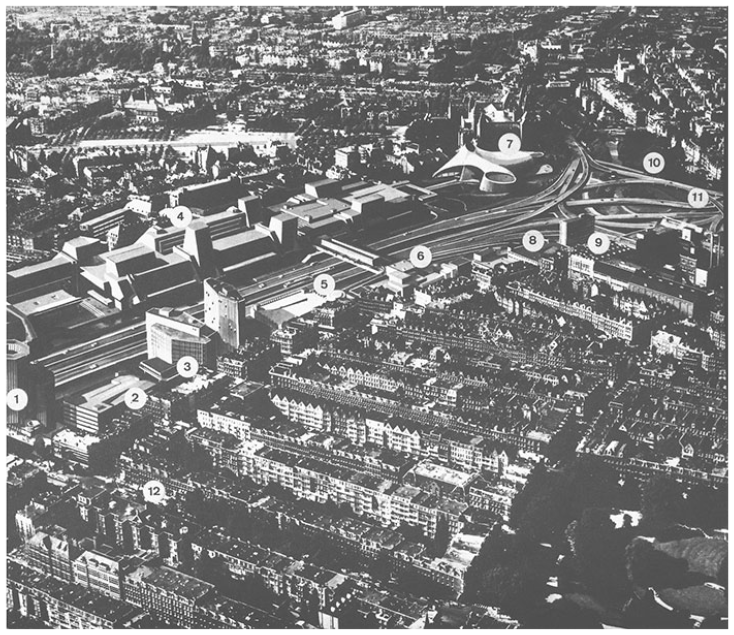
This photo montage from David Jokinen’s 1967 scheme “Give the City a Chance” (Geef de Stad een Kans) clearly demonstrates the effect of car-centered planning on the closely knit urban fabric of Amsterdam. The numbers indicate landmarks and key elements in the unrealized scheme, with number 7 designating the famous Rijksmuseum.
The latter development was obviously the result of suburbanization. In combination with exploding population numbers, mass motorization was expected to radically transform Dutch living patterns, leading planners to predict a densely populated, barely livable country in the near future. 39 Whereas the majority of the urban expansion areas built during the 1950s and 1960s consisted of tower blocks and housing estates in high densities, a national pollster concluded in 1963 that 80 to 90 percent of the interviewees preferred a (semi)detached single-family house. To fulfill this demand, towns and villages on the outskirts of major cities had begun developing lush suburbs within commuting distance of metropolitan areas. 40 As the Ministry of Physical Planning considered the lure of the countryside irresistible, to prevent urban sprawl in 1966, its planners advised to “bundle” the dispersing population into designated growth nucleuses. 41 Indeed, throughout the 1970s, the alleged individualization of living patterns led the same ministry to believe that the future lay in the suburbs. 42 Such beliefs were evidenced by contemporary demographics: around 1970, more than ten thousand Amsterdam residents left the city annually. 43 The consequent construction and widening of highways to connect the suburbs with central areas encouraged only more people to go on the road.
Further accelerating suburbanization was the shopping behavior of car drivers. Whereas Dutch businesses and companies mostly maintained their offices in central areas, fears grew that retailers and shop owners were inclined to follow their customers. Between 1950 and 1970, the number of independent retailers and outlets dropped by, respectively, 12 and 7 percent nationally, illustrating a trend toward the upscaling and franchising of smaller stores. 44 To survive, retailers moved to car-friendly locations or pushed for greater car access to central locations. In 1962, former national planning chief Frits Bakker Schut argued that a radical decentralization of the Dutch shopping landscape was inevitable, as democratic societies had only limited capabilities to influence consumer behavior. 45 Between 1950 and 1965, the Netherlands saw the construction of more than a hundred suburban shopping centers, with many more schemes in the pipeline. 46 The rise of one-stop shopping threatened convenience stores and high streets on the fringes of city centers in particular, whose less mobile costumers—poor families, the elderly and disabled—were often left behind. 47
Thus, over the 1960s, growing car ownership and the accompanying suburbanization of the Dutch landscape had come to be seen by most experts as the mournful but inevitable outcome of consumer choice and suburban living (Figure 2). Fearing the growing political influence of car drivers, political and professional elites saw no other way than to invest heavily in local and national road networks. In this regard, the Netherlands initially did not differ much from car attitudes in other Western countries, where there was a similar urge to keep up with the inevitable march of progress. 48 What transpires from the Dutch mindset, however, is that officials and planners were keener to follow than to guide societal developments, convinced that only pragmatic and anticipative policies could steer the small, vulnerable, and rapidly changing country in the right direction. 49 Indeed, these elites thought “being modern” to be a moral imperative. As the next section will demonstrate, this political imperative of making way for the modernity of the “expressway world” should not be confused with political goodwill, in particular when compared with the mindset of planners abroad.
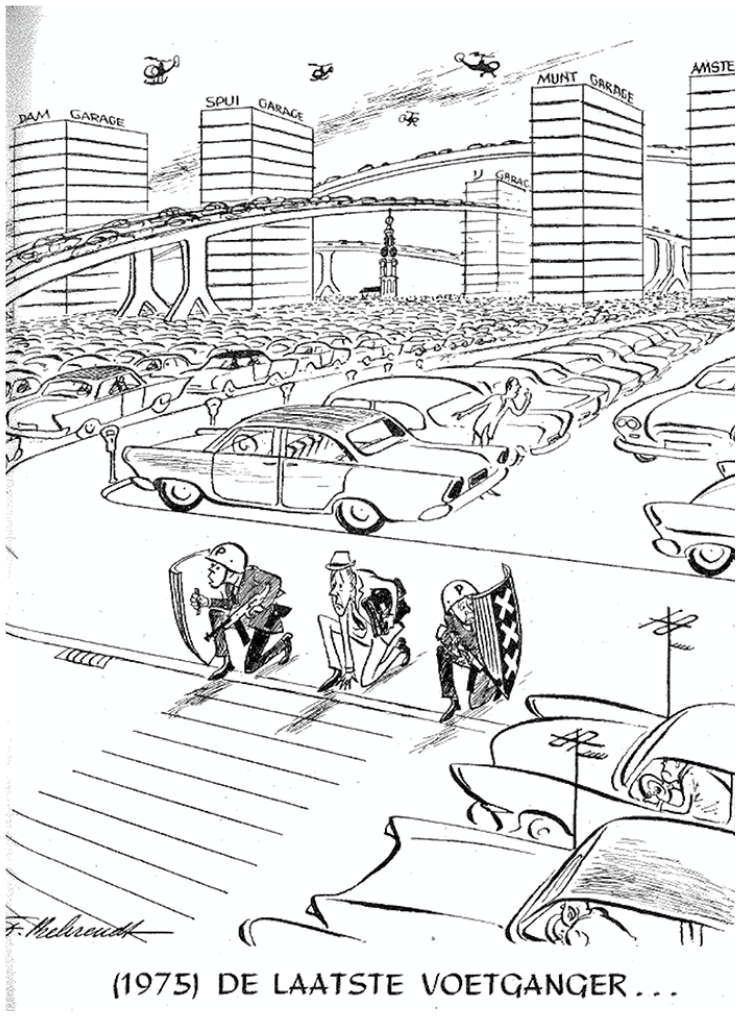
The 1965 comic drawing of how Amsterdam’s city center might look like in the year 1975 if the car was given its way. The caption reads “The last pedestrian . . .”
Fearing the Motor Age
Throughout the 1950s and 1960s, Dutch planning agencies and advisory bodies frequently expressed concerns about the rise in car ownership and its negative consequences for historical cityscapes and social relations. In 1953, urban planner Willem Valderpoort argued that mankind could not cope with the pace of the technologies it was inventing, of which the car was a prime example. 50 Five years later, officials working for the Ministry of Physical Planning mentioned “the possible danger of implementing unwanted solutions out of sheer necessity.” 51 According to the same planners, the motorization of Dutch society would require an expertise no one possessed yet. 52 Gerrit van den Berg, one of the first Dutch social geographers, was particularly alarmed about the lack of expertise: “We are searching for light in the darkness. And whilst we are searching, the scale and nature of the matter is continuously changing. Consequently, we cannot get a sight on it, let alone a grip.” 53 To prevent widespread fatalism, Van den Berg called for a thorough “disenchantment” of the traffic issue—a subtle call for more professionalization and research funding. 54
To gather new insights, experts increasingly looked at the work of traffic engineers in other countries. In particular, the United States, Great Britain, and Germany served as reference cultures for Dutch planners, who imitated, adapted, or resisted the planning practices of their foreign colleagues. 55 Much more than an example of sound urban planning, the suburbanized American landscape was a nightmarish sight of things to come. 56 The British were supposedly giving the best example, as demonstrated by the widespread demand for Colin Buchanan’s 1963 report Traffic in Towns. To safeguard the quality of life in central areas, the British town planner recommended the construction of ring roads, an extensive use of parking garages and a thorough separation of traffic flows. Despite these forceful recommendations, Buchanan was also “appalled” by the magnitude of the problem, although he was not against cars per se: “We are nourishing at immense cost a monster of great potential destructiveness, and yet we love him dearly. To refuse to accept the challenge it presents would be an act of defeatism.” 57 In a similar vein, a few years earlier, the West German traffic engineer Hans Reichow had called for car-centered cities. Small chirurgical interventions did not suffice any longer: the time was ripe for more radical measures. 58
Dutch municipalities were reluctant to intervene on such a grand scale but took cue from the solutions proposed by their foreign colleagues. In comparison with Britain and Germany, the Dutch urban fabric was relatively dense. Therefore, making way for the car inevitably meant the destruction of buildings dating to the medieval or early modern period, which, during the 1960s, were in many cases already listed as monuments. This designation of heritage sites obviously thwarted the work of traffic engineers. While most planners thought that some sacrifices would be inevitable, others believed striking a balance between progress and tradition was possible by carefully selecting heritage sites, similar to how British planners used radical forms to preserve traditional elements from the destructive forces of modernity. 59 Radical measures such as the filling of Amsterdam’s canals to make way for urban expressways, as proposed by the city’s superintendent in 1954, were never seriously considered by local officials. 60 The construction of inner-city superhighways, as suggested by Jokinen, was already rejected by municipal planners in 1967 as “old-fashioned.” 61 This demonstrates how the Dutch were quick to condemn the American expressway world, which was only introduced two decades earlier by the likes of Robert Moses. 62
Instead of comprehensive redevelopment, Dutch planners opted for more considered and tailored solutions. The Dutch equivalent of Buchanan’s Traffic in Towns was the similar titled Verkeer en Stad, published in 1965 by traffic consultant Hendrik Goudappel. Although Goudappel considered the value of historic city centers “priceless,” he also argued that their residents and visitors could no longer ignore the consequences of growing automobility. 63 The young engineer was keen to compare his methods for curing congested cities with those of a general practitioner: “Traffic is entitled to a full treatment. Careful observation, diagnosis, prognosis, and a curing therapy are all intrinsic elements of traffic planning.” 64 The comparison drawn by Goudappel was based on a metaphor often used by traffic engineers, in which cities were represented as organic and self-contained systems amenable to scientific research methods. 65 Most Dutch planners agreed that car traffic had to be accommodated instead of combated, albeit along moderate lines. Around the same time, cities in other parts of the Western world were still gearing up for massive car-centered redevelopment, as might be exemplified by plans for New York’s Cross-Manhattan Expressway, the innermost circuit of London’s ringway network, the Berliner Stadtring and the Parisian Périphérique—plans that were all under implementation or at least under consideration during the 1960s. 66
Reinforcing the Dutch belief in cautious measures was the realization that cars could not only extend but also reduce personal freedom of movement. Enquiries from the late 1960s and early 1970s demonstrate how people with children living in central areas adjusted their choice of schools to levels of road safety. Elderly people admitted they were too afraid to leave their homes due to the roaring traffic outside. The number of car accidents peaked between 1966 and 1972, when an annual average of nearly three thousand people died in traffic—leading to growing concerns over road safety and a more critical public opinion. In addition, the car-centered society would exclude the less affluent from everyday amenities, which were increasingly accessible to car drivers only. In 1971, a national survey pointed out that 64 percent of the interviewees were in favor of banning cars from city centers altogether, 67 while a 1974 survey by car lobbyists concluded that an overwhelming majority of Dutch car owners considered their vehicles disturbers of cityscapes and polluters of nature. 68
From the early 1970s onward, national planners began realizing that alternative measures were needed to tame the growing flows of car traffic in Dutch cities. Despite political efforts to curb the motorization of society, to contemporaries, the situation seemed to be running out of control. As traffic engineers came to understand that there was no saturation point in the growing number of cars, they began proposing traffic-diverting solutions such as small-scale ring roads, pedestrian zones, and separated bike lanes. In addition, prohibiting cars from entering city centers proved less expensive than granting full access, which was a welcome conclusion in an increasingly faltering economy. Thus, in the wake of the 1973 Oil Crisis and the Limits to Growth report by the Club of Rome, the Ministry of Physical Planning concluded that Dutch city centers should no longer be subject to large physical interventions. In the words of Marshall Berman, which seem particularly apt to the Dutch context, as economic growth stalled Western societies lost their power to blow away the past: “All through the 1960s, the question had been whether they should or they shouldn’t; now, in the 1970s, the answer was that they simply couldn’t.” 69 The Ministry concluded that the travel behavior of Dutch car drivers was to be influenced by small inducements such as parking fees, incentive parking, and partial road closures. 70
These insights into car-discouraging measures were induced by protests from urban action groups, most notably the so-called Provo and Goblin movements. Their often-young supporters were usually employed in nonproductive sectors of the economy or not heavily engaged in the labor market, and demonstrated a growing concern for immaterial values. What bonded them was an aversion of the detrimental side-effects of pro-growth policies, among others increasing pollution and the demolition of historical buildings.
71
Their re-evaluation of the older cityscape was driven by a predisposition toward living in central areas and an associated rejection of middle-class life in the suburbs,
72
thus introducing a more urban and bohemian definition of the good life in which bicycles and other alternative means of transport came to play a pivotal role.
73
As a commentator stated in 1972, “Our youth brings back dynamism, diversity and contact with the anonymous but familiar urban crowd, reviving streetscapes that have been ruined by car traffic.”
74
Such admiring observations are a reminder that the opponents of car-centered planning were no less modern than its proponents or, as Berman illuminates the discovery of urban living: Before long they would find something more, a source of life and energy and affirmation that was just as modern as the expressway world, but radically opposed to the forms and motions of that world. They would find in . . . in the everyday life of the street.
75
As this section has shown, the shift from car-centered to traffic-calming policies was already well underway when urban social movements came to the fore. Dutch planners frequently displayed feelings of ambivalence and doubt about their own problem-solving capabilities. Obviously, the purpose of their alarming statements was not only to cause unrest, but also to convince national and local governments to get a better grip on the societal effects of growing car ownership. While the first stirrings of protests against the expressway world in the United States were already felt during the 1960s, most notably in the work of Jane Jacobs and Richard Sennett, the Dutch case seems unique for the pace by which urban planners and elected officials switched to alternatives. Indeed, American and, to a lesser extent, European historians of automobility have demonstrated that in other Western countries, there were more incentives during the 1970s to continue down the road of comprehensive redevelopment and suburbanization. 76 To bring further nuance to their histories of car-centered planning, the last two sections of this article move the focus toward the governance practices behind urban redevelopment schemes on the local level, in particular the involvement of externally hired traffic engineers and property developers.
Utrecht: Opposing Outside Views
When mass motorization began to take a hold of Dutch cities, Utrecht was the fourth largest conurbation in the country, counting some 250,000 inhabitants. Contrary to Amsterdam, Rotterdam, and the Hague, the city’s economic base was rather diffuse, but its central location and function as a nation-wide transport hub promised great potential. The 1954 Structure Plan was the first planning document to mention the mounting pressures of car ownership in central districts, predicting a tripling in the number of locally owned cars between 1955 and 1960. 77 In 1956, the city’s municipal executive outlined their vision for the city center, which was to enhance its function as a meeting place for consumerism, business, and entertainment. While the center was still pulsating with economic life, mass motorization also threatened its vitality and livability. The composers of the plan urged Utrecht to choose between “conservation and curtailment” or “renewal and expansion.” 78 Given this biased language, the position of the municipal executive was clear.
While the urge for modernization was pressing, the municipal executive’s intention to create more space for car traffic was hampered by the inexperience of its planning office. 79 According to Wim Derks, the city’s alderman for urban planning between 1954 and 1962, outside expertise had to be brought in. Given the recent wartime experiences, his choice for the West German traffic engineer Max Feuchtinger in 1958 was bold but well considered as West Germany was well ahead of the Netherlands in terms of car ownership and traffic engineering. 80 Despite the dominance of cyclists in Utrecht’s commuter traffic at the time (58% cyclists; 23% motorists; 19% public transit), 81 Feuchtinger suggested to intersect the city’s medieval core with two north-south and two east-west arterials, whereas the old city moat was to provide space for a ring road equipped with multiple interchanges (Figure 3). Although ring roads had been an object of study in the Netherlands for more than two decades, Feuchtinger was the first to propose a detailed and seemingly feasible scheme. 82 The traffic engineer sold his plan as a “harmonious” and “moderate” attempt at relieving congestion, beneficial to thousands of daily commuters. 83
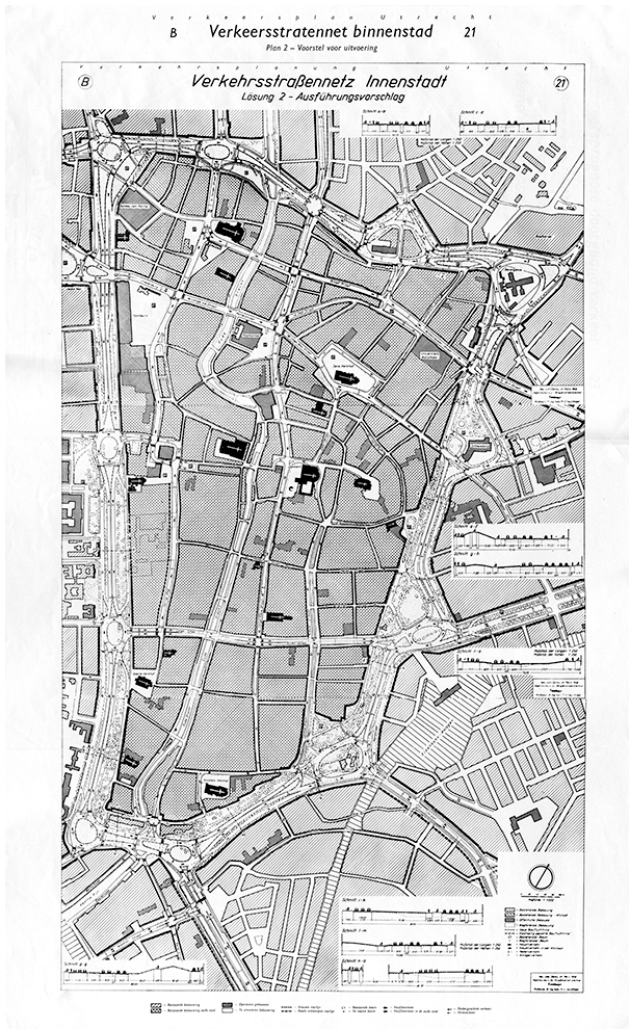
The 1958 map of how Feuchtinger’s proposal would transform Utrecht’s city center, with the city moat filled in and two arterial roads intersecting the medieval core.
A wide range of local and national actors responded to Feuchtinger’s proposal. Whereas the municipal executive and its planning department sided with the German traffic engineer, virtually all other stakeholders spoke out against the scheme. According to local preservationists, Utrecht would fall victim to a “disastrous experiment” with unforeseeable consequences. The Ministry for Education, the Arts and Sciences opposed the filling-in of the city moat for its historic value. Feuchtinger responded to his critics by arguing that Venice and Swiss mountain villages were the only places in the Western world where cars could still be banned. 84 In a similar reply, alderman Derks accused critics of turning back the hands of time: “This diagnosis has been made by an expert, wholly objective, as if a doctor has diagnosed a vital organ with a serious infection. These critics opt for prewar Utrecht: a small, stifled city of civil servants.” 85 With these observations, Derks alluded to popular banter of Utrecht being a backward and old-fashioned place. Even the mayor denounced his city as having a “dull, small-town mentality,” while a local architecture critic described his hometown as a “small but charming medieval reserve, surrounded by a boring and provincial village.” 86
The city council was, however, not convinced by Feuchtinger and Derks, and demanded a more moderate approach. Dutch traffic engineer Johan Kuiper was summoned to accomplish Feuchtinger’s plan. Kuiper had earned his reputation with the functionalist rebuilding of Rotterdam, making him an odd choice for a city center left untouched by acts of war. 87 Instead of concentrating Utrecht’s business and retail venues, as proposed by Feuchtinger, Kuiper suggested to move commercial functions away from the central city. 88 His solution was to develop a new business district on the fringe of the city moat, leading to an eastward diversion of car traffic. While this idea would have saved the medieval core, it also foresaw demolition of large swathes of Utrecht’s nineteenth-century housing stock. The counterproposal sparked off an intense debate in which the planning department sided with Feuchtinger by stating that Kuiper’s business district would be too distant from the city center for office clerks, where they would have lunch and buy groceries after work hours. 89 Evidently, the hustle and bustle of the old city had not lost its appeal, even at the zenith of urban modernism. In his final proposal, Kuiper was forced to compromise by incorporating Feuchtinger’s inner ring road, arterial thoroughfares, and a central pedestrian zone. 90 Despite protests from local preservationists and national planning agencies, in 1966, the city council duly approved Kuiper’s plan and by extension the partial filling-in of Utrecht’s city moat, bringing a decade-long discussion to an end.
This decision was enforced by the ongoing construction of a redevelopment scheme launched a few years earlier. In 1962, the Bredero construction company had proposed a vast inner-city shopping and office complex connecting Utrecht’s central railway station to the city center and a set of parking garages. The Hoog Catharijne scheme was expected to generate more car traffic in central areas and therefore demanded the tarmacking of the western stretch of the city moat and construction of an additional arterial road. The megastructure was designed to accommodate much of Utrecht’s expected growth in demand for office and retail space, which effectively brought a halt to the suburbanization of shops and offices. 91 In addition to its mixed functions and covered arcades, these characteristics made Hoog Catharijne a hybrid of American and Western European planning practices. In fact, the scheme was inspired by Birmingham’s Bull Ring Center and the work of Victor Gruen, the Austrian American planner who pioneered in pedestrianizing American inner cities and designing shopping malls. 92
While the car can be seen as Hoog Catharijne’s raison d’être, it was also the main reason for local residents to protest against the scheme. Political and public approval of the plan altered in 1970, when Bredero rejected an alternative scheme for a parcel within the predetermined redevelopment area. The optional plan, devised by architect Herman Hertzberger, concerned a venue for cultural performances that would lead to the abolition of an arterial road that was drawn by Kuiper and demanded by Bredero planners to supply stores in Hoog Catharijne and the city center. 93 Whereas the construction company emphasized the swift circulation of people, cars, and consumer goods, Hertzberger’s cultural venue was geared toward spontaneous and informal interactions in public spaces devoid of car traffic. This was reflected in its design, which consisted of a maze of corridors and niches connected to the surrounding medieval street pattern. Not surprisingly, the shopping center’s spiritual fathers were not amused and uttered fears of decreasing car access. 94 Their stance only contributed to a more critical public opinion. Local residents came to understand Hoog Catharijne as a complex catering exclusively to car drivers, well-heeled consumers, and out-of-town office clerks. Eventually, in October 1970, a slim majority of twenty-three against nineteen councilors voted in favor of Hertzberger’s venue, thus rejecting the arterial road. 95
This political outcome and by extent the growing opposition toward Hoog Catharijne were partially the result of the rediscovery of central living by a younger generation of urbanites, who increasingly made it into local politics and civil service. The appointment of a young head of Public Works in 1969 heralded in a major policy shift at the very moment cars were getting the upper hand in the share of Utrecht’s commuting traffic. 96 While the anti-car rhetoric of protesters and young city officials chimed with the alternative planning views of Hertzberger, 97 it should be emphasized that Hoog Catharijne never functioned as a modernist competitor to the old city center. While Bredero’s vision left most of the medieval core intact, with the construction company even proposing to fund the renovation of townhouses, 98 Feuchtinger’s scheme would have resulted in wholesale demolition. Not only does the situation in Utrecht add to our understanding of the reasons behind urban redevelopment in general, it also demonstrates how the involvement of both external traffic experts and entrepreneurs proved decisive for local decision-making processes. The influence of property developers was no different in the Hague, where increasing car traffic led to similar discussions but with different outcomes.
The Hague: Automobility’s Mixed Blessings
In 1964, architectural critic Reinder Blijstra was utterly pessimistic about the future of the Hague’s city center, which would soon fall prey to a “monomania, seeing urban life solely through the windscreen of a car.” 99 His vision of impending doom was based on the rapidly growing number of cars registered in the nation’s seat of government, which at that time counted some 600,000 inhabitants. Over the 1950s, the numbers of cars had quadrupled, while traffic intensity on the city’s road network had grown by 35 percent. Frits Bakker Schut, who in 1949 had succeeded his father as head of the Public Works department, feared “anemia and hypertrophy” of the urban tissue. To solve the issues of overcrowding, traffic, and lack of central office space all at once, in 1957, his department presented the ambitious Structure Plan (Figure 4). Not held back by the inexperience of Utrecht’s planners, the report was a car-centered blueprint envisioning the redevelopment of nearly 1,500 acres of urban fabric over a forty-year time span, thus making it the most comprehensive redevelopment scheme ever presented for a Dutch city center.
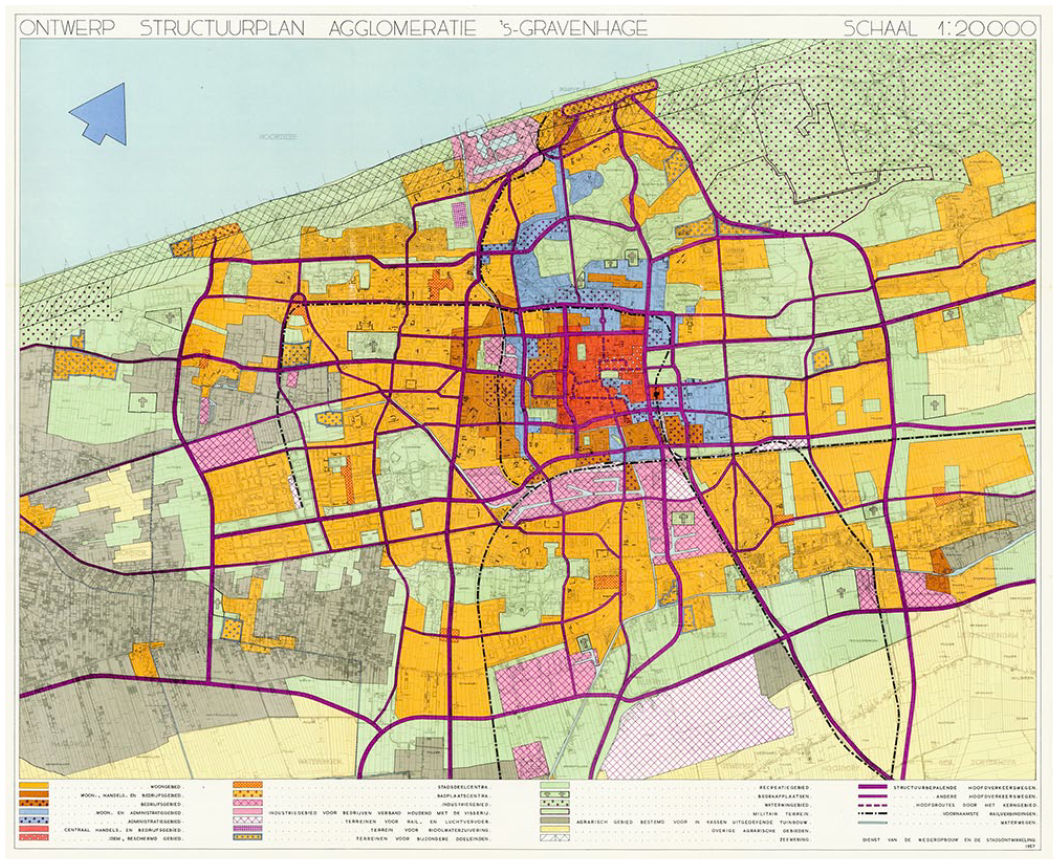
The 1957 map of the Hague’s structure plan. The purple lines designate major thoroughfares, most of which were not yet realized at the moment of the plan’s presentation.
A key element in the plan was the inner ring road, meant to give car drivers quick and easy access to a central business district while clearing a number of inner-city slums adjacent to the center of national government. Protection of local heritage, which was mainly located within the confines of the ring road, was said to go hand in hand with traffic improvements. 100 Car traffic could even be an attraction in itself, as was exemplified by a drawing of two businessmen leisurely watching cars go by while smoking a cigarette. 101 According to Bakker Schut, the ring road could enhance the Hague’s cityscape by cleansing areas plagued by “high birth rates, low incomes, large numbers of workers, the unreligious and extremist voters.” 102 The city’s chief planner was supported by his political superior R. C. A. F. J. van Linda Nessel, who served as alderman for urban planning between 1955 and 1962. Defending the clearance of more than one-hundred fifty tenements and businesses, Van Linda Nessel stated that traffic issues should precede over housing shortages—even at a time when the housing problem was considered public enemy number one. 103 According to the alderman, residents were turning their backs on the inner city anyway, and not taking measures to improve traffic conditions would lead to future regrets. 104
The provision of car access to central districts was thought to result in “spontaneous” regeneration—a euphemism for the intervention of property developers. Due to its proximity to approach roads and favorable land values, the Spuikwartier—a mixed-use neighborhood bordering the city center—was singled out for a special treatment. In 1961, the municipality’s expectations were seemingly fulfilled with the presentation of a vast redevelopment scheme by property developer Reinder Zwolsman and Italian architect Pier Luigi Nervi, whose plan encompassed the Netherlands’ first skyscraper, a six-story parking garage and four-hundred-bed hotel, as well as several catering, entertainment, and shopping facilities. According to Zwolsman, construction of the ring road was “indispensable” to his project, an observation by which he pressured the municipal executive into acting quickly. A majority of the city councilors responded overwhelmingly positively to the scheme, thus sealing the fate of the Spuikwartier. 105
However, the car not only asserted itself in plans for the inner city. As Zwolsman unfolded his Nervi scheme, he simultaneously presented plans for the first suburban shopping center in the Netherlands. A flashy American-styled brochure stated that his initiative would mark a radical break with the past: “Historical growth gave us the shape of the inner city; creative thinking will give us the shape of the shopping center.” 106 When compared with retail venues in the city center, Rijswijk’s In de Bogaard shopping center was easily accessible by car and therefore a threat to the viability of central businesses. As one council member rhetorically questioned the scheme, “Do we want to save our inner city or will we accept the developments we see abroad, where shopping centers on suburban locations drain the vibrancy and entertainment out of central districts?” 107 Other councilors were even more alarmed by the plan, exclaiming that it might potentially wipe the old city center of the face of the earth. 108 Thus, the motor age had a dual effect on the city of the Hague. While a wished-for central business district was taking shape, the less desirable suburbanization of retail activities had come to threaten the city’s high streets.
In an ironic twist of events, in 1964, it was the Nervi scheme that was aborted. After three years of haphazard demolition works and forced evictions, a provincial planning commission called Zwolsman’s office scheme “disastrous” because of its violation of the Hague’s skyline and, more importantly, the expected straining of traffic caused by the three thousand office clerks who would have to make the daily commute to its offices. According to the commission, to prevent traffic jams and congestion, the ring road had to be completed first. 109 The municipal executive, a majority of council members, and Zwolsman were unanimous in their disapproval of the planning refusal. When the private developer finally abandoned his plans for the Hague’s city center in 1970, the city was left with a huge swath of undeveloped land.
Despite the failure of these urban renewal efforts, the municipal planning department initially kept focusing on improving car access. Planners calculated that during the 1960s, the number of locally registered cars had doubled, while traffic intensity had grown by 50 percent. 110 During the same decade and well into the 1980s, more than one hundred thousand residents eventually moved out of the city. 111 As almost any other Western European city during this period, the Hague was falling on hard times. Pollution, congestion, and social misery led an increasing number of middle-class families to opt for a better future in the suburbs. Obviously, increasing suburbanization meant more people on the road, for which planners compensated by proceeding with the ring road and more elaborate traffic schemes. However, from the early 1970s onward, a counter movement—albeit less boisterous than in Utrecht—was beginning to criticize the tightening stranglehold of cars.
In the wake of the 1970 municipal elections, a group of young architects naming themselves Dooievaar pleaded for an eco-friendly city center where the rights of cyclists and pedestrians took precedence over those of car drivers. The protesters demanded a moratorium on the Hague’s traffic schemes, which were considered to be disintegrating the urban fabric while jeopardizing the physical and mental well-being of local residents. 112 Dooievaar compared the Hague’s growing road network to a spreading tumor that led to crude amputations and ugly scars, which was the work of “authoritarian narrow-minded specialists.” 113 Willem Nuij, the freshly elected alderman for urban planning, was more sensitive to such accusations than his predecessors, stating in 1972 that “. . . twenty years ago you were a big man when you planned a car-centered city. Today we think about the environment, our habitat and how people actually use the city.” 114
While it took nearly another decade for Nuij and his successors to abandon the Hague’s car-centered policies, his observation clearly signaled changing tides in the field of urban planning. The local planning department, which was better equipped than its counterpart in Utrecht and therefore less reliant on outside expertise, was reluctant to adapt to the changing wishes and demands of urban society. As the country’s administrative capital, the Hague had always known a high demand for office space and traffic facilities, with many commuters living in its suburban surroundings. While the ring road was eventually aborted, it left many inner-city areas earmarked for redevelopment in a state of dereliction, most notably the Spuikwartier. During the second half of the 1970s, the blueprints of the late 1950s and 1960s were replaced by more fragmented and flexible planning policies, in which the car was increasingly banned from the Hague’s central streets.
Conclusion
Recently, Christopher Klemek compared car-centered redevelopment schemes with military operations, thus referring to the popular idea of urban renewal being an utterly authoritarian and technocratic undertaking with highly questionable results. 115 As the national and local discussions between traffic experts and elected officials in this article have demonstrated, the Netherlands presents a different case. Underpinning the notion of car-centered cities in the Netherlands was the widely supported view that unrestricted motion of the individual was an absolute right and the inevitable outcome of the affluent society. Dutch planners initially saw the car as a democratic force, albeit one with coercive and potentially destructive powers. Planning for the car was largely driven by a compulsive need, which is reflected in the compromises reached over Utrecht’s and the Hague’s traffic schemes. The governance perspective in this article, which has allowed for the inclusion of multiple planning actors working on different levels, has shown that car-centered urban redevelopment was by no means a linear and unscrupulous process contrived by technocratic and self-assured planners in the backrooms of city halls.
The traffic discussions conducted during the 1960s paved the way for the acceptance of the car-discouraging policies and schemes of the 1970s. With the prospect of a fully mobilized society, the Dutch expressed growing concerns over the imminent downsides of growing automobility. Eventually, planners signed a truce with the car by designating pedestrian-friendly areas, which diverted traffic to inner cities’ fringes and gave right of way to cyclists and pedestrians. Learning from planning practices from abroad and the demands of urban action groups, Dutch planners slowly but surely abandoned the idea that cities should favor the car. Already during the 1960s, their engagements with local officials and property developers signaled this impending paradigm change, implying that pleas for a gentle modernization of Dutch city centers may have been equally important for their rescue from tarmacking as the rise of action groups in the early 1970s.
In comparison with other Western countries, the realization that there was no perfect solution for the problems associated with growing car traffic came rather early, which was the result of a more cautious approach to modernity observable in other domains of Dutch society as well. By employing the work of Marshall Berman, this article has demonstrated that the experience of modernity is usually a double-edged sword—an experience that in the Dutch case significantly influenced the attitudes and eventually practices of contemporaries. Thus, this article has not only shown how and why Dutch governments, businesses, and citizens grappled with mass mobilization, but has also demonstrated the merits of challenging temporal definitions of modernity in the field of urban history. While the 1950s and 1960s are usually depicted by urban historians as the heyday of urban modernism and self-confident technocratic thinking, 116 this contribution has demonstrated that Dutch attitudes and mindsets were closer to postmodern structures of feeling, which are often associated with self-reflection and self-doubt. 117 In addition, by focusing on two second-tier cities, it has suggested to pay more attention to what happened outside the capital cities of the Western world. While it seems that the cautious stance on car-centered cities was typically Dutch, a comparative approach to international case studies might present an even broader range of attitudes.
Footnotes
Acknowledgements
This article was mainly written during a research leave at Leicester’s Centre for Urban History. The author would like to thank Paul Knevel for granting him the opportunity to work abroad, and Simon Gunn for his comments on an earlier version of this article.
Declaration of Conflicting Interests
The author(s) declared no potential conflicts of interest with respect to the research, authorship, and/or publication of this article.
Funding
The author(s) received no financial support for the research, authorship, and/or publication of this article.
