




Abstract
While scholars have addressed the challenges Black women face in various workplace environments, less is known about the psychological and social experiences of Black women leaders in the nonprofit sector. In the present qualitative study, we draw from plantation politics and intersectional leadership frameworks to explore the perspectives of Black women Executive Directors. Specifically, we examine how they navigate structural and interpersonal challenges while building and growing nonprofit organizations that serve Black girls. Furthermore, we consider the extent to which the racialized logics of plantation politics inform their well-being and social justice missions as organizational leaders. Using consensual qualitative research methods, we analyzed semi-structured interviews from 16 Black women Executive Directors of 501(c)3 nonprofits across America (33–62 years old, M = 44.6, SD = 9.7 years). We identified the following themes: (1) unsupportive and hostile nonprofit landscape, (2) subpar access to opportunities and organizational infrastructure, and (3) attrition and burnout. Our findings demonstrate a connection between structural racism—manifested as plantation politics—and the chronic underinvestment in Black women’s leadership, which ultimately undermines their well-being.
Keywords
Introduction
Begin with the assumption that discrimination, racial sorting, and an unequal distribution of resources are...rather foundational organizational norms (Ray, 2019, p. 46).
Within the United States (U.S.), 15% of nonprofit organizations are run by Black 1 leaders, with Black women comprising 64% of these leaders (Candid, 2024; Clerkin et al., 2024). About 70% of US nonprofits have White leadership, with White women comprising 45% of this figure. Based on these statistics, Black women are well-represented among Black nonprofit leaders; yet, there are racialized and gendered disparities among the financial and infrastructural support that Black women receive compared to other nonprofit leadership (Heckler, 2019; LeRoux & Medina, 2023). For example, White men lead 28% of nonprofit organizations; yet, they account for 41% of those with annual revenues exceeding $25 million (Clerkin et al., 2024), thereby affording them disproportionate access to financial resources and greater capacity to advance their organizational and personal interests. Although White men do not control all of the resources within the nonprofit sector, they do run a large portion of highly funded nonprofits as compared to BIPOC women.
While there is not sufficient documentation on Black women running comparable organizations (Candid, 2024), only that of BIPOC 2 women (12% of organizations earning over 25 million; Clerkin et al., 2024), data support that Black women are under-represented among their counterparts. Therefore, they have less capital and influence to promote social justice and shift the status quo than their peers. These statistics, or lack thereof, illuminate the ways Black women leaders are under-represented in organizations, as well as in scholarship, and the unique challenges they face, such as racial stereotyping and low financial investment, compared to their White counterparts (Ford et al., 2021; Spates et al., 2020; Wilson, 2024).
Despite discrepancies in how Black women and their organizations are financially supported, they have advanced positive social change within the U.S. through their own financial investment in Black businesses and organizations (Ford et al., 2021; Freeman, 2020). Many of these organizations prioritize giving resources and services to underserved communities in an effort to facilitate social good (Faulk et al., 2021). However, such contributions and leadership experiences of Black women are understudied within psychology.
Thus, the current study sought to explore and highlight the lived experiences of Black women Executive Directors (EDs) who lead nonprofit organizations that primarily serve Black girls. We apply Gladden and Levine Daniel’s (2022) plantation politics framework to examine Black women’s experiences of institutional hierarchies in the nonprofit sector. This framework allows us to consider how structural racism dating back to the enslavement of African Americans undergirds the social, political, and economic institutions of America (Heckler, 2019; Ray, 2019; Wilson, 2024). We also draw on Peters and Miles Nash’s (2021) intersectional leadership framework to contextualize how Black women’s gendered and racialized identities inform their leadership practices. Together, the study explores how Black women nonprofit leaders (BWNs) employ anti-racist and anti-sexist praxis to navigate plantation politics and prioritize their own well-being and their mission to serve Black girls. In the next sections, we detail plantation politics and intersectional leadership to explain how we ground our present research study.
Conceptual Framework: Plantation Politics and the U.S. Nonprofit Sector
The racialized and gendered logic of African American enslavement continues to inform social, political, and economic structures in America’s nonprofit organizations (Gladden & Levine Daniel, 2022; Ray, 2019; Wilson, 2023, 2024). The institution of slavery perpetuated a dependency model in which enslaved Africans relied on plantation owners for sustenance, including food, shelter, and health care (Ruef, 2004). Enslaved Africans were legally and socially denied their personhood, as their bodies and labor were “owned” by the White individuals who enslaved them. Further, the racialized and structural logic of plantations is grounded in the use of financial resources as a means of social control which carried over into the infrastructural processes of many nonprofit organizations (Dunning, 2023; Rodriguez, 2017).
After emancipation, Black people created mutual aid societies and nonprofits to generate social and economic power for their communities, but they were met with violent opposition (Freeman, 2020; Roberts, 2005). This opposition included separating families (Roberts, 2005), police brutality and incarceration (Destine, 2023), lynchings (Francis, 2019), and organizational disbandment by police (e.g., Black Panther Party; Potorti, 2017).
Gladden and Levine Daniel (2022) defined these racially oppressive tactics in organizational contexts as “plantation politics,” to denote the parallels in the rules and practices that were used to enslave and disempower enslaved African individuals with more contemporary forms of anti-Black disenfranchisement in the nonprofit sector. Within the framework, Gladden and Levine Daniel (2022) highlight that: (1) the end of enslavement connects to the development of philanthropic and nonprofit organizations, (2) organizational hierarchies often parallel the racialized realities of broader society via the nonprofit industrial complex (NPIC), and (3) the intersection of white supremacy and selective philanthropy limits nonprofit organizations’ social justice impact. Similarly, Ray (2019) posits that within racialized organizations: (1) the agency of ethnically marginalized individuals is stifled by their position within the organization, (2) disproportionate resourcing is normalized, (3) whiteness holds capital (e.g., stereotypes used to justify White individuals having more resources than Black individuals), and (4) racialized undertones drive the mismatch between organizational policies and practices.
Using Ray’s theory in their work, Wilson (2023, 2024) has found the tenets of racialization to be pervasive and consistent towards Black leaders in nonprofits, such as them receiving less funding than their White counterparts. In Wilson’s (2024) study, interviewing 15 Executive Directors of Black-led organizations in Wisconsin, they found many instances of racialization, such as the EDs not being taken seriously and their legitimacy being questioned, funding being used to try to control their collaborations, and threats of funding retraction to censor those who are too outspoken.
Today, the racialized and structural logic of nonprofit organizations’ social control remains relatively unchanged (Rodriguez, 2017). For instance, Black-led organizations are less resourced, have more “strings” attached to the funding they receive, and can even be subject to violent opposition (Dunning, 2023; Ford et al., 2021; LeRoux & Medina, 2023; Waltz, 2024; Wyatt, 2023). Black women leaders are also expected to assimilate to white supremacist organizational policies through code-switching and tone policing (Dickens et al., 2019; Heckler, 2019; LeRoux & Medina, 2023; Washington Area Women’s Foundation, 2023), in order to receive funding and support for their organizations. Taken together, white supremacist ideologies that undergirded plantation politics continue to have lasting impacts on the social, economic, and political empowerment efforts within Black communities. Despite the racially oppressive nature of plantation logic in the nonprofit sector, Black women leaders find creative ways to best serve and advocate for Black girls in their organizations—often through intersectional and social justice-oriented leadership practices (Battle & Myrick, 2025; Inniss-Thompson et al., 2024).
Intersectional Leadership
To frame our study, we draw from intersectionality theory and praxis (Crenshaw, 1989; Lewis, 2023) to best understand how Black women nonprofit leaders navigate multiple axes of domination. This includes an individual’s unique experience of power and oppression within social hierarchies; for those who are structurally “at the bottom” of these hierarchies, it can translate into inequitable access to social, economic, and political resources (Crenshaw, 1989). Intersectionality offers a useful lens to conceptualize Black women’s social positioning as individuals within broader macrostructures of power. In the current study, we use Peters and Miles Nash’s (2021) intersectional leadership framework to explore Black women’s experiences, including their challenges, as leaders of nonprofit organizations that primarily serve Black girls.
This framework acknowledges intersectional leadership as: (1) explicitly anti-racist (leaders proactively employ anti-racist and affirming practices), (2) explicitly anti-sexist (leaders challenge heteronormativity and sexism), and (3) contingent on the distinct contributions of Black women leaders’ service to Black girls (inclusive and affirmative practices). These tenets are of particular importance as we consider how Black women nonprofit leaders challenge anti-Black oppression and disrupt heteronormative expectations of Black girls in their work. Given their experience as both Black and women, Black women nonprofit leaders are often able to identify and relate to the manifestations of oppression and discrimination towards Black girls, and importantly, advocate for and support Black girls in their capacity to navigate these experiences. By building upon past and current epistemological and ontological understandings of Black women, both as individuals and leaders, the framework offers a guide to better capture the intention and action behind their leadership (Peters & Miles Nash, 2021), even in the midst of remonstrance.
While plantation politics can inform institutional structures in ways that disadvantage Black women and the organizations they lead (Gladden & Levine Daniel, 2022; Heckler, 2019; Nickels & Leach, 2021), an intersectional leadership framework allows us to consider how Black women leaders navigate a hostile and unsupportive nonprofit landscape to advance social justice (Branche, 2014; Griffin, 2021; Washington Area Women’s Foundation, 2023). BWNs create their own avenues of support to sustain programming by investing personal funds or incessantly engaging donors (Francis, 2019; Heckler & Mackey, 2022). These systematic disparities extend beyond pay and BWNs often commit to arduous work to keep their organizations running amidst limited resources (Dorsey et al., 2020; Ford et al., 2021; LeRoux & Medina, 2023). In response to inadequate support structures, many Black women leaders build coalitions and collaborations with other BIPOC organizations (Douglas & Iyer, 2020), or alter their work practices, such as prioritizing mental health and changing work responsibilities (Washington Area Women’s Foundation, 2023, 2024), to make the nonprofit landscape more supportive for Black girls.
Plantation politics allows us to see that the U.S. nonprofit sector resembles antebellum plantations in practice and policies aligned with white supremacist ideals in modern society, which limits leaders’ social justice approaches, while the intersectional leadership framework showcases how Black women leaders uniquely push back against oppressive forces through their anti-racist and anti-sexist work with Black girls. Taken together, these frameworks guide our examination of how BWNs traverse a nonprofit landscape in which they must navigate lacking support and financial resources used for social control while fighting to assure their organization’s sustainability and their own well-being.
Black Women’s Leadership and Psychological Experiences
It has been well documented that Black women who pursue leadership roles across industries are susceptible to mental health challenges, such as race-related stress, especially if the nature of their work centers historically underrepresented groups (e.g., Black girl programming) (Carter et al., 2022; Clark et al., 1999). As a result, there has been a burgeoning line of research on Black women’s leadership experiences and the various ways in which they cope to navigate burnout, mental health struggles, and cultivate joy.
For example, a grounded theory study conducted by Sharma and colleagues (2024) found that, despite strong values rooted in faith and community, Black women in nonprofit leadership faced persistent loneliness and isolation in leadership roles. This emotional burden, which was particularly from being the only Black woman in the organization and having to make decisions alone, highlights the psychological costs of leadership. While Sharma and colleagues discussed their resilience, the study demonstrates how Black women often cope with structural and social barriers in ways that mask ongoing stress, reinforcing the need to critically examine the organizational challenges that impact Black women leaders’ psychological safety.
Several studies have shed light on Black women’s psychological experiences in leadership across industries, namely education, church, and STEM (Harris et al., 2025; Rogers & Tinsley, 2024), which can provide a nuanced understanding of both the power and the cost of their roles. While their presence offers critical representation and more aligned support for Black girls in their care, it is also consistently accompanied by stress, burnout, and other mental health challenges. Chance (2021) highlights how Black women leaders often draw from their own adverse experiences to become more resilient and effective leaders. However, the field of Black psychology can move beyond resilience (Bentley-Edwards & Adams, 2024), and focus on the organizational structures that need to be changed to promote the psychological safety of Black women in leadership roles, which would positively impact Black girls.
Further, Black women often navigate a complex psychological landscape shaped by the intersecting forces of racism, sexism, and systemic inclusion (Peters & Miles Nash, 2021) compounded by an internalized pressure to overperform especially when Black girls are the center of their work (Leath et al., 2025; Robinson et al., 2023). There is extant literature surrounding the positive benefits of affirming spaces for Black girls including psychological safety and civic engagement (Inniss-Thompson et al., 2024). Together, Black women who lead and create innovative programs for Black girls are significant to the development of Black children and also risk experiencing a lack of investment in their social justice missions.
Purpose of Present Study
Black women nonprofit leaders are especially susceptible to negative experiences because of organizational structures. These experiences can impact their psychological safety and their mission to support Black girls. The current study’s purpose is to examine how Black women’s challenges in the U.S. nonprofit sector mimic the racialized and structural logics of the plantation system. Using an intersectional framework (Crenshaw, 1989; Peters & Miles Nash, 2021), we identify how Black women’s social identities inform their praxis within nonprofit spaces and explore the challenges they face amid the pursuit of positive development spaces for Black girls. Using insights from BWNs, we also consider ways Black women can utilize anti-racist practices to further their social justice missions. We also address current gaps in the literature regarding how Black women leaders are viewed, supported, and treated in the nonprofit landscape, as well as how they navigate their wellbeing (Branche, 2014; Bui, 2019; Griffin, 2021; Washington Area Women’s Foundation, 2024). As a result, they can enhance the organizational programming available to facilitate Black girls’ positive development (Ford et al., 2021; Heckler & Mackey, 2022; Wyatt, 2023). The following research question guided our study: Do Black women nonprofit leaders (BWNs) face challenges that are discriminatory and distinct to them, due to their social identities and the target population they serve? The current study advances the field of Black psychology by considering the context of nonprofit spaces designed for Black populations, where Black women often take leadership roles.
Method
In the current study, we employed a phenomenological research design (Alase, 2017; Davidsen, 2013). We were interested in first-hand accounts of Black women Executive Directors of organizations that primarily serve Black girls and how their experiences are impacted by their social identities and focus of their work. By taking a phenomenological stance and centering the individual experiences of various BWNs, we sought to illustrate the manifestations of plantation logic within nonprofit organizations and relevance of intersectional leadership.
Researcher Positionality
We believe it is imperative to offer background on who we are as people and researchers, to situate our research inquiry and epistemological approach (Collins, 2000; Lockett et al., 2025). The first author is a cisgender Black woman from a middle-class background, whose research interests include respectability politics, gendered racial socialization, Black girls’ empowerment, and capacity building (Latimer et al., 2024). She has five years of experience with nonprofits and does community work with Black girls across different contexts. The second author is a cisgender Black woman from a middle class background whose research interests include political education, social justice, K-12 education, and Black youth identity development and school engagement. She has worked as a high school counselor for a nonprofit organization and experience in community work focused on Black youth. The third author is a cisgender Black woman from a low-income background, whose research interests include Black antifascist traditions, youth-led spaces for Black girl joy, and misogynoir (Bailey & Trudy, 2018; Onuoha et al., 2023). The fourth author is a cisgender Black woman from a lower-income background. She is a developmental psychologist with over one decade of experience working on studies related to Black women and girls’ healthy identity development and well-being. Our collective investment in Black women’s well-being, social justice, and positive youth development drove the vision for the current study. The overlap between our lived experiences as Black women, nonprofit supporters, and mental health advocates shaped the way we related to and prioritized the participants’ narratives. Though we share similar identity markers to the participants, we recognize that our researcher positions dub us as “outsiders within” (Collins, 2000). Thus, we took precaution to be continually mindful of and discuss our biases throughout the study design and analysis processes (Adames et al., 2025; Lockett et al., 2025).
Participants
Demographic Table for Participant Organizational Information
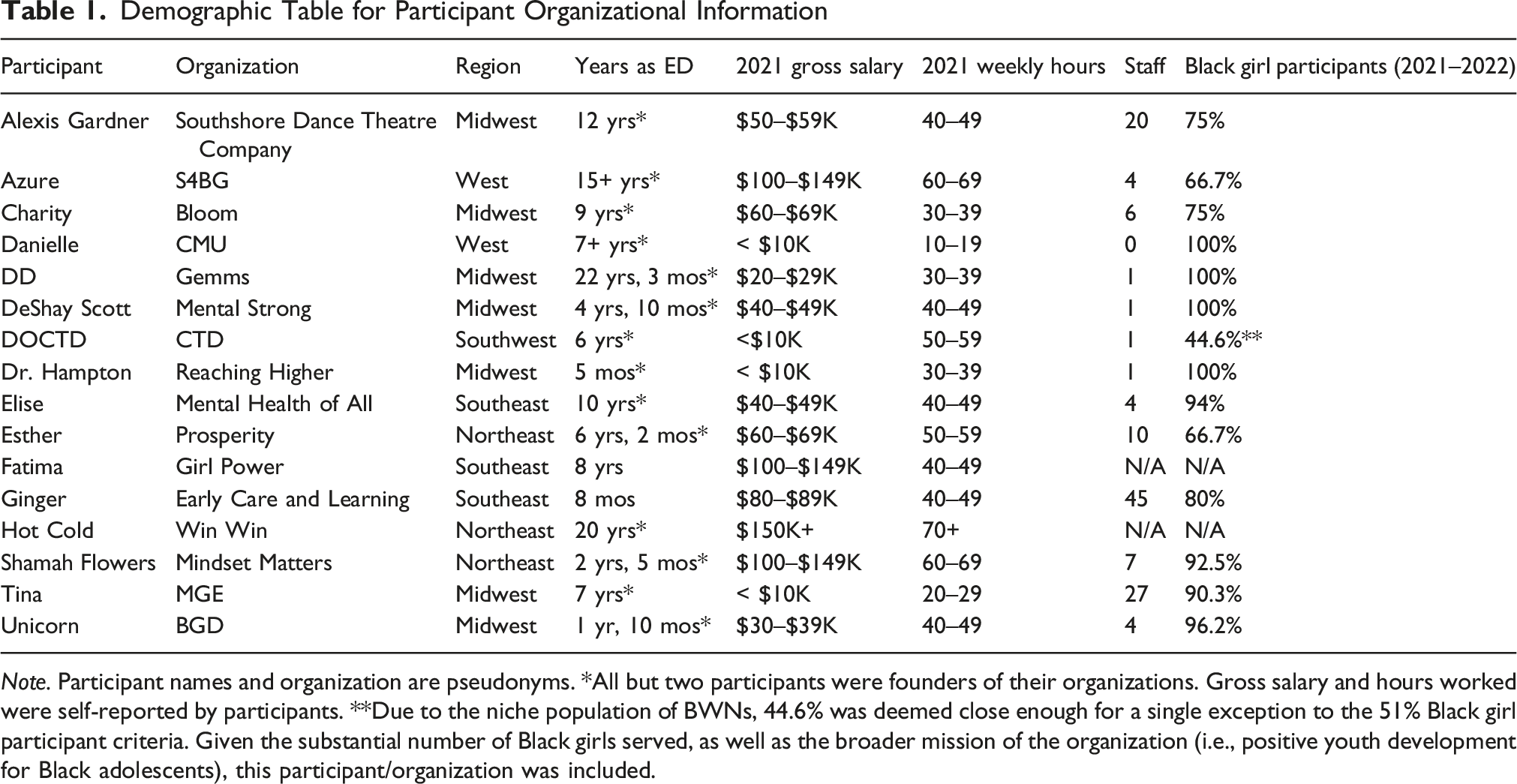
Note. Participant names and organization are pseudonyms. *All but two participants were founders of their organizations. Gross salary and hours worked were self-reported by participants. **Due to the niche population of BWNs, 44.6% was deemed close enough for a single exception to the 51% Black girl participant criteria. Given the substantial number of Black girls served, as well as the broader mission of the organization (i.e., positive youth development for Black adolescents), this participant/organization was included.
Procedures
After receiving IRB approval from the institutions of study, the first author and principal investigator (PI; Latimer) recruited Black women leaders in nonprofits (e.g., EDs and Program Directors) for interviews in 2022–2023. For inclusion in the study, women had to self-identify as a Black, live in the U.S., and be a nonprofit leader of an organization primarily 3 serving Black girls. Given the specificity of our study, we used purposive and snowball sampling (Campbell et al., 2020; Noy, 2008; Parker et al., 2019) to locate our population of interest and gather a sizeable number of accounts (∼8 to 15; Hill, 2012, 2014) from this population by recruiting broadly and using email and social media. The first author and an undergraduate research assistant compiled a list of 501(c)3 organizations in the U.S. that primarily served Black girls (51% of participants or more) with a Black woman ED. The recruitment flier was emailed to these organizations (∼60 contacted) and posted publicly on social media. Some participants were acquired through emailing, others through the posted flyer, and the remainder through referral by those who had already participated in the study. The flier invited Black women nonprofit leaders (BWNs) to share their experiences in relation to their identities, wellness practices, and support needed for them and their participants. It included the PI’s contact information and a QR code linked to the demographic survey. After confirming eligibility, the PI emailed participants the informed consent form, which they digitally signed and returned before their 90-minute Zoom interview. All interviews were semi-structured and conducted by the PI over a 6-month period. Each participant received a $50 Amazon e-gift card for their time and expertise.
Measures
Demographic Survey
Interested participants were asked to fill out a demographic survey, which was also used to determine eligibility. We asked questions about their age, country of birth, gender identity, sexual orientation, religious orientation, income, level of education, self-care practices, and health conditions. They also denoted their hometown and state residence, years in nonprofit, time in their position, hours worked per week, most important tasks of their role, most frequent tasks of their roles, and how they directly interact with the girls. Participants also supplied information on the amount, race, and gender of their organizational staff, volunteers, board members, participants, and parents.
Interview Protocol
As part of a larger study, the interview protocol focused on the well-being and sustainability of BWNs, their organizations, and Black girls. The semi-structured interview protocol (see Online Appendix) consisted of four sections about their: (1) occupational journey and wellness practices, (2) organizational work and support needed, (3) Black girls’ assets and environmental barriers, and (4) vision casting for future leaders. The protocol included 16 questions, such as, “In what ways does your Black woman identity enhance your ability to do this work?” and “Do you think taking care of your health (mental and/or physical) is important and/or necessary to improving your ability to do this work?” Participants were also asked to reflect on organizational capacity and challenges (e.g., “In your opinion, why do you think these obstacles exist and/or persist?”), as well as the experiences of their girls (e.g., “What strengths do the Black girls you serve have?”). Lastly, the participants were asked about the future of their organization and the next generation (i.e., “What advice would you give to Black women pursuing leadership in the nonprofit sector?”). Participants were given a pseudonym and transcript ID number for confidentiality. Following completion of the participant interviews, the audio was uploaded to Rev.com for AI transcription. Once transcribed, the first and second authors listened to the interview audio while reading the interview transcript to ensure participants’ responses were captured accurately. In instances of inaccurate content, the authors updated the content of the transcripts to align with the recorded audio. Finalized transcripts were uploaded to a secure university server.
Coding Analysis
The coding team included three Black women. At the time of analysis, the first and second authors were graduate students and the third member was an undergraduate research assistant. We used Consensual Qualitative Research (CQR) methods (Hill, 2012) to identify themes and subthemes, with three phases of analysis: initial data review, initial codebook development, and codebook finalization. The CQR approach was chosen given its use of inductive data analysis, small sample sizes, emphasis on consensus across team members, and engagement of multiple perspectives in order to provide the most accurate representation of participants’ insights (Hill, 2012, 2014). Prior to coding, all team members discussed our biases and read articles (e.g., Branche & Ford, 2022; Peters & Miles Nash, 2021) to orient us to research on nonprofits and Black women leaders’ experiences. To prepare the data for other team members, the first author removed excerpts that did not meet study criteria. This was done using a free, web-based spreadsheet on Google Docs (Opara et al., 2023) that was later shared with the coding team and co-authors prior to coding. The transcripts, transcribed by Rev.com, were stored in a secure server, along with the demographic survey and interview log. The first author also facilitated spaces for team members to voice nuanced understandings of the data.
For phase one of analysis, the first and second author noted emergent codes (labels) and domains (larger categories of codes). The first author (PI) created a spreadsheet with excerpts denoting challenges Black women nonprofit leaders (BWNs) faced (e.g., discontented White folks, the grant process, and working tirelessly). The spreadsheet had four columns: participant ID, pseudonym, excerpt, and notes summarizing the excerpts and citing connections across excerpts. After an initial list of challenges was compiled, the PI and the auditor (last author) reviewed the emergent codes. In line with Hill’s (2012) recommendation, this first list was broad and inclusive and we reviewed how frequently the emerging codes occurred across the sample.
Phase two included developing an initial codebook. Each team member was assigned a tab with their name on a spreadsheet containing all relevant excerpts to be coded. The tabs had identical excerpts. Coding team members independently reviewed the data and recorded notes on their assigned tab, and then met to confer about how the excerpts had been coded (consensus). One-third of the transcripts (n = 6) were reviewed to reach inductive thematic saturation, or the point at which no new main ideas emerge and existing codes are representative of the data (Hill, 2014; Saunders et al., 2018), and each person coded the same number of transcripts. Then, we produced a broad list of codes with notes for each (e.g., navigating stereotypes and getting grants). We discussed the team notes and integrated the auditor’s feedback about how to condense and define codes. The auditor was not involved in the weekly coding meetings, but she was familiar with the research questions and topic area; thus, she was able to offer an informed but independent assessment of the final coding assignments.
Phase three entailed finalizing the codebook with non-overlapping themes (patterns across the data of codes and domains) and applying the refined codes to the excerpts. In the coding file, each team member had a tab with their name and a spreadsheet with five columns: participant ID, pseudonym, excerpt, notes, and theme. Each coder was assigned transcripts they were responsible for “leading” (5–6 total), and we alternated. Leading coding entailed a member being the first to write notes and codes on their assigned tab. This was followed by the other team members viewing the same transcripts on their own tabs, writing notes and codes, and then viewing the main coder’s tab and flagging any disagreement prior to our weekly meeting. In meetings, we discussed coding disagreements until we reached a consensus. The auditor provided input on excerpts that we could not come to a consensus on, and the following week the coding team voted again until we reached consensus. This process was iterative, and the codebook was updated with codes and themes until the data was best represented. The coding team integrated the auditor’s feedback on final codes and themes.
Reliability and Trustworthiness
Our coding analysis process was steered by Hill (2012)’s guidelines for CQR methods. In keeping with Hill’s (2012) recommendations for reliability and trustworthiness, we highlighted the women’s sociocultural contexts (e.g., socioeconomic status and education) and incorporated coding team members’ perspectives to get a more robust understanding of the data. For instance, we used a standardized interview protocol to control for potential bias from interviewers, and discussed coding team members’ biases throughout the team coding meetings. To balance power and perspective during the coding meetings, the first author invited everyone to discuss their perspectives on the data. As an additional measure of reliability, the coding team integrated feedback from the auditor (fourth author) to aid reaching consensus.
Results
Challenges Black Women Nonprofit Leaders Face
Unsupportive and Hostile Nonprofit Landscape
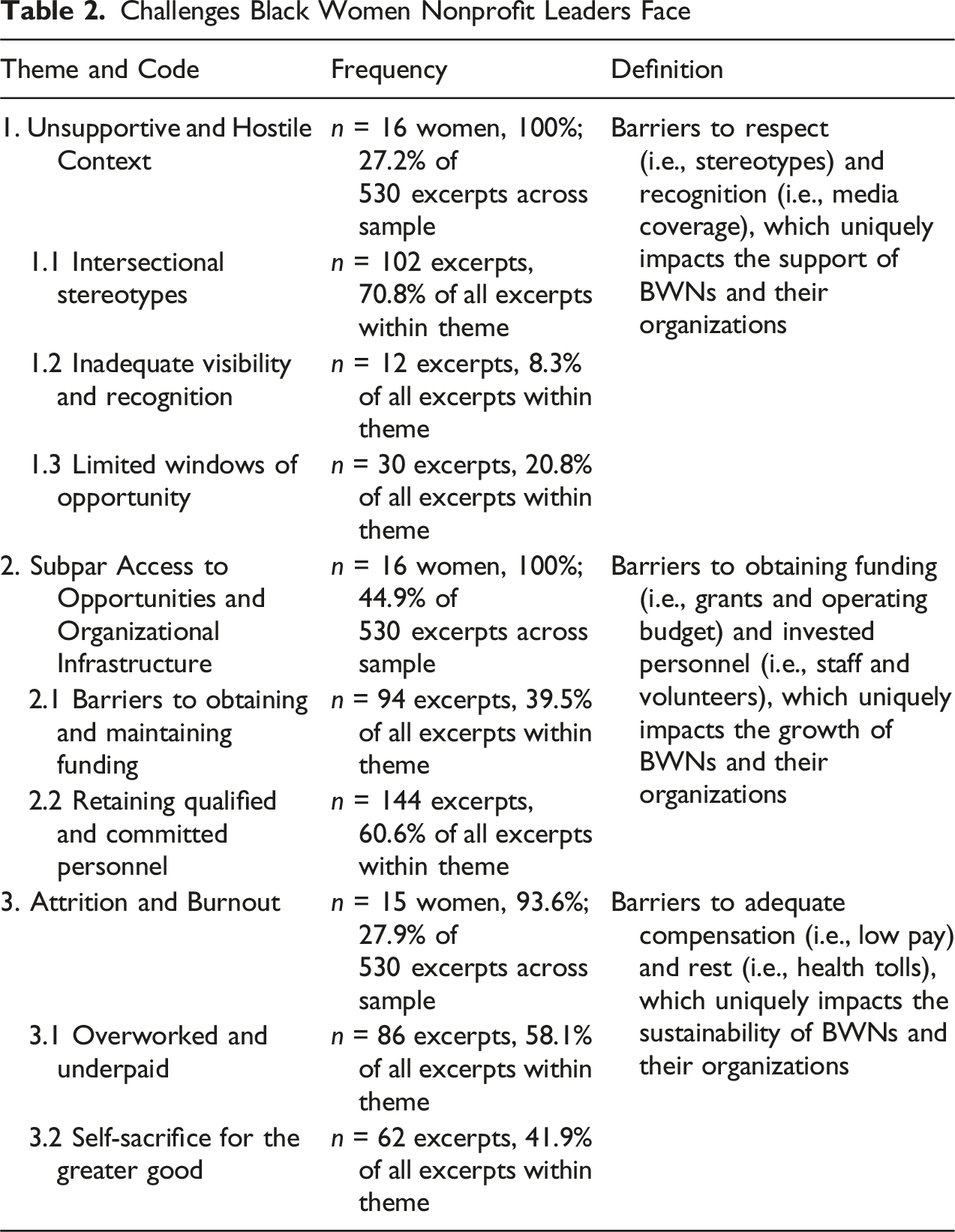
The first theme focused on high levels of interpersonal and systemic hostility in the U.S. and nonprofit context, coupled with low levels of organizational support that BWNs (n = 16) experienced. This theme included three subthemes: (1.1) intersectional stereotypes, (1.2) inadequate visibility and recognition, and (1.3) limited windows of opportunity. The women’s excerpts demonstrated how plantation politics, dependent on denigrating Black individuals and extracting labor, created a hostile environment for Black women in the nonprofit landscape.
Intersectional Stereotypes
The first subtheme underscored the misogynoir or systemic gendered racism (Bailey & Trudy, 2018; Lewis, 2023) that BWNs faced. Circumventing negative stereotypes required more emotional and intellectual labor of BWNs, in a hostile environment. Charity, a 9-year ED of a Midwestern nonprofit, stated: [I] work[ed] very hard as a Black woman to prove my credibility. I have colleagues who started Black girl organizations who weren’t able to get into the rooms I got into, whether it was because of their degree level... [or] they weren’t able to code-switch as good as I can... They didn’t have those connections that I was afforded… [Initially] I was treated very young. It was hard for me to get buy-in… that took 10 years. Degree after degree.
Charity noted several stereotypes Black women leaders faced related to language, pedigree, and intersecting identities (e.g., race, gender, and age). She was aware that her degrees and networks “got her in the room,” even as she critiqued the underlying bias (Spates et al., 2020). Dr. Hampton, a 5-month ED of a Midwestern nonprofit, added, “Our people [Black] otherwise wouldn’t even be [let] in. That’s why I got them little funky letters [PhD] that they say... make you undeniable. All other people, they can show up, and they going to take they word.” Due to plantation politics, Dr. Hampton had to attain and surpass mainstream standards of excellence (via obtaining a PhD), while the competence and legitimacy of non-Black colleagues with the racialized privilege of whiteness were taken at face value. In both instances, BWNs’ access was determined by their identity performances (e.g., code-switching and educational attainment) over their leadership prowess and illustrates how Black women’s social identities contribute to the inordinate expectations placed upon them to achieve similar goals and reception as other nonprofit leaders. Similarly, DD, a 22-year ED of a Midwestern nonprofit, elucidated how stereotypes intertwine and attempt to threaten her leadership and expertise: In meetings where it’s mostly White and there’s a few Blacks, it’s still this kind of aggression... like “Why are you here? Or what do you have to offer?”... [As] a consultant and trainer in that field, my biggest challenge is always with my White participants. They have the tendency to be like, “Hey, I think I saw a grammatical error in the manual.” Or “Maybe you should have said that a different way.”... So that has been daunting.
Despite decades of experience and professional credentials, DD encountered gendered racial microaggressions in workplace contexts from individuals less experienced than her. This chronic micromanagement and diminution of DD’s abilities presented a challenge in itself as she carried out her role, particularly in spaces with less Black representation. Still, many participants recognized the social capital they gifted other Black women by remaining in the field. As Hot Cold, a 20-year ED of a Northeastern nonprofit, summarized: I’m a first-generation, Haitian, lesbian woman. I see my identities as being a possibility model… where you don’t typically see a Black woman with the identities that I carry leading, and co-chairing, and being on the board of, or being in the room and being deferred to. I’ve endured a lot of ‘being the first,’ and been able to make room…in the conversation and the culture of whatever institution we're talking about for others.
Hot Cold being “the first” in many of these 21st century institutions revealed insufficient progress building diverse leadership in nonprofits. Those proximate to whiteness and cisgender men continue to inform leadership decisions, policies, and resource allocation within the sector. But despite the reality that individuals similar to her (i.e., a first-generation lesbian Black immigrant) are excluded from leadership opportunities, Hot Cold demonstrated a motivation to maintain her leadership position. She ensured her presence and organizational power made a difference for other leaders of marginalized backgrounds. The consideration of other Black and marginalized leaders is one BWNs continued to propel, even as their personhood was opposed by the gendered, racist, and/or heteronormative work cultures they were employed in. Similarly, in the second subtheme, BWNs detailed challenges of inadequate visibility and recognition.
Inadequate Visibility and Recognition
Organizational visibility and buy-in from sponsors are a crucial element of nonprofit sustainability. Many Black women EDs struggled to obtain buy-in, which they often attributed to social ambivalence regarding Black girls’ well-being. Azure, a 15+ year ED of a Western nonprofit, noted issues with media coverage, “Black girls…we’re deprioritized and we’re erased. Of course we do our own media… [but] it’s interesting cause I see other groups, specifically Latinx groups being covered and our work is not.” Relatedly, Hot Cold, a 20-year ED of a Northeastern nonprofit, reflected on subpar protection and care for Black girls: After an eight year old Black girl was raped in the community, um that kept me…in this work… [We live] in a world that can find empathy and fragility in White women, White girls – even the fragility of our Black men. But have to dig so deep, or be told, or be shamed into recognizing the fragility of an 8-year-old [Black] girl who was just raped.
BWNs also lamented justifying their mission to nonprofit leaders and funders, inquiring why they did not just focus on “girls” (non-Black) or “Black youth” (boys). The sparse care and visibility for Black girls echoed plantation politics that dehumanize Black girls and orient Black bodies for exploitation. This reality informed BWNs’ social justice missions. Shamah Flowers, a 2-year ED of a Northeastern nonprofit, wields statistics and a keen awareness of misogynoir: It hurts more when it comes from Black people though…and especially when it’s from Black women. The conversation is – why not “focus on our Black boys,” or “what about Black boys too?” And it’s like, “Yep, they have a lot of funding already. Black girls don’t... But the organizations that are doing work for Black girls – where we are positioned and how we’re treated in society, it’s reflected on all levels.
Over the years, Shamah Flowers adopted ways to substantiate why programs for Black girls were necessary. Having had these conversations with various individuals, she was disappointed when this pushback came from Black people in lieu of an anticipated sense of racial solidarity. Like Shamah Flowers, Elise, a 10-year ED of a Southeastern nonprofit, noted her surprise that more nonprofit support for Black girls did not arise during Barack Obama’s presidency: President Obama was still in office, and I remember just a lot of news around My Brother’s Keeper and uplifting young Black men. And I was just like… how is there nothing that is focusing on Black girls?.. Historically... no one is going to help the Black girl, unless it is a Black woman or another Black girl. So I... help[ed] fill that void.
Elise, whose organization is focused on mental health education and access, started her journey in the nonprofit world to fill a programming gap for Black girls. Given that Obama was the first Black president, she expected new programming for Black youth during his presidency. Instead, a federally-endorsed initiative emerged to reduce youth violence and grow effective mentorship programs for Black boys alone. Together, the women in the study highlighted the cyclical nature of Black girls being made invisible. While Black girls face many of the same issues as Black boys, they do not receive similar recognition or visibility. In efforts to ensure Black girls receive the resources they deserve, participants discussed a third challenge, which was the limited windows of opportunity they had to capitalize on to garner support for their organizations.
Limited Windows of Opportunity
Finally, the women discussed how time-sensitive, limited windows of opportunity stifled their ability to actualize their organizational missions. For instance, some leaders experienced an influx of funding and organizational investment after the 2020 Black Lives Matter protests. While seemingly helpful, this support was a double-edged sword, as many anticipated these investments lapsing once local and national leaders believed they had done enough to assuage racial injustice. Alexis Gardner, a 12-year ED of a Midwestern nonprofit, explained: With the whole George Floyd [murder], everybody was now pro-Black and wanted to give to Black folks... Before 2020, our highest grant year was maybe what? 15K. Over the course of 2020 to 2022... half a million... But now it's switching. We took full advantage but I also was very fully aware of what the hell was going on.
Alexis Gardner knew the funding increase that her organization experienced after 2020 was a temporary boon; she saw funding opportunities return to the abysmal status quo in less than 2 years. Fatima, an 8-year ED of a Southeastern nonprofit, also acknowledged the temporary financial support her organization received after George Floyd’s murder. She said: Some funders started to loosen up a little bit and lean into Black-led organizations but it’s just been a struggle forever. It [was] a good public relations move, right? Because we are a Black-led organization serving Black girls. Some thought that they’d get away with just funding us for one year [2020]. But no, I called them out and that has boded well for us.
Like Fatima, many BWNs capitalized on the limited windows of opportunity to leverage support for their organizations; although, they were simultaneously critical about relying on transient beneficence. In addition to accruing resources, some participants described how they enacted meaningful practice and policy changes for Black girls. For example, Hot Cold, a 20-year ED of a Northeastern nonprofit, discussed her long-standing efforts around educational inequities: Getting the [term redacted] Act passed in [our] state and now it’s in the courts was a huge win... [the term] is often used in courts when it comes to gender nonconforming, especially masculine-of-center, Black girls in the juvenile system... further criminalizing Black girls... The governor… passed it also in education. [But] the implementation... Are they decreasing pushout and suspension and zero tolerance policies around Black girls? And is the education there? No. So we know there’s more work to do.
Legislative advocacy was a critical element of protecting Black girls for Hot Cold’s organization, Win Win, which is focused on gender justice and policy reform. Hot Cold knew getting the (redacted) Act passed was a major victory, as criminalization marks individuals as habitually deviant and unworthy of protection. For decades, this label has been weaponized by authorities to disproportionately target and punish youth of marginalized ethnicities and gender performances. Hot Cold and other BWNs were aware that moments in time when broader society found it advantageous to espouse concern for Black girls, typically in response to egregious acts of misogynoir, including the publicized murder of Breonna Taylor, might be short-lived. Thus, they acted quickly to achieve their social justice aims. Relatedly, in the next theme, BWNs expounded on how limited access to funding opportunities and social networks undermined their leadership and organizational capacity.
Subpar Access to Opportunities and Organizational Infrastructure
Within the second theme, Black women EDs (n = 16) discussed deficits in opportunity access and infrastructure that threatened organizational growth. BWNs contended with: (2.1) barriers to obtaining and maintaining funding and (2.2) retaining qualified and committed personnel. The excerpts demonstrated the vitality of plantation politics, in that Black individuals were seen as property and unworthy of basic resources to maintain functionality, which translated to Black-led and smaller organizations being less resourced and able to sustain than their counterparts.
Barriers to Obtaining and Maintaining Funding
The women detailed several issues with the funding process, such as inequitable access to funding, the grant progress, and needing creativity to resource their programs. Tina, a 7-year ED of a Midwestern nonprofit, shared, “Fundraising has been a challenge. And I am working to find organizations or agencies to develop a fundraiser strategy because we know that grants are not guaranteed. So if we had a consistent cash flow… that would really help.” Tina knew that the organization needed a sustainable funding plan, and, like many other BWNs, she was still figuring it out. Participants shared that funding issues were tied to a disconnect between organizational social justice missions and a lack of funders promoting equity for Black girls. For example, Elise, a 10-year ED of a Southeastern nonprofit, explained: We still to this day probably have smaller budgets than any other organization kind of in our spaces… [Why?] we’re focusing on such a niche demographic and a lot of donors are White. A lot of individual corporat[ions], small business foundations, or family foundations. Many times, we don’t even qualify for government funding. So, to have to convince someone who doesn’t look like you, who doesn’t necessarily understand your experiences to invest in those who candidly… are not on their radar, can be quite difficult.
Elise shared that BWNs often had to educate funders and coax them to care about Black girls’ well-being by highlighting how this investment benefited funders. This is a layer BWNs’ White counterparts did not have to navigate. For some, cultural socialization informed their fundraising challenges. DOCTD, a 6-year ED of a Southwestern nonprofit, recounted: I physically had a hard time with asking donors to support. Black women… we’re taught to... be grateful... For whatever we’re given... Everything we do is tied to our value and how we view ourselves because we’re already looked at as “less than”... But we have to be okay with going out there and demanding that people give us money. Cause that White man is gonna go out to Chase Bank and say, “I need $10,000. You need to give it.”... This isn’t a friendly environment for people who are afraid or ashamed to ask for big dollars.
DOCTD mentioned that Black women are conditioned to be content with being under-resourced, while their White counterparts are taught to expect and acquire more resources. BWNs were aware of the longstanding commodification of Black bodies, which harmfully links one’s value to their production, under capitalism. Thus, some Black leaders are afraid or ashamed to ask for money, a norm that makes it difficult for BWNs to bid for funding. Fatima, an 8-year ED of a Southeastern nonprofit, shared how her social position related to her ability to secure funding: I found it challenging to sort of get the respect that you need… and the trust from funders. Whereas a White counterpart may be able to go in with an idea and they get seed funding, like hundreds of thousand[s]... We did good work, we wrote grants and we received funding, but I didn’t know how much we depended on particularly our White board members... Showing our data wasn’t enough. There still had to be a gatekeeper.
Fatima reflected on having to surmount funding hurdles due to misogynoir. Some of BWNs’ counterparts are guarded by the “credential of whiteness,” or the access and shielding from discrimination allotted to those proximate to whiteness (Ray, 2019). Fatima’s account highlighted her experience of White leaders receiving a vote of confidence—sometimes funded from an idea versus the data-driven applications that Black individuals had to present. Also, the women were expected to stretch fewer resources. Alexis Gardner, a 12-year ED of a Midwestern nonprofit, said, “I feel like they put Black organizations against each other because... all these other White institutions... get a whole bunch of money. Why don’t we?” She highlighted that Black leaders were compelled to distribute scarce resources among themselves, in contrast to their White counterparts who might have had more access to funding. Both Fatima and Alexis Gardner saw gatekeeping and reliance cycles perpetuated (e.g., needing White board members’ networks); Black individuals were allowed limited access to financial and social capital based on terms and conditions from people who often had a narrow and monolithic perspective of their organizational needs.
Many participants also discussed the difficulty of having a smaller organization with few staff, which limited their visibility and capacity to access funding. Some felt heightened pressure because they did not have the infrastructural support to achieve as much as larger, more well-resourced nonprofits. Ginger, an 8-month ED of a Southeastern nonprofit, explained: I left [a] 30 million organization...We always had opportunities to come to the table with national initiatives. [At] a small nonprofit, those opportunities are not given... So, when we see the big nonprofits on TV...with the mayor...we feel sort of left out…We know that money’s going to come behind that opportunity. My thing is no money, no mission.
Previous experience made Ginger aware that larger organizations had access to professional networks and media coverage, which raised visibility and funding for the organization’s social justice work. Additionally, many of the women articulated the systemic and cyclical nature of nonprofits funding processes. Elise, a 10-year ED of a Southeastern nonprofit, expressed: [It’s] like a hamster wheel... They’re [funders] like, “Okay, well where’s your audited financials?”... [It’s] 25 to 35K on the low end... [which] a lot of organizations just don’t have... [During COVID] they were like, “okay, just send us a one page.” But now we’re back in the space where we have full proposals that will take me... a week to write... [It’s] this kind of continuum that makes it difficult to go after the big dollars to really grow.
Retaining Personnel and Expanding Support Structures
In addition to the funding processes, retaining qualified and committed personnel and expanding organizational support structures problematized infrastructural sustainability and impact. Participants discussed barriers such as having to discern the intentions of donors and other supporters, navigating contentious BWNs, and having little guidance on how to steer the organization. This created additional work for BWNs, contributing to premature burnout and limiting organizational reach, as opposed to their counterparts who were given the resources needed for success. Charity, a 9-year ED of a Midwestern nonprofit, noted expansion challenges: We need full-time staff. I do serve as a part-time Executive Director... My volunteers, my board of directors… [need] to stop looking at us as some small startup nonprofit and expand their mindset and their thinking as we scale up… [Also] I definitely have founder’s syndrome... you [n]ever want to let it go… trust [or] delegate.
Charity’s quote underscored how the quality and commitment of an organization’s board, staff, and volunteers translated to viability. Managing the volume of work required full-time staff, including the ED, and scaling up depended on organizational builders (e.g., volunteers and board members) buying-in to the vision. Additionally, Charity struggled with “founder’s syndrome” — the difficulty originators have adapting and sharing power with their team, out of fear of organizational mismanagement or being replaced (Block & Rosenberg, 2002) — but decided to trust her team and delegate. Additionally, some participants discussed staff attempts to undermine them. Hot Cold, a 20-year ED of a Northeastern nonprofit, said: The[y] expec[t] that because it is a Black, queer-led organization, that it’s going to be the mammy organization. “Anything you need you’re going to get here”… You can challenge however you want. You can come in as an intern and think, “Well this 20 years that you have actually means nothing”... That does not happen in these White-led organizations.
Akin to the stereotypes mentioned in the first theme, Hot Cold pinpointed the racism and sexism that she encountered from staff (seen as a “mammy organization”) despite her years of expertise and leadership qualifications. Hot Cold’s experience with being disregarded as a competent and tenured leader, speaks to the overall lack of genuine support discussed by BWNs. At times, this lack of support came “in-house” as several BWNs expressed beliefs that circumventing stereotypes from unsupportive staff took away from the true work of the organization, and further marked a need for building additional avenues of support.
A few women also encountered a “crabs in a barrel” mentality among BWNs. As Dr. Hampton, a 5-month ED of a Midwestern nonprofit, put it, “They see them [other leaders] as opposition. ‘I worked hard to get this ball. I want to be the token negro with the ball.’... [But] if we do it right, everybody could eat.” Dr. Hampton’s analogy harkened back to enslavement and racialized privileges, in which only a select few of African descendants (e.g., lighter-skinned, more subservient, and those with specialized skills) were allowed privileges including education opportunities, skill training, and business relationships with affluent White people. This manifested as BWNs striving for degrees, positions, and access to gatekeepers, as well as vying for favor and resources. Dr. Hampton’s example highlighted the consequences of the reinforcement of plantation politics within the NPIC today and its impact on BWNs support structures and engagement with available opportunities. Aligned with this, Black women EDs had to be discerning about their expansion efforts. As Fatima, an 8-year ED of a Southeastern nonprofit, stated on potential investors presenting challenges: 400 years of trying to navigate through a system that doesn’t necessarily see us as... valued... Funders or even our board members... want us to... have girls come to their home and speak... Why can’t you just take my word or look at the stats... Even at our fundraising events, when we have to do this tear jerking, hav[ing] our girls speak, have the parents speak... With the pandemic and the social pandemic... we talk[ed] about... what [we]’re willing to do and what funding [we] just have to leave on the table... [Considering] this white savior syndrome... I just need to understand the intention.
Fatima stressed selectiveness of what she asked of Black girls and their families in exchange for funding. Some White supporters expected BWNs and participants to exaggerate their need (via “tear jerking” performances) to satisfy stereotypes they held (Wilson, 2023); this is akin to (blackface) minstrelsy or performances that caricatured Blackness for the viewing pleasure of White audiences. Fatima also referenced “white savior syndrome,” which refers to the white supremacist notion that non-White people are inherently destitute and incompetent, and that White people should “rescue” them (Jefferess, 2021). By casting Black girls as “in need of saving,” organizational funders reinforced these deficit-based stereotypes.
Finally, some BWNs discussed leading without a roadmap. While many excelled in previous roles, their ED roles required different skills. For instance, Fatima who served as programming staff for 13 years prior to becoming ED said: Answering to a 30 plus board and the admin piece, it was different than [me] being on the program side. And so, the challenge for me was getting out of that work and looking at the bigger picture. But the advantage of that was… understanding some of the things that they [team] would be going through and what they needed from a leader.
While many BWNs began looking at the “bigger picture,” most did not receive mentorship about best practices and logistics. Unicorn, a 1-year ED of a Midwestern nonprofit, stated: I don’t have any experience. I’m making it up as I go and relying on my board. I need to know more about tuition and have systems to make things run more automatically. I find myself Googling what board members should be doing. I could use more guidance.
Fatima’s and Unicorn’s organizations were passionate about girls’ empowerment and personal growth through dance; yet, they also needed more operations guidance. This guidance was often hard to obtain or only secured through competitive grants. Elise, a 10-year ED of a Southeastern nonprofit, noted, “Support needed? Mentorship and coaching. I don’t know anyone who does logistics… [or] who to turn to. We just received a new grant with a coaching component. So, I’m curious to see how helpful that is.” Plantation politics also influenced professional development opportunities, which were often relegated to those with access to leadership training networks, funding to pay for them, and enough staff to entrust the organization to. Infrastructural flexibility for mentorship, coaching, and attending full-day workshops were a luxury to BWNs; this was a self-propelling cycle in which lack of access threatened growth. In the same vein, in the last theme, participants pointed to issues of attrition and burnout which ultimately impacted sustainability.
Attrition and Burnout
Due to the unsupportive and hostile nonprofit context, as well as issues with funding and infrastructural issues, some participants (n = 15) discussed challenges with remaining in leadership. Areas of concern noted were: (3.1) overworked and underpaid and (3.2) self-sacrifice for the greater good. Some women also discussed how stressful moments impacted staff burnout (e.g., onset of COVID-19). These excerpts showcased the exploitation of Black women’s emotional, physical, and intellectual labor, which has a long history within America’s racial and sociopolitical landscape. Still, many of the BWNs espoused a strong commitment to their work because it benefitted Black girls and served as a critical path toward resisting racism and sexism in the U.S.
Overworked and Underpaid
Participants expressed having difficulty prioritizing their well-being juxtaposed to their organization’s. This encompassed: not taking breaks, working multiple jobs due to a non-existent or insufficient salary, “wearing many hats” or having a stretched capacity without matching resources, and running the organization using minimal resources. Danielle, a 7+ year ED of a Western nonprofit, noted that Black women were socialized to “put themselves last”: We get the trope that “Oh, a Black woman will do it.”... [We] aren’t given the opportunity to rest… We can go a lot further when we rest... [I want] Black women in particular to do what you can and rest and... teach the girls in your life [that] rest is okay.
Danielle exposed that the “I put myself last” mentality—that Black women should prioritize others more than themselves despite self-detriment—does not serve BWNs. This socialization is a manifestation of enslavement where Black individuals were expected to work tirelessly, at times to the point of death; they were treated as “property” for the plantation owner’s disposal and “superhumans” able to endure extreme pain (Collins, 2000; Ruef, 2004). Historically, Black women’s labor has been central to this country’s social movements and institutions, including nonprofit organizations, frequently subject to the expectation of sacrificing their health or pushing through inconceivable working conditions and stress. DeShay Scott, a 4-year ED of a Midwestern nonprofit, recounted the multiple roles she assumed to keep her organization afloat: It really is overwhelming sometimes because I don’t want to do fundraising all the time. And I’m wearing so many hats, program development, I’m facilitating workshops. I’m doing all of these different things. The board members are a big part of that [fundraising] as well [but] it’s not something that I particularly care to focus on, but you have to.
DeShay Scott expressed the difficulty of wearing “many hats” and pushing past her capacity to perform the roles necessary for her organization. BWNs leading smaller organizations were often unable to outsource tasks that were beyond their specialties like larger organizations did. In some cases, the women worked multiple jobs to serve Black youth yet meet their financial obligations. Dr. Hampton, a 5-month ED of a Midwestern nonprofit, discussed how she paid her bills: [I] make 10k as an ED. But I am also a yogi [and] a doula... [because] it’s not enough to live off of. That's why I do have the support of my husband– and... I’m a hustler... I’ve been a licensed cosmetologist since 1999... because I know that other things are required for me to be able to help with feeding the family. It take a long time sometimes, for you to get funded as a nonprofit... to make a living wage... And then they say, “At what cost?”
Dr. Hampton explained that she worked full time hours for her nonprofit but did not receive a living wage. To fill this gap, she had “side hustles” (yogi, doula, cosmetology), and depended on her husband’s financial support to maintain their lifestyle. Similarly, DD, a 22-year ED of a Midwestern nonprofit, recounted how she made ends meet, “Last year was probably the first year I would say I ever got a real salary… The money is little, lacking. If I had to depend on it, I would be in trouble… So [I contract] my consulting training[s].” DD highlighted that she could not depend on a salary from her nonprofit, despite being an ED for decades, and had to take on additional jobs to supplement her income. This financial strain and dividing time detracted from BWNs’ ability to focus on their organization and, in some cases, hampered the organization’s trajectory. Many women understood that they were overworked and underpaid due to the nature of nonprofit funding and the devaluation of Black women’s labor. Esther, a 6-year ED of a Northeastern nonprofit, expounded on what she called “chitterling mentality”: Being so great with this little bit of shit... I call it... chitterling mentality. How we’ve made innards chitlins, they want us to make it a delicacy now. No... because then you are gonna keep giving us scraps... It’s dangerous to keep having [to] be great when I get the least of everything... And we do it with no complaint... So that’s what I believe leads to sickness, mental illness... always trying to make something work. And that takes a lot of mental energy, which impacts the heart... the head... [and] the gut, which impacts everything.
Esther drew attention to Black women’s resourcefulness, which can be a strength (e.g., superwoman schema; Donovan & West, 2015; Woods-Giscombé, 2010), but interrogates the ideological framing and impacts. BWNs received “scraps” or minimal funding to survive, yet were expected to sacrifice their time and health to “make a way” out of the little they were given. This is rooted in enslavement, where landowners kept the best for themselves and co-opted Black people’s resourcefulness to rationalize giving them less than they needed to survive. Esther’s awareness of the “chitterling mentality” could help nonprofits shift from plantation politics by challenging the normalization of scarcity, advocating for equitable resource allocation, and restructuring organizational expectations to support leaders’ well-being. In the second subtheme, Black women EDs expounded on the consequences that arose from prioritizing others above themselves.
Self-Sacrifice for the Greater Good
The women also cited the toxic environments some girls faced at home and within broader society, and the emotional weight of BWNs navigating this context. While BWNs knew that their work mitigated youth’s adverse home, school, and community experiences, fulfilling roles meant for multiple people and managing participants’ traumas impacted BWNs’ capacity to do this work at full health. Charity, a 9-year ED of a Midwestern nonprofit, said, “Our girls… feel silenced in certain spaces… their [parents] don’t want ‘em... [they’re] grappling with grief… [and] sexual assault… They [sometimes] feel hopeless... A lot of times we sparking that light in them…[to] feel hope… [and] want more.” Charity highlighted that some of her participants were devalued and unprotected, navigating misogynoir in their homes and communities (e.g., silenced, unwanted, grieving, and sexually abused). Helping Black girls navigate these harsh realities can lead BWNs to inadvertently carry the weight of situations home with them and push through despite the emotional toll. Alexis Gardner, a 12-year ED of a Midwestern nonprofit, reflected on the mental health supports she used to navigate racism and her organizational work: Reparation[s] should be free mental healthcare because in order to be Black in America honey, you need to go to therapy to even deal and download all the shit that is… We just are taught to move through life. Very few times do we really sit down and truly reflect... That is essential for anybody working with children. When you doing heart work, you also take on a lot because it’s so much a part of you as well and that can be heavy.
Alexis Gardner cited the need for mental health support as an owed payment for the harms of enslavement, to help Black individuals navigate the hostile sociopolitical context that disparages and harms Black life. Plantation politics feeds capitalist culture, and subsequently informs Black individual’s socialization, to discourage rest and reflection; this hinders BWNs’ ability to heal, develop as leaders, and stave off overworking and burnout. Moreover, Alexis Gardner endorsed therapy as an essential tool for those doing “heart work,” as their capacity can be sapped when not counterbalanced with means of reprieve (e.g., self-care and social support amidst gendered racism; Lewis, 2023; Spates et al., 2020). For instance, Charity, a 9-year ED of a Midwestern nonprofit, illustrated that when health was not prioritized, physical costs amassed: I was very stressed this week... haven’t been sleeping... When you get into just Black women and our health... why we die?... I’ve seen leaders not be able to lead and not be able to be a change agent because of their health... When I first started, girl... I had four or five meetings in the evening, just all over the place. I just took a week[-long] cruise... So, [now] I do prioritize and center mental health, physical health, and spiritual health.
Charity recalled how organizational stress negatively impacted her health, and cited cautionary tales of peers being unable to fulfill their social justice missions. Black women must draw on individual forms of resistance in the action of taking breaks or other self-care practices, since the nonprofit landscape as a capitalist system regards BWNs as hyperproductive “Superwoman” (Collins, 2000; Reynolds-Dobbs et al., 2008; Woods-Giscombé, 2010) and does not pace productivity for health. Over time, Charity prioritized health in service to herself and modeled this for her staff and participants. Similarly, Tina, a 7-year ED of a Midwestern nonprofit, shared: The things that they [girls] tell me can really weigh on me. So, I have to take time for myself to detox… [A participant] very close to me tried to commit suicide… [I’m] mak[ing] sure she’s okay, mom’s okay… [that] she gets the resources that she needs.
Tina’s experience highlighted the critical youth advocacy many of these women have done, navigating organizational contexts that were hostile and harmful to their health. To challenge the white supremacist and capitalist norms in nonprofit spaces—the structures that plantation politics spawned—BWNs sometimes pushed themselves to the point of burnout. Yet, BWNs pressed on because they felt an urgent need to be present in Black girls’ lives, connect them to resources for positive developmental trajectories, and ensure that Black girls not only survive but thrive.
Discussion
The purpose of the current study was to explore the challenges that Black women nonprofit leaders (BWNs) faced while directing organizations that primarily serve Black girls. We integrated plantation politics (Gladden & Levine Daniel, 2022) and intersectional leadership (Peters & Miles Nash, 2021) to examine Black women’s experiences as leaders, revealing how oppresive racialized and gendered logics shaped both organizational and interpersonal dynamics. Our findings highlighted an often-overlooked experience: how unsupportive and hostile nonprofit landscapes, combined with limited access to opportunities and organizational infrastructure, contribute to attrition and burnout among Black women leaders (Donovan & West, 2015). These results lend insight into the systemic underpinnings impacting not only the growth of organizations run by BWNs but their own psychological health, as well. Our findings extend prior scholarship on the experiences of nonprofit leaders from socially marginalized backgrounds (Branche, 2014; Bui, 2019; Douglas & Iyer, 2020; Griffin, 2021; Wilson, 2024) by considering the unique challenges BWNs face.
The first theme detailed the unsupportive and hostile nonprofit context BWNs navigated. Participants discussed how the pervasiveness of racism and classism in the nonprofit landscape undermines BWNs’ ability to access resources, respect, and support to succeed. Additionally, the women navigated racialized and gendered stereotypes from their counterparts and funders, as they strived to implement policies and practices to support Black girls (Collins, 2000; Griffin, 2021; Washington Area Women’s Foundation, 2023). BWNs noted feeling pressured to identity-shift or codeswitch (Dickens et al., 2019), altering aspects of their physical appearance and mannerisms to be viewed as acceptable (Spates et al., 2020) and just as skilled as their White male counterparts. Also, the BWNs highlighted the lack of prioritization of Black girls’ health and protection, evidenced by pushback for centering Black girls and the existence of harmful legislation. Additionally, participants noted facing a “limited window of opportunity” around 2020, in the wake of the more publicized murders of Breonna Taylor and George Floyd (Destine, 2023). Some funders quickly moved past DEI initiatives and resumed offering meager support and visibility to organizations serving Black youth. These findings are consistent with prior research on Black women’s underrepresentation, tokenization, and marginalization within organizations (Dickens et al., 2019; Griffin, 2021; Spates et al., 2020; Washington Area Women’s Foundation, 2023), highlighting the ongoing need to address inequitable opportunities in leadership and resource access. “Plantation politics”—or racism embedded into America’s institutions—is the heir of the institution of slavery, and showcases the insidiousness in the design of wealth and resource control even in the nonprofit landscape (Gladden & Levine Daniel, 2022; Ray, 2019; Rodriguez, 2017; Wilson, 2024).
The second theme foregrounded how BWNs struggle to access opportunities and organizational infrastructure, with a particular focus on funding and sustainability. Across the nonprofit sector, funding is a main determinant of an organization’s sustainability; yet, many Black women-led organizations and those focused on Black girls receive less financial investment than their White and Latine counterparts (Ford et al., 2021; LeRoux & Medina, 2023). While several funding sources exist for nonprofits, including the government, corporations, and individuals, evaluation-backed grants are still pushed (Dorsey et al., 2020; Faulk et al., 2021). Many of the participants suggested that successful grant planning and writing was a luxury, especially at short-staffed organizations with limited operating budgets. Some BWNs viewed grant funding as invasive and exploitative, as they had to “prove” Black girls and their families deserve resources (Dorsey et al., 2020; Wyatt, 2023). Additionally, the labor-intensive nature of grant applications and restricted funding (Dorsey et al., 2020) mirrored the economic obstacles Black people faced in antebellum America, including limited access to employment and education (Ray, 2019; Villanueva, 2021). In both contexts, systemic structures constrained Black economic agency, requiring extraordinary effort to secure resources necessary for survival and advancement.
In addition to fundraising, acquiring and maintaining qualified personnel was another common challenge that BWNs shared. Many of the participants did not have the resources to hire additional staff, making them the only employee or one few full-time staff members; they relied on unpaid labor, which led to concerns about quality volunteer and board member assistance (Francis, 2019; Heckler & Mackey, 2022). At times, younger or newer staff members sought to undermine BWNs by questioning their leadership skills, and funders viewed White board members as necessary gatekeepers despite BWNs’ expertise and data (Heckler, 2019). Participants mentioned needing to be selective of volunteers and partners who wanted Black girls to showcase their need and deservingness through emotional theatrics (Wilson, 2024), and they revisited funding mechanisms during the onset of the COVID-19 pandemic (Washington Area Women’s Foundation, 2023). They also noted that the resurgence of the Black Lives Matter movement in 2020 prompted increased attention and investment in Black-led organizations, but they were acutely aware that much of this funding came with conditionalities that could potentially exploit the girls in their programs or conflict with the mission and values central to their work.
The women also cited exposure to a “crabs in a barrel” mentality in which scarcity brewed competition instead of collaboration; this derived from plantation culture in which select Black individuals were chosen to be “house negros” proximate to White individuals and opportunities. Today, BWNs are pitted against each other to be “token negros” who possess traits favorable to White individuals including lighter-skin, docility, and speaking proper language, and are used to further the goals of white supremacy (Collins, 2000; Reynolds-Dobbs et al., 2008). Furthermore, akin to enslavement days where Black individuals were not provided the tools and skills to flourish, BWNs did not have adequate support mechanisms to succeed. Plantation politics has been sustained by cultivating scarcity and rivalry among BWNs, reinforcing stereotypes to provide conditional support, and obstructing access to leadership development opportunities.
Lastly, participants expressed experiences with attrition and burnout. Participants noted issues with receiving adequate compensation for their labor; many had to perform multiple roles due to staffing issues or maintain a job outside of their organization to pay their bills. Some BWNs also discussed how other nonprofit leaders and funders praised them for their resilience strategies and the extreme lengths they went to in order to keep their organizations afloat; however, this praise rarely translated into financial support (Bentley-Edwards & Adams, 2024; Branche & Ford, 2022). Thus, BWNs were expected to be resourceful despite having inadequate resources, which one participant dubbed a “chitterling mentality.” Yet, if BWNs failed to adhere to unrealistic expectations, they risked satisfying those who sought to prove their incompetence and justify abuse. The racialized and gendered logic of plantations, in which Black women’s worth was tied to their productivity and labor extraction, perpetuated controlling images of the Mammy serving White families to her own detriment and the Strong Black Woman/Superwoman working tirelessly (Collins, 2000; Jones et al., 2025; Reynolds-Dobbs et al., 2008; Woods-Giscombé, 2010).
Limitations and Future Directions for Research
While our study design and method have benefits, limitations also exist. First, although the participants were candid, they may have tailored the content and depth of what they shared due to uncertainty about whether they could trust the PI to honor their stories accurately. This hesitation could have reflected their awarenes of a broader legacy of extractive research practices, in which scholars have historically taken knowledge from Black communities without reciprocity, misrepresented their experiences, or used their narratives to advance academic goals rather than community priorities. Considering the participants’ positionality as Black women in highly visible leadership positions, they may have chosen to share particular information to safeguard vulnerable aspects of their stories (and their girls' stories) that could be exploited by other scholars or potential funders. Furthermore, the BWNs may have perceived “distance” or a lack of relatability with the PI due to differential life stages and professional roles, which could have influenced the perspectives we were able to capture. We sought to mitigate this by engaging in culturally responsive, relational research practices — building trust through shared experiences as Black women and a mutual commitment to the health and well-being of Black girls — thereby creating a space where participants felt seen, valued, and understood. Second, our sample size offered a glimpse into the lived realities of Black women in nonprofit spaces. Interviewing more Black women across diverse organizational contexts (e.g., grassroots community organizations, national nonprofits, philanthropic foundations, educational institutions, and policy advocacy groups) and individual-level characteristics (e.g., age, career stage, immigrant background, sexual orientation, disability status, and geographic location). Would allow us to have a more nuanced understanding of the challenges and the ways they use antiracist and antisexist praxis to continue their social justice missions for Black girls.
Third, although the current study seeks to understand the experiences of BWNs, the findings could be interpreted as only acknowledging deficits. To address this particular limitation, in the larger study, we asked participants about how their Black woman identity enhanced their ability to fulfill the tasks of their roles, what successes they have experienced, and the strengths their Black girls possess. Studying these research processes from a strengths-based lens is essential for capturing the cultural assets, leadership strategies, and community wisdom that Black women bring to their work. This approach not only challenges deficit-based narratives but also highlights how their identities, cultural knowledge, and collective practices serve as powerful tools for sustaining their leadership and advancing their missions. For example, Black women leaders may draw on intergenerational storytelling to help Black girls see themselves within a legacy of resistance and leadership; rely on church networks and faith-based traditions to create community-based programs for Black girls; use culturally rooted healing circles to nurture their emotional well-being; and build reciprocal mentorship models that center mutual care and empowerment between Black women leaders and Black girls.
Future research in this area can position Black women nonprofit leaders as research collaborators who can spearhead the research process and interview other nonprofit leaders, strengthening trust and generating richer, more contextually grounded data. Peer-to-peer research can offer an insider perspective that traditional researcher–participant dynamics often overlook, allowing for more candid reflections on sensitive organizational and personal challenges. Because these leaders share certain profesional experiences as EDs, they are better positioned to surface nuanced insights, unspoken norms, and systemic barriers that may remain hidden to researchers. Second, the participants in the current study were BWNs who specifically focus on youth development programming for Black girls. Future studies can instead focus on the lived realities of adolescent Black girls, the relationship they may or may not have with BWNs, and their perspectives on the programming that is designed for them (Inniss-Thompson et al., 2024). Black girls can offer their own insights on the relationship they may have with their Executive Directors, which would also grant researchers a deeper understanding of the effectiveness of this leadership based on the girls’ experiences with programming. Finally, understanding plantation logics involves raising awareness about how nonprofit organizations and other workplaces can be rooted in white supremacy. This anti-racist and anti-sexist praxis is about going beyond conceptual frameworks and actively resisting white supremacy (Freire, 2000; Heckler, 2019).
To advance the field of Black psychology in particular, more research is needed to integrate Black studies and psychology to best contextualize the experiences of Black women. In this study, we situate plantation logics as integral to explain the contemporary manifestations of racism, sexism, and disproportionate labor Black women face within white supremacist structures. Also, our study included participants across the Black Diaspora (e.g., Nigerian and Haitian). Including ethnically diverse Black women aligns with a Black studies perspective by centering the multiplicity of Black experiences across the diaspora, highlighting how race, culture, and historical context intersect to shape distinct social, political, and psychological realities. Thus, future researchers can study the psychological experiences of plantation logics more intentionally with Black women from the Caribbean or Africa, as these cultures are also rich with their own revolutionary histories and can contribute to more knowledge with Black people from a Diasporic lens. It would be beneficial to conduct quantitative studies surrounding the psychological impacts of plantation politics for Black women, as well. In our study, participants discussed staff attrition and leader burnout as a result of plantation logic. Quantitative studies could help establish the prevalence and magnitude of these experiences across a broader population, offering empirical evidence of their systemic impact. Such research could also identify key mediating and moderating factors—such as organizational resources, support networks, or coping strategies—that shape how plantation politics affects Black women’s leadership sustainability and well-being.
Implications
This study has implications for researchers, funders, policy makers, and community members. By centering BWNs and honoring their intersectionalities as strengths (Crenshaw, 1989; Peters & Miles Nash, 2021), the nonprofit sector can be revolutionized. First, scholars can use the findings from this study to investigate how oppressive logics undergird the policies and culture within nonprofit organizations, and their impact on disparate support, sustainability, and health outcomes among those who lead thee organizations. We aim to create 1-pagers to post on social media and to make handouts of our findings available to interested stakeholders, such as other BWNs, policy makers, and funders to start this conversation. Similarly, nonprofit leaders can wield these findings to create accessible and holistic resources, including toolkits and podcasts, support networks, research-partnerships, and paid wellness days to help future BWNs counter job-related stress and scarcity mindsets, enhance program offerings, and generate viable sustainability pathways. Second, funders can streamline grant applications, with a different track for smaller and newer organizations that do not have audited financials. Third, policy makers can draw on these findings to implement legislation championing Black girls’ positive development. Investing in programs that empower Black girls is crucial for their health and well-being. These initiatives provide safe, supportive environments where Black girls can build resilience, develop leadership skills, and access resources that promote mental, emotional, and physical health. For example, The Beautiful Project uses mentorship and creative training in photography, film, and writing to help Black girls and women tell their own stories, fostering self-expression and emotional well-being. Similarly, Black Girls Do STEM engages high school-aged Black girls in STEM education, mentoring, and internship opportunities, cultivating confidence, curiosity, and skills that support long-term empowerment and holistic health. By supporting organizations like these, we help break cycles of trauma and disenfranchisement, fostering a generation of empowered young women equipped to lead and thrive. Lastly, community members can use this research to give language to the disparities in support and expectations that BWNs face, inform conversations with policymakers, and drive their financial support. Because community members are “on the ground,” they have firsthand knowledge of the challenges and strengths within local contexts, allowing them to offer support for nonprofit leaders that is practical, timely, and deeply informed by lived experience. Their proximity enables them to connect resources, advocate effectively, and implement solutions in ways that policymakers may be more oblivious to -- especially in the day-to-day experiences of their constituents.
Conclusion
In the current study, we examined the challenges BWNs face, as well as their leadership paradigms and strategies for navigating a racist and sexist occupational context. Women in this study emphasized that Black women nonprofit leaders navigate a challenging environment characterized by a lack of support and resistance within the sector, limited access to critical resources and organizational structures, and high rates of stress and turnover—all reinforced by entrenched institutional policies and practices. Our findings hold significant practical implications for cultivating environments with plentiful resources and opportunities, in which Black women leaders and girls are prioritized, supported, and able to thrive. Fewer scholars have focused on the experiences of Black nonprofit leaders, in relation to the persistent stereotyping, marginalization, and barriers to authority and resources they encounter (Ford et al., 2021; Wilson, 2024), and even fewer examine Black women in executive leadership roles (Griffin, 2021; Washington Area Women’s Foundation, 2023; Wyatt, 2023). Thus, our study advances the field of Black psychology by centering the experiences of Black women leading nonprofit organizations, exposing how systemic forces work to undermine their sustainability and well-being, and showcasing their strategic resistance to disrupt the status quo and uplift the Black community.
Supplemental Material
Supplemental Material - Chitterling Mentality: Plantation Politics and Organizational Challenges for Black Women Nonprofit Leaders
Supplemental Material for Chitterling Mentality: Plantation Politics and Organizational Challenges for Black Women Nonprofit Leaders by A’zure Latimer, SynClaire Arthur, Alexandria Chidera Onuoha, and Seanna Leath in Journal of Black Psychology
Footnotes

Ethical Consideration
The PI received Institutional Review Board approval at the University of Virginia before starting data collection with the participants.
Consent to Participate
All participants completed an informed consent form before each interview. The study did not involve deception, and the PI’s (first author) contact information was provided at the conclusion of each interview.
Funding
The authors received no financial support for the research, authorship, and/or publication of this article.
Declaration of Conflicting Interests
The author(s) declared no potential conflicts of interest with respect to the research, authorship, and/or publication of this article.
Data Availability Statement
Interview protocol and coding process documents available upon request.
Supplemental Material
Supplemental material for this article is available online.
Notes
References
Supplementary Material
Please find the following supplemental material available below.
For Open Access articles published under a Creative Commons License, all supplemental material carries the same license as the article it is associated with.
For non-Open Access articles published, all supplemental material carries a non-exclusive license, and permission requests for re-use of supplemental material or any part of supplemental material shall be sent directly to the copyright owner as specified in the copyright notice associated with the article.
