




Abstract
In the present qualitative study, we draw from a psychological framework of radical healing in communities of color to explore Black mother’s perspectives on what it means to raise free, Black children in the anti-Black racial context of the United States of America. Specifically, we consider the extent to which Black mother’s descriptions about supporting their children’s freedom involve new cultural and social norms that integrate personal wellness with collective social justice practices. We used consensual qualitative research methods to analyze semi-structured interview data from 31 Black mothers (28–50 years, M = 35, SD = 6.03) with children ranging from 6 months to 21 years old. We identified the following themes: promoting pro-Black critical consciousness, encouraging self-authentic expression through socioemotional support, and building strength and resistance through community care. Overall, we found that mothers viewed raising free, Black children as an inherent act of social justice, since they hoped to help their children learn to identify oppressive forces and engage in community-level efforts to promote social change and build a life-affirming future for themselves.
Keywords
“I’m often reminded of how much is asked of Black parents and of how politically powerful Black parenting can be.” (McClain, 2019 p. 5)
Dating as far back as a 1662 doctrine passed in colonial Virginia that legalized chattel slavery as inheritable from mothers to their children (i.e., “partus sequitur ventrem,” Latin for, “that which is born follows the womb”; Klein, 2020), Black mothers have had to fight for their bodily autonomy and assert their right to parent their children autonomously in the United States of America (USA) (Collins, 1994; Elliott et al., 2015). Even after slavery was abolished in 1863, Black 1 mothers and their children endured generations of racialized and gendered violence (e.g., lynching and rape), sociopolitical and economic dispossession and precarity, as well as persistent myths about the dysfunctional nature of Black family systems (Hartley, 2019; Jackson et al., 2018). Yet, alongside this historical legacy of anti-Black bias and discrimination, scholars have highlighted Black mothers’ resistant ways of knowing, loving, and parenting that “do not just escape the everyday brutalities of capitalism, patriarchy, and white supremacy, but build community, establish fellowship, [allow for] play and laughter, and plant seeds for a different way of living, a different way of hearing.” (Kelley, 2022, p. 12). In the current study, we extend prior literature on Black radicalism, psychological liberation, and racial healing (Bañales et al., 2021; Brown, 2020; Chapman-Hilliard & Adams-Bass, 2016; Kelley, 2022) by exploring Black mother’s perspectives on what it means to raise free, Black children.
Historian Kelley (2022) opened his account of Black radical imagination by referencing his mother’s tendency to dream out loud, stating that she wanted her children to see life as possibility, “She wanted us to imagine a world free of patriarchy…to see the richness in our daily lives…to visualize a more expansive definition of Blackness, to teach us that we are not merely inheritors of a culture, but its makers” (p. 4). Consistent with Kelley’s (2022) articulation of dreams and imagination as poetic knowledge—or the ability to see a different future while living in the present—we consider how Black mother’s parental beliefs and practices fuel radical possibilities for the present and the future of society, in so much as these dreams fuel new personal and community practices that promote wellness in themselves and their children. We use French et al.’s (2020) lens of radical healing in communities of color to analyze Black mother’s narrative accounts of how they plan to cultivate their children’s critical awareness of the society in which they live, in conjunction with the necessary internal love and radical hope to address oppression through courageous conversations and collective action (Brown, 2020; Cullors, 2022; McClain, 2019). We will contribute to literature on positive youth development and family wellbeing (Berkel et al., 2009; Dunbar et al., 2017; Hutchins & Nelson, 2021) by exploring empirically how Black mothers grapple with the political, social, and economic realities of anti-Black racism through intentional family healing practices.
A Psychological Framework of Radical Healing in Communities of Color
The white supremacist capitalist patriarchal context (hooks, 1997) of the USA has long shaped Black family systems (Collins, 1994; McWayne et al., 2020), in that the country’s endemic history of racialized oppression is associated with biological, cultural, environmental, psychological, and social markers of traumatic stress among Black mothers and Black children (Anderson & Stevenson, 2019; Henderson & Wells, 2021; Jackson et al., 2018; Miller & Vittrup, 2020; Murry et al., 2018). However, the ability to survive historical and contemporary racialized trauma intimates that Black people possess corresponding markers of resilience, which Black mothers also pass down and transmit to their children (Brown & Tylka, 2011; Chapman-Hilliard & Adams-Bass, 2016; Everet alt et al., 2016). In the current study, we will add to the expanding literature on Black families’ resilience and resistance to race-based traumatic stress (Anderson & Stevenson, 2019; Jones et al., 2014) by drawing upon French et al.’s (2020) framework of radical healing to situate Black mother’s narrations of what it means to raise free, Black children in the U.S racial state. This framework builds on foundational theories in Black psychology (White, 1970), ethnopolitical psychology (Comas-Díaz, 2007), intersectionality (Cole, 2009; Crenshaw, 1989), liberation psychology (Grills et al., 2016), and social justice education (Ginwright, 2010; Love, 2019) to contextualize the legacy of resilience among People of Color and Indigenous (POCI) individuals in the USA. The framework includes five categories: critical consciousness, cultural authenticity and self-knowledge, emotional and social support, strength and resistance, and radical hope. Below, we connect each of these categories to related literature on Black mothers’ parenting practices and review how we will add to this scholarship in our study.
Critical Consciousness
Within the radical healing framework, critical consciousness refers to “an individual’s capacity to critically reflect and act upon their sociopolitical environment” (Diemer et al., 2006, p. 445). It is considered a prerequisite for moving oneself towards freedom, based on the idea that individuals must be able to reflect on and question their current sociopolitical realities to envision a different way of living and being in community with others. Specifically, scholars have suggested that as individuals gain more critical consciousness, they are more likely to engage in critical reflection (i.e., analysis of historical and structural factors that lead to social inequities) and develop a stronger sense of political self-efficacy (i.e., confidence in one’s ability to effect positive change in society), which may then translate into critical action (i.e., moving from awareness to action against oppression; Watts et al., 2011). As one example, Saleem et al. (2020) found that Black mothers’ experiences with racial discrimination influenced the content and pattern of messages that they delivered to their adolescent children over time, such that the more encounters the mothers had with racial discrimination, the more likely they were to emphasize preparation for bias and cultural and racial pride messages. Their findings highlighted that as Black mothers experienced racial bias and discrimination, they were more likely to try to prepare their children by communicating race-related coping strategies and messages that encourage racial pride and empowerment. In this study and related work (Dow, 2016; White-Johnson et al., 2010), scholars suggest that Black mother’s experiences of racial discrimination may contribute to a more socially aware and critical perspective on how race operates in the USA (critical consciousness), thus informing their racial socialization messages and how they prepare their children to respond to racial discrimination (critical action).
Another prime example involves the large body of work in education, wherein scholars have found that Black mothers’ awareness of school-based inequities translates into advocacy on their children’s behalf (Daniels, 2012; Love, 2019; White-Johnson, 2015; Williams et al., 2017). Specifically, Black mothers’ knowledge of anti-Black racism (e.g., racialized academic tracking, inequitable school funding, higher dropout rates for Black children, and unfair disciplinary practices) has informed the actions they take to ensure their children’s academic and social success. In Williams et al. (2017), Black mothers discussed the extent to which they were prepared to step in and advocate for their children if teachers’ racism became an issue. Mothers saw themselves as either intervening at home, by giving their children preparation for racial bias or racial pride messages, or in the school, by confronting teachers and administration or changing their child’s school. Black mothers’ values, beliefs, and parenting strategies are grounded in the historical and sociocultural contexts in which they live (Berkel et al., 2009; Leath et al., 2021; Smith-Bynum et al., 2016). Thus, it is critical that we understand the nature and depth of Black mother’s critical consciousness as a component of what it means to raise free, Black children, in so much as it lends insight into mother’s discernment about how power relations are structured and maintained and how they can help their children subvert and negotiate unjust systems.
Cultural Authenticity and Self-knowledge
The second component within the radical healing framework is cultural authenticity and self-knowledge, which involves returning to ancestral cultural teachings and resisting colonized knowledge practices that devalue or demean one’s racialized communities (Comas-Díaz, 2007). For instance, POCI scholars in the USA have drawn attention to the cultural incongruence and harmful nature of Eurocentric ideologies for Black people’s self-concept (Ginwright, 2010; Grills et al., 2016), and the importance of Black people recognizing and rejecting forms of internalized racism to develop positive beliefs about themselves and Black communities across the Diaspora (Daniels, 2012; Murry et al., 2018). This component is consistent with the well-established body of literature on the protective and promotive role of racial socialization, in which scholars have found that Black mothers tend to communicate positive messages to their children about racial and cultural heritage (i.e., You should be proud to be Black), as well as messages about how racism operates in the USA and how to cope with it (i.e., You may be harassed just because of your race; Murry et al., 2018; Thomas & Blackmon, 2015; Wang et al., 2020). Black mothers’ racial socialization messages tend to encourage Black youth to view their identities positively, which may in turn, help youth produce more cognitively sophisticated interpretations of racism, and facilitate better developmental outcomes (Elmore & Gaylord-Harden, 2013; Wang et al., 2020; White-Johnson, 2015).
For instance, Stokes et al. (2020) found that Black adolescent girls (13–17 years; Mage = 15 years) who received more empowering messages about Black people (i.e., Black people have made great contributions to U.S. society) and Black women (i.e., Black women are beautiful) from their parents reported that race was more central to their self-concept, and they had more positive attitudes about their racial group. Conversely, girls who heard more oppressive messages about Black women (i.e., Black women typically have bad attitudes) were more likely to report negative feelings about being Black and experience more depressive symptoms than Black girls who did not. Furthermore, Black girls who had more positive feelings about being Black indicated fewer depressive symptoms. Black parents’ communications about race and gender identity matter, in that oppressive or stereotypical messages about their identities may undermine Black youth’s self-concept, and supportive messages about their identities may encourage a stronger sense of connection and psychological well-being. In all, researchers have indicated that as Black mothers try to help their children gain a sense of who they are and who they can be, they may impart critical messages on resisting Eurocentric assumptions so that their children develop a healthy sense of alignment between their racial and cultural knowledge and their self-concept (Brown, 2020; Suizzo et al., 2008; Wang et al., 2020).
Emotional and Social Support
The third component of the radical healing framework involves seeking and cultivating a network of emotional and social support among individuals who fully respect one’s racial and cultural values, and who offer respite from experiences of discrimination and social inequities. Freedom necessitates community (Chapman-Hilliard & Adams-Bass Kelley, 2016) and radically healing from racism requires that POCI build solidarity and create spaces that celebrate the full range of individuals’ emotional lives—including their feelings of joy, despair, happiness, fear, and hope. While we know that social support networks promote positive developmental outcomes among Black youth (Cross et al., 2018; Taylor et al., 2016, 2017), we have less empirical documentation regarding how racial and social norms influence emotional socialization and emotional development among Black youth. Emotional socialization refers to the process by which children learn social and cultural norms for expressing and regulating emotional responses (Labella, 2018), and researchers suggest that Black youths’ emotional knowledge and emotional skills are shaped by their experiences and understanding of racial dynamics and oppression (Lozada et al., 2022). Still, most researchers have focused on emotional socialization among white middle-class families (for review, see Labella, 2018) or used comparative research designs between Black and non-Black samples (Nelson et al., 2013; Parker et al., 2012) to focus on racial differences rather than understanding emotional and social support structures within Black families, specifically. As more scholars consider the racial and sociocultural context of emotional socialization processes in Black families (Cunningham et al., 2009; Dunbar et al., 2017), it will be important to examine how racial discrimination and oppression uniquely shape Black mothers’ emotional socialization practices and Black children’s emotional expression skills (Dunbar et al., 2015; Jones et al., 2014).
For instance, Dunbar et al. (2017) found that Black parents encouraged emotional vigilance and suppression of negative emotions (e.g., anger, fear, and sadness) during interracial interactions but validated their children’s emotional expressiveness at home. Their findings were consistent with other evidence suggesting that Black parents may try to suppress their children’s negative emotional expressions to reduce potential racial bias from others (e.g., teachers or law enforcement authorities) or to subvert potentially life-or-death confrontations (Parker et al., 2012; Thomas & Blackmon, 2015). Additionally, some scholars have suggested that Black mothers build intentional communities of social support where their children can safely practice their emotional skills (i.e., naming and expressing their emotions and feeling confident about setting healthy boundaries), without fear of racially biased consequences (Dunbar et al., 2017; Nelson et al., 2013). Yet, in some ways, this may still send the message to their children that they can only expect to embrace the fullness of their emotional humanity with certain peers, family members, and community spaces. This is a critical area of emergent study, as very few scholars focus on the notion of emotional “freedom” within the racial and emotional socialization processes of Black families (e.g., Lozada et al., 2022), such as how Black mothers might encourage their children to express both positive and negative emotions with the same expectation of grace and understanding that white children receive in society.
Moreover, the notion that healing and wellness is achieved through social and community support allows us to directly challenge scholars who use deficit-based lens to present non-nuclear Black families (families headed by one parent or other family members such as grandparents or aunts/uncles, etc.) as deviant and broken (Cross, 2021). Instead, we can use this framework to draw attention to how Black mothers involve biological family members and fictive kin networks (e.g., friends and community members) as village members to strengthen their children’s emotional and social support, improve their wellbeing, and support their freedom (Berkel et al., 2009; Bryant et al., 2024; Taylor et al., 2016). For example, in a comparative study with self-identified African American and Black Caribbean adolescents (Mage = 15 years), Cross et al. (2018) found that both groups of adolescents provided and received a significant amount of instrumental and emotional support from their family members, including companionship, encouragement, help with chores, financial assistance, and transportation. In addition, feeling closer to one’s family members was positively related to family support exchanges, such that youth who reported higher levels of subjective family closeness received and provided instrumental, financial, and emotional support more often than those who reported lower levels of subjective family closeness. Their results aligned with related scholarship on the significance of family solidarity and family cohesion for Black youth’s wellbeing and positive developmental outcomes (Billingsley et al., 2022; Taylor et al., 2016, 2017). In the current study, we sought to explore how Black mothers’ beliefs about raising free, Black children involved supporting their children’s emotional development and cultivating networks of support.
Strength, Resistance, and Radical Hope
To imagine a more just society than the one that currently exists, French et al. (2020) also discussed the interconnected importance of strength and resistance and radical hope, based on the idea that resisting oppression requires collective strength and an inherent belief in the human capacity for change. To date, most researchers have investigated individual resilience processes (Martinez et al., 2022)—for instance, Black people’s individual capacity to adapt to racial adversity and overcome race-related challenges (Brown & Tylka, 2011). Instead, French et al. (2020) use the radical healing framework to illuminate how Black people resist oppression and advance societal change in collaboration and in community with other people. This focus on collective strength, resistance, and hope allows us to explore how building solidarity with others can enhance Black mother’s agency to resist racism and transform their children’s environments to promote interpersonal healing and wellness (Comas-Díaz et al., 2019; Hope & Spencer, 2017).
For instance, to what extent might Black mother’s perspectives about raising free, Black children involve educating their children about Black liberation struggles and giving back to the communities they care about? In related work on prosocial development (voluntary actions intended to benefit others; Eisenberg et al., 2006), researchers have indicated that more frequent racial socialization is associated with more prosocial behaviors among Black young adults (White-Johnson, 2015), and that within their racial socialization messages, Black parents focus on positive role models, such as Black leaders who participated in civic and community activism (Hughes et al., 2006; Suizzo et al., 2008). In the present study, we add to this literature by exploring the relational elements of Black mother’s beliefs about freedom, including whether they discussed the importance of civic engagement and collective solidarity with their children.
Finally, radical hope is presented as a necessary component of radical healing. French et al. stated that, “radical hope is an act of courage, when you face devastation and head toward an unimaginable future with the belief that something good will emerge” (p. 26). In mainstream scientific literature, researchers conceptualize hope as a positive expectancy trait that involves distinct ways of thinking about individual’s goals and challenges (Ong et al., 2023; Snyder, 1994). For instance, Snyder (1994) suggested that hope involves agentic thinking, or thoughts related to how successful one is in reaching goals and resolving problems (I meet the goals that I set for myself), and pathways thinking, or thoughts related to how effective one is in planning to accomplish goals (There are lots of ways around any problem). In general, researchers have found that “high hope” individuals report more adaptive problem solving behavior, and that hope is associated with better psychological functioning (Rand & Cheavens, 2009). Yet, as noted in Chang and Banks (2007), most early studies of hope involved predominantly white student samples, with little to no examination of racial oppression, power dynamics, or hope as a collective process. Fewer researchers have explored how hope functions in POCI communities in relation to the ongoing racial and sociopolitical oppression in the USA.
More recently, scholars have begun to outline the nature of radical hope, or how hope-related constructs function in mobilizing personal and collective action to address longstanding inequities (Daniels, 2012; Sears, 2010). Rather than focusing on hope as an individual personality trait or a positive expectancy variable that varies across different social groups (Ong et al., 2023), these researchers emphasize how individuals who have a radical sense of hope in the future—in the context of justice-centered and healing-focused communities—affect positive and tangible change. For example, McArthur and Lane (2019) found that when Black feminist educators emphasized radical hope and love in their pedagogical practices, Black girl learners felt empowered to problem-solve about issues that directly affected them, and felt supported emotionally and psychologically to think about how they could not only survive, but thrive in their daily contexts. Their findings echo related work on how pedagogies of hope (Mogadime, 2000) and politicized care practices (Butler-Barnes et al., 2023; Sears, 2010) disrupt school-based inequalities and oppressive educational practices that harm Black girls. In the current study, we wanted to consider whether Black mothers espoused a sense of radical hope to their children, in ways that might help them envision new possibilities about their futures.
The Current Study
While freedom should be Black children’s birthright in the ‘land of the free and home of the brave,’ scholars have documented the additional emotional, intellectual, and financial labor that Black mothers invest to help their children live out their hopes, dreams, and desires (Jones & Neblett, 2017; Lozada et al., 2016; McClain, 2019; Thomas & Blackmon, 2015). Black mothers play a critical role in helping their children build a strong and positive sense of self amidst the anti-Black racialized realities of the USA (Miller & Vittrup, 2020; Smith-Bynum et al., 2016; Stokes et al., 2020), which for some, may include a commitment to living joy-filled lives despite a critical awareness of racial oppression. In the current study, we use the five tenets of French et al.’s (2020) radical healing framework—critical consciousness, cultural authenticity and self-knowledge, emotional and social support, strength and resistance, and radical hope—to explore Black mothers’ perspectives on what it means to raise free, Black children. Given the importance of Black mothers as purveyors of culture and social justice activists (Harper, 2021; Leath et al., 2022; McClain, 2019), their individual and collective knowledge on raising free, Black children will offer new insight on surviving historical trauma and encouraging intergenerational healing.
First, our expansion on the radical healing framework in the context of mothering will deepen family science and development literature in a few key ways; specifically, we interrogate the intersections of racial and emotional socialization in Black families (Cunningham et al., 2009; Dunbar et al., 2017; Lozada et al., 2016), as well as the role of radical hope in Black mother’s communication practices with their children. Second, we will add to the growing literature on how to raise justice-minded youth (Anyiwo et al., 2018; Bañales et al., 2021; Chapman-Hilliard & Adams-Bass, 2016) by considering the perspectives of mothers who have children across distinct developmental phases (infancy and toddlerhood through young adulthood). This will offer a more complex understanding of how Black parents can build their children’s capacity to see themselves as social justice change agents through small, day-to-day interactions, as well as within the broader milieu of instilling family and community values. Third, we build upon existing strengths-based studies of resilience processes in Black families (Anderson & Stevenson, 2019; Doyle et al., 2015; McWayne et al., 2020; Murry et al., 2018) by exploring Black mother’s beliefs about raising free, Black children amidst the sociohistorical realities of oppression in the USA. Theorizing about freedom and liberation is fraught with challenges and contradictions, particularly around whether scholarship on these topics will contribute to meaningful and measurable change in society within our lifetimes. Yet, consistent with a radical healing approach to decolonizing methodologies, we know that analyzing Black mother’s narratives provides a necessary recounting of Black communal resistance.
Method
Participants
Summary of Mothers’ Demographic Information.
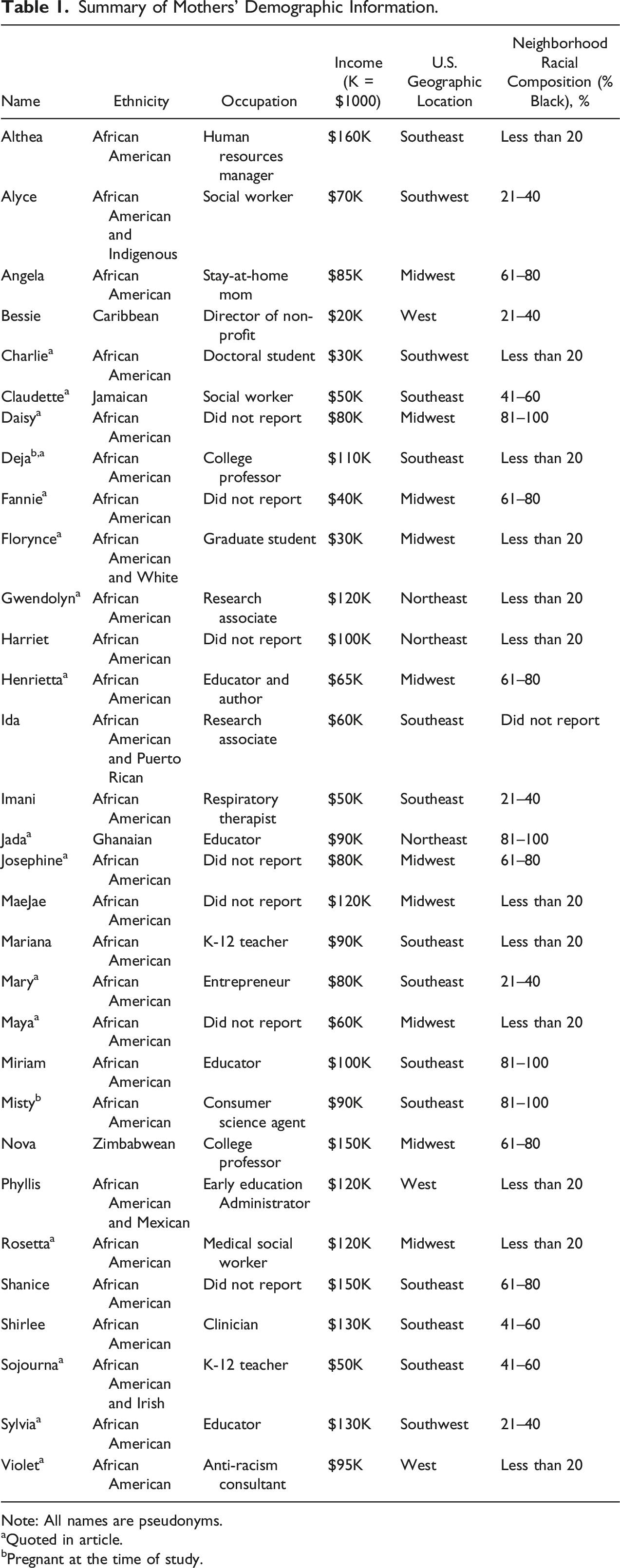
Note: All names are pseudonyms.
aQuoted in article.
bPregnant at the time of study.
Procedure
After obtaining IRB approval, the primary investigator (PI) posted electronic flyers with details on the study across various social media platforms for Black parents (e.g., Facebook, Twitter, and Instagram) during the summer of 2020. The online posting included information about the study, as well as contact information for the PI, and a Calendly link (online appointment scheduling software) for interview scheduling. Black mothers who were interested in participating could either sign up for an available time on Calendly or reach out via email to the PI to schedule an interview. Given the in-person safety restrictions due to COVID-19, all data recruitment and data collection activities were completed online through email, Calendly, and via Zoom (a video conferencing platform).
Once a mother signed up for an interview through Calendly or reached out via email, the PI sent her an informed consent form and a pre-interview survey. The consent form included additional information about the interview and the pre-interview survey included demographic questions on personal and household information, such as age, ethnicity, gender, religion, sexuality, indices of social class status, number of children at home, and parenting resources (i.e., “Below are a list of sources that you may have used as a source of knowledge about conscious parenting practices. Please highlight all of those that you have used in the past”). All mothers returned the informed consent form and pre-interview survey via email, and interviewers collected verbal consent to record at the start of each interview. The audio recorded interviews lasted between 50 and 120 minutes (M = 90 minutes), and mothers received a $30 Amazon gift card for compensation. The PI sent the audio files out for professional transcription. Once the research team received the written file, the original interviewer reviewed the transcript for accuracy.
Positionality
We recognize that research is an inherently subjective process, in which scholars’ cultural selves and sociopolitical locations inform the research questions we ask, the recruitment and data collection process, and our interpretive lens during analysis and dissemination (Reich, 2021). Thus, we present our positionalities as researchers to reveal our situational knowledge within and surrounding the research process. The first author is a Black woman scholar from a working-class background with close to ten years of research experience with Black women and girls on identity development, academic achievement, and psychological well-being. Her children remind her to find joy in the everyday moments, as she continues to challenge racial and gender inequities in her scholarly and community work. The second author Black neurodiverse woman and conscious parenting coach who uses her platform to advocate for the liberation of Black children from oppressive parenting practices. She dedicates her work to her special needs daughter whose very existence is an act of resistance. The third author is a second-generation Latina woman who focuses her research on understanding how Black and Latinx adolescents leverage critical consciousness and civic engagement to navigate inequities in their schools and communities. Her investment in Black and Latina women’s liberations stems from an understanding of how marginalization rooted in white supremacy and slavery present in both the U.S. and Latin America. The fourth author is a biracial Black woman whose childhood was deeply influenced by her Black grandmother. Her work focuses on illuminating protective and promotive developmental processes within Black and Brown families. The fifth author is a Black woman scholar who learns and freedom dreams with Black children and their families, and then uses their collective brilliance to guide the development of new research, policies, practices, and narratives. She learned how to be free from the love and care from her family as a child. The sixth author is a biracial Black and Asian woman whose research interests involve how racial and emotional socialization influence Black youth’s psychological well-being. She approaches her work and this current study from the lens of a daughter, granddaughter, and niece who was collectively and lovingly raised by her parents, grandparents, aunts, and uncles.
Interviewing Techniques and the Interview Protocol
The interview team included the PI (first author; a Black woman) and two graduate students (third and fourth author; a Biracial Black woman, and a Latina woman). In conducting the semi-structured interviews, we intentionally used co-constructive interviewing techniques (Harris, 2019) because we recognized and valued the mother’s knowledge and we hoped to disrupt hierarchical and harmful boundaries between those doing the research and those “being researched.” Our goal was to use a relational and rapport building lens to enrich the interviewing space that we shared with them. We followed many of the tenets outlined in Walton et al. (2022), such as: (a) interviewing with authenticity and shrinking the distance between interviewer and participant, (b) building cultural connections to help the mothers feel safe as they shared their personal stories, (c) validating the mothers’ experiences and feelings about shared life experiences, and (d) extending cultural capital by offering opportunities for connection after the interview commences (e.g., member checking, co-authoring manuscripts, and connecting mothers to parental resources). Thus, the interviews involved a standardized list of questions, as well as probing questions that we asked based on the natural direction of each conversation.
This approach allowed the interview team to collect reliable data on the primary topics of interest, while also allowing us to ask supplementary questions based on the individual reflections of each mother. The interview protocol had four main sections: (1) mothers’ disciplinary experiences during childhood (e.g., “From what you recall, what types of disciplinary styles did your parents use when you were younger?”), (2) mothers’ current parenting practices with their children (e.g., “How did you learn about conscious parenting practices?” (3) mothers’ race-related beliefs and experiences (e.g., “In what ways, if at all, do you plan to prepare your children to cope with racism?” and (4) participants’ advice for other Black mothers (e.g., “What advice would you give to Black mothers who want to use conscious parenting practices?” In relation to the current study, we asked each mother, “What does it mean to you to raise free, Black children?” within the fourth section of the protocol. While all mothers responded to this specific question, several participants referenced the notion of raising Black children “freely” at other points during the interview. Thus, we reviewed the full transcripts to capture any reference to “freedom” or “raising free, Black children.”
Coding Analysis Approach
In the present study, we used team based consensual qualitative research (CQR) procedures outlined by Hill (2012) to probe Black mother’s articulations of freedom for their children. CQR methods rely on team consensus and the belief that multiple informed perspectives render a veritable representation of participants’ meanings. First, the lead author compiled the mothers’ responses to the guiding research question (i.e., what does it mean to you to raise free, Black children?) into a Microsoft Excel 11 (2022) file. Then, she had her research lab (thirteen African American women and one Latina woman) review the responses and draft up independent memos on the mothers’ responses. To construct the core ideas and summarize the narratives, we talked about our personal rendering of the mother’s beliefs on raising free, Black children and the PI recorded key features of this dialogue in a shared word document.
After this initial process, the PI recruited two Black mother scholars who were familiar with the data and had expertise in Black family processes. The lead author intentionally recruited other Black mother scholars to assist with the coding process, as she believed that the shared experiential knowledge as Black mothers and academic scholars would generate a more emic coding analysis of the mothers’ ideas and beliefs about freedom. We each reviewed five transcripts and the notes from the lab dialogue to generate initial, independent domain lists. We then met to discuss what domains we pulled from the data, what excerpt responses fit into each domain, and general definitions and rationale for our domains. This resulted in several domains (e.g., unapologetically pro-Black, critical thinkers, self-express, taking up space, free from external expectations, having a strong internal compass, raising positive change agents, and racial socialization on Black history), which we needed to reduce and finalize.
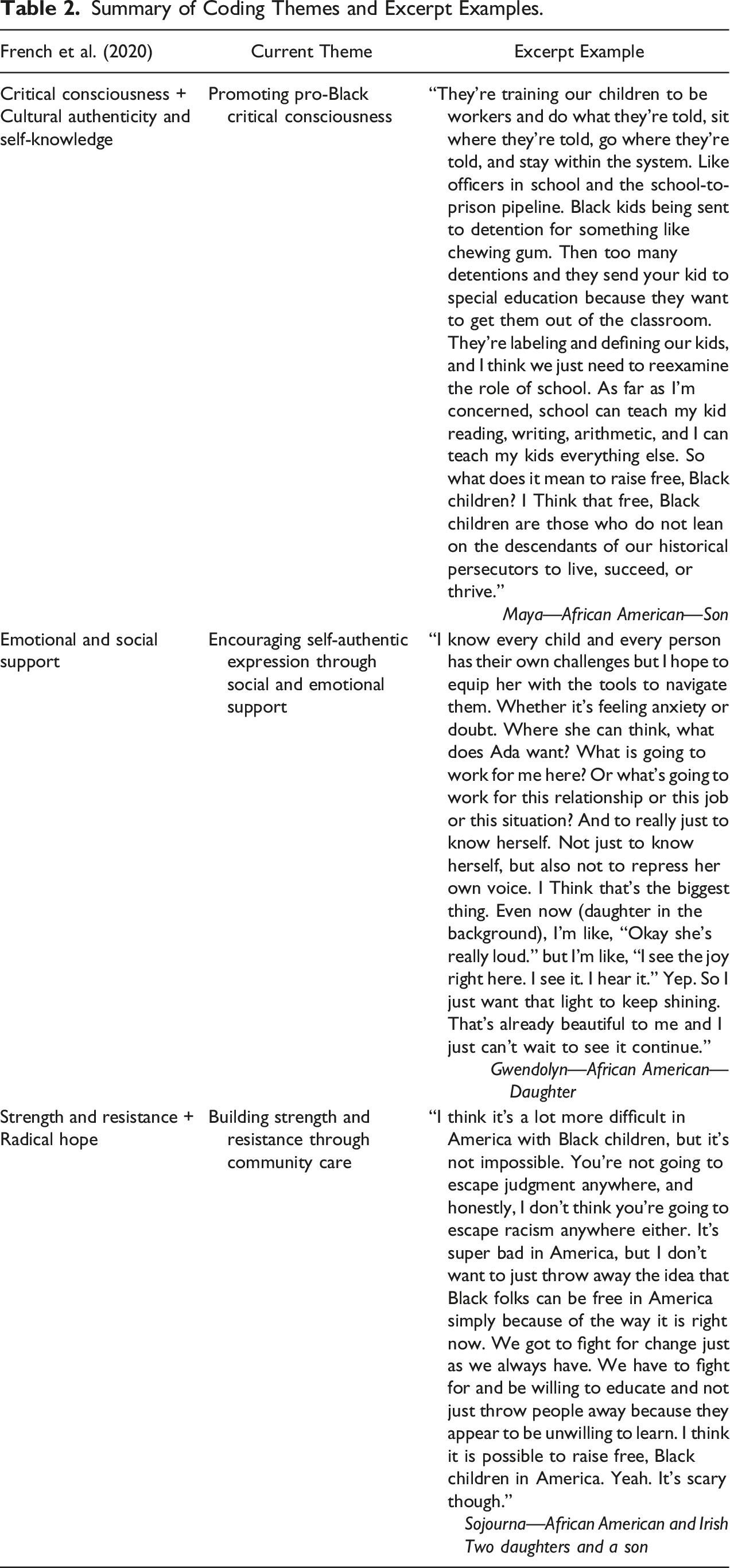
Summary of Coding Themes and Excerpt Examples.
Finally, the coding team engaged in a variety of accountability processes to substantiate the integrity of the data and to ensure that we provided an accurate perspective of the mother’s experiences. Throughout the coding process, the three Black women coders recorded our biases and expectations of the data, such as our personal experiences as Black mothers and how we would respond to the guiding research question. Based on recommendations from Hill (2012), we also engaged in member checking (i.e., showing the mothers when and how their words were being used within the manuscript throughout the coding process). In addition, consistent with recommendations from Naidu and Prose (2018), the PI disseminated the initial results back to the community (i.e., Black mothers) through an online forum and received feedback about the usefulness and accessibility of the findings, as well as important next steps for research.
Findings
“Free Black children, that’s the blessing and the promise. To me, that’s poetry. That’s the goal. That’s it. Free, Black children. That’s beauty.” (Sylvia, African American mother of three)
Mapping onto French et al. (2020) five tenets of radical healing, we found three emergent themes among the mothers in our sample about raising free Black children: (1) promoting pro-Black critical consciousness, (2) encouraging self-authenticity and self-expression through socioemotional support, and (3) building Black children’s strength and resistance through community care. Below, we review examples of each theme to demonstrate how Black mothers viewed their parenting within a radical healing framework that would help their children foster a sense of agency to challenge and change oppressive conditions. See Table 2 for the parallels between the original radical healing framework and our findings.
Theme 1: Promoting Pro-Black Critical Consciousness
Within the first theme, the mothers discussed how they wanted to help their children develop a strong understanding of interpersonal prejudice and discrimination, as well as critical consciousness around institutional and structural oppression. Critical consciousness refers to an “individual’s capacity to critically reflect and act upon their sociopolitical environment” (Diemer et al., 2006, p. 445). In the current study, this included the women recognizing how ideologies of oppression (i.e., racism, sexism, and classism) harm Black people and communities and them having a clear understanding of how these systems work to suppress their freedom. The mothers discussed the ways in which different carceral mechanisms (i.e., school resource officers, school disciplinary practices, and police officers) contributed to a general form of surveillance and control over Black children’s ability to move freely in the world. For instance, Rosetta, an African American mother with two children, shared: Raising a free Black child is conscious parenting for real. I live in a predominantly White suburb. We are the only house that has a Black Lives Matter sign, and that will probably always be true. A couple streets over, there are Trump signs and blue lives matter flags. I told my husband the other day, “You realize that having dialogue with our children expands to all kinds of other things, right? That means that when they’re teenagers and they start to say, ‘Well, I don’t know if I'm a Christian.’ They know they’re not getting disowned or shamed.” They don’t have to code switch. I’m raising free Black kids who can school you, okay? I used to say that I didn’t know if my kids could go to public school because they’re going to be the ones raising their hands and telling the teachers, “Actually, that’s not true. Actually a Black person discovered that.” To me, that’s how you raise free, Black, and unapologetic kids.
As in Rosetta’s example, several other mothers questioned whether mainstream schooling institutions would provide the type of liberatory education that they wanted for their children. In many cases, they anticipated that they would have to supplement or interrupt educational discourse that erased or pathologized Black cultural traditions and Black ways of knowing. Within this theme, the mothers discussed both the importance of teaching their children Black history and encouraging their children to question the current status quo to realize a future that would feel fulfilling and life affirming to them. Charlie, with three children, said, “I want to raise children who will question everything. To raise children who will imagine the possibility and imagine a better future and will think that they are capable enough to work towards that to happen.” To help their children develop this sense of pro-Black critical consciousness, many of the mothers described how they engaged their children in dialogue on racial and structural oppression in developmentally appropriate ways. For younger children, this usually involved reading them books with Black characters and for older adolescents, the mothers often encouraged their children to question the differential treatment of Black people and communities. For instance, Florynce, a biracial woman with three children, stated: My daughters are carefree Black girls. Honestly, it’s a joy to see. When I think about my girls… I want them to know their worth and their value. And to feel like they have a solid foundation of knowledge and that they don’t have to fit into any stereotypes of who they should be. If they’re nerdy, be nerdy Black girls. I don’t want them to feel limited by the way society treats Black girls, and I hope we can instill a lot of that through parenting. Part of parenting is having them be aware of the challenges and the history of how we got here. One of my favorite things to do is to dog the rich with my kids (laugh). So part of their freedom is knowledge, which can be heavy, but also liberating.
As represented in Florynce’s words, many of the mothers connected their children’s critical consciousness and knowledge seeking with knowing their self-worth as Black people. They communicated that they wanted to teach their children about racialized, gendered, and social class realities to help them navigate situations beyond the family context. The excerpts revealed the mothers’ conscientiousness in their long-term parenting goals, since they considered developing a critical awareness of historical racial trauma and Black communities’ resistance as an ongoing and evolving familial process.
Theme 2: Encouraging Self-Authentic Expression Through Socioemotional Support
Within the second theme, mothers described the importance of cultivating their children’s self-authentic expressiveness through social and emotional support, and often talked about how they were not allowed to experiment and practice the same type of self-expression during their own childhood. The mothers described the instrumental role that they saw themselves playing in encouraging their children’s self-expression, even during challenging moments when their children pushed boundaries and expressed emotions that were taboo in their parent’s household (i.e., anger, disappointment, or disapproval with their parents). The mothers recognized the power that they had to try a different approach with their children and remove the stigma associated with expressing emotions that may be “inconvenient” for others around them. They supported their children’s self-expression in anticipation of positive long-term benefits. Mary, an African American woman with one child, shared: What it means for me is allowing. Allowing her to be herself without me putting my stuff on her, allowing her to figure out who she is, allowing her to express her emotions in order for her to understand who she is because I didn’t know who the hell I was. I was so lost in my 20’s because I didn’t have a sense of self. It never developed in my childhood the way it was supposed to. So it’s important to me to raise someone who is confident in herself, has a voice, and is able to advocate for herself. People are always talking about, “I went to medical school and I’m my ancestor’s wildest dream.” I don’t think a college education is. I think that our children having a sense of self – liberated children – is our ancestors’ wildest dreams.
Within this theme, the mothers made it clear that they thought it was important that they create the space for their children to share their thoughts and emotions with them. This included giving them their full attention and letting them take the lead in conversations, interactions, and setting family norms of engagement and togetherness. Deja, an African American woman with three children stated, “That they can figure out who they are, and that it doesn’t have to be tied up in who I think they are. It damn sure don’t got to be tied up in who the world thinks they should be.” The mothers often expressed wanting their children to be free from the external expectations of others, including their own. For many, building space for their children to be authentic involved a significant shift from what they experienced in their own childhood. Henrietta, an African American woman with two children, stated: “From the time I had them, I said I wanted to have carefree Black kids. It’s a mindset shift because back in my day, it was like – hurry up, it’s raining and we gotta get in the house. And my daughter will be like, “Mom, can I jump in the puddle?” You want to say no, but now I’m like, “Go ahead. Do your thing.” It’s a mindset shift, but I think it’s necessary. When you see kids grow into adults who are just themselves...that’s a beautiful thing. There are some people who are 40 and 50 and they don’t know themselves.
Henrietta’s words drew attention to how she intentionally caught herself falling into old logic patterns and made a different choice in responding to her daughter. She also highlighted the day-to-day decisions that mothers made regarding their children’s self-expression. While some women described the momentous conversations on sexual health, physical safety, or college choices that they had with their children, all the women talked about smaller moments of engagement where they allowed their children to “just be.” As Violet declared, “No one is judging those white moms when their kids fall out on the floor crying. If my baby is having a hard time and they need to get some sad feelings out at Target, then they can do that.”
Compared to the first theme, a consistent thread in the second theme was that self-authentic emotional expression in the family context represented a significant generational shift from their relationships with their parents. Most of the mothers received racial socialization messages or Black history lessons from their parents and grandparents, but fewer of them received explicit socialization from their parents on how to identify their emotions and appropriate responses or other emotional socialization skills (e.g., navigating difficult emotions or setting healthy boundaries). Daisy, an African American woman with one child, recollected: It’s a lot because of how I’ve been socialized. I feel like she’s doing the most, but that is absolutely what I want. I want her to do the most, feel the most, and be the most. I don’t want it to take her as long as it took me. I’d rather have to tone her down than build her up. There are things about her now where I’m like – we’re going to have to work on that. Like, her telling me to be quiet was a trigger. Because that’s disrespectful to tell a grown person to be quiet, right? But “be quiet” is valid. She’s watching TV and I didn’t say excuse me. I just started talking. And if a grown person did that to me, I’d probably be like, “Excuse me. Be quiet.” So I’m trying to teach her that there are levels. Sometimes, it’s a, “No thank you, could you tone it down?” and then sometimes it’s a, “Shut the f--- up!” I want her to have the range and be unafraid to tell someone to shut the f--- up. I don’t want her to feel like she has to be somewhere where she doesn’t feel good or that she has to be around people or be in situations where she feels unsafe. I want her to be free enough to do what she needs to reach her highest potential and be unafraid about it.
Only mothers with daughters specifically used the phrase “take up space” and intimated that it was revolutionary to teach young Black girls to exist as they were in the world. Their narratives highlighted that it was important to them to build their daughter’s self-awareness about the connection between their physical bodies and their mental and emotional states, and the mothers were conscientious about helping their children navigate interpersonal interactions. Additionally, a few mothers stated that they did not believe in “good” or “bad” emotions. Instead, they thought it was important to help their children recognize the range of their emotions, label them, and develop the skills necessary to deal with situations that brought up particular feelings.
Still, they recognized that encouraging this type of self-authentic emotional expression could have significant consequences. Although they were invested in what they considered liberatory or “freeing” parenting practices, they understood that they lived within a society that has historically supported, justified, and codified state-sanctioned violence against Black people. Fannie, an African American mother with two children, declared: Did that help Trayvon? Did that help Philando? Did that help George? All these people were compliant, all these people did all the things the police wanted them to do, right? Every last one of them had a parent who gave them the speech about doing this and doing that and being in control of themselves. And they’re all dead, so what the f---? If that model worked, I would go with it. If it kept me alive and kept my children alive, I would sacrifice my beliefs for that. But Sandra didn’t put her turn signal on and ended up dead. So I tell my children to be free and to live out loud. If officers come after them, they’re going to have to work for it. You gon’ kill me, but you’re gon’ kill me living my best life. I am not going to lay down and let you kill me, and that is why I tell my children. To live and to breathe and to fight. I think it was Zora Neale Hurston who said, “If you’re silent, they'll kill you and say that you enjoyed it,” right? I tell my kids – don’t be silent.
As captured in Fannie’s words, the mothers were well-aware of the antagonistic relationships between law enforcement and Black communities, including racial profiling (i.e., driving while Black), as well as the prejudiced (and sometimes deadly) actions of police officers. Yet, they refused to allow their fears of racist violence restrict the messages they provided to their children about honoring the fullness of their humanity and their birthright to emotional expression. They hoped that their children’s self-expression would inspire a revolution (if only internally), as they knew that emotional suppression would not fully shield them from racial discrimination. Instead, they wanted to provide a model of radical love and authenticity, in which they encouraged their children to find out for themselves who they wanted to be in the world. This dovetailed into the last theme, which involved building a village of support for their children and their mothering.
Theme 3: Building Strength and Resistance Through Community Care
The third theme highlighted the mothers’ goals to build a community of friends, family, and loved ones to help support them in their liberatory parenting goals. Many of the women’s models for “parenting in community” moved away from the traditional nuclear family structure to an expansive and more inclusive vision of communal parenting, consistent with the long history of fictive kin networks in Black communities (Cross et al., 2018). They described a sense of security in knowing that they had a village of folks who were willing to help raise their children to know hope, joy, and freedom. Additionally, they recognized that they needed to seek out folks who would love on their children and build relational connections that reinforced their sense of cultural authenticity and self-pride as Black children in an anti-Black society. Jada, a Ghanaian mother with two children, reflected: Is it possible to raise free, Black children? Based on where I grew up, where my kids grew up and the schools that they attended. It is possible in those areas that know them. But I’m not sure that it’s possible when they get out of the circles that know them. When they’re stepping into places where people are not familiar with or refuse to recognize their humanity. So my sons can go running on our street and I know folks would take care of them, but I don’t know if my sons could go running on another street where people don’t know their name and don’t know their family and who they belong to.
Jada characterized the mothers’ awareness of how and why it mattered to surround their children with people who knew that they were beloved sons and daughters who belonged to a family and a community. The excerpt characterized one of the challenges in raising free Black children in a society where individuals regularly disregard Black people’s humanity and Black family ties. The women recognized the power and strength of building a community that would claim and advocate for their children when they were away from their parents. They discussed the importance of having others who would make a conscious effort to provide their children with opportunities to explore and be free. Violet, an African American mother with one child, stated: It means that she can experience the fullness and variety of herself. And in every moment of that, her experience is honored. She is addressed with love and care and understanding. Even as I’m trying to tap into what free means for me, I’m thinking about the environments that I’m in, and the people around me who will support me. I think about how others love me with no hooks, right? The people who are invested in my spiritual development. I want her to experience people in the world like that and within herself. Where they’re invested in her spiritual development. It’s also directly connected to the freedom I haven’t experienced. I go to therapy for me and her. I can’t provide her with a different experience than I had until I realize that the experience that I had wasn’t free. I have to know more about what I need, so that I can move in support of her freedom.
As in Violet’s case, some of the women also talked about the challenges in finding and building this type of community. Some mothers had to explore their own childhood trauma and identify the habits that they needed to unlearn as parents to help them connect to their children and build the necessary community to enact the liberated parenting practices that they hoped to adopt. While all mothers recognized the importance of building their children’s sense of self by finding a supportive village that would offer the cultural, intellectual, and emotional affirmation that they desired for their children, it was more challenging for some mothers to find this type of village than it was for others. Specifically, as the mothers themselves challenged social norms that try to limit how Black children can show up in the world (e.g., letting them assert their feelings or question authority figures), some women encountered tension in friendships and family relationships. Josephine, an African American mother with two children, shared: Free, Black children? That’s a big question. I have a cousin…he just turned 20. Excuse me. They just turned 20. They’re non-binary, and they just came out as non-binary. And that was really difficult for my family to process. My cousin’s father was like, “I always thought my kid was gay, but now I have to learn this whole new thing. And they’re mad at me.” I was like, “Well, it’s been 20 years, and to be honest, our family is homophobic.” One of the things that my trans friends have said is that they wished their parents had been open to having the kid they got. So I think raising a free, Black child means that my daughter knows that I’m going to do everything I can to equip her with being who she came here to be. I want her to be in community with folks who help her know that she deserves to live her life no matter how others feel about her existing in the world. If she wants to wear her butt out one day, she’ll wear her butt out. I want her to be in spaces where she is allowed to wear her butt out and be a Christian and eat chitlins and go to the Pride Parade. I don’t want her to feel obligated to silence or deny a part of herself.
As Josephine communicated, the mothers recognized that their children might encounter family members or individuals in other contexts who would try to stifle their self-knowledge and sense of agency and they wanted to prepare them by offering boundless love and acceptance at home. Several of the women expressed a queered sense of freedom in community, in that they wanted them to experience limitless and fluid forms of family, love, and relational intimacy that moved beyond the confines of traditional nuclear household norms. Claudette, a Caribbean mother of two, said, “Free, Black children are part of something bigger than them that grounds them and keeps them. Contributing to their family and society and their future. It’s about seeing the child for who they are and who they see themselves as.” The women wanted to build the types of community support that would allow their children to develop a strong and assured sense of self, because they understood that raising free, Black children in an anti-Black society necessitated connection to one’s communities as a source of social support and collective resistance.
Discussion
“Transforming ourselves and the world means we have access to the seeds, soils, and space to grow our own visions of freedom, resilience, and possibility for a different world. Our collective joy, creativity, and courage will be our new sustenance.” (Cullors, 2022, p. 9)
In the present qualitative study, we explored Black mothers’ perspectives on what it means to raise free, Black children within the racial and sociopolitical landscape of the USA. We employed Kelley’s (2022) definition of freedom as, “building community, establishing fellowship…and planting seeds for a different way of living,” (p. 12), and drew upon a psychological framework of radical healing for communities of color (French et al., 2020) to contextualize Black mothers’ ideas about the possibilities of an anti-oppressive reality for their children in the future. First and foremost, our findings revealed that the mothers believed that mental, physical, and psychological liberation from racial oppression was possible, and they planned to do the intentional personal and communal work necessary to nurture this same radical hope and imagination about the future within their children. The mothers were less concerned with the specific types of racial discrimination or bias that their children might encounter, and more attuned to fostering the necessary internal values and personal relationships that would equip their children to flourish amid ongoing racism. In all, their perspectives add useful insight to extant scholarship on how Black mothers maintain and impart a sense of hope to their children in the face of racial oppression (Brown, 2020; McClain, 2019; Murry et al., 2018).
In general, their beliefs mapped onto the five key tenets of the radical healing framework, as they described the importance of their children having a critical awareness about racial oppression, a strong sense of connection to their racial and cultural identities, the emotional tools to live authentically, as well as the social and community support to help them do so. In the current sample, the mothers’ racial socialization practices focused heavily on promoting a pro-Black racial consciousness to provide a cultural anchor and ground their children with their sense of Blackness. This aligns with substantial evidence that Black parents’ use proactive racial socialization strategies to protect their children from the deleterious influence of racial discrimination (Doyle et al., 2015; Wang et al., 2020; White-Johnson et al., 2010). Consistent with a growing number of studies (Elmore & Gaylord-Harden, 2013; Lozada et al., 2022; McWayne et al., 2020), we found that Black mothers valued parenting practices that focused on building their children’s emotional and social well-being. The mothers considered emotional well-being a necessary component of supporting their children’s freedom because it would better enable them to reject the types of dehumanizing ideologies (i.e., white supremacy, patriarchy, and homophobia) that might limit their sense of respect and self-worth. Additionally, they emphasized the importance of community connection as a means of freedom. Specifically, they wanted to cultivate a village of non-parental support from other family members, mentors, and friends who could also help their children navigate the social and contextual risk factors stemming from anti-Black racism (Bryant et al., 2024). In all, our findings evidence that Black mothers believe that raising free, Black children involves strengthening their children’s racial and cultural knowledge, emotional and social skills, and sense of community to facilitate their positive development and help them embrace radical resistance over maintaining the status quo.
Freedom Through Critical Consciousness and Challenging the Status Quo
Critical consciousness is a key component of the radical healing framework because individuals must have the ability to reflect and act upon their sociopolitical realities in order to recognize and address inequitable power relations and the need for change (Bañales et al., 2021; hooks, 1997; Diemer et al., 2006). In the current study, the mothers’ socialization messages to their children on racial inequity and social justice took place in response to what they described as hostile, and many times, harmful, institutional structures, that worked against their children’s autonomy and freedom (i.e., punitive disciplinary policies in school and policing brutality). The mothers believed that it was necessary for them to equip their children with knowledge on how anti-Blackness functioned in the country’s social order to set them on the road towards holistic well-being and freedom. In addition to the explicit messages and practices that the mothers offered to their children (e.g., reading books on racial justice and hanging #BlackLivesMatter signs in their yard), evidence suggests that Black parents may shape their children’s critical consciousness by imparting racial knowledge in how they navigate social and political systems (Anyiwo et al., 2018; Bañales et al., 2021; Hope & Bañales, 2019). For instance, (Diemer & Li, 2011) found that the more often Black youth discussed race, politics, and current events with family members, the more youth reported a sense of critical agency in challenging inequity and promoting social change. While beyond the scope of the present study, our findings are consistent with the growing body of literature that documents the connections between parental racial socialization, consistent dialogue in familial contexts on social power dynamics, and sociopolitical development among Black youth (Anyiwo et al., 2018; Jones & Neblett, 2017).
There were also several ways that the mothers’ racial and sociopolitical knowledge changed as they thought about the lessons that they hoped to pass down to their children to nurture their critical consciousness. For instance, some mothers noted a departure from their parents’ socialization on the importance of getting a college education as an index of personal freedom for Black people. While all the mothers valued their children’s education, they considered earning a degree from an institution of higher education as one future pathway (among many) that their children might choose to pursue, and they did not want to send the messages that they valued that particular pathway over other options. On the one hand, the mothers’ rejection of higher education as the best route for their children to pursue in adulthood represented an intentional departure from false meritocratic and capitalistic expectations in the USA about upward social mobility and valuing individual’s labor over their wellness (Caldera, 2020). On the other hand, most of the mothers in our sample were highly educated from a traditional academic standpoint (65% had a graduate degree). Thus, they may have had more educational and financial privilege to support their children in pursuing a variety of future pathways than other Black mothers have available to them (Elliott et al., 2015; Harper, 2021). Still, the mothers believed that raising free, Black children involved equipping their children with the necessary self-awareness and knowledge on race and social power to make decisions that would help them build the type of future that they imagined for themselves.
Freedom Through Emotional Expression
Our findings add to the small but growing number of studies that focus on race and emotion socialization practices among Black families (Labella, 2018; Lozada et al., 2016; McWayne et al., 2017). In line with the radical healing framework, all mothers in the sample communicated the importance of allowing their children’s emotional expressions and actions to “be authentic, reflect their truth, and align with their identities and contexts” (French et al., 2020, p. 26). The women’s narratives on their children’s right to express emotional range (in private and in public) defied racist expectations in the USA that “good” Black children are docile and deferent to authority (Brown, 2020; Dow, 2016). While there were some developmental differences in how the women expected their children to manage and regulate their emotions (i.e., mothers of teenage youth did not discuss tantrums at shopping stores), the mothers generally talked about similar priorities regarding nurturing their children’s mental and emotional health. This included talking openly with their children about their emotions (i.e., happiness, sadness, anger, and disappointment), freely complimenting their children, expressing their love for them, and recognizing that their children’s emotional responses (particularly angry outbursts) were not a reflection on their parenting. A main goal was to resist colonized Eurocentric practices that delegitimize Black children’s emotions (Brown, 2020), as mothers recognized that encouraging their children to live authentically was an act of radical resistance.
A few mothers also discussed the intentional steps that they took to move away from the “tough love” disciplinary approaches that their parents used with them or their siblings during their childhood (i.e., spanking, yelling, or very little verbal emotional encouragement). While a few of them recognized that their parents may have been trying to prepare them for the realities of racism and surviving as a Black person in the USA, they believed that it was a revolutionary act to prioritize self-definition and emotional self-awareness in their mothering (Brown, 2020). We found that the mothers encouraged and praised their children’s emotional expressivity, which has been related to youths’ socioemotional competence in prior research (Cunningham et al., 2009; Dunbar et al., 2017). In addition, we found that both Black mothers of sons and daughters discussed the significance of self-expression and emotional authenticity. Given the mixed findings on gender differences in Black parents’ support of sons versus daughters’ emotional expressivity (Doyle et al., 2015; Nelson et al., 2012), our findings suggest that mothers were invested in helping their children see themselves fully and authentically, irrespective of gender.
Unlike in some prior studies, the Black mothers in our sample did not communicate a greater propensity to use emotionally suppressive responses to prepare for racial bias (Brown et al., 2015; Dunbar et al., 2015), and instead, focused on supporting their children’s awareness of their emotional states and emotion regulation. For instance, Parker et al. (2012) found that African American participants believed that Black parents should know what their children are feeling at all times, in order to help them solve problems and avert negative outcomes, which the researchers characterized as vigilant parenting in the context of greater environmental risk (i.e., discrimination). While some of the mothers in our study discussed an awareness about the potential negative consequences of Black children’s emotional expressivity related to racial discrimination or state-sanctioned violence (e.g., future encounters with police), they maintained that it was important to them that their children “feel their feelings,” regardless of social context. Our findings highlight how the mothers were charting a new path forward for their children that focused on holistic wellness and the integration of racial and emotion socialization practices.
Freedom Through Community Care and Collective Resistance
Finally, the mothers encouraged their children to dream about the futures that they wanted for themselves and believed that it was critical for them to be in community with others who would help support their dreams and aspirations. Consistent with the focus on collectivism within the radical healing framework, the women’s narrations highlighted the importance of familial relationships and networks of folks (i.e., fictive kin, friends, and mentors) who would love on their children. For some women, this required that they reconfigure family bonds to find individuals who valued the sociopolitical knowledge, emotional skills, and sense of self-authenticity that they wanted to develop in their children (Berkel et al., 2009; Brown, 2020). The mothers reflected on their own childhood experiences and the “village” that helped raise them, which offered insight into the expansive nature of Black intergenerational bonds and family networks. Our findings reveal the explicit ways that the women built intimate relationships with others who they wanted within their parenting community, and much of this was predicated on how others would support their children’s sense of racial pride and self-worth. Thus, our results add to extant scholarship that seeks to understand the ecological and sociocultural contexts that ground Black mothers’ parenting strategies and goals (Murry et al., 2018; Suizzo et al., 2008).
Our findings also illuminate how Black mothers engage in Afrofuturistic world building (i.e., the construction of a world in which Black people are healed from racial, social, and economic violence and are living healthy lives, united through African diasporic ideals; Love, 2019) by decentering whiteness and focusing on visions of liberation and freedom for their children. While Black communities make up only 13% of the USA population, Black people’s labor and cultural traditions are a cornerstone of the country’s economic, political, and social landscape (Jackson et al., 2018; McClain, 2019). Both historically and currently, Black mothers refuse to feel constrained by the racial and sociopolitical realities that harm Black people and try to preemptively end Black futures (McKee et al., 2015). For instance, the mothers in our sample attempted to resist and subvert racist and hegemonic cultural norms that disregard Black family ties in how they nurtured their children’s awareness of systemic oppression, respected their children’s autonomy and emotional expressivity, and modeled family and community cohesion.
In effect, these mothers were preparing their children for a world that has yet to exist, by arming them with the socioemotional skills and appreciation for community-based solidarity that will be necessary to help make that future into a reality. In line with the radical healing framework, the mothers talked about how they were trying to plant seeds of hope, authenticity, strength, and community that would offer their children refuge and peace in the context of ongoing systemic oppression. In addition, they made their children the central protagonists of their lived experiences, rather than marginal secondary characters who helped sustain and advance racist tropes of Black deviancy or inferiority. These Black women were deeply invested in teaching their children how to flourish in a society that profits from the disinvestment in Black communities (Love, 2019; McWayne et al., 2017). In all, the mothers highlighted the need for more research on how Black parents employ cultural ways of being and experiential knowledge to support joy, healing, and resistance in family contexts.
Limitations and Future Directions
The present study has a few limitations worth noting. First, we captured the mother’s beliefs about freedom and parenting at one time point. While we had mothers with children from infancy to adulthood, we might have gathered more comprehensive information from multiple interviews with them at various stages in their parenting journeys to see if and how they redefined and expanded their definitions of freedom over time. Future studies should consider developmental differences in Black mother’s parenting practices around freedom and healing and conduct within-group comparisons in parenting practices among Black families (Cross et al., 2018). Other demographic factors including socioeconomic status, parents’ educational attainment, and parent or child gender, may influence parents’ beliefs and practices (Doyle et al., 2015; Elliot et al., 2015). Second, we did not present frequency counts for each theme because a single excerpt sometimes traversed multiple themes as the mothers responded to the question. The coding team excised the portions that fit within each domain. Third, although our study highlights the importance of attending to Black mothers’ beliefs, specifically, future research would benefit from including responses from children and youth about how they perceive, understand, and internalize their mothers’ messages on systemic oppression and healing.
Still, this study makes several key contributions to the study of Black family processes. First, we underscored the importance of examining Black mothers’ beliefs and practices as a joint function of multiple individual and contextual characteristics (i.e., ages of their children, their personal experiences as a child, and the availability of caregiving networks). We must continue to consider the complex relations between Black parents’ social identities (i.e., ethnicity, gender, and social class location), and their caregiving contexts as we theorize and empirically study parenting (McWayne et al., 2020). Second, we highlighted the importance of attending to concepts such as hope, love, and joy, as an overlooked area of research within empirical research on Black family processes. The next generation of scholars can build on existing strengths-based work about racial and cultural protective factors for Black youth (Anderson & Stevenson, 2019; Bañales et al., 2021; Jones & Neblett, 2017) to examine how Black parents help their children learn to love and resist at the same time. Finally, our findings underscore unequivocally the power of Black mothering as a site of liberation and freedom building. The mothers in our study were (re)claiming the space and time for themselves and their children that has been historically denied to Black women and their families, as they built their home lives to be a microcosm of the world that they wanted their children to live in.
Conclusion
We join existing calls for more theory, research, and culturally emic approaches to interpersonal healing and wellness with Black families and communities. While the mothers in our sample understood that Black children in the USA face unique challenges related to racial and systemic oppression, they hoped to disrupt the historical and contemporary legacies of anti-Blackness by raising children who felt empowered by their self-knowledge, critical awareness, emotional expression, and supportive social networks and loving communities. Researchers should examine how Black mothers engage in intentional healing work around their own childhood experiences, and how this internal healing work informs the messages they pass down to their children about building a life with a sense of meaning and purpose beyond the constraints of white supremacy and capitalism. Coupled with existing studies on racial and emotional socialization, positive youth development, and collective action among POCI communities, we hope that our findings offer a conceptual foundation to support future studies on Black family processes at the intersection of racial healing and parenting for social justice. Specifically, we need more narrative studies that include perspectives from a diverse array of Black families in order to deepen our understanding of what it means to resist oppression and move towards freedom. In all, the act of being able to dialogue about topics like hope, justice, and joy (in spite of oppression) is, in and of itself, a process of healing, and the mother’s responses outline important points of departure for future healing-centered research.
Footnotes
Author Contributions
All authors made substantial contributions to the conception or design of the work, helped to draft the manuscript, and approved the version to be submitted for review.
Declaration of Conflicting Interests
The author(s) declared no potential conflicts of interest with respect to the research, authorship, and/or publication of this article.
Funding
The author(s) disclosed receipt of the following financial support for the research, authorship, and/or publication of this article: This research was funded through the Small Grants Program for Early Career Scholars through the Society for Research on Child Development.
Ethical Statement

Data Availability Statement
Interested parties can contact the corresponding author for abridged versions of the narrative excerpts. Full transcripts will not be released to protect the confidentiality of all participants.