



Abstract
An increasing number of strategies for dealing with value conflicts in public management have been presented. These include Cycling, Firewalling, Casuistry, Incrementalism, and so on. A closer look reveals an apparent contradiction. The strategies are presented as forms of practical rationality to go beyond instrumentalist approaches and find answers in the common interest, but at the same time they are presented as instrumental rational strategies to deal with blockades for particular interests. This paper uses Paul Ricoeur’s analyses of compromise and of political paradox to overcome this puzzling contradiction and to distinguish more justifiable strategies of value conflict management from less justifiable strategies
Introduction
In recent decades, public administration and the scholarly focus of this field have undergone a renaissance of values. This shift includes a significant increase in the emphasis on integrity (see, e.g., Graycar, 2020; Huberts, 2014) as well as a heightened interest in the normative aspects of the public sector more broadly. This broader concern encompasses the question of what characterizes governance and, more specifically, good governance, distinguishing it from the private sector and particular interests. With some exaggeration, one might argue that we are witnessing a rediscovery of the common good in public administration. Exemplary approaches in this development include studies on public value creation (building on Moore’s, 1995 analysis) and the identification of typical public values (in line with Jørgensen & Bozeman, 2007).
This (renewed) focus on the common good also has led to studies of the diversity of and even conflicts between values in administrative practice. Research has pointed to different sets of competing values in all kinds of fields and at all levels of public decision-making and implementation. These include conflicts between efficiency versus honesty and empathy in the prison sector (Paanakker, 2019), strict adherence to rules versus quality of service in train stations and police stations (Maynard-Moody & Musheno, 2000; Steenhuisen & Van Eeten, 2008), affordability of services for clients versus quality of life in care provision (Oldenhof et al., 2014), privacy versus functionality in the design of digital services (Meijer & De Jong, 2020), tactical gain versus damage and casualties in military interventions (O’Kelly & Dubnick, 2006), to name just a few examples. Research also explores explanations for this (growing) diversity of values and the conflicts experienced by practitioners (e.g., Jaspers, 2021; Røhnebæk & Breit, 2022). Many studies include the question of how these public officials deal with value conflicts and what the strategies they use when they encounter such conflicts in their work (e.g. De Graaf & Paanakker, 2015; Ford et al., 2019; Meijer & De Jong, 2020; Oldenhof et al., 2014; O’Kelly & Dubnick, 2006; Stewart, 2006).
A seminal study of strategies for dealing with value conflicts in public administration was Thatcher and Rein’s (2004) Value Conflict in Public Policy. They identified three strategies (Cycling, Firewalling, Casuistry) that enable administrators to act in ways that acknowledge the plurality of values. These strategies involve decision-making approaches where all relevant values receive due consideration. Thatcher and Rein present these strategies as an alternative to a perspective frequently encountered in public management that they perceive to be lacking. They challenge the notion that there is a predetermined highest value or goal in the governance sphere and argue against the idea that proper or rational action simply entails effectively realizing that goal (Thatcher & Rein, 2004, pp. 458/9). In doing so, they join the broader critique of value monism in public administration. This critique asserts that no set of values be it freedom, justice, ecology, privacy, security, or others – can be (fully) realized at the same time, and that there is no rational way to determine which value trumps the other. Public values in our time, this critique of value monism argues, exist in plurality, are incommensurable, and in practice are often incompatible. According to these critics, practitioners and scholars in public administration often neglect this fundamental plurality and thus fail to see and recognize what is for the common good. (Most explicitly in Spicer, 2001; 515ff; Jun, 2006; Wagenaar, 1999, p. 445; see also, e.g., Bijker et al., 2009; Le Grand, 1990; O’Kelly & Dubnic, 2006; Pielke, 2007; Røhnebæk & Breit, 2022; Van der Wal & Van Hout, 2009). Thatcher and Rein seek to show what it means to create public value by taking seriously the plurality of values in the public sphere: how can one combine diverse (even conflicting) normative demands for the common good in one’s decisions and actions? The strategies they distinguish are expressions of what they call practical rationality and are to be distinguished from instrumental rationality, which is concerned with the effective realization of a given goal (Thatcher & Rein, 2004, pp. 459, 476).
Many scholars have been inspired by Thatcher and Rein’s analysis of strategies of practical rationality. Their strategies (Cycling, Firewalling, Casuistry) have been applied to a variety of policy areas, but new strategies have also been identified. These include hybridization, incrementalism, bias, denial, and deliberation (Jaspers, 2021; Meijer & De Jong, 2020; Steenhuisen & Van Eeten, 2008; Stewart, 2006). However, some scholars have taken a remarkable turn in their use and elaboration of Thatcher and Rein’s suggestions. They present strategies for dealing with conflicting values not only as strategies of practical rationality, but also as ways of achieving one’s particular goals. They see these strategies as well as effective tools for securing support, blocking opposition, or preventing employees from being paralyzed by the decision-making process (see, for example, Jaspers, 2021; Meijer & De Jong, 2020; Steenhuisen & Van Eeten, 2008; Stewart, 2006). In short, such strategies appear as effective realizations of particular organizational goals (i.e., instrumental rationality) and not (only) as vehicles for finding and realizing better (i.e., practical rational) answers to public value questions as Thatcher and Rein understand them.
This leaves us with a puzzling situation. On the one hand, the conflict management literature seeks to take seriously the plurality of values relevant to many areas of policy making. It presents strategies that acknowledge this diversity by opting for a practical, rational, common-interest approach. On the other hand, the literature also sees these and other strategies as useful tools for effectively realizing the particular goals of particular political actors. The strategies, which are intended to provide answers to complicated common-good problems involving a plurality of values, are presented as strategies for actors who have problems realizing their particular goals in a context of multiple actors and values. The problem focus has shifted from societal or public problems to organizational or partisan problems. This change can be seen in the goals identified in the literature, such as blocking opposition or gaining support (see above), but also in the strategies added to the list, such as bias. Bias involves the strategy of framing the policy issue in such a way that particular values are kept out of the picture, for example, by presenting an issue as purely a security issue while hiding issues of privacy (Stewart, 2006, p. 190).
Thus, scholarship on the management of value conflict seems to contain a contradiction. Strategies presented as alternatives to instrumental rationality are (also) presented as instrumental rational strategies. The approaches that should bridge substantive differences are now transformed into approaches for the effective realization of one’s own purpose. The answers to the problem of value plurality have become answers to a different goal, and thus seem to neglect (and perhaps even exacerbate) the original problem. This contradiction could be taken as a reason to simply discard certain strategies or the use of strategies for specific purposes. Recent literature on coping strategies would then be considered misleading. But is it really? Is the distinction between practical and instrumental rational strategies, following Thatcher and Rein, not too strict? Could a concern for practical rationality under conditions of value conflict be combined, under certain conditions, with an instrumental concern for effective goal attainment? Answering this question is important for clarifying the theoretical puzzle that is the literature in this area.
This is more than a theoretical puzzle, however. The strategies presented by Thatcher and Rein and those who follow their line of thought are not simply descriptive categories. They are strategies for those who want to avoid monism and instrumentality and who want to create public value, that is, to realize the common good. The confusion we have observed in the literature may thus lead to confusion among practitioners: are strategies such as Cycling, Firewalling, Casuistry, Hybridization, Incrementalism, Bias, Denial, and Deliberation really appropriate strategies for good governance?
To answer the questions of which strategies for dealing with value conflicts are truly practically rational, and whether practical rationality and instrumental motives can be combined, we need to dig deeper. Thatcher and Rein, among others, claim that the incommensurability of values can be overcome by using their strategies and being practically rational. What exactly is meant by practical rationality, and in what sense can it overcome the incommensurability of values? Can practical rationality that is oriented toward the common good be related to, or even combined with, the more partisan instrumental concerns of particular actors?
In this paper, I will address these questions by turning to the work of Paul Ricoeur. Ricoeur, first of all, starts where Thatcher and Rein leave off. Thatcher and Rein refer to the work of Boltanski and Thévenot (2006, (1991) to clarify what value conflict is all about: it is a matter of opposing justifications for actions (Thatcher & Rein, 2004, pp. 461, 475/6). What they do not mention is that Boltanski and Thévenot also indicate how these conflicts can be overcome: by compromising. Ricoeur (1991, 2000, 2005) explicitly begins his argument on how to deal with value plurality by referring to Boltanski and Thévenot and their analysis. Secondly, Ricoeur shows in his elaboration how, although the plurality of values in our society is real and there is no given super-value, it is possible to reasonably combine different value positions. This answers the question of what practical rationality might mean here. He does this in his analysis of compromise and compromising (Ricoeur, 1991, 1992, 2010). Third, in his work on political action, he shows that instrumental rationality has indispensable functions and how and when it can go together with practical rationality. It also expresses a particular understanding of the common good in politics (Ricoeur, 1987, 1992, 2000, 2005). Building on Ricoeur’s analysis, I will provide criteria to distinguish between proper and improper management strategies.
In what follows, I will first (in Section 2) focus on the literature on the management of value conflicts and specify the tension in that literature. Ricoeur’s approach to value conflicts and the tension between value rationality and instrumental rationality is developed in Sections 3 and 4. The final section explains the implications of the analysis of Ricoeur’s work for the study and management of value conflicts.
Management of Value Conflicts
In recent decades, many scholars in public management and policy analysis have emphasized the need to take value pluralism seriously. The complexity of modern life seems to have led to a growing discomfort with scholarly approaches limited to a strictly instrumental concern that neglects actual value conflicts. Røhnebæk and Breit (2022) note that scholars from all theoretical perspectives can no longer neglect this plurality of values, whether one is working with institutional theory, paradox theory, or public management. Findings in all these approaches call for strategies to deal with value pluralism, including observations of hybridity in policy networks, of internal conflicts in organizations, and of conflicts between styles and philosophies of governance. Other observers draw on empirical studies of specific policy domains to illustrate the need for the management of value conflicts. They emphasize the incompatibility and incommensurability of values. This means that values cannot be simultaneously (fully) realized and that there is no given priority among values (e.g., Hoppe 2010; Koppenjan et al., 2008; Oldenhof et al., 2014; Steenhuisen & Van Eeten, 2008; Wagenaar, 1999).
These testimonies underscore the inadequacy of utilitarian and principled approaches to policymaking. Utilitarianism fails to recognize incompatibility and incommensurability because it tends to reduce all values to a single one (e.g., “general welfare” or “satisfaction of given preferences”) and to seek the most efficient and effective policy to achieve it. Principled approaches along the lines of Kantian ethics rely on some universal procedure or principle to guide all our actions, thereby neglecting or devaluing procedures or principles that express other values as most important. Both utilitarianism and Kantianism suggest that value pluralism is not really an issue, and that science can simply focus on finding effective and efficient ways to realize the overarching goal. In this way, they support an instrumentalist or managerialist tendency in public administration (for elaborations of such critiques of utilitarian and Kantian approaches, see, e.g., Farmer, 1995; MacIntyre, 1985; Thatcher & Rein, 2004; Wagenaar, 1999).
In their article Managing Value Conflict in Public Policy, Thatcher and Rein offer an alternative to forms of management that follow an instrumentalist rationality of effectively realizing a single aim—an alternative that takes value plurality and incommensurability seriously. They explain that in order to articulate alternative strategies they rely on an understanding of practical reasoning that is less algorithmic than utilitarianism or Kantianism but “relies on situated judgments about what is appropriate in particular times, places, and contexts.” In this alternative approach, agents’ preferences are understood as unfinished. Values may therefore initially appear incommensurable and incompatible, but this does not mean that future resolution is impossible (Thatcher & Rein, 2004, pp. 458, 462. Thatcher and Rein refer to the works of Jonsen and Toulmin (1988), Millgram (1997), Richardson (1997), and Searle (2001) for this understanding of situated practical rationality). Rather than elaborating on the philosophical underpinnings of this practically rational approach, Thatcher and Rein focus on possible strategies that practically rational policymakers can pursue. They present three empirically grounded strategies that can help in developing a reasonable policy responses to particular situations in which individuals’ conflicts have manifested themselves as a problem. This means that individuals in such situations face a challenge of justification, as Boltanski and Thévenot put it. In such cases, multiple and conflicting values are relevant, while there is no clear overarching goal (Boltanski & Thévenot, 2006 cited in Thatcher & Rein, 2004, p. 461).
The first strategy that Thatcher and Rein present is called Cycling. It involves focusing on each value sequentially, emphasizing one value until the destructive consequences to other values become too severe to ignore. By following this strategy, policy actors can progressively find more sophisticated ways of dealing with the dilemma over time. An example is the practice in the New York City police department of balancing a nearly unqualified commitment to crime control with a primary concern for community relations; that is, between order and liberty as overriding values. Over the course of time, new approaches were developed that still involved regular shifts in emphasis but without destructive consequences for the temporarily neglected values. In this way, Cycling policies can be invented that are better all-around and have “a higher level of sophistication.” Thus, the strategy of Cycling can be described as spiraling. According to Thatcher and Rein, it is rational for a policy-maker to engage in such a process and not let themself be paralyzed by the current lack of a clear solution to a value dilemma. The opposite of this constructive approach is mere policy flip-flopping (“Sisyphean cycling”) or even downward spiraling. In such cases, the process of cycling is not rational and does not lead to better and better answers to deal with the value conflict (Thatcher & Rein, 2004, pp. 464–469).
The second proposed strategy is to create Firewalls. This involves establishing and sustaining multiple institutions, each committed to different values. Each institution has a primary responsibility for a particular value, and each value has a committed defender. They refer to Michael Walzer’s social design strategy of “the art of separation” in which each institution is protected from the inappropriate influence of any consideration outside its own sphere. The various UN organizations, each with its own tasks and mandates, are a good example of this strategy. These arrangements enable agencies such as the UNCHR, the UN Human Rights Commission and the UNDP to take a principled stand (on refugee protection, human rights, and development, respectively). Thatcher and Rein argue that in such a balanced system of different autonomous institutions, each value has a better chance of being realized than if a single institution tried to pursue all of them in a balanced strategy. At the same time, Thatcher and Rein point out that the strategy of creating Firewalls can only be a temporary strategy when dealing with value conflicts. The distinctions between institutions tend to blur over time because of contextual developments. In reality, moreover, the different value spheres cannot be that strictly separated. Consequently, the strategy of Firewalling can best be viewed as a temporary measure to buffer value conflict (Thatcher & Rein, 2004, pp. 469–476).
A third strategy that Thatcher and Rein introduce is called Casuistry. Policy-makers who follow this strategy do not make general decisions when weighing conflicting values. Instead, they encourage and facilitate case-by-case judgment in the implementation of policies. The scholars suggest that this approach is similar to legal reasoning. In case law, the proper decision is found by drawing analogies with legal precedents. In a similar way, policy-makers can find the proper answer for particular cases of value conflict through casuistical reasoning. As an example, Thatcher and Rein refer to the dilemmas that arise in refugee policy. Here, a case-ethical approach that builds on past experiences can help to obtain a better understanding of the complexity both of the decisions that have to be made and of the values involved. This may make it possible to develop guidelines or repertoires for dealing with particular types of situations, as Jonson and Toulmin suggest. In this way, approaches can be developed to deal with difficult future cases. Casuistry involves a form of learning (Thatcher & Rein, 2004, pp. 476–480; reference is to Johnson & Toulmin, 1988).
When one compares the three strategies Thatcher and Rein offer, an important difference between the second and the other two becomes apparent. Both Cycling and Casuistry appear as rational strategies that lead (if properly applied) to better answers in issues of value conflict. They involve a kind of learning; they suggest an approach to finding a proper solution in cases where different values appear incommensurable or incompatible. In the case of Firewalling, the strategy does have a strategic function (temporarily buffering value conflict), but does not have the rational character of the other two. 1
Thatcher’s and Rein’s strategies for dealing with value conflicts have inspired others to elaborate on the approach and add further strategies. Steward, for example, adds Hybridization (the coexistence of two policies or practices with different values bases, e.g., a service ethos alongside an efficiency ethos in a public revenue agency), Incrementalism (stepped change, while signaling longer-run intentions, e.g., a gradual shift toward an NPM organization of health care), and Bias (excluding values through power-related techniques, e.g., only emphasizing only the economic and financial side of a particular policy issue) (Stewart, 2006). Like Thatcher and Rein, Steward proposes some strategies of practical rationality (e.g., when pointing out barriers to “productive debate” Stewart, 2006, p. 188). The focus of Steward’s analysis, however, is on “how governments structure, control, and condition values, in a variety of ways, so as to minimize their disruptive potential” (p. 193). Yet bias, as a technique of framing policy programs in a particular partisan way, is clearly not a strategy of practical rationality. Incrementalism, as a way of “avoiding the need to engage in more deep-seated analysis” (idem: 190), is also not practically rational. These are, in fact, strategies of instrumental rationality, of getting one’s way and of getting things done effectively and without disruption (Table 1).
Coping Strategies for Dealing With Value Plurality in Public Policy Making.
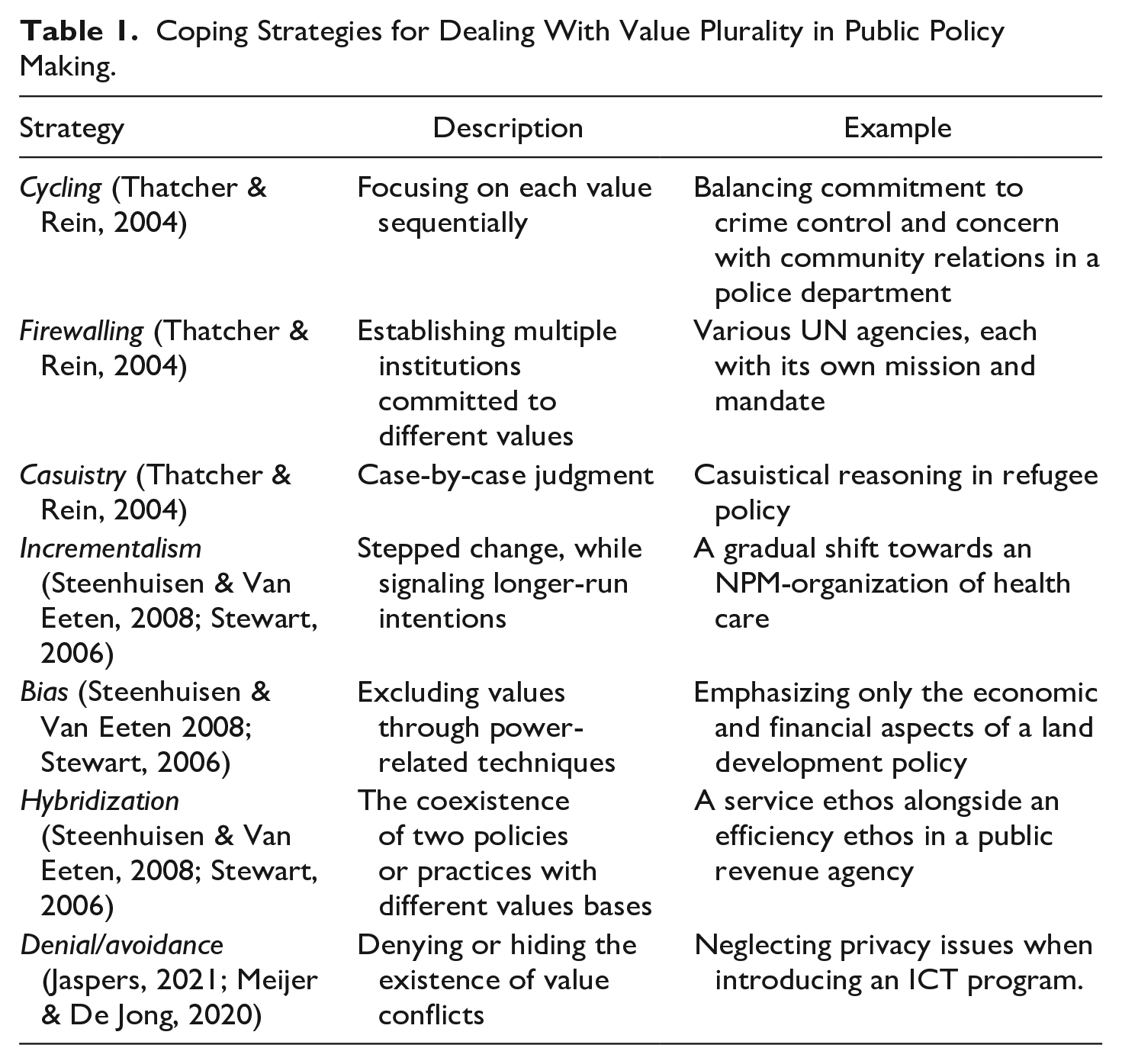
Studies that adopt Steward’s extended set of management options show how these strategies can and are being used to create external support, to diminish tensions within the organization, and to prevent paralysis among officials facing value conflicts (e.g., De Graaf et al., 2016; Ford et al., 2019; Jaspers, 2021). Meijer and De Jong have expanded Thatcher and Rein’s set of strategies even further. They add two more categories: “avoidance” and “learning.” Avoidance involves denying or hiding the existence of value conflicts; that is, not being open to the arguments of opponents. Learning, on the other hand, means being open to opponents’ arguments. Coping lies somewhere between these extremes (Meijer & De Jong, 2020, p. 980). Two observations need to be made about this elaboration of Meijer and De Jong. First, it is noteworthy that they categorize Thatcher’s and Rein’s options for practical rationality under Coping and not under Learning, as would be logical if these strategies were taken as instances of practical rationality. Second, the perspective chosen is that of a particular actor dealing with one or more adversaries. The goal is not to find a good solution in the general interest under conditions of value conflict. Meijer and De Jong (2020) clarify this, stating: “Managing public value conflicts is crucial for improving the quality of innovations, enhancing their legitimacy, and driving the implementation process forward” (p. 986). Their study focuses on dealing with barriers that an actor may encounter when working on innovation.
Taken together, these observations lead us to a perplexing conclusion. Although Thatcher and Rein sought to find strategies of practical rationality to overcome instrumentalist approaches that neglected value conflicts, those following in their footsteps have turned their strategies into instruments to cope with value conflicts when they present some kind of obstacle to realizing the administrator’s aims. One might now be tempted to dismiss these successive additions as irrelevant to Thatcher and Rein’s project. Such a reaction, however, may be premature. Is it not also important and part of good (public) management to avoid tensions in organizations and to prevent administrators from becoming paralyzed? And if these goals are legitimate, how can they be achieved without ending up in instrumentalism? In some analyses of the management of value conflict, scholars express such a concern. Steenhuisen and Van Eeten (2008), for example, refer in the conclusion of their study to a practice of “pushing value conflicts around” and a “mindless cycling” of policy programs (p. 152). Occasionally, not only is the problem identified, but a solution is suggested. Oldenhof et al., like Steenhuisen and Van Eeten, follow Steward’s list of six strategies. The former emphasize, however, the dangers of using instrumentalist strategies for learning and for organizational morality and urge a better understanding of what value conflicts are all about (Oldenhof et al., 2014, p. 53). They refer to the work of Boltanski and Thévenot, as did Thatcher and Rein. However, Oldenhof et al. point out that Boltanski and Thévenot used compromise as a way to deal with value conflicts. Compromising involves justification and reason-giving (Oldenhof et al., 2014, p. 54, 58). Arguably, giving reasons makes compromise a form of practical rationality.
Given the role of Boltanski and Thévenot in the Thatcher/Rein’ argument, and given Boltanski’s and Thevenot’s emphasis on compromise as a form of practical rationality, their work might seem to be a good starting point for unraveling the puzzling observation above. Unfortunately, Boltanski and Thévenot do not elaborate on the concept of compromise and its role in a situation of conflicting values. Here, the work of Paul Ricoeur is more promising. First, Ricoeur takes the Boltanski/Thévenot study as a starting point for his analysis of compromise as a response to modern value conflicts. Second, this analysis of compromise is closely linked to Ricoeur’’s elaboration of practical rationality—an elaboration that is clearly distinct from utilitarianism or Kantianism. Third, in his analysis of politics and policy-making, Ricoeur explores the relationship between a concern for the common good and more instrumental and partisan concerns.
Ricoeur on Value Plurality and the Role of Compromise
Boltanski and Thévenot understand value conflicts in society as clashes between different value orders in society, each with its own system of justification. They distinguish orders such as Market, Industrial, Domestic, and so on (Boltanski & Théveneot, 2006). In several of his publications, Ricoeur (1987, 1992, 2000, 2005) emphasizes the plurality of value claims in society. He expands Boltanski and Thévenot’s analysis of orders of value and argues that disagreements exist on three levels. They are present in everyday political debates about the proper distribution of particular goods, in disputes about the aims of good government (security, welfare, freedom, etc., and in disagreements about the legitimacy of government (Ricoeur, 1987, 1992, pp. 258–261).
Ricoeur agrees with Boltanski and Thévenot that there is no given overarching value by which such clashes can be simply resolved. Following their line of argument he points out that conflicts can be pacified by compromising (Ricoeur, 2000, p. 76). People compromise because there is an irreducible plurality in justifications and a wish to resolve disputes peacefully. The justification that can be given for any compromise—here Ricoeur goes beyond Boltanski and Thévenot’s analysis—is always weaker than the justifications that are given for a “pure” position that is based on a particular position or order of value, as there is no unitary or overarching idea of justice by which someone might defend a compromise (Ricoeur, 1991, 2000, pp. 81–90). Compromises, therefore, are fragile. As Ricoeur states, “A compromise is always threatened with being denounced by pamphleteers from all sides as a surrender of principle” (Ricoeur, 2005, p. 210, 1991).
According to Ricoeur, people opt for compromises to keep the peace. It is a pragmatic strategy in a society in which the number of roles we engage in continuously grows and the number of potential value conflicts increases (Ricoeur, 1991, 2000, p. 93). Compromises must not, however, be understood only as pragmatic and realist answers. Ricoeur emphasizes that they also promise to be the starting points for new, more encompassing principles. Compromises, by forming a bridge, can help develop common understandings and evaluations that did not exist before. By helping to realize a new common way of thinking, compromises are more than mere (pragmatic) advantages for each party individually. They can contribute to the common good by providing better answers to collective problems (Ricoeur, 1991, pp. 2, 6).
Ricoeur suggests that in order for compromise to work, a certain transition is necessary. This means rising above one order of value and its particular justification. Each party must go beyond its own world and understand its position as one next to that of others. Compromising demands for each party to imagine what it means to inhabit other value orders. Ricoeur (2005) compares this to “learning a foreign language to the point of being able to appreciate one’s own language as one among many” (p. 209). In this way, compromising offers a perspective on the common good, an idea of common aims and values, although it can never express the common good (Ricoeur, 2000, p. 91). Compromising is thus motivated by the idea of an encompassing common good and at the same time can result in an (approximation of) common good principles. The common good emerges in so far as the compromise opens the way to a future encompassing principle that bridges current disagreement. Simultaneously, this is a presupposition in the sense that some vision of it is needed to arrive at a viable compromise (Ricoeur, 2010, p. 210. [For a reconstruction of Ricoeur’s elaboration of compromise, see also Assayag-Gillot, 2018; DeWeer, 2022).]
Ricoeur (1992) develops his understanding of the common good in his ethical theory (the so-called “little ethics” in Oneself as Another). His understanding of the common good is not built on some idea of individual liberty or the maximization of welfare but on an understanding of leading the good life. Like Aristotle, Ricoeur proposes that the good life is not a solitary life but a life of individual development with others into a person who is at once vulnerable and capable. We need others in order to develop into capable, responsible and relatively independent individuals. Only in societies, societies of a certain kind, can we flourish and lead a meaningful life. This involves people who are close to us as well as people whom we do not know and may never even meet. Our interactions with this latter group usually take place in or through institutions. A precondition for us leading the good life is that these institutions are just. The human goal, according to Ricoeur (1992), might be summarized as leading a good life together with others under just institutions (ch 7). To elaborate what “just” means here, Ricoeur turns to Kant. In society, all kinds of violence might be lurking (physical violence but also myriad kinds of verbal harm and manipulation). The good life of each person could always be threatened by the disrespect of others. Therefore, in every action, in the making of laws and in policy-making, the question must be asked whether each individual is respected as a person. Every decision must go through what Ricoeur (1992) calls “the Kantian sieve” (ch 8).
In the final part of his “little ethics,” Ricoeur explains that Kant neglected the possibility of value conflicts—that is, the types of conflicts that have been indicated above. To deal with such conflicts, our ethics must include a third element, the virtue of phronesis (“prudence”). This virtue encompasses the ability to choose the proper action in particular situations while taking into account all relevant aspects. Here, Ricoeur refers to Hegel’s analysis of tragic action. He agrees with Hegel that situations become tragic when actors hold on to a one-sided view and allow for only one value (or justification). It is the holding of one value as absolute that creates tragedy. The prudent decision balances or integrates all the values that are relevant to this particular kind of action or to this particular case into a feasible and appropriate action given the general aims of living the good life together under just institutions (Ricoeur, 1992, ch 9).
Again, this “little ethics” (or “critical phronesis”) underlines Ricoeur’s effort to take value diversity seriously and to overcome it, possibly in the form of compromise. This does not mean, however, that a compromise is always better than no compromise. First, Ricoeur distinguishes true compromise from fraudulent compromise. The latter occurs, for example, when a factory owner says to his or her employees, “we are one big family.” Here, the factory owner is trying to hide the fact that, whatever other relationship he might have with his workers, the value order of the labor force market implies competition and not harmony between employer and employees. A compromise is honest or true if it somehow maintains the claims of both value positions (Ricoeur, 1991; see also 1992, p. 273).
Second, Ricoeur blocks certain kinds of compromise by setting a limit on actions in general. Compromises, like other actions and decisions, must pass through Kant’s sieve. Compromises that express or imply disrespect for persons, whether or not they are party to the compromise, are off-limits. Such compromises are, in Margalit’s terms “rotten” (Margalit, 2009).
Ricoeur on the Two Faces of Politics and Policy-Making
As we saw above, Ricoeur enables us to understand how and why we can still find good answers in certain situations where values are fundamentally plural. His work can also clarify the puzzling and contradictory perspectives on strategies of value conflict management. For this latter clarification, we have to turn to Ricoeur’s analysis of politics and policy-making.
Politics, Ricoeur explains, has two sides or aspects, each with its own logic. On the one hand, it is politics as Hannah Arendt has expressed it. It is the idealistic side of politics as the common project of people who want to live together under just institutions. It concerns the power to realize common aims and expresses the horizontal relationship among citizens. The second side is politics as understood in the work of Max Weber, for instance. Here, politics is the realism of striving, winning and losing. It is about force, violence, and manipulation—in short, domination. It concerns the vertical relation of having power over someone (Ricoeur, 1995, p. 20, Ricoeur, 2007b, pp. 248, 255).
The relationship between these two sides of politics is complicated and even paradoxical. The ideals of the common project cannot be realized without the realist use of power. In our societies, there must be representative bodies and state machinery that are in certain vertical relationships with ordinary citizens. These bodies, moreover, are made up of politicians who have to compete with each other; they have to fight and try to win. Moreover, given the complexity of political issues and the uncertainty of outcomes and effects of proposed policies, politics cannot function without rhetoric. It is about trying to persuade others through form, frame, appeal, and suggestion. As a final example, the implementation of regulations and policies sometimes means using instruments of force and even violence against citizens. The use of all these necessary measures of realist politics, however, can undermine trust in the common project. The rhetoric used by politicians can be (understood as) a mere form of manipulation; the use of force can be perceived as oppressive; the activities of politicians can be seen as mere games that politicians play among themselves, and so on. In short, the use of politics can destroy what it is supposed to realize (Ricoeur, 1987, 1995). This is one of the faces of what Ricoeur (2007a, p. 330, 2007b, p. 261, 2010) calls the political paradox.
This more general analysis of the tension within the field of politics can help us to understand the tension we witnessed in the literature on value conflict management. The strategies Thatcher, Rein, and others propose in this literature are meant to deal with situations in which such conflicts occur. The strategies are designed to find new answers in situations of conflict—new answers in the common interest. They can, however, also be employed by one or more actors as instruments to realize particular partisan aims. In such cases, the use of certain strategies, when others understand the instrumental motivation, may lead people to lose trust in others and, as a consequence, to lose trust in the common project.
Ricoeur’s analysis, however, does not stop at this understanding of the complex relation of the common good and instrumental strategies. They are two spheres of politics (policy-making and public management) with their own raisons d’être that can be at odds and even mutually undermining but cannot be reconciled; this tension is necessary and irresolvable. The permanent fragility of the common political project, according to Ricoeur, is a matter of concern for politicians and citizens in general. Our recognition of this fragility makes us aware that we have a responsibility for it. That is, we have a responsibility to find ways to do what is necessary for the continuation and flourishing of the common project. This encompasses engaging in realist politics and instrumentalist strategies, but only if it can eventually strengthen the general trust in the common project (Ricoeur, 1987, p. 41; 1991, p. 287; 1995, p. 21; 2007b, p. 336/7, 2013). For reconstructions of Ricoeur’s political paradox and political responsibility see also, e.g., Dallmayr, 2002; Dauenhauer, 1998, 2002; Deweer, 2017; Hoskins, 2013; Kaplan, 2003).
In the previous section, we saw what practical rationality can mean. Ricoeur expressed it as critical phronesis. It is an approach that recognizes the plurality of values but, given our common project of living together under just institutions, sees a possibility to overcome value conflicts by seeking new (compromise) answers for particular issues. In this section, we have seen that Ricoeur expresses concern for this common project in terms of responsibility. This includes the responsibility to help realize the project but also to make sure that these actions themselves do not undermine the (trust in the) project itself.
Back to the Theoretical Puzzle
Our detour via Ricoeur’s work helps us to deal with the puzzle presented by the literature on value conflict management. Ricoeur explains how practical rationality allows us to deal with conflicting incommensurable values and how and when specific instrumental concerns are compatible with an orientation to the common good.
How Can Conflicts Between Incommensurable Values be Overcome?
Ricoeur, building on Boltanski and Thévenot, shows when and why value conflicts are a problem: when people, in their efforts to defend their positions, find that others have justifications that are contrary to their own. In such cases, however, we have a motivation, beyond the pragmatic motivation of keeping the peace, to try to find a solution. This initial motivation lies in our aspiration to live the good life together with others under just institutions. At the same time, this idea of the common good contains our guideline, however vague it might be, for finding good answers in particular cases. Practical rationality is the ability to look for and find answers under such conditions. Ricoeur calls it “critical phronesis” and by doing so he references its ethical roots in Aristotelian virtue.
Practical rationality, in this ethical tradition, does not follow utilitarian calculations or universal rights and rules. It involves the ability to arrive at the right answer to particular issues or even in very particular cases, guided by an idea of our common aim.
The process of finding such answers may take different forms in different contexts and circumstances.
This understanding of the practically rational handling of conflicting values seems to fit best with the strategies of Cycling, Casuistry, Incrementalism, and Firewalling. These are all strategies that—ideally—offer paths to finding the right answers over time. In Cycling, the hope is that by moving from one unilateral focus to another, new and better answers will emerge over time. This is also the premise of Incrementalism: testing what might work step by step. The image is that of an upward spiral. In the case of Firewalling, a similar positive effect can be expected from bracketing the value conflict for a time. The difference between these strategies and Casuistry is that Casuistry tries to find general answers by working on a case-by-case basis. The other strategies try to move directly to such a general answer.
Can Practical Rationality and Instrumental Rationality be Combined?
Ricoeur develops the relationship between practical rationality and instrumental rationality by exploring the tension between living the good life with others under just institutions and acting tactically to achieve one’s ends. Each has its own raison d’etre and presupposes the other. In order to actually work, the common project requires some political maneuvering, rhetoric, and concern for the flourishing of one’s own organization, and so on. At the same time, instrumental and often partisan action runs the risk of undermining (trust in) the common project. Thus, instrumental rationality can be used, but only when and to the extent that it does not damage the common project—that is what practical rationality aims at. The responsible manager or policy maker should always take care that his or her instrumental use of certain strategies (be it Cycling or Firewalling or any other strategy) does not undermine the common project. What follows are the lessons to be learned from this.
Conclusion
Lessons for Policy Makers
Ricoeur’s analysis implies certain limits to the management of value conflicts. First are limits regarding the dangers of mere instrumentality. For example, a certain amount of rhetoric may be necessary, but it must contribute to trust and not (threaten to) undermine it. This can be seen, for example, when someone presents a false compromise, where a partisan instrument is deceptively presented as a solution that is in the common interest, while in fact certain values are removed from the picture. An example would be the presentation and justification of COVID measures in many Western countries. The problems that policies such as lockdowns were designed to address often were framed in terms of public safety or efficient resource allocation, neglecting values related to children’s education or social contact (see, e.g., Lavezzolo & Fernández-Vásquez, 2022; Lee, 2021).
Second, some limits follow from the “critical” in Ricoeur’s critical phronesis. This concerns the need for strategies and solutions to pass through the Kantian sieve. The value of each individual must be respected. An example of an approach that would not have passed the sieve (for several reasons) concerns an internal policy of the Dutch Tax Administration. In an effort to combine strict control of benefits with efficiency, this agency resorted to racial profiling, completely neglected individual circumstances in claims, and made it almost impossible to obtain reviews (Claassen & Robeyns, 2022).
Neglecting these limits has consequences for public trust, Ricoeur (1991) maintains. Some strategies, such as Bias and Denial, seem to be off limits altogether. In these strategies, respect for others and their understanding is absent (in the case of Denial), and only manipulation remains (in the case of Bias). In both cases policy making is not directed at finding ways to bring multiple values together, but at avoiding the task of building bridges itself. People and ideas are “removed from the frame.” Once citizens find out that this is the case, skepticism and cynicism are likely to undermine public trust. A constructive approach to the common good seems best served by the strategies of Cycling, Casuistry, Incrementalism, and Firewalling.
Advice for Organizations
Ricoeur’s analysis also implies advice for organizations. In the Aristotelian tradition, he emphasizes the ethical capacities of human beings and the need to develop them. According to this way of thinking, good organizational management means that members of organizations are not excluded from ethical decision making. Management strategies such as Firewalls that (permanently) prevent employees from dealing with value conflicts actually limit their opportunities for personal development and responsibility. Efforts to prevent the paralysis of members of one’s own organization must not become instruments of limitation. (On the need for organizations to help their members make value choices, see also Thatcher & Rein, 2004, p. 461/2.) Currently, many organizations have appointed specific officials or offices to deal with particular ethical issues: privacy officers, integrity officers, ethics committees, and so on. This organizational specification can be important for maintaining ethical standards and mainstreaming values. But it can also become a form of ethical externalization or ethical outsourcing. It can lead to an attitude of routinely leaving the concern for particular values, or the consideration of ethical issues in general, to “the specialists,” thus undermining the sense of responsibility. This form of organization then takes the form of Firewalling with the result of what Thatcher and Rein (2004) called “downward spiraling” (p. 475).
Contribution to Public Value Scholarship
The analysis using Ricoeur has been able to resolve an apparent contradiction or paradox in the literature on strategies to cope with value plurality. In particular, it has done so by showing how to distinguish between better and worse strategies and between appropriate and less appropriate use of certain strategies.
The analysis also points the way to further questions for empirical research in this area. This analysis can help to expand and refine existing research on acting with integrity, decision-making in cases of value plurality and providing moral education in public service and policy making.
First, now that we can distinguish between better and worse coping strategies and the use of such strategies, what makes actors choose one approach over another? What variables can explain why policymakers choose an appropriate strategy (or not), and when they do, whether they actually use it to promote the common good? How does awareness of values, knowledge of different strategies and their effects influence choices and attitudes?
A second line of inquiry concerns the relationship between coping strategies and trust. Ricoeur points out that the project of the common good depends on public trust. How and why exactly do certain strategies tend to undermine trust, and when and how do they strengthen it? Which of the strategies work best in particular situations (and in what specific form)?
Finally, the analysis helps to raise specific questions of personal development. What would it take to strengthen an attitude of critical phronesis (i.e., Ricoeur’s specification of practical rationality) as an alternative to utilitarian and Kantian orientations in public policy-making? How can practitioners best be trained to make the right strategic choices, and how can organizations best be designed to support individuals in doing so?
Footnotes
Acknowledgements
I would like to thank the editor and anonymous reviewers for their valuable suggestions on an earlier version of this article.
Declaration of Conflicting Interests
The author declared no potential conflicts of interest with respect to the research, authorship, and/or publication of this article.
Funding
The author received no financial support for the research, authorship, and/or publication of this article.

Data Availability Statement
Data sharing not applicable to this article as no datasets were generated or analyzed during the current study.