




Abstract
Citizens with lower social status are underrepresented in participatory democratic innovations like citizens’ initiatives. Much research focuses on the barriers to participation that these citizens experience. The current study concentrates on civil servants tasked with advising on what initiatives to support and how. Informed by research on the social construction of target groups and the use of social stereotypes by civil servants, our work scrutinizes how the social status of initiators plays a role in the assessments of citizens’ initiatives. Grounded on vignette-based, in-depth interviews with civil servants, we conclude that social status does indeed play a role. Contrary to the conventional understanding, we find that: (1) high-status initiators are met with suspicion and low-status initiators with benevolence; and (2) high-status initiators are offered hands-off support, while those with a low status are provided with hands-on help to carry out their plans.
Keywords
Introduction
Confronted with declining voter turnout, Western European governments have experimented with various democratic innovations to identify new ways of engaging (lay) citizens in public-policy decision-making and implementation, for example, via interactive policy-making, participatory budgeting, or citizen juries (Elstub & Escobar, 2019). While the dominant tide within democratic and public-administration theory tends to praise the democratic value of these innovations, critics warn that they may have unintended negative consequences (Smith, 2009). Studies of participation across a range of these political activities demonstrate that citizens with a lower social status are substantially underrepresented (e.g., Bovens & Wille, 2010; Li & Marsh, 2008; Pattie et al., 2005; Young, 1990). Social status entails widely shared cultural beliefs about social categories or “types” of people that are ranked as more esteemed and respected compared to others. Status beliefs are tied to a range of characteristics, including religion, ethnicity, gender, and class (Ridgeway, 2019), but, status beliefs connected to socio-economic factors prove most relevant when it comes to status differences in political attitudes and behavior, including participation in citizens’ initiatives in Western European countries such as the Netherlands (Van de Wijdeven, 2012). The latter are therefore the focus of the present study.
Given the underrepresentation of citizens with lower social status, scholars have expressed concern that extending opportunities for citizen participation in public decision-making and execution will reinforce and amplify existing differences in power and influence (Smith, 2009). Attempting to overcome this, some governments experiment with offering more accessible ways to participate. A recent addition to the spectrum of democratic innovations are citizens’ initiatives, which can be seen in countries like the United Kingdom and the Netherlands. These involve citizens carrying out public tasks or providing public services themselves (Dekker, 2019; Newman & Tonkens, 2011), giving them direct influence over their living environment. Examples include citizens who maintain a public playground or open a community center and organize elderly care there. Dutch local governments are increasingly encouraging and actively inviting citizens to participate in public-service delivery via self-organization in such projects (Dekker, 2019; Denters, 2016; Igalla et al., 2020).
However, citizens with lower social status are also underrepresented in this type of participation (even though initiators often try to involve them), hindering their democratic potential (Dekker, 2019). Their underrepresentation is predominantly explained by lack of time, money, social contacts, and political knowledge (Berinsky, 2004; Dekker & Uslaner, 2001; Galston, 2001). The extant literature thus focuses on the barriers to participation that people face and how governments can design democratic innovations with less hurdles. Meanwhile, we do not know how the decisions of civil servants about citizens’ initiatives might (intentionally and unintentionally) impact the underrepresentation of lower social status groups, especially when it comes to the question of which initiatives deserve their support.
Although citizens’ initiatives are, in theory, self-organized and, at their core, independent from government organizations, this is never completely the case in practice. Nederhand et al. (2016) have demonstrated that self-organization evolves in the shadow of hierarchy. A certain level of cooperation with the government is required to, for example, obtain financial support, information, or access to social and institutional contacts.
The question thus arises concerning how civil servants assess citizens’ initiatives and make decisions about which ones to support. Research on the use and activation of stereotypes by civil servants in the domains of health care, education, and taxes suggests that social status influences how willing civil servants are to support citizens and the kinds of support that is offered. Consequently, we theorize that the social status of an initiator of a citizens’ initiative plays a role in civil servants’ assessment of their initiative, their willingness to support it and the assistance provided (Harrits, 2018; Raaphorst, 2017).
Accordingly, we scrutinize how civil servants’ assessments of citizens’ initiatives are influenced by the social status of those proposing them. We also seek to identify the motivations and narratives underlying these assessments to unravel their underlying rationales. To this end, we conducted vignette-based, in-depth interviews with civil servants tasked with encouraging and providing advice on citizens’ initiatives in Rotterdam (the Netherlands), a city that is very active—via several policy programs and regulations—in encouraging citizens’ initiatives.
Social Construction of Target Groups and Social Stereotypes among Street-Level Bureaucrats
The notion that civil servants’ assessments of citizens’ initiatives are affected by the social status of those proposing them is informed by theories on the social construction of target populations in public-policy processes (Schneider & Ingram, 1993). These theories emphasize that policies are aimed at specific target populations. These populations are social constructions; that is, they are not already existing, but are the outcome of social and political processes (Schneider et al., 2014). Social constructions impinge on all aspects of policy, from design to implementation. As such, policies not only involve the allocation of values to achieve public goals, but are also buttressed by the desire to give “good things” to “good people” and punish those perceived to be “bad” (Ingram & Schneider, 2017). Accordingly, ideas on target populations shape the allocation of benefits and burdens, with various groups treated differently in public policies (Bell, 2021). The treatment that these different groups receive is influenced by the cultural characterizations and popular views ascribed to them. Schneider and Ingram (2019), for example, have shown that bias, labeling, stereotyping, and stigma are reflected and reinforced in public policies.
The literature on the social construction of target populations focuses on politicians and policy-makers. However, as Lipsky (1980) emphasizes, policy is made on the ground. The decisions “who gets what, when and how” are made not only by the public officials who are formally tasked with creating policies, but also by officials on the frontline of interactions between the state and citizens, that is, street-level bureaucrats (SLBs) (Lipsky, 1980). Consequently, how policies are implemented is shaped in encounters with members of the public (Maynard-Moody & Musheno, 2012). Accordingly, an appropriate understanding of how social status plays a role in decision-making requires an examination of SLBs and how they construct target groups. Extant research shows that the mismatch between rules and the actual problems encountered encourages SLBs to improvise and engage in discretionary decision-making (Maynard-Moody & Musheno, 2012). In doing so, they often rely on social stereotypes, like those linked to the social status of particular groups. Stereotype activation is primarily uncontrolled, since stereotypes are deep-seated and culturally and socially learned categories (Harrits, 2018).
Most of the literature focuses on the effects of stereotypes, not on how and when they are employed (welcome exceptions are: Harrits, 2018; Raaphorst, 2017). We attempt to remedy this by investigating the ways and circumstances in which stereotypes about social status are applied by SLBs. Stereotypes can affect decision-making both directly and indirectly (Raaphorst & van de Walle, 2018). In the former, social typologies serve as short-cuts. SLBs make inferences about unknown attributes based on certain characteristics of citizens that signal they belong to a particular social group (Lipsky, 1980). In the latter, social typologies serve as “lenses” through which other attributes of the individual are assessed, that is, by influencing the interpretation of other signals relevant to the judgment at hand. This implies that similar signals are interpreted differently depending on the social group to which someone is perceived to belong (Foschi, 2000; Raaphorst, 2017; Ridgeway, 2019).
Studies of the use of stereotypes based on social status show that these are largely driven by widely-shared beliefs about the worthiness and competence of people in particular social groups (Fiske, 2015; Lamont, 2002), revealing that lower social-status groups are perceived as less worthy and less competent. Harrits (2018), Møller (2009), and Harrits and Møller (2014), in the domains of health care, child care, and education, respectively, found that SLBs’ use of social-status stereotypes affects their support for different groups. High-status groups were viewed as more competent, causing SLBs to offer modest and short-term assistance that enabled these citizens to continue to take the lead. In contrast, low-status groups were assumed to lack competence and were met with suspicion. These negative assumptions by SLBs have been found to generate offers of more long-term assistance that is corrective in nature and has a profound impact on the daily lives of citizens. Furthermore, Foschi (2000) has shown that hiring decisions involve lower-status groups being evaluated by SLBs using stricter standards than those deemed to have a higher status, who get the benefit of the doubt and are analyzed more leniently.
Ridgeway (2019) has found that social-status characteristics serve as strong signals in social interactions, especially when resources are scarce and tasks are goal-oriented. Since citizens’ initiatives make a claim for limited resources (public money) and are goal-oriented (creating public value), we expect that SLBs use social status stereotypes when they assess these proposals. We aim to disentangle precisely how social status plays a role in their assessments.
Methods and Data
Context and Research Focus
Our study is set in Rotterdam, the second largest city in the Netherlands. This is a strategic case for two reasons. First, it is characterized by substantial differences in the social status of its population (Engbersen et al., 2019) and has contrasting narratives in relation to lower and higher-status groups. As a former industrial city and still the largest port in Europe, Rotterdam is composed of a substantial share of working-class, less-educated, and migrant residents. In an attempt to reinvent the city for a post-industrial future, the local government actively and explicitly seeks to attract middle and higher-class, higher-educated individuals (described in policy documents as “the strong shoulders we need” and “the prospect rich”) and displace the “prospect poor” lower classes (van den Berg & Chevalier, 2018). Accordingly, we expected that status differences play a substantial role in the decisions and experiences of civil servants in Rotterdam; the results presented below support this expectation.
Second, the municipality is very active in encouraging citizens’ initiatives (Custers et al., 2019; Uitermark, 2015), for instance via the “Citizens” Initiatives Regulation’ (Bewonersinitiatievenregeling), which enables individuals or groups to apply for both funding of up to 10,000 Euros and professional support to execute their projects. Around 1,700 applications are made annually, involving ideas like local housework assistance, language lessons, social events, and maintaining community gardens (Opzoomer Mee, 2019). That this Rotterdam regulation has been explicitly developed to appeal to a wide variety of citizens, by making the application process as easy and accessible as possible (unlike others created to attract more professionalized groups like the Right to Challenge), makes it particularly suitable for our research.
Rotterdam comprises multiple districts and neighborhoods, each with its own governance team and a citizen council. In our study, we focused on neighborhood managers and networkers. These civil servants are intermediaries between citizens, organizations, and the municipal services within a specific policy domain or geographical area. They occupy the lower-middle of the organizational hierarchy, being liaisons between middle-management and citizens and neighborhood (welfare) organizations. Their most important task is to implement policies that stimulate citizens’ initiatives. Therewith their main activities include encouraging neighborhood initiatives, assessing applications for support that are made and connecting initiatives to the municipal organization. In doing so, they interact daily with citizens and have a great deal of discretion when making decisions on initiatives. Because of these characteristics, we see them as SLBs. We therewith follow Tummers (2017) and use the term SLBs to denote public professionals who implement policies and thereby have discretionary space and interact directly with citizens. 1
Method and Vignette Construction
To examine whether and how the social status of an individual proposing an initiative plays a role in the assessment processes adopted by SLBs, we conducted vignette-based, in-depth interviews with neighborhood managers and networkers. We use vignettes as elicitation material since they are especially useful for making explicit and gaining an understanding of, often implicit, attitudes, values, perceptions, and judgments in decision-making processes (Mutz, 2011). The use of “real-life” vignettes enabled our SLB respondents to articulate their “authentic” decision-making norms by eliciting the normative reasoning and contexts that shape their actual judgments (Raaphorst, 2017). Moreover, vignettes help to limit social desirability bias, because they prevent the interviewer from asking direct questions about sensitive topics like social status (Hainmueller et al., 2014).
Our vignettes describe hypothetical citizens’ initiatives. Within these descriptions, we manipulated a set of characteristics of the initiator in order to provide a “cue” as to whether the initiator has a high or low social status (cf. Raaphorst et al., 2018). Inspired by sociological studies on socio-economic status, we included in our vignettes manipulations for the following aspects: occupation (based on literature on occupational prestige (e.g., Ganzeboom & Treiman, 2003)), leisure activity (based on literature on cultural capital and lifestyle preferences (e.g., Roose et al., 2012; Savage et al., 2013), and home-ownership (based on literature analyzing home-ownership as both an economic as well as social status asset (Kurz, 2004)). 2
As the respondents were asked to reflect on two vignettes, one with a high-status initiator and one where the status of the initiator was low (see below), we included two different topics to ensure it was not obvious that social status was the issue of interest. Based on information about actual applications for funding in recent years, we constructed vignettes that resembled the real-life context of neighborhood managers and networkers: one concerning a musical event and the other a community playground. Table 1 provides an overview of the vignettes.
Vignettes and Their Possible Manipulations.
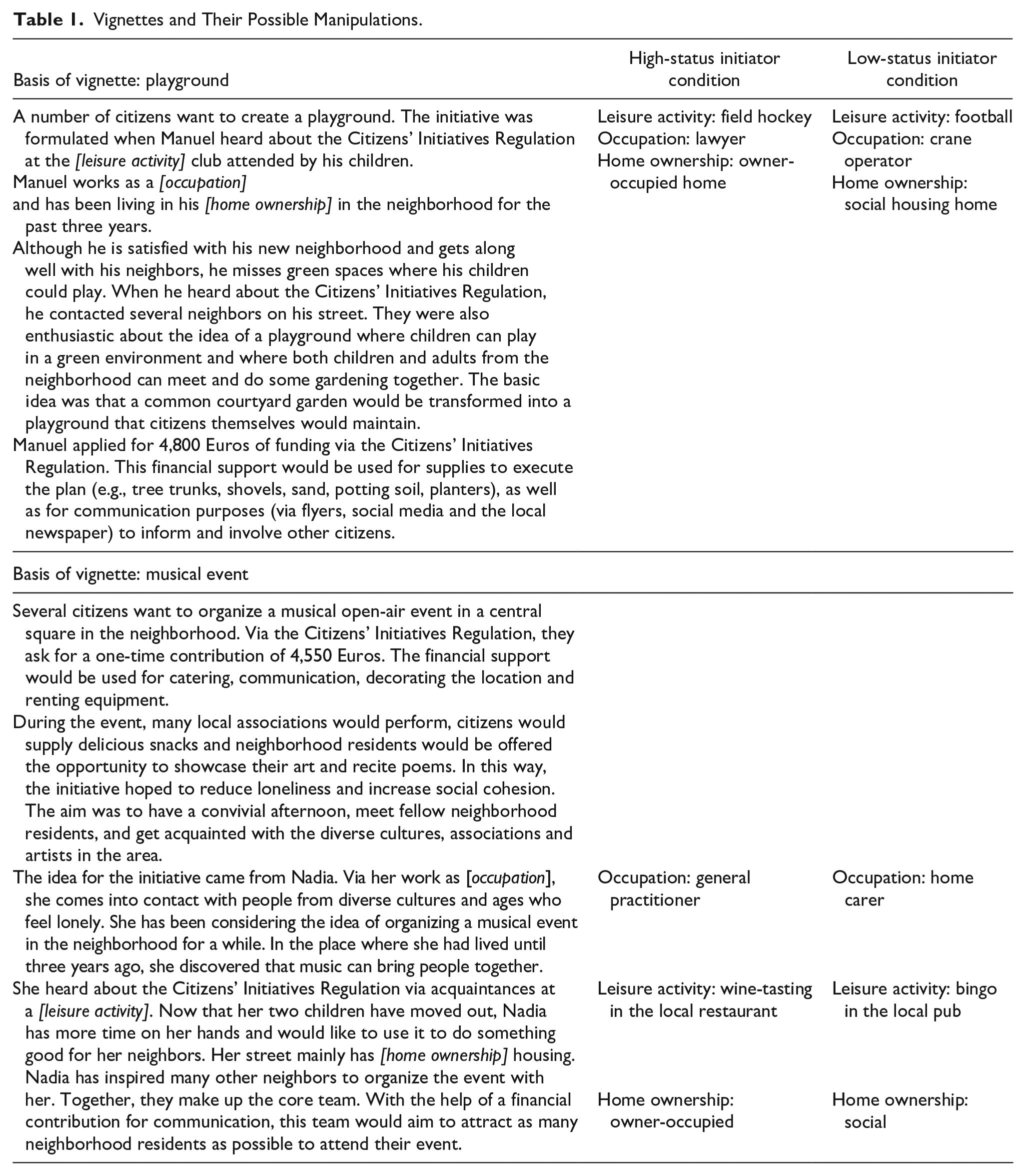
We co-designed the vignettes with two participation advisors and the neighborhood managers’ and networkers’ general manager. This helped us to design vignettes that adequately reflected common initiatives and whose manipulations were sufficiently strong and detectable while also remaining realistic. As our results will show, the vignettes—with their various combinations—were seen as realistic and triggered respondents to mention various examples of real-life initiatives they had encountered in their day-to-day work. Moreover, the interviews gave us the opportunity to assess how the respondents interpreted certain social-status indicators. Our findings demonstrate that our status “cues” were interpreted as intended, thereby validating our vignettes in the form constructed. 3
Data Collection
The data collection took place between April and December, 2021. As a first step, we invited all the (approximately 80) neighborhood managers and networkers to complete an online survey. In this, we asked them to reflect on two randomly assigned vignettes; that is, on hypothetical descriptions of citizens’ initiatives, one from a high-status initiator and one from an individual portrayed as having low status (see above for more information on the design and content of the vignettes). We asked the respondents about their general associations, the expected chance of success, the anticipated value to the neighborhood, the likelihood that the initiative would be funded, and the support required. Additionally, they were able to indicate what kinds of help they thought the initiative would need and share general remarks. This was followed by several questions on the background characteristics of the respondents themselves. We ended the survey with an invitation to an in-depth follow-up interview. If a respondent was willing to cooperate, they could share their contact details to enable us to arrange this.
The survey was completed by 32 respondents and we conducted follow-up, in-depth interviews with 19 of them (11 neighborhood managers, 8 neighborhood networkers). Because of privacy concerns, we could only collect data on a limited number of background characteristics. Respondents varied in age (between 29 and 64 years old) and years of working for the municipality (between 4 and 43 years); all had tertiary educational credentials (with backgrounds in, e.g., urban planning, social work, or sociology). Based on commonly used indicators like education, occupation, and income, our respondents have a social status in the middle between the hypothetical high and low initiators in the vignettes.
During the interviews, we focused on the meaning-making of the respondents in relation to the vignettes (see, also, Raaphorst, 2017). We again presented them with the two vignettes that they had read in the survey. We first asked them to speak freely about the elements of the description that caught their attention and to give us their initial thoughts and impressions. This stimulated lively interviews in which the respondents felt able to discuss their views, which were not limited to the topics in the survey. Thereafter, we encouraged them to elaborate on how they would go about evaluating the cases in the vignettes. Their answers to the survey questions served as inputs for this part of the interview. The interviews offered us the opportunity to further scrutinize which elements played a crucial role in the assessment.
In the interview invitation, as well as during it, we created a safe space for the respondents to openly discuss their views. We assured them that the findings would remain anonymous, would not be disclosed to their general manager, and would not be used as an evaluation of their work. As a result, many said they “enjoyed the interview” or had experienced it as “a nice conversation.” Validation was ensured via an interactive meeting with the respondents in which we discussed our findings. They confirmed to us that our interpretations of their inputs were accurate and resonated with their experiences.
As the results show, our two-step procedure proved to be well-suited to our research purpose. At the start of the in-depth interviews, the respondents were reluctant to talk about social status and gave more general, socially desirable answers about how they examine initiatives. When subtly reminded by the interviewer about their more candid responses in the survey, this led to a frank and open discussion about the role of social status in the assessment process.
All the interviews, which lasted between 45 and 90 min, were recorded and transcribed, producing 299 pages of single-spaced text. We translated all the quotes from Dutch, and in doing so have tried to accurately reflect the original wording. We use pseudonyms to protect the respondents’ privacy and omitted any references to the neighborhoods where they work.
We adopted an abductive approach, moving back and forth between theories and the data (Tavory & Timmermans, 2014). We coded the interview transcriptions using constant comparison (Glaser & Strauss, 1967). Sensitizing concepts (Charmaz, 2006) relating to social status, worthiness, and competence helped us identify meaningful resemblances and differences in the data. The analysis enabled us to discern that the respondents’ evaluations of the budget, inclusivity and the types of support being sought were important aspects in the assessment process. These were grounded in both a specific notion about what and for whom citizens’ initiatives are intended and an ideal of empowerment. We used these empirical insights to further explore the relevant literature and refine our analysis accordingly.
Results
Perceptions of the Vignettes
Before discussing our analysis of the vignettes and the role of social status therein, we first elaborate on our respondents’ general perceptions of the material provided to them. When asked to freely associate while reading the vignettes, the respondents confirmed that our hypothetical descriptions of citizens’ initiatives matched those they would encounter in their daily work: “I recently had a similar kind of application” (Yvette) and “The past years, we’ve had many initiatives like this” (Alice). The vignettes also caused the respondents to refer to experiences they had had with similar initiatives: “Such ‘greening’ initiatives in my neighbourhood predominantly come from new residents [. . .] we see these kinds of initiatives a lot recently” (Andrew), or “Not long ago we had such a multicultural event from the Surinamese community” (Oliver).
Additionally, and more importantly for the purpose of our study, all the respondents had noticed the high and low status cues: “It was an amusing characterisation of the initiator” (Anna). More precisely: “I see a combination of an open-air event, wine-tasting, multiple involved neighbours and owner-occupied housing” (Nathan); “Oh yes, I remember [from the survey], this was an initiative from the general practitioner” (Robert); “I read that this gentleman lives in an owner-occupied home” (Lucy); “I recognised the term lawyer” (Oliver); and “I see he is a crane operator” (Alice).
Some said that the initiator’s characteristics were irrelevant: “It says that she lives on a street with only social housing. Ok, could be, but that shouldn’t matter whether someone lives in a rented or owner-occupied house (Erik); and “Manuel is a lawyer [. . .] I don’t see why this information should be relevant” (Axel). Most respondents, however, made assumptions based on the status signals. In relation to high-status initiators, it was presumed that they were affluent: “I assume he’s no pauper” (Erik); “This rich gentleman [. . .]” (Iris); and “I assume we’ve got quite some disposable income here” (Nathan). Others were quick to label the high-status initiators: “An arrogant snoot” (Iris); “I would call this the higher segment of initiators” (Yvette); and “This all comes across a bit pretentious, elitist so to speak” (Aleah). Regarding the low-status initiators, the respondents assumed that they were not experienced at organizing a project. Two expressed this very clearly: “When I see this, I think, or assume, that they’re doing it for the first time” (Erik); and “The way I read this, I see a mother who thinks ‘I’m going to organise an event’ for the first time in her life” (Andrew).
How these different perceptions of the social status of the initiators sparked diverse assessments of their proposals is discussed below. We found that initiatives from those with high status were met with suspicion, while those from individuals whose status was low were viewed with general benevolence. Moreover, the type of help suggested differed: high-status initiators were offered hands-off support, while low status initiators were offered hands-on support. We also identified that these different treatments were justified by the respondents� social constructions of the target group of the policy on citizens’ initiatives and embedded within a narrative of empowerment.
Attitude: Suspicious versus Benevolent
That social status plays a role in the assessment of initiatives became apparent in our respondents’ different attitudes toward the high and low social-status initiators. Initiatives from the former were met with suspicion. The respondents generally expressed a desire for more information before they could make a proper decision, and often wanted to meet the initiator in person: “To see whether he [high-status Manuel] is not just some arrogant prick” (Iris). More specifically, the respondents raised two issues they wanted to discuss further with the high-status initiators: how the financial help would be used and the status of the support and involvement from other neighborhood residents. These issues were linked to distrust about whether the initiators would make an active contribution to the initiative and doubts about inclusivity and value in relation to the public good.
On the other hand, initiatives from those with low status were met with general benevolence. The respondents said that they would be “very happy to receive an initiative like this” (Lucy). They were also keen for these projects to succeed, which was reflected in their lenient assessments of the budget. Moreover, no concerns about inclusivity, in particular support and the involvement of other residents, were expressed; instead, inclusivity was assumed.
Critical versus lenient assessment of the budget
A common reaction from the respondents to the high-status initiators was that they wanted to “critically assess the budget” (Anna). This was necessary because “those people are used to buying everything [. . .] they’ll probably just hire a third party to do all the work for them” (Iris); “those people feel entitled to do anything, that anything’s allowed, they just try [to get funding]” (Aaron); “those citizens, when they organise an event, they’d prefer to hire an event bureau, to let them do the work for them, and that’s where all the money would then go” (Robert); and “well, usually it can be done for way less money, but the people that have got more money, they just don’t look critically at the budget” (Aleah).
As a solution, the respondents suggested that high-status initiators could contribute some of their own money: “It would be a very good idea if they made a financial contribution themselves” (Alice). Regarding the playground, two respondents said bluntly: “Well, if you have, so to speak, 50 houses around that courtyard, well, then, those households can just come up with the money” (Aaron); “well, to be honest, I think ‘come on, what’s 5k, act normal [. . .] just share the money among the households, that’s not a problem, right?’” (Iris); and “In my opinion, this isn’t necessary at all. I’d say, go play in your own garden” (Oliver).
The opposite was true for proposals from low-status initiators: financial contributions were hardly ever mentioned. On the contrary. When asked about whether a contribution would be sought from these applicants, Owen, Iris, and Oliver all answered with a clear “no!” Aleah explained: “No, I wouldn’t probably ask [for a financial contribution] if people live in social housing.” This was because the respondents assumed that this group would contribute to the initiative in other ways: “They do all the work themselves” (Alice); “What you see is that people from social housing organise everything themselves […] because they’re used to getting by without any money [. . .] they don’t even ask financial compensation for their own efforts” (Iris); and “Those people don’t just hire anything, they do a lot, everything themselves” (Anna).
Moreover, while the respondents wanted to assess critically the budgets of high-status initiators, their low-status counterparts were not subjected to such scrutiny and could be confident they would be looked upon benevolently. When discussing the vignette from a low-status applicant, the respondents took a lenient view and were willing to bend the rules: “Well, we can always just use the budget without permission, for things that it’s officially not meant for” (Robert); and “In principle, the municipal funding isn’t meant to buy materials [. . .], but I can write a convincing advice so that in this case it can get done” (Nathan). Lucy, meanwhile, recounted: “I sometimes even have the idea that money goes down the drain [. . .] or that they put in in their own pockets [. . .] well, that just happens and I ain’t gonna be too strict about that.”
Concerns about inclusivity versus assumed inclusivity
In relation to the high-status vignette, the respondents were very suspicious about the social inclusivity of the initiative described in it. Almost all of them expressed concern: for instance: “This initiative looks like it’s meant to be for their own small group of people” (Olivia); “They seem to just want funding for their own party” (Andrew); and the high-status initiative “didn’t match the demand of the whole neighbourhood. One of the basic principles of citizens’ initiatives is that they should be open to every citizen in the neighbourhood. In this specific description, I highly doubt that that’s the case, it seems to be meant for a specific target group” (Oliver). Based on previous experience, Anna also believed that the high-status initiative would be exclusionary: “You really see, residents from owner-occupied houses have great ideas for initiatives, but then they just do it with their fellow home-owners. Even if social housing residents live in the same street! This really happens.” This concern about inclusivity reinforced the critical assessments of the budget. As well as being suspicious about how the money would be spent, the respondents presumed that it would only benefit the in-group of the initiator.
Following on from this perceived exclusivity, the respondents also questioned the public value of these initiatives: “Are they doing it for themselves or for a societal impact?” (Aaron). Others were convinced that the high-status initiatives would not have a broader societal impact: “Well, it seems to me that these people are well-off [. . .] silly, maybe, but usually you see that they attract like-minded people [. . .] so, yes, it could be a useful initiative, but I wouldn’t quite call it relevant to society” (Oliver). Andrew said something similar: “If they want to organise something for their own people who are equally well-off, I’d say, please go ahead [. . .] but I don’t expect it to have a societal effect.”
Given these concerns, the respondents said they needed more information to properly assess the initiatives of the high-status initiators. They wanted to know, for example, how the initiative would involve more people: “How do they plan to enthuse other residents and increase public support?” (Olivia); “I would have a critical look at how the initiator aims to reach out to others” (Robert); and “I don’t think that she [high-status Nadia] has a neighbourhood network that involves different groups. I think that she’ll probably be able to create enthusiasm for the event within one particular group, but I’d like to know from her how she’ll make sure that the party is also interesting for more than just those couple of people” (Aleah). Lucy also wanted information about how the initiative would do justice to the diversity of the neighborhood: “I’d like to know, what local associations does she [high-status Nadia] have in mind? Does that involve only classical music or also different musical genres? [. . .] How does she ensure that it’s not just for their own elitist group of people?” Particularly in relation to the courtyard playground idea of the high-status residents, almost all the respondents first wanted to know how the garden would be used: “I want to know, how publicly accessible is this garden?” (Iris, Owen); “How many people can make use of it?” (Axel); and “The problem with this initiative is, how are they going to make it publicly accessible?” (Emmett).
Interestingly, this concern about inclusivity and the related broader societal impact was hardly ever mentioned by the respondents with respect to the low-status vignette. Instead, inclusivity was assumed: “This doesn’t look exclusionary to me, the way I read it it’s publicly accessible, I think that’s very important” (Aiden); and “This looks like it’s meant for lots of people [. . .] yes, I think this initiative is broadly supported [in the neighbourhood]” (Oscar). In contrast to the desire for more information concerning the public accessibility of the courtyard playground in the high-status vignette, the respondents just took this for granted for the low-status version: “I suppose this is a public area [. . .] yeah, I just assumed that was the case [. . .] this initiative looks very low key to me [. . .] yeah, I think anyone can be involved” (Alice); and “The way I see it, this initiative aims to do something for the whole neighbourhood” (Nathan).
On the rare occasions the respondents did raise doubts about the inclusivity of a low-status initiative, it was attributed to a perceived lack of organizational capability, in contrast to the perceived exclusivity and assumed self-interest of the high-status initiators. Moreover, if there were any concerns about inclusivity, these did not lead to a negative evaluation: “Even if they’re only able to attract only two ‘new’ people, I’m all positive” (Aaron). Additionally, the respondents suggested that this “minor” problem could be overcome with the right kind of support.
Support: Hands-off versus Hands-on
The kind of support suggested by the respondents differed for the high and low-status initiators. The former were assumed to be capable of organizing the initiative themselves: “Very silly, but when I read that the initiator’s a lawyer, it gave me confidence that he’s perfectly capable of organising something” (Oliver); “I think they could easily pull it off” (Oscar); “I see a lot of organising capacity here, so I’m confident that they could get the initiative off the ground” (Aleah); “Those people probably know better than me how to run a project” (Anna); “Yes, they’ll manage” (Lucy); and “Higher educated people usually know how to achieve what they want” (Alice). In view of this, it was anticipated that the high-status initiators would not need much help: “It’s not that difficult [. . .] I don’t think they’ll need any help” (Oliver); and “If the general practitioner thinks she can pull it off by herself, that’s very good. I’d say ‘if you need anything, you know where to find me’” (Olivia). The support offered to these high-status initiators was therefore modest and hands-off. The respondents described their roles as “facilitating” (Andrew) and “advising” (Olivia, Aiden, Alice).
This advice concerned two particular issues. First, the respondents would advise the high-status initiators about the institutional context: “I’d just familiarise them with the municipal organisation and connect them to a contact person [. . .] I’d only refer them to the right departments, I’m not going to do any actual organising with them” (Alice); and “I’d explain where they could get their permit” (Andrew and Olivia). Second, based on their anxieties about the exclusivity of the high-status initiatives, the respondents said they would tell high status initiators about how to overcome the issue: “I’d advise them, for example, to use the local newspaper, because it has a broad audience” (Olivia); and “I’d strongly advise them to go to organise real broad public support” (Aiden). In a similar vein, Lucy explained how she would “encourage them to connect with key figures in the neighbourhood [. . .] to make sure that everyone feels welcome,” while Aleah would advise the initiator to “cooperate and exchange ideas with neighbourhood associations.”
In contrast to the high-status initiators, low-status initiators were perceived to lack the necessary competence: “The question is whether their organising capacity is in order” (Oliver); “I’m not sure whether [low-status] Nadia is capable of doing it herself” (Aleah); and “Well, I’m not so sure yet whether she [low-status Nadia] knows what she’s starting; after all, it’s not as easy as it might seem” (Emmett). Consequently, the respondents indicated that the low-status initiators would need more hands-on support: “I think we’d really need to help them [. . .] I’d support them wherever I can” (Oscar). Andrew explained what this support might look like: “I’d take them by the hand a bit, get them going, like, how do you tackle such a thing? What do you need to think about? That kind of stuff” (Andrew). Others would provide more detailed help with organization: “I’d really take them by the hand, I’d almost write the application myself. I’d say things like write this here and write that there” (Lucy); “I’d think along with these people, like where they can get the equipment they need [. . .] and what’s an appropriate price for water etc” (Aleah); “I’d help with the line-up” (Owen); “I’d help them setting up a communication plan, designing flyers and where to print them, that sort of stuff” (Axel); “I’d help them to fill in the paperwork” (Oliver); and “I’d hire someone who could coach them, think along [with them] during the whole process” (Olivia).
Although the respondents expressed no suspicion about the low-status initiators, the hands-on support proposed would, nevertheless, result in more control—compared to the hands-off support offered to high-status initiators. Aaron said that residents with higher socio-economic status in his neighborhood were more “professional” and so “the funding for an initiative was transferred to the personal account [of the initiator].” When it came to the “vulnerable people,” Aaron said that “we usually hire a treasurer, to help them with the budget and to keep an eye on everything.” Alice suggested that the low-status initiator would need help with developing a “participation plan” that describes who would do what. This was because, she argued: “Oftentimes, it’s the case that this kind of man, he’s able to set up a plan, but when push comes to shove. . . It doesn’t all work out that way. So, I note that my help’s needed there.”
Motivations for Different Treatment
The respondents explained the differences in their attitudes and the support they would offer to the high and low-status initiators by referring to what, according to them, a citizens’ initiative actually is. Broadly speaking, they agreed that it is “from, for and by the neighbourhood” (Andrew). Or, in other words: “Simply put, it’s about people doing things together, for each other and for the neighbourhood’s benefit” (Robert); and “Well, it comes down to the highest principle of a citizens’ initiative, that the funding is meant for activities for, but more importantly, by residents” (Nathan). This conforms with the description in the Citizens’ Initiatives Regulation.
Constructing the target group
The definition of an initiative referred to above did not, however, prevent the respondents from formulating additional characteristics that are not mentioned in the formal Citizens’ Initiatives Regulation. Most interestingly, they not only constructed what they perceived a citizens’ initiative to be, but also the intended target group. Although the formal policy states that it applies equally to all of Rotterdam’s residents, the respondents interpreted it in such a way that the funding was taken to be for lower-status residents in particular: “I see citizens’ initiatives as a way to mobilise those people that have the least” (Oliver); “The most important raison d’être for citizens’ initiatives is to encourage the non-usual suspects” (Aiden); and: “Yes, this is, for me, the focus group, people who are less well-off” (Owen). After reading the low-status vignettes, the respondents typically made remarks like Aaron’s: “This is a true, yes, a true citizens’ initiative.” Such comments were never made about the high-status vignette.
In fact, the respondents wondered out loud whether the policy was ever intended for higher-status groups: “Look, we have new residents that buy a house for 400, 500 or 600k [. . .] in principle, I don’t [see the] need [for] a citizens’ initiative for them, not for people who have an above average income [. . .] I don’t think the policy at its core is meant for that” (Andrew). Similarly, as Iris explained: “My point is, those people have pretty beautiful houses and three cars, so they can get by. The question is whether we would really need an initiatives’ regulation for those groups.” The respondents were concerned that better-off groups would make more use of the funding available for initiatives and wondered whether this was the right way to go: “Most applications come from the posh areas in my neighbourhood [. . .] people that need it less [. . .] so yes, from a social point of view, I do wonder whether I serve the people who need it” (Oliver); “I’m afraid that the upper class in my neighbourhood dominates these kinds of initiatives” (Andrew); “I notice that we have to deal with a lot of usual suspects [. . .] and then I frown on that: ‘is this what the purpose of the policy was?’” (Emmett); and “When people with a high income and a lot of money organise a pub quiz, I’m like, why should we spend public money on that while other people in the neighbourhood actually need money to do those kinds of things? [. . .] I find that weird” (Alice).
In light of these concerns, the respondents thought it was their primary role to mobilize the “non-usual suspects” (Olivia) and “more vulnerable people” (Oliver). This was seen as “challenging” (Andrew), because “well, those people, they don’t have the space of mind to think about citizens’ initiatives, so to say” (Aaron); “They’re preoccupied with other things, like surviving” (Aiden); and “They’re verbally less strong, less loud” (Andrew). As such, the respondents said they were less strict when a “new” initiator applied for funding: “Yes, I guess I’m more critical about people that apply very often than people who are new. To people who are new, I’d immediately say, go ahead, good idea” (Anna). To mobilize the non-usual suspects (i.e., lower-status groups), the respondents would not only offer hands-on support (as discussed above), but would also actively try to lower the barriers to participation by, for example, “not asking them to pitch their ideas, because this usually makes people very nervous” (Iris); and “I’d try to make the whole process less formal” (Aaron).
In summary, the respondents took the view that not only would a true citizens’ initiative involve a proposal from low-status applicants who would make an active contribution to the initiative, but that the relevant regulation is not in any event intended for high-status initiators, often, depicted as “yuppies” (Andrew) and “the happy rich” (Anna), who it is assumed, would just hire third parties to do the work. The construction of this definition and this intended target group means that “going the extra mile” (Olivia) to support this group, that is, lower-status initiators, is justified. Olivia elaborated about this: “Well, it depends on the situation. For example, there are people who have very good ideas, and who can organise well, but they simply can’t write well. In those instances, I think that the societal impact of them organising an event can be big, so I’d put more effort into supporting them [compared to better-off initiators].” The respondents thus explained their extra assistance for low-status initiators by embedding it within a broader narrative of empowerment.
Empowering lower-status groups
A recurring, positive feature that the respondents identified in the low-status vignettes was an “educational element,” by which they meant that these initiators would learn something from it. Intriguingly, the vignettes made no mention of any such element and remarks like these were never made in relation to the high-status vignettes. In their discussions of the low-status proposals, the respondents made an assumption about a learning opportunity: “There’s also an educational aspect in this [. . .] Yes, I became very enthusiastic about this” (Nathan). Others saw the initiative as a way to construct a learning process: “It can be useful to connect those initiators to more experienced residents, so they can use the initiative to learn” (Erik); “I’m positive […] it’s an opportunity for talent development” (Yvette); and “We need to create a pedagogical climate for them to learn” (Lucy). Accordingly, for low-status initiators, the respondents thought it was less important what the proposal would achieve and more important that this group was actually proposing it in the first place. The focus was on the process itself, not the outcome: “When new people start an initiative, I don’t really mind if it sort of fails, I want to get a taste of what these people are capable of” (Oliver); and “The impact isn’t in what they achieve [. . .] In the end, I find it less important what they do than that they take the initiative to do something. [. . .] Cause maybe they’ll learn for next time how to do those kind of things” (Anna). This learning opportunity was also deemed to be important by the respondents, because: “They realise what they themselves are capable of” (Aaron); “It creates a sense of ownership [. . .] and pride about what they can do” (Lucy); “It gives them the feeling that they are actually capable of organising something themselves, you know” (Yvette); and “They might start to recognise their own power” (Iris).
These reactions reflect paternalistic attitudes. From their higher positions, the respondents seek to “empower” lower-status groups: “I want to uplift people” (Alice); “I want to empower the neighbourhood” (Iris); and “Often, I really try to improve the neighbourhood” (Erik). Tellingly, they only brought up the empowerment ideal when discussing the low-status vignette. As part of the process they envisage as “uplifting,” the respondents attempted to “enrich” (Owen) initiatives from lower-status applicants by linking them to established parties and highbrow culture: “I’d get them to collaborate with professional sociocultural organisations in the neighbourhood” (Aaron); “I’d connect them to, for example, an artist in my area who’s pretty famous in Rotterdam [. . .] that would improve the image of the initiative” (Erik); and “I’d say, ‘hey guys it doesn’t have to be rap or soccer all the time [. . .] try to work together with the opera association and incorporate some classical music’” (Owen).
Conclusion and Discussion
This study set out to scrutinize whether and how the social status of initiators plays a role in civil servants’ assessments of citizens’ initiatives. Using vignette-based, in-depth interviews with neighborhood managers and networkers, we found that this indeed is the case, both directly (stereotypes as a short-cut) and indirectly (stereotypes as a lens). Directly, the social status of an initiator was used to make inferences about what are actually unknown attributes, for example, that they lack experience (low-status) or are arrogant (high-status). Indirectly, the respondents interpreted similar signals differently for individuals with different social statuses, including about the in/exclusivity of an initiative.
Overall, high-status initiators were met with suspicion, as reflected in critical assessments of budgets and the potential for exclusivity. Low-status initiators, on the other hand, were met with benevolence, as seen in lenient examinations of budgets and assumed inclusivity. Moreover, the former group would have been offered hands-off support, while the latter would be told that hands-on assistance was available. The respondents clearly deviated from the formal policy and, in doing so, were more willing to support initiatives coming from low-status applicants and would put in extra work to support and mobilize them; meanwhile, they were quite critical, or even discouraging, concerning high-status initiators. This was grounded in their conception of what a real citizens’ initiative actually is and who the policy’s intended target group is. In line with the idea of “policy alienation” (Tummers, 2017), we see that respondents question the purpose of the policy regulation and whether it serves the people who need it, which inspires them to bend the rules (Tummers et al., 2015).
The narrative of empowerment the respondents used to justify the differences in how they would treat these low and high-status initiators echoes the citizen-agent narrative (Maynard-Moody & Musheno, 2000). In this narrative, SLBs see themselves as professionals who act in response to individuals and circumstances and base their decisions on their judgment of the worth of individual citizen clients and beliefs about the fairness of allocations of resources. Ideals of empowerment seem to permeate these judgments of worth and fairness. It follows from this empowerment narrative that, on the one hand, our respondents reproduced existing, patronizing views of lower-status groups, namely that they are needier and less active and therefore require special help and activation (Newman, 2010). On the other hand, the respondents contested another dominant frame about lower-status groups; that is, that they are the “undeserving poor” (cf. Ingram & Schneider, 2015). In the context of Rotterdam, in particular, lower-status groups are depicted negatively in public discourse (van den Berg & Chevalier, 2018). The respondents actively opposed this by constructing these groups positively and as deserving of governmental help. In this way, the respondents were trying to contribute to social equity in their daily practices. In line with Maynard-Moody and Musheno (2012), we found that while these civil servants often conserved established cultural beliefs, they also contested these culturally accepted norms and enacted and redefined notions of social equality.
The extant literature—in relation to, for example, education, taxes, welfare, and policing—predominantly focuses on how having lower social status negatively affects assessments by and treatment from civil servants. These studies show that lower-status groups are approached with more suspicion and are treated more harshly (Andersen & Guul, 2019; Borelli, 2022; Dubois, 2010; Foschi, 2000; Harrits, 2018; Harrits & Møller, 2014; Maynard-Moody & Musheno, 2003; Møller, 2009; Raaphorst & Groeneveld, 2019; Schram et al., 2009). Similar to Raaphorst (2017), however, we found the opposite mechanism to be true: lower-status groups were viewed benevolently and leniently by our respondents. Our findings underline the call made for a greater academic focus on this reversed mechanism. Indeed, although there is some consideration of this reverse mechanism in the literature on deservingness among civil servants (e.g., Jilke & Tummers, 2018), these studies presume and examine the criteria that would account for (un)deservingness. Our work demonstrates the value of employing a more inductive approach in attempts to better understand the criteria that civil servants use in their assessments, and when and how they interpret these factors in the decisions they make about deservingness or its absence.
Our in-depth study focused on the role of citizens’ social status in civil servants’ assessments of citizens’ initiatives in a strategic case: a municipality in which these initiatives are widely employed, characterized by marked status differences in both the city’s population and participation in these initiatives. Although we do not aim for statistical generalization, it is important to explore the analytical generalizability (Yin, 2014) of our findings. Therefore, we reflect on relevant micro- meso- and macro level characteristics.
We have focused on the micro-level attitudes of civil servants, not their actual actions. Their positive attitudes toward initiatives from lower-status groups do not necessarily lead to more approved applications from this group, since civil servants might be afraid that this would come with too much extra work; this is consistent with the idea of “creaming,” indicating that civil servants prefer simple cases and refer complicated ones to others (Lipsky, 1980). Additionally, the relation between civil servants’ own role perception and their attitudes toward lower- and higher-status groups needs further attention. We surmise that, for example, when civil servants see themselves as helping professionals (Tummers et al., 2015), they feel more at ease when citizens fit the classical “client model” in which citizens are subordinate to the professionals compared to more active, “empowered,” and even superordinate citizens in term of social status (Pivoras & Kaselis, 2019). Instead, when civil servants primarily see themselves as rule enforcers (Bell & Smith, 2022), we expect that they would be less benevolent toward lower-status groups and less willing to provide them extra support and bend the rules.
The micro-level attitudes we explored are embedded within a meso-level context characterized by a specific regulation and domain. It may be that the precise nature of the regulation we examined—which has been designed to be easily accessible and open to all citizens—has influenced our findings. In contrast, other regulations, like the Right to Challenge established in the United Kingdom and the Netherlands, have been designed with “expert citizens” in mind. It is possible that social status plays out differently in these cases: that is, high-status initiators are met with more benevolence. We also theorize that the role of social status in decisions might play out differently when one looks at other domains, for example where the core task is regulatory compliance or law enforcement (Loyens et al., 2019). Nevertheless, research by Raaphorst (2017) indicates that even in the case of tax compliance, lower-status groups are treated more benevolently.
At the macro level, it is relevant to take into account that the Netherlands stands out because of its very low level of status inequality (Paskov & Richards, 2021, pp. 100–101). It might be that civil servants show less benevolence to lower-status citizens in countries with more outspoken status inequalities, because they experience a greater distance from this group.
Strikingly, our finding that civil servants are very welcoming toward lower-status initiators contradicts the perceptions of many lower-status citizens themselves, who feel that civil servants look down on them and would not take them seriously if they wanted to start an initiative (Visser et al., 2022). Future research could attempt to uncover how these different perceptions can both be true at the same time. We theorize that the well-intended, hands-on support on offer to less-educated citizens that we have highlighted might actually have adverse effects, because it is likely to be experienced as “belittling” and “suffocating,” or as simply annoying because it comes with more red tape (Visser et al., 2022). Another possible explanation that could, however, be explored is that urban policies seeking to attract the better educated (van den Berg & Chevalier, 2018) as well as the collective imagery that celebrates meritocratic beliefs (Hall & Lamont, 2012; Sandel, 2020), send implicit messages about how important the less educated’s problems are to the government and whether their participation is likely to be effective. This could cause less-educated citizens to feel unworthy and unwelcome by the local government and its civil servants (cf. Maynard-Moody & Musheno, 2012), meaning they might be reluctant to come forward with proposals or would try to get them started without involving the municipality (cf. Verloo, 2017). In contrast, negative stereotypes about civil servants that are especially prevalent among less-educated citizens (Bertram et al., 2022) may also prevent them from reaching out and making applications, reducing the opportunity for encounters in which such stereotypes can be countered.
Footnotes
Declaration of Conflicting Interests
The author(s) declared no potential conflicts of interest with respect to the research, authorship, and/or publication of this article.
Funding
The author(s) received no financial support for the research, authorship, and/or publication of this article.
Data Availability Statement
Data sharing not applicable to this article.
Notes
Author Biographies
 .
.