



Abstract
Behavioral insights teams (BITs) employ behavioral experts and policy professionals to collaboratively improve public policy. Most evaluations of BITs focus on the interventions that BITs develop, but not the functioning of BITs. Here, we report the first comprehensive evaluation of a BIT, the Behavioral Insights Group Rotterdam. We investigate how its resources were used, for what activities, with what outputs, and to which effects. Using quantitative and qualitative methods, we derive nine propositions to describe and improve the integration of behavioral insights into public policy and administration.
Keywords
The integration of behavioral science findings into public policy continues to attract widespread attention from governments and scientists alike (e.g., Afif et al., 2018; Grimmelikhuijsen et al., 2017; Lourenço et al., 2016; OECD, 2017). This integration, often generically referred to as behavioral insights, is based on the argument that public policy can be improved by avoiding common misconceptions about behavior (e.g., humans act like homo economicus) and infusing more realistic understandings of behavior into policy making and implementation (e.g., Thaler & Sunstein, 2008). Behavioral insight teams (BITs) are prominent forerunners translating this argument into practice. BITs combine expertise from behavioral sciences and public policy to address concrete policy issues with a behavioral dimension on a case-by-case basis by developing behavioral solutions. According to review articles, many solutions from BITs successfully change behavior (e.g., DellaVigna & Linos, 2020; Hummel & Maedche, 2019). Here, we report the first systematic evaluation of a BIT.
Background
The publication of the book Nudge is a useful starting point for summarizing the evolution of behavioral insights (Whitehead et al., 2017). According to the book, nudges are light-touch interventions that tend to capitalize on behavioral automatisms to encourage behavioral change without forbidding any options (Thaler & Sunstein, 2008). Nudge became a worldwide bestseller, attracted widespread attention from public organizations, and paved the way for behavioral insights being institutionalized. The first BIT, also called “nudge unit” (Halpern, 2015), was formed in the United Kingdom (UK) only two years after Nudge was published. This team played an important role in combining behavioral insights with experimentation to trial mostly nudges in the field and find out “what works” (Haynes et al., 2012; John, 2014). Behavioral insights are since strongly associated with experimentation (Einfeld, 2019). According to Strassheim et al. (2015), behavioral insights gain authority using easily understandable experimental evidence, that “appeals to common sense reason, while at the same time being linked to scientific norms and standards.”
Not all BITs are the same, though and relevant differences were reported, for instance between BITs from Australia and New Zealand (Jones et al., 2021). However, BITs tend to have in common that they are specialized teams employing expertise from behavioral science and public policy for investigating policy issues from a behavioral perspective to develop solutions grounded in behavioral science findings. Many BITs rely on step-wise procedures to analytically identify interventions for changing behaviors underlying policy issues and on experimentation to evaluate those interventions before implementation (OECD, 2019; Service et al., 2014). BITs also play an important role for disseminating behavioral insights by providing influential showcases and guidelines (e.g., Haynes et al., 2012; Service et al., 2014), and by capacity-building for policy professionals (e.g., Baggio et al., 2021).
Behavioral insights received relevant criticism. First, they were said to follow a limited understanding of autonomy and be part of an elitist program where government and/or scientists define good behavior and promote such behavior using a technocratic approach that suppresses policy debate (e.g., Feitsma, 2018). Second, nudges and similar efforts were claimed to be ineffective for tackling complex problems, and to distract from more durable system-level change (e.g., Selinger & Whyte, 2012). Third, the fixation on experimentation was claimed to limit the analytical lens of behavioral insights, the understanding of mechanisms, and the potential scope of application (e.g., Pearce & Raman, 2014). This criticism, however, motivated advanced versions of behavioral insights rather than preventing its growing popularity (Ewert, 2020; Ewert & Loer, 2021).
Key take-aways from these advanced versions are that behavioral insights should (a) draw on multidisciplinary inputs and engage various stakeholders to fully reflect the social and political embeddedness of behavior, (b) apply behavioral insights throughout all stages of the policy process, (c) integrate interventions into existing policy measures and aim to change social structures if needed, (d) embrace methodological pluralism, and (e) combine the micro-level focus on individual behavior with meso and macro level perspectives (Ewert, 2020; Ewert & Loer, 2021). In addition, the nudge concept was advanced to also stimulate deliberative decision-making processes (Banerjee & John, forthcoming) or boost individual decision-making competences (Reijula & Hertwig, 2022). Finally, scholars suggested that those involved in behavioral insights be aware and critical about behavioral factors influencing their own behavior (Lodge & Wegrich, 2016). The latter aspect relates to behavioral public administration, which is the “[. . .] analysis of public administration from the micro-level perspective of individual behavior and attitudes [. . .]” (Grimmelikhuijsen et al., 2017). In fact, advanced versions of behavioral insights widen the scope from behavior of the public to also include the behavior of administrators and interactions between both (Gofen et al., 2021).
Present Study
What to the best of our knowledge is still lacking are systematic evaluations of BITs (McDavid & Henderson, 2021). In focusing mostly on the outputs of BITs (e.g., interventions; BIT, 2019; Lourenço et al., 2016), other features of BITs have received little attention (e.g., necessary investments, effects on policy discourse, skill development; Kosters & Van Der Heijden, 2015). In an attempt to fill this gap, the current study reports the comprehensive evaluation of one BIT set up at a Dutch local government: the Behavioural Insights Group Rotterdam (BIG’R). BIG’R aimed to investigate how the municipal administration could benefit from behavioral insights as a public sector innovation lab (McGann et al., 2018). In line with that, the focus of BIG’R also was on the process of integrating behavioral science findings and public policy at the municipality, rather than developing interventions only. In adopting a broad focus and a long-term perspective, the evaluation covers a period of four years and investigates which resources BIG’R used, for what activities, with what outputs, and to which effects. It is a combined process and outcome evaluation.
BIG’R was a “deviating case” (Gerring, 2008) when compared to other BITs (Ball & Head, 2021; Jones et al., 2021; Mukherjee & Giest, 2020; Sanders et al., 2018). For BIG’R, an academic institution and the municipality of Rotterdam acted as equal partners (a “boundary organization”; Guston, 2001), whereas for most other BITs either government or academia dominate. Moreover, BIG’R did not pre-commit to any behavioral or methodological framework for analyzing and changing behavior. Rather, it considered behavioral insights a collaborative and integrative effort between policy practitioners and researchers (Dewies et al., 2022). Finally, BIG’R decided to avoid political affiliations and support which is also different from many other BITs (e.g., John, 2014).
Scientific inquiry was the main motivation for the evaluation, but some results were also used to inform the municipality’s decision to continue BIG’R in a different format (a utilization-focused evaluation; Patton, 1997). The research design has been reviewed by the DPECS ethics review committee at Erasmus University Rotterdam (20-023).
Methodology
The evaluation was designed using a stepwise procedure adapted from Saunders et al. (2005) described below. We started the design after the first two years of BIG’R and data collection took place during the fourth and last year. The evaluation is hence predominantly summative in nature. Our aim was to derive propositions as key take-aways that can be tested in future research and support BIT practitioners for designing and developing BITs. Propositions are declarative statements about abstract constructs, here, based on empirical observations (i.e., induction).
We assume that our findings, although subject to biases, correspond to reality “out there” (i.e., post-positivist metatheory). To increase confidence in our findings, we used a mixed methods design (Johnson & Onwuegbuzie, 2004) integrating multiple data sources (surveys, interviews, and documents) pragmatically (Morgan, 2007). Three of the authors (MD, IM, SD) had been members of BIG’R. These insider evaluators hold fine-grained experiences of BIG’R and interacted with informants naturally. To safeguard independence of the evaluation (Barnett & Camfield, 2016; Morris, 2004), two non-members (KR, JE) were involved in all stages of the research as well. We also pre-registered the research in advance to increase transparency (see https://osf.io/f3av9).
Step 1: Logic Model
To systematically describe BIG’R, we developed a logic model (Figure 1) depicting its relevant components and describing the underlying theory of change (Frechtling, 2007). The logic model was designed together with the BIG’R management through an iterative process of theorizing, feedback, discussion, and adjustment. As a starting point we took common basic elements of logic models (resources, activities, outputs, outcomes, and context; Frechtling, 2007) that we equipped with multiple blocks describing relevant components of BIG’R. The logic model guided the evaluation and structures the presentation of our findings.
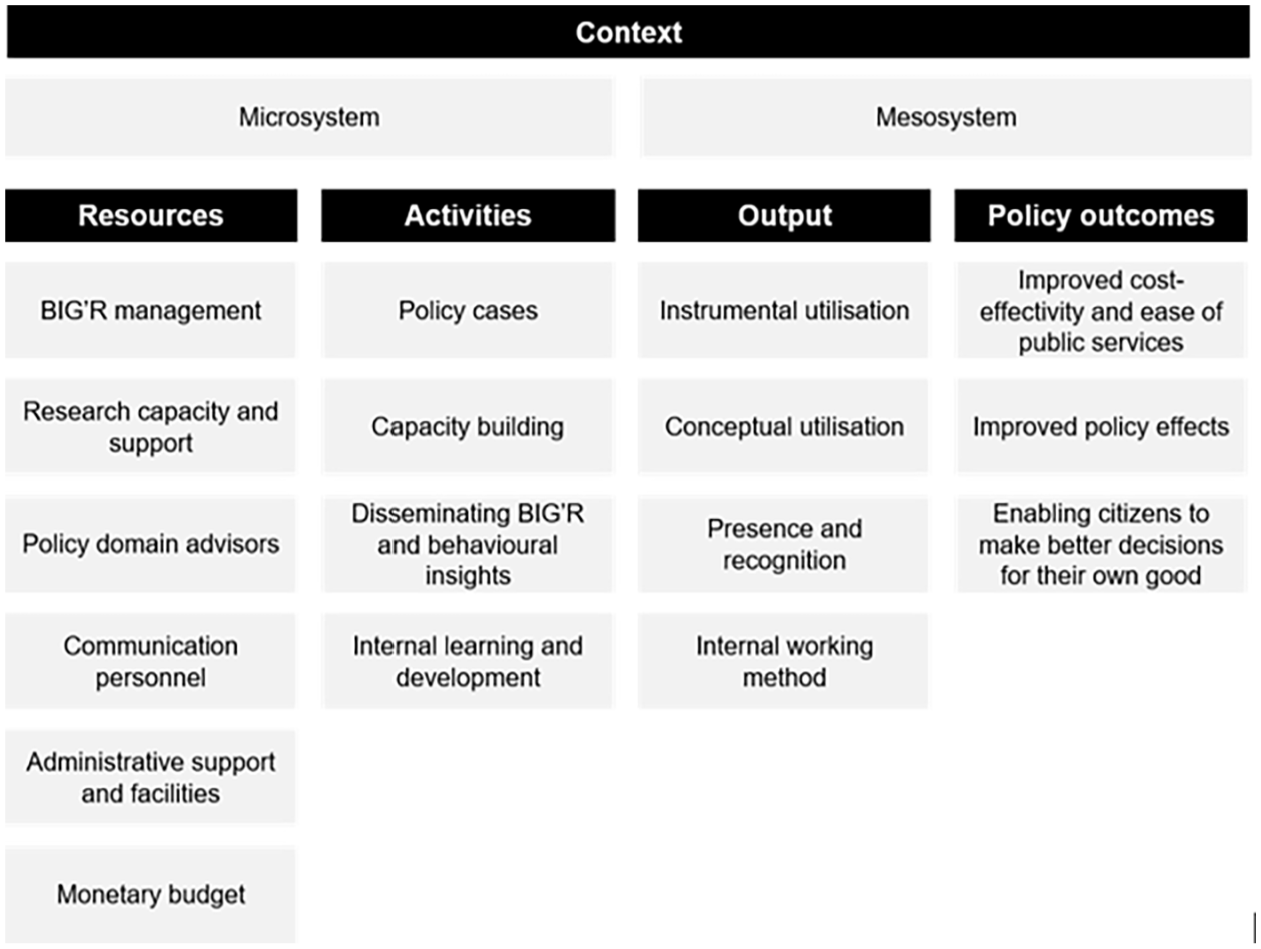
BIG’R logic model.
Step 2: Evaluation Questions
For each block of the logic model, we developed evaluation questions. For resources, these questions investigated quantity and quality (e.g., number and education of BIG’R members), and for activities common aspects of process evaluations (fidelity, dose, reach, recruitment, responsiveness, and context; Durlak & DuPre, 2008; Saunders et al., 2005; Steckler & Linnan, 2002). For the other elements (output, policy outcomes, and context), the evaluation questions were directly inferred from the meaning of the respective blocks. This way, we were confident that the 98 evaluation questions we developed (see Supplemental Material) were sufficient for a comprehensive evaluation.
Step 3: Methods
To answer all evaluation questions, each question was assigned to at least one of seven research methods (see Supplemental Material). Whenever possible, questions were assigned to multiple methods for triangulation. The seven methods were:
(a) A randomized survey of a representative sample of municipality employees (N = 779).
(b) Interviews with municipality employees who had collaborated with BIG’R for a policy case (N = 28).
(c) Surveys of members of policy case teams (N = 87).
(d) Surveys of instructors and attendees of capacity building activities (N = 105).
(e) A survey of all BIG’R members (N = 23).
(f) An analysis of documents (e.g., presentations and policy proposals).
(g) A logbook kept by the first author.
Step 4: Interpretation and Integration
To extrapolate from the highly granulated answers to the different evaluation questions (see Supplemental Material), we conducted three online sessions lasting 6 hours in total where one author (MD) presented the results to all co-authors who then wrote down their conclusions independently to limit the influence of groupthink (e.g., Park, 1990) and production blocking (Stroebe et al., 2010). Subsequently, the conclusions from all authors were discussed one-by-one with all authors during two additional online sessions of in total 4 hours to agree on relevant conclusions and propositions. In the presentation of our findings, we focus on these conclusions and propositions.
Findings
In the following, we describe the findings for each block of the logic model.
Context
Microsystem
The microsystem comprised the immediate physical and social work environment of BIG’R members. The physical environment included flexible workplaces at the office buildings of the municipality in the center of Rotterdam, one with office space exclusively available to BIG’R members. In addition, university employees could use workplaces at the university. During the last year of BIG’R, members mostly worked remotely because of the COVID-19 pandemic. Almost all BIG’R members had split work responsibilities (i.e., working part-time for BIG’R and part-time at other functions), meaning that their social work environment consisted of two or more separate layers.
In general, the group climate within BIG’R was judged positively by BIG’R members. However, some members mentioned being kept out of information loops and reported misunderstandings. This may be due to the differing availabilities and work locations of BIG’R members, reducing opportunities for interaction. BIG’R members also acknowledged a difference in objectives between the university and the municipality (e.g., “doing things right” vs. “doing the right things,” respectively).
Mesosystem
The mesosystem encompassed interrelations between the BIG’R microsystem and other microsystems, namely relations with other work settings. According to BIG’R members, having split work responsibilities could cause competing interests for available working time and priorities. However, some members also mentioned positive spillover effects (e.g., when behavioral insights were used for the other work environment).
Resources
Resources were inputs required for the BIG’R activities. For role descriptions of the BIG’R management, researchers, and policy domain advisors, see Dewies and colleagues (Dewies et al., 2022) and Figure 2.
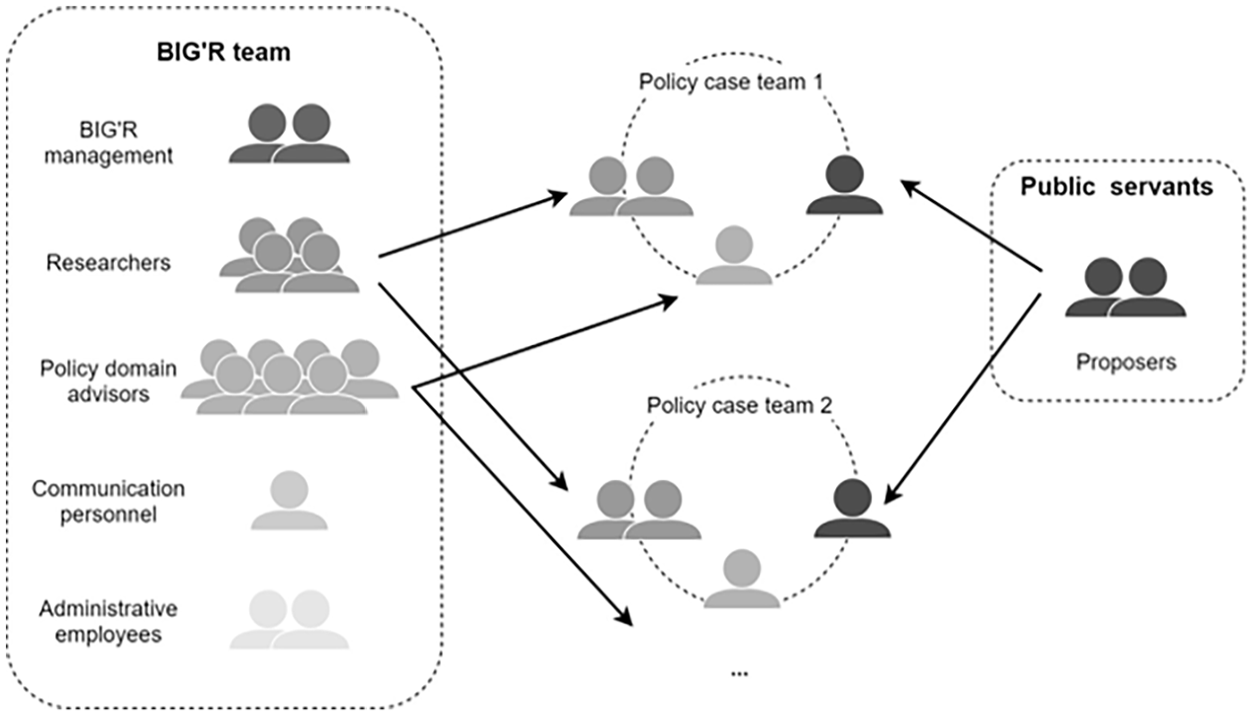
BIG’R team and composition of policy case teams.
BIG’R Management
The BIG’R management consisted of a municipal project manager (0.44 FTE) and an academic head (0.20 FTE). Together, they were responsible for managerial tasks, such as management of people, the budget, team strategy, and output quality. The management itself and other BIG’R members found that management possessed sufficient knowledge and skills to fulfill its role.
Nevertheless, the management faced some challenges. First, management members had to get acquainted with the “other” organization (e.g., the municipal project manager learning the importance of scientific publications). Second, it reported that it invested more time than agreed upon and less than would have been optimal for developing the team and keeping a good overview of ongoing activities. Third, different skills and approaches were required during the start-up phase (i.e., focus on team formation) and later phases of BIG’R (i.e., focus on results). This refers to common group development processes that precede effective group performance (Tuckman & Jensen, 1977). To facilitate this process, another person took over the role of the municipal project manager after approximately two years.
Research Capacity and Support
BIG’R employed researchers from both the municipality (two 0.44 FTEs) and the university (1 FTE and 0.9 FTE) with diverse methodological and disciplinary backgrounds (e.g., psychology, anthropology). In general, researchers found that they possessed sufficient knowledge and skills to fulfil their role. However, they sometimes reported they lacked knowledge about the municipality administration as well as about behavioral (change) theories. According to the researchers, time constraints could limit opportunities for reading (scientific) literature and could lead to preferring “quick fixes” over more careful working modes. Research capacity was perceived as an important bottle neck for policy cases; as a result, it was temporally increased using interns and student assistants.
It was sometimes unclear how the responsibilities between municipality and university researchers should be divided. In addition, there were some disagreements between both types of researchers about methodological choices, potentially implying enhanced scrutiny to combine scientific and municipal requirements. Uncertainties due to lack of clarity and disagreements were discussed and resolved via compromise, agreement, or management decisions.
Domain Advisors
The municipality administration was divided into seven subdivisions concerned with different policy domains (e.g., city development, public safety). Each subdivision seconded one policy domain advisor (PDA) to BIG’R (six 0.4 FTEs and one 0.2 FTE). About two-thirds of the PDAs reported that they invested more time, and about one-third less time than agreed upon. PDAs found that time constraints could limit efforts to disseminate knowledge about BIG’R and often resulted from part-time work duties that PDAs still had in their subdivisions.
Most PDAs held university degrees (in, e.g., criminology, history), and a few had received additional training related to behavioral insights. When compared to other BIG’R roles, more PDAs reported they lacked skills and knowledge to fulfil their role (e.g., lack of knowledge about the working method of BIG’R). Other BIG’R members found that availability and capacity differed between PDAs. A plausible contributing factor was a high turnover rate among PDAs, with a total of 17 different PDAs. Reasons for the high turnover were both unrelated and related to BIG’R (e.g., retirement, difficulty in combining part-time duties).
These results indicate that some PDAs found their role challenging. Adopting an interactional perspective on work experiences (Bakker & Demerouti, 2007), challenges originate from a lack of personal resources for too high task demands. The latter were high for PDAs because their role involved bridging the complex science-policy nexus (e.g., Strassheim, 2020a, 2020b) and, at the same time, learning about behavioral insights. Such bridging and learning required PDAs to understand the needs and relevance of science (i.e., having a positive attitude toward science and a basic understanding of research procedures and requirements) and to approach policy issues from a behavioral perspective (i.e., having a positive attitude toward applying behavioral insights, knowing how to apply behavioral insights). Without related resources (e.g., research training, a behavioral sciences background), this may have been too difficult, especially given the part-time availability. The recruitment of PDAs did not take these resources into account as motivation and interest were the main criteria. These findings motivate our first proposition:
P1: Competencies for conducting or managing research and knowledge about behavioral science are key for policy professionals working within BITs.
This proposition corroborates earlier research (Feitsma & Schillemans, 2019; Jones et al., 2021). Such research also describes policy competencies and public sector experience as important for BIT professionals. PDAs, however, typically had many years of experience in the municipality in different roles, which may explain why this aspect did not feature in the evaluation.
Communication Personnel
One communication advisor was seconded to BIG’R from within the municipality (0.44 FTE). This person strategized and oversaw the group’s external communication. Because of missing responses from communication personnel, most evaluation questions related to this resource cannot be answered. Other BIG’R members reported fluctuation in the available capacity of communication personnel, and on average they found communication personnel less sufficiently available than those in other roles.
Administrative Support and Facilities
Two administrative employees (0.44 FTEs) were responsible for operational aspects (e.g., monitoring the team’s inbox). BIG’R members judged administrative employees to be sufficiently available. However, administrative employees themselves reported to have invested more time than agreed upon. They mostly held university degrees and did not miss any skills or knowledge to fulfil their assigned role according to both these employees and other BIG’R members.
Monetary Budget
The municipality funded BIG’R with an annual budget of 250,000 EUR. The budget was used to fund the university researchers (53% of the budget), personnel (36%), communication (8%), and research and organization (3%). BIG’R received additional indirect funding because many BIG’R members were paid by other units of the municipality. According to BIG’R management, no limitations were attributable to budget constraints.
Activities
Policy Cases
Policy cases involved collaborative efforts of BIG’R researchers and PDAs to address concrete policy challenges of the municipality together with municipality employees. Every municipality employee could propose a policy challenge related to the employee’s work to be addressed together with BIG’R. In the following, we refer to these employees as proposers (Figure 2). Political actors were not allowed as proposers because BIG’R aimed to distance itself from party politics and because political actors were too remote from practice (e.g., they could not implement solutions or share field experience). According to PDAs, it was a challenge when political actors still approached BIG’R with suggestions for policy challenges because BIG’R then needed to find a suitable and motivated employee within the administration with whom to collaborate as a proposer.
Proposals for policy cases were stimulated by PDAs using their individual networks and communication channels (e.g., emailing department heads), and by dissemination activities that informed municipality employees about BIG’R. As a consequence, the number and nature of proposals could depend on individual PDAs (e.g., more proposals with more active PDAs). Most proposers worked on a strategic level (i.e., as project managers and policy advisors) or were communication staff. This may be due to a larger interest from these job functions as well as the set-up of BIG’R (e.g., PDA networks on a strategic level). Multiple reasons motivated proposers to submit a policy case. They often submitted policy challenges that they found relevant and urgent (e.g., related to political priorities), and many proposers wanted to try a new perspective for a wicked problem, hoping that a behavioral approach would lead to more effective solutions. In total, BIG’R received 84 proposals, 30 of which were addressed as a policy case and 25 were completed (Figure 3).
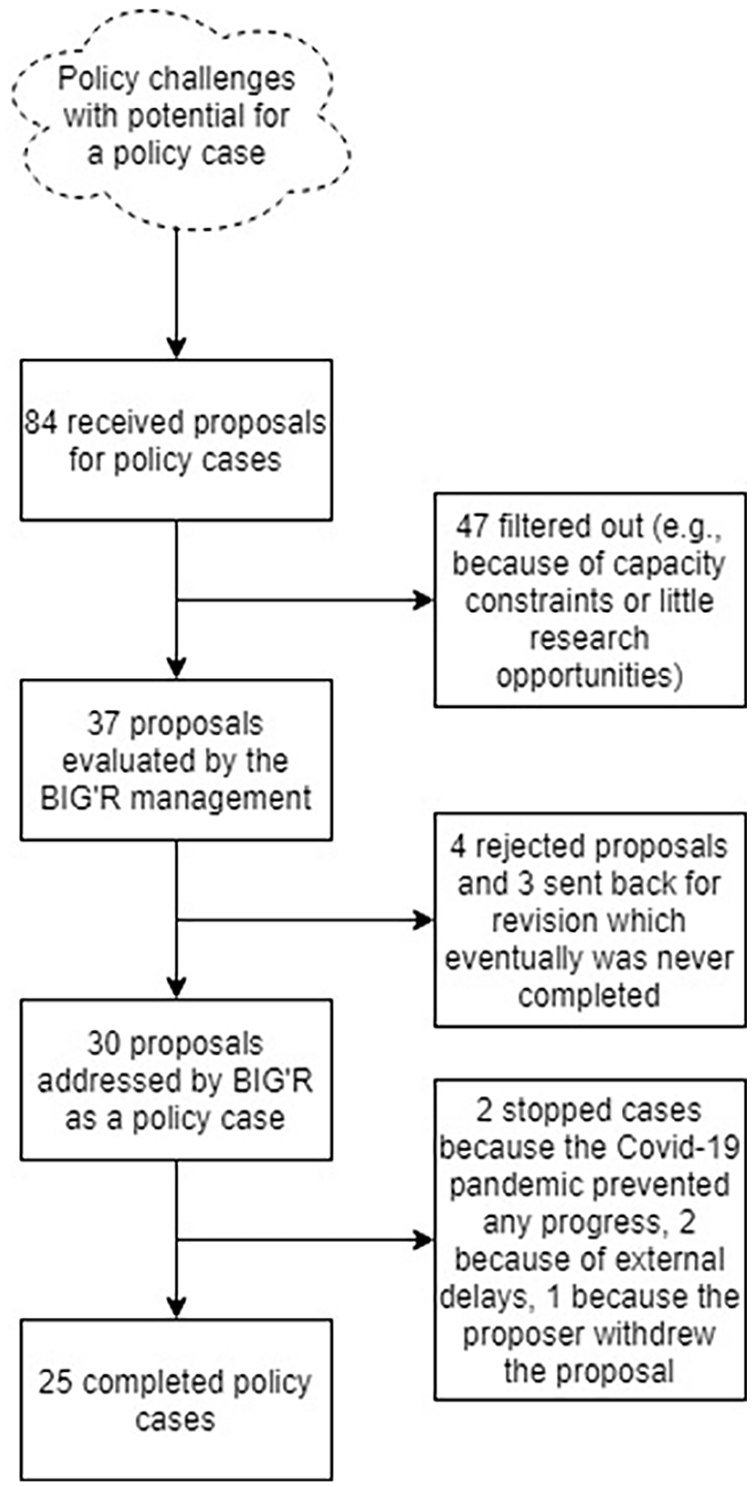
Flow of proposals for policy cases.
All policy cases followed a standard procedure of four phases: approval of the case, exploratory research to understand related behaviors, development of solutions, and efforts to stimulate implementation of policy advice from BIG’R. (For more details see Dewies et al., 2022.). During the first phase, policy case teams tightly defined target behaviors to be able to change and measure them. However, this could narrow the focus of policy cases (e.g., on residents in a specific neighborhood to recycle their food waste rather than Rotterdam residents to live more sustainably). In addition, most proposals started with a narrow focus on small parts of the municipality administration because of the fragmented administration (e.g., letters sent by one department rather than the whole administration).
Following the first phase, policy cases could take different forms to adapt to specific target behaviors and contexts. Policy case teams, for instance, used different forms of research to better understand behaviors, with the most common forms being desk research (93% of all policy cases), interviews (38%) and site observations (31%). This required input from researchers with different perspectives and methodological backgrounds. For 43% of the policy cases, interventions were brainstormed with various stakeholders during a co-design session, and interventions were piloted in the field for 32% of the policy cases.
According to BIG’R members, involvement by proposers could differ between policy cases, with some proposers participating a good deal and others demonstrating an outsourcing mentality (i.e., delegating the policy issue to BIG’R). Similarly, their time investment varied between 0.5 and 20 hours per month, according to the proposers. Some urgent policy cases, however, were completed quickly (e.g., within one month) while others required longer term collaboration (e.g., 2 years). The more involved proposers, for example, attended meetings, shared information and data, co-designed interventions and solutions, introduced BIG’R to stakeholders, and provided research assistance. After the collaboration, about half of the proposers reported that they continued their involvement with behavioral insights (e.g., reading related books).
The social climate within policy case teams was judged very positively for almost all cases. Multiple aspects of the collaboration (e.g., communication) and policy advice were judged positively as well. However, the high turnover of personnel that was already found to influence the availability of PDAs also impaired team composition and communication within policy case teams. In addition, the involvement of external stakeholders was a challenge in some policy cases when there was little engagement and support from those stakeholders, or their actions could not be foreseen. In general, BIG’R could act more like a facilitator or knowledge broker (Feitsma, 2019) when there were many stakeholders, and more like an independent problem-solver or policy-designer when there were only a few. This, and BIG’R’s use of different research methods to investigate different kinds of target behaviors (e.g., on-off behaviors, habits, and group behavior) motivate the following proposition
P2: BITs need to adapt their approach to policy cases (e.g., research methods, own role) to operate under different administrative circumstances and with different target behaviors.
This proposition stands in contrast to the rule-based approaches propagated by other actors in the field that leave little room for adaptation (e.g., Kettle & Persian, 2022; OECD, 2019). These approaches typically encompass step-by-step procedures to develop and trial interventions, often anticipating a limited set of behavioral determinants. Meanwhile, our proposition emphasizes flexibility from BITs concerning procedures, research methods, and roles in interaction with stakeholders. This is in line with advanced versions of behavioral insights (Ewert, 2020).
Capacity Building
Capacity building encompassed 23 introductory trainings and few other activities of BIG’R members (e.g., sharing literature) to increase the knowledge and skills of municipality employees about behavioral insights. Training sessions typically lasted about 1.5 hours and focused on how to brainstorm behavioral solutions for policy issues. Four hundred and four people attended the 16 training sessions, with attendance at individual sessions ranging from 7 to 48.
Most trainings were organized because BIG’R applied or was invited to present at events internal and external to the municipality. Training reached a similar target group as policy cases, since the majority of attendees worked on a strategic level and was motivated by curiosity about and openness to new ideas and tools. In addition, some attendees sought to use behavioral insights for specific applications.
Only four trainings took place after the start of this research and could be evaluated. In general, these sessions were judged positively (e.g., concerning the level of engagement) but the results are limited in their representativeness because they were conducted online during the Covid-19 pandemic. As trainings informed attendees about BIG’R and behavioral insights, trainings also were a dissemination activity.
Disseminating BIG’R and Behavioral Insights
Dissemination includes all efforts to inform municipality employees and others about BIG’R and behavioral insights. For this, BIG’R used its own corporate design and relied on various information channels (e.g., presentations, a website). In total, BIG’R members gave presentations at 89 events (including trainings), reaching 1,806 individuals during the 60 events for which the number of attendees was recorded. The reach for most digital products was low, however (e.g., a maximum of 79 readers in the municipality intranet).
On average, BIG’R members were not very content with dissemination (on average 3.7 on a scale from 1 “totally not content” to 5 “totally content”), mostly because they found communication not being up to date (e.g., an outdated website). The COVID-19 pandemic was considered a contextual factor that boosted dissemination because then behavior change was a necessity to increase compliance with hygiene measures, highlighting the importance of behavioral insights. In contrast, limited available time and communication expertise were contextual factors that hindered dissemination.
Internal Learning and Development
Internal learning encompassed capacity building for BIG’R members individually and as a group. This involved some formal training (e.g., on moderation techniques) but most learning happened on the job when discussing experiences from practice and lessons learned.
Generally, BIG’R members tended to be content with training and development (on average 4.0 on a scale from 1 “totally not content” to 5 “totally content”). Yet, they would have liked more learning and development opportunities, and they found learning and development to be impaired by time constraints and a high turnover of personnel, resulting in little experience being accumulated. This suggests that high turnover not only complicated collaborations within policy case teams but also impaired learning and development. Therefore, we put forward the following proposition:
P3: Team stability and/or good handover to new team members are key to the completion of policy cases, and to improve group learning and development.
High turnover rates have been reported for some other BITs too (Fels, forthcoming; Jones et al., 2021), mostly in the context of internal staff mobility at their parent organizations. The Dutch government welcomed such mobility as a means of adaptation and renewal (Ministerie van Binnenlandse Zaken en Koninkrijksrelaties, 2015). While preventing risks from a high turnover, BITs can align with such a perspective and view inwards mobility as an in-flow of novel and diverse capabilities and outwards mobility as dissemination of knowledge and skills.
Output
Outputs were the anticipated results of BIG’R activities. Borrowing from Pelz (1978), we differentiate between instrumental and conceptual utilization.
Instrumental Utilization
Instrumental utilization refers to the implementation of BIG’R policy advice. At least some aspects of advice were implemented for 15 of the 24 policy cases that were completed and where implementation could be investigated. For the other nine cases there was no implementation. Most implementations involved quick and simple changes (e.g., posters). Whenever BIG’R suggested more systemic or comprehensive solutions, proposers often were not supportive, because they found them too difficult to implement (e.g., getting support from stakeholders in other units of the municipality). Policy cases thus started with a focus on small parts of the administration related to the responsibilities of individual proposers (see Policy Cases section) and implementation was constrained when extending beyond these responsibilities. Therefore, we suggest the following proposition:
P4: To increase their achieved scope of change, BITS require a broad mandate that includes support for implementation.
Implementation challenges are rarely mentioned in the behavioral insights literature, possibly because experimental evidence is viewed as inarguable and the need to repackage and negotiate evidence for policy implementation is often downplayed (Einfeld, 2019). Our findings illustrate, however, that implementation is not a given and was limited by the resources and willingness of proposers who often needed to bridge different units of a fragmented administration for successful implementation. This highlights the importance of the micro level of individual behavior for policy implementation and challenges top-down views of mechanistic policy implementation (Gofen et al., 2021). Moreover, it highlights that BITs can benefit from being assigned a broad mandate from the start that encourages proposers to “think big” and guarantees access to resources needed for implementation (e.g., dedicated innovation teams). Otherwise, the scope of change achieved by BITs may be limited to “technocratic tweaks” (Hansen, 2018) that can easily be applied in different contexts and are well-known in the literature as “low-hanging fruits” (e.g., Sanders et al., 2018).
Case proposers gave multiple explanations for why advice was or was not implemented. The most common explanation for implementation was that proposers had co-produced the advice. Stimulating proposers to take an active role during policy cases can thus improve implementation. Moreover, for proposers, the advice often gained authority because it was co-authored by academic scholars referring to scientific evidence. This implies that BITs employing scholars can distance themselves from experimentation without immediately losing influence. We therefore suggest the following:
P5: Besides direct forms of evidence (e.g., field experiments), BITs can also capitalize on circumstantial forms of evidence (e.g., expert authority) to gain influence.
As mentioned in the introduction, BITs often gain authority by referring to experimentation that is presented as the highest form of evidence (Einfeld, 2019; Feitsma, 2020). If BITs can refer to circumstantial forms of evidence instead, this enables BITs to supply and advocate behavioral insights that cannot be prototyped and changed for experimentation (e.g., policy directions). This way, BITs may more easily achieve change that is not just incremental (e.g., Halpern & Mason, 2015). It moreover enables BITs to better integrate different sources of evidence (e.g., meta-analyses) instead of having to rely on singular experiments.
Interestingly, some proposers adopted a behavioral problem understanding during the policy case trajectory (e.g., some cars are too loud because drivers want to attract attention) that required a behavioral solution (e.g., create better opportunities to attract attention) rather than standard approaches (e.g., policing tuned cars). Such an understanding could facilitate implementation and was plausibly fostered when proposers were more actively involved, providing them with more instances to acquire this understanding. We propose the following:
P6: Explaining the mechanisms underlying behavioral solutions to decision makers leads to better implementation.
Comparing the factors that we found to influence implementation with factors from a comprehensive literature review (Damschroder et al., 2009), we find behavioral problem understanding to be a novel mechanism for implementation. However, behavioral problem understanding can also be an outcome, suggesting that behavioral insights can be applied during all stages of policy making, particularly problem definition (Ewert, 2020; Gopalan & Priog, 2016). In the past, behavioral insights often were viewed as a means to develop interventions rather than an analytical lens.
Common explanations for not implementing advice were a lack of someone coordinating and pushing implementation, lack of urgency of the policy issue, the requirement to involve multiple stakeholders, and time and capacity constraints. In addition, interventions not fitting their targeted context was a frequent reason for not implementing them (e.g., a recommendation to install streets signs was not implemented because legal enforcement of the signs was impossible). This implies that intervention development should anticipate the intervention’s target context and individuals involved in their implementation, since decision-making about implementation is dispersed across strategic and operational levels (Mintzberg & Waters, 1985; Tummers & Bekkers, 2014). Since there was no automatic implementation mechanism, support for implementation from other parts of the municipality administration had to be secured actively by BIG’R members and proposers. We therefore suggest the following:
P7: For better implementation, BITs can benefit from more concentrated implementation efforts and insights from implementation science.
With the behavioral insights literature often assuming that evidence translates into implementation, there has been little uptake of knowledge from implementation science. Implementation science, however, points to factors that increase the likelihood of advice being implemented (e.g., Fixsen et al., 2005), suggesting that BITs can, in fact, plan for implementation (e.g., Dewies et al., 2022).
Conceptual Utilization
Conceptual utilization refers to what proposers learned about integrating behavioral insights into public policy. Generally, lessons learned fell in three broad categories. The largest category encompassed aspects directly related to behavioral insights, namely the direct application of behavioral insights to public policy (e.g., by using social norms), an increased awareness of behavioral aspects and their importance for public policy, and a focus on the target group and its behavior. Proposers with a background unrelated to social or behavioral sciences sometimes described the collaboration as an “eye-opener” for the possibility to program behavior rather than taking behavior as a given. The second category concerned lessons learned about collaboration, namely that expectation management and process management are important. The third category encompassed lessons learned about science, namely that science can be impractical but also useful in providing convincing evidence and a neutral, task-oriented perspective.
P8: Policy professionals can deliberately collaborate with BITs to learn about the importance and usefulness of behavioral insights for public policy.
We believe conceptual utilization covers relevant learning outcomes affecting the attitudes and skills of proposers. We find this aspect to be lacking in the literature, since most research focuses on members of BITs rather than their collaborators (e.g., Ball, 2022). Proposers can thus be viewed as learners rather than clients or informants for intervention development. This perspective can help to view and design collaborations with BITs as a curriculum-based learning experience (Billett, 2011) that enables proposers to apply behavioral insights independently and BITs to engage in applied ways of capacity-building.
Presence and Recognition
Presence and recognition refer to behavioral insights and BIG’R being known and positively appreciated. After about 3.5 years of BIG’R, one third of municipality employees indicated they know the group. In their view, the group had a neutral (e.g., meeting minimum requirements) or no reputation (e.g., not having formed an opinion) since the average score was close to the middle of the scale (3.1 on a scale from 1 “negative” to 5 “positive”), with some variation between policy subdivisions (range 2.50 – 3.88).
Internal Working Method
The internal working method refers to a written document that described a standardized way of collaborating for BIG’R members, designed to instruct policy case teams. The document was regularly reviewed and adjusted. According to BIG’R members, major adjustments included the addition of more concentrated efforts to achieve implementation of policy advice, to hold more role-specific instead of general meetings, and to clarify role responsibilities. Generally, these changes represent a shift toward a more result-oriented working mode. In addition, after recognizing that not every policy case could be combined with scientific research that pilots interventions, BIG’R also approved policy cases in which it advised solutions without prior piloting and adjusted the working method accordingly. BIG’R members tended to be somewhat content with the final working method (on average 3.6 on a scale from 1 “totally not content” to 5 “totally content”). However, some considered it still work in progress, and some recognized a difference between the document and practice (e.g., some members did not always comply with the working method).
Policy Outcomes
Policy outcomes refer to the consequences of policy cases for municipal practices and how they relate to three goals that were defined for BIG’R at its start (Figure 1). For instance, one policy case helped to achieve better cost-effectiveness of municipal services by reducing clean-up costs for garbage (Merkelbach et al., 2021). According to proposers, some but not all policy cases contributed to achieving the goals of BIG’R (Table 1). If they did, they typically contributed to achieving some but not all of the goals at the same time. One obvious reason for policy cases not contributing to reaching the goals was that advice from BIG’R was not implemented.
BIG’R Contributions to Policy Outcomes.
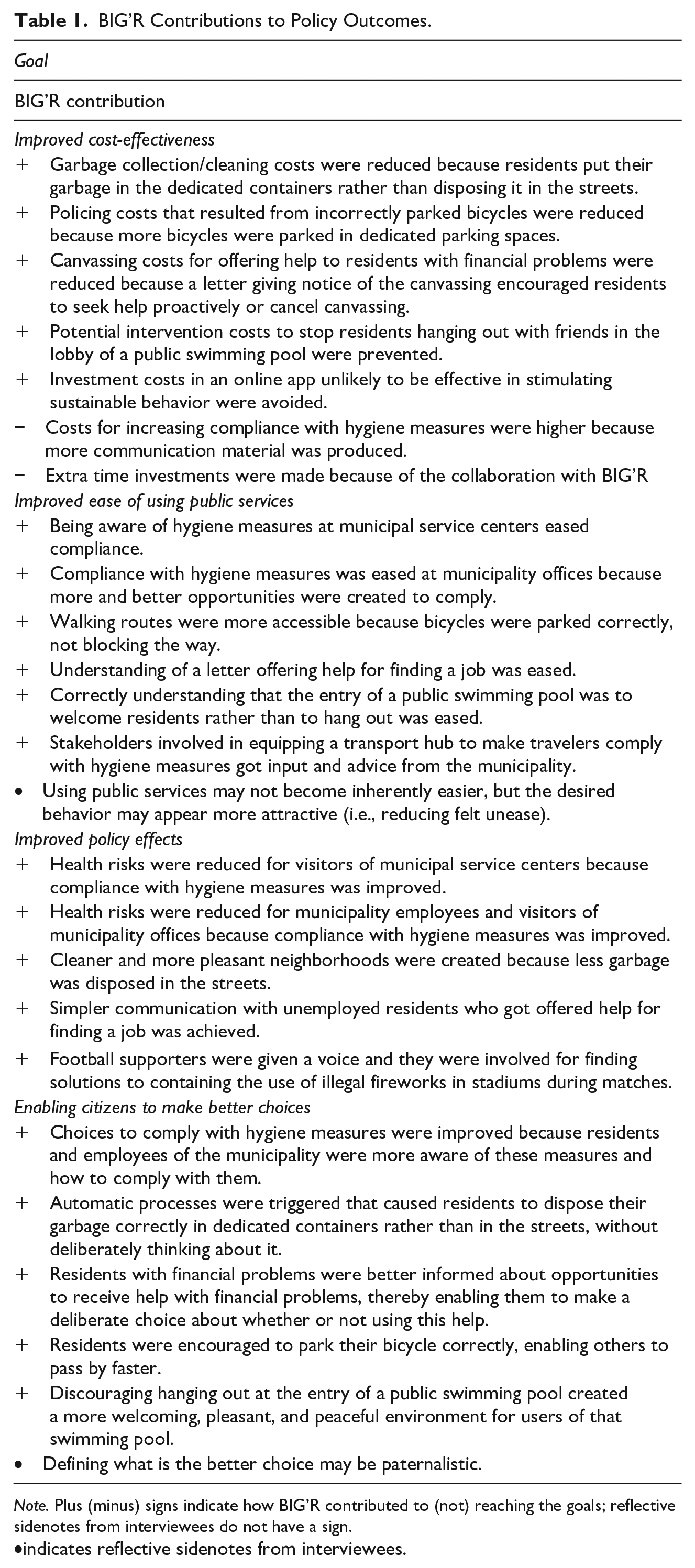
Note. Plus (minus) signs indicate how BIG’R contributed to (not) reaching the goals; reflective sidenotes from interviewees do not have a sign.
•indicates reflective sidenotes from interviewees.
Discussion
We report, to the best of our knowledge, the first comprehensive evaluation of a BIT. BITs rely on expertise from policy and behavioral sciences to integrate behavioral science findings and public policy. We evaluated BIG’R which was the BIT of the municipality of Rotterdam for a period of 4 years. A logic model served to systematically describe BIG’R and allowed us to evaluate all its relevant aspects. Our findings led us to the formulation of eight propositions, to which we will add one more below.
The municipality administration was fragmented horizontally into different subdivisions, and vertically based on multiple levels separating strategic from operational tasks. In theory, BIG’R aimed to integrate behavioral insights across the whole administration but in practice the subdivisions with more active PDAs and strategic levels of the administration were better reached. We believe, however, that operational levels, although not reached well by BIG’R, have much to gain from behavioral insights because the literature reports many related examples (e.g., BIT, 2019). Fragmentation also meant that policy case teams rarely operated in isolation but were dependent on various stakeholders (vertically and horizontally) for the successful completion of case studies and the implementation of solutions. This motivates the final proposition.
P9: Effective boundary workers are important to increase reach and complete policy cases.
BITs are often “policy labs” (McGann et al., 2018) that are separated from other parts of the organization to be able to come up with novel solutions. However, this increases the distance between BITs and the organization, requiring “boundary workers” (e.g., Langley et al., 2019) to bridge this distance. BITs can reflect on this bridging (e.g., where should behavioral insights be integrated, who should be involved in intervention development and how) to link their activities to their goals. Such reflections seem central to the success of BITs but scholarship has rarely addressed.
BIG’R followed an analytic approach and extensively investigated policy issues that it addressed in order to improve understanding of these issues. Extensively investigating issues served to develop contextualised understanding and to incorporate different sources of knowledge and disciplinary inputs (Dewies et al., 2022). This enabled BIG’R to provide advice that did not develop stand-alone concepts but sought to complement existing policy. This differs from BITs that repeatedly exploit a limited set of behavioral automatisms to develop interventions. Yet, despite recent scholarly advice (e.g., Ewert, 2020), BIG’R involved those targeted by interventions (e.g., residents) only in some instances. Therefore, it may be that BIG’R sometimes promoted behaviors wanted by municipality employees and researchers rather than “helping people make the choices they want to make” (White, 2013, p. 101). It is plausible that the involvement of an academic institution and collaborations with BIG’R being free of charge were contributing factors in motivating and enabling enhanced efforts of BIG’R to improve understanding of policy issues before rushing to solutions.
Scholars criticised the fixation of behavioral insights on the micro level of individual behavior while neglecting the meso and macro levels (e.g., Ewert, 2020; Moseley & Thomann, 2021). The logic model that we developed and our findings respond to this criticism by describing what is needed at the meso-level to change behaviors at the micro level. It links individual policy cases and behavioral change attempts with administrative aspects and policy processes, acknowledging that the application of behavioral insights needs to be strategized and embedded in policy practice. This enables others to reflect on BITs more comprehensively and shift attention from interventions developed by BITs to how BITs operate, how they generate what outputs, and how they are embedded in policy practice. Our propositions are first steps investigating contingencies between different aspects of BITs (e.g., how do resources influence activities and outputs of BITs?) to improve BIT practice and its effects.
This evaluation looked at actors within the municipal administration using a behavioral lens, for instance, investigating their motivations and attitudes. In this way, the evaluation contributes to the field of behavioral public administration (Grimmelikhuijsen et al., 2017): First, it corroborates the argument that implementation of policies (e.g., advice from BIG’R) is contingent on the perceptions, understandings, and willingness of administrators (Moseley & Thomann, 2021). Second, the propositions provide advice for the staffing and management of personnel in BITs. Third, the evaluation illustrates how BITs can be leveraged and embedded within organizations to improve the skills and knowledge about behavior in those organizations.
Like all studies, this evaluation has limitations. Specifically, the double role that some of us had as evaluators and BIG’R members might have caused some biases. For instance, positive results may reflect having asked the wrong questions rather than signs of good program implementation and outcomes. However, the non-members of BIG’R involved in this research helped to reduce such bias. Second, as a “deviant case” BIG’R differs from many other BITs, limiting the potential for generalization (Mullin, 2021). BIG’R’s distinctiveness, however, suggests that this evaluation concerns novel aspects of BITs that might be of broader interst or possible application. Finally, data collection for this evaluation started only during the last year of BIG’R, producing some delay between events and data collection. Therefore, accurately recalling original experiences might have been more difficult due to decaying or distorted memories.
Future research can apply and evaluate our propositions in the field. In addition, future research can use our findings to compare the design of different BITs and what changes they bring about. Such research can identify best practices for the set-up and operations of BITs. Finally, future research can use government employees who collaborated with BITs as informants. They were major informants for this research, providing critical comments based on their experience that related, for instance, to ethics and the limits of behavioral insights.
Taken together, BIG’R incorporated most aspects of advanced versions of behavioral insights. Yet, it encountered challenges that received limited scholarly attention so far, particularly insufficient implementation, the need to employ effective boundary workers, and aspects of embedding and strategizing the application of behavioral insights within organizations.
Supplemental Material
sj-docx-1-aas-10.1177_00953997231180302 – Supplemental material for Comprehensive Evaluation of the Behavioral Insights Group Rotterdam
Supplemental material, sj-docx-1-aas-10.1177_00953997231180302 for Comprehensive Evaluation of the Behavioral Insights Group Rotterdam by Malte Dewies, Inge Merkelbach, Jurian Edelenbos, Kirsten I. M. Rohde and Semiha Denktaş in Administration & Society
Supplemental Material
sj-docx-2-aas-10.1177_00953997231180302 – Supplemental material for Comprehensive Evaluation of the Behavioral Insights Group Rotterdam
Supplemental material, sj-docx-2-aas-10.1177_00953997231180302 for Comprehensive Evaluation of the Behavioral Insights Group Rotterdam by Malte Dewies, Inge Merkelbach, Jurian Edelenbos, Kirsten I. M. Rohde and Semiha Denktaş in Administration & Society
Supplemental Material
sj-docx-3-aas-10.1177_00953997231180302 – Supplemental material for Comprehensive Evaluation of the Behavioral Insights Group Rotterdam
Supplemental material, sj-docx-3-aas-10.1177_00953997231180302 for Comprehensive Evaluation of the Behavioral Insights Group Rotterdam by Malte Dewies, Inge Merkelbach, Jurian Edelenbos, Kirsten I. M. Rohde and Semiha Denktaş in Administration & Society
Footnotes
Acknowledgements
We thank the municipality of Rotterdam for this research opportunity. We thank Astrid Schop-Etman for her support in designing the research.
Authors’ Note
Malte Dewies is also affiliated with University of Cambridge, United Kingdom.
Declaration of Conflicting Interests
The author(s) declared no potential conflicts of interest with respect to the research, authorship, and/or publication of this article.
Funding
The author(s) received no financial support for the research, authorship, and/or publication of this article.

Supplemental Material
Supplemental material for this article is available online.
Author Biographies
References
Supplementary Material
Please find the following supplemental material available below.
For Open Access articles published under a Creative Commons License, all supplemental material carries the same license as the article it is associated with.
For non-Open Access articles published, all supplemental material carries a non-exclusive license, and permission requests for re-use of supplemental material or any part of supplemental material shall be sent directly to the copyright owner as specified in the copyright notice associated with the article.
