



Abstract
In this article, we explore the embedding of citizen participation in local government. Our study combines and synthesizes the focal aspects of two theoretical streams—citizen participation and interactive governance—in a novel way to identify, illustrate, and analyze the layers of governance required for citizen participation. The analysis shows how the institutional pervasiveness and holistic nature of citizen participation affects the strategic, executive, and citizen interface layers of governance and their interconnections. The research contributes to the literature on embedding citizen participation in government by emphasizing the need to address citizen participation as a profound question of governance and management.
Introduction
Due to the need for open government and as an attempt to tackle the crisis of representative democracy, promoting citizen participation and linking it to local government decision-making has a strong, societally recognized basis in democratically governed societies (see, e.g., Ansell & Torfing, 2016; Michels & De Graaf, 2010). The public governance literature has paid extensive attention to the aims of citizen participation (e.g., Boedeltje & Cornips, 2004; Klijn, 2011; Sørensen, 2013; Sørensen & Torfing, 2005) and to participatory instruments and processes (e.g., Bryson et al., 2013; Cuthill, 2001; Michels & De Graaf, 2010; Nabatchi & Amsler, 2014).
However, despite the vast literature on citizen participation, it remains unclear how to embed citizen participation into the government of public sector organizations (Osborne & Strokosch, 2022). Embedding citizen participation in government practices is complicated and requires attention to the interconnections between interactive governance and democratic institutions (Edelenbos et al., 2010).
In this article, we explore the embedding of citizen participation in local government. We ask, how can citizen participation be embedded in the government? We answer the research question by first synthesizing the extant literature on citizen participation and interactive governance to identify the layers of governance implicit in citizen participation. Second, we formulate a categorization of these layers and use the synthesis to guide our empirical analysis. In the analysis, we further illustrate the layers and their interconnections by analyzing interview data on the efforts of the City of Helsinki (Finland) to enhance citizen participation. By doing so, this study contributes to the literature on embedding citizen participation in government.
The article consists of five main sections. After the introduction, we theoretically frame our paper by investigating interactive governance and citizen participation from an organizational viewpoint. In the extant literature, we identify three layers of governance that contribute to embedding citizen participation in local government organizations. We use this theoretical conceptualization as an analytical frame for qualitatively analyzing the interview data to isolate the critical points in each of the layers that contribute to embedding citizen participation in local government. In addition, we shed light on the interconnectedness of these layers. Finally, we discuss the need to address citizen participation as a profound question of governance and management in order to embed it into government.
Interactive Governance Enabling Citizen Participation
In this article, we combine two theoretical streams that are crucial for understanding the embedding of citizen participation in government. Drawing from the extant literature on (a) citizen participation research and (b) interactive governance research, we build a synthesis of these research threads to identify the focal layers of governance for embedding citizen participation in government.
In presenting the conceptual background of our paper, we first introduce and define the key concepts and theoretical streams on which we build our study. Subsequently, we summarize these approaches and discuss how they are applied in previous research. Finally, we combine these theoretical streams to form a synthesis and build our framework for analyzing the layers of governance and their interconnections, which shape the embedding of citizen participation in the government.
Previous Research on Citizen Participation and Interactive Governance
The promotion of participatory democracy and citizen participation provides a basis for developing contemporary local governance, as it is hoped that participation will improve the legitimacy, democracy, and effectiveness of the public sector (e.g., Edelenbos & Van Meerkerk, 2016; Jäntti et al., 2018; Michels & Binnema, 2019; Michels & De Graaf, 2010). This development emphasizes interaction between local government organizations and societal stakeholders, that is, citizens, organizations, and businesses. In this respect, building open democratic governance is a focal part of the interaction between different actors (see, e.g., Healey et al., 2017).
Interactive forms of governance strive to respond to the shortcomings of previous public management doctrines that have neglected the role of civil society and positioned citizens as passive recipients or consumers. Interactive governance brings people back into the heart of governance, which challenges institutionally oriented governing perspectives (Bang, 2016). It allows citizens, among other stakeholders, to gain access to policy arenas and influence political decision-making at an early stage (Boedeltje & Cornips, 2004). The aim is to bring different stakeholders together to solve societal problems by facilitating interaction between civil, public, and private actors (Kooiman et al., 2008). Interactive governance is understood in this study as a holistic orientation of local governance that creates conditions for a democratic, pluralistic, multi-stakeholder approach to governance.
One part of the interaction at the local level is citizen participation. By citizen participation, we mean participation in which citizens are allowed to participate in and influence local decision-making and activities so that power is not merely delegated to elected representatives (Nabatchi & Amsler, 2014). Based on previous research, we outline three major parallel developments to identify the roots of mainstreaming citizen participation in public sector organizations. First, citizen participation has come to be about the opening up of government to enhance transparency, democracy, and participation (see, e.g., Meijer et al., 2012). Second, it is seen as a response to the crisis of representative democracy (see, e.g., Boedeltje & Cornips, 2004; Fung, 2015; Michels & Binnema, 2019; Røiseland & Vabo, 2016; Tormey, 2014). And third, collaboration with citizens has become considered vital for solving wicked societal problems (see, e.g., Head & Alford, 2015). All these streams highlight the need for enhancing citizens’ opportunities to participate in and influence local decision-making.
The focus of governance theories and practices has emphasized collaboration and interaction between different actors in governing citizen participation. The promotion of citizen participation in local government organizations is related to many parallel and overlapping approaches and concepts, such as networked governance (Stoker, 2006), interactive governance (Kooiman, 2008; Sørensen, 2013; Torfing et al., 2012), new public governance (Osborne, 2006), collaborative governance (Ansell & Gash, 2008; Emerson et al., 2012; Sørensen & Torfing, 2021), participatory governance (Fung & Wright, 2001; Gaventa, 2004), community engagement (Head, 2007), and public value (Moore, 1995). These approaches stem from different theoretical roots, but they all emphasize the growing role of interaction between governments and citizens.
Rather than seeing interactive forms of governance as a separate paradigm, we propose that interactive governance forms a continuum with network governance. The focus is on the interaction between different actors in society. Interactive governance is a way for public sector organizations to deal with democratic development (Boedeltje & Cornips, 2004; Røiseland & Vabo, 2016). In this article, interactive governance serves as an umbrella concept to describe the shift in local governance and management toward emphasizing interaction, collaboration, and partnership with local actors, particularly citizens.
Interactive governance and citizen participation have been the subject of much research. The public governance literature has paid extensive attention to the aims of citizen participation and interactive governance (e.g., Boedeltje & Cornips, 2004; Edelenbos & Van Meerkerk, 2022; Klijn, 2011; Sørensen, 2013; Sørensen & Torfing, 2005) as well as to the benefits that citizen participation and interactive governance are expected to offer (e.g., Edelenbos & Van Meerkerk, 2016, 2022; Michels & Binnema, 2019; Michels & De Graaf, 2010). In addition, participatory instruments and processes have been studied widely (e.g., Bryson et al., 2013; Cuthill, 2001; Michels & De Graaf, 2010; Nabatchi & Amsler, 2014). Challenges and problems related to citizen participation have been examined for decades, especially in relation to, for example, representation, legitimacy, accountability, leadership, and the costs of citizen participation (e.g., Cupps, 1977; Edelenbos & Van Meerkerk, 2022; Fung, 2015; Ianniello et al., 2019; Irvin & Stansbury, 2004; Sørensen, 2013). Previous researchers also point out that the institutionalization of citizen participation calls for more interactive forms of governance (see, e.g., Edelenbos, 2005; Edelenbos & Van Meerkerk, 2016; Kooiman, 2004; Torfing et al., 2012).
However, less attention has been paid to the embedding of citizen participation in public sector organizations and their government (Osborne & Strokosch, 2022; Yang, 2016). From an organizational viewpoint, citizen participation conflicts with traditional bureaucratic government practices. Thus, embedding citizen participation in government is not an easy task. It cannot be just “added into” existing structures but must be implemented through governance (Grönroos & Voima, 2013). Scholars have also pointed out that embedding citizen participation in government is difficult because of the problematic connections between citizen participation and existing democratic institutions (e.g., Edelenbos, 2005; Edelenbos et al., 2010; Sørensen & Torfing, 2007). Failure to embed citizen participation may have unintended consequences; efforts to strengthen legitimacy by enhancing citizen participation (Michels & De Graaf, 2010) might result in less trust in and diminished legitimacy of the local government (see also Edelenbos et al., 2009; Klijn, 2011).
To mitigate the problems connected to citizen participation, an understanding of the various dimensions of embedding citizen participation in government is needed. For instance, Ianniello et al. (2019) emphasize the need to analyze examples of successes and failures of citizen participation to show both its potential and downfalls. This study aims to respond to the need identified in previous studies for a more detailed analysis and understanding of how citizen participation can be embedded in government.
Layers of Governance Required for Embedding Citizen Participation in Government
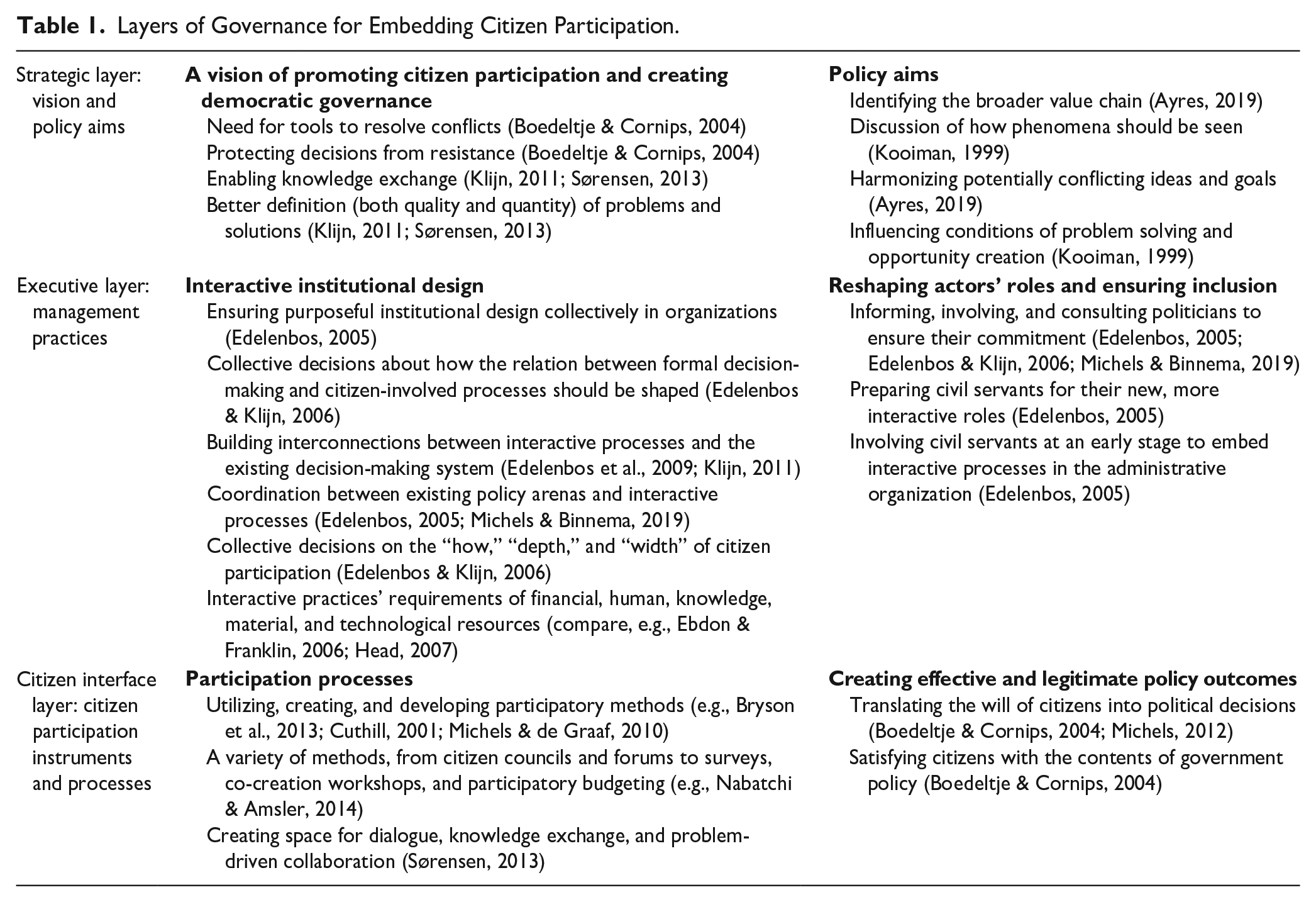
Based on the extant literature and to develop the two theoretical streams concerning citizen participation and interactive governance, we built the following synthesis. From previous research, we have extracted and named three layers of governance that are crucial for embedding citizen participation in public sector organizations: (a) the strategic layer, which concerns vision and policy aims; (b) the executive layer, which is the site of management practices; and (c) the citizen interface layer, which contains participation instruments and processes. These three layers form a background for the analysis of the data of this study (Table 1), and the analysis process will be guided by the categories of the analytical framework that we built based on the extant literature on interactive governance and citizen participation. The next section briefly describes these layers.
Layers of Governance for Embedding Citizen Participation.
The Strategic Layer: Vision and Policy Aims
The layer of governance integrating vision and policy aims addresses ideas about why citizen participation is seen as beneficial from the viewpoint of public organizations. A vision acts as a tool for promoting citizen participation and creating democratic governance, as it reveals the attitudes towards and the political aims and expectations of citizen participation. Public organizations strive to foster interaction and knowledge exchanges between different stakeholders to enable better definitions of problems and solutions (Klijn, 2011; Sørensen, 2013).
Principally, vision is about interpreting the purpose of citizen participation—the meanings, values, benefits, and expectations related to it. Attitudes toward citizen participation define how well citizen participation can be embedded in government.
Second, the policy aims are shaped to enhance citizen participation by guiding and defining the practical efforts and actions of an organization. The framing of the policy aims includes discussions of why and how citizen participation should be enhanced in line with wider societal and global trends and values. A shared understanding of the value, meaning, and potential of citizen participation could offer a foundation for a culture that guides all city actions and their management. At the policy level, it is possible to identify, define, and articulate the values of public organizations and to reconciliate various ambitions, ideas, and conflicting goals (Ayres, 2019). Vision and policy aims influence conditions of problem solving and opportunity creation (Kooiman, 1999, p. 79). In the strategic layer, in terms of vision and policy aims, the values and benefits of citizen participation need to be recognized collectively. Thus, to embed citizen participation in government, the different governance logics require the consolidation of various societal, political, and administrative demands.
The Executive Layer: Management Practices
The executive layer reflects the organizational endeavors needed to embed citizen participation into government. Enhancing citizen participation requires financial, human, knowledge-based, material, and technological resources (see, e.g., Ebdon & Franklin, 2006; Head, 2007). The allocation of these resources brings us back to the issue of management.
Successful interactive processes involve supporting the institutional designs that are built cooperatively within organizations. Links between interactive processes and the existing decision-making system are crucial for preventing institutional detachment (Edelenbos, 2005; Michels & Binnema, 2019), as interactive processes shape the relation between formal municipal decision-making and citizen involvement (Edelenbos & Klijn, 2006).
Establishing a relation between formal decision-making processes and those that integrate citizens requires intentional and collective shaping. Interactive processes imply a certain degree of formalization through process design and management when deciding on “how the ‘depth’ and ‘width’ of citizen participation are organizationally shaped” (Edelenbos & Klijn, 2006, p. 421). Building connections between interactive processes, such as citizen participation, and the existing decision-making system is a focal organizational arrangement (Edelenbos et al., 2009, p. 74; Klijn, 2011, p. 230).
Reshaping actors’ roles and ensuring inclusion requires institutional design (Edelenbos, 2005; Edelenbos & Klijn, 2006, Edelenbos et al., 2009; Klijn, 2011; Michels & Binnema, 2019). In practice, it might be realized by informing, involving, and consulting politicians to ensure their commitment by involving civil servants at early stages of planning interactive processes in public organization and preparing them for their new, possibly more interactive, roles in advance (Edelenbos, 2005, pp. 130–131; Michels & Binnema, 2019).
The Citizen Interface Layer: Citizen Participation Instruments and Processes
The layer of citizen participation instruments and processes reflects the practical aspect of governance. Citizen participation is concretized in the interface between governments and citizens through their interactions and participatory instruments. At the same time, these participation instruments and processes translate the strategic vision and policy aims into practices. Typically, citizen participation is about utilizing, creating, and developing participatory methods to involve citizens in decision-making processes (e.g., Bryson et al., 2013; Cuthill, 2001; Michels & de Graaf, 2010). Citizen participation can be enacted through a wide variety of actions, such as citizen councils, forums, surveys, co-creation workshops, and participatory budgeting (see, e.g., Nabatchi & Amsler, 2014). Citizen participation channels are usually the most visible and concrete parts of citizen participation. However, these channels are only the tip of the iceberg: under it lies a complicated network of citizen participation processes, which spreads to local governance actions and decision-making (Jäntti & Kurkela, 2021). The effectiveness of these instruments depends on a low level of formal institutionalization because of their intended role of offering a space for dialogue, knowledge exchange, and problem-driven collaboration (Sørensen, 2013).
However, these alone do not guarantee the effectiveness of participation. Citizen participation instruments and processes gain their place in public organizations by creating effective and legitimate policy outcomes. This can happen only if the processes succeed in translating the wills of citizens into—otherwise political—decisions and in making the contents of local government policy satisfactory to citizens. Ensuring strong links between participatory instruments and processes and formal decision-making processes is essential for institutionalizing interactive governance in democratic institutions (see also Edelenbos, 2005). In addition, the organizational processes need to be well designed, functional, and attached to formal decision-making processes.
Context, Data, and Methods
This article draws on a theoretically informed case analysis. A case analysis offers a chance to gain in-depth information on complex or vague phenomena in certain contexts (Lee et al., 2010; Miles, 2015). According to Lee et al. (2010, p. 688) a case study aims “to understand so-called practical knowledge—what and how change occurs.” In addition, theoretically informed case analysis has the virtue of harnessing selected theoretical aspects for closer examination and in identifying themes to guide the study (Lee et al., 2010, p. 684). This study aims to illuminate the embedding of citizen participation in local government by analyzing the layers of governance required for citizen participation and their interconnections.
Qualitative content analysis is used to (a) reduce and condense vast and rich data, (b) focus on selected aspects, and (c) process empirical data in a systematic way (Schreier, 2014; Tavory & Timmermans, 2014). We conducted abductive qualitative content analysis by categorizing the data into a predefined theoretically constructed framework, focusing on the three layers of governance for embedding citizen participation (Table 1). The abductive analysis enabled moving back and forth between empirical observations and the conceptual framework (see also Tavory & Timmermans, 2014).
The content analysis focused on identifying and illustrating the layers of governance that contribute to promoting citizen participation and embedding it in the government. The aim was to recognize the expressions and interpretations of the aims, practices, and meanings of citizen participation in a city organization.
The City of Helsinki as a Context of Citizen Participation
In Finland, local governments have played an indispensable role in promoting civic participation, and this role has been reinforced especially over the past decade. Many Finnish local governments have introduced new democratic innovations, such as participatory budgeting and citizen panels, and renewed their citizen participation models and programs. Local governments are obligated to arrange opportunities for citizen participation under the Local Government Act (410/2015), and local councils are responsible for enabling citizen participation. Nevertheless, due to their high autonomy, Finnish local governments vary considerably regarding practical attempts to arrange citizen participation.
In this study, we use the City of Helsinki and its citizen participation efforts as an empirical case of embedding citizen participation in government. Helsinki has a long history of citizen participation that draws not only from the institutional efforts to enhance citizen participation overseen by the city organization but also from a legacy of citizens’ self-organizing activities (such as NGOs and neighborhood associations) (Kuokkanen & Palonen, 2018). In the last decade, the city organization has enhanced its efforts to promote and improve citizen participation by, for example, renewing its citizen participation model and recruiting more staff to increase participation (Jäntti et al., 2021). Citizen participation in Helsinki has been promoted and studied in, among other areas, the urban development context (e.g., Kuokkanen & Palonen, 2018; Niitamo, 2021), management system reform (Jäntti et al., 2021), and participatory processes, such as participatory budgeting (Ertiö et al., 2019).
Helsinki is an interesting case for determining how to embed citizen participation in government because the aim of promoting citizen participation lies at the core of its management system reform. This reform placed citizen participation in the wider context of management. Helsinki has been active in national and international city networks in finding ways to promote citizen participation. As the capital of Finland, moreover, Helsinki is a leading city, setting an example for other Finnish cities. As part of its management system reform in 2017, the City of Helsinki introduced a new participation and interaction model (City of Helsinki, 2021). The purpose of the new participation model was to invite residents and stakeholders to take part in developing neighborhoods and public services. The core principles of the citizen participation model are: (a) the utilization of individual and community knowledge and expertise, (b) the enablement of citizen-initiated activities, and (c) the creation of equal opportunities for participation (City of Helsinki, 2020).
From a management perspective, the principles of participation are included in the administrative regulations of the City and thus guide the actions of the entire organization. The participation and interaction model concerns the City’s organization and units. In practice, the model requires each organizational division to plan its citizen participation efforts, which are monitored and reported on regularly. The implementation of the model is followed at the strategic level. Helsinki has also emphasized the importance of citizen participation in its strategy, stating that the City will “strengthen its position as an international pioneer of participation and openness” (City of Helsinki, 2018, p. 15).
Interview Data
The data were collected in 2019 to 2020 as part of academic evaluation research on the City of Helsinki’s management system reform. The data consisted of 23 individual interviews with leading politicians (mayor, vice mayors, and city board members) and civil servants (executive directors and citizen participation experts) of the City of Helsinki. The interviewees were selected based on their central positions in the city organization and their expertise in citizen participation. They were asked for their consent to record the interviews to be transcribed later. In addition, the interviewees were informed that the data would be handled and the results reported confidentially in such a way that anonymity would be preserved and no individual interviewee could be identified. Thus, the information about the interviewees provided in the quotes cannot be more detailed.
The interviews consisted of multiple themes related to management system reform. Citizen participation was one of the themes that was systematically discussed with the interviewees. The durations of the interviews varied between approximately 50 and 100 min. The recorded interview data were transcribed into transcripts by professional experienced transcribers (474 pages in total). While a larger sample size possibly would have brought up some more details, the data began to saturate during the analysis process and seemed to be well suited to our purposes. The interview data provide a rich source of material for analyzing the different layers of governance necessary for citizen participation.
Analysis Process
The analysis process began with inputting the transcripts into Atlas.ti-software, in several phases (Figure 1). First, the data were carefully read. We then distinguished excerpts containing the expressions that the informants used to talk about citizen participation. In the first analytical phase, the excerpts were searched for regularity and reoccurrences, which led into the initial coding of data. In the second phase, the excerpts were categorized into three layers presented in the analytical framework: (1) strategic layer: vision and policy aims; (2) executive layer: management practices; and (3) citizen interface layer: citizen participation instruments and processes. The contents within the categories were grouped into codes that followed the initial coding. Some recoding was performed, for example, to avoid overlapping of multiple codes. Finally, the interconnections of the layers were reflected to identify linkages between the three layers and to ensure their coherence. The next presents the results of the analysis with excerpts from the interviews.
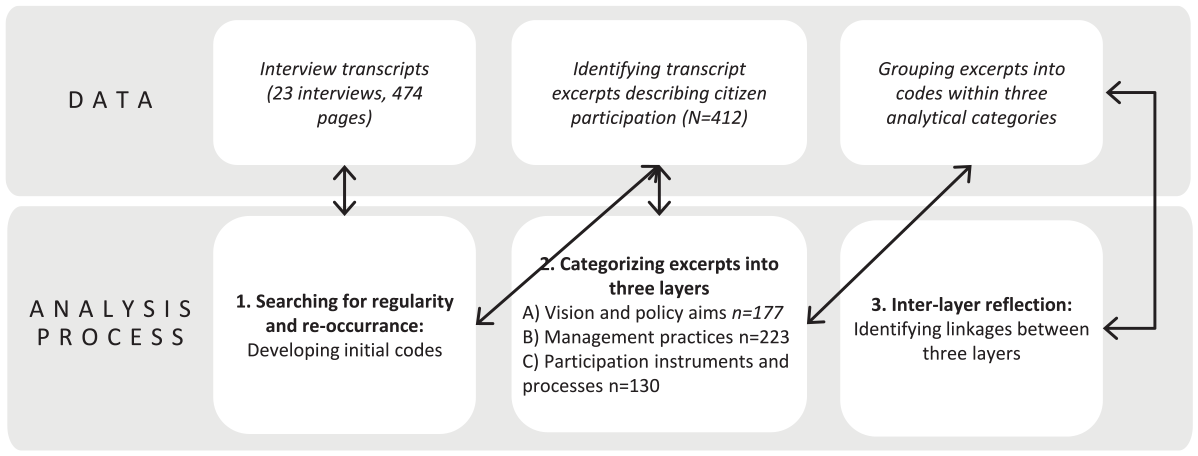
Analysis process.
Results: The Interconnected Layers of Governance Required for Embedding Citizen Participation in Government
Our analysis illustrates the three layers of governance necessary for integrating citizen participation and identifies their key elements and challenges. First, we address the strategic layer of embedding citizen participation by illustrating how the conflicting values and interpretations of citizen participation complicate its embedding in government. Second, the executive layer is scrutinized by describing the importance of management and resources for the embedding. Third, we look at the citizen interface layer by focusing on the connectedness of citizen participation instruments and processes with management and decision-making.
Finally, the analysis explores the interconnectedness of these layers. By doing so, the analysis creates a new understanding of the systemic nature of the embedding of citizen participation in government by emphasizing the need for a holistic approach.
The Strategic Layer: Conflicting Values and Interpretations of Citizen Participation
The promotion of citizen participation is one of the core ideas in the management system reform of the City of Helsinki and is emphasized in the city strategy. However, at the same time, there are different interpretations concerning the aims and practices of citizen participation. For instance, each organizational division has its own traditions and characteristics that influence how citizen participation and engagement are perceived. There are also differences in attitudes and values at the individual level concerning who should take responsibility for citizen participation. While it is generally easy to endorse the ideals of citizen participation and to consider democracy and citizen involvement valuable as such, there are simultaneous yet opposed opinions on how to promote citizen participation.
The forms of citizen participation in participatory democracy can be seen as supplements to representative democracy. In principle, citizen participation efforts are part of organizational actions and decision-making processes. However, participatory democracy challenges the formal decision-making system, which has traditionally been based on the ideals of representative democracy. This challenges the whole management and decision-making system and the ways the city has traditionally functioned. Thus, this participation is subject to different interpretations and valuations in administrative organization.
The data show that citizen participation has an instrumental value that benefits the City of Helsinki’s organization as a whole by producing knowledge and understanding to improve the quality of decisions and actions. Based on our analysis, the aims of citizen participation are connected to establishing a wider knowledge base, which is needed for effective service provision and democratic decision-making. This requires a better understanding of citizens’ needs and of the issues that they face in their daily lives. The experiential knowledge of citizens supplements the expert knowledge of civil servants and politicians that is expected to improve the quality and effectiveness of public services.
I think that the value of citizen participation lies precisely in this idea of getting to better understand the lives of the people. (Civil servant)
The political will to enhance citizen participation also appears in the city’s strategic guidelines. The strategic significance of citizen participation may thus be widely acknowledged and rhetorically appreciated, but the benefits of participation are not as widely shared. Therefore, there is a risk that citizen participation will remain an artificial, rhetorical aim and not a key principle that genuinely guides organizational actions. In addition, it collides with other policy aims and organizational logics, thus making it more difficult to actually implement.
Now that this [citizen participation] is a new megatrend and the “new black”, this needs to be mentioned. But it’s a totally different thing to genuinely promote it inside a city division. (Civil servant)
The Executive Layer: Disregarded Management Practices and Scarce Resources for Citizen Participation
The ideal of citizen participation may easily be included in strategic guidelines, but its implementation and institutionalization are more complicated. The aim of improving citizen participation may remain disconnected from organizational actions and management and thus become mere rhetoric or vague principles. Although support at the political level can facilitate the change, the embedding of citizen participation in organizational activities requires that citizen participation become a guiding principle in management and be taken into account by executive management.
We enacted a management system reform in which we made a sectoral model and a mayoral model and renewed the participation model. . .This participation model, which would have led to the participation of local citizens having similar impact on the affairs of the city as these other parts of the reform, we are nowhere near it. (Civil servant)
Our analysis showed how disconnected citizen participation is from both the management and the everyday work of civil servants. If citizen participation is not well established in decision-making and management processes and practices, civil servants may perceive it as an artificial goal. This can lead to scattered efforts to enhance citizen participation.
It’s so complex and such a new thing that it feels like it’s easily forgotten. . .Last time, we received a lot of feedback on how the involvement with the urban strategy process was pretty artificial. At some point, we realized that we should involve citizens, too. Without this observation, it wouldn’t have been part of the plan. . .So, it’s not rooted in the way we think. (Elected politician)
To embed citizen participation as an integral part of organizational activities and everyday work, it must be operatively managed. This requires a shift in policy and course of action. The adoption of new attitudes and novel ways of thinking takes time to become rooted, and so the role of management becomes substantial. The strategic importance and value of citizen participation are indicated through management activities.
It’s an organizational culture issue, and these are the kinds of things that top management needs to regularly push, remind, and look after. (Elected politician)
If citizen participation appears as a cross-cutting orientation in city management, it should also be converted into an established part of practices. Our analysis showed that the construction of shared values is still in progress. This may explain why citizen participation remains detached from management practices and decision-making as well as from the basic work of civil servants.
Enhancing citizen participation is easily perceived as someone else’s responsibility and thus not an integral part of anyone’s particular work. The responsibility for promoting citizen participation is directly allocated to inclusion experts, although the goal is for the entire organization to operate according to the values of citizen participation.
Still, it’s somehow seen as the responsibility of interaction experts to handle citizen participation instead of the responsibility of each employee to work in an interactive way. (Civil servant)
The value and benefits of enhancing citizen participation are connected to how the responsibility for citizen participation is shared in an organization. If the promotion of citizen participation is merely outsourced to citizen participation experts, it will remain fragmentary and disconnected. Therefore, to become institutionally embedded in the government, citizen participation should be a collective responsibility in the organization and actively managed.
Management plays a crucial role in advocating citizen participation like any other management principle that guides organizational activities. Managers eventually determine how resources are allocated and what issues are prioritized.
You can see that they [citizen participation efforts] haven’t been taken up all the way down. But it’s a question of management. You know what your own supervisor brings up and tells you is an important matter, and that’s that. . .and then something has to be done. (Civil servant)
Responsibilities and the division of duties involve paying attention to the dependence on individual employees, such as inclusion experts. If the responsibility is not shared, enhancing citizen participation will depend on how each organizational member interprets their importance. Relying on individuals increases the risk that, instead of becoming systematic, the promotion of citizen participation will remain random.
The resources required for citizen participation, such as working time or specific skills or competencies, are not always sufficiently planned and allocated. Implementing citizen participation methods and instruments causes extra work and increases workloads. If the process is laborious and the resources for enhancing citizen participation are insufficient, there is a risk that civil servants will become even more skeptical about promoting it. The frustration of civil servants may lead to reluctance to enhance citizen participation.
Participatory budgeting was not in anyone’s job description. So it became a huge task, and there was nothing about who was going to do this or any additional resources or anything. (Civil servant)
Implementing citizen participation, from strategy-level goals to practical actions, means a shift in the way of thinking, working, and making decisions, requiring commitment at every organizational level. The top management, but also middle managers and leaders play a key role, as they can, through their position, make participation part of the work of civil servants.
I think that the most important thing is to have committed middle managers, because that’s how it trickles down to employees and then finally—possibly and hopefully—also to service users and citizens. (Civil servant)
The Citizen Interface Layer: Poorly Connected Citizen Participation Instruments and Processes
Citizen participation is embodied in the interface between government and citizens—in the tools, practices, and processes that have been chosen to promote citizen participation. Achieving goals requires different kinds of participation channels. However, single-citizen participation methods alone do not guarantee the effectiveness of participation if these methods are not well designed and connected to formal decision-making processes.
To raise awareness of opportunities and to increase citizens’ interest in public affairs, the City of Helsinki has developed various citizen participation methods to provide opportunities to influence the city’s operations and decision-making. For example, participatory budgeting has become one of the highlights of the new model.
The use of information and effective participatory processes may affect citizens’ perceptions of the city’s organization and the legitimacy of its operations. Although citizens are offered a wide range of opportunities to participate, it remains unclear how the information gained from them is utilized and considered in decision-making, even though this is a crucial aspect of embedding citizen participation in local government.
In quite a few cases, it is also completely quasi-participation. People are given the opportunity to say something, and then they say what they say, and then we move on. And even if it might affect the ideas of one of the civil servants. . .then, in the next stages of the process, at the head of the department’s table or in the management team or the city council, it may change. What is the impact? (Elected politician)
Single participation channels are the most visible and concrete parts of the City of Helsinki’s participation model. At its core is a complex network of participatory processes that partly overlap and are linked to the activities and decision-making of the city. The development of the city’s operations and public services still has a long way to go before it utilizes the experiential knowledge of residents that is gained through participation channels.
Does the city take advantage of information that is being gathered around it all the time?. . .If we slapped all that [information] together, we wouldn’t have to do any damn polls about anything, because we would already know what they [citizens] want. . .it has great unexploited potential. (Civil servant)
Interconnectedness of the Layers of Governance Involved in Citizen Participation
When analyzing our interview data to gain an understanding of the embedding of citizen participation in government, we found that the main problem in Helsinki is that citizen participation remains separate from decision-making and management. The reason for this disconnect is not to be found in only one aspect but instead is due to the lack of a systemic approach to citizen participation. Although there is a generally positive attitude toward participation in the City, there are problems in practice. The problems concern the lack of commitment among top management towards citizen participation and the inadequate resourcing of citizen participation as well as the struggles in reconciling expert and lay knowledge. Together, these lead to detachment of participation from decision-making.
To conclude the analysis of the results, we emphasize that all three layers of governance involved in citizen participation contribute to embedding it in the activities and decision-making of the City’s organization.
First, in the strategic layer, vision and policy aims reveal conflicting values and interpretations of citizen participation. The attitudes toward and expectations of citizen participation guide and define practical efforts and actions to enhance that participation.
Second, for citizen participation to become part of everyday work at all organizational levels, attention needs to be paid to the executive layer. The results reinforce the importance of management in, for example, sharing responsibilities, allocating resources, and dividing work to enhance participation.
Third, the disconnectedness of citizen participation instruments and processes from management and decision-making processes emerges on the citizen interface layer; citizens’ experiential knowledge and information gained through participation channels remain underutilized in decision-making. Embedding citizen participation in local government thus requires paying more attention to governing and managing the connections between the city’s organization and citizens.
Finally, focusing on just one layer of governance of citizen participation is not enough; action is needed to address all three layers and their interconnectedness. This can be seen in the analysis that emphasizes the difficulties in translating the underlying aims and values into practical action. Even though the aims of and values underlying citizen participation are expressed on the strategic level, they do not concretize into action without management practices and well-functioning, impactful participation instruments and processes.
The political will has been very strong, so we have wanted to create the political leadership for citizen participation. And now it cannot be put into practice. If we really want to make it work, there should be a structure for how it is both managed and implemented. And the roles should be clear. . . and structures, opportunities, and resources to implement it. (Elected politician)
Discussion
In this analysis, we focused on identifying and illustrating the layers of governance involved in citizen participation to study the embedding of citizen participation in government. Our findings reinforce the need to pay attention to the strategic, executive, and citizen interface layers of governance and their interconnections in embedding citizen participation in government. Problems in the interconnections between the layers become visible in the (1) contradictions between strategic aims and practices, (2) dissociation from the everyday work of civil servants, and (3) poor links between processes of participatory democracy and of formal decision-making. If the implications of these failures in the strategic, executive, and citizen interface layers and their interconnections are not resolved together in the organization, citizen participation remains disconnected from formal governance and decision-making processes, making it difficult to embed citizen participation in government.
Based on our analysis, we emphasize the holistic nature of citizen participation as it affects different layers of governance. Our study highlights how citizen participation is institutionally pervasive, disclosing the values, beliefs, and logics that guide local governance. The study underlines the need for seeing citizen participation as a phenomenon that largely affects local government instead of narrowly scrutinizing it in terms of channels and methods of participation.
The institutional design needed to embed citizen participation in government requires a collective understanding of and direction for issues such as how citizen participation is managed and connected to formal decision-making processes. Moreover, embedding means defining the values and main benefits of citizen participation for an organization as well as responsibilities for and methods of promoting citizen participation in the organization. To tackle the problem of building links between citizen participation and existing power structures (Edelenbos, 2005), we argue that citizen participation is indeed an issue of governance and management. If it is not treated as a management issue, it will remain dissociated from formal management and decision-making processes, leaving the tensions between representative and participatory democracy systems unresolved.
Our results strengthen prior research findings to the effect that, even though citizen participation has been recognized as a central, guiding idea of legitimate public sector organizations (e.g., Edelenbos & Van Meerkerk, 2016; Michels & De Graaf, 2010), practically implementing it is difficult (see, e.g., Huxham, 2003). Our results show that, even though the City of Helsinki’s management system reform put citizen participation at the core of the management system, thereby expressing the importance of citizen participation in the strategic layer, it has not been thoroughly managed. Thus, the vision and aims remain disconnected from management practices and citizen participation instruments. This can also be seen as a disconnect between participatory processes and the basic, everyday work of civil servants.
Our study strengthens the findings of previous research on how citizen participation challenges existing local governance systems and practices, in many ways bringing forth competing institutional logics and affecting local governance and its culture, policies, and procedures (e.g., Bang, 2016; Bertels & Lawrence, 2016; Edelenbos & Klijn, 2006; Edelenbos & Van Meerkerk, 2011; Michels & Binnema, 2019; Torfing et al., 2019), and creates tensions between representative and participatory systems (Geurtz & Van de Wijdeven, 2010; Sørensen, 2020). Consequently, our study also strengthens previous research findings on the need to build links between existing power structures and participatory democracy initiatives (Edelenbos, 2005).
Our study broadens previous research by identifying and illustrating the different layers of governance and their interconnections. In addition, the study broadens understanding of the importance of management in connecting strategic aims with practices and stresses that, to embed citizen participation in government, participatory processes need to be interwoven into management and decision-making processes. If the links between participatory instruments and processes, management practices, and formal decision-making processes are missing, citizen participation will remain an isolated exercise with unexploited potential. Moreover, if management does not consider citizen participation important or does not take the leading role in pursuing its institutional embedding in government, it is likely that citizen participation will remain dissociated from formal local governance decision-making. This, in turn, may lead to a decline in trust in local authorities and deterioration of the legitimacy of local government. Thus, our study also broadens previous research findings highlighting the essential role that management has in building interconnections and institutional links among interactive, participatory processes, and the government and its decision-making.
In addition, our study broadens previous research by emphasizing that the role of management is central at all levels of organization to promote citizen participation and embed participatory activities into representative decision-making processes. Ultimately, management defines and decides the organization’s priorities, where resources are channeled, and how they are allocated. Thus, the resource aspect also highlights the importance of management for citizen participation. The role of management is vital as well when discussing, addressing, and building a shared understanding of the value of citizen participation and in making citizen participation compatible with the competing institutional logics of the organization. Management ultimately has the power and the opportunity to consider citizen participation a governance issue that pervasively affects government.
Finally, to become more open and interactive, we emphasize that public organizations need to embed citizen participation in governments. Enhancing citizen participation and embedding it in governments forces governments to adapt more interactive forms of governance.
Conclusions
In this article, we have examined the embedding of citizen participation in local government. From an organizational viewpoint, we have scrutinized citizen participation efforts as a form of interactive governance. Building on the extant literature and on our empirical analysis, we have identified and illustrated three layers of governance—the strategic, executive, and citizen interface layers—that contribute to embedding citizen participation in organizational activities, management, and decision-making. In our analysis, we have illustrated the three layers of governance involving citizen participation and identified their key elements and challenges. We have also pointed out the importance of the interconnectedness of these layers in embedding citizen participation in government.
We argue that for citizen participation to become embedded in local governments, attention needs to be paid to vision and policy aims in the strategic layer, management practices in the executive layer, and the effectiveness of the instruments and processes of citizen participation in the citizen interface layer of governance. Most importantly, attention needs to be paid to all of the layers and to the interconnections of these layers: vision and policy aims only become concrete through citizen participation instruments and processes and management practices. To holistically address citizen participation, its governance layers and their interconnectedness, we argue that citizen participation should be treated as a governance and management issue.
Our study has contributed to the development of the theory of embedding citizen participation in government by combining and synthesizing the focal aspects of two theoretical streams—citizen participation and interactive governance—in a novel way to identify and illustrate the layers of governance involved in citizen participation. Moreover, our study has shed light on the interconnections of these governance layers.
Finally, the study has produced new knowledge concerning the embedding of citizen participation in government. We have emphasized that addressing citizen participation as an essential tool for democratic local government needs to be considered a governance and management issue that profoundly affects the local government system.
The research contributes to the literature on embedding citizen participation in government by demonstrating its institutional pervasiveness and holistic nature, making it a management and governance issue. Further research is needed to explore the management of citizen participation and its dynamics. Fully understanding how citizen participation can be embedded in government requires further development of existing theories through the integration of insights from governance, public management, and citizen participation studies.
Footnotes
Authors’ Note
Kaisa Kurkela is now affiliated to University of Vaasa, Finland
Declaration of Conflicting Interests
The author(s) declared no potential conflicts of interest with respect to the research, authorship, and/or publication of this article.
Funding
The author(s) received no financial support for the research, authorship, and/or publication of this article.
