



Abstract
This article analyses the dynamics of local platform governance with special regard to the roles and relations of city governments, citizens, and local businesses. We approach the subject through five Finnish platforms in which city governments are actively involved. This multiple case study shows that city governments tend to adopt a facilitative and enabling role on the platforms. They seek to create value by utilizing skills, knowledge, and resources of local communities in different kinds of co-creation processes. Local platform governance brings added value to innovation and urban vitality by utilizing multiple roles of citizens, businesses, and other local stakeholders.
Introduction
Finding innovative solutions to complex urban problems requires as a rule interdisciplinary and intersectoral cooperation, involving not only public sector actors but also companies and local civil society. During the last decade, platforms emerged as a novel organizational solution for utilizing citizens’ ideas, supporting participation, increasing co-creation, and democratizing innovation. Platform refers to a socio-technical space that provides context and architecture for bringing different groups and organizations together to identify shared interests, find new opportunities for cooperation, and to create and exchange value in new ways (Hodson et al., 2021, p. 3; Sotarauta & Suvinen, 2019). Beside actors, platforms bring together various kinds of resources and provide tools for processing and organizing them (Thomas et al., 2014, p. 202). As such, platforms operate as focal points for ecosystems of constantly evolving constellations of actors (Thomas et al., 2014), which increase their ability to adopt to their environments (Ciborra, 1996).
Platforms gained prominence first in technology development and business and started to expand to new application areas in the 1990s and the following decade. At that time platforms emerged also in public governance (Ansell & Gash, 2018, p. 16). Platforms have become particularly popular in local governance, especially in promoting innovation (Borghys et al., 2020; Sotarauta & Suvinen, 2019, p. 1753). There is, however, limited research on the use and impact of platforms in public governance (Ansell & Gash, 2018; Yu et al., 2019). Some researchers have discussed the role of public sector actors in platform governance (Bollier, 2016; Brown et al., 2017; Desouza & Bhagwatwar, 2014; Falco & Kleinhans, 2018; Haveri & Anttiroiko, 2021; Janowski et al., 2018; Janssen & Estevez, 2013; Millard, 2018; O’Reilly, 2011). However, most of the research has focused on certain types of platforms, such as open data or participatory platforms, whereas multiple case studies investigating how different kinds of urban platforms are affecting the roles and relations of city governments and local communities at large are missing from the literature.
Our aim in this article is to shed light on the dynamics of local platform governance as the utilization of various types of platforms shape the roles and relations of city governments, citizens, and other community actors, such as local businesses. To be more precise, we will address the following two research questions: (1) What kind of roles the public, private, and non-profit actors play in local platforms sponsored by city governments? (2) How do different types of platforms shape the relations between actors in urban governance? The research questions are approached through five Finnish cases of local platform governance in which city governments are actively involved.
The Changing Relationship Between City Government and Community Actors
Evolving Governance Paradigms: From Hierarchies to Networks and Co-governance
The development of public governance in the Western world is usually depicted as having three stages: hierarchy-based Traditional Public Administration; New Public Management (NPM), which utilizes markets as its key coordination mechanism; and New Public Governance (NPG), which takes place within multi-actor networks (e.g., Osborne, 2006, 2010). Each of these three dominant paradigms contains a different view of the relationship and ideal roles of public administration, citizens, businesses, and other local actors. While traditional public administration is characterized by the dominant role of public authority, NPM’s market orientation emphasizes price competition and contracts, and NPG takes place within networks characterized by resource-dependencies, diplomacy, and trust between the actors. (Rhodes, 2007, pp. 1245–1246).
The role of the citizens can be seen to have diversified throughout the continuum of the paradigms as new models have set forth novel channels of participation (Torfing & Triantafillou, 2013, pp. 14–15). In the paradigm of the Traditional Public Administration, citizens are seen primarily as the recipients of services and targets of regulation as well as through their role in representative democracy. Emphasis is on professional knowledge of officeholders, leaving only little room for collaboration with or input from citizens (Steen & Tuurnas, 2018, p. 81). The criticism of the paradigm is often directed at the passive and simplified role of citizens.
The NPM responds to this criticism by adopting a customer-oriented approach. It highlights the role of the administration as a service provider and puts user-satisfaction, consumer choice, and citizens’ needs at the center of attention. (Torfing et al., 2019, pp. 798–799; Brandsen & Honingh, 2013). It considers the opportunities for citizen participation by emulating the way the private sector tends to involve customers in the product and service development, which in the public sector context implies improved capacity to meet the needs of service users. However, NPM has been criticized for being too narrow a lens for citizen participation as it ignores the importance of community (Aberbach & Christensen, 2005).
NPG responds to the criticism of NPM by emphasizing the interactive, trust-based cooperation, and partnerships between all civil society actors and the public sector within multi-actor networks (Osborne, 2006; Torfing et al., 2019). In addition to voting, choosing a service provider and measuring customer satisfaction, this governance model offers citizens new channels for participation by bringing them together with other community stakeholders into the multi-actor dialog and policymaking (Torfing & Triantafillou, 2013). Many concepts related to NPG, such as co-production, co-creation, co-governance, and collaborative governance, signal a fundamental change in the way the actors’ roles and relationships in public governance are perceived (Steen & Tuurnas, 2018, pp. 81−82). Public governance has become increasingly decentered or distributed, which implies that public sector leadership must seek new models and adopt new roles (Ansell & Miura, 2020, p. 262).
Both NPM and NPG have also introduced new approaches to the relationship between public sector and businesses. For example, the NPM’s focus on the use of markets, competition, and contracts for resource allocation (Osborne, 2010, p. 379) led to growth of public-private partnerships. However, although such partnerships grew out of the NPM paradigm, they have since developed allowing public entities to benefit from mutual interdependencies in complex relationships, utilizing private-sector knowledge to innovate, share risks, and realize gains (Greve & Hodge, 2010).
Actor Roles and Relations in Platform Governance
Local platform governance reflects some of the features of all the previously discussed paradigms, especially those of NPM and NPG. However, platform governance has been assumed to introduce novel elements into governance theory. (Haveri & Anttiroiko, 2021.) Whilst in NPG networks are depicted as more or less stable structures between interdependent actors consisting of social relationships (Klijn & Koppenjan, 2016, p. 21), platforms bring actors and activities together to enable fast reorganization and finding new opportunities for audience-building, matchmaking, and scaling up (e.g., Thomas et al., 2014).
Platforms are increasingly digital, showing a capacity to gradually restructure the public sector by reorganizing highly complex processes that contribute to the generation of public value. A particularly important element in this picture is the increased technological facilitation of governance, service and development processes as well as the broadening of the views of resource integration, which have led to an ecosystem thinking, depicted in the concepts like public ecosystem governance (de Magalhães Santos, 2019; Paulin, 2017). Ecosystem thinking has been associated with richness and diversity of actors, their differentiated roles, digitalization, open innovation, and greater importance of market forces relative to public sector initiatives (Oh et al., 2016). In local and regional governance, the spread of ecosystem thinking has, for example, shifted the focus of innovation policies from initiation, coordination, and funding of clusters to organizing and facilitating co-creation processes and evolving collaboration on innovation platforms (Sotarauta & Suvinen, 2019, p. 1761). Ecosystem thinking and platforms as focal points of ecosystems thus bring new elements to city governments’ relations to local and extra-local businesses. In the same vein, city governments have started to utilize platforms to create new business opportunities and service innovations (Haveri & Anttiroiko, 2021, pp. 6, 8), offer businesses opportunities to test new solutions, and link local businesses to main public actors and corporations in relevant fields (Sotarauta & Suvinen, 2019, p. 1760).
In platform governance, the role of the public sector is often described as enabling (Millard, 2018, p. 76; Brown et al., 2017; O’Reilly, 2011). The enabling role has not only shaped the city governments’ relation to businesses, but to local communities as whole. Platform governance is associated with the idea of empowering citizens to actively cooperate both with the administration and amongst themselves, to create new innovative activities that produce public value, and to improve their performance and effectiveness by learning in local communities (Janowski et al., 2018; Janssen & Estevez, 2013; Millard, 2018). The idea that the role of the city government is an enabling one highlights communities’ participation and self-directedness, which in turn can be supported by platforms. Thus, the idea of platform governance is often associated with direct or participatory democracy (Bollier, 2016; Brown et al., 2017; O’Reilly, 2011).
Platform governance brings new elements into the city government−community relationship, as it is centered around the idea that platforms enable citizens’ self-organized activities and the utilization of the skills and involvement of local communities, thus broadening their role in local governance. Although both NPG and platform governance are decentralized and promote cooperation between city governments and local communities, unlike NPG, platform governance explicitly emphasizes the provision of resources and structures that allow citizens to create public value by themselves (Janowski et al., 2018). Haveri and Anttiroiko (2021) point out that while the paradigmatic relation between actors in hierarchies is centralized control and responsibility, in markets transaction, and in networks resource pooling, in platform governance it is characterized by sharing, co-development and empowerment in real, digital, or hybrid spaces.
It is worth noting that urban platforms are not a homogeneous group of structures. Ansell and Miura (2020) have identified four types of governance platforms: interaction platforms, such as participation or matchmaking platforms; open innovation platforms, including crowdsourcing, open data, and Living Lab platforms; production platforms, most notably service and co-production platforms; and co-creation platforms, which promote deep collaboration to facilitate both innovation and production. Since the platform types initiate different kinds of interaction and thus may shape roles and relations of actors in distinct ways, each type is represented in the five cases selected for this research.
Data and Methods
As local platform governance is still taking shape, the case study seemed appropriate research strategy. It allows an in-depth examination of a given phenomenon within a real-world context, even when the boundaries between phenomenon and context may not be clear (Yin, 2014). To be able to analyze how the platform logic reshapes the roles and relationships of public and private sector actors in urban platforms, the primary requirements of the case include: high degree of functional differentiation, innovations in democratic governance, sufficient digital infrastructures and, as a practical requirement, the existence of various kinds of urban platforms. As the comparison of different platforms is meaningful within similar societal context, we ended up conducting multiple case study within a single country.
As mentioned above, an important criterion for our case selection was the multitude and diversity of urban platforms in the given context, as different platform types are likely to affect actors’ roles and relationships. In Europe, suitable countries would be for example Finland, Sweden, The Netherlands, Spain, and the UK. Similar kinds of conditions were also met by the United States and a few Commonwealth countries. After screening the platforms in the unitary states in Europe, urban platform cases initiated by six largest cities in Finland stood out as a potentially sufficient pool of candidate cases. On this basis we were able to select platforms that bear notable differences in terms of their function, scale, operating environment (physical, digital, or both), and platform provider (one or more city governments, a network of different actors, a local community).
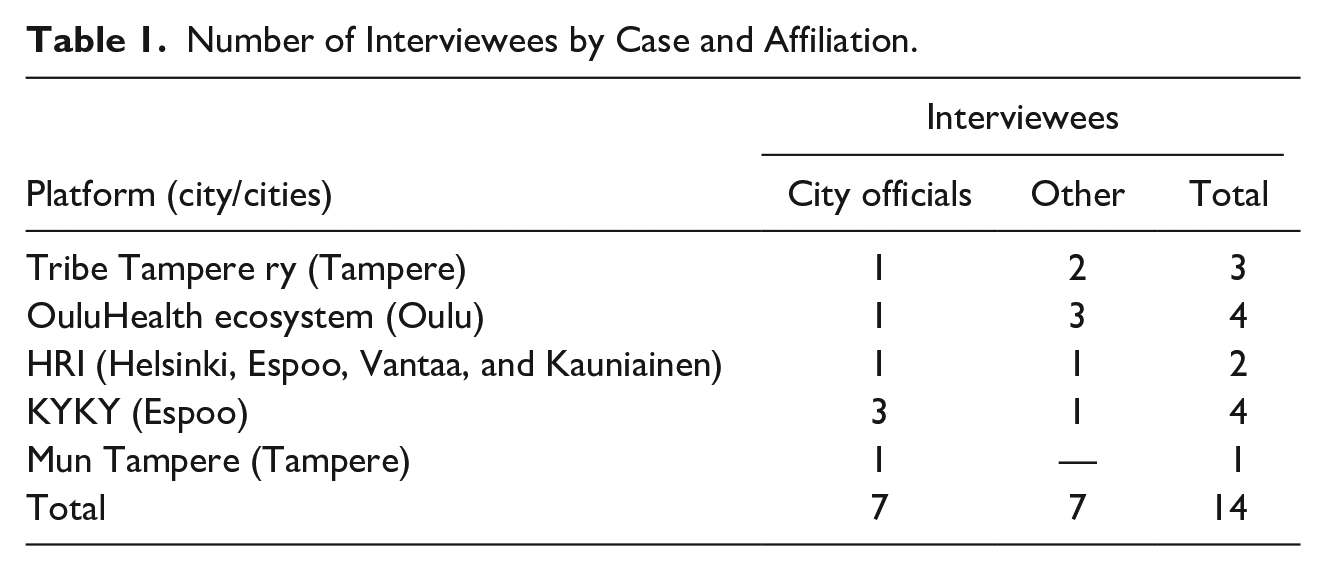
Our research data consists of semi-structured interviews collected from five Finnish local platforms. In all five cases, city governments are either providing the platforms or actively involved in their functioning. To provide a comprehensive picture of urban platform governance, we conducted thirteen semi-structured key informant interviews with actors in different positions on platforms. As one of them was a joint interview of two people, there were fourteen interviewees in total. This data collection method suited well to our needs, for even if our research was based on predefined themes, the phenomenon under investigation is novel, which requires interaction in the researcher-informant relationship and especially a chance to ask improvised follow-up questions (Kallio et al., 2016).
Because of the varying sizes of the platforms, we interviewed different numbers of key informants in each case (see Table 1). Seven of the interviewees represented city governments and municipal companies. They were closely involved with the operating activities of the platforms, working under the titles such as designer, network director, community manager, and project coordinator or manager. Three of the interviewees represented other local organizations closely involved in the operating activities of the platforms: two represented higher education institutions and one a university hospital. One of the interviewees represented a funding body involved in the strategic decision-making of a platform. The three other interviewees were end-users of the platforms. The distribution of the interviewees by case and their affiliations are summarized in Table 1. Interviews were conducted in Finnish and the quotes in this article are translated into English by the authors.
Number of Interviewees by Case and Affiliation.
As local platform governance is largely unexplored phenomenon, we applied inductive approach in the early stage of the analysis. In this approach, the research questions are attempted to be answered primarily based on the collected data. Miles and Huberman (1994) divide this reasoning process into three stages: (1) reduction, where essential expressions are identified amongst the data and coded; (2) clustering, where the coded data is compared and pooled, and the codes are contrasted with each other, and (3) abstraction, where essential theoretical concepts are formed through the combination of classifications. However, the analysis cannot be described as purely inductive, but rather abductive, since in the second stage of the analysis the essential concepts identified during the abstraction stage were contrasted with existing theoretical concepts in order to anchor the results more closely to the research field of local governance.
Description of the Cases
Tribe Tampere
Tribe Tampere is a community and registered association based in the city of Tampere. It functions as an organization bringing together local entrepreneurship and start-up associations. Tribe organizes events and serves as the community operator for the Tampere start-up house named Platform6, being responsible for the building’s communal areas where anyone can come to work, network, or reserve a space for a meeting or an event.
“Tribe Tampere is a community consisting of people dedicated to serve Tampere startup and entrepreneurial ecosystem. We are operated partly on a voluntary basis and act as a platform for new ideas to develop the startup ecosystem in Tampere. Our mission is to unite the actors inside the startup ecosystem in Tampere.” (UNCTAD, n.d.)
Tribe collaborates with higher education institutions and several local private, public, and third-sector actors. The City of Tampere allocates partnership grants for Tribe and is an important partner for the Tribe community. Even though Tribe operates in spaces organized by the city government, the city government did not initiate it and does not coordinate its operations. Tribe is the only one among our cases that relies on bottom-up style organization, in which the member associations are responsible of the decision making at Tribe.
OuluHealth Ecosystem
The OuluHealth ecosystem is a consortium of the key health technology actors in the City of Oulu. It does not have its own business ID (y-tunnus) or budget, and its main actors are linked together by cooperation agreements. City-owned business development agency BusinessOulu coordinates cooperation within the ecosystem and is also responsible for its communications and for supporting the growth and commercialization of the local businesses in the industry. The University of Oulu currently works as the Chairman of the ecosystem and the University’s Centre for Health and Technology is responsible for coordinating its innovation activities.
“We are striving to transform healthcare on a global scale and, as a result, improve people’s lives. Our main goals are to accelerate the implementation of health innovations, boost the health-tech business and create better solutions for the benefit of citizens.” (OuluHealth, n.d.a)
The OuluHealthLab platforms are commoditized testing and piloting environments for health sector companies and operate under the ecosystem. Labs are offered by the Oulu University Hospital (OYS TestLab operating in a hospital environment), Oulu University of Applied Sciences (SimLab simulation environment), and the City of Oulu Social Services and Healthcare (Oulu WelfareLabs, where products are tested by professionals and clients).
“Oulu WelfareLab offers your company a unique opportunity to develop your product or service in authentic social and healthcare processes and environments: homes, social and healthcare centers as well as hospital. You can also join co-creation workshops with end-users. Oulu WelfareLab will match you with the right end-users you need to develop your solution, whether they are social and healthcare professionals, customers or patients.” (OuluHealth, n.d.b)
The ecosystem also has different local cooperation functions regarding organization, business, and student encounters as well as the InDemand project designed for collecting healthcare professionals’ and citizens’ ideas. While the OuluHealth ecosystem represents all the health technology companies in Oulu, OuluHealthLabs are paid services that can be used by companies located anywhere. The OuluHealth ecosystem is also involved in different extralocal co-creation projects. Although the ecosystem uses online platforms in the InDemand project, for instance, product development on the OuluHealthLabs platforms takes place in a particular physical environment.
OuluHealth is the broadest of the cases in this study. It is also the only one that is conceived as an entire ecosystem, that is the essential functions and actors are closely linked together. The idea is that different cooperative activities (such as the OuluHealthLab platforms) are built upon this ecosystem.
Helsinki Region Infoshare
The Helsinki Region Infoshare (HRI) is an open data service provided by the cities of Helsinki, Espoo, Vantaa, and Kauniainen. The service consists of information regarding the abovementioned cities, the inter-municipal transformation company Helsinki Regional Transport Authority (Helsingin seudun liikenne), public utility companies of the cities, and other similar entities. The data is available for free and can be used anonymously by anyone for any purpose. The users can also leave data requests for the website and comment on other people’s requests, but in practice, the users have not had many discussions on the website in recent years.
HRI operates as an open-source digital platform. The service is funded by the cities running it. The HRI service’s operations are managed, overseen, and executed by a board of directors and a steering group according to the main and financial agreement. The board of directors consists of the Mayors of the Helsinki Metropolitan Area. The steering group includes the financiers of the service, the City of Helsinki Executive Office, and the City of Helsinki innovation company Forum Virium Helsinki Oy. The City of Helsinki Executive Office is responsible for the operative coordination of HRI. Data material and IT experts, publicists, and lawyers are also involved in the operations of the HRI service. The basic idea of the service is to offer opportunities for data-based value creation.
Open data can be seen as a facilitator for creating new services and business opportunities, as well as supporting research and development. The value of public data increases the more it is used. (HRI, 2017) Translated from Finnish.
KYKY
KYKY (Koulujen ja yritysten kiihdytetty yhteiskehittäminen, Accelerated co-creation by businesses and schools) is a Living Lab type service offered by the City of Espoo that allows companies to develop their products and services in the City of Espoo Education and Cultural Services units with their target groups in accordance with the principles of co-creation. The KYKY marketplace is an open-source online service that offers schools or other units of the Education and Cultural Services and companies a chance to meet and find opportunities for cooperation. Companies can share a product idea on the platform and find a partner within the city government interested in co-creation. City government’s units may also share their development needs on the platform.
Opening schools as an innovation platform will increase companies’ understanding of the daily life of schools, teachers, and pupils. Co-created products and services are more competitive, as their development has been guided by the value experienced by the customer. (City Business, n.d), Translated from Finnish. The City of Espoo Education and Cultural Services create and develop innovations for supporting deep learning and the joy of learning as well as sustainable and smart learning environments. Good, already existing methods are taken further and scaled up for broader use. (6Aika, n.d.), Translated from Finnish.
The KYKY service allows pupils and teachers to test and develop new products. Such co-creation activities are integrated into the school’s everyday life. Unlike with OuluHealthLabs, companies do not pay for product development on the KYKY platform as it emphasizes mutual benefits of co-creation. Local companies as well as companies around Finland and abroad can get involved.
Mun Tampere
Mun Tampere (“My Tampere”) is the City of Tampere’s online service utilized for the city’s participatory budgeting project. It is the youngest of the case platforms, as it was launched for the first time in 2020. Via the platform, 450,000 euros is allocated to activities related to the welfare of children and adolescents throughout the city. Anyone can participate in the participatory budgeting by sharing an idea on the digital, open-source platform. Willing parties can also participate in workshops taking place in physical spaces in which the ideas are developed further together with the City of Tampere staff. After the further development stage, citizens of Tampere can also vote for the ideas.
Central to participatory budgeting is the participants’ genuine experience of having their opinions be heard and actions lead to results. (City of Tampere, n.d), Translated from Finnish.
The Roles of the Actors on the Case Platforms
We have identified three major actor groups in urban platforms that will be analyzed in this section based on the five Finnish cases. First, we will discuss the role of the city governments. Their role within urban platforms and wider urban ecosystems is often considered primarily facilitative (Borghys et al., 2020). Second, we will examine the role of the major “principal” in the urban community, citizenry. Citizens’ self-organization and their views and skills—together with their multiple roles as voters, residents, and service users—have been recognized as an essential potential to be channeled through urban platforms (Bollier, 2016). Lastly, we will consider the role of companies, whose role in urban platform governance is interesting, as platform and ecosystem thinking are gradually extending to local business development (Anttiroiko et al., 2020).
City Governments
The city governments play a central role in urban platforms by facilitating cooperation within actors, building ecosystem, enabling and supporting citizens’ self-directed activities, and providing of resources and services. In addition, they may also be platform providers, as in the cases of HRI, KYKY, and Mun Tampere. In the case of OuluHealth ecosystem the city government is also one of the platform providers along with other actors. In Tribe the city government is an important partner, even though not a factual platform creator.
City governments contribute to multi-actor co-creation in some way on all the case platforms. Engaging in co-creation with the local communities was described as an essential part of the activities of Tribe, OuluHealth, KYKY, and Mun Tampere. In the case of HRI, its cooperation with the local community is less direct and manifested mostly as the enabling of self-directedness through the provision of data, but it also cooperates with its largest urban areas on the development of the data platform.
Our experts have seen the value in working on the information and design by co-creating, and even though our officials and experts have a lot of knowledge, it’s important to see the value of crowdsourcing even more of the design work. But it’s not easy. This is a new way of doing things and requires you to “flip the switch” in your brain towards this new direction. (MunTampere, coordinator)
Facilitation is also one of the major roles of city governments in all cases. On the KYKY platform, city officials facilitate the co-creation activities by taking care of the administrative responsibilities, following the progress of the process, and supporting schools and businesses in creating action plans and in communications when needed. In the case of Mun Tampere, city officials facilitate development of ideas in workshops.
The city governments also utilize platforms for providing services for businesses. On the OuluHealthLabs and KYKY platforms, they offer product development services, and in the case of Tribe, cooperation with the local community was descried as co-production of business services. The provision of data by HRI can also be considered a service. This type of enabling was seen as a cost-effective way to promote value creation and innovation. According to the interviewees, it requires the city officials to expose themselves to criticism more directly and to assume a role of equal interactor that encourages citizens to voice their concerns and share their ideas, instead of being expertise-driven authorities.
Building and developing the ecosystem together with other actors is also an important part of the activities of city governments on the case platforms. It is particularly highlighted in the activities of OuluHealth and Tribe. In the OuluHealth ecosystem, this function is carried out by BusinessOulu, which was described to be actively in contact with different local, national, and international health technology networks, when supporting and guiding local startup companies with regard to internationalization and networking. In the case of Tribe, the role of the city government in building the ecosystem was similarly depicted, not only in relation to the acquisition of partners and spreading of the platform ideology, but also as an activator and enabler for local actors. The purpose of building the ecosystem is, in both cases, to scale up operations and to strengthen existing connections.
Citizens
The roles of citizens on the platforms vary considerably. Overall, citizens are often seen as experts by experience whose ideas, skills, and experience-based knowledge are utilized on the platforms.
Citizens’ role is most diverse in the case of Tribe. All the actors were supposed to coordinate the platform together, develop the ecosystem, and take ownership over the activities. The changing role of citizens—from passive recipients of services toward active citizenship—, citizen empowerment and the opportunity for citizens’ self-improvement as members of their communities were all mentioned in the interviews with the key players of Tribe. Such an empowerment helped individuals in creating their own career paths and in identifying new opportunities for value creation.
This is a startup brand from Tampere that’s maintained by the community itself, and everyone kind of owns it, it isn’t owned by the city or some other individual actor, but everyone owns it and is proud, in a way, that they’re able to be building and representing it. (Tribe, active participant)
Active municipal citizenship was also brought up in Mun Tampere, in which the support for the participation of citizens and the utilization of their ideas were said to be at the heart of platform’s mission. On the OuluHealthLabs and KYKY platforms, the citizens’ participation is utilized in the product development and testing activities. This concerned the skills of both public service professionals and service users, that is the clients of the Education and Cultural Services on the KYKY platform and healthcare clients on OuluHealth’s WelfareLabs platform. Similarly, with Tribe, experiences of ownership and empowerment were also mentioned in the case of OuluHealth and KYKY. According to an interviewee, healthcare staff felt empowered when their expert opinions were appreciated in testing environments. KYKY, on the other hand, was said to improve the pupils’ sense of self-efficacy and offer a taste of success. In the HRI, the role of the citizens was independent, their motive of utilizing freely available data ranging from self-interest to seeking the common good.
Companies
In most of the platforms discussed here, companies play their part by utilizing the services and resources available on the platforms. There is, however, differences in the inputs they bring to the platforms, which is why their roles varied between and even within the platforms.
In OuluHealth ecosystem companies are considered both as partners and customers. In the ecosystem’s activities coordinated by BusinessOulu, local health technology companies are offered support and guidance for internationalization. Companies that have scaled up their operations are also encouraged to share their experiences and participate in mentoring the startup companies of the ecosystem. When it comes to the activities of OuluHealthLabs, however, companies are considered paying customers of the services. Unlike OuluHealthLabs’s activities, KYKY’s activities in Espoo are not subject to a charge. Rather, mutual benefits are regarded as one of KYKY’s key principles, and the products and services of the companies are expected to provide added value for teaching.
In Tribe, companies—along with all other actors—are expected to participate in the development of the community. This means, for example, sharing their own networks, efforts, or skills with the other members of the community. In the case of HRI, reciprocity is not required since companies are free to utilize the data available on the platform. On the Mun Tampere platform, individual citizens, communities, and companies could all share their ideas, but the executors of the chosen ideas were selected only after the voting. Thus, neither companies nor other actors were able to determine independently the execution of the suggested projects.
Relations Between the Actors on the Case Platforms
Local platform governance has been found to include elements from Traditional Public Administration, New Public Management and New Public Governance as well as bring completely new features to the theory of governance (Haveri & Anttiroiko, 2021). In the following sections, we will describe how the relations of the key actors on the case platforms are structured and coordinated by utilizing the framework of coordination methods associated with various governance paradigms.
Hierarchies and Rules
Management based on hierarchies and authority did not play a particularly important role in the coordination of the platforms discussed here, but the mandates and strategic goals of senior management in city government were considered an essential element for launching activities and for platform development in all cases. Although there was reluctance toward setting too many rules, the interviewees pointed out that a certain level of accountability was expected from the city governments, and this occasionally required imposing certain ground rules or interventions in conflict situations. On digital platforms, this was reflected in the terms of use and platform providers’ ability to moderate discussions on the platforms.
It’s obvious that platforms need rules too, and we can discuss separately what kind of rules and culture are needed, but we start with the nice idea that having as much freedom as possible is preferred. If mistakes are made, they can always be fixed along the way, but yes, instead of following the traditional, regulation-driven approach usually used in the public sector, where as many things as possible are prohibited first and then you start considering what could be permitted, we’ve taken inspiration from the startup world and try to start out by leaning towards freedom as much as possible. (Tribe, city official)
In the case of Tribe, a city official emphasized that although the city government does not coordinate the activities of the platform, appropriate behavior is always expected from the partners, and the city government must have the ability to ultimately intervene in problem situations. At the time of the interviews, Tribe was moving to a startup house called Platform6, which is a property managed by the city government. It was expected that a greater significance would be given to written rules and criteria as the role of the city government strengthens. Regarding the OuluHealth ecosystem, it was stated that the co-creation companies are carefully selected and that testing and developing alternative therapies, for example, is not permitted on the platform. The so-called ground rules were also described as essential for the coordination of KYKY’s activities. However, those rules were not hierarchically created. Rather, they had been developed together with stakeholders, and their implementation was ensured through agreements.
The coordination of activities relies most heavily on the principles of traditional public governance in the case of HRI. This can be explained, first, by the fact that the management of the core activities of HRI does not require extensive governance of external networks beyond the four cities functioning as platform providers. Second, HRI is the most established of the case platforms since its alpha version was launched already in 2010. HRI differs from the other case platforms also in the sense that the users of the platform are neither actively in contact with the providers nor with each other. However, if examined as part of end-user ecosystems, HRI and similar open data platforms provide urban governance with elements that aptly highlight the specific nature of platform governance: actors are free to take advantage of the resources provided by the city government and build upon them new, value-creating services or specific functions, while on the demand side users are bound only by a few rules in utilizing them.
Markets and Contracts
The idea of markets as a method of coordination is emphasized particularly on the OuluHealthLabs platforms, since they offer companies services that compete with other similar testing and simulation platforms globally. Ready-to-use contract templates and a high degree of productization were mentioned as their competitive advantage.
We have made headway with productization, and we’re agile. We can take up and deliver the case quite fast and create a high-quality service package out of it. In other places where they’re only just practicing it, it might take months for them to draft an agreement, because they have no proper practices in place and no valid licenses, so in that way that’s probably one significant factor. (OuluHealth, representative of OYS TestLab)
Ready-to-use agreement templates are also significant to KYKY’s activities. However, agreements between companies and schools concern not only clear terms, such as intellectual property rights and information security, but also principles and values related to the co-creation ideology, which were conceived as shared ground rules.
Networks, Dialogicality, and Shared Resources
All the case platforms utilize features related to network governance in their coordination. For example, the interviewees talked about the significance of horizontal relationships, dialogicality, negotiating, and trust.
We are now in a situation where we have many different employers — for example, let’s say, the North Ostrobothnia Hospital District or the city’s welfare services or the university or VTT [nationally owned Finnish research institution] — and that requires a completely different, genuine kind of trust in order for us to make it work, because everyone obviously thinks about their own organization’s goals and about taking their own organization’s things forward. About whoever is paying their salary. But still, if we can build a good, strong, and genuine relationship of trust, we can succeed in creating a shared agenda and vision. So, even though there are people from different organizations and everyone’s following their own path, everyone’s still working towards the same goal. (OuluHealth, representative of BusinessOulu)
According to a few interviewees, the building of the OuluHealth ecosystem was made easier by the fact that there had already been some cooperation and partnerships among the actors through different projects and experiments. Even though not all the projects were perceived as successful, they had paved the way for the establishment of the platform, since the foundation for co-operation was already in place. This is a good illustration of the significance of social relationships in network governance. The significance of interaction was also discussed in relation to the role of the city government as a facilitator on the Mun Tampere and KYKY platforms. In KYKY’s activities, dialogicality is reflected in the formulation of the ground rules, as they were developed together with the end-users of the platform, that is companies, schools, and the parents of pupils.
The case platforms also utilize resource pooling to achieve synergies, which can be considered a key characteristic of partnership-based network governance (see, e.g., McQuaid, 2010, pp. 131–132). In the OuluHealth ecosystem, the intention is to share good practices, experiences, skills, and other resources within the network. The sharing of resources was visible, for example, in how the working hours of the platform provider organizations’ experts were distributed outside their own organization. The common digital architectures are also shared, and all testing and simulation requests received through the OuluHealthLabs platforms were allocated by the platform providers to relevant organizations, instead of pitting them against each other. This resembles the distribution of resources—skills, ideas, time investments, and networks—between the platform actors in Tribe.
Cultural Embeddedness of Platforms
An interesting factor recurring in the data is that many of the interviewees talked about shared values, mentalities or ideologies as well as about behavior in the platforms being affected by cultures, which were all considered to reduce the need for rules that were regarded as “bureaucratic.” Culture, therefore, seemed to function as an important conditioning factor of coordination or meta-coordination on some of the platforms.
The effect of operational culture was particularly evident in the case of Tribe. On one hand, the interviewees emphasized the fact that Tribe is open to all, but on the other hand, they stated that Tribe’s activities are technically not directed to everyone, but rather, certain “like-mindedness” was expected from the people participating in its activities. Like-mindedness referred to an entrepreneurial startup mentality, self-directedness, communality, an optimistic and international attitude, as well as the individuals’ desire to improve themselves. Other important values that were mentioned included openness and equality. Shared values and mentality—and thus a particular kind of self-selectivity as well—were considered to reduce the likelihood of conflicts and the need for rules as well. Selectivity also pertained to skills, such as self-directedness and interpersonal skills. One of the interviewees said that since people who seek to join the platform tend to have better than average communication skills and ability to cooperate, “rudimentary conflicts” do not even arise. There was no desire to codify Tribe’s values in written form so that they would not turn into rigid rules. Rather, according to the interviewees, values were described to new actors and visitors in unofficial conversations and “elevator pitches,” for instance. However, one interviewee pointed out that having the values written down would be beneficial in some cases—for example when ensuring non-discrimination based on gender. The KYKY interviewees, too, emphasized the significance of operational culture, but unlike Tribe’s, the principles and values of KYKY’s activities were presented in written form along with the essential ground rules.
A lot of it [ground rules] has to do with co-creation, with the philosophy. About equality and being open-minded about other people’s ideas, so we’re trying to move away from that kind of expert-driven attitude. We try to promote a way of working that’s open, inclusive and respectful towards others. (KYKY, city official)
Participating in the activities of KYKY and the OuluHealth ecosystem is voluntary for professionals and not subject to a separate charge. On both platforms, it was assumed that in this way genuinely enthusiastic professionals who want to make an impact and improve their skills would participate in the activities.
In spite of the obvious differences, from a cross-case perspective platforms’ commonalities indicate the emergence of a nuanced social morphology in the form of enabling structures that channel audience involvement into value creation in public service, policy, and governance processes. At the same “the urban” implies a certain degree of local embeddedness, which seem to set limits to audience and service ecosystem building, and thus diminish opportunities for scaling-up, despite the obvious advancements associated with digitalization.
Discussion
Platforms as a Mode of Governance
Governance based on hierarchy and chains of command, associated with traditional public administration, play a limited role in platforms. Instead, platform governance is often based on creating horizontal relationships and minimal power imbalances between the actors. While the intention is to keep the platform activities as flexible as possible and to avoid strict rules, platform activities are often regulated through contracts between the parties. The significance of contracts and market-based governance is most evident in the product development platforms. Characteristics associated with network governance —resource pooling, the significance of trust between the actors, and dialogicality—characterize the governance of all the case platforms in some way. Such observations support the view that platforms are in essence a hybrid form of governance, yet having their own quality rooted in the facilitation of connections, the orchestration of resources and activities, the utilization of ecosystem thinking (Haveri & Anttiroiko, 2021).
Values, Norms, and Self-Selection
The informants of our interviews pointed out that there were novel ways to coordinate cooperation between the key actors. These included shared values, ideology, and principles, as well as self-selection of actors involved, which the interviewees saw as factors reducing the need for actual rules and norms. These characteristics seem to relate to the nature of platforms. Shared values as part of the coordination of activities is not a concept exclusively characteristic to platforms and can be seen in network governance at large, but its operational logic seems to have some differences between networks and platforms. Network macrocultures—that is the shared values, norms, and beliefs of the network actors—are regarded as promoting successful network governance but creating such a culture is described as a difficult and time-consuming process that may even take decades (Jones et al., 1997). On platforms, however, norms and culture need to be created quickly, due to the fast co-creation, reorganization, and scaling-up processes.
In many cases, an important factor that promotes actualization of the shared values, principles, and norms in platform governance is self-selectivity. By self-selectivity we refer to the fact that participation is sought by individuals who already have a certain type of mentality, internal motivation, or certain characteristics. This kind of self-selectivity is possible in platform governance, as individuals do not join the platforms based on existing interdependencies but to find new opportunities. The actors’ self-selection and their interest in finding new opportunities relates to another important function of the platforms, namely that of successful encounters for the sake of matchmaking.
The characteristics of platform governance complement the paradigm continuum by easing the challenges associated with network governance, such as the difficulty of seeking consensus, through the provision of new tools for utilizing the skills of the local communities in resolving complex problems. At the same time, this creates a new, broader perspective on the role of citizens and local communities in relation to local governance. Although co-creation is often linked with NPG paradigm (Steen & Tuurnas, 2018, p. 81), the data collected from five case platforms operating in Finnish cities suggests that co-creation is also at the core of local platform governance. There is, however, differences in how it is carried out: in networks the city governments are co-operating with key stakeholders, whereas in platforms city governments seem to adopt more enabling role, in which they encourage local actors to co-operate with each other within constantly evolving ecosystems. Although urban governance is still primarily reliant on more traditional modes of governance, cities seem to have growing interest in opportunities offered by platform logic.
Toward an Enabling City
As platform governance changes the roles and relationships of key actors in local governance, it may also shape the perception of citizen engagement in public policy-making and value creation. Lund (2018) argues that as the focus of the promotion of citizen engagement moves away from the citizens’ participatory opportunities, inclusivity, and democratic engagement, and toward self-selectivity based on innovation potential and value creation opportunity, the public sector will assume the role of an enabling state. In a similar way to platform governance, many descriptions of the enabling state highlight the idea of self-improving individuals and local communities creating public value by themselves. Whereas the key role of the welfare state has been thought to ensure the fulfilment of basic needs and to provide services to its citizens, the enabling state is described as providing citizens with opportunities for improving the quality of their own lives by building partnerships with the private and third sectors (Bevir, 2009; Wallace, 2013). Enabling city is related to the empowerment of the local community, but can also be associated with the idea of narrowing the responsibility of public sector by activating citizens to take greater responsibility for the production of services and the well-being of local communities (e.g., Botsman & Latham, 2001; Gilbert, 2005). On the other hand, Sirianni (2009) and Miettinen (2013), among others, suggest that enabling active citizen engagement does not necessarily lead to the shrinking of the welfare society per se. Instead, it signifies a new way of organizing services that encourages communal and institutional learning.
Examining platform governance can shed light on the way in which the idea of enabling is realized at different levels of governance, since viewing city governments as enablers and facilitators of citizens’ self-directed activities—a perspective often associated with local platform governance—can be also interpreted as an ideological change toward a more enabling city. As Millard (2018) points out, it is important to keep in mind that even if public sector organizations adopt an enabling and platform-like operational approach, they should remain bearers of responsibility within the organizational constellation that is supposed to bring about public value. In addition to bringing actors together, organizing resources, facilitating and encouraging actors to find new opportunities, and providing new tools for value creation by means of platform governance, city governments must simultaneously ensure the commitment to democratic principles, the creation of public value, and the maintenance of sufficient quality standards. An interesting topic for further study is, how cities should seek to promote and protect public interest in such changing operational environments.
Implications for Theory and Practice
As discussed above, there is a limited body of research on platform governance in the public sector. However, there are a few studies that have shed light on the functioning logic and opportunities of governance platforms. For instance, Ansell and Miura (2020) and Ansell and Gash (2018) have argued that utilizing organizing logic of platforms in public governance demonstrate great potential. Based on this study, the platform approach seems to be a fruitful way of coordinating collaboration in local communities. As Haveri and Anttiroiko (2021) have noted, although platform governance is a hybrid form of governance, it also brings new elements to the theory of governance. In this article, we have drawn attention to the novel features regarding the roles and relations of key actors in local platform governance. We noticed, for instance, that shared values, ideology, and self-selection of participants are perceived as an important way to reduce conflicts and the need for rules on local governance platforms.
Previous research on the roles and relations of key actors in local platform governance has mainly focused on the relationship of citizens and city governments. Researchers have stated that platforms create opportunities for co-production and may enhance the self-organization of citizens (Falco & Kleinhans, 2018), and that the role of public administration in platform governance is to empower citizens to create public value themselves (Janowski et al., 2018). The results of this study are in line with these findings. In addition to this, we have included the role of businesses into the scope of our research. Platforms provided by city governments often cater to businesses, especially in the case of innovation and product development platforms. However, we noticed that the inputs that companies are expected to bring to the platforms vary significantly. This article also takes a broader lens to the systematic changes that platform governance brings to the relations of these actors in local ecosystems. We argue that the novel elements of platform governance, such as viewing city governments as facilitators of citizens’ self-directed activities, can be interpreted as an ideological change toward a more enabling city.
City governments may utilize the findings of this study in the development of urban governance, particularly in the context of smart cities as they manifest how urban technologies are reshaping the fundamentals of urban life, governance included. The research also benefits local communities since it sheds light on the nature and scope of platform activities city governments are involved in and the opportunities and risks associated with platformization. It is essential for the development of local democracy that citizens know how new approaches to urban governance, such as platform governance, may affect their relationship with the city government and other stakeholders. Such an understanding provides tools to critically assess and make an impact on urban futures.
Conclusion
Through five Finnish cases, this article has shed light on the roles and relations of three key actor groups in local platform governance: city governments, citizens, and companies. The cases indicate that while each individual platform has a structure that determines actor roles and relationships, varieties of platform types manifest themselves in dynamically changing role constellations in which platform logic operates through changing roles as a reminiscent of a classic Triple Helix relations in which actors assume each other’s roles. In all such cases city government serves as a facilitator of cooperation with diminished interest in controlling processes and increased interest in enabling, accelerating, and channeling value creation for the benefit of the urban community. Citizens role in this type of governance is to be a partner in co-creation processes. They may act as experience-based experts in product development and testing or possess a more independent role, such as platform coordinator and self-directed value creator. The role of companies varies from customers of the services provided on the platforms to partners, who, like citizens, bring to the platform their resources. In some platforms the reciprocity between companies and other actors is based on the idea that all parties will benefit from the co-creation in the future, in a form of better products on the markets and improved vitality of urban or regional economy.
The enabling role of the city governments may empower local communities through emphasizing active citizenship and self-improvement, but there is also a risk that it does not adequately consider citizens’ different abilities and resources for self-directed value creation nor intrinsic value of citizen involvement. For this reason, it is important that city governments ensure the creation of public value and maintain quality standards even as they adopt a new, more enabling role.
There are two main limitations in our study that could be addressed in future research. To help us identify the common denominators of the cases relevant to their nature as urban platforms, we have selected cases within only one country, Finland, to reduce institutional and cultural variation in the operating environment of the platforms. As the practical and theoretical understanding on urban platforms develops further, it is likely that interest in comparative analyses of platform governance in different societal contexts will emerge. Second, our research data consists primarily of interviews. It would be useful to conduct in-depth analyses of platforms with special consideration of contextualization, triangulation of data, and cross-case analyses.
Footnotes
Declaration of Conflicting Interests
The author(s) declared no potential conflicts of interest with respect to the research, authorship, and/or publication of this article.
Funding
The author(s) disclosed receipt of the following financial support for the research, authorship, and/or publication of this article: This work was supported by the Finnish Municipal Foundation sr.
