



Abstract
While the relationship between bureaucracy and democracy has gained attention in historical cycles, the literature on the roles of bureaucrats in relation to democracy has become increasingly fragmented. Drawing on comparisons among public administration theory and participatory, deliberative, and collaborative democracy, this article provides typologies that reflect the historical multiplication of the theoretically determined roles and characteristics of bureaucracy that contribute to democracy. This comparative analysis highlights a common democratic trend among the four schools in adding stresses on bureaucrats’ autonomy, morality, publicity, and direct connection to citizens, with a constant coexistence of rational and managerial elements.
Keywords
Introduction
As democratic disaffection associated with the crisis and potential death of liberal democracies (Corbett, 2020; Offe, 2011) has been growing since the 2000s, the need to redefine bureaucrats’ roles, characteristics, and values has been addressed in relation to the current problems concerning governing (Dickinson et al., 2019; Frederickson et al., 2016; Perry & Christensen, 2015; Peters & Pierre, 2012; Rabin et al., 2007). The call for a democratic bureaucrat, which is relevant both theoretically and practically, is now on the agenda more than ever, given the new complexities of the existing social and political systems of governance in the current world (Hildreth et al., 2021), which include the aggregation of multiple global emergencies, such as economic, environmental, migration and health crises. It has been estimated that the representative functions of the state, in addition to social and public programs, as well as those of elected and unelected officials, are being reduced by the power of big capital and special interest groups, and that the bureaucratic capacity to fulfill citizens’ expectations has been destroyed (as shown by reforms regarding downsizing, hollowing out, privatization, and elimination) (Wilson, 2001).
Various factors have recently been adding to the social complexity in which bureaucrats act. Authoritarian and populist political programs and activities challenge not only bureaucratic values relating to political neutrality (Box, 2021), but also bureaucrats’ accountability relationships with politicians (Wood et al., 2022). Furthermore, bureaucratic agencies have become over-burdened and hyperresponsive (Meier, 1997), forced to deal with increasingly complex tasks and demands from the people as well as from politicians. In such circumstances, it is no surprise that the practice of bureaucracy is facing low levels of institutional trust (Torcal, 2006), and is perceived as non-democratic (Brugué & Gallego, 2003) and sometimes even as a threat to democracy (Meier & O’Toole, 2006). Indeed, historical forces, economic trends, and changing political preferences have provoked a re-thinking of public administration theory and practice (Roberts, 2004).
Theoretical and empirical efforts to describe the roles of bureaucrats have significantly varied over time. They have been greatly influenced by evolving theories regarding democracy while at the same time continuously dealing with general tensions between (a) rationalism and efficiency and (b) democratic/public-oriented bureaucrats’ roles.
On one hand, rational/public choice theory and management studies have prevailed for decades in the form of new public management (NPM) (Osborne & Gaebler, 1992), which was criticized and partly replaced by the theory of new public governance, based on organizational sociology and network theory (Osborne, 2006). On the other hand, the reconciling of bureaucracy with democracy (Etzioni-Halevey, 1983; Kirlin, 1996; Meier, 1997; Peters, 2010) has been elaborated within the theory of representative bureaucracy and bureaucratic representation (Coleman et al., 1998; Wilson, 2001), as well as that of bureaucratic responsibility (Burke & Cleary, 1989) and network governance approaches (O’Toole, 1997), and within various governance-driven democratization developments (Meier & O’Toole, 2006; Warren, 2009), where calls for civic support persist (Norris, 2011; Sedgwick et al., 2022).
Additionally, attempts to limit the existing deficits of representative democracy, to reshape the traditional hierarchical views of public administration, and to reinsert a democratic debate in a transparent administrative procedure (Crozier et al., 1975; Erkkilä, 2020) have spread widely throughout four streams of democratic and governance thought: a debate on participative democracy in the 1970s, which was later accompanied in the 1980s and 1990s by calls for democratic public administration, together with today’s still relevant debate on the benefits of deliberative democracy and collaborative democracy. Indeed, many different theoretical (re)definitions of the roles of bureaucrats co-exist today, while the technocratic/rational-centric approach seems to have been predominant as it appears in various schools of public administration.
In this contribution, we offer typologies of the roles, types, and characteristics of bureaucrats that have been developed based on a comparative review of four sets of democratic literature (public administration, as well as participatory, deliberative, and collaborative democracy). While reviewing the literature, we concentrated on three main research questions: how have debates in the literature redefined the role of bureaucrats concerning democracy and the public? How do these redefinitions relate to the changing real world? How can these redefinitions be presented in terms of a typology? Through a systematic comparison of the literature during the process of answering the research questions, we consider a dynamic redefinition of bureaucrats’ roles from the democratic point of view, and suggest ideas for further research on the roles of bureaucrats within an increasingly complex and multi-level administration in a global context that also have very important practical implications for democracy.
Public Administration Theory
Context
The bureaucracy–democracy relationship has not always been the focus of public administration theorizing. The traditional (Wilsonian) role of bureaucracy in the US began with a clear separation of administration from politics in order to develop a science of administration. In the context of the end of the 19th century’s industrial and trading age, administration was viewed as hierarchically ordered and professionally trained, as well as subordinate to political direction. Similarly, administrative questions were seen as distinct from constitutional ones, as they also involved issues regarding the practical, systematic, and effective execution of public laws (Wilson, 1887). In the European context of industrial capitalism, too, the focus was on the principles of rationality, predictability, and the technical superiority of bureaucracy, as well as effectiveness, impersonality, formality, specialization, and discipline, all of which ensured the importance of primarily organizational rather than partial objectives, through equality of services and political neutrality among public servants (Weber, 1919).
The Evolution of Democratic Public Administration
In the period after the Second World War, and in the context of a more complex society, three main developments in public administration have been particularly evident. First, Simon (1947) exposed administrative behavior in a hierarchical organizational setting, influenced by external factors and administrators’ personal (bounded) rationality and values, but still acknowledged the hierarchical environment as the most appropriate. Nevertheless, the separate roles of administrators and politicians hidden in bureaucrats’ political neutrality disabled their accountability to the citizens (Cooper, 1998). Second, the idea of a democratic public administration was revived in democratic theory (Beetham, 1987). In response to the public administration crisis under the Carter and Reagan presidencies (Marshall & White, 1990), public administration needed to address its identity crisis and to empower each administrator as a self-conscious agent of democratic transformation (Dennard, 1996), while exposing its human side (Gawthrop, 1998). Third, ideas relating to NPM, rooted in rational choice and influenced by Taylor’s (2010) Principles of Scientific Management, spread widely internationally, stressing the vision of government being like a business. These have persisted in spite of criticism that they are Western-centric and constrain democratic, ethical and professional values and principles (Vargas-Hernández, 2016).
The Postmodern Critique
Postmodern critiques of technical rationality, moving toward interpretative approaches have been founded on perceptions of society’s postmodern conditions characterized by fragmentation. Studying these phenomena, it contributed the sensitivity for imagination, deconstruction, deterritorialization and alterity (a moral stance stressing that there are more than one understanding and that diversity must be furthered) (Bogason, 2007). Indeed, the postmodern public administration stream (Miller & Fox, 2007; Wamsley, 1990; Wamsley & Wolf, 1996) revived calls for the moral and value foundations of administration (Cooper, 1998; Hart, 1984), as well as its constitutive role in protecting citizens (Cook, 2014; Olsen, 2004) and helping co-create the government for the people (Vigoda, 2002). Nevertheless, tensions and even conflicts appeared in the literature, particularly in determining bureaucrats’ relation to regime values.
Normative Expectations
In a bottom-up approach, normative expectations expanded to include bureaucrats’ voluntary entrepreneurship, committing to moral nobility, enhancing trust, and basing their actions on civility, citizen virtue, trust and moral law while at the same time acting as active proponents of the regime’s values (Hart, 1984). Bureaucrats cannot be citizens’ delegates, but can instead be their trustees, holding multiple responsibilities including dealing with minority opinions, policy-specific values, and proposing solutions that are beneficial for all (Barrett, 1995). On the contrary, publicity- and citizen-oriented ideas expected bureaucrats to listen, be open to differences and seek diverse viewpoints while drawing on their expertise to engage in reciprocal communication with various stakeholders, as well as teaching citizens about responsibility and solving disputes (Stivers, 1994; Vigoda, 2002).
With the increased fragmentation of the state, views of bureaucrats on the meso- and partly micro-levels (policy processes, discourses, networks, actors’ morals) also fragmented, including a shift in relation to bureaucratic roles, which changed from being innovative managers/entrepreneurs (Osborne & Gaebler, 1992), educators and facilitators (Barth, 1996), to being a neo-Weberian bureaucrat: a policymaker, a negotiator, and a democrat (Peters, 2009). With intensive globalization, administrative internationalization has also been developing (Schomaker et al., 2019), including international organizations (see e.g., Weiss, 1982), and the “intermediate level of governance” between the national and the global levels (e.g., on the level of the European Union) (see e.g., Bauer & Trondal, 2015). Issues regarding relations between bureaucrats and civil society (Ongaro, 2019) gained new dimensions, although they did not directly deal with bureaucrats as democratic agents (Ege, 2020; Pedersen et al., 2011).
Participatory Democracy Theory
Context
In the context of increasingly elitist decision-making in Western representative democracies in the 1970s and 1980s, participatory democracy, with its demand for increased citizen participation, gained momentum. Nevertheless, participation has always been present to some degree in the theory of public administration, although in varying dimensions and within different political and social contexts (Barber, 1984; Dahl, 1971; Pateman, 1970). Jean-Jacques Rousseau argued that bureaucrats should be chosen for their probity, enlightenment, experience, and merit. According to this theory, bureaucrats are expected to facilitate and foster citizen participation (Putterman, 2003).
Evolution of the Theory
The benefits of participation, including popular control of the issue agenda, decision-making, and implementation, together with educational effects, were believed to contribute to a just society through building a collective solidarity (Wolfe, 1985) and the feeling of belonging to a community (Pateman, 1970). In the early 20th century, Mary Parker Follett’s bottom-up approach acknowledged the need for citizens’ authentic participation and cooperation in public administration (Morse, 2006). A truly democratically oriented bureaucracy was believed to be possible despite the anomalies of liberal representative governments and the inevitable existence of bureaucratic structures and formal procedures. This kind of bureaucracy respects moral ends developed in the collective solidarity of group members, practicing collective decision-making and coordinating roles as a product of group needs, and acknowledges that power relations are based on members’ conscious and autonomous use of moral principles (Wolfe, 1985). The managerial aspect was included in the fusion of effective and democratic bureaucratic conduct, providing that total bureaucratic control, great citizen alienation, and apathy can be reduced through shared power, while mutual trust can be enhanced by participatory-oriented bureaucratic management (Smith, 1971).
Normative Expectations
Bureaucrats need to hold moral and democratic responsibilities, including for facilitating community (Morse, 2006) and taking care of authentic participation in administrative decision-making as cooperative participants and interpretative mediators who listen, collaborate, and deliberate with the affected citizens (King et al., 1998). They should act as trustees, cooperating through neighborhood associations, community organizations, and client groups (Roberts, 2004). Such bureaucrats’ roles are expected to be played within informal, empowered participatory governance or democratic innovations (Baiocchi, 2001; Fung, 2003, 2006; Fung & Wright, 2003; Papadopoulos & Warin, 2007; Thompson, 1995). As heavy weight has been put on social administration (Souza & Menezes, 2013), critics have pointed at unrealistic expectations that lead to bureaucrats only providing information rather than engaging the broader public (Dudley et al., 2018).
Deliberative Democracy Theory
Context
The response to elitist public administration thought – social choice theory and the real-life crisis of democratic legitimacy in the context of complex and pluralistic societies (Ansell & Gash, 2008; Dryzek, 2000) – has demanded that policy-making processes be accessible to all citizens to whom they are addressed.
Evolution of the Theory
Deliberative democracy involves a form of government that relies on a public discussion model as a method for argumentation, which acts as the focal point of most decision-making processes and leaves the decision-making process open, including after a decision is made (Bohman, 1996; Dryzek, 2000). Its early focus at the local level (Kelly, 2004) has spread to the whole system (Parkinson & Mansbridge, 2012). This model is rooted in the recognition of a mutual, deliberative, and communicative relationship between decision-makers and citizens, including bureaucratic institutions as well (Morgeson, 2005). The idea of democratic talk is focused on enabling the participants involved to reflectively think and listen, and be inclusive, while the effects of such practices on the outcomes are expected (Dryzek, 2016). A broad discussion should include argumentation, fairness, justice and reciprocity—the mutual recognition and acceptance of different and conflicting views among participants (Gutmann & Thompson, 2004).
Normative Expectations
Bureaucracy in its renewed public appearance or form (Bohman, 1996) does not simply follow formal procedures. Instead, administrations are envisioned as deliberative, citizen-oriented institutions, based on mutual respect for persons and positions that serve contemporary governmental and public needs (Boswell, 2016; Forester, 1999; Gutmann & Thompson, 2004; Habermas, 1996). They are intended to work on behalf of a larger polity and consider the larger public good beyond particular interests (Gastil & Black, 2008). While political conceptions of justice have brought about public officials’ obligation to explain to citizens their reasons for fundamental political decisions based on public reason and taking care of deliberation on (political) public reason within constitutional structures (Rawls, 1997), ideas on the democratic form of administrative decision-making have been amended by including legislative deliberation, civil society’s procedures, and control by the lifeworld (a concept linked to civil society) (Habermas, 1996).
The ideal of deliberative bureaucracy has brought together concepts of public deliberation, publicity, democratic dialog, effectiveness, accountability, responsiveness, and inclusiveness (Boswell & Corbett, 2018; Döring, 2021). An administrator is expected to be held accountable through public impact statements (citizens’ review boards, cooperative problem-solving process, public control) (Bohman, 1996) and to be responsible for engaging citizens in reasoning processes that assist legislators (Bessette, 1997). In addition, an administrator is expected to build a civic infrastructure in order to enhance the benefits of a deliberative civic engagement process (Nabatchi, 2010, 2014). As bureaucrats are legitimately the active agents of the people, and not vice versa (Parkinson, 2003), they should become deliberative representatives (Bryer & Sahin, 2012) in deliberation (Boswell, 2016), which also includes citizens’ bargaining and negotiations. The prominence of deliberation in public administration continues (Abdullah & Rahman, 2015; Farrell & Suiter, 2019; Steiner, 2012), replacing the expert-dominated, central command model of administration with a deliberative one. It appears to bring about citizens’ participation in a dialog aimed at creating mutually satisfying solutions and public meetings, which guide administrative discretion and result in official policy and informal commitments (Gastil & Black, 2008; Sabel et al., 1999). Through this aspect, rational choice, including cost-benefit considerations and political decision-making, finds its way into deliberative democracy.
Collaborative Democracy Theory
Context
In the context of the increasingly fragmented and interdependent steering of postmodern societies (Booher, 2004) and complex institutional infrastructure, governance as a new (collaborative) method of governing societies has evolved while borrowing some ideas from participatory democracy (Sirianni, 2009). As ideas of various forms of governance (democratic, network, global, corporate, interactive, new public governance) have developed, the governing processes appear to be non-political. The critical response has come from both governance literature discussing the need for meta governance and in the development of a collaborative democracy.
The Evolution of the Theory
This theory has high expectations for bureaucracy and democratic outcomes (Leach et al., 2014; Papadopoulos, 2012; Sirianni, 2009). It is shifting from the state-centered social steering, managerial and adversarial models of public management to collaborative decision-making, bringing stakeholders (multiple actors, organizations, and governments) together (Ansell & Gash, 2008; McGuire, 2000). The weaknesses of this theory have only been recently addressed by exposing its difficulties with accountability and legitimacy (Dupuy & Defacqz, 2022).Collaborative governance, collaborative network structures (Booher, 2004), participatory management, interactive policy-making, stakeholder governance, and collaborative public management still constitute a significant stream (Ansell & Gash, 2008; Rapp, 2020). The idea is linked with an understanding of collaboration as a form of democracy, with the focus on solving public issues (Kemmis & McKinney, 2011) while also enlightening and engaging citizens in a process of self-governance.
Normative Expectations
As bureaucracy is expected to take part in horizontal societal steering involving state and non-state actors reaching beyond statehood for juridical-political and institutional reference points (Ansell & Torfing, 2016), this model is perceived as a specific type of administrative arrangement (Dupuy & Defacqz, 2022). Bureaucrats should reconcile the demands of economy and inclusion while acting as collaborative public managers (O’Leary & Bingham, 2009). They should assume the power to act, facilitate and operate in multi-organizational networked arrangements, fulfill their mandates and realize the will of the public at the same time (Greenwood et al., 2021). Bureaucrats should share professional expertise to empower citizens in solving public problems (Sirianni, 2009) and behave as ethically responsible civic enablers (Cooper, 1998).
A Comparative View
Despite Meier’s (1997) claim that no normative theory of bureaucracy exists in political science or Dahl’s (1947) argument regarding the non-existence of universal principles of public administration, literature on the roles bureaucrats should play in (democratic) governance has flourished. Four common trends are visible: (1) the reactive approach to the pre-existing problems of governing in general and democracy in particular; (2) the cross-cutting persistence of managerial, rational aspects of bureaucrats’ roles, more or less influenced by ideas of government as a business; (3) a shift of power from political actors to bureaucrats, while ordinary citizens play an important part in this change, and (4) the increasingly proliferated roles compatible with democratic principles bureaucrats are expected to play (making a bureaucrat a democratic bureaucrat).
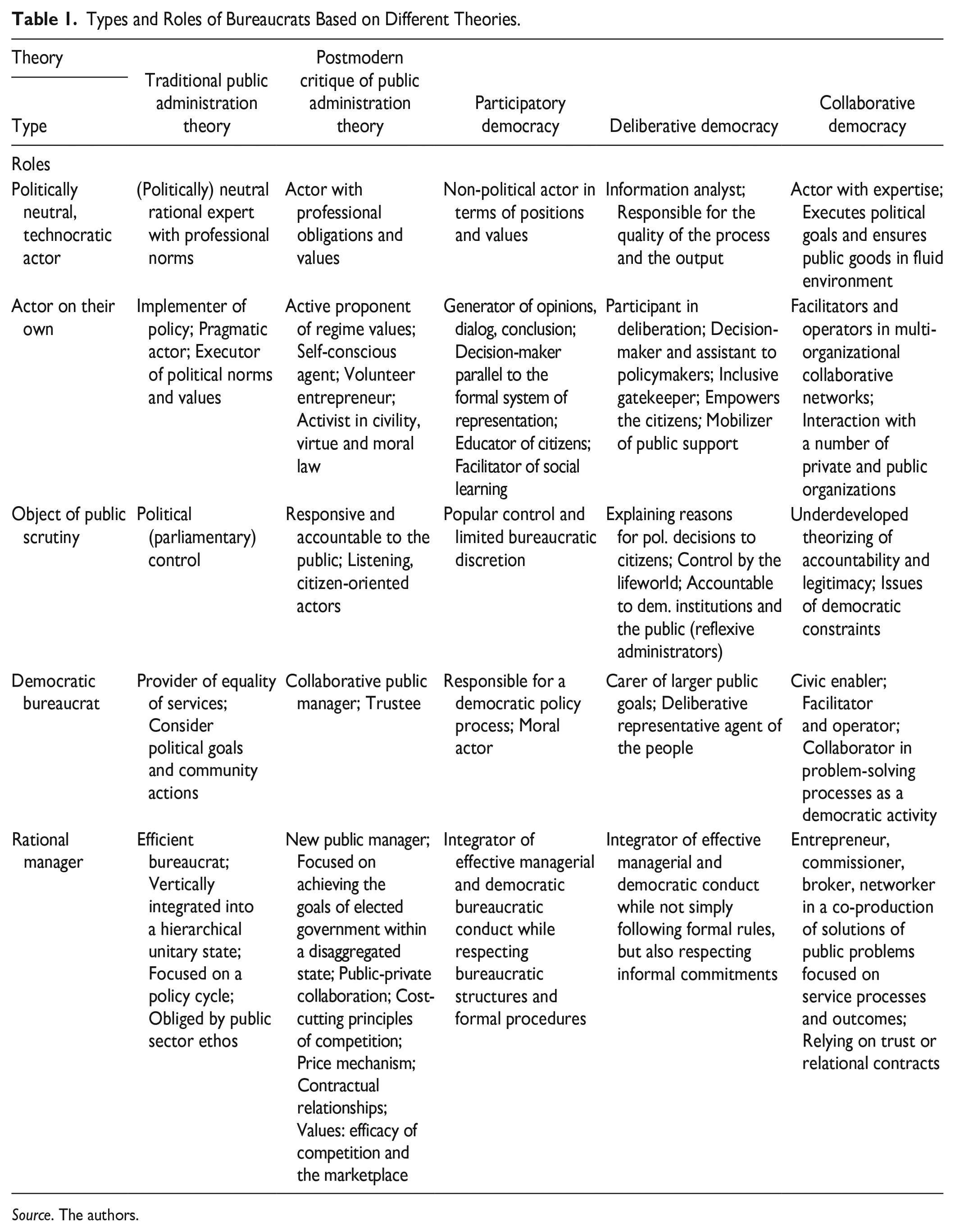
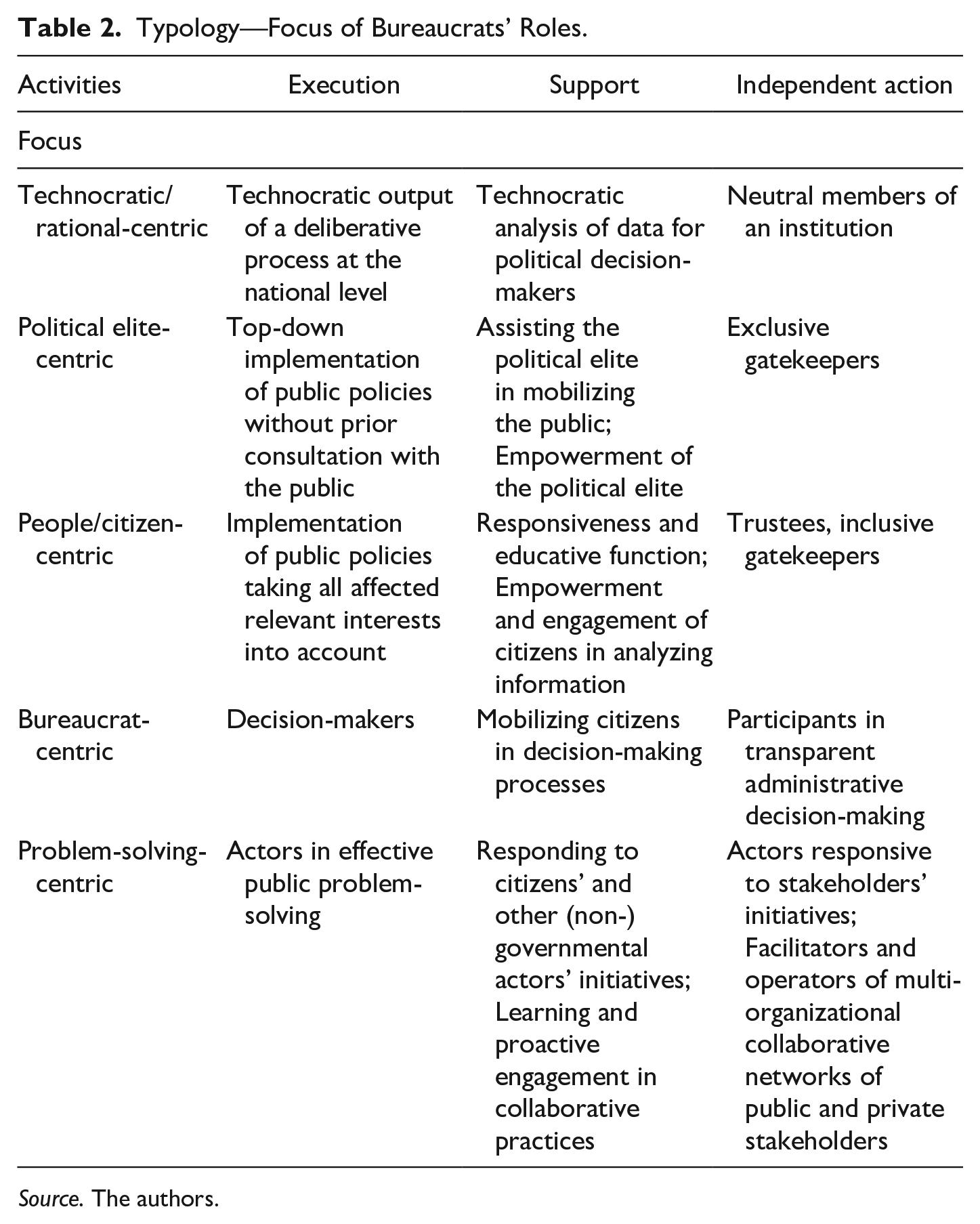
What particularly stands out in comparing fragmented views of the roles of bureaucrats are the distinctive bureaucratic types (shown in Table 1) and the relationships between bureaucracy and politicians as well as between bureaucracy and the public (shown in Table 2). We propose ideal types based on overall patterns within each theory. In Table 1 we distinguish five main clusters of bureaucratic types based on a review of the literature: (1) politically neutral technical actors, (2) actors on their own, (3) objects of public scrutiny, (4) democratic bureaucrats, and (5) managers.
Types and Roles of Bureaucrats Based on Different Theories.
Source. The authors.
Typology—Focus of Bureaucrats’ Roles.
Source. The authors.
In the critical response of
Finally,
The
To summarize, normative bureaucrats’ roles have been radically shifting from providing neutral service for political decision-makers and managers, whose interests, values, and beliefs have no impact on decision-making, to being relatively autonomous, responsible, inclusive, and pro-active promoters of the participatory practices involving affected citizens in deliberative and collaborative processes of decision-making and problem-solving. At the same time, the rational choice-based managerial dimension has led to an increasing proliferation of managerial roles.
Nevertheless, the key macro-focus leading bureaucrats’ activities has also evolved (Table 2). The technocratic/rational-centric view of bureaucrats goes together with the idea of them acting as technocrats to execute and support political decisions, as well as operating relatively independently within a neutral bureaucratic institution. Still, they may be more or less subordinated to political power and regime values. The political elite-centric focus leads bureaucrats to act as implementers of public policies formulated by political actors. They support, empower, and assist political elites to mobilize the public and act more independently as gatekeepers more open to privileged groups and interests.
The citizen-centric focus leads a bureaucrat toward being a responsive actor, who acts as an inclusive gatekeeper or trustee, and supports citizens’ participation, empowerment, and education, and executes public policies that are inclusive of all affected interests. The bureaucrat-centric focus sets bureaucrats’ central role in acting as participants, decision-makers, and mobilizers of citizens, while having discretion based primarily on bureaucrats’ democratic value orientations. The problem-solving-centric focus does not demand that bureaucrats prioritize their status in relation to other actors, but rather emphasize solving particular public problems.
Concluding Thoughts
Based on our analysis, we answer our first research question by finding that debates in the literature have indeed dynamically redefined the role of bureaucrats. The changing roles of bureaucrats may be observed in two dimensions.
Firstly, the formal (top-down) view perceives bureaucrats as experts and as effective and efficient agents who perform a supportive service for decision-makers while focusing on the implementation of policies designed from above. Secondly, the human (bottom-up) view redefines a responsible, public, and democratically oriented bureaucrat who is acting as a real representative of the people and serving the public by opening spaces for their active participation and deliberation within formal and informal institutional mechanisms.
Historically, the top-down view of the role of bureaucrats has been increasingly challenged and altered by the bottom-up view. However, these perspectives cannot be regarded as mutually exclusive. New and amended elaborations of the roles of bureaucrats have indeed generated several shifts. The previously rational and neutral bureaucrat is now becoming a self-awarded and values/ethics-oriented actor. Their efficiency is being evaluated according to their interactive and collaborative nature with citizens; their previous wide discretion is being limited by public and political scrutiny; and their expertise is being extended by taking into account knowledge and information from other stakeholders and citizens. The idea of democratically oriented bureaucrats who are receptive to public participation, more frequent deliberation and collaboration, and more diverse daily work, based on democratic values and ethics as well as rationality, has become a common pattern.
In answering the second research question of how redefinitions of bureaucratic roles and characteristics relate to the changing real world, we offer the thesis that such redefinitions have been evolving as responses to the practical problems of governing in representative democracies within complex post-modern societies in attempts to contribute to solving these problems. Solutions have been offered in terms of inventing increasingly pro-active autonomous types of bureaucracy.
All in all, various notions of public administration and bureaucratic roles and characteristics still exist, while current social changes and crises challenge all the existing theoretical approaches, but particularly the technocratic/ rational-centric one.
In line with the third research question, we have developed two typologies in a bottom-up manner. The typology of roles that bureaucrats are expected to play has shown that all the studied segments of literature have tended to multiply roles for bureaucrats, along with increasing expectations of public and political scrutiny, while at the same time effectively managing the processes for solving public problems. The typology including the activities and focus of bureaucrats’ roles has revealed how these are expected to be performed in relation to the bureaucrats’ autonomy and the focus of their activities.
Our analysis shows an obvious shift in bureaucratic normative roles from the hierarchical administrative state context to horizontal, networked bureaucrats’ relationships with civil society, public and private interests, and citizens in the context of an increasingly disaggregated and multi-level state. While the presented typologies are abstract and should be considered historically and contextually (including the literature, which has a Western-centric bias) (Meier & O’Toole, 2006), we believe it is interesting to see the following link: the more the nation-state has reached its limits in solving social and economic problems, the higher the normative expectations that have evolved for it to act as an integrative agent steering inclusive decision-making in the space between society and various state forms.
Nevertheless, the public administration theoretical contributions presented do not clearly determine how a democratic bureaucrat is defined or what the democratic relationships are between bureaucrats (public administration) and other actors (institutions) that could contribute to countering the authoritarian tendencies in the current world. They also do not clearly respond to current critical issues of radically increasing inequalities in society, power and political representation within national borders and globally, or issues of solving macro-economic, social and political conflicts in the context of multiple crises and extremely fast technological developments (particularly artificial intelligence). These are issues that are deeply linked with many ethical and moral dilemmas. This is why we second the call to capture holistically the relationship between bureaucrats and democracy, including the dynamic relationship among society, the economy, and the state, in addition to international and supranational milieus (Farazmand, 1999; Fleischer & Reiners, 2021). Although it is unrealistic to place responsibilities for solving multiple social crises on bureaucrats, it seems necessary to link public administration efforts with the efforts of other academic disciplines in terms of theoretical searches, empirical research into ongoing processes and practical contributions to help solve issues of the bureaucracy-society pact.
Indeed, our research speaks in favor of taking into account deep social changes, organizational structures and processes (Pedersen & Johannsen, 2016), politics (Meier et al., 2019), and organizational culture, as well as the political ideology and population heterogeneity (Groeneveld et al., 2015). The constant social dynamics and fluidity also call for more interdisciplinary collaboration, especially through research into the relations between public administration and public policy (Knill & Bauer, 2016; Stone & Maloney, 2019) and political science in general (Trondal, 2017), and governance (Farazmand, 2020) and international relations in particular (Trondal, 2016).
Finally, normative expectations of bureaucrats in the current world cannot be developed on their own but should be advanced in relation to the currently lacking theorizing regarding state and democracy (both its deconstruction and reconstruction). Linking the micro-, meso- and macro-levels in research is a pre-condition for the substantial (re)thinking of bureaucrats’ place and roles.
Footnotes
Acknowledgements
We would like to express our sincere gratitude to prof. John S. Dryzek (University of Canberra), dr. Patrycja Rozbicka (Aston University), and to the anonymous reviewers for their valuable and helpful comments and insightful feedback.
Declaration of Conflicting Interests
The author(s) declared no potential conflicts of interest with respect to the research, authorship, and/or publication of this article.
Funding
The author(s) disclosed receipt of the following financial support for the research, authorship, and/or publication of this article: This work was supported by the research grant P5-0136 funded by the Slovenian Research Agency (ARRS).
