




Abstract
This paper investigates the role of strategic artifacts in realizing change in two Swedish cities. Drawing from qualitative studies of city development projects we illustrate how ambiguous formulations in vision statements constitute a powerful basis for legitimizing actions. As part of establishing linkages between future-oriented vision statements and concrete actions here and now, we highlight the role of materialization. We provide three examples of how the vision statements studied materialized—into organizational structures, management control systems, and communication efforts—and discuss how such materialization implies that only some parts of broad vision statements are translated into practice.
Introduction
It is a trend for cities, in various governance constellations, to draft strategic documents (Brandtner et al., 2017; Kornberger & Carter, 2010; Rosenberg Hansen, 2011). This tendency can be understood as a consequence of new public management, in which public organizations mirror private ones in an attempt to enhance efficiency (Christensen & Laegreid, 2011; Johnsen, 2019). The role of these documents is generally claimed to be to present decisions, action plans, and other tools in the process of realizing the stated ambitions and measuring the associated development (Brandtner et al., 2017; Bryson & George, 2020; Kornberger, 2012). Strategic documents in the public sector are often drafted across traditional organizational boundaries through collaboration with actors from diverse parts of the organization, as well as with external stakeholders (Ansell & Miura, 2020; Hautz et al., 2017). Underlying this development is the perception that to address contemporary challenges such as climate change, urban segregation, and sustainability, actors must work together across boundaries in new and innovative ways (Metzger & Rader Olsen, 2013; Swyngedouw, 2007). However, research has shown that these documents tend to be abstract and vague (Abdallah & Langley, 2014; Allmendinger & Haughton, 2012; Gioia et al., 2012). This can give rise to “governance gaps” between what is agreed on at an abstract level and the resulting actions (cf. Pierre, 1999). Rather than studying how strategy becomes part of an organization, it is then important to consider how organizational actors transform their organizations “to create ‘fit’ with a new strategy” (Merkus et al., 2019, p. 4). In this paper, we investigate how such links between strategic documents and action are made and expressed through different forms of materialization. We are interested in one particular form of strategic document—the vision statement. Vision statements have become extensively used in municipalities as a way of articulating and steering what the city or municipality should become in the future. They are naturally abstract and vague, and typically present “glossy” futures of the cities in question. They have been criticized for merely presenting speculative and unrealistic dreams that seldom resemble the development that eventually occurs (Lauermann, 2020).
In this paper, we regard such vision statements as strategic artifacts (or tools), and we are interested in what happens when actors use these tools, rather than assuming their usage (Spee & Jarzabkowski, 2009). Strategizing always involves various material artifacts that influence the work being done (Rosenberg Hansen, 2011; Werle & Seidl, 2015), and applying this perspective responds to calls for more studies into strategy tools (Laamanen, 2017; Vuorinen et al., 2018). We thus advance research into the role of strategic artifacts in the public sector by illustrating how vision statements have led to changes and different practices in two Swedish cities. Our aim is to shed light on how these artifacts can become powerful as actors act upon them (cf. Abdallah & Langley, 2014; Gioia et al., 2012; Spee & Jarzabkowski, 2017). We argue that the ambiguity that characterizes strategic artifacts, particularly vision statements, paves the way for selective performativity. Here, we regard vision documents as a “performativity device” (cf. Cabantous et al., 2018; Kornberger & Clegg, 2011), as the vision is materialized only when actors act upon it (Leonardi, 2015). 1 To develop an understanding of what aspects of the visions that are more performative than others, and why, we explore three types of materialization that serve to link vague vision statements and other organizational actions.
In addition to making a contribution regarding the performativity of strategic tools, we also more generally aim to advance the literature on strategic management in the public sector (Brorström, 2017, 2020; Bryson et al., 2018; Ferlie & Ongaro, 2015). In this way, we also respond to calls for studies of how strategic thinking is applied in practice in the public sector (Johnsen, 2015), of how ambiguous ambitions are addressed in strategic management (Bryson et al., 2010), and of the effects of strategic planning (Johnsen, 2019). The paper is organized as follows. First, we outline a framework combining previous research into strategies in the public sector with theories of the role of strategic ambiguity. Then we present the two cases and the methods used, followed by our findings. We end the paper by presenting a discussion, conclusions, and avenues for future research.
The Public Sector and the Ambiguity of Strategic Documents
A strategy is perceived to be a modern tool enabling and creating change and is something that “proper” organizations are expected to have (Bromley & Meyer, 2015; Johnsen, 2019). Bryson (2011, pp. 7–9) defined strategic management as a “deliberative, disciplined effort to produce fundamental decisions and actions that shape and guide what an organization (or other entity) is, what it does, and why.” This definition affirms the importance of strategic management, as well as the articulation of strategic artifacts, noting that it comprises various elements, such as strategic planning, implementation, control, and evaluation (Bryson & George, 2020).
Langley (1988) claimed that strategic documents play an important role in inter-organizational communication and, as such, also in decision making. In the same study, Langley (1988) argued that strategic documents are important for creating legitimacy in public-sector organizations, implying that they play both internal and external roles. Strategic documents should not be seen as outcomes that end a chain of decision making but as “new beginnings” (Tekathen et al., 2019) that promise action in the future (Mouritsen & Kreiner, 2016). Kornberger et al. (2021) showed how strategic work in a city organization created a change of “thought style,” meaning that a vision created a new mindset in the people working in the organization. Strategic work could also be claimed to create what Bryson et al. (2009, p. 183) called a “way of knowing,” as the process always entails procedures and practices. For example, Brorström (2020) illustrated how change was triggered in a public organization by the mere process of drafting a strategic document, rather than by what was actually stated in the final document.
As noted, in this paper we consider vision statements as one specific form of strategic artifact. Vuorinen et al. (2018, p. 592) defined such strategic artifacts—or tools—as “models, frameworks or methods that shape the development of strategies.” By adopting a practice perspective, researchers have studied strategy tools as boundary objects (Spee & Jarzabkowski, 2009), as technologies of rationality (Jarzabkowski & Kaplan, 2015), and as vehicles of visualization (Paroutis et al., 2015). Researchers applying this perspective have shown that there is a blurry line between the development of new technologies and strategy implementation, meaning that the technologies “that are essential for implementing strategy also shape its making” (Leonardi, 2015, p. 20), making strategic artifacts performative (Callon, 2007; Merkus et al., 2019). Previous research has shown that the adoption of a strategic artifact can create tensions within organizations, for example, between the short and long terms, between the whole organization and its parts, and between reactivity and proactivity (Höglund et al., 2018). More specifically, Vaara et al. (2010) noted that strategic texts, such as vision statements, serve various purposes: “they communicate socially negotiated meanings, legitimate ways of thinking and action and de-legitimate others, produce consent but may also trigger resistance, and have all kinds of political and ideological effects, some more apparent than others” (p. 686).
The flexible and adaptive nature of strategic artifacts (Carlile, 2015; Eisenberg, 1984) suggests that ambiguity is always involved when visions are to be realized (e.g., Rainey, 2009; Steane, 1999). Gioia et al. (2012) claimed that this ambiguity can be beneficial because it lets actors feel included and allows for their own interpretations. Broad participation arguably improves the strategy process by giving different stakeholders a sense of “ownership” that creates commitment to the formulated strategy (Bryson et al., 2018; Hautz et al., 2017). Similarly, Spee and Jarzabkowski (2017) argued that ambiguity provides a mechanism that enables multiple meanings to coexist and enables diverse actors to construct different meanings and thereby be satisfied. Ambiguity is thus a tool for accommodating multiple perspectives and interests (Davenport & Leitch, 2005), and can even be interpreted as a prerequisite for change to occur at all, as Allmendinger and Haughton (2009) argued in their study of the Thames Gateway. They found that “fuzzy boundaries” and “soft spaces” are requirements in highly complex change processes characterized by uncertainty. Such fuzziness, they argued, often provides necessary “room for strategic and tactical manoeuvre” (Allmendinger & Haughton, 2009, p. 631).
Strategic ambiguity also entails dilemmas, however. Sonenshein (2010) highlighted that ambiguity can lead to confusion about how to act or even lead to resistance (also see McCabe, 2010). Moreover, Ogbonna and Harris (2002) argued that ambiguity entails the risk that the change process could be hijacked by interested parties. In other words, people with particular interests and intentions may exploit the ambiguity of strategic documents to legitimize their actions. This means that ambiguity can be both a prerequisite for and a hindrance to action—what Abdallah and Langley (2014) have called a “double-edged sword” (also see Sillince et al., 2012). Against this backdrop, we here focus on the link between vague, highly inclusive vision statements and the materialization of these statements. As only some parts of broad vision statements tend to become translated into further organizational practices (here understood as a selective performativity), we need to develop understandings of the processes by which statements are turned into practice. We examine two Swedish municipalities to explore three types of materialization that turn vision statements into (certain) activities.
Method
We base our analysis on two in-depth studies of the Swedish cities of Gothenburg and Varberg, chosen because, at the time of study, they were undergoing major urban developments guided by explicit strategic visions launched in relation to these developments. Gothenburg is located on the west coast and its 570,000 inhabitants make it the second most populous city in Sweden. Varberg is also located on the west coast, about 1 hour from Gothenburg, but has only about 27,000 inhabitants. The two cities are within the same geographical area but are very different in size, giving rise to different conditions when visions are formulated and implemented. A point of departure for our study was to explore whether and how the launch of new vision statements led to any changes in decisions about how work with the visions would be divided, organized, and coordinated, and how such decisions were justified. Also, to obtain a sense of whether such decisions mobilized additional organization and specific actions, we were interested in understanding how these changes were described, perceived, and handled by employees in their daily work. It is important to note that our aim here is not to compare the cities but to use them as two illustrative and complementary examples of how city visions can be materialized and mobilize change.
Data Collection
The empirical data were collected between 2014 and 2017. In Gothenburg, the River City vision was adopted by the city council in 2012, which is when the work of realizing it began. In Varberg, the city developed and adopted a new vision in 2011, and since then the vision has been explicitly applied and talked about in the municipality. We conducted interviews with people who in various ways were involved in realizing the vision statements in the two cities. Some of the interviewees were involved in drafting the visions, but many became involved only after that process. We selected people to interview in various positions at all levels: steering committee directors, middle managers of the project management group, project leaders of the subprojects, communication officers, politicians, external contractors, and journalists at a local newspaper. During the study period, a total of 47 interviews were conducted, 25 in Gothenburg and 22 in Varberg.
The interviews were conducted in two phases: (a) a pilot study to obtain an overview of the ongoing changes and the background and workings of city development processes and (b) a main study involving a large number of semi-structured interviews to deepen our understanding of the organizational complexities involved and how, where, by whom, and why the visions in the two municipalities were activated in these processes. The interviews in Gothenburg were conducted by one author, while those in Varberg were conducted jointly by the two other authors. The interviews lasted 45 minutes to 1.5 hours and were recorded and transcribed verbatim.
Data Analysis
To analyze the data about the vision statements and how they were applied, we divided the work into three phases. In the first phase, the research team developed a joint understanding of the empirical data. After reading all the material (i.e., interview transcripts and documents) individually, the team members discussed the empirical findings from the two cities in several meetings. This meant that we were able to identify patterns and ways of categorizing the empirical findings and to develop an overall joint understanding of the role and impact of the vision statements in the two cities.
In the second phase, we returned to the literature on performativity and the role of the materialization of strategic documents. Through a process of iteration between our empirical data and theory, we were able to advance our analysis and develop interpretations of the actions identified as different types of materialization. This allowed us to elaborate on different types of materialization evident in the empirical data. Our discussions focused on what characterized the division of labor and coordination of work connected to and justified with reference to the visions in the two cities. One conclusion from these discussions was that both cities had decided to establish new project organizations for the vision realization work, which also included hiring new staff, although in quite different ways. Structures for decision making and management control as well as the emphasis on communication efforts stood out as relevant to the vision realization work, although it was not clear how.
The purpose of the third phase was to further develop the identified analytical categories and evaluate their relevance and applicability. This was done through discussions within the research team devoted to making sense of similarities and differences between the Gothenburg and Varberg cases, enabling us to narrow our analytical framework to three specific categories: organizational structures, management control and performance measurements, and communication efforts.
The first category, that is, new organizational structures in terms of project organization and new positions, was, as noted, an analytical category of materialization emerging from our previous discussions in phase two. Early in the study and analytical work, we identified that in one of the cities, Gothenburg, the project organization consisted of employees working for both the new project and the regular divisionalized organization, while in the other city, Varberg, it consisted of staff hired specifically and solely for the new project. We moreover identified differences in the decision-making capacities of the two project organizations depending on their distance from the political management. However, the two additional categories called for further discussion and work during this final phase.
The second category, that is, new structures for management control, including structures for performance measurements, had also been identified early on as a relevant category. However, here we observed rather different situations in the two cities, and it was not self-evident how to define the category and what to include in it. While Gothenburg struggled with how to control and measure the output of the work, the situation in Varberg appeared rather non-problematic. In the end, we found these differences to be important and of great interest in that they informed us about diversity and conditions of materialization work in relation to aspects such as the size and culture of the municipality.
As we know from other studies that communication is highly performative, from the outset we considered communication of the vision to be central to all types of materialization. It was not until later in our process, however, that we decided to define communication efforts as a third, distinct category. We believe that the promotional animated films produced in both municipalities are illustrative examples of how strategic documents can become performative through materialization in specific types of communication. Our studies demonstrate how such materialization legitimized certain actions and decisions, leading to a selective performativity. Below we provide a detailed account of the research settings of our two studies, followed by a presentation of our main findings sorted according to the materialization framework presented above.
Research Setting: The Vision Statements of Gothenburg and Varberg
Gothenburg—open to the world. In 2012, the city council of Gothenburg adopted the vision “River City Gothenburg—open to the world” along with three strategies to provide guidance on how to realize the vision. These strategies mirrored the three dimensions of sustainability and were formulated as: “Connect the city,” which aimed at improving social inclusion; “Strengthen the regional core,” which aimed at improving business conditions; and “Meet the water,” which focused on ecological factors and on developing areas near the River Göta Älv. The year 2021, when the city turned 400 years old, was highlighted as a year when intense development was to be seen in the city. However, to achieve all the intended changes, the project leader of the drafting process acknowledged that they needed to work in new, innovative ways. Moreover, the vision document included a graphic model of what the city needed to do to achieve the vision. This model consisted of the concepts collaboration, learning, participation, and leadership, which together were to help realize the vision. The model also highlighted the importance of working across organizational boundaries, and a key phrase was “the whole city,” implying that all departments and municipal corporations needed to be involved.
Varberg—the creative hotspot of West Sweden. In 2011, the city of Varberg developed and adopted a new vision, “Creative hotspot of West Sweden 2025” or, briefly stated, “Varberg 2025,” describing it as follows: Varberg’s position, with the sea and the surrounding countryside, offers unique opportunities. To take full advantage of its potential, Varberg is to become “the creative hotspot of West Sweden”. This will require new ways of thinking, enterprise, knowledge, and boldness. The vision creates conditions for growth throughout the municipality and a fantastic environment in which to live. (Varberg, 2016a)
Varberg’s vision articulates two core values: sustainability, referring to future generations’ social, economic, and ecological needs, and participation, referring to an open and inclusive decision-making climate. The municipality’s website presents the aim of the vision: to influence the municipality’s internal work, and to constitute “a guiding principle that will help us to move in the same direction” and “guide the work of the municipality in everything from goal formulation to action plans.” Although the municipality did not previously have a vision, it did have a tourism slogan, “Varberg—Sweden’s spa,” conveying an image of Varberg as a location for relaxation. Some interviewees said that a vision was necessary, not least to move away from the old tourism slogan that they claimed over-emphasized stability and signaled reluctance to change. Moreover, as described by one official, Varberg municipality had been recognized as “municipality of the year for growth” in 2010, intensifying discussion of how to increase the focus on growth as well as on change and creativity.
Although these vision statements belong to two very different cities, they are rather similar in their focus. They tap into current societal trends such as sustainability, inclusion, diversity, and collaboration as well as growth and creativity. These broad concepts are well suited for vision statements as they are attractive, future oriented, and can be interpreted by many different actors in different ways. As we show in our analysis below, in their materialization, the visions trigger and legitimize very different and often rather specific activities.
Findings: Materialized Visions in Two Swedish Cities
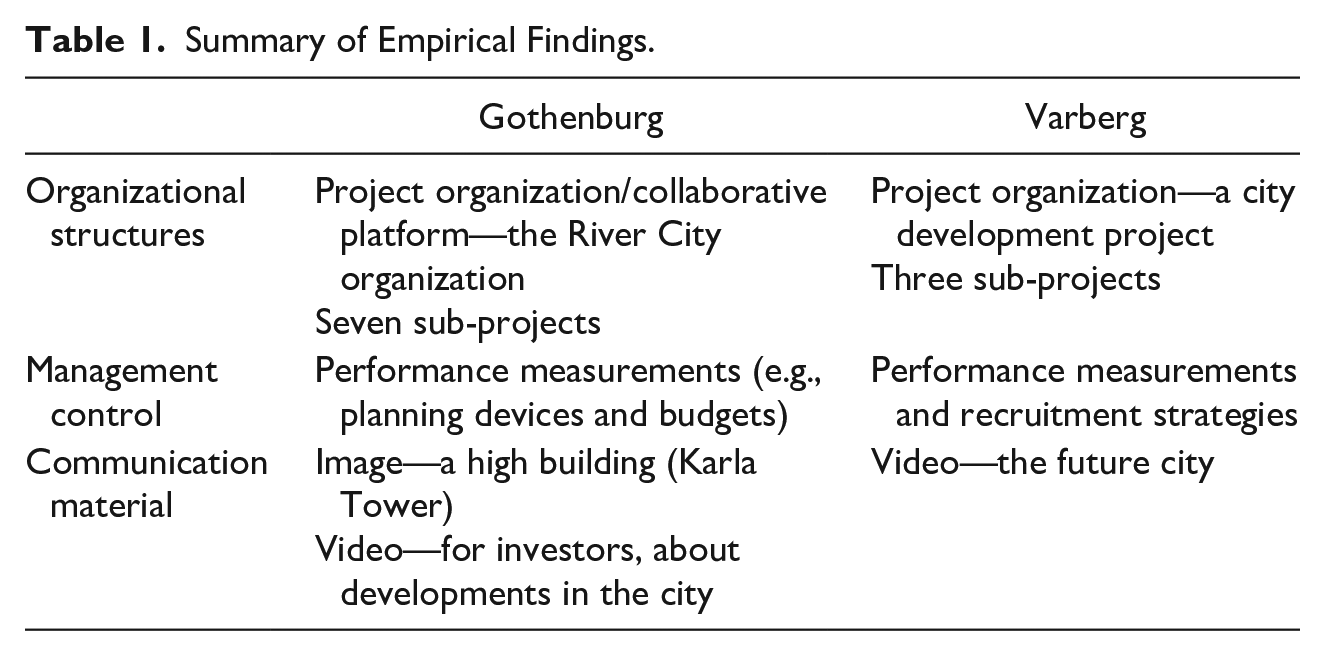
In this section we present our findings regarding Gothenburg and Varberg, and develop and discuss the three types of vision statement materialization we identified. Table 1 summarizes the findings that we develop later in the paper.
Summary of Empirical Findings.
Materialization Through Organizational Structures
After the adoption of the vision document in Gothenburg, discussions were held to determine the most suitable organizational form to implement the proposals, and it was decided to establish a “project organization.” This organization, the River City Organization, which consisted of a steering committee of the directors of different municipal departments and corporations, met once a month and was tasked with the quality control and approval of ongoing work. A “project management group” consisted of middle managers from the same municipal departments and corporations. This group was responsible for the operational work of realizing the vision and strategies. The next organizational level consisted of seven sub-projects, one for each of seven city districts, each with two project leaders responsible at the micro level for realizing the vision and strategies in their respective areas.
Soon after the launch of the process, the participants raised the concern that the organization was not a typical project organization, since it lacked both an organizational mandate and a budget. It was more of a “collaborative platform,” some argued, and all decisions were to be made by the involved municipal departments and corporations. However, the steering committee members could determine what decisions should be made in their respective home organizations, and subsequently make those decisions in their organizations. One interviewed public servant said that even though the steering committee did not make decisions jointly, its agreements had implications: “The steering committee has a great impact – it would stir up heaven and earth if we did not do as agreed on here.” (Public Servant 4)
This collaborative platform was a forum for discussing different aspects of what the visions implied, but was criticized for being a “talk organization” rather than an “action organization,” in which details were discussed but seldom resolved. This criticism implied a focus on trying to establish routines, performance measurements, and an organizational structure that could respond to the criticism. However, the focus on how to organize the vision’s realization resulted in discussions of what the vision statement actually meant being downplayed in favor of discussion of how to organize and stabilize the vision. This happened through the creation of measurements of when and how change was expected. Organizing the vision realization across boundaries at the same time as decisions were to be made within the regular organization implied that it was unclear to whom the project leaders should report progress or whom to ask for resources. One project leader said: What issues should I raise? What issues should I not raise? What issues should I raise in the River City Organization and what issues should I raise in the line organization? (Project leader 1, River City Organization)
In practice, this often meant that the project leaders either tried to resolve issues themselves or raised them in both the project and line organizations, with sometimes conflicting results. How to organize the materialization of the vision proved to be a greater challenge than initially anticipated, and several interviewees said that it was difficult to make people change their usual way of doing things. For the project leaders, the vision was a document that indicated a direction, but its vagueness and abstraction made it difficult to describe the consequences of the vision in detail. One project leader said that the vision was a tool with which to question suggestions and to say “no” to certain proposed developments. The project leader said that it might be easier to say what the vision does not imply than to describe in detail what it does imply.
In the city of Varberg, a new project organization was also established to implement the vision, but with quite different consequences. For decades the city had tried to find ways to increase the capacity of a local single-track railway. Although different possibilities had been discussed and debated over the years, nothing had been decided on. Similarly, attempts to move one of the ports had been initiated earlier without success. However, Varberg adopted its vision in 2011 and only 1 year later new organizational structures were in place—a new city development project had been launched. The project consisted of three sub-projects: (1) constructing a double-track railway through a new tunnel; (2) moving Varberg’s two ports—the smaller one for the ferry to Denmark and the larger industrial one mainly for forestry product transportation—away from the city, creating a new urban area by the sea; and (3) creating a large area for urban development—the West Port area—in a central and attractive location where the single-track railway and the two ports used to be.
While previous efforts to change parts of Varberg had met with considerable resistance over the years, the decision to organize and structure these particular changes into one joint project was made smoothly, even though these changes did not obviously or intuitively belong together. Leading politicians and officials involved in developing and implementing the new vision expressed high hopes regarding the city development project with its reconfiguration of the West Port area, directly citing the vision and its message of creativity, boldness, and growth for the municipality as a whole. The new West Port residential area was furthermore framed as a solution to the problem highlighted by the vision: the municipality’s housing problems in relation to expected growth. The other two sub-projects were combined to form an attractive overall “solution”: moving the port, which had not previously been seen as an important or prioritized change, became justified and legitimized because it was a prerequisite for realizing the West Port development.
In fact, the organizational structure of the city development project created an internal hierarchy among the sub-projects. The West Port residential area stood out specifically, constituting the foundation of the entire project and largely being used to legitimize and justify the other two sub-projects. The hierarchy was also mirrored in the organization: the West Port project manager was not only responsible for one sub-project but also had a coordinating function for the entire project, and most of the newly hired staff members were working on the West Port sub-project.
However, our analysis also shows how the West Port project “stole” attention from the other two sub-projects in terms of resources, political support and decision making, dialogue activities with citizens, and media exposure. Various ideas were discussed about what should fill this new area in the best possible part of the city—a mix of housing types, commercial and public spaces, green areas, and cultural activities. In many ways, West Port was presented as a way to realize ideas about developing the city of Varberg into the creative hub mentioned in the new vision. One journalist from the local newspaper even described moving the port as a “non-issue,” as it was expected to result in a better and more efficient port to be open to the general public. Still, the political decision to move both the ferry and industrial ports lacked detail and was decided on rather late in the process, in 2012. “Well, there is a lot of attention on building a new city, the tunnel, and the station. That’s really the goal. The port is a side issue.” (Public servant D)
In this way, the West Port sub-project—the vaguest sub-project with the longest timeline—turned out to be the focal project, legitimizing and justifying the changes needed for the other city developments. This sub-project became the repository of the expectations of politicians, public servants, journalists, and citizens, creating engagement among the participants.
In both cities, the visions were materialized through new organizational structures in the form of projects. However, the projects differed in structure and format and thus also played very different roles in terms of status and mandate in their respective municipalities. In Gothenburg, the project organization turned out to be rather complex and intertwined with the regular organization, so decision-making processes slowed down. In Varberg, the project organization was created as something separate from the regular work of the municipality. This created a situation in which the project could work in isolation and therefore experienced less need to anchor its decision-making processes in other parts of the municipal organization. In other words, the Gothenburg organizational setting emphasized values of “participation” and “collaboration,” while the Varberg setting was more guided by the values of “growth” and “creativity” and by the idea of innovative and “bold” decisions. In terms of materialization through the organizational structures, the similarities between the two visions were reduced and rather different values were emphasized, guiding the vision realization work.
Materialization Through Management Control
In Gothenburg we observed how one specific challenge was that of translating the ambiguous vision into performance measurements and other management control systems, such as planning devices and budgets. One reason for these efforts was that public servants felt that they needed a way to demonstrate to the politicians what they had accomplished in both the short and long terms. However, the vision was broad and abstract and thus not easy to translate into concrete performance measurements or other control systems. One interviewed manager said: “A vision is a mindset . . . but now we will not benefit from an overly abstract discussion. We will benefit from a discussion of how to make this realizable. (Public servant 1)
Another problem concerned the inherent long-term effects of urban development and of the vision extending to 2030, at the same time as it was perceived as important to continuously demonstrate progress, even at an early stage of the process. Some interviewees described this as “stressful” and a few even said that too many different projects, which in Gothenburg consisted of city districts to be developed, had started simultaneously. The risk was that there would be insufficient human and financial resources to realize all the developments at the same time. Starting several projects simultaneously can be interpreted as a way of showing ambition and attracting investment to the city. Internally, this became a “Catch 22,” however. Having high ambitions that could be translated into organizational objectives was a means to show politicians that the River City Organization should be allocated funding in the next budget process. These high ambitions were thus a means to attract attention to the projects, but if the politicians did not allocate the needed resources, the projects would end up with overly ambitious objectives but insufficient resources. Related to this was the practical problem of translating the vague, qualitative concepts highlighted in the vision, such as “green,” “inclusive,” and “socially sustainable,” into concrete measurements. A predicted problem was that when it came to concrete action, aspects that could be measured in financial terms would be prioritized, whereas aspects that were difficult to translate into measurable indicators would fall by the wayside. This dilemma prompted discussion of the new competences needed in the city organization to realize the vision in practice: “There are people here who understand that we need other competences than engineers and architects or economists, that we need social competence as well.” (Public servant 2)
More specifically, given the focus of the Gothenburg vision on being innovative, trying new ideas, and abandoning old ways of working, new experts were recruited to take responsibility for issues such as social sustainability. Playing such expert roles proved difficult in a collaborative setting, however, since these experts were responsible for issues but had no mandate to make decisions regarding them. In practice they were the “vision carriers,” while the city managers were busy discussing details and asking for performance measurements.
In Varberg we also observed the vision being actively used in exerting management control over recruitment work and the performance measurement of municipal activities; however, we did not observe, to the same extent, discussions of difficulties in translating unmeasurable values into quantifiable indicators. What was measured and emphasized was also narrower and more focused on growth, boldness, and creativity—in recruitment ads, for example, “boldness” and “creativity” were highlighted as attractive personal characteristics. The recruitment of a new chief executive who had never lived or worked in Varberg was in line with the local “identity journey” described by yet another official. According to this person, Varberg residents were moving away from what had been characterized as quiet small-town life toward something associated with growth, creation, and dynamism, a change occurring not entirely without resistance. One aspect that the interviewee said reinforced this identity journey was the large number of newly recruited officials working on the ongoing city developments.
Several public servants confirmed that the vision was central and did influence how employees were thinking and acting, with consequences for the types of suggestions that gained a hearing in municipal decision making. One interviewee, for example, said that the new vision was central to his decision to start working for Varberg municipality. Other interviewees related similar stories: For my part, I can tell you that it [i.e., the vision] was one of the reasons I signed [the employment contract here]. That’s how strong I felt it was. . . . It’s very much a living part of my daily work and what goes on around me. (Public servant G)
Yet another person explained that the vision made “the difference” for the work in the municipality (Public servant K). The vision’s keywords— “new thinking,” “enterprise,” “knowledge,” and “boldness” —could be used in daily work to explain to co-workers why certain decisions or initiatives were necessary. The vision provided direction; the interviewee continued: “It may be vague but it’s still a shared direction.” Moreover, there were efforts to develop a follow-up system similar to that used in ordinary governance based on a goal and performance model. Up to 2016, a kind of “vision list” had been used so that employees could “tick things off,” that is, items identified as helping the municipality realize the vision. As a next step the plan was to develop “checkpoints” enabling the municipality to prove that it had actually “delivered,” as one interviewee put it (Public servant G). The reporting system was intended to make it more likely that the vision would be followed, that is, de-emphasizing old views and habits and replacing them with more “modern” ones. Another result was that only selected aspects were measured and reported, with values such as creativity and boldness emphasized to a greater extent than, for example, social sustainability or participation, restricting the focus of change that would be rewarded and thereby reinforced.
These examples of management control structures illustrate how materializations of the vision help distinguish the categories of “desirable” and “less desirable” residents and officials, that is, those included in the vision of the future and those not fitting in. The vision shaped expectations regarding the municipal employees’ initiative and willingness to change. It was obvious that the vision and its ideas of creativity and growth had taken root among the employees when it came to the plans and proposals for West Port: a new housing district would allow new residents to move to Varberg, it was argued, since the attractive housing would appeal to them and also create opportunities to locate additional amenities in the area. In our interviews, many ideas were expressed regarding the potential establishment of international collaboration with a university, museum, or opera house, so that West Port would become a “meeting place for knowledge, culture, and creativity—not just a place to live” (Public servant C). The same official cited examples of desired activities connected to ideas of growth and creativity in the form of a highly educated workforce moving or commuting to the municipality and the creation of favorable conditions for companies to establish head offices in Varberg.
In both cities, we identified how the visions were materialized via management control in terms of performance measurements and recruitment strategies. Particularly in Gothenburg, this gave rise to discussion of whether it was really possible to translate broad and fuzzy vision concepts into specific measurements. Simultaneously, the materialization through management control often appeared to be seen as inevitable and self-evident. To “prove” that the municipality was on the “right track” toward the future, the visions needed to be translated into some kind of performance. Yet going from “fuzzy” visions to concrete measurements and control systems could decouple the ambitions articulated in the documents from the actions based on what gets measured.
Materialization Through Communication Material
In Gothenburg, the abstraction of the vision was discussed from the outset as a potential problem, but it was also stated that it was important not to go too quickly into detail since a vision should be “a feeling.” However, soon after the vision was adopted, images and concretizations were needed and sought by the city administration, media, and other stakeholders. One example was a suggestion from the construction company Serneke to build the highest tower in the Nordic countries, the Karla Tower, consisting of a mix of housing and workplaces. When drafting the vision, the project leader had stated that the vision was not about high buildings, but soon after its adoption, the vision was interpreted by Serneke to mean just that. In a newspaper article in the city’s daily newspaper, the CEO of Serneke argued that the tower would be a good representation of the intentions underlying the vision. Since the vision was abstract, this was possible. Construction of the Karla Tower has begun, and although many think that the tower will be beneficial for the city, this process taught the city administration that they need to control what is and is not framed as in line with the new vision. This was one reason for a decision to increase the emphasis on communication and associated materials. A key player in this process was the municipal corporation RiverSide Development, which recruited communicators to disseminate its intentions regarding the vision. One interesting example of a communication effort was a 5-minute video produced by the RiverSide Development communication unit in 2016. The video was not intended to illustrate how the city would look in the future, but to show investors that considerable development was to occur in the city. The video was produced to be shown at MIPIM, the construction exhibition held each year in Cannes, though it ultimately travelled to different settings. One interviewee explained: It [i.e., the video] is a bit rough, so to speak, and it was not for the public, but when it was released there was such a need for an overall picture. About 100,000 watched it in just a few weeks and people still watch it. (Public servant, RiverSide Development)
The interviewees concluded by saying that the vision is what inspires all their communication.
In Varberg a video about the future city was also produced, by the municipality’s own communication group linked to the city development project. The video production was seen as a public relations effort undertaken to implement the new vision, and the animated video was to be shown in conjunction with a major campaign during spring/summer 2014, which consisted of various civic dialogues regarding the plans for the new West Port district. The individual responsible for communication regarding the city development project explained that the message the municipality wanted to communicate in the video came directly from the vision. The following extract from the video script clearly illustrates the strong imprint of the vision, particularly the goals of growth and of becoming the creative hotspot of West Sweden: Growth brings competitiveness and more contact with those around us, which has positive benefits for the municipality as a whole. Our everyday life is enriched through diversity and new opportunities for choice, but as we grow in number, we also need to expand the town with new housing, workplaces, and infrastructure for everyone. We want Varberg to be the creative hotspot of West Sweden by 2025. (From the video Varberg utvecklas, see Varberg, 2016b)
The representative of the video production company described the project group from Varberg as very decisive and clear about the desired message: They wanted to explain the future – where they wished to go – in a positive way. They also wanted to explain why they should go there. They needed to do this because times were changing . . . They had an idea: “So, who are we in Varberg? Well, we know we’re quite creative. We’re growing. There are a lot of different things to do. We have a fantastic environment. We have a lot of summer visitors, but there are also lots of people who live here all year round”. (Interviewee, video production company)
The project group was also clear about the animated format, which the production company had used in a project for another municipality. The advantage, explained the interviewee from the production company, is that one can explain a great deal very quickly by including many details in the form of symbols, while the imagery does not show as much detail in the form of exact depictions of artifacts such as plans, buildings, and people. In other words, animations allow one to present one’s message very clearly, while conveying the sense that nothing has been finally decided and that matters remain open to interpretation. In the Varberg video, the message is positive and free of conflict: the focus is on summer and sunshine, uplifting music, and people enjoying themselves, apparently in their free time (cf. Ferring, 2015).
Our interviewees described the production process as under great time pressure, since the municipality was in a hurry to complete the video. Simultaneously, the process was described as going smoothly and quickly because the commissioning group was small, the task was clear, and decisions could be made quickly: They’d done their homework, they knew what they wanted, and they didn’t hesitate but could say “yes” or “no” straight away. . . . They really wanted [to achieve] change by showing this [video] and to make people understand. (Interviewee, video production company)
Both videos discussed here exemplify the materialization of visions in which growth and creativity are specifically emphasized as natural elements. However, in the case of Gothenburg, it was, among others, an outside stakeholder—a construction entrepreneur—who used the municipal vision by citing it in the media and framing the company’s building plans as in line with, and responding to, it. In the case of Varberg, the video was produced by the municipality itself in an effort to frame the ongoing urban development, particularly the sub-project for the new West Port residential area, as emphasizing growth and creativity.
Discussion: Ambiguous Visions as Tools to Highlight and Obscure
This paper sheds light on how abstract vision statements—as a specific form of strategic artifact—may become “vehicles of change” in various and subtle ways (cf. Gioia et al., 2012; Kornberger, 2012). Our study illustrates how materialization of the strategic artifact can make strategic documents performative (Kornberger & Clegg, 2011), something that more generally contributes to an understanding of strategic artifacts in the public sector (Höglund et al., 2018; Rosenberg Hansen, 2011). Specifically, we have discussed three types of materialization identified in the empirical material: (a) new organizational structures and positions labeled according, or with direct reference, to core concepts of a vision; (b) management control systems (e.g., performance measurement systems and formal criteria for recruitment processes); and (c) communication material (e.g., promotional videos and campaigns as well as citizen dialogues).
We show in this paper how the ambiguity characterizing strategic artifacts, an ambiguity particularly salient in vision statements, paves the way for selective performativity. While the vagueness of vision statements may be powerful in terms of offering actors plenty of latitude for action, this action will not happen by default or by itself. We show that even though the three types of materialization discussed here appear to be rather neutral and even insignificant, they highlight certain aspects of the vision statements while obscuring others. This suggests that if we want to advance knowledge of how strategic artifacts may create change, we must turn our analytical lens to how materializations are being implemented.
First, in both cities, the city organizations expanded as a result of the visions adopted. In Gothenburg the vision led to an ambitious organizing process and discussions of the future organization of the city. In this way, the vision spurred organization and created a platform for collaboration among civil servants, politicians, and other groups in the city. The vision gave impetus to meetings and to “creating something together”; at the same time, this intense and resource-demanding work was criticized for being restricted to employees engaged in the management teams established specifically to work on the vision, and for not enabling “real” change. In Varberg, the vision conveyed expectations that public servants would act with “boldness” and “creativity” and be “fast” in decision-making processes, ideas that gained power and legitimized large-scale changes, some of which had previously been debated but never led to substantial projects.
Given the expanded organizing processes and the new skills required, the two cities needed to recruit new competencies: expertise in collaboration and sustainability in Gothenburg, and individuals experienced in large city development projects and aligned with at least some values of the vision (e.g., creativity, fast growth, and boldness) in Varberg. In this way, the visions could be interpreted as ways to change the identities of the two cities, the images of the future cities, and their inhabitants. In a sense, the visions were ways to start “identity journeys” that developed rather differently in the two cases. Nevertheless, in these cases, materialization became a way to link the far-fetched and blurry ideas of the future of the cities with the here and now.
Second, we saw how the visions and their implementation led to increased focus on management control and the development of control devices (cf., French & Mollinger-Sahba, 2020). While the materialization of the vision statements in the form of performance measurements was characterized by intense discussion and seen as complicated and problematic in Gothenburg, it was a very different process in Varberg. In Varberg, such materialization appears to have been rather unproblematic; in addition, the control devices, which developed in a stepwise manner, seem to have been more flexible and open. For example, in Varberg, the concepts of creativity and boldness were emphasized in the vision, legitimizing a new type of decision-making process characterized by swiftness and creativity, whereas more traditional, bureaucratic decision making was not only criticized but also sometimes avoided. Although the materialization of performance measurements differed greatly between the two cities, the processes in both places can be seen as ways of making the vision manageable, filling in its governance gaps (Brandtner et al., 2017).
Finally, although the vagueness of visions can attract broad public support, their broad, vague character may also make the visions difficult to control, as they are open to various interpretations and applications. This means that a wide range of organizational activities can be legitimized through communication efforts referring to abstract visions (cf. Desmidt & Meyfroodt, 2018). Our findings show that materialization can be accomplished through, and allow for, the engagement of multiple actor groups with interests in a certain municipal development. In the case of Gothenburg, we noted that a construction company used the vision to legitimize and frame its own projects, whereas in Varberg, the animated video emphasizing growth and creativity was made by a management team connected to the new city development project.
Previous research has identified both the downsides of and opportunities afforded by ambiguous strategies (Abdallah & Langley, 2014; Sillince et al., 2012). Our analysis illustrates this well: even though the vision statements were ambiguous, they still produced certain frames that both enabled and constrained change (e.g., Höglund et al., 2018; Sillince et al., 2012). The decisions on adopting the visions were evidently “new beginnings” (Mouritsen & Kreiner, 2016) that led to action, and certain proposals and decisions were intensely debated and legitimized with reference to the visions, while others were downplayed and sometimes not even debated or treated as formal decisions. This implies that one consequence of visions is that they lead to discussion, making it legitimate and even necessary to address issues that have not been up for discussion before. This confirms previous research arguing that strategic texts foster communication between organizational levels (Langley, 1988; Vaara et al., 2010), but we further show how this, due to the noted types of materialization, is a highly selective process. Not everything is up for discussion.
Conclusions: Decoupling Versus Selective Performativity
Vision statements, here regarded as strategic artifacts, do not contain power per se; rather, some kind of “actorhood” is needed to make them performative and produce change. In this paper, we have highlighted the role of materialization in terms of organizational structures, management control systems, and communication material as a way for actors to link vague visions to actual practice. While materialization emphasizes certain aspects, it simultaneously tends to ascribe power to the vision, delegitimizing and obscuring initiatives not framed in terms of its core concepts. In other words, materialization makes static vision statements come alive, and can even change the initial intentions or goals underlying the formulations in the vision.
With this analysis, we contribute to the literature on how the vagueness of vision statements can be a means to initiate, govern, and accomplish change in cities. In both Varberg and Gothenburg, the visions were means of determining what was right and what was wrong. Although it was difficult to state exactly what the visions meant in detail, it was easier to say what they did not mean. As they expressed mindsets rather than plans of action (cf. Kornberger et al., 2021), these vague visions could be seen as tools for deciding when things were not in accordance with the underlying aims. When it came to specific projects, the visions could be seen as tools making it possible to advocate those projects or changes, as illustrated by the examples of West Port in Varberg or the Karla Tower in Gothenburg, where the visions indeed became performative. The projects were then stabilized through the organizational systems enforcing the need for change, by means of performance measurements and control systems.
Previous studies have shown that it can be difficult to produce change through reforms and the adoption of new management systems, due to various decoupling practices that tend to reinforce business as usual (Bromley & Meyer, 2015). What we see in our study of Varberg and Gothenburg, however, is that ambiguity embodied in visions can become a means to both justify and limit change, illustrating its “double-edged sword” character (Abdallah & Langley, 2014). This makes visions potentially strong tools for both promoting and restraining change, not despite their vagueness but because of it.
Our analysis illustrates how actors in the studied cities devoted much effort to creating change with the help of the vision statements, and we have highlighted organizational structures, management control systems, and communication efforts as three examples of materialization. We contribute to the literature on strategic management in the public sector by showing that materialization in practices available and known to city actors can be a forceful way of realizing a strategic artifact and making it performative (cf., Merkus et al., 2019). This may, however, be a highly selective process. This in turn explains why actions based on vague visions become different in different organizations, and why organizations can adopt similar visions, yet act very differently (Abdallah & Langley, 2014). This is arguably a strength of such visions as well as their greatest drawback. A well-known example is the United Nations Agenda 2030 with its 17 Sustainable Development Goals (SDG), which many organizations are striving to reach, yet in different ways. The upside is that the SDGs, through their vagueness, allow for a variety of interpretations, materializations, and actions. Yet, whether or not those actions contribute to the bigger goals is still unclear. Not least, the inclusive and broad nature of strategic artifacts can create a very specific selective performativity in which actors in powerful positions can create linkages through materializations that match their own self-interests. This vagueness, the role of materialization, and the consequences of broad aims—such as Agenda 2030 and the SDGs—merit further investigation in future studies.
Footnotes
Declaration of Conflicting Interests
The author(s) declared no potential conflicts of interest with respect to the research, authorship, and/or publication of this article.
Funding
The author(s) disclosed receipt of the following financial support for the research, authorship, and/or publication of this article: The authors would like to acknowledge the financial support of Vinnova, project DECODE – Community Design for Conflicting Desires (2016–03724), Mistra Urban Futures and the city of Gothenburg.
