




Abstract
Since 2015 Dutch street-level bureaucrats have ample discretionary space to determine how to help clients. Simultaneously, resources were reduced. According to Zacka SLBs should avoid three pathological positions: indifference, caregiving, and enforcing. At the individual level SLBs supposedly accomplish that by a gymnastics of the self. We observed SLBs. They avoided the pathological positions by (1) reframing the reigning policy for clients (enforcing caringly) and (2) managing clients’ self-image, bolstering their confidence, or tempering their expectations (caring forcefully). SLBs practice a gymnastics of the client alongside a gymnastics of the self. SLBs thus make the reigning policy palatable for clients.
Introduction
In 2015 the delivery of welfare services in the Netherlands was decentralized to the local level. Youth care, care for people with disabilities and psychiatric problems, long term non-residential care for frail elderly, welfare policy for the long-term unemployed, and sheltered work for people with disabilities, all became the responsibility of municipalities. This decentralization went hand in hand with a drastic budget cut of 20% on average (De Rijk, 2018; Van Nijendaal, 2014).
The implementation of these significant policy changes is done by street-level bureaucrats (Lipsky, 1980) working together in “integrated neighborhood teams.” Street-level bureaucrats (from now on: SLBs) are public employees who interact directly with citizens and have substantial discretion in the execution of their work (Lipsky, 1980; Weatherley & Lipsky, 1977, p. 3). When Lipsky wrote his seminal book in 1980 he observed a tendency to reduce SLBs’ discretionary space, but he did not think this was desirable or even feasible. The nature of SLB work was such that it could not be reduced to programmatic formats (Lipsky, 1980, p. 15). Nor should it be divided into specialized packages, as this would lead to SLBs who would only see segments of their product and would not be confronted with the full outcomes of their decisions (Lipsky, 1980, p. 77).
Yet in the 1980s policy-makers were inclined to disregard this advice and introduce ways and means to monitor and direct their SLBs. Under the banner of New Public Management (Hood, 1991), policy-makers decreased SLBs’ discretionary space and urged for specialization in the name of expertise and efficiency, as we will explain in Section 2.
Recently, however, the tide has changed once more, away from specialization and toward integration and wider SLB discretion. Present-day SLBs (or at least the ones that we study in this article) operate in what is referred to as a catch-all bureaucracy, an institution charachterized by wide leeway on the one hand and tight budgets on the other. Watkins-Hayes (2009) defines a catch-all bureaucracy as “an institution whose work is intimately tied to responding to a variety of individual- and family-level issues and concerns that are directly or indirectly related to severe economic and social disadvantage” (p. 13). In a catch-all bureaucracy, SLBs resist specialization and fragmentation; they have a broad range of integrated tasks for the same clients, ranging from support with finding work and health care to dealing with debts, and problems with parenting.
SLBs working in the US agencies tasked with assisting the poor in the first decade of the 21st century that Watkins-Hayes (2009) studied resemble those working in the Dutch neighborhood teams we studied. Both the American and the Dutch SLBs have been granted large discretionary space, much more than they used to have in previous decades. Watkins-Hayes (2009) observed that her SLBs were subject to “seemingly contradictory impulses of surveillance and support” (p. 13), as the enlarged discretionary space came along with budget cuts; SLBs were supposed to meet their clients’ needs as they saw fit, but simultaneously had to guard their agency’s budget. Dutch SLBs in integrated neighborhood teams find themselves in a similar situation. On the one hand they are expected to deal with all their new responsibilities in coherence, that is help out with all problems that may plague their clients, varying from wayward children and youngsters, to substance abuse, marital problems, housing problems, and health-related issues. The term integrated in integrated neighborhood teams refers to policy makers’ hope that such problems are best dealt with in coherence, not by specialized SLBs who observe just one segment of their client’s situation. On the other hand, neighborhood teams are admonished to operate within a tightly limited budget, which substantially reduces SLBs’ room to maneuver.
In this article, we will investigate how SLBs deal with these contradictory demands: providing integrated care to their clients under the constraint of budget cuts. In the next section we will first briefly discuss how our study can be positioned in the SLB literature from Lipsky (1980) onward and explain what theoretical lens will be used to interpret our data. Subsequently, we will explain our methodology: observations of neighborhood teams and their clients in various Dutch municipalities. In Sections 4 and 5 we will report our findings and we will end our article with an answer to our research question and reflections on SLBs in catch-all bureaucracies.
Contradictory Demands in SLB Encounters
Since Street-Level Bureaucracy was published in 1980 the policy context has changed a lot. We discern three phases. The first phase was what Lipsky (1980) wrote about: broad tasks and ample discretionary space for SLBs. This was followed by a policy shift toward New Public Management (NPM) with specialization and little discretion (Brodkin, 2011; Ellis, 2011; Nothdurfter & Hermans, 2018). NPM aimed to model the public sector after the private sector, with tight but distant government control by way of performance measurement. In this way, the government would steer rather than row (Bryson et al., 2014) and give “public managers more freedom, politicians more control and public service users more choice” (Pollitt, 2003, p. 26). Hood (1991) identified seven doctrinal components, including “shift to greater competition in the public sector” and “stress on private sector styles of management” (pp. 4, 5).
NPM defined in terms of competition and private sector-inspiration only could have left SLBs’ discretionary space intact. However, “explicit standards and measures of performance” and “greater emphasis on output controls” (Hood, 1991) did curtail SLBs room to maneuver. Many researchers studying NPM in action conclude that it has indeed decreased SLBs’ discretionary space; that is, their personal agency and authority granted by the institution to make decisions. NPM has negatively impacted SLBs’ discretionary space by increasing their accountability toward managers, peers, and clients (Hill & Hupe, 2007). Governments’ performance measures were translated into performance measures on the lower levels of organizations, departments, and individual workers. Studies into the effects of performance measures found that they actually distort performance and erode responsiveness (Brodkin, 2007). Soss et al. (2011) have shown how performance measures are a form of coercive power that drives SLBs to discipline the poor.
Scholars suggest that the heydays of NPM are behind us (Bryson et al., 2014). Negative effects of, among other aspects, performance indicators and output controls, have led to new ideas on governance and management (e.g., Moore, 1997, 2013). Hence NPM was followed by a third phase that SLBs still find themselves in today: a return to broader tasks and larger discretionary space for SLBs reminding of Lipsky’s (1980) days, but now with much tighter budgets. Some SLBs—like the ones we study in this article—have tasks that are even broader than in Lipksy’s days; these SLBs work in Watkins-Hayes’s (2009) catch-all bureaucracy. SLBs working in catch-all bureaucracies address a wide range of problems that trouble their clients in coherence (Watkins-Hayes, 2009, p. 13). Watkins-Hayes (2009) shows that many SLBs appreciate this, because it gives them the chance to do holistic work with clients (pp. 102, 103). Elderly SLBs are reminded of the way they used to operate in the past. Clients benefit from the integrated approach, because it allows SLBs to be more responsive to their needs.
While catch-all bureaucracies give SLBs increased room to maneuver, they also present them with a set of contradicting demands. According to Watkins-Hayes (2009), SLBs in catch-all bureaucracies are their clients’ first responders and last resort simultaneously (p. 31), since they offer a bare minimum of services and act when no other options are open. They take on a unique role in the lives of disadvantaged families, but at the same time have to limit clients’ reliance on them. The 2015 reforms in the Netherlands have created catch-all bureaucracies, much like the one that Watkins-Hayes (2009) studied in the US after the introduction of the Personal Responsibility and Work Opportunity Reconciliation Act in 1996. SLBs in integrated neighborhood teams in the Netherlands are also subject to contradicting demands. On the one hand, they have the assignment to be more responsive (by visiting clients at their homes, engaging in so-called kitchen-table conversations and discussing their clients’ full range of problems), but on the other hand they have be more strict, as the reform came with serious budget cuts and SLBs are instructed to tell clients to demand less from paid social services and turn to their social network instead.
We aim to find out how SLBs cope with the current situation of more discretion on the one hand, but much tighter budgets and therefore also probably less discretion on the other hand. To research this, we build on the empirical studies of other researchers who already described what strategies SLBs have developed to cope with contradictory demands. A systematic literature review by Tummers et al. (2015) describes three “coping strategies,” which we will discuss below. The three strategies are also present in the work of Zacka (2017), but in a slightly different way. Watkins-Hayes (2009) discerns two strategies that are comparable to two of those identified by Zacka (2017) and Tummers et al. (2015). All these strategies have their own risks, or, as Zacka (2017) puts it “pathologies,” which result from narrowing down to one modus operandi at the expense of others.
A first strategy has to do with identifying with the needs and perspective of the clients, and keep focusing on fulfilling these needs, despite external pressures that make this more difficult. Tummers et al. (2015) label this strategy “moving toward the client.” This can be done, for example, by bending the rules in their favor, breaking the rules, or investing personal time or means to help them. This was the most frequent coping strategy found in the literature review that Tummers et al. (2015) performed. Zacka (2017) also found this strategy and labels it one-sided caregiving. A caregiver SLB is committed to serving the needs of clients and conceives of their job as a mission to live up to high ideals of service (Zacka, 2017, pp. 92, 93). Watkins-Hayes (2009) identifies this as the “social worker” approach; trying to help out clients in all sorts of ways, some of which creative and suitable for the client, others more questionable, for example, offering clients a medical way out if they are not up to paid employment. Caregiving may sound attractive but Zacka (2017) warns that caregiving also “gives clients a perverse incentive: it rewards them for letting their despair be visible (. . .) it encourages them to present themselves in the most unfavorable and helpless light—in a way that may unintentionally contribute to undermining their own sense of self-respect.” (chapter 2). Moreover, using personal time and resources to help clients will probably benefit a small part of the clientele; those who are deemed especially deserving, especially needy or both.
The second strategy consists of making the opposite move: instead of focusing on clients’ needs, SLBs here focus on the rules and regulations that they are faced with, to maintain equity despite possibly different needs. Tummers et al. (2015) call this “moving away from clients.” This is done, for example, by limiting hours of access, or standardizing services when tailor-made help would have been more effective. Zacka (2017) labels this (one-sided) indifference. An indifferent SLB puts people processing first in order to achieve equity. Therefore, indifferent SLBs remain distant and refrain from giving clients individuating features (Zacka, 2017, p. 92), again for good reasons, because equity or equality before the law is an important moral value. However, persistently failing to see clients’ individual needs may also become pathological. This strategy is comparable to what Watkins-Hayes (2009) calls “efficiency engineering”: trying to distinguish between problems rightly put before the SLB and problems that they would rather not address; efficiency engineers in Watkins-Hayes’s (2009) research sometimes refused to dig deeper to find out what was really troubling their client.
The last strategy focuses on the client, like the first strategy, but this time to correct and control them. This is what Tummers et al. (2015) call “moving against the client.” This strategy was least found in the literature but still present in 19% of the studies under review, and especially prominent among policemen and social workers. Zacka (2017) labels this strategy (one-sided) enforcing. A one-sided enforcer places social and legal norms at the center of their role conception. While caregivers are driven by a desire to fulfil their clients’ needs, enforcers are first and foremost preoccupied with sanctioning the undeserving. Like caregiving this is prima facie commendable. Enforcing becomes pathological, however, when a SLB rigorously follows the rules, discounting disadvantages, such as the fact that enforcement can be quite resource intensive; chasing wrongdoers at all cost “takes time and detracts from the fast pace of everyday work” (Zacka, 2017, p. 108).
These three strategies are understandable, considering the pressures on SLBs in a catch-all bureaucracy, but they are also problematic. Zacka (2017) sees all three strategies as pathological. By that he means that in response to impossible situations, SLBs show reductive behavior, and simply focus on one goal while neglecting others. He argues that the three pathologies can be avoided, at three levels: individually, in SLB teams and on the level of the organizations. At the individual level, SLBs develop three “everyday gymnastics of the self”: 1. self-examination to uncover biases and proclivities, 2. calibration to regulate personal involvement, and 3. modulation to shape the nature of their involvement (pp. 141–145). On the group level “informal moral taxonomies” help SLB to avoid the pathologies, while on the organizational level this is done by peer group consultation. These three types of practices help SLBs to stay clear from pathological behavior and develop a “spirit of moderation.”
Recent empirical studies suggest that SLBs indeed manage to steer clear of the pathologies. Hand (2021) and Hand and Catlaw (2019) studied a nutrition program in Arizona; she concludes that SLBs working for a program aimed at low income, vulnerable mothers with the risk of stigmatizing their clients, were very respectful toward them, since their communicative practices related to the principles of an ethic of care offered the potential for resisting stigmatization. Thunman et al. (2020) conclude from their research at the Swedish social insurance agency that the call-takers combine “rule compliance with responsiveness to the situation at hand by using the limited resources available, that is, using a variety of conversational forms when offering intermediary assistance” (p. 1357), again suggesting that these are SLBs who manage to avoid the three Zacka (2017) pathologies. De Winter (2019) observed encounters at welfare offices in the Netherlands, using the concept of “responsive regulation,” which states that SLBs usually start by being friendly and resort to a more punitive approach if that does not produce the desired behavior in the client.
The SLBs in these different researches seem to be able to find middle-ground between or combine strategies. Research into the way SLBs do this in catch-all bureaucracies is urgently needed, since a catch-all bureaucracy as the combination of very wide discretionary space and tight budgets is especially challenging. Zacka (2017) has researched SLBs in a catch-all bureaucracy, but he does not dig very deeply into the empirical details of the interaction SLBs have with clients, during which they maneuver between the three pathologies.
Our study aims to fill this empirical void by answering the following research question: (how) do SLBs working in a catch-all bureaucracy deal with contradictory demands during their interactions with clients? Following Zacka (2017), we will operationalize this question as: how do SLBs avoid the three pathologies (care-giving, enforcing, and indifference)? In other words: we intend to find out if and how SLBs in a catch-all bureaucracy manage to stay in the middle of a theoretical triangle, with three vertices: indifference, care-giving, and enforcing. Because of our data (mostly observations of encounters between SLBs and clients) we will focus at Zacka’s (2017) individual level, that is, we will look at SLBs’ gymnastics of the self, not at peer group consultation at the organizational level.
Research Setting and Methods
The 2015 reforms in the Netherlands have made municipalities responsible for youth care, non-residential elderly care, and care for people with chronic (psychiatric) illnesses or disabilities. Municipalities can organize care—within limits—as they see fit. For example: elderly citizens who are housebound because of medical problems may be helped by an electric wheelchair, but they may also benefit from a volunteer who comes by and takes them for an occasional outing. Or they may be transported to a daycare center where they can volunteer or perform recreational activities. Or they may be helped by their own children or neighbors if these are admonished to lend a hand. Dutch municipalities may carve out their own policy with regard to this and other vulnerable target groups. Municipalities may organize the help directly by employing (social workers as) civil servants who then hand out services to needy citizens. But they may also hire welfare organizations to do the actual work, for instance by organizing tenders and having welfare organizations draw up plans with accompanying budgets. The municipality (civil servants and aldermen) can subsequently choose which plan suits their policy.
Most municipalities chose to install neighborhood teams (Van Arum & Schoorl, 2015). Neighborhood teams consist of professionals with different educational backgrounds, work histories and expertise, including professional social workers, district nurses, psychiatric nurses, occupational therapists, welfare officials, and debt counselors. Neighborhood teams have ample latitude to help clients as they see fit. Simultaneously they are usually expected to save costs and to make do with as little public assistance as possible. Neighborhood teams therefore are good examples of catch-all bureaucracies.
This article uses data collected as part of a large-scale research project. For this research project six municipalities were selected in different parts of the country. The research team aimed for variety regarding the ways in which neighborhood teams were organized. In each of the six municipalities, one neighborhood team was selected. The researchers tried to select neighborhoods that were representative for the diverse set of problems that neighborhood teams face in the six municipalities. This came down to a selection of (partly) poor but not utterly deprived neighborhoods. Between January 2015 and July 2017 a team of researchers observed neighborhood teams members during encounters with clients, usually at the clients’ home, in so-called kitchen table conversations. The team made 127 observations of house visits of members of these neighborhood teams—the SLBs of this study—and conversations between clients and these neighborhood teams members. During these observations the researchers made notes about the interaction between clients and neighborhood team members on an observation protocol form. The notes of the observations were later elaborated in computer files. The form requested researchers to describe the setting of the conversations, the actions and talk of the SLBs, and the responses of clients and others present. All observations were described as detailed as possible in digital log books and discussed during weekly meetings of the research team.
At the start of each observation, the researchers informed participants about the aim of the research and the anonymization of all data. They then asked participants orally whether they agreed (thus acquiring informed consent). We use pseudonyms in this article to refer to SLBs and clients. No formal ethical approval by a board and written consent forms were required according to Dutch regulation in 2015, the starting date of the project (The Netherlands Code of Conduct for Academic Practice, 2014).
The research was commissioned by five municipalities, the Dutch ministry of Internal Affairs, organization GAK (a large organization that funds research pertaining to social security or labor market developments) and Actiz, a branche organization for elderly care. The changes in the Dutch welfare state inspired several research questions; hence the focus of the observations was not restricted to the topic of SLBs operating in a catch-all bureaucracy. Researchers also looked at what happened in families when family members were admonished to provide more care to the family member who applied for public assistance (Bredewold et al., 2019). For policy makers it was especially relevant to see if additional informal care would be available.
Many SLBs in neighborhood teams had a background in social work. By the end of the twentieth century social workers had gone through a process of specialization. They specialized in specific types of problems (e.g., financial problems, addiction, and marital problems) or in specific groups of clients (youngsters, the elderly, and women). Operating in a catch-all bureaucracy meant putting an end this specialization. Many people suffer from multiple problems, if only because problems in one part of life tend to cause problems in others (addiction causes financial and marital problems; unemployment may lead to financial problems and psychological or emotional problems in families). Our research team also set out to observe the effects of the move toward despecialization (which was also part of Watkins-Hayes’s, 2009 research in the US, cf. Appendix A of her book).
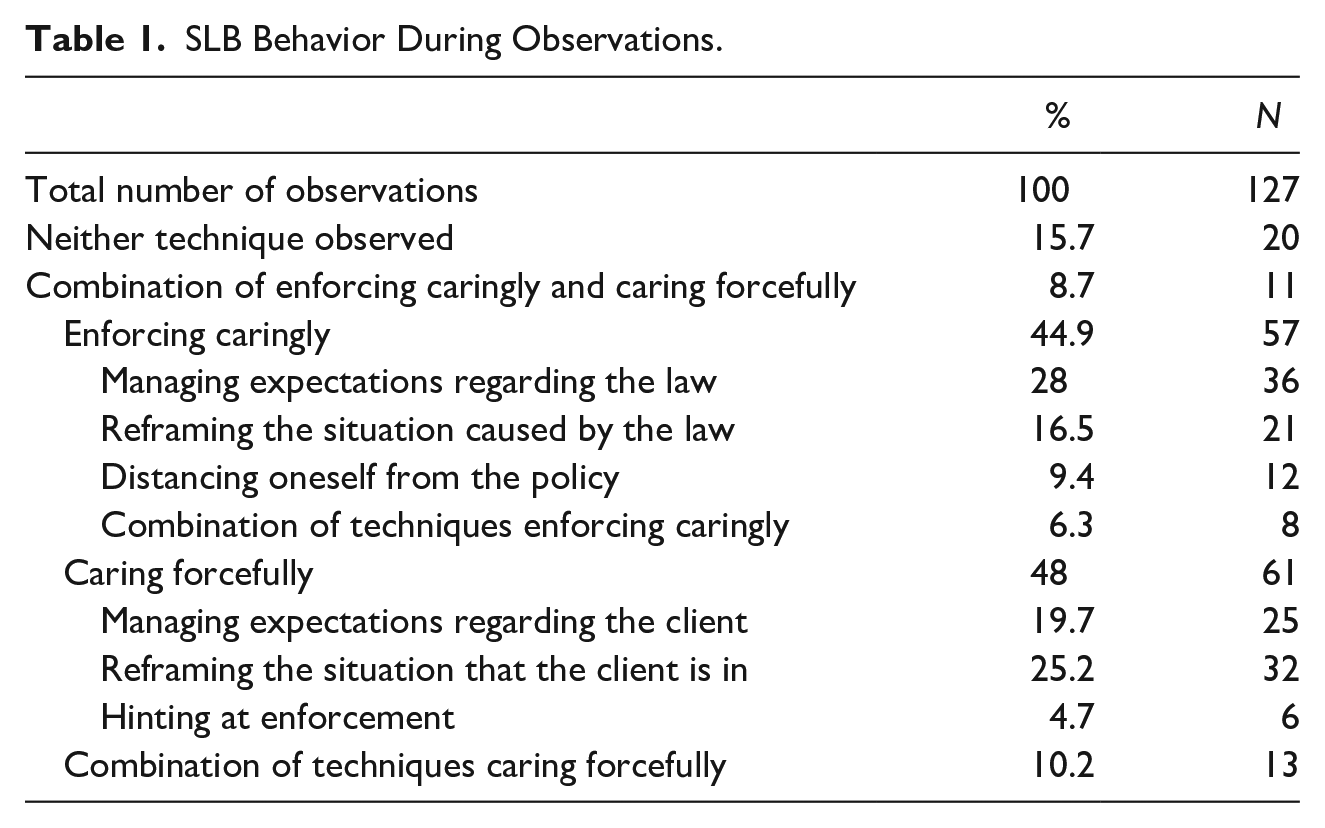
The coding process was done inductively and a collaborative endeavor of the research team involving the multiple research angles that inspired the research project. After ample discussion of the data ATLAS.ti was used for the final coding. Since the coding was done inductively and in great detail it allowed us to re-analyze the data for this paper. First, we selected all codes that had a bearing on either of the three Zacka (2017) pathologies. Second, we discussed how the codes related to either “care,” “indifference,” or “enforcement.” However, after trying to classify the SLBs within one of the three approaches we realized that most coded interactions were examples of a combination of two approaches. Therefore, lastly, we recoded our material in more detail with regard to these combinations, which allowed us determine in what ways SLBs managed to avoid pathologies. We recoded our observations in two broad categories, each consisting of three subcategories, as can be seen in table 1. The categories will be explained in the next sections.
SLB Behavior During Observations.
Enforcing Caringly
Our analysis of the interaction between Dutch SLBs and clients shows that SLBs find ways to combine different roles in order to help clients and simultaneously restrict their access to care and welfare arrangements. They either enforce, but caringly or they care, but forcefully. So even though they seem to be placed in an “impossible situation,” SLBs do not slip into one of the three pathologies that Zacka (2017) pointed out. “Enforcing caringly” means that SLBs apply the rules but at the same time try to take their clients’ feelings into account. “Caring forcefully” means that SLBs are convinced the client needs care and should accept it. The techniques used in performing these two roles are similar but with a different twist. In this section we will discuss “enforcing caringly.” We observed this technique in 57 of the 127 conversations. In Section 5 we move on to “caring forcefully,” which we observed in 61 conversations. The two techniques were hardly ever combined; in only 11 cases we observed both in the same conversation. Not during every house visit or conversation we observed one of the two techniques; there were 20 cases in which we observed neither. These conversations were about undisputed matters like the fitting of a wheelchair for someone who was clearly in need of one, the continuation of a care arrangement that all parties involved thought was necessary, or they were just conversations about the current affairs in the lives of clients who received regular support from SLBs.
However, in around 85% of the conversations we witnessed either “enforcing caringly” or “caring forcefully.” SLBs who “enforce caringly” enforce the law, but do so in a caring way, by showing interest in clients’ feelings or actions, or by explicating how enforcement is also in clients’ interests, as it will help them in the long run. SLBs “caringly enforce” the law in three ways: by managing expectations (N = 36), by reframing the situation (N = 21), and by distancing themselves from policy (N = 12). During eight house visits two or more of these three techniques were combined in the same conversation. We will describe all three strategies by giving our most illustrative empirical examples.
Managing Expectations Regarding the Law
The most common technique to caringly enforce rules and regulations is managing clients’ expectations regarding the law. Before SLBs visit clients that apply for services, a part of this enforcing work has already been done. For instance, clients’ expectations are managed during the first interaction they have with the integrated neighborhood team that handles their request. Telephone conversations prepare clients for disappointing decisions.
Researcher: I can hear how workers steer for a reduction of care services to save costs. Whenever they talk to people on the phone about a request for household help or support I can hear them say that the kitchen table conversation will probably lead to a reduction of household help. Clients are forewarned that way. Observation 34, 24 April 2015, Municipality A
This way clients expect to receive less care than previously, and this paves the way for SLBs to apply the new rules rather strictly when visiting clients.
During the actual kitchen table conversation SLBs often try to manage expectations further. In the following example the SLB tries to manage expectations about a possible claim in the future.
Daughter asks about the length of the arrangement. (. . .) What if [her mother] will need more care in the future? (. . .) “If anything changes, you can contact us”, says the SLB. “But that doesn’t mean she will get more daycare. More days of daycare do not necessarily produce more happiness. Providing services is not always good for people”, she repeats. Daughter says that she hears that all the time.
Observation 52, 7 December 2015, Municipality B
While managing her client’s expectations, this SLB makes clear that access to care does not equal happiness. This kind of reframing resembles the second way of enforcing caringly that we have observed and will discuss later on.
SLBs also manage the expectations of clients regarding welfare benefits. For example clients who need to accept that being on benefits entails a loss of freedom.
Client: “Maybe I just want to be in control of my life? I want to do as I please . .” SLB: “Yeah, well you could say that when you had a job, but not anymore. You’re on benefits now.”
Observation 196, 16 November 2016, Municipality A
Other unemployed clients must learn to push themselves harder. Like the client in the next observation. The SLB starts off by making clear that she cares about what he has been doing, and when it turns out he did not make an effort to find work, she criticizes this lack of initiative:
SLB: “I haven’t seen you around for a couple of months. What have you been doing with yourself?” “Hanging out on the street”, says the client. “Doing this and that. Family stuff.” Today is actually his grandmother’s birthday, but he won’t go because of this appointment with the SLB. The SLB observes that “this and that” is not enough. The municipality expects something more useful from him.
Observation 74, 2 December 2015, Municipality C
In this observation, the SLB is enforcing caringly: enforcing by pointing out that there are expectations that he has to live up to, but caringly since she also shows interest in his whereabouts and does not only check whether he fulfilled his duties.
Reframing the Situation to Enforce the Law
The second way of enforcing caringly is by reframing the situation in such a way that it softens the blow for clients (N = 21). In the next observation the SLB explains the rationale behind the law to a client who has applied for paid taxi transport on account of her poor health. The law is caringly enforced by presenting restricted access to a provision as being in the client’s best interest.
SLB: “If you need to go to hospital for treatment your health insurer will pay. But for other things . . Let me put it this way. The law says that giving you a provision may hamper convalescence. It’s like with electric wheelchairs. If you drive around in an electric wheelchair all the time, you won’t recover.”
Observation 100, 16 February 2016, Municipality B
Besides making clear how unrestricted access to services would hinder recovery, SLBs also equate restricted access to rights with something positive. In the following example the client has asked permission to move to another house because of her medical condition, but she does not qualify and her SLB presents the rejection as something positive:
SLB: “You may look at it from the bright side. Apparently, you are still fit enough, that’s why you don’t qualify for another apartment. That’s nice, don’t you think? There are other people who are a lot worse than you. You don’t need it yet.”
Observation 92, 13 April 2016, Municipality A
Reframing the situation and inviting the client to view her situation from another angle is a way of enforcing caringly; the rules are enforced by putting a positive spin on the self-image of the client.
Another way is offering a frame of reference that makes the client’s situation look better. For instance, by telling them arrangements are worse in other municipalities.
SLB: “So, we will send you a new decision. We have to see what happens.” He explains that household help has been abolished completely in another municipality, but this is not going to happen here. “Here people still get to choose, that’s nice, isn’t it?”
Observation 61, 25 November 2015, Municipality B
SLBs sometimes suggest a hypothetical frame of reference to legitimize restricted access to care. This SLB tells his client that for now cutbacks are only made on the number of hours, while at the same time suggesting that further budget cuts in the future might eliminate household care altogether.
“I can’t predict how things will be in two years. We haven’t heard about strange ideas coming from the government, but there are severe cutbacks. In this municipality we solved it by decreasing hourly wages, but I can’t guarantee anything for the future. Do you understand that?”
Observation 66, date unknown, Municipality B
Notice how reframing the situation is often also a way to manage the client’s expectations. The two ways of enforcing caringly are sometimes applied at the same time.
Distancing From Policy
Besides managing expectations and reframing the situation, a third way of enforcing caringly is by distancing oneself from policy (N = 12). This strategy is in line with what Zacka (2017) calls “dissolution”: “seeking shelter behind the protective shield of rules” (p. 146), suggesting that SLBs are simply doing their job. In the following example the SLB feels that the policy is too harsh on clients and therefore he distances himself from it by making clear that he is not as indifferent to the client’s situation as it may seem:
“This has absolutely nothing to do with you personally. The laws have changed. There’s different laws now and they are more severe.”
Observation 92, 13 April 2016, Municipality A
In this observation, the SLB enforces by pointing out the rules, but in a caring way, by showing she understands the client’s feelings.
In yet other cases SLBs distance themselves from policy by letting the client know that they are just the messenger. Like this SLB who discussed household help with a female client:
The SLB explains that the municipality gets half as much money as before. “That’s a lot”, says the woman. The SLB explains that it will be even less next year. He has heard about new policy principles. They will no longer clean the whole house; they won’t even do the bathroom every week. “That is beyond me”, says the SLB. “I don’t like that, it’s not getting any better”, says the client. The SLB explains that the new policy will only start next year and it’s still a bit unclear what will happen. But it won’t be better, for sure. “It’s not your fault”, says the woman. “It’s tough on you that you have to tell everybody.” “Part of the job”, says the SLB. “It started in 2008, with cleaning windows, remember?”
Observation 61, 25 November 2015, Municipality B
The SLB in the household help example again enforces the rules by underlining them, but in a caring way, by showing he sympathizes with the feelings of the client. He thereby actually caringly enforces policy in two ways: he manages expectations before distancing himself from policy.
In sum: enforcing caringly entails that the SLB manages a client’s expectations to soften the blow. This is often times followed by an attempt to reframe the situation and have the client look at the bright side of the rejection: rejection means that the client is too healthy to qualify for help; or: things could have been worse, in fact things áre worse in other municipalities. Lastly, SLBs caringly enforce the law by distancing themselves from a policy that is in their eyes too indifferent or too harsh. In the next section we will discuss a second combination of roles by SLBs.
Caring Forcefully
While the previous section showed the tactics SLBs use to implement the law without falling into the enforcer pathology, this section shows how SLBs care without becoming pathological caregivers. “Caring forcefully” means that SLBs are convinced the client needs care and should accept it. Unlike pathological caregiving (Zacka, 2017), caring forcefully does not mean heeding the clients’ preferences. First, we will show how this technique involves another form of managing expectations, this time not regarding the law but regarding the client’s situation (N = 25). Subsequently we will see another form reframing the situation, this time not intended to make clients look at the bright side of a seemingly harsh decision, but to empower them and make them feel good about themselves (N = 32). Lastly, we will show how caring forcefully entails caring in the shadow of possible sanctions (N = 6).
Managing Expectations to Care
The first way to “care forcefully” is by managing expectations. SLBs manage clients’ expectations about themselves, to prevent future disappointments. For instance, when clients expect too much from the life ahead of them, SLBs temper their clients’ ambitions with “tough love.” In the following observation the client has to accept his physical limitations.
The client says that he needs 6 to 12 painkillers a day. “And I am still in pain.” His wife says this is a good day, but there are bad ones too. The SLB explains that they will try to get the man an electric wheelchair, but that this will not compensate for the loss of his limbs. “So what do you want to do, once you have the electric wheelchair, where do you want to go?” “Maastricht”, says the man. “And do you want to go together with your wife, or do you also want to go alone?” The man also wants to go alone. His wife says he will always need help to get a wheelchair in and out of a car. She starts to cry. “Maastricht is out of the question”, says the SLB, “the whole city is full of cobbled stones, you won’t be able to drive around in an electric wheelchair.”
Observation 48, 11 January 2016, Municipality B
The message is tough, but the SLB’s intent here is to prevent disappointments. This is an example of caring forcefully because the SLB worries that the man’s self-overestimation will affect his own condition and overburden his wife. Confronting the man with his limitations is the SLBs way to care for both.
Expectations are often managed to protect clients against self-overestimation. The next example concerns a client who has to learn to accept that she will not live quite like other people because of her learning disability and her psychiatric condition.
Client: “I have a lot of questions. I live on my own now, and boy, that’s complicated. Other people seem to manage that better.” The SLB says: “Remember where you were ten years ago? And now this, you should be proud of yourself.” Client: “Yes, but other people . .” SLB: “There’s also things that I find difficult. You don’t have to be able to do everything.” The client says she is often scared, she doesn’t even dare to enter an elevator. SLB: “You do things your way and that’s fine. You’ve come a long way. You have your own house now.” The SLB explains that she has a learning disability. She also had psychotic episodes and that made it worse. The SLB repeats that the client now has her own dwellings and that this is quite an accomplishment.
Observation 148, 2 October 2015, Municipality C
By reassuring the client she is already doing the best she can, the SLB tries to prevent the client from over-estimating herself, also because this may trigger a psychosis. In order to care for the client’s well-being this SLB quite forcefully tries to change the client’s take on her situation.
In a similar way the SLB in the following observation tempers his client’s expectations regarding his chances on the labor market. This client has a learning disability and the SLB seemingly wants to protect him from disappointments.
SLB: “You made a lot of progress.” The client explains that he is ready for work now. He wants to apply for a job like everybody else. “I need to make more money than I have now”, says the client. The SLB says that they need to take it one step at the time, “not like last time”. The client says he wants to find a job. Whenever he sees adolescents working at the supermarket, he thinks: “I can do that.” He does odd jobs when he stays with his mother. People approach him for that. SLB: “You’ve got the right attitude, but maybe you’re getting ahead of yourself now.”
Observation 75, 9 December 2015, Municipality C
Caring for his well-being, the SLB convinces the client to take baby steps this time by calling to mind a negative experience. The “last time” the SLB is referring to ended with a rejection after a job interview that negatively impacted the client’s self-esteem and from which he had to recover.
Managing expectations is the first way of “caring forcefully.” Clients have to accept that their medical condition will only get worse, that their psychiatric condition will not go away and will limit their abilities, that they may never be able to hold a proper job. SLBs manage expectations with the interests of their clients in mind.
Reframing Situation to Care
The most common way to “care forcefully” is by reframing the situation. This technique was used during one in four of all the observed conversations (N = 32). While clients feel that their problem or call for help is their weakness, SLBs reframe their situation in order to boost their self-esteem. In the next example the SLB relabels a client’s welfare benefit to make it more palatable:
SLB: “It’s important that the welfare officer sees that you’re working on it and that’s what you do. You get your wages, right?” They both laugh.
Observation 135, 31 July 2015, Municipality C
Ever since the client had to claim benefits, she developed a negative self-image. In the past she described herself as a parasite, because she felt she was living off other people’s tax money. The SLB tries to lift the burden of her past by reframing her use of social assistance in a more positive light. By referring to her benefits as “wages,” the SLB wants to remind her that she used to pay taxes as well and that she is entitled to care now.
The client in the next observation struggled with financial difficulties. She has joined a group of people with similar problems. The SLB is boosting her confidence by suggesting she might teach others how to deal with money problems.
SLB: “I would like to ask something else, if I may. You have been going to the money problems group, but what more would you like to do? I can see you teach a budgeting course at one point. Would you like that?” Client: “Well, I don’t know. I am still in the middle of things, and I don’t think I could do that. I’m not that good at explaining stuff and all.” SLB: “In a couple of months perhaps. And you might tag along with another budgeting coach first. You know what it’s like.” Client: “Well, that’s right. I know how it feels when you pay the rent and there’s nothing left to get you through the month. Despair.” SLB: “You might practice a bit in the money problems group?” Client: “You may be right. It might be a way to get back to work. You’ve been helping me, but I should do something myself too. It really helps to meet people who have been through the same thing.”
Observation 166, 24 November 2015, Municipality D
While the client believes dealing with money is her weakness, the SLB reframes her experience with money problems as a strength. This is a forceful way of caring, since the SLB offers a frame that is diametrically opposed to the client’s self-image which convinces her to develop her capabilities.
A totally different way in which SLBs reframe the situation is by acting over-concerned. The SLB reacts to a problem a client describes as if they need care right away in order for the client to see that they are overreacting. In the following example the SLB reacts to something the client has forgotten as if she suffers from short-term memory loss.
SLB: “Okay, let me summarize that. You will register to seek a place to live. You will find somebody else that people can call if there is a medical emergency. They call us now, but that can’t be right.” Client: “I could ask my sister, but she lives too far away. John would be very nice. He is nearby.” SLB: “So how will you manage with house keys?” Client: “I will have two copies made, one for my sister and one for John.” SLB: “Right. (. . .) By the way, do you know how to register for a house?” Client: “Sure I do. I wrote a letter to the housing corporation. That I want another house.” SLB: “And did they reply?” Client (long pause): “I can’t remember.” SLB: “So how come you don’t remember? Will you be able to remember our agreements?” Client: “Well, it’s not that bad.”
Observation 78, 3 September 2015, Municipality A
The SLB’s intention is to care; he tries to teach the client how important it is to register for a house. But the way he cares is forceful: by making clear that if the client would really understand the importance, she would not forget whether or not the housing corporation has replied to her application letter.
Hinting at Enforcement
The third way of caring forcefully is by hinting at enforcement. This technique was present in only six of all the conversations we observed, probably because it is used as a last resort for convincing people to accept the care they are offered. In the previous section we have seen how SLBs distance themselves from policy in order to enforce the law with care. We have also observed how SLBs do the opposite: they distance themselves from the client and turn toward policy by hinting at enforcement of the law. This too is in line with Zacka’s (2017) observation of “dissolution” by seeking shelter behind rules: “measures you won’t like,” as it is put in the example below. This is a way to care forcefully when the intention to care is still there, but hinting at enforcement is necessary to convince the client they need it. The SLB in the following example has seen a falling out between a client and her child and she was shocked. She explains to the mother she has to improve her parenting skills.
SLB: “I was flabbergasted when I saw you like that Angela. I’d never seen you like that.” Client: “Well I don’t show that normally. Just when we’re on our own as a family.” SLB: “We need to make a plan Angela. You have to make a plan for Geordie to stay with your mum or your sister for a time-out. Because otherwise ‘‘I will have to come up with measures that you won’t like.” Client nods. SLB: “And then we need to talk about a bike for Geordie. His school is way too far to walk. Did you get him a bike yet?” The client hasn’t done that. SLB: “He must have a bike after the autumn holidays, Angela!”
Observation 176, November 2016, Municipality D
The SLB’s warning ‘‘I will have to come up with measures that you won’t like’’ is meant and taken as a threat to the mother’s parental authority. The SLB wants to take care of the family by arranging some time apart from each other (a “time-out”), but refers to the possibility of enforcing the law in order to underscore the urgency of the mother accepting the SLB’s care.
Discussion and Conclusion
This article shows how individual SLBs manage to stay away from the pathologies that various authors (Tummers et al., 2015; Zacka, 2017) indicated, even though they can be argued to find themselves in impossible situations, where they are instructed to be both more caring and more enforcing. They avoid the pathologies and find a middle ground between caring, enforcing, and indifference. They do enforce, but in a caring way. They also do care, but add enforcing elements. So they develop two types of SLB behavior: “enforcing caringly” and “caring forcefully.” Both caring forcefully and enforcing caringly are largely done by managing expectations and reframing the situation.
If SLBs aim to enforce the law they will prepare their clients for restricted access to care arrangements and make clear that they should not expect any improvements in future policies. When SLBs aim to care for clients they try to lower the expectations clients have of themselves. In both cases SLBs try to prevent future disappointments. Reframing the situation can serve both enforcing the law and caregiving. SLBs enforce the law by presenting rights as something negative and putting a positive spin on being denied welfare arrangements. SLBs aim to care by reframing people’s problems as their strengths. In these ways, they manage to find the middle ground between Zacka’s (2017) pathologies, making use of the advantages of either one of them while working around their disadvantages. This indicates how well Dutch SLBs in integrated neighborhood teams have accomplished a spirit of moderation in the catch-all bureaucracy. Our research underlines the importance of this spirit of moderation. Watkins-Hayes (2009) prefers the caring attitude, in her terms: the “social work approach,” especially for vulnerable clients who will more likely get appropriate assistance from social work SLBs. But our empirical data confirm Zacka’s (2017) point that moderation is preferable, for both clients and SLBs, because by moderation SLBs manage to avoid the pathologies that Zacka (2017) pointed out. The caring attitude that Watkins-Hayes (2009) prefers may seem to be in the interest of clients, as it offers them protection and empathy, but it does not stimulate them to accept their situation and to take action while accepting the limitations of that situation. For these things to happen, a combination of caring and enforcing is more helpful.
The SLB actions we observed did not result in what Zacka (2017) described as pathological behavior. With Zacka (2017), but also in line with other studies (De Winter, 2019; Schonewille, 2015) we found that there is variety within the middle ground. On the individual level, Zacka (2017) argues that this middle ground can be found by SLB’s “gymnastics of the self.” We found indications of such gymnastics of the self: most notably with the third strategies in our table: distancing oneself from the policy and hinting at enforcement. Both of these might be characterized as gymnastics of the self, geared at steering toward enforcing, without really touching the actual vectice of the triangle.
However, we mostly witnessed a different type of gymnastics, a gymnastics of the client. The SLBs in this study worked not so much on their own moral selves but instead on the expectations and moral imagination of their clients, by reframing situations and managing expectations. The many and contradicting demands of the catch-all bureaucracy were transferred from the SLBs to their clients, who were coaxed into not just compliance but active acceptance of policy goals. When SLBs had to refuse a request, they demanded understanding and adaptation from their clients, by for example reminding their clients of other vulnerable citizens or rules in other municipalities. They tried to stimulate clients to take control of their lives, by complementing them if they did. They steered them toward accepting their condition or their fate if this was not feasible. In addition to the gymnastics of the self that Zacka (2017) observed among SLBs, we found a gymnastics of the client to be an effective way to deal with conflicting demands and avoid an impossible situation.
Ever since Pressman and Wildavsky (1978 [1973]), public administration scholars have worried about good, or at least democratically decided policies getting lost, somewhere between Washington and Oakland, or—in the Netherlands—between The Hague and the various municipalities in our study. Ever since Lipsky (1980), we know that policies sometimes strand at the bottom of the hierarchy, because SLBs do more than just implement democratically ordained legislation. Maynard-Moody and Musheno (2000, 2012) and Musheno and Maynard-Moody (2015) argue that a large part of public administration literature considers SLBs to be state agents implementing public policy, using discretionary space. Their own research shows that SLBs might be better characterized as citizen agents, exercising judgment and taking into account cultural norms, and societal circumstances and their clients’ predicament. Interestingly we found that operating in a catch-all bureaucracy that increases room for individual judgment, seemed to turn SLBs more into state-agents who managed to uphold and embody the spirit of the law, making it palatable for service-users.
Another important lesson to draw from our findings is that, unlike Watkins-Hayes (2009), we did not see much efficiency engineering. Or in the words of Zacka (2017): we have not seen any attempts to avoid pathological indifference among SLBs. While SLBs oscillated between care giving and enforcing without touching the respective vectices, they did not have to struggle to avoid the third vectice: indifference. This may have been caused by the way the Dutch reforms were introduced in 2015. SLBs and neighborhood teams were instructed to deliver tailor-made services, to provide integrated care to their clients and to deal with all problems in coherence. They were given ample room to pay heed to this request; hence remaining indifferent to clients would go against the spirit of the reforms. While this sounds good and attractive for clients who struggle with a multitude of problems that are never quite the same as those of others, and while SLBs seem to appreciate the individualized approach, there is a price to be paid here as well. Like the two other vectices of the triangle indifference is not just a pathology to avoid, it also embodies a value to uphold, namely the value of equity: treating like cases alike. This third value disappears from SLBs’ sight when a bureaucratic system is turned into a catch-all bureaucracy emphasizing individualized care. At one point or another, this third value may come back to haunt SLBs and policy makers in the Dutch catch-all bureaucracy. No two cases may be exactly alike, but many cases might be similar enough to warrant equal treatment between SLBs and between municipalities.
Of course this research has its limitations. Our aim was to see and understand how SLBs behave in catch-all bureaucracies under a regime of contradictory demands. For this aim our research method was very suitable (see also Brodkin, 2011; Dubois, 2010; Hand, 2021; Hand & Catlaw, 2019; Watkins-Hayes, 2009), but it comes with disadvantages too. Observations run the risk of researcher bias: one researcher might focus on certain aspects of SLB behavior and neglect other aspects. However, in this project we were fortunate that ample funding allowed us to have a team of researchers doing observations in six different municipalities to study the implementation of a changing welfare state regime. Having a team of researchers discussing the observations in their different research venues also prevented researcher bias. Still, the generalizability of each qualitative study is limited. We studied SLB behavior in 6 municipalities (out of 355); drawing conclusions about Dutch municipalities in general requires caution. Generalizing further, like to other national contexts, requires even more caution. We think the generalizabitily of our findings should be found more on a theoretical level, in the sense that our finding that SLBs often combine approaches in order to avoid pathological application of one approach is more broadly applicable.
With regard to future research it would be interesting to study whether one or another strategy dominates in different catch-all bureaucracies. Another suggestion for future research would be to focus on the peer group strategies and the organizational strategies employed to avoid the three Zacka (2017) typologies. In this article we focused on individual behavior by SLBs, which means that we did not pay attention to how the avoidance of pathologies is or can be facilitated by peers or the organization. It might be worthwhile to study this in a separate article. Lastly, our focus has been on the interaction between SLBs and their clients. This illuminated the gymnastics of the client within this interaction. It is important to study in future research how clients respond to and reflect upon these attempts to reframe situations and manage expectations thrust upon them by SLBs.
Footnotes
Acknowledgements
The authors acknowledge the contributions of Femmianne Bredewold, Loes Verplanke, Vicky Hölsgens, and Jan Willem Duyvendak, who participated in the research project.
Data Availability
Data are stored at a closed part of the server of the University of Humanistic Studies. Because of respondents’ and research subjects’ confidentiality they are not accessible to a general scientific audience.
Declaration of Conflicting Interests
The author(s) declared no potential conflicts of interest with respect to the research, authorship, and/or publication of this article.
Funding
The author(s) disclosed receipt of the following financial support for the research, authorship, and/or publication of this article: This work was funded by the Instituut GAK, five Dutch municipalities, and the Dutch Ministry of Internal Affairs and Actiz.
Author Biographies
 ) is associate professor at the Utrecht School of Governance (Utrecht University). She holds a part time chair in Foundations of Social Work at the University of Humanistic Studies. Her research interests include welfare state changes, professionalism, social work and health care policy. Previous work was published in the European Journal of Social Work, the British Journal of Social Work, Health Care Analysis, and Professionalism and Professionalism.
) sociologist, is full professor of Citizenship and Humanization of the Public Sector at the University of Humanistic Studies in Utrecht, The Netherlands since 2014. Since 2019, she is also Academic director of the Graduate School of the UHS and Director of Research of the UHS. Between 2005 and 2014, she was professor of Active Citizenship at the University of Amsterdam. From 2002 to 2005, she was a Member of the Dutch Parliament for the Green Left. She holds a PhD in social sciences from Radboud University in Nijmegen, the Netherlands. Her research focuses on changing ideals and practices of citizenship against the background of and developments in welfare state reform, democracy, meritocracy, and globalization.