



Abstract
In the “Future We Want,” states and non-state actors are invited to contribute to achieving sustainable development goals through various means and mechanisms. This includes securing justice for the most marginalized and disadvantaged sectors like small-scale fisheries, whose rights and access to resources are threatened by Blue Economy/Growth initiatives. While strong and just institutions are imperative to securing sustainable small-scale fisheries, they are not sufficient conditions for obtaining justice. As illustrated in this paper, justice must be secured in the daily interactions between small-scale fisheries actors and other stakeholders, including governments, by means of interactive learning and involving governance transformation.
Keywords
“Small-scale fishers are currently the largest population group directly economically dependent on the ocean and are part of the private sector. They feel squeezed out of coastal zones that they have occupied, used and stewarded, in some cases for centuries. They could be powerful allies for ocean stewardship.”
Introduction
Small-scale fisheries involve millions of people globally, playing a major role in the viability of coastal and inland aquatic communities and providing the world’s population with nutritious food (FAO, 2015). The UN Sustainable Development Goal (SDG) 14 (Target B) specifically names them, thus underlining that the small-scale fisheries sector is simply “too big to ignore.” 1 They are core stakeholders in the Blue Economy/Growth, a new development template that evolved from the Green Economy and the Rio + 20 conference, launched by the association of small-island development states, which is now spreading around the world (Jouffray et al., 2020; Steadman, 2019). Small-scale fisheries have much at stake in current and emerging development initiatives, but also a contribution to make in fulfilling many SDGs, like eradicating poverty (SDG1) and hunger (SDG2). Deterring small-scale fisheries from fulfilling this role would risk not only their own livelihoods and communities, but also the food security of local and global consumers.
On their own, small-scale fisheries people face persistent challenges. They are vulnerable to environmental degradation, especially when it affects the health of their resource base. Their location and operation make them exposed to effects of climate change, be they sea level rise, storm surges, flooding, or coastal erosion (Allison et al., 2020; Charles et al., 2019). 2 Small-scale fishing is among the most dangerous occupations, as measured by the number of fatalities from capsizing and drowning (Remolà & Gudmundsson, 2018). Small-scale fishers suffer from the encroachment of their traditional territories at land and sea (Allison et al., 2020; Charles, 2013), and in the era of Blue Economy/Growth, they face the present threat of ocean and coastal “grabbing” (Barbesgaard, 2018; Bavinck et al., 2017; Queffelec et al., 2021). Small-scale fisheries typically exist in rural settings, away from centers of power, outside the political process of decision-making on issues that affect them and their communities, and without organizations to represent and speak for them. Consequently, many small-scale fishing people end up in extreme poverty (Béné, 2003; Jentoft & Eide, 2011), unable to realize their potentials to contribute to achieving the SDGs, or benefit from this call to action to improve their own well-being and secure their human rights. While some small-scale fisheries possess capacity and assets that are critical for their viability, many are in precarious situations and can be disadvantaged by development plans that exclude them.
To achieve social justice for small-scale fisheries, substantive action is required by many stakeholders. Such action has been advocated for by the Voluntary Guidelines for Securing Sustainable Small-Scale Fisheries (SSF Guidelines), endorsed unanimously by FAO (UN Food and Agriculture Organization) member states in June 2014 (FAO, 2015). The SSF Guidelines 3 are the result of years of stakeholder consultations around the world and two rounds of negotiations between state delegates and civil society organizations at FAO headquarters in Rome in 2013 and 2014. 4 The SSF Guidelines are a landmark achievement, representing the first global instrument targeting this sector and a formal consensus among nations about what constitute progress toward a better future in and for small-scale fisheries, with a strong emphasis on human rights. While not the only instrument that can be used to promote sustainable small-scale fisheries, and certainly not a panacea, they are what states and civil society organizations have defined as the blueprint for promoting a human rights-based approach in small-scale fisheries governance. Thus, the SSF Guidelines are highly applicable to discussions about securing justice for small-scale fisheries in the Blue Economy/Growth. If states, contrary to what they committed themselves to do, do little or nothing to implement the SSF Guidelines, Blue Economy/Growth policies are likely to negatively impact small-scale fisheries (Jentoft et al., 2022; Standing, 2019), thus exacerbating the long-standing injustices they have been experiencing.
The SSF Guidelines include suggestions for transforming existing institutional frameworks to realize social justice for small-scale fisheries people. However, as such processes rarely are, the implementation of the SSF Guidelines is not straightforward (Jentoft, 2014; Jentoft et al., 2017). It is, as Van Assche et al. (2021) say, more than just “pushing a button” (p. 6), especially when new ways of learning are required. Despite the global consensus around the SSF Guidelines, they may encounter obstacles at national and local levels if they challenge existing institutions and power relations. For instance, industry actors may not accept the justice principles advanced in the SSF Guidelines pertaining to human rights and gender equity. They may also oppose concrete measures for achieving these principles in their own settings. Governments may drag their feet when calls are made for institutional reform (Jentoft et al., 2017). Such obstacles are likely to make the implementation of the SSF Guidelines a tense process ridden with conflict. Consequently, the SSF Guidelines may, to quote Van Assche et al. (2021), be “reinterpreted, reframed, promoted, or contested, and all this changes the meaning and potential impact of these ideas and the policies in which they are reflected” (p. 9).
As a co-evolutionary process, the implementation of the SSF Guidelines requires interactive and transdisciplinary learning as an inherent aspect of building “strong institutions” as per SDG 16 (Chuenpagdee & Jentoft, 2018a). Drawing on years of research on small-scale fisheries and the learning thus far from the implementation of the SSF Guidelines globally (Chuenpagdee & Jentoft, 2018a; Jentoft & Chuenpagdee, 2015, 2017; Kooiman et al., 2005), this paper explores the relationship between creating strong institutions that are just, on one hand, and interactive learning as a co-evolutionary process (Van Assche et al., 2021) in the Blue Economy/Growth on the other. When putting the SSF Guidelines into governance practice and in the realization of the SDGs, considerable overlaps between the SDGs and the SSF Guidelines are noted (Said & Chuenpagdee, 2019).
We base our analysis on the perspective of the three “governance orders” outlined by Kooiman (2003) pertaining to: (i) governance principles, (ii) institutions, and (iii) interactions. 5 Informed by this approach, the analytical focus is on the interconnected, complex, and dynamic relationship between a governing system, including governing institutions, and a system-to-be-governed, in which learning is an ongoing, adaptive, and preferably transdisciplinary and interactive process (Jentoft et al., 1999). In addition to enhancing understanding about the interdependencies between the systems that are being governed and the governing systems (Partelow et al., 2020), the interactive governance theory offers a comprehensive lens for examining justice for small-scale fisheries in the context of the Blue Economy/Growth. Furthermore, it is useful for identifying knowledge gaps at all three orders of governance essential for successful implementation of the SSF Guidelines.
We begin by discussing what institutions are and what characterizes their strength. Since knowledge is one of the pillars of institutions (Scott, 1989), we emphasize interactive, co-productive learning as a way of strengthening institutions. Special attention is paid to how knowledge makes institutions powerful. We suggest that empowerment is essential for the governance system to bring justice for small-scale fisheries, which are typically the weakest stakeholders in the Blue Economy/Growth. Noting the critical role of institutions in the implementation of the SSF Guidelines, we also discuss how governance systems learn. Next, we introduce the concept of Blue Justice and articulate how it can be achieved, arguing that justice for small-scale fisheries in the Blue Economy/Growth must occur at all governance orders. The final section reflects on governance and the crucial role of interactive learning as a necessary condition for the implementation of the SSF Guidelines and achieving Blue Justice.
What Makes Institutions “Strong”?
Rules, Norms, and Values
Different academic disciplines think differently about what institutions are, and therefore about what makes them strong (Jentoft, 2004). North (1990, p. 5) talks about institutions as “the rules of the game.” Rathmell and Mellors (2016) do the same while discussing SDG15 (Life on Land). Thus, in their interpretation, institutions are legal—or quasi-legal—entities. They consist of formal and informal rules that frame, but not necessarily determine, how games are actually played (Barth, 1966). Here, the strength of institutions is measured by their rule enforcement capacity.
Scott (1989) argues that rules are not the only thing that makes up an institution. He notes that institutions are also carriers of knowledge. One cannot, for instance, talk about fisheries governance institutions and forget about science and “folk knowledge” (Dyer & McGoodwin, 1994; Wilson, 2009). Moreover, Scott emphasizes the normative aspect of institutions, suggesting that they uphold and transmit social values and moralities. We do not just follow rules because of the sanctions. Rather, we follow rules because we identify with the norms that uphold them and the values they express, like those of justice. Cohen (2008) argues that justice requires not just a set of rules that people must follow, but an “ethos. . .that inform individual choices.” (p. 16). Institutions are therefore not external to the individual; they are part of our perception of self. They “define individual, group and societal identities, what it means to belong to a specific collective” (March & Olsen, 1989, p. 17).
Scott (1989) thinks of rules, knowledge, and norms as the three “pillars” of institutions. If these pillars crumble, the institution falters. Hence, building “strong” institutions involves creating solid pillars. Therefore, the analysis of institutional failure or success would need to inspect the strengths and weaknesses of these pillars. Institutional reform, which the SSF Guidelines call for, would require their solidification. However, the three “pillars” do not provide a definition for what an institution is, only what it rests on. March and Olsen’s (1989) definition is richer than that of North and more inclusive than Scott’s. According to March and Olsen (1989), institutions are “collections of interrelated rules and routines that define appropriate actions in terms of relations between roles and situations” (p.160). Institutions combine the “logic of consequentiality” and the “logic of appropriateness” (p. 160 ff). They have outcomes that may or may not serve justice, but they also set the moral standards for what justice is.
Power and Knowledge
Following Sen (2009), we posit that poverty eradication and food security, the focus of SDGs 1 and 2 and the SSF Guidelines, are social justice issues, connecting with institutions at various levels and scales. SDG 16 (“Peace, justice, and strong institutions”) is therefore relevant for SDGs 1 and 2. Institutions that are “strong” enough to secure just access to resources and markets are essential for achieving sustainable small-scale fisheries in the Blue Economy/Growth. To ascend out of poverty and avoid falling back into it, small-scale fisheries people need strong institutions at micro, meso, and macro levels (Allison et al., 2020; Krishna, 2013). People must then know how to make use of the opportunities that institutions create, both individually and collectively (Jentoft et al., 2018). Knowledge is power (“scientia est potentia”), as Francis Bacon said in his Meditationes Sacrae (1597), 6 but knowledge is more powerful when backed up by strong institutions.
When combined, power and knowledge have the potential for institutional transformation, and by that also social change. Through this lens, the building of knowledge and strong institutions are a mutual, iterative process (Foucault, 1977; Jentoft, 2017). However, power may also stand in the way of both, especially if it challenges existing power relations. Power is an enabling force, but it may also block the effective implementation of the SSF Guidelines and the achievement of justice for small-scale fisheries people. Flyvbjerg (2001) notes that “power often ignores or designs knowledge at its own convenience” (p. 1439). The result is “epistemic injustice” (Fricker, 2007).
Nonetheless, learning is an integral part of the empowerment required for poverty alleviation, beginning from the observation that access to education is a privilege that small-scale fisheries people do not often have. The need for better education is a recurrent theme in the SSF Guidelines, for example in article 6.14: “States should provide and enable access to schools and education facilities that meet the needs of small-scale fishing communities and that facilitate gainful and decent employment of youth, respecting their career choices and providing equal opportunities for all boys and girls and young men and women.”
Article 6.15 talks specifically about children’s education: “Small-scale fisheries actors should recognize the importance of children’s wellbeing and education for the future of the children themselves and of society at large. Children should go to school, be protected from all abuse and have all their rights respected in accordance with the Convention on the Rights of the Child.”
However, small-scale fishers cannot always afford to send their children to school; they need them at home or aboard the fishing vessel. Children and adolescents do not learn the skills of fishing in school, but informally by fishing with others, typically relatives (Jentoft & Bavinck, 2019). Thus, formal school education may prevent informal education on the fishing vessel. In the current context, with the advance of technology, other skill-sets obtained through formal training are still useful. SDG 4 (Quality education) is therefore also relevant for small-scale fisheries. Quality education relies on strong institutions as a governance instrument and a vehicle of empowerment.
Institutions, including educational systems, create social integration and order: they are what make society a society, more than a simple aggregate of individual, self-centered actors. We are born into them; we grow up and live with, by, and in them. They bring meaning to our individual and social existence; they help us make sense of things. We use institutions to govern. To function, as Searle (1995, p. 59ff) points out, institutions are “language dependent.” The governance institutions of small-scale fisheries are no exception to this rule. The implementation of the SSF Guidelines requires the mobilization of, and in many instances, the reform of institutions, and thereby the language they depend on. New institutions may be created, and along with them, new language, which raises the question of how we should talk about small-scale fisheries in the Blue Economy/Growth and what concepts to use. The SSF Guidelines provide many examples of new language, for example through their novel use of human rights terms in small-scale fisheries governance. The role that language plays in institutional formation and change, and how institutions form language that is integral to individual and collective learning in small-scale fisheries governance, warrants further research.
The SSF Guidelines (article 11.9) stress the need for building a more solid research and knowledge base as a measure against their marginalization in the policy making process: “States and other parties should, to the extent possible, ensure that funds are available for small-scale fisheries research, and collaborative and participatory data collection, analyses and research should be encouraged. States and other parties should endeavour to integrate this research knowledge into their decision-making processes. . .”
The SSF Guidelines also emphasize that states should provide sufficient funding to support research and that acquired knowledge is actively used in the governance process. New knowledge does not necessarily carry the weight to induce governance reform on its own, unless it receives the backing of powerful actors like the state or civil society organizations. In other words, knowledge is power if those who have it are willing to act on it. Fisheries departments are rarely the most powerful government actor and would therefore, regardless of the knowledge they have, suffer from lack of weight, especially in the Blue Economy/Growth where departments other than fisheries are involved, like energy, trade, transportation, industry, military, and finance.
However, the co-production of knowledge has its own merit not just because of the quality of the data that has been gathered but also the quality of the knowledge production process. The process itself matters for the credibility and legitimacy of knowledge that is generated in concert with others. In the case of the SSF Guidelines, the final draft that was negotiated by the FAO member states and delegates was developed through an extensive process of stakeholder participation around the world, prior to the negotiation, orchestrated by FAO and civil society organizations and involving thousands of people, including academics with research experience in small-scale fisheries. In terms of social justice and other moral issues, academics have no special authority. We may draw from philosophical discourse for conceptual clarification, but we also need to hear from people who are experiencing injustice. The SSF Guidelines are voluntary, but carry considerable moral power because of the process that created them, and the general support they achieved when adopted by FAO member states.
Institutional Design
As noted by Scott (1989), institutions are containers of knowledge. Knowledge is their reason-to-be and their contribution to society. Knowledge presupposes learning, and learning is therefore an institutional mechanism that is part of governance. Learning is not only a means to an end; it also has inherent value. Institutions require collective acceptance, and they are kept intact as long as we believe in them. Searle (1995) uses money as an example to illustrate how institutions depend on agreement, and we may equally think of fisheries management institutions. Once fishers stop believing in them, the legitimacy and the ability of management agencies to install and enforce rules falters. The greater the trust they enjoy and the more their basic values and norms are shared, the stronger the institution. When values and norms are internalized, institutions are taken for granted. They acquire the status of “social facts,” “capable of exercising over the individual exterior constraint” (p. 13), as discussed by Durkheim (2014, p. 1ff), through the institutionally determined “logic of appropriateness.” As social facts, institutions define what counts as justice in both a general and a concrete sense at all three governance orders. By the same logic, justice becomes obligatory. The more entrenched the logic of appropriateness, which would amount to the opposite of what Durkheim defines as “anomia” (normative confusion), the stronger the institution because people would know what is expected of them.
For institutions, knowledge is both an independent and a dependent variable. Institutions may grow out of a deliberate, collective decision or out of habit and routine, as observed by March and Olsen (1989). This often makes it hard to determine from where institutions originated, why they are there, and what would happen if they disappeared. Institutions often serve multiple purposes and have “manifest” and “latent functions,” as discussed by Merton (1949, p. 105). The former are apparent and intended whereas the latter less so and therefore less recognized. The latent functions of community institutions for the viability of small-scale fisheries often go unnoticed (Jentoft, 2020).
Although most coastal states face similar overfishing problems, fisheries governance institutions vary between them (Mikalsen & Jentoft, 2008). This suggests that institutions emerge from, and function in, particular societal and ecological contexts where they must fit. Thus, there are limits to what DiMaggio and Powell (1983, p. 147) term “institutional isomorphism.” It is to be expected that fisheries governance institutions do not differ radically from how governance institutions are structured for other natural resource industries in a given country. This is why many of the articles of the SSF Guidelines have a proviso; they should be implemented “as appropriate.” The idea is that the diversity of small-scale fisheries globally is simply too great for the “one size fits all” approach. The implementation of the SSF Guidelines requires pragmatism and sensitivity to contextual specificities.
Arguments over institutional reforms often assume the character of what Unger terms “false necessity” (title of book – Unger, 2004), or the idea of TINA,—“there is no alternative,” which was Margaret Thatcher’s slogan for her neoliberal policies. Accordingly, we must accept and learn to live with what we are offered. Still, it is not a given which institutional design will fit the situation. As a result, institutional reforms create debate, and sometimes conflict, as people have different ideas about what would work best. Institutions are not often true innovations, but selection from among pre-established recipes and menus (Scott, 1989). Institutions spread through comparison and mimicking, thereby leading to isomorphism, which may or may not fit the particular context. It is for the same reason that the global spread of concepts like the Blue Economy/Growth poses risks to small-scale fisheries. Institutional designs that work in one setting may not do so in another. “Best practices” (Haas et al., 2020) do not therefore have universal merit. 7 The fact that a practice has been proven to work in one environment is no guarantee that it would work elsewhere if replicated. They work because they fit the context, which in small-scale fisheries differ enormously globally. As Van Assche et al. (2021) argue, “best practices” are never at their best out of context and they are never just practices.
Therefore, “best practices” should not be adopted before serious effort is made to understand the problem as it exists in concrete situations; or else policy makers and governors are in for a surprise (Flyvbjerg, 2001). This is an argument for evidence-based politics, which do not exclude the lessons that can be learned from comparisons between cases and contexts. Ex ante, comparative learning is a way to reduce risk and avoid unpleasant surprises (Van Assche, Beunen et al., 2020). It should therefore be part of any policy and planning process, such as the implementation of the SSF Guidelines.
This also calls into question what it means to be an expert and who can claim to be it in the social realm, like in small-scale fisheries. As Flyvbjerg (2001) points out, social systems are not only complex; there is always something unique about them that must be taken into consideration. But that would require time and effort to get to know. A rapid appraisal would not do. Experts often have “a firm belief in a particular solution that motivates” them “to define it as a problem” (Van Ascche et al., 2021, p. 7). Knowledge drawn from disciplinary training would not suffice. Text-book recipes may not fit the problem. Without intimate empirical knowledge of the particular circumstances in the locality they operate, experts may do damage. What they have seen before may distort their views on what is going on in a new place. Thus, learning from comparison may help to distinguish “differences that make a difference,” as Bateson and Bateson (2004, p. 17) phrase it, but it may also dissuade them from taking a closer look into the specificities of the situation. Experts have an eye for similarities but they are often blind to distinctiveness.
Interactive Learning
Knowledge is a prerequisite for making reasoned and rational decisions about which steps to take and which futures to pursue. One needs to know what opportunities exist, what the alternatives are, and the consequences of choosing one over the other, before acting. In the “logic of consequentiality,” experience-based learning is what we learn when we see the consequences of our choice. In the “logic of appropriateness,” experience-based learning is what we learn when we have tried to live up to the expectations as we interpret them, like whether we act in accordance with justice norms and principles. The learning curve is steeper when we meet (positive or negative) sanctions in our social environment. Notably, as Van Assche et al. (2021) submit, learning is not necessarily intentional, but may be accidental and retrospective, as when people reflect on what happened to them ex post whether justice was served or not. This is what these authors label “reflexive learning,” which involves “a critical reflection on the core foundations of governance, including the concepts, forms of organizing, institutions, and consequent practices that constitute governance” (p. 13).
Kooiman (2003) argues that opportunities and alternatives are not necessarily given; they are of our own making, and therefore part of governance, as he defines it. Governance is not just about rational, collective choice among available alternatives, but also about innovation and social construction, as well as about creating alternatives previously not available, often through an incremental, interactive process. March (1976) observes that we may not know in advance what alternatives and opportunities exist and what inhibit our choices. Limits are often discovered when they are broken, like when we stumble into them or meet unexpected sanctions. Adaptive, stepwise learning through experiementation is preferable to path dependency. However, Van Assche et al. (2021) offer a warning: “The experiment has to be, by definition, loosely coupled from the rest of the system if it wants to be a real experiment.” (p. 19). If not, the experimentation may stir contention and cause resistance, and hence inhibit learning. The implementation of the SSF Guidelines could, in many instances, follow such a path.
March (1976, p. 77) argues that organizational learning requires “playfulness”—“a technology of foolishness.” This is a caveat for the implementation of Blue Economy/Growth agendas, when technical fixes are spreading globally, often spearheaded by the academic community. Marine protected areas (MPAs), marine spatial planning (MSP), and individual transferable quotas (ITQs) regimes are examples of fisheries management panaceas (Degnbol et al., 2006; Young et al., 2018). They are technical solutions for societal problems that are inherently complex and “wicked” (Jentoft & Chuenpagdee, 2009; Rittel & Webber, 1973). Good governance requires not only scientific or technical knowledge, but also what Aristotle called “phronetic” knowledge: practical, contextual knowledge, and the wisdom acquired from experience. This knowledge includes the moral conventions embedded in existing institutions and the social norms and principles that follow from them (Flyvbjerg, 2001; Jentoft, 2006; Linke & Jentoft, 2014). Governors do not only need to know which norms and principles exist and when and where they apply; they also need the deep understanding of why they are relevant.
Interactive learning is a co-evolutionary process where participants learn from each other and from each other’s learning. Learning comes from observing, talking to, comparing, and copying one another (Van Assche et al., 2021). We also learn about the context (when and where) and process (how) of learning itself, in what Bateson (1972, p.166 ff) calls “deutero-learning”—learning at a meta-level. When governors learn about how to solve a problem or create an opportunity, they also learn about the context and what governance involves at all three orders: about the concrete problem and practical solutions at the first order; the design, functioning and feasibility of the institution at the second order; and the meta- or third order governance—the values, norms, and principles that steer the governance system, for instance what constitutes justice. Gradually, a stock of knowledge is built and layered in the governance system, enhancing its functioning and governability, that is, its ability to govern efficiently, effectively and justly (Kooiman, 2003). The more solid the stock, the more robust the institution. Learning to build a stock of knowledge is therefore pivotal for the implementation of the SSF Guidelines and the realization of SDG 16. It is an iterative, time-consuming, and recursive governance process of trial and error and adaptation, “as a consequence of unintentional mistakes, surprises, or misunderstandings” (Van Assche et al., 2021, p. 2).
Argyris (1992) sees learning as a circular process: of “single” and “double loops.” In the interactive governance language, the former would take place at the first order, or learning from problem solving, which prepares governors for the next time the problem occurs. The latter happens when the basic variables and conditions that create incongruences at the first governance order are identified at the second order. Double loop learning requires partners not only to cooperate and negotiate, but also to reflect and deliberate in a way that leaves a lasting institutional footprint within the governance system, thus creating precedence. It involves learning that is beyond the learning of individuals. It occurs at the governance system as a whole (Van Assche et al., 2021), in a way that helps to develop rules, roles, and relations that make up and stabilize the system. Thus, learning also involves what predecessors learned, thereby preventing governance failures to reoccur. Hersoug et al. (2004) refer to organizational learning, or the lack of such, as the reason Norwegian fisheries development agencies have tended to repeat the same mistakes. If we assume that organizations can learn, we must explore how they do it, how they reproduce themselves, and what exactly they do with what they learn. New knowledge may or may not lead to organizational change, and the conditions under which one or the other occurs is an intriguing research question, also in the context of the implementation of the SSF Guidelines. As Van Assche et al. (2021, p. 10) suggest: “The attention to what organizations (and by extensions networks of organizations) do with knowledge in governance is very useful in clarifying the (potential) roles of knowledge and learning in organizations.”
We suggest that organizations learn like people do, according to Bateson and Bateson (2004): Which observations are behind their perception of injustice is therefore worthy of investigation. Small-scale fisheries people, and the organizations that represent them, learn when they detect a disjuncture between the governance orders that makes a difference. They learn when justice principles at the meta-order do not correspond with institutional designs and functioning at the second order, or governing practices at the first order. Learning may then provoke a trickle-up process that leads the governance system to enact lasting change. Then, they learn that social struggle pays off, that their engagement in governance matters.
Researching Blue Justice
Understandably, institutions and justice are mentioned together in the same SDG 16. Institutions are often what create injustice, but they also can provide mechanisms to correct it. Rules may be unjust, like if they disqualify small-scale fisheries people from participating in decision-making (“procedural injustice”), as they often do. Injustice may also result from insufficient knowledge about how rules discriminate. Small-scale fisheries are not a prioritized research focus, despite involving more than 90% of the people employed in the fishing industry globally (FAO, 2020). In light of this reality, the SSF Guidelines suggest that they should be a major focus of research. One of the key research questions is whether existing institutions work to inhibit or promote human rights, dignity, gender equity, and participatory democracy, as called for by the SSF Guidelines, and what can be done to put institutions on track toward Blue Justice.
The Blue Economy conference held in Kenya in November 2018 saw about 18,000 people, mostly representing governments and industries, coming together to discuss exciting “new” opportunities for ocean development. A month prior to that in Chiang Mai, Thailand, about 400 researchers and practitioners gathered at the third World Small-Scale Fisheries Congress, when the “Blue Justice” concept was first discussed. While the discussion of these two concepts occurred at a vastly different magnitude, the Blue Justice concept stirred up a lot of excitement among researchers and practitioners and it further figures in several research papers, such as Kerezi et al. (2020), Bennett et al. (2021), Engen et al. (2021), and Ertör (2021). It also appears in the “blue paper” of the High Level Panel for a Sustainable Ocean Economy, “The Human Relationship with our Ocean the Ocean Planet,” which has a caveat for the Blue Economy/Growth agenda: “Without adequate and integrated consideration of social and cultural objectives, the blue economy may become a tool for ‘ocean grabbing’ and marginalization and dispossession of traditional cultural, recreational and small-scale commercial uses and users” (Allison et al., 2020, p. 11.2).
The Blue Justice concept is at the same level of abstraction as the Blue Economy/Growth. It is easy to grasp, and may work as a much-needed link between the Blue Economy/Growth and the SSF Guidelines, which should not become separate discourses—as they currently are at risk of being. However, there is a need to enrich the concept empirically based on how people experience and conceptualize injustice in their particular situations. The Blue Justice concept does what Wittgenstein says what concepts do; they “lead us to make investigations; are expressions of our interest, and direct out interest” (Wittgenstein, 1953, p. 570). This was our motivation for soliciting case studies from around the world about how small-scale fisheries people are experiencing Blue injustices (Jentoft et al., 2022). 8 Through the interactive governance lens, we examined justice in the three “orders of governance,” and within the linkages between them (Figure 1).
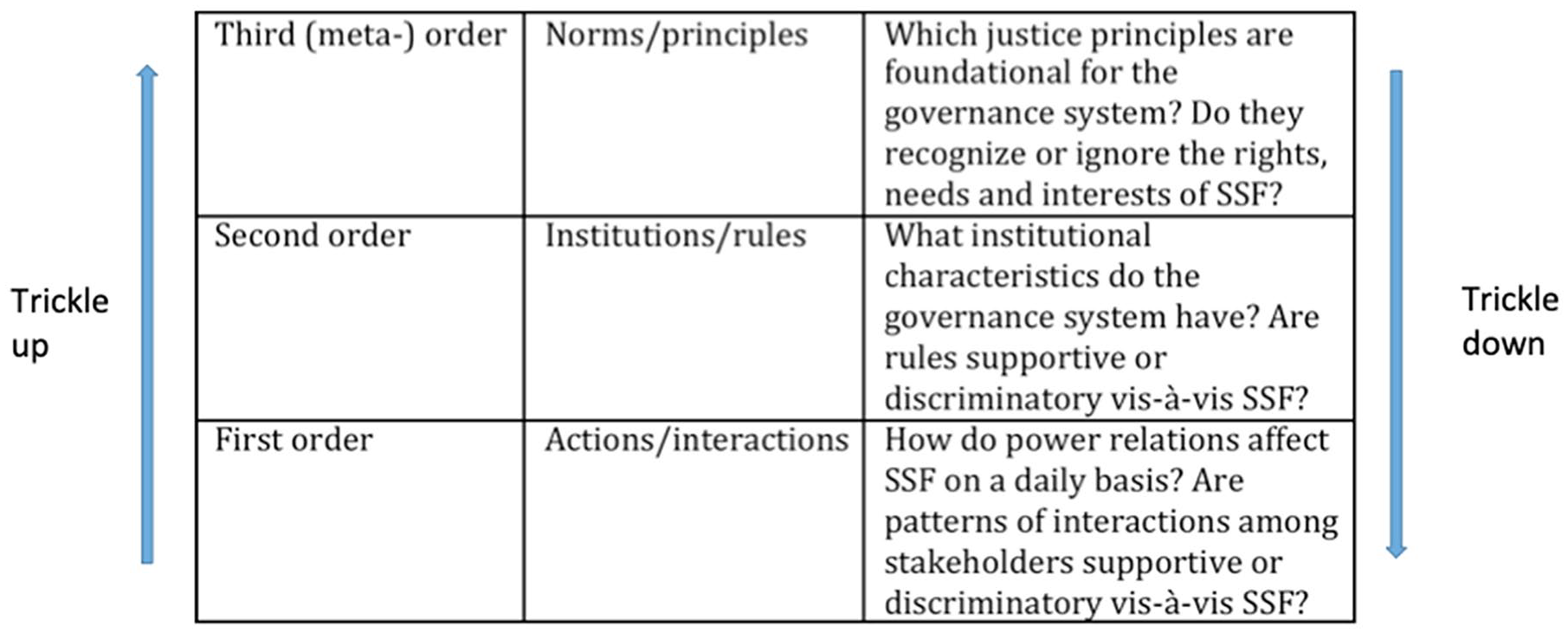
Justice in three governance orders.
Third (meta-) Governance Order
At this most abstract governance order, the emphasis is on how values, norms, and images translate into justice principles to be applied in the governance of a small-scale fisheries system (Kooiman & Jentoft, 2009). The 13 “guiding principles” in the SSF Guidelines belong here. 9 Relevant questions include: Are they explicitly or implicitly recognized in the particular small-scale fisheries system under scrutiny? Does the government have different ideas of these principles than those of the SSF Guidelines? Do the justice principles of the government agree with those of the small-scale fisheries community and those of other stakeholders in the Blue Economy/Growth?
Rawls’ (1971) “Difference Principle,” as defined in his “Theory of Justice” (p. 302), says that social and economic inequalities must satisfy two conditions: First, they are to be attached to offices and positions open to all under conditions of fair equality of opportunity; second, they are to be the greatest benefit of the least advantaged members of society. The principle is recognizable in several SSF Guidelines articles, for instance in article 5.7: “[S]tates should where appropriate grant preferential access of small-scale fisheries to fish in waters under national jurisdiction, with a view to achieving equitable outcomes for different groups of people, in particular vulnerable groups” (FAO, 2015, p. 6).
Does the governance system under assessment honor this principle? If not why, and if yes, how?
Second Governance Order
Here, the focus is on the design and functioning of institutions (rules/norms/knowledge). Do they ensure that positions are open to all under conditions of fair equality of opportunity, and by that securing representation of small-scale fisheries people in the policy and decision-making processes? Do existing resource access rules discriminate against small-scale fishers, contrary to SDG 14 Target B?
The argument for institutional reform runs through the SSF Guidelines. Our research shows that such reforms are underway in many small-scale fisheries around the world, although some countries are still lagging behind (Chuenpagdee & Jentoft, 2018b; Jentoft et al., 2017). Also for small-scale fisheries, governance reform is an uphill battle, for reasons Machiavelli (1950, p. 21) point out: “It must be considered that there is nothing more difficult to carry out, nor more doubtful of success (. . .), than to initiate a new order of things. For the reformer has enemies in all those who profit by the old order, and only lukewarm defenders in all those who would profit by the new order. . .”
Van Assche et al. (2021, p. 9) make a similar observation: “Actors will either attempt to cling to their positions of power, to the narratives they know, and to the institutions they are used to, or simply use the new opportunities for the coordination of their own interest.”
Fisheries governance institutions are rarely created as a grand, concerted scheme. Instead they have co-evolved incrementally and non-linearly over time, sometimes throughout history (Van Assche et al., 2021), often as a response to a concrete demand or incident, like a resource or market crisis in fisheries. The result is often a loosely coupled system, a dynamic of “legal pluralism” (Benda-Beckmann & Turner, 2018; Jentoft, 2011), an institutional “bricolage” (Cleaver & de Koning, 2015; Nunan, 2020) absent of a coherent and stable structure without concerted efforts for securing justice in small-scale fisheries. Multiple governance institutions exist side-by-side, sometimes in conflict with each other, occasionally and accidentally mutually supportive (Bavinck et al., 2014). Some are of the government, others of the community, some may be informal, some customary and others of more recent origin.
The SSF Guidelines suggest that such institutional disparities often have deep cultural roots that should be understood and respected. What works should not be tampered with. However, the system as a whole may not serve justice, even if parts of it do. Thus, social science researchers should not only consider discrete parts of the governance system, but also the whole and how its parts are connected and interact. This would be consistent with article 10.5 in the SSF Guidelines, which says: “States should establish and promote the institutional structures and linkages including local–national– regional–global linkages and networks – necessary for achieving policy coherence, cross-sectoral collaboration and the implementation of holistic and inclusive ecosystem approaches in the fisheries sector. At the same time, there is a need for clear responsibilities and there should be well-defined points of contact in government authorities and agencies for small-scale fishing communities.” (FAO, 2015, p. 15)
First Governance Order
Commenting on Rawls’ justice theory, Sen (2009) argues that we need to investigate how justice plays out in the life of people, in their social interactions, and how it determines the action space they actually possess. According to Sen, there is no need to wait for conceptual clarification and institutional perfection. Something can still be done to reveal and correct injustices that are apparent here and now. Justice is therefore also an issue at the first governance order, in the day-to-day experience of small-scale fisheries people, like with other value chain actors with whom they interact and negotiate the terms of trade.
There is much empirical evidence of discrimination, and sometimes outright abuse, of small-scale fishers. They are often in direct and daily competition with large-scale operators, who with the sheer power of their vessels dominate on the fishing grounds. Spatial distribution and secure tenure rights, which are issues much discussed in the SSF Guidelines, may help to protect small-scale fishers, but only in so far that rules are respected.
Similar injustice also occur in small-scale fishers’ interactions with money lenders and vendors—who are often the same actors (see for instance Jentoft et al., 2010)—where fishers are price takers, trapped in a relation of dependency and unfreedom. Whatever lesson small-scale fishers may draw from this situation, they often lack the power to even the playing field. Knowledge of injustice is not sufficient to alter the status quo: power is also needed, which would benefit from collective action and organization. Lack of organization at community level and beyond largely explains their marginalization.
Institutions do not guarantee justice even if designed with justice in mind. They set limitations, but may lack the legitimacy and enforcement power to bring compliance. Sometimes rules have loopholes. Governments may abuse their authority. Actors at the receiving end may violate existing rules. If these actors are powerful, they may succeed in bending or breaking the rules to serve their particular interest at the expense of small-scale fisheries people. In some fisheries, corruption is rampant, which “makes the trade in and consumption of fish a threat to sustainability as well as a generator of poverty” (Yan & Graycar, 2021, p. 1).
Interlinkages
In an ideal world, as the vertical arrow to the right in Figure 1 suggests, there would be coherence between the orders: justice principles at the third (meta-) governance order would determine the design of institutions at the second order, and in the next instance the governance interactions at the first order. Yet, in practice, things are often different. As Piketty (2020, p. 969) points out, “. . . it is wise to be wary of abstract and general principles of social justice and to concentrate instead on the way in which those principles are embodied in specific societies and concrete policies and institutions.” Thus, there may well be a disjunction between meta-order principles, second order rules, and first order governance (inter-)actions that is not always easy to reveal or address, especially if it is in the interest of powerful actors to maintain this disjuncture. In these conditions, injustice remains as long as the disjuncture is allowed to persist. The arrow to the left suggests that such a situation may be unstable and harbors incentives for popular revolt (Bavinck et al., 2018). Then, initiatives to bring coherence between orders come from below, from the first governance order and up, spontaneously or through coordinated effort. The SSF Guidelines may inspire small-scale fisheries people to act, to organize and to engage in governance. Whether this is actually happening around the world is a question worth investigating.
Concluding Thoughts
The answers to the research questions listed in Figure 1 and expanded above would provide essential information pertaining to process of learning of how the governance system works for small-scale fisheries in the Blue Economy/Growth. They are equally relevant for the implementation of the SSF Guidelines and the realization of the SDGs. These questions serve as a reminder not to take for granted that justice will be served, but rather that there will winners and losers (O’Riordan, 2016; Pauly, 2018). Small-scale fisheries have long been exposed to pressures that have jeopardized their sustainability and threatened the well-being of people in fishing communities. This is why the SSF Guidelines were developed in the first place, but it remains to be seen if they will deliver on the expectations they have created around the world.
Walking the Talk
As have been experienced in previous development agenda, the Blue Economy/Growth initiatives are likely to advance, industrialization, and privatization paradigms (Ertör & Hadjimichael, 2020; Mansfield, 2004), which is contrary to what the SSF Guidelines promote. In the former, fisheries development is seen as process of selection where the most powerful technologies are bound to win. Concepts like the Blue Economy/Growth may convey positive images and messages, which are hard to reject. However, small-scale fishers and their communities have reasons to be wary when these concepts are defined and operationalized within a neoliberal paradigm before they are spread and adopted worldwide.
The SSF Guidelines represent a very different paradigm. They call for protective measures, like securing tenure rights and distributional reforms favoring small-scale fisheries. In regard to the three “P”s - People, Planet and Profit (cf. e.g., Elkington, 1994; Larson, 2019), the priority concerns of the SSF Guidelines is in that order, while in the Blue Economy/Growth, the order is reversed. The Blue Economy/Growth will test how serious FAO member states were when they endorsed the SSF Guidelines in 2014. States committed themselves to respect and enhance a series of social justice principles for small-scale fisheries governance, like the aforementioned Difference Principle. The gap between talk and practice is an issue for inspection, and of criticism when “hypocrisy” is revealed (Brunsson, 2003). There exist general lessons about why the implementation of international codes of conduct often meets obstacles at national and local levels where they are to make a positive difference. Thus, the implementation of the SSF Guidelines should not only appeal to people with a special interest in fisheries. They allow for meta-learning, for example about the implementation of international codes and declarations, and for public policies in general. With the hundreds of millions of people engaged in the small-scale fisheries value chain globally, and given their contribution to food security, issues affecting their viability are of wide-ranging interest.
Change may come from below through a process of uprising and social struggle (Bavinck et al., 2018), when people act on injustice done to themselves or someone else who matters to them. Even if small-scale fisheries people do not have the conceptual sophistication of a moral philosopher, they would still know injustice when they experience it. Shapiro (1999) is probably right to say that people usually have a clearer idea of what injustice is than what is justice. They also have concerns “beyond justice” at the meta-governance order, like ideas of freedoms and perceptions of what constitute a good life (Heller, 1987).
Principles Enable and Empower
People’s sense of (in)justice does not only come from institutional rules, as when a management system discriminates against small-scale fisheries. It is “pre-institutional”: it informs people’s perception of what the institution should do and why it is there in the first place (Olsaretti, 2003). Governors, like policy-makers and government officials, need nuanced concepts for justice at all orders that capture people’s own experiences, concepts, and discourses. One would be obliged to make an effort to understand justice “from the native’s point of view,” as Geertz (1974, p. 55ff) argues.
As a consensus instrutment, the SSF Guidelines would not have seen the light of day if those who negotiated them did not already have a basic set of shared justice concepts, principles, and values. The SSF Guidelines draw upon established and agreed upon human rights and “good governance” principles and other international legislation, such as those pertaining to Indigenous Peoples, minorities, and the rights of children. These principles are as much the foundation for the perception of what constitutes Blue Justice, as they are to the Blue Economy/Growth. Justice principles do not precede governance, but rather are integral to it. Once settled, they become “a point of departure for bargaining among implementers,” (Majone & Wildavsky, 1979, p. 180)—in this case the implementation of the SSF Guidelines.
Bending Without Breaking
The Blue Justice concept gives small-scale fisheries people language to communicate what they experience, argue their case and, gain inspiration from what they learn. Following Piketty (2020), third (meta-order) justice principles are not sufficient to secure justice, but they are a yardstick for evaluating processes and outcomes, and should provide motivation for collective action, even litigation, if gaps persist. Justice principles, such as Rawls’ Difference Principle, also provide a measure for institutions at the second order.
Institutions are strong when their pillars are strong. In turn, these pillars are well-suited to be designed to bend without breaking, in other words be flexible and resilient. In a dynamic system of small-scale fisheries, institutions must be able to learn, adapt and if necessary transform. They must be flexible and open for reform and innovation (Van Assche, Hornidge et al., 2020). For that, they must allow negotiations about the adequacy of rules and regulations. Even when principles are firm, institutional designs may require continuous evaluation, learning, and adaptation.
Interactions must facilitate learning not only at an individual but also at a system level, for the stock of knowledge, which Scott (1989) talks about, to expand. Rules should be changed if needed, or abolished when superfluous. Values and norms should undergo reflexive (learning from the past and present) and dialectical learning (learning from talking to each other) (Van Assche et al., 2021). Governance systems under-perform when they do not learn from the exchange between the governance orders. The SSF Guidelines stress the importance of “holistic approaches,” which involve the overview of, and intervention into, the complex and dynamic system-to-be-governed where small-scale fisheries operate, a system that is partly ecological and partly social (Van Assche, Hornidge, et al., 2020). Given the relevance of all SDGs and the multiple stakeholders, many of them new, in the Blue Economy/Growth, the implementation of the SSF Guidelines must be an interactive single and double-loop learning process, checking performance at all governance orders relative to the justice principles that states committed themselves to when they endorsed the SSF Guidelines.
Final Litmus Test
Justice is not a static state of affairs, secured once and for all, even if legally encoded. As Heller (1987, p. 118) observes: “In a democratic society, devalidation of norms and rules by certain principles is a normal, and in a matter of speaking, an everyday experience. Moreover, it is a constant and continuous procedure. There are always certain norms and rules (even many) that we consider unjust. A great portion of public debates centres around such issues” (p. 118).
The implementation of the SSF Guidelines may provide an illustration of what Heller warns of, since there is no reason to expect that consensus will be achieved without strife and that it will bring about any change on its own.
Justice must be learned, nurtured, and enacted in ongoing social relationships. Thus, securing justice is what Rittel and Webber (1973) consider a “wicked problem” that is never settled once and for all. This is also true for small-scale fisheries governance. Some justice principles are ancient, like the “golden rule,” which exist in all cultures as a basic mechanism of group survival. “Humans were not meant to live alone” (Sacks, 2020, p. 314), and must have rules for how to live together. Justice principles, and the rules and norms they lead to, have lasting value when they “speak to our better angels,” to use Abraham Lincoln’s expression. But they must still be operationalized in concrete contexts, where they must draw support. They work as long as institutions have sufficient legitimacy among those who depend on them, as Searle (1995) posited.
Whether the guiding principles of the SSF Guidelines will prevail at the second and first governance orders in the Blue Economy/Growth remains to be seen. Although necessary, just institutions are not sufficient to achieve social justice, as Sen (2009) argues. To secure Blue Justice, we cannot rest on the third (meta-) governance order or stop at the second order of institutions, but must continue to the first-order (see Figure 1), where the final justice litmus test takes place. This is because justice is “ultimately connected with the way people’s lives go and not merely with the nature or the institutions surrounding them” (Sen, 2009, p. x).
People may have an innate sense of justice: small children have it, like with language, as Chomsky (1957) posits. Yet, enacting Blue Justice in governing systems requires language developed and used in an interactive, dialectic learning process. In practice, interactive governance involves justice principle where those with important things at stake, like small-scale fisheries people have in the Blue Economy/Growth, deliberate on what justice should mean in the setting where they exist and operate. The Blue Justice concept may induce reflexive, comparative learning when people check the performativity of justice language at the first governance order. In fact, Blue Justice requires that they do.
Footnotes
Acknowledgements
We thank the special issue editor, Dr. Kristof Van Assche, for inviting our manuscript and for his guidance throughout the writing process. Thanks also to the two reviewers for their constructive comments, as well as to Brennan Lowery for his editorial help.
Declaration of Conflicting Interests
The author(s) declared no potential conflicts of interest with respect to the research, authorship, and/or publication of this article.
Funding
The author(s) disclosed receipt of the following financial support for the research, authorship, and/or publication of this article: We acknowledge the support of Oak Foundation, which enables the Blue Justice research in the Too Big To Ignore Partnership.
Notes
Author Biographies
 , which is an international research network for small-scale fisheries research, aiming at elevating the profile of small-scale fisheries and rectifying their marginalization in national and international policies.