




Abstract
Increasing interest in ‘co-creation’ raises an intriguing question about the role that political leaders can play. This role may have changed as wider models of public governance have evolved from Traditional Public Administration and New Public Management to more collaborative and networked approaches. With growing recognition that local solutions to complex public policy problems are needed, the role of mayors as important political leaders has come into sharp focus, yet few have considered how governance context influences political leadership of co-creation. Drawing on strands of theory on public governance and leadership, we specify how extant governance models can influence political leaders’ attempts to inspire co-creation. We illustrate these proposals by showing how mayors performed leadership to inspire co-creation in two contrasting cases drawn from Roskilde, Denmark, and Ljubljana, Slovenia. We demonstrate, counterintuitively, that an embedded form of TPA that coincided with a hierarchical approach to leadership better supported the adoption of co-creation. Thus, we propose that mayors may resourcefully adapt co-creation to local contexts. Political leaders may find these conclusions insightful for understanding how governance context may impact their co-creation efforts.
Introduction
This article explores how different governance models can influence political leaders’ attempts to lead co-creation. Scholars are increasingly interested in how co-creation can be inspired across locations, driven by perceived potential benefits such as enhanced democratic participation, improved legitimacy, innovative solutions, and the development of more sustainable policies (Fitzgerald et al., 2022; Torfing et al., 2021). The term ‘co-creation’, which encompasses collaboration among varied actors including laypersons, government, and organised actors to address policy issues, can play a role in both policy design and operational service delivery (Torfing et al., 2021).
The movement towards co-creation has been framed under wider approaches to New Public Governance (NPG)—including networks or collaborative platforms (Ansell and Torfing, 2021; Torfing et al., 2016)—that move beyond the hierarchical Traditional Public Administration (TPA) and the market-driven models of New Public Management (NPM). However, whether more networked approaches lead to greater co-creation in practice (Ferlie, 2021; McMullin, 2020) remains unclear (Greany and Higham, 2018; McMullin, 2023). Some scholars also explore novel approaches to leadership as potential enablers of sustained co-creation (see Sørensen, 2020). In particular, some argue that formal leaders should now engage in more horizontal and integrative approaches (Crosby and Bryson, 2010; Sørensen et al., 2021). Attention has turned to whether politicians should engage in a more shared form of political leadership (Sørensen, 2010; Torfing and Sørensen, 2019). However, while advocates of co-creation highlight the influence of political leaders in facilitating a turn towards co-creation (Hambleton, 2019; Sørensen, 2020; Torfing and Sørensen, 2019), empirical evidence across different governance contexts remains elusive.
Therefore, we focus on how co-creation play out in cities and explore the role of local political leadership, notably city mayors. City mayors may be particularly well-suited to adopting more horizontal and integrative approaches given their rootedness in local communities, high political visibility, and legitimacy (Barber, 2014; Hambleton, 2019). However, there are also reasons to doubt that mayors—or other political leaders—will behave in this way. Politicians who feel that their direct power is waning may instead hold fast to hierarchical approaches and hoard rather than share power (Crosby and Bryson, 2005).
To answer these questions, we first review public governance and leadership theories to enhance our understanding of how contexts may shape how political leaders promote co-creation. To illustrate this, we explain how some mayors attempted to facilitate co-creation within their cities. In Ljubljana, Slovenia, the mayor initiated an online portal for citizens to share local problems with the city administration. In Roskilde, Denmark, the mayor attempted to inspire co-creation in response to cultural policy problems centred around management and service delivery of the Roskilde Museum (ROMU), consisting of ten museums across three municipalities. These two examples were also selected because each reflects a different national tradition of public governance. The first case covers the Digital Service for Citizens’ Initiatives in Slovenia, with a mayor using a hierarchical, TPA-style approach. However, the mayor strongly championed a move to implement a digital portal for co-creation. By contrast, in the second case, the mayor sought to work collaboratively to make a network of museums a platform for co-creation in Denmark. However, this initiative has thus far led to only limited success. Thus, these two examples illustrate how contexts shape political leaders’ employment of co-creation in surprising ways. We conclude by specifying our contribution to understanding the rollout of co-creation across countries and we propose avenues for future research.
Theoretical framework
Co-creation has many definitions and meanings (see Baptisa et al., 2020; Voorberg et al., 2015). Here, we adopt the view of co-creation as an approach to governance in which the public sector collaborates with a range of actors, including citizens and those in the private and voluntary sectors (Torfing et al., 2016, 2021). We focus on co-creation across the policy process, including agenda setting, design, implementation, and evaluation (Brandsen and Honigh, 2018; Torfing et al., 2021).
Below, we discuss some implications of co-creation as a novel governance mode and explore key elements of potential change or tension—namely, with embedded modes of governance—and the roles of leaders—especially local political leaders—who could be involved in co-creation (Torfing et al., 2016, 2021). We first review the literature before putting forth propositions regarding what we should expect to find.
Basic modes of governance in the public services: Implications for co-creation
We start by outlining contrasting models of governance in public services management, and we explore how they may relate to co-creation, moving on to consider specific implications for co-creation within local systems.
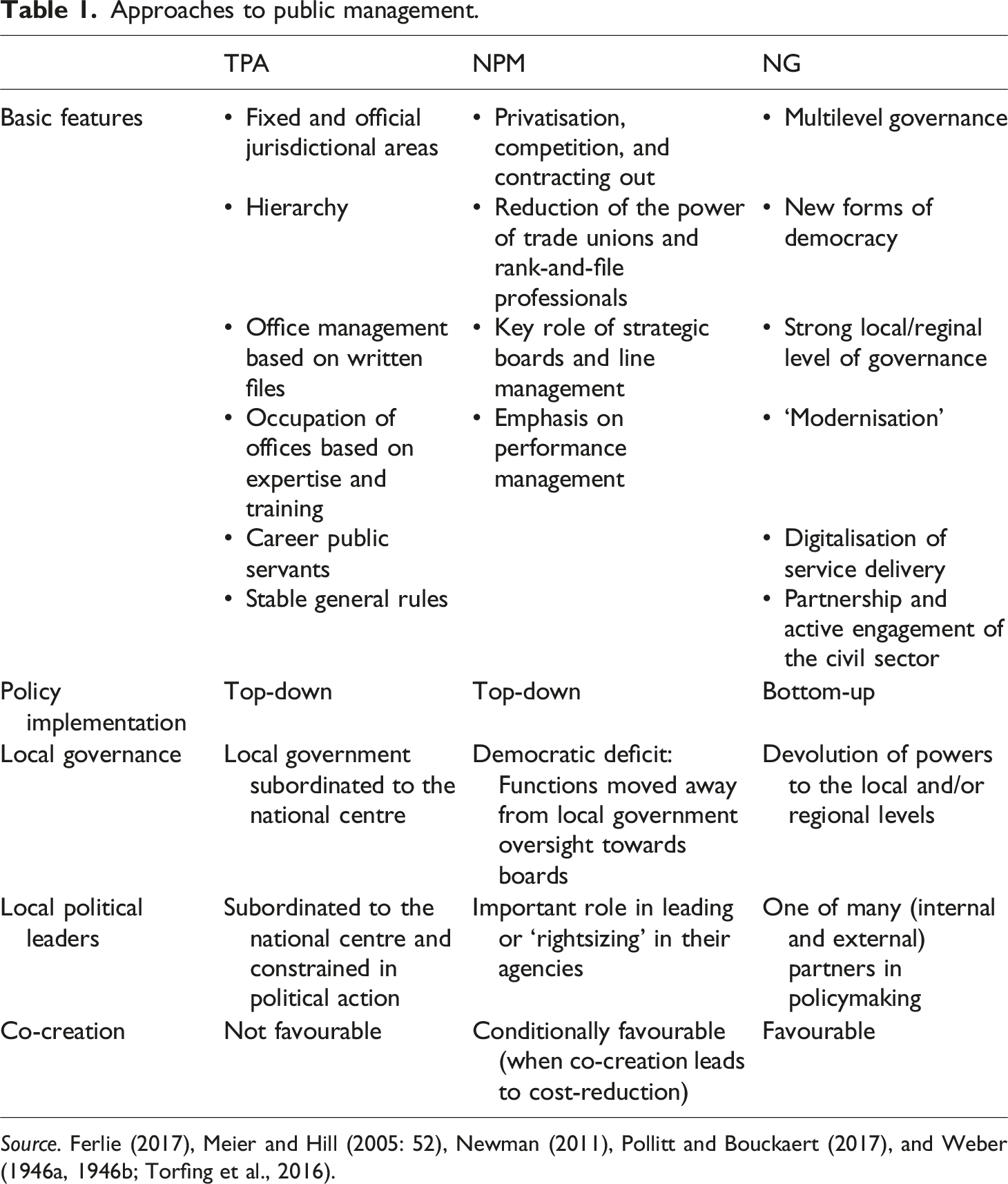
Approaches to public management.
Source. Ferlie (2017), Meier and Hill (2005: 52), Newman (2011), Pollitt and Bouckaert (2017), and Weber (1946a, 1946b; Torfing et al., 2016).
TPA is closely associated with the Weberian public bureaucratic ideal type that was dominant in many countries until the 1980s—with Germany being a typical Weberian Rechtstaat (or ‘constitutional state’; Pollitt and Bouckaert, 2017: 295–301). It embeds the principle of hierarchy and builds on a strictly defined and stable legal framework (Meier and Hill, 2005: 52; Weber, 1946a). This ideal type suggests that full-time civil servants/public administrators are embedded with lifetime careers in their bureaus and may prove dominant in practice over temporary politically elected leaders. Policy implementation is also top-down with little scope for bottom-up influence from citizens. Co-creation is unlikely to flourish in these conditions. In a pure Weberian system, local government may be subordinated to the national centre with its many top-down plans, regulations, and instructions. Hence, mayors could face severe constraints on local political action and tend to look upwards—where resources and power lie—rather than outwards and downwards.
From the 1980s onwards, NPM reforms have been influential in some jurisdictions, including (but going beyond) Anglo-Saxon countries. This implies more competitive government in service delivery, mission-led government, and, in some contexts, such as the US, a community-owned government (i.e. public agencies that, in an effort to reduce costs, may be open to co-creation; Osborne and Gaebler, 1992). In general, however, ruling NPM values cluster in economic concepts, such as productivity, performance, efficiency, competition, which may constrain co-creation (McMullin, 2023). At the local level, NPM reforms have often moved functions away from local government oversight towards boards appointed for ‘business-like expertise’, leading to many so-called appointed bodies or Quangos (Van Thiel, 2017). Nevertheless, local political leaders still have an important role in NPM-orientated regimes, especially in leading or ‘rightsizing’ their agencies (see Andrisani et al.,’s 2002, collection of case studies from US governors and mayors).
A recent view suggests a shift from hierarchical and market-based coordination to a greater use of networks that include organisations from the public, private, and third sectors, but also citizens (Exworthy et al., 1999; Klijn and Koppenjan, 2020; O’Toole, 2015; Torfing et al., 2021). These reforms broadly fall under the umbrella of NPG or NG to reflect the more publicly orientated nature of this approach. An implication for city governance is that the system may become more porous, outward looking, ‘bottom-up’, and digitally enabled. However, the understanding of NG as different than NPM remains imprecise (Greany and Higham, 2018; Pollitt and Bouckaert, 2017).
While McMullin (2020) draws on comparative empirical case-study data and suggests that co-creation can occur in all three governance modes reviewed, others (Ansell and Torfing, 2021; Torfing et al., 2021) propose that the collaborative governance model fits best in supporting a shift towards co-creation. In local governance contexts, the effects of these governance models may be amplified as local policymakers negotiate local identities’ intersections with national policies (Lee and Lounsbury, 2015). This leads to our first proposition:
Local governments in countries with high TPA are less likely to engage in co-creation due to the high centralisation of the state and its top-down decision-making. Local governments heavily impacted by NPM reforms will be more likely to engage with outside actors, such as the private sector, and mainly to support productivity or efficiency. Local governments in high NPG/NG orientated cities will be more likely to engage in co-creation due to a focus on inclusivity and locally orientated solutions.
Political leadership for co-creation
Political leaders may help expand co-creation beyond isolated instances given their authority, as achieving a more comprehensive shift requires profound changes to the political, legal, economic, and social systems that surround the policy process (Ansell and Gash, 2018; Sørensen, 2020; Steen and Brandsen, 2020; Torfing et al., 2021; Van Elk and Regal, 2023). Local political leaders, such as mayors, may be particularly responsive to sponsoring and implementing more inclusive systems due to their strong connections to local communities (Ansell and Torfing, 2021; Barber, 2013; Hambleton, 2019; Hambleton et al., 2021). However, leaders may now need to adopt horizontal approaches to leadership. Traditional hierarchical approaches to leadership may be ill-equipped in polycentric situations where the leader cannot establish predetermined goals or visions (Hambleton, 2015; Hartley et al., 2019; Torfing and Ansell, 2017; Torfing et al., 2016). However, various leadership approaches may be ingrained, given their association with different governance models.
TPA casts elected politicians as legitimate governors armed with a democratic mandate, with civil servants and public managers as their agents. Weber (1946b: 95) described the role of the politician as ‘tak(ing) a stand’ and ‘be(ing) passionate’, while civil servants are expected ‘to execute conscientiously the order of the superior authorities’. Similarly, Wilson (1981) argued that politicians set the tasks for the administration of public policy. Thus, political leaders are portrayed as ‘charismatic leaders’, embodying traits that enable them to engage followers (Andrews-Lee, 2021; Wilner, 1984; Wilner and Wilner, 1965). Under TPA, political leaders may rely on legitimate power derived from the authority vested in them through specific rights and prerogatives associated with their role. Additionally, in the context of emphasizing ‘charismatic leaders,’ they may leverage referent power gained through the identification or admiration of the leader (see Yukl, 2013). Nevertheless, while charismatic leaders may attract many followers, their focus is not on including others.
NPM reshaped the relationship that political leaders had over public service delivery as hierarchy shifted to markets with contracts as an integral coordination mechanism. As NPM favoured delegated discretion, decentralised administration, and contracting out for goods and services (Ferlie, 2017; Pollitt, 2001), public and private managers gained more latitude to enact policies, but under performance management regimes. Therefore, political leaders may be expected to delegate operational authority to public managers and service-delivering actors while retaining oversight through established contracts (Bolden, 2011; Kellis and Ran, 2015). As NPM shifts away from emphasizing authority rooted in hierarchical roles, leaders might increasingly rely on acquiring power through rewards or referent power via admiration (see Shamir and Eilam-Shamir, 2017; Yukl, 2013). Thus, the focus on performance management may encourage singularly visionary leadership to ensure that objectives are met (Taylor, 2017). Concurrently, while NPM reforms opened up delivery of public services to non-traditional actors working under contract, it did not empower citizens or other affected actors within policy or service design and innovation.
Within NPG, political leaders are tasked with incorporating a diverse range of actors with varying needs and expectations, so they must navigate and embrace emergent processes characterised by less predictable outcomes (Torfing et al., 2021; Van Elk and Regal, 2023). Political leaders may heavily rely on their credibility and expertise, utilizing expert power or garnering admiration to ensure the preservation of their vision (see Yukl, 2013). Additionally, they may facilitate horizontal collaboration, bringing together actors from the public sector, civil society, and the private sector (Bryson et al., 2015; Hofstad et al., 2021; Sørensen, 2020; Torfing and Sørensen, 2019). Political leaders may also leverage digitalization strategies not only to retain an element of oversight through the reintegration of services but also to establish connections with a broader range of stakeholders, including citizens (Dunleavy et al., 2006; Larsson and Skjøslvik, 2021; Torfing et al., 2020). In countries with a high focus on digitalisation, political leaders may use digital tools to connect with citizens. Overall, political leaders in countries that have undergone a significant transition to NPG may have already developed the skillset necessary to ensure sustained co-creation.
There is some evidence of mayors embracing co-creation to support innovative solutions in their communities. Siebers and Torfing’s (2018) two case studies of co-creation in a Dutch and Danish municipality identified local mayors as significant drivers of change. Hambleton (2019) highlighted the role of the mayor in Bristol (UK) in bringing together diverse stakeholders to facilitate co-creation. Finally, Sørensen et al. (2021) detailed how Gentofte’s (Denmark) mayor reformed a political committee structure to inspire politicians to co-create. However, these studies do not explore how broader contexts shape the response of political leaders. Instead, they primarily focus on the instances of co-creation itself, which may present an overly favourable depiction (Ferlie, 2021; Regal et al., 2023). For example, while research by Hambleton et al. (2015; 2019; 2020) emphasised the role that mayors played in facilitating co-creation in Bristol, a recent referendum abolished the office, given concerns that the mayoral system led to the over-centralisation of power.
This leads us to Proposition 2:
In countries with strong TPA, such as Slovenia, local political leaders will consolidate power within their offices, hindering co-creation, while in countries characterised relatively more by NPG, such as Denmark, local political leaders will encourage horizontal relationships between government and stakeholders, facilitating co-creation.
Methodology and research context
Below, we consider the attempts of two mayors to inspire co-creation within their cities.
These cases originally formed part of a wider comparative study consisting of 15 case studies.
Context
We focused on these two contrasting cases as they both exemplified an attempt by a mayor to inspire co-creation based in Weberian traditions but with currently diverging approaches (see Esping-Andersen 1990).
Slovenia is characterised by a strong Weberian base (Vrbek and Kuiper, 2022). Despite the two-tiered governance system, Slovenia is regarded as a rather centralised country where local governments (municipalities) mainly deliver public services, while the central government primarily performs regulatory functions (European Commission, 2021, 2022). In such a setting, key local challenges include low administrative capacity, high territorial fragmentation (there are 212 municipalities), low financial autonomy, and the postponed establishment of regions as an intermediate governance level (European Commission, 2021). However, the City of Ljubljana has a favourable position due to its size and financial superiority. Ljubljana is the capital and largest city in Slovenia as well as its educational, economic, and administrative centre. In 2019, population of Ljubljana was recorded as 292, 988.
Denmark is characterised by a Weberian base, but also by strong norms of welfare statism, democratic participation, and communitarianism (Painter and Peters, 2010). There are also strong ideals of being an ‘enabling state’, focused on bringing together a range of stakeholders to solve problems (Krogh et al., 2022). The Danish system of local governance is highly decentralised, with significant responsibilities recently assigned to municipalities. Per the Local Government Act, the city council is organised into committees, and the daily administration is headed by the mayor, who is assisted by a managing director (Bogason et al., 2019). Roskilde is the 10th largest city and sits west of Copenhagen, the capital of Denmark. Roskilde is an important centre for business and education within the region. The population of the Municipality of Roskilde is around 90, 000 with 50,000 within Roskilde.
We also compare different sectors that aligned well with embedded governance models. In Ljubljana, characterized by high levels of TPA and centralization, we delved into co-creation efforts in the delivery of internal administrative services. We anticipated lower levels of co-creation, given the city administration’s high level of control. In contrast, we examined the culture sector in Denmark, situated in a city marked by a strong interest in NPG reforms. We anticipated higher interest in co-creation, given the interest in NPG reforms and the culture sector’s longstanding interest in participatory practices driven by the need to attract engaged visitors (Simon, 2010).
Data collection and analysis
Original case studies were based on qualitative data, including semi-structured interviews and document analysis. All interviews followed a shared interview guide that included questions on leadership, governance structure, barriers and drivers of the co-creation initiative, and outcomes of the initiative.
Participant information.
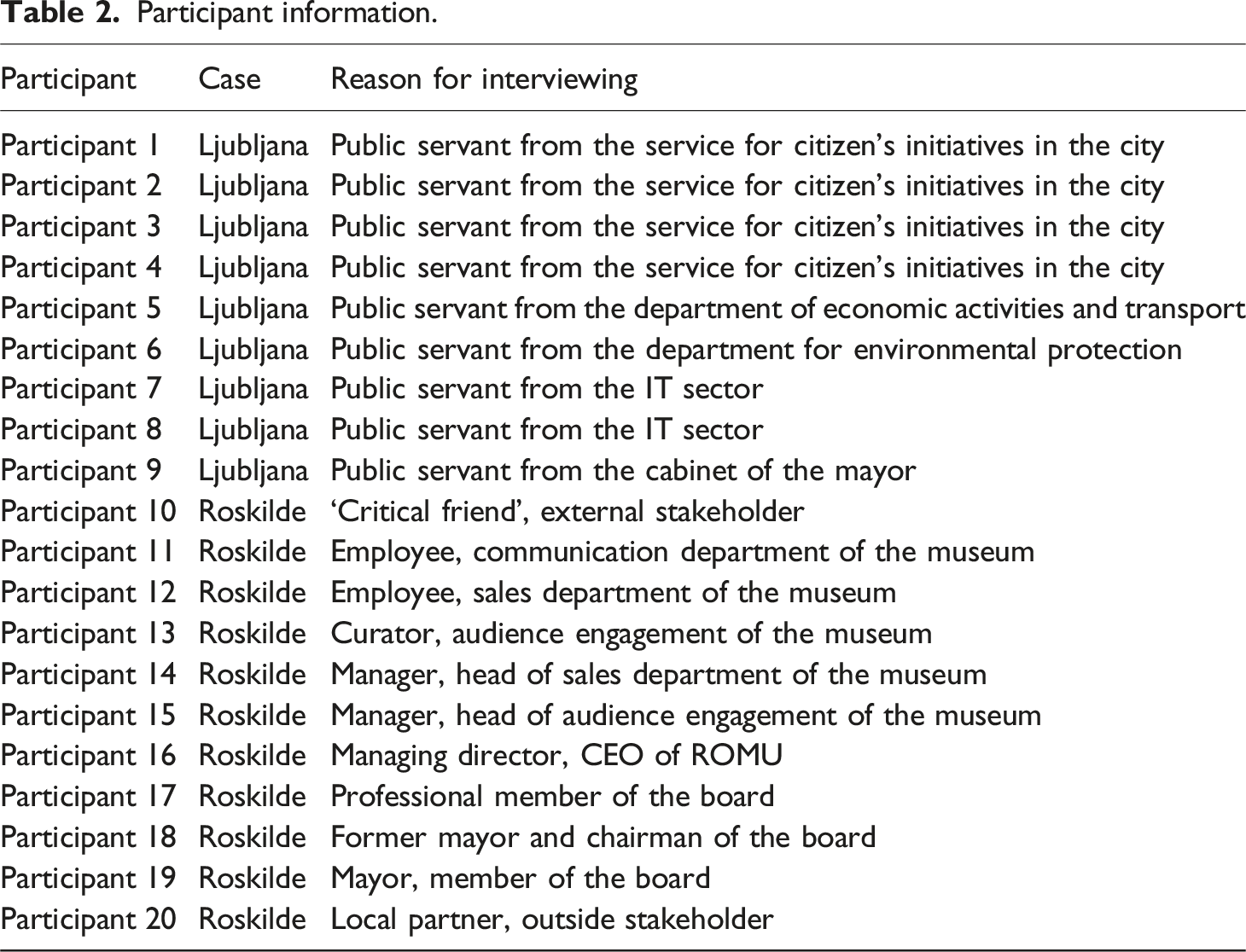
Cases were first formatted using a common template to facilitate comparative analysis. To ensure reliability, project leads ran a pilot study, provided ongoing feedback during the period of case selection and reporting, and shared a draft summary of the work package with the larger research team to gain feedback on the final analysis. The final versions of these reports can be found on the research consortium’s Web site (Aagaard, 2020; Regal and Ferlie, 2020; Vrbek, 2020). For this article, we returned to the original data and reports. First, the case reports were used to understand how the national-level governance traditions influenced the mayors’ approaches to co-creation. In the second step, the two case authors returned to the original data to detect the leadership approaches deployed to enable the co-creation initiatives. The data were recoded based on the leadership models that could potentially be present (see the section above, “Theoretical Framework”).
Following in the footsteps of Sørensen et al. (2021), we draw on data from the previously completed project to present illustrative vignettes that shed light on findings that contrast with perspectives within the current literature. Thus, we offer shortened and more analytic treatments drawing on these earlier base reports (Aagaard, 2020; Vrbek, 2020).
Findings
First, we present the contexts before sharing reflections based on the proposition.
The governance context of co-creation
Ljubljana
In Slovenia, the role of the mayor is both executive and coordinative. They summon and preside over municipal council meetings, but they do not have the right to vote (Republic of Slovenia, 1993: Article 33). Additionally, they propose the draft budget, municipal decrees, and other legal acts for adoption by the municipal council. The mayor has the right to withhold the publication or implementation of an act adopted by the municipal council if they consider it unconstitutional or illegal (Republic of Slovenia, 1993: Article 33). However, the mayor’s most significant role is overseeing the municipal administration, which allows them to pursue policies independent of those of the municipal council (Kukovič and Haček, 2013). The mayor’s unprecedented influence on the municipal administration stems from their complete autonomy in appointing and dismissing its chief executive officer (CEO), and their authority to authorise or refuse the CEO’s mandates within the mayor’s scope of competencies (Haček et al., 2012: 230). This subordinates the CEO, the most qualified civil servant, to the mayor, a hierarchy further reinforced by the limited and vague legal definitions of the CEO’s powers and duties. Thus, mayors have a virtually untouchable position throughout their entire term of office and can run for unlimited terms (Haček et al., 2012). As a result, the Slovenian local governance system tends to produce strong mayors who are often reelected to several terms. From 1998 to 2010, 77 out of 211 Slovenian municipalities had incumbent mayors serving at least their third consecutive term, with 19 municipalities having the same mayor since 1994 and 31 municipalities having the same mayor since the role was initiated (Kukovič and Haček, 2013, 96).
Running for his sixth term in 2022, the mayor of Ljubljana exemplifies this trend. When first elected in 2006, he viewed the municipality as a ‘bureaucratic apparatus’, suffering internal silos and alienation from the actual problems citizens faced. Before 2006, the governance style within the City of Ljubljana was characterised by strong vertical centralisation that undermined interdepartmental collaboration. Moreover, external collaboration and citizens’ participation were not on the radar of the previous leadership (the mayor and municipal CEO). Given his previous work experience in the private sector, the new mayor aimed to change the strategic direction and way of doing things set by the previous leadership by introducing ‘efficiency’ and ‘becoming closer to citizens’ as the main values pursued during his time in office.
Coming from the private sector, where the public sector is often a target of criticism, he tried to refurbish the image of the City of Ljubljana as a responsive administration that follows the newest (technological) trends and that endeavours to efficiently solve local problems. To achieve this, the mayor required the development of a digital portal that serves as a two-way online communication medium, enabling direct collaboration between the city government and citizens to solve local problems. Hence, the main motivation for the mayor to establish the Digital Service for Citizens’ Initiatives (‘the Service’) in 2008 was to have direct and comprehensive insights into citizens’ problems and to identify better solutions. The portal helped the municipality better address problems, such as improving the existing municipal infrastructure (e.g., road potholes, a tree blocking the road, unmown lawns in public spaces). While the portal was primarily designed to facilitate ideas exchange between the municipality and citizens about specific municipal problems, it also inspired larger-scale co-creation. For example, the ‘Service’ served as a catalyst for the transformation of neglected areas into children’s playgrounds by encouraging citizen initiative and ensuring logistical support from the municipality (Vrbek, 2020). Due to the successful inclusion of citizens, the Service received international recognition in 2017 when the municipality won the title of URBACT Good Practice (City of Ljubljana, 2017).
In 2018, the mayor instigated a reform of the Service to address the potential risk of undermining the image of the municipality due to the first system’s shortcomings. In addition to correcting technical problems (duplications, inconsistencies, and lost answers to citizens’ initiatives) to improve the administration’s efficiency and responsiveness, the reform also provided the mayor with a detailed overview and real-time control of the progress and performance of public servants responsible for each citizen initiative submitted.
Overall, the election of the new mayor did not affect the level of centralisation as such (the municipality remained highly centralised). The key difference was that this feature was capitalised on by the new mayor to introduce different values and a different style of work by the municipal administration. Specifically, this affected the internal power asymmetries and ‘silos’ among departments, paving the way for the introduction of a citizen-centred narrative/focus of policymaking, in which the Service emerged as an operational portal to pursue these values.
Nevertheless, the City of Ljubljana still represents the prevailing governance context locally implying a centralised and hierarchical structure with a clear (i.e., formally regulated) division of tasks and responsibilities across vertical and horizontal lines. In this context, the top (i.e., political) leadership has the key decision-making role, while lower-level actors implement adopted decisions. This presupposes a central role of mayors in instigating and implementing new projects (e.g., the Service). Thus, for an idea to be successfully implemented, it needs to enjoy their unequivocal support.
In addition to centralisation, the autonomy of public servants is further constrained by a rigid legally positivist understanding of the legality principle (manifesting as non-action without explicit legal basis), leaving (almost) no room for collaborative experimentation beyond what is legally stipulated (Vrbek and Kuiper, 2022). Although the existing legal framework does not pose a barrier to co-creation, per se, it often lacks an explicit legal basis (imposing obligation) for public servants to apply co-creation day to day. It is precisely this absence of explicit legal grounds (or an explicit requirement/directive by their superiors) that prevents public servants from independently resorting to co-creation.
As such, the Slovenian governance context remains embedded within TPA, utilizing digitalization to connect with citizens while also continuing centralization. Although this setting is not considered favourable for (bottom-up) co-creation initiatives, in the case of the Service, the hierarchical organisational structure of the municipality undoubtedly empowered the mayor as the key initiator of the implementation of this (‘his’) co-creation initiative.
Roskilde
In Denmark, mayors and city hall members are often approached by citizens on the main street, creating an impression of an egalitarian culture. The mayor serves as both the political leader and head of local administration, with power over the managing director. Mayors have the right to vote and are automatically appointed the head of the financial committee, which is the most important committee, by law. Mayors are elected indirectly by the city council to 4-year terms and can be re-elected multiple times.
Traditions of collaboration among political parties are strong, with coalition-building among parties common even for the mayor’s party, which often lacks a majority. The mayor is often put in charge of new efforts for collaboration and acts as a political CEO. Some researchers argue that the increased size of municipalities forces local politicians, particularly the mayor, to act more as a ‘meta-governor’ by distributing decision-making power (Bogason, 2019). Nevertheless, despite the decentralization of the local government system, the degree of local self-governance has diminished recently due to more stringent national economic governance. This is evident in the mandate for state approval for new municipal investments (Bogason, 2019). Yet recent years have been characterised by a significant rise in interest in co-creation, especially among Danish municipalities.
Efforts to promote different forms of collaboration in the cultural sector have been widely supported by the national government in Denmark. In the 1990s the state started to promote regional experimentation in the cultural sector where there was a recognised need for co-creation to ensure longstanding sustainability by encouraging citizen engagement. Given this, the CEO of ROMU convinced neighbouring municipalities to join the ROMU organisation. This new cross-municipality museum needed not only a new structure, but also a new way of operating. Here, the vision of a co-created museum—across municipalities, employees, groups of volunteers, and engaging citizens—took off.
This approach was rooted in a broader normative change in the Danish cultural sector. Since 2004 it has been broadly recognised that there is a need to stop the extreme decline in the number of visitors to Danish museums. Before then, no one really cared about who the visitors were, what they thought of the exhibitions, if they thought the museums were relevant, or if there were special groups to target. Museums across Denmark were dominated by the classic conception of the museum as a top-down, inside-out, and curator-dominated organisation. The vision of the co-created museum challenged the classic notion and identity of being a museum. The idea is to ‘open’ the museum by embracing active citizenship, invite user groups to become part of a learning process (also at an early stage of the creation of new exhibitions), and to influence what is deemed as worth preserving or to decide what the history is. This notion was also present in the identity and culture of ROMU. However, a public scandal of mismanagement in 2016 reflected a hierarchical culture that lacked trust and transparency, internal cooperation, and involvement of employees.
Thus, the mayor had a new vision for co-creation that included public professionals and citizens. In Denmark, ad hoc committees have become a forum for co-creational efforts in municipalities. However, the mayor’s attempts to reorganise municipal administration to implement a collaborative, innovative, and co-creative approach did not gain support in the city council. The majority preferred to maintain a traditional committee-based approach to municipal administration. However, the mayor ignored the views of a majority of elected members and took her agenda for innovation to external forums using a collaborative and network-driven approach. She invited citizens and organisations to join what was described by one participant as ‘add-on projects’. Given her position as the chair of the ROMU board, the mayor also tried to use the museums as a platform for her agenda for innovation. To establish the ROMU as a platform for co-creation, the mayor collaborated with changing CEOs and a professional board.
The ROMU collaborative approach had another source, rooted in a mix of increased NPM and TPA pressure. As mentioned above, local self-government autonomy was recently reduced due to much stricter national economic governance. This austerity policy reached the museum branch in 2016, when Danish museums were hit with 2% general budget cuts annually as part of the government’s Finance Act. These yearly reductions lasted until the change of government in 2019 and the passage of the Finance Act for 2020. The 2% cuts increased the awareness of the importance of commercial income among all cultural institutions in Denmark. Thus, ROMU’s board decided that the museum should increase commercial income by up to 10% of the economic turnover annually. Though commercial income remains a small portion of the budget, the 10% of the turnover is considered internally as a huge ambition. The strategy is to convince mostly local, private businesses to use ROMU as conference facility. Accordingly, the museum has started collaborating with local businesses in several ways. For example, it has opened a new business club and has joined the local business forum. It also collaborates with local restaurants, a catering firm, a local brewery, a dance company, and a folk high school to increase its commercial value.
We surmised that local governments in countries with high TPA would be less likely to engage in co-creation due to the high centralisation of the state and its top-down decision-making. While we argued that local governments heavily impacted by NPM reforms would be likely to engage with outside actors to support productivity or efficiency, we believed that local governments in high NPG/NG orientated cities would be more likely to engage in co-creation due to a focus on inclusive and locally orientated solutions. We conclude that our first proposal is only partially supported. Indeed, NPM pressures for commercialisation and ‘consumer’ responsiveness encouraged local governments’ engagement with outside actors. In the case of Roskilde, NPM pressures at the national level pushed local collaborative efforts in a more commercial direction. We also found support for the idea that NPG ideals encourage partnership work, as national-level support in Denmark led to cross-municipality collaboration and, thus, the creation of ROMU. Surprisingly, we also noted that the national context, with high levels of TPA (Slovenia), facilitated local governments’ co-creation processes due to high political engagement that leveraged hierarchic chains of control. In particular, the mayor was able to use digitalization as a means to connect with citizens and retain control over services, suggesting that digital reforms helped further embed TPA. In contrast, while the context with a tradition in NPG (Denmark) supported cross-municipality collaboration, local government then faced barriers associated with this decentralised, networked context.
The local political leadership context for co-creation
Ljubljana
The mayor of Ljubljana’s key asset is that he enjoys unprecedented political legitimacy. In all local elections from 2006 to 2022 (five regular and one early election), he won in the first round with a significant margin over his competitors (City of Ljubljana, 2006, 2010, 2014, 2018; 2022a; 2022b). This reputation is also reflected in his support within the City Council, where three of his mandates (2006, 2010, and 2018) received support from an absolute majority (Municipality of Ljubljana, 2006, 2010, 2018).
Initially, the key official channel for direct communication between the mayor and citizens was the Mayor’s Open Door Days. The high attendance at this event, and the increased inflow of information by citizens, raised a need for formalisation and better structuring of this communication. Hence, upon realising he could not personally meet and respond to everyone, the mayor proposed an idea for establishing a focal point within the municipality, ensuring efficient communication between the city and its citizens. In 2008, the Service web portal was established, and it functioned for the next ten years until the first major upgrade occurred in August 2018.
The initial implementation of this interactive and collaborative digital portal proceeded without obstacles. Once instigated by the mayor, the novelty was accepted and implemented by the municipal administration. In addition to facilitating and better structuring communication with citizens, the administration recognised the Service as beneficial, on the one hand, for providing them with up-to-date information on where they need to intervene, and, on the other hand, as a space for promoting their work conducted with and for citizens. However, once the Service was widely accepted by citizens and the number of submitted initiatives increased to 100 per day, problems started to emerge. The increased workload revealed the system’s shortcomings, such as duplication and inconsistent and lost answers to citizens’ initiatives, threatening its successful functioning. Fearing that this could harm the image of the municipality as an efficient and reliable service provider, the mayor required an upgrade of the portal in 2018. The reform aimed to avoid any visible changes for end-users (citizens) familiar with the existing portal; therefore, the changes were focused on the background system and aimed to ensure that the municipal administration provided consistent and relevant answers in a timely manner.
Overall, the mayor had the last word on service updates, and he often came up with ideas for ways to reform projects. Although municipal civil servants felt encouraged to propose solutions to specific problems based on consultations, experts’ opinions, and conclusions adopted at the departmental/interdepartmental level, the political leadership decided whether or not an idea was worthy of further consideration. Hence, the mayor was the key actor who secured the requisite legitimacy to implement the Service and who ensured that all the relevant actors were on board while neutralising any potential barriers.
To engage all relevant actors, he established a working group for the 2018 reform of the Service that consisted of representatives of the Cabinet of the Mayor, the Department for Citizens’ Initiatives, and the IT sector. Enjoying undisputed authority and using this to solidate his position of power, the mayor easily ensured that all the relevant actors within the municipal administration were committed and dedicated to implementing the Service. The solutions to the initial problems encountered by the 2018 reform reveal not only the mayor’s authority, but also his inclination towards the (micro-) management of the municipal administration. In particular, when a few department heads took on the role of moderators of citizens’ initiatives (addressed to their departments) and struggled to successfully perform this new task, the mayor solved this problem by suggesting that the department heads appoint their secretaries to these roles.
The key role of the mayor in the establishment and implementation of the Service was undoubtedly facilitated by the hierarchical organisational structure of the municipality. Thus, the municipal administration perceived the mayor as its ultimate authority. Because the Service has had strong support from the leadership, this has translated into unequivocal support at the lower levels of government. Although the absence of genuine interest among the municipal administration would not have led the leadership to abort the implementation of reforms to the Service, its presence certainly contributed to their legitimacy. It also increased professional loyalty to the mayor as someone who, beyond professional relationships, takes care of the municipal administration as the reforms were presented as measures that will ease the workload of the administration.
Roskilde
From 2016 to 2019, the mayor of Roskilde became the key actor in convincing the diverse stakeholders in and around ROMU of a new co-creation strategy. The mayor here used a collaborative style to involve and convince both external and internal stakeholders. The participants viewed co-creation not only as a tool to engage citizens, but also as helping to increase the number of visitors and, in turn, revenue.
The mayor of Roskilde had a reputation for being willing to attend any event throughout the city, and to create relations among a broad citizenry. She also nursed a clear cultural vision of the city and was known to be highly motivated to improve the city’s cultural life, especially branding Roskilde as a city of music (Baire, 2019; Søndergaard et al., 2019).
From the outset, ROMU was a highly fragmented organisation covering many topics ranging from the Stone Age to rock music. While the mayor tried to lend momentum to the effort through networking, smaller museums in ROMU struggled to embrace the new co-creation strategy, particularly when the cultural institutions began to experience increasing financial strain. Despite local issues, the mayor’s approach secured political backing from a majority of the three city council members of the ROMU board. However, the mayor also needed to work with local voluntary associations at the museum. These relationships were more contentious because the groups were ‘happy with how things were’. Overall, as each part of the museum decided how to interpret the new strategy, there were often conflicting focuses on commercialisation and co-creation.
These issues worsened when the new professionalised board of ROMU became the main forum for essential strategic discussions and decisions. The board declined direct control over the implementation of the strategy, partly because many stakeholders (e.g., volunteers and municipalities) were not under the direct control of the mayor or the board. Furthermore, the mayor and the board wanted to give the new CEO room to manoeuvre. Thus, the board formulated a strategy of openness and flexibility so that the museums would implement the strategy themselves. The mayor had wanted to be more inclusive given criticisms of the previous CEO’s managerial style. This collaborative approach often led to external coordination; however, she struggled to ensure internal coordination. Her plans conflicted with staff preferences, especially those of the ROMU curators. While the mayor, the board, and the new CEO embraced the idea of a co-created museum, the curators sought to maintain their specialised knowledge and their status as experts. After discussions ended without consensus, it fell to the new CEO to convince them to change their stance. However, the strategy specified no method for approaching ROMU as a platform for co-creation. A new manager for audience communication was hired to reflect the new approach to co-creation, with the key responsibility being to involve users and audiences. There was some support for the co-creation strategy here, but the rest of the ROMU, which remained fragmented, did not focus on co-creation.
However, neither the mayor nor the new CEO took part in implementing the new approach. In 2019, both the mayor and the new CEO left for other jobs. Consequently, the responsibility for implementing the new co-creation strategy fell to the third new CEO of ROMU in 3 years, who had not participated in formulating the strategy. Despite attempts to maintain momentum, the new CEO still faced a fragmented organisation and diverse strategic goals. Given the unclear direction and internal fragmentation, the loss of the mayor as the champion for co-creation dampened efforts to transform ROMU. Eventually, the co-creation strategy was put on hold due to the outbreak of COVID-19.
Several respondents in the study suggested that new ideas and methods of co-creation had not been implemented within ROMU, given issues with balancing the pressures of commercialisation with co-creation. One senior participant claimed that ROMU had a long way to go before it became a platform for co-creation.
We initially surmised that in countries where TPA is embedded, political leaders would centralize power in their offices, impeding co-creation. Conversely, we proposed that in countries marked by a higher degree of NPG that political leaders would be inclined to foster collaborative relationships between the government and stakeholders, thereby facilitating co-creation. We conclude that Proposition 2 is also only partially supported. We found that the mayor in Slovenia engaged in a hierarchal, top-down, visionary approach associated with embedded TPA models. However, he also facilitated co-creation. In contrast, the mayor in Roskilde (embedded NPG) did engage in horizontal, inclusive leadership approaches as surmised, but she struggled to overcome internal resistance and the decentralised, fragmented context. In attempting to respond to both NPM and co-creational pressures, the mayor was not able to effectively implement a strategy to ensure that co-creation was prioritised.
Discussion
Our core finding is that mayors can, in some—but not all—settings, play an important role in enabling co-creation as local political leaders, especially in establishing it as a top-down political priority. However, contrary to our initial propositions, co-creation in the more successful case (Ljubljana) was facilitated by a more hierarchical, or even a directive, approach with strong TPA connections rather than an interactive approach connected to NPG. This surprising finding highlights that co-creation can be influenced in counterintuitive ways by the existing public governance approach evident at both national and local levels. Thus, we propose that mayors may resourcefully adapt co-creation to local contexts.
Recognition that addressing the challenges faced by governments requires involvement from a diverse range of actors has become widespread across various administrative traditions (McMullin, 2020; Van Gestel et al., 2023; Zhao et al., 2023). Within our own cases, we observed mayors from different administrative traditions viewing co-creation as an opportunity to address local concerns. Additionally, we found evidence, consistent with other scholars (see also Van Gestel et al., 2019), of coexisting models of governance rather than complete shifts. Previous research has shown how public managers and staff deploy different values, strategies and tactics to implement innovations within healthcare provision (Vickers et al., 2017). We demonstrate that mayors also employ a bricolage of strategies, tactics, and values from different governance models to achieve their political aims. For example, the mayor of Ljubljana used digitalization as a modernization strategy to connect with citizens while retaining hierarchical control (see also Hammerschmid et al., 2023). Thus, the mayor of Ljubljana worked within the existing structure to inspire co-creation and, in doing so, adapted it to align with the framework of TPA (see Giddens, 1984).
Reflections on the leadership approaches of mayors
In Ljubljana, where reforms to support co-creation were more strongly implemented, we discovered a hierarchical approach to leadership. While the literature on public leadership suggests the recent rise of collaborative practices (see Hambleton, 2019; Hambleton et al., 2021; Sørensen, 2020; Sørensen et al., 2021), we found, as have others, an intent among mayors to exercise strong individual leadership with a clear vision (Fenwick and Elcock, 2005; Verheul and Schaap, 2010). Instead of engaging others through collaboration, the mayor of Ljubljana did so through inspiration, using TPA-style control mechanisms. Instead of loose governance, the Slovenian case presents a centralised and directive form of political leadership to which civil servants responded as legitimate and embedded.
The mayor of Ljubljana engaged in a directive, hierarchal approach and yet succeeded in establishing a digital platform for co-creation and engaging with the affected actors, including citizens who were critical of his policies. The mayor viewed the Service as useful in gathering information about potential citizen dissatisfaction that could undermine his position. Nevertheless, his reasons for engaging with citizens, which included gathering more data on civil servants and bolstering his image, may mean this digital platform for co-creation may not be sustainable when a new mayor takes office.
In Roskilde, we saw a more concerted attempt to use horizontal and inclusive approaches to leadership by engaging affected actors and shaping a shared vision. Overall, the mayor had a strategic vision. However, she needed to engage with several actors to ensure implementation because she lacked direct formal authority over key external actors. Concurrently, she was reluctant to directly command internal stakeholders, desiring a more inclusive and horizontal leadership style. The vision of a platform for co-creation was supposed to fill a strategic gap in a highly fragmented organisation. However, the change towards co-creation was rudimentary owing to continued organisational fragmentation and little political and managerial persistence. The agenda for a platform for co-creation was left in the hands of a few dedicated museum employees and a new CEO.
Thus, we found evidence that the ‘shadow of hierarchy’ due to an embedded TPA context can—at least at first—support the transition to new modes of governance (see Héritier and Lehmkuhl, 2008). While the mayor of Roskilde might have formulated a stronger coalition had she remained in office, the fragmented, decentralised, and complex situation in ROMU needed not only more co-creation efforts, but also more centralised direction and prioritisation over commercial and efficiency pressures.
Impact of modes of governance on mayoral leadership and co-creation
While there are suggestions in the literature that co-creation is an emerging model that can supplant previous governance approaches (see Ansell and Torfing, 2021; Torfing et al., 2016), we found a key enabling condition for co-creation in Ljubljana was the mindset and identity of the TPA-oriented public servants. They felt confident to act only given explicit legal provisions that formally regulated their actions (e.g., a stipulated requirement for collaboration with citizens during their tasks). Hence, instead of independently initiating (new forms of) collaboration, they worked with external actors only in the context of prevalent formats/procedures prescribed by the law, or within the framework of specific platforms institutionalised by the municipality (i.e., the Service). Moreover, they were clear about not taking independent initiative in terms of co-creation with external actors without explicit approval from superiors. Because the Service has enjoyed strong support from the mayor, this translated into unequivocal support at lower levels. The civil servants believed in the role of the mayor as a strong leader. Therefore, a mayor who concentrates power under TPA can paradoxically also formulate digital platforms for co-creation. The fact that public servants collaborated with citizens predominantly in the context of the Service—as an official framework for co-creation institutionalised with the ‘blessing’ of the mayor—or when adhering to the law, indicates that co-creation has not yet been internalised by the municipal administration. Overall, the mindset and identity of public servants fit well with the idea of traditional Weberian civil servants (Vrbek and Jukić, 2021). They thus only felt confident to act either based on explicit legal provisions or on superiors’ directives.
A key constraining condition in Roskilde was the decentralised networks used to deliver public services; this made the mayor dependent on the will of others to ensure the implementation of co-creation platforms. A traditionally dominant professional group (curators) remained influential; thus, while people were able to voice their opinions, this did not result in the successful implementation of a new strategy for a platform for co-created value. We can only speculate that the results would have been different if the mayor of Roskilde had remained in her job and as chair of the board. However, this did not lead to any sustained transformations, as the context was too fragmented and other considerations (revenue generation, commercialisation, and a marketing orientation) emerged.
The above was a key difference in the two cases. The public managers and professionals in Ljubljana were constrained by the role of the mayor. However, the mayor could capitalise on his longstanding position and receptive context to implement a digital platform for co-creation that was useful to support his strategies. In Roskilde, public managers and professionals exerted their own approaches to co-creation, but these often conflicted with overbearing commercial interests. There was turnover in key leadership roles too. Nevertheless, the fact that relevant actors were clearly engaged and intrinsically motivated by the ideology of the co-created museum may lead to an overall long-term shift towards ROMU becoming a platform for co-creation.
We confirm previous scholarship that shows that co-creation can be found across different models of governance (see also McMullin, 2020; Van Gestel et al., 2023). In focusing on city governance, we also have illuminated the difficulties that local governments face in negotiating local co-creation efforts with extant national models of governance. Our study adds that political leadership may remain hierarchical while attempting to facilitate co-creation. While previous scholars have argued that political leadership will be reshaped by the co-creation process (Sørensen et al., 2021; Sørensen and Torfing, 2019), we found that deeply ingrained political leadership approaches may be utilised to engage in seemingly paradoxical strategies. In sum, we found that current theorisation of the transition towards co-creation does not adequately reflect the empirical contexts, as our proposals were only partially supported.
Conclusion
The finding that mayors can play an important role in co-creation efforts is perhaps unsurprising, given that co-creation in public services is more apparent locally (Ansell and Torfing, 2021) than nationally. However, in comparing these two cases, a top-down, TPA-driven, and hierarchical approach appears to be more successful (at least over the period studied) in implementing an arena for co-creation than a more collaborative and inclusive approach. Thus, political leaders may resourcefully adapt co-creative strategies to match their own contexts. Overall, this suggests that current literature does not adequately reflect how change is occurring across models of governance. Thus, we contribute to theory building and further empirical research in two key ways.
First, we find, as have others, that governance traditions influence co-creation initiatives (McMullin, 2020; Van Gestel et al., 2023). Here, we add to the burgeoning literature on how context shapes co-creation efforts by focusing on city governance. In Slovenia, mayors are expected to set the vision for bureaucrats to implement. Thus, our findings may have implications for other countries with directly elected mayors. Such systems include Italy and the United States (Elcock, 2008; Sancino and Castellani, 2016). While mayors may inspire some co-creative initiatives, these may be directly connected to their political timescales and interests (see Van Elk and Regal, 2023). This raises questions of the ideas’ sustainability if and when these leaders are not re-elected.
Second, we found that hierarchical approaches to political leadership were not necessarily constraining of co-creation. While hierarchical approaches may seem counterintuitive to co-creation, our finding aligns with other research acknowledging the ongoing significance of top-down, strategic planning to provide long-term and overarching perspectives (Johnsen, 2022; Regal et al., 2023).
Future research should examine the role of mayors in inspiring co-creation across further and different administrative traditions. A deeper analysis of mayoral roles and styles would be helpful. Our findings empirically suggest the importance of both political and managerial persistence and direct electoral backing. The directly elected mayor of Ljubljana was long in office and could rely on long-term goodwill. By contrast, the indirectly elected mayor of Roskilde was quickly promoted and left office shortly thereafter. Longitudinal research that explores further how turnover or longevity of mayors impacts on co-creation would therefore also be useful.
It would also be useful to connect further with social scientific theoretical frameworks that could illuminate empirically orientated work. Bourdieu’s (2011) typology of different forms of capital may be relevant here: (i) economic capital (e.g. where a mayor may be a major local businessman or employer); (ii) social capital (e.g., political and local networks which might increase personal commitment by the mayor to co-creation) and (iii) cultural capital (e.g., mayoral membership on boards of cultural or educational organizations). Is a mayor with strong capital on one or more dimensions more likely to support co creation and do it effectively? Is one dimension of key importance or are the three dimensions highly intercorrelated in practice? Other academic work on the relationship between the possession of ‘astute’ political leadership and the promotion of public value may also well be relevant theoretically (Hartley et al., 2015, 2019).
Finally, empirical research is also needed to understand whether some national ministers (acting as national level political leaders) can effectively lead larger scale and more complex co-creation initiatives within their ministries or across whole service systems, as opposed to the smaller scale local government settings examined here.
Footnotes
Declaration of conflicting interests
The author(s) declared no potential conflicts of interest with respect to the research, authorship, and/or publication of this article.
Funding
The author(s) disclosed receipt of the following financial support for the research, authorship, and/or publication of this article: Slovenian Research and Innovation Agency (P5-0093) and Horizon 2020 Framework Programme (770591).
