



Abstract
Hybrid organizations face the fundamental challenge of building legitimacy. To deal with this challenge in administrative theory and practice, we apply an analytical framework following an organizational logic of legitimacy building to an exemplary case of hybridity—the Swiss Institute for Translational and Entrepreneurial Medicine. Our framework application illustrates that pragmatic legitimacy (i.e., establishing instrumental value) must be built before moral legitimacy (i.e., fostering normative evaluation) and cognitive legitimacy (i.e., creating comprehensibility), followed by an iterative process of mutual influence between the legitimacy forms. Originating in the management literature, the framework promises new insights for public administration research on hybrids.
Keywords
Introduction
Legitimacy is the property that is most important to the sustainable success and existence of a hybrid organization (Gulbrandsen, 2011). Research shows that organizations with greater legitimacy achieve better organizational results and that resources can be more easily transferred into the organizational system in a sustainable way (Díez-Martín et al., 2013; Dowling & Pfeffer, 1975; Zimmerman & Zeitz, 2002). This paper addresses the challenge of building legitimacy in contemporary hybrid organizations, in which structures and processes of policy making and implementation cut across public and private boundaries (Thomann et al., 2016). Specifically, we aim to answer the following research question: how do hybrid organizations build legitimacy?
In order to address this question, we apply an analytical framework consisting of the organizational logic of pragmatic, moral, and cognitive legitimacy (Suchman, 1995) to the real-world single case of the Swiss Institute for Translational and Entrepreneurial Medicine (sitem-insel) (Rosser et al., 2020). The sitem-insel, which has been established in 2019 on the campus of the University Hospital in Bern, Switzerland, serves as our exemplary case where the relevant object of investigation—the need for legitimacy building in a hybrid organization—is visible in a particularly pronounced way (Gerring, 2006). As regards method, the paper builds on a qualitative content analysis (Mayring, 2004; Sager & Rosser, 2015) of documents and expert interviews from the investigation period between 2008 and 2020.
Instead of the primacy of the state in public service delivery, a broad principle of subsidiarity applies today (Koppenjan et al., 2019; Rosser, 2017). This principle extends, for instance, through public-private partnerships beyond the state administration to privately organized service providers (Torchia et al., 2015). While the latter mainly need to ensure that services be delivered effectively and efficiently, public organizations must also do justice to the democratic principles of popular control and participation (Klijn & Edelenbos, 2013). Accordingly, building legitimacy is a tricky challenge per se, which becomes even trickier for hybrid organizations mixing institutional elements as well as organizational identities, forms, and action logics of both the public and the private sectors (Battilana & Lee, 2014; Johanson & Vakkuri, 2017; Nederhand & Klijn, 2019). This is no trivial fact as studies on hybrid organizations and organizational legitimacy originate largely from the field of organization studies whose “theoretical works [. . .] usually lack attention to the crucial role of politics in designing and implementing change and creating hybridity in public services organizations” (Denis et al., 2015, p. 285).
By considering different strategies of legitimacy building in hybrid organizations, we contribute to the mainly managerial discussion by adding aspects of legitimacy building that are essential from a public administration perspective. In a nutshell, we illustrate that due to the different stakeholder interests in hybrids, the preliminary focus of legitimacy building must be on integrating stakeholder 1 interests. Stakeholder inclusion to a certain extent depends on the democratic justification of the hybrid’s public purpose or social mission and, at the same time, the stakeholders’ willingness to support this mission. Only when the heterogeneous actors from both the public and the private sector estimate the advantage of joint activities within the same organization, can the hybrid organization provide services that benefit all actors and therefore allow future resources to be transferred to the organization. Or to put it in Suchman’s (1995) terms, only after stakeholder inclusion as key criterion of pragmatic legitimacy has been met can moral and cognitive legitimacy be managed. Once all forms of legitimacy have been formed, an iterative process of mutual influence between the three forms of legitimacy may ultimately lead to keeping organizational legitimacy.
The paper is structured as follows: we start with a discussion of the theoretical background of our research before we turn to our research design, demonstrating our case selection, data collection, and data analysis. Subsequently, the actual case analysis is performed by applying the analytical framework to the sitem-insel. To make our case more applicable to the study of legitimacy of hybrid organizations in general, we then discuss our findings in relation to secondary literature. The paper concludes with practical and theoretical implications of our findings.
Theorizing Legitimacy
“Legitimacy has emerged as a pivotal but often confusing construct in management theory” (Suddaby et al., 2017, p. 451). One of the most influential definitions of legitimacy stems from Suchman (1995, p. 574), according to whom “legitimacy is a generalized perception or assumption, that the actions of an entity are desirable, proper, or appropriate within some socially constructed system of norms, beliefs, and definitions.” This implies that legitimacy is possessed objectively while at the same time being constructed based on subjective evaluations (Deephouse & Suchman, 2008, p. 54; Tost, 2011; Zimmerman & Zeitz, 2002, p. 416). We use Suchman’s (1995) definition of legitimacy for two reasons: On one hand, his relational concept is commonly accepted in the literature (for an overview, see Bitektine, 2011; Díez-Martín et al., 2021; Suddaby et al., 2017, p. 458; Tost, 2011, p. 688). On the other hand, the definition is wide-ranging enough to apply to organizations in general, disregarding their public, private, or hybrid nature.
Legitimacy in Hybrid Organizations
Within a growing body of literature on hybrid organizations (e.g., Huybrechts et al., 2020; Mair et al., 2015; Pache & Santos, 2013), Battilana and Lee (2014) have introduced the term hybrid organizing to describe activities, structures, processes, and meaning of hybrid social enterprises that bring sense into the organization. According to them, three aspects characterize hybrid organizations. First, they blend multiple organizational identities which are defined as “the central, distinctive, and enduring features of an organization” (Battilana & Lee, 2014, p. 400). Second, hybrid organizations at the same time mix multiple organizational forms, such as network and hierarchy as well as a “form of science-based business that combines aspects of academic research organizations and business organizations” (Battilana & Lee, 2014, p. 401). Third, hybrid organizations combine multiple action logics or, in other words, various beliefs and practices that shape the behavior of actors (Sager et al., 2021; Thomann et al., 2018).
In order to take advantage of both the public and the private world, hybrid organizations are under dual pressure of legitimizing themselves (Huybrechts et al., 2020). In contrast to their private counterparts, hybrid organizations must not only be perceived as efficient service providers. Similar to public administration authorities, the legitimacy of hybrid organizations depends on both their administrative effectiveness and democratic quality (Klijn & Edelenbos, 2013). Seeking commercial success in the marketplace while at the same having a public purpose or social mission, hybrid organizations need political support. This support stems from the democratic institutions of popular control and participation.
The distinction between popular control and participation, on the one hand, and effective and efficient service delivery, on the other, implies an institutional division of authority and labor between elected and appointed officials. While elected officials are the “principal” enjoying the institutional legitimacy to formulate laws and regulations and to subsequently provide policy leadership and legislative oversight, appointed officials are the “agent” who enjoy institutional legitimacy if they apply the laws and regulations to specific cases in a predictable, dutiful, and proficient manner (Benz, 2008, p. 132). Similar to public organizations, hybrids provide services to citizens, rather than “just” clients. This is why trust in the hybrid organization’s ability to deliver on its public purpose or social mission is an important catalyst for the creation of stable relationships between hybrid organizations and their target populations (Torchia et al., 2015; Warsen et al., 2018, p. 249).
In the following, we employ Suchman’s organizational approach to inquire legitimacy building of hybrids. We link the findings of our inquiry back to the political concepts of institutional legitimacy in the discussion.
The Organizational Logic of Pragmatic, Moral, and Cognitive Legitimacy
Drawing an analytical distinction between pragmatic, moral, and cognitive legitimacy, Suchman (1995) formulates several distinct legitimacy types. While all these types depend on a generalized perception regarding the desirability, correctness, and appropriateness of a socially constructed system of norms, values, beliefs, and definitions, they rest on a “somewhat different behavioral dynamic” (Suchman, 1995, p. 575). Obviously, these ideal typical forms of legitimacy “co-exist in most real-world settings” (Suchman, 1995, p. 584); they are mutually overlapping and reinforcing.
Pragmatic legitimacy refers to the self-interest dependent evaluation of an organization’s instrumental value (Tost, 2011, p. 693). To put it in the words of Díez-Martín et al. (2021, p. 5), this form of legitimacy occurs “when stakeholders clearly and precisely perceive benefits from the organization.” In a similar vein, Suddaby et al. (2017, p. 454) hold that this kind of legitimacy “arises from an organization’s capacity to achieve practical outcomes in its immediate environment.” In view of the instrumental value of specific outcomes, Suchman (1995, p. 578) speaks of exchange legitimacy, because this form of pragmatic legitimacy entails direct situational exchanges between an organization and its audience. At a more general level, an organization enjoys pragmatic legitimacy if the organization is perceived to respond to the larger interest. Suchman (1995, p. 578) speaks of influence legitimacy here, which “arises when the organization incorporates constituents into its policy-making structures or adopts constituents’ standards of performance as its own.” The third sub-type of pragmatic legitimacy is called dispositional legitimacy and refers to the personalization of organizations. As organizations are increasingly identified with personalities possessing characters, styles, and tastes, they must convey an image that is congruent with the collective identity of its audience to enjoy legitimacy.
Moral legitimacy is based on normative evaluation, resting on the congruence between collectively held norms and beliefs on the one hand and an organization’s achievements, procedures, structures, and leadership on the other. Regarding achievements, the moral legitimacy reflects an organization’s consequential effectiveness (Suchman, 1995, p. 580). An organization may also enjoy moral legitimacy if its practices, techniques, and routines are perceived to be sound and professional (Díez-Martín et al., 2021, pp. 5–6; Levi et al., 2009, p. 360; Suddaby et al., 2017, p. 454, Tost, 2011, p. 694). The legitimacy of an organization is then assessed in view of how results are achieved. Suchman (1995, p. 581) explains that procedural legitimacy stems from an isolated consideration of organizational procedures, whereas structural legitimacy has its source in the “general organizational features that arise when entire systems of activity recur consistently over time.” Structural legitimacy thus asks whether an organization promises to be the “right organization for the job.” Finally, an organization’s moral legitimacy may stem from the charisma, credibility, and appeal of its leaders as “moral entrepreneurs” (Suchman, 1995, p. 581).
Cognitive legitimacy depends on the comprehensibility or mere acceptance of an organization’s role in the environment; it emphasizes the aspects of “explanation, theorization, and the incomprehensibility of alternatives” (Deephouse & Suchman, 2008, p. 51). Suchman speaks of comprehensibility legitimacy when an organization’s pursuit of goals is deemed proper and desirable and if its actions conform to its audience’s cognitive scripts and belief systems. Finally, an organization may quite simply be “taken for granted” (Suchman, 1995, p. 582). Since taken-for-granted legitimacy pertains beyond evaluation, it is theoretically the most powerful while at the same time extremely rare form of legitimacy.
Empirical Strategy
We employ the sitem-insel to address the research question of how a hybrid organization builds legitimacy (Rosser et al., 2020). The in-depth qualitative analysis of our single case allows us to substantiate the analytical framework deductively and derive practical implications for the management of emerging hybrid organizations.
Case Selection: A Hybrid Organization in the Field of Medical Innovation
Innovation in the medical field is synonymous with translational medicine, as the latter deals with the translation of “new findings and products resulting from industrial development and basic research into clinical application” (Frey, 2017, p. 1). Translational medicine has at both a national and international level become increasingly relevant for industry, academic medicine as well as innovation policy, health policy, and economic policy (Collins, 2011; Dearing, 2007). Translation was traditionally used to refer to the development of new diagnostic or therapeutic products from “bench to bedside.” However, this understanding of translation has been called into question, as bench work is mainly considered to be of clinical utility. In contrast, future bedside application is either unlikely or constrained by long development and approval procedures. Focusing exclusively on the bench and the patient neglects several key players involved in translational medicine. Translation therefore needs to be considered as process-oriented discipline including numerous stakeholders from different industries, scientific disciplines, clinics, regulatory agencies, politics, and administration. People from such heterogeneous backgrounds usually have distinct rationalities and interests, which renders their cooperation unlikely.
Different rationalities and interests lead to silo building as key challenge of translational medicine (Bornstein & Licinio, 2011). Silos exist between the public and the private sector, where the fragmentation of interests may result, for instance, in an insufficient integration of academic research into private companies’ research and development strategies. What is more, private investors often focus on short-term returns, which is why especially small and medium-sized enterprises (SME) face difficulties in raising capital for their translational endeavors. In contrast, business knowhow and experience in estimating the market potential of a certain product is often lacking in academia. A key driver of innovation from an industry standpoint may thus not receive enough attention among scientists. Silos also exist between disciplines of translational medicine. Simply put, physicians, chemists, engineers, business economists, regulation experts, and other specialists do not talk together enough—a well-known problem of science in general that is accentuated in translational medicine.
Medical innovation is an important driver of Switzerland’s international competitiveness and the medtech and pharmaceutical industries are cornerstones of the Swiss economy. They depend on cooperation with university hospitals for their product development. Large companies operating globally can identify the countries and clinics with the best conditions for their translation. Whereas global companies need thus not attach much relevance to the framework conditions of translational medicine at the national level, startups, SME, and public research institutions very much depend on a healthy and competitive national framework.
Consequently, the federal government puts heavy emphasis on promoting translational medicine. This emphasis is equally pronounced within the canton of Bern’s economic strategy 2025 to strengthen Bern’s medical location (Kaufmann et al., 2016). As successful translation depends on intensive interaction between public and private actors from various fields, policy makers at the federal and cantonal level are turning away from centrally steered approaches toward bottom-up, network-oriented approaches in promoting innovation (Dearing, 2007). Hence, officials of the canton of Bern as well as representatives from industry, universities, and the Bernese university hospital have in 2014 joined forces to establish the sitem-insel (Frey, 2017).
Located in the field of research and innovation policy, the sitem-insel qualifies as hybrid organization in terms of organizational identities, forms, and action logics (Ilgenstein, 2021). First, regarding identities, the sitem-insel is viewed by both public and private actors as part of a long-term solution to issues affecting society and the economy at large. The sitem-insel embarks on a clear political initiative in Switzerland’s capital city. On the legal basis of the Innovation Promotion Acts of the Swiss Confederation and the canton of Bern, the sitem-insel receives subsidies of approximately 62 million Swiss Francs over a period of 8 years (2017–2024). As part of its social mission, the sitem-insel is supposed to contribute to the growth of the medtech and biotech industry and to thereby generate jobs. The sitem-insel is also expected to contribute to developing new products and services in favor of patients by institutionalizing and professionalizing the interaction between scientists from the private sector and universities as well as clinicians, regulatory bodies, and investors (Government Council of the Canton of Bern, 2015a, 2015b).
Second, in terms of combining organizational forms, the sitem-insel is located in the field of science-based business and includes both organizational features from university and private companies. In contrast to a mere network or partnership of public and private actors, the organization possesses its own legal structure—that of non-profit limited company under private law. The members of the board of directors, management, staff, and advisory board are from both the public and the private sectors. The same applies to the sitem-insel’s ownership structure with public and private shareholders holding approximately 30% and 70% of the shares respectively (sitem-insel, 2020b).
Third, the sitem-insel combines action logics from both public and the private sector. Most importantly, the sitem-insel has a public purpose or social mission as it is entrusted with the promotion of innovation—a service that has traditionally been provided by the public sector. However, having to attain financial sustainability and independence from public subsidies by 2025, the sitem-insel at the same time follows the market logic of private companies. In a nutshell, the combination of social action logic and market action logic identifies the sitem-insel as a social enterprise, making it an exemplary case of hybridity (Battilana & Lee, 2014; Gulbrandsen, 2011; Mair et al., 2015).
Data Collection
The collected data corresponds with the investigation period from 2008 until 2020, beginning with the conceptual starting point of the sitem-insel in 2008 and running through the formal founding of the company in 2014 until the end of 2020. The body of sources for the textual content analysis consists of a total of 3,166 documents. The data includes both publicly available and confidential strategy documents, meeting minutes, emails, agreements, and contracts produced by the sitem-insel and its governmental and business stakeholders, as well as newspaper articles, television and radio reports, homepages, and newsletters (see Table A1 in the Appendix for a detailed overview of the empirical data).
Eight-teen semi-structured expert interviews were performed in addition to observations of meetings as well as formal and informal conversations. The first round of interviews was led with interviewees from the top management level (Interview 1 and 2), the board of directors (Interview 3 and 4), internal strategy practitioners (Interview 5), external stakeholders (Interview 6, 7, 8, and 9), and members of the cantonal and national government (Interview 10 and 11). In terms of content, questions regarding the strategy work, important actors, and milestones in the organization’s development were addressed. All interviews lasted about 1 hour and took place either on the premises of the sitem-insel or at the interviewee’s workplace. The data obtained was then triangulated with document analysis and verified in the second round of semi-structured interviews. The second round consisted of interviews with people from the top management level (Interview 12, 13, and 14), senior staff members (Interview 15, 16 and 17), and a senior civil servant of the cantonal government (Interview 18). All interviews were performed in German; the translations of interviews and primary sources are our own. Finally, we have complemented our findings with secondary literature.
Data Analysis
The case study builds on a qualitative content analysis of neuralgic documents as well as expert interviews. Considering the number of interviews and their triangulation with other sources, the credibility of information promises valid and objective results (Gray et al., 2007). To analyze the documents, field notes and interviews, we defined categories based on Suchman’s (1995) types of influence and dispositional legitimacy (i.e., three forms of pragmatic legitimacy); consequential, procedural, structural, and personal legitimacy (i.e., four forms of moral legitimacy) as well as comprehensibility and taken-for-granted legitimacy (i.e., two forms of cognitive legitimacy). We then operationalized the categories and searched the data for applicable statements or text passages with the MAXQDA 12 software (www.maxqda.de). Table A2 in the Appendix contains the categories and their definition as well as examples found in the data and coding rules. As one can imagine, taken-for-granted legitimacy could not be empirically established. It also turned out that quite a few empirical examples could partly be assigned to several legitimacy types, which underlines their overlapping and mutual reinforcement.
Legitimacy-Building in the Sitem-Insel
In this section, we present the process of a hybrid’s legitimacy building by applying our analytical framework of pragmatic, moral, and cognitive legitimacy to the case of the sitem-insel.
Gaining Pragmatic Legitimacy
According to our framework, pragmatic legitimacy is based on reason and self-interest, depending on the evaluation of an organization’s instrumental value. An organization can thus build pragmatic legitimacy by representing its audience’s interest. The sitem-insel very early aroused the interest of both the public sector and industry because of its social and macroeconomic relevance. It was the promise to help companies to bring their medical products to the market and innovation to patients that allowed the sitem-insel to build pragmatic legitimacy.
When the sitem-insel was started conceptually, strong emphasis was attached to recruiting charismatic personalities into the organization while at the same time knowing the diverse opinion leaders of the sitem-insel’s heterogeneous audience (sitem-insel, 2014). It was clear that attention must be paid to stakeholders and their perception of the instrumental value the sitem-insel generates in their favor. A major concern was to identify and integrate the key stakeholders without excluding other potentially important partners (sitem-insel, 2018a). For instance, one interviewee mentioned that “everyone involved must work together. We should have an interest in really having open doors” (Interview 3). In the context of attracting investors, another expert stated, “We are striving for a shareholder structure that is mixed. No main shareholder but different shareholders from private industry, from university, from the Inselspital, from private individuals. So as not to say this institute belongs to pharmaceutical company a or b (Interview 13).”
To convince the clinical stakeholders to promote the sitem-insel in its early development phase, a highly respected CEO from the medical field was hired to work out the conceptual details of the endeavor. Not only was this CEO known for having the network and speaking the language of key stakeholders, but he was also persistent in his efforts to reach them (Interview 1; Interview 3; Interview 13; sitem-insel, 2018b).
In view of the long-term orientation of the sitem-insel, our interviewees underscored the inclusion of powerful political-administrative stakeholders such as the Federal State Secretariat for Education, Research, and Innovation (SERI) and the Canton of Bern at an early stage (Interview 3, Interview 10, Interview 11; Frey, 2017). The strong political-administrative support becomes evident when considering that the establishment the sitem-insel has been democratically legitimized at both the federal and cantonal levels. The sitem-insel’s public subsidies have been approved by the federal and cantonal parliaments on the legal basis of the Innovation Promotion Acts of the Swiss Confederation and the canton of Bern. No use was made of the direct-democratic instrument of the referendum, which is customary in the Swiss political system (Sager & Zollinger, 2011). Not only the fact that the federal SERI classifies the sitem-insel as a research institution of national importance with highest priority, but also the speed with which the cantonal parliament has passed the innovation act to fund the sitem-insel and the cantonal government granted its building permit may serve as evidence for the strong political-administrative support (Government Council of the Canton of Bern, 2015a, 2018; Governor’s Office [Regierungsstatthalteramt Bern-Mittelland], 2017).
Additional political instruments are in place to monitor whether the sitem-insel is able to fulfill its public purpose or social mission. At both the federal and cantonal level, policy leadership and legislative oversight are secured by binding the subsidies to performance agreements and controlling the sitem-insel’s compliance with these agreements annually with the help of detailed reporting dossiers. Additional policy leadership is executed through the membership (without vote) of the federal and the cantonal governments in sitem-insel’s board of directors. Finally, the use of subsidies is reviewed by the cantonal audit office. Acting on behalf of the cantonal parliament and the government, the audit office is an organizational unit within the cantonal public administration, bound in its activities only by the constitution and the law (Audit Office of the Canton of Bern, 2020, p. 10; Frey, 2017; sitem-insel, 2020a).
Once the commitment of the federal and cantonal governments was secured, the sitem-insel continued to include resource-rich before less influential stakeholders (Interview 10; Interview 18; sitem-insel, 2018c). In terms of early movers, widely known industrial companies could be acquired as shareholders, lending credibility to the sitem-insel. It also made sense to focus on cooperation with local partners such as the Inselspital’s heads of clinics as main shareholder and local companies, before extending partnerships to a national and international level. The inclusion of the university hospital’s opinion leaders was key for developing the sitem-insel, quite simply because translational medicine does not work without clinical expertise (Interview 1; Interview 3; Interview 6; Interview 17; TMCS, 2014). In this context, an interviewee stated, “You cannot bring a product to the patient if doctors do not cooperate. When they say that they have no interest in this needle, this pacemaker, that these dialysis machines do not interest them, there is nothing the sitem-insel can do” (Interview 13).
Another interviewee explained that the initial focus was on involving the right stakeholders, “The sitem-insel needs the right know-how. [. . .] I firmly believe that people are crucial to the success of the project. One can always create structures. But if one has the best structures while having bad people, the whole thing is for nothing” (Interview 7).
In summary, the sitem-insel paid considerable attention to the creation of pragmatic legitimacy during its conceptual phase. It was the socially and macroeconomically relevant purpose of strengthening the medical location that allowed the sitem-insel to respond to a large interest group and convinced public authorities to invest in sitem-insel. By including diverse stakeholders, pragmatic legitimacy was built and thus the momentum for the further development of the sitem-insel was created.
Gaining Moral and Cognitive Legitimacy
Changing organizational processes and structures had a major impact on the output produced by the sitem-insel and how this output was perceived. Once the sitem-insel had been legally founded, performance agreements were signed with the federal and cantonal governments to assess whether the expected results would be achieved (sitem-insel, 2018d, 2020a). These performance agreements and their monitoring through annual reports not only helped the sitem-insel to justify the subsidies it received, but also to systematically increase trust among its stakeholders. At this point, the sitem-insel needed to increasingly pay attention to the normative evaluation of its policies, practices, routines, organizational structure, and leadership to maintain pragmatic legitimacy in the long term.
Once the sitem-insel started operationally, the informal and flexible, iterative decision-making processes were gradually replaced by formalized processes with more binding negotiations between the parties involved. This streamlining was important for the pursuit of shared goals without creating intra-organizational silos and divergent ideas about the organization’s strategic direction. Some stakeholders also argued that formalized processes would increase reliability of expectations and transparency, which in turn would reduce the risk of the project (sitem-insel, 2020c). Financial accounting and reporting procedures were progressively strengthened and standardized to complement the medical expertise (Interview 6; Interview 8; Interview 10; sitem-insel, 2018a). When asked about the sitem-insel’s main challenge after the foundation, an interviewee replied, for instance, that “there will be no straight path to achieving our goals. We increasingly need stability and clarity in order to really manage this project” (Interview 3).
From a structural perspective, the recruitment of staff was decisive. In both the board of directors and the executive management, members with status and seniority allowed the sitem-insel to justify its investments and acquire additional resources (Interview 1; Interview 10; sitem-insel, 2018d). Not only the recruitment of staff, but also its turnover was essential for the sitem-insel’s further development. The demand for increasingly private and entrepreneurial skills led to the adjustment or replacement of staff members (Interview 3; sitem-insel, 2020b, 2020c; Task Force Medicine Bern, 2013). Especially at the top of the organization, the sitem-insel hired people with knowhow and experience from the private sector while at the same time being able to understand and represent the publicness of the sitem-insel (Interview 1; Interview 2; Interview 3; sitem-insel, 2018b): “I have the feeling that we probably need to set up a more professional management team now. A management that really has the administrative, economic, and professional skills and a good network. We are still too pioneering. We urgently need to hire a powerful, ordinary, small but efficient administration that knows how to run something like this” (Interview 3).
Moreover, since translational research organizations and leaders with a strong track record in managing such organizations are rare at the regional and national level, the sitem-insel started looking for international professionals with experience in promoting translational medicine (TMCS, 2014; Interview 3).
In addition, more focus was laid on coherent communication and reputation management (Interview 4). For instance, an interviewee stated, “The question is how to communicate well. The most important thing is to have the right people who are communicative and open, who really do something” (Interview 1).
Another expert added, “I think that the CEO should personally be responsible for network and communication at the sitem-insel, since communication and the networking are crucial and need to be streamlined” (Interview 15).
As regards branding, the sitem-insel incorporated the term “Insel” into sitem-insel’s name. Since the Inselspital probably has the strongest brand name in the Swiss medical landscape, this elective affinity allowed the sitem-insel to free ride to a certain extent. However, the proximity of the sitem-insel’s location to the university hospital comprising nearly all tertiary medical disciplines represented a major asset beyond branding. It can hardly be overestimated how important it is to be able to meet with clinicians in a subliminal and efficient manner (Interview 2).
In summary, it can be held that the early results achieved—the new building, the strong financial and ideological commitment of the federal and cantonal governments, as well as the support of shareholders, stakeholders, and recognized staff members—were publicly and medially acknowledged and represented by future partners. Only recently, the strategic management of the sitem-insel has emphasized the importance of systematically communicating the great social and economic benefits of the sitem-insel to policymakers and the wider public (sitem-insel, 2021). However, when the operational work started, pragmatic legitimacy alone would not suffice to stabilize and further develop the organization. Additional emphasis was therefore placed on building moral and cognitive legitimacy by making procedural, structural, and personal adjustments to the organization. This emphasis would in turn reinforce the pragmatic legitimacy that had already been built.
Discussion
Despite the publicness and political relevance of hybrids, the question of how such organizations may gain legitimacy has rarely been addressed in the public administration literature (Gulbrandsen, 2011). Given the increasing role of hybrids in public service delivery, there is a need to fill this gap. We therefore turn to discussing the implications of our findings for the legitimacy building in hybrid organizations at a more general level. Considering the limited generalizability of a qualitative single case study, we propose learnings for hybrid organizations by discussing our findings against the background of secondary literature on the subject.
Pragmatic Legitimacy: Process-Oriented Stakeholder Inclusion
Our study suggests that systematic stakeholder inclusion is key. The underrepresentation of important stakeholders and their lack of joint activities or participation in strategic decision making will lead to the fragmentation of interests, which in turn will lead to the implementation of policies of the lowest common denominator that do not necessarily fit the interest of individual stakeholders (Gulbrandsen et al., 2015; Klijn & Koppenjan, 2016; Torchia et al., 2015). Hybrids may not only increase their efficiency through complementary interaction of the stakeholders involved, but also benefit from a possible redistributive function between the different actors (van der Heijden, 2015). In order to enhance the inclusion of stakeholders, trustful relationships and contracts that allow flexibility are necessary (Nederhand & Klijn, 2019). Leaders of hybrid organizations should therefore cooperate and communicate compassionately, flexibly, and honestly with stakeholders and acknowledge the validity of their diverse interests. More generally, hybrids should respond to stakeholder interests “within a mutually supportive framework, because that is a requirement for the legitimacy of the management function” (Donaldson & Preston, 1995, p. 87).
The congruence between the identities of the organization and its audience must be high. Gaining pragmatic legitimacy therefore entails a great deal of interaction between a hybrid and its environment. Our case study indicates that political and administrative officials, opinion leaders from private industry, professional experts, and so-called devil’s advocates from civil society should be involved in decision-making and implementation processes. This can contribute to creating reliability of expectations and establishing unambiguous rules for the implementation of policies. As a result, stable relationships between different stakeholders may be established, which in turn contributes to consolidating existing achievements and anticipating future implementation challenges. In this context, transparency ought to be secured by pursuing and communicating unambiguous objectives and a credible long-term commitment to comply with these objectives. These suggestions are in line with Suchman (1995, p. 596) stating that “frequent and intense interaction creates dense webs of meaning that can resist, survive, and repair disruptions in individual strands of understanding.”
Our findings also correspond with Tost’s (2011) analysis combining institutional theory and social psychology. Highlighting the “importance of the relational dimension” of legitimacy building, Tost (2011, p. 703) states that an audience’s likelihood of attesting legitimacy to an organization is greater if the audience perceives itself as a relatively homogeneous group that consciously or unconsciously pursues similar goals with the help of the organization under consideration. Once a “legitimacy judgement” has thus emerged, it may act “as an anchor that guides interpretations of new legitimacy-relevant experiences such that new information is viewed as consistent with the existing generalized judgment” (Tost, 2011, p. 697).
The complex task of including stakeholders should be oriented from the inside out or, in other words, from the local to the international level. First, the relevant legal bodies and normative authorities must support the organization, as political-administrative support proves to be a key factor for success. The process may then continue with stakeholders who control resources and continue with less decisive players. Overall, this process-oriented stakeholder inclusion should be oriented toward efforts to obey the “dictates of preexisting audiences within the organization’s current environment” (Suchman, 1995, p. 587). Only later may an organization be able to adopt strategies “to manipulate environmental structure by creating new audiences and new legitimating beliefs” (Suchman, 1995, p. 587).
Moral and Cognitive Legitimacy: Organizational Adjustments
It is a hybrid’s instrumental performance that leads to support because of the level of reward of the organization’s policies. To “monitor” and potentially increase this level of reward, a hybrid should establish key performance indicators that not only measure the output of the organization’s performance, but also their impact. The higher the quantity and quality of the hybrids’ performance will be perceived by its audience, the more will the organization be considered legitimate from a consequential perspective. For example, in terms of performance management, Pozen and Kline (2011) suggest several measurable aims translational research organizations must achieve to work in compliance with their audience’s expectations. These aims refer to funding and commercial investment, the quantity and quality of the organization’s staff and talent turnover, the quantity and quality of collaborations achieved, the size of pipeline with new projects and efficient progress through this pipeline, the number of patents and high-quality publications, and the dissemination of innovative insights.
Personal legitimacy refers to the support for an organization’s leaders because of their credibility and appeal. As the strategic leaders of a hybrid organization should do justice to its publicness, a hybrid is well-advised to integrate staff at the strategic level from both the public and the private sectors who assume the role of legitimization promoters. Due to their high hierarchical rank and reputation, they can justify innovation processes, acquire the necessary resources, and overcome the resiliency of change (McGivern et al., 2015). Especially in health organizations, “the relationship between medicine and management is subject to specific constraints at the workplace level, thus conditioning the expected outcomes of policy setting” (Correia & Denis, 2016, p. 75).
Hybrid organizational leadership may not only include proactive explanations and apologies, but also more severe strategies such as the replacement of staff and the reconfiguration of organizational structures and processes. Anticipatory and reactive blame avoidance strategies are enlightening in this context. Whereas anticipatory forms of blame avoidance prepare for failures before they happen, reactive forms are short-term responses ex post (Hinterleitner & Sager, 2017; Hinterleitner, 2020). Hybrids should internalize anticipatory forms of blame avoidance to secure resilience for cases of failure. It almost goes without saying that effective crisis leadership largely depends on the existence of a crisis management concept and an unambiguous chain of command.
What is more, in terms of both building personal and procedural legitimacy, a hybrid organization may pursue the strategy of “legitimacy spillovers” (Kostova et al., 2008, p. 1001). This may be done, for instance, by associating the hybrid’s leadership with other reputable organizations and their leadership from a related environment. To put it differently, a hybrid is well advised to draw on the expertise of leaders who have gained a reputation of successful leadership in comparable organizations (Correia & Denis, 2016; Levi et al., 2009, p. 358; Tost, 2011, p. 697). As novel solutions are more likely to be accepted if they remind their target populations of successful examples, a hybrid should borrow sound administrative practices and professional routines from the private sector. The right degree of formalization should ensure that compliance rules are administered with long-term consistency and thereby contribute to reducing uncertainty on the part of both the organization’s staff and its audience. Even though it may seem obvious that sound financial reporting and controlling processes and business expertise are crucial for the performance of hybrid organizations, such processes and knowledge are often lacking within entrepreneurial public programs (Vecchi et al., 2015, p. 6).
When it comes to cognitive legitimacy, attention should be drawn to mimetic isomorphism or the tendency of an organization to voluntarily imitate the structures and processes of another organization whose structures and processes are judged to be beneficial (DiMaggio & Powell, 1983). Given their novelty, hybrid organizations are in a legitimacy process comparable to that “under conditions of institutional change” (Bitektine & Haack, 2015, p. 52). Hybrids find themselves in a volatile environment, “where multiple sets of norms advanced by their proponents compete for the minds of evaluators” (Bitektine & Haack, 2015, p. 54). Since hybrid organizations with a similar purpose and successful track record are scarce, potentially conflicting structures and processes may be taken as the established model (Battilana & Lee, 2014). In line with what Kostova et al. (2008) observe in the context of multinational corporations, this is arguably why mimetic isomorphism may not apply as strategy for legitimacy building in hybrid organizations. Instead, Kostova et al. (2008) conclude, the focus is on negotiating the legitimate status of the organization with each stakeholder group. This negotiation resembles a deliberative process that creates a favorable perception of the organization without implementing certain structures and processes in the sense of isomorphism. This conclusion underscores the prominent role of stakeholder inclusion illustrated above.
To facilitate vertical and horizontal intraorganizational exchange, a flat and flexible structure with different interconnected operational units may be adopted. The interorganizational network of this matrix-organization may be expanded using open innovation platforms, making sure that as many participants as possible find better solutions by taking advantage of the knowledge and experience of others (Steijn et al., 2011). Such structural measures observed in network organizations may contribute to avoiding inter- and intraorganizational silos.
Temporal Sequences of Legitimacy Building
Suchman’s (1995) work helps us grasp physical properties of legitimacy that may be measured as to how they change “under different degrees of ‘fit’ with various environmental and contextual conditions” (Suddaby et al., 2017, p. 453). In other words, legitimacy in Suchmanian terms is “workable” in that it may be achieved, increased, or lost. This makes Suchman’s work pragmatic, providing us with concrete directions for practical action while at the same time ensuring certain conceptual rigor. This corresponds with Nagy et al.’s (2017, pp. 55–56) work on legitimacy building in an “emerging venture context,” which provides “entrepreneurs with the ability to accelerate the pace at which legitimacy is achieved.” Their empirical study suggests how and when a private company may do what to build legitimacy, arguing that a private organization’s early focus of legitimacy building should be on activities such as “networking and broadcasting its mission” or “obtaining funding and trying to win awards,” while later activities should concentrate on “developing a formal information system” or “employee handbooks and directions for task completion,” among others (Nagy et al., 2017, p. 55). Although this study concerns only private companies, there seems to be an elective affinity between their and our findings: measures regarding stakeholder inclusion are crucial at an early stage, while subsequent measures tend to relate to organizational structures and processes. The sitem-insel may thus seem to be an ideal case of success and legitimacy, since it was evident from the beginning that at least some forms of legitimacy had been built. However, as the data analysis suggests, it was a complex and enduring process of legitimacy building that ultimately led to the success of the sitem-insel. It follows that different forms of legitimacy influence each other and must be constantly developed to become sustainable.
Our findings appear to correspond well with the institutional perspective of input, throughput, and output legitimacy (e.g., Scharpf, 1971; Schmidt, 2013). Input legitimacy (government by and of the people) has to do with the democratic institutions of representative decision making and participation. It asks how to include the interests of as many stakeholders as possible. In contrast, throughput legitimacy (government with the people) asks what goes on within the “black box” of the organization and entails the efficacy, legal certainty, and predictability of governance structures and procedures as well as the equal and fair treatment of people. Finally, output legitimacy (government for the people) is associated with organizational performance or problem-solving capacity and asks whether an organization’s implementation of policies represents an effective response to societal needs. In a nutshell, our paper suggests that both private and hybrid organizations depend on throughput and output legitimacy. However, what hybrid organizations clearly share with public organizations is the high relevance of input legitimacy.
This link between an organizational and a political perspective on the service provision of hybrids is not a trivial insight, given that research on hybrids and studies on organizational legitimacy come mainly from the field of management, while studies on institutional legitimacy are at home primarily in political science. Accordingly, Public Administration as a research field at the crossroads between organizational studies, management, and political science can benefit from more interdisciplinary work on the normative foundations of hybrid organizations.
Conclusion
By applying an analytical framework of an organizational logic of legitimacy to the single case of the sitem-insel, this paper provides new insights into how emerging hybrid organizations build legitimacy. Our main findings are twofold: On the one hand, our paper suggests that building legitimacy is a manageable process requiring a strong initial focus on stakeholder inclusion. On the other hand, hybrids are considerably more concerned with political aspects of legitimacy building than private organizations.
Legitimacy building is a manageable process (Nagy et al., 2017). Our findings suggest that pragmatic legitimacy has to be secured before moral and cognitive legitimacy can be achieved. Especially in a hybrid’s formation phase, the focus of legitimacy building must be on integrating stakeholders. Hybrid organizations have to align the interests of their constituencies, members, and target populations before they can achieve results that benefit all actors. Overall, the performance of a hybrid organization can be considered legitimate if the target population perceives the organization’s performance as profitable. The more the target population values the organization’s performance, the more likely may future resources be transferred to the organization. The individual forms of legitimacy must then reinforce each other in order to stabilize and further develop the organization. This will make the organization sustainable, and the hybrid organization may eventually be taken for granted.
Once multiple identities, rationalities, and objectives have been integrated by focusing on process-oriented stakeholder inclusion, emphasis may be placed on other aspects of legitimacy building. Targeted planning instruments and transparency in cooperation and communication may be equally important as leadership, managerial, financial, and entrepreneurial competence. In addition, efficient processes and structures should be established to implement policies effectively. This may be achieved, for instance, with the help of performance reputation strategy, incorporating expertise in financial management and business administration into the organization, and implementing flat and flexible organizational structures. Especially in this context it makes sense to “borrow” experience and expertise from the private sector.
When comparing hybrid organizations with private counterparts of similar size and turnover, however, hybrid organizations are much more embedded in a political field in addition to the managerial field. In other words, hybrid organizations are considerably more concerned with political aspects of legitimacy building than private organizations. In this aspect, hybrids remind us of public organizations, whose legitimacy depends on both their democratic quality and administrative effectiveness in service delivery. The same applies to hybrid organizations because they are accountable to both a public and a private authority. Hence, in contrast to their exclusively private counterparts, hybrid organizations need political legitimacy, which mainly stems from the democratic institutions of representative decision making and participation. It thus follows, for instance, that leaders of hybrid organizations must be aware that the more strategic the decisions to be made, the more politicized the organization they represent becomes. Political intuition and diplomacy thus generally seem to be more important for the leadership of hybrid organizations than for purely private companies.
Further research could provide more applicable insights into how organizational legitimacy can be actively managed in hybrid contexts while at the same time abiding to the rule of law and being accountable to democratic politics in one way or the other. It might be fruitful to compare the process of legitimacy building in hybrids with examples from public administration, where legitimacy is generally conceived to stem from constitutional and legal sources as well as the efficacy, legal certainty, and predictability in administrative procedures. However, knowing that public administration exerts discretionary power in its service delivery, we must assume that hybrid organizations have even more room for maneuver. Deriving legitimacy from the delegation of power and the prevalence of law may thus come to its limits. Accordingly, the decisions of organizations providing public services have to be justified on their own. While there are attempts to address this normative question, for example, in literature on administrative reputation (Bustos, 2021; Carpenter & Krause, 2012; Kuenzler, 2021) and public values (Bryson et al., 2014; Rhodes & Wanna, 2007; Stoker, 2006), it has not yet been resolved in this context, let alone applied to hybrid organizations. As the strategic management of legitimacy in hybrids raises doubts about their democratic quality, it may be interesting, for instance, to further discuss whether creating an independent legal form for hybrid organizations could be useful (Karré, 2021). Given that instead of the primacy of the state, a broad principle of subsidiarity applies today in public service delivery, more research on hybrid organizations will be needed to increase their legitimacy amidst definitional ambiguity and confusion.
Footnotes
Appendix
Deductive Category Application Based on Mayring (2004).
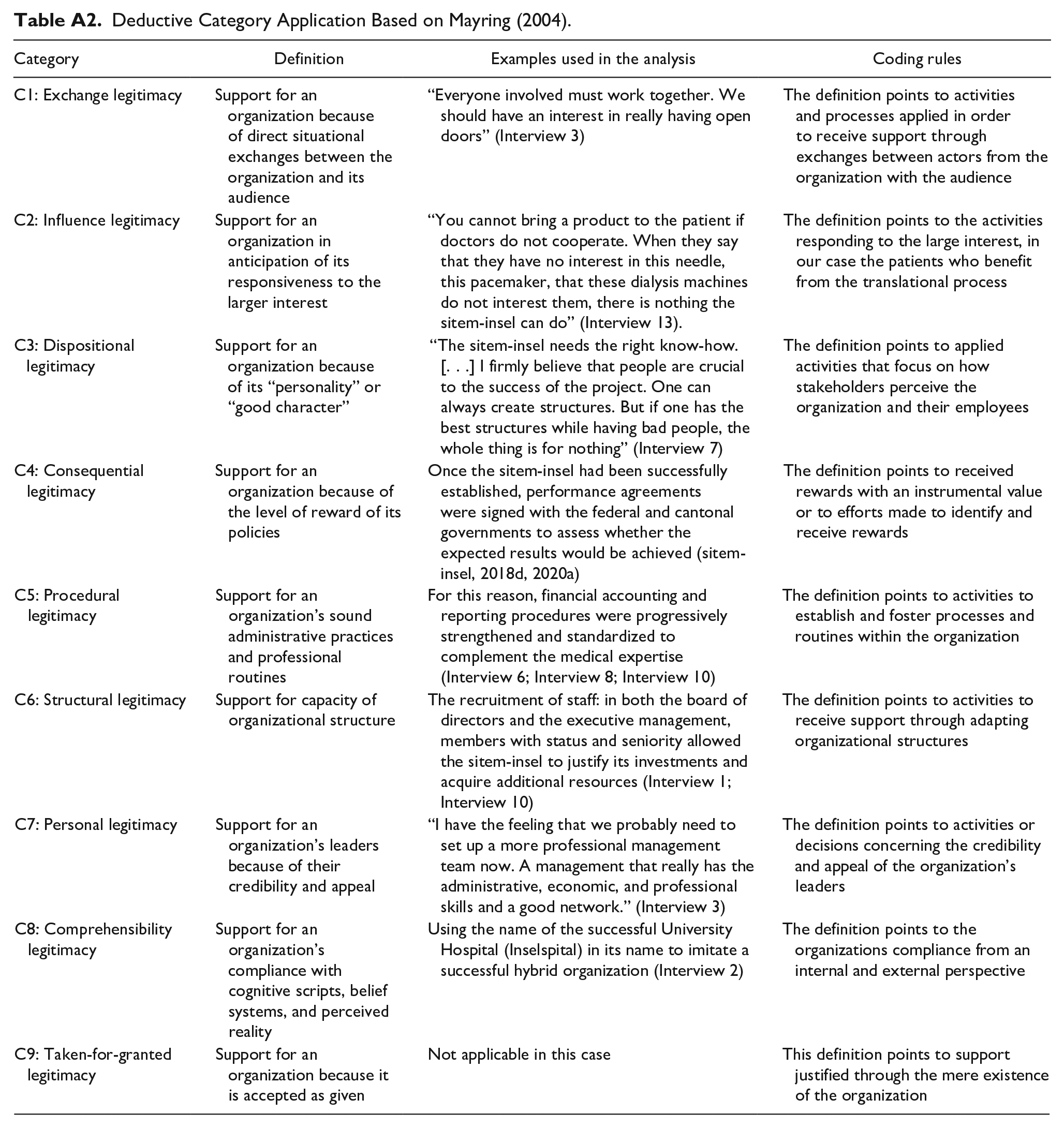
| Category | Definition | Examples used in the analysis | Coding rules |
|---|---|---|---|
| C1: Exchange legitimacy | Support for an organization because of direct situational exchanges between the organization and its audience | “Everyone involved must work together. We should have an interest in really having open doors” (Interview 3) | The definition points to activities and processes applied in order to receive support through exchanges between actors from the organization with the audience |
| C2: Influence legitimacy | Support for an organization in anticipation of its responsiveness to the larger interest | “You cannot bring a product to the patient if doctors do not cooperate. When they say that they have no interest in this needle, this pacemaker, that these dialysis machines do not interest them, there is nothing the sitem-insel can do” (Interview 13). | The definition points to the activities responding to the large interest, in our case the patients who benefit from the translational process |
| C3: Dispositional legitimacy | Support for an organization because of its “personality” or “good character” | “The sitem-insel needs the right know-how. [. . .] I firmly believe that people are crucial to the success of the project. One can always create structures. But if one has the best structures while having bad people, the whole thing is for nothing” (Interview 7) | The definition points to applied activities that focus on how stakeholders perceive the organization and their employees |
| C4: Consequential legitimacy | Support for an organization because of the level of reward of its policies | Once the sitem-insel had been successfully established, performance agreements were signed with the federal and cantonal governments to assess whether the expected results would be achieved (sitem-insel, 2018d, 2020a) | The definition points to received rewards with an instrumental value or to efforts made to identify and receive rewards |
| C5: Procedural legitimacy | Support for an organization’s sound administrative practices and professional routines | For this reason, financial accounting and reporting procedures were progressively strengthened and standardized to complement the medical expertise (Interview 6; Interview 8; Interview 10) | The definition points to activities to establish and foster processes and routines within the organization |
| C6: Structural legitimacy | Support for capacity of organizational structure | The recruitment of staff: in both the board of directors and the executive management, members with status and seniority allowed the sitem-insel to justify its investments and acquire additional resources (Interview 1; Interview 10) | The definition points to activities to receive support through adapting organizational structures |
| C7: Personal legitimacy | Support for an organization’s leaders because of their credibility and appeal | “I have the feeling that we probably need to set up a more professional management team now. A management that really has the administrative, economic, and professional skills and a good network.” (Interview 3) | The definition points to activities or decisions concerning the credibility and appeal of the organization’s leaders |
| C8: Comprehensibility legitimacy | Support for an organization’s compliance with cognitive scripts, belief systems, and perceived reality | Using the name of the successful University Hospital (Inselspital) in its name to imitate a successful hybrid organization (Interview 2) | The definition points to the organizations compliance from an internal and external perspective |
| C9: Taken-for-granted legitimacy | Support for an organization because it is accepted as given | Not applicable in this case | This definition points to support justified through the mere existence of the organization |
Declaration of Conflicting Interests
The author(s) declared no potential conflicts of interest with respect to the research, authorship, and/or publication of this article.
Funding
The author(s) received no financial support for the research, authorship, and/or publication of this article.
