




Abstract
This article examines to what degree citizens and societal stakeholders are involved in Public–Private Partnership (PPP) projects, what factors account for their involvement, and what the effects are on the performance and innovativeness of the projects. This research, based on a survey in 2014 consisting of 144 respondents involved in Dutch PPP projects, shows that although trustful relationships between actors enhance the inclusion of societal parties, the presence of a contract that allows for flexibility leads to more citizen involvement. Furthermore, we found that the involvement of stakeholders leads to more innovative projects but not necessarily to better performing projects.
Introduction
Public–private partnerships (PPPs) have been very popular in the last two decades among governments as “the” governance strategy to improve service delivery and realize large infrastructural projects. The idea was, and still is, that by intensive cooperation between public and private actors, better and more innovative services and policy outputs can be realized for lower costs (Ghobadian, Gallear, O’Regan, & Viney, 2004; Hodge, Greve, & Boardman, 2010). PPPs come in many shapes and sizes. Although there is no generally accepted understanding of PPPs (Hodge & Greve, 2007), many definitions share the aspect of some sort of durable cooperation between public and non-public entities, the sharing of risk and the joint production of products and services (see Hodge & Greve, 2005; Klijn & Teisman, 2003; Savas, 2000). A definition that encompasses most of these aspects is that of Klijn and Teisman (2003) who describe PPPs as a “cooperation between public and private actors with a durable character in which actors develop mutual products and/or services and in which risks, costs and benefits are shared” (Klijn & Teisman, 2003, p. 137).
Within the broad range of PPP families (see also Hodge & Greve, 2007, for an overview), we choose to focus on one of the most visible forms of partnerships: the contractual Design, Build, Finance, Maintenance, Operating (DBFMO) partnership. In this contract, the design, construction, financing, and possibly (commercial) operation of an infrastructure project (such as a road or a building) are integrated into a so-called DBFMO-contract. This contractual form of cooperation, which is focused on an inclusive and long-term approach, can be seen as an innovative form of governance as there is early involvement of a possible contractor and more freedom for the contractor to manage the service for a longer period.
The purpose of our study is to understand stakeholder involvement in these contractual DBFMO partnerships. Currently, the extent to which stakeholders are involved in contractual PPPs is an understudied aspect of the successful completion of these projects. The fact that PPPs are part of a larger network where various stakeholders are involved is often neglected in PPP literature (Skelcher, 2005). In fact, in the DBFMO literature, the focus is often more upon the contractual relationship between the partners or other organizational features to organize the interactions and monitor the performance (de Bettignies & Ross, 2009; Hodge & Greve, 2005; Office of the Deputy Prime Minister [ODPM], 2004; Savas, 2000). Skelcher (2005, p. 364) observes in an overview of PPPs: “There is little evidence that democratic considerations have made a significant impact on the governance arrangements for PPPs.” In another analysis of U.K. PPPs, he has further found that rules that arrange accountability of and access to partnerships by others are mostly lacking (Skelcher, Mathur, & Smith, 2005). Usually the presence of a tight contract because of a narrow technocratic treatment of risk is seen as one of the main reasons for the limited involvement of stakeholders (d’Alessandro, Bailey, & Giorgino, 2014). Other reasons given for this restricted involvement are that these projects are technical in their nature and, furthermore, that the negotiations are about sensitive financial deals which preclude the involvement of other stakeholders (see Hodge & Greve, 2005; Weihe, 2008). If this limited involvement of stakeholders is true, then PPPs distinguish themselves from most other new forms of governance as, more often than not, the broader involvement of various stakeholders is mentioned as one of the most striking features of these governance arrangements (Levi-Faur, 2012; Pierre & Peters, 2000; Rhodes, 1997; Sorensen & Torfing, 2007). In the governance literature that conceptualize governance as more horizontal forms of steering including various stakeholders, there is also a strong emphasis on positive aspects of stakeholder involvement in the sense that it reduces veto power, improves the content and innovativeness of proposals and solutions, and enhances democracy (see Dryzek, 2000; Fischer, 2003; Klijn & Koppenjan, 2016; Sorensen & Torfing, 2007). 1
Is PPP the outlier in the governance forms and the governance rhetoric that stakeholder involvement produces better outcomes? In this article, we examine whether the involvement of stakeholders actually makes a difference and how it does so. We will first describe what the involvement of stakeholders in PPP projects is, and then answer the questions of what factors influence the involvement of stakeholders, and what the effect of stakeholder involvement is on the outcomes of PPP projects. In analyzing stakeholder involvement, we focus on societal actors (citizens and societal groups).
To test these questions empirically, we use data from a survey among PPP projects in the Netherlands to identify both the nature of stakeholder involvement and its effect. The majority of these projects are dominated by a strong Design, Finance, Build, and Operating (DFBO) character. 2 They thus fit the classical format most often described in the literature about DBFMO and are useful in examining the impact of stakeholder involvement in these PPP projects. In the “Stakeholder Involvement in PPP: Some Theoretical Considerations” section, we discuss the theoretical framework and the hypotheses. The “Research Methods” section contains the methodology and the operationalization of the key variables as well as the analysis that has been performed. The “Results” section presents the main findings, and the “Conclusion” section presents our conclusions and reflections.
Stakeholder Involvement in PPP: Some Theoretical Considerations
Especially in DBFMO PPPs, the process of building and running a PPP does not allow for much involvement of other stakeholders, some authors argue (see, for instance, Willems, 2014). The stakeholders (citizens and societal groups) have limited opportunity for involvement because of the wide variety of rules that restrict the tendering process. This restriction is enhanced by the way most PPP processes are tendered. The emphasis in this tendering and negotiating process is very much on the interaction between the public and the private actors, and as a great deal of the information is valuable and not publicly available (because it contains information on prices and tendering offers of private consortia), there is little interaction with other stakeholders (Savas, 2000; Verweij, 2015). After the tendering process is over, the content of the PPP projects has been at least partly determined, and often strongly determined, and involvement of stakeholders can only result in minor changes (Verweij, 2015; Weihe, 2008). Verweij (2015), in his in-depth analysis of two PPP projects (one with a strong contractual character, and one with a mixed contractual and organizational character), concludes that internal managerial orientation and non-cooperation and low involvement of stakeholders are strongly related to the nature of the contract which favors achieving deadlines and agreed performance targets over any other aspect of the project (see also Skelcher, 2005). Therefore, given the literature on DBFMO PPPs, which emphasizes the technocratic character of PPPs, their contractual rigor, and the problem of sharing valuable economic information, a relatively low involvement of other stakeholders may be expected (especially compared with other new forms of governance).
PPP: Better performance and more innovation?
That PPPs lead to better performance in terms of service delivery and the achievement of policy goals is the main argument set out in the literature and the many governmental reportsPPP could achieve better products or services or provide services for lower costs (see Hodge & Greve, 2005; Savas, 2000). What exactly do we see as good performance and innovation? Partnership performance can be conceptualized in roughly two ways. First, performance can be narrowly conceived as the achievement of particular targets as set out in the contract and the (cost) efficiency of achieving those targets. Second, partnership performance can also be conceptualized more broadly “beyond the contract” by focusing upon the wider support for the project and the durability of the relationships within the project. We focus on both dimensions as various authors argue that many different indicators are needed for assessing performance in partnerships (see Jeffares, Sullivan, & Bovaird, 2013; Skelcher & Sullivan, 2008). Thus, we focus our attention for performance on five dimensions often mentioned by authors (see Klijn & Koppenjan, 2016; Skelcher & Sullivan, 2008): the effectiveness of the solution offered, the support, the integral character of the solution, the robustness (is the solution durable in the future), and the cost effectiveness (efficiency).
When it comes to innovation, the structure as well as the supposed outcomes of the partnership are often presented as possible innovative outcomes (see H. de Vries, Bekkers, & Tummers, 2016, for an overview of different types of innovation). Here, we focus on innovative outcomes, building on the transformative performance domain (Skelcher & Sullivan, 2008). Innovation is conceptualized as the production of perceived new ways of achieving outcomes, thereby fundamentally changing existing ways of organizing or delivering services, for example, by the usage of new technology (Bekkers, Edelenbos, & Steijn, 2011). The opportunity for a long-term involvement in a project provides both the potential for devising new solutions to problems and protects a risk aversion to untested approaches. Innovations typically demand a significant investment and the return or payback period of these investments is relatively long.
Stakeholder involvement and project outcomes: Performance and innovativeness
The vast literature on governance mentions several arguments why stakeholder involvement would enhance project performance and innovation (see Levi-Faur, 2012; Sorensen & Torfing, 2007).
Basically, the arguments cluster around three categories.
Veto power. This is a classic argument already prominent both in inter-organizational theory (see Pfeffer’s authoritative study on power in 1981) and in the classic political science literature on interest intermediation (Jordan, 1990; Williamson, 1989), and which again figures prominently in governance and network literature (Klijn & Koppenjan, 2016; Pierre & Peters, 2000; Sorensen & Torfing, 2007). The argument emphasizes the veto power and resources that stakeholders have. In this line of thought, involving stakeholders is needed because it reduces opposition and mobilizes necessary resources (Jordan, 1990; Klijn & Koppenjan, 2016; Williamson, 1989). This argument is especially relevant for situations where PPP projects draw considerable opposition from societal or citizens groups. In this case, involving stakeholders might preclude protracted conflicts with environmental groups or citizen groups over projects. Actually, this is one of the reasons why some authors argue for an active environmental or stakeholder management (Bryson, 2004).
Improvement of content and innovation. This argument is very different from the previous argument. It rests on the observation that knowledge is spread among various actors, and that top-down initiated processes create poor policy problem definitions and solutions (Fischer, 2003). Indeed, this argument is commonly given as to why earlier involvement of private actors in the PPP process is valuable (see Ghobadian et al., 2004; Hodge & Greve, 2005). Because private consortia are involved earlier and adjustments are possible, better, innovative, and more tailor-made solutions (Hodge et al., 2010; Weihe, 2008) are achievable. The idea is that this would also hold for the involvement of other stakeholders in the network around a PPP project. In that way, more value perspectives on the problem; more information, knowledge, and ideas; and more creativity in designing solutions can be included (see also Klijn & Koppenjan, 2016; Mandell, 2001). Likewise, the confrontation of differing ideas and perspectives is an important ingredient for innovation (Alter & Hage, 1993; Parker & Vaidya, 2001). By harnessing each other’s knowledge and expertise, actors are able to realize solutions and alternative processes that they would otherwise had not thought of (Huxham & Vangen, 2005; Parker & Vaidya, 2001). The development of new alternatives is especially salient in PPP projects because stakeholders normally are not an integral part of the tendering and contractual process. Consequently, their input in the decision-making process of projects provides the public and private parties with novel viewpoints. Of course, this is the ideal that in practice may be difficult to achieve due to the complexity of the decision-making process and the differences of values and interests among the actors (Klijn & Koppenjan, 2016).
Democracy. This argument, again different from the first two arguments, stresses the fact that including more actors in the decision making around wicked problems and service-delivery processes enhances the democratic quality of these processes. Thus, network governance is seen as a new way to include citizens and bridge the gap between politicians and citizens (see Berry, Portney, & Thomson, 1993; Sorensen & Torfing, 2007; see also the ideas about deliberate democracy: Dryzek, 2007). This argument actually works two ways. However, there is a suggestion that enhancing democratic legitimacy, which is the aim of including stakeholders, will positively affect the performance of networks. Stakeholders will, for instance, actively favor the policy ideas (and promote them) if they consider them legitimate (see for empirical evidence of the positive effect of democratic legitimacy: Klijn & Edelenbos, 2013). But from a normative point of view, democratic legitimacy can be considered as (public) good in itself, even if it does not contribute to better performance (see Dryzek, 2007).
Although one may expect that, in general, the involvement of stakeholders in PPP projects will not be very high, these three sets of arguments in the literature we discussed would suggest that in those cases where there is (more) involvement of stakeholders, there will be a positive impact on the performance and project innovativeness. In fact, earlier research done on environmental projects has showed that stakeholder involvement did have positive influence on performance (see Klijn & Edelenbos, 2013). Hence, our hypotheses are as follows:
Factors influencing stakeholder involvement: Contracts and trust
A second question that this article attempts to answer is which factors influence the level of stakeholder involvement. Many authors argue that one of the most important factors is the contract and especially the flexibility of the contract (FLE). P. de Vries and Yehoue (2013) refer to flexible contracts as contracts, where the wording of the contract is not taken literally to the letter of the law. When difficulties or uncertainties emerge in projects, the contract can be made more flexible and allow for negotiation between the partners for the greater good and long-term viability of the project. Flexible contracts thus allow for adaptation of the contractual framework to unanticipated contingencies, thereby creating incentives for cooperative behavior (Athias & Saussier, 2010). If the contract contains many tight performance indicators and strict time schedules and penalties, it is very difficult, at least for the private consortium, to include external stakeholders (see Verweij, 2015; Weihe, 2008). We would, therefore, expect characteristics of the contract (especially flexibility) to have an impact on the degree of (external) stakeholder involvement. This leads us to the third hypothesis:
Another important factor in explaining the extent of stakeholder involvement is the relation of the public and private partners with the stakeholders in the network around the project. A crucial factor in these relationships is trust. An important value of the concept of trust lies in the fact that through interaction in partnerships and the wider network around the partnership, strategic complexities (Klijn & Koppenjan, 2016) make it too difficult for the actors to foresee all the possible contingencies, reason them out, or calculate them accurately (Deakin & Wilkinson, 1998). It is precisely the wide range of possible contingencies which makes the concept of trust such an interesting one to consider when appraising the involvement and performance of stakeholders in governance networks and partnerships (Brown, Potoski, & Van Slyke, 2007; Huxham & Vangen, 2005; Klijn, Edelenbos, & Steijn, 2010). In the literature on trust, especially on alliances (Bachmann & Zaheer, 2006; Sako, 1998) and collaboration (Ansell & Gash, 2008; Huxham & Vangen, 2005), several arguments have been proposed for why trust would be beneficial for cooperation in general, and for partnerships in particular. Among these, the three most compelling are that trust reduces transaction costs because there is less need for extensive contracts and monitor activity, that actors are more likely to invest in the relationship (and support the project also when difficulties arise), and that they are more likely to exchange information, which can also be conducive to innovations (see Klijn et al., 2010; Lane & Bachmann, 1998; Nooteboom, 2002; Sako, 1998). Because of these views on trust and cooperation, we also expect that if the relation between the actors in the wider network around the PPP project is characterized by a higher level of trust, we will see a higher stakeholder involvement. After all when the trust level is higher, stakeholders will be more inclined to participate in the project, and the core public and private actors are more likely to invite or encourage that participation. This leads us to the fourth hypothesis of our article:
Research Methods
Data
The analyses in this article are based on a survey (March 2014-June 2014) among respondents who are involved in PPPs in the Netherlands. For the survey, respondents who are involved in officially known PPP projects in the Netherlands were identified looking at all publicly available databases of ministries and ministerial PPP support bureaus. Consequently, this survey is actually not a sample but represents more or less the whole Dutch population of (officially known) PPP projects. In total, 343 respondents divided over 93 projects were selected and received a request to fill in the survey. The selected potential respondents were predominantly public and private respondents who were involved in the projects. The response rate of the survey was 46.6%, and the 144 respondents are involved in a total of 68 PPP projects in the Netherlands. Thus, the survey covered 73% of the officially known PPP projects in the Netherlands. This means that often more than one respondent involved in several projects is included in the data set. Respondents are employed in private consortia organizations (27.1%), consultancy organizations (13.2%), public organizations (45.8%), and other organizations (11.8%) such as non-profit organizations and law firms. On average, the survey respondents have been involved in complex projects for 14 years, which indicates their considerable experience with these kinds of projects. Each of the respondents was asked to answer the survey questions with a specific PPP project in mind, which they also had to mention in the survey.
Measurement
Stakeholder involvement
Our main variable is stakeholder involvement in the decision-making process. The respondents rated the involvement of stakeholders among two dimensions: citizen involvement (CIT) and societal group involvement (SOC). The items we used are divided into two groups: (a) no involvement to intensive involvement of citizens in the decision-making process and (b) no involvement to intensive involvement of societal groups in the decision-making process. The items have a Cronbach’s alpha of .82. However, in most of our analyses, we separately tested citizen involvement and involvement of societal groups. The mean score of perceived citizen involvement within the project is 5.34 (SD = 2.66), and the mean score of societal group involvement is 6.39 (SD = 2.36). on a 10-point Likert-type scale. These findings show that stakeholders are involved to a moderate extent, with societal groups being slightly more involved than citizens. The standard deviation for both items is quite large, which shows that stakeholder involvement differs across projects.
Trust
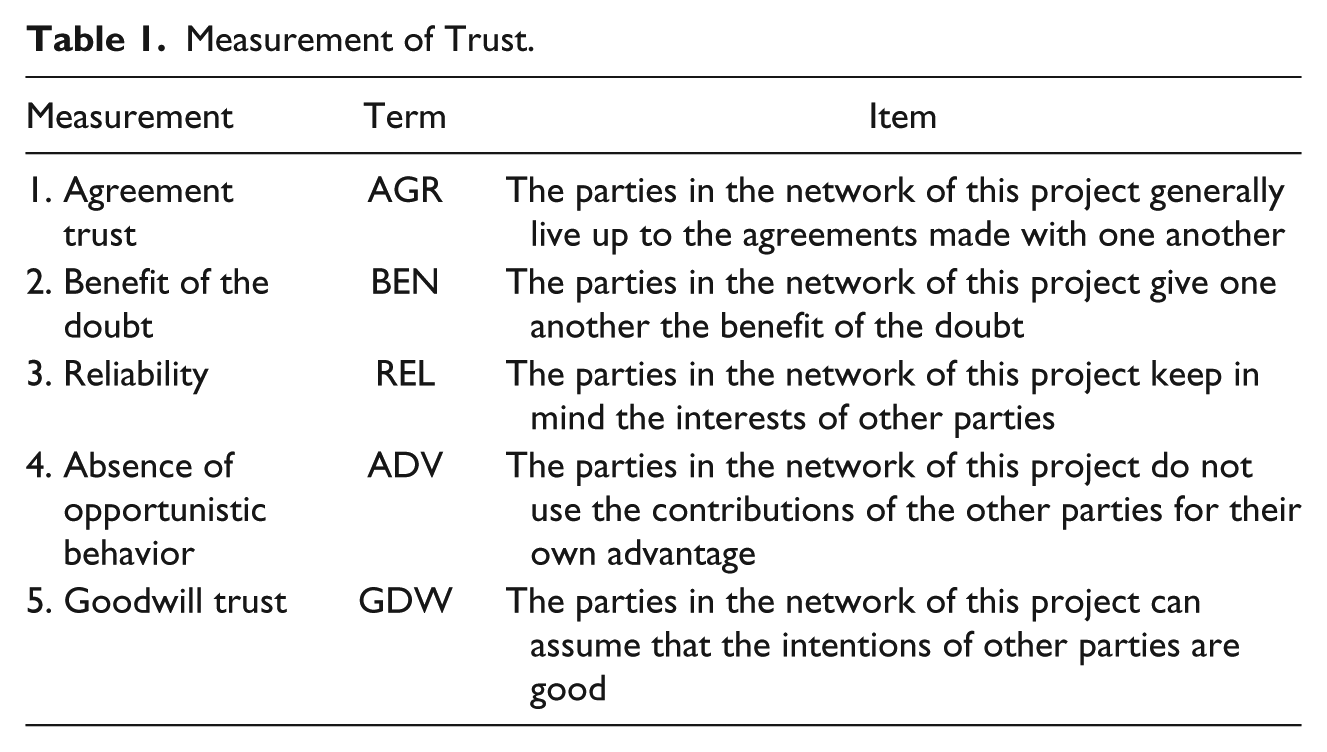
To measure trust within the project, we used a scale developed by Klijn et al.’s (2010). In our survey, the respondents rated the level of trust among five dimensions, listed below in Table 1. The items have a Cronbach’s alpha of .85. The mean score of perceived trust between organizations within the project network is 3.41 (SD = 0.67) on a 5-point Likert-type scale. This indicates a moderate degree of trust.
Measurement of Trust.
Flexibility of contract
Respondents were asked to rate the FLE by answering the question whether the contract offers much room for negotiation on a 10-point Likert-type scale. To determine this, the following item was used: The project offers little room for negotiation, to the project offers much room for negotiation. The mean score is 4.93 (SD = 2.17) on a 10-point Likert-type scale. This shows that respondents perceive the contract to be quite inflexible, but that the amount of flexibility differs considerably across projects.
Perceived outcomes: Project performance
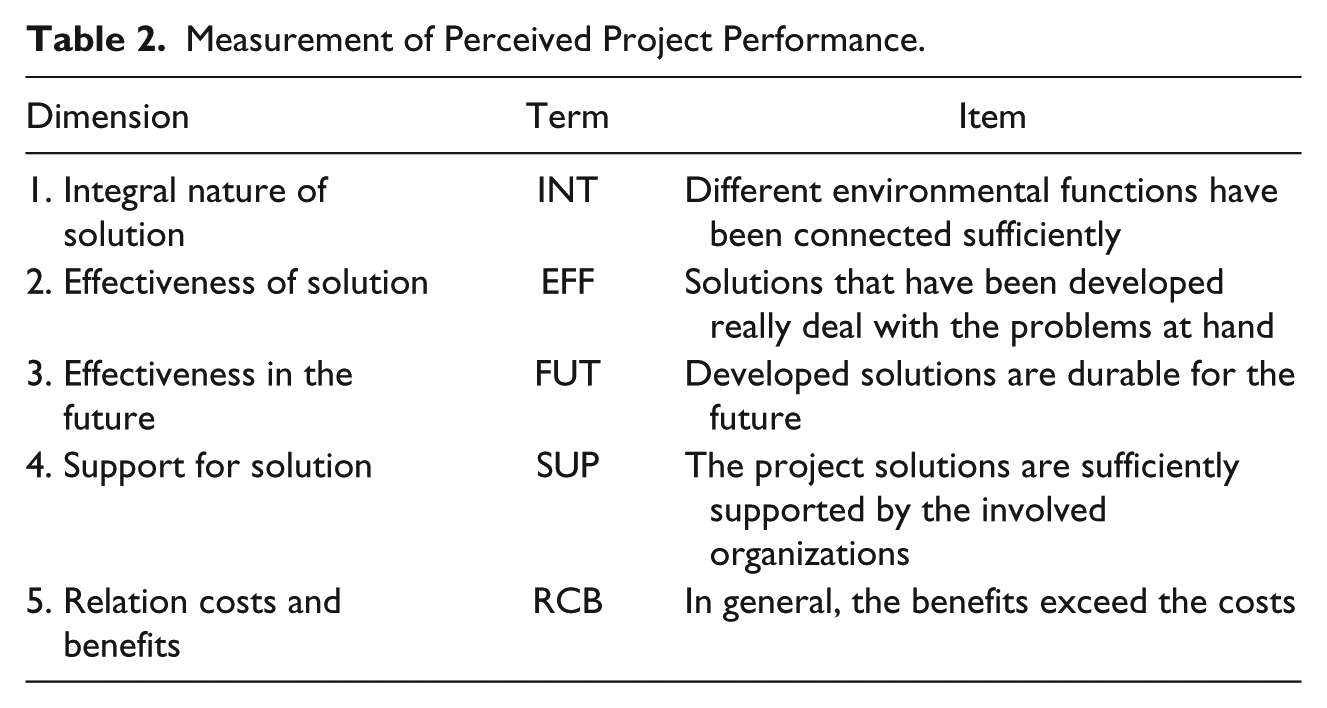
It is difficult to measure the performance of projects. As projects generally consist of various actors, multiple goals are present. Hence, it is difficult to choose one overarching goal in which all actors feel represented. Furthermore, as projects usually have a lengthy time span, goals of actors will likely change over time due to a readjustment of preferences as a result of learning or goal displacement (Klijn & Koppenjan, 2016). In addition, the assessment of objective outcomes by making use of surveys that measure the perceptions of respondents is not possible. Therefore, perceived project performance is taken as a proxy for outcomes. In this approach, we follow the work of Klijn et al. (2010). The measurement scales they use build on different dimensions of project performance, listed below in Table 2. Cronbach’s alpha for these items is .71. The mean score for project performance, as rated by the respondents of the projects, is 4.00 (SD = 0.51) on a 5-point Likert-type scale, indicating a high satisfaction with the performance of their project.
Measurement of Perceived Project Performance.
Perceived outcomes: Project innovativeness
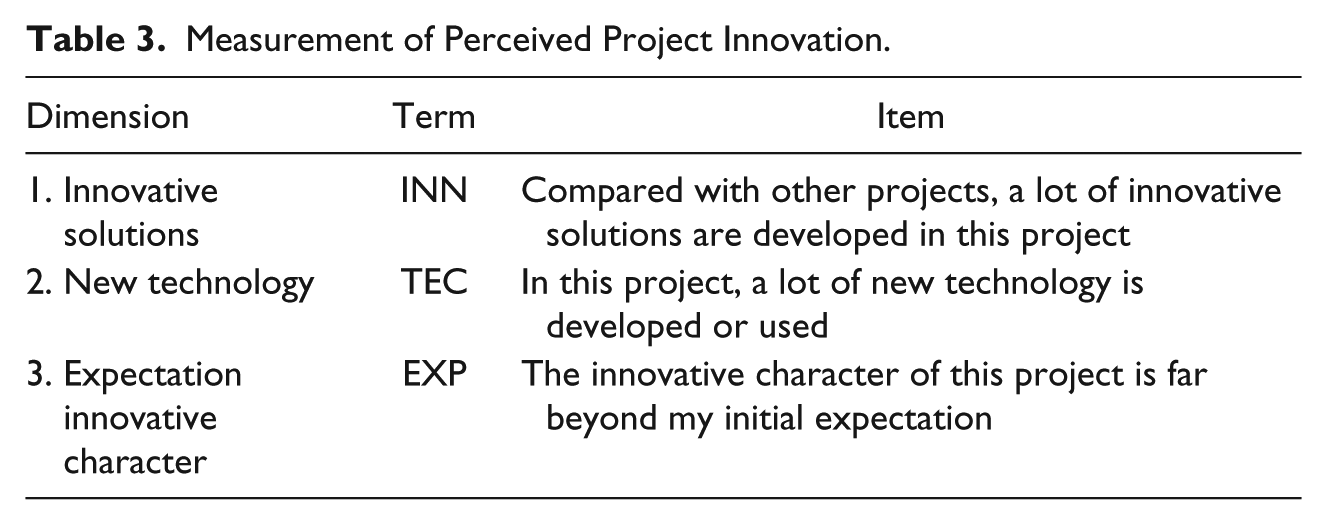
To measure project innovativeness within the project, respondents rated the level of innovativeness among three dimensions, listed below in Table 3. Two dimensions follow the two aspects of innovation we mentioned earlier (innovative solutions and the use of new technology), and the third dimensions tries to measure the overall perception of innovation of respondents. Cronbach’s alpha for these items is .78. The mean score for project innovation, as rated by the respondents of the projects, is 6.38 (SD = 1.69) on a 10-point Likert-type scale, indicating rather high levels of perceived innovation within the project.
Measurement of Perceived Project Innovation.
Control variables
We selected control variables on two analytical levels. First, we controlled for project-level variables: the phase of the project and the technical complexity of the project. Second, we controlled for the organizational background of the respondents: public organization, private organization, consultancy organization, and other.
Common Method Bias
The use of a survey in which both the independent and dependent variables are filled in by the same respondents could lead to inflated relationships between variables. As all data are based on the perceptions of the same survey respondents, variance could be caused by the measurement method rather than by the research variables. However, Lance, Dawson, Birkelbach, and Hoffman (2010, p. 450) showed that common method effects do not appear to be so large that they pose a serious threat to organizational research. To be sure, we performed Lindell and Whitney’s (2001) test, and also conducted a Harman one-factor test to assess whether common method bias is a problem in this article. The results of these analyses (see Appendix A) suggest that common method variance is not of great concern in this study, and that it is unlikely to confound the interpretation of results.
Data Analysis
We will use multilevel regression analysis (MLA) because the observations in the data set are not fully independent given that individuals in the same project tend to be more alike. This similarity is a problem because most statistical tests assume the independence of observations. By using multilevel statistics, unbiased standard errors are generated by taking into account the various dependencies (Hox, 2002). We can thus overcome this problem of non-independent observations and include both individual and project-level variables. However, conducting MLA only makes sense if there is a sufficient level of variation in the dependent variable at the project level. In our analysis of perceived performance, for instance, (see the next section) according to the baseline (null) model, about 42.6% of the variation in perceived project performance can be explained by project-relevant characteristics, 3 and in the case of perceived project innovativeness, 47.8% of the variation can be explained by project-relevant characteristics 4 (for citizen involvement as dependent variable, this is 33.8% 5 ). In all these three cases, given their high percentages, combined with significant −2ll values, it is clear that a single-level regression analysis is not suitable here.
Results
In this section, we will first discuss the results of a correlation analysis between the main variables of our conceptual model and an exploratory factor analysis to test whether our measurement model is a valid and a reliable one. We will then proceed with the testing of our hypotheses.
Relations Between the Variables
In Table 4, the results of a correlation analysis between the variables of our conceptual model are presented. We also conducted a factor analysis to check whether our measurement model is valid and reliable, see Appendix B. Interestingly, citizen involvement (r = .270, p < .01) is positively related to contract flexibility, whereas social group involvement is positively related to trust (r = .394, p < .01). These results give a first indication of the relation between trust and contract flexibility on one hand and stakeholder involvement on the other. Thus, as a first step in our analysis, the correlation analysis only partially supports the theoretical expectations formulated in the third and fourth hypotheses. Furthermore, the results show that stakeholder involvement is only related to perceived project innovativeness (and not performance). This means that our first hypothesis is not supported, but that our second hypothesis is.
Descriptive Statistics and Correlations Between Variables.
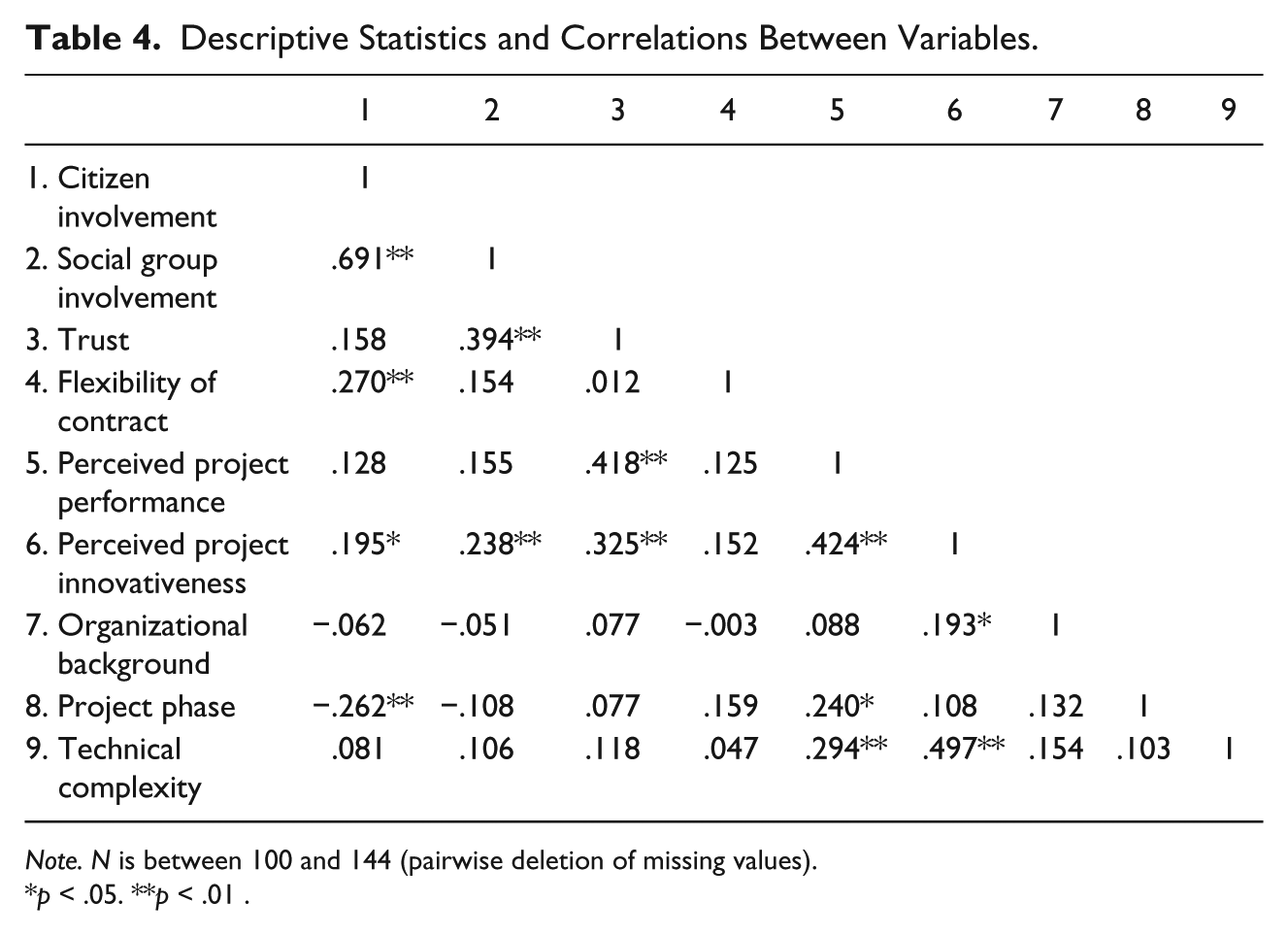
Note. N is between 100 and 144 (pairwise deletion of missing values).
p < .05. **p < .01 .
Stakeholder Involvement
To explore the degree of citizens and societal stakeholder involvement in the decision-making process of PPPs, we plotted the stakeholder involvement per project in Figure 1. The bar plot shows that the inclusion of stakeholders in decision making varies considerably across projects.
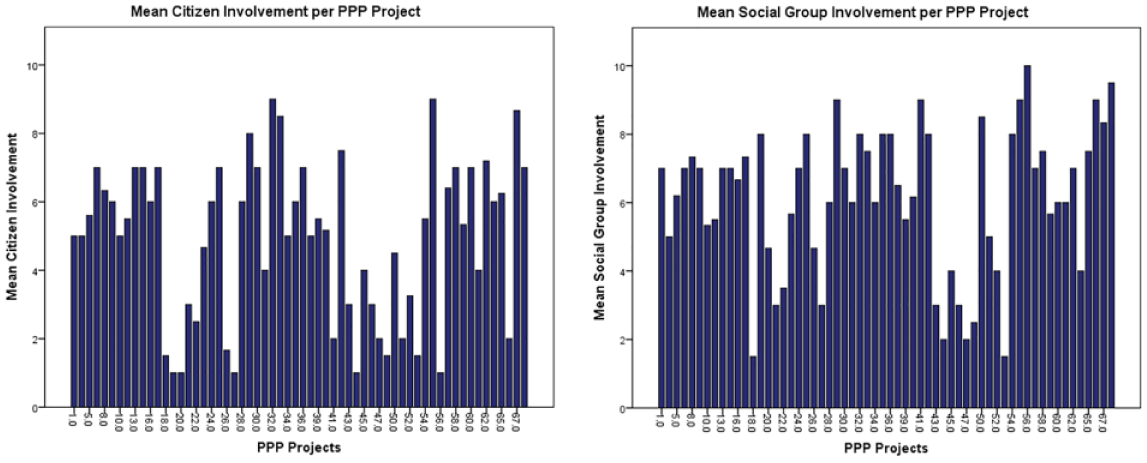
Bar plot stakeholder involvement.
When we divide the projects into the categories of infrastructure, regional development, and real estate projects, the bar plots show a more coherent picture (see Appendix C). Analysis of the data using a Kruskal–Wallis test shows that there is a significant effect of project family membership on levels of citizen involvement, H(2) = 18.26, p < .000, and on levels of social group involvement, H(2) = 11.08, p = .004. Pairwise comparisons with adjusted p values showed the level of stakeholder involvement in real estate projects was, with an average of 3.11 for citizen involvement and 4.68 for social group involvement, significantly lower than in the other analyzed project families. There were no significant differences between infrastructure projects and regional development projects. The mean level of stakeholder involvement and differences between real estate projects and the other project families are included in Table 5.
Kruskal–Wallis Test on Citizen Involvement and Social Group Involvement Per Project Family.
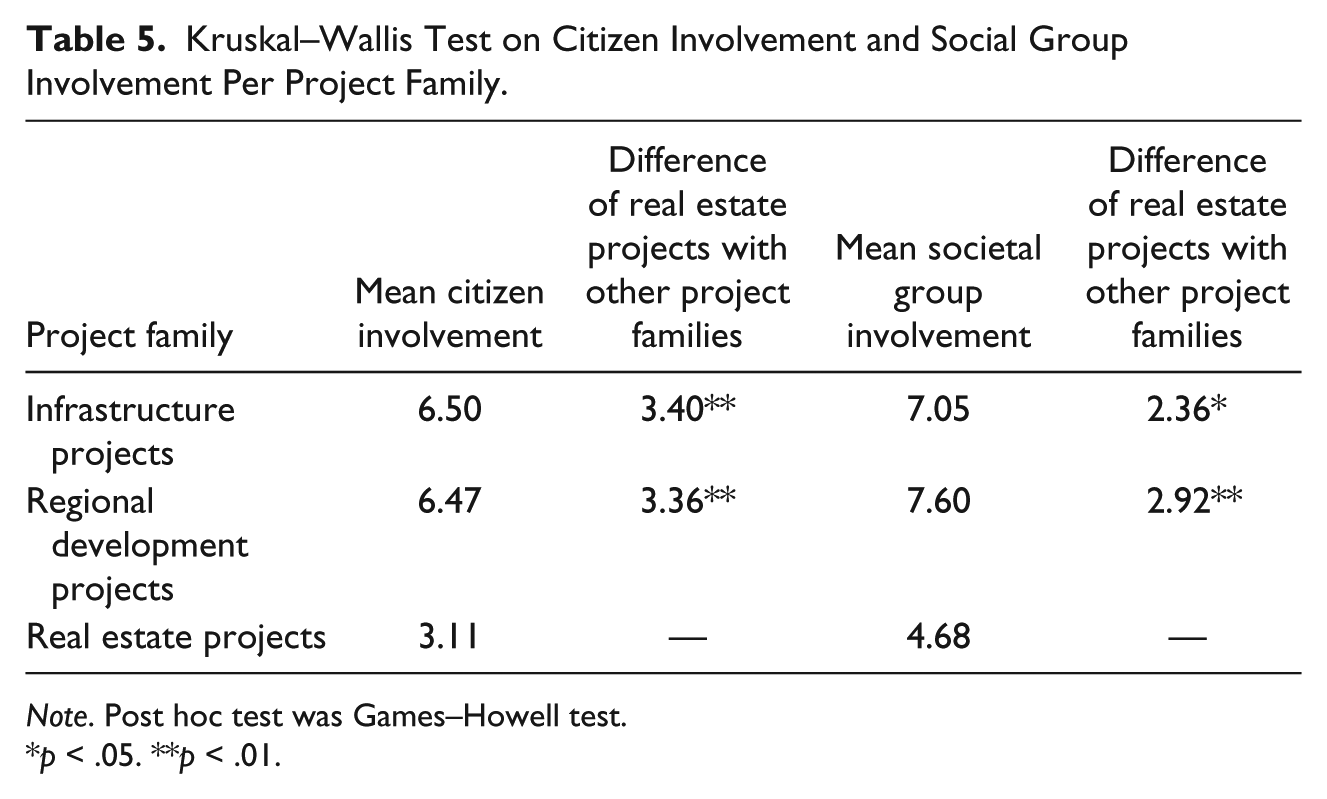
Note. Post hoc test was Games–Howell test.
p < .05. **p < .01.
Results Analyses
Perceived outcomes: Project performance and innovation
Can perceived project performance be explained by stakeholder involvement? Table 6 shows the results of the MLA with perceived project performance as a dependent variable. In this table, we specified two models: one that contains the item citizen involvement, and one that contains the item societal group involvement.
Multilevel Regression Model for Perceived Project Performance and Perceived Project Innovativeness.
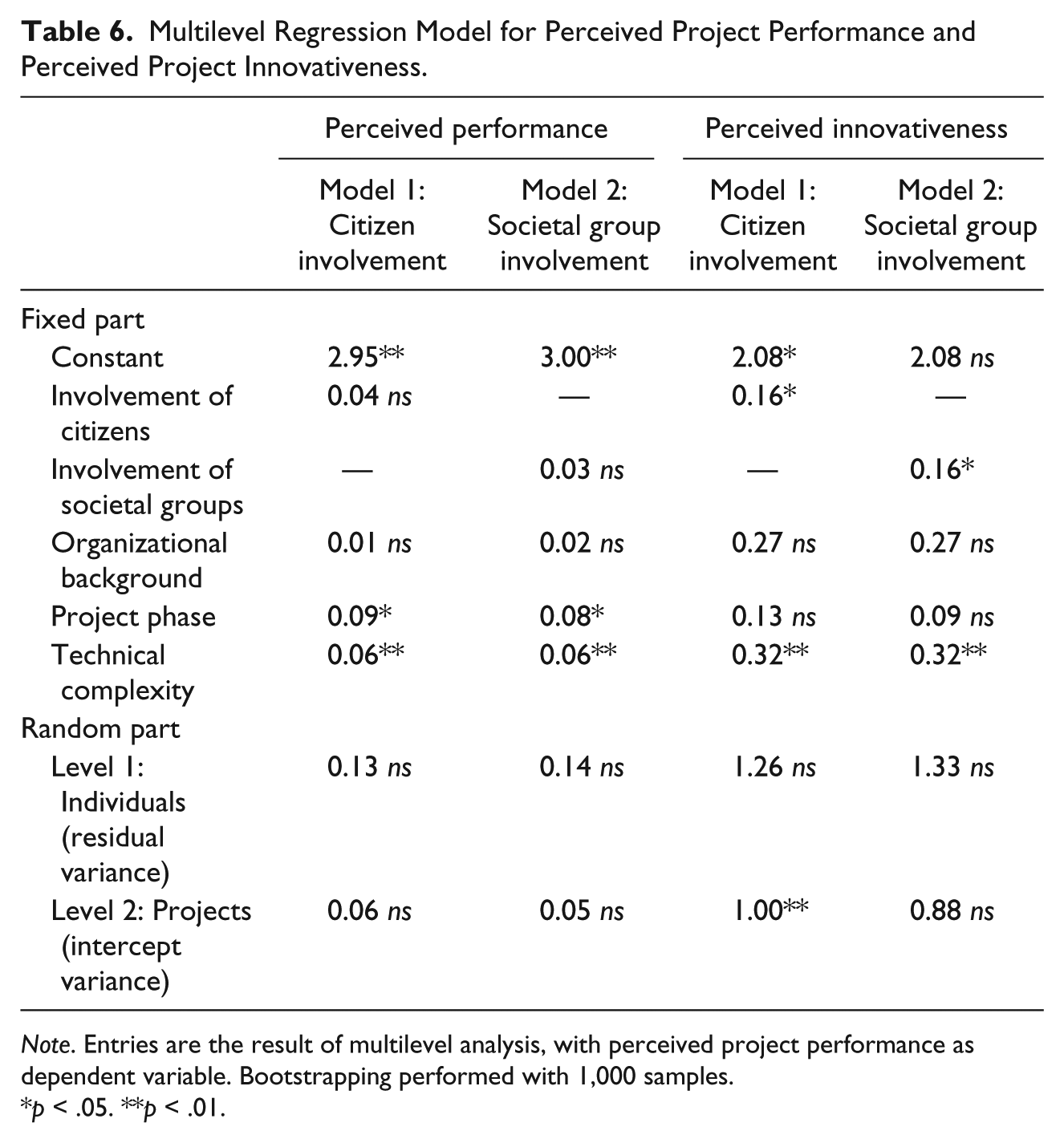
Note. Entries are the result of multilevel analysis, with perceived project performance as dependent variable. Bootstrapping performed with 1,000 samples.
p < .05. **p < .01.
The multilevel model shows that, in both models, only project phase and technical complexity are significantly related to perceived project performance. These results thus indicate that the further a project is in phases, the better project performance is perceived, and the more technically complex a project is, the better the project performance is perceived. Furthermore, the level of citizen and social group involvement in the decision-making process of the project are not significantly related to perceived project performance. Thus, from the results we cannot confirm the first hypothesis: more involvement of stakeholders in the decision-making process of PPP projects will lead to better performance.
Table 6 also shows the results with perceived project innovation as a dependent variable. In line with our hypotheses, the analyses showed that in both models, stakeholder involvement leads to better perceived project innovativeness. In addition, the results indicate that the more technically complex a project is, the higher the project innovativeness is perceived.
Stakeholder involvement
To answer the second research question, we will test whether stakeholder involvement could be explained by trust and contract flexibility. We will first discuss the findings for citizen involvement (Table 7). First, in line with our third hypothesis, contract flexibility is significantly related to citizen involvement. This implies that when the contract of a PPP project has a more flexible character, this leads to a higher involvement of citizens. Second, despite our expectations formulated in Hypothesis 4, we find that trust is not significantly related to citizen involvement. Furthermore, only the control variable project phase significantly influences citizen involvement. The more phases a project has accomplished, the less stakeholders are involved in the decision-making process of the project.
Multilevel Regression Model for Citizen Involvement.
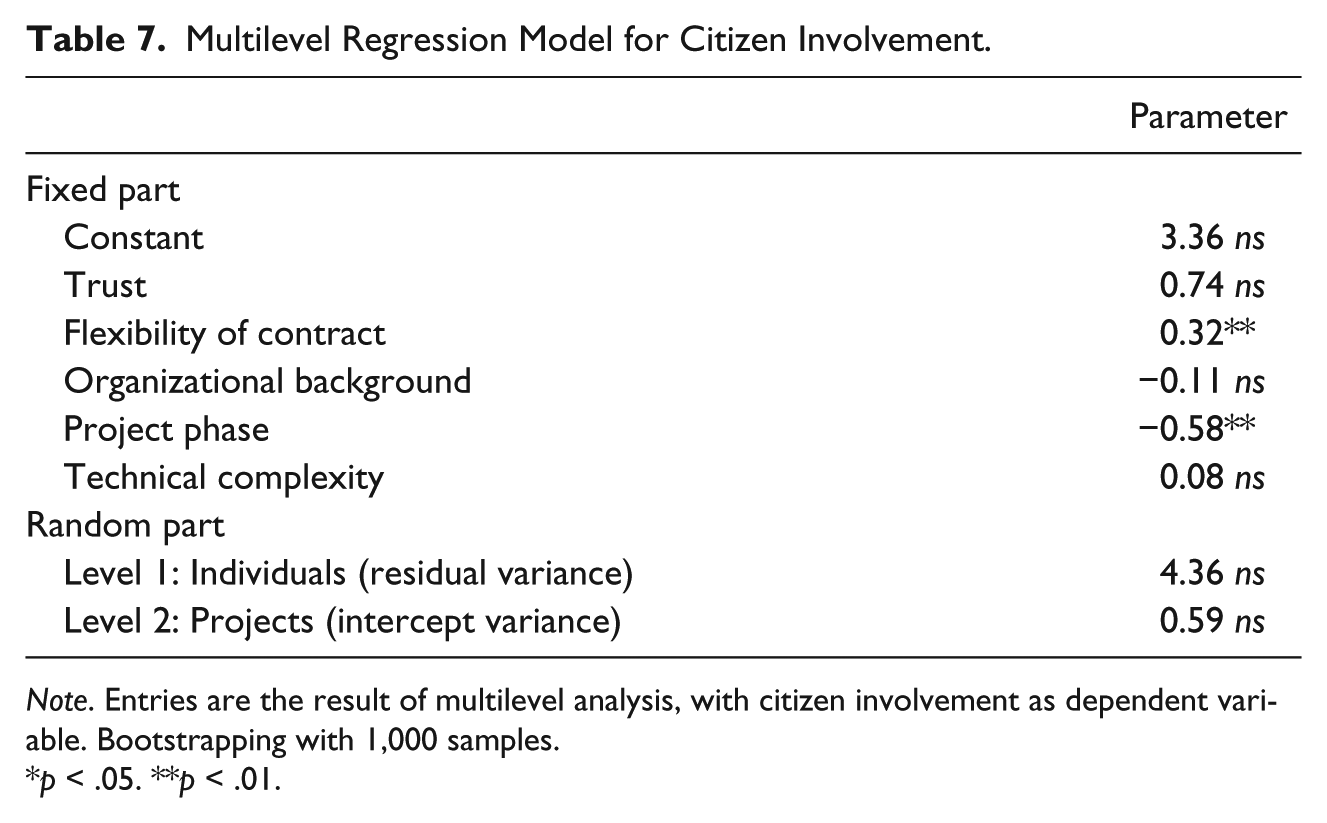
Note. Entries are the result of multilevel analysis, with citizen involvement as dependent variable. Bootstrapping with 1,000 samples.
p < .05. **p < .01.
Table 8 shows the results with social group involvement as a dependent variable. Here, we conducted a regression analysis as the level of variation in the dependent variable at the project level was not sufficient. According to the baseline (null) model, about 17.9% of the variation in societal group involvement can be explained by project-relevant characteristics. 6 Given this low percentage and taking into account the levels of the −2ll deviance, it was clear that in this case, a single-level regression analysis is more appropriate. The results of the analysis are not in line with our third hypothesis, but do confirm our fourth hypothesis. We can see that trust significantly influences social group involvement in the decision-making process of projects. Furthermore, none of our control variables significantly influences social group involvement.
Multiple Regression Model for Societal Group Involvement.
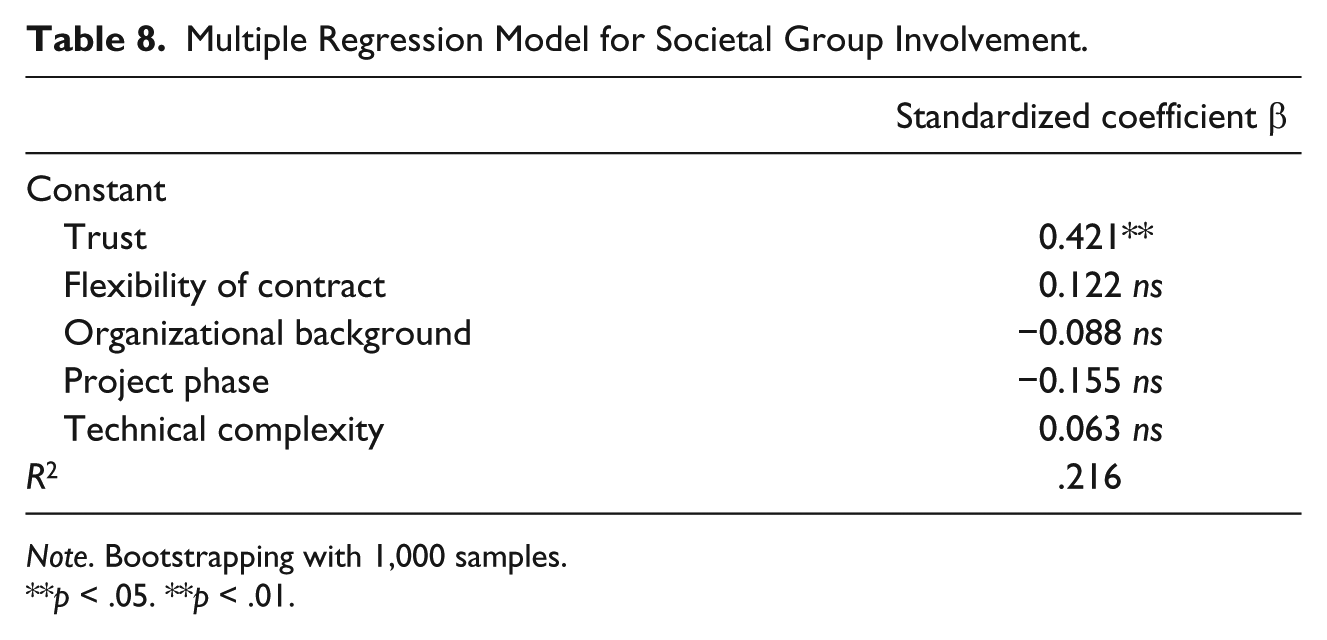
Note. Bootstrapping with 1,000 samples.
p < .05. **p < .01.
Thus, the results only partially confirm our third and fourth hypotheses: When the contract of a PPP project has a more flexible character, this will lead to a higher involvement of citizens (not social groups), and trustful relationships in the wider network around a PPP project influences the involvement of social groups in the decision-making process of PPP projects (not citizens). At the same time, the project phase influences the level of citizen involvement in the decision-making process, while the level of social group involvement is not (significantly) influenced. These are some interesting results that will be further discussed and reflected upon in the conclusion.
Conclusion
Stakeholder involvement in classical PPP projects is an under-researched area, while in the governance literature, the advantages of stakeholder involvement on network performance are emphasized. In this article, we examined to what degree citizens and societal stakeholders were involved in the decision-making process of PPPs, what factors account for the involvement of these stakeholders, and whether their inclusion enhanced the performance of the PPP projects.
First, our findings show that stakeholder involvement is contingent upon the type of PPP project. Stakeholders are better represented in infrastructure and regional development projects than in real estate projects. The reason for this can probably be found in the technical character of the real estate projects in particular, which is focused mostly on the building or renovating of government buildings, such as ministries, schools, and hospitals. It could well be that these projects attract fewer societal stakeholders because there are simply fewer stakeholders present or that societal stakeholders are not interested in participating in the decision-making processes of the projects. Another explanation could be that because of the stricter formal participation requirements in infrastructure and regional development projects, stakeholders are more involved. In this case, stakeholders have more legal means at their disposal to hinder the projects and are thus more interesting for the project partners to include.
Second, we found that stakeholder involvement did not lead to a better project performance. This finding is contrary to earlier findings of stakeholder involvement in non-DBFMO PPP environmental projects (see Klijn & Edelenbos, 2013). It could be that especially in PPP projects in which, after the tendering process is over, the content of the PPP projects is often strongly determined; therefore, involvement of stakeholders can only result in minor changes. In line with network theory (Klijn & Koppenjan, 2016; Mandell, 2001; McGuire & Agranoff, 2011) and theory on collaborative governance (Ansell & Gash, 2008; Huxham & Vangen, 2005), the presence of different perceptions and problem definitions make it more difficult to achieve solutions that are acceptable for all the involved actors when the contractual space is already limited, as is the case in PPPs.
However, PPPs do offer room for stakeholders to positively influence the innovativeness of PPP projects, because we did find a significant relation between stakeholder involvement and project innovativeness. An explanation for this might be that it is maybe easier to implement radically new ways of achieving outcomes compared with other projects (e.g., by using new technology) than to achieve good performance. After all, innovativeness is only one of the possible factors that influence good performance (and may not even be a crucial factor).
Third, we found that different factors account for the involvement of citizens and social groups. Although trustful relationships between actors in the wider environment of the project enhance the inclusion of societal parties, the presence of a contract that allows for flexibility leads to more citizen involvement. These results highlight the importance of making distinctions in groups of stakeholders. For societal parties, whose representatives are often well-known by project partners, trust is an important factor in their decision to be included or not in projects. Citizens, on the contrary, cannot be personally known, which implies that trust is not important. In turn, their inclusion probably depends on more formal considerations, such as contract flexibility. This is also highlighted by the finding that when it comes to citizen involvement, the phase of a project matters. More citizens are involved when the project is at an earlier stage, while this effect is not found for the involvement of societal groups. This again highlights the variety of factors that are relevant for stakeholder involvement.
Limitations of the Study
The study does have several limitations. First, and probably most important, although the advantage of a survey is the number of measurements and generalizability, this comes at the costs of in-depth knowledge. By necessity, we have to measure performance by a limited number of items and the same holds for innovation. Thus, although this research shows some very interesting relations, it would be good to follow up with comparative multiple case researches. In this type of research, the types of achieved outcomes can be studied more in-depth, also in relation to type of stakeholder involvement. In this way, we would also get more information on the types of innovation achieved, and see whether these are real achieved innovations, as we now only have a general impression about the respondents’ perception of innovation. For such research, we, however, need quite a number of case studies and probably qualitative comparative analysis (QCA) to assess the relation between stakeholder involvement and innovation. Another limitation is that because not all the respondents that we approached actually filled in the survey, for some (mostly larger) projects, more respondents reacted than for other projects. For this reason, we conducted multilevel tests where applicable to take the multileveled nature of our data into account. For about half of our projects, we, however, only had one respondent per project who filled in the survey, where at least two respondents would have been better for aggregation to the project level.
Reflections
Despite these limitations, we think we have highlighted an interesting and understudied topic in the PPP literature; moreover, our study showed that the general idea (and empirical finding) in the governance literature, that stakeholder involvement positively influences performance, might be different for DBFMO projects. It is then interesting to expand future research to non-DBFMO projects to see if we find the same conclusions.
This empirical conclusion, however, does not mean that the ambition of stakeholder involvement should not be strived for. One could, for instance, argue that it does improve innovation. And as we mentioned earlier, stakeholder involvement could also be strived for because of normative (democratic) reasons (and not only because it enhances performance and innovation). And especially the involvement of stakeholders provides an extra check on accountability of PPP projects beyond the contract, which is of course a value in itself (see Gazley, 2008).
For future research, it would be interesting to study the involvement of stakeholders and the role of trust and conflicts in PPPs also more qualitatively and in more detail. More specifically, this research could distinguish between different types and depths of involvement and contract flexibility, for instance. In doing this, we would suggest the usage of a case-based approach to causal inference, such as process tracing or as mentioned above the use of multiple comparative case studies using QCA. The research would have to focus on two questions: What the results are of the PPP projects (and what stakeholders want to achieve with their influence attempts), and what exactly the role is of trust and conflicts within these projects. For that, it would also be important to study the relationships in a longitudinal way. Opting for a more longitudinal design is an interesting future option to more precisely unravel the underlying relations, while taking into account how the process develops in the shadow of the project contract.
Footnotes
Appendix A
The Lindell and Whitney test uses a theoretically unrelated construct as a marker variable to adjust the correlations between the principal constructs. Any high correlation among these items would be an indicator of common method bias. We used a survey variable, which is not used in this study to answer our research questions, as a marker (to what extent parties have worked together before). Table 4 shows the correlation coefficients and R2 between variables in the model and marker. The highest value corresponds to the technical complexity of projects. The squared of this correlation coefficient shows the maximum percentage of variance shared between factors. If common sources bias were a concern, we would obtain high levels of dependency between factors and marker. In our study, however, a low level of common source effect is shared between constructs (R2 = .044).
In addition, we conducted a Harman one-factor test to test whether there is one single explaining factor in the data that accounts for the majority of the covariance among measures (Podsakoff, MacKenzie, Lee, & Podsakoff, 2003, p. 889). The unrotated principal components analysis revealed the presence of five factors with an eigenvalue greater than 1.0, rather than one single factor. The five factors together account for 62% of the total variance; the first (largest) factor did not account for a majority of the variance (26.46%). Thus, no one general factor is apparent.
Appendix B
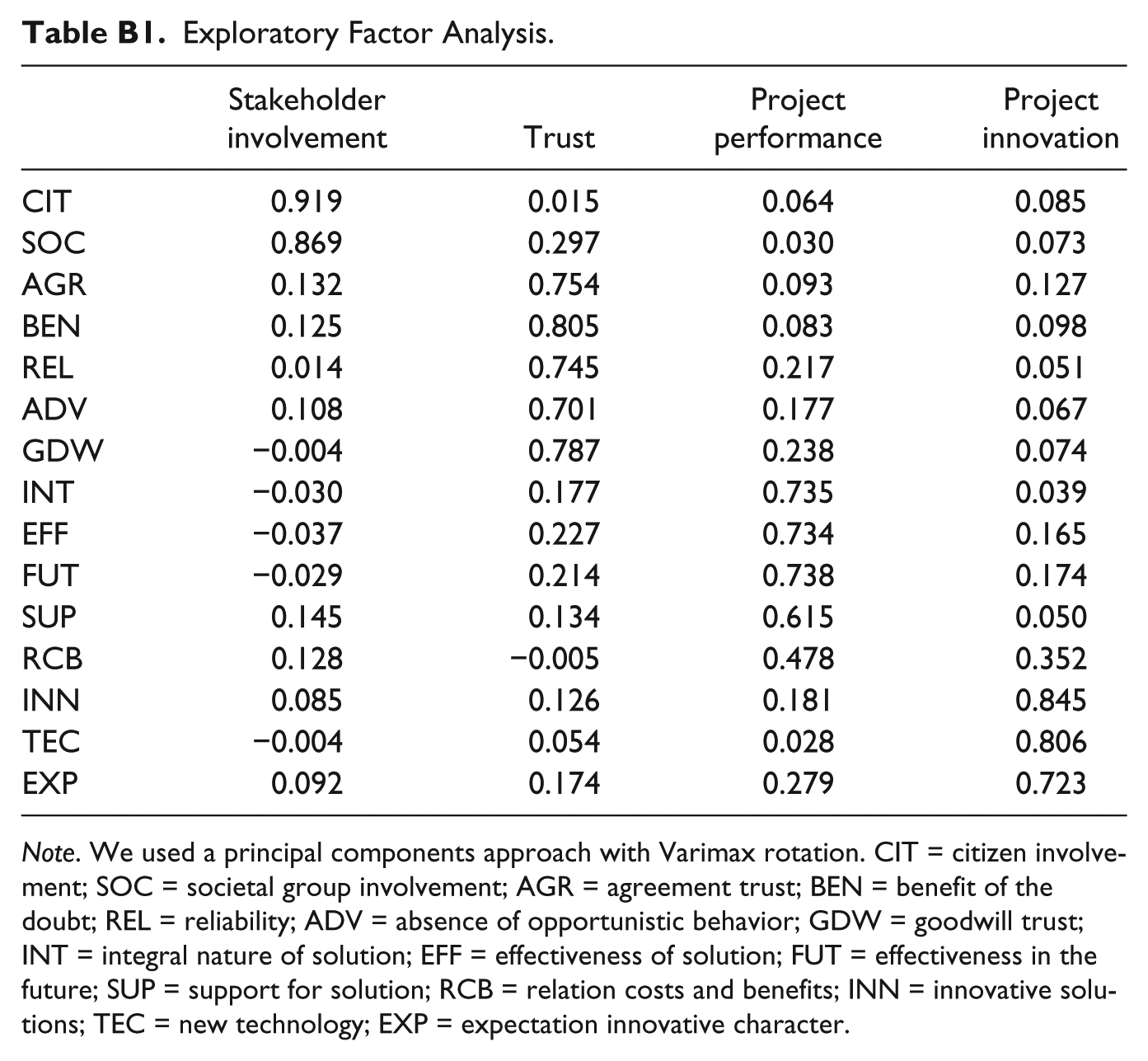
Exploratory Factor Analysis.
| Stakeholder involvement | Trust | Project performance | Project innovation | |
|---|---|---|---|---|
| CIT | 0.919 | 0.015 | 0.064 | 0.085 |
| SOC | 0.869 | 0.297 | 0.030 | 0.073 |
| AGR | 0.132 | 0.754 | 0.093 | 0.127 |
| BEN | 0.125 | 0.805 | 0.083 | 0.098 |
| REL | 0.014 | 0.745 | 0.217 | 0.051 |
| ADV | 0.108 | 0.701 | 0.177 | 0.067 |
| GDW | −0.004 | 0.787 | 0.238 | 0.074 |
| INT | −0.030 | 0.177 | 0.735 | 0.039 |
| EFF | −0.037 | 0.227 | 0.734 | 0.165 |
| FUT | −0.029 | 0.214 | 0.738 | 0.174 |
| SUP | 0.145 | 0.134 | 0.615 | 0.050 |
| RCB | 0.128 | −0.005 | 0.478 | 0.352 |
| INN | 0.085 | 0.126 | 0.181 | 0.845 |
| TEC | −0.004 | 0.054 | 0.028 | 0.806 |
| EXP | 0.092 | 0.174 | 0.279 | 0.723 |
Note. We used a principal components approach with Varimax rotation. CIT = citizen involvement; SOC = societal group involvement; AGR = agreement trust; BEN = benefit of the doubt; REL = reliability; ADV = absence of opportunistic behavior; GDW = goodwill trust; INT = integral nature of solution; EFF = effectiveness of solution; FUT = effectiveness in the future; SUP = support for solution; RCB = relation costs and benefits; INN = innovative solutions; TEC = new technology; EXP = expectation innovative character.
Appendix C
Declaration of Conflicting Interests
The author(s) declared no potential conflicts of interest with respect to the research, authorship, and/or publication of this article.
Funding
The author(s) disclosed receipt of the following financial support for the research, authorship, and/or publication of this article: This article presents findings of the research project Governance for Smartening Public–Private Partnerships implemented in collaboration with the University of Twente and financed by the Netherlands Organisation for Scientific Research (NWO; Dutch research Council: No. 409-14-014) and co-financed by The Netherlands School of Public Administration (NSOB), Deltares, Rebel group, Resetmanagement, Twynstra Gudde, and Rijkswaterstaat.