



Abstract
This article studies two Swedish organizations with key roles in the facilitation and promotion of ethics management vis-à-vis other public-sector organizations. The study offers insights into how organizations combine and prioritize ethics management measures, involve submanagement employees, and consider external stakeholders, in contexts of democratic governance and public concern about corruption. Our findings suggest that these types of bird’s-eye view organizations studied are important as they are in a position less prone to ad hoc scandal-driven responses. They can thus promote strategies that consider a combination of aspects and avoid a narrow rules-based focus.
Sound organizational ethics are crucial for responsive and successful implementation of public policy and to generate confidence in public administration. An ethical climate is also positively linked to performance, employee work satisfaction, and employee turnover (Cooper, 2012; Maesschalck & Bertok, 2009, p. 21; Menzel, 2007, p. 10; Rose & Heywood, 2013, p. 10).
What is considered appropriate conduct in an organization is determined by rules governing it and also by the values held by it, its members, and the rest of society. Research on organizational ethics has emphasized that effective ethics management strategies need to combine measures to ensure compliance with existing rules with measures that aim to encourage the development of appropriate ethical values among staff (e.g., Huberts, 2018, p. S26; Lewis & Gilman, 2005, p. 1; Menzel, 2007, p. 55). We know that rules without compliance become meaningless, but as not every situation can be accounted for in law, rules on their own cannot ensure appropriate behavior (e.g., Cooper, 2012; Hoekstra et al., 2008). Moreover, trying to regulate every aspect of administrative action, and eliminate administrative discretion, would lead to inflexibility, inefficiency, and lower staff morale (e.g., Anechiarico & Jacobs, 1996). We also know that finding the most effective mixture between measures focused on compliance and values is difficult. Less is known about how organizations practically combine strategies and on what grounds they choose the combinations they do. Similarly, the literature increasingly points to the importance of considering inclusion of submanagement-level employees and external stakeholders for strategies to be effective while noting that more study is needed of how this is done in practice (Anechiarico & Segal, 2020, p. 293).
This article contributes to our knowledge about how different strategies are combined in practice by investigating how two organizations holding important roles in promoting ethics management strategies in the Swedish public sector combine different strategies and how they make priorities between them. The organizations are the Swedish Agency for Public Management (SAPM) and the Swedish Association of Local Authorities and Regions (SALAR). Their respective functions (more on this further down) enable them to hold a bird’s-eye view perspective on public-sector organizations at the state level (SAPM) and local level (SALAR). We show that ethics management strategies promoted in practice combine aspects from rules- (compliance) and values-based strategies. Our study also shows how these organizations are prioritizing between instruments and to what extent involvement of submanagement-level employees and external stakeholders is emphasized. We argue that some of the differences found between the two organizations are related to contextual factors such as legislation and experience of scandal in the state and local government sectors, respectively, and also due to differences in the roles of the organizations.
The research aims to explore what types of ethics management strategies the two organizations promote in the public sector. It is guided by three research questions:
- How do strategies promoted combine ethics instruments and align on the rules–values spectrum?
- How and to what extent is the involvement of submanagement-level employees promoted?
- How and to what extent is consideration of stakeholders outside an organization promoted?
Ethics management strategies aim to establish appropriate conduct, which is determined by rules and the values held by the organizations and citizens. We define ethics management strategies in line with Anechiarico and Segal (2020, p. 280) as “administrative mechanisms” used by organizations to “ensure appropriate workplace conduct” and to inform about the value of organizational behavior both internally and externally.
In a wider sense, this study is also related to an interest for ethics management in contexts characterized by citizens having high expectations of good governance paired with concern for corruption and conflict of interest. This situation is found in many countries associated with having well-established and prosperous democratic governance with effective public administration, such as the United States and other established and wealthy democracies (Johnston, 2005, 2014, see also Anechiarico, 2016; Lessig, 2013; Warren, 2015). Similarly, many of these countries have seen increased use of market incentives and private contractors that have impacted traditional lines of accountability, interpretations of what is public and private interest, and understandings of integrity and ethics violations (Andersson & Anechiarico, 2019, p. 13; Bevir, 2011, pp. 15–16; Bozeman, 2002; Hood, 1991; Hood & Dixon, 2015; Huberts, 2014, p. 5; Menzel, 2007, p. 171). The Swedish case is a good representative of such a context. Sweden scores highly in international comparisons of public-sector efficiency, transparency, justice, and corruption (e.g., Bertelsmann Stiftung, 2019; European Commission, 2014; The World Justice Project, 2019, p. 141). This is combined with citizens viewing corrupt influence as a concern, especially as regards conflict of interest and contacts being viewed as important for how matters are handled in the public sector (Bergh et al., 2016, p. 61; European Commission, 2017). Moreover, in the 1990s, Swedish public administration implemented many of the market incentives associated with new public management (NPM).
We thus argue that the implications drawn from this study of the Swedish public sector can provide valuable insights for ethics management also in other countries sharing these characteristics of effective public administration and high citizens’ expectations combined with concern for corruption and conflict of interest.
The argument is presented as follows: Next, we discuss previous research on ethics management and derive our analytical framework and expected outcomes (our hypotheses). In the main empirical part, we first provide further information on the organizations for study and the specifics of the Swedish administrative context before analyzing the three research questions. Finally, we discuss our main findings in relation to expected outcomes and provide concluding remarks.
Theory and Framework of Analysis
Ethics Management and Ethics Management Strategies
How to get members of an organization to do the right thing and act with integrity 1 goes back a long time. Bowman’s (1983) research on organizational ethics is an early example of moving beyond a focus on ethics as something associated with individuals to consider also the organizational context. His strategy (Bowman, 1983, pp. 73–74) included training programs, codes of conduct, and dealing with administrative dissent (whistleblowing and protection of whistleblowers). He emphasized taking into account the extent of discretion for officials in public organizations, where what is the right conduct is not obvious and opinion of what is right and wrong differs among staff. This discussion about administrative discretion has been important to the development of key concepts in ethics management.
In the classical debate in the 1930s and 1940s with Herman Finer, Carl Friedrich emphasized discretion both as unavoidable and welcome given his view that in practice it was difficult to separate the political and administrative side of public governance. He viewed internal controls as the best way of dealing with discretion in growing public-sector organizations with increasing complexity. Finer, on the contrary, was skeptical of discretion and viewed the growth of tasks, staff, and money spent in public administration as an argument for tighter external political and institutional controls (Cooper, 2006, p. 156; Finer, 1941; Stewart, 1985).
External controls refer to instruments put on individual public servants from “outside themselves,” such as ethics legislation and codes of conduct (Cooper, 2006, p. 149). Strategies based on external controls, which we call rules-based (or compliance), emphasize rule compliance, avoidance of illegal behavior and a belief in extrinsic motivation 2 of employees and that relying on self-regulation and professional standards to uphold ethical behavior is insufficient. It also tends to be top-down.
Internal controls, on the contrary, center on public servants’ internalizing professional values and standards through personal and professional socialization processes (Cooper, 2012, p. 9). Strategies that emphasize instruments to encourage self-regulation, moral judgment, and each person striving to tune his or her ethical compass, we label as values-based. Instruments such as ethics training, experience exchange, and dilemma workshops can be used as part of such strategies. Public administrators are expected to make decisions motivated by what is right based on moral values and intrinsic motivation 3 and not by avoiding punishment for breaking rules (Cooper, 2006, pp. 149–150; Lawton et al., 2013, pp. 117–120; Menzel, 2007, p. 190).
Rules-based approaches provide clear guidelines and may be straightforward and quick to implement and monitor, not least after ethics scandals when they often are the go to solution, but responses in these situations are often improvised rather than well thought through (Anechiarico & Jacobs, 1996; Demmke & Moilanen, 2011, p. 43; Heywood, 2012, p. 478). However, in large organizations with many tasks and activities, it is impossible to regulate every aspect of an organization and its activities (Hoekstra et al., 2008). Moreover, tough enforcement of ethics laws may result in inefficiency, goals displacement (Vaughan, 1999, p. 275), and focus on avoiding illegal behavior rather than stimulating employees’ development of ethical thinking (Cooper, 2006, p. 136) and acting in accordance with shared values. Thus, the approach is sometimes referred to as the “low road” to ethics (Rohr, 1989, p. 60, quoted in Lewis & Gilman, 2005, p. 15). In business research, Paine (1994, p. 111) cautioned early against understanding organizational ethics as just “avoiding illegal practice” with a punitive compliance approach and using the law as a guide for exemplary practice.
Values-based approaches, on the contrary, can define and encourage ethical behavior and development and are therefore sometimes referred to as the “high road” to ethics (Lewis & Gilman, 2005, p. 16). Research also points to them being more effective in countervailing unintentional forms of ethics violations 4 than rules-based approaches (Demmke, 2020, pp. 270–271). However, implementation is a challenge due to the generality of the approach, the difficulty of assessing personal ethics, and the commitment and extent of work required over a long time. Moreover, work to form “shared” values in the organization needs to be aware of risks that this crosses the line to staff being pressured and indoctrinated to conform.
Over time, practice has come to center on combining ethics measures and finding the right balance of rules-based and values-based approaches rather than seeing it as a dichotomous choice (Huberts, 2018, p. 26; Lewis & Gilman, 2005, p. 1; Menzel, 2007, p. 55). We use the Organisation for Economic Co-operation and Development’s (OECD) integrity management framework to exemplify such a combined approach. As elaborated by Maesschalck and Bertok (2009), it includes external and internal control instruments in relation to their function in defining integrity, guiding toward integrity, monitoring integrity, and enforcing integrity, and the processes and structures used for ethics instruments to have meaningful impact. This, together with the inner and outer context of the organization, forms an overall integrity framework.
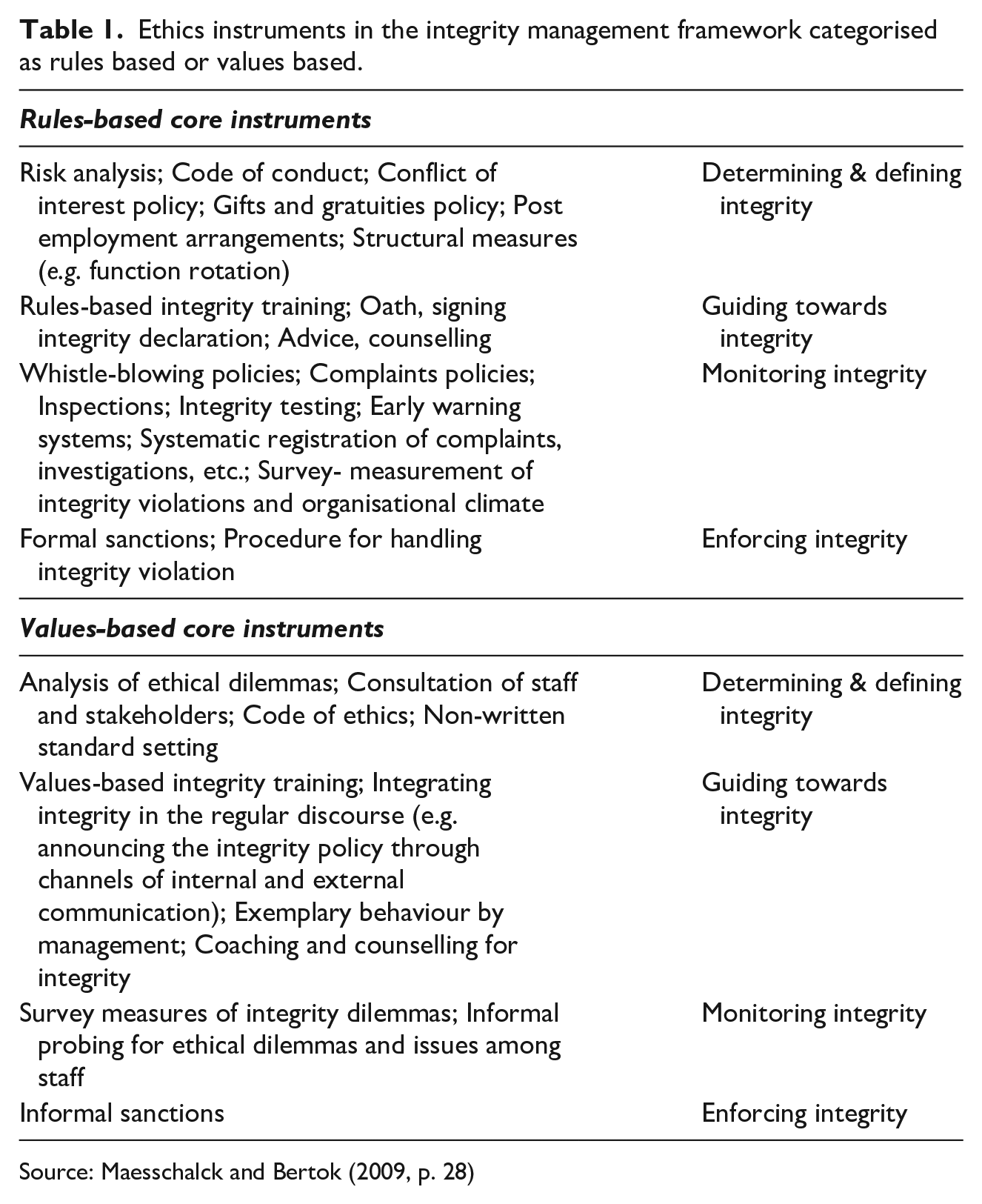
The framework distinguishes between core and complementary instruments. Core instruments address ethics and include codes, rules, guidance, ethics training and advice, and disclosure of conflict of interest. In Table 1, common instruments are further distinguished into rules- or values-based. Complementary instruments are management activities that may significantly impact on organizational ethics without this being their primary goal, such as ethics being part of recruitment and promotion criteria of staff, measures in procurement procedures, and internal and external control and audit.
Ethics instruments in the integrity management framework categorised as rules based or values based.
Source: Maesschalck and Bertok (2009, p. 28)
The discussion on the need to combine values- and rules-based approaches is directly connected to our first research question on the combination and alignment of strategies on the rules–values spectrum. Finding the right balance in practice is difficult as there are no established methods to do so, which leaves organizations to implement this without knowing effects and costs (Hoekstra, 2016; Huberts et al., 2014, p. 179; Maesschalck, 2004, p. 27). 5
Based on this discussion, our first hypothesis (Hypothesis 1) is that both organizations promote strategies in state and local government, respectively, that combine rules- and values-based instruments. In terms of how they align on this spectrum, we expect SALAR, which works toward local government where corruption scandals have been more frequent (more on this below), on balance to lean more toward compliance than SAPM. However, it is important to note that we are studying the types of strategies these organizations promote in relation to other organizations in their respective sectors (state and local government) and not how they manage ethics in their own organizations. This gives them more room for thinking through measures and avoiding knee-jerk responses. Moreover, reactions to scandal are one factor among many that potentially affect what ethics instruments are promoted. The context in terms of legal rules also vary, as do the roles of the two organizations. Our analysis of the two organizations will add to our understanding of how these organizations (and others) prioritize instruments and what factors are affecting this.
Recent literature has emphasized that a narrow focus on external and internal control limits the view of what ethics instruments are about and could lead to a top-down view of ethics as how management can/should control employees (Anechiarico & Segal, 2020; Tremblay et al., 2017). Our subquestions on inclusion of staff and role of stakeholders are derived from this critique and emphasis on employee involvement and consideration of the surrounding society.
The pluralist contingency approach of Tremblay et al. (2017) starts from the bottom-up, evaluating individuals’ ethical needs and preferences. Focus is on ethics practices defined as “any rule, method, procedure, process, management tool, structure or institution that presents an essential teleological character aiming at increasing consciousness, reflection and ethical behaviour in an organization, at the individual, collective and strategic levels” (Martineau et al. 2016, p. 3, cited in Tremblay et al., 2017, p. 227). As part of the approach, Tremblay et al. (2017, pp. 227–228) point to consultation and participation practices, which highlight to what extent employees are involved in ethical initiatives and dialogue, and social and environmental responsibility practices, which draw attention to the importance of social responsibility and the relationship of the organization with society. Anechiarico and Segal (2020, p. 282) similarly emphasize the importance of “ethical co-determination” among employees, that is, voice to and participation from submanagement employees in deciding and implementing ethical standards employed to guide behavior within the organization and in relation to society. Measures that staff are involved in developing and implementing are expected to be more effective because staff are more likely to feel ownership and see them as useful. If instead handed down from the top, we can expect the opposite reception. Moreover, Anechiarico and Segal (2020, pp. 284–286) extend the discussion to include the importance of building trust also with stakeholders outside the organization, which arguably is gaining importance as a result of social media and new technology (e.g., almost everybody having cameras and recording devices in their mobile phones) that makes it easier to mobilize and activate stakeholder values.
So, for the second research question, concerning to what extent and how ethics practices promoted involve submanagement-level employees, our hypothesis (Hypothesis 2) is that this is done by the organizations to some extent as the importance of this has increasingly been emphasized in the literature. We expect this to be more pronounced by SAPM than SALAR as values-based strategies tend to be less top-down in general than rules-based strategies. Regarding the third research question, our hypothesis (Hypothesis 3) is that this is done by the organizations to some extent in line with its increased importance in the literature. Given that we expect the organizations to align slightly differently in terms of rules-based and values-based strategies, this may also affect both the purpose of such involvement and how they are involved; however, we do not derive an explicit hypothesis for this in relation to the two organizations.
Model of analysis, data, and methods
In Table 2, we summarize our study framework. Cases, SAPM and SALAR, are selected due to their key roles of promoting good and ethical public administration. They also allow us to cover differences in promotion of ethics management strategy for state agencies (SAPM) and local government (SALAR), given variation in terms of institutional settings and experience of ethics scandals for state and local government administration.
Promoting organisational ethics in the public sector: study framework.
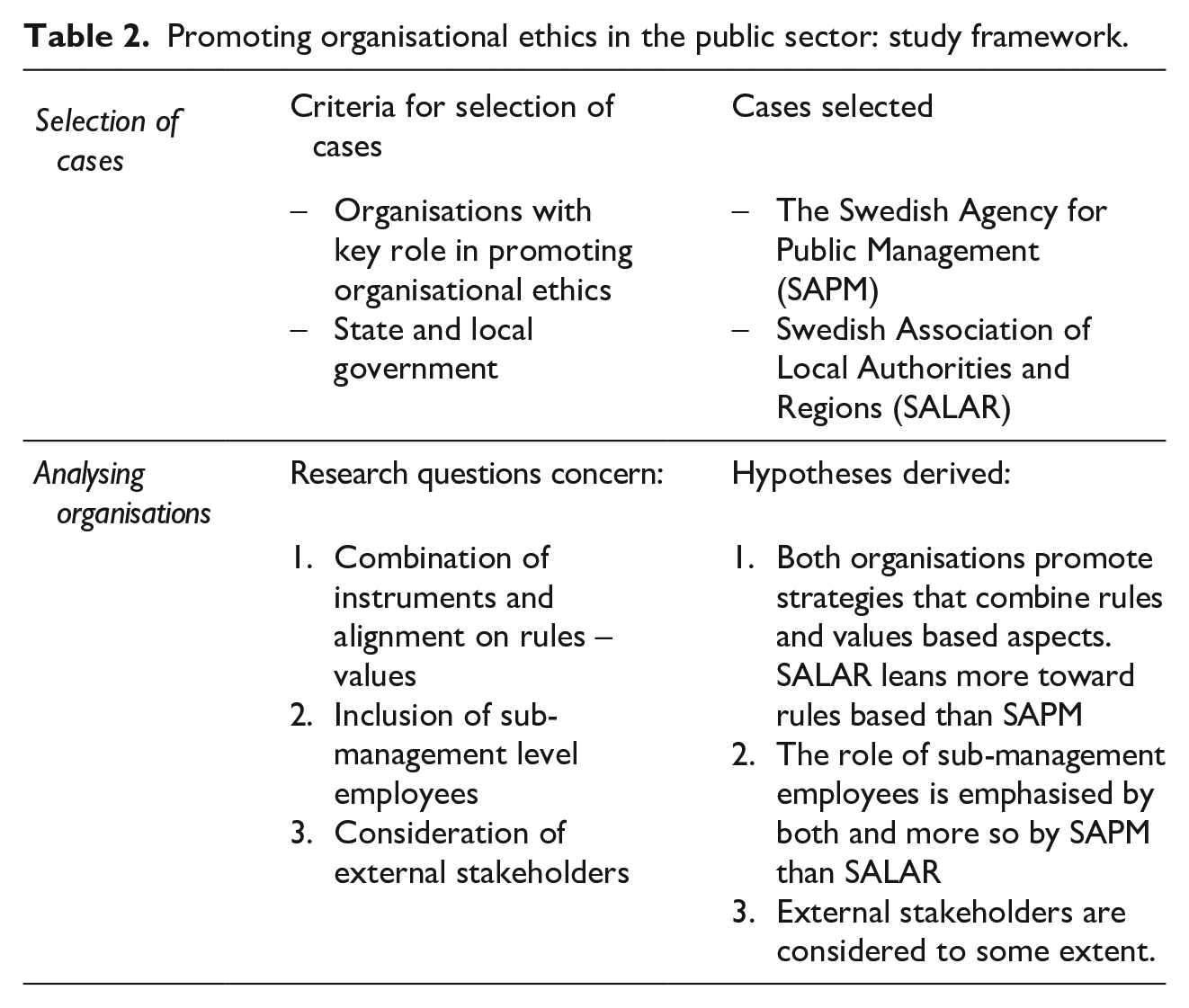
The type of ethics management strategies promoted by the two organizations is explored and we investigate three research questions to cover the use of rules and values instruments, submanagement employee involvement, and how external stakeholders are considered. For the first question and hypothesis on how values- and rules-based strategies are combined, we relate to the distinction of ethics instruments into their four functions and into rules- and values-based (Table 1). Concerning the second question on submanagement involvement and the third on external stakeholders, we use the perspectives presented above, highlighting the importance of increased attention to these aspects at the same time as we relate to the four functions of ethics instruments.
The material and data we use are mainly from webpages of the organizations (documents, reports, videos) up to April 2021, complemented by interviews with two officers at SAPM and two at SALAR. Interviews were done semi-structured (Leech, 2002), aiming for a conversation where the interviewee could speak as freely as possible. Questions were organized into sections where each section started with an open question with follow-up questions to ensure aspects of interest were covered. We used Zoom for the interviews and to record them. We used NVivo for transcription and then edited these transcriptions to use as data.
The Organizations and Their Administrative Contexts
SAPM and SALAR have important roles providing information and education in the area of ethics and anti-corruption in their respective sides of the public sector. SAPM is the Government’s organization for analysis and evaluation of state and state-funded activities. It employs around 75 people, of which 60 are analysts (SAPM, 2019a, 2020a; SFS, 2007, p. 827a). Its assignments include contributing to and coordinating the work of state authorities toward a sound administrative culture. SALAR is a member organization for all local and regional authorities, which serves as an employer’s organization for its members and provides support in the development of their activities. Its main office has around 440 employees with expertise in various fields (SALAR, n.d.-b).
Several ethics measures concerning policy, legislation, and education have recently been taken by the central government. Some of these relate to SAPM and SALAR. In 2020, the government adopted the first national action plan against corruption aiming for more comprehensive and coordinated work. SAPM has been given a key role to support state agencies, their cooperation, and follow-up of their corruption prevention. The plan also calls for including SALAR in cooperation between agencies against corruption (Regeringen, 2020a, 2020b). Another initiative is to introduce an obligatory introductory education for all state employees. It aims to increase citizens’ trust (Sweden is generally a high trust society, see, for example, Holmberg & Rothstein, 2020; OECD, 2021) and state employees’ common understanding of the constitutional foundation of state administration, enhanced knowledge of standards, legal principles, and ability to fulfill their roles. SAPM will host a council that decides on course content (Regeringskansliet, 2020a; Statens Offentliga Utredningar, 2020, pp. 36–40).
Historically, ethics management strategies in Sweden have relied more on indirect external controls and informal strategies than formalized ethics strategies. 6 This contrasts with (more studied) cases such as the United States and the Netherlands, where formalized ethics strategies have a longer trajectory.
Objectivity and impartiality in public administration have constitutional protection (Instrument of Government) with complementing legislation in the Penal Code, the Administrative Procedure Act, and Labour laws concerning bribery, conflict of interest, and loyalty in administration. Another important constitutional check on irregularities and corruption is that records at authorities as a general rule are official and citizens have access to them (i.e., the publicity principle). Moreover, the anonymity of public administrators is protected when providing media with information (including most classified information as long as documents are not handed over) and employers are banned from investigating who leaked. This gives the media an important watchdog position; media have often, rather than government control institutions, revealed corruption cases.
Ethics codes used to be uncommon but have increasingly been adopted (Svensson & Wood, 2004, 2009) in line with a European wide trend (Demmke et al., 2020). In state administration, some adapt to their agency the six ethical foundations for state agencies introduced in 2009, namely, democracy, legality, objectivity, freedom of expression, respect, and effectiveness, efficiency, and service (SAPM, 2018; Värdegrundsdelegationen, 2013), and others have introduced own codes (Interview 3).
Overall, integrity in public administration has been rated as relatively strong but there are also vulnerabilities, such as weak systems for dealing with interest conflicts in relation to hiring, public procurement, and purchasing (Andersson, 2012). NPM reforms were carried out with lack of attention to anti-corruption and ethical considerations, which increased vulnerability (Andersson, 2008; Andersson & Bergman, 2009; Höglund & Falkenström, 2018; cf. Kolthoff et al., 2006). For instance, the constitutional protection of whistleblowers in public administration lost in reach, as it did not similarly apply in services contracted out to private providers (Andersson, 2012, p. 21). Although legislative steps have been taken to improve this situation, vulnerability persists.
Lobbying is not regulated except for penal code rules concerning bribery and conflict of interest. Similarly, postemployment work restrictions used to be few for high-level public officials moving between the public and private sector. In 2018, a government bill (Government Proposition 2017/18:162) introduced a postemployment restriction for ministers and chief officers of government departments of maximum 12 months. No such regulation has been proposed for subnational levels of government.
Swedish public governance is characterized by extensive delegation; state and local government administrative authorities have a long tradition of independence from government interference, which precedes the international trend in the 1980s of creating independent executive agencies (Hall, 2016, p. 301; Talbot, 2004, pp. 3–4). In addition, Sweden incorporated several of the aspects of the NPM wave from the late 1980s and onward, including more use of contracting out services and using market incentives in public administration (such as in the school sector and in elderly care). However, in recent years, the Swedish government has aimed for more trust-based steering of public administration, which implies more emphasis on confidence in the knowledge of professional employees and less reliance on control and performance measurement tools associated with new public management (cf. De Vries & Nemec, 2013; Regeringen, 2014, 2019).
The Government Offices, including ministries, are small (around 4,600 employees) and separated from state agencies (Regeringskansliet, 2020b) with about 263,000 employees (SAPM, 2020d, pp. 11, 33). Central government and state agencies are, among else, responsible for law enforcement, social security, and university education. The government steers agencies with legislation, directives, budget allocation, appointments, and informal contacts. However, ministers are prohibited from intervening in how individual cases are handled (i.e., ministerial rule; Instrument of Government, Chapter 12, Articles 1 and 2). The National Audit Office audits all state activities.
Local self-government is expressed in the Instrument of Government (Chapter 1, Article 1) and is underlined by the power to set income tax. However, the state has also delegated the operation of certain welfare services to local governments. Twenty-one regions and local authorities (290 municipalities), which have elected assemblies, provide the major part of public services, particularly in education, care for children and the elderly, and health care (regions). Services may be contracted to nongovernmental operators, including for-profit companies. Audit of local government activities is the responsibility of local governments themselves and not the National Audit Office (The Local Government Act, Chapter 12). This has been argued to be weaker than the national audit of state activities as it is run by elected lay-auditors, assisted by expert auditors (e.g., Ahlenius, 2018, 2020; Bäck, 2018). Local governments have been pointed to as more vulnerable for conflict of interest and corruption than state agencies and have experienced frequent corruption scandals (e.g., Bergh et al., 2016; Wångmar, 2013).
Ethics Management Strategies Promoted
Instruments Promoted and Alignment on the Rules–Values Spectrum
For SAPM, integrity is determined and defined by the six ethical foundations of the state and is associated with an anti-corruption culture. Whereas these foundations can be seen as a code of ethics, that is, a values-based instrument, they have a compliance basis as they are derived from the constitution and administrative laws (Interview 3). In its anti-corruption work specifically, SAPM (2019b) promotes the inclusion of corruption risks in all risk analysis at state agencies (SAPM 2020c). Corruption is defined as “To use a public position for private gain, either for oneself or for others” (SAPM, 2019b, p. 6, authors’ translation), which includes actions that are inappropriate although not illegal. The rationale is that such gray-zone activities equally result in a loss of trust not limited to the offending public servant, but the agency at large, and, by extension, the whole public administration apparatus.
In 2017, SAPM was commissioned by the government to analyze the work of the National Property Board and give recommendations for improvement after the media had exposed corruption at this agency. Three persons at the agency (and three business persons) were charged in 2020 with gross bribery, gross breach of trust against principal, and official misconduct. The three business persons were found guilty of gross bribery as were the main defendant, a property manager at the agency (Stockholms tingsrätt, 2021). SAPM (2017, p. 41) recommended that work with administrative culture should be connected to human resource (HR) processes, such as recruitment, employee appraisals, and in talks with employees who are leaving the agency for other jobs or retirement. Practical examples are to review interview questions in relation to recruitment, to include ethics and corruption issues in appraisals or when managers or employees leave the agency, that is, elements of formal ethics management.
SALAR has devised the concept of “robust organizations” to describe how it determines and defines integrity. Robust organizations are characterized by clarity of responsibility, mission, and routines outlined in steering documents and documented processes for audits and accounting. Laws and regulations must be followed, and organizations must not be swayed by other considerations (Interview 2). SALAR (2018, p. 21) promotes risk analyses that consider everything from the overall situation in the organization down to specific processes and the situation of individual public servants. Risks to the goals of the organization and risks of corruption and irregularities should be identified. Their underlying factors and potential connections between different risks should be analyzed. Processes should be scrutinized to identify the weak points and consider how they can be removed (Interview 2). The probability of wrongdoing and what the consequences would be should be estimated before deciding on how to manage the risk.
For SAPM, guiding toward integrity involves making public servants understand that they are part of something larger and work for the benefit of citizens (Interview 3). In practice, this entails training to provide public-sector employees with knowledge about public-sector values and the confidence to carry out their duties in accordance with them (Interview 1). How employees act, not what values they hold privately is what matters. There must also be a joint vision within each state agency (Interview 3; SAPM, 2020b). As it is not always obvious how different values should be understood in practical terms, and as different principles can come into conflict with each other, decisions will sometimes have to come down to individual judgment. Hence, SAPM (2017) emphasizes that employees must train their ethical compass continuously, and agencies should strive for a culture where management and employees can discuss these issues (Interview 1). Dilemma examples can be very useful tools for discussion to make the ethical foundations concrete at the state agencies in relation to their activities (Interviews 1 and 3; SAPM, 2018, 2021). Discussions could concern what it means to be objective and impartial, the general principles for avoiding conflict of interest by never accepting gifts, favors, and benefits, and the requirement to report second jobs/activities.
Moreover, SAPM emphasizes the “tone at the top” and behavior of management to be important in guiding toward integrity. Top-level managers must have awareness of corruption risks and why corruption is a problem to be able to diffuse this knowledge throughout their organizations (SAPM, 2019b, p. 25). People in leadership positions have the formal responsibility and are influential in setting norms (Interview 1). It is their responsibility to ensure that steering documents are orderly, up to date, and known by staff throughout organizations (SAPM, 2021, p. 6). In the recommendations to the National Property Board, SAPM (2017, pp. 25, 41) asserts that management should personify the work with administrative culture in word and action and take overall responsibility for the work, which includes arranging educational and discussion activities. Opportunities for education and competence development for all employees and managers, and recurrent workplace discussions about difficult work situations and dilemmas, concerning administrative culture are regarded as key factors. It contributes to anchoring the administrative culture work in the organization.
For SALAR (2020b), clear communication about directives, processes of governance, and what regulations apply in various contexts is important in guiding toward integrity. However, drawing on research on quality of governance, SALAR tries to combine the focus on law and compliance with values and sound culture. SALAR argues that public servants need to understand that public-sector work means working for something greater than individual gain (SALAR 2020c; Interview 2). Public servants must know the meaning of impartiality, the publicity principle, and the equal value of all people. They must understand that they are handling tax payers’ money and need to keep records of what they are doing. Consciously taking the circumstances of one’s organization into account is crucial (SALAR, 2018, p. 24). To create the desired culture, SALAR (2020d) argues that it is important first to map and pursue a dialogue about what values and behaviors prevail throughout organizations. This work may be extensive and time-consuming, but the map produced can serve as a starting point for creating the public administration culture organizations seek. SALAR (2020d) maintains that all work on values is a long-term project, as you cannot change them overnight. It is also important to recognize that different people may mean different things despite using the same words to describe their values.
SALAR also points to the importance of leadership in local public administration. Documenting processes in writing is not sufficient. It is also important that political leaders demonstrate through their actions that they stand behind agreements made and that they provide support to employees (SALAR 2020a; Interview 2). What norms and values are manifested by words and deeds play important parts as credibility rests on managers’ practicing what they preach (SALAR, n.d.-b, p. 13).
SAPM considers well-developed internal control important for monitoring integrity. Unclear or contradictory internal rules as well as a lack of knowledge of such rules are risk factors for unethical behavior (Interview 3). In the recommendations to the National Property Board, SAPM (2017, p. 41) points to the importance of delegation that clearly states who is authorized to make certain decisions. Follow up of risks related to the administrative culture is important for countervailing corruption and for building a better administrative culture. The identification of risk is dependent on the willingness of employees to speak out and that routines and guidelines for this are known in the organization (SAPM, 2017, p. 41). There should be an open climate where employees act if they encounter irregularities and where management positively receives and supports such initiatives. It should also be well known where to turn with information about corruption, with alternatives to turn to your immediate manager. To pay attention to and appreciate employees who are engaged in strengthening sound administrative culture is also noted as important (SAPM, 2017, pp. 26–27).
SALAR (2018, pp. 8–9) similarly emphasizes internal risk control, asserting that it must be integrated into steering systems in the organizations in question. Planned controls, which often involve doing a sample to get an idea of how procedures are functioning, are important for monitoring integrity as are analysis and evaluation of the functioning of the internal control system. As heavy control systems can be perceived as cumbersome, risk analyses are important to determine where controls are most needed so as to gain the best effect (Interview 2). An organizational climate that allows people to voice concerns and the existence of channels for doing so is also important (SALAR, 2018, pp. 20–23).
In terms of enforcing integrity, the two organizations refer to existing laws and regulations and law enforcement authorities (SALAR, 2018; SAPM, 2021).
In summary, both organizations have emphasis on instruments that concern guiding toward good practice and monitoring, while less so on defining and enforcing ethics. They promote a combination of rules- and values-based instruments.
To determine and define integrity, both organizations lean more toward rules-based instruments. SAPM emphasizes that all public-sector activities must be carried out in accordance with Swedish law and the fundamental principles and values laid down in the ethical foundations of state activity (Interview 1; Interview 3). Formal rules and risk analysis are also emphasized. SALAR similarly focuses on formal, documented procedures.
Training is an important instrument guiding toward integrity. Here, SAPM places even emphasis on rules and values. The importance of knowing relevant rules is emphasized in conjunction with awareness that an ethical compass must be developed as rules do not explicitly cover every possible situation. An interviewee indicated that the focus is more on the values embedded in these legal frameworks than on compliance per se (Interview 3). By contrast, SALAR focuses more on rules-based training. The difference in focus between SAPM and SALAR in this regard can be explained by the role of the organizations. Whereas SALAR has a key role in advising local governments on all aspects of external and internal control, responsibility for such matters at state level is shared. SAPM is commissioned to work on administrative culture, but advice on rules is also provided by the Swedish National Financial Management Authority, which develops the financial management regulations for state agencies and conducts budgetary follow-up (www.esv.se). Whereas formal training has a focus on rules, SALAR also points to the importance of discussion, which is an example of integrating integrity in regular discourse, a values-based instrument. Exemplary behavior by management is another values-based instrument promoted by both organizations. Rules-based instruments, such as clear rules and formal processes that are well known throughout organizations, are seen by both organizations as important for monitoring integrity. Similarly, rules and formal processes dominate the organizations’ views on enforcing integrity.
Inclusion of Submanagement Employees
The bottom line emphasized by both organizations, especially SAPM, is that employees must act in accordance with the law. Sanctions are ultimately determined by the legal system. However, what is good practice and ethical behavior concerns more than obeying the law. Both organizations mainly tend to see employee involvement in terms of ethics management instruments guiding toward integrity and monitoring integrity. In practice, that means work on how to understand relevant regulations in relation to the activities of the organization in question.
SAPM (2021) regards submanagement participation in discussions to understand the ethical foundations of state activity to be necessary. Work should be systematic and continuous (SAPM, 2017, p. 40). All levels and functions of an organization must be involved and it is rarely appropriate to leave work on administrative culture to one sole function (SAPM, 2021, p. 12). SAPM (2017, pp. 24–26) emphasizes that while work with administrative culture must be anchored among management, work that comes from the top with no possibility for real influence for employees will lose in legitimacy. SAPM (2017, p. 41) views ongoing discussions between management and employees of the boundaries for what is appropriate as beneficial, and argues that employees should be involved in interpreting how difficult situations should be handled to comply with rules and control measures laid out in laws and government ordinances. As impartiality and nepotism are regarded as particular challenges for Sweden, SAPM emphasizes the need for government agencies to ensure that employees are aware of their responsibilities and the internal procedures for handling such issues. This requires systematic and continuous work to involve staff in training and discussion as knowledge among staff otherwise tends to be lost over time (SAPM, 2017, p. 24). Employers have a responsibility to ensure employees have adequate knowledge (SAPM, 2021).
SALAR (2018, p. 9) promotes ongoing dialogue to integrate internal risk control and argues that effectiveness of ethics codes and similar instruments depends on them being accepted by employees. If control mechanisms are perceived as additional burdens added from the outside and/or if there are discrepancies between the words and actions of management (the tone from the top), mechanisms for internal risk control will not work effectively. Group discussions are seen as very valuable when seeking to develop a common ethical compass within an organization (Interview 2). It is important that such things are incorporated into the culture and that organizations are willing to learn from mistakes to improve for the future. SALAR (2020d) believes that the real insights come from discussing questions of why some values and behaviors are prioritized over others and what the implications of these priorities are for employees, citizens, and elected politicians. The aim of the dialogue should be on understanding differences, not on reaching consensus.
Involving submanagement employees is a challenge given the large number of employees in subnational authorities. Subsequently, it is sometimes necessary to train “ambassadors” who then train others. SALAR attempts to provide varied training material ranging from how to deal with everyday situations to more theoretical accounts. Situations may also differ between, say, the health care sector, where SALAR believes that increasing knowledge could be an effective strategy to promote ethical behavior as irregularities may often be innocent in nature and occur due to a lack of understanding (Interview 2), and capital-intensive sectors where there may be a higher risk that a culture deviant from ethical behavior develops.
SAPM regards a culture that allows for the expression of different opinions to be important for effective monitoring for integrity. Although it is beneficial to have a joint view within an agency, complete uniformity may lead to important aspects being overlooked (Interview 3). Management and sublevel management have a joint responsibility here (Interviews 1 and 3; SAPM, 2021). To create trust between management and employees, employees need possibilities to influence and take responsibility for activities and change in processes at the agency (SAPM, 2017, pp. 40–41). For instance, employees have the responsibility to notify their employer when their impartiality may be in question (SAPM, 2021).
SALAR (2018, pp. 11–13) similarly views trust as important for monitoring integrity, in particular as it is impossible to eliminate all risks. Whereas municipal and regional executive committees have the overarching responsibility for risk control, and managers in local and regional public administration are responsible for internal control of their agencies, the involvement of submanagement employees is encouraged. To determine whether risk controls are working satisfactorily, SALAR encourages organizations to carry out recurring self-evaluations where they look into to what extent employees are familiar with and utilize these risk control mechanisms, whether guidelines are up to date, and whether action is taken to address identified risks.
Consideration of External Stakeholders
Although consideration of external stakeholders is not a key part of ethics management strategies promoted by the two organizations, they do consider the relationship between organizations and society and building trust with external stakeholders as emphasized by Tremblay et al. (2017) and Anechiarico and Segal (2020).
The documentary material studied did not indicate that consideration of external stakeholders is an important part of SAPM’s promotion of ethics management, and the interviewees confirmed this to be the case. The two interviewees at SAPM argued that the most important aspect for creating trust in public agencies is that the public agencies fulfill the role they have been set up to do. Interviewee 1 argued that it is troublesome if agencies start to focus on satisfying other needs than what their key role specifies. This is not to say that external stakeholders are not considered at all. According to Interviewee 1, it is not sufficient that public-sector employees themselves “feel” like they know what it means to be impartial; they must also consider what their actions look like to outsiders. Similarly, Interviewee 3 emphasized that public servants must be loyal to their mission at the same time as they must clearly motivate and explain decisions made. If external stakeholders such as citizens understand on what grounds decisions are made, they are more likely to trust the organization, Interviewee 3 argued. These views are echoed also in SAPM (2021) where SAPM states that trust in public agencies can follow from these agencies acting in accordance with public-sector values. Another example of indirect consideration of external stakeholders can be found in the recommendations to the National Property Board where SAPM suggested the development of a code of conduct that is shared to suppliers and contracting parties. This is taking into account that the external relations of the agency to suppliers, and dependence on hiring consultants, had affected its vulnerability to conflict of interest. The scandal also resulted in loss of trust both internally and externally (SAPM, 2017, p. 83).
Similarly, we found no indicators that SALAR directly considers the involvement of outside stakeholders when promoting ethics management strategies. A more indirect connection to this aspect is SALAR’s emphasis on public access to official records and transparency as important checks on local and regional authorities. The fact that journalists and the general public can ask to see documents at any time could discourage unethical behavior. However, for this to work as an effective control mechanism, there must be people who are interested enough to actually ask for the documents (Interview 2) and who have the capacity to scrutinize based on the information. The organization is also aware of considering external stakeholders when working with, for instance, Agenda 2030.
Conclusion
This article contributes to filling a gap identified in previous research about how organizations combine and prioritize different ethics management instruments, involve submanagement employees, and consider external stakeholders by exploring how ethics management strategies are promoted in the Swedish public sector by two key organizations, SAPM and SALAR.
First, our results show that strategies promoted by both organizations combine values and rules instruments, which is in line with expectations in our first hypothesis. Both organizations prioritize rules-based instruments to define integrity and to enforce integrity while instruments aimed to guide toward integrity and to monitor integrity tend to be more values-based. Strategies of both organizations emphasize ethics instruments concerning guiding integrity and monitoring integrity more than determining integrity and enforcing integrity, which are more treated as given.
We expected SAPM to lean more toward values than SALAR. For this, we find some support but the difference is small and concerns instruments defining integrity (where SAPM’s focus includes the ethical foundations for the state, a sector-wide ethics code) and guiding toward integrity (where SALAR pursues rules-based training more than SAPM, which evenly pursues rules-based and values-based training). However, we conclude that other factors than local government having more often been affected by scandal, a situation where compliance is a common response, are as important for these findings. An important consideration is that we are analyzing how these organizations view strategies in their respective sectors vis-à-vis other organizations, and not in their own organization. This reduces the risk that these organizations will pursue strategies that promote quick, scandal-driven ad hoc responses that are not thought through. This, we believe, would also apply beyond Sweden to organizations with similar roles working in similar contexts. However, how and what rules–values mix such strategies entail may differ due to country specific administrative features.
Differences in their roles also contribute to the slight differences noted. SAPM has an assignment from the government to promote and coordinate work for a sound administrative culture in the state, which contains values aspects. As part of this work, SAPM evaluates authorities and sometimes provides direct recommendations, including various instruments to improve administrative culture and reduce risks for ethics violations. SALAR does not have an equivalent government assignment, as it is a membership organization and employers’ organization for local and regional authorities. Another factor contributing to the result is that whereas SALAR has a key role concerning advice on internal control for local and regional organizations, compliance-related issues at the state level are oftentimes handled by an agency other than SAPM.
Second, our results show that both organizations emphasize systematic and continuous work to involve submanagement-level employees in strategies, especially concerning how to guide toward integrity and monitor integrity. This is in line with expectations in our second hypothesis. In terms of the extent to which inclusion in strategies is promoted, however, we do not find significant differences between the two organizations. This is due to both organizations referring to instruments defining integrity and enforcing integrity as top-down processes, that is, already laid down in law with little room for staff to participate. Differences can be found with regard to how inclusion is to be achieved. For example, SAPM emphasizes letting employees have real influence in activities and change to processes, as it is believed that work with administrative culture that comes from the top without real employee influence will lose legitimacy. SALAR points to the importance of employee involvement in relation to ongoing dialogue, education, and discussions about ethics codes, internal control systems in the organization, and rules.
Third, we found consideration of external stakeholders to be limited and only indirectly connected to ethics management strategies promoted, and hence scant support for our third hypothesis. Both organizations emphasize that the starting point for all public-sector organizations is to act in accordance with public-sector values, and any consideration of external stakeholders must not detract from this foundation. As far as inclusion of external stakeholders is discussed, it is more indirect and related to how the work of organizations affects public trust or how the ethics instruments employed by organizations need to be understood by external stakeholders to reduce risk for irregularities. It is possible that this emphasis on trust may lead to more direct involvement of external stakeholders in work with ethics management strategies in the future. Potentially, stakeholder involvement would already have been stressed more if public trust had fallen more than is the case in Sweden.
As the two organizations studied have roles in promoting and advising on ethics management to other public agencies and authorities in Sweden, the priorities they make have the possibility of impacting priorities throughout the public sector. Determining the extent of this impact is beyond the scope of this article, however. To shed more light on this, and how it works, would require further research that ideally included data on ethics management strategies of organizations at state and local level and how they prioritized different instruments with different functions. If combined with surveys of how citizens and other external stakeholders view these strategies, it could also provide more knowledge about what balance instills the most confidence and whether this differs for various external stakeholders and groups of citizens (which is interesting not least in relation to how external stakeholders are considered in strategies pursued). Such results for Sweden could also be relevant for other cases with similar public governance characteristics, while it would also be interesting to see if Sweden being a high trust country impacted results, for example, whether or not citizen confidence in values-based responses to scandal is higher than in other comparable countries. Moreover, this study’s focus on what strategies SAPM and SALAR promote in relation to other organizations may somewhat skew the results toward an overemphasis on instruments for guiding and monitoring integrity and downplaying the use of instruments for defining and enforcing integrity.
The priorities and considerations made by these Swedish organizations are made in a context where citizens have high expectations on public-sector effectiveness and integrity but also have concerns for corruption and other ethics violations. In such a public administration context, found in Sweden and many other established democracies, finding fitting ethics management strategies for public-sector organizations is important for upholding or restoring confidence in public administration. Our findings suggest that bird’s-eye view organizations, such as those in focus for this article, can have an important role in doing so by promoting ethics management and supporting organizations to ensure that strategies consider relevant aspects and avoid a narrow rules-based focus.
Footnotes
Acknowledgements
The authors thank the organizers and participants of the workshop on Quality and Integrity of (Climate) Governance at the IIAS Conference in December 2020 for valuable comments and suggestions. They also thank the reviewers for constructive criticism.
Declaration of Conflicting Interests
The author(s) declared the following potential conflicts of interest with respect to the research, authorship, and/or publication of this article: On April 22, 2021, Andersson was invited to become a member of the Scientific Council of the Swedish Agency for Public Management, which he accepted. The purpose of the Scientific Council is to bolster cooperation and dialogue with research and the research community.
Funding
The author(s) received no financial support for the research, authorship, and/or publication of this article.

Interviews
Interview 1. Interview conducted by authors with senior official at the Swedish Agency for Public Administration, November 6, 2020.
Interview 2. Interview conducted by authors with two senior officials at the Swedish Association of Local Authorities and Regions, November 9, 2020.
Interview 3. Interview conducted by authors with senior official at the Swedish Agency for Public Administration, November 5, 2020.