



Abstract
Consequences of public officials’ policy influence have been at the center of debates on political–administrative relations. Based on a survey of public managers in Swedish local government (N = 1,430), this study examines whether policy politics hollows out political neutrality. The analysis shows that although managers are highly involved in policy politics, attitudinal support for the neutrality principle is strong. The enquiry into behavioral intentions shows more variation. In relation to a set of dilemmas, most managers would defend neutral competence, but significant minorities would also act for more partisan reasons. However, we find no empirical evidence that policy influence undermines political neutrality.
Keywords
Introduction
The relationship between politicians and public administrators is a classic theme that has continued to generate debate within public administration research. At the center of these debates is the question of whether public administrators’ policy influence undermines their political neutrality (Overeem, 2005; Svara, 2006a). This question evokes normative concerns. The classic politics–administration dichotomy depicts the separation of political and administrative spheres as critical to ensuring the political neutrality of the administration. This dichotomy has provided a normative foundation for modern public administration going back to Wilson (1887) and Weber (1919/1946).
This model has been debated, however, on both normative and empirical grounds (Demir, 2009; Lee & Raadschelders, 2008). For example, public value research (Moore, 1995) emphasizes the importance of (entrepreneurial) public managers providing public values to society within broad directives from “the authorizing [political] environment” (Hartley et al., 2015; for a critique, see Rhodes & Wanna, 2009). Others conclude that the dichotomy is an unrealistic empirical model, suggesting that the relationship is better characterized as a hybrid (Aberbach et al., 1981) or as a pair of complementary roles, in which politicians and public administrators have overlapping functions, are interdependent, and exert reciprocal influence (Svara, 2006a). Following this line of reasoning, defining and upholding political neutrality within the administration is less about drawing a clearly demarcated line and more about active reflection and deliberation by public administrators (Hartley et al., 2015) and/or having a more highly developed political leadership (Torfing & Sørensen, 2019).
In response, defenders of the dichotomy have argued that, by distinguishing between partisan politics (the struggle for power) and policy politics (influence over the content of policy), the empirically observed policy influence of public administrators could be reconciled with ideals of political neutrality, conceptualized as officials being nonpartisan or even apolitical. As argued by Patrick Overeem (2005), “public administrators cannot (and should not) be excluded from the kind of politics that is inherent in policy-making, but they can (and should) be excluded from politics that has a more partisan character” (p. 322). From a classic Weberian perspective, however, upholding the dichotomy is important not only as a way to ensure that the administration can avoid politicization when dealing with policy problems and policy politics, but also because it serves as a bulwark against bureaucratic dominance. In other words, power in the form of policy influence risks corrupting, eroding, and hollowing out the bureaucratic ideal of political neutrality. How the policy influence of public administrators is related to their attitudes toward political neutrality deserves more research attention.
In addressing this question, it is important to recognize that political neutrality has dimensions of both principles and behavior, which cause tensions in the everyday lives of public administrators. As a fundamental bureaucratic norm, political neutrality has a principle-based character that is generally supported by public administrators, offers important normative guidance, and is well institutionalized within public administrations (Demir, 2009). However, such principle-based support is not enough. Public administrators must also apply and make sense of political neutrality in diverse situations and when facing difficult value conflicts and ethical dilemmas (Svara, 2013). Hence, in empirically exploring the relationship between policy-political influence and political neutrality, we need to consider both attitudes (principle-based support) and behavioral intentions (action-based support).
This article contributes to this fundamental research debate by empirically exploring and elaborating on the relationship between local Swedish public managers’ policy influence and their attitudes and behavioral intentions concerning political neutrality. Does involvement in policy politics hollow out managers’ neutrality? The purpose of the study can be more precisely formulated in the following questions:
Many empirical studies on the relationship between politicians and public administrators have been conducted on the national level (e.g., Aberbach et al., 1981; Christensen & Opstrup, 2017). However, there are strong arguments that features of the local government level make it particularly apt for empirical studies of political–administrative relationships (Hysing, 2014; Svara, 2006b) although care is warranted when applying theories generated from the national level. First, the relationship is generally closer and more direct on the local level, with plentiful opportunities for daily, face-to-face interaction and more developed social and community ties. Second, local governments tend to be less characterized by conflictual partisan politics and more inclined toward pragmatic problem-solving, implying a greater space for policy politics. Third, local governments are responsible for a broad range of policy issues and welfare services and thus employ a mix of administrative and professional staff with different relations to politicians, policy influence, and professional attitudes.
Most previous studies have targeted city managers—the top-level administrators within local government (e.g., Demir & Nyhan, 2008; Demir & Reddick, 2015; Reddick et al., 2020; Svara, 2006b; Zhang & Feiock, 2010). The broader ranks of public managers have been designated a “missing variable” in policy studies (Meier, 2009), and while extensive attention has been given to top-level as well as street-level bureaucrats in public administration research, only scant interest has been devoted to the middle-level managers (Page, 2007). In this study, public managers are particularly interesting, as their position not only gives them responsibility for everyday operations in the administration (“organizational politics”) but also requires them to deal with politicians, public policy, and the public (Hartley et al., 2015). Although most (middle) managers only have indirect or sporadic interaction with the political level, many can be expected to exercise at least some influence over the content of policy within their organization (policy politics).
Following this introduction, we further discuss the diverse conceptualizations of political neutrality in the literature and distinguish between two important dimensions of political neutrality: neutrality (impartiality) and neutral competence (objectivity). We then draw on insights from social psychology into the relationship between power and morality (the so-called inhibition theory of power) to discuss how policy influence is expected to affect bureaucratic values such as neutrality. After describing the research design, including case selection, data, and measurements, an exploratory, two-level analysis is presented of attitudes and behavioral intentions of Swedish local public managers. The results show that public managers have a high degree of policy-political influence, but that this influence does not seem to undermine their neutrality and objectivity in principle. Further analysis of the behavioral intentions of public managers regarding a set of dilemmas revealed that most public managers would act against local government decisions if they were unlawful, went against their professional expertise, or would result in severe negative consequences (neutral competence). However, a considerable minority would also act against decisions if they countered their ideological commitment or public opinion (partisan politics). Finally, we analyze how perceived policy influence affects behavioral intentions and conclude that influential managers were significantly more prone to act in defense of neutral competence, whereas we found no significant relationship to partisan politics. After concluding that policy influence does not seem to undermine political neutrality, we relate the findings to previous studies and discuss key areas in need of future research.
Theoretical Framework
Pioneering scholars such as Max Weber and Woodrow Wilson were concerned about the neutrality and power of public administration, but for different reasons. Whereas Weber feared the power of the bureaucratic administration (Weber, 1919/1946), Wilson wanted to take “politics out of administration” (Fry, 1989, pp. 1036–1037; Rosenbloom, 2008). These different underlying motives for a concern for neutrality are still visible in the debate and to some extent can be attributed to different political systems. In pronouncedly meritocratic administrations, such as the Swedish system, politicization of the public administration has been a limited concern, whereas the opposite holds for patronage systems with stronger political interference in the recruitment and operations of the administrations (Peters & Pierre, 2018). The norm of political neutrality is not constant, however. Administrative reforms, most prominently New Public Management, have had substantial impact on the relationship between politicians and administrators in many countries, have heightened the ambitions to clarify and separate their roles and functions (Demir, 2009), and have strived to reduce the role of politicians to formulating goals and evaluating performance while letting public managers run the administration without political interference (Lennqvist-Lindén, 2010). By contrast, the agendas of populist political movements often question the value of a neutral administration, emphasizing instead the necessity of a politically responsive administration to implement their radically different political goals (Peters & Pierre, 2019). This has also caused reactions from within administrations, resulting in heated debates on appropriate bureaucratic behavior (Hollibaugh et al., 2019; Pierre, 2019). We now turn to how political neutrality has been conceptualized in public administration research, with a particular focus on local governments.
Political Neutrality
How best to understand and define the concept of political neutrality has been a topic of debate within public administration research, resulting in both normative and empirically oriented conceptualizations. From the perspective of individual public administrators, political neutrality is largely about finding one’s way between the demands for neutrality and for responsiveness (Aberbach & Rockman, 1994; Hustedt & Salomonsen, 2018; Peters & Pierre, 2018; West, 2005). Accepting that public administrators (and managers in particular) have policy influence, political neutrality has been defined as public administrators not engaging in party politics or taking sides in partisan political controversies in their professional capacity (Du Gay, 2000, p. 141; Overeem, 2005). For some, this suggests “both political and policy neutrality” (Demir, 2009, p. 507), meaning that public administrators are neutral not only in terms of acting in a nonpartisan way, but also in acting without a particular policy agenda and taking a neutral position on contested policy issues. This is close to the Weberian bureaucratic ideal, which still exerts powerful normative influence on public administrations (Demir, 2009; see also Kernaghan, 1986, pp. 640–641).
Others, such as Overeem (2005, 2012), attempt to reconcile political neutrality with extensive policy influence by proposing a distinction between two types of politics: “in ‘partisan politics’ the stakes are the powers to make decisions (votes and offices), whereas in ‘policy politics’ the stakes are the contents of those decisions” (Overeem, 2005, p. 321). A clear separation of partisan and policy politics is not straightforward, however. In practice, policy politics often requires public administrators to take partisan political considerations into account to effectively perform their role of providing professional support to the incumbent democratic government (Hustedt & Salomonsen, 2018). As argued by Mulgan (2007), “political neutrality, as usually understood, requires public servants to abstain from only that degree of partisanship which will compromise their capacity to serve alternative governments with equal loyalty” (p. 571). Also, within this line of reasoning, there is an “invisible line” (although never clear-cut) between acting as a neutral bureaucrat and acting in a (too) partisan way. Public administrators are recognized as often engaging in highly partisan activities, such as drafting speeches for politicians or defending government decisions (Mulgan, 2007). In contrast, Demir and Reddick (2015) define political neutrality in relation to contending groups in society, which is more in line with Overeem’s definition of partisan politics. Neutrality thus means not giving unfair advantages to any group, not withholding resources from eligible groups, and (ensuring) that groups compete on a level playing field.
Debates on political neutrality have a strong focus on the nonpartisan dimension and need to be complemented by the dimension of neutral competence (objectivity) to give the concept a more complete meaning. As expressed by Herbert Kaufman, neutral competence is “the ability to do the work of government expertly, and to do it according to explicit, objective standards rather than to personal or party or other obligations and loyalties” (Kaufman, 1956, p. 1060). Rather than emphasizing what a neutral administration is not (i.e., partisan), the debate here centers on what a neutral administration should bring to democratic government, focusing on expertise and objectivity (cf. Demir & Nyhan, 2008).
Following Kaufman (1956), political neutrality is about acting expertly and according to objective standards, which means not only neutral execution of the law, but also basing actions on professional expertise. This underscores the two-dimensional character of political neutrality—nonpartisanship/impartiality and neutral competence/objectivity—both of which are indispensable parts of the public ethos and the foundation on which the power of public administrators ultimately rests (Hustedt & Salomonsen, 2018; Mulgan, 2007). However, these dimensions are not always easily reconciled in practice. In a conflict between political parties, political neutrality may not necessarily mean keeping a low profile to avoid taking sides, but rather taking a stand based on professional expertise and objective evidence. This is about adopting the role of experts ready to speak truth to power rather than being responsive to any of the parties (Wildavsky, 1979). The incumbent government may see this as a disloyal act, but it can be considered a neutral act in support of neutral competence. In a similar vein, a political superior may ask a civil servant for expert support that is not possible to deliver because the state of the knowledge is unclear. In this situation, nonresponsive action can be understood as responsible objectivity leading to political neutrality (cf. Mulgan, 2007).
As argued by Reddick et al. (2020), neutral competence can be challenging for public managers because they most often are generalists (and thus are less likely to be able to draw on professional expertise) and their role often requires them to understand and engage with the political realm (cf. Du Gay, 2000, p. 141). In their study of city managers, they thus define political neutrality not only as grounding recommendations on facts but also as remaining neutral in policy debates and not being identified with, or being shown to favor, specific political interests.
As discussed here, what is meant by political neutrality is not a straightforward matter for public administrators and especially not for public managers. Based on the academic debate, we here define political neutrality broadly, as consisting of both neutrality in terms of nonpartisanship (impartiality) and objectivity (neutral competence). Moreover, we recognize the need to empirically approach political neutrality not only as something that may be supported (or not) on the level of principle, but also as something that may guide behaviors in specific situations (neutrality-in-action). Next, we turn to theoretical ideas about how policy influence may affect political neutrality.
The Effect of Policy Influence on Bureaucratic Values
Although extensive research has been invested in studies of the involvement and influence of public officials and managers in public policy making (see, for example, Hysing, 2014; Svara, 2006b), considerably less systematic examination has been devoted to whether policy influence threatens political neutrality. However, within the field of social psychology, questions of power and morality have received increasing attention. In an early groundbreaking study, Kipnis (1972) examined the assertion that power corrupts. He found that having power increases the likelihood of managers attempting to influence others and valuing them less, and also increases their social distance from them. Although power is still often viewed as undermining the roots of moral behavior, more recent research has come up with diverse findings indicating that the link between power and morality is rather complex (Lammers et al., 2015). In integrating these diverse findings, Keltner et al. (2003) have proposed the inhibition theory of power. They argue that power triggers activation of the behavioral approach system. Because power is related to resources and involves the awareness that one can act without interference, it activates approach-related processes. In a similar vein, a lack of power is associated with increased inhibition. As less powerful individuals have less access to resources and are more subject to social threats, they are more sensitive to moral and social constraints. According to a number of empirical studies, the approach-related effect of power can thus lead powerful managers to act immorally (Lammers et al., 2015), and studies also show that power reduces leaders’ moral reasoning (Giurge et al., 2019).
Against this background, there are reasons to believe that political neutrality is at risk among influential managers who are heavily involved in policy politics. However, studies using the inhibition theory of power as a point of departure show that power may also cause individuals to act morally. In their review of the literature on power and morality, Lammers et al. (2015) give two highly relevant examples. First, people with low power might perform a kind of self-censorship when they witness someone else acting unethically. Because they have a more activated inhibition system, these individuals perceive conflicts with others as a threat, something that power may help other individuals to overcome. According to Anderson and Berdahl (2002), this especially applies in relation to superiors, such as managers’ relationship to political superiors. Second, when a situation prompts people to consider behaving in a moral manner, power can reinforce their orientation and foster greater morality. In other words, if there is strong, principled support for political neutrality, power can increase the correspondence between attitudes and actual behaviors (Lammers et al., 2015). For this reason, it is important to examine how power relates to both principled support and behavior (DeCelles et al., 2012).
Based on this research, we formulate a simple model with two baseline expectations. The first expectation is that public managers’ propensity to acknowledge neutrality as a key principle is related to their policy influence. Put simply, more policy influence will yield less support for the neutrality principle. The second expectation concerns the empirical relationship between policy influence and neutrality on the operational level, that is, in situations where public managers face difficult dilemmas. Here the inhibition theory of power leads us to expect that influential managers are more prone to interfere with politics than managers with limited power.
Research Design
Case Selection
Sweden is well known for its national administrative model. At this level, the relationship between politics and administration is characterized by a historical, rather than constitutional, dualism (Hall, 2016) manifested in a formal organizational separation between small government ministries and semiautonomous agencies, and in a prohibition of ministerial rule. Although the government appoints the top managers, and there are extensive informal relationships between the government and the central administration, there is a strong meritocratic tradition within the Swedish administration.
At the same time, Sweden’s extensive welfare system necessitates a decentralized administrative system that is close to its citizens. Municipalities have extensive responsibility for providing welfare services, including secondary education and elderly care, coupled with far-reaching taxation rights (Lidström, 2016). This broad competence and autonomy of local governments is encapsulated in the idea of “local self-government” (Montin, 2016). Contrary to mayoral systems, Swedish municipalities are governed through political collectivism (Lidström, 2016). Relations between leading politicians and managers are created locally. In theory, politicians and top managers have clearly separated functions, although, in practice, the roles are less separable (Bergström et al., 2008). In contrast to national politics, local politics is generally characterized as less ideological, more pragmatic, and oriented toward solving local policy problems. This political culture is strengthened by the practice of allowing both the governing parties and the opposition to have seats on the municipal boards.
Data
The article is based on a broad survey of local public managers in Sweden. There are about 31,000 public managers in local Swedish governments. Most of them work in the core businesses of local government such as education, health, and social care, but a few work with city planning and infrastructure development, or with central public administration tasks such as decision-making, management, and evaluation. A random sample of 3,000 individuals registered as managers and employed by a Swedish local government was drawn from the Swedish occupational register.
Statistics Sweden drew the sample and facilitated the data collection through a broad survey. The survey included questions and statements on 25 different themes, including professional values, ethical dilemmas, and policy influence. There were 1,430 responses to the survey (48% response rate). The nonresponse analysis revealed an underrepresentation of managers below the age of 35 years (response rate of 24%) and managers within the lower income bracket (response rate of 36%). Otherwise, the respondents were representative of local public managers in Sweden. Of the 1,430 managers in the data set, 32% are men and 68% are women. About half of the respondents are 55 years of age or older and come from cities with fewer than 30,000 inhabitants aged between 16 and 64 years. Furthermore, the largest group of respondents is school managers (29%). The other respondents are preschool managers (15%), elderly care managers (15%), social work managers (18%), and managers at technical departments (8%), at planning departments (6%), and in central administration (9%).
Measurements
Attitudes are usually seen as precursors of behavior that determine how a person will actually behave in daily affairs. However, we must distinguish between two types of attitudes to fully understand their influence on behavior. The first type comprises general attitudes, and here refers to principle-based support for neutrality. The second type comprises intentions to perform a specific behavior with respect to a specific target and refers in this article to neutrality in action. While general attitudes can provide information to explain broad patterns of behavior, behavioral intentions are more informative when it comes to understanding judgments in specific contexts. Intentions are dispositions in the process of realization and therefore are more closely related to actual behavior than other constructs (Ajzen & Fishbein, 2005).
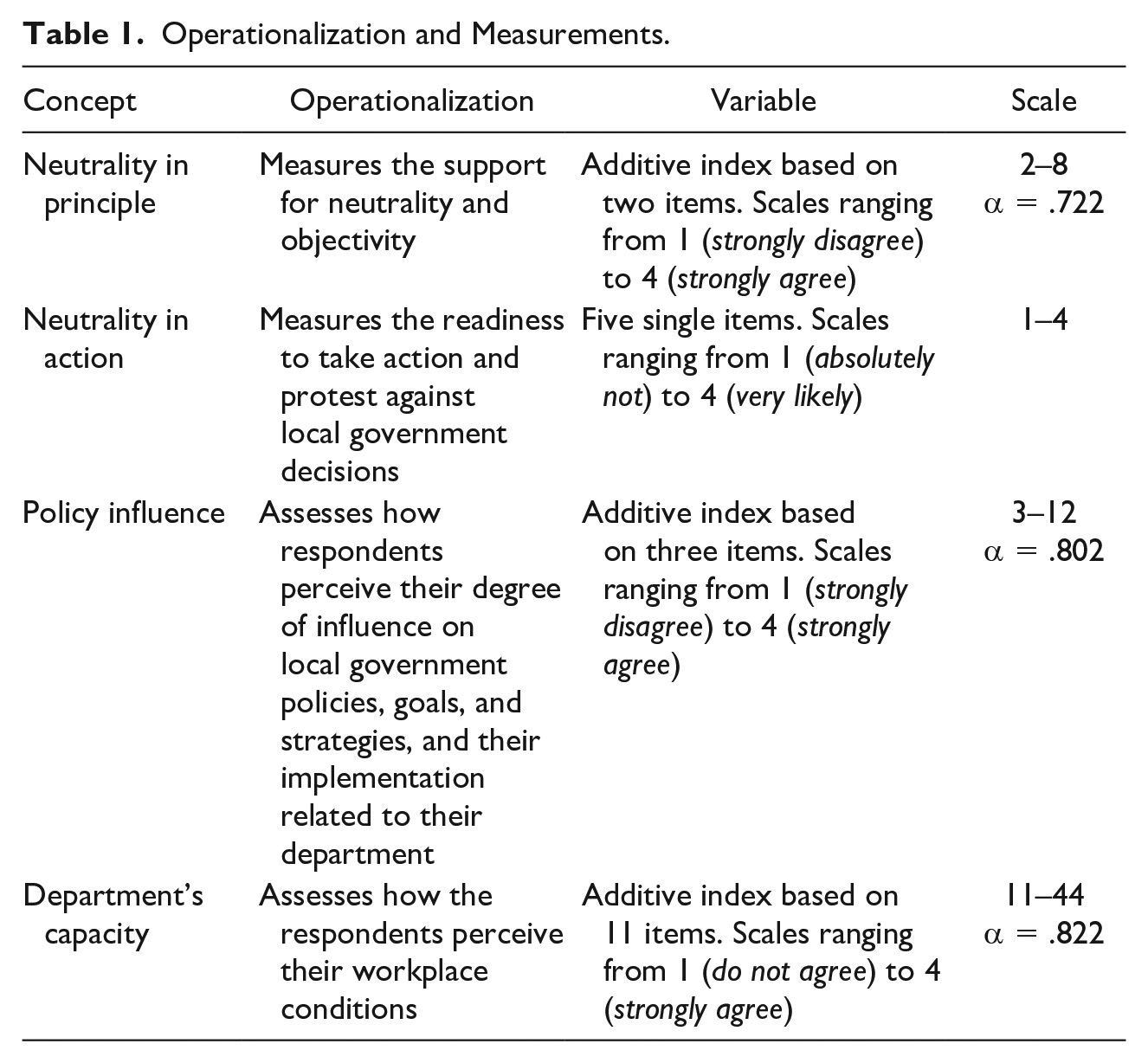
The survey used attitudinal and intentional questions (see Supplemental Appendix). The attitudinal questions are operationalized in line with the two dimensions of political neutrality as defined in the theoretical section, namely, neutrality in terms of nonpartisanship and objectivity as neutral competence. Principle-based support for political neutrality was accordingly assessed with the following attitudinal items: To what extent do you agree with the following statements? (a) The ideal civil servant is neutral and objective, and (b) In my work as a civil servant, it is important to be neutral and objective. The Swedish words chosen for the questionnaire (neutralitet and objektivitet) were deemed more straightforward and easy to understand for managers in a Swedish setting than other alternatives, for instance, the Swedish equivalents of “impartiality” or “nonpartisanship.” The chosen measurements are thus likely to produce more valid results than the alternatives. The Likert-type scale ranged from 1 (strongly disagree) to 4 (strongly agree). Cronbach’s alpha was .722, demonstrating good reliability of this measure as a dependent variable.
To measure neutrality in action, the study compared intentions across five dilemma situations. We used a standard problem probe in which targeted dilemma types, ranging from issues associated with neutral competence to partisan political issues, were interchanged. The respondents were asked to indicate whether it is likely that they would take action and protest against a local government decision if it does the following: (a) violates existing legislation, (b) contradicts all available expertise on the subject, (c) is likely to produce difficult undesirable consequences, (d) goes against public opinion, or (e) contradicts their own ideological convictions. Measures aiming to tap intentions typically let respondents rate the likelihood that they will perform a particular behavior (e.g., Ajzen, 2002). Although dichotomous yes-no items are relatively simple, they do not allow respondents to indicate degrees of intentionality. The response options therefore ranged from 1 (absolutely not) to 4 (very likely).
For the purpose of this study, policy politics has been defined as the degree to which various actors influence the development of government policies, goals, and strategies of specific departments, as well as goal interpretation and implementation. The study’s main independent variable assesses the extent to which the public managers perceive their level of influence in the following areas: (a) the development of local government policies relating to their department, (b) goals and strategies for their department, and (c) how goals are interpreted and implemented in their department. The Likert-type scales ranged from 1 (strongly disagree) to 4 (strongly agree).
In addition to these main variables, the study controlled a number of individual variables and variables related to the contexts of the respondents. Results from previous studies indicate that organizational size and administrative capacity are potentially important contextual factors. According to Van de Walle (2019), organizations of greater size and administrative capacity may give their managers more weight and autonomy in dealing with politics and can thus change the politics–administration relationship. Moreover, it can be argued that this relationship is also affected by the character of the policy area. Owing to their direct effect on citizens, the relational welfare policy areas (school, preschool, social work, and elderly care) are potentially more politically salient than the administrative or technical policy areas (technical, planning, and central administration).
Table 1 summarizes the attitudinal measures used in the article. In addition, a number of control variables are used: gender (1 = female, 0 = male), type of department (1 = administrative, 0 = relational), age (number of years), and municipal size (population). Although a limitation of this study is that it uses perceptions in describing organizational properties such as power relations and administrative capacity, perceptions are usually seen as valid indicators of organizational properties (Yang & Callahan, 2007). Given the large number of local governments (and departments within governments), the study simply had to rely on the responding managers’ perceptions regarding working conditions and their role in policy politics. Moreover, although attitudes and intentions have often been found to influence actual behavior, there probably still is an attitude–behavior gap. This would comprise cases where public managers display a favorable attitude toward political neutrality, or intend to behave in such a way, but do not engage in such behavior in practice. To examine this further, we would have needed data on actual behavior, which is beyond the scope of this study. Furthermore, although dilemma questions are designed to make the decision-making situation more realistic, at the same time they standardize the social stimulus across the respondents. It is possible that being able to influence policy affects political neutrality differently in other circumstances, for example, when it concerns one’s own managerial decisions rather than interfering with local government decisions (Lammers et al., 2015). Finally, it is reasonable to think that the national context matters. Due to the legacy of its past, Sweden is likely to be a hard test of the expectation that policy influence yields less support for the neutrality principle. The result may very well differ in other national contexts and other institutional levels, something we touch on further in the “Discussion” section.
Operationalization and Measurements.
Results
Support for the Neutrality Principle
Political neutrality is often considered a defining characteristic of public administration. When public managers have the power to shape policy, it is generally agreed that they should do so in a nonpartisan and objective way. In this section, we will examine the extent to which this principle is shared by the local public managers in Sweden and how their support for political neutrality relates to their power to shape policy. The majority of managers sampled for this study recognize that they possess a great deal of policy power. A clear majority of them think that their policy influence is high in the development of policies (64%), setting goals and strategies (79%), and interpreting and implementing policies (82%) (Table 2). These findings may not come as a big surprise to public administration scholars, but still they suggest that the public managers in Swedish local governments are deeply involved in policy politics.
Public Managers’ Perceived Policy Influence.
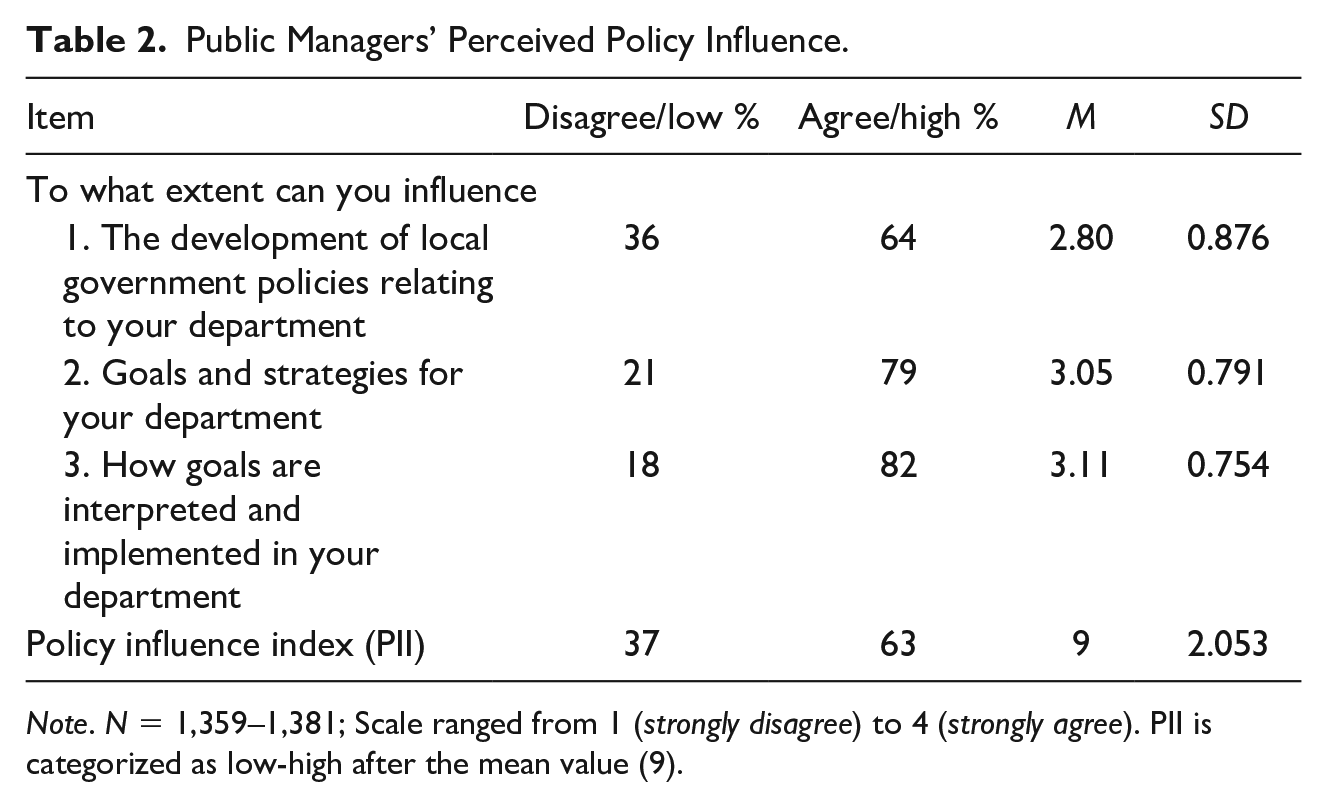
Note. N = 1,359–1,381; Scale ranged from 1 (strongly disagree) to 4 (strongly agree). PII is categorized as low-high after the mean value (9).
As presented in Table 3, the principle that civil servants should be neutral and objective is strongly supported by public managers in Swedish local governments. The data show that 87% of the respondents agree that the ideal civil servant is neutral and objective, and 88% agree that neutrality and objectivity are important in their work.
Public Managers’ Support for the Neutrality Principle.
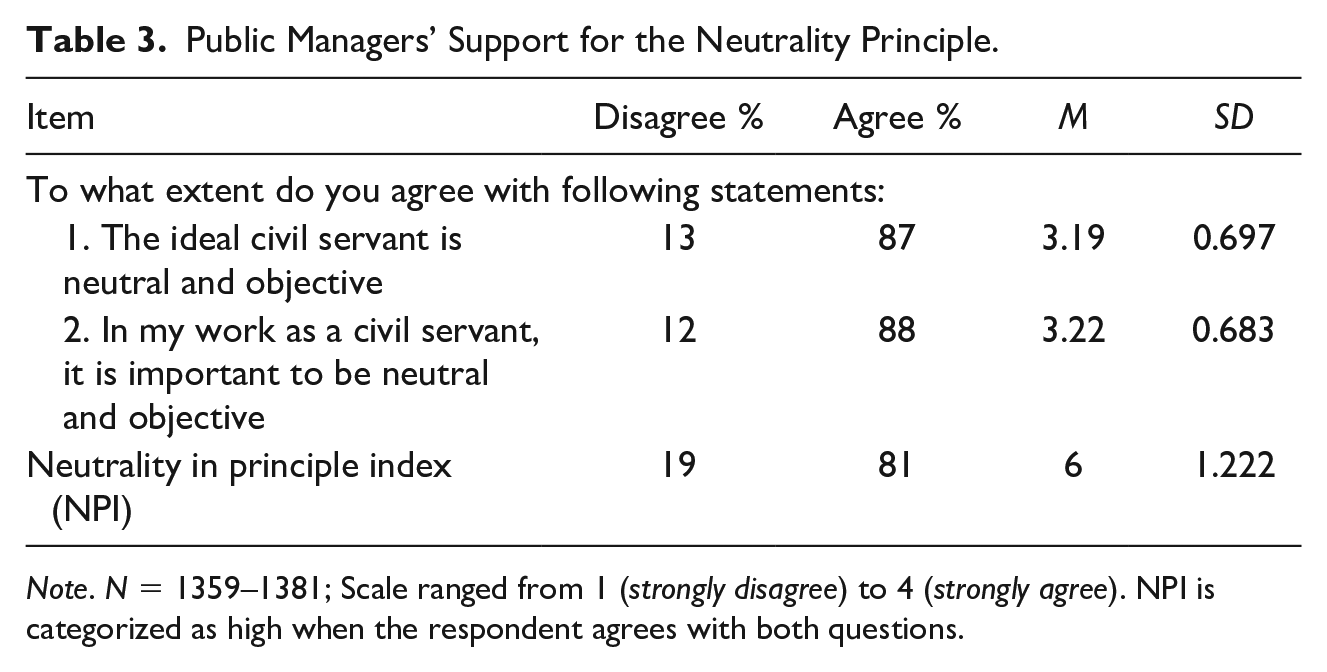
Note. N = 1359–1381; Scale ranged from 1 (strongly disagree) to 4 (strongly agree). NPI is categorized as high when the respondent agrees with both questions.
To further explore policy politics and support for the principle of neutrality, the study also sought to examine the relationship between these two aspects: Is greater involvement in policy politics yielding less support for the neutrality principle? Table 4 suggests that the answer to this question is in the negative. About 80% in both groups agree that the ideal civil servant is neutral and objective, and that it is important to be neutral and objective in their work. The regression analysis, with controls for gender, age, municipal size, department, and department resources, confirms that there is no significant correlation between policy influence and support for the neutrality principle. Managers at relational departments (such as schools, health care, and social care) showed less support for the neutrality principle than managers at administrative departments (technical, planning, and central administration). Furthermore, resource poverty seems to lead to less support for the neutrality principle. In essence, policy-political influence does not seem to undermine support for the principle of political neutrality.
Perceived Policy Influence and Support for the Neutrality Principle.
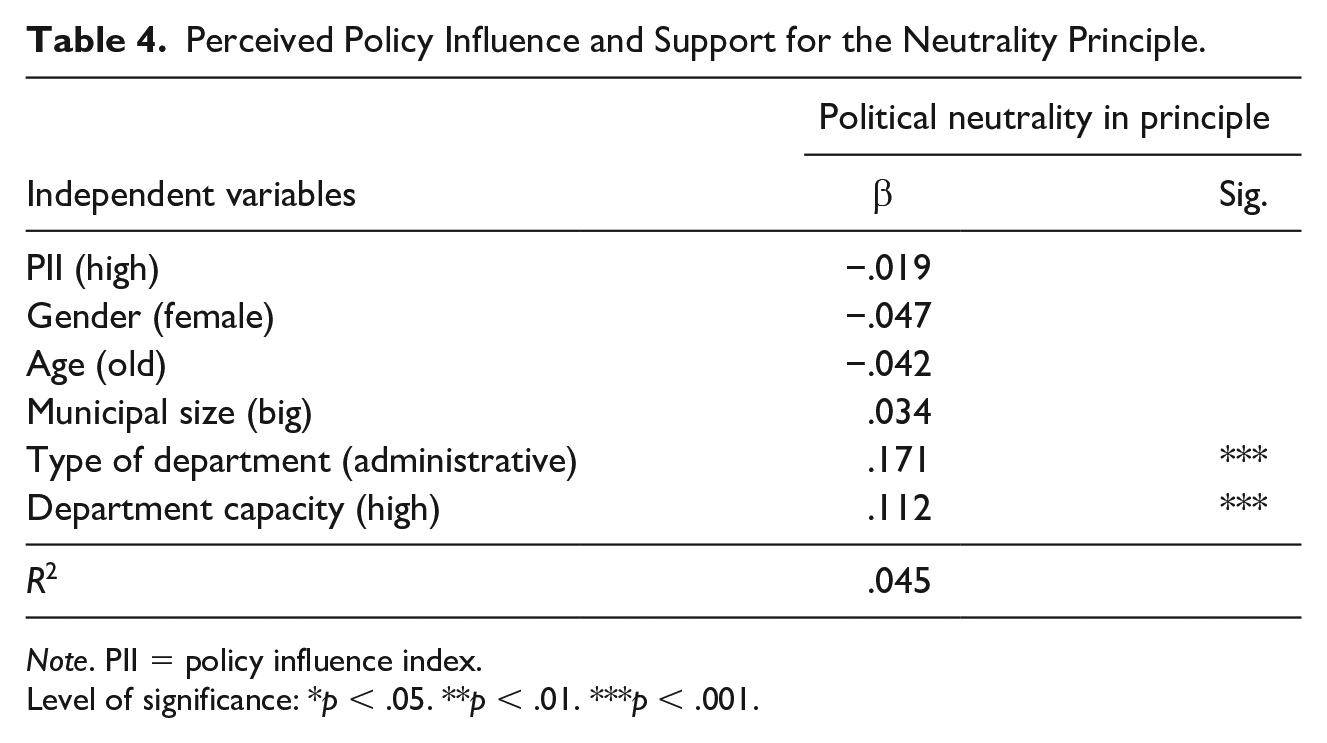
Note. PII = policy influence index.
Level of significance: *p < .05. **p < .01. ***p < .001.
Political Neutrality in Action
As empirical research has convincingly shown that public administrators in practice are heavily involved in policy making and contribute to political decisions (Aberbach et al., 1981; Svara, 2006a), the academic debate on political neutrality has increasingly centered on conceptualizing political neutrality within “the purple zone” in which red politics and blue administration interact (Alford et al., 2017).
Inspired by this research, this study formulated a series of dilemma questions to determine the extent to which public managers would interfere with the government in support of “neutral competence” (legislation, expertise, and consequences) and for partisan political reasons (ideology and public opinion). What does political neutrality mean in practice? As Table 5 indicates, most of the public managers would take action against a local government decision that violates existing legislation (80%), contradicts the available expertise on the subject (81%), or contains risks producing difficult undesirable consequences (64%). A majority of the responding public managers stated that they would not act against a local government decision that conflicts with public opinion (71%) or with their own ideological convictions (67%).
Political Neutrality in Action.
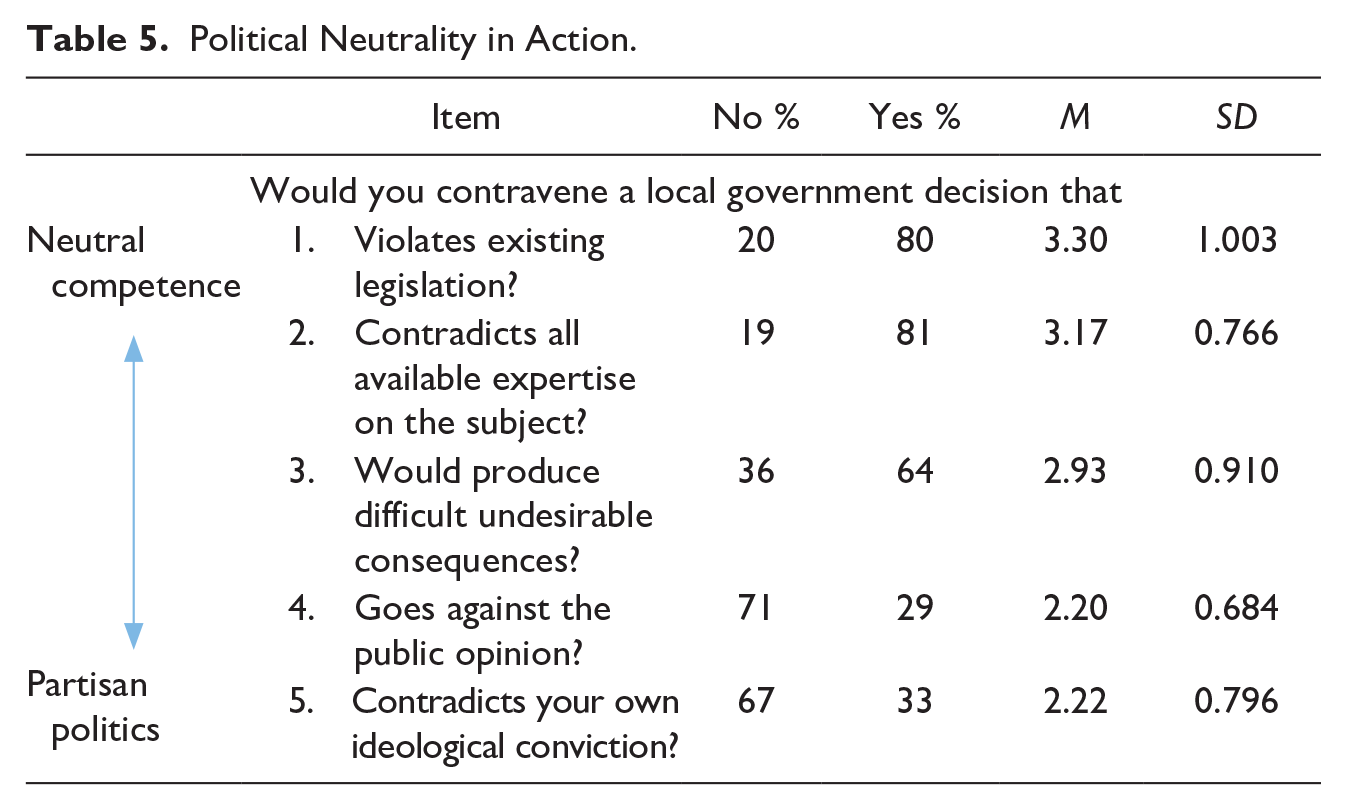
Furthermore, a factor analysis was conducted in which ideology and public opinion were grouped together in a partisan political factor. Aspects related to the law, expertise, and consequence judgments were included in the ideal of “a neutral competence” (Kaufman, 1956) and were grouped into another factor. That more managers would act against local government decisions in support of “neutral competence” instead of for “partisan political reasons” is well in line with the traditional responsibilities of public administrations.
It must also be noted, however, that there was a considerable minority who would act differently from the majority. As seen in Table 5, 20 percent of the managers would not contravene the local government’s decisions even if they violate the law and a considerable minority of the public managers would heed public opinion (29%) and act out of their ideological conviction (33%). This signals a readiness to also engage with partisan politics. This called for a closer look at how the public managers’ level of principle-based support is related to their behavioral intentions (neutrality in action). Table 6 shows the relationship between the two. In particular, the findings in this regard indicate that managers with strong principled support for neutrality are less inclined to act against local government decisions for partisan political reasons while the relationship between principle-based support and neutrality in action is weaker when it comes to neutral competence.
Neutrality in Action in Relation to Support for Principle.
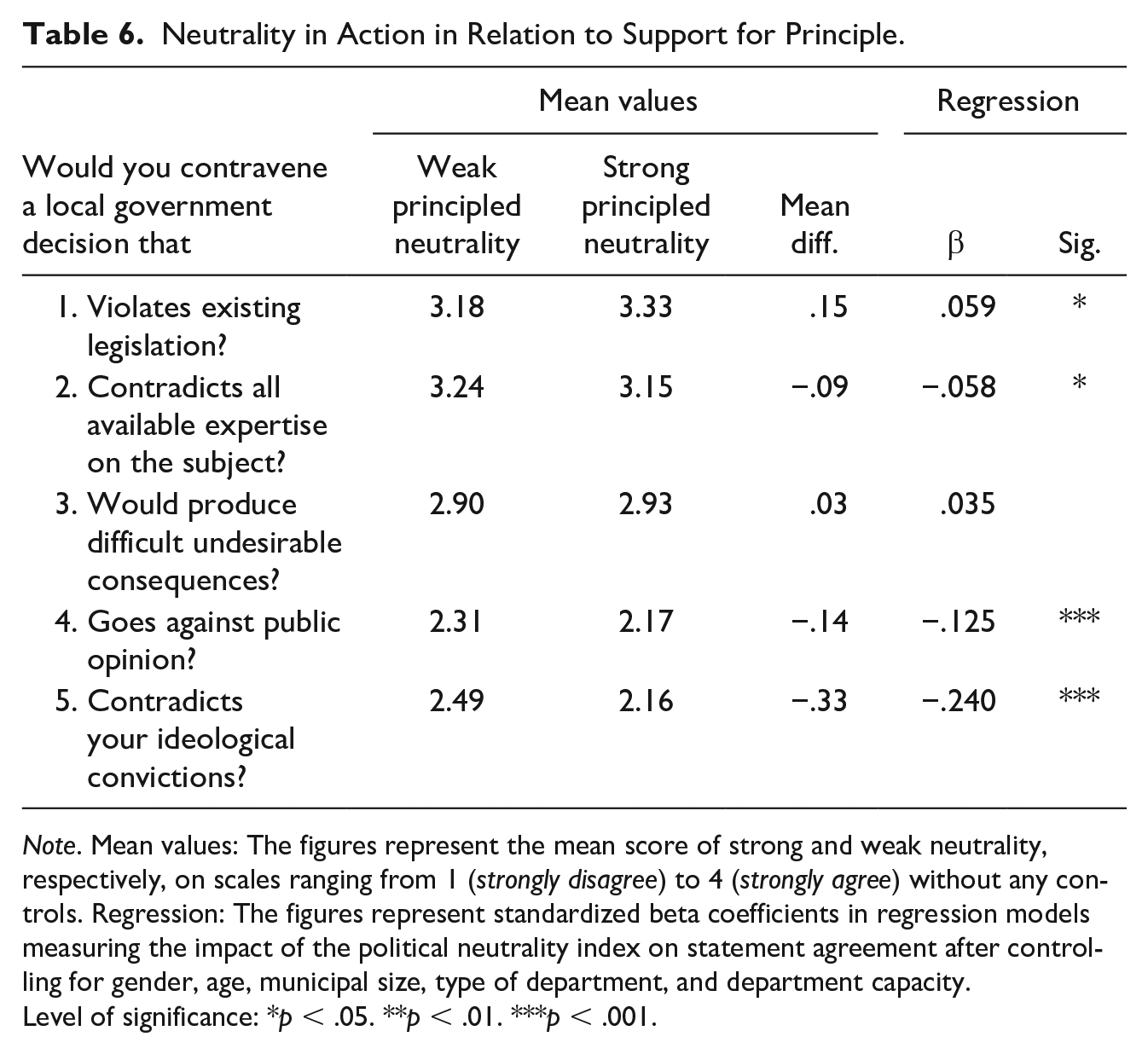
Note. Mean values: The figures represent the mean score of strong and weak neutrality, respectively, on scales ranging from 1 (strongly disagree) to 4 (strongly agree) without any controls. Regression: The figures represent standardized beta coefficients in regression models measuring the impact of the political neutrality index on statement agreement after controlling for gender, age, municipal size, type of department, and department capacity.
Level of significance: *p < .05. **p < .01. ***p < .001.
Does having a higher level of influence on policymaking contribute to the hollowing out of public managers’ norms of political neutrality? This has been examined in Table 7 where the managers’ neutrality, expressed as behavioral intentions (neutrality in action), is related to perceptions of their policy influence. When it comes to “partisan politics,” the results show that there is no significant difference between managers with high and low levels of policy influence. However, the results show that managers who perceive themselves as having high policy influence are significantly more prone to take action in defense of “neutral competence” than managers with less perceived power.
Policy Influence and Neutrality in Action.
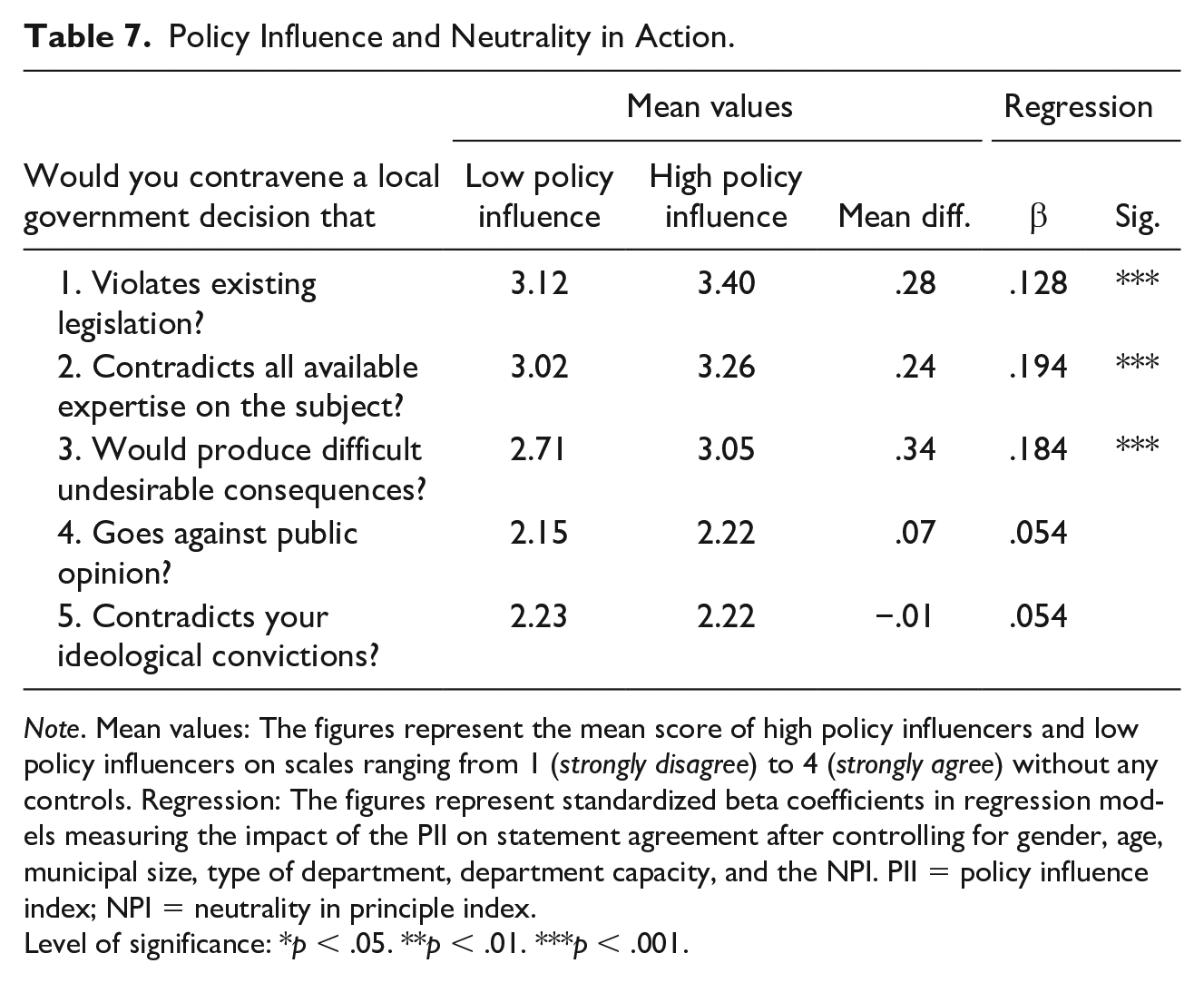
Note. Mean values: The figures represent the mean score of high policy influencers and low policy influencers on scales ranging from 1 (strongly disagree) to 4 (strongly agree) without any controls. Regression: The figures represent standardized beta coefficients in regression models measuring the impact of the PII on statement agreement after controlling for gender, age, municipal size, type of department, department capacity, and the NPI. PII = policy influence index; NPI = neutrality in principle index.
Level of significance: *p < .05. **p < .01. ***p < .001.
Discussion
The empirical results show that the public managers do have a great deal of policy influence, and that they strongly support the principle of neutrality. In other words, it seems to be perfectly possible for public managers to support the principle of neutrality and still be deeply involved in policy politics. Consequently, there is no empirical evidence to suggest that policy politics would undermine the norms of political neutrality. However, the article also presents a more complicated empirical picture when the public managers take a stand on how to react to five dilemma situations in local government decisions. In those more critical situations, the public managers’ behavioral intentions tend to be more mixed and debatable. How can we make sense of these two kinds of findings in relation to previous studies, and what implications do they have for the study of political neutrality among public managers?
Despite the theoretical reasonableness of the socio-psychological hypothesis—which asserts that power and policy influence are likely to undermine neutrality—it does not receive empirical support in this study. This conclusion is also supported by previous studies generated in different contexts and on other institutional levels. For example, a recent study at the German federal level shows that senior civil servants with a background in party politics “act neither more responsively nor less responsibly than their non-politicized peers” (Ebinger et al., 2018, p. 861). On the local level, a survey study of American city managers shows that there is no evidence of a conflict between political orientation (activist values) and the values of political responsiveness and political neutrality. Quite interestingly, however, when the managers engage in high-profile policy making, the impact on political responsiveness and neutrality turns negative. In these situations, administrators are likely to have a greater need for political support to achieve intended policy outcomes (Demir & Reddick, 2015, pp. 594–595). Thus, the findings of these studies are in line with the first type of result of this article and, considering our large data set (N = 1,430, response rate, 48%), this clearly indicates that policy influence does not hollow out political neutrality.
However, there is more to it than this nonexistent relationship between policy influence and neutrality, as is indicated by an American study of city managers, which found that high-profile policy making is an exception (Demir & Reddick, 2015). This underscores that the research task is quite complex, and more studies need to be conducted to elaborate on this complexity. We know from previous studies that the relationship between politicians and administrators is affected by the organizational context. For instance, whereas civil servants in ministries pay more attention to legal constraints when acting as political advisors, agency officials are more inclined to prioritize professional standards (Christensen & Opstrup, 2017; Egeberg & Trondal, 2009). Thus, closeness/distance to political power seems to make a difference. This empirical insight is in line with our results when controlling for type of department, showing that the more distant managers at relational welfare departments (such as schools, health, and social care) expressed less support for the neutrality principle than managers at administrative departments (technical, planning, and central administration).
Furthermore, these results can be interpreted in relation to some other recent studies, showing that interactions and learning are quite important within the “purple zone” of politics and administration. Public administrators need to develop ways to walk “the invisible line” between neutrality and responsiveness (Hustedt & Salomonsen, 2018). Hartley et al. (2015) conclude, for example, that public managers not only need to be politically astute to be able to perform their job constructively and contribute public values, but also that these same skills enable managers to draw a line for what is legitimate in a democracy. Thus, continuous interaction between politicians and administrators facilitates the development of nuanced working relationships and shared understandings of political neutrality. These relationships may, however, constitute local cultures that vary between different organizations and can be problematized in relation to different normative understandings of political neutrality.
The more problematic findings of this article regarding administrators’ reactions to tentative government decisions underscore the importance of further investigation into the value-pluralism of public administrations and the complexity of the politics–administration interface (De Graaf, 2015; De Graaf et al., 2016; Spicer, 2014). Public administrators often find themselves in situations where it is not self-evident to whom or what they should be neutral or responsive: Are they political superiors, citizens, or the law and public ethics in a more fundamental sense? To understand this complexity, more research is needed into value-pluralism on the operational level; that is, it is necessary to further explore and elaborate on neutrality in action. Such work also requires further theoretical elaboration on politics within public bureaucracies (Olsson, 2020; Peters, 2019). Perhaps there will always be a limited number of public administrators who take sides in conflicts, represent partisan interests, and/or operate in an activist manner, at least occasionally or in some situations (Hysing & Olsson, 2018; Olsson & Hysing, 2019). This “strong minority” deserves special attention in future empirical studies, which also requires theoretical elaboration and normative analysis as stipulated in the literature on public ethics (De Graaf, 2015, p. 1099; Svara, 2013).
The empirical study in this article also identified a considerable number of managers who would not oppose illegal decisions taken within their organization. Why is this? What values or other considerations would weigh more highly to them than the law? These results from the local level in Sweden have some similarities with findings about the Danish state administration. Drawing on a large survey study, scholars stress the importance of functional politicization among administrators (Poulsen & Boye Koch, 2018) and that strong loyalty to superiors is prioritized before the letter of the law by a relatively large minority of Danish civil servants (Bischoff Saxlund, 2018). However, we should be cautious when generalizing across decision-making levels, even if some mechanisms of the relationship between politicians and administrators can have general relevance. We should also remember that there are many potential explanations of why administrators can be “too responsive” to their political superiors and disregard fundamental bureaucratic values; from dark stories about cowardice, careerism, and indifference to public values, to active politicization and practical challenges in how to interpret what the law stipulates in concrete situations. Thus, more empirical studies are needed to explore and elaborate on law-abidance and law interpretation, on different levels. Future studies would ideally be based on mixed methods, combining quantitative survey studies with deep case studies that carefully map actual behavior in policy processes. This type of mixed research could give new insights into problematic relationships in the politics–administration interface and the importance of contextual factors, such as issue areas and types of organizations.
Previous studies of civil servants and public administrations show that, although most officials cherish bureaucratic principles such as neutrality and objectivity, there are also some who commit different types of organizational wrongdoing, such as corruption and fraud (Brown et al., 2014; Rothstein, 2015). Thus, civil servants differ in many respects and operate on both the light and dark sides of public life (Hysing & Olsson, 2018; O’Leary, 2017; Olsson, 2016; Olsson & Hysing, 2019). We need to take this variation seriously. Some civil servants adopt high principles and have very strong integrity, whereas others use double standards and have dirt on their hands. We should also remember that organizational wrongdoings are committed by both top managers and rank-and-file administrators, but that the illegal and/or immoral behavior of a top manager is likely to be more damaging in terms of negatively affecting “the norms of appropriateness” within the organization as well as public support and trust in the public administration. This underscores the importance of ensuring that public administrators actively deliberate and reflect on the meaning of political neutrality (Hartley et al., 2015), of securing better developed and more responsible political leadership (Mulgan, 2007; Torfing & Sørensen, 2019), and of putting institutional mechanisms into place to ensure transparency and protect those who dare to speak out against the powerful (Lundquist, 1998). The politics–administration interface can be understood as involving a fundamental tension between normative yardsticks and empirical complexities. This tension is of a kind that can never be finally resolved, but understanding current practices and barriers is of key importance for making recommendations about how to move from support of political neutrality in principle to a well-functioning, real-world practice of political neutrality.
Conclusion
This study examines whether policy influence hollows out political neutrality among public managers in Swedish local governments. A two-step analysis shows, first, that a large majority of managers are highly involved in policy politics while strongly supporting the neutrality principle. A second analysis of behavioral intentions through a set of dilemmas not only shows that most managers would act against local government decisions in support of “neutral competence,” but also that a significant minority would act for partisan political reasons. However, managers with high policy influence are significantly more prone to defend neutral competence in practice. Overall, there is no empirical evidence that policy politics hollows out political neutrality. After concluding that policy influence does not seem to reduce political neutrality, and that a considerable minority of the public managers have problematic behavioral intentions, we relate these findings to previous studies and discuss key areas in need of future study.
Supplemental Material
sj-pdf-1-aas-10.1177_00953997211050305 – Supplemental material for Does Policy Influence Hollow Out Public Managers’ Political Neutrality?
Supplemental material, sj-pdf-1-aas-10.1177_00953997211050305 for Does Policy Influence Hollow Out Public Managers’ Political Neutrality? by Joachim Åström, Jan Olsson and Erik Hysing in Administration & Society
Footnotes
Declaration of Conflicting Interests
The author(s) declared no potential conflicts of interest with respect to the research, authorship, and/or publication of this article.
Funding
The author(s) received no financial support for the research, authorship, and/or publication of this article.

Supplemental Material
Supplemental material for this article is available online.
Author Biographies
References
Supplementary Material
Please find the following supplemental material available below.
For Open Access articles published under a Creative Commons License, all supplemental material carries the same license as the article it is associated with.
For non-Open Access articles published, all supplemental material carries a non-exclusive license, and permission requests for re-use of supplemental material or any part of supplemental material shall be sent directly to the copyright owner as specified in the copyright notice associated with the article.
