



Abstract
Although journalism and media coverage are known to induce, inform, and affect public accountability processes, little is known about media-covered accountability. This study therefore explores accountability processes of Danish and Flemish agencies as subjects of the news. Drawing on news construction literature, our quantitative content analysis of newspaper coverage (N = 13,540) focuses on the presence of accountability processes in media coverage and the extent to which organizational characteristics (task, political salience, and size) are related to this phenomenon. Horizontal accountability forums have the highest media presence. Opinions from horizontal forums, vertical forums, and citizens appear less frequently for service-providing organizations.
Introduction
Public accountability is at the heart of the public sector: Government organizations are embedded in a range of formal and informal accountability relations (Busuioc & Lodge, 2017; Overman et al., 2020). Many empirical studies of public accountability describe and explain unmediated public accountability mechanisms, that is, the direct information relations between the organization and the accountability requester, the forum, following from either formal arrangements (Bovens et al., 2014) or more informal reputation-driven dynamics (Busuioc & Lodge, 2017). Yet, coverage in the news media can initiate and affect public accountability processes and accountability processes can also be subjects of coverage (Jacobs & Schillemans, 2016). In this study, we focus on the latter: accountability as a subject of the news, also called media-covered accountability. This concept refers to a specific subject of media coverage: organizations that are held to account (thus, being criticized or praised) by “forums”: for instance, interest groups, citizens, or ministers.
Exploring the origins of news content, in this case: about organizational accountability processes, implies analyzing the process of news construction. Journalists act as gatekeepers of the news (Shoemaker & Vos, 2009) and are—among other factors—driven by considerations of newsworthiness, in which news factors—characteristics of events such as accountability processes—are generally considered as increasing the chance of an event being covered in the media (Eilders, 2006). In the context of public organizations and their accountability processes, four news factors are especially important: controversy or conflict, negativity, eliteness (actors with societal power or impact), and relevance for or influence on society (Boukes & Vliegenthart, 2020; Eilders, 2006). Following news factor theory, accountability processes are interesting for journalists as they inherently focus on the evaluation and judgment of public organizations, which can exert powers over citizens and institutions in society (Harcup & O’Neill, 2017).
Although much is known about the institutional design and functioning of accountability processes on one hand (Bovens et al., 2014) and about news factors related to organizational news (Boukes & Vliegenthart, 2020) on the other hand, the magnitude of accountability covered in the media as well as the conditions that affect this phenomenon are unknown. This combination is especially relevant for two reasons. First, media coverage can amplify the reach of accountability processes: coverage informs citizens about which organizations were held to account by whom (Jacobs & Schillemans, 2019). In that way, citizens are informed about how the institutions in their society function, which helps them to exert their democratic roles (Dimova, 2019). Second, media coverage might function as a de-facto sanction for the account-giving organization on top of eventual formal sanctions that resulted from the accountability process. This might have reputational consequences for the organizations (Busuioc & Lodge, 2017). We therefore explore the coverage of account-holding efforts by various forums—thus, those who evaluate the organization’s behavior—regarding Flemish (Belgian) and Danish agencies in newspaper coverage. Flanders and Denmark are rather similar in terms of agencification and media systems (Hallin & Mancini, 2017; Verhoest et al., 2012). We distinguish four types of accountability requesters or forums: vertical forums (characterized by hierarchical relationships between organizations and accountability forums), horizontal forums (no hierarchical relationship between organization and forum), diagonal forums (nonhierarchical, in-between vertical and horizontal), and citizen accountability, as citizens are the ultimate principal in accountability processes (Strøm, 2000) and also popular in journalistic practice to represent a human perspective (Sjöström & Öhman, 2018; Zerback & Peter, 2018).
News is a social construction. Journalists observe, select, and interpret events, which has implications for how the “consumers” of this news interpret the world: “Gatekeepers determine what becomes a person’s social reality, a particular view of the world” (Shoemaker & Vos, 2009, p. 3). Newsworthiness of an event or actor is one of the criteria that affects the selection and interpretation of the news by gatekeepers, and it is assumed that the possession of one or more “news factors” helps to pass through the news gates (Jonkman, Trilling, et al., 2020). Research on how organizational news passes through the gates found that “hard” organizational characteristics intrinsically affect the newsworthiness of an organization (Jonkman, Trilling, et al., 2020). For that reason, the same characteristics might also affect the chances that the accountability processes of organizations with those characteristics end up in the news. So, in this article, we do not study the organization’s or forum’s deliberate attempts to acquire media attention, but we take the accountability processes between the organizations and forums as a given, as an event, that has ended up in the news that and whose visibility we aim to explain with the help of news factor theory.
We thus study to what extent organizational factors are related to the visibility of organizational accountability processes (Boon, Salomonsen, & Verhoest, 2019). First, the agency’s tasks (service delivery and/or authoritative) is included, as some tasks are more likely to attract media coverage than others—especially those which are closer to the daily life of citizens and, from the perspective of news factors, thus can be considered as having a higher relevance for the public (Harcup & O’Neill, 2017; Ketelaars, 2016). Second, the size of government agencies is considered, as larger organizations could be associated with more societal impact (news factor: reach) and thus a higher likelihood of their accountability to be covered in the news (Eilders, 2006). Based on the same argument, the political salience (number of parliamentary questions) of the agency is relevant, as this touches on eliteness (prominent actors or organizations that can exert societal power), impact on society, and controversy (Boukes & Vliegenthart, 2020; Eilders, 2006). Last, we consider the formal-legal distance of the organization from the central government, as legally autonomous organizations are more recognizable as separate entities and therefore have better opportunities to communicate their uniqueness, which might trigger journalistic attention (Boon, Salomonsen, & Verhoest, 2019; Waeraas & Byrkjeflot, 2012). Shoemaker (1996) explicitly mentions “deviance” as an aspect of newsworthiness, which in this case means performing public tasks at arm’s-length distance, in contrast to organizations closer to the central government.
Thus, we address two main research questions. The first one examines the size of the phenomenon at study, media-covered accountability, and the second one aims to explain this phenomenon based on news factor theory: (a) which accountability processes are most frequently present in newspaper coverage of these agencies and (b) can we relate this presence to organizational characteristics (political salience, size, task, and formal-legal distance)?
By investigating media-covered accountability processes and their relation to organizational characteristics, the article contributes to a series of literatures interested in principal-agent dynamics; most notably scholars interested in accountability and reputation, and agencification. Public accountability processes between principal(s) and agent(s) are assumed to be affected by the media, yet studies in these fields tend to focus on unmediated accountability processes, either formal (Bovens et al., 2014) or informal reputation driven (Busuioc & Lodge, 2017). The gatekeeping role of the news media in giving voice to accountability demands has been overlooked (Boon et al., 2019a; Jacobs & Schillemans, 2016). Our contribution lies in theorizing and empirically exploring which elements of news construction are of relevance for the media to report on accountability processes, thus increasing understanding on how factors derived from news construction literature translate into reporting of account-holding efforts of different forums vis-à-vis organizations with particular characteristics. By providing media-based explanations for media-covered accountability processes, the article also provides insights into effects of agencification. While effects of agencification already have been theorized and empirically identified in terms of, for example, blame-shifting behaviors and accounts on the part of the actor (Hood, 2011) and the agencies in the news media (Mortensen, 2016), our study adds by suggesting that also criteria on the part of the journalist and more general, the construction of “news,” may determine whether such behavior “makes it to the news.”
Theoretical Framework
Public Accountability
The democratic perspective on political forms of public accountability conceptualizes this concept as mirroring the “chain of delegation” in representative democracies (Strøm, 2000). This chain is based on principal-agent theory and explains how citizens—by voting—delegate their sovereignty to political representatives, who consequently transfer the responsibility for preparation and execution of public policies to the government, that in turn delegate ministries and other governmental organizations to carry out these tasks. Public accountability relations mirror this chain of delegation in such a way that each delegate can be called to account by its principal, for example, the Parliament can ask the minister to explain its behavior (Bovens, 2007; Strøm, 2000). In this democratic perspective, the mass media play an important role: “Citizens can hold decisionmakers accountable for their actions only when mass media provide information about policy decisions and their outcomes” (Hasler et al., 2016, p. 137). This democratic perspective on public accountability lies at the roots of many empirical accounts of accountability (Brummel, 2021; Busuioc & Lodge, 2017; Hasler et al., 2016; Schillemans, 2011). If we look at the very essence of what constitutes an accountability process, these studies often conceptualize public accountability as a mechanism, as introduced by Bovens (2007). Public accountability is a communicative process between an actor (e.g., a public agency) and a forum, in which the actor gives information about his or her behavior, this information is subjected to discussion (in which either no evaluation can be given, or the organization can be criticized or praised for its behavior), from which consequences can follow (Bovens, 2007). Many empirical studies of public accountability examine the direct information relations (not including the media) between the actor and the forum, following from formal arrangements (Brummel, 2021).
Mediated and media-covered accountability
Recently, studies have shifted to broader, perceptive and informal aspects of public accountability processes (Overman et al., 2020; Reddick et al., 2020). Although empirical studies regarding the role of the media in accountability processes of public sector organizations are rather scarce (Jacobs & Schillemans, 2019), the media are hypothesized to interact in four multiple and overlapping manners with public accountability processes (Hasler et al., 2016; Jacobs & Schillemans, 2016). First, even before actual coverage takes place, the possibility of media attention and the activation of other forums might trigger pre-emptive self-reflection in organizations (Jacobs & Wonneberger, 2019). Second, fulfilling their democratic watchdog function, journalists ask organizations to explain their behavior and thus operate as an accountability forum themselves (Eriksson & Östman, 2013; Hasler et al., 2016). Third, accountability processes can also be subjects of media coverage. Then, media coverage amplifies accountability processes that have already occurred, thus giving accountability processes a wider audience, while at the same time also shaping the content (Jacobs & Schillemans, 2019). Empirically, these processes can be observed as organizations that are either criticized or praised (thus, hold to account) by forums (account-holders) in the media. Here, accountability processes are a media topic. We call this media-covered accountability. Finally, media coverage interacts with political attention (Opperhuizen et al., 2020). It can inform other accountability forums, such as inspectorates or members of parliament and induce or trigger them to hold public sector organizations to account (Dimova, 2019; Jacobs & Schillemans, 2016). We use the term mediated accountability as an umbrella term for all four roles described above; thus, for public accountability processes that are covered, initiated, or (pre-emptively) induced by the media (Jacobs & Schillemans, 2016). In other words, accountability in which the media are involved. “Mediated” has different meanings, depending on the context. We do not refer to statistical interaction (mediation) effects here—our term only refers to the role of the media.
In this study, our empirical focus is on the third role: media-covered accountability. This term refers to accountability processes as subjects of the news, for example, a newspaper article that reports on a public agency that had to explain its behavior to its minister. Media-covered accountability results from processes of news construction (Jacobs & Schillemans, 2019). Among factors such as resources and capacities and format-related considerations (Strömbäck et al., 2012), evaluations of newsworthiness play a crucial role in news construction. These are affected by news factors: characteristics of events that—in combination with the journalist’s news values—increase their chance for selection in coverage (Kepplinger & Ehmig, 2006). Over the years, different catalogs of news factors have been established, for example, referring to conflict, impact/reach, or elite actors (Eilders, 2006). News factor theory has often been used to explain which news topics were selected by journalists (Kepplinger & Ehmig, 2006). We explore to what extent news factor theory can explain the presence of accountability processes of public agencies in the news.
Accountability forum types
Prior to hypothesizing differences in the visibility of accountability processes in the news, we need to discern the types of forums that can call organizations to account. As Dimova (2019, p. 5) notes: “Most of the time, media allegations actually refer to allegations made by the opposition or some other group which appear in the media but are not made by the media.”. Differentiating between forum types is relevant, both from the perspective of the organization and the different forum types, as it gives a more fine-grained account of who evaluates whom. It can illuminate to what extent the organization’s accountability regime is mirrored in media attention, or whether specific accountability relations are underrepresented, which is both of organization-strategic and democratic importance. From a forum perspective, if particular forum types are either more likely or attractive for the media, or more successful in their media relations, this might trigger learning behavior by other forums.
A common way to classify the accountability relations of public sector organizations is according to the nature of the obligation: to what extent have the forum formal powers to ask the actor to render account? (Bovens, 2007). This degree of formality depends on the legal framework that constitutes the relation between the actor and the forum. Spatial metaphors are used to characterize these relationships. Vertical accountability refers to occasions of unequal power relations, in such a way that the forum can (formally) exert power over the actor, for example, as a consequence of a hierarchical relationship (Bovens, 2007). Horizontal accountability is used to describe accountability relations that—generally—cannot be enforced due to a lack of hierarchy (Bovens, 2007). Schillemans refers to these as “a form of accountability to third parties” (Schillemans, 2011, p. 390). These could be, for instance, boards of stakeholders, independent evaluators, or nongovernmental organizations (Schillemans, 2011). Although they do not rely on a hierarchical relationship, horizontal accountability is not necessarily without obligations: It may be based on a legal requirement, may follow from freedom of information laws or be based on what Mulgan (2003) dubbed: “The principle of affected rights and interests.” If the rights and interests of third parties are at issue this provides a title to hold someone accountable. (Mulgan, 2003 cited in Schillemans, 2010, p. 305)
Diagonal accountability is also a nonhierarchical form in which forums generally “have few powers to enforce their compliance,” but since these forums—such as ombudsmen and inspectorates—report to political actors, this “two-step relation” can be considered as in-between vertical and horizontal (Bovens, 2007, p. 460). Before exploring how organizational factors are related to media-covered accountability of agencies, we need to know which forums are present in newspaper coverage about these agencies. Due to limited prior knowledge and theoretical expectations, we refrain from hypotheses and opt for the following specific research question:
Applying News Factor Theory to Media-Covered Accountability
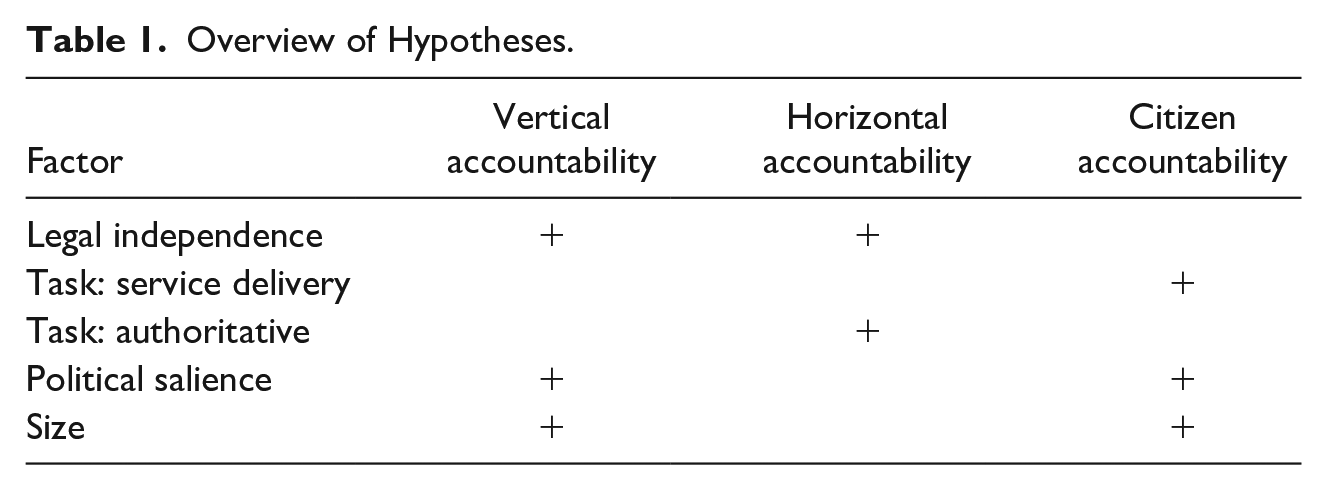
Previously, we introduced the organization’s political salience, size, task, and formal-legal distance to the central government as characteristics that are closely related to news factors and therefore might be able to explain the media visibility of accountability relations. We now specify these relationships for the three main accountability processes: vertical, horizontal, and citizens. These reflect key issues regarding the role of media in accountability processes: the amplification of formal, vertical accountability processes; possible compensation for alleged accountability deficits, and voicing “the final principal’s,” thus citizens’ opinions (Jacobs & Schillemans, 2016). Although theoretically relevant, diagonal accountability can be assumed to only play a marginal role empirically and is therefore not discussed here. For reasons of clarity, we already present our overview of hypotheses here in Table 1. The motivations for the hypotheses can be found below. Table 1 summarizes our expectations regarding the factors that influence the three main accountability processes.
Overview of Hypotheses.
Vertical accountability
Vertical or political accountability can be considered as possessing quite some news factors, as it involves elite actors who can exert power in society and are often related to conflict. We expect that several organizational factors increase the (already expected to be newsworthy) vertical accountability processes: “The more news factors an event displays, the greater its news value and the higher the likelihood that it will make the news” (Tresch, 2009, p. 71).
First, some agencies have a higher political salience than others, which is expected to increase relevance for media attention. Koop (2011) finds that politically salient agencies (i.e., receiving political attention) deal with issues and tasks that attract more attention from society at large. We expect that, like politicians, journalists use this salience as a heuristic for relevance which is expected to increase the media profile of salient organizations. This relation is expected to be strengthened when vertical forums share their opinion on these agencies, as this often brings with it an element of conflict and dramatization, fuelled by elite actors—all factors which are expected to increase the newsworthiness of these agencies (Eriksson & Östman, 2013, Harcup & O’Neill, 2017).
Second, larger organizations are associated with a higher importance for the media agenda (Jonkman, Trilling, et al., 2020) and political agenda (Corbett & Howard, 2017). This can be related to the higher perceived relevance for news consumers or citizens and impact of bigger organizations on society (Eilders, 2006; Jonkman, Trilling, et al., 2020). A related explanation could be that the authority that they have is newsworthy (Strömbäck et al., 2012). We expect that attention by vertical account-holding actors for large organizations will be particularly likely to attract media attention, due to the combined presence of political and administrative elite and powerful actors.
Third, the formal-legal distance of agencies from the central government is an important determinant of their (formal) accountability relations (Schillemans, 2011). Legally independent agencies are positioned outside the legal identity of the state, which means that they are able to act before courts, to have their own assets and their own governing board. In European parliamentary systems, legally independent agencies need to present their budgets and accounts separately to parliament (Verhoest et al., 2012). These features make independent agencies more identifiable and recognizable as distinct from their political principal (Boon et al., 2019a). Ruder (2013), for instance, shows that the media associate policy making by U.S. executive agencies with the president but connects policy-making by independent agencies to those bodies themselves. Institutional design scholars have argued that granting agencies more autonomy is a way for vertical account-holders to shift responsibility for certain tasks to agencies, and to facilitate blame attribution to these agencies (Hood, 2011; Mortensen, 2016). We therefore expect a higher likelihood to observe media coverage of vertical accountability processes when it concerns agencies at increased formal-legal distance. We therefore formulate the following hypothesis:
Hypothesis 1: The evaluation of agencies by vertical accountability forums in media coverage will be positively related to the agency’s (a) political salience, (b) size, and (c) formal-legal distance.
Horizontal accountability
Horizontal forms of accountability have been established and examined as alternatives for vertical arrangements, often following the autonomization of agencies (Schillemans, 2011). One of the questions surrounding the autonomization of these organizations was also whether, and under which conditions, the media might fill the accountability gap that emerged after the autonomization (Schillemans, 2011).
We expect that media coverage will more likely contain the account-holding efforts of horizontal forums when they concern authoritative agencies (i.e., regulatory and redistributive agencies). In the literature on regulation and institutional design, these agencies are well recognized as organizations with considerable public authority that operate largely independent from the political center (Maggetti, 2012; Majone, 2002). This independence is needed to maximize authoritative agencies’ credibility as independent actors, yet it also comes at the price of a potential democratic deficit due to the apparent imbalance between their (high) autonomy and (low) accountability vis-à-vis elected officials (Maggetti, 2012). To counter such imbalance, Majone (2002) points to the need for a “multi-pronged system of controls” to keep authoritative agencies accountable. In such a system, the combined efforts of numerous horizontal forums among which authoritative agencies operate—interest groups, civic associations, organizations of professional and scientific expertise, regulated businesses, and so on (Carpenter, 2010)—which are reported about in the news media offers potential as a counterweight to the relative decrease of vertical accountability toward these agencies (Maggetti, 2012). In light of the aforementioned democratic deficit, the media are an accountability forum of particular suitability for authoritative agencies, constituting one element of a complex accountability system (Hodge & Coghill, 2007), without hindering these agencies’ independence (Majone, 2002).
We also expect to see more media-covered accountability of horizontal account-holders toward agencies at increased formal-legal distance from central government. We discussed how these agencies’ design might facilitate increased blame attribution from vertical actors. A supplementary expectation is that the increased visibility and recognizability of these agencies as separate organizations from politics facilitates scrutiny from horizontal forums. The notion that horizontal actors might fill the accountability gap that has occurred by granting these agencies independence from politics is well recognized in the accountability literature, although findings indicate that “horizontal accountability is a partial solution for the accountability deficit” (Schillemans, 2011, p. 387). We formulate the following hypothesis:
Hypothesis 2: The evaluation of agencies by horizontal forums in media coverage will be positively related to (a) agencies with an authoritative task and (b) formal-legal distance.
Citizen accountability
From the perspective of the chain of delegation, citizens can be considered the ultimate principal. This form of accountability—in which citizens have little to no formal powers to enforce accountability—is labeled social accountability (Brummel, 2021; Klijn & Koppenjan, 2014) or voluntary accountability (Koop, 2014). Although citizen accountability could be categorized as horizontal accountability, we analyze it separately here as covering the perspective of citizens is increasingly practiced by journalists, who depict citizens that express their opinions in the news. Their opinion can either be based on personal experience or they can talk as a “person from the street.” The use of citizen exemplars in the news has risen, often to present a human perspective on topics (Zerback & Peter, 2018). Specifically in coverage about public sector organizations, this occurs within the “David versus Goliath” frame, presenting a powerless citizen vis-à-vis a powerful organization (Sjöström & Öhman, 2018).
Our first expectation in relation to citizen accountability pertains to the type of task agencies perform. More specifically, we expect more citizen opinions to be depicted toward service delivery agencies, which have relatively direct and more frequent contact with citizens. The direct nature of contact makes their work more easily evaluable for citizens, who can form and disseminate an opinion based on the observable performance of the agency in question (Bertelli, 2016). Furthermore, the outcomes of service delivery agencies are more directly attributable to their actions. This stands in contrast to regulators and redistributive agencies, where the ultimate results of their actions depend on the actors they regulate or subsidize (Boon et al., 2019a).
Second, we expect that the visibility of citizen accountability might be related to the political salience of agencies and their size. Especially for organizations with which citizens do not interact personally, there is a high dependency on media coverage for gaining information about these organizations (Einwiller et al., 2010). Both characteristics—salience and size—enhance the visibility and therewith the familiarity of citizens with these organizations, which is a prerequisite for voicing opinions. In addition to that citizen accountability is often rendered voluntarily, and higher levels of voluntary account-giving were found for agencies dealing with salient issues and agencies with more staff (Koop, 2014).
Hypothesis 3: The evaluations of agencies by citizens as an accountability forum in media coverage will be positively related to (a) service delivery as an organizational task, (b) political salience, and (c) size.
Methods
Empirically, we rely on media data from public agencies in Denmark and Flanders (Belgium). Being one of the autonomous regions in the Belgian federal system, Flanders has its own parliament, cabinet, and public administration (with departments and agencies). Flanders therefore can be considered a full-fledged state for the competences under its remit. Denmark and Flanders have similar population sizes and both have parliamentary systems with similar degrees of agencification (Verhoest et al., 2012). However, they differ in terms of their politico-administrative cultures and state traditions, with Denmark being part of the Nordic tradition and Flanders of the Napoleonic tradition (Verhoest et al., 2012). Since the two research contexts have news media positioned in similar media systems—the democratic corporatist system (Hallin & Mancini, 2017)—we do not expect significant differences between these research contexts.
Sample
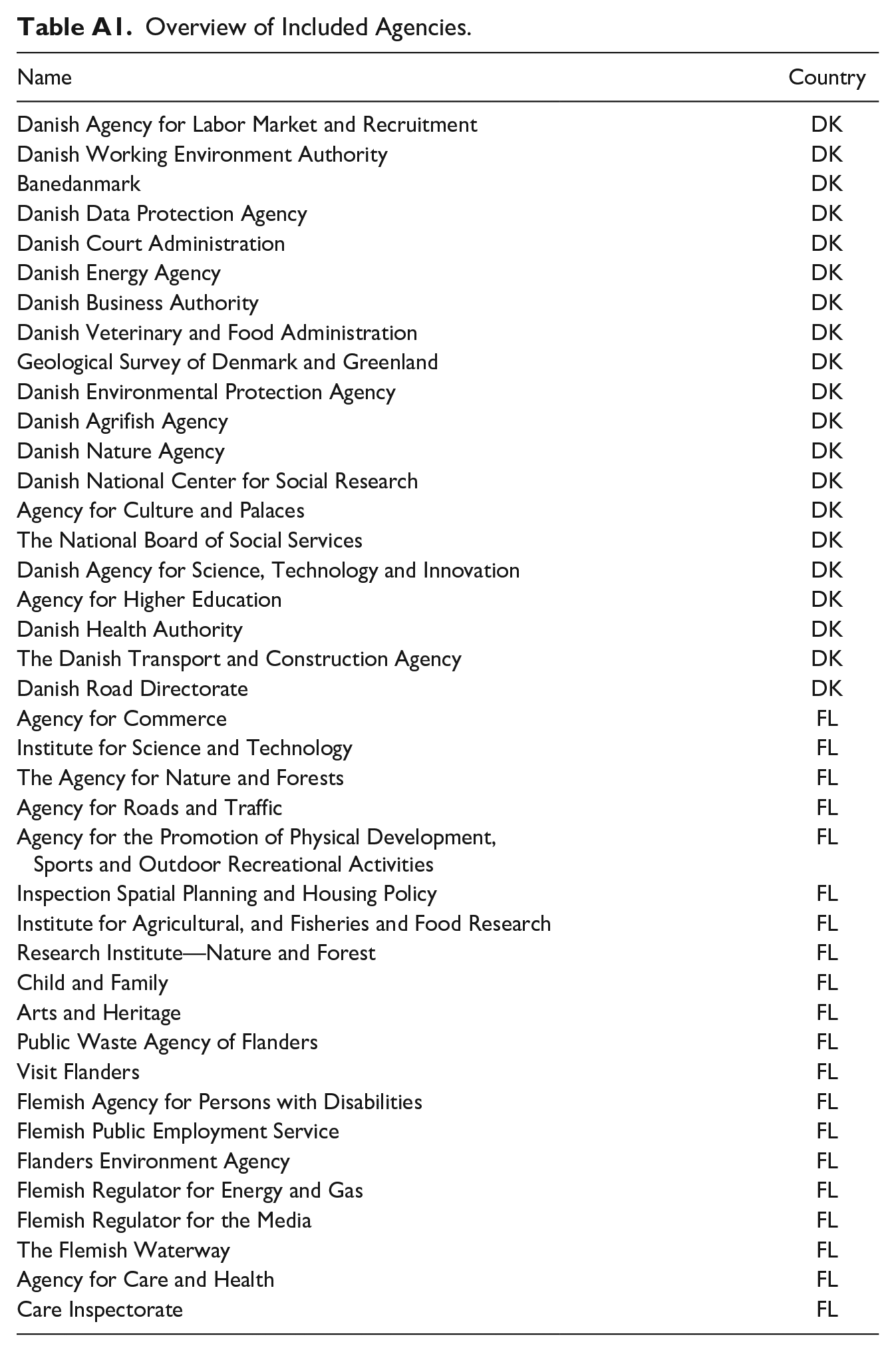
To answer our research question concerning the visibility of different public accountability relations of Danish and Flemish agencies in newspaper articles, we used data of a larger manual content analysis that had been conducted in both countries. The sample included news coverage of 40 public agencies (20 per country); cf. full list of included agencies in Table A1. Purposeful sampling of agencies was applied to yield maximum variation concerning organizational task and type. To obtain a comparative sample, agencies were selected that can be considered as closest equivalents in both countries.
News articles that addressed the selected agencies were searched for using national news databases; INFOMEDIA for Denmark and GoPress for Belgium. All of the articles over a 10-year-period (2006‒2015) containing agency names (or variants of them) in two nationwide quality newspapers, Berlingske in Denmark and De Standaard in Flanders, were coded. 1 These two newspapers are comparable in terms of political orientation (center-right) and focus of coverage (national, both with a general focus on policy, politics, and business news). A sample period of 10 years ensured that the sample of news articles was not affected by specific incidents or crisis situations which may increase negative media attention for an organization. A longer sampling period, in contrast, included periods of crisis as well as noncrisis for most organizations. The final sample comprised N = 13,540 news items of which 7,917 were from the Danish and 5,623 were from the Flemish sample.
Coding Procedure
To ensure reliable coding within and across the two research contexts, a combination of best practice strategies were taken (Lacy et al., 2015). Reliability had to be ensured at two levels: within-country (between student coders) and between-country (between master coders of the research team). In a first phase, an explicit written protocol that can be shared with other researchers was developed by senior members of the research team, based on iterative rounds of coding and discussion, from which a common interpretation grew. The intercoder reliability coefficient (Krippendorff’s alpha, KA) was calculated both between countries and within each country. The Krippendorff’s alphas for intracountry reliability were on average 0.69 for negative opinions, 0.58 for positive opinions, and 0.64 for neutral opinions (on a total of 169 articles, and eight different coders). The mean intercountry reliability calculated on a set of English articles (n = 40, three different coders) was 0.67 for negative opinions, 0.67 for positive opinions, and 0.73 for neutral opinions. These alphas, in particular, for the intracountry reliability tests, are relatively low. Two mitigating factors exist, being (a) variable complexity: As Lacy et al. (2015, p. 797) discuss, “coding news story topic is easier than coding the valence (positive or negative leaning toward an object, person, or issue).”; and (b) difficulties of the KA measure to deal with skewed variables, in which case KA is known to yield lower coefficients even when the levels of simple agreement are high (Lacy et al., 2015). In our case, newspaper coverage toward agencies is typically overwhelmingly neutral (Deacon & Monk, 2001; Schillemans, 2011). When calculating simple agreements, we observe an agreement of 88% for negative opinions, 88% for positive opinions, and 82% for neutral articles (intracountry); and 87% for negative opinions, 87% for positive opinions, and 87% for neutral articles (intercountry). Furthermore, we took additional measures to maximize reliability: (a) in Microsoft Access (which was used as an interface for coding), a “doubt box” was added which coders were strongly urged to use in case they experienced doubt. All articles that were ticked as “doubtful” were later discussed and decided on by the master coders in both countries; (b) the Danish master coder visited the Belgian team to finalize the data. In preparation of this visit, all master coders again went through all articles, and again listed potential problem cases which were discussed and solved together.
Measures
Public accountability processes formed the dependent variables of this study. These processes were operationalized as positive and negative opinions expressed by different kinds of forums toward a public agency. An article was considered to include an opinion when an agency’s behavior was evaluated; either in a positive way (praise) or negatively (threat), for example, through a description of the causal link between the agency’s (in)action following an incident following or more generally concerning its past/future programs, policies, plans, or intentions. The coding of opinions was based on all of the parts of an article in which the agency is discussed positively or negatively by one or more accountability fora. Each article may contain multiple opinions, all of which were included in the coding. A dummy variable was created for each accountability forum based on the subcategories listed in Table 2. If at least one of these subcategories (e.g., “interest group”) voiced an opinion in the article, the encompassing category of interest (e.g., “horizontal forum”) was coded as 1 (otherwise 0).
Operationalization Accountability Fora and Examples.
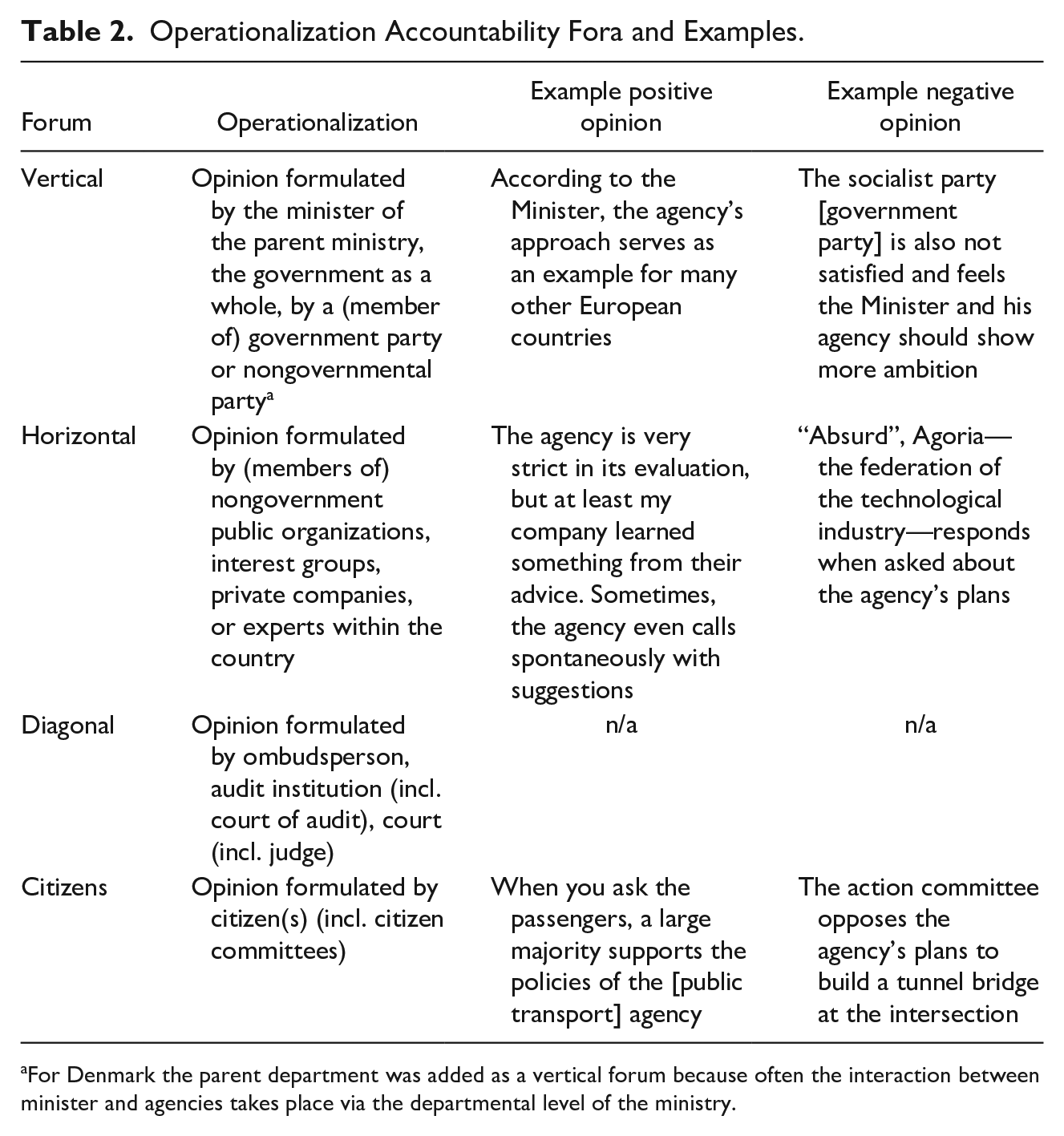
For Denmark the parent department was added as a vertical forum because often the interaction between minister and agencies takes place via the departmental level of the ministry.
Concerning the independent variables, we first included the primary task of agencies, distinguishing between service delivery, 2 regulatory, 3 and redistributive 4 agencies . Regulatory and redistributive agencies were merged yielding the category of authoritative tasks. Note that service delivery and authoritative were not mutually exclusive categories because some organizations covered both tasks. Consequently, both tasks were included as separate dummy variables (service delivery: 70.0%; authoritative: 80.0%). Second, we relied on Van Thiel’s (2012) classification of agency legal types, focusing on Type-1 and Type-2 agencies. 5 The classification of agency task and type was performed by the authors based on the descriptions and criteria mentioned here and after several rounds of discussion (Type 1: 60.0%, Type 2: 40.0%). Third, agency size related to each agencies’ number of full-time equivalents (FTEs), one FTE being equivalent to one full-time employee. Time-variant FTE data were collected in both countries in the agencies’ annual reports (M = 835.55; SD = 1,421.56; n = 400). Fourth, for political salience, a yearly measure was used of the number of written parliamentary questions which contained the agency’s name (M = 62.87; SD = 118.42; n = 400). Given their highly skewed distributions agency size and political salience were log-transformed. Finally, we included a dummy variable for country to account for possible differences.
Analysis
To account for the dichotomous nature of the dependent variables and the hierarchical structure of the data, logistic multilevel models were estimated for each forum variable using the glmer function of the lme4 package in R (Bates et al., 2015). News articles were considered as cross-nested within organizations and years. Therewith, this approach controlled for the unequal presence of agencies in the news coverage and for possible differences over time. With relatively rare occurrences of forum references (ranging from 0.4% to 4.80% of the total sample), the estimators of logistic models might be biased due to the much greater weight that is put on the majority category. Adjusting sampling strategies or weighting have been proposed as a possible solution (King & Zeng, 2001). For this reason, we estimated alternative models based on a smaller sample comprised of the articles with at least one opinion voiced by a forum. Largely comparable findings indicated the robustness of the results obtained based on the full sample.
Results
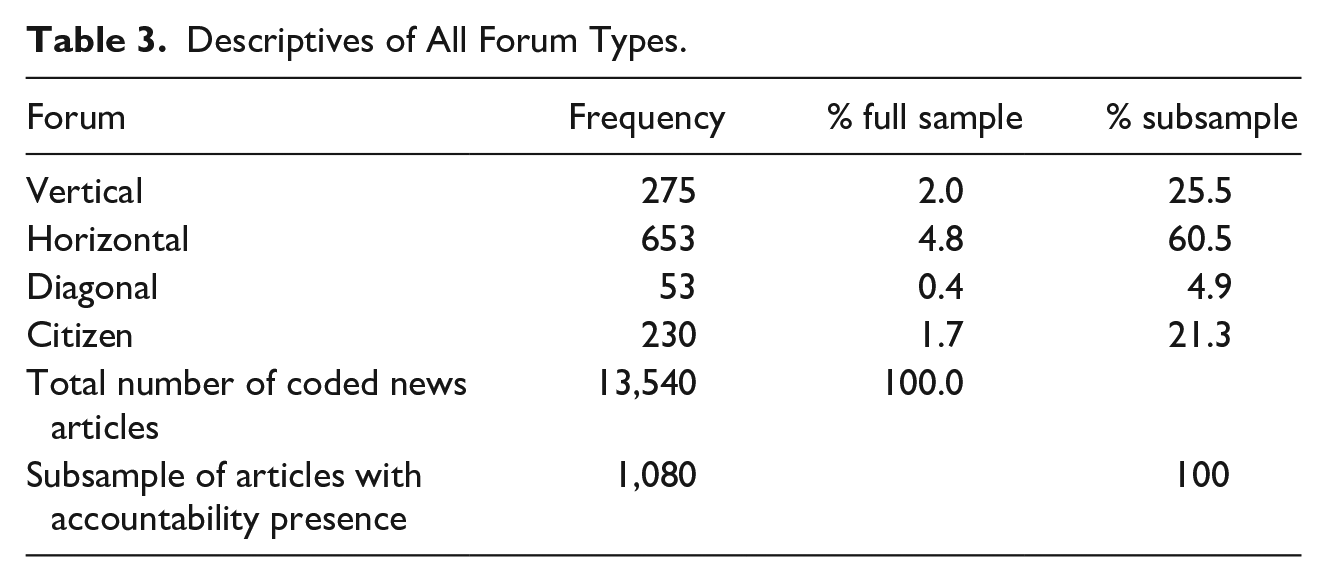
Accountability processes occurred in 8.0% (n = 1.080) of the articles in our sample. Of these, the majority included negative opinions (93.8%) while positive opinions were covered less frequently (21.4%) and in most cases in co-occurrence with negative opinions. To answer RQ1, we inspected the distributions of the forum variables to ascertain the relative appearance of the different types of accountability (Table 3). Paired-samples T-tests revealed that the mean differences between all four forum types were significant. With 653 references, the opinions voiced by horizontal forums was by far the most frequently occurring form of accountability in our sample (4.8% of all news articles). The other accountability types appeared less often ranging from 0.4% for diagonal forums to 2.0% for vertical forums.
Descriptives of All Forum Types.
Next, we examined to what extent the opinions voiced by the different forums were associated to a range of organizational characteristics. Due to the very low frequency of diagonal forums, a reliable estimation for this forum type was not possible. Table 4 presents the estimated models for the three remaining types of public accountability relations. Odds ratios (ORs) smaller than one indicate negative associations and scores greater than one positive associations. In addition, Figure 1 depicts marginal effects, that is, the effects on the probability of forum presence (thus, the evaluation of an agency by a specific forum type) for significant coefficients of the three models offering a more meaningful interpretation. Generally, it should be noted that the detected effects are rather small but given the relatively rare occurrence of forums can still be considered substantial. The presence of vertical forums as addressed by the first hypothesis was positively associated (p < .001) to political salience (OR = 2.232; 95% CI: 1.526, 3.265) with marginal effects increasing from .01 to .05 from low to high political salience, confirming Hypothesis 1a. Vertical forums were neither significantly related to size (OR = 1.053; 95% CI: 0.633, 1.750) nor to legal distance (OR = 1.445; 95% CI: 0.813, 2.570). Hence, Hypotheses 1b and 1c were not confirmed. In addition, we found that opinions from vertical forums appeared significantly less frequently for service-delivering agencies (OR = 0.484; 95% CI: 0.258, 0.910) and more frequently in Denmark (OR = 2.608; 98% CI: 1.205, 5.645).
Factors Associated With the Presence of Public Accountability Relations in Newspaper Articles.
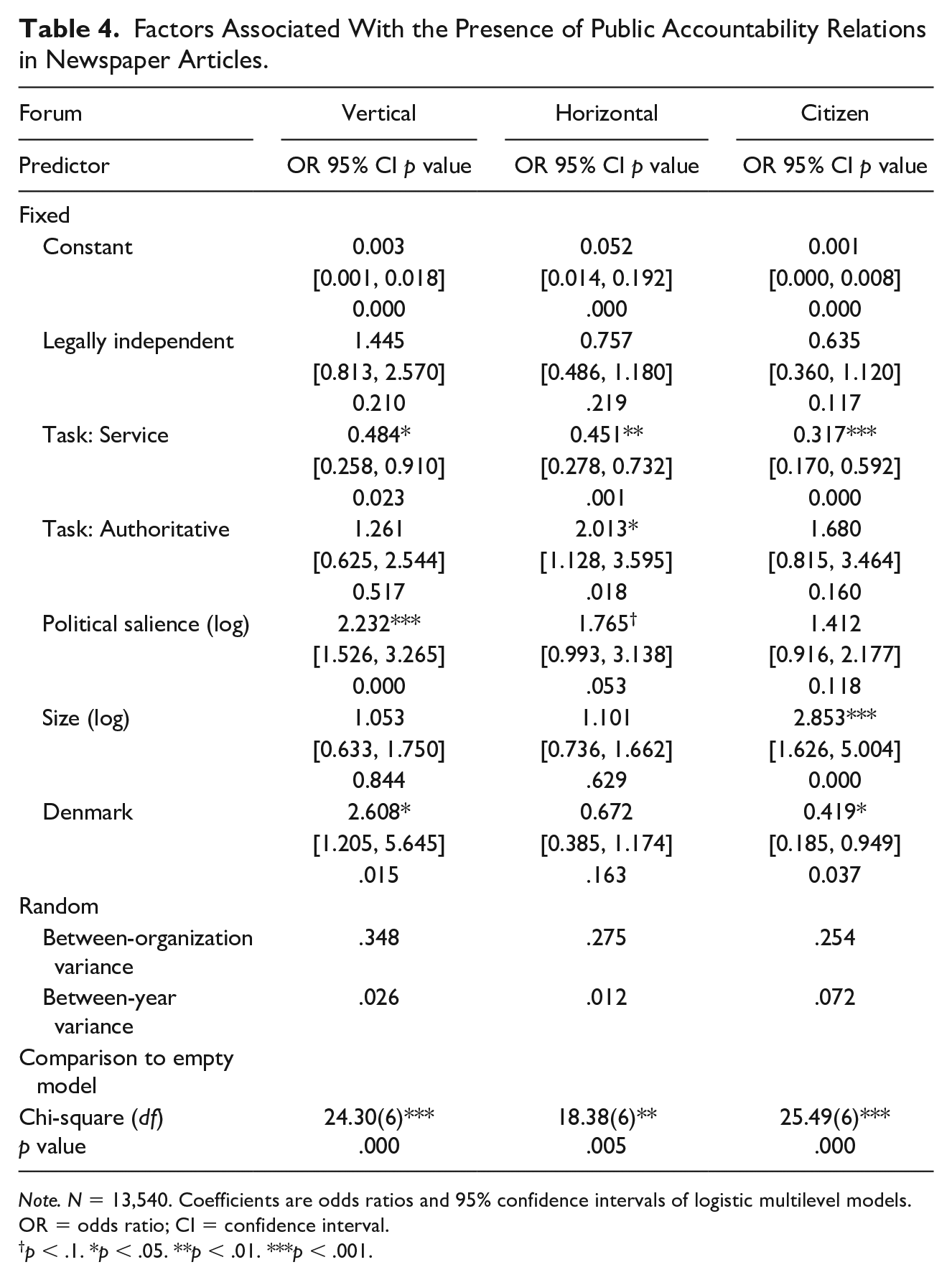
Note. N = 13,540. Coefficients are odds ratios and 95% confidence intervals of logistic multilevel models. OR = odds ratio; CI = confidence interval.
p < .1. *p < .05. **p < .01. ***p < .001.
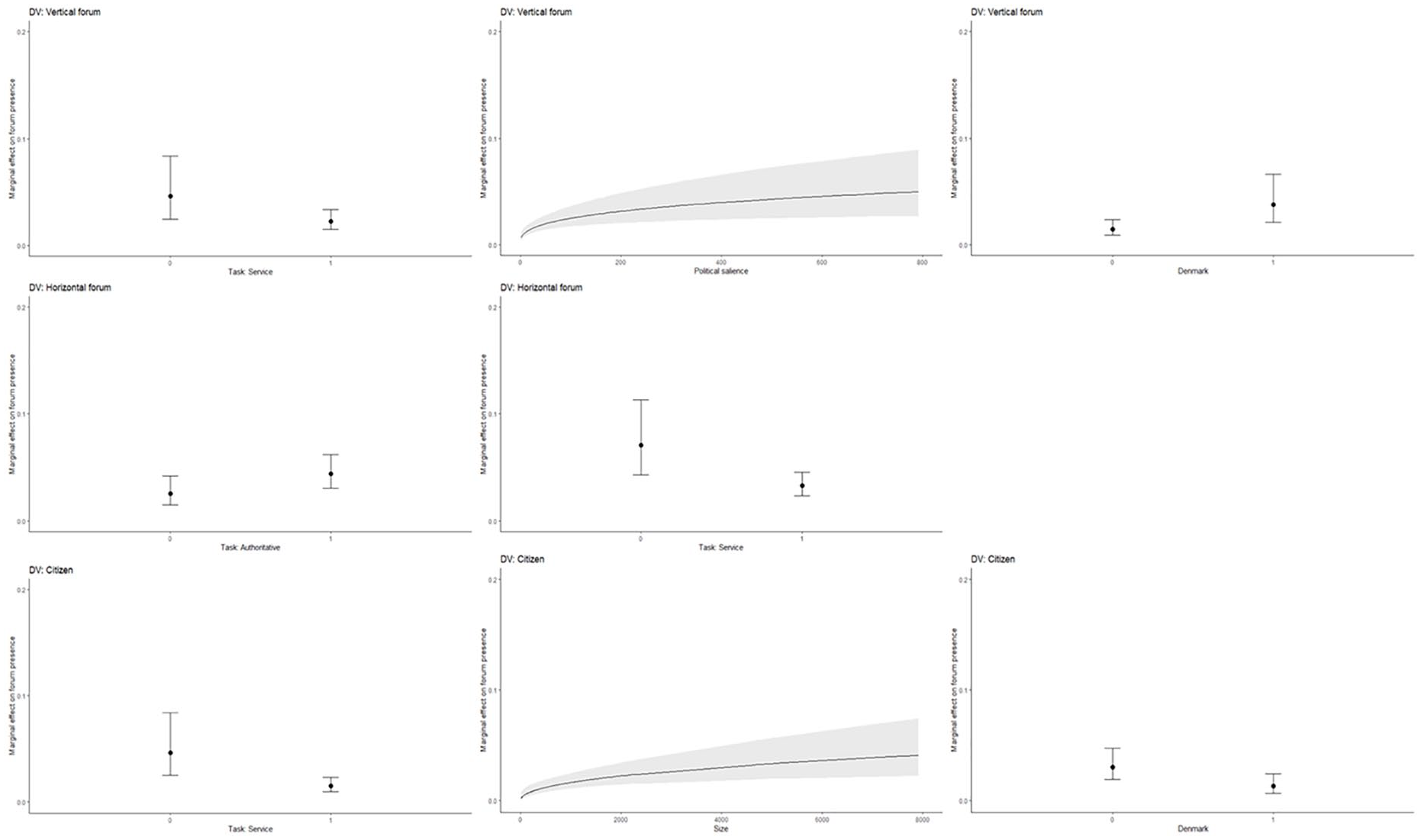
Marginal effects—effects on the probability of forum presence (and 95% confidence intervals) for different organizational characteristics.
The second hypothesis concerned horizontal accountability processes. We found that authoritative tasks that include regulative and redistributive organizational tasks were significantly positively (p < .05) related to opinions of horizontal forums (OR = 2.013; 95% CI: 1.128, 3.595) with a small increase of predicted effects from .03 to .04, confirming Hypothesis 2a. In line with this finding, we found a significant negative relationship for service as an organizational task (OR = 0.451; 95% CI: 0.278, 0.732). No significant relationship was found, however, for organizational independency (OR = 0.806; 95% CI: 0.518, 1.255) which means that Hypothesis 2b could not be confirmed.
Finally, hypothesis three addressed the presence of citizens as a forum. Quite contrary to our expectations in Hypothesis 3a, we found that service-providing organizations were significantly (p < .001) less often reported in relation to citizens (OR = 0.317; 95% CI: 0.170, 0.592) with a change in the effect on forum probability from .05 to .02. Furthermore, no significant association was found for political salience (OR = 1.412; 95% CI: 0.916, 2.177), not confirming Hypothesis 3b. However, larger agencies were more often (p < .001) evaluated by citizens (OR = 2.853; 95% CI: 1.626, 5.004) which confirmed Hypothesis 3c. While there is no effect on the probability of forum presence for small agencies, this increases to .04 for the largest agencies in our sample. Finally, we found that citizens were less present in the Danish press compared to the Flemish coverage (OR = 0.419; 95% CI: 0.185, 0.949).
Conclusions and Discussion
The aim of this study was to shed light on the presence of accountability forums of Flemish and Danish agencies in newspaper coverage and to explore to what extent this presence could be related to organizational (actor) characteristics: legal type, task, political salience, and size.
Our analysis of media-covered accountability processes provides valuable insights about the scope of this phenomenon. Strikingly, in only 8.0% of the analyzed articles about public agencies opinions voiced by accountability forums were present and these were mainly negative. News is however generally found to suffer from negativity biases, with disproportionate attention to negative news, also in the context of (private) organizations (Jonkman, Boukes, et al., 2020). Our findings imply that the negativity found in organizational news only to a small extent represents voices of criticasters but rather seems inherent to the media operating as accountability forum or fulfilling their democratic watchdog role (Eriksson & Östman, 2013; Jacobs & Schillemans, 2019).
A key result from the descriptive analysis was the strong presence of horizontal forums (nongovernment public organizations, interest groups, private companies, or experts) compared to other forum types in the coverage. From a news factor theory perspective, the observation that accountability demands from horizontal forums strongly outweigh those of vertical forums (as elite audiences, potentially reflecting high-level conflict within the political-administrative sphere) is surprising. Insights from the public accountability and reputation scholars, which focus more strongly on actors’ and forums’ volition to perform accountability behavior in the first place (Busuioc & Lodge, 2017), may be of interest. First, horizontal forums have little formal powers to call their actor (i.e., public agency) to account, yet they may compensate their lack of formal powers with investments in their relations with journalists. In other words: their institutionalized contacts with the media may explain a higher likelihood to appear in coverage (Figenschou, 2020). Second, vertical forums have other means at their disposal to hold their agents to account than the media. Reputation and public accountability scholars point at the reputational considerations that drive account-holding efforts, which—more often than not—lead political principals to renege on their account-holding role (Busuioc & Lodge, 2017), that is, so-called “forum drift” (Schillemans & Busuioc, 2015). Ministers might generally be hesitant to criticize their agents in the media because this conflict in the media might also reflect poorly upon their role as principals. This reasoning would also fit with transactional authority reasoning, which sees principal-agent relations as negotiated partnerships in which accountability and performance is foremost discussed bilaterally (Carpenter & Krause, 2015).
From a democratic perspective, emphasizing pluralism (Held, 1987), the prominence of horizontal accountability processes in the news may, at a first glance, be comforting, as media coverage of the accountability processes between agencies and such nonhierarchical accountability forums may enhance the likelihood of catching the attention of formal accountability forums (Jacobs & Schillemans, 2016). The article thus holds some potential implications for political principals and their reliance on the media as a “fire alarm” (McCubbins & Schwartz, 1984). As such, our study demonstrates that the fire alarm or the watchdog being the media is “biased” in terms of which of such processes actually get covered. Hence, there may be horizontal accountability requests that “never make it to the news” as they do not live up to the news criteria, but which nevertheless deserve the attention of the principals.
Turning next to the explanatory analyses into the organizational characteristics as antecedents for forum presence, a key finding was that opinions from all three forum types appeared significantly less frequently for service-providing organizations. This is surprising given the generally recognizable and attributable nature of service delivery activities and outcomes (Bertelli, 2016; Boon et al., 2019a). One careful explanation is that the effect of service-providing organizations was measured against the reference category of authoritative and mixed-task organizations. The observation that account-holding of agencies with authoritative tasks generates more media coverage fits with insights from institutional design scholars that have pointed at the accountability gap that followed from separating these agencies from politics to maximize their credible commitment (Majone, 2002), a gap for which scholars have turned to the media (Maggetti, 2012). The reputation literature, in turn, has argued that the type of work that is done by authoritative agencies holds an affective component. These agencies often need to take unpopular decisions, which may affect stakeholders negatively, constrain them in their actions, or force them to behave in a certain way (Verhoest, 2018). As Waeraas and Byrkjeflot (2012) argue, this creates a charisma problem for these agencies, more so than for service delivery agencies, making them more susceptible for criticism. Finally, quite some agencies in the sample are multitask agencies that combine service delivery tasks with regulatory and/or redistributive tasks. It looks like the authoritative aspects of these agencies’ functioning outweighs the effects of their service provision, yet future research could look at the effect of the mixed task profiles on accountability processes in a more in-depth manner (Busuioc & Lodge, 2017).
Politically salient agencies tend to be related to more media-covered accountability from vertical forums. This was expected from a news factor theory perspective which expected such accountability processes between recognizable agencies and political actors to trigger journalists’ orientation toward elite, dramatized and conflictual coverage (Eriksson & Östman, 2013; Harcup & O’Neill, 2017). Yet the finding is also in line with reputation scholars who expect more account-holding and -giving to occur as salience increases (Busuioc & Lodge, 2017; Gilad et al., 2015). It should be stressed, however, that our findings should not be seen as evidence of causal relations. This holds particularly true for the relations between political salience and media salience, which can be considered as distinct yet strongly interlinked concepts that to some extent tap into the same latent process of “salience.” In such cases, the precise nature of causality can be hard to disentangle. The political agenda setting literature showed that media attention about specific topics more strongly affects parliamentary attention than vice versa (Van Aelst & Vliegenthart, 2014). Reciprocal relations may thus be at play for political and media attention for organizations as well. While it is important to emphasize that our dependent variable did not measure media salience as such but merely a fracture of it (media attention for vertical accountability processes of organizations), and while we were careful to avoid framing our hypotheses and results in a causal way, readers should take extra care in interpreting the relation between political salience and media-covered accountability from vertical forums.
Finally, while we did not theorize a country effect—and in fact, selected the countries and respective newspapers for their relative similarity—we did observe that the Danish context was significantly related to forum presence in two out of three models (positive effect for vertical forums, and negative effect for citizens). Studies show that Danish journalists prioritize a “critical-active” (or watchdog) role—related to the scrutiny of (often political) actors in power—over other roles (Skovsgaard et al., 2012), whereas Flemish journalists prioritize quickly providing information, analysis and interpretation and spreading this information (Raeymaeckers et al., 2012). This difference may explain why account-holding efforts of vertical forums are more present in Danish coverage.
Our article comes with several limitations. First, the quantitative approach has its strengths in showing patterns in the relations between organizational characteristics and media-covered accountability. Yet its main weakness lies in its inability to uncover the mechanisms that lead these effects to take place. Future research may turn to approaches that are better suited to pinpoint these mechanisms, for example, process-tracing. In addition, studies could shed light on the agency of accountability forums related to journalists and the media: to what extent do they actually aim at media attention and does this also have the consequences for the actor that they had in mind, for example, regarding organizational improvement? Also, research on news decisions and dynamics regarding accountability forums would possibly clarify why some forums have a higher media visibility than others. In addition to that, our data did not allow to examine interaction effects, even though one may well theorize that certain effects (e.g., legal independence) may show in combination with other factors (e.g., political salience). Future research may use larger data sets that allow for the inclusion of interactions, or rely in qualitative comparative analysis designs, to examine these combinational effects. Likewise, it was mentioned that the mixed nature of many task profiles may provide interesting avenues for future research.
To conclude, our analysis provides interesting perspectives on the size of the phenomenon of media-covered accountability, the visibility of different forum types, and the relations with actor/agency characteristics. Our findings indicate that processes of news construction can explain some aspects of media-covered accountability rendering and that the proposed news factor perspective can be seen as a valuable addition to the reputation and agency literature.
Footnotes
Appendix
Overview of Included Agencies.
| Name | Country |
|---|---|
| Danish Agency for Labor Market and Recruitment | DK |
| Danish Working Environment Authority | DK |
| Banedanmark | DK |
| Danish Data Protection Agency | DK |
| Danish Court Administration | DK |
| Danish Energy Agency | DK |
| Danish Business Authority | DK |
| Danish Veterinary and Food Administration | DK |
| Geological Survey of Denmark and Greenland | DK |
| Danish Environmental Protection Agency | DK |
| Danish Agrifish Agency | DK |
| Danish Nature Agency | DK |
| Danish National Center for Social Research | DK |
| Agency for Culture and Palaces | DK |
| The National Board of Social Services | DK |
| Danish Agency for Science, Technology and Innovation | DK |
| Agency for Higher Education | DK |
| Danish Health Authority | DK |
| The Danish Transport and Construction Agency | DK |
| Danish Road Directorate | DK |
| Agency for Commerce | FL |
| Institute for Science and Technology | FL |
| The Agency for Nature and Forests | FL |
| Agency for Roads and Traffic | FL |
| Agency for the Promotion of Physical Development, Sports and Outdoor Recreational Activities | FL |
| Inspection Spatial Planning and Housing Policy | FL |
| Institute for Agricultural, and Fisheries and Food Research | FL |
| Research Institute—Nature and Forest | FL |
| Child and Family | FL |
| Arts and Heritage | FL |
| Public Waste Agency of Flanders | FL |
| Visit Flanders | FL |
| Flemish Agency for Persons with Disabilities | FL |
| Flemish Public Employment Service | FL |
| Flanders Environment Agency | FL |
| Flemish Regulator for Energy and Gas | FL |
| Flemish Regulator for the Media | FL |
| The Flemish Waterway | FL |
| Agency for Care and Health | FL |
| Care Inspectorate | FL |
Declaration of Conflicting Interests
The author(s) declared no potential conflicts of interest with respect to the research, authorship, and/or publication of this article.
Funding
The author(s) disclosed receipt of the following financial support for the research, authorship, and/or publication of this article: The research was funded by the Danish Research Council, (1182-00110B) and the Fonds Wetenschappelijk Onderzoek, (1244720N).
