



Abstract
Highlighting public-service actors’ deliberately tokenistic or self-serving efforts, existing literature has shown that public participation often involves the co-optation of sympathetic citizens. In contrast, our study demonstrates that participatory advocates may discredit and marginalize critical voices despite their own inclusive, democratic ideals. We analyze the entangled legitimacy claims of participating citizens and “inviting” public-service actors, capturing (a) the often-unintended dynamics through which the inclusion of particular participants legitimizes the exclusion of others, while illuminating (b) the tenacious propensity of participatory initiatives to establish “constructive cooperation” as the norm for participation and, subsequently, to normalize exclusionary practices.
Introduction
Promoted as a reform strategy for public services (Voorberg et al., 2015), extant literature often portrays public participation as a way of incorporating “community values into local decision-making processes” (Abelson et al., 2003, p. 243). Just who is meant by “community,” however, often remains ambiguous (Kenny et al., 2015). Within both policy and academic debates, terms like “the public,” “civil society,” and “community” are often used interchangeably to refer to “ordinary people” as a category distinct from officials, professionals and other so-called insiders to the health care system (Contandriopoulos, 2004; Contandriopoulos et al., 2004). Research into participatory efforts (e.g., Barnes et al., 2003; Martin, 2008) has examined how the “public” within public participation is translated into a more demarcated set of participants; that is, who actually participates?
When investigating how actors negotiate the concrete parameters of a participating “public,” it is particularly interesting to consider the role of critical voices within such processes. Paradoxically, while advocates tend to portray public participation as a welcome democratizing counterpoise to managerial and professional power (Harrison & Mort, 1998; Needham, 2008), research shows that critical voices within participatory initiatives often tend to be marginalized, compromising public participation’s potential as a countervailing power (e.g., Barnes et al., 2003). Particularly in the case of “invited” (i.e., as opposed to “grassroots”) participation that is “orchestrated by an external agency of some kind, be it state or non-governmental” (Cornwall, 2008, p. 281), public service agencies tend to draw boundaries to delineate whom they consider “appropriate” participants and what they see as the “proper” scope of their engagement (Glimmerveen et al., 2018, 2020; Kenny et al., 2015). Moreover, citizens themselves may also be unable or unwilling to participate, especially when doubtful about whether their participation actually makes a difference (Abelson et al., 2003; Cornwall, 2008; Hodge, 2005). As a result, participatory initiatives tend to attract “archetypally ‘active’ citizens” (Martin, 2008, p. 50), characterized by a willingness to participate as partners rather than as critical challengers (Croft et al., 2016). Existing studies thus show that public participation initiatives often exclude citizens who take a more antagonistic stance.
For this reason, scholars have cast doubt on the democratic intentions behind participatory efforts, highlighting instead organizational actors’ deliberate co-optation of citizens in order to advance their own positions (e.g., Hodge, 2005; Lee & Romano, 2013). By empirically investigating the entanglement of citizens’ and public-service actors’ efforts to justify who is and who is not involved in a participatory process, we try to move beyond such cynical accounts. As of yet, the dynamics that help explain the marginalization of democratic opposition have not received due empirical or theoretical elaboration. Extant research displays a limited ability to explain exactly how actors negotiate one another’s (il)legitimacy within processes of local service governance. In particular, it pays limited attention to the micro-dynamics through which critical outsiders are disqualified and excluded from such processes—either by themselves, fellow citizens, or public-service actors. Consequently, current literature tends to overlook the interactive and entangled nature of actors’ disqualifying and legitimizing claims and how these gradually shape participant selection. By building on a longitudinal, qualitative case study of a professional care provider that solicited local citizen participation for one of its elderly care homes, we demonstrate why—even when their participation is invited from a “desire to pursue democratic ideals of legitimacy, transparency and accountability” (Abelson et al., 2003, p. 239)—critical citizens still tend to be marginalized. In short, our paper addresses the following question:
How do citizens and public-service actors try to establish the legitimacy of their mutual engagement and how does this affect the position of critical voices within public participation practices?
Our paper’s main contribution is twofold. First, we provide an empirically grounded analysis of participation’s intrinsic dynamics of inclusion and exclusion. Although the question of “who participates” is often treated as a design choice (e.g., Fung, 2006) or as the deliberate selection of “appropriate” participants (e.g., El Enany et al., 2013), we illuminate the emergent, often-unintended inclusionary and exclusionary dynamics that shape participant selection over time. This allows us to make a second contribution. Our empirical analysis substantiates our claim that “exclusion” is part and parcel of participatory efforts: in fact, it is built into its very design. Participatory initiatives tend to normalize the undemocratic lockout of protesters—even when the actors involved deliberately set out to be open to criticism and opposition. In its critique of citizens’ co-optation, extant literature often proposes strategies to achieve more “real and meaningful” participation (Durose et al., 2013, p. 331) and to “more effectively [. . .] open opportunities for influence” (Cornwall, 2004, p. 8). Without denying the potential of such strategies, our analysis justifies more fundamental caution regarding the assumption of participatory initiatives’ democratic counterpoise potential.
In what follows, we first explore how extant literature approaches the question of “who participates in public participation.” We then conceptually zoom in on the notion of legitimacy and its pursuance by actors involved in public participation initiatives. Subsequently, we move on to our case study of a professional care provider’s attempts to solicit and build on local citizen engagement regarding one of its care homes. In conclusion, we reflect on our findings’ implications for making sense of the apparent difficulty to engage with critical citizens.
Moving From Public to Participants
While “the public,” “the community,” and “civil society” are often treated as singular actors (Brandsen et al., 2017), public participation always relies on some form of representation or mandate-giving (Contandriopoulos, 2004). Especially when soliciting participation with some degree of “depth”—that is, when aiming for more than just a one-off consultation—practitioners inherently face the need to compromise on “breadth”—that is, on a participatory trajectory’s inclusiveness in terms of who participates (Cornwall, 2008). Scrutinizing how an abstract public is translated into a concrete set of participants allows us to approach public participation “as a constitutive process in which particular concepts of the public are mobilized, negotiated, and enacted” (Barnes et al., 2004, p. 273) within the governance of local services. Scholars have highlighted the “political action by individuals who claim to ‘speak as,’ ‘stand for,’ or ‘act for’ the ‘public’‘ (Contandriopoulos, 2004, p. 327), while also demonstrating actors” unequal abilities to define the characteristics of “legitimate” representation (Barnes et al., 2003). Such research has demonstrated that “the political efficacy of public participation ultimately rests upon symbolic struggles to appropriate the intrinsic legitimacy of the public” (Contandriopoulos, 2004, p. 328). To understand such struggles, scholars have emphasized the importance of focusing on the micro-politics through which various actors operationalize abstract notions of a public (e.g., Barnes et al., 2003, p. 396). Nonetheless, and for at least two reasons, extant literature is still limited in its ability to empirically and theoretically account for who participates and who is excluded within public participation efforts.
To begin, much scholarly work on public participation retains a rather functionalist approach, largely ignoring the political contingencies of legitimate representation. A common approach within the literature treats the criteria for legitimate participation as a function of why citizens are invited to participate. Take, for example, Fung’s insightful and influential overview of public participation’s disparate manifestations (Fung, 2006, 2015), presenting a “menu of design choices” (Fung, 2015, p. 513) in which “particular designs are suited to specific objectives” (Fung, 2006, p. 74). In a similar vein, Marent et al. (2015, p. 836) delineate how “different types of lay people (who) can become relevant on different levels, for different organizational programs (what) and thus facilitate different functions (why).” Within such approaches, the legitimacy of a particular set of participants flows from the participatory effort’s particular purpose. In practice, however, the different rationales with which citizens are engaged tend to be more ambiguous and contested than the notion of “design choices” suggests—even among actors within a single participatory initiative (Cornwall, 2008; Glimmerveen et al., 2018). In sum, and notwithstanding the usefulness of such taxonomies for categorizing disparate participatory practices, these approaches present oversimplified accounts of how “a public” is translated into “participants”—that is, by portraying this as a technical choice or managerial decree and, in doing so, obscuring the sociopolitical dynamics through which citizens are gradually included or excluded as “representative participants.”
Second, scholars that do take a more politically sensitive approach tend to ignore how a concrete set of participants is interactively constructed and legitimized between the disparate actors involved in public participation efforts. Such interactive dynamics, we contend, are key to understanding the often-marginal position of critical voices within such efforts. By investigating the use of inclusive and exclusive discourses within public participation campaigns (e.g., Contandriopoulos et al., 2004; Lancaster et al., 2017; Martin, 2008), scholars have demonstrated the discursive accomplishment and contestation of legitimate representation—for example, by highlighting the “symbolic struggles for the objectification of a particular definition of ‘the public’‘ (Contandriopoulos et al., 2004, p. 1591) as community organizations try to exert influence over governance decisions. However, these studies lack the empirical grounding required to account for the real-time micro-dynamics through which different actors” pursuits of legitimacy interact over time. One notable exception from the field of service user involvement includes El Enany et al.’s (2013) processual account of how some users are (self-)selected and gradually shaped as “expert participants” while others are left uninvolved. By providing valuable insights into the interconnectedness of the disparate views and actions of those involved, their study demonstrates some of the interactive processes that gradually shape the nature of user participation. In the current article, we take their approach one step further. In addition to investigating the interactions between citizens and public service employees, we also investigate how these, in turn, are affected by actors’ attempts to justify their mutual involvement within their own respective constituencies (respectively within the larger “community” and “organization”). By investigating how these various pursuits of legitimacy interact and co-evolve over time, we are able to shed new light on an often-stated but under-theorized challenge faced by public service agencies: how to meaningfully engage with critical voices when soliciting citizen participation.
Pursuing Legitimacy
Extending beyond our current focus on public participation, the concept of legitimacy has been applied to a broad range of empirical phenomena and theoretical domains (Suddaby et al., 2017). In his seminal review article, Suchman defines legitimacy as “a generalized perception or assumption that the actions of an entity are desirable, proper, or appropriate within some socially constructed system of norms, values, beliefs, and definitions” (Suchman, 1995, p. 574). Conceptually, legitimacy is closely linked to power, often being rendered the “recognition of the right to govern” (Courpasson, 2000, p. 143). As such, we see it as a fruitful conceptual lens for investigating public participation processes, that is, processes in which actors try to substantiate their own intent to serve the public (Contandriopoulos et al., 2004) while simultaneously struggling over who is allowed to define and voice this public’s interest (Barnes et al., 2003).
Traditionally, legitimacy has been conceptualized as a characteristic of a particular actor (e.g., of an organization, a team, a group, etc.), indicating how well it meets its external environment’s normative expectations (Suddaby et al., 2017). While still informing most scholarship on legitimacy, this view has been criticized for being overly essentialist as it treats legitimacy “as a highly abstract-independent variable to explain other organizational outcomes rather than [studying it] as an empirical phenomenon in its own right” (Suddaby et al., 2017, p. 458). In contrast, other strands of research have approached legitimacy “as a communicative process co-constructed in acts of meaning negotiation” (Suddaby et al., 2017, p. 458)—taking place among multiple actors with disparate positions, perspectives and interests (e.g., Zietsma & Lawrence, 2010). Within such processes it has been argued that legitimacy ultimately lies “in the eye of the beholder,” constituted within individual actors “judgment of the appropriateness of an organizational product, practice, or characteristic” (Suddaby et al., 2017, p. 463).
Following this latter perspective, we focus our investigations on how participants’ various legitimacy claims and judgments interact. Our approach to legitimacy as a subjective perception makes it possible to account for the ambiguity and heterogeneity of actors’ perspectives (Suddaby et al., 2017). Scholars have already demonstrated that “legitimacy itself may become a source of contestation” (Drori & Honig, 2013, p. 368)—for example, when the desirability of a particular form of public participation becomes contested among the employees of a single organization (Glimmerveen et al., 2018) or among citizens who are invited to participate (van Eijk & Steen, 2014). In a similar vein, public-service actors’ attempts to meet the expectations of relevant “external” stakeholders might be at odds with the various “internal” objectives that people within their organization consider worth pursuing (Brandsen & Pestoff, 2006; Drori & Honig, 2013). In order to account for the dynamic relationship between such interlocking legitimacy pursuits—both “externally” and “internally”—we must “study how legitimacy is produced, defined, and finally reified, at different organizational sites” (Suddaby et al., 2017, p. 470). Doing so enables us to scrutinize how notions of “legitimate participants” are interactively carved out among the disparate actors involved within public participation efforts.
Building on the above, we distinguish three key areas for investigating legitimacy claims and judgments within the field of public participation: (a) public service agencies’ claims to serve the public interest (Abelson et al., 2003; Fung, 2006, 2015; Hodge, 2005; Martin, 2012), (b) participating citizens’ claims to represent a given constituency (Barnes et al., 2003; Contandriopoulos, 2004; El Enany et al., 2013), and (c) the relationship and interaction between, on one hand, public service agencies’ pursuit of legitimacy among citizens and, on the other hand, other objectives pursued within these organizations (Brandsen & Pestoff, 2006; Drori & Honig, 2013; Glimmerveen et al., 2018, 2019). Whereas extant research has investigated these three areas in isolation, we set out to generate a better understanding of their interconnectedness within processes of public participation. As a result, we are better able to untangle the intricate relationships between the multiple legitimacy pursuits that take place both within and between groups of citizens and public-service actors.
Moving on, we now investigate the interlocking pursuits of legitimacy within our empirical case study of a professional care provider’s attempts to solicit and build on local citizens’ engagement around one of its care homes. We take this case study as the empirical basis for answering our main research questions, that is, elucidating how citizens and public-service actors try to establish the legitimacy of their mutual engagement and how this affects the position of critical voices within public participation practices.
Methodology
Empirically, our investigations focus on public-participation efforts within the field of long-term care in the Netherlands. Especially in the past decade, the Dutch national government has emphasized both the desirability and inevitability of a more active role for citizens within the governance and delivery of care services. On one hand, calls to stimulate public participation are presented as a way to empower citizens and counter paternalism within local service governance (Van De Bovenkamp & De Bont, 2016). At the same time, such calls have been associated with concerns about rising public expenses. The Dutch care system is known for its broadly defined eligibility criteria for an extensive range of publicly funded services (Kroneman et al., 2016). Public spending on long-term care is growing faster than any other type of care (Organisation for Economic Co-Operation and Development, 2017). Against this background, considerable policy debate has ensued over what constitutes an “appropriate” balance between public and private responsibilities in long-term care (e.g., Sociaal-Economische Raad, 2012). While care services in the Netherlands are mostly publicly funded and regulated, they are often provided by private non-profit organizations. Facing calls for public participation, these private provider organizations are increasingly expected to engage with local citizens as they design and deliver their services.
This study builds on an ethnographic case study of CareOrg (a pseudonym), a private, but-publicly funded, professional care provider, as it solicited the participation of local citizens around its elderly care home in Carville (a pseudonym), a rural town in the Netherlands. Ethnography “combines an orientation towards subjective experience and individual agency in everyday life with sensitivity to the broader social settings and historical and institutional dynamics in which these emerge or are embedded” (Schwartz-Shea & Yanow, 2012; Ybema et al., 2009, p. 7). Capable of capturing how such “institutional dynamics are created at multiple local sites” (Suddaby et al., 2017, p. 470), ethnography is particularly well-suited for investigating actors’ dispersed-but-interconnected pursuits of legitimacy (Suddaby et al., 2017). Our two-and-a-half-year investigation provided us with the empirical groundwork necessary for studying negotiations over who constituted an “appropriate” participant and who did not, subsequently revealing the mundane micro-dynamics that tend to remain concealed when applying other methodological strategies (e.g., comparative case studies, interview or survey research, etc.). Our ethnographic approach allowed us to follow how actors’ legitimacy claims interacted over time and across sites, thereby generating a politically sensitive insight into the dynamics of inclusion and exclusion (Glimmerveen et al., 2020; van Hulst et al., 2017).
Our case study makes sense of the processes through which employees and citizens explored the feasibility of keeping the care home open until its scheduled replacement by smaller-scale facilities several years later. In order to continue daily operations, the organization was forced to rely on the efforts of an increasing number of volunteers. Importantly—and in an effort to ensure that decisions on the future of local services were not only made in the boardroom—CareOrg’s director emphasized the importance of involving local citizens on decisions that potentially affected them. Exacerbating the urgency of the situation, CareOrg faced an increasingly pronounced incentive to contain costs due to stricter eligibility criteria for public funding, which had led to empty rooms in the home and a looming financial deficit. This created a context in which the exact scope and objectives of public participation (i.e., pursuing inclusive participatory governance versus cost-containment) remained contested throughout the trajectory. The rise and eventual fall of the efforts to safeguard the care home’s continuity is described in more detail elsewhere (see Glimmerveen, 2020; Glimmerveen et al., 2018, 2020). This article builds on our empirical investigations of employees’ attempts to involve a group of participants that could “reasonably be considered to constitute a public engaged in the process” (Martin, 2012, p. 1852), and, in turn, of citizens’ attempts to legitimize their abilities to indeed represent this public.
Although our empirical context differs from, for example, government-led public-participation programs or efforts initiated by citizens themselves, we believe that our case findings’ relevance extends across such empirical contexts. By presenting an approach for the theoretical and empirical investigation of citizens’ and public-service actors’ interconnected pursuits of legitimacy, our study develops a fuller understanding of the broadly-identified challenge of engaging with critical voices in public participation efforts (e.g., Barnes et al., 2003; Cornwall, 2008). Moreover, our study generates fertile ground for studying the dynamics of inclusion and exclusion that shape most pursuits of public participation, albeit to various degrees and in different manifestations. While we believe that our analytical lens will be broadly applicable for studying such relational dynamics in a wide range of settings, we expect the challenge of engaging with more critical citizens to be particularly pronounced in participatory pursuits that are characterized by a more “exclusive” participant selection (e.g., when participation entails a more sustained relationship between citizens and public-service actors).
Empirically, we mainly focus on a participatory space that emerged as a key site on which CareOrg employees and Carville citizens negotiated their involvement. By scrutinizing how this platform’s composition evolved over time and examining how both employees, citizen participants and non-participating citizens evaluated and/or legitimized their respective positions, we were able to investigate the interactive and contested constructions of “appropriate” participation and representation. Moreover, we both followed how employees and participating citizens coordinated their involvement on this platform with their respective constituencies and investigated how this affected the perceived legitimacy of individual participants and the trajectory in which they participated.
In particular, we drew on three sources of data: (a) observations of the various meetings attended by both employees and citizens, (b) observations of internal CareOrg project meetings and (c) interviews and conversations with both employees and citizens. Table 1 provides an overview of the data on which this study is based.
Overview Empirical Material.
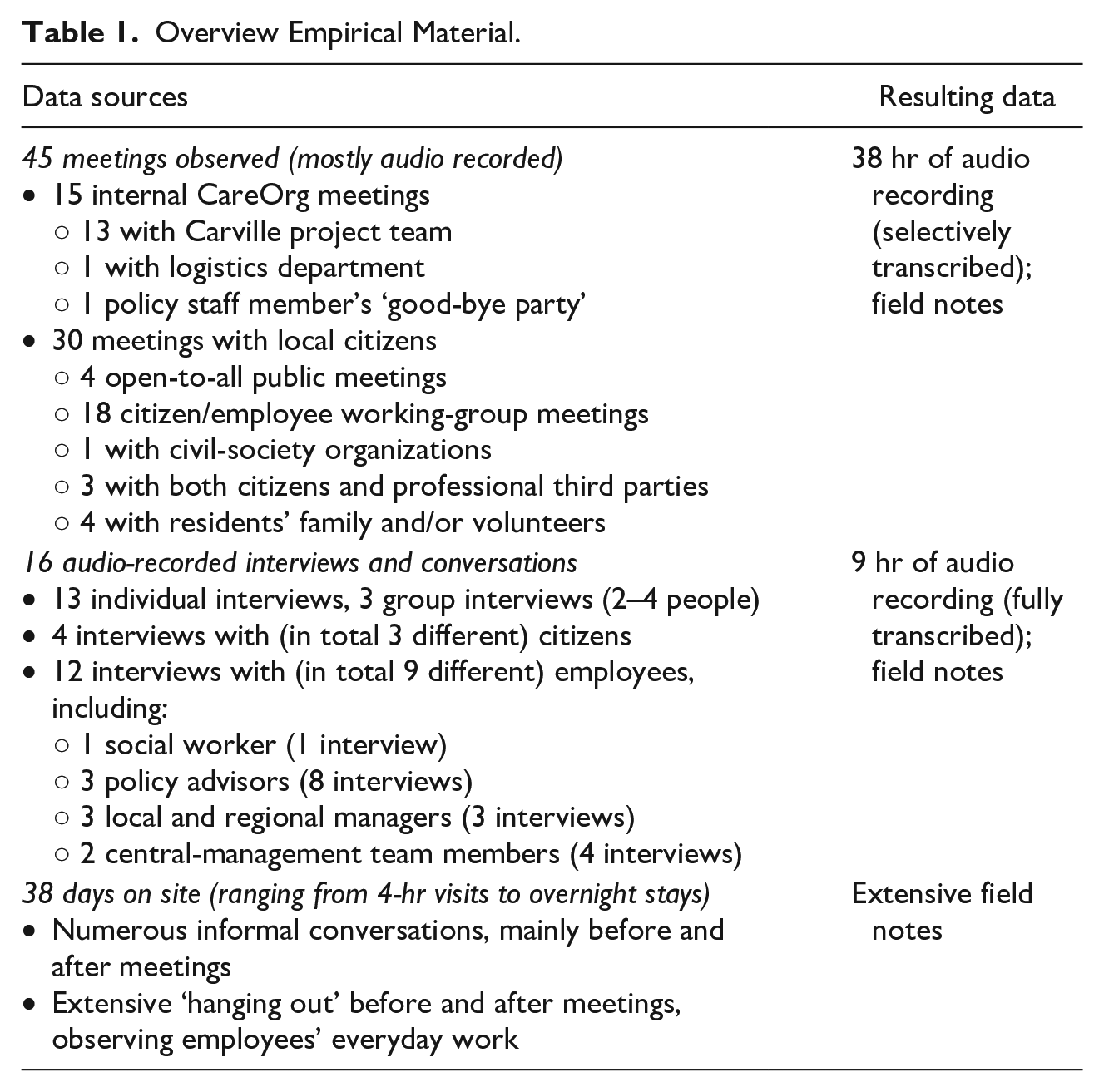
All fieldwork was performed by the first author. In total, 15 strictly internal CareOrg meetings were observed, in addition to 30 meetings that also included local citizens and/or other actors involved with the care home. Most meetings were audio-recorded (resulting in almost 38 hours of tape) and largely transcribed, particularly the discussions that (either directly or indirectly) concerned the respective positions and relationships between and among CareOrg employees and local citizens. During these meetings, the researcher was generally a passive observer.
Supplementing this core corpus of observational data, the fieldworker also engaged in a myriad of formal and informal conversations throughout the 38 days spent in the field. These conversations with participants, that is, with both citizens and employees who were either directly or indirectly involved with the trajectory in Carville, mostly had a casual and spontaneous character. This enabled us to capture people’s accounts outside of a formal interview setting, encouraging them to speak relatively freely about the process of citizen participation, and to reflect on their own and others’ involvement. In addition, 16 more formalized interviews were conducted. These interviews also included participants with whom the fieldworker was less likely to “naturally” strike up a conversation, including people in central management positions and other participants who were only occasionally present in Carville. Each interview was individually prepared using a topic list attuned to the particular interviewee.
By combining these data sources, we were able to juxtapose real-time observations of participants’ in-situ (inter)actions with their more distant reflections and accounts of these same events. Doing so allowed us to move beyond participants’ post hoc justifications of their behavior, instead also witnessing how they had implicitly and explicitly drawn on, evaluated and promoted particular interpretations of “the public” and its representation in real time. This allowed us to analyze how participants dealt with discrepancies between the official policy discourse and the more contentious dynamics between actors as they bargained over the practical meaning and implications of citizen participation.
Data Analysis
The question of “who participates” emerged as a key theme in an earlier analysis of the same data set in which we investigated how actors negotiated the scope of “appropriate” public participation (see Glimmerveen et al., 2018). While this initial analysis did not primarily scrutinize how “legitimate” categories of participants were gradually carved out, initial findings did trigger us to include this question as an additional analytical focus. Before addressing this question within our data analysis, we first revisited the literature to study how such demarcation or selection of participants was treated in extant research on public participation, while also drawing on more conceptual literature on legitimacy.
As a first step in our subsequent data analysis, and before engaging in a micro-level analysis of employees’ and participants’ interactions, we composed a timeline of events in order to obtain an overview of the broader dynamics of inclusion and exclusion surrounding the participatory efforts within our case setting (e.g., who was involved on which platform, what was the scope of each platform’s agenda, how did the different platforms relate to one another and to those in decision-making positions, etc.). Second, we conducted a more fine-grained analysis of our transcripts and field notes using software for qualitative data analysis (MaxQDA). This allowed us to capture how employees’ and citizens’ shifting positions and relations, including their various claims to represent (or respond to) a particular “public,” were “constituted in the mundane ‘stuff’ of everyday interactions” (Baxter & Montgomery, 1996, p. 27). In particular, we coded those data excerpts in which actors were included or excluded from the newly erected participatory platforms, as well as the instances in which such inclusion or exclusion was evaluated and/or legitimized by the people involved (resulting in codes like “self-exclusion,” ‘questioning representativeness’ and “preventing partisan dynamics”). Moreover, we searched for instances in which both citizens and employees scrutinized the legitimacy of these participatory spaces and the people acting in them, as well as their strategies to enhance this legitimacy (e.g., “creating infrastructure for accountability,” “enhancing organizational support base,” “promoting partnership orientation in town”). By reviewing the coded segments from various data sources, we found that employees’ and citizen-participants’ legitimacy claims were often entangled. This led us to consider how such entangled pursuits of legitimacy gradually shaped what was considered “legitimate participation” within the participatory initiative. Moreover, this shed light on actors’ ambiguous and contentious interpretations of “the public” and its representation, moving between more inclusive and more exclusive notions of who constituted a “legitimate” participant.
Building on these analytical steps, we then moved back and forth between (a) our broader overview of the unfolding dynamics of inclusion and exclusion in our setting and (b) our more fine-grained analysis of the micro-dynamics that both reflected and affected such developments. This allowed us to identify two dominant dynamics that both characterized actors’ legitimacy pursuits and shaped the emerging participant selection, that is, as actors attempted to deepen and broaden the character of participation within their initiative. In what follows, we describe these findings in more detail.
Findings
Although the issue often remained under the surface, the question of “who participates” emerged as a common thread throughout our case study. Making abstract references to both “the town” and “the community” as if they were a relatively singular actor, both CareOrg employees and citizens regularly commented on the role, needs and actions of “the community.” During both internal CareOrg meetings and meetings with citizens, CareOrg employees emphasized that “what the town wants is incredibly important to everything that we do” (regional manager, meeting transcript): I see serving the community as a necessity. [. . . ] If the community doesn’t see the care home as theirs [. . . ] then is its existence legitimate? I question that.
(General director, interview transcript)
When operationalized, however, abstract references to the community turned out to be “no more than a cover term for a heterogeneous collection of [actors]” (Brandsen et al., 2017, p. 677). This became particularly apparent when local citizens were invited to the first open-to-all meeting to discuss the care home’s situation. By hosting the meeting at a community hall that belonged to a local church—a venue right in the middle of town—CareOrg employees wanted to symbolize how the challenges faced by the care home did not only affect their organization, but were of key concern to the local community. Just days before the meeting was to commence, however, they found out that a considerable number of the town’s inhabitants belonged to a different congregation, causing CareOrg employees to worry that this group would refuse to attend and making them decide to organize the meeting in their own care home after all (meeting notes). Later in the process, after citizens had already taken a proverbial seat at the table, notions of “the community” remained diffuse and unclear. For instance, participating citizens sometimes became frustrated when an employee stated that they first needed to “consult the people in town,” replying that they were “here on behalf of the town; we represent them, we have that authority!” (local citizen, meeting notes). In sum, both citizens and employees continued to struggle with the need to translate abstract notions of “town” and “community” into actual categories of participating citizens.
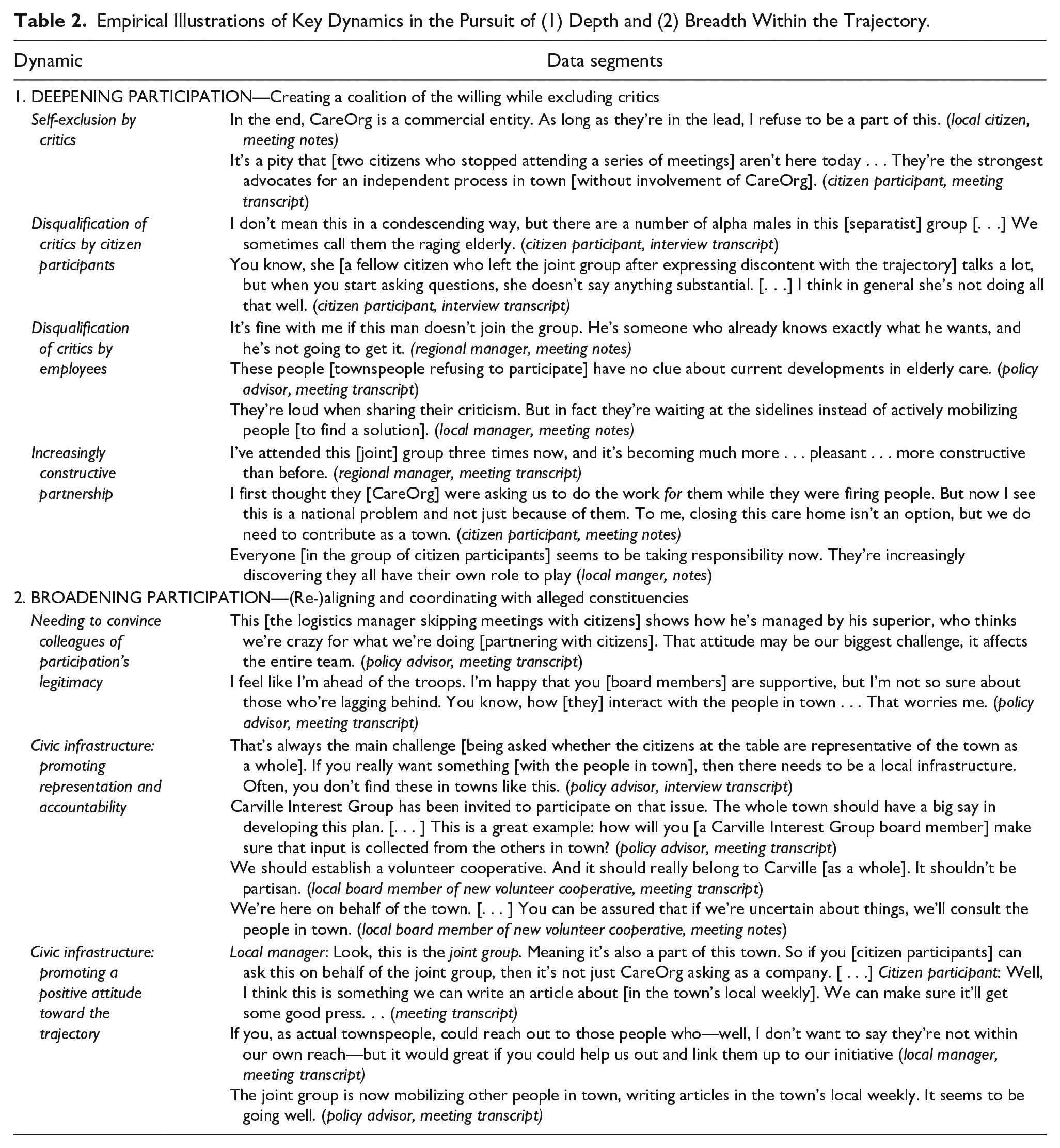
To further elaborate on how the community was “constituted as actors” (Barnes et al., 2003, p. 396), we now investigate citizens’ inclusion and exclusion from the joint group—a platform that was established as the key locus of public participation. During the joint group’s monthly meetings, employees and citizens discussed the facility’s situation and negotiated their mutual involvement within it. Analyzing how this platform emerged and developed over time, we now explore (a) how employees and participating citizens tried to deepen participation by creating a coalition of the willing, which differentiated “appropriate” participants from “marginal” outsiders and (b) how they tried to broaden participation by investing in citizen-participants’ alignment and coordination with their alleged constituencies. (Table 2 presents an overview of data segments illustrating these dynamics.)
Empirical Illustrations of Key Dynamics in the Pursuit of (1) Depth and (2) Breadth Within the Trajectory.
Deepening Participation: Fostering a Partnership by Excluding Critics
Resulting in the creation of a constructive coalition that progressively reinforced the legitimacy of the initiative, we identify three mutually reinforcing dynamics through which actors differentiated between “appropriate” participants and legitimately excludable citizens: (a) citizens’ self-exclusion, that is, their refusal to take part in a trajectory they considered illegitimate; (b) citizen participants’ simultaneous disqualification of critical outsiders and legitimization of their own positions; and (c) CareOrg employees’ disqualification of critical outsiders and their propensity to endorse cooperative citizens. Interestingly, we are able to show how these dynamics sanctioned the marginalization of critical voices without necessarily challenging the legitimacy of the trajectory—at least in the eyes of the participants themselves. On the contrary, the exclusion of critics allowed citizens and employees to reinforce—at least within the confinements of the joint group—their mutual recognition of themselves as legitimate actors in addressing the care home’s situation. (See Figure 1 for an overview of these dynamics.)
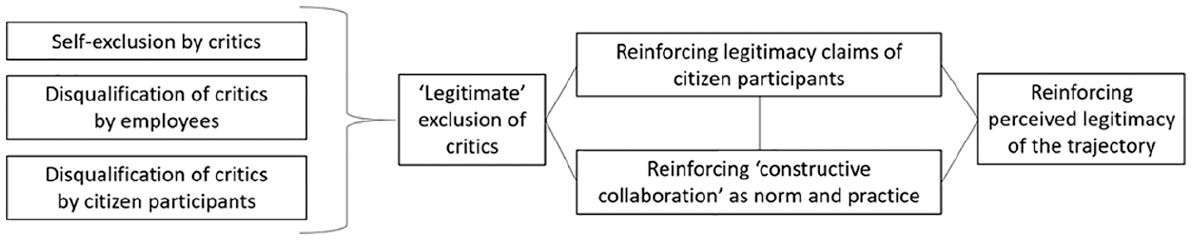
Dynamics of inclusion and exclusion in pursuit of “deepening” participation.
Citizens’ self-exclusion
First, and perhaps most obviously, it was critical citizens themselves who refrained or withdrew from participating on the provider-initiated platforms. The voluntary nature of citizen participation in the joint group inevitably implied that the critical citizens who questioned the trajectory’s legitimacy avoided provider-initiated efforts. Such self-exclusion was observed when, for instance, during an open-to-all town meeting hosted by CareOrg, the discussion surrounding the formation of the joint group included several citizens voicing their antagonism and suspicion of CareOrg’s motives (‘It’s cheaper for them to involve us than to close the home entirely’—local citizen, meeting notes) and refusing to join the group: I won’t join if CareOrg is in charge. Such an initiative should be led by citizens, not by an external commercial actor.
(Local citizen, meeting notes)
Citizens’ self-exclusion from the processes through which CareOrg solicited their participation continued to play a role as the trajectory progressed. To deliberate on the future of local care services among themselves, a citizen-only group was established as an alternative to the CareOrg-initiated joint group. When most members of the citizen-only group eventually became inclined to collaborate with CareOrg, two of the group members who had initially criticized such collaboration stopped attending the meetings. Soon after, a mutual decision was made to merge the citizen-only group and the CareOrg-initiated joint group. On the whole, citizens’ gradual inclinations toward constructive collaboration with CareOrg went hand-in-hand with the self-exclusion of those who rejected CareOrg as a legitimate partner. As such, and inherent to all initiatives reliant on participants’ self-selection (El Enany et al., 2013; Fung, 2006), this meant that participant selection was increasingly skewed toward a more partnership-oriented (versus a more antagonistic) group of citizens. Nonetheless, participating citizens and employees did not seem to view this as a fundamental challenge to the legitimacy of the trajectory since, as we will discuss now, both tended to discredit the legitimacy of the critical voices that had been excluded.
Citizen participants’ disqualification of critical outsiders
As a second dynamic, we observed citizen-participants’ disqualification of their more critical non-participating peers, which reinforced their own status as community representatives. Joint-group participants spoke of critical outsiders (i.e., those who did not engage in the CareOrg-initiated trajectory) in a derogatory way while sanctioning a more positive attitude as the norm for appropriate participation. The critical townsman quoted above, who had questioned CareOrg for its commercial motives, was described by others as someone who himself wanted to “be the boss” (local citizen, interview transcript). Similarly, after a joint-group participant—unhappy with how the group was functioning—quit the group, she was delegitimized by a fellow citizen who described her as someone who “gabbed a lot without having much to say” (local citizen, interview transcript). More generally, critical citizens were referred to as “the raging elderly” (local citizen, interview transcript). Among themselves, citizen participants would sometimes reprimand one another for being overly critical or uncooperative—for example, by urging others to “have a more positive attitude [and] [. . .] stop acting so dependent” (local citizen, meeting transcript). Such responses enforced a collaborative, partnership-oriented attitude as the norm for legitimate participation and marked a more antagonistic position as inappropriate. Simultaneously, participating citizens’ derogatory portrayals of critical outsiders boosted their own legitimacy as spokespeople for the local community and thus as valuable partners within the trajectory.
CareOrg employees’ disqualification of critical outsiders
Third, we observed employees’ similarly disapproving responses to markedly critical citizens, which reinforced the trajectory’s legitimacy in spite of such critics’ non-participation. On one hand, employees sometimes attempted to keep such critics “on board”—for example, by immediately getting in touch with a prominent townsperson in response to rumors that he had been dissatisfied with CareOrg’s approach (meeting notes). On the other hand, and at least as frequently, we observed employees’ disqualification of these same critical citizens. For example, CareOrg employees criticized Carville Interest Group, a local civic organization, because of its members’ outspoken suspicion of CareOrg’s initial invitation to engage with the care home: This group is still a bit backward-thinking, they think we’re a large corporation playing games with them. [. . .] They’re really uncooperative, really critical [. . .].They’re constantly struggling with their own constituency. Carville Interest Group doesn’t represent the town’s interests!
(Policy advisor, meeting transcript)
When faced with antagonism from local stakeholders, employees talked about the need for an “incubation period” in which these actors would be “talked through everything time and again” (policy advisor, meeting transcript) as a way of essentially stimulating them to become more collaborative partners: It’s in their interest, though they don’t see it that way. But they’re lagging behind in terms of information; they don’t really know why we’re doing all this. We need to invest in that [. . .] and work through this phase.
(Policy advisor, meeting transcript)
These three dynamics—that is, critics’ exclusion by either (a) themselves, (b) other citizen participants, or (c) CareOrg employees—were entangled. They reinforced one another in their propensities to “legitimately” marginalize critical voices within the participatory process. Illustrative of such entanglement was citizen participants’ changing positionings within the joint group as the trajectory unfolded. Although somewhat reserved throughout the initial meetings, these same citizen participants became increasingly proactive and cooperative as the meetings ensued. At the same time, employees who had at first both criticized citizens’ initial hesitations and lamented their waiting “at the sidelines” (conversation notes) later explicitly praised them for “increasingly adopting their role” (conversation notes). As a result, citizens’ cooperative attitude not only effectively contributed to both the legitimacy of the joint trajectory and the recognition of CareOrg as a legitimate partner, it also boosted citizens’ own legitimacy among employees. Moreover, after Carville Interest Group, the local civic organization, gained new leadership and dropped their hostile approach to CareOrg—even, eventually, explicitly praising their handling of the care home’s situation—CareOrg employees, in turn, referred to the new board members as a “gift from heaven” (conversation notes) and began to refer to this organization as a valuable partner. Again, this illustrates the reciprocal nature of actors’ recognition of one another’s legitimacy (and, implicitly, of excluded citizens’ ineptitude as collaborative partners in the process).
In sum, and catalyzed by the (self-)exclusion of critical citizens who had been framed as unfit to participate, CareOrg employees and “appropriate” citizen participants increasingly granted each other their sought-after legitimacy as “good partners” in their joint efforts to deal with the care home’s situation. In the eyes of those involved as “partners,” this reinforced the validity of their emerging local coalition.
Broadening Participation: Reconnecting Participants and Constituencies
So far, we have discussed the development of mutual recognition within the confines of the joint group. At the same time, the joint group’s alignment with the wider constituencies of citizens and employees remained a point of concern among the actors involved. We will now discuss how the joint-group citizens and employees tried to align their involvement with (a) other colleagues within CareOrg and (b) the “larger community.” While, in practice, further compromising the group’s potential as a countervailing power, such cross-boundary alignment was often pursued to enhance both the representativeness and the organizational impact of the initiative.
Negotiating the legitimacy of public participation among colleagues
For CareOrg public-participation advocates, convincing colleagues of the legitimacy of their dealings with citizens constituted a key challenge. Throughout the trajectory, the scope of participation remained contested among CareOrg employees (also see Glimmerveen et al., 2018, 2020). Some of them favored a more instrumental approach—that is, engaging citizens as operational volunteers in pursuit of cost-containment—and some senior managers were even reported to have fundamentally questioned the initiative’s legitimacy, believing that the organization was “crazy for doing what we’re doing” (conversation notes). Facing such opposition, a senior staff member was specifically assigned to “create a base of support [for public participation] within the organization” (interview transcript). Mandated by the CareOrg director, she would interfere and correct colleagues in back-stage “internal” discussions if they too-easily cast aside citizens’ concerns or input (see Glimmerveen et al. [2020] for a more elaborate discussion of the dynamics of such “internal corrections”). While this exemplified CareOrg leadership’s endorsement of the imperative of inclusion, the same staff member admitted to often feeling as if she was moving too fast for her colleagues as they “lagged behind” (meeting notes), remaining unconvinced of the value of engaging with citizens. Clearly, the legitimacy of public participation as a guiding principle within local service governance remained contentious.
Such inconsistent internal support limited the space available for engaging with critical voices. Instead of engaging with critical citizens’ concerns, internal advocates of public participation faced the challenge of convincing more skeptical colleagues who were concerned with other organizational interests. For example, in order to monitor whether public participation was “paying off” for CareOrg, joint-group meetings would start by collectively reviewing a spreadsheet that tracked both the target and the current number of operational volunteers for a range of activities. Explaining his desire for such clear overviews and “SMART objectives,” a logistics manager stated, When do you say: we can’t continue like this, we need to close the facilities? [. . .] We need to be more specific. [. . .] I don’t think we put enough pressure on the people in town [. . .] To what extent do these participants spread the word that we really need volunteers for the care home?
(Logistics manager, interview transcript)
The imperative to “deliver” a sufficient number of volunteers allowed supporters of public participation less room for dealing with citizens who did not already show a degree of willingness to constructively cooperate. Especially since the developments in Carville were considered an important pilot project for other CareOrg locations facing a similar situation, there was considerable pressure to demonstrate convincing results on operational targets “to colleagues that look at this from a financial perspective and question why we’re doing this—purely by looking at a spreadsheet” (general director, interview transcript). Such pressure reinforced a more instrumental approach to participation. In essence, the need to convince colleagues of the participatory trajectory’s value diminished the space available for addressing the concerns of citizens who questioned its legitimacy.
Negotiating the legitimacy of public participation among citizens
Within the local community, citizen participants faced a similar challenge: (re)connecting to the constituency they allegedly represented. Looking for ways to deal with the diffuse nature of “the community,” both citizens and employees regularly stressed the importance of developing some form of civic infrastructure, that is, the need to “align the muddle of disparate initiatives in town [. . .], to get everyone on the same page” (local citizen, meeting transcript). One CareOrg staff member actively stimulated citizens to “form a proper mouthpiece as discussion partners within this trajectory and organize themselves within all the plans being made” (policy advisor, meeting notes). About halfway through our fieldwork, a group of local citizens took the initiative to form a volunteer cooperative. This cooperative would coordinate the various grassroots initiatives in town and connect partisan factions—“really belonging to all people in town” (local citizen, interview transcript)—while providing an infrastructure to “gather input from the rest of town” (policy advisor, meeting notes) when engaging in local governance issues. At least in part, this citizen-led infrastructure was established to enhance the legitimacy of public participation by actively including a broad constituency; in other words, it supported the alignment of those actively participating and those who claimed to be represented by such participants.
Nevertheless, establishing such citizen-led infrastructures did not seem to contribute to the inclusion of more critical voices within participatory processes. Instead, it contributed to the promotion of a favorable attitude toward CareOrg among a broader group of citizens. The newly established citizen-led spaces ended up being dominated by those citizens who already constructively collaborated with CareOrg. The aforementioned citizen-only group, established as an alternative to the CareOrg-initiated joint group, constitutes an illustrative case in point. Referring to this citizen-led platform as “the separatist group,” two women who participated in the joint group purposively signed up for the citizen-only group in an attempt to “reel them back in” (local citizen, interview transcript). As the two groups later merged, they eventually succeeded in their efforts (although the two most prominent critics of CareOrg on this citizen-led platform subsequently stopped attending the platform’s meetings; see earlier discussion of citizens’ self-exclusion). In a similar vein, another prominent member of the joint group, who had been a driving force behind the volunteer cooperative, consistently referred to CareOrg as a valuable partner and made sure a local CareOrg employee—also an inhabitant of Carville—was granted a central position within the cooperative. Furthermore, the open-to-all town meetings showed a similar dynamic: citizens’ initial critique and suspicion in the meetings organized by CareOrg later evolved into a consistent portrayal of CareOrg as a valuable partner in the meetings organized and hosted by Carville Interest Group (meeting notes). Instead of enhancing the trajectory’s inclusiveness of more critical voices, the various, increasingly self-organized citizen groups effectively promoted the legitimacy of partnering with CareOrg. Increased connectivity between “invited” (CareOrg-initiated) and “grassroots” (citizen-led) participatory spaces helped to imbue a more positive attitude toward the joint initiative.
While this “constructive bias” within citizen-led spaces was not the direct result of a deliberate attempt to co-opt citizens and boost the legitimacy of the trajectory, employees did engage in more-explicit efforts to leverage connections between citizen participants and their fellow citizens in order to create a more favorable public opinion. This became particularly apparent when employees explicitly requested citizen members to act as ambassadors and advocates for the joint initiative. Having identified a level of “distortion” in how townspeople discussed CareOrg’s motives for inviting public participation, a local manager asked citizen members whether it would be possible to “get this distortion out of the way” (meeting transcript). In the same vein, when a local weekly newspaper published a critical piece about the process surrounding the care home, a citizen participant volunteered to go and talk to the editors and see if they would agree to first pass such articles by the group members before sending it to print. Such examples of citizen participants reaching out to other citizens were highly welcomed by CareOrg employees—enabling them to “extend their network” (local manager, meeting transcript) and link up with actors they would otherwise find hard to reach.
In sum, efforts to broadly strengthen the legitimacy of public participation efforts, both among CareOrg colleagues and among citizens, did not lead to the inclusion of critical voices in the trajectory. In fact, the promotion of the joint trajectory among those colleagues and citizens not directly involved had the opposite effect: critical citizens (and critique in general) were marginalized as the norm of constructive partnership was further promoted. (See Figure 2 for an overview of these dynamics.)
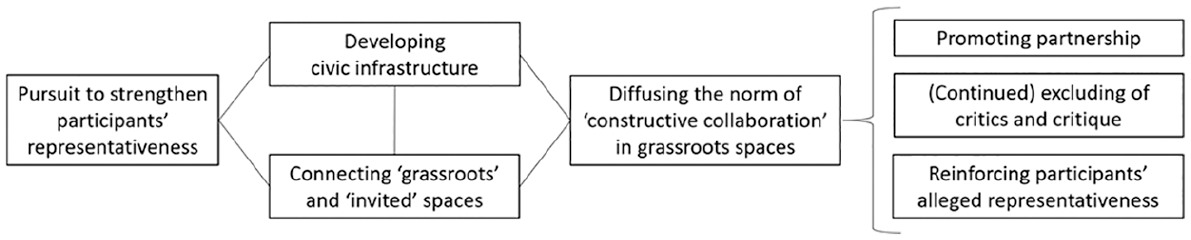
Dynamics of inclusion and exclusion in pursuit of “broadening” participation.
Discussion
Our study investigates why critical voices so often remain marginal within public participation—even when participation is pursued for so-called “genuine” or “authentic” motives (Abelson et al., 2003; Osborne & Strokosch, 2013). In our investigation, we explored the processes triggered by a professional care provider’s attempts to solicit citizen involvement for one of its care facilities. Building on the notion that “[i]t is in the micro-politics of institutional engagement, rather than through officially espoused views or strategies, that the public is constituted as actors” (Barnes et al., 2003, p. 396), we have uncovered how abstract notions of “community” are interactively translated into a concrete set of participants. In particular, we have highlighted the contentious character of such translations by investigating people’s disparate attempts to justify their own positions within the governance of services. By empirically grounding a politically sensitive analysis within the real-time interactions of the actors involved, we are able to move beyond the predominantly functionalist public participation literature, which mainly treats participant selection as a relatively clear-cut “design choice” (Fung, 2006, p. 70). At the same time, we also provide a rebuttal to somewhat-cynical political accounts that overemphasize public-service actors’ deliberate co-optation of citizens in order to advance their own interests. Instead, we shed light on the more subtle dynamics through which critical voices get marginalized within participatory processes.
Moving forward, we now reflect on what we see as the two main contributions of our study. First, our study highlights the entanglement of legitimacy claims made by, on one hand, the public-service actors who solicit participation and, on the other hand, the citizens who choose to participate. Both parties seek recognition for their position within the local governance of services. By endorsing each other as legitimate partners and reinforcing a notion of collaborative partnership as the appropriate form of participation, they are able to jointly construct a normative basis for disqualifying and excluding critical citizens without threatening the overall legitimacy of the process. Furthermore, public service employees often face the need to internally advocate for public participation among colleagues in order to convince them that such participation indeed “pays off.” Pressure to deliver concrete results (e.g., in terms of mobilizing operational volunteers) also limits the space available for engaging with critical voices. Paradoxically, this bias toward constructive participation may be further reinforced when trying to align participant efforts with the concerns of other (potentially less willing or constructive) citizens who are not directly involved. Instead of creating more space for engaging with their potential critique, such alignment may serve to further promote the norm of constructive participation within participants’ alleged constituencies. By scrutinizing these dynamics, our study explains why participatory initiatives are easily and inadvertently skewed toward the involvement of citizens who are already willing to constructively cooperate—despite a persistent effort to being open to criticism and opposition.
A focus on these entangled legitimacy pursuits also provides us with an alternative perspective on how actors deal with the trade-offs between the so-called breadth and depth of participatory initiatives. Extant literature points to the inevitable compromises that must be made when (a) pursuing an inclusive set of participants (breadth) and (b) sustaining and strengthening participation throughout the various stages of a given process (depth) (Cornwall, 2008; Fung, 2006). Combining such depth and breadth has been described as “either virtually impossible to achieve or so cumbersome and time-consuming that everyone begins to lose interest” (Cornwall, 2008, p. 276). Building on our case findings, however, we demonstrate that actors continue to seek legitimacy for their participatory initiatives precisely by simultaneously pursuing breadth and depth. While establishing a coalition of willing participants as a main platform throughout the participatory process (i.e., while deepening participation), the actors involved may concurrently aim to promote this main platforms’ legitimacy by fostering participant alignment vis-à-vis their alleged constituencies (i.e., while broadening participation)—albeit with limited success. Our analysis demonstrates the analytical merits of untangling such interacting pursuits of breadth and depth, helping us explain how a particular selection of participants is demarcated and legitimized.
As a second contribution, our analysis highlights a potential dark side of participatory initiatives: the tenacious propensity to establish “constructive cooperation” as the norm for legitimate participation. While this propensity may echo the democratic ambitions of citizen-participation advocates, it may equally contribute to the exclusion of those who do not subscribe to this norm—that is, those unwilling to acknowledge the legitimacy of the agencies soliciting their participation. This tendency resonates with, and may help explain, the historical shift identified by Brandsen et al. (2017) from a “rather adversarial” relationship between civil society and the public sector “towards a more cooperative relationship” (Brandsen et al., 2017, p. 682). Our analysis elaborates on the micro-dynamics of this development while our findings suggest being cautious of the assumption that citizen participation is always as an effective means of incorporating “community values into local decision-making processes” (Abelson et al., 2003, p. 243). In fact, our analysis reveals the potential parochialism and coerciveness of establishing a benign culture of participation: its normative cooperation and congeniality tends to shut out opposition and opponents. Even when citizen participation is pursued as a critical, democratizing counterpoise to managerial and professional power (Harrison & Mort, 1998; Needham, 2008), our study demonstrates the ease with which such well-intended democratic ambitions may actually be marginalized in the face of actors’ respective pursuits of legitimacy. Participation is only for the willing.
Further substantiating such reason for caution, consider our analysis of the possible alignment between provider-initiated “invited” spaces and citizen-led “grassroots” spaces. Scholars have emphasized that connecting such spaces may potentially enhance participants’ potency as a countervailing power (Cornwall, 2004; Taylor, 2007), stating that participatory processes “require both insiders and outsiders, those who choose to enter invited spaces and those who prefer to operate in their own ‘popular’ [citizen-led] spaces” (Taylor, 2007, p. 311). Being able to move back and forth between invited and citizen-led spaces, they say, can help participants “gain confidence and skills, develop their arguments and gain from the solidarity and support that being part of a group can offer” (Cornwall, 2008, p. 265). While our analysis partly supports this empowering potential, it also exposes the potential dark sides of forging such connection. Eventually, as witnessed in our case, alignment of these spaces may result in the further discrediting and marginalization of citizens’ antagonism or criticism while reinforcing the legitimacy of those already constructively collaborating. Even when aiming for empowerment, promoting the interconnectedness of invited and citizen-led spaces may, in reality, effectively undermine the critical potential of public participation.
Our analysis has demonstrated the exclusionary potential of inclusionary pursuits. When constructive collaboration emerges as the dominant norm for participation, critics and critique may end up being “legitimately” discarded. To some extent, the relative ease with which such exclusionary dynamics shaped the selection of participants may have been particular to our current case context, that is, that of a private provider-organization pursuing participation around one of its care facilities. In coming to a “legitimate” group of participants, private actors may have more room to maneuver opportunistically than public organizations. Facing the accountability requirements of a representative democracy, a municipality, for example, may be more limited in its ability to “legitimately” discard its critics. Moreover, the tendency to disqualify and exclude critics may be most pronounced (and most visible) in settings where participation entails a more sustained relationship between those inviting participation and those responding to these invitations; and/or when (often as a result of the former) participation is characterized by a more “exclusive” participant selection. Nevertheless, we believe that the identified mechanisms of inclusion and exclusion may be typical of participatory efforts. In both private and public contexts, inclusionary efforts may separate the willing from the unwilling. While these mechanisms may manifest differently in public settings (e.g., when determining membership of formal “community” advisory committees to local governments) and lead to different outcomes (e.g., because mechanisms of representative democracy may indeed be able to “correct” or “restrain” those of public participation), dynamics of inclusion and exclusion remain at the core of all participatory efforts (see, for example, Allen et al., 2012).
To substantiate this hypothesis, an interesting avenue for future research would be to investigate whether similar mechanisms indeed shape the position of critical voices within government-initiated pursuits of public participation. To what extent, for example, do citizens-as-voters constitute an effective counterpoise to the marginalization of critique and exclusionism? In the context of government-initiated pursuits, scholars may be able to shed new light on the micro-level tensions that arise between, for example, representative and participatory democracy by scrutinizing actors’ competing (and more or less entangled) legitimacy claims within such competing governance regimes.
Moreover, another avenue for future research could be to study the dynamics of inclusion and exclusion within participatory initiatives that are initiated and steadfastly led by citizens themselves. For example, the Dutch long-term care sector has recently witnessed the emergence of initiatives in which participating citizens have gained formal ownership and control over (some) services provided within their communities (Ubels et al., 2019; Van Der Klein et al., 2013). Compared to our current case setting, citizen participation and its impact on service governance may, in these contexts, be less dependent on the goodwill of (professional) organizations that “invite” participation. Furthermore, most of these citizen cooperatives already have local roots and have incorporated mechanisms to keep themselves accountable to their constituencies. Nonetheless, this does not mean that the dilemmas encountered in the current study (e.g., depth versus breadth of participation) would be suddenly irrelevant. Nor does it mean that the public’s interest is legitimately and unambiguously represented within these citizen-led initiatives. There is no reason to assume that citizen cooperatives, which face similar if not the same challenges of representation (Ubels et al., 2019), are able to fully avoid such trade-offs or the risks of parochialism.
That said, a comparison of the dynamics between citizen-led versus provider-initiated cases may produce relevant insights into the promises and pitfalls of more “radical” forms of citizen participation. For example, to what extent do citizen-led initiatives demonstrate a similar tendency to establish “constructive collaboration” as the norm for participation? Are they more likely or able to keep critical voices “on board”? By comparing the dynamics of such different manifestations of participation, we would gain a more comprehensive insight into the potential merits of participatory initiatives without sliding back into uncritical accounts that portray them as a panacea for “inclusive” service governance.
Throughout this article, a normative question has been lying just beneath the surface: to what extent should the inclusion of critical voices (always) be pursued? How should we evaluate the “legitimate” marginalization of such critical voices within public participation efforts? To a certain extent, it seems reasonable to question whether inclusiveness and “keeping critics on board” should always be a guiding principle. Particularly in cases similar to our study setting—that is, when actors try to preserve a local care facility that is threatened in its existence due to public budget cuts—one might say it is acceptable to engage only with “willing” citizens. From a pragmatic perspective, sacrificing some inclusivity and “breadth” may be acceptable if it means that a particular subsection of the community effectively mobilizes itself around a care facility to prevent its closure. While we do not necessarily reject such reasoning, we do want to caution for its implications for the public character of services. Our case study demonstrates how a public service agency’s affiliation with one particular faction of a participating community (in our case, only the willing, or only one of two churches in town) may preclude the engagement of those not belonging to this faction. By banking on a “coalition of the willing” and turning a blind eye to the “inherent parochialism” (Gittel 2001 in Taylor, 2007, p. 312) of individual civic actors, policy makers and managers do, as a trade-off, accept strong informal barriers for particular citizens to access participatory processes. In doing so, they may promote a narrow interest disguised as public interest. At the very least, actors’ critical awareness of and reflection on slippery notions such as “the public interest” and “representation” seem an ethical imperative to any attempt at fostering citizen participation.
Conclusion
Moving beyond cynical accounts that overemphasize public-service actors’ deliberate co-optation of citizens, this paper has generated insights into the more-subtle dynamics that contribute to the difficulty of engaging with critical voices within public participation efforts. Our identification of both public-service actors’ and participating citizens’ pursuit of recognition as legitimate actors within the local governance of services allowed us to then recognize the propensity to reinforce a norm of constructive partnership when establishing a local coalition of citizens and employees. This norm effectively granted both parties the sought-after legitimacy while diminishing space for engaging with critical voices. The resulting implications suggest that attempts to reconnect participants and their alleged constituencies—even when motivated by a desire to enhance participant responsiveness and representation—might, in practice, actually contribute to citizens’ further co-optation.
Footnotes
Acknowledgements
We would like to express our sincere gratitude to all of the CareOrg employees and local citizens who participated in this study, to the Jo Visser Fund for financially supporting our research project, and to Lilli Turner for her meticulous editing.
Declaration of Conflicting Interests
The author(s) declared no potential conflicts of interest with respect to the research, authorship, and/or publication of this article.
Funding
The author(s) disclosed receipt of the following financial support for the research, authorship, and/or publication of this article: This research project was funded by the Jo Visser Fund.
