




Abstract
In addressing the problem of alienation, normative democratic theories claim that citizen participation encourages public engagement and a sense of community. This article analyses the effects of citizen participation on public engagement in four local citizens’ summits in the Netherlands based on a combination of survey data, interviews and documents. The citizens’ summits appear to attract a selective group of predominantly highly educated citizens from a Dutch background. Of the citizens who took part in the summits, only a minority felt more connected and responsible after having participated. Moreover, the results show that over the longer term, the number of people who remain involved in public initiatives decreases. The findings raise doubts about the contribution of participation in one-off forums to public engagement. A sense of public engagement seems to be more a precondition for participation rather than a consequence of participation.
Points for practitioners
This article analyses the effects of citizen participation on public engagement in four local citizens’ summits in the Netherlands. The citizens’ summits appear to attract a selective group of predominantly highly educated citizens from a Dutch background. Of the citizens who took part in the summits, only a minority felt more connected and responsible after having participated. Moreover, the results show that over the longer term, the number of people who remain involved in public initiatives decreases. The findings raise doubts about the contribution of participation in one-off forums to public engagement.
Introduction
A large body of empirical research has found declining levels of satisfaction with the institutions and processes of representative democracy (Dalton, 2008; Kaase and Newton, 1995). There seems to be general support for the idea that because many people feel alienated from our democratic institutions and politicians, we should look for ways to give people a more direct say in political decision-making that complement the existing forms of representative democracy (Cain et al., 2006; Inglehart and Welzel, 2005). Theories of participatory and deliberative democracy assert that more direct forms of citizen involvement have a number of positive effects on democracy. In addressing the problem of alienation, the claim is that citizen participation encourages public engagement and a sense of community, fostering a feeling of being a public citizen, feeling responsible and the willingness to be active in public life (Barber, 1984; Pateman, 1970; Putnam, 2000).
Yet, the empirical evidence as to what extent involving citizens affects public engagement is sparse and scattered. Numerous studies point at improvements in knowledge, but also in skills, and identification with the community as an effect of participation (Geissel, 2009; Grönlund et al., 2007; Vetter, 2014; Michels and De Graaf, 2010 ). However, both the variation in concepts and operationalization, and the variation in forms of participation, make it difficult to compare studies and draw conclusions about the relation between participation and public engagement (Michels, 2011).
This article seeks to build on previous insights by analysing the effects of citizen participation on public engagement in four local citizens’ summits (so-called G1000s) in the Netherlands. 1 A G1000 is an example of a deliberative mini-public (Grönlund et al., 2014; Ryan and Smith, 2014), which was first introduced in Belgium in 2011 as a means to empower citizens and to reach agreement in cases where politicians had failed to do so (Caluwaerts and Reuchamps, 2014a, 2014b). The G1000 in Belgium formed a source of inspiration to citizens and council members in a number of municipalities in the Netherlands.
The aim of this article is to investigate the effects of participation in the G1000s on public engagement. The article is structured as follows. In the first section, previous research about participation and its effects on citizen engagement is discussed. Then, the G1000s in Amersfoort, Uden, Kruiskamp and Groningen are introduced. After describing the methodology and data used, the empirical analysis of the G1000s in the Netherlands starts with a characterization of the group of participants in each G1000. The analysis then focuses on the effects of this on public participation. In the conclusion, the findings are summarized.
Participation and effects on citizens
Normative theories on citizen participation and democracy differentiate between effects on individual citizens and effects on politics and decision-making. The impact on politics and decision-making refers, for example, to the effects of citizen participation on decision-making, the quality of decisions, the legitimacy of decisions and the inclusion of different interests and voices. With regard to the effects on individual citizens, participatory democrats believe that participation has several important functions (Barber, 1984; Pateman, 1970). The first is an educational function: citizens increase their civic skills and become more competent when they participate in public decision-making. Public participation, therefore, may make citizens feel more efficacious and more confident of their ability to affect policymaking (Verba et al., 1995). In the second place, participatory democracy has an integrative function. Participation contributes to the development of civic virtues, as well as to a feeling of being public citizens and part of their community. As a consequence, citizens may also feel more responsible personally for public decisions.
Similar views can be found in the work on social capital by the American sociologist Robert Putnam. In his famous book Bowling Alone, Putnam (2000: 338–340) considers participation in social networks and voluntary organizations to be important to democracy. In his view, networks of civic engagement make citizens more competent. Those voluntary associations are schools for democracy, where civic skills are learned. Moreover, they become acquainted with civic virtues, such as active participation in public life, trustworthiness and reciprocity (giving and taking).
Furthermore, theories of deliberative democracy hold that deliberation increases knowledge. A deliberative process assumes free public reasoning, equality, inclusion of different interests and mutual respect. Through information and deliberation, people would learn to respect other arguments and, as a result, be more willing to change preferences (Dryzek and List, 2003; Fishkin and Laslett, 2002; Gutmann and Thompson, 2004).
In short, normative participatory and deliberative theories on democracy argue that participation enhances citizens’ knowledge and skills, while contributing to the development of civic virtues and to a feeling of being public citizens and part of their community (Fischer, 2000; Fung and Wright, 2001).
Most empirical studies about the benefits of participation for individual citizens focus on knowledge and civic skills. More particularly, much research has been conducted on deliberative democracy and the effects of deliberation. These studies have often found increasing levels of knowledge among participants (Fishkin and Laslett, 2002; Setälä et al., 2010; Michels, 2011). However, it should be noted that involving experts and providing expertise to participants are often seen as prerequisites for a deliberative mini-public. Other forms of participation have also been associated with an enhancement of citizens’ knowledge and skills (Tolbert et al., 2003). Some studies focus on specific aspects of knowledge and skills. For example, a study of interactive governance and neighbourhood budgets in the Netherlands showed that participants appeared more confident about their organizational capabilities and had a better understanding of decision-making procedures (Michels and De Graaf, 2010). Also, a case study on Local Agenda 21 showed an increase in participants’ civic skills, notably, a significant growth of their knowledge and skills with regard to sustainable and political matters (Geissel, 2009).
Very few studies have examined the effects of citizen participation on other aspects of public engagement, such as developing a sense of community or the willingness to take action in the public domain. A sense of community is defined here as a feeling of belonging, a feeling of being able to identify with the community and a feeling of being connected to the community. Some studies have found positive results for particular types of participation, such as involvement in religious and neighbourhood associations, or participation in neighbourhood associations (Ohmer, 2008). Empirical studies on citizen involvement in democratic and policy forums show mixed results that are, to say the least, inconclusive. Eggins et al. (2007) found increasing levels of political engagement in a deliberative poll in the Australian Capital Territory, and suggest that the poll created or increased a sense of connection by giving people the opportunity to exchange views in a respectful atmosphere. Vetter (2014) found an increasing identification of citizens with their city in 16 cases of participatory governance in Baden-Württemberg in Germany. Similar results were found in the study by Michels and De Graaf (2010) in two cities in the Netherlands, where citizens felt more connected and responsible for their neighbourhood.
Effects of participation on individual citizens.
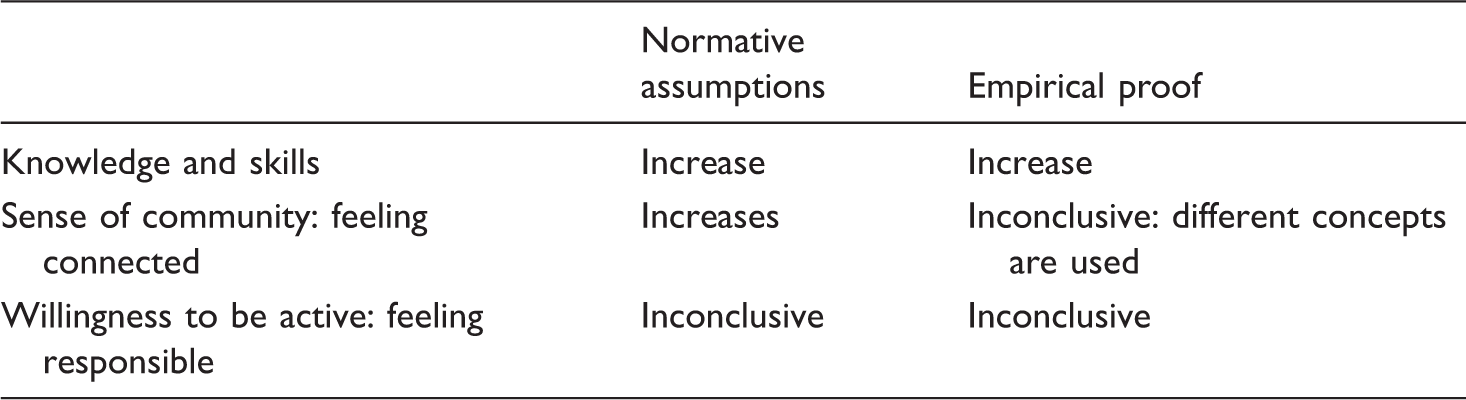
Public engagement thus encompasses different components. It is clear from this overview that most empirical research focuses on knowledge and skills and that more empirical research is needed on the empirical effects of participation in democratic and policy forums on sense of community and willingness to be active. The question, too, is whether citizens participating in these one-off forums will care more about their communities after participation, and whether this leads to their actually becoming active citizens. Although in interviews, people sometimes express a clear willingness to take part in community projects in the future (e.g. Michels and De Graaf, 2010), these are obviously self-reported perceptions that do not automatically lead to actual active behaviour. This relates to an emerging literature on scaling up mini-publics, central to which is the notion that it is vital for mini-publics to have an impact outside the mini-public, in the broader public sphere (Curato and Böker, 2016; Niemeyer 2014). Niemeyer (2014: 194) argues that widespread participation in mini-publics can have a long-term effect in improving the civic skills of the participants. While the impact of deliberative mini-publics on communities should not be overrated, longer-lasting forums in which people meet each other on several occasions might be expected to be better able to create a sense of ownership and of taking responsibility than one-day forums (Pierce et al., 2011).
Hence, in this article, the focus is on the following aspects of public engagement:
sense of community, which is understood as feeling connected to the city or neighbourhood; willingness to be active in the city or neighbourhood, feeling responsible; and taking part in initiatives in the city or the neighbourhood.
Before answering the question about public engagement, I start with a description of the group of participants. Earlier research has shown that participation and involvement in participatory governance are (likely to be) significantly unequal (Mansbridge, 1999). Specifically, people from lower socioeconomic backgrounds and with low levels of educational attainment are generally less involved in politics and decision-making (Bovens and Wille, 2010; Dalton, 2008). For this reason, a great deal of effort and energy was spent on attempts to attract participants in the G1000 initiatives reported on in this article from as diverse backgrounds as possible, either by randomly selecting participants or by targeting specific groups. Granted, the social and cultural characteristics of the cities in this study differ considerably. However, if the G1000 organizations fail to draw a diverse group of people that broadly reflects the composition of the population of the city or neighbourhood in which the summit is held, the effects of participation on public engagement will only hold for the select group of people that takes part.
The G1000s as an example of mini-publics
The Belgian experience with a citizens’ summit involving a large number of people inspired many groups of citizens and politicians in the Netherlands to organize a similar type of event. Although the designs of the G1000s differ, they do share a number of features common to all mini-publics (Ryan and Smith, 2014: 20). Mini-publics are, first and foremost, characterized by the realization of structured deliberation, enabled by independent facilitation. Mini-publics are designed with the aim of being deliberative, which means that the focus is on following the ideal deliberative procedures; opinion formation and the exchange of arguments are more important than decision-making. A second key element is the participation of a broadly inclusive and representative subgroup of an affected population. Except for the G1000 in Uden, sortition was used as the selection mechanism to obtain a diverse body of participants.
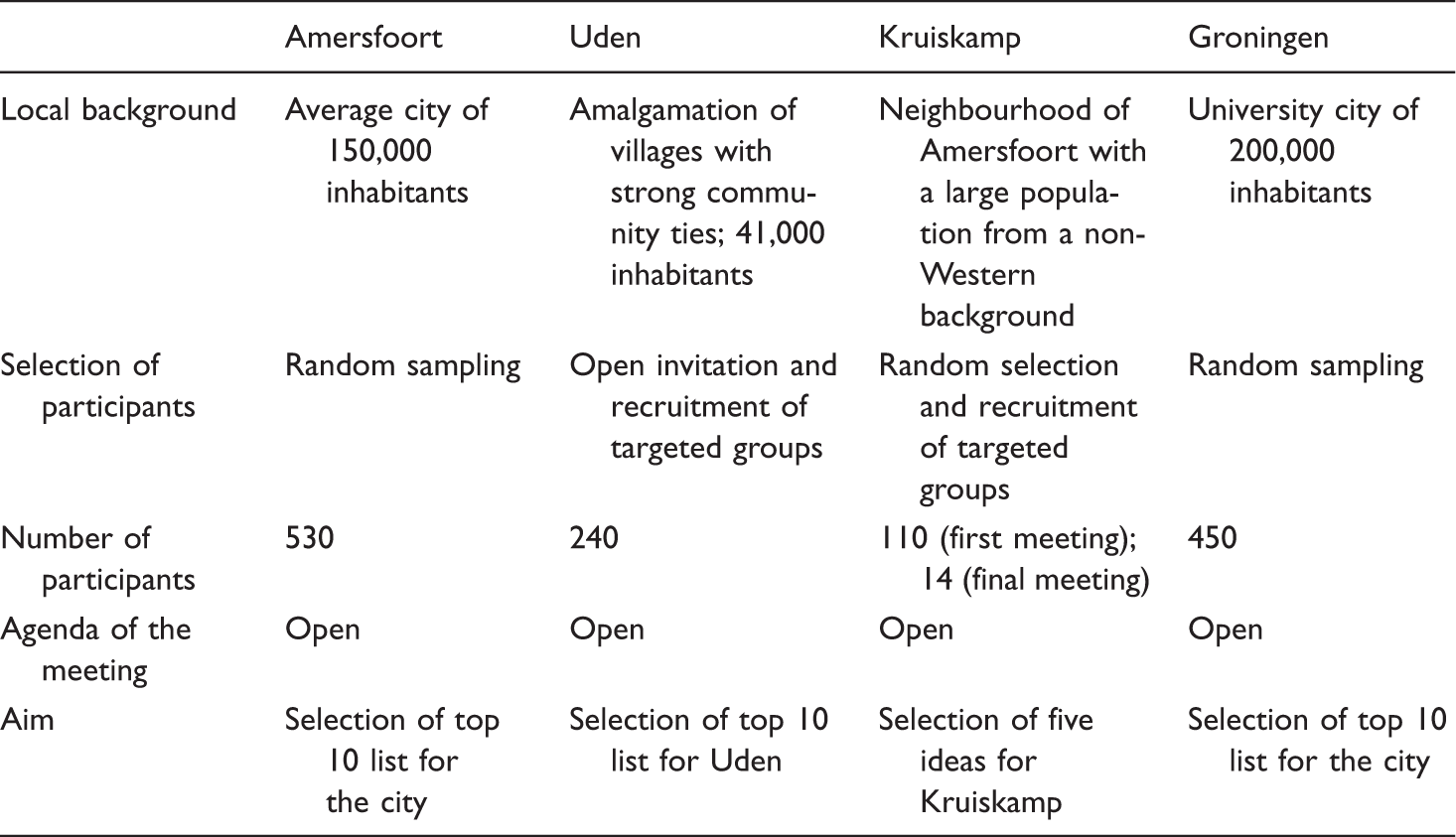
The G1000 in Amersfoort was the first G1000 to be organized in the Netherlands. Amersfoort is an average city made up of neighbourhoods with highly educated citizens, but also neighbourhoods with a concentration of lower-educated and migrant groups. The G1000 was held on 22 March 2014, and was initiated by a group of citizens. A total of 530 people took part, among them 354 lay citizens. The design of the G1000 in Amersfoort was characterized by (cf. Fung, 2006):
a random selection of participants through an a-select draw among all inhabitants; dialogue and an open agenda to create opportunities to deliberate about topics that matter to the participants; and the presence of the ‘whole system’, including politicians and civil servants, at the tables during the day.
The central questions that were discussed during the day were: ‘What do you think is important for Amersfoort in the next four years?’; ‘What should be done?’; and ‘How are you going to contribute?’. The aim was to come up with a top 10 list of topics for the city of Amersfoort. It was also emphasized that this list of topics was, first and foremost, an agenda for citizens to adopt as their responsibility, and less an agenda for the city council or government.
Uden was the second city to organize a G1000. The municipality of Uden, which is an amalgamation of Uden and a number of surrounding villages, has retained its village character, complete with strong community networks. The G1000 in Uden was initiated by a number of council members and the council secretary and was held on 4 October 2014. The design of Uden’s G1000 was, in many respects, similar to that of the Amersfoort initiative, but there were also some differences:
an open invitation to all inhabitants above 16 years old to participate, and recruitment of targeted groups; and brainstorming and deliberation about the selection of ideas.
About 250 lay citizens took part. Furthermore, 20 council members participated. The central question of the G1000 in Uden was: ‘Which ideas do you feel should be realized that are important for the future of Uden?’. By the end of the day, 10 initiatives had been selected. Citizens could sign up to join one or more of the working groups to contribute to the further development of these initiatives.
The G1000 in Kruiskamp, which is a neighbourhood of Amersfoort with many different nationalities (about 40% of the population has a non-Western background), was organized by a group of people that had previously participated in the G1000 of Amersfoort. The G1000 in Kruiskamp consisted of a series of five meetings. At the first meeting, 110 lay citizens took part; the final meeting attracted a total of only 14 people. By the end of that day, several proposals had been selected for further development. Other aspects of the design in Kruiskamp were:
a combination of a random selection of participants, which only attracted 20 applications, and recruitment through key persons and the distribution of flyers; and dialogue and an open agenda.
Summary of the local characteristics and the designs of the G1000s in this study.
Methodology and used data
Background characteristics of the participants, in percentages.
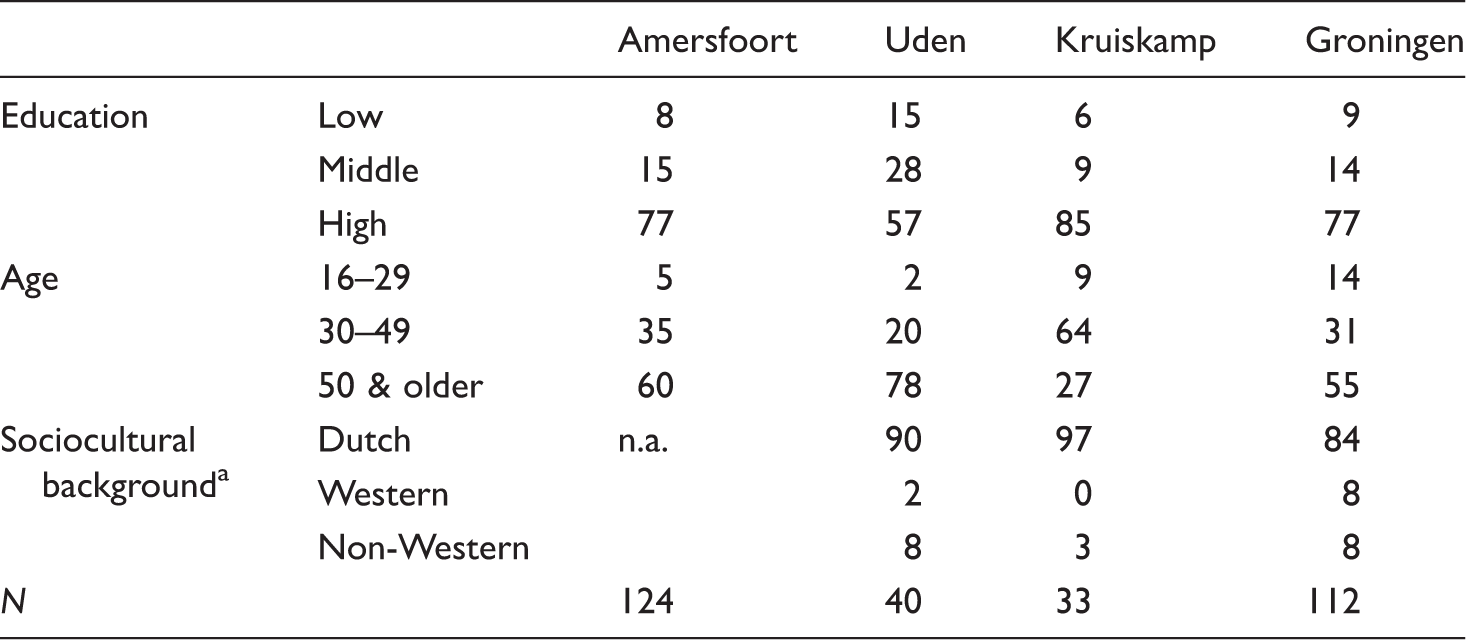
Note: aA person is not classified as Dutch if he or she was born outside the Netherlands and/or one of the parents was not born in the Netherlands.
Two sources were relied on to obtain an answer to the question of whether citizens actually felt more connected to and responsible for their community after having participated in a G1000. I, we used the data obtained from the survey on each G1000 held shortly after the event. In the survey, the respondents were asked to respond to the following statements:
Since the G1000, I feel more connected to the neighbourhood where I live. Since the G1000, I feel more connected to the city where I live. Since the G1000, I more often want to contribute to my neighbourhood.
Politicians and civil servants were excluded from the findings. Unfortunately, these questions were not included in the survey conducted in Kruiskamp. In the second place, semi-structured interviews were held with 15 to 20 participants on the day of the summit 3 by the researchers at its close.
To investigate whether participation in a G1000 had led to taking responsibility in one of the initiatives that resulted from the G1000, two sources were used. Four months after the G1000, a second round of semi-structured interviews was conducted with 14 of the respondents who had previously also been interviewed and who had then expressed enthusiasm and a clear willingness to contribute to the further development of one of the initiatives that had been initiated during the G1000. A second approach was to look at the initiatives that were selected by the participants of the G1000s, in order to see whether these were still current and were being further developed, by investigating the websites and newsletters of each G1000. My expectation was that longer-lasting forums in which people meet each other on several occasions, rather than on a single day only, would be better able to create a sense of ownership and hence stimulate people to take responsibility. To test this, I compared the G1000 in Kruiskamp, which consisted of a series of five meetings, with the other forums. Obviously, people may have felt encouraged to take up other activities as well, but these are much harder to follow. So, for practical reasons, the focus is on the sustainability of the initiatives that resulted from the G1000s.
Who takes part?
The presentation of the findings starts with a characterization of the group of participants. Table 3 shows a few selected characteristics. In Amersfoort, participants older than 50 were strongly represented, as were people with higher levels of educational attainment. There were hardly any participants from a non-Western background, as can also be seen on the film of the day that was made by the organizers (YouTube: G1000 kort AmersfoortGezien). In Uden, the majority of participants were aged 50 and over, with only very few young people taking part. Again, there were only a small number of people from a non-Western background.
In Kruiskamp, again, citizens with higher educational qualifications were well represented. The largest group of participants was between the ages of 30 and 49. Once again, citizens from a non-Western background were poorly represented, despite the fact that Kruiskamp is a neighbourhood with many inhabitants with a non-Western background. The final meeting of the G1000 in Kruiskamp was attended by a mere 14 participants, none of whom was younger than 30 and only one of whom had a non-Western (Indonesian) background.
In contrast, in Groningen, all age categories were reasonably well represented and, especially compared to Amersfoort and Uden, a higher number of young people attended. This may be due to the fact that, in contrast to the other G1000s, the initiators of the G1000 in Groningen were mainly young people. Apart from that, the pattern was similar to that of the other citizens’ summits: the people attending were, for the most part, highly educated and hailed from a Dutch sociocultural background.
The data show that the typical G1000 participant in this study appears to be a man or woman, born and raised in the Netherlands, who is older than 50, with relatively high educational qualifications. While this does not mean that people from other backgrounds do not take part, there is no denying that they only constitute a minority. The survey data further reveal that the typical participant is someone who votes (92% to 95%) and is not cynical about the functioning of the local council and administration, 4 but who is not necessarily active at neighbourhood meetings, citizens’ panels or residents’ committees. However, the participants were often found to be involved in neighbourhood activities (42% to 45%).
Hence, the diversity of the group of participants of the G1000s is rather low. This should not come as a complete surprise. Although a key element of mini-publics is that they try to attract a diverse crowd, evidence for deliberative polls shows that those who decide to attend are usually well educated, older and politically active (Fishkin and Farrar, 2005; O’Flynn and Sood, 2014). Also, participants tend to be more knowledgeable than non-participants, which suggests that political interest plays a role in the decision to participate (O’Flyn and Sood, 2014: 45). Stratified sampling, often used in smaller mini-publics, serves as an instrument to ensure that citizens from salient groups are selected and that the forum better reflects socio-demographic variations (Ryan and Smith, 2014; Smith, 2009). However, even then, certain biases remain. Citizens often do not take up opportunities to participate (Cain, 2014). As there is no obligation to participate, self-selection always has some effect on the participants: in the British Columbia Citizens’ Assembly, participants tended to be more politically knowledgeable and civically active (Smith, 2009); and in the Australian Citizens’ Parliament, participants tended to be less cynical about politics (Curato and Niemeyer, 2013).
That said, in the Dutch G1000s, self-selection had a much stronger impact on the background characteristics of the participants. Formal invitations and a sense of having been asked were found not to be enough to motivate citizens to participate. More than nine out of 10 who were selected and invited failed to respond to the invitation. This low response led the organizations of the G1000s to decide to accept everyone who had responded. Stratified sampling was never considered. Although the Belgian G1000 encountered the same problems, they managed to attract more people from disadvantaged and minority groups by targeting them directly through civil society organizations (Caluwaerts and Reuchamps, 2014b). The fact that the participants received no honorarium may have contributed to the low response. Furthermore, whereas Belgian citizens felt a sense of urgency because of failing politicians in a deeply divided Belgium, this was never the case in the local Dutch communities organizing the G1000s.
Feeling connected and responsible
Feeling connected and responsible since the G1000, in percentages.
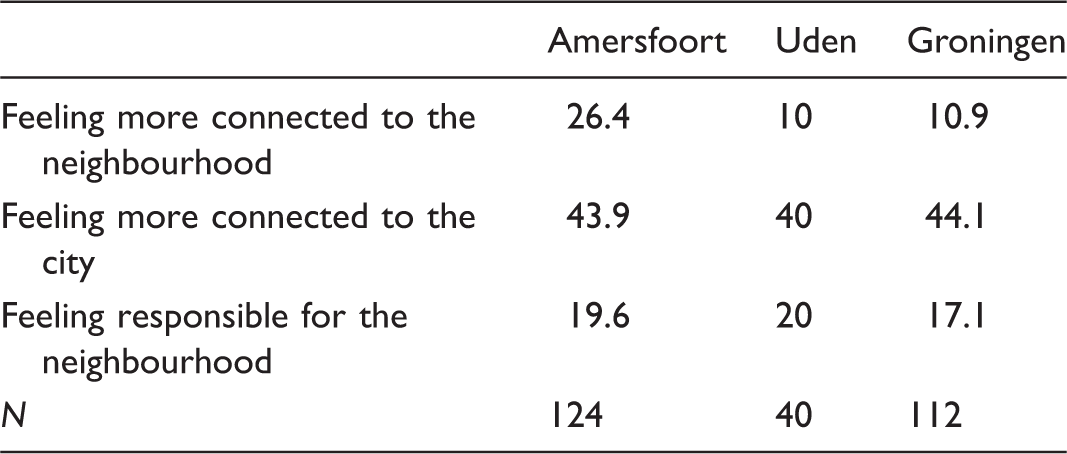
The answers to the questions about connection to the community and responsibility show a remarkably similar pattern in all cities. What stands out is that a minority of the respondents reported feeling more connected to the city after having taken part in the G1000. Looking at changes in feeling connected to and responsible for the neighbourhood since the G1000, an even smaller minority responded positively. A plausible explanation for this could be that many participants already felt interested in and connected to their neighbourhood and city. The fact that many respondents gave a neutral answer (3 on a five-point scale) seems to support this explanation. Also, the fact that many of the participants were already active in the neighbourhood and involved in all sorts of neighbourhood activities upholds this argument. The focus during the G1000 on formulating ideas for the future of the city (i.e. Amersfoort, Groningen and Uden) may explain the greater feeling of connection with the city after the G1000s, rather than with the neighbourhood.
From the semi-structured interviews that were held at the end of the meetings, a similar pattern emerges. In addition, the interviews revealed some of the factors that people take into consideration in responding to the question of whether they want to take responsibility or not. There were three types of answers. First, one group of participants indicated that they felt more connected to the city and considered themselves more of a ‘citizen’ of the city. They expressed a desire to take responsibility by taking part in initiatives aimed at improving the city or neighbourhood. For some respondents, the fact that by taking part, they had met other people with similar ideas with whom they felt they shared some ‘common ground’ was also important.
Second, many people also reported that they felt connected to and responsible for the city or the neighbourhood but that this feeling had not increased as a result of taking part in the G1000 as they had already been active in the community all along. Some reported that the G1000 would not really change their behaviour and that they were willing to take part in some of the initiatives resulting from the G1000. Others said that they felt that they had done enough for the community and were doubtful whether they would do more.
The third, and smaller, group consisted of people who were sceptical about what would be done with the results of the G1000. They expressed doubts about the follow-up of the G1000, in particular, about the response of the government, but also about the sustainability of the ideas initiated by citizens themselves. This even caused some to feel less connected and responsible for the community because of disappointment about the vagueness of the G1000, its ambition and its results.
In summary, many people reported feeling connected to their community, and expressed a willingness to be active in the public sphere. However, for a very considerable number of people, their participation in the G1000 did not affect their feelings of connection and responsibility as this connection to the community had already been established prior to taking part.
Taking part in initiatives
The next thing we want to know is whether a sense of community and the willingness to take responsibility is subsequently transformed into actual behaviour and concrete action. More in particular, does participation in a G1000 lead to taking responsibility in one of the initiatives that resulted from the G1000?
One of the main topics of the second round of semi-structured interviews was: are people still participating in one of the projects and if not, why not? The interviews show that, in some cases, people still felt a strong responsibility for the city and neighbourhood and were actively involved in one of the initiatives. However, most people admitted that their commitment had waned and that they were not (or no longer) involved in any of the G1000 follow-up projects, or, at least, far less so than originally intended. The respondents’ reasons for doing less than they had planned could be divided into two categories. The first had to do with the follow-up projects. People expressed disappointment about the content of the projects and topics; they experienced too little cooperation from fellow participants in project groups or from the local administration, or were disappointed to see ‘the usual suspects’ again. The second category included practical considerations, such as lack of time, lack of specific skills to further develop an initiative, busy with work or daily life, or the bad planning of meetings. In short, daily life took over once again.
A second way of approaching this is to look at the initiatives that were selected by participants of the G1000s in order to see whether these were still current and were being further developed. In Amersfoort, 10 proposals were selected by the participating citizens during a voting round, one of which concerned the organization of a G1000 at the neighbourhood level. This proposal was, indeed, put into practice some months later in the Kruiskamp neighbourhood. Other proposals related to the green space in the neighbourhood, or increasing the awareness of what is going on in the neighbourhood. After a year, the overall conclusion was that only a few working groups were still active, and that apart from the organization of the G1000 in Kruiskamp, no other plans had been effectuated.
The proposals that came up in the G1000 in Uden concerned topics such as more safety for cyclists and pedestrians, the accessibility of the town centre for visually disabled people, and the preservation of the public library. Many people became active; more than 100 participants enrolled in the working groups, of which several are still active today. One example is the ‘Leercafé’, in which citizens share experiences and expertise, or discuss recent events. While the café has no fixed schedule, quite a number of activities are organized, often in cooperation with civic organizations and the Kantelhuis (Tilting House), where citizens can meet to discuss new ideas and the progress being made on the various themes.
In the multicultural neighbourhood of Kruiskamp, proposals included safety and activities for the young, but also the organization of a food festival (‘Proef Kruiskamp’), where people in the neighbourhood could meet and eat. This latter plan was the only one to succeed. Contrary to what was expected, this longer-lasting forum of a series of five meetings did not create a sense of ownership and of taking responsibility for the community. The final meeting attracted only 14 people. Of the scant 13 people who became active in working groups after the G1000, seven were involved in organizing the food festival.
Finally, in Groningen, 70 people enrolled in the various initiatives that resulted from the G1000. Some of the proposals that were selected were ambitious, such as a basic income for everyone; some were rather abstract, such as ‘going green together’; and some were more down to earth, such as organizing a neighbourhood G1000 and the development of a neighbourhood app. The organization has tried to encourage people to remain or become involved by organizing a number of follow-up meetings. After a year, only a few working groups were still active, and apart from the organization of a neighbourhood G1000, no other plans have been effectuated. So, although many participants show a willingness to take responsibility and to contribute to the further development of the proposals that resulted from the G1000s, the extent to which these generated new activities in which citizens were involved was limited.
Conclusion and discussion
In this study, the effects of citizen participation on public engagement were investigated in four local mini-publics, the G1000s, in the Netherlands. The findings show, first of all, that the citizens’ summits appeared to attract a selective group of predominantly highly educated citizens from a Dutch background who vote, and who were often found to be involved in neighbourhood activities. Even the multicultural neighbourhood, Kruiskamp, showed a similar pattern, with attendees at the G1000 held there also consisting of highly educated Dutch-born participants. Although random sampling was used in Amersfoort, Kruiskamp and Groningen, self-selection caused serious biases (O’Flynn and Sood, 2014). Self-selection and high non-response are likely to be a more serious problem in larger mini-publics, where a further stratified sampling among those who respond to the first invitation is not possible, unless combined with other selection methods, such as the targeting of specific groups, as was done in the Belgian citizens’ summit (Caluwaerts and Reuchamps, 2014b). However, even then, systematic biases in mini-publics are likely to remain towards citizens who are politically interested, civically active and less politically cynical (Curato and Niemeyer, 2013; Smith, 2009). A systematic failing to include not only citizens with different socio-demographic characteristics, but also citizens who are less interested in politics, less civically active and more cynical, undermines the legitimacy and democratic value of the forum.
The analysis further shows that of this selective group of participants, only a minority felt more connected and responsible after having participated in the G1000. Within this selective group, many participants already had a sense of public engagement. A sense of public engagement seems to be a precondition for participation rather than a consequence of participation.
Furthermore, other than in Uden, the number of follow-up projects of the G1000 was low, as was the number of people involved in one of the follow-up projects. This low level of activity as a result of the G1000 can partly be explained by the fact that many people feel that they have already done a lot for their community. A second explanation relates to a lack of time or specific skills. Whatever the reasons for dropping out, it shows that it is difficult for mini-publics to have an impact outside the mini-public in the broader public sphere (Curato and Böker, 2016; Niemeyer, 2014), even when people have attended a series of meetings, as was the case in Kruiskamp. More research is needed about how to increase the impact of mini-publics and how to connect mini-publics to the public sphere.
The findings for Uden may provide a first clue. Only in Uden did a large number of citizens become active and did several initiatives result from the proposals that were the outcome of the G1000, often in cooperation with community organizations. The stronger impact in Uden may be due to a strong existing civil society and the connection with previous citizen initiatives. This suggests that local characteristics of the city or neighbourhood, and, in particular, an existing civil society with strong neighbourhood associations (Thijssen and Van Dooren, 2015), fosters public engagement and a more enduring public impact of mini-publics.