



Abstract
Although network governance has become increasingly popular in both research and practice, its anticipated benefits do not always materialize. Although literature on network governance acknowledges the challenges that result from its introduction, scholars tend to assume these challenges can be managed and rarely analyze how the different participating actors (strategically) react to the tensions surrounding its establishment. As such, the process of how “networking” actors establish, maintain, and negotiate a network remains understudied. In light of these shortcomings, this article zooms in on how actors, in their collaboration efforts with network partners, navigate the tensions between (a) their discretionary space and the parameters set by a central policymaker, and (b) their pursuit of both integration and differentiation. This ethnographic case analysis contributes by, first, revealing how local actors demonstrate agency in maneuvering between these tensions in everyday practice by adopting three strategies—that is, overwhelmed deflection, situational segmentation, and strategic reappropriation—and, second, by revealing how these tensions interact and subsequently affect the implementation of policies in networks.
Introduction
Network governance, celebrated as a counterpoint to the shortcomings of New Public Management (Bevir, 2011; Lewis, 2011; Sørensen & Torfing, 2007a), is built on the assumption that public problems, such as an aging population, both cut across sectoral boundaries and need to be collectively addressed by multiple societal actors (Klijn & Koppenjan, 2016). Network-based forms of governance also presume that local actors are better positioned to devise solutions “on the ground” (De Vries, 2000; Saito, 2011; van der Veer et al., 2011). According to network governance theory, central actors should therefore offer discretionary space to local actors and promote the development of interorganizational networks to stimulate communication between them (Head & Alford, 2013; Jessop, 2011; Klijn & Koppenjan, 2016; Sørensen, 2006). As such, network governance scholars build on the assumption that local actors will eventually be able to establish and maintain strong collaborative ties (Ansell & Gash, 2007; Bryson et al., 2015; Emerson et al., 2012; Thomson & Perry, 2006). Although they acknowledge network governance formation as a complicated process, network governance scholars tend to take successful networks as their point of departure and view its emergence and existence as something that can be managed. The intricacies of establishing, maintaining, and adjusting a network as a complex process tend to be reduced to problems that can be overcome by interventions, such as is the case with “network management” (Agranoff & Mcguire, 2001; Klijn et al., 2010; Provan & Kenis, 2007). This alluring assertion has turned network governance into an imperative for public policymakers (Ansell & Gash, 2007; Bryson et al., 2015; Emerson et al., 2012; Thomson & Perry, 2006). At the same time, this has left the process of how networking actors navigate and negotiate the challenges inherent to the establishment of network governance neglected.
Critical scholars have pointed out that the alleged benefits of network governance are often hard, if not impossible, to achieve in practice (Rhodes, 2000b; Vangen, 2017; Vangen & Huxham, 2012). These scholars are wary of both research and policies that target networks as a whole, arguing that conceptualizations of a network as fixed and uniform are unrealistic (Bevir & Rhodes, 2016). Instead, they argue that we should zoom in on the individuals who constitute a network to illuminate why the alleged benefits of network governance are so hard to achieve (Bevir, 2013). Taking a “decentred” approach to governance, these scholars assume that “network governance arises from the bottom up” and that “actions arise from the beliefs that individuals adopt” (Bevir & Rhodes, 2016, p. 5). This implies we should understand and study network governance as a practice resulting from “conflicting beliefs, competing traditions, and varied dilemmas” (Bevir & Rhodes, 2006, p. 5). From this vantage point, the central issue in network governance becomes how each actor in a network maneuvers the dilemmas they encounter.
Given that local networks comprise complex constellations of interdependent actors and operate in a context of contradictory institutional demands (Klijn & Koppenjan, 2016), stakeholders within such networks need to interpret and react to two tensions. First, although responsibilities are decentralized and self-organization on the ground is promoted, a central governor continues to coordinate, exercise control, and define regulation (Marsh et al., 2003). Consequently, local initiatives both develop “in the shadow of the state” (Scharpf, 1997) and, somewhat ironically, compromise central control (Skelcher, 2000). A second tension inherent to network governance stems from the demand on local organizations to collaborate with stakeholders while also competing with them for scarce resources. In other words, local actors may work with others to pursue shared goals and collective opportunities, but they cannot neglect their own agendas (Huq et al., 2016; Vangen, 2017). In that vein, empirical studies of decentralization and collaboration indeed show problems that emerge in the process of establishing or maintaining a network (e.g., Huq et al., 2016; Ospina & Saz-Carranza, 2010; Vangen & Huxham, 2012). These empirical studies, however, do not shed light on the messy dynamics and intricacies of establishing and maintaining a network as a process in which actors engage with multiple tensions simultaneously. Our lack of insight in how networking actors continuously and strategically navigate tensions between (a) centralization and decentralization, and (b) integration and differentiation constitutes key challenges for the implementation of network governance. It has left much of the process of how actors navigate and negotiate network governance, and the unintended consequences that may emerge from its management, overlooked.
Employing a decentered (Bevir & Rhodes, 2006) approach, we therefore ask the following question: How do local stakeholders involved in a transition towards network governance navigate the tensions around centralization versus decentralization and integration versus differentiation?
This article draws on an ethnographic study of a regional network of active stakeholders in local health care governance in the Netherlands post 2015, when the government mandated the decentralization of care provision. Rather than detailing the individual actions of all stakeholders involved, we describe the dominant strategies that actors pursued in their attempts to establish, maintain, or negotiate a network. Based on our observations, we have concluded that local actors deploy three strategies: overwhelmed deflection (they recognize a tension, but defer responsibility to someone else and avoid actively facing its problematic implications), situational segmentation (they divide a tension into segments to respond to them either sequentially or differently in frontstage versus backstage interactions), and strategic reappropriation (they reframe a tension until it is no longer experienced as such in service of their own self-interests). Our analysis of these strategies demonstrates, first, how local actors strategically respond to the two tensions inherent to network governance in their everyday work practices. Second, our analysis shows how these two tensions are interlinked: (De)central steering affects the tensions experienced within local collaborations and vice versa. Before explaining our methodology, we will first provide an overview of relevant literature on network governance and how a decentered approach may help unravel how local actors work toward network governance while continuously navigating tensions.
Working Toward Network Governance: Making Room for Empirical Complexity
With the popularity of (research into) network governance came a huge variety in definitions of the term (Börzel, 2011; Klijn & Koppenjan, 2016; Lewis, 2011) that clarify, as well as delimit, what we may understand as network governance. Curiously, the characteristics commonly used when describing governance networks (Sørensen & Torfing, 2007b) already contain intrinsic tensions. Assuming at once autonomy of, and collaborative ties between, local partners, network governance is commonly defined as a stable constellation of “interdependent, but operationally autonomous actors” (Sørensen & Torfing, 2007b, p. 9). In a similar vein, control is defined as at once centralized and decentralized when local networks in network governance are seen as “self-regulating within limits set by external agencies” (Sørensen & Torfing, 2007b, p. 9). Given these tensions, working toward networks clearly is not without its challenges and its ambitions can be hard to achieve.
Although scholars are aware of the tensions and complexities within which a network is considered to emerge (e.g., Bryson et al., 2015; Provan & Kenis, 2007; Scharpf, 1997; Vangen, 2017), they also tend to routinely define a network in terms of its successful endstate where tensions are balanced out (cf. Ansell & Gash, 2007; Bryson et al., 2015; Emerson et al., 2012; Thomson & Perry, 2006). Over the last decades, many scholars have dedicated themselves to developing frameworks to provide insight into how successful collaborative forms of governance may be constructed (e.g., Ansell & Gash, 2007, 2017; Emerson et al., 2012; Thomson & Perry, 2006) or what characteristics and conditions may be required in order for networks to be effective (Provan & Kenis, 2007; Provan & Milward, 2001). This literature has outlined (a) different types of networks, such as models of “shared governance,” “lead organization,” and “network administrative organization” (NAO; Provan & Kenis, 2007); (b) characteristics of successful networks, such as trust, size, goal consensus, and competencies (Provan & Kenis, 2007); (c) frameworks bringing together various components related to the construction and functioning of a network (Bryson et al., 2015; Emerson et al., 2012); and (d) theories on how network governance’s effects could be evaluated (Kenis & Provan, 2009; Provan & Milward, 2001). Although we can thus rely on a host of insights that help appreciate network governance, networks remain difficult to construct and its anticipated results nearly impossible to achieve (Rhodes, 2000b; Vangen, 2017; Vangen & Huxham, 2012). Moreover, the insights that literature on network governance thus far shed light on mostly entail typologies, frameworks, or characteristics that may be required for, or be typical of, successful networks. By doing so, these insights tend to take successful or established networks as a starting point for its analyses, leaving little room for acknowledging and appreciating the everyday intricacies of different actors working toward network governance. As such they do not shed light on how collaborating actors construct network governance while continuously navigating the tensions inherent to decentralization and collaboration. We therefore turn our attention to precisely this question.
If we want to enhance our understanding of why the alleged effects of networks and collaboration are often hard, if not impossible, to realize we need to zoom in on processes of establishing from scratch and maintaining established network governance and the work of local actors therein. More particularly, how do the participating actors navigate the core tensions inherent to network governance: between state steering and local discretion, typical of decentralized governance (Börzel, 2011; Scharpf, 1997) and between integration and differentiation, typical of collaboration in networks (Huq et al., 2016; Vangen, 2017). In its assuming of, and search for a balanced end-state, the literature tends to skim over or inadvertently overlook the intricate dynamics of network governance and the tensions inherent to the process. Although, in the era of “New Public Governance” and network governance, the state is often implicitly assumed to become a horizontal partner to other stakeholders (Klijn & Koppenjan, 2016; Osborne, 2006, 2010), we are also left with the “residue of the past” (Goodwin & Grix, 2011; Marsh et al., 2003; Rhodes, 2015), meaning that negotiations “on the ground” take place “in the shadow of the state” (Scharpf, 1997). The central government is in a position of power in relation to other actors in the field and, as Bevir and Rhodes (2011, 2016) describe, essentially creates “the rules of the game” that local actors can “follow” or resist. Network governance is thus a model that requires both centralized and decentralized efforts: Central actors are responsible for outlining a field of play and encouraging field partners to collaborate, and decentral actors are supposed to use their discretion to adapt to local situations. Similarly, collaboration between various stakeholders within a network governance context also requires both integration and differentiation. In its primary layout, the value of network governance rests upon the diversity implied by the gathering of a variety of stakeholders with different areas of expertise and resources (Lowndes & Squires, 2012; Vangen, 2017). However, for differentiated actors to commit to joint objectives and to find common ground on boundary-crossing issues facing their organizations, it makes integration—the pooling of resources and the building of shared values and beliefs—equally important (Huq et al., 2016; Klijn & Koppenjan, 2016; Lewis, 2011; Quick & Feldman, 2014). The combination of contradictory components typical of network governance brings along that networking actors continuously need to navigate tensions, from the very outset of the network and indeed throughout its entire course. The main question of how network governance is constructed then becomes, “How do local actors experience and demonstrate their agency in the face of these tensions?”
A Decentered Approach to Unravel Agency in Network Governance
Network governing actors face many tensions in their day-to-day work. These “dilemmas do not have given, or even correct, solutions” (Bevir & Rhodes, 2006); how each actor responds to a tension therefore depends on their own beliefs and frame of reference. To explore how networking actors interpret, and subsequently react to, the tensions they face in their everyday working lives, we adopted a decentered approach (Bevir & Rhodes, 2006).
A decentered approach rejects essentialist definitions and instead takes a more diversified, bottom-up approach (Rhodes, 2017). This means that instead of starting from an objectively assumed, or “reified,” notion of networks, the participating actors’ divergent positions and understandings of network governance are our point of departure. We take an interpretive approach and focus on the meanings that various actors hold as well as situate these in a wider web of meanings (Bevir & Rhodes, 2006). Practice is also important here, given that the beliefs actors hold constitute their actions and vice versa. As such, a decentered approach can help reveal the agency actors experience and deploy in their actions. It centers on the actor’s interpretation of how much room they have to maneuver and make their own independent choices. Decentered theory considers a network a bottom-up construction (Rhodes, 2017). Therefore, rather than looking back on an already constructed network, which is the dominant focus in research on network governance, we studied network governance as it was constructed from scratch. By adopting a decentered approach, we are therefore able to both shed light on how such actors engage with the dilemmas they face in their pursuit of network governance, and analyze how network governance emerges in multiple actors’ practices and interpretations.
Given that research has so far neglected to empirically demonstrate which strategies local actors actually pursue in response to the tensions that arise between central coordination and decentral operation, and between a push for integration and a pull toward differentiation, our adoption of a decentered will start to fill this gap and provide insight into how local actors make sense of and act upon these challenges in their day-to-day work. Furthermore, through detailing the strategies actors deploy in navigating these tensions, we shed light on how the horizontal and vertical tensions are entwined—another issue current research into network governance has thus far failed to address, As our study will show, decentralization affects the collaborative efforts of potential network partners by, on one hand, opening up opportunities for self-organization and collaboration outside the realm of state control while, on the other hand, simultaneously closing down the central regulations and coordination that had previously helped structure interaction and resolve conflicts between the different parties. These connections make our analysis of the strategies actors deploy with regard to the collaboration tension in conjunction with the decentralization tension particularly relevant.
Method
Case selection: Mandated collaboration in East-Valmere. 1
The data in this article are derived from ethnographic field research conducted in East-Valmere, one of the 43 care regions in the Netherlands and a setting we selected due to its exemplary reputation: Before the government introduced its nation-wide decentralization plans, as discussed below, a pilot was implemented in East-Valmere. The experiments that were part of this program were to set the region up for success in implementing the changes and collaborations required by the long-term care reform. The region consisted of 18 municipalities, each of which conducted its own consultations with BHI—the name of the health care insurer with the largest market share in the region—and HIC, the region’s second-largest insurer.
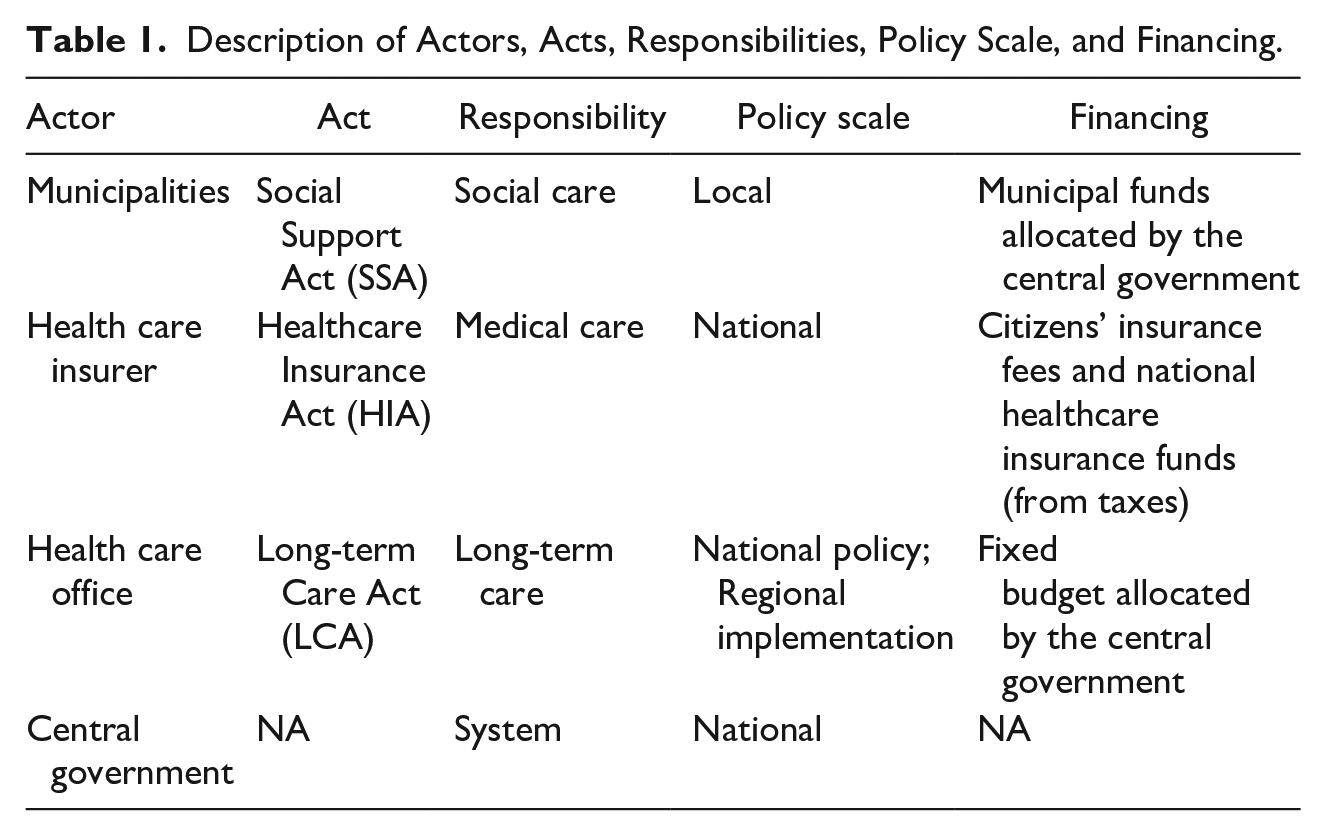
In 2015, long-term care tasks that used to be nationally organized under the Exceptional Medical Expenses Act (EMEA) were transferred to health care insurers and municipalities (see Table 1). This was supposed to make the health care system more cost-efficient and of higher quality. This reform was also referred to as “the decentralizations” and “the transition” by the field. As part of this reform, the central government mandated these new stakeholders to form health care policy networks and to become collectively responsible for organizing integrated care by connecting the medical-care domain (Health Insurance Act and the Long-term Care Act) to the social-care domain (Social Support Act; VNG, 2014). As Table 1 demonstrates, the parties responsible for the actors were, however, organized on different levels: The policy scale of health care insurers (which also represented the care office) was on a national level and the municipalities were organized on a local level, responsible for individual municipalities. This complicated collaboration between the actors. Although there was no jurisdictional basis on this “level,” the central government asked local actors to meet in the middle and to form two new networks on the regional level: one “narrow” table with the new financial stakeholders (municipalities and health care insurers) and one “broad” table that included all of the relevant actors (e.g., also health care providers, GPs, and client organizations). These actors, however, had no previous history of working together and, insofar they did have shared experiences, these, they said, “were not that positive.” Moreover, their widely divergent organizational arrangements further complicated collaboration. Health care insurers, responsible for a nation, opted for a more top-down “blueprint” approach, whereas municipalities were required to come to solutions tailor-made to the needs of citizens. To stimulate the creation of a network where none existed before, the central government took various measures, such as appointing regional “transition secretaries” made responsible for stimulating collaboration between the financing parties (i.e., the health care insurers) and awarding health care insurers special funds to finance district nurses who would coordinate care between the social and medical fields at the neighborhood level (S1-funds). These measures were implemented for the time leading up to the national transition, but were scheduled to cease shortly after.
Description of Actors, Acts, Responsibilities, Policy Scale, and Financing.
Methods
Structured to build a multisited ethnography (Hannerz, 2003), our fieldwork was conducted in various localities rather than in one: Instead of being bound by a single department or organization, our field could be more accurately described as a political location (Wittel, 2000). Fieldwork was not only focused on the individual organizations of various important stakeholders in the Dutch health care system, it was also conducted during regional consultations, that is, when these organizations intersected. Most of our data, which were collected between February 2015 and March 2017 and are based on participant observation, semi-structured interviews, and document analysis, were gathered during (interorganizational) strategic-level meetings.
Participant observation
As stated, observational data were largely gathered during meetings that were focused on strategy development. This article draws on observations from 40 meetings, of which 33 proved relevant to the topic of this article: 11 between only municipal actors, five between municipal actors and health care insurers, six between municipal actors and another group, eight between a broad range of participants, and three between other stakeholders. Our observational focus was on how actors made sense of changes both in terms of policy in the field and their own roles and relationships with other stakeholders. Observations were always combined with conversations with stakeholders before and after each meeting to learn about their expectations beforehand and reflections afterward.
Semi-structured interviews
Interviews gave us the chance to talk in depth with actors who were often difficult to reach in the field due to their busy schedules. This article uses data from 18 of our 24 interviews, conducted with health care insurers, municipal actors, regional transition secretaries, 2 one health care provider, and various GPs, and consultants. While interviews focused on topics similar to those that came up during observations, they were also open to the “flow” of the conversation.
Document analysis
Our analysis includes data from over 100 documents related to the meetings and decentralization plans, including procurement documents, meeting notes, emails, and participant evaluations regarding the “broad-consultation table.” Instead of systematically analyzing these documents, we used them for initial orientation and for gaining more insight into the different actors’ perspectives, frames of reference, and communications outside of face-to-face meetings.
Data analysis
Taking an abductive approach (Tavory & Timmermans, 2019; Timmermans & Tavory, 2012), we went back and forth between gathering data and theoretical exploration. First, we identified which data segments revealed the experience of tension around the governance problems local actors faced in their new tasks. Coding the data in MaxQDA, we then categorized each segment by its tension “type,” which quickly revealed how each tension could be traced back to centralization versus decentralization and integration versus differentiation. Next, we observed how actors used three strategies to respond to both of these tensions. To analyze these responses, we made use of paradox literature (e.g., Poole & Van de Ven, 1989; Schad et al., 2016). Defining paradoxes as “persistent contradictions between interdependent elements” (Schad et al., 2016, p. 6), studies using a paradox lens explore how actors cope with, and cater to, these competing elements (Smith & Lewis, 2011). Paradox literature therefore served as a first inspiration for interpreting participants’ strategies to cope with tensions, such as acceptance, spatial separation, temporal separation, and synthesis (Poole & Van de Ven, 1989). Moving back to our data, however, we realized we needed a more experience-near reading of participants’ strategies. We started out with a broad categorization of actor strategies: “avoidance,” “segmentation,” and “transcendence.” However, we aimed to add nuance to the broad strategies described in the literature and include the subjective practices of actors as well as their experienced agency to the neutral vocabulary of actor strategies. We therefore analyzed their responses in more detail. The first set of responses showed inaction and deflection of responsibility out of a sense of being overwhelmed and not experiencing room for maneuvering. The second set of responses showed actors feeling more empowered and finding ways to work with the tensions they experienced. The third set of responses showed how actors could reframe the challenges they faced and use the tension to their own advantage. We therefore arrived at three strategies that actors used to navigate the tensions of (de)centralization and collaboration: overwhelmed deflection, situational segmentation, and strategic reappropriation.
Findings
In the meetings we observed, local actors discussed the implications of the health care reform, negotiated conditions, and, in the process, frequently sighed some version of “The transition [to decentralized governance] is done, but the [actual] transformation won’t be for years to come.” To explain our analysis of how they dealt with their frustrations and responded to the tensions of network governance, we will now discuss how local actors positioned themselves vis-à-vis, first, the central government and, second, their local counterparts.
Navigating Decentral Discretion and Central Control: The Decentralization Tension
First, local stakeholders struggled both with shifts in power distribution and the central government’s changing responsibilities and authority vis-à-vis municipalities and health insurers. How did local actors interpret, and respond to, these tensions between central control and decentral autonomy?
Overwhelmed Deflection
The first reaction we observed to the tensions surrounding decentralization was overwhelmed deflection. Local actors voiced their discontent with the situation, blamed the central government, and expressed feeling little ability to take action themselves. On one hand, local actors seemed to feel genuinely paralyzed by their assignment’s confusing complexity and the large number of related policy changes. On the other hand, their sentiments may also be perceived more strategically: as a way of evading responsibility by accusing the central actor of, for example, giving them an “impossible assignment” (alderman, meeting notes), saddling them up with “really big budget cuts” (alderman, meeting notes) and “changing the rules along the way” (policy advisor, meeting notes).
Take, for example, local actors’ responses to the creation of an administrative decree that regulated the negotiation of pay rates for in-home care, which the central government had implemented after encountering a number of organizing problems related to its delivery. Most notably, in-home care providers had complained that they were not being paid enough for their services while municipalities had complained that in-home care providers were not being transparent about their costs. Conversations ensued between the care providers’ umbrella organizations and the Ministry of Health, but to little effect. In response, the central government’s decree both limited the ability of municipalities to organize in-home care and proposed set pay rates. This was not well received in the field. During a meeting about the transition, municipal policy advisors voiced their discontents. One of the policy advisors exclaimed, “I just think it’s nonsense that ‘it’s necessary.’ The decree is just one step closer to re-centralization.” The policy advisors at the meeting all expressed feeling that the decree had re-centralized some of their decision-making powers, which put a strain on the decentralized system and made them feel powerless. Instead of being empowered to make autonomous decisions about the delivery of in-home care, the government had taken matters into their own hands after care providers had complained.
Whether they truly felt powerless or were trying to evade responsibility, local actors blamed the central government for their own lack of influence in the decision-making process. Although these decentral actors were supposed to take the lead, they instead seemed paralyzed in the face of central control and surveillance. With a touch of resignation and a sense of victimhood, they drew on a familiar framing: the notion of a central government that, despite its own decision to decentralize, fails to relinquish control when push comes to shove. Rather than resolving the tension, local actors left it intact. Doing so allowed them to claim that the central government “talked decentral talk” without “walking the walk” while using a “you-villain, me-victim” framework to evade personal responsibility.
Situational Segmentation
Local actors also experienced tension between the central government’s authoritative powers and their own desire for autonomy when it came to measurement and evaluation. Actors in the region had doubts about the effectiveness of the central government’s efforts to gain insight into what was happening on the local level. Concretely, local actors did not understand why the central government wanted to evaluate only a few months after the transition had begun—way too quickly, according to them. They also expressed feeling indignant about regional comparisons given that each region had its own unique set of circumstances. Besides arguing against the effectiveness of such evaluations, coordinating actors claimed that the central government’s wish to be kept in the loop had an unintended effect: It made the municipal actors feel like they were being controlled, rather than empowered to function as autonomous actors. In an interview, one of the coordinators explained, Coordinator: The transition commission [installed by the central government] has set up a social-domain monitor [in the form of an evaluation system that uses traffic light colours]. Municipalities are constantly being called by people [from the transition commission] telling them, “You have to fill out the monitor now, that traffic light.” What do you think municipalities are going to do then?! They’ll put everything on green, of course. Interviewer: Ah, they won’t say, “This doesn’t work,” or “That doesn’t work”? Coordinator: No! Because if they did, they would be called—even if they’d only put it on yellow—and questioned: “What’s going on there?” That whole mechanism of control and that attitude of control, it makes you feel . . . [she cringes] Well, it makes you feel like “I’m being controlled,” “I’m not allowed to do something” or something like that.
Here, we found a different response to the (de)centralization tension: segmentation. Actors were responding to central control by presenting an outward appearance that differed from their backstage practices. To escape the authority and input of the central government, municipal actors fulfilled its demands while, behind the scenes, admitting falsification out of fear of central interference. By segmenting their frontstage and backstage behaviors, local actors were able to adjust to, and escape, central control.
The central government’s decision to combine decentralization with central control—that is, through close monitoring and evaluation—heightened the tensions felt by local actors, who felt they were being subjected to contradicting requirements—that is, municipalities should autonomously organize the decentralized care landscape and answer to centrally organized actors. The unintended effect of this policy was municipal actors’ aversion to conflict, which hampered central actors’ ability to gain the intend insights. Although municipal actors said they understood the government’s need for evaluation, they felt the scope of their expectations was unfair. As a result, central initiatives did not always succeed in producing their intended effect.
Strategic Reappropriation
Because the tension between central control and local autonomy led to frequent discontent among local stakeholders, these actors eventually developed ways to manipulate the central government to strengthen their own positions within the decentralized system. This strategy allowed them to bridge or transcend the tension, using central control to justify and validate their own choices, even at the expense of their other local partners.
One case in point was the discussion around the topic of prevention. Insurers were very reluctant to invest in prevention (e.g., by identifying and mitigating risks for elderly citizens who lived independently) as they felt this was “the municipality’s responsibility,” given that such prevention would not benefit them. To justify this lack of investment (and other “gray areas”), insurers often referred to the strict regulations: The question is: what are we allowed to pay for? Because, naturally, we only carry out what Mrs. Schippers [Minister of Health] says we’re supposed to. Which means we’re only allowed to cover the costs of services that have actually been delivered within the framework of the Healthcare Insurance Act. (Health care insurer, interview)
This insurer claimed their hands were tied. In the end, they argued that the health care insurer could not decide what to pay for and the (controlling) central government gave them little room to maneuver on a local level. Despite indeed being bound by a tight financial framework, there did seem to be more leeway than insurers cared to admit. As prevention became more of a concern within the decentralized system, the central government explicitly discussed the issue in a letter to the Parliament (Schippers & van Rijn, 2016): They stressed not only the importance of prevention but also the ways insurers could, and should, contribute to prevention—together with municipalities. As one coordinator summarized, The healthcare insurers say, “We can’t contribute financially because we don’t have an official filing number.” And the letter [of the central government] says, “Well, do we have to make an official filing number then? Because there’s already space [for insurers to contribute], so we don’t want to do that [create an official filing number].” (Coordinator, meeting notes)
In her eyes, insurers did have room to maneuver. The insurer’s strategy, of utilizing the central government’s control to manipulate their own decentral discretionary space, helped them instead “transcend” the central–decentral tension (at the expense of collaboration on the local level, an issue we will return to later).
Insurers’ financial partners—that is, municipalities—also deployed the reappropriation strategy, particularly to strengthen their own position vis-à-vis larger organizations, such as the health care insurers. Shortly after the decentralization, for example, the Ministry of Health summoned the region’s main insurer due to the many complaints from municipalities. In this case, the municipalities used the hierarchical position of the Ministry to pressure insurers to spend their resources on collaborative efforts. In a similar vein, one alderman anticipated using the central government’s position to force insurers to behave more collaboratively: “They [the insurers] are absolutely part of it [collaboration on the local level], and I hope it comes naturally and we won’t have to force it through the central government.”
In sum, both aldermen and insurers not only employed an overwhelmed deflection strategy—by portraying themselves as powerless victims vis-à-vis the central government to avoid the centralization–decentralization tension altogether—and a situational segmentation strategy—by selectively informing the central government to evade control—they also used strategic reappropriation to manipulate central control to their own advantage and to evade accountability. To strengthen their own position within the local network, they used one side of the tension—central control—to reinforce the other—decentral discretion.
Preliminary Conclusion: The Decentralization Tension
Local actors’ strategies demonstrate an inherent difficulty of governmental decentralization, the pursuit of which is often done under the assumption that, through collaboration, local actors will create something better and more cost-efficient. Governmental intent, however, does not always perfectly translate to local action. As illustrated above, local actors can strategically evade taking responsibility, avert central interference, and use central control to justify their own claims on a local level. In other words, network governance’s reliance on local actors’ initiatives may, ironically, compromise the success of decentralization. This becomes all the more clear when we zoom in on the collaboration aspired to by local actors.
Pursuing Integration and Differentiation Simultaneously: The Collaboration Tension
Local actors also struggled to put the policy vision of decentralized health care into practice because of its reliance on simultaneous integration and differentiation. As part of the decentralization plans, one single care act and its corresponding funds had been divided into three different acts, each with varying standards for different local actors in the health care system. This structurally imposed differentiation went hand in hand with policy documents that prescribed local actors’ collaboration to both integrate services and ensure the continuity of citizen care and funding. How did local actors make sense of, and respond to, this tension in their everyday work?
Overwhelmed Deflection
The tension between the desired policy integration and the differentiation of budgets, policy goals, instruments, and responsibilities—as detailed in the three new health care acts—manifested in so-called “gray areas”: situations in which it was unclear who was responsible for arranging care and funding for a particular client. While the three care acts had divided the health care sector into subfields, policymakers were simultaneously stressing the importance of cross-boundary collaboration. Municipal actors, we observed, found it difficult to put the policy vision of integration into practice. In a conversation between policy advisors regarding these “grey areas” and the patients who “fell between the cracks” of different care acts, one of them concluded, again implicitly holding the central government responsible, “It [the intended integration] all looks really nice on paper, but in reality we’re being forced to work in silos.”
As with the decentralization tension, local actors’ first response to the collaboration tension was overwhelmed deflection: Participants experienced tension between the desired integration on one hand and the structural differentiation on the other hand, unable to see a workable solution to the tension themselves. Instead, they blamed the health care system and the central government for legislation that “forced” them to both work in organizational silos and collaborate at the same time. Insurers also liked to point at the tension inherent to their assignment. When discussing the desired collaboration between the social and medical field in a meeting, for instance, one of them cynically commented, “The legislator creates a system with boundaries and then says we can experiment across those boundaries. That makes it seem as if the legislator himself also didn’t think it was such a clever idea.” Local actors blamed the central government for giving them an impossible assignment: They were supposed to collectively make autonomous decisions by engaging in collaboration with network partners, all the while being structurally separated in different subfields, with competing interests and under different acts. For local actors, the two tensions of (de)centralization and collaboration were interconnected: Their local discretion was tightly bound by a top-down assignment that simultaneously created differentiation and demanded integration on the local level. In their eyes, collaborative problems intensified as a result of their relatively powerless position vis-à-vis the central government.
Situational Segmentation
According to local actors, the joint imperative to “find solutions” was complicated by central legislation that prevented the insurers from exchanging information. This meant that the two insurers who structurally joined the strategic meetings with aldermen were not allowed to openly discuss information during such meetings. Local actors felt this impeded collaboration and blamed the central government, which was partly responsible for the legislation. During one of these meetings, an insurer tried to share their procurement strategy for the coming year with the aldermen: Insurer: That’s a condensed version—it’s actually much more extensive, but since the other insurer is sitting here we’re [not allowed] . . . Well, anyway, this is more or less our approach. Coordinator: Write that down Sarah [the fieldworker], it’s very difficult for municipalities that they [the insurers] are not allowed to talk to each other. (Meeting notes)
The actors continued to discuss how they could collaborate in spite of such legislative complications. For instance, necessary information was hinted at and kept out of the minutes. Rather than deflection, in this case the actors engaged with the tension by segmenting their frontstage and backstage behaviors, either by behaving according to the rules or by working around them, trying to find mutual solutions in a fragmented landscape.
One alderman commented, “In practice, everyone feels what’s necessary and they secretly act on that. But it’s ridiculous that that has to happen in secret.” This narrative unveiled how local stakeholders framed their own roles and responsibilities in the changing landscape, a sentiment that only became more prominent as a sense of urgency grew among the different stakeholders. For instance, during a meeting about long-term care procurement with municipal policy advisors, an office manager from a regional care facility stressed the importance of collaborating across organizational boundaries to achieve more seamless care: Municipal policy advisor: What you’re asking the care field to do is only possible to a limited extent, as long as the LCA [Long-term Care Act] isn’t changed. Do you know what I mean? Office manager of regional care facility: I know what you mean, but I also think—to put it bluntly—[don’t] sit back and wait for the outside world to change.
Following the strategy of deflection, the policy advisor portrayed the local stakeholders as powerless, emphasizing a lack of room to maneuver as long as the government upheld the current Long-term Care Act. The manager, however, framed the local stakeholders as being both empowered and responsible in the face of the challenges posed by the outside world. As she later added, “If we don’t act, if we don’t start trying, if we don’t enter into the conversation, then we know for sure that nothing is going to change.” Thus, according to the manager, local stakeholders should not wait for the outside world (i.e., legislation) to change—for it to “enable” them to work together—rather they should take the initiative themselves despite the current obstacles. In the examples above, the connection between the two tensions of collaboration and decentralization is apparent: The decentralization tension caused the actors to employ segmentation to both work around the “crippling” rules and make sense of how to collaborate despite the legislative prohibitions.
The collaboration tension was, of course, not only created by the tensions related to specific policy goals. It was also a result of the inherent fragmentation of the health care field. As one manager of a care organization stated during a meeting, “The health care field is extremely fragmented and you can’t deal with the whole map at once.” Accordingly, local actors focused first on their own subareas before trying to coordinate across boundaries. Although the collaboration tension is in this sense inherent to the entire field of health care, the decentralization tension exacerbated the dilemmas that already surround issues of integration and differentiation in the field.
Strategic Reappropriation
While complaints about the confusing lack of clarity were rampant, local actors also seemed to purposefully foster a sense of vagueness, strategically maneuvering through the no-man’s land that exists between integration and differentiation. Doing so created space for the development of joint initiatives and pursuance of personal objectives. While confusing and frustrating, the uncertainty of the situation also allowed them to establish their own terms of engagement (or nonengagement) when working together (or going their separate ways). In their pursuit of clarity and certainty, they often jointly agreed not to aim for tight control and strict rules, as such restrictions were said to be undesirable and counterproductive. Instead, local actors expressed a desire to “define a common direction, and not necessarily a common goal” (director client support, meeting notes) and to “search for a bit of clarity” (coordinator, meeting notes) rather than total transparency—for example, by establishing operational arrangements and ways to more quickly connect with actors in other areas of the field.
Local actors thus engaged in contradicting objectives. In their attempts to establish a working consensus within the newly established health care system, local actors invested in better understanding their partner organizations: how the partner organizations functioned, which legislation they had to work with, which problems they encountered, and with which individual members they could best connect. At the same time, however, they purposefully avoided developing strict arrangements between them by, for instance, loosely defining the assignment of a joint budget group as “to think philosophically about health care costs in the future” (project coordinator, meeting notes). Local stakeholders also preferred to keep their options open, as clarifying the rules of conduct and conditions for collaboration could potentially create new forms of fragmentation. Ironically, this could also lead to the exclusion of stakeholders in decision-making processes. As one coordinator explained in relation to an integrative project initiated by health care providers and insurers, “Municipalities are afraid that the medical domain will have soon figured out how to organize itself and, as a consequence, won’t be locally flexible anymore.” As a result, local stakeholders emphasized the benefits of abstract goals and undefined flexibility. For example, Policy advisor: You shouldn’t impose or want to be the boss. Coordinator: [Yeah, just] the governance has to be clear. Policy advisor: And then it will just happen. There are so many common goals.
Instead of drawing sharp lines around who was responsible for what (delimiting differentiation) or striving to close a detailed cooperation agreement (defining and enforcing integration), local actors often preferred to keep things between them imprecise and ambiguous. By eluding the demands of integration and differentiation in this way, they were able to transcend the tension.
Preliminary Conclusion: The Collaboration Tension
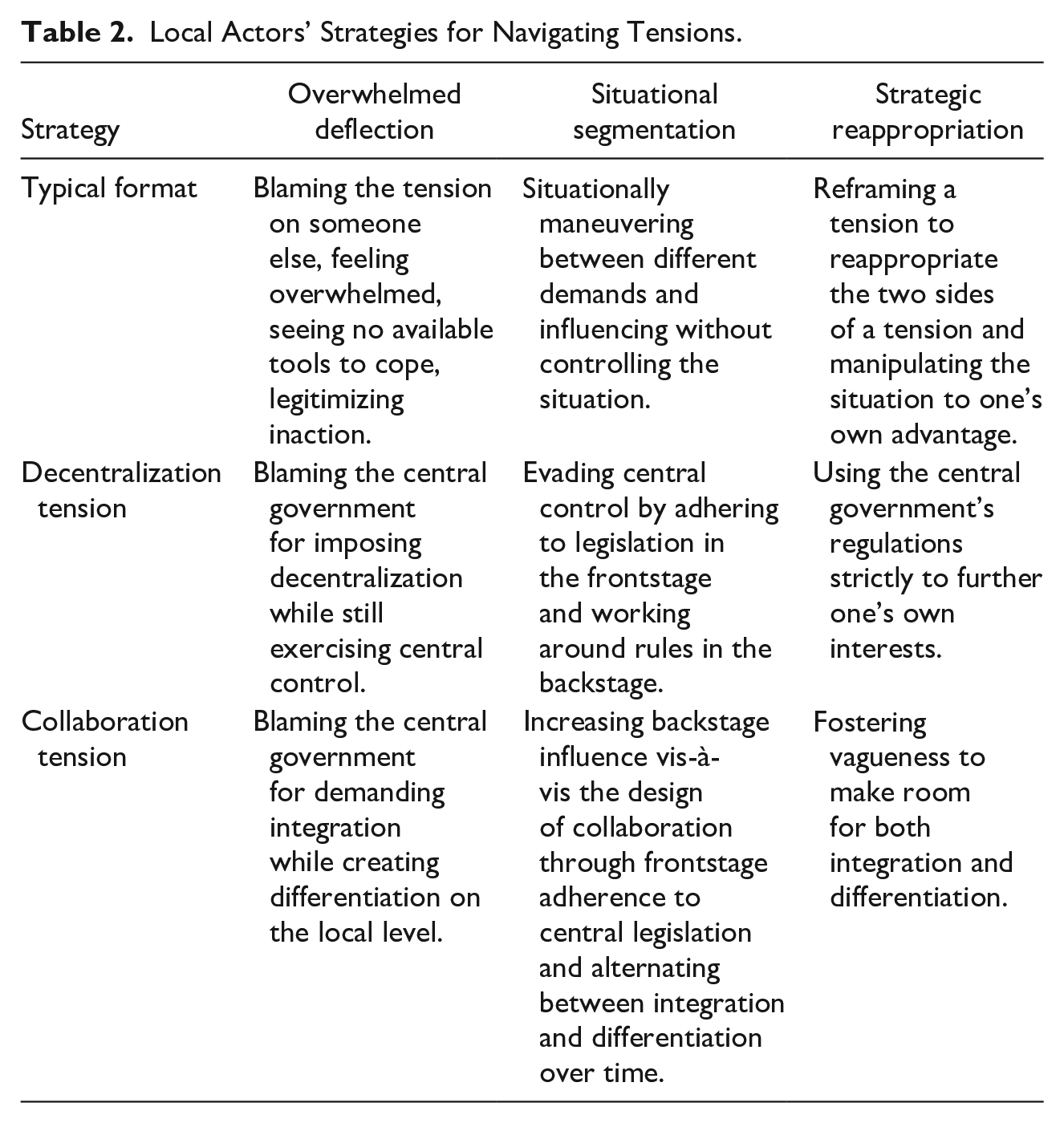
Achieving collaboration in a field as fragmented and widespread as the field of health care is a challenge under any circumstances. In our case, when collaboration was required by a decentralized government, it became all the more challenging. Local actors were forced to continue (if not improve) operations despite being increasingly disconnected from central instructions and increasingly left to their own devices. At the same time, there was still a great deal of uncertainty among local actors and their collaborative efforts remained a process of trial and error. We observed local actors who were required to translate central-level obligations to the local level and devise their own strategies to navigate not only the complex care landscape but also the tensions inherent to the mutual adjustment (integration) of a variety of stakeholders with different priorities and perspectives (differentiation; for an overview of the strategies, see Table 2).
Local Actors’ Strategies for Navigating Tensions.
Unintended Consequences of Actors’ Strategies to Navigate Network Governance
In our analysis, we distinguished and described two tensions inherent to network governance: one that revolves around vertical relations (the contradicting combination of decentral discretion and central control) and one that pertains to horizontal relations (decentral actors tasked with navigating both integration and differentiation in their efforts to collaborate). Besides proving analytically helpful, this distinction also allowed us to see that, empirically, the two tensions both intersect and interact and therefore reveal how actor’s strategies to navigate tensions also lead to unintended consequences. This was already evident in the central government’s assignment: implicating a combination of centrally imposed differentiation and decentral integration, the health care reform planted the seeds, and created the experience, of a collaboration tension. Likewise, local actors’ strategies for tackling one tension affected the effects of another tension. In response to the (de)centralization tension, local stakeholders resorted to inaction (overwhelmed deflection), putting up a facade (situational segmentation) and/or the co-optation of central control (strategic reappropriation). In turn, these strategies affected the collaborative relations that unfolded between local stakeholders (the collaboration tension). For instance, a strategy of overwhelmed deflection in response to central control (the first strategy we described) both facilitated and hampered collaboration between local stakeholders: By collectively lamenting the central government’s assignment and critiquing its top-down control, a common enemy was created. This broke the ice and improved network ties between local stakeholders, but also legitimized collaborative inertia. The strategies to navigate the (de)centralization tension thus had unintended consequences that affected the collaboration.
On the flip side, collaborative relations also affected how local actors positioned themselves in relation to central control and decentral discretion. When collaboration did not emerge spontaneously, for instance, the central government launched initiatives—exerting more of their central influence—to steer and facilitate the construction of collaboration on the local level, that is, by providing funds (“S1-funds”) to stimulate integration between the social and medical domains, and by appointing transition secretaries. In this case, the overwhelmed deflection strategy with regard to the collaboration tension thus led to a stronger emphasis on central steering in the (de)centralization tension. Similarly, when one local stakeholder was reluctant to work on a particular issue, the central government would use its central role to strengthen the position of the other local actor(s) within the decentralized constellation (e.g., to stimulate insurers to better facilitate prevention efforts, the government strengthened the position of municipalities). When collaboration on the local level did get off the ground, local stakeholders could then strengthen their local discretion and bypass central control, loosening the central government’s grip on them. This becomes particularly clear in the examples we described under situational segmentation: Local actors found ways to work around central legislation, implementing rules as they saw fit. In essence, the success of a strategy to navigate the collaboration tension on the local level decreased the influence central actors had on the decentralized system. Such knock-on effects were largely unforeseen and unintended, either facilitating or hampering the functioning of the network.
Discussion: Working With Tensions in Network Governance
The findings of this study have theoretical and practical implications for literature on network governance.
Theoretical Implications
Although network governance has become increasingly popular in research and practice (Börzel, 2011; Lewis, 2011; Sørensen & Torfing, 2007a), scholars have insufficiently addressed how networking actors navigate the tension they face during a transition from a hierarchically steering central government to governance through a plurality of local stakeholders. Instead, the literature has provided insights by differentiating between different modes (e.g., Provan & Kenis, 2007), shedding light on conditions that may influence the success of a network or building relations between actors (e.g., Bryson et al., 2015; Emerson et al., 2012), and considering how we can evaluate the outcomes of network governance (e.g., Kenis & Provan, 2009; Provan & Milward, 2001). At the same time, this literature is less well equipped to appreciate the on-the-ground intricacies of interactions between participants working toward a network. Consequently, Provan and Kenis’s account of different modes of network governance, for instance, enables and constrains our understanding by allowing us to show empirical complexities: We found traces of all three of these in the network, and the participating actors all had different takes on what would be a beneficial approach for the network to function in. Although the intention was to create a horizontal network, there were deep-seated cultural and political differences between the different actors. With this article, we thus aim to contribute to the extant literature by adding empirical detail and exploring actor’s strategies in coping with tensions when creating a network that does not neatly fit any prototypical mode of network governance. Indeed, we did not so much study a network, but rather each actor’s actions as he or she attempted to affect the actions of others in their strategic environments. With a focus on how actors made sense of, and constructed, local network governance efforts, we have thus been able to shed light on the three strategies such actors use in response to the contradicting tensions of network governance.
Our analysis also reveals why network governance may be so difficult to accomplish: The tensions of decentralization and collaboration are intertwined and reinforce one another. Concretely, the possibilities for central steering are bound by the effectiveness of collaboration on the local level, and the development of local collaboration is bound by the influence of the state. For example, when the local actors in our study addressed the decentralization tension by co-opting central control to strengthen their own position (strategic reappropriation), their actions inevitably reinforced their experience of the collaboration tension: Individual actors’ interests were placed above a common interest. In other words, scholars and practitioners should be aware that interventions designed to target one of the tensions of network governance may, perhaps unintentionally, (negatively) affect the other tension—creating a new range of challenges that then must be addressed.
Second, while paradox literature has described the different ways actors may react to paradoxical demands (e.g., Beech et al., 2004; Jarzabkowski et al., 2013; Lewis, 2000; Schad et al., 2016), our research elucidated the specific tactics actors may employ in response to tensions in the context of network governance. By doing so, we have revealed in more detail how these strategies play out in practice, whose interests these strategies may serve, and how this affects the efficacy of network governance. On one hand, our findings suggest that network governance can create unintended consequences and fail to meet its objectives: Rather than finding local solutions to local problems, the local actors in our study seemed to engage in overwhelmed deflection and inaction, situational segmentation and the putting up of a façade, and strategic reappropriation and the co-optation of central control. On the other hand, these local actors pursued such strategies to secure their local interests and to carve out room to maneuver and muddle through the competing demands of a contradictory assignment. These findings suggest that when local actors are granted autonomy in their efforts to collectively shape the decentralized care system, the result may not necessarily correspond to the central actor’s intentions, but—ironically and as intended—the outcome will be the product of a decentralized process. In other words, local actors may devise their own strategies to cope with central demands and central actors may only have a limited ability to influence the eventual shape of the local landscape.
Practical Implications
This article has important implications for practitioners. We have shown both that network governance comprises a contradictory mix of divergent policies and practices—a configuration that is at once centralized and decentralized, integrated, and differentiated—and that built-in tensions prompt local stakeholders to constantly consider and weigh action versus inaction, frontstage versus backstage performance, and public versus private interests. Although network governance has become increasingly popular in practice and may even be perceived by some policymakers as a panacea for wicked problems, we are certainly not the only ones to recognize that it does not live up to its expectations (Jessop, 2011; Rhodes, 2000a; Vangen, 2017). As we have shown in this article, the simultaneous pursuit of both integration and differentiation in a context of decentralization under centralized authority gives local stakeholders ample room to engage in networks on the basis of their own, and perhaps different, interpretations of the tensions inherent to network governance.
These findings importantly pertain to the central government, as well. Our study shows how one government’s initiative to implement network governance hugely affected the decentralized policy-making processes. However, our critical finding, in this sense, is that the effects at the local level were not necessarily consistent with the central actors’ vision. The strategies pursued by local actors in response to central steering efforts led them to act in ways that were perhaps unwanted and definitely unplanned. In other words, networks are not reified structures: It is not network management that produces network outcomes, but rather the decentered action of the actors, each in their own strategic environment. Unintended consequences are, therefore, in fact inherent to decentralization. Although central control enables and constrains local actors, these very actors also exercise their decentral discretion as they discover their own and different ways to work within the legislative framework.
Building on this insight for central governments, we suspect there is value to be gained from a network governance approach that tailors central policy initiatives to the different actors in a network rather than to an abstract notion of a network or to the allegedly shared policy problems all network partners are thought to face. Our findings underline that the demands placed on local stakeholders should not be underestimated. The decentralized integration of policy domains is a highly complex assignment, inherently ridden with contradicting demands. Having insights into, and strategies to deal with, the complexities of a network governance configuration would likely help local actors feel more influential and capable vis-à-vis the challenges they face.
Limitations and Future Research
This article illustrates some of the different challenges local actors face in the implementation of a decentralized health care system and demonstrates how they address these challenges in their attempts to implement network governance “on the ground.” These findings, however, should be interpreted within the context of our study, which focused on local actors operating in a care region that had followed a government-funded trajectory in preparation of the decentralization. Perhaps their experience of central control or influence was heightened because of this, and the tension between central control and decentral discretion all the more apparent. It would be interesting to explore whether actors in other regions and countries, as well as actors belonging to other types of organizations, construct the tensions of decentralization and collaboration in similar or different ways. For example, do they also acutely experience these tensions in their day-to-day work and do they pursue the same or different strategies in response? Also, as we did not study central-level stakeholders, we do not know whether and how their interpretations affected the process. It would be interesting to explore how central actors conceptualize such tensions, and how such tensions influence their actions and policies. Do central actors react to the tensions in network governance in ways that are similar or different to those of local actors? And which strategies do they use to influence local actors? Answers to these questions could not only provide a more rounded picture of how the tensions inherent to network governance are constructed and made sense of at different levels of government, they could also illuminate to what extent central actors both consider local actors as they interpret and shape policy changes, and expect local actors to work with (or around) central legislation. Subsequent research could explore these questions in more depth.
Conclusion
In recent decades, network governance research and policy has proliferated. The anticipated benefits of network governance in practice, however, have often failed to materialize due to the challenges involved with its implementation. So far, literature on network governance and management has tended to assume the stable existence of a network, which has resulted in the underexploration of the strategies employed by the participating actors (and the effects of these strategies on the establishment of network governance). This article has contributed by first taking the different “networking” actors as a starting point and then analyzing the various ways in which the individual local actors involved in a transition toward network governance responded to the tensions between, first, central control and decentralization and, second, integration and differentiation between local actors. Using a decentered approach, we have shown (a) how local actors adopted three different strategies when faced with the contradictory situations inherent to establishing network governance: overwhelmed deflection, situational segmentation, and strategic reappropriation. Our analysis of these strategies has also revealed that (b) stakeholders’ day-to-day handling of one tension affected the other: (De)central steering affected collaboration on the local level and vice versa. Central legislation, for instance, either complicated or facilitated local collaboration just like local actors’ collective maneuvering either triggered or compromised central control. The entwinement of these two tensions means that to fully understand how network governance is established, we must analyze the second-order effects of “networking” actors’ strategies. More generally, our findings underscore the methodological importance of up-close and in-depth research focused on local actors and the interactions between them. By using actors and interactions as starting points for research, scholars can generate a more grounded understanding both of how network governance is constructed and, given the gap between governmental intention and local (in)action, why it may lead to such contradictory and sometimes detrimental effects.
Footnotes
Acknowledgements
We would like to express our gratitude to Scott Poole for his insightful comments on earlier drafts. We also thank two anonymous reviewers for their constructive feedback on the paper.
Declaration of Conflicting Interests
The author(s) declared no potential conflicts of interest with respect to the research, authorship, and/or publication of this article.
Funding
The author(s) disclosed receipt of the following financial support for the research, authorship, and/or publication of this article: This research project was partly funded by the Ministry of Health, Welfare and Sport (VWS).
