




Abstract
While populism challenges the pluralism and technocratic expertise on which public bureaucracies are based, extant scholarship has overlooked its effects on accountability processes. In particular, it neglects the impact of anti-elite rhetoric, characterized by what can be regarded as “emotionalized blame attribution,” on the thinking and behavior of accountability actors. Responding to this gap, this article examines the impact of this distinctive form of populist rhetoric on accountability relationships within the bureaucratic state. It identifies three “stages” whereby these populist pressures challenge accountability relationships, threaten the reputation of accountability actors, and result in alternative accountability practices. In doing so, the article provides a roadmap for assessing the impact of anti-elite rhetoric on accountability actions.
Keywords
In countries worldwide, populist leaders have launched scathing attacks the institutions of liberal democracy by publicly challenging the pluralism and technical expertise on which public agencies, central banks, and supreme courts are based. In the United States, President Trump frequently attacked experts at the Environmental Protection Agency, disbanding several of its independent advisory boards (Executive Order No. 13875, 2019), and during the COVID-19 crisis, denounced advice on social distancing offered by his own advisory taskforce. In Brazil too, President Bolsonaro “has coupled defiant rhetoric with active sabotage of public health” (Reid, 2020) by encouraging his citizens to defy lockdown measures set by the country’s health ministry, and implemented by state governors. Recent years have also witnessed public attacks by populist politicians on central banks in countries such as the United States and Turkey; and in the United States, President Trump mooted packing the Federal Reserve with “unqualified cronies” (“The Independence of Central Banks Is Under Threat From Politics,” 2019). Populists frame their rhetorical attacks as increasing the “accountability” of expert bureaucrats, who they often frame as a morally suspect “elite” (Mudde, 2010, p. 1175); and it is clear that populism challenges the expertise offered by those public institutions that are essential to the functioning of any liberal democracy. Yet, in contrast to the wealth of research that has examined the electoral success of populist parties (e.g., Albertazzi & Mueller, 2013; Mudde & Rovira Kaltwasser, 2012) and the impact of populism on specific policy areas (e.g., Albertazzi & McDonnell, 2015), extant scholarship has largely overlooked the effects of populist pressures on public bureaucracies, and in particular on those public servants whose expert authority is publicly attacked in a climate of populist hostility. Indeed, despite the profound implications of populist attacks on public bureaucracies, and the resultant challenge for established accountability relationships, there has been limited cross-fertilization between research on populism and research on public accountability. This gap matters because the way that populism creates an “antagonistic relationship between the corrupt elite and the virtuous people” (Rooduijn, 2018, p. 363) is likely to challenge the unwritten rules and informal practices that structure crucial accountability relationships between elected politicians and their bureaucratic agents in democratic states; and in doing so destabilize the “public service bargain” upon which effective public governance depends (Hood & Lodge, 2006; Perry, 1996).
In response, this article shifts the focus from what makes populism successful to the impact of populism on public bureaucracies and the reactions of bureaucrats to its effects. Specifically, it examines the impact of the anti-elite rhetoric associated with populism on the thinking and behavior of accountability actors. Drawing on state-of-the-art research that has demonstrated the significance of informal or internal dimensions of “felt accountability” (e.g.; Hall et al., 2017; Overman et al., 2021; Romzek et al., 2012), and the importance attached to “reputation” by accountability actors (e.g., Busuioc & Lodge, 2016; Gilad et al., 2013; Schillemans & Busuioc, 2015), the article argues that anti-elite rhetorical attacks are likely to create bad faith in accountability processes, which manifests in how both principals and agents feel threatened when considering their reputation and when exercising their respective account-holding and account-giving roles. Flowing out of this, the article argues that anti-elite rhetorical attacks are likely to result in additional or excessive accountability demands on the part of politicians; and the withholding or communicating of information to alternative account-holders, on the part of bureaucrats. To make this argument, this article delineates three analytically interconnected stages at which the “public service bargain” and attendant accountability practices may be destabilized through anti-elite rhetorical attacks: a change of tone in the debate, a change of attitude toward the accountability process, and a change of behavior by the involved actors.
By developing this overarching argument, and by directing attention to the three specific stages at which “bad faith” is likely to manifest, this article responds to calls for “fruitful cross-fertilization” between subfields to inform “innovative new questions and hypotheses about populism” (Rooduijn, 2018, p. 369; see also Borins, 2018; Stoker, 2019). To make these contributions, the article proceeds as follows. It commences by providing a state-of-the-art analysis of current research on bureaucratic accountability that has focused on the reputational dynamics of account-holding and account-giving, and the ways in which various bureaucrats experience their accountability environment. It then examines the nascent body of scholarship that has begun to explore the general impact of populist pressures on public bureaucracies. Having brought together these two separate strands of scholarship, the article analyzes implications of anti-elite populist attacks for established accountability relationships via the three stages of “tone, attitude, behavior,” delineating a series of theoretically informed expectations about changes that may occur at each stage. The article concludes by providing a roadmap for future research on the impact of populism on accountability relationships to improve our understanding of how populism impacts democratic governance, improving the prospects for safeguarding crucial democratic norms of pluralism and expertise.
The Reputational Dynamics of Account-Holding and Account-Giving
To understand the destabilizing effects of anti-elite populist rhetoric on accountability relationships, it is first necessary to understand the underlying principles that govern the compact between elected politicians and their bureaucratic officials, i.e., the “public service bargain” that has been struck. The concept of the “public service bargain” draws attention to the trade-offs made in terms of “competency,” “loyalty,” and “rewards”; and, in turn, to the way in which these trade-offs result in a series of expectations concerning functions, roles and remit (Hood & Lodge, 2006). In broad terms, the classic Weberian “bargain” casts bureaucrats as loyal but neutral experts, whose discretion is rewarded with career stability in terms of appointment and tenure. Similarly, expert agencies usually work with a trustee bargain, where the agency is entrusted with significant autonomy to develop and apply expertise according to specified remit (Triantafillou, 2015; Wood, 2019). Thus, while varying according to context or regime, the core of any public service bargain revolves around an exchange whereby politicians offer career stability and blame-taking, and in return civil servants pledge their loyalty and expertise.
As this suggests, accountability is central to the effective working of any public service bargain, enabling the reconciliation of bureaucratic autonomy and (the possibility of) political control (see Mulgan, 2003). At its most fundamental, accountability can be understood as: a relationship between an actor and a forum, in which the actor has an obligation to explain and to justify his or her conduct, the forum can pose questions and pass judgement, and the actor may face consequences. (Bovens, 2007, p. 450)
The public service bargain presumes a degree of discretion for the public servant at any level of the hierarchy; and they are asked to account for their behavior, and given rewards or sanctions in return (Hood & Lodge, 2006). It also presumes that accountability relationships are underpinned by clear and prospective understandings of the respective functions of account-holders and account-givers. In other words, accountability relationships can be seen as facilitating or underpinning the workings of the public service bargain. Indeed, public service bargains can only function if both parties comply with their formal rules and informal norms in a cooperative equilibrium; and these rules and norms are critical in providing an organizing rationale for controlled bureaucratic autonomy, even when the business of practical governance is often messier. Simply put, elected political principals signal how they relate to their agents (the bureaucracy) by the ways in which they hold them accountable.
Traditionally, a large part of the literature on public accountability has focused on the formal rules and processes that structure accountability relationships between principals and agents, examining the formal stages in the “chain of accountability” that “mirrors” the chain of delegation which runs from voters to elected politicians and then to bureaucratic officers (Bovens, 2007; Przeworski et al., 1999; Strøm, 2000). Studies have tended to follow in Niskanen’s (1971) footsteps, and assume that “agency problems” such as omission (the bureaucrat fails to act in the best interests of the politician) and commission (the bureaucrat takes positive action that is contrary to the best interests of the politician) stem from a fundamental mismatch between the incentives and interests of principals and their agents (see Strøm, 2000). Flowing out of this, studies have sought to assess the conditions under which agency drift occurs and have examined the effectiveness of formal ex-post accountability mechanisms (alongside ex-ante selection mechanisms) to contain these agency losses (prominent studies include Lupia & McCubbins, 1994; McCubbins & Schwartz, 1984; Moe, 1984; for a useful overview see Gailmard, 2014). However, while these studies have offered useful insights into the way in which accountability rules and processes structure relationships between principals and agents, the emphasis on the formal paints a partial picture. This gap has been recognized by scholars such as Posner (2006), who argues that “informal accountability systems” have “an important impact in framing accountability” by “defining implicit standards for performance, expectations for implementation, types of information considered to be legitimate and necessary, and actions to be taken in response to perceived problems” (p. 80; see also Mulgan, 2003). Missing from this, however, is an understanding of how individual bureaucrats respond to such signals or manage tensions between formal accountability processes and informal accountability pressures. Thus, to fully understand the destabilizing effects of anti-elite populist rhetoric on how accountability relationships function, it is also necessary to examine the perceptions, experiences, decisions, and behaviors of bureaucrats under the psychological pressure of accountability.
Recent scholarship has shown that the functioning of accountability is critically influenced by how account-givers and account-holders think and feel about their mutually constitutive relationships (Overman, 2021). Instead of privileging the formal rules and processes that structure accountability relationships, this literature directs attention to the complex entanglement of obligations, audiences, and concerns about legitimacy. In particular, it has shown that effective accountability relationships are underpinned by reputational concerns and “felt accountability” (Hall et al., 2017) on the part of individual agents as account-givers, and on the part of the account-holders (Busuioc & Lodge, 2016; Overman et al., 2021) or any other “venues of influence” that enact account-holding (Waterman et al., 1998)
In terms of reputational concerns, several studies have demonstrated that the way in which agents and account-holders perceive their reputation affects how they fulfill their accountability obligations (e.g., Busuioc & Lodge, 2016; Carpenter, 2010; Doering et al., 2021). Both principals and agents are concerned with their reputation: a good reputation can build bureaucratic authority beyond legal boundaries; whereas reputational threats risk eroding such authority and discretion (Carpenter, 2010). Returning to accountability specifically, the accountability exchanges that occur between agents and principals and other account-holders provide an important stage for the public enactment of reputation. As Busuioc and Lodge (2016) state: Seen from a reputational perspective, accountability is not about reducing “information asymmetry,” moral duties, containing agency losses, or ensuring that agents stay committed to the original terms of their mandate. Instead, accountability . . . is about advancing one’s own reputation vis-à-vis different audiences, for account-givers and account-holders alike. (p. 92)
Indeed, this literature anticipates that “higher reputational investment” will result in “more intensive account holding” to demonstrate that “accountability is a core task for account-holders” (Busuioc & Lodge, 2016, p. 256). Conversely, reputational threats affect how agents provide information and “give account” to various account-holders, and how extensively those account-holders scrutinize this information. So, if accountability “greases the wheels” of public service bargains, then reputation “greases the wheels” of (formal) public accountability, with underlying reputational threats forming the basis of “voluntary” (Koop, 2014), “transactional” (Carpenter & Krause, 2012), and “self-imposed” (Bovens, 2007) account-giving and the “performance” of account-holding duties. Together, this literature draws attention to the way reputation is a commodity that can be won, lost, and rebuilt, in the “dialogue” between agents and their account-holders. As Busuioc and Rimkutė argue, “from a reputation basis, legitimation will come down to the politics of reputation: to how organisations legitimise themselves and how these attempts are received by relevant audiences”. In turn, this will necessitate “the deployment of ambiguity, and the strategic use of communications to shape regulatory image and actively manage expectations” (Busuioc & Rimkutė, 2019, p. 8, emphasis in original).
The key assumption here is that reputational threats to public sector organizations emerge in good faith, with the behavior of bureaucrats being shaped by commonly-shared and commonly-understood organizational or societal norms (e.g., Olsen, 2013; Tetlock, 1992). Such norms include reasonable and fair evaluation of, and respect for, facts and logic; common standards of ethical behavior; and, analytical and legal integrity. If a bureaucratic agency communicates clearly how it conforms to such norms (diffuse as they are), it can protect its organizational “turf” against encroachment from other actors, and its reputation will at least be evaluated against predictable standards (Carpenter & Krause, 2012; Christensen & Lodge, 2018). In turn, it is incumbent on relevant account-holders to treat information fairly, because those account-holders are themselves concerned with their reputation as responsible account-holders (Matthews, 2020). Reputational threats are hence likely to be clearly identifiable, with “threatening” events posed in a way agents can reasonably respond (Busuioc & Lodge, 2016).
The literature on reputation dovetails with a second body of work, which has examined the existence and impact of “felt accountability.” Simply put, “felt accountability” is the awareness on the part of account-givers that they will be held accountable, an awareness which is crucial to the functioning of accountability (Hall et al., 2017; Han & Perry, 2020). As Overman (2021) argues, “the causal link between accountability mechanisms on the one hand and desirable outcomes on the other is, thus, dependent on felt accountability”; and that within this, “the individual manager’s perception of accountability is a crucial linking pin” (p. 4). Again, the perceptions of individual bureaucrats matter in terms of shaping accountability behaviors, and it is also important to note that those perceptions of accountability are not restricted to the anticipation of accountability but also encompass notions of legitimacy and expertise (Overman et al., 2021). Indeed, the notion of “felt accountability” has antecedents in the work of earlier scholars who highlight the significance of concepts such as “values” and “professionalism,” such as Day and Klein, who describe actions based on values as reflecting an “internalised” sense of accountability (Day & Klein, 1987; see also Corbett, 1996; Leat, 1990). Individual bureaucrats are thus enmeshed in a web of accountability, connected to multiple account-holders or other “venues of influence” (Waterman et al., 1998). The accountability claims from some account-holders will be seen as legitimate while some others are felt to be illegitimate. Also, some of those account-holders have the required expertise to evaluate and judge one’s actions while others are mainly shooting arrows at a dark sea. Such distinctions are crucial to understand how individual bureaucrats respond to accountability (Aleksovska et al., 2019; Lerner & Tetlock, 1999), and to any threats that may destabilize existing accountability relationships.
Populist Pressures and the Challenge of Anti-Elite Rhetoric
Taken together, the literature above demonstrates the way in which accountability process are rooted in emotional and affective understandings of the interinstitutional and interpersonal relationships that individual bureaucrats develop, which evolve alongside the more calculated and strategic considerations that they give to their organizational reputation. In so doing, it reveals the significance of formal accountability rules and informal accountability norms for the effective functioning of the public service bargain that exists between elected politicians and their bureaucratic officials. However, as this section makes clear, despite the clear threat posed by anti-elite rhetoric for the delicate equilibrium such bargains hold, limited attention has been given to populism’s effects on public bureaucracies, particularly accountability relationships.
In recent years, liberal democracies worldwide has been confronted by a range of populist pressures that challenge the pluralism of democratic systems, and the legitimacy and relevance of expertise in public administration (Borins, 2018; Canovan, 1999; Mudde, 2010). The most obvious manifestation of such pressures is the growing number of parties entering office on anti-establishment platforms (see Albertazzi & McDonnell, 2015; Mudde & Rovira Kaltwasser, 2012). In addition to these direct pressures are a range of spillover effects, as populist parties have challenged the established order even when not entering national government. Evidence suggests the indirect influence of populism on specific policy areas, notably immigration, integration, and national security (e.g., Mudde, 2013; Van Acker, 2020). This broader understanding of the range of populist pressures accords with recent studies that focus on the communicative, performative, or stylistic aspects of populism (e.g., Engesser et al., 2017; Jagers & Walgrave, 2007). Moffitt (2016) draws attention to the “discursive” or “rhetorical” styles of populism; and Wettstein et al. (2016) distinguish between populism “as ideology, as strategy or as style” and the different channels through which populist “political communication” occurs. These insights are of crucial importance, sensitizing scholars to how populism manifests itself as a specific mode of political communication or framing; and that this is not the sole preserve of ideologically committed populist politicians. Drawing on these insights, this article adopts a broader understanding of populist pressures, focusing on the impact of “populist communication” that is “characterized by assigning blame to elites in an emotionalized way” by “drawing on the emotions of anger and fear” (Hameleers et al., 2017, pp. 870–872).
The essence of populist communication, as Hameleers et al. (2017, p. 874) state, is a “frame” in which political actors including politicians, political campaigners, and the media itself “blame the corrupt elites who are opposed to the people.” In terms of accountability specifically, it has been argued that populist communication reflects a “willingness to divert political accountability,” as “expressed in the forms of blame-shifting and exclusivity” (Vasilopoulou et al., 2014, pp. 392–400). Such emotional discourse has been shown to increase negative attitudes toward target populations (e.g., immigrants) among the public, and increase their demands for accountability (Wirz, 2018), but also to manipulate accountability relationships within the state. In one recent example from Donald Trump’s U.S. administration, the Department of Health and Human Services (DHSS) produced a report highlighting shortages in personal protective equipment in U.S. hospitals. When Trump found out about the report, he demanded the DHHS Inspector General explain the report, via twitter on April 7, 2020: “Why didn’t the I.G., who spent 8 years with the Obama Administration . . . want to talk to the Admirals, Generals, V.P. & others in charge, before doing her report. Another Fake Dossier!” (Ward, 2020). After this emotional outburst, the Inspector General was replaced, provoking claims from commentators Trump was pursuing a “war on accountability” (Ward, 2020, emphasis added). While Trump’s tweet did not override traditional accountability process, it challenged them through anger and provoked a response, leading to the Inspector General’s replacement.
Together, then, these studies suggest that the emotionalized blame attribution of anti-elite rhetoric risks undermining the “good faith” compact that underpins the public service bargain by destabilizing the established ground rules of accountability and informal understandings of “reputation.” Yet, as the introduction made clear, extant scholarship has largely overlooked the effects of this specific manifestation of populist pressure on public bureaucracies, and in particular on those public servants whose expert authority is challenged in a climate of populist hostility. Thus, while a Web of Science search conducted in June 2020 on “populism” in combination with “governance” or “bureaucracy” or “public administration” yielded 211 results, there were only fifteen peer-reviewed studies that specifically focused on the impact of populism on governance, bureaucracy or public administration (Andreucci, 2019; Arellano-Gault, 2020; Batory & Svensson, 2019; Borins, 2018; Buijs et al., 2014; Cortez-Vazquez, 2020; Du Gay, 2008; Green, 2019; Haggerty, 2007; Knott, 2019; Meier et al., 2019; Peters & Pierre, 2019; Rockman, 2019; Stoker, 2019; Vogelsang-Coombs, 2007).
This small pool of studies provides useful empirical insights about the impact of populism on established policymaking processes and institutions. First, populism has been deployed by political elites as a governing strategy. Vogelsang-Coombs (2007), for example, shows how populist governing strategies have been deployed by the U.S. municipal mayors to create conflict with stakeholders and to bring public sector organizations into public conflict with political elites. Second, and relatedly, populist discourse has driven radical policy change. Buijs et al. (2014), for example, demonstrate that the nationalist-populist discourse perpetuated by the Dutch Party for Freedom (PVV) influenced a dramatic 70% cut in nature conservation budgets after the 2010 election, despite decades of pro-conservation consensus. Third, there is evidence of populist governments misappropriating the tools of participatory governance to secure populist advantage. Batory and Svensson (2019), for example, reveal how Victor Orbán’s government in Hungary have utilized “deeply flawed” participatory processes to secure legitimacy for regressive, even authoritarian, policy outputs (p. 238). More broadly, several of these studies have sought to develop theoretical expectations about the nature of what can be regarded as “populist governance.” Peters and Pierre (2019), for example, argue populist governance is characterized by a loss of expertise and enhanced politicization; reflected in practices such as increasing levels of patronage and political interference in appointments, and the centralization and personalization of executive power (pp. 1527–1528). Rockman (2019) similarly suggests populist political leaders (in the United States in particular) aim to “unmoor government from the past and seek to have its future detached from expertise” (p. 1,565).
In turn, a handful of scholars have focused on the bureaucratic response to populist governance. Meier et al. (2019), for example, analyze the “bureaucratic pathologies” that can emerge as a result of “the failure of politics.” In particular, they draw attention to how “multiple demands from actors with the ability to withhold resources or to levy constraints on the agency” can encourage the bureaucracy to be “overly responsive.” This in turn risks “incoherent policies that shift with the political winds” or resources spread “too thinly for effective policy,” in addition to well-known bureau-pathologies such as “goal displacement” or “organisational cheating” (pp. 1589–1590). This formulation echoes what Koppell (2005) described aptly in a different context as multiple accountabilities disorder. Elsewhere, Du Gay (2008) considers the capacity for bureaucrats to exercise their professional agency in response to the instability driven by populism. In particular, he highlights a “template. . . derived from populist doctrines of political right,” which “requires bureaucrats to be responsive to the needs of their ‘clients’.” In other words, “populist doctrines” require a shift away from modes of neutral, objective thinking to “re-humanize or re-enchant official life” (p. 340). However, the likelihood of such responsiveness is challenged by Stoker, who argues that “technocratic,” “civic,” or “democratic” responses are all “unlikely to make a difference” and “runs the risk of missing the thrust of the populist attack.” Instead, he argues for a shift away from “the argument that expresses the democratic value of governance as primarily based on the idea that networks are a smart way of governing in a complex world”; and toward a recognition that governance procedures can be “open to revision; backed by a recognition that they can develop faults.” At the same time, this “defense move” needs to be accompanied by an explicit “ethical and moral” rejection of populism by actors within governance networks, which re-asserts that “it’s not just what works that matters, it is also what can be justified as good, right, fair and legitimate” (Stoker, 2019, pp. 14–15).
Reenacting Accountability Under Populist Pressures
Taken together, this small handful of studies articulate the urgency of analyzing populism’s impact on public administration and governance, as well as the potential strategies that bureaucrats and their organizations may deploy to deflect, preempt, or respond to its growing prevalence. However, while it has been acknowledged that long-standing pathological accountability burdens on bureaucrats may increase in times of political turbulence (e.g., Batory & Svensson, 2019; Meier et al., 2019), it is important to recognize that the “thrust of the populist attack” is specific and distinct (Stoker, 2019, p. 15). This is more serious than simply perpetuating widely recognized bureaucratic pathologies (e.g., the multiple accountabilities disorder identified by Koppell, 2005) and reflects the foundational distrust of pluralism and bureaucratic expertise at the heart of populism (Caramani, 2017). The challenge to accountability relationships posed by anti-elite rhetorical attacks therefore concerns the systematic erosion of the good faith assumptions that underpin effective accountability processes, which in turn fundamentally alters the way in which account-givers and account-holders understand their respective roles and their reputational domains.
In response, this article advocates an assessment of how individual bureaucrats and their principals reenact their respective accountability roles under the weight of such attacks. To support this objective, the remainder of the article advances a theoretically informed research agenda to examine the way that such populist pressures challenge existing accountability relationships, threaten the reputation of accountability actors, and result in alternative accountability practices. Specifically, it focuses on three analytically interconnected stages, as detailed in Figure 1: a change of tone in the debate, a change of attitude toward the accountability process, and a change of behavior by the involved actors. Taken together, these interconnected stages provide a set of theoretical expectations about how populist rhetoric may serve to destabilize accountability relationships that are crucial to the effective organizing rationale of public bureaucracy in particular, and governance effectiveness more generally, and allow for pluralism and expertise in governance. This section sets out these stages.
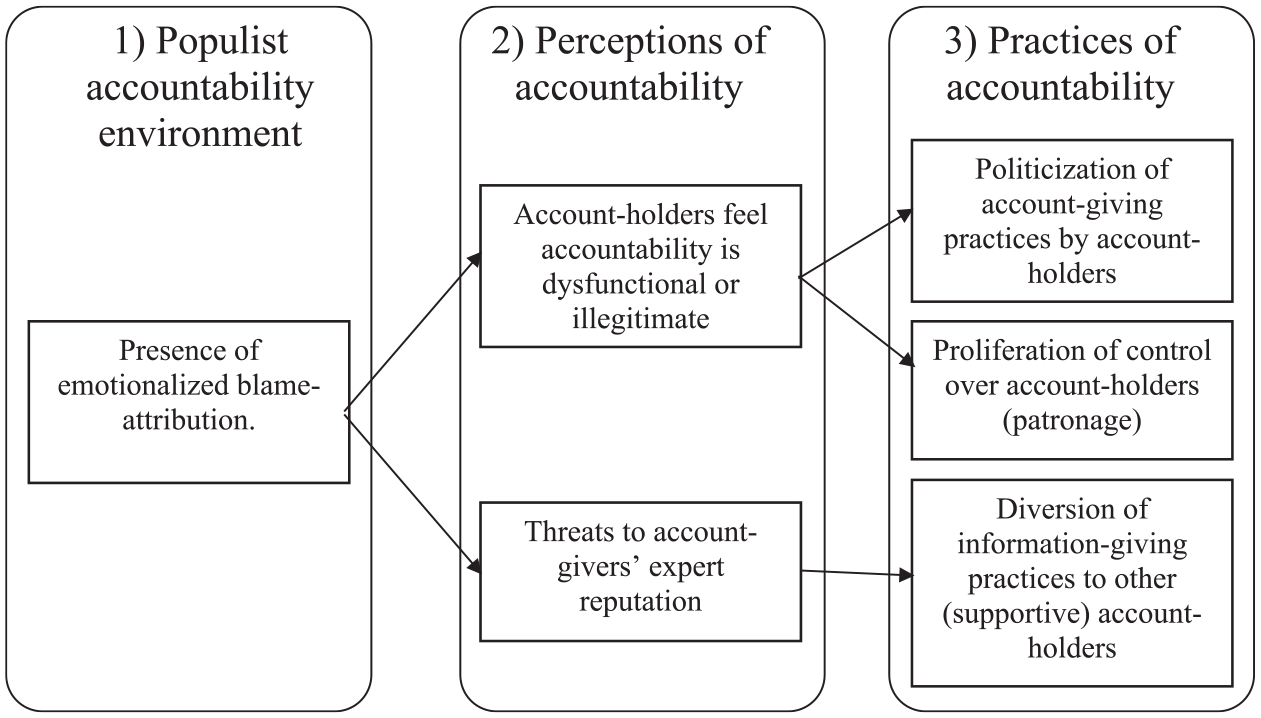
Populism’s challenges to public accountability.
Stage 1: A Change of Tone—Emotionalized Blame Attribution Tightens Accountability Pressures (Populist Accountability Environment)
Blame attribution is important in initiating or stimulating accountability processes. This can occur during crises or media controversies (Jacobs & Schillemans, 2016), in which blame avoidance and blame attribution are key dynamics, or in response to already emergent accountability “episodes” (Hood, 2010). It can also occur during more routinized processes of “learning” where various actors feed into processes of evaluation and feedback (Schillemans & Smulder, 2015). In contrast, however, emotionalized blame attribution is a specific accountability rhetoric that emphasizes “anger and fear toward threatening political elites” (Hameleers et al., 2017). Anger or fear can be expressed, for example, in outrage at a negative policy outcome (“something must be done!”), or disappointment at officials’ incompetence or alleged corruption (“you couldn’t make it up!”). Crucial to populist rhetoric is that “the elite,” referring to traditional political parties or leaders and experts in government, are blamed for outcomes which supposedly have a negative impact on “the people.” Advancing such rhetoric, populist actors may seek to strategically escalate demands for “consequences” for political or policy outcomes that they perceive as evidence of immoral or corrupt public leadership. In immigration policy for example, nationalistic populists in Europe and the United States attempt to “catastrophize” relatively banal statistical trends and claim evidence of elite conspiracy or cover-up. Commentators whip up emotive blame games about allegedly “lax” migration restrictions following the publication of new government data, to coincide with scrutiny by legislative committees. While such rhetoric is not restricted to populist politicians, this policy style thrives in an age of mediatization, which facilitates the rise of populism (Kriesi, 2013).
It is therefore necessary to pinpoint the existence of emotionalized blame attribution, both around specific “crisis” moments, but also surrounding routine accountability processes in relevant policy areas. Doing so sits well with the level of analysis of public accountability studies at organizational and individual practices and behaviors. Our approach therefore suggests public administration scholars first engage in interdisciplinary research, borrowing from communication studies, to focus on the prevalence of emotionally driven moralizing claims in the environment surrounding formal and informal organizational accountability processes. Whereas much extant research on “blame games” is focused on specific political crises and catastrophes that form the epicenter of blame attribution (e.g., Boin et al., 2010), the scholarship detailed above shows how emotionalized blame attribution can be disconnected from the “facts” of policy results on the ground—there need not be an objective crisis for populist emotionalized blame attribution to have impact. In addition, blame may be expressed in a personalized manner, targeting the individual’s, rather than the organization’s, expertise.
In turn, Stage 1 also requires scholars to map the wider network of actors influencing public accountability processes (e.g., Carpenter & Krause, 2012; Stoker, 2019) or that serve different account-holders (e.g., Busuioc & Lodge, 2016; Schillemans & Busuioc, 2015). Emotionalized blame attribution is likely to vary with the waxing and waning of populist parties, to either create pressure on accountability mechanisms or feed into standard accountability processes. It can also be higher for some actors than for others. As such, it is anticipated that when state actors exhibit such emotionalized blame attribution (populist parliamentarians and even ministers, as opposed to marginal populist interest groups and media outlets), the intensity of populist pressure on bureaucrats charged with coordinating relevant policy areas will be greater. This in turn may then impact how they consider their reputation, and how politicians perceive accountability processes, leading to Stage 2.
Stage 2: A Change of Attitude—Emotionalized Blame Attribution Challenges Perceptions of Accountability (Perceptions of Accountability)
Shared understandings of “reputation” are vital to the effective functioning of accountability relationships; and for bureaucrats specifically, “expertise” is a key reputational resource that enables bureaucrats to operate effectively at arms-length from their political principals. However, the way that populist rhetoric publicly negates the value of expertise and challenges the principles of bureaucratic neutrality (e.g., Peters & Pierre, 2019; Stoker, 2019) threatens the reputation of account-givers. This process destabilizes established understandings and expectations that constitute “felt accountability” for the account-giver. As a result, actors in the accountability relationship may change their attitudes toward each other. Stage 2 therefore focuses on the effects of emotionalized blame attribution in terms of its threat to the expert reputations of account-givers and in terms of the repatriation of powers to account-holders. In doing so, it separates out the cognitive effects of populist pressures in terms of interpretations and considerations (Stage 2), from the responses in terms of behavior and practices (Stage 3).
Existing studies have demonstrated that reputational “threats” have significant impacts on bureaucratic thinking and behavior (Busuioc & Lodge, 2016; Carpenter, 2010; Maor, 2015). Studies have also shown that bureaucrats experience competing reputational concerns (sector, agency, ministry, cabinet), and that the focus of reputational concerns varies according to seniority and task environment (Kolltveit et al., 2019). Moreover, “reputation” is not monolithic, but encompasses a range of technical, procedural, moral, and performative forms (Carpenter, 2010; Overman et al., 2020). Building on these insights, it is anticipated that under conditions of populist pressure, manifest through anti-elite rhetoric, bureaucrats will become highly concerned with their procedural or technical reputation as they seek to defend their legitimacy as impartial administrators and experts. Indeed, emotionalized blame attribution creates an atmosphere of scandal and panic, in which the most basic professional identities are held up to scrutiny. As such, it is anticipated that bureaucrats—whose raison d’etre is their neutral impartiality (Rothstein & Teorell, 2008)—will become highly concerned with maintaining their procedural reputation; and that those whose primary role is generating evidence-based expert regulations or recommendations, will become highly concerned with maintaining their technical reputation. Sorting reputational from non-reputational concerns is difficult, given that shaping reputation can involve simply performing one’s job effectively (Carpenter, 2010). However, because reputation management is an explicitly communicative affair (Busuioc & Rimkutė, 2019), it requires significant resource investment in functions for communicating outside the organization. As such, this article suggests populist-driven reputational concerns will result in budgetary resources shifting toward public relations, stakeholder management and communications, and away from internally facing departments.
These reputational threats are made more acute by the centralizing and politicizing dynamics of populism, which are driven by feelings and emotions on the part of political elites. As Peters and Pierre (2019) put it, a “move to centralize may arise from the feeling of isolation in a ‘system’ that is hostile, or because of a felt need to impose a program of change on that system” (p. 1528 emphasis added). Account-holders influenced by populism may feel that the bureaucracy is “hostile” toward them, or at least feel emotionally distant from “elite” bureaucrats. In other words, account-holders in central government may feel under conditions of populism, generated by populists or the wider media and public figures making populist claims, that account-givers are not being held sufficiently accountable, or not playing (or being seen to play) their part in the accountability process. They may therefore feel that stronger accountability measures are needed, in line with Peters and Pierre’s centralization expectation, which reflects a wider distrust of the prevailing political system as a whole. As this suggests, Stage 2 is also concerned with the feelings of account-holders about their accountability relationship with bureaucrats. The centralizing dynamic suggests that ministers and legislatures will feel the need to control and monitor their agents more aggressively, because of distrust in their purported professional goals. Importantly, these feelings are more subtle and pernicious than openly authoritarian. It would not be expected that ministers and parliamentarians become convinced of the need to strip civil servants and agency staff of their powers, but rather to feel—as a matter of emotion—that the accountability relationships with the bureaucracy have become frayed and drained of trust. In turn, it is also anticipated that this centralizing dynamic (and accompanying rhetoric characterized by emotionalized blame attribution) will further compound the feelings of reputational threat experienced by account-holders within the civil service and the wider agglomeration of agencies and satellite bodies about their neutrality and technical expertise. Locked in this seemingly vicious cycle of emotionalized blame attribution and deflection, it may therefore be anticipated the emergent changing attitudes of the actors involved toward the accountability system and, consequently, the emergence of an alternative set of accountability behaviors and processes as a response to such populist dynamics.
Stage 3: A Change of Behavior—Emotionalized Blame Attribution and Perceptions of Tightened Accountability Sparks Alternative Accountability (Accountability Practices)
Thus far, this article has set out a series of theoretically informed expectations about the anticipated cognitive effects of anti-elite rhetoric, often characterized by emotionalized blame attribution, focusing on how account-holders and account-givers think and feel about their roles under such pressures. It has suggested that account-givers (the bureaucrats) will experience growing concern for their reputation and about the legitimacy and expertise inherent in accountability demands, while formal account-holders (i.e., ministers and legislatures) experience declining felt accountability. In Stage 3, the focus therefore shifts to consider how account-holders and account-givers respond to populism in terms of concrete behaviors and interventions in their accountability relationships.
In terms of the response of account-givers, it is anticipated that the dynamics of centralization and politicization will encourage increasing levels of patronage and political interference in bureaucratic appointments. As Peters and Pierre (2019) put it, “Not trusting the government establishment will lead populist elected officials to the use of as many loyalists as possible in the government,” while “working actively to move officials whom they deem unreliable to lower-level positions” (p. 1528). While the installation of policy allies to high-level positions within public agencies has become an attractive strategy for governments worldwide (e.g., Ennser-Jedenastik, 2016; Hollibaugh et al., 2014; Thatcher, 2005), it has been argued the strategic use of patronage appointments enables elected politicians to reconcile the “natural tension” that exists between “firm control over public policy” and “the need for credible commitment” (Ennser-Jedenastik, 2016, p. 823; see also Panizza et al., 2019). However, it is anticipated that the lack of trust toward neutral bureaucrats and experts implicit in emotionalized blame attribution will result in the appointment of political allies to senior public office, who either actively share or are willing to reinforce emotionalized blame attribution. In other words, under conditions of populist pressure, patronage is redeployed as a tool of populist governance, as opposed to effective policy delivery. This has been witnessed in Hungary among others, where prevailing patterns of politicization (see Meyer-Sahling, 2008) have intensified under Orbán, with many bureaucrats being demoted or fired (Peters, 2020). Moreover, recognizing the critical distinction between the politicization of personnel decisions and the politicization of personnel processes (see Matthews, 2020), it is anticipated that systems of checks and balances (e.g., legislative committee scrutiny) may be diluted or bypassed—as has been argued in the case of Trump’s presidency (Johnson, 2020).
This article also anticipates that such overt acts of political interference will be accompanied by more subtle behaviors which are intended to undermine bureaucratic independence, such as reduced budgets or increasingly Kafkaesque accountability demands for reports, appearances in front of legislative committees, and communications with ministers. This form of “governmental” politicization should be distinguished from the “discursive” politicization in the public sphere (Wood & Flinders, 2014); and this article argues that actions such as increasing requirements for reporting imposed by elected representatives, coupled with contracting resources and slashed budgets, amount to a politicization of accountability relationships.
At the same time, this article is concerned with the impact of populism on account-givers’ actions. As detailed above, this article theorizes that bureaucrats will become increasingly concerned with their reputation as experts when populist discourse becomes widespread. Such a situation presents bureaucrats with several options for “responding,” which divert away from communication with their political principals, who they view with increasing suspicion and trepidation. As Stoker (2019) suggests, bureaucrats may seek to re-assert their reputation via a defensive strategy that emphasizes their expert credentials and their vital role in upholding the fairness, legitimacy and transparency of the policy process. Bureaucrats may also seek to “give account” to a wider range of audiences, as alternative account-holders, to attain trust, support, and legitimacy (Schillemans, 2011). Nonetheless, while recognizing the imperatives to seek alternative account-holding processes, Stoker also questioned the capacity of such strategies to buffer bureaucrats from populist pressures. This paints a gloomy picture of the practical capacity of bureaucratic agents to protect values of pluralism and expertise in government. This article instead anticipates the installation of populist political allies (and the demotion of critics) which will impinge upon the behavior of individual bureaucrats, encouraging them to be more subservient to their superiors or less confident in voicing dissent to senior colleagues and ministers (see Cooper, 2018). Faced with such a challenge to established working practices, it is also anticipated that the installation of populist political allies will—in time—encourage bureaucratic exits; as extant scholarship has already demonstrated the link between politicization and retention (Cooper, 2018) and the relationship between political instability and bureaucratic turnover (Rattus & Randma-Liiv, 2018).
Conclusion: Advancing Research Through Causal Identification
Populism has, over the past decade, changed accountability relationships between bureaucrats and political principals, a tension that goes much deeper than the widely researched pathologies of delegation documented in public administration. It raises fundamental questions about pernicious “democratic backsliding” where accountability relationships are subject to emotionalized blame attributions and disciplining, rather than nuanced and productive learning. In response, this article has argued that the impact of populist pressures on the thinking and behavior of political principals and their bureaucratic agents demands attention; and that that there is a need for the populism and public administration literatures to engage with each other. It has then detailed a series of interconnected expectations about the specific impacts of anti-elite rhetoric and emotionalized blame attribution on account-holding and account-giving in government. Drawing on concepts of “account-holders,” “account-givers,” “reputational threat,” and “felt accountability,” this framework theorizes how populism—as a style of political communication—may create a regime change in public accountability within liberal democracies, and anticipates a series of likely results. This is relevant, as populism challenges foundational principles of pluralism and expertise in democratic governance.
An important aspect of our theorizing is that it is centered at the organizational and individual levels. This accords with recent trends in public administration theory to advance productive, empirically testable propositions about the impact of macrolevel trends on how bureaucrats interpret their political environment, think about the pressures associated with their jobs, and subsequently behave in their roles (Jilke et al., 2019). Focusing on the anti-elite rhetoric of populism, this article concludes by providing a roadmap for future empirical research, and directs research toward a tightly controlled empirical analysis of relevant speeches, news reports, and similar empirical phenomena that are already shown to have an impact on behaviors in accountability relationships (e.g., Jacobs & Schillemans, 2016; Kolltveit et al., 2019). Future research should therefore build on this, to empirically test for the causal effects of anti-elite rhetoric and emotionalized blame attribution on bureaucratic behavior, focusing on the three interconnected stages outlined in this article. This forensic empirical work is crucial to go alongside the higher-level work on populism as an ideology and as a driver of democratic backsliding within the broader research field. It is the hope of this article’s authors that scholars will take up its theoretical propositions to test the effects of populism, emanating from anti-elite rhetoric and emotionalized blame attribution, to improve our understanding of the impacts of populism on democratic governance; and, more normatively, to defend the values of pluralism and expertise in advanced liberal democratic states and their bureaucracies.
Footnotes
Declaration of Conflicting Interests
The author(s) declared no potential conflicts of interest with respect to the research, authorship, and/or publication of this article.
Funding
The author(s) received no financial support for the research, authorship, and/or publication of this article.
