




Abstract
We focus attention on the public policy-making influence of frontline bureaucrats. They are increasingly operating in interorganizational partnerships and networks in which they develop collaborative relations with frontline workers of other public organizations. We theorize that their embeddedness in local interorganizational environments induces and enables them to defy locally inappropriate policies and to pursue locally relevant policies as policy entrepreneurs simultaneously. The case study of policy-making in Dutch civil–military crisis management demonstrates that this “frontline bureaucratic politics” bears considerably on policy outcomes. We conclude that viewing frontline workers as bureau-political actors enhances our understanding of public policy-making in interorganizational arrangements.
Keywords
Introduction
Frontline workers are increasingly operating in interorganizational arrangements, as the use of (semi-)permanent partnerships and networks is rising in the public sector (Durose, 2007; Keast, Mandell, Brown, & Woolcock, 2004; Sager, Thomann, Zollinger, Van der Heiden, & Mavrot, 2014; Weber & Khademian, 2008). 1 Consequently, frontline workers have to collaborate more intensively with frontline workers of other organizations during which they may feel induced to maintain good collaboration (Sorenson & Rogan, 2014; Thacher, 2004). At the same time, frontline empowerment and the changing dynamics of hierarchical control (e.g., Durose, 2007; Gofen, 2013) have enabled an expanded discretion of frontline workers. Therefore, the image of coping street-level bureaucrats (Lipsky, 1980) has been succeeded by one of active policy-making agents (Arnold, 2015; Durose, 2011; Kørnøv, Zhang, & Christensen, 2015; Mintrom & Norman, 2009). We aim to contribute to this new field of research by studying the origins and manifestations of frontline policy-making in interorganizational settings.
Traditionally, bureaucratic politics scholars have studied the process of policy-making in an interorganizational public management setting. The bureaucratic politics approach states that policy is a resultant of pulling and hauling among senior officials of public organizations with competing perspectives and interests (Allison, 1971; Halperin & Clapp, 2006). Recent studies confirmed once more that the study of bargaining processes among public-sector organizations is essential for understanding policy outcomes in areas as diverse as Chinese disaster management (Chen, 2016), German security institution reform (Brummer, 2009), and Swedish welfare state policy-making (Dahlström, 2009). However, these studies build on the traditional assumption that the struggles of frontline bureaucrats are a mere “microcosm of the higher-level decision-making” (Allison, 1969, p. 711; see also Keane & Wood, 2016; Rosenthal, ‘t Hart, & Kouzmin, 1991). Given that frontline workers in interorganizational arrangements may be induced and enabled to actively engage in their own local policy-making as well, we theorize that frontline workers are bureau-political agents in their own right. Using this perspective, our guiding research question is the following:
How do frontline workers in interorganizational settings negotiate vertical and horizontal pressures in the creation and implementation of public policies?
To answer this question, we build on bureaucratic politics theory, as well as literature on frontline work in collaborative settings. Both streams of literature put policy-making individuals at the center of analysis and are interested in why and how individuals promote policy perspectives. On the basis of our case study on civil–military crisis management in the Netherlands, we describe how frontline workers are caught between vertical directions and local expectations, and how they use their discretion to defy policy directions as well as to entrepreneurially design and pursue local policies. Their challenge is that their bureau-political activities need to remain acceptable to both their superiors (exercising vertical influence) and their local collaboration partners (exercising horizontal influence). We use our case study to make the policy-making influences of frontline workers in interorganizational arrangements tangible.
By studying the activities of these frontline workers as bureau-political, this research contributes to the “new narrative of frontline work” (Durose, 2007, p. 231). Our specific focus on frontline workers in interorganizational partnerships and networks, moreover, clarifies how frontline workers are often caught in role conflicts when working in hybrid policy implementation structures (Keane & Wood, 2016; Sager et al., 2014). In coping with these conflicts, frontline workers are likely to bring forms of divergence from policy intentions to the fore which can subsequently materialize in policy change (see Gofen, 2013). We thus show how tinkering “at point of delivery” has an effect on policies, particularly in light of the shift toward new governance and collaboration structures (Ellis, 2011, pp. 240-241; see Saetren, 2005, p. 573).
In the next section, the role of frontline workers in the bureaucratic politics literature is discussed and problematized. Subsequently, we describe how frontline workers in interorganizational arrangements face competing vertical and horizontal pressures. Next, we propose to view frontline workers as bureau-political actors that creatively mediate between these pressures. After some methodological reflections, the empirical part of this article demonstrates the relevance of this new perspective in the analysis of policy-making in Dutch civil–military crisis management. The final sections discuss the implications of the findings and conclude the article.
Bureaucratic Politics Theory
In his landmark book, Essence of Decision, Allison (1971) argued that policy decisions are the outcomes of bargaining games involving various governmental players. The framework posits that these players aim to exercise influence over public policy-making based on their positions, interests, backgrounds, and perceptions (Halperin & Clapp, 2006). Within certain action channels (i.e., standardized ways of policy-making on an issue), these players “pull and haul” in pursuit of preferred outcomes (Allison, 1969, 1971). The nature of this bargaining can vary from low-intensity consensus-seeking to high-intensity confrontations (Preston & ‘t Hart, 1999). Ensuing compromises lead to the policy outcome as the resultant of this bureau-political bargaining (Allison, 1969; Rosenthal et al., 1991).
In their explanations of policy outcomes, bureaucratic politics scholars tend to restrict their attention to strategic-level decision-making struggles and ignore the influence of frontline workers on policy-making. Instead of active and intentional policy-making, bureau-political scholars maintain that frontline workers negotiate policy specifics with other frontline workers in a competition that resembles strategic bargaining (Allison & Halperin, 1972; Halperin & Clapp, 2006). The limited research on interactions among frontline workers in the bureau-political literature confirms the hypothesis that they pursue organizational preferences in line with the directions of their organizational superiors during the implementation process (e.g., Rosenthal et al., 1991, pp. 218-223). Keane and Wood (2016), for instance, found that personnel in interorganizational Provincial Reconstruction Teams in Afghanistan were primarily guided by their own agencies in their actions and pursued incongruent goals as a consequence. Some bureau-political authors recognize that there may be internal organizational dissent at times as well (see Grauer, 2015; O’Leary, 2010), but local bureaucrats are portrayed as relatively powerless and their active deviance is perceived as exceptional (Brower & Abolafia, 1997; O’Leary, 1994).
Thus, policy-making is predominantly presented in bureau-political theory as a bargaining game among senior officials, whereas frontline workers may only in rare or minimal ways exercise influence over policy choices. In contrast, literature on frontline work in interorganizational settings demonstrates that frontline workers have horizontal pressures next to vertical directives and may thus also be induced to counter their superiors.
The Horizontal Pressure of Local Expectations
The bureau-political view on policy-making as a strategic-level decision-making process can, in fact, be contested, based on studies of frontline work, for ignoring the multilayer implementation problem. Therefore, it is worthwhile to pay closer attention to two shortcomings in the bureau-political view (Hill & Hupe, 2003). One is based in the misguided, normative assumption that there is a clear distinction between negotiating policy-makers and neutral policy implementers. The second concerns the fallacy that strategic interorganizational relations can be directly translated to operational interorganizational relations (Hill & Hupe, 2003). Opening up the “black box” of presumed neutral implementation (see Hupe & Hill, 2016), we instead assume that frontline workers may have divergent views (see Barrett, 2004; Hupe, Hill, & Nangia, 2014, p. 160). These divergent views may very well result from horizontal pressures on frontline workers in interorganizational settings.
In fact, the context in which frontline workers need to employ their public service activities is increasingly characterized by such interorganizational arrangements (Kapucu, Arslan, & Collins, 2010; Keast et al., 2004; O’Toole, 1997; Weber & Khademian, 2008). In practice, frontline workers in interorganizational settings are embedded in horizontal micronetworks that have their own rationales and interests (see Hupe & Hill, 2007). In these networks, they can nurture good working relations and may feel accountable to common local goals, resulting in preferences to avoid pursuing policies that evoke antagonism (see Sorenson & Rogan, 2014; Thacher, 2004). Analogically, this resonates with earlier research which finds that “private street-level bureaucrats” face competing accountabilities because it proves hard to “reconcile the rules of the state with the incentives of the market and/or the needs of their clients” (Thomann, Hupe, & Sager, 2018, p. 17). Similarly, frontline workers in an interorganizational setting may also grow concerned with (and feel accountable to) the competing interests of local collaboration partners and their home organizations, particularly when the interorganizational arrangement has a (semi-)permanent nature (Kalkman & De Waard, 2017; Sorenson & Rogan, 2014; Williams, 2002). Thus, these frontline workers are mandated to implement policies as directed by their superiors (i.e., vertical pressures), but their embeddedness in the local partnership or network also affects their views and actions (i.e., horizontal pressures; Chisholm, 1992; Thacher, 2004).
Frontline Workers as Bureau-Political Actors
As policy-making continues throughout the policy process, frontline workers’ deviating views can lead to actions deviating from strategic intentions, as they employ their (micro-)political policy-making influences (see Barrett, 2004; Hupe et al., 2014). More specifically, the loyalty to the local partnership can motivate frontline workers in interorganizational arrangements to pursue nonantagonistic consensus-based solutions against the wishes of their superiors (Chisholm, 1992; Sorenson & Rogan, 2014; Thacher, 2004). In other words, frontline workers can decide to defy their superiors’ directions for policy implementation, when these directions are perceived to be locally inappropriate and if the frontline workers opt to use their discretion for alternative actions instead. Just like bureau-political players, frontline workers may overzealously implement policy directions, disregard them, or make adjustments (see Halperin & Clapp, 2006). Thus, whereas Lipsky (1980) explained policy deviations of street-level bureaucrats by referring to employees’ attempts to cope with pressure, local collaboration interests may lead to an intrinsic motivation of frontline workers to occasionally defy vertical directions for policy implementation.
In addition, frontline workers have considerable discretion (see also Gofen, 2013; Lipsky, 1980; Maynard-Moody & Musheno, 2003), particularly when operating in partnerships and networks, and can wield their discretion in pursuing alternative ends as they both have professional autonomy and operate at a physical distance from their superiors’ gaze and control (Evans, 2011; Henderson & Pandey, 2013; Prottas, 1978). They can use their unique position in the existing social order, their expertise, and their considerable control over information and contacts that are crucial to the organization (Chisholm, 1992; Prottas, 1978) to design or pursue the policies that they deem appropriate. Thus, the traditional perspective on the frontline worker as being pressured and coping (Lipsky, 1980) has been replaced by the image of frontline actors as active and professional actors, who negotiate policy implementation (Johansson, 2012), promote professional values (Evans, 2011), and can resist politicization attempts (Cooper, 2018). As frontline workers have more room for innovation and action, they may even come to fulfill the role of policy entrepreneurs (Arnold, 2015; Durose, 2007, 2011; Kørnøv et al., 2015; Petchey, Williams, & Carter, 2008). Policy entrepreneurs are innovating actors who creatively facilitate policy-making. Policy entrepreneurship is a role traditionally reserved for high-level staff but increasingly believed to be carried out by workers on the frontline of organizational activities (see Arnold, 2015; Kørnøv et al., 2015). Frontline policy entrepreneurs use or create space for policies in a complex policy environment and pursue these locally designed policies in interaction or negotiation with central, hierarchical powers (Durose, 2007; Petchey et al., 2008). While earlier independent actions of frontline staff were viewed as questionable transgressions, current frontline workers are often enabled to go beyond mere implementation and use their creativity to develop public policies (Arnold, 2015; Durose, 2011; Kørnøv et al., 2015; Petchey et al., 2008).
After defying or developing policies, frontline workers must still “pull and haul” to rally support from their home organization and local partners for materializing these policies (see Allison, 1971; Arnold, Long, & Gottlieb, 2016; Johansson, 2012; O’Leary, 1994). In fact, in their active policy-making endeavors, frontline workers in interorganizational arrangements increasingly bear similarities to the governmental players identified in the bureaucratic politics literature, albeit with a more limited area of operation.
Theory-Based Expectations and Research Interests
From the theory, we derive two major expectations and resulting research interests. First, we expect frontline workers in interorganizational contexts to be subject to vertical pressures (i.e., top-down directions) and horizontal pressures (i.e., local expectations). In our case study, we will examine how exactly these local expectations influence frontline workers and with what consequences, as well as how the actions may subsequently be at odds with the desires of their superiors. Second, we suggest that frontline workers are actively involved in policy-making, both through deviance of top-down directions as well as by their entrepreneurial policy-making attempts to develop useful actions within the local network. In this study, we will more specifically unveil which bureau-political activities they employ to this end. By researching how frontline workers process diverging pressures and which bureau-political activities they use, we will be able to answer our research question and describe how frontline workers in interorganizational settings negotiate vertical and horizontal pressures in the creation and implementation of public policies.
Research Setting and Methods
Case Selection
Empirical data for this research were collected from civil–military crisis management in the Netherlands. This case fits within the bureaucratic politics tradition, which has often focused on policy-making in crisis and security management. Allison (1969, 1971), for instance, used the case of the Cuba crisis to outline the fundamentals of the bureaucratic politics framework. Although initially merely using the approach for explaining the Cuba crisis, he later proposed that “perhaps particularly in crises, organizations compete for roles and missions” (Allison & Halperin, 1972, p. 49). It is, therefore, no surprise that his followers often studied crisis and security policy issues as well. Halperin and Clapp (2006), for example, focus on the U.S. deployment of an antiballistic missile system, Keane and Wood (2016) look at U.S. agencies’ operations in Afghanistan, and Rosenthal et al. (1991) study a series of primarily domestic crisis responses. In line with this tradition, we focus on Dutch domestic crisis management, which is characterized by mandated and structural collaboration among various organizations (see Kapucu et al., 2010; Kapucu & Garayev, 2014; Saban, 2015). This may induce clear and open manifestations of bureau-politics between these organizations as they are competitively pursuing organizational legitimacy and future funding (Rodriguez, Langley, Béland, & Denis, 2007; Rosenthal et al., 1991; ‘t Hart, Rosenthal, & Kouzmin, 1993).
In bureau-political analyses, there is often considerable attention for the role of the armed forces in the management of crises (see Allison, 1971; Chen, 2016; Halperin & Clapp, 2006; Keane & Wood, 2016), because the military has a significant interest in maintaining its legitimacy by taking a leading role in crisis and security incidents. This renders the (frontline) military activities in crisis management policy-making highly relevant to our study. There is an additional reason to focus specifically on the armed forces in domestic crisis management. Recently, Western armed forces have increasingly preoccupied themselves with domestic crises. After traditional external threats had waned, these military organizations took on new tasks such as domestic safety and security provision (Clarke, 2013; Edmunds, 2006). The increasing domestic military role has prompted various struggles with established civilian crisis management organizations that view this military rise as a threat to their position (see Clarke, 2013). This renders civil–military crisis management collaboration a particularly appropriate topic for a study on the role of frontline workers as bureau-political actors.
By studying civil–military crisis management with a specific focus on military frontline workers, we aim to gain an understanding of frontline bureaucratic politics. Our case is descriptive, as we are interested in how policies are created and implemented in interorganizational settings, and specifically how frontline workers play a role in these policy-making processes (see Yin, 2012). Our case also as an “extreme” or “deviant” nature because the armed forces typically have a very strong hierarchy with limited freedom of action for its frontline workers. We suggest that if frontline bureau-politics even influences policy-making in a very hierarchical organization, it is a phenomenon worthwile studying in other settings too (Flyvbjerg, 2006; Yin, 2012). Moreover, by studying frontline bureaucratic politics in an extreme case, the basics of the phenomenon (i.e., the deeper causes and consequences of frontline bureaucratic politics) are more likely to come to the fore (Flyvbjerg, 2006).
Case Description
Civil–military collaboration in Dutch crisis management takes place on two levels. On the strategic level, organizational and ministerial decision-makers develop strategies and negotiate policies in national forums. On the frontline, most of the civil–military collaboration takes place in 25 Safety Regions, which are public authorities that have been set up to improve crisis management in their areas of responsibility (Ministry of Security and Justice, 2010). The Safety Regions bring together units and liaisons of different crisis organizations and thus host networks of crisis management actors. As Safety Regions are relatively autonomous, there is significant leeway in the regional implementation of nationally adopted (civil–military) crisis management policies (Kalkman, 2016).
Like the other crisis response organizations, the armed forces are represented in the Safety Regions by liaisons. As frontline workers, these military liaisons are tasked with implementing civil–military crisis management policies. Similar to other frontline workers, they are faced with task pressures, lack of resources, and involuntary clients (see Henderson & Pandey, 2013; Lipsky, 1980). Due to their professionalism, considerable discretion, and the interorganizational work context, they display characteristics of policy entrepreneurs (Arnold, 2015; Durose, 2007, 2011; Kørnøv et al., 2015) and are involved in the negotiation of policy outcomes (see Allison, 1971; Johansson, 2012).
Data Collection and Analysis
Whereas most studies on bureaucratic politics rely primarily on document analysis, the empirical part of this article is based on interviews and observations, conducted throughout 2016. In terms of sampling, we selected senior and frontline military officers by their relevance to the study. Thus, we identified 12 senior military officers working at the Ministry of Defense or at the Headquarters of one of the branches of the armed forces. We also selected 10 frontline military liaisons of different Safety Regions (which vary considerably in size and risk profiles) and different military branches (i.e., Army, Navy, Air Force, Military Police). In addition, 14 civilian officials, were approached and interviewed. Some of them were independently invited due to their known experience with military operations in crisis management, whereas frontline military liaisons selected others as civilian partners with whom they collaborated most. In total, 36 interviewees participated in the study. In addition, we conducted 15 days of observations at relevant events, such as civil–military training exercises and military liaison instruction meetings. Attendance at these events was arranged through respondents.
In the first phase of data collection, senior military officials were asked about their views on policies and practices related to civil–military collaboration in domestic crisis management. They were also asked about their views on policy implementation and their expectations of (and interactions with) military liaisons. In the second stage, military liaisons were interviewed to develop an understanding of their views on civil–military collaboration policies and practices. More specifically, they were questioned on factors as how they perceive and implement policies and pursue the directions for policy implementation of their superiors, as well as how they advocate their own views on civil–military crisis management. Aspects of discretion, policy interpretation, local interests, deviance, and policy entrepreneurship were extensively discussed. During military liaison instruction meetings, we paid specific attention to how military frontline workers and their superiors viewed recent policies and negotiated differences of opinion. In the civil–military training exercises that we attended, we looked at how civilian and military liaisons interacted with each other, spoke about their superiors, and overcame possible conflicts of interests.
All interviews were recorded and transcribed. Similarly, the notes made during the observations were typed out. The interviews and notes were subsequently coded by means of qualitative data analysis software (Atlas.ti). In the first coding, specific attention was given to views on public policy-making, the policy implementation process, organizational and local interests, the pursuit of these interests, and experiences with inter- and intra-organizational interactions. Over time, the coding became more specific and vertical and horizontal influences came to the fore while several bureau-political activities of frontline workers could be identified and reconstructed. The combination of interviews and observations provides for a detailed image of policy-making in Dutch crisis management. The main findings based on this rich data are presented in the next section.
Findings
We formulated two expectations and research interests on the basis of our theoretical framework. First, we are interested in how vertical and horizontal pressures influence frontline workers and with what consequences. Second, we aim to understand the dynamics of frontline bureaucratic politics. The empirical section is structured accordingly in two parts. We use Figure 1 to structure our empirical discussion.
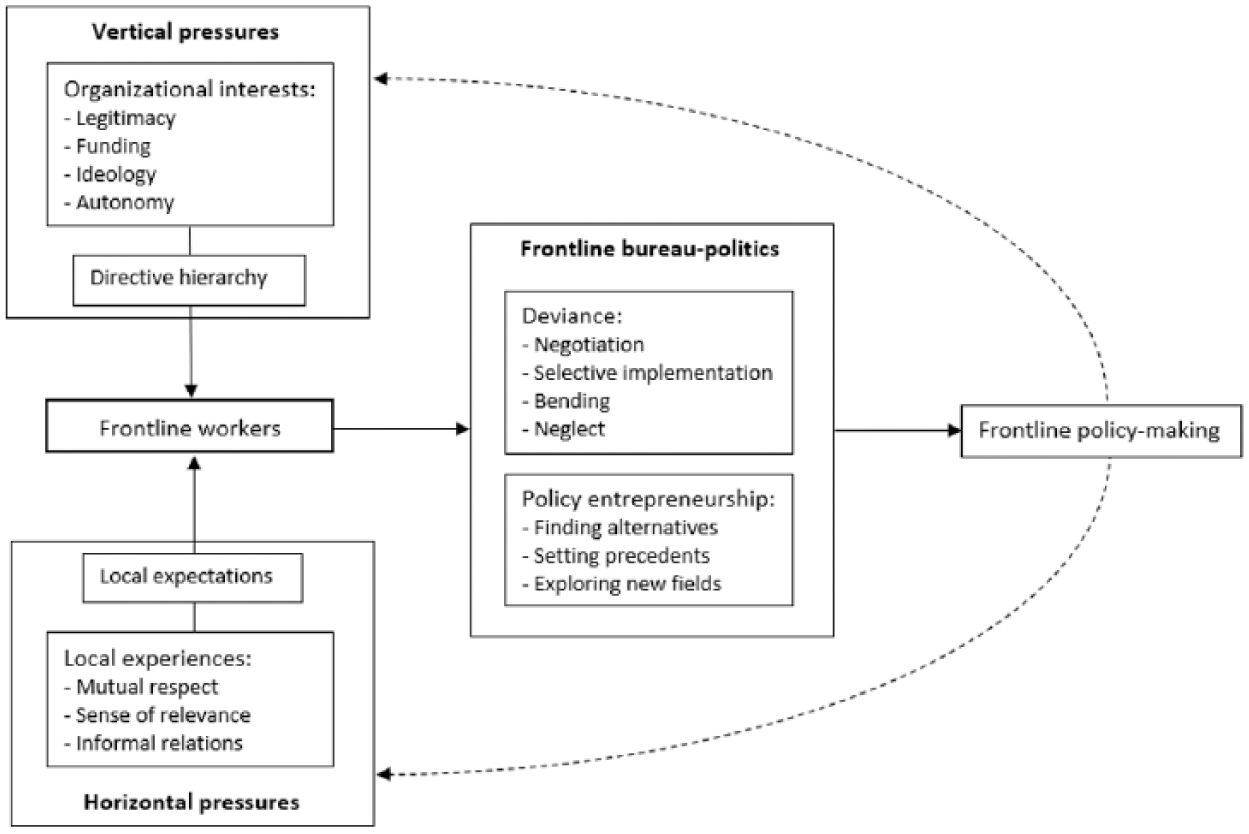
Frontline workers engage in bureau-political negotiations with superiors and local partners during policy-making. Resultant policies, in turn, set in motion new cycles of frontline bureaucratic politics.
Competing Pressures: Vertical Directions Versus Horizontal Expectations
Vertical pressures: Organizational interests
Frontline military liaisons are, first of all, subject to vertical pressures. Vertical pressures materialize in directions of senior managers within the armed forces to pursue military organizational interests. In fact, the Dutch armed forces have a strong interest in increasing their domestic military activities as a means to justifying the organization’s continued existence. The military leadership feels compelled to seek new tasks as traditional military duties appear less relevant with the waning of statist threats. Domestic military tasks provide an opportunity to enhance the military’s legitimacy by directly benefiting the population that funds it: What we can do for the Netherlands through our experience in war areas contributes to the creation of a positive image, and so we can find public support [for the armed forces]. (Interview, military officer)
The attempt to regain legitimacy in the public eye is the dominant motivation for the armed forces to expand its operations in the domestic environment. In addition, there are other organizational interests at stake. The armed forces take on some domestic tasks for ideological reasons (e.g., the military wish to provide explosive ordnance experts because it fits the organization’s profile) or to maintain a certain level of autonomy (e.g., avoiding sharing drones with the police by also deploying its drones domestically for policing purposes). The rising domestic role is further believed to ensure the continued flow of incoming funding or even expand it. One policy-maker declared that while tasks were switching from the other emergency services to the armed forces, [M]ore money should go to Defense because the police or fire brigade does not have to do it but Defense and it cannot be done for free. (Interview, military officer)
Vertical pressures: Directive hierarchy
On the basis of these interests, high-level officials of the armed forces engage in policy negotiations with their counterparts from civilian emergency services. Many of the resulting policies are sufficiently general to allow for considerable leeway in the implementation. As a result, high-level officials often give their frontline workers directions for policy implementation that are informed by organizational interests. In fact, military policy-makers view military liaisons as the organization’s advocates in the frontline partnerships and networks and give policy directions with little concern for the potential adverse reception: I know that I give my military liaisons specific tasks: start pushing in that direction for instance, regardless of whether that is terrible annoying. (Interview, military officer)
Top-level military officers expect conformity with their directions: In the domain of disaster response and crisis management or whatever you call it, there should be relatively little room for deviant opinions and procedures. (Interview, military officer)
If deviance does occur, they are not opposed to enforcement either: Many people must see the light, but there are also those who need to have held their feet to the fire. (Interview, military officer)
Horizontal pressures: Local experiences
In addition to vertical pressures, frontline military liaisons are subject to horizontal influences. At first sight, it is easy to spot differences between military liaisons and their civilian counterparts: The very structured thinking that we have, according to our guideline command, with thinking in objectives and scripts [ . . . ] that is completely absent here. The decision-making as they do it here, the process that they use, their [decision-making] model, I really don’t . . . I really call it into question. (Interview, military officer)
However, rather than criticizing each other, both military and civilian frontline workers report high mutual respect, aim to learn from these differences, and invite each other to give presentations on specific crisis management issues. In general, professional expertise is mutually recognized and respected. This also means that military liaisons feel relevant. They feel appreciated and useful as they can contribute by means of their particular (military) expertise in scenario-based thinking, long-term planning, and operating in crisis areas. Frontline military workers also report that they have established strong social relations with civilian partners over time. In turn, many partners are keen to involve the military liaisons both in their daily operations as well as in social events: Because you are invited here as well—and that is very important—invited to team-building activities [. . .] and then I also go. I enjoy that. (Interview, military officer)
The strong informal relations also lead to civilian attempts to keep military liaisons in their networks when their terms expire: So, then we filed a request to find out if [the military liaison] was allowed to and could indeed stay another term, and they met that request and confirmed it, so we were satisfied about that. (Interview, civilian official)
Horizontal pressures: Local expectations
As a consequence of the mutual respect, sense of relevance, and informal relations, military liaisons develop divided loyalties to their own organization and the local collaborative partnerships. They come to value the local interest as much as (or sometimes even more than) the interests of their home organization, rendering them unwilling to put forward military views. Military liaisons, therefore, do not take the confrontational stance of their superiors, regardless of pressures to this end, but instead perceive themselves as the builders of bridges between military and civilian entities. Being caught between these two pressures is challenging and alienating at times: But you’re really leading a double-life: [in] Defense and in the Safety Region. (Interview, military officer)
Frontline Workers as Bureau-Political Actors
Frontline bureau-politics: Deviance
In a hierarchical organization as the armed forces, frontline workers are not expected to, nor used to, challenge or develop policies. Nevertheless, virtually no policy direction was implemented at the frontline without some form of deviance. Primarily, military liaisons often criticized and negotiated inappropriate policies and policy directions. For instance, during one meeting with a ministry representative, military liaisons shared their (and civilian liaisons’) frustration about the process of requesting military capabilities (e.g., units, vehicles) as this process proved cumbersome, slow, and unclear to the requesting civilian authorities.
When such negotiations fail, military liaisons often selectively implement policy directions. For example, policy prescribes that military liaisons can be invited to crisis response teams to advise about possible military contributions. When such incidents occur or are trained for, military decision-makers want their liaisons to take a leading, proactive role by continuously recommending military capabilities. In practice, however, military liaisons take a more humble position: Something you can also do, and that’s what I did during my last crisis response training [ . . . ], I sat behind one of those PCs [points to a corner in the room]. [ . . . ] Since in the script, a long time nothing happened in which Defense could play a role, the fact I was sitting in the back, that was fine. (Interview, military officer)
Military liaisons also bend policies. For example, a military official was asked for military logistical support to the health services in transporting medical supplies, but his superiors rejected the request which should have finished the case. However, the liaison then arranged a military logistical training that “happened” to exercise providing this exact same logistical support. Thus, this “training” met the civilian request while policy was not strictly violated as the training, as opposed to the support mission, did not require top-level approval. Similarly, after a ministry representative had defended the cumbersome and slow processes of requesting military capabilities (as mentioned in the example above), one frontline military worker admitted that he “just writes down what they want to hear,” so that they grant the request.
More rarely, liaisons are willing to neglect directions in the local interest. Exemplary, policy prescribes a dominant role for the Army in providing support to civilian authorities, but liaisons do not feel bound to this. Instead, one liaison refused Army-support, which was ordered by his superiors as the right policy interpretation because he considered Navy-support to meet the civilian request better. Corresponding with the general policy interpretation and as customary, Army officials sent subject matter experts (SMEs) to advise the requesting party before the support mission, but the liaison refused to receive him as well and invited a Navy-SME instead: I didn’t care at all about that, so when I needed a SME, I called a SME who was one and not one who only pretended to be. (Interview, military officer)
Frontline bureau-politics: Policy entrepreneurship
The significant bureau-political role of military liaisons is also reflected in their promotion of policy aims that emanate from their local interactions with civilian liaisons (i.e., policy entrepreneurship). Policy entrepreneurship is sometimes a response to inconsiderate policy implementation directions of superiors. Exemplary, liaisons were instructed to get a permanent position in their regional crisis response teams, but one liaison knew that his collaboration partners considered this unnecessary and wished not to antagonize them. He built a case by reviewing past crises and showed his superior that the military could rarely play an active role in crisis response in his Safety Region, after which the direction was rescinded. As more liaisons had questioned the rationality of this goal, the liaisons instead proposed an alternative solution. They suggested to be “on call” and join the crisis response team when civilian liaisons think military support might come in useful during a specific crisis. This was accepted by both civilian and military organizations as the new policy and is now documented as the standard.
Also, in many crisis incidents and training exercises in which the military is active, retrospective analyses show that the military liaisons’ active lobbying inside their organization influences which military capabilities are deployed. Resulting military activities do, however, set a precedent for future incidents of a similar nature, even in fields that have no immediate priority to military decision-makers. This is possibly most visible in senior military officials’ wish to provide high-tech, high-visibility military deployments. In most training exercises, however, military liaisons arrange “boots on the ground” that carry sandbags to protect against flooding, which senior officials now feel compelled to provide in every new flood exercise.
To a large extent, finally, liaisons guide the policy directions of civil–military crisis management as well. While military liaisons were originally tasked to merely focus on crisis response, they explored new fields for military contributions and found opportunities in crisis preparation (e.g., crisis training exercises) and non-crisis tasks. The military’s Advanced Search Teams, for instance, proved to be extremely useful in searching buildings for drugs, weapons, and money: We have learned of course in mission areas to search with special devices [. . .] for hidden ammunition and weapons. Well, those techniques and those devices we use, appear to be very useful in assisting the police in the Netherlands. (Interview, military officer)
Liaisons’ continued efforts to convince their superiors of the local need for military support in these fields have reoriented the scope of policy-making on civil–military collaboration to become much more demand-focused.
In conclusion
While senior military officials intend to induce their liaisons to implement policies in such a way that they think military interests are best defended, liaisons also have other concerns, arising from their interactions with local partners. Thus, they defy orders if they deem it necessary, as well as use their discretion to entrepreneurially promote local plans which form the basis for new processes of policy-making. The role of military liaisons in frontline policy-making is highly valued by local civilian partners, many of whom mention that their perception of the armed forces, in general, has considerably improved over the last decade due to military liaisons’ activities: For a very long time, as inhabitant of the Netherlands, I doubted the use and necessity of Defense, [but] because of [the military liaison] who took me by the hand [ . . . ] I have just been happily surprised by the possibilities that the Defense organization offers. (Interview, civilian official)
Discussion
Our first research interest was how frontline workers in interorganizational settings deal with conflicting vertical and horizontal pressures. Although bureaucratic politics scholars have presumed that frontline workers pursue the same goals as their superiors (Allison, 1971; Keane & Wood, 2016; Rosenthal et al., 1991), we find that frontline workers are not just subject to vertical pressures. Instead, as frontline workers hold very different positions than their superiors and presuming that “where you stand depends on where you sit” (Allison, 1969, p. 711; Allison, 1971, p. 176), it is inevitable that frontline workers have different views than their strategic colleagues. Being located in (semi-)permanent networks and partnerships, horizontal pressures emerge and role conflicts become unavoidable (Keane & Wood, 2016; Sager et al., 2014). Specifically, we find that frontline workers feel respect for civilian liaisons’ expertise, realize that they can usefully contribute to local crisis management endeavors, and develop strong informal relations with civilian colleagues. As a result, they feel divided allegiance between their own organization and the local partners. Thus, they prefer to build bridges between civilian and military entities instead of unwaveringly pursuing military organizational goals. Therefore, policy deviance does not always need to be a result of work pressures that impose coping behavior (see Gofen, 2013; Lipsky, 1980). Instead, to Lipsky’s (1980) list of causes for policy deviations, we can add that frontline workers occasionally actively and intrinsically defy policies in the interest of frontline collaboration.
Second, we derived from theory the supposition that frontline workers, particularly those working in interorganizational settings, may have considerable discretion and use this discretion to play an active role in policy-making. This suggests that frontline workers may be similar in some ways to the governmental players in the bureau-political literature (Allison, 1971), but the question remained which strategies frontline workers employ. We find two main categories of frontline bureaucratic politics. First, military liaisons defied imposed policy directions that were inappropriate in the collaborative structure (see Chisholm, 1992; Sorenson & Rogan, 2014; Thacher, 2004). Specifically, we find that frontline workers negotiate, selectively implement, bend, and neglect policy directions. Second, military liaisons displayed a creative use of their discretion in entrepreneurially developing and advocating innovative policies for which they negotiated support among their superiors and collaboration partners (see Durose, 2011; Johansson, 2012; Kørnøv et al., 2015). In more detail, we recognize that frontline workers find alternatives for inappropriate policy directions, set precedents through their actions, and guide policy-making through exploring new fields. The resulting policies feed back into new cycles of bureau-political policy-making. This research thus sheds light on how frontline workers bring about policy changes in new forms of public management (Durose, 2007; Ellis, 2011; Sager et al., 2014) and demonstrates that the defiance of locally unacceptable organizational directions and the pursuit of local ideas prove essential activities of frontline workers in interorganizational settings (see Arnold, 2015; Arnold et al., 2016; Gofen, 2013).
By extension, we found that the policy process is a (bureau-)political process (see Mintrom & Norman, 2009, p. 650), in which frontline workers are bureau-political actors who can exercise decisive influence over policy outcomes. This conclusion corresponds with the idea that the separation between policy formation and implementation is flawed because implementation involves “negotiation and bargaining between those seeking to put policy into effect and those upon whom action depends” (Barrett, 2004, p. 253). At the same time, it corroborates the idea that public policy is a resultant of the sum of the actions of all actors involved (Allison, 1971). These insights in the bureau-politics of policy-making (Mintrom & Norman, 2009, p. 650) may evoke normative criticism (O’Leary, 1994), but occasional deviance and intra-organizational debates can foster beneficial outcomes for the organizations involved as full use can be made of available expertise (see Lindqvist, 2016; Petchey et al., 2008), which means that the policy “gap” should not necessarily be seen as a failure (Hill & Hupe, 2003).
Conclusion
We studied the policy-making role of frontline workers in interorganizational settings. In these settings, frontline workers are subject to both vertical pressures (i.e., directions of organizational superiors) and horizontal influences (i.e., expectations of frontline collaboration partners). Consequently, frontline workers feel a divided allegiance and aim to resolve competing role conceptions through their bureau-political activities. They defy inappropriate policy directions and entrepreneurially develop locally relevant policies. Frontline bureau-politics thus bears considerably on policy-making in interorganizational arrangements and appears essential in accounting for policy outcomes in these settings.
Further research could reinforce and contextualize our findings in multiple ways. We studied frontline bureaucratic politics in the armed forces as an “extreme case.” The armed forces are a hierarchical organization in which frontline staff have formally little room for deviance or policy entrepreneurship. If frontline workers in this organization manage to exercise considerable influence over policy-making, frontline workers in other interorganizational public management settings are similarly likely to affect policy-making in significant ways (e.g., Harrits & Møller, 2014; Henderson & Pandey, 2013), warranting more research on how policies are made and implemented in these contexts (Saetren, 2005, p. 573). Next, the partnerships and networks studied in this research were governed rather loosely, giving frontline workers much liberty in their local environment (i.e., the Safety Regions). It would be interesting to see how the bureau-political activities of frontline workers materialize under different forms of network governance (see Provan & Kenis, 2008). From a civil–military perspective, the Dutch armed forces are not necessarily representative either. In countries in which the armed forces have a more prominent societal position, organizational interests may clash more fiercely in civil–military interactions and military liaisons may be less inclined to take into account partner organizations’ concerns (cf. Keane & Wood, 2016). The degrees of bureau-political activism, negotiation styles and success also varied among frontline workers. Further research is needed to explain this variance to provide a fuller image of frontline workers’ motivations, bargaining styles and to unveil which factors (e.g., network position) contribute to their success (Arnold, 2015; Arnold et al., 2016; Durose, 2007; Ellis, 2011; O’Leary, 1994). Finally, other studies viewing frontline workers as active bureau-political actors will undoubtedly further enhance our understanding of public policy-making and improve explanations of policy outcomes by building on the findings we have reported here.
Footnotes
Acknowledgements
The authors would like to thank two reviewers and the editor for their insightful and constructive criticisms, which were extremely helpful in revising the manuscript.
Declaration of Conflicting Interests
The author(s) declared no potential conflicts of interest with respect to the research, authorship, and/or publication of this article.
Funding
The author(s) received no financial support for the research, authorship, and/or publication of this article.
