




Abstract
Existing research on bureaucratic encounters typically studies how bureaucrats’ and clients’ characteristics influence frontline decision making. How social interactions between street-level bureaucrats and between officials and citizens could directly affect case-related decisions largely remains an underexplored field of study, despite the fact that new forms of governance introduce social dynamics in the form of trust and collaboration as tools to increase legitimacy. Relying on in-depth qualitative data of the Belgian labor inspectorate and the Dutch tax authorities, this study scrutinizes how decisions about cases could be affected by their immediate social context.
Introduction
The relationship between frontline officers and citizen–clients has always been at the core of street-level bureaucracy literature (Bartels, 2013). It has gained importance with the introduction of New Public Management reforms—aiming to increase performance and legitimacy—that have led to the reformulation of the bureaucratic encounter as a businesslike arena, where officials are responsive to citizens’ (or clients’) needs and demands (Vigoda, 2002). Citizens then become more involved in the process of public service delivery. Post-New Public Management movements, based on notions of participatory governance, even point to a more horizontal relationship, where officials collaborate with citizens and other stakeholders to deal with complex problems (Bartels, 2013; Vigoda, 2002). The process and outcome of frontline decision making has hence come to depend on interactions between officials and citizens (Bartels, 2014). Such trends are visible not only in public service delivery but also in public organizations preoccupied with law enforcement like tax and inspection authorities (e.g., Mascini & Van Wijk, 2009). Inspectors, typically perceived as “state-agents” (Maynard-Moody & Musheno, 2000), are, for instance, encouraged by their organizations to negotiate with citizen–clients about settlement agreements. This brings the social interaction between officials and citizens to the center of frontline decision making. Research on how social dynamics of such an interaction affect decision making is, however, scarce (Bruhn & Ekström, 2017).
Furthermore, street-level bureaucrats are embedded in professional networks with coworkers and peers as actors giving support and advice when needed (Brehm & Gates, 1997; Lipsky, 1980; Maynard-Moody & Musheno, 2000; Vinzant & Crothers, 1998). Nowadays, it is assumed that new service pressures such as multiproblem clients even require multiprofessional action (Noordegraaf, 2011, 2016). Therefore, new organizational arrangements are arising that enable collaboration between different agencies and professionals, thereby avoiding fragmentation (Groeneveld & Van de Walle, 2011; Noordegraaf, 2011). In various sectors, such as health care and social services, programs are set up in which frontline workers across agencies work together to improve quality and availability of social services (e.g., Mccallin, 2001; Sandfort, 1999). Inspectorates too engage in partnerships and work in multidisciplinary teams of inspectors on common issues, based on shared discretion (Rutz, Mathew, Robben, & de Bont, 2017). Noordegraaf (2011) points to the complexity of such multiprofessional interactions, resulting from possible clashing professional cultures, difficulty in exchanging knowledge, and other practical problems. Social dynamics between officials within such interdisciplinary teams are said to add to this complexity. Their impact on frontline decision making is, however, an underexplored theme within the literature.
Thus, in the call for more responsiveness, horizontal relationships with citizens and other professionals are introduced into public organizations, implying negotiation with clients and collaboration with peers. Whereas the street-level bureaucracy literature has described how frontline decision making is embedded in official–client and collegial interactions, it mainly focused on either client or official characteristics (e.g., Maynard-Moody & Musheno, 2003). What has thus far largely remained out of sight is the impact of social dynamics in which street-level bureaucrats operate, involving interactions with clients and peers, both in uni- and multidisciplinary teams (but see Rutz et al., 2017). This is striking, given that such complex social dynamics in frontline decision making are becoming increasingly important in governance nowadays (Bartels, 2013; Yang, 2005). To address these gaps, this article aims to answer the following research question:
The aim of the article is to generate insight in the different ways in which social interactions could directly affect decision making, that is, not by looking at socialized rules, shared cultures, norms, and beliefs, but at how decisions about specific cases are shaped by their immediate social context. We thereby not merely look at the role of social context in substantive considerations about a case, but also at how relational aspects of these interactions, that is, what happens “in-between” (Bartels, 2013, p. 475) the involved actors, could affect decision making. Comparing different social frontline constellations of two inspectorates (labor inspectorate and tax authorities), and relying on the methods of storytelling and observations, this article analyzes how frontline officials’ immediate social context could affect case-related decision making. The data gathered in these two originally independent case studies are used because they allow us to compare different frontline social constellations.
This article will bring the street-level bureaucracy literature further by (a) addressing the call for research on the role of social context and social dynamics in street-level work (Bruhn & Ekström, 2017; Siciliano, 2015) and (b) answering the call for more comparative research in street-level bureaucracy, which is important to increase knowledge about frontline behavior in various contexts, but which is still scarce (Hupe, Hill, & Buffat, 2015; Pollitt, 2013).
The Social Context of Frontline Decision Making
Within public administration, different streams of literature focus on the social context of street-level bureaucracy. We shortly discuss the socialization, professionalism, and accountability literature, which all focus on how frontline officials’ social context may indirectly affect decision making. We argue that more insight is needed in how street-level bureaucrats’ social context may affect case-related decisions directly, that is, how decisions may also be shaped by situational social dynamics of an interaction that could go beyond officials’ reasoning and considerations about a case.
The socialization literature shows that attitudes and identities of newcomers to public organizations become more homogeneous over time (Moyson, Raaphorst, Groeneveld, & Van de Walle, 2017), by which they become organizational members (Oberfield, 2014). Officials learn the ropes of the job by relying on their (in)formal networks of colleagues for information and social support (Hatmaker, Park, & Rethemeyer, 2011), and communication with colleagues increases uniformity in law enforcement (Van Kleef, 2016). Learning is primarily about acquiring information about the organization, the technicalities of the task, and appropriate behaviors (Hatmaker et al., 2011). In line with this approach, recent studies have begun to analyze the role of social network structures and composition in street-level innovation and performance (Maroulis, 2015; Siciliano, 2015). The professionalism literature adds that the transfer of knowledge and expertise is facilitated by professional associations, institutional arrangements, and shared education (Schott, Van Kleef, & Noordegraaf, 2016). Studies have also concluded that professional norms shared by frontline officers affect street-level decision making (Maynard-Moody & Musheno, 2003; Sandfort, 2000). Both literatures offer valuable insights in, respectively, the impact of social networks on learning processes of newcomers and the role of professional norms. However, their scope is too limited for the purpose of this study, given their focus on the homogenizing influence of peers or on similarities across officials. Differences in decision making between officials remain underexplored. Moreover, the focus is mostly on the structural aspects of peer networks and on more generic outcomes such as performance, innovation, and learning. How social interactions could directly affect decision making about specific cases is not explored.
The accountability literature broadens the perspective by emphasizing the role of not only vocational associations, peers, and colleagues but also other actors surrounding street-level bureaucrats. Hupe and Hill (2007) mention three fora of public accountability, being (a) professional accountability (also addressed in socialization and professionalism literature); (b) public-administrative accountability, including performance indicators, managerial oversight, and the rule of law; and (c) participatory accountability, including citizens and interest groups. These fora form a “complex institutional web” (Hupe & Hill, 2007, p. 290), in which street-level bureaucrats are confronted with different, possibly contradicting, demands from actors they are accountable to (Behn, 2001). In specific situations, street-level bureaucrats either try to find a workable balance between them (Thacher & Rein, 2004), or consider the demands as possible repertoires they can choose from, thereby strengthening their discretion. This literature thus provides a general framework of actors to whom street-level bureaucrats are accountable, but does not offer any insight in how case-related decision making is shaped by these accountability fora, and to whom street-level bureaucrats feel accountable (if they indeed do so). Hence, more insight is needed into the underlying processes that explain how actors surrounding street-level bureaucrats shape frontline decision making about specific cases.
Some studies do offer some clues as to how social dynamics between officials and citizens and between coworkers may affect street-level decision making. The study of Bruhn and Ekström (2017) on frontline interactions, for instance, shows how decisions are designed in interactions with citizens and how “the progression of the conversation is conditioned by the client’s acceptance of the decision” (p. 206). Furthermore, they show that even in a street-level context with strict rules, these rules are negotiated in concrete interactions with citizen–clients, and argue that the application of rules should be seen as “interactional achievements” (p. 199). Nielsen (2007) moreover shows that street-level inspectors’ treatment of citizens being regulated is dependent on characteristics of the interaction; the higher the level of negotiation and cooperation, the more lenient the inspector’s enforcement is. That study points to the relevance of the frequency and quality of interaction for how citizen–clients are treated. In line with street-level bureaucracy scholars arguing that interactions between street-level officials and citizens are underexplored and deserve more scholarly attention given the centrality of these interactions in the public sector (e.g., Bartels, 2013; Bruhn & Ekström, 2017), Nielsen (2007) contends that, in the regulation literature, the interaction between inspectors and inspected parties is mostly treated as a black box, mixing characteristics of inspectors’ actions with characteristics of interactions. How interactions are performed is usually conceptualized and measured as part of inspectors’ enforcement styles, which can be strict, lenient, or both. Studies on explaining enforcement styles generally focus on external factors such as the organizational setting, political environment, and the attitudes of the inspector (May & Winter, 2011; Nielsen, 2007).
With regard to interactions among coworkers, Keiser (2010) shows that, even without a high level of interaction between street-level bureaucrats, individual street-level bureaucrats’ decision making is shaped by their perceptions of how other colleagues would make the decision. It is held that expectations or knowledge that other organizational units would overturn particular decisions discourages street-level officials to make such decisions. Furthermore, in line with street-level bureaucracy studies, Rutz et al. (2017) show that inspectors working individually sometimes consult colleagues for advice or specific know-how. They also show that teams with shared discretion have a greater action repertoire and mandate, because inspectors can make use of other inspectors’ authority and abilities. That study mainly shows how inspectors purposefully rely on coworkers to act both consistently and responsively.
This current study builds on these studies by exploring how social context, including more situational social dynamics, could affect case-related decision making in different frontline social constellations (i.e., encounters with citizens, informal networks, interorganizational teams).
Description of Research Contexts
This article shows the results of two case studies, respectively, conducted in a Belgian labor inspectorate and the Dutch tax authorities. Focus is on cross-context, and not cross-country comparison, exploring how interactions with citizen and peers affect case-related frontline decision making.
Case Study in a Belgian Labor Inspectorate
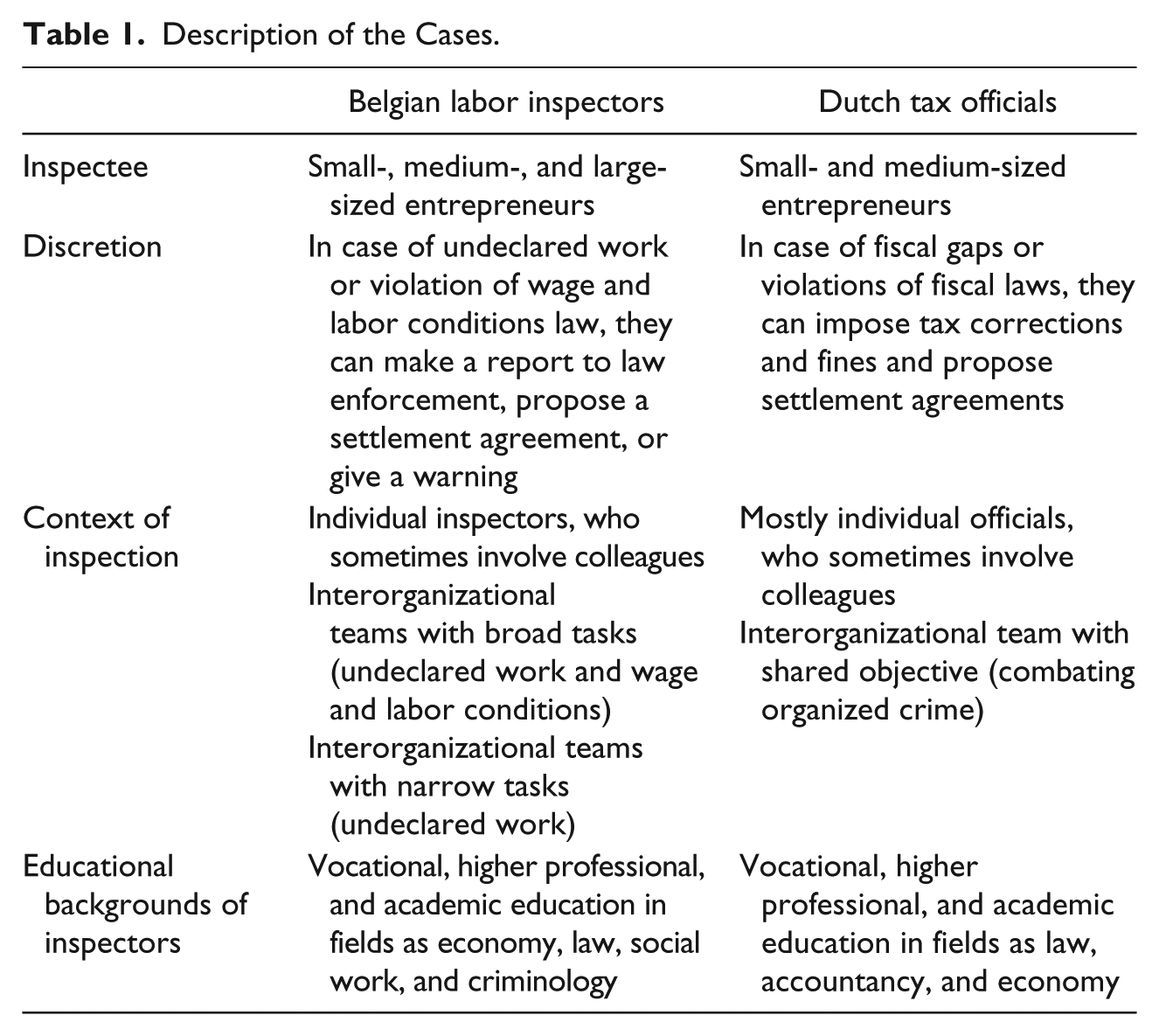
The first study is conducted within the Belgian Inspectorate of Social Laws, which inspects undeclared work violations and enforces wage and labor condition regulations. In undeclared work inspections, inspectors consult the social security registration system to check which employees have been registered by entrepreneurs and then make “on-site” visits to identify employees who are present. Wage and labor condition inspections mostly start with a complaint (e.g., from a [former] employee who did not receive the correct wage), after which inspectors go “on-site” to examine pay scales, reimbursements, and labor regimes. Inspectors who detect violations have the discretion to make a report to law enforcement, to propose a settlement agreement, or to give a warning. Managers in regional offices supervise decision making to maximize consistency within their office, but their authority is not always recognized. Encouraging consistent decision making between regional offices is not considered a priority.
Inspectors in this agency work alone, with a colleague (in complex or sensitive cases) or in interorganizational teams. They do inspections within a specific district, allowing them to build a strong working relationship with the entrepreneurs there. Inspectors are involved in two types of interorganizational team work: (a) antifraud teams with labor inspectors from the five Belgian labor inspectorates who focus on undeclared work violations only and (b) interdisciplinary teams with representatives of different enforcement agencies, such as the police, the tax inspectorate, the food inspectorate, and the labor inspectorate, in which each inspector focuses on his own specialty. While the former type of team cooperation is aimed at increasing consistency of decision making across organizations, the latter type aims at enhancing efficiency and decreasing the frequency of inspections. Notwithstanding interorganizational cooperation, each case file is dealt with by inspectors with individual discretion.
Case Study in the Dutch Tax Authorities
The second study is conducted within the Dutch tax authorities, and focused on frontline tax officials who audit the tax returns and bookkeeping records of small- and medium-sized businesses. They have face-to-face interactions with entrepreneurs, mostly “on-site.” To enhance compliance, the Dutch tax authorities have adopted a policy promoting responsive law enforcement (Gribnau, 2007) in which officials are encouraged to approve bookkeeping records instead of disapproving them (i.e., by not correcting every gap, but making future agreements with entrepreneurs) and have more leeway to take into account contextual elements, such as the demeanor of entrepreneurs.
Depending on the complexity of the case, inspections take a week to months, and inspectors work alone or with colleagues. Inspectors generally have not previously seen or inspected the entrepreneur, but have a lot of information available about the case to be inspected. They have much leeway in interpreting cases, choosing their actions and making decisions. Some tax officials are part of the multidisciplinary “take-away team” aimed at combating organized crime and confiscating criminal assets. It involves a collaboration between five large municipalities in the province of Brabant in the Netherlands, the public prosecutor, the police, Fiscal Information and Investigation (FIOD), the tax authorities, and the Royal Military Police. The team started in 2012 at two locations as part of a 2-year pilot, which has been extended another 3 years, and to another province. The different parties collaborate to take away criminal assets as quickly as possible, thereby increasing legitimacy by showing that crime is tackled. The parties exchange information about suspects, and collaboratively make a decision.
Method
In both case studies, qualitative methods were used. The labor inspection study had an ethnographic design using observations (of inspections and [in]formal meetings), informal conversations, and semistructured interviews with labor inspectors and managers over a period of 18 months. This article draws upon a doctoral study on decision making of labor inspectors and police officers (Loyens, 2012). Four Flemish regional offices were selected that varied in size and type of districts (urbanized or not). Within these offices, all inspectors and their supervisors were invited for an interview. Only one inspector refused cooperation, because of a lack of time. Of the 18 inspectors and four managers who were interviewed, 11 were women and 11 were men. The average age was 45, varying between 26 and 60. The central goal was to explore how inspectors deal with and reason about dilemmas in decision making. Observation and conversation data were written down in detailed field notes, whereas formal interviews were audio recorded and transcribed verbatim. For the purpose of this article, the dilemmas in which client–inspector and collegial interactions were important for case settlement were selected. The data were reanalyzed for the purpose of this article by means of topic and analytical coding (Richards, 2005). Topic coding aimed at sorting out the various types of interactions that influenced decision making in the selected cases. Three types of social interactions were distinguished, being (a) interactions between a client and one or more than one inspector of the studied agency, (b) an antifraud team of labor inspectors of the five Belgian labor inspectorates, and (c) an interdisciplinary team of inspectors and street-level bureaucrats of other agencies. The analytical coding process started with open coding of characteristics of these interactions and decision-making outcomes or processes; codes were, for example, “negotiation,” “meaning of rules,” “social bond,” “adapting to the team,” and “(in)consistent decision making.” Codes about interaction characteristics and decision making were then related, and ways in which social interactions shape decision making were identified.
In the tax authorities study, interviews were conducted with tax officials aimed at soliciting stories about situations they experienced as difficult. The data used for this article have been collected as part of a study on tax officials’ uncertainty experiences (Raaphorst, 2018). Stories are suitable for showing how street-level bureaucrats meaningfully deal with difficulties or tensions in their everyday work (e.g., Maynard-Moody & Musheno, 2003). The storytelling approach allows for gaining insight in how respondents give meaning to situations, showing what they find important. When studying frontline decision making about specific cases, such an approach is more suitable than probing for respondents’ ideas about abstract concepts. The respondents were selected on theoretical grounds: They have considerable discretionary space to interpret rules and make decisions, and have face-to-face encounters with citizen–clients as part of their job. Moreover, one of the respondents is also involved in a project entailing multidisciplinary collaboration. This sample allows us to study how social dynamics may affect case-related decision making.
The interviewed tax officials work in different tax offices across the Netherlands. Of the 18 interviewed respondents, 15 are male and three are female. Eleven respondents have been in service for more than 30 years, one for 18 years, and six have been in service for less than 10 years. The interviews were audio recorded and transcribed verbatim. The interview transcripts were reanalyzed, looking specifically at stories that bear witness to the role of social interactions in case-related decision making. These could be stories in which specific interactions were retold, or in which officials explicitly reflected on the social character of decision making. The stories were analyzed according to the thematic narrative analysis approach as delineated by Riessman (2008, p. 54). The focus is on what is being said, rather than how language is used within those stories. The analysis started with an open coding process, from which different general themes emerged, such as “deliberation with colleagues,” “interactions with colleagues,” and “negotiation with clients.” The stories within these general themes were coded as “recognizing subjectivity” and “problematizing inconsistency or subjectivity” when respondents themselves reflected upon these matters. The stories were further analyzed and compared to look at how social interactions could affect decision making about specific cases.
To enhance intercoder reliability, the researchers both coded data they collected and a part of the data collected in the other case study. Interpretations of the data were discussed in four coding sessions, and subsequently refined. Even though the data for this study were collected independently and for different purposes, both studies are comparable because they contain inductive and in-depth data about how officials’ social context, in different frontline constellations, could affect case-related decision making. See Table 1 for a summary of the case descriptions of both studies.
Description of the Cases.
Findings
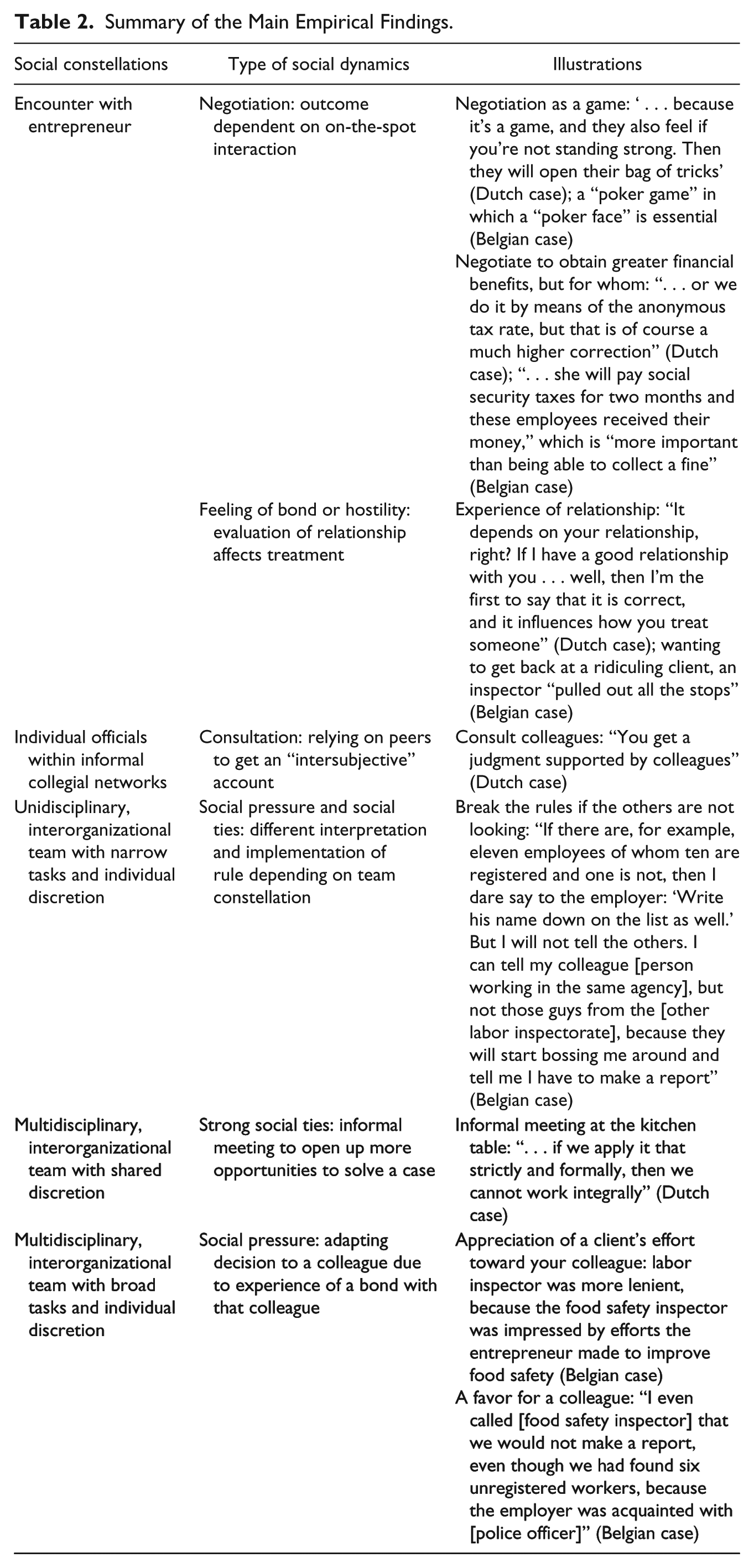
This part illustrates the different ways in which street-level decision making about specific cases is shaped by social dynamics (summarized in Table 2). Similarities across cases can contribute to an overall theory of the role of social context in street-level decision making.
Summary of the Main Empirical Findings.
Individual Inspections
Discussing and negotiating with the client: “It’s a game.”
Within both organizations, settlement agreements are seen as a means to enhance entrepreneurs’ compliance. Settlement agreements allow more leniency, provided that entrepreneurs agree to do it right in the future. In practice, it is often used in “ambiguous” situations, where there is room for different interpretations or not enough evidence. Oftentimes officials need to negotiate with entrepreneurs to come to such an agreement. The following story excerpt underlines the importance of social dynamics for the final decision tax officials make: Yeah, you have to prepare very well, and to discuss with specialists here at the office. You have to have a good story there. Because if you are there, and they have a rebuttal, and you start stuttering and stammering, then it’s not going well. Then it becomes difficult to still . . . because it’s a game, and they also feel if you’re not standing strong. Then they will open their bag of tricks . . . So it went well. I prepared very well [laughs]. If something like that happens, I want to know everything of it. Then I’ll have a conversation with them, and if they come with things and we have no answer at that moment, yeah, then they did better. I’ve no problems with that.
This story shows that tax officials’ decisions largely depend on the involved actors’ reactions and negotiation skills, in addition to the available evidence (which is used as leverage). The respondent even compares it with a game that has to be played out. This game, it is held, is about who has the most convincing account: You have to convince the entrepreneur of your point of view. If they agree, then they agree . . . Then it could be that they read a section of the law differently. That’s possible. Then they need to convince me.
The labor inspectors also use the game metaphor (particularly poker) to describe interactions with entrepreneurs. In situations where they lack evidence to prove their case—which often occurs in presumed overtime violations—labor inspectors try not to show the entrepreneur that they are in the weakest position. To recover as much money as possible for the disadvantaged employee(s), a “poker face” is essential, although fear and lack of legal knowledge on the part of the entrepreneur are helpful too. In both organizations, the underlying idea is that negotiation results in greater financial benefit than a sole reliance on available evidence would generate.
How social dynamics shape this negotiation process is clearly shown in the following story from a tax official who received a snitch letter asserting that an entrepreneur fires his employees in the winter, letting them claim unemployment benefits, and, at the same time, letting them do undeclared work within the winter period.
But yeah, there we were, not knowing the amount; I missed a lot of hours, but I couldn’t prove it. You then try to convince them, based on facts and substantiations. So it resulted in a compromise, with which he [the entrepreneur] got away very well. But well, I was proven right . . . It was actually his own fault. We got a snitch letter stating that those people received unemployment benefits, but proceeded their work as painters. So I was substantiating a lot, like: “You have one person on the payroll, and you paint yourself, and I have barely seen those self-employed people, so you did something with those people.” . . . I said: “Your income per hour in the winter is just ridiculous.” And then he said: “But the boys that help me out during the winter . . .” And I thought: “Now I got you!” I said: “You’re standing on thin ice, sir . . . You’re facilitating benefit fraud . . . If the UWV [employee insurance agency] knows about this, then you have a very big problem.” At that moment, he admitted it. So I said: “Tell me what you want: do you want me to correct the boys [employees], but then they have a big problem, because then UWV discovers it [laughs], and then they will also come to you, or we do it by means of the anonymous tax rate, but that is of course a much higher correction.”
Although the tax official did not have enough evidence at the start of the interaction, the entrepreneur accidently admitted the violation, because he was figuratively pushed to the wall. The decision that follows thus results from how both officials and entrepreneurs stand their ground and react to each other.
Labor inspectors also negotiate with employers, but not always in a way that is supported by the agency. The agency’s policy prescribes that labor inspectors always make a report to law enforcement in the case of undeclared work, but encourages them to make settlement agreements in the case of wage and labor condition violations. However, in practice, labor inspectors regularly use undeclared work violations as leverage to make a settlement agreement concerning employees’ wage, as illustrated in the story below: In [small shop], I also had a case with two undeclared employees who had not received any wage the past two months or so. So we made a kind of deal actually. The employer admitted that she had not registered the two employees, but she agreed to register them retrospectively for the past two months and pay them their wage, if we did not make a report to law enforcement for the undeclared work violation. So she corrected the situation. That is more important than being able to collect a fine [approximately 5000 euro], because she paid social security taxes for two months and these employees received their money.
Hence, bargaining with the employer is considered a strategy to find a solution that is in the best interest of the employee(s), the treasury, or both. Thus, final decisions are dependent not only on officials’ thoughtful considerations or agency policies but also on inspectors’ and clients’ on-the-spot persuasion and negotiation skills.
Consulting colleagues to deal with subjectivism
Whereas tax officials view themselves as professionals, who need a degree of freedom to adjust their enforcement styles to the situation at hand and to make informed decisions, the examples above show the downsides of the discretion inherent to their work. These inspectors are sometimes concerned about inconsistencies in decision making—resulting from the subjective nature of their decisions—which run counter to their strong sense of justice, fostered by the idea that entrepreneurs in similar situations should be treated similarly. The following interview excerpt shows how a tax official experiences a tension between discretion and equal treatment: We luckily still have freedom. But it remains something very subjective of course, because I’m inspecting with a digital dossier that I need to fill, but what I fill out, remains subjective of course. I can leave something out, or mention something. So if you have an enterprise and you say something to me I don’t think is very kind, then it can have an influence . . . yeah, it is not supposed to be like that, but it involuntarily plays a role. It depends on your relationship, right? If I have a good relationship with you . . . well, then I’m the first to say that it is correct, and it influences how you treat someone. When there are differences of opinion, I think you’re much more inclined to approach each other. Then I won’t easily say like, I will continue my inspection to find something. Then I’m more inclined to say well, okay, possibly there could be something wrong, but I close the book and we shake hands.
Like other respondents, this inspector acknowledges that decisions are involuntarily influenced by relationships with entrepreneurs. This might result in more lenient or strict enforcement. A labor inspector explains that an uncooperative entrepreneur in a recent case was ridiculing the inspector for not having enough proof; the inspector then “pulled out all the stops” (with house searches and confiscations), just to get back at him. A tax official explains that a bond of friendship can also influence one’s view of the case, because even though “we are government officials who are supposed to be as objective as possible,” “we are humans.” The inspector acknowledges that “[a]nother colleague would maybe have made different decisions.” These examples clearly show how inspectors experience that relations with citizens, that is, feelings of friendship or hostility, could affect their inspection style and decision making, standing in the way of being “as objective as possible.” When this subjectivism is experienced as a problem, officials use different strategies to make decisions less subjective. Besides relying on overall inspection guidelines (tax officials), and official-specific “rules of thumb” to safeguard equal treatment across cases (labor inspectors), officials also rely on their peers to reach a widely supported decision.
That is the hard part . . . when do you have enough assurance, when have you done enough work? Yeah, that’s hard to tell, that’s different for each inspection. In case of doubt, you need to consult with your colleagues, just briefly talk about it . . . you get a judgment supported by colleagues. That’s enough then. Professional judgment, that’s what it is called.
Consulting one’s colleagues is a strategy that is often mentioned by tax officials. By attuning their decisions to colleagues’ opinions or assessments, officials feel their case is stronger and less subjective. One respondent refers to this practice as making “intersubjective” judgments, which are shared among colleagues. Such consulting practices can also help to prevent “tunnel vision” by letting “a colleague objectively assess whether you’re still on the right track.” One respondent argues he looks for “likeminded colleagues,” who do not correct everything, and do “not want to go to extremes.” This suggests that “intersubjectivism” is sought by consulting colleagues who share the same inspection attitudes and practices.
The studied labor inspectors are not so much concerned about reaching a widely supported decision. Only newcomers in the job regularly consult with other inspectors, but quickly learn the importance of developing a personal inspection style, as one of the newcomers explains: There’s the style of always believing in the goodwill of the entrepreneur, and constantly excusing for doing one’s job and requiring so much of entrepreneurs’ time . . . Then there are those men who, rather straightforwardly, require entrepreneurs’ cooperation, or else they will make a report for obstruction of the investigation . . . Those are the extremes, and other colleagues’ styles are in between. That shocked me in the beginning . . . I didn’t know how to behave myself, but then I realized that whatever style I would choose, it would be okay [laughs]. If these extremes are accepted, then anything goes, right?
Team Inspections
Breaking rules if others are not looking
The social context, and thereby also the decision making, changes when street-level bureaucrats are part of teams. The labor inspectors under study monthly participate in regional antifraud inspections, in teams consisting of inspectors of the five Belgian labor inspectorates. Given that inspectors are encouraged to always make a report to law enforcement in the case of social fraud, similar enforcement can be expected when labor inspectors work alone or in these unidisciplinary teams. However, observations showed that differences in social context lead to different decisions. Particularly, social dynamics shape how the “strict enforcement” rule is interpreted and enforced. A labor inspector explains that the law is strictly enforced in team inspections, but not in individual inspections, because then inspectors believe they can be more lenient.
The agreement in these anti-fraud teams is to adapt a kind of zero tolerance policy [consistent with agency’s policy]. This means that even if an employer registers the employee the day after the inspection, we make a report to law enforcement. In regular inspections . . . , you can—and I have already done that—be more lenient by offering him to drop the charge if he registers the employee correctly afterwards. If he registers the employee, also for the day of the inspection of course, then I will not make a report. If he does not do so, I will make a report.
Observations of antifraud team and individual inspections confirmed that the social context surrounding the case shape the meaning and weight of the “strict enforcement” rule. In team inspections, inspectors, for example, ask the question “Who will make the report?” rather than “Who will take this case?” when violations are detected, implying that making a report to law enforcement is considered the only acceptable response. In interviews, labor inspectors explained that, when working in an antifraud team, the “strict enforcement” rule is seen as a formal instruction that should be followed or, as mentioned above, an agreement they have made with other agencies. However, if they work alone, individual discretion prevails and the same rule is considered a mere guideline or recommendation. The different interpretation could be explained by inspectors trying not to appear “soft” in front of colleagues from different agencies, as is illustrated by the following interview excerpt, where two inspectors from the same agency make a secret deal with an employer during an antifraud inspection, because they think he deserves leniency: If there are, for example, eleven employees of whom ten are registered and one is not, then I dare say to the employer: “Write his name down on the list as well.” But I will not tell the others. I can tell my colleague [person working in the same agency], but not those guys from the [other labor inspectorate], because they will start bossing me around and tell me I have to make a report. But if two inspectors of our agency are present, we can make a deal . . . We do that without letting the others know. We do it sneakily.
Also the more distanced relationship between inspectors and clients in team inspections could explain the difference. In individual inspections, inspectors might deliberately use leniency to foster the long working relationships with entrepreneurs and thereby aim to increase compliance.
Using strong social ties to get things done
Dutch tax officials also participate in interorganizational cooperation. The so-called “take-away team” involves professionals from different agencies (including the tax authorities) to combat organized crime and confiscate criminal assets. To enhance cooperation, they have found a way to collaboratively work around laws that are experienced as restricting the possibilities to combat crime. In so-called “kitchen table conversations” confidential information is openly shared: Every Tuesday we have the kitchen table, that’s how we call that. All things that are brought to the attention are discussed . . . in an informal way. Because we have the obligation of confidentiality. If a police officer asks me: “We have that person in the picture, could you check what kind of earnings he has, and whether he has bank accounts and tax debts?,” then I am actually not allowed to tell him that. If I ask a police officer: “Could you check whether this taxpayer has antecedents, or whether there are police reports about him?,” then he cannot actually tell me, because the police officer also has the obligation of confidentiality. But yeah, if we apply it that strictly and formally, we cannot work integrally. So every Tuesday morning, we have an informal meeting, where all sorts of things are discussed . . . The police for instance saw someone driving in an expensive car, of whom they know he doesn’t work. Then we are asked what we know about that: “Can you check what he earns, what he declares, whether he has savings, whether he can explain that he’s driving that expensive car?.” Well, then we are going to look in our systems. That’s how we share information. Then we’re going to discuss what we’re going to do with it: are we going to get him under criminal law, . . . or under fiscal law? When the decision is made, we have to share the information formally. Well then the formal requests have to be made, . . . because in 99 of 100 cases a lawyer is involved.
The respondent refers to this information exchange as an informal meeting without which integral cooperation would be impossible. Only after choosing the course of action, the formal route is followed. The respondent even acknowledges that only the formal side of the story is presented to the outer world: You really have to have your case covered, because otherwise . . . if you are in front of the judge, and he asks: “Inspector, how did you get these police reports?.” “Yeah, I got these at the kitchen table.” Well yeah, then the judge will say it is illegally obtained evidence. Then it’s done, then you’ll never be vindicated.
The informal meeting makes things possible that are not possible if rules were strictly followed. The participants justify this practice by referring to the common objective of combating crime, for which the “take away” team carries joint responsibility. Social ties with other involved actors also facilitate the obtainment of permits to use information from other organizations: We actually always get the permission, . . . , because the prosecutor is [name] from the parquet in [city in Brabant], who also knows us, and also regularly joins our kitchen table. So he knows when we come with this request, then something is the matter.
The respondent seems to imply that the prosecutor grants these permits based on strong ties with the team; because he personally knows the members and even joins the informal meetings, it is suggested, the prosecutor can rely on the judgment of the team. Hence, strong social ties between members, as well as the common objective to combat crime, are used as justifications for these “informal” practices.
Adapting decision to team to maintain relationship
Multidisciplinary team cooperation between food inspection, police, and labor inspectorate is, in the Belgian case, not based on shared discretion. In joint inspections, different agencies enforce different regulations; inspectors are thus formally independent. However, their decisions as part of such teams are oftentimes informally influenced by colleagues’ decisions. In one case, a labor inspector treated a recidivist employer leniently, because a food safety inspector was impressed with his efforts to meet food safety regulations, even though social fraud recidivism is in other cases dealt with by making a report to law enforcement (consistent with agency’s policy). It is striking that the labor inspector emphasizes the employer’s goodwill based on efforts in compliance to rules that her inspectorate is not even responsible for, while the employer fails to correct social fraud, which is considered a very serious violation.
In another case, the police officer in the team had suggested to inspect a new catering establishment owned by one of his acquaintances, because he was sure they were compliant to all regulations. However, many serious violations were detected, putting two labor inspectors in the team in the dilemma whether or not to file a report to law enforcement. They decided not to do so, because they did not want to offend their colleague (the police officer). Instead, they made a deal with the employer to give a warning if he would register his employees retrospectively.
[Name of police officer] said: “Let’s inspect that establishment.” He knew the owner and was sure that everything was perfectly in order. We [labor inspectors in the team] said: “Are you sure [name of police officer]? Do you really want to do this?” When we entered, we saw them smoking in the establishment [which is a food safety violation]. And no-one of the employees was registered. No-one no-one. He did not speak again all evening. I told him: “We will not make a report.” I even called [name of food safety inspector who was present] that we would not make a report, even though we had found six unregistered workers, because the employer was acquainted with [name of police officer]. I would offer the employer to register them retrospectively and not file a report. But then, the employer had only registered his employees for two hours in the whole month, while the inspection itself had already lasted for more than two hours. So then we [labor inspectors in the team] decided to make a report anyway.
Although this case ended in the labor inspectors making a report to law enforcement, which would, given the agency’s policy, have been the obvious decision in the first place, this case shows how strong ties and social pressure within interdisciplinary teams can affect the kind of decision being made. Because the same individuals are over a longer period of time responsible for a specific district, there is indeed a chance that inspectors or police officers inspect establishments owned by friends of acquaintances. Dutch tax officials, to the contrary, are prohibited to inspect acquaintances and inspectees living in the same town or area as the inspector is residing.
The experience of social ties by officials, thus, affects decision making about specific cases. In both of these examples, the official felt obligated to adapt his or her decision to a colleague, because of an experience of a social bond with that same colleague. What is notable in these examples is that the respondents chose for a more lenient treatment than they would have done if they were to decide about this case alone.
Discussion
This study shows how social dynamics in different bureaucratic contexts influence frontline decision making about specific cases. Street-level bureaucracy literature has described that client–official and collegial interactions may influence frontline decisions (Lipsky, 1980; Maynard-Moody & Musheno, 2000). Our results go further by pointing at the importance of the course of an interaction with citizens, depending on negotiation and bargaining, and thus how both parties stand their ground, in determining the final decision. As for collegial interaction, the literature has mainly focused on the supporting and advisory role of coworkers (e.g., Hatmaker et al., 2011; Van Kleef, 2016). In line with the professionalization and socialization literature, our results show that street-level bureaucrats consult colleagues with the aim to decrease subjectivism of decision making.
These streams of literature, however, cannot explain the more subtle influence of collegial interaction on frontline decision making shown in our results, for example, that the mere presence of other professionals alters not only the meaning of rules but also how clients are addressed and how inspectors perceive and use their discretion. Street-level bureaucracy research should thus broaden its scope by including the influence of these subtle social dynamics on frontline decision making and interactive effects between client–official and various types of collegial interaction. This article contributes to the literature by showing that even in law enforcement agencies, which are highly regulated and where adherence to agency rules and procedures is expected, social dynamics within and surrounding public encounters significantly affect decision making at the frontline. A possible explanation is that, despite different organizational contexts, inspectors have to deal with uncertainty about facts, value conflicts and complicated personal and interorganizational relationships, in a similar way as street-level bureaucrats in service-delivery organizations.
These results raise important questions for street-level bureaucracy scholars. First, to what extent does the notion of individual discretion still hold, in light of broader social dynamics that affect decision making? Discretion assumes a degree of freedom and autonomy that is left open by rules and laws, mostly given to semiprofessionals with the necessary expertise and skills to handle such autonomy. Ad hoc social dynamics are, however, left out of the equation, while they can hamper autonomy, and could lead to unplanned particularism and subjectivism. This study suggests that the notion of individual discretion does not reflect the real-life practice of frontline decision making where decisions are not only the result of thoughtful considerations but could also be affected by what happens in interactions, such as social ties, social pressure, and negotiations. These findings thus call for theoretical approaches that perceive street-level work as a social practice, where bureaucratic judgments and decisions are made collectively through the interaction between bureaucrats and citizens, colleagues, and other stakeholders (e.g., Moulton & Sandfort, 2017; Wagenaar, 2004).
Second, how do social dynamics within official–citizen and collegial interactions, which are actively encouraged by new responsive policies, relate to fair decision making? Maynard-Moody and Musheno (2003) show how frontline workers strive for making fair decisions by relying on their own moral standards. Fairness is a value that is highly important to these workers. In trying to make fair decisions, they rely not only on rules, as could be expected of state agents, but also on clients’ needs and their feelings toward them (either hostility or friendship), which is typical for citizen agents. In particular situations, the inspectors in both cases regularly experience a clear tension between being a state agent and a citizen agent (Maynard-Moody & Musheno, 2000). Our study has furthermore shown that officials sometimes feel that strong social ties with colleagues get in the way of fair decision making. When the officials in our examples made different decisions because they felt pressured by colleagues, they valued maintaining a good relationship with the respective colleague higher than the decision they would deem most appropriate or fair. The social character of decision making, thus, could bring other values into the decision making process; officials not only look at case-related aspects in making decisions but also take into consideration (what certain decisions would mean for) relations with clients and colleagues.
This raises a third question: To whom do street-level bureaucrats feel accountable (if indeed they do so)? Hupe and Hill (2007) explain that street-level bureaucrats are “confronted with multiple demands for accountable behavior,” stemming from a multidimensional web of vertical and horizontal relations, that “may produce tensions” (p. 290). Whereas balancing between these conflicting demands could, in some cases, resolve such tensions, the inspectors in this study seem to rather switch between fora of accountability. In other words, on a case-by-case basis they choose (albeit sometimes implicitly) to whom they feel accountable. Depending on the social context, they feel held accountable by their peers (professional accountability, by, for example, intersubjective judgments), their clients (participatory accountability, by, for example, negotiation with clients), or the law (public-administrative accountability, by, for instance, strict rule enforcement). More importantly, the direction of decisions at the frontline is sometimes the result of unplanned and nondeliberative social dynamics between officials and citizens (negotiations and bargaining) and colleagues (social pressure, strong social ties). As such, decisions are socially constructed, which raises important questions as to whether individual officials—even when formally having individual discretion—can be held fully accountable for the decisions they make, because decisions are “enabled and constrained by social dynamics within the field” (Moulton & Sandfort, 2017, p. 147).
These findings have practical implications. Prior research has shown that “procedural constraints on the exercise of discretion” (Loyens & Maesschalck, 2010, p. 68), could increase consistency in decision making, but that this, at the same time, could hamper frontline officers to be “responsive to individual need” (Evans, 2016, p. 13) and decrease their motivation. Our study shows that officials sometimes rely on their informal collegial network to make their decisions less subjective, particularly in ambiguous situations. In trying to reduce personal bias, they “sought to act ethically in their official role” (Evans, 2013, p. 754). We believe more can be gained from strengthening openness among street-level bureaucrats about dilemmas they experience in dealing with discretion, with the aim to find common solutions. However, our results also suggest that citizens (entrepreneurs in this study) are not passively subjected to inspectors’ decisions about their case, but are active players who in negotiation stand up for their own interest. In the negotiated order, citizens are thus reflexive, trying to make sense of the inspectors’ response and “adapt the system and make it work for them” (Evans, 2007, p. 226). Recognizing the agency of inspectees in the negotiation process draws attention to ways in which collaborative governance has affected inspection work.
Conclusion and Recommendations for Future Research
By relying on in-depth interviews and participant observation, this study has analyzed how social dynamics in official–citizen interactions and in collegial interactions may affect case-related decision making. Our study indicates that social dynamics could play a determining role in frontline decision making in several ways. In negotiating with clients, final decisions are dependent not only on officials’ thoughtful considerations but also on both parties’ on-the-spot persuasion and negotiation skills. The unfolding of an official–citizen interaction thus plays an important role in case-related decision making. This study has furthermore found that officials try to make their decisions less subjective by relying on their colleagues’ judgments. Besides deliberate consultation, this study has found that social ties with colleagues could also more implicitly affect decision making, leading to a different decision than the individual official would or could have taken. Sometimes, this is experienced as positive, as is the case with the informal “kitchen table” meetings, where strong social ties open up opportunities to better solve a case. Sometimes, this is experienced as problematic, when, for instance, social pressure leads to a decision that runs counter to officials’ own idea of what is the appropriate decision.
We employed a micro perspective to explore how social dynamics may affect frontline decision making. We looked at individual street-level bureaucrats and how they feel enabled or constrained by social dynamics. The study has indicated that bureaucrats meaningfully deploy social dynamics to “get things done.” As such, they can be seen as “socially skilled actors” (Moulton & Sandfort, 2017, p. 145) who use their agency to shape social dynamics, such as social pressure and cooperation, by relying on tactics such as deploying good relationships with colleagues, or aligning judgments with those of colleagues (see also Wagenaar, 2004, p. 652). Because of our focus on the micro aspects of social dynamics, we could not analyze processes of change or stability more generically. Future research could analyze the impact of social dynamics on decision making from a macro perspective, by looking at variations in decision making across different groups or teams (see, for example, the multilevel analytical framework proposed by Moulton & Sandfort, 2017).
The main disadvantage of this study is the use of independent case studies with no prior aim to compare. At the same time, using these particular case studies, in different countries and sectors, offered the opportunity to find overall patterns of social dynamics in street-level bureaucracy. Future research on street-level bureaucracy should more often apply a comparative case design to study the impact of different contexts on frontline decision making. Our study could be further extended by examining how frontline officials balance the different values, including those stemming from social interactions, in case-related decision making. Future street-level bureaucracy research could also develop and use research designs that allow for better studying the role of social dynamics in frontline decision making. Participant observation allows for studying how social interactions—and also the more subtle social dynamics such as social pressure—play out in practice, whereas narrative analyses of transcripts of interactions not only would enable studying what policies, rules, and values are evoked and reshaped in real-time interactions (e.g., Bartels, 2014; Bruhn & Ekström, 2017) but also how citizen–clients actively negotiate the responses of officials (e.g., Evans, 2007). Social network analyses could be performed to, for instance, study the influence of frontline officials’ informal network structure and composition on, for instance, officials’ willingness to reach “intersubjective” accounts.
Footnotes
Declaration of Conflicting Interests
The author(s) declared no potential conflicts of interest with respect to the research, authorship, and/or publication of this article.
Funding
The author(s) disclosed receipt of the following financial support for the research, authorship, and/or publication of this article: The Dutch study was supported by the Dutch Organization for Scientific Research (NWO; Vidi Grant 452-11-011).