




Abstract
Modern societies are increasingly faced with “unknown unknowns,” Black Swans, and mega-crises. Both public and corporate leaders find it deeply challenging to respond to these crisis events. Existing approaches and tools to cope with crisis-induced uncertainty are of little help in these dynamic environments. This article explores how the principles of Pragmatism may provide the building blocks for a theory of effective strategic crisis management. We argue that these principles, formulated by a group of American philosophers in a time of deep uncertainty, provide a way of thinking that will help practitioners prepare for, and deal with, emerging risks, crises, and disasters.
Introduction: The Challenges of Strategic Crisis Management
We live in an era of Black Swans and mega-crises (Helbing, 2013; Helsloot, Boin, Jacobs, & Comfort, 2012; Taleb, 2007). These threats find their origins in the use of dangerous technologies and complex systems, in the dynamics of interstate relations, in the changing climate, or simply in human behavior (Ansell, Boin, & Keller, 2010; U. Beck, 1992; Perrow, 1984; Reason, 1990; Turner, 1978). Regardless of their origins, crises put institutions and leaders to the test. When a crisis emerges, constituents look to their leaders to protect them from the consequences. Leaders are expected to organize a timely, effective, and legitimate response under conditions of deep uncertainty (Boin, ‘t Hart, Stern, & Sundelius, 2016).
Many leaders do not have the cognitive or organizational means to tame the deep uncertainty that comes with crisis. They do not have an effective approach to recognizing new risks and grasping the dynamics of these unfolding events. As a result, they find it hard to make sense of a crisis (Helsloot et al., 2012; Rosenthal, Boin, & Comfort, 2001; Rosenthal, Charles, & ‘t Hart, 1989). Without a clear picture of the situation, in turn, it is hard to make critical decisions and coordinate a complex response network; it is also hard to effectively communicate to anxious citizens and concerned stakeholders.
The temptation to manage a crisis through some form of rational approach lies at the heart of this problem. Inexperienced crisis managers tend to deal with uncertainty by calling for more information. They are taught to think through key decisions by exploring short- and long-term consequences, preferably through the creation and assessment of multiple scenarios. In their efforts to coordinate large-scale networks, they fall back on plans and bureaucratic structures that are ill suited for such dynamic events (Clarke, 1999). In formulating messages to an anxious public, they often seek to manage fear with facts only to learn that the public does not respond in a desired way to the presentation of these facts.
The rational approach to managing crises appears logical and reasonable (cf. Allison & Zelikow, 1999; Klein, 2009). In fact, this approach to crises and disasters is so intuitively plausible that one might ask what is wrong with it and why it does not work. The answer is straightforward: These approaches may be appropriate when problems are relatively simple and stable—but what works in these conditions does not necessarily work in times of “unruly problems” (Ansell & Bartenberger, 2016); it may, in fact, be counterproductive (Boin & Lagadec, 2000; Perri 6, 2014).
Anecdotal evidence suggests that leaders who excel in times of crisis do not lean on rational, everyday approaches to tame uncertainty (Bechky & Okhuysen, 2011; Weick & Sutcliffe, 2011). They realize that uncertainty is inherent to crisis. They work with what they have, making decisions based on a few core principles rather than a semicomplete picture of the situation; they stumble forward relying on the professionalism of their employees, offering communications that carefully balance imagery with facts. To the untrained eye, this approach may look unstructured and unconstrained by procedure, which, in a way, it is. But it is not the “chaos” so often described by observers of crisis management. We think it is best described as Pragmatic.
The principles of Pragmatism were first formulated by a group of American philosophers and social thinkers, collectively known as the Pragmatists (Menand, 2001). As a philosophy, Pragmatism is wide ranging, addressing issues that reach from epistemology and logic to political theory and aesthetics. Running through many of its contributions is a concern about practical rationality and problem solving in the face of uncertainty. This concern has made it increasingly influential in theorizing about policy making, institutions, organizations, city planning, and public administration. It has not, however, been widely recognized in the academic study of risk and crisis management.
In this article, we outline what is essentially a Pragmatic theory of strategic crisis management. At its core, Pragmatism is both analytical and prescriptive. Analytically, it sheds light on how individuals and social collectives respond to discontinuities and ambiguity and how they generate change and innovation. But it also advises people on how to view the world, learn, see, raise kids, and be happy (in no particular order). This article intends to show the promise of Pragmatism for understanding and improving the response to large-scale crises and disasters.
Managing Crises and the Challenge of Uncertainty
Crises will always happen and cause surprise (Clarke, 1999; Jasanoff, 1993; Perrow, 1984). The idea that one can map out all possible failure sequences, and build barriers to prevent each and every crisis scenario from happening, is now widely discarded (U. Beck, 1992; Clarke, 1999). Complex technologies, human shortcomings, and unpredictable environments make it impossible to fully control all risks. If we accept the notion that people make errors (Reason, 1990), organizations have blind spots (Turner, 1978), and technologies will “bite back” (Tenner, 1996), we must accept that crises are in a sense “normal” events (Perrow, 1984).
We speak of crisis when a group of people, an organization, a community, or a society perceives a threat to shared values or life-sustaining systems that demands an urgent response under conditions of deep uncertainty (Rosenthal et al., 1989). We define crisis management as the set of preparatory and response activities aimed at the containment of the threat and its consequences.
Nearly every crisis response has both an operational and a strategic dimension. On the operational dimension, we find first responders, control room operators, and system experts. They are professionals trained to deal with glitches, accidents, and emergencies. On the strategic dimension, we find the senior managers or political leaders who carry ultimate responsibility for the outcome of the crisis. They may not have operational expertise, they may not be so well trained, and they are often far removed from the operational heart of the crisis.
In this article, we concentrate on strategic crisis management. We conceptualize strategic crisis management in terms of orchestrating and facilitating a joint response to an urgent threat. To enhance our conceptual grasp, we delineate strategic crisis management into a set of tasks (Boin et al., 2016; Boin, Kuipers, & Overdijk, 2013). The underlying assumption is that the effective execution of the following tasks will help a response network produce the best possible actions to limit the impact of crises:
Sense-making: Organizing the process through which strategic crisis managers arrive at a shared understanding of the evolving threat and its consequences. This requires the collection, analysis, and dissemination of information about the unfolding threat and its consequences.
Critical decision making: Making strategic decisions (while avoiding operational ones) that are effective and legitimate, both in the short and the long run.
Coordinating: Facilitating the implementation of planned actions and strategic decisions by motivating actors in the response networks to work together and perform their tasks (in an effective and legitimate way).
Meaning-making: Explaining to all involved what is going on, what is being done to remedy the situation and limit the consequences, and offering actionable advice to move forward.
These tasks are not easy to perform (Helsloot et al., 2012; Janis, 1989; Rosenthal et al., 2001; Rosenthal et al., 1989). It is hard to deal with uncertainty, to make decisions without information, to discover that plans for response networks do not suffice in the face of unimagined threats, and to then somehow communicate in a meaningful way to an anxious public. The uncertainty that comes with crisis makes it seemingly impossible to resolve these dilemmas in an ordered, rational way.
It is useful here to distinguish between “unknown unknowns” and “known unknowns” or more routine emergencies (cf. Pina e Cunha, Clegg, & Kamoche, 2006). Emergencies occur with some regularity and may provide a quantitative basis for sound risk management and rational planning. Examples include floods, forest fires, and hurricanes. It is much harder to prepare for crises and disasters that do not happen often and unfold in unforeseen ways. 1 Nobody knows when such a crisis will materialize, what the consequences are, who will be involved, and what actions will be required to stop it. 2 It creates the condition of what Barry Turner (1994) referred to as “decision making under ignorance.” It is simply impossible to draw up a specific plan for these “unknown unknowns” (Clarke, 1999).
When confronted with an urgent task and without a clear set of instructions, we may expect strategic crisis managers to fall back on proven practices. Routine strategies, however, tend to be ineffective or, worse, counterproductive in these situations. The institutionalized practices of meetings, information collection and analytics, and the scripted ways of communication rarely work in times of crisis. These practices are based on an underlying model of rational planning and political negotiation. In the face of deep uncertainty, a very different approach is needed.
A different approach can be observed in practice and is described in case studies of crisis and disaster management (Bartenberger, 2017; Klein, 1998; Weick, Sutcliffe, & Obstfeld, 2005). The American philosophical school of Pragmatism provides the building blocks for conceptualizing strategic crisis management under such conditions. The next section introduces these building blocks.
The Promise of Pragmatism
In colloquial speech, the term pragmatism 3 refers to a practical and commonsensical way of behaving, characterized by flexibility and compromising to get things done. In this article, we refer to Pragmatism as a philosophy, a set of ideas originally set forth by the American philosophers William James, Charles Peirce, George Mead, Jane Addams, and John Dewey, who wrote their most important works between the late 1800s and the Second World War. 4 These ideas were influential in the early development of the social sciences and the American progressive movement, though with mixed uptake in public administration (Shields, 2008; Snider, 2000a, 2000b). Shifting political currents and the development of logical positivism had eclipsed the general influence of Pragmatism by the mid-20th century, but it was revived by philosophers and social theorists in the 1970s and 1980s (Dickstein, 1998).
Over the last decade, public administration has been engaged in a lively debate about the contemporary value of Pragmatism, much of it in the pages of this journal. One axis of debate has pitted scholars drawing inspiration from classical Pragmatism (Evans, 2000, 2005; Garrison, 2000; Shields, 2003, 2005, 2008; Snider, 2005; Stolcis, 2004; Webb, 2004; Whetsell, 2013) against those who identify more strongly with the neopragmatism of Richard Rorty (Kasdan, 2011, 2015; Miller, 2004, 2005; for an overview of similarities and differences, see Hildebrand, 2005). A second axis of debate opened with Evans (2010) and Salem and Shields (2011) arguing that Pragmatism offers a powerful alternative to logical positivism. Snider (2011) responded that this argument overlooks the uncomfortable coexistence of at least two quite different versions of Pragmatism, which he called the 4P version (practical, pluralistic, participatory, provisional) and the radical process (RP) perspective. Whetsell and Shields (2011) reaffirmed the value of Pragmatism and argued that the RP version suffers the same liabilities as neopragmatism (see also Dieleman, 2017). In this article, we draw primarily on classical Pragmatism, though like Hoch (2006), we remain open to what neopragmatism may teach us.
Our chief interest in Pragmatism is that it offers a powerful and distinctive model of practical rationality (Garrison, 1999, 2000). This model is processual, but not in the radical sense described by Snider. Classical Pragmatism offers a fairly cohesive set of ideas with regard to the way people understand and act upon a dynamic world full of uncertainties. It regards all knowledge as fallible and subject to continuous revision (Dieleman, 2017). Moreover, it builds on a rich and behaviorally plausible model of human nature (Ansell, 2011; Farjoun, Ansell, & Boin, 2015).
The original Pragmatists had little to say explicitly about public organizations, leadership, or crisis management (but see Stever, 1993). The ethos of Pragmatism (Evans, 2000; Garrison, 2000; Hoch, 2006) points in useful directions. Notably, for our purposes, Pragmatism rejects the “quest for certainty” (Dewey, 1930) and adopts the position that creative action begins with doubt and contingency (Evans, 2000; Shields, 2008). In recent years, organization theorists have drawn upon Pragmatism to study how organizations (both public and private) deal with dynamic uncertainty (Elkjaer & Simpson, 2011; Farjoun et al., 2015). These Pragmatism-inspired ideas have been applied to various levels of governing, ranging from the individual and group level (Weick, 1988) to the organizational and institutional level (Selznick, 1957; Shields, 2003).
Building on the work of Ansell (2011) and Bartenberger (2017), we present our understanding of Pragmatism’s core ideas as they can inform an approach toward crisis management that is both analytical and prescriptive. Pragmatism yields insights into strategic crisis management that are relevant for both theorists and practitioners (Whetsell, 2013). We begin by sketching Pragmatism’s theory of action, which illuminates some of its distinctive insights into human behavior.
A pragmatist theory of action
Pragmatists wrestled with a philosophical legacy that they see as dualistic—as creating overly drawn dichotomies such as culture versus nature, thought versus instinct, mind versus body, individual versus society, theory versus practice, fact versus value, and so on (Dewey, 1896; Harmon, 2006; Rorty, 1979). As they found these dualities unproductive, they sought to reconceive the dichotomies as interdependent and continuous, rather than independent and oppositional. This antidualist perspective helped to create new perspectives on how people think and act. Although Pragmatists disagree on many points, this antidualism is a common theme woven through their work.
One of the most basic ways in which classical Pragmatism sought to break down dualisms was to adopt a strong orientation toward action. They took the perspective of people acting in situ, living their lives, making sense of the world, and confronting challenges. This led them to emphasize the practical nature of rationality, with a focus on experience and problem solving, an emphasis on process and social interaction, and a view of beliefs as subject to ongoing experimentation (Evans, 2000; Garrison, 1999, 2000; Shields, 2003). Pragmatism’s distinctive take on practical rationality holds that human behavior is both habitual and creative (Berk & Galvan, 2009; Joas, 1996; Kilpinen, 2009). Although Pragmatism’s conception of practical rationality bears some relation to the behavioral model of decision making developed by Herbert Simon (which drew to some degree on both James and Dewey), Simon’s logical positivism erected a sharp dualism between fact and value (M. D. Cohen, 2007; Snider, 2000a; Whetsell & Shields, 2015).
Pragmatism takes a particular stance on how people think. It argues against the idea that we always think first—that is, form a mental representation of what we want or believe—and then act. Instead, people often learn what their goals are by trying to do things (Joas, 1996). 5 People act their way into an understanding of their environment, a process Weick (1979) calls enactment. 6 Enactment occurs when the actor does something in response to an observed change, which, in turn, may produce change in that environment. 7 The reaction to their action helps people to understand their environment. A circular, tightly coupled relationship brings action, perception, and understanding together in a process that unfolds in small, iterative steps (Dewey, 1896). 8 In place of the “blank slate” and “out of the box” thinking, so often promoted in the literature, Pragmatism encourages what is known as bricolage, which can be described as improvising with what is available (making the best out of the situation, so to speak).
The Pragmatist perspective on thinking and action breaks with the teleological conception of action embraced by rational choice theory (Beckert, 2003; Joas, 1996; Mousavi & Garrison, 2003; Whitford, 2002). Doing so enables Pragmatism to better fathom the complexity of strategic action (Beckert, 2003, p. 772). To illustrate the point, Bromley (2008) draws on an example from a famous debate on epistemology between Otto Neurath and Rudolf Carnap: The comprehensive inability to write down objective descriptions of the future entailments of available actions puts us in the position of Neurath’s Mariner who was forced to repair his ship while at sea. Unable to reach port, the mariner needed to figure out what he must do as he figured out what it was possible for him to do. Each of us must work out (learn about) what is to be done as we work out (learn about) what can be done. (p. 4)
The powerful implication here is that we must learn about ends and means together. Strategy emerges through action (Simpson, 2009). This is particularly true for crisis.
Pragmatists suggest that working under uncertainty—repairing the ship at sea—requires a combination of habit and inquiry. Habits are learned dispositions to respond in certain ways in certain circumstances (Baldwin, 1988; Kilpinen, 2009; Lawlor, 2006). 9 As long as the context is stable and familiar enough, habits are crucial in “selecting” the goals, preferences, outlooks, and actions we pursue (or avoid) and the environments where they are likely to flourish (Lawlor, 2006; Penrose, 1959). Inquiry is prompted by the need to act in an “objectively precarious but improvable environment” (Festenstein, 2001, p. 732) or as Bromley (2008) provocatively puts it, “indeterminacy is the reason we reason” (p. 4). Local breakdowns or nonroutine events (such as crises) trigger an emotion of doubt, which, in turn, initiates a process of inquiry through reflexivity, deliberation, and experimentation (Kuruvilla & Dorstewitz, 2010; Massecar, 2011; Miettinen, Paavola, & Pohjola, 2012).
Although an emphasis on inquiry sounds rationalistic, Pragmatism does not assume that decision makers optimize a single underlying value metric (e.g., utility) or that they know the risk probabilities underlying their decisions. Pragmatist decision makers do use deliberation to adjudicate and reconstruct value conflicts and to balance desires, goals, and interests in emotionally satisfying ways (Barbalet, 2004, 2008; James, 1896; Mousavi & Garrison, 2003). 10 But by dropping the presumption of utility maximization (Frega, 2010; Garrison, 1999, p. 301; Morse, 2010, p. 226; Mousavi & Garrison, 2003, p. 8), Pragmatism greatly reduces information-processing demands on decision makers, directing their attention instead to the creative resolution of conflict.
Rather than initiating a comprehensive analysis before making a decision, Pragmatists advise decision makers to take their cue from what Mary Follett called “the law of the situation” (cf. Terry, 1995)—that is, to focus on the contextual character of the problem. To do so, Pragmatism stresses that decision makers draw inferences about the situation they are in (Ansell, 2015). One of Pragmatism’s most important contributions has been to identify a distinctive type of inference called abduction, which is particularly relevant to creative decision making under uncertainty. Peirce used the following syllogism to describe abduction:
The surprising fact, C, is observed:
But if A were true, C would be a matter of course,
Hence, there is reason to suspect A is true.
Peirce defines abduction as forming a hypothesis in the face of incomplete information. Surprise is a critical element in this process because it triggers doubt (Aliseda, 2005; Cooke, 2011). Abduction is reasoning backward from the surprise to a hypothesis about why the surprise occurred. For example,
We observe a creature that looks like a black swan
We are exploring a new continent with many unusual plants and animals
Black swans must exist in Australia
As an inference, abduction must provide an explanation of the surprising fact, even if this explanation is speculative and fallible (Minnameier, 2004). It remains a hypothesis subject to further testing; it may also represent an efficient judgment in the face of uncertainty because it may draw deeply on our habits and past experience (Mullins, 2002). 11 It is a form of reasoning used in scientific inquiry, criminal detection, and clinical diagnosis (Eco & Sebeok, 1988).
For Pragmatism, inference is mediated by signs and symbols. Under conditions of uncertainty, think of signs such as clues. Smoke is a clue (a sign) that there is fire. “Fire” is natural phenomenon, but when firefighters talk about fire it is also a linguistic category. Pragmatism’s attention to symbols and language leads it to place great stock in communication, which it understands as the fundamental basis of social coordination (Russill, 2008). But it regards communication as challenging because meaning differs according to experience and situation. To address this challenge, people often need to adopt the perspective of others to see things from their point of view. Pragmatism regards this “perspective-taking” to be a critical social mechanism because it helps explain how people are able to act reflexively (e.g., seeing themselves through other people’s eyes) and develop shared social schemas (Martin, 2007).
If we combine the Pragmatist stress on communication, the mediating role of symbols, and the importance of perspective, we are led to an appreciation of the dramaturgy of action—that is, to an appreciation of how action unfolds in front of an audience not only with expectations about role performance but also with an understanding that action and interaction create meaning (Edelman, 1985; Goffman, 1978; ‘t Hart, 1993). This dramaturgical perspective is another expression of what we have argued makes Pragmatism distinct: its sense that action can be both habitual and creative.
A Pragmatist Approach to Strategic Crisis Management
A Pragmatist approach to strategic crisis management emphasizes a general ethos that combines a sense of “fallibilism”—a combination of modesty and doubt—with a disciplined abstention from “antidualism,” and a preference for experimentation and bricolage. Together, these attitudinal components set Pragmatist Man apart from Rational Man, which helps strategic crisis managers to deal with unruly situations that defy rational approaches. Let us briefly discuss each of these components.
The first component of the Pragmatist ethos can then be summarized in the following way: Our knowledge of (crisis) processes remains fallible and is in need of constant calibration in the face of emerging doubts and new facts (James, 1909/1997; Peirce, 1992). The Pragmatist view invites us to acknowledge, rather than reduce, the complexity of the world (Langley & Tsoukas, 2012). That does not mean habits and institutions have no place in understanding the world. On the contrary, the very instability of events requires the existence of stable meanings (Nayak & Chia, 2011; Tsoukas & Chia, 2002; Van de Ven & Poole, 2005; Weick, 1976). But stability requires constant adaptation (Ansell, Boin, & Farjoun, 2015).
The second component of the Pragmatist ethos instructs strategic crisis managers to avoid self-imposed dichotomies as they blind them to the complexities of their environment (Peirce, 1992). This antidualism helps crisis managers to deal with decision situations that are framed in terms of dilemmas (e.g., Farjoun, 2010; Weick, 1979). By avoiding the temptation to accept simplifying definitions of a situation, one also escapes from the apparent logic of action that comes with such definitions (“now or never,” “do or don’t”). This principle guides decision makers toward unpacking a dilemma in processual, relational terms—seeing scales rather than categories; gray zones rather than hard boundaries—which, in turn, allows for a piecemeal approach. Deliberation informs this process.
The third component of the Pragmatist attitude is experimentalism. Strategic crisis managers should treat strategies as provisional and subject to continuous revision as new information becomes available. Pragmatic crisis leaders treat their decision as a hypothesis: Once it is made and “enacted,” decision makers should carefully monitor the impact (or lack thereof) of their decision and adapt where necessary. A series of small decisions in adaptive fashion will help decision makers wrestle down the imperatives of uncertainty. Rapid feedback allows for subsequent refinement of strategy. This “probe and learn” strategy helps crisis leaders to avoid making irreversible commitments (Ansell & Bartenberger, 2016).
The fourth component of the Pragmatist attitude is bricolage. Pragmatists prefer bricolage over clean-slate reasoning. In deciding about action, Pragmatism suggests that decision makers consider what is available and build on the available parts. Bricolage is about exploiting available resources, combining them improvisationally to address specific needs (Duymedjian & Rüling, 2010). It may require strategic crisis managers to deploy existing institutions, for example, toward new purposes (Carstensen, 2017). But it does not call for resources that are not available. It helps to keep decision makers grounded in the reality of what is possible (vs. what is desirable). It tells decision makers not to reach for the moon. In the Pragmatist perspective, perfection is the enemy of the good.
Could Pragmatism provide the building blocks for an effective and legitimate approach to strategic crisis management? Where conventional approaches cannot seem to help leaders solve complex problems under conditions of deep uncertainty, the Pragmatist approach aims to do exactly that. To further explore what a Pragmatist approach would look like (from a deductive point of view), we apply it to each of the four strategic crisis management tasks introduced earlier in the article.
A pragmatist approach to sense-making
Rational models of decision making assume that uncertainty is vanquished by collecting more information. Although information is certainly important to Pragmatists, they place more emphasis on how that information is interpreted and given meaning—that is, on how decision makers make sense of situations (Weick et al., 2005). This approach builds on the realization that absolute certainty is impossible to achieve in the best of times and certainly in a crisis. Maybe it is possible to fully understand what happened long after the crisis has passed and all data can be carefully scrutinized, but during a crisis, “facts” may turn out to be rumors and perceptions are likely to shift. It is best to accept uncertainty and work with rudimentary sketches of the situation.
Emphasizing the fallible and provisional nature of emerging knowledge, the Pragmatist approach places great stress on continuous inquiry into the crisis situation. This is not a matter of triggering an all-out search for the “right” information. Rather, it amounts to a more targeted evaluation of whether an interpretation of the situation continues to line up with changing facts on the ground. Thus, it places a premium on triangulating between different sources of information to construct coherent interpretations and a selective search for information that can test these interpretations (Rerup, 2009). Moreover, no amount of information can resolve the basic value trade-offs inherent in crisis situations. Inquiry, in the Pragmatist sense, calls for a reflexive and deliberative examination of ways to productively address value conflicts. This is a key point of Pragmatism: Decision makers are not just information processors. They must approach situations as creative, moral, and knowledgeable actors.
Appreciating that information is incomplete, attention selective, and perspective limited, Pragmatist crisis managers will selectively scan the environment for “cues” and reflexively consider how cognitive biases and complex system dynamics might hide them. Sensitive to the nonlinear and emergent nature of crises, they will give particular attention to anomalies or surprises as critical reference points around which to engage in sense-making (Barton, Sutcliffe, Vogus, & DeWitt, 2015; Pettersen, 2013; Pina e Cunha et al., 2006). Pragmatist crisis managers will also take special care to investigate what is happening in the “periphery,” where surprises often take shape (Day & Schoemaker, 2004). They will seek to exploit the potential of “heuristics,” which present themselves quite naturally (Kahneman, 2011) while seeking to safeguard against the observed risks of heuristic thinking (van den Heuvel, Alison, & Power, 2014). Focusing on novelty, anomaly, or surprise is critical both for interpreting situations (see our earlier discussion of abduction) and also for a way of keeping up with emerging dynamics.
A Pragmatist approach warns against the temptation to categorize events, using, for instance, clear-cut labels such as “natural disaster,” “banking crisis,” or “terrorism.” Such categorizing may well blind decision makers to available details that would suggest a more complex scenario. It may hide the Black Swan by suggesting a reoccurrence of a familiar risk. Not only do such dichotomies blind crisis managers from the complexities of an evolving crisis, they also suggest analogies with past events, which, in turn, bring response strategies to mind that can be fatally flawed (Ansell & Gingrich, 2007; Brändström, Bynander, & ‘t Hart, 2004; Neustadt & May, 1986).
The Pragmatist perspective offers an alternative approach: Treat the emerging picture of the situation as a hypothesis and test it continuously against incoming information (Weick, 1988). Abductive reasoning and thought experiments are particularly relevant here (Pettersen, 2013). Strategic leaders can use mental simulation to rapidly explore different strategic scenarios and cope with uncertainty (Ball & Christensen, 2009; Baumeister, Vohs, & Oettingen, 2016; Klein, 2009; van den Heuvel et al., 2014). They may also engage in “reflection-in-action”—that is, “stepping back” from the situation to critically examine prior and current action (Schön, 1983; van den Heuvel et al., 2014; Yanow & Tsoukas, 2009). This approach offers a feasible combination of speed (establish a picture based on what you think you know) and verification (realize that the picture will and should be adapted in light of new facts and shifting perceptions). It is, thus, critically important to organize feedback loops to test a picture of the situation against emerging facts. Experience and skill are likely to be especially important in these circumstances.
This approach can only work when there is an acceptance of the need for deliberation within the sense-making group and among network partners. In an analysis of a large number of transboundary crisis cases, Hermann and Dayton (2009) found that decision makers who must urgently adapt to surprises “[ . . . ] seem more likely than others to get ‘locked’ into a particular way of responding and less likely to perceive that they could have made a mistake” (p. 240; cf. Staw, Sandelands, & Dutton, 1981). Debating the emerging picture of the situation in light of new facts and shifting perceptions can provide a check against this tendency to cognitive entrapment.
Deliberation refers to the skill of critically discussing underlying assumptions, causal reasoning, and resulting interpretations. Building on the idea that every participant may hold a piece of the sense-making puzzle, deliberation can place anomalies and conflicting interpretations on the table (Barton et al., 2015). It prizes the idea that alternative views of the situation exist and may help decision makers “experience rare and unusual events richly” (T. E. Beck & Plowman, 2009, p. 909).
The Pragmatist approach to sense-making alerts sense-makers to the possibilities of bricolage. Conventional methods of information collection, analysis, and sharing may no longer work in times of crisis. Pragmatists would suggest to make use of available means, which may not be perfect but can be better than trying to revive what is not there. A great example is found in the response to Hurricane Katrina (2005), where Mississippi officials reintroduced the messenger system as conventional means of communication had fallen apart due to the destructive effects of the storm.
This Pragmatist approach works best when certain preconditions are in place. It is, for instance, important that sense-making units enjoy a fair degree of autonomy that provides them with the time and conceptual space to engage in this form of sense-making. This type of freedom comes more or less automatically when we think of firefighters or police officers in the line of duty (Klein, 1998; Lipsky, 1980). But at the strategic level, sense-making units may suffer from direct interventions of political actors who demand immediate confirmations or specific details. Although such requests may be justified, they can also disrupt the sense-making process. Such disruptions are especially dysfunctional when driven by politicization and blame games.
A Pragmatist form of sense-making can be found in so-called high reliability organizations (HROs). HROs perform high-risk tasks while maintaining a remarkable safety record. In studying these organizations, researchers identified a special organizational culture—a “culture of awareness”—that helps organizational members recognize impending threats and make sense of unfolding incidents. In the academic descriptions of HRO sense-making, we can recognize the Pragmatic characteristics set out above. HROs display a reluctance to simplify interpretations. Employees constantly look for anomalies; they can and do trust their intuitions. According to Weick (2015), HROs “react to ambiguity by increasing it momentarily” (p. 117). The HRO culture nurtures “conceptual slack,” a divergence of analytical perspectives, which helps to avoid simplistic dichotomies (Schulman, 1993). Routines and designs are fluid; in times of uncertainty, organizational hierarchy is loosened to make room for experts (Roe & Schulman, 2008; Weick et al., 2005).
According to Weick et al. (1999), this culture of mindfulness “involves interpretive work directed at weak signals, differentiation of received wisdom, and reframing, all of which can enlarge what is known about what was noticed” (p. 90). Strategic leaders are instrumental in creating this culture. The classic example is found in the National Aeronautics and Space Administration (NASA): “Wernher von Braun sent a bottle of champagne to an engineer who, when a Redstone missile went out of control, reported that he may have caused a short-circuit during pre-launch testing” (Weick et al., 1999, p. 93). Westrum (1988) notes that this engineer took two risks: He advanced a guess and invited sanctions (p. 14). Westrum (1988) dryly remarks that “in most organizations, such an admission would have received a very different response” (p. 14). In the years since, NASA built a culture (and procedures) that treats situations of uncertainty as hypotheses to be confirmed or discounted (Vaughan, 1996).
The potential drawback of this Pragmatist approach is that it may take too much time. Time is always an issue, of course, but from a Pragmatist perspective, there is less urgency to arrive at the exact picture of the situation. Situational definitions are understood to be in flux and deliberation is a continuous process. Still, sense-making teams must be trained to deliberate rapidly and to produce provisional accounts of what they are doing. Leaders of U.S. Navy Seal teams, for instance, develop a skill for rapidly synthesizing different perspectives (Fraher, Branicki, & Grint, 2017). Deliberation will probably be most effective when it takes the form of what Maitlis (2005) has called “guided sensemaking,” where both leaders and stakeholders engage in the process together. Otherwise, a fragmented picture of the situation may well occur and persist.
A Pragmatist approach to strategic crisis decision making
The Pragmatist conviction that decision makers are fallible gives rise to counterintuitive advice: Crisis leaders should try to avoid making irreversible decisions (those that do not allow for revision or adaptation). The understanding that one cannot know everything, especially in times of crisis, suggests that decision makers take little steps (Schulman, 1993). This is known as incremental decision making (Lindblom, 1959). And, even for small decisions, decision makers should be wary of long-term consequences (De Zwart, 2015; Perri 6, 2014). Strategies should be “robust” in the face of different crisis trajectories (Lempert & Collins, 2007).
An incremental approach goes against what is widely perceived as the essence of crisis leadership (“making the big calls”). The pronounced antidualism of Pragmatists offers a way out. It suggests that decision makers look past apparent dilemmas and try to break them down in smaller decisions. This can be done by avoiding binary constructs such as “everybody,” the “entire” area, “now”; Pragmatism suggests the use of scales—“most people,” “much of the area,” “as soon as possible.” The use of scales creates room for decision makers. The antidualist attitude cautions, in particular, against self-introduced categories or self-imposed deadlines (Rosenthal et al., 2001, p. 8).
Strategic action during a crisis often runs into the mariner’s dilemma described earlier in the article: figuring out what must be done while figuring out what is possible to do. This means, as some research on decision making under high tempo, uncertain conditions suggests, that sense-making and action occur nearly simultaneously, typically without complete information (Mishra, Allen, & Pearman, 2015; Weick, 2015). As a result, strategic objectives cannot be fixed, but must be adapted as the situation evolves (Boulton & Cole, 2016). Setting out objectives prior to crisis events (e.g., via planning documents) may be useful for some purposes, but, at best, these are provisional goals.
Pragmatists view deliberation as a condition for effective and legitimate decision-making processes. Deliberation helps to bring out alternative arguments and, thus, facilitates the “probing” of emerging consensus. It is done before a decision is made, and continues when feedback on the decision is returned. The continuing discussion helps to prevent such pathological phenomena as “groupthink” and “entrapment” (cf. ‘t Hart, 1994). It also helps leaders to avoid the “great man” trap (the idea that leaders must make all decisions during a crisis).
In a crisis, painful decisions must sometimes be made that trade off important societal values against one another. There is an inescapable political dimension to crisis decision making—some win and some lose in crises. Pragmatism would encourage decision makers to inquire into the values at stake in any situation and to explore how they can be balanced and protected. Decision makers may find that they can creatively and skillfully adapt strategy as they learn more about the values at stake. It may help decision makers if they explicitly consider the present situation in light of both past commitments and future possibilities (Kaplan & Orlikowski, 2013).
Although Pragmatism suggests that grand strategic objectives must be tempered by ongoing inquiry, experimentation, and bricolage, none of this suggests that strategic decision makers can just “wing it.” Advanced planning documents may have limited effectiveness, but Pragmatism would suggest that the habits and skills that decision makers bring to a crisis will be very important for how they respond to uncertainty. Crisis management experience, then, is especially valuable.
A powerful example of Pragmatist crisis leadership can be found in the story of General Stanley McChrystal, taking command of the Joint Special Operations Task Force in 2004, during the depths of the Iraq crisis. McChrystal responded by instituting what, in essence, is a Pragmatist type of decision making. Experimentation was the key in finding a way to defeat Al Qaeda. Small units were encouraged to experiment. What worked was quickly “scaled” across teams. This is how McChrystal describes his approach: Over time, we came to realize . . . that we were actually struggling to cope with an environment that was fundamentally different than anything we’d planned or trained for. The speed and interdependence of events had produced a new dynamics that threatened to overwhelm the time-honored processes and culture we’d built . . . Few of the plans that we did develop unfolded as envisioned. Instead, we evolved in rapid iterations, changing—assessing—changing again. Intuition and hard-won experience became the beacons, often dimly visible, that guided us through the fog and friction . . . The environment in which we found ourselves, a convergence of twenty-first century factors and more timeless human interactions, demanded a dynamic, constantly adapting approach. (McChrystal, Collins, Silverman, & Fussell, 2015, pp. 2-3)
A Pragmatist approach to crisis coordination
The Pragmatist approach warns against overestimating one’s capacities. In the coordination of a response network, this warning translates into the realization that partners in the response network have their own expertise and may even have (much) better ideas about the response. The Pragmatist approach, thus, prescribes a sense of humility in the lead coordinator, even if external perceptions emphasize a directive role of the coordinator. In this approach, the coordinator is a facilitator of network performance (Boin & Bynander, 2015). A good example is provided by Coast Guard Commandant Thad Allen’s description of his decision as National Incident Commander during the Deepwater Horizon Oil Spill to bring a senior person to manage political relations with the White House: My ego’s not so big to know that I’m not the end all and be all of political wisdom here. And having somebody there as an independent third party to look at you and tell you what the politics are is extremely valuable. (Kennedy School of Government Case 1981.0, 7)
A command and control approach does not sit well with a Pragmatist perspective.
Pragmatism’s antidualism offers a supporting background. It encourages leaders to tolerate the ambiguities inherent in emerging cooperation between parties that have never worked together before. It fosters appreciation of shifting authorities across levels to fit dynamic situations (cf. LaPorte, 1996; Roe & Schulman, 2008; Weick & Sutcliffe, 2011). For example, despite well-honed strategies for public health incident response, the initial response to outbreak of Ebola in Dallas was highly chaotic, though an unexpected intergovernmental patchwork of authority gradually consolidated (Kennedy School Case 2055.0). Indeed, the more novel the crisis, the more likely that emerging coordination will be ad hoc. It helps to accept that there will be overlap and informal back channels (as there inevitably will be in a complex response to a large-scale crisis).
Experimentalism offers a clear way to fill in this approach to crisis coordination (cf. Boin & Bynander, 2015; Jarzabkowski, Lê, & Feldman, 2012). It suggests that the role of the coordinator is to provide an overall aim for which the best implementation methods remain to be discovered in practice. The coordinator should allow partners to figure out what the best way is. The role of the coordinator is to monitor actions and effects, facilitate what works, and correct where necessary. Although it is difficult to train for novel events, some research suggests that training can help teams develop coordination skills that can be useful in responding to novel and uncertain situations (Marks, Zaccaro, & Mathieu, 2000). Perturbation training that disrupts team coordination has been shown to speed adaptation to novel circumstances (Gorman, Cooke, & Amazeen, 2010).
The idea of bricolage suggests that all partners make use of what is available. Importantly, it means that both the coordinator and the network partners should not rely on detailed plans and thick playbooks, especially those that have little or no bearing on the situation at hand (Clarke, 1999). 12 Formal organizational structures are certainly important for achieving coordination, but it is the process of coordinating that is critical (Jarzabkowski et al., 2012). Rules should be kept simple to preserve flexibility (Eisenhardt & Sull, 2001). An example of bricolage can be found in the Deepwater Horizon oil spill, as described by the Assistant Secretary for Homeland Security, Juliette Kyyem: “We took a piece of the National Incident Command . . . and just literally created a place for them [mid-level officials from agencies across the U.S.] all to come” (Kennedy School Case 1981.0, 11). To the uninitiated, bricolage may look suspiciously like chaos. The media will quickly translate this sense of chaos into a charge of incompetent leadership. Yet, the absence of a blueprint and directive leadership leaves room to emerging relationships on the ground.
The art of deliberation helps to bring it all together. Crisis coordination requires continuous communication across and between all levels of a response system. Pragmatist crisis leaders will expect breakdowns in shared understanding and provisional agreements (Kaplan & Orlikowski, 2013). They will be aware of the possibilities for miscommunication that arise when different partners or levels use similar language but mean different things. A key task of crisis leadership is to make sure communication flows, bottle necks are removed, and miscommunication is avoided. Emerging relationships require an ongoing process of “articulation” or “relational work” to productively mesh them together (Brooks, Bodeau, & Fedorowicz, 2013). By all accounts, Assistant Secretary Kyyem excelled at this role of facilitating communication and deliberation during the Deepwater Horizon response. Her basic perspective was that agencies and officials that felt like they had a stake in the outcome—whether or not they had a legally defined role—needed to “have a seat at the table” (Kennedy School Case 1981.0, 11).
On February 1, 2003, Space Shuttle Columbia disintegrated above the skies of Texas, killing all astronauts on board. The disaster prompted a frantic search for (potentially dangerous) debris, scattered across the state. The response involved 130 federal, state, local, and volunteer agencies converging on the scene. It is now a textbook case of successful coordination. None of the key actors (think of the Federal Emergency Management Agency, NASA, the Environmental Protection Agency, Department of Defense, Texas Forest Service) claimed a dominant position; there was no blueprint, just emerging collaboration.
In analyzing this successful response, T. E. Beck and Plowman (2014) describe what we can now recognize as a Pragmatic approach to crisis coordination. The key actors quickly agreed on a superordinate goal for the network—one that did not dictate ways of working for individual agencies, but did provide clear metrics for operational success. By co-locating all actors, a basis for “swift trust” was created. Most important, coordination took the shape of mutual adjustment and experimentation: “The stories we heard repeatedly depicted organizational representatives as acting, observing others’ responses to their actions, adjusting their behavior, and then acting again” (T. E. Beck & Plowman, 2014, p. 1241).
A Pragmatist approach to meaning-making in times of crisis
A crisis is an event where the significance of the construction and communication of meaning is amplified by the urgency of action. Different people and different communities—with their varied experiences—might interpret these signs and symbols in different, even unexpected, ways. Rorty (1989) stresses the contingency of language and notes the plurality of vocabularies that people use to understand their world. According to Rorty, an ironic attitude is valuable for appreciating the different rationalities that arise from these vocabularies.
A vivid example is offered by the recent experience of combating the spread of the Ebola virus in West Africa. Tragically, some citizens interpreted the activities of medical professionals to trace and treat the illness as efforts to spread the disease. This created a deep challenge for these medical professions to communicate how and why they responded as they did. Here is where neopragmatism’s emphasis on language is quite useful.
Crisis leaders play a critical role in making and communicating meaning. Leaders are often tempted to make dramatic, sweeping statements in response to a crisis. In the bright lights of the media, they seek to display leadership. Consider, for instance, the first reaction of President Bush in response to the 9/11 attacks, delivered from a grade school in Sarasota, Florida. Before the towers had collapsed, Bush declared that “terrorism against this country will not stand,” implicitly declaring the war on terror that would unfold in the weeks, months, and years after the events of 9/11. Or, recall the response by President Kennedy to the news that the Soviets had beat the Americans into space (“We choose to go to the moon”)—a daring gamble that paid off but could have easily backfired.
A Pragmatist approach warns against projecting leadership through false reassurance or appeals to authority (Kasdan, 2011). For example, according to a postal union official, a New Jersey state health official told postal workers that they had “a better chance of getting hit by a car than getting anthrax” (Chess & Clarke, 2007, p. 1580). The message was comforting, but when more postal workers became ill, postal workers grew distrustful. Pragmatism prescribes a more cautious approach, informed by the realization that little is known for sure in the early phase of a crisis. Public communications should, therefore, build on the realization that crisis managers are essentially operating in the dark. The antidualist stance cautions leaders against an immediate identification of clear causes or simple solutions; it tells them to avoid deadlines and solutions that make alternative courses of action hard to initiate without performing an embarrassing and politically expensive U-turn. A good example is found in the initial response to the London bombings (July 2005) by Mayor Ken Livingstone. The London mayor offered a rousing and well-received response “to those who committed these [acts]” but he refrained from initiating any specific course of action, keeping all options open.
To be sure, this does not mean that symbolic, arousing language must be avoided. The point is that leaders must avoid the temptation to convert uncertainty into certainty or to oversell problem solutions for the sake of reassuring the public.
Unfortunately, prudence is not always a recognized leadership trait in times of crisis. In the public mind, crisis leadership is about big decisions. A Pragmatist approach to strategic decision making, therefore, requires some skillful explanation. President Franklin Dwight Roosevelt explained his approach to the deep economic crisis that he was battling in the following way: “The country demands bold, persistent experimentation. It is common sense to take a method and try it: if it fails, admit it frankly and try another.” This example reminds us of the drawback of a Pragmatist approach: In the absence of a great communicator such as President Roosevelt, the approach is easy to misinterpret and attack in terms of “too little, too late.” 13
Pragmatist crisis managers recognize that the symbols created and evoked during crisis become freighted with emotion. While they play a key role in communicating these symbols, they also appreciate that they are players in a larger drama. Crises are assemblages of many smaller dramas, and sensitivity to these dramas can help crisis managers grasp the emerging meaning of the crisis (Carlin & Park-Fuller, 2012). In addition, Pragmatist crisis managers appreciate that they may themselves become symbols of heroism, victimhood, or blame. During and after the July 22, 2011, terrorist attack in Norway, for instance, the Prime Minister effectively communicated the grief and patriotism of the nation, but the Minister of Justice came to be negatively perceived as an apologist for the police (Christensen, Lægreid, & Rykkja, 2013). The dramaturgy of crisis requires crisis leaders to appreciate that strategic action is simultaneously instrumental and performative (Adrot & Moriceau, 2013; ‘t Hart, 1993).
Experimentation with public communication strategies can create the impression that crisis managers are cynically manipulating public opinion and sending mixed signals, but managers should certainly try out different message framings within the crisis management team. Here again, deliberation is useful. In conducting these frame experiments, team members can adopt different roles to model how different groups or institutions might interpret or misinterpret communications. Once a communication strategy is deployed, Pragmatism managers should solicit feedback about how the public and partner institutions are understanding and perceiving the message.
The idea of bricolage further helps to think about building effective message frames. To make sure that the frame resonates with an aroused public, it should build on existing conceptions, explanations, reputations, and symbols. It should not indicate brand-new solutions that may not be feasible either politically or in terms of required resources. Nor should it make use of language or symbols that have not been used before by crisis leaders.
In a crisis, it is hard to communicate decisively while maintaining a flexible position. The U.S. Postal Service (USPS) managed to maintain a Pragmatic approach to meaning-making when confronted with the extraordinary Anthrax crisis in the wake of the 9/11 attacks (Lundberg, 2003). When the first indications emerged that letters sent by mail might contain the deadly Anthrax spores, the Centers for Disease Control and Prevention (CDC), the U.S. Department for Health and Human Services (HHS), and White House publicly emphasized that this was an isolated case. Azeezaly Jaffer, the vice president (VP) of public affairs and communications, took no chances. Communicating to employees, the VP emphasized that nothing was confirmed and that the crisis might get bigger. It did: Soon, more infected letters were discovered and more people died.
Even after postal workers had died, the CDC downplayed the risks for postal workers. When postal officials were asked repeatedly whether they could guarantee the safety of the mail, the postmaster general Potter resisted the temptation to offer definite answers. The postmaster told a television interviewer that “I can’t offer a guarantee.” Chief operating officer Donahue, likewise, commented that “since we don’t have 100 percent control of the mail that comes into the system, we can’t say it’s 100 percent safe.” This despite the fact that other agencies downplayed the risks, the risks were indeed minimal, and the USPS was losing money.
Conclusion: Building a New Paradigm for Strategic Crisis Management
We started with the observation that a “rational” model of decision making is not well suited to understanding, let alone guiding action under the crisis conditions of novelty, uncertainty, and instability. Under such conditions, decision makers simply cannot start with clear, well-defined strategic objectives (ends) and then optimize the means to achieve those ends by collecting the information necessary to fully evaluate them. In a crisis (and, we would argue, in many other situations), strategic objectives must be partially discovered through action using fallible knowledge. Decision makers must figure out what to do while figuring out what they can do.
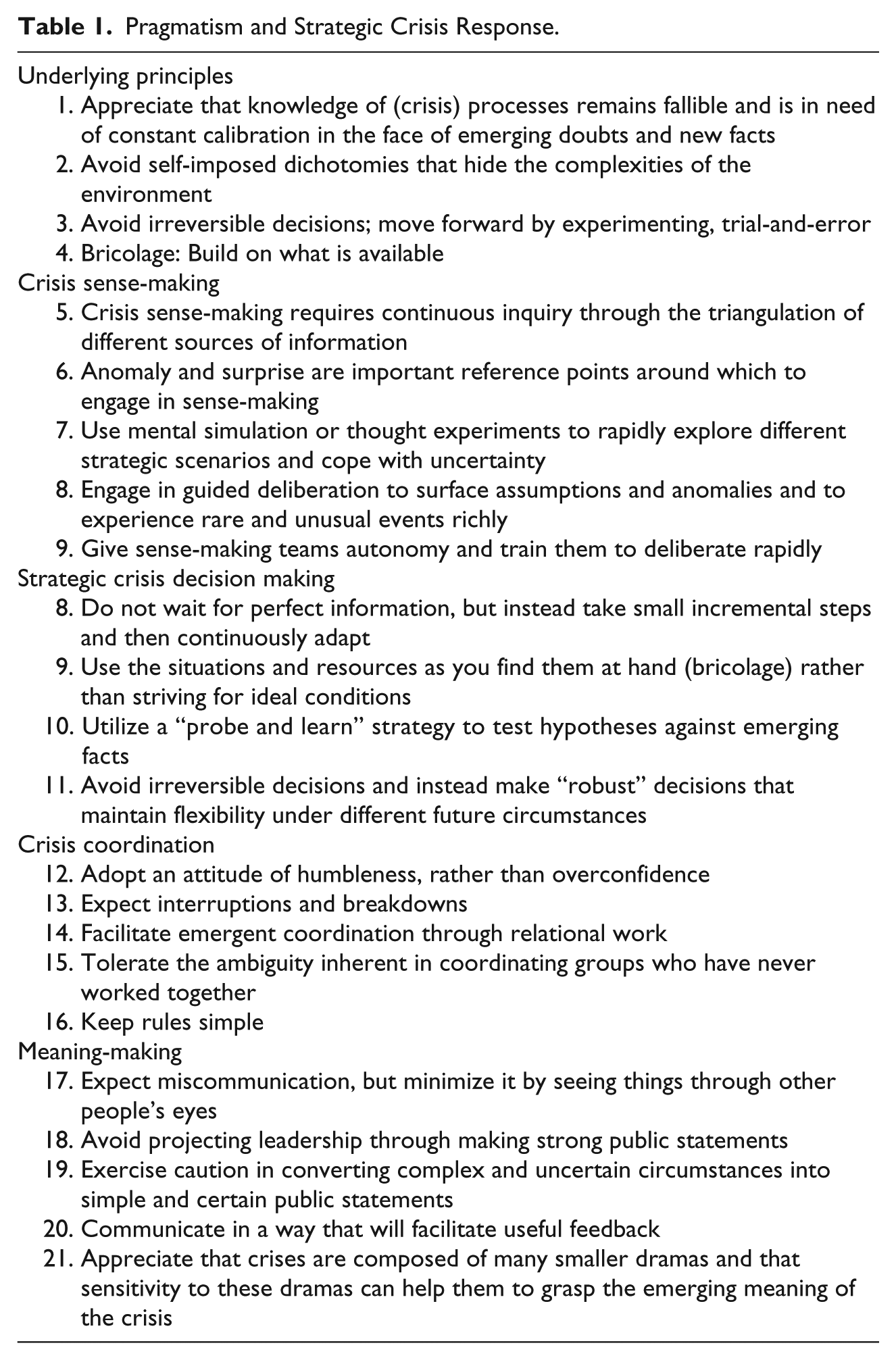
Pragmatism suggests an alternative approach, one more in line with what skillful crisis managers actually do during a crisis. This model suggests crisis managers approach a crisis with a sense of humility, recognizing the provisional nature of their knowledge. They adopt incremental strategies that are robust in the face of rapid change and they avoid making irreversible commitments. They avoid false dichotomies and they treat their strategies as experiments. They engage in continuous inquiry to test their interpretations against changing circumstances; they encourage deliberation about emerging goals, values, and interpretations; and they facilitate the action of others. They recognize the importance of communication and the ever-present potential for miscommunication. They acknowledge the dramaturgy of crisis and act prudently when communicating meaning. Table 1 provides an overview of what we have argued a Pragmatism model entails.
Pragmatism and Strategic Crisis Response.
Pragmatism’s antidualist, action-oriented, nonteleological conception of action provides a powerful framework for understanding and improving strategic crisis management. It is a framework that can be used to compare and assess the performance of strategic crisis management in multiple cases.
It is also an approach that can be translated to practice. Pragmatist crisis management is not necessarily simple or straightforward, however. We certainly do not mean to suggest it is a recipe for successful crisis management. It requires skill and experience and makes significant demands on crisis decision makers. However, it suggests quite different demands on crisis managers than those portrayed by the rational model. One of the core differences is that Pragmatism regards uncertainty as something to manage and live with, rather than to dispel and conquer. Like the rational model, Pragmatism prizes inquiry. But Pragmatism directs crisis managers’ energy toward a different mode of inquiry. The rational decision engages in a comprehensive inquiry to systematically collect information to reduce uncertainty, evaluate value trade-offs, and to optimize utility. By contrast, the Pragmatist decision maker engages in a more targeted inquiry, focusing on surprise and anomalies, and on selectively testing interpretations and searching for opportunities for creative resolution of value conflict. This mode of inquiry supports a more adaptive style of decision making that is more realistic under conditions of uncertainty and high tempo change.
The Pragmatist approach respects the complexity, instability, and uncertainty of crisis situations and offers a constructive perspective on how to proceed. It flies into the face of established practices and ways of thinking that dominate routine processes of governance. It is, therefore, essential to train strategic managers, to properly prepare them for the effective adoption and execution of such approach. We cannot expect strategic managers—experienced or not—to engage in the abductive reasoning, experimental decision making, deliberation, and communication practices prescribed by Pragmatism.
Footnotes
Declaration of Conflicting Interests
The author(s) declared no potential conflicts of interest with respect to the research, authorship, and/or publication of this article.
Funding
The author(s) received no financial support for the research, authorship, and/or publication of this article.