




Abstract
Knowledge exchange and collaboration in innovation networks is based on trust. Individuals and organizations within the network further play an important role in creating trusting relationships. Using this as a basis, the article explores the dynamics of trust when relationships and positions within the network change. Counter to the expectation that relationships are formalized in this scenario, the article shows that in the Chicago case, trust is layered. The article concludes that third-party sources of information about trustworthiness are strategically established as a layer in the network and that individuals translate past interactions into lasting organizations that can facilitate trust.
Introduction
Trust is a key element of innovation networks. This has to do with the dynamic and often uncertain environments in which individuals and organizations interact (Edelenbos & Klijn, 2007; Nooteboom, 2006). The risky nature of innovative endeavors with potentially high investments and long-term research efforts perpetuates this. At the same time, innovation networks rely on knowledge exchange for the ability to come up with new ideas and products. In short, trust is a commodity that permits voluntary participation in production and exchange in such networks (Dasgupta, 2000; Doss, 2013; Innes & Booher, 2007; Klijn et al., 2016). There is variation in the type of trust found in innovation networks. Those forms involve the trust in competence, that is, the ability to act according to agreements and expectations, and the trust in intentions, that is, the will to act properly with attention and commitment and “benevolence” (Nooteboom, 2006). 1 An opportunity for trust building in this setting is personal relationships among individuals within the network based on shared experiences (e.g., working in the same company) as well as the role of third parties or go-betweens. Third parties can play a role when moderating or extending trust from one individual to another.
There is a growing amount of research on the importance of trust in these settings (Klijn et al., 2016; Willem & Lucidarme, 2014); however, one aspect that is often overlooked is the possible disruption of trusting relationships due to the complexity and dynamic in networks that often requires trust renewal or compensation mechanisms of actors (McEvily, Perrone, & Zaheer, 2003; Mesquita, 2007; Ross & LaCroix, 1996). Over time, collaborative networks are further in danger of suffering from partnership-fatigue and ever-changing settings (Huxham & Vangen, 2004; Willem & Lucidarme, 2014). Research focusing on network settings shows that trust is developed “in action” and requires facilitation through continued interaction and network management structures (Klijn, Edelenbos, & Steijn, 2010; Klijn et al., 2016). Some suggest that in times of change or loss of trust, stakeholders fall back on monitoring and control mechanisms, which include contracts and formal agreements or look for a larger framework that might uphold current relationships (Lowndes & Skelcher, 1998; Nooteboom, 2006). There is further the general idea that as the relationships in the network change, partnerships give way to formalization (Lowndes & Skelcher, 1998) and that both dynamics of contract and trust can complement and precede each other (Nooteboom, 2006).
Looking specifically at the dynamics of trust in networks that are highly volatile when it comes to the actors involved, the article focuses on the question how trusting relationships within dynamic and competitive innovation clusters are established and sustained. The article explores a specific dynamic within network settings, looking at the scenario where trusted individuals move around in the network. This is an underexplored area of research as much of the literature acknowledges the complexity of network settings and the different trusting relationships among individuals and organizations, but remains unclear on compensating mechanisms when actors change positions or leave the network. The case suggests that personal and organizational relationships work in tandem when changes occur and are able to facilitate trust rather than formalize it by layering individual- and organization-based trust.
The following section addresses current and past literature on trust and facilitation and takes a closer look at the dynamics in innovation networks connected to trust transfer. The “Chicago Case Study” section highlights the dynamics within the life science field in Chicago, tracking some of the key individuals and their relationships to each other. The “Discussion” and “Concluding Remarks” sections discuss the findings and contribute to the understanding of trust patterns within networks by identifying possible compensation and facilitation mechanisms.
Trust in Innovation Networks
Trust is an inherently vague concept, and the current literature identifies several aspects that have not been fully explored in the context of networks. Specifically in connection to the complexity and movement that stakeholders experience in networks, there is limited research on actors moving in and out of the local network (Klijn et al., 2016; Willem & Lucidarme, 2014). Challenges specific to collaborative network settings include “building trust, overcoming partnership-fatigue and ever-changing settings, and developing balanced leadership” (Huxham & Vangen, 2004; Willem & Lucidarme, 2014, p. 740). There is an overall (implicit) mentioning of complexity, a change in goals or even foci, but the movement of actors and the challenge of retaining the trust attached to them have not been fully explored in current research. The following section looks at the conceptualization of trust through a network lens touching upon the ever-changing conditions and actors as well as a possible midlevel range idea of trust (Farrell, 2009).
Networks can be categorized as a type of organization in that they face some of the same institutional problems and constraints (Skardon, 2011). They consist of informal and formal connections among small and large companies as well as investors, government, and knowledge brokers or boundary-spanners. Each of these stakeholders has different incentives for being in the network. Innovation networks mostly enable transaction costs to stay low and create value based on the collaboration among members. This value stems from the flow of information, knowledge, and technology. Especially tacit knowledge, which lacks codification and often needs face-to-face effort, is said to further innovation and is exchanged in such setups (Nonaka & Takeuchi, 1995; Powell & Grodal, 2005). In addition, for the transfer of tacit knowledge, having the right person with the right connection plays a much larger role and ultimately limits the number of partners (Reagans & McEvily, 2003).
Trust has a key function in these networks, as collaboration is part of their value. At the same time, network members experience intense competition among companies resulting in an information dilemma in which stakeholders have to choose whether to disclose or not disclose certain information (Zucker, Darby, Brewer, & Peng, 1995). In contrast, ongoing communication and repeated interaction improves trust (Klijn et al., 2016; Shapiro, Sheppard, & Cheraskin, 1992). “From this perspective, people cooperate with others because cooperation represents a shared value in the network” (Reagans & McEvily, 2003, p. 246). Klijn et al. (2010) further point toward the “process of allying,” which makes trust a horizontal coordination mechanism that ultimately fosters innovation. In short, trust creates collaborative dynamics in a competitive setting. This is best described in the economic “stag-hunt” approach. This game-theoretic approach to collaboration in a competitive environment indicates that the viability of cooperation depends on mutual beliefs and rests on trust (Skyrms, 2003). It ties trust attitudes to specific behavioral patterns that are candidates for generating macro-level outcomes (Bosworth, 2013). The stag hunt perspective supports the importance of trust in stakeholder relationships by making an economic argument for trust causing prosperity, as a change in attitude leads individuals to make different decisions in settings where their decisions have economic consequences (Bosworth, 2013).
Trust is facilitated in these mostly competitive networks through a common history or repeated contact of stakeholders. Stakeholders use information from their history of interactions with a partner to draw inferences about the partner’s trustworthiness. This information can also come from third parties (Ferrin, Dirks, & Shah, 2006; Kramer, 1999). Past research has tried to distinguish between interorganizational and interpersonal trust (Barney & Hansen, 1994; Gulati & Sytch, 2008; Zaheer, McEvily, & Perrone, 1998). This is described by Farrell (2009) as “mid-range forms of trust.” This conceptualization incorporates the realm between the individual and the highly abstract level of trust. The idea is based on Hardin’s (2002) encapsulated interest where individuals trust actors who belong to broader classes. This implies that there is relational trust between two individuals, and on top of that, trust can also be established based on one of the two individuals belonging to a certain group of people. This class-based idea is different from institutional trust described in the literature, as the latter refers to a more general set of norms and rules (Farrell, 2009).
A similar idea is represented in the organizational trust literature. Here, trust is related to reduced negotiation costs and lower level of conflict as well as information sharing (Gulati & Sytch, 2008). Interpersonal trust of individuals in different firms or organizations can then translate into collectively held trust toward another organization (Zaheer et al., 1998). Similar to the individual trust relationships, the length of prior interaction between two firms has an effect on the interorganizational trust. Familiarity thus breeds confidence in another stakeholder (Gulati & Sytch, 2008; Uzzi & Gillespi, 2002). At individual level, “two people who have little or no knowledge of each other can develop trust for each other relatively quickly when they share trust in a common third party” (McEvily et al., 2003, p. 94). This third party can be another person, or an organization. These dynamics also play out in a way in which an individual transfers the trust to another member of their own group with whom they have no history with (McEvily et al., 2003). This indicates that the knowledge about the trustworthiness of a stakeholder can be transferred from one network member to another through a third party or intermediary (Coleman, 1990; Hardin, 2002; McEvily et al., 2003). This implies that trust transfer can happen unintentionally by being part of the same tight-knit network or intentionally when facilitated by boundary-spanners within the network, for example.
To summarize, collaboration partners build trust by sharing information and knowledge, demonstrating competency, good intentions as well as follow through over longer periods of time (Arino & de la Torre, 1998; Klijn et al., 2016; Merrill-Sands & Sheridan, 1996). The observed and plausible link between generalized trust attitudes and economic prosperity further shows the need for individuals to trust their partners and the relevance of coordination (Bosworth, 2013). In fact, many of these relationships require a large amount of brokerage effort to form alliances and ultimately share information (Gulati, 1995). The broker within a network is in a position to enhance the collaborative capacity for stakeholders working together as well as supporting the absorptive capacity for knowledge exchange (Giest, 2015; Klijn et al., 2010; Klijn et al., 2016).
The Role of Boundary-Spanners
Boundary-spanners or brokers are defined as institutional actors who are positioned at the intersection of network members and can play an important role in sustaining those linkages (Gulati & Sytch, 2008; Klijn et al., 2016). Singling out their role has the purpose of highlighting two dynamics that this group can contribute to: Boundary-spanners within innovation networks can reduce distance among stakeholders and the complexity of their relationships. This, in turn, creates opportunities to build trust among actors. The trust in boundary-spanners is said to evolve over time, as they first cultivate interpersonal trust relationships within the network. As time passes, the commitments among individuals become routinized and institutionalized at the organizational level (Gulati & Sytch, 2008; Rosenkopf, Metiu, & George, 2001).
Furthermore, trust in brokers (Davis, Yoo, & Baker, 2003) and in leaders (Dirks, 2000) has been found to be positively related to group performance (Lee, 2004). Lee (2004) finds that trusted leaders can be “moderators” of trust and thereby have a positive effect on cooperative behavior. This is similar to the argument that Mesquita (2007) makes linked to “trust facilitation.” He states that “trust-facilitating abilities and reputation, when moderated by appropriate process structures and managerial propensities to trust, help demarcate separate relationship domains, which represent new opportunities for trust and cooperation to emerge in relationships previously gridlocked in uncooperativeness” (Mesquita, 2007, p. 72). Klijn et al. (2010) and Klijn et al. (2016) further find that network management and knowledge transfer has a positive effect on process and content outcomes. The reliance upon the existence of brokers however makes the network more vulnerable. The departure of a trusted broker may change or even jeopardize existing relationships (McEvily et al., 2003).
Trust Transfer Mechanisms
As the previous sections show, trust is something that is in flux as relationships among stakeholders change. There are further indications for the fact that if these scenarios play out, there are trust transfer mechanisms in place that can potentially compensate for some of the changes in the relationships. The connection between a change in the relationship based on individuals leaving and the trust transfer that occurs after has however not been widely dealt with in the literature. So far, studies have found that a change in trust not only affects the two actors involved but also affects the whole network. This is due to the trust facilitation role key individuals take on. As Golbeck and Kuter (2009) describe,
Consider that Alice trusts Bob, and Bob trusts Charlie. Although Alice does not know Charlie, she knows and trusts Bob who, in turn, has information about how trustworthy he believes Charlie is. Alice can use information from Bob and her own trust in Bob to infer how much she may trust Charlie. (p. 170)
A very similar dynamic is described by Farrell (2009), where an actor in the network has reason to trust another because he or she belongs to a broader class of actors. Under this class-based account of trust, individuals can trust each other without previously having known each other. This applies to both past experiences as well as ongoing relationships. Trust at an organizational or midrange level further becomes crucial to fall back on, suggesting that if trust in management or a crucial stakeholder declines, another trust element in the network has to remain (Morgan & Zeffane, 2003).
The literature generally highlights the importance of trust for innovation networks and the complementary relationship between formal or contract- and trust-based connections. There have been additional studies on the role of network managers and go-betweens for trust, however, little on the trust compensation among individuals once actors leave or enter the network. So far, it is suspected that stakeholders either fall back on contracts to substitute or replace trust or look for a larger framework that might uphold the connection.
Overall, current research highlights the following premises for innovation networks when it comes to trust:
Trust is incrementally built based on a history of interaction—this applies to interpersonal as well as interorganizational relationships.
Boundary-spanners are involved in these relationships by creating and sustaining them. If trusted individuals leave the network, they create a gap which is filled with contractual links or third parties indicating trustworthiness of a stakeholder.
Based on these premises, the article puts forward the following hypotheses for innovation network:
Trust in networks is developed and sustained as follows:
Method
The article maps the connections among stakeholders in the Chicago life science cluster (Illinois, USA). Those current and past relationships are used as proxies for the trust among individuals. Based on descriptions by other researchers (Bigley & Pearce, 1998; Dirks & Ferrin, 2001; Lewicki & Bunker, 1996; Worchel, 1979), the article focuses on trust as a psychological state, such as a belief or attitude toward another known individual, as opposed to trust as a dispositional construct (e.g., Rotter, 1967) or among groups or firms (e.g., Das & Teng, 1998; Wicks, Berman, & Jones, 1999). Thereby, trust provides the condition under which certain outcomes such as cooperation and higher performance are likely to occur. In short, the article uses a narrow definition of trust, by defining the concept as the “expectation that a partner will not engage in opportunistic behavior, even in the face of opportunities and incentives for opportunism, irrespective of the ability to monitor or control that party” (Woolthuis, Hillebrand, & Nooteboom, 2005, p. 816). Innovation clusters are defined as regional agglomerations of companies, research institutions, and government agencies in an area of business activity related through various knowledge and economic linkages (Ketels, 2011; Porter, 2008). And the life science sector is representative of various innovative fields where knowledge exchange shapes the relationships within networks.
The article draws on interviews conducted for a larger study that included biotechnology networks in Chicago (Illinois, USA), Copenhagen (Denmark), Singapore, and Vancouver (British Columbia, Canada). In-person interviews in Chicago were conducted with six stakeholders from academia, government, and industry that are active in the life science field. The interviewees were selected to include representatives from the three stakeholder groups that contribute to innovation networks and reaching some of the key organizations that manage and connect the cluster. Furthermore, one follow-up interview was completed over Skype specifically addressing changes in the network. In addition, information on individual biographies was collected linked to key individuals identified by the interviewees. Thereby, the measure of trust is based on the model developed by Ferrin et al. (2006), which outlines that stakeholders make inferences about trustworthiness based on the history of interaction with a partner and further draw on third parties to inform their trust judgments. This translates into analyzing past interaction of stakeholders, including third-party players—individuals or organizations—as well as the current network setup. Individual biographies were collected through desk research and partial information highlighted in interviews. Special attention was paid to changes over time. The interviews were conducted in 2013, the follow-up interview in 2014, and the desk research was largely done in 2015. This is also a time in which Illinois had a change in governor as well as personnel changes in some of the key institutions identified by interviewees. The unit of analysis is the biotechnology network also identified as the “cluster” in the remaining part of the article.
Chicago Case Study
The Chicago biotechnology community is a rather new and small network for biotech standards. According to those working within the field, “everyone knows everyone,” and collaborative structures are based on individual collaboration. The biotechnology community thereby builds on a foundation of personal and business relationships that often exceed the existence of the Chicago network. As one government interviewee put it, “I started out asking ‘who are the right people to meet,’ ‘who to get in front of’ ‘who do we need to be talking to.’” Meanwhile, the network is growing in economic impact. The latest report by the Illinois Biotechnology Industry Organization (iBIO; 2013) reports that the state contributes US$98.6 billion in economic output and 369,000 direct and indirect jobs to Illinois. For the network structure in particular, latest numbers reveal 299 participating organizations in the medical biotechnology field with 1,437 unique pairings (78% of these pairings demonstrate potential connections) and a calculated 6,498 collaboration opportunities (Illinois Science & Technology Coalition [ISTC], 2014). The interviews with stakeholders from different types of organizations within the network, such as academic institutions, research institutes, government, and companies further point toward key initiators and connectors within the network.
A representative from the technology transfer office at an Illinois university points out that
We’ve been running a program with Northwestern University of Chicago and iBIO, we all started a program called Chicago Innovation Mentors and that has been a catalyst for us, one to work closer with the other universities as well as iBIO and then our mentor pool is people in industry. Through all that, it has been an opportunity to enhance the community a little bit. So it is easier for me now to talk to someone from Northwestern, because I see them at least once a month and I am on the phone with them almost every week in helping run that program.
The Chicago Innovation Mentors (CIM) support university-based and local technology innovation ventures through the use of mentor teams. The board of governors consists of three university representatives (University of Chicago, University of Illinois, Northwestern University) as well as the Argonne National Laboratory and iBIO/PROPEL. In 2003, iBIO was established with the goal of orchestrating the interplay of business and education in the biotech field. One program by iBIO that stood out during the interviews was PROPEL. PROPEL helps the development of formation-stage and early-stage life sciences companies by providing entrepreneurs with access to specialized resources and expertise to prepare them for early-stage funding. Thereby, in addition to the iBIO Institute and iBIO support staff leading PROPEL, the organization depends on the time and expertise of the life sciences community, serving as coaches, technical experts, subject matter experts, and panelists. The CEO of a biotech start-up company underlines the importance of these institutions for underpinning the network relationships. He states that, “I mean iBIO, Chicago Innovation Mentors, Women in Biotechnology organization are very active, so there are several organizations that are constantly gathering together expertise from throughout the community and finding a way to bring people together.” The establishment and collaboration of these institutions is built on personal relationships.
Table 1 shows the relationship among key individuals and their current positions in the network. An interview with Person D (see Table 1) showed that he not only hired Person B but also formed, together with a small group of people, the iBIO organization by merging the “Chicago Biotech Network Association,” which was a Chicago land organization, with a crop association focused on agriculture. Person A and Person D are further connected to smaller companies that exist in the Chicago network. As Person D highlights,
I started my own company that was a consulting practice offering myself and others out as part-time CEOs, because what I realized was that many start-up companies cannot afford a full-time CEO. So I would rent myself out to 3 or 4 companies at a time and help them get along, working with early-stage venture capital etc.
Connections and Careers in the Illinois Biotech Network.
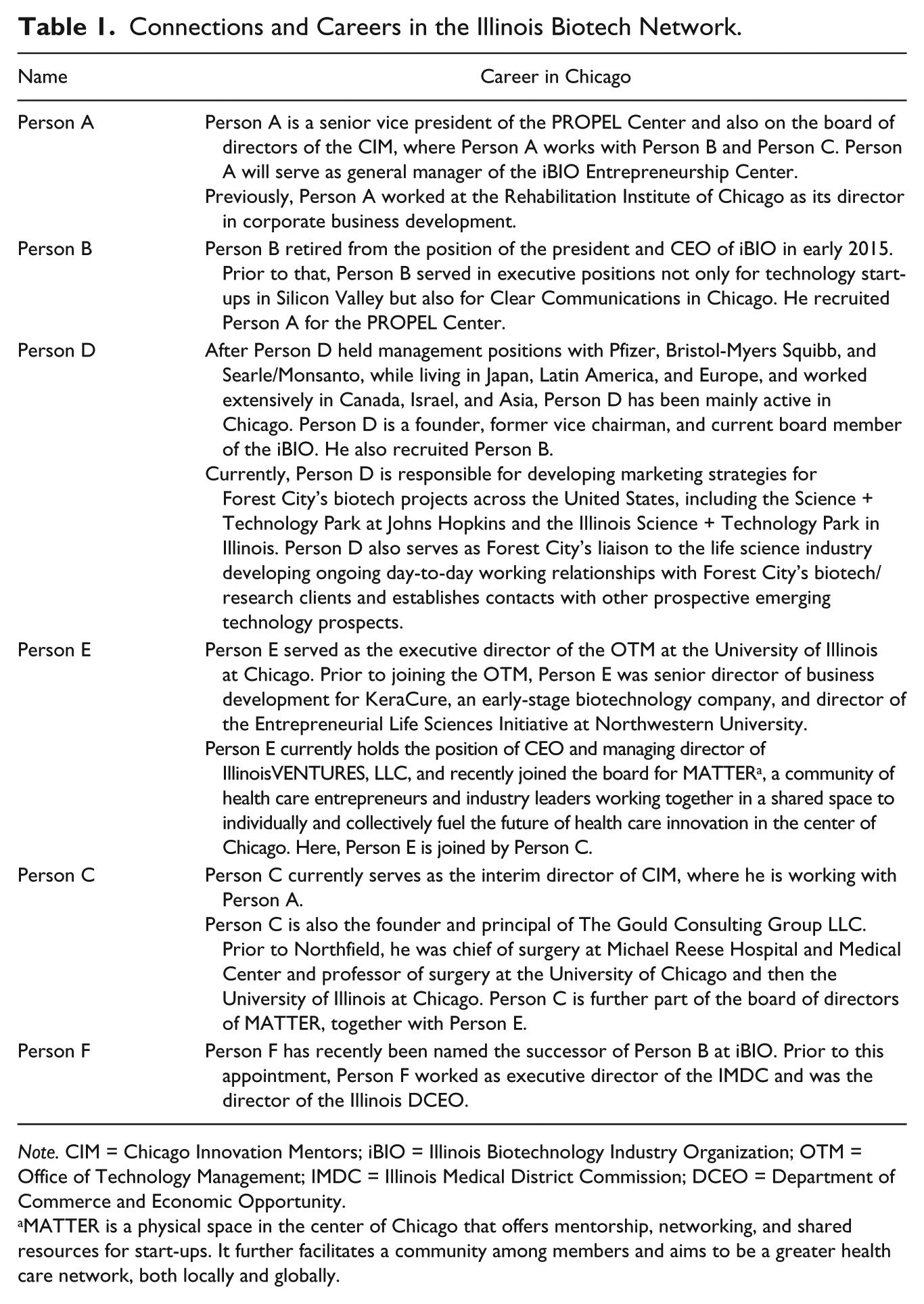
Note. CIM = Chicago Innovation Mentors; iBIO = Illinois Biotechnology Industry Organization; OTM = Office of Technology Management; IMDC = Illinois Medical District Commission; DCEO = Department of Commerce and Economic Opportunity.
MATTER is a physical space in the center of Chicago that offers mentorship, networking, and shared resources for start-ups. It further facilitates a community among members and aims to be a greater health care network, both locally and globally.
Person D further states that Person A, who is running PROPEL, builds on a wide-ranging connection to companies, as this individual “worked with 30 or 40 companies over the last 4 plus years.” These types of connections repeat themselves in different forms. From a university perspective, an interviewee at the business development center at the University of Illinois highlights that they report to the research office, which hired an individual who used to work at the Chicago Department of Commerce and Economic Opportunity—the government department responsible for the funding of the network in form of the Office of Entrepreneurship, Innovation and Technology (OEIT). The OEIT is in charge of catalyzing local, national, and global partnerships, including the Small Business Development Center network and the Advantage Illinois program that strengthen Illinois’s competitive advantage. The office was originally set up and then developed and shaped by a biotechnology entrepreneur before being back in public servant hands. This resulted in structures that would accommodate new businesses in terms of application and funding. It also made its role immediately prominent in the biotech community.
Interviewees from research institutes and companies also pointed toward the role of the Illinois Medical District Commission (IMDC), which manages the urban medical district that also houses the state’s largest biotechnology complex and provides incubation for approximately 30 technology-based companies. And as hospitals gain a more prominent role in the field of pharmaceutical and life science research, the IMDC also gained in importance for the network. Stakeholders largely point toward its umbrella function for the hospital sector and the ability to provide physical space for collaboration of smaller companies.
When tracing some of the biographies of the individuals employed by these institutions, it becomes clear that they—even when changing organizations or switching from private to public—remain in the network and cultivate their connections. Based on the names that came up during the interviews, the following examples represent a large portion of the kind of careers in the Chicago biotech network.
Table 1 highlights two things. First, many of the individuals have gained experience outside of the network, for example, in Silicon Valley or even other countries before coming back or entering the Chicago group. And second, there seems to be a core group that crosses paths in the same organizations, creates new organizations, or even recruits each other in the process. What is striking is that there seems to be a layering of individual and organizational relationships. Although the large organizations such as iBIO or DCEO have formal ties, there are also smaller groups such as PROPEL, CIM, or MATTER that were created in recent years. PROPEL was established in 2007, CIM in 2010, and MATTER in 2014. And finally, there are direct linkages among individuals, either based on common employment in one of the organizations or more personal linkages.
The patterns that emerge from this are that individuals establish trust over time and then translate that trust into informal and formal groups.
These structures were recently put to the test when Person B, CEO of iBIO, retired. Person B was president and CEO of the iBIO, in this position Person B also served as the president and CEO of the iBIO Institute. Prior to joining iBIO, Person B held executive positions for technology start-ups. The name was front and center in most interviews when talking about the major initiatives in the network such as PROPEL or more general networking initiatives. In fact, before the successor of Person B was announced, a medical district representative pointed out that the relationship between iBIO and the IMDC would turn from an informal relationship with Person B into a more formal one due to Person B’s retirement. He further expressed his worry about how that would reshape the relationship between the larger biotech network and the medical district. In 2015, it was announced that Person B is succeeded by Person F. Person F led the IMDC from April of 2012 and is widely credited with revitalizing the district and attracting new tenants and life sciences developments, including the University of Illinois’s Health Technology Innovation (HTI) center. Before taking over leadership of the IMDC, Person F spent 3 years as the head of Illinois’s economic development agency, the Illinois Department of Commerce and Economic Opportunity (DCEO; Business Wire, 2015). In short, the successor of Person B is a person that the network is familiar with, and who also served in some of the key positions—namely, as the leader of IMDC as well as DCEO.
Overall, the Chicago innovation network in the field of life sciences displays a variety of personal relationships that are based on repeated interactions outside and inside the network. Positions essential for the network were distributed and redistributed among a small number of individuals. In addition, organizations established and sustained by those key individuals serve as entities that now connect actors within the network.
Discussion
The case in Chicago shows that the community of stakeholders was built over time and that many of the personal relationships spilled over into organizations that can potentially serve as trusted entities if relationships in the network change. Most of the organizations, such as CIM or PROPEL, were established from the bottom-up. That means individuals, based on experience and past relationships, decided to form or merge groups that could enhance the biotech community in Chicago. Translating some of the personal relationships in this form then carried weight for the overall trust dynamic in the cluster moving forward. This gives a pretext to the findings by Klijn et al. (2016) that state that “trust is formed by individuals but in a context of relations among organizations” (p. 117). The Chicago case thus shows the early beginnings of such organizations sustaining the trust in networks among network members. For this development, the case points toward elements of dynamic trust development through historically evolved, individual relationships that spillover into smaller organizations which can then sustain trust.
In short, once organizations, such as CIM or MATTER, are established, they can act as buffer or compensation, in case individuals leave or change positions within the network. Stakeholders can then use the organization the leaving individual was part of, to gain new connections.
In the same way, the recruitment of known stakeholders, as shown in Table 1, and events of personnel change in key organizations highlight that if there is change in personnel, the network tends to recruit someone who is already known to some of the stakeholders or even to strengthen and uphold close relationships among key institutions, such as placing the former head of the IMDC in the role of the CEO of iBIO.
Based on these observations, it seems that stakeholders avoid falling back on formalizing relationships when actors change, as is suggested in some of the literature (Lowndes & Skelcher, 1998; Nooteboom, 2006), but rather build on existing trust with stakeholders and moving them around within the network. The network also has a tight-knit core community which is represented in the different boards of organizations. Thereby, instead of going from trust to no trust when actors change, in the framing of Woolthuis et al. (2005), it is a more nuanced picture that is forming. It is a back-and-forth between personal relationships and organizational relationships. In short, there are layers of trust that work both ways. Middle layer or midrange forms of trust act as a buffer for individuals leaving, and recruiting trusted individuals secures the relationships among organizations.
In connection to the role of boundary-spanners, there is the IMDC which represents a large portion of the research stakeholders in the network whereas iBIO and the PROPEL program are able to connect research and businesses as well as government funding schemes. These linkages are supported by an established group of individuals known to each other and members of the network. Their work does not connect directly to trust building, but the interviews point toward regular contact among otherwise isolated stakeholders. They form an access point toward trust-building activities based on regular contact and communication.
To summarize, the Chicago case shows that first, long-lasting personal relationships are translated into organizations that carry the community beyond key individuals and become boundary-spanners in the network. Second, key individuals were strategically placed in positions that became vacant to secure relationships at an organizational level.
Connecting these findings to current conclusions in the literature shows that the case can advance existing knowledge by highlighting time and group dynamics of trust within innovation networks. The issues presented go beyond the idea that trust needs to be established in networks to facilitate innovation and that boundary-spanners contribute to the level of trust (Klijn et al., 2016; Willem & Lucidarme, 2014). The case adds that trust building relies on relationships that span several years and thus several interactions reinforcing trust. It further refines the boundary-spanner role by showing that it poses an entry point for stakeholders outside of the direct network to connect with key individuals or organizations. Generally speaking, the trust is not formalized but rather recycled in the case, where the back-and-forth between personal relationships and organizational relationships reinforces trust dynamics within the network. This further highlights the overlap of personal and organizational relationship, a dynamic which can be used by boundary-spanners to enhance trust. Finally, the case adds to existing research by giving insight into movements in and out of the network. It shows that although boundary-spanners are access points for moving in, movement out of the network is being compensated by long-established personal or organizational relationships. In short, the case suggests adjustments to theory connected to the close relationships and layering of interpersonal and interorganizational relationships as well as paying close attention to who is moving in and out of the network and how those leaving are replaced.
Concluding Remarks
By looking at the evolution of relationships in one innovation cluster, the article aims to partially fill the gap in the literature concerning dynamic and midlevel range trust in networks with a particular focus on changes in network members. In line with the research on trust that uses the history of individuals as proxies for trust, the article refutes the notion that when trusted individuals change their position in the network or leave, relationships are formalized (Lowndes & Skelcher, 1998; Nooteboom, 2006). Instead, it shows that stakeholders rely on the structure established over time layered on top of the individual relationships. To avoid the reliance upon individuals that will potentially leave the network, stakeholders translated their individual connections into organizations that upheld the connections made or even facilitate new connections among network members. This mechanism to retain trust adds to the models suggesting that past interactions contribute to trusting relationships (Ferrin et al., 2006; Kramer, 1999; Lewicki & Bunker, 1996). Although past interactions build the basis for the network, these connections are made sustainable by translating them into organizations that outlive individuals within the network. In turn, recruiting trusted individuals to key positions was used to uphold relationships among institutions. The role of intermediaries or boundary-spanners also plays a role in this setting, as they form an access point toward trust-building activities based on regular meetings and communication. This suggests that interpersonal and interorganizational relationships are layered in the network setting and that boundary-spanners facilitate this by being access points to the network.
The case findings thus support research conducted in network settings that point toward the dynamic elements of trust where prolonged and repeated interactions develop and sustain trust and network management helps to facilitate these relationships (Klijn et al., 2010; Klijn et al., 2016). The case further shows evidence of a class-based version of encapsulated interest where a network member becomes trustworthy to another actor due to belonging to a certain “class” or organization (Farrell, 2009; Hardin, 2002). In sum, the takeaway from this one case is that trust-sustaining mechanisms in networks exist and counteract the dynamic and complex elements of such a setting. In addition, trust is not formalized during changes in the network, but rather recycled by replacing positions with known individuals and facilitating trust through smaller organizations where key individuals come together.
The findings stem from one innovation network and have thus to be treated with caution, as the network studied is rather small and highly volatile. This means that some of the compensating mechanisms for stakeholder movements are exaggerated in this setting. The same applies to the organizations being established and the strategic placement of known people in key positions. Within these limitations, however, the case strengthens future research looking at the role of trust in networks in general and the role of network management in particular. It further points toward a potential mechanism of how networks sustain trusting relationships in a highly volatile environment.
Footnotes
Declaration of Conflicting Interests
The author(s) declared no potential conflicts of interest with respect to the research, authorship, and/or publication of this article.
Funding
The author(s) received no financial support for the research, authorship, and/or publication of this article.