



Abstract
Why do democratic militaries constrain force to protect enemy civilians? This study identifies an international media enforcement mechanism, arguing it operates as a default constraint that collapses under specific conditions. Bibliometric analysis of 57 publications reveals a 5.77-fold scholarly gap prioritizing casualty aversion over enemy civilian protection. Israeli and comparative democratic cases from 1987 to 2025 show how militaries transformed from treating media as peripheral to making international legitimacy central to doctrine. The mechanism’s breakdown or recovery depends on three variables: the nature of the perceived threat, domestic social resilience, and the hierarchy of international pressure. A multi-phase analysis of the 2023 to 2025 Gaza War reveals complex dynamics. While initial existential threat perceptions led to the collapse of traditional constraints, the mechanism’s recovery fluctuated, worsening in the final phase. When survival imperatives dominated, unprecedented domestic consensus insulated leaders from international criticism. The study concludes that the mechanism is powerful but conditional, fluctuating with threat perceptions and operational contexts.
Keywords
Introduction
Contemporary democratic warfare can be understood through the lens of a central tension between two, often conflicting, imperatives: force protection and civilian protection. This dichotomy is rooted in the two cardinal rules of post-heroic warfare first identified by Edward Luttwak (1995, 2001): the need to minimize casualties among one’s forces while simultaneously avoiding harm to the enemy’s civilians. The power of this dynamic became evident in subsequent decades, as televised images of civilian suffering repeatedly forced military operations to halt or adapt. This study focuses on the second element of this tension: Why do democratic militaries constrain their use of force to protect enemy civilians, even when facing significant threats?
The practical significance of these constraints became evident in a private conversation between Luttwak and Major General Gershon Hacohen, commander of Israel’s National Defense College, following the 2009 Gaza War. During their discussion, Luttwak observed that, Israel is in a constant tension between the argument to achieve domestic legitimization within the Israeli society, that could be revoked if it has too many self-casualties; and between the argument to act in a manner that will endow external international legitimization. (Hacohen, 2014, p. 50)
This post-conflict assessment, by the theory’s originator and shared with a senior military practitioner, highlights the central dilemma facing democratic militaries in contemporary post-heroic warfare. While extensive literature has examined the first rule—military casualty aversion among democratic publics—the implementation of the second rule and its connection to international legitimacy have received less systematic analysis within the framework of post-heroic warfare.
This study addresses this gap by developing a media enforcement mechanism that explains when and how democratic militaries constrain force to protect enemy civilians. The mechanism operates as a default constraint through a clear causal chain: international media coverage of civilian casualties creates perceived political costs, forcing democratic leaders to respond with operational constraints to maintain legitimacy.
However, this mechanism is conditional and can collapse. When leaders perceive threats as existential and successfully mobilize domestic consensus (a “securitizing move”), they achieve a “political shield” that insulates them from international pressure, causing the mechanism to weaken or break down entirely. Critically, the mechanism depends on leaders’ perceptions rather than objective realities, explaining why its operation varies dramatically.
Existing scholarship has essentially treated the second rule as a normative commitment rather than as an operationally enforced practice. Empirical analyses of how the second rule is operationalized during active military operations remain exceedingly rare. This study addresses this gap by developing a media enforcement mechanism that explains when and how international media coverage constrains democratic militaries to protect enemy civilians.
In a detailed examination of the Israeli experience, this study delineates the boundary conditions under which this mechanism functions effectively. Israel demonstrates the media enforcement mechanism most clearly, but the mechanism operates across democratic militaries. The U.S. ended the Gulf War partly due to the Highway of Death coverage, and NATO changed targeting rules in Kosovo after civilian casualties. The paper begins with a review of existing literature on post-heroic warfare and the second rule, identifying the empirical and theoretical gaps that motivate this study. After introducing the analytical framework of the media enforcement mechanism, the study examines the Israeli experience alongside comparative cases. A detailed multi-phase analysis of the 2023 to 2025 Gaza War provides a critical test case, revealing the mechanism’s boundary conditions. It demonstrates an initial collapse under perceived existential threat, followed by complex dynamics and partial recovery as threat perceptions and operational phases evolved. The analysis concludes by discussing the theoretical implications and directions for future research.
Methodological Innovation: Quantitative Bibliometric Analysis
To systematically evaluate theoretical balance in post-heroic warfare literature, this study analyzed 57 scholarly publications (articles, chapters, and books) published between 1995 and 2025, covering most scholarly works referencing post-heroic warfare identified through searches in Web of Science, Scopus, JSTOR, and Google Scholar as of July 2025. The inclusion criteria required peer-reviewed publications that included the term “post-heroic warfare” in the title, abstract, or keywords. The resulting dataset, comprising 57 publications spanning three decades of scholarship, provides sufficient scope for statistical analysis of theoretical patterns (Donthu et al., 2021).
Building on Mudde’s approach to theoretical inventories (Mudde, 1995; Weinberg et al., 2004), this study systematically coded whether each publication addresses the explanatory factors for the two foundational rules of post-heroic warfare. This coding process adheres to established bibliometric data practices (Donthu et al., 2021), allowing for a statistical assessment of scholarly attention patterns within the theoretical framework.
The analysis examined the equilibrium between the two rules by counting the frequency with which articles addressed each theoretical explanation. This bibliometric approach differs from standard performance analyses and science mapping (Donthu et al., 2021) by employing chi-square testing across a comprehensive three-decade dataset (1995–2025) to identify systematic biases in theoretical coverage. This quantitative method reveals gaps in scholarly attention within post-heroic warfare theory that qualitative assessments might overlook.
Literature Review
The Two Rules of Post-Heroic Warfare
Luttwak’s (1995, 2001b) theory of post-heroic warfare rests on two foundational principles: minimizing casualties among one’s troops and avoiding the killing of enemy civilians. These rules describe the contemporary reality in which Western democracies tend to minimize both military losses and civilian harm, sometimes at the expense of operational effectiveness (for a complete citation list, see Table 1 below).
Inventory of Post-Heroic Warfare Explanations in the Literature.
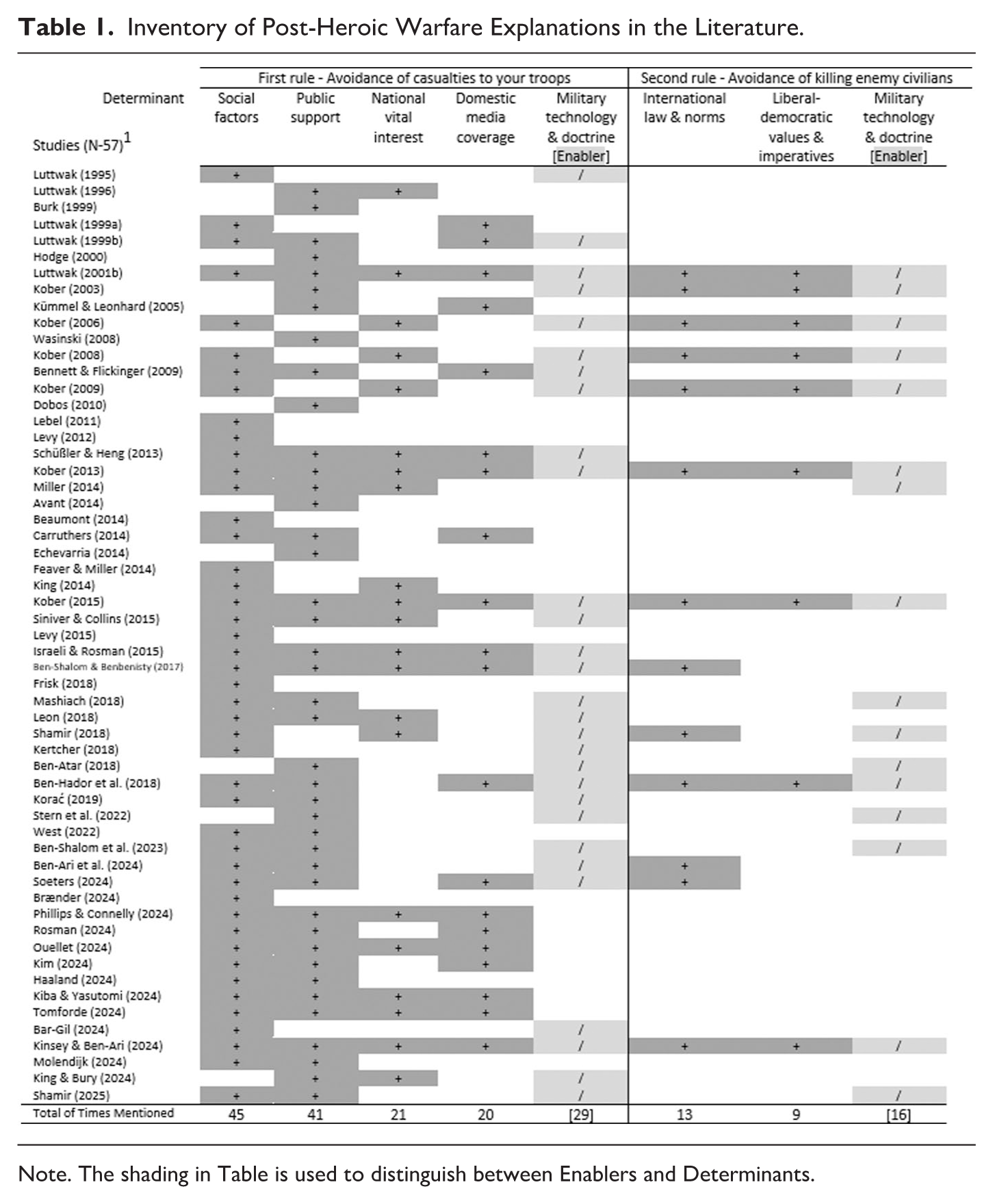
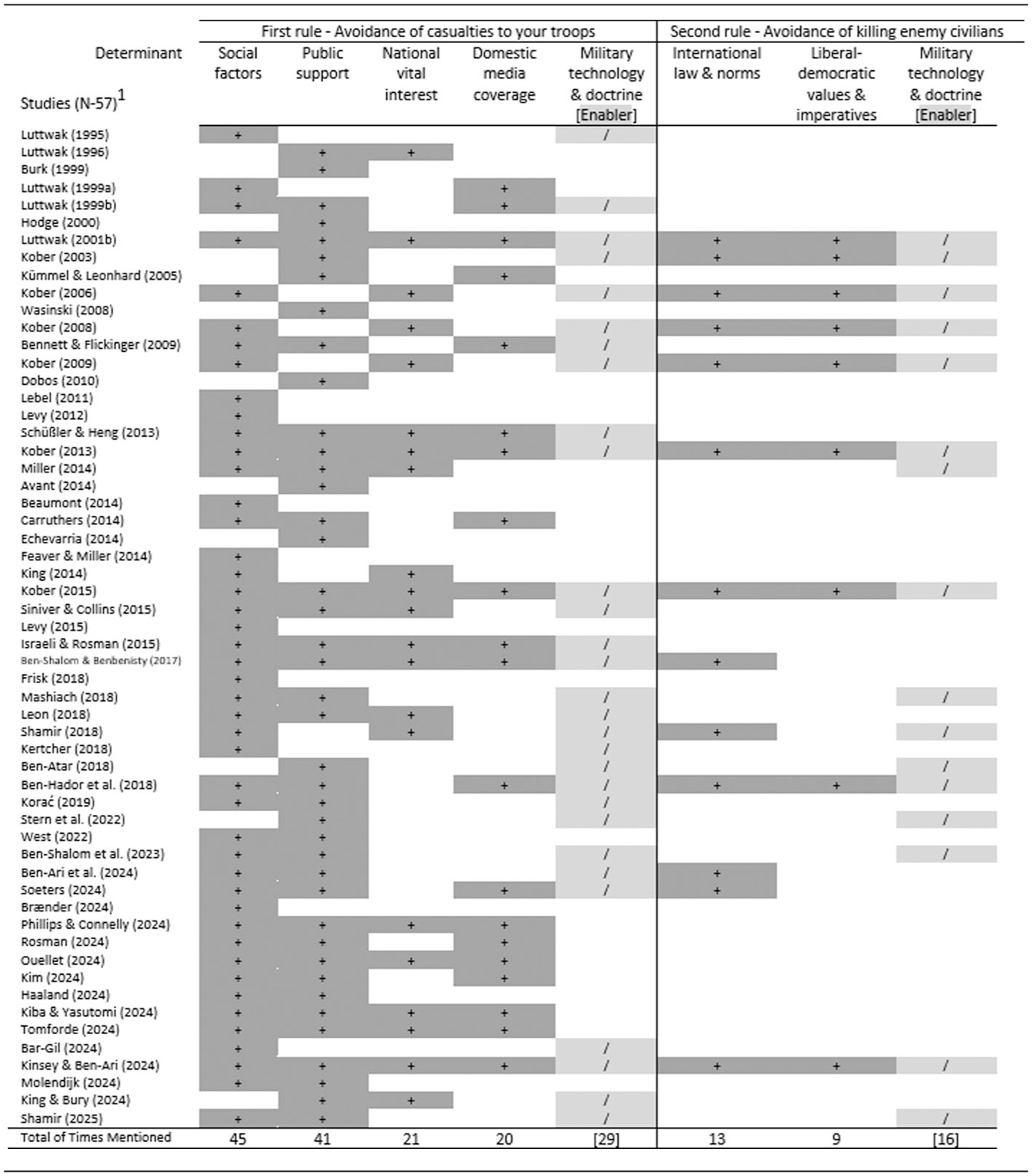
Note. The shading in Table is used to distinguish between Enablers and Determinants.
Rule 1: Avoidance of Casualties to Your Troops (i.e., Casualty Aversion)
Scholars have identified four primary explanations for casualty aversion in Western democracies (Ben-Shalom & Benbenisty, 2017; Kober, 2013):
Rule 2: Avoidance of Killing Enemy Civilians (i.e., Civilian Protection)
The second rule reflects decreasing tolerance for the enemy’s civilian casualties and excessive force (Luttwak, 2001b), supported by two main explanations:
Enabler/Facilitating Factor (for Both Rules): Military Technology and Doctrines
Advanced military technology serves both rules by enabling low-casualty warfare through precision-guided munitions, robotics, C5I systems, and network-centric warfare capabilities (Enemark, 2013; Kober, 2003, 2009, 2013, 2015; Luttwak, 2001a). These technologies allow militaries to minimize both their losses and civilian casualties compared to past conflicts.
Explanatory factors address why democratic states adopt civilian protection constraints, while enabling factors address how these constraints are implemented operationally. Military technology serves as an enabling factor for both rules, but does not explain why democratic leaders choose such constraints.
Critical Gaps and Empirical Evidence
Analysis of the literature reveals significant theoretical discrepancies between the two foundational rules of post-heroic warfare (see Table 1). While the first rule—avoidance of casualties to one’s troops—benefits from extensive theoretical development across four distinct explanations and a facilitating factor, the second rule—avoidance of killing enemy civilians—remains theoretically underdeveloped, with only two explanations often consolidated into one (and a facilitating factor).
This theoretical gap is evident in the distribution of scholarly attention. The vast majority of studies focus exclusively on casualty aversion, while civilian protection explanations receive minimal independent theoretical treatment. This stark asymmetry suggests that theoretical explanations for civilian protection are only acknowledged in conjunction with casualty aversion, never as a standalone focus.
Chi-square analysis across the 57 studies shows significant asymmetries in how scholars approach the two foundational rules of post-heroic warfare, indicating systematic patterns of theoretical development at the expense of balanced academic coverage. The first rule—avoidance of casualties to one’s troops—demonstrates markedly greater scholarly attention than the second rule—avoidance of killing enemy civilians, suggesting differential theoretical maturation between the two foundational principles.
A goodness-of-fit test confirms significant variation in factor identification frequency (χ² = 44.17, df = 5, p < .001). Social factors (n = 45) and public support (n = 41) represent the most frequently cited explanatory factors, suggesting established scholarly pathways within certain theoretical domains. A direct comparison shows a substantial imbalance: first-rule explanatory factors receive 5.77 times more scholarly attention than second-rule factors (127 vs. 22 total mentions, χ² = 73.99, df = 1, p < .001), indicating that casualty aversion has received greater theoretical elaboration within post-heroic warfare scholarship.
A Mann–Whitney U test confirms complete separation between the rules (U = 0), with no overlap in scholarly attention levels, indicating that civilian protection explanations consistently receive less theoretical development than casualty aversion explanations.
This disparity remains even when accounting for the different number of determinants per rule, with first-rule factors averaging 31.75 mentions compared to 11 for second-rule factors. This substantial difference demonstrates uneven theoretical development across the framework’s core principles.
Independence analysis shows that no studies examine second-rule explanatory factors independently of each other, while 77.2% focus exclusively on first-rule factors. This pattern suggests that civilian protection lacks autonomous theoretical treatment within current scholarship. Scholars consistently mention civilian protection only in conjunction with casualty aversion, never as a standalone focus of inquiry.
The bibliometric analysis also reveals that enabling factors receive relatively balanced attention between rules (1.81:1 ratio) compared to explanatory factors (5.77:1 ratio). However, the second rule relies disproportionately on enabling factors (42% vs. 19% for the first rule). The identified imbalance exposes fundamental weaknesses in existing theoretical accounts of civilian protection imperatives within democratic armed forces.
Finally, the bibliometric analysis reveals significant geographic concentration. Of the 13 studies addressing civilian protection explanations, 10 focus exclusively on Israel (Ben-Ari et al., 2024; Ben-Hador et al., 2018; Ben-Shalom & Benbenisty, 2017; Kinsey & Ben-Ari, 2024; Kober, 2003, 2006, 2009, 2015; Shamir, 2018), while only 3 examine other democratic contexts. This geographic concentration raises questions about whether current theoretical explanations for the second rule apply broadly across democratic contexts. The evidence points toward enforcement mechanisms for civilian protection being context-dependent rather than universal features of democratic warfare. Understanding when and how such mechanisms operate effectively requires examining both their enabling and boundary conditions.
Additional Explanation for the Second Rule: International Media Coverage
In a 2001 Hebrew op-ed in the IDF Magazine (Ma’arachot), Luttwak briefly identified international media coverage as a crucial factor for civilian protection (Luttwak, 2001a); however, this explanation has received virtually no “post-heroic warfare” scholarly attention since. Luttwak argued that television coverage creates political pressure for implementing the second rule, especially when fighting happens in civilian areas or during crowd control. The media focuses on civilian casualties instead of what started the fighting, creating international pressure that influences strategic decisions. As Luttwak noted, while television coverage cannot directly create strategic decisions, it can create political influence that leads to strategic results (Luttwak, 2001a, p. 7).
The Media Enforcement Mechanism: International Media and Civilian Protection in Post-Heroic Warfare
The Conditions for the Media Enforcement Mechanism: A Theoretical Framework
The media enforcement mechanism operates as a default constraint in democratic warfare, functioning through the causal process described in the introduction (media coverage → perceived political costs → operational restraint). This mechanism has functioned across democratic militaries, consistently translating media pressure into tactical and strategic adjustments.
However, the mechanism is conditional rather than universal—it can weaken or collapse entirely under specific boundary conditions. The breakdown occurs not through random failure but when three variables align to neutralize external pressure: (1) how leaders perceive the threat, (2) the resilience of the domestic political environment, and (3) the source of international pressure.
The most critical variable is how leaders perceive the nature of threats. Rather than treating “existential threat” as an objective category, this framework understands it as a socially constructed phenomenon. Drawing from the Securitization theory, threats are not inherently threatening but become so through political processes (Buzan et al., 1998). Political actors transform issues into existential threats by successfully framing them as fundamental dangers to referent objects like the nation. The success of this “securitizing move” depends on audience acceptance of the framing (Wæver, 1995). A successful securitization grants the state legitimacy to take extraordinary measures beyond normal political channels. The breakdown of the media enforcement mechanism is therefore triggered when leaders perceive a threat as existential and successfully securitize it. 2
This successful securitization, in turn, forges the second critical variable: Domestic Political-Social Resilience, which refers to the degree of internal consensus for a military operation, a concept closely related to the “rally ‘round the flag” effect, where crises produce surges in national unity (Mueller, 1973). High resilience—characterized by broad political unity and strong public backing—acts as a “political shield,” insulating decision-makers from external pressure. Foundational theories of social conflict explain how external threats increase internal group cohesion (Coser, 1956). Such decisive domestic support enables leaders to absorb the political costs of international condemnation.
Hamanaka’s (2020) analysis of Operation Protective Edge provides evidence for this dynamic. The announcement of ground operations created what he termed a public “frenzy,” increasing Jewish Israeli government support by 1.4 points. Critically, this rallying effect was ethnically bounded—it did not extend to Arab Israelis, despite their formal citizenship. The finding shows that domestic political-social resilience depends on group identification with the threatened referent object rather than operating automatically. Where significant constituencies remain outside the rally effect due to competing loyalties, the domestic mandate fragments, and leaders become more vulnerable to international pressure.
Domestic resilience also filters the third variable: the hierarchy of international pressures. External criticism carries different weight depending on its source. The state’s primary strategic patron sits at Tier 1—for Israel, the United States, whose pressure can directly threaten operational capacity through control of indispensable resources (Baldwin, 1985; Lake, 1996). International Organizations with binding authority, such as the UN Security Council, form Tier 2, drawing power from their legal capacity to authorize coercive measures (Cortright & Lopez, 2000; Hurd, 2002). Other strategic allies occupy Tier 3, imposing significant but secondary diplomatic and economic costs (Morrow, 1991; Walt, 1997). Global public opinion and media criticism form Tier 4, with limited direct coercive power but significant influence on higher-tier actors (Nye, 1990; Robinson, 1999). The media enforcement mechanism is most vulnerable when domestic resilience is high and pressure comes primarily from Tier 4.
The Israeli Laboratory: Testing the Media Enforcement Mechanism in Democratic Warfare
Israel serves as the primary case study for both theoretical and empirical reasons. Empirical research demonstrates that Israel receives disproportionate international media attention compared to other democratic states. Analysis of 56,490 news articles across three leading U.S. newspapers from 1981 to 2013 shows that Israel is covered extensively by the American press (Cavari et al., 2017), while systematic examination of European news outlets confirms intensive news attention with coverage that is mainly critical and hostile toward Israel (Segev & Miesch, 2011). This exceptional media focus involved unprecedented resource allocation: the Associated Press maintained more staff covering Israel than in China, Russia, India, or all of sub-Saharan Africa combined (Friedman, 2014a). The coverage disproportion becomes evident in casualty figures: despite significantly lower casualty rates compared to other contemporary conflicts—42 deaths in Israel-Palestine versus 190,000 in Syria over the same period—media attention remained disproportionately focused on Israel (Friedman, 2014b). Such intensive documentation likely explains why the media enforcement mechanism has been most systematically studied in the Israeli context, giving researchers rich empirical material to trace the mechanism’s evolution over time.
As a democratic state, Israel underwent a rapid transition from heroic survival wars (1948–1973) to conflicts against Palestinian and Lebanese organizations while still facing constant existential threats. This combination of institutional continuity, tactical evolution, and extensive documentation provides exceptional analytical opportunities rarely found elsewhere.
The choice of Israel as the primary case is supported by the bibliometric analysis, which shows that 40.4% of post-heroic warfare literature focuses on the country, highlighting its role as a key laboratory for these dynamics in an era of 24/7 news cycles.
Within the IDF, the media enforcement mechanism evolved through a fundamental shift from media indifference to media centrality. During the First Intifada (1987–1991), the IDF treated media relations primarily as an internal function for providing security information to Israel’s population (Peri, 2007; Shavit, 2016). Yet conflict realities forced early engagement with international media, despite internal resistance. A 1988 military pamphlet by Brigadier General Ehud Gross, the IDF’s Education Corps Commander, captured this emerging dilemma: media presence could stimulate violence but remained essential to democracy (Gross, 1988).
Despite this nascent awareness, the dominant view within the IDF high command was one of dismissal. As Major General Matan Vilnai, the head of the IDF’s Manpower Directorate, asserted, “foreign reporters are a different thing. I do not feel that I need to give an account to the world.” Major General Ehud Barak echoed this sentiment, then the GOC Central Command, who added, “It is inconceivable that we allow the coverage of activities when filming. . . will interfere with our ability to carry out our mission” (IDF Spokesperson Unit’s Instruction Video, 1988). This initial posture of indifference would serve as the baseline from which the IDF’s journey toward the full institutionalization of media-driven constraints would begin.
Early Demonstrations: The Qana Incidents (1996 and 2006)
Early examples of the media enforcement mechanism can be seen in two separate incidents in the Lebanese village of Qana, which demonstrate a recurring pattern of media coverage compelling strategic and operational changes. During the 1996 Operation Grapes of Wrath, an Israeli artillery attack on a UNIFIL compound resulted in the deaths of 102 Lebanese civilians (Harel, 2015; Zonsheine, 2015). After horrific pictures and video clips were published worldwide, Israel suffered intense international condemnation. This direct political pressure culminated in Prime Minister (and Minister of Defense) Shimon Peres ordering an immediate ceasefire on the same day as the Qana incident, followed by nine days of intensive diplomatic negotiations that ultimately led to the formal end of the military campaign (Lasaloy, 2020).
A decade later, during the 2006 Lebanon War, the pattern repeated. An Israeli airstrike on a residential building in the same village killed 28 civilians, including 16 children (Human Rights Watch [HRW], 2006). Once again, visual footage prompted immediate international pressure, with UN Secretary-General Kofi Annan calling for an “immediate cessation of hostilities” (Husseini et al., 2006). In direct response, Foreign Minister Tzipi Livni expressed “deep regret at the loss of innocent life” (MFA, 2006), and Israel announced a 48-hour cessation of aerial attacks, providing a precise instance of the mechanism translating media pressure into an operational constraint.
The lessons from the 2006 Lebanon War, however, did not lead to a linear progression. Instead, the 2009 Gaza War (Operation Cast Lead) revealed a profound paradox within the IDF, where a bottom-up digital innovation ultimately undid an official top-down strategy of media restriction. Reacting to domestic criticism of its perceived openness in 2006, the IDF high command reverted to a traditional model, closing the Gaza Strip to foreign journalists. Simultaneously, however, a young soldier in the Spokesperson’s Unit, Sergeant Aliza Landes, launched an independent initiative, opening an official IDF YouTube channel. The aim was to bypass traditional media gatekeepers by providing international bloggers and journalists with video clips of IDF strikes and drone footage for them to use and distribute. The channel achieved remarkable reach: within a week, its 45 videos garnered 2.45 million views (Benayahu, 2011; Caldwell et al., 2009; Collings et al., 2012; Lapid, 2011; Zeitzoff, 2011). This success compelled the chain of command to acknowledge both the failure of its closure policy and the significant influence of social media. Eight months after the war, this bottom-up initiative was formalized with the establishment of the IDF’s “New Media Desk.” However, the full implications of this new media environment would only be understood after the next major crisis (Landes, 2011a, 2011b, 2011c)
The Turning Point: The 2010 Gaza Flotilla Raid
The 2010 Gaza flotilla raid serves as a critical turning point, demonstrating how a failure to manage the media enforcement mechanism can compel fundamental doctrinal change. The incident exposed a fundamental mismatch: the IDF prepared for a “riot control” operation, equipping forces with paintball guns as primary weapons. At the same time, activists aboard the Mavi Marmara orchestrated what Shavit (2016) termed a “violent mediatized event” for media consumption. As one coordinator stated, “The media is part of the story. . . the media is one of the tools we have been employing to focus attention on Gaza” (“Death in the Med,” 2012). During the violent interception that killed nine civilians, the activists’ narrative dominated global news coverage (Popovich, 2016). Meanwhile, operational and bureaucratic hurdles delayed the IDF’s footage for ten hours, making it irrelevant to the crucial initial news cycle (“State Comptroller,” 2013). The media management failure significantly damaged Israel’s international legitimacy.
Reactions within the IDF high command revealed the scope of the lesson learned. IDF Spokesperson Brigadier General Avi Benayahu (2010) expressed tactical frustration: “One side came for a public diplomacy operation while the other side went to carry out a commando operation. . . it was not an ‘IDF Spokesperson Special Forces’ operation.” Chief of the General Staff, Lt. Gen. Gabi Ashkenazi, however, grasped the broader strategic implications. He acknowledged that the “battle of perceptions” had become central: “We understand the importance of the image on the screen. We also understand the battle of perceptions, for the hearts and minds of the people” (Ashkenazi, 2010). Consequently, the IDF Spokesperson’s Unit was formally tasked with a new strategic purpose: “Helping the Ministry of Foreign Affairs achieve international legitimization of IDF activities” (IDF’s Annual Report, 2011), institutionalizing the media enforcement mechanism as a core component of military planning.
Maturation and Limits: The 2012 and 2014 Operations
The Pillar of Defense (2012) and Protective Edge (2014) operations produced contrasting outcomes that revealed both the maturation and limitations of the IDF’s media-conscious doctrine. After the flotilla raid, the IDF formalized its new approach to media warfare. The 2012 Land Forces Operations (2012) doctrine, for instance, asserted that to achieve political and military objectives, it is necessary to influence international public opinion, explicitly linking unethical conduct published by the media to a “fatal blow to the legitimization of the use of military force.”
During the 8 days of 2012’s Operation Pillar of Defense, the IDF successfully applied these lessons. The operation was deliberately limited to an aerial campaign, utilizing only precision-guided munitions (PGMs). In contrast, a proactive public diplomacy campaign was launched in parallel to legitimize its use of force (Aviram and Tiarjan (Orr), 2015). The IDF’s narrative was consistent: innocent Israelis were under attack, and the military was precisely targeting terrorists operating within civilian populations (Yarchi, 2016). As IDF Spokesperson Brigadier General Yoav Mordechai later explained, his “ability to explain the 2012 confrontation was easier because there was [international] legitimacy. . . It is clear that if the Air Force had missed. . . the challenge would have been different” (Mordechai, 2012).
That “future confrontation” broke out in July 2014. In Operation Protective Edge, the IDF initially attempted to replicate the 2012 success with an aerial campaign that resulted in a relatively low number of civilian casualties (Tira, 2014; Pfeffer, 2014). However, the subsequent full-scale ground offensive—launched to counter the threat of cross-border tunnels—led to a sharp rise in civilian casualties, with over 1,250 Palestinian civilians killed during the ground operation (B’Tselem, 2014). Due to Hamas’s aggressive media campaign, Israel was portrayed as the aggressor. That image brought the U.K. and Spain to postpone weapon shipments and contracts with Israel (Neate, 2014; “Spain Temporarily Halts Arms Sales to Israel,” 2014).
The long-term impact was another round of institutional learning. Following the 2014 war, the IDF officially updated its mission to include supporting national efforts to strengthen international legitimacy (IDF’s Annual Report, 2014, 2015). The 2015 IDF Strategy document also recognized the need to counter adversaries’ soft power while emphasizing the importance of maintaining international legitimacy (Eisenkot, 2016). This led to the final institutionalization of the media-conscious doctrine, including the expansion of the IDF Spokesperson’s Unit and the deeper integration of spokesperson personnel into operational planning processes (Eisenkot, 2018; IDF’s Annual Report, 2017).
Fine-Tuning the Mechanism: The 2021 and 2022 Operations
Operations in 2021 and 2022 represent the final stage of the media enforcement mechanism’s evolution, revealing ongoing tensions between military operations and strategic communications. Operation Guardian of the Walls (May 2021) exposed significant coordination failures. The IDF’s destruction of the 13-story al-Jalaa Tower, which housed both Hamas assets and international press offices, generated immediate global criticism. Yarden Vatikay, who headed Israel’s National Information Directorate, observed that this incident exposed “significant gaps. . . between policy and practice” in Israel’s strategic communications (Vatikay, 2021). Despite the tower’s military significance as a Hamas cyber operations center, the IDF withheld this justification for five critical days. This led Major General (res.) Nitzan Alon, in the IDF’s official investigation, labeled the strike a strategic mistake, arguing that the diplomatic damage outweighed the military gains (Alon, 2021).
The 2022 Operation Breaking Dawn demonstrated how this lesson was applied in practice. On August 6, 2022, an explosion killed four Palestinian children in Jabalya. Military commanders possessed immediate evidence clearing Israel, but initially preferred to wait before disclosure. Public diplomacy officials, however, demanded immediate release to prevent another media crisis, escalating the issue to cabinet level. The cabinet sided with the communications team (Hoffman, 2023). Israel’s immediate disclosure of intelligence proving an errant Palestinian Islamic Jihad rocket was responsible successfully prevented a media crisis. The incident demonstrated the complete integration of media considerations into real-time operational decisions.
When Media Constraints Collapse: The October 7 Turning Point
Hamas’s October 7, 2023, attack marked a decisive break from the post-heroic warfare paradigm that had governed Israeli military operations for decades. The attack created profound national trauma, generating widespread existential fears that collapsed the media enforcement mechanism. The sheer brutality of the assault and the massacre of civilians in their homes shattered Israel’s fundamental sense of security, producing visceral perceptions of existential threat. Israeli leaders immediately channeled this collective trauma through what securitization theory terms a successful “securitizing move.” Their public framing captured genuine national shock and was substantiated by the attack’s unprecedented scale: 1,163 killed (69.3% civilians) and 255 hostages taken, making it the third-deadliest terrorist attack globally since 1970 (Byman et al., 2023). Prime Minister Netanyahu invoked the biblical injunction to “remember what Amalek has done to you” (Sharon, 2024) and referred to the conflict as Israel’s “Second War of Independence” (Berman, 2023). Defense Minister Gallant termed it “a war for our home.” This securitization, grounded in real national trauma, created “perceived survival imperatives” that overrode previous normative operational constraints (Fabian, 2023).
The successful securitization of the October 7 attack immediately forged an unprecedented level of Domestic Political-Social Resilience. Israeli society and its political establishment unified to a degree not seen in decades, demonstrating the classic “rally ‘round the flag’” effect (Mueller, 1973). Foundational theories of social conflict explain this dynamic: external threats significantly increase internal group cohesion (Coser, 1956). Three developments illustrated this unity. First, a national emergency government was formed swiftly on October 11, 2023. Second, public support surged dramatically, with 94% of Jewish Israelis backing the goal of toppling Hamas (Israel Democracy Institute [IDI], 2023); Third, approximately 360,000 reservists mobilized en masse, with many units experiencing turnout rates above 100%—some reaching 120% or even 150% as soldiers reported without formal orders (Fabian, 2024; Hassan & Taylor, 2023). This powerful wave of national cohesion, rooted in shared trauma, acted as the “political shield” theorized earlier, providing the government with a nearly absolute domestic mandate.
This domestic consensus enabled a military campaign that represented a complete departure from the cardinal rules of post-heroic warfare. The IDF reverted to restricting foreign media access to the battlefield, echoing its approach during the First Intifada almost four decades earlier, and departed from the media-conscious doctrine that had characterized its strategy since 2012 (Compare to Shelah & Peleg, 2025). The operation became the longest military campaign in Israeli history, surpassing the 1948 War of Independence. Both post-heroic rules were subordinated to operational objectives, reflected in the high casualty figures as of the end of July 2025: approximately 900 Israeli soldiers were killed, 451 of them in the IDF’s ground offensive (Fabian, 2025), while the Hamas-controlled Gaza Health Ministry reported over 60,000 Palestinian casualties (Loveluck et al., 2025). 3
These aggregate figures, however, mask important changes within the conflict itself. Core military objectives remained constant, but the character of civilian harm evolved as the war moved between operational phases. Examining casualty data across these phases reveals how international scrutiny and civilian protection norms evolved in response to the shifting dynamics of prolonged warfare.
Table 2 presents a harmonized and methodologically adjusted analysis of casualty data. The data are divided into phases corresponding to major operational shifts. To isolate the war’s direct impact, the analysis first calculates “excess fatalities” by subtracting estimated natural deaths from the total number of fatalities reported by the Gaza Ministry of Health (Loveluck et al., 2025). Second, it uses the final combatant fatality estimate of ~23,000 from Israel’s Institute for National Security Studies (INSS) as a primary anchor (“Swords of Iron,” 2025). This dual adjustment allows for a robust calculation of the civilian-to-combatant ratio.
Analysis and Harmonization of Casualty Data in the Gaza War (Oct 2023 to Oct 2025). 4
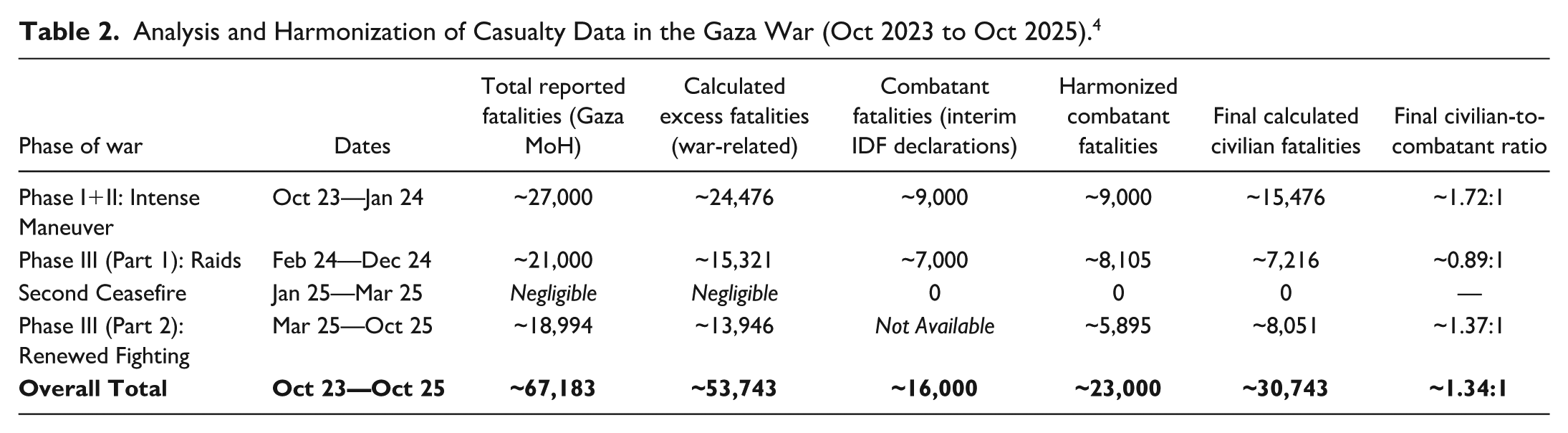
The revised data reveal a far more complex picture than initial reports suggested. The overall civilian-to-combatant ratio stands at approximately
Achieving this consistent phased analysis required addressing a significant data discrepancy. A logical contradiction was found between the IDF’s interim, real-time casualty declarations and the final, comprehensive INSS figure. To resolve this, the model presented in Table 2 utilizes the verified real-time data for the initial phase and then proportionally distributes the remaining combatant fatalities across the later phases to align with the final INSS total. This data harmonization, while a model, is a necessary methodological step to create a coherent and logically consistent analysis from conflicting sources.
The process itself is a key finding, underscoring the “fog of war” and the unreliability of interim data. The final, harmonized figures, however, provide the most complete and intellectually honest strategic-level view possible. They suggest that international scrutiny frameworks operated based on an incomplete picture, and that the operational reality of the conflict was more dynamic than a single, static casualty ratio can capture.
It was precisely this informational ambiguity, combined with the profound national trauma of the October 7 attack, that allowed the Israeli government to build a resilient domestic consensus. Protected by domestic consensus, the Israeli government withstood complex international pressure. Israel initially faced heavy criticism from Tier 4 sources (global public opinion, media), but the Biden administration’s unequivocal support neutralized the media enforcement mechanism. The U.S. provided robust military aid and diplomatic cover: deploying two aircraft carriers and multiple warships to the eastern Mediterranean, warning Iran and Hezbollah against intervention through third parties (Ravid, 2023), and vetoing the first UN Security Council ceasefire resolution in December 2023 (AP and ToI Staff, 2023; Lederer, 2023). The mechanism only began to reassert itself partially as the war progressed. Pressure began to emanate from the top of the hierarchy, first from the Biden administration—including the May 2024 hold on 2,000-pound bomb shipments to protest Israel’s Rafah invasion (Ravid, 2025)—and later shifting with the new Trump administration in January 2025, which reversed Biden’s arms restrictions and expedited $4 billion in military assistance to Israel (Robio, 2025). This dynamic demonstrates that in a state of perceived existential threat, the specific policy of the Primary Strategic Patron is the most decisive external variable.
Luttwak himself, writing in 2025, acknowledged this exceptional breakdown of the media enforcement mechanism. Thirty years after developing post-heroic warfare theory, Luttwak observed that while “now the entire world can watch the fighting, the killing and the destruction in color, up close and in real time,” typically resulting in wars being “interrupted, by ceasefires, demanded by distant Presidents and Popes,” this established pattern failed in Gaza. As Luttwak noted, “this time, though, the ceasefire did not come,” despite Netanyahu being “under worldwide attack (both literal and rhetorical) for killing ‘innocent civilians’” (Luttwak, 2025).
Comparative Evidence: The Media Enforcement Mechanism Beyond Israel
The Israeli experience illustrates broader dynamics affecting democratic warfare. The media enforcement mechanism operates similarly across different democratic and military contexts: international media coverage of civilian casualties creates political pressure that forces tactical and strategic changes. Cases beyond Israel’s unique media environment demonstrate how this mechanism operates, highlighting common patterns alongside contextual differences in how democratic militaries respond to international scrutiny.
The Highway of Death: Strategic-Level Media Enforcement (1991)
Although American media coverage helped drive the U.S. withdrawal from Vietnam (Kober, 2013; Luttwak, 2001b), the 1991 Gulf War marked something different—international media became a direct brake on military operations as they unfolded. The Highway of Death incident provides perhaps the clearest example of how media coverage can influence strategic decisions in real-time. On February 26 to 27, 1991, U.S. forces bombarded a retreating Iraqi convoy on Highway 80 between Kuwait and Iraq, destroying approximately 1,500 military and civilian vehicles with death toll estimates ranging between 500 and 10,000 casualties (C. Powell, 1995; C. L. Powell & Persico, 1995, pp. 505–506).
The international media response created the precise dynamic theorized. General Colin Powell noted that the highway “turned into a shooting gallery. . . and reporters began referring to this road as the ‘Highway of Death’” (C. L. Powell & Persico, 1995, pp. 505–506). Powell informed General Norman Schwarzkopf that he would need to provide the President and the Secretary with a recommendation on when to halt the war. Perceived television coverage generated immediate political pressure at the highest levels of government. Powell and General Norman Schwarzkopf concluded that “the television coverage was starting to make it look as if we were engaged in slaughter for slaughter’s sake” (C. L. Powell & Persico, 1995, pp. 505–506).
This media pressure directly influenced strategic decision-making. One day after the attack, President George H.W. Bush declared the war’s end, stating: “It’s a proud day for America. And, by God, we’ve kicked the Vietnam syndrome once and for all” (Bush, 1991). Four years later, General Colin Powell revealed in his autobiography that one of the reasons the American administration decided to restrain its use of military force and end the war was the televised coverage of the Highway 80 attack (C. L. Powell & Persico, 1995, pp. 505–506). The sequence demonstrates the media enforcement mechanism: international media coverage creating political pressure that altered military strategy.
NATO Kosovo Intervention: Multilateral Media Enforcement (1999)
The 1999 NATO intervention in Kosovo demonstrates the media enforcement mechanism within multilateral democratic warfare. Across 78 days of bombing (Lambeth, 2001), international media coverage of civilian casualties generated sustained political pressure that compelled immediate tactical adaptations throughout the alliance.
Two incidents particularly illustrate this dynamic. On April 12, 1999, NATO aircraft struck a passenger train crossing the Grdelica Bridge, killing at least 10 civilians and wounding 15 others (International Criminal Tribunal for the former Yugoslavia [ICTY], 2000). Two days later, coalition planes attacked what they believed were military convoys but proved to be refugee movements, resulting in 73 civilian deaths (HRW, 2000).
Both incidents generated immediate international media coverage that translated into political pressure across NATO. The alliance faced criticism in national parliaments and growing public skepticism about the campaign’s conduct. Most significantly, “after the first two incidents, on April 12 and 14, the civilian deaths led to changes in rules of engagement” (HRW, 2000). NATO commanders began requiring stricter target verification and limited strikes in urban areas. The sensitivity to civilian casualties also produced unprecedented policy shifts. According to senior U.S. Department of Defense officials, the White House issued an unannounced executive order in mid-May to cease cluster bomb use in the conflict, just days after NATO cluster bombs killed civilians in Niš on May 7 (HRW, 2000). This decision represented a significant tactical constraint explicitly imposed in response to media coverage of civilian casualties.
Kosovo shows that the media enforcement mechanism can function even within alliance warfare. International media coverage created political pressure that constrained military operations. RAND Corporation observed that “extraordinary media attention” to civilian casualties “further detracted from the overall effectiveness of the campaign” (Lambeth, 2001).
The Kunduz Hospital Airstrike: Modern Media Enforcement (2015)
The 2015 U.S. airstrike on a Médecins Sans Frontières hospital in Kunduz, Afghanistan, illustrates the media enforcement mechanism in contemporary warfare. On October 3, 2015, a U.S. AC-130 gunship repeatedly struck the hospital, killing 42 people (MSF, 2015). Intense international media coverage followed immediately, representing what this framework terms Tier 4 pressure from the base of the international hierarchy, amplified by MSF’s condemnation of the strike as a potential war crime. Media pressure forced responses at the highest government levels. President Barack Obama issued a rare personal apology, the Pentagon conducted a full investigation leading to disciplinary action against 16 service members, and the U.S. government paid compensation to victims’ families (Margulies, 2016). When democratic states’ actions become indefensible under international norms and pressure reaches top decision-makers, the mechanism can force accountability and operational review.
Model 3: Post Hoc Institutional Reform (Australia 2017–2020 and the U.S. 2023)
Australian special forces’ alleged war crimes in Afghanistan illustrate a different pathway for the media enforcement mechanism: post hoc institutional reform. While other cases show real-time operational constraints, Australia demonstrates how sustained media investigation can force democratic states to confront past actions and enact long-term changes. The process began with investigative reports, particularly the 2017 “Afghan Files” by ABC News, which exposed credible evidence of unlawful killings of civilians and prisoners (Oakes & Clark, 2017). Tier 4 media pressure created a massive public and political scandal within Australia, empowering an ongoing internal inquiry. Years later, the 2020 Brereton Report provided a comprehensive official investigation that confirmed the media’s findings. The report’s release triggered institutional constraints, including the disbanding of an entire squadron and the establishment of a special investigator’s office to pursue criminal charges (“Afghanistan Inquiry,” 2020). Australia shows that the mechanism can force national reckoning and systemic reform even when effects are not immediate.
This “post hoc” (after-the-fact) model of institutional reform is not unique to Australia. The U.S. military’s adoption of ‘Department of Defense Instruction 3000.17: Civilian Harm Mitigation and Response’(DOD Instruction 3000.17 Civilian Harm Mitigation and Response, 2023) demonstrates the exact same pathway. While this doctrine is proactive in its intent (to mitigate future harm), its origin is entirely reactive—it is the direct result of “hard-earned lessons” and heightened scrutiny following civilian casualties in Iraq and Afghanistan.
This U.S. doctrine, much like Australia’s Brereton Report, represents the institutionalization of lessons learned from past media enforcement crises, thus confirming the logic of the post hoc reform model. This finding is critical for understanding the mechanism’s limits. The IDF itself underwent a similar post hoc institutionalization between 2010 and 2022, creating a sophisticated media-conscious doctrine as a direct response to the 2010 Flotilla raid.
However, the 2023-2025 Gaza War serves as the ultimate critical test case. It demonstrates that even these fully institutionalized, post hoc (“proactive-in-intent”) doctrines can collapse entirely when leaders successfully securitize an event as an existential threat, thereby creating the domestic “political shield” that neutralizes the mechanism’s power.
Conditions for Success and Failure of the Media Enforcement Mechanism
Universality of the First Rule Versus Contingency of the Second Rule
The empirical analysis reveals a fundamental asymmetry in how democratic militaries operationalize the two core rules of post-heroic warfare. While casualty aversion has become a universal principle across Western military doctrine and political decision-making, civilian protection mechanisms operate differently, remaining contingent on specific political, institutional, and media dynamics that vary dramatically across cases.
While existing literature documents civilian protection mechanisms primarily in Israeli, American, and European contexts, this study’s broader analysis reveals that such mechanisms operate across democratic militaries under specific conditions. This asymmetry suggests the need for more targeted theorization of when and how civilian protection norms translate into actual operational constraints, rather than assuming they operate universally like casualty aversion mechanisms.
Media Enforcement Mechanisms: Success and Failure
To test whether the media enforcement mechanism explains the implementation of civilian protection across democratic contexts, this analysis examines successful cases alongside failures where extensive civilian casualties did not generate operational constraints (see below). The mechanism works through democratic leaders’ perceptions. When they view sustained international media criticism as creating significant political pressure, operational constraints follow, regardless of objective coverage measures or actual political costs. The comparative analysis of both successful and unsuccessful cases reveals important boundary conditions that determine whether such a mechanism can translate into real-time operational adaptation, post hoc institutional change, or fail to generate any substantive response.
The 2011 NATO intervention in Libya shows how the mechanism fails when powerful coalitions of top-tier states conduct operations. NATO framed the intervention as a humanitarian mission under the “Responsibility to Protect” doctrine rather than a war of national survival for participating countries.
Despite intense international media coverage (Tier 4) of civilian casualties from airstrikes, such as the Gharari and Majer bombings, NATO air operations proceeded without any documented changes to targeting practices (Dyke, 2021; HRW, 2012). The mechanism failed because the actors conducting the operation—a coalition including the United States and key European allies—were themselves the highest authorities in the international pressure hierarchy. With no “Primary Strategic Patron” or higher international body to constrain them, NATO was able to institutionally deflect the Tier 4 pressure by issuing official statements of denial and failing to conduct thorough internal reviews of the incidents. The Libya case thus highlights a key boundary condition: the media enforcement mechanism is least effective when the pressure emanates only from the bottom of the international hierarchy. In contrast, the actors at the top are the ones conducting the military action.
The U.S.-led Coalition’s air campaign against ISIS in Syria (2014–2019) illustrates the media enforcement mechanism’s failure under low political salience and institutional denial. The fight against ISIS, while framed as a critical security issue, was not perceived as an existential threat to participating Coalition nations, unlike the 2023 to 2025 Gaza War. The conflict, therefore, generated lower political salience domestically and failed to create significant “socio-political resilience.” Without a decisive domestic mandate from the “rally ‘round the flag’” effect, Coalition leadership was more vulnerable to external criticism regarding their conduct.
Despite this theoretical vulnerability, the media enforcement mechanism failed to activate. Sustained Tier 4 criticism from media and NGOs like Amnesty International and HRW (2019), which documented at least 7,000 civilian deaths from Coalition actions, failed to generate operational adjustments. The mechanism was effectively short-circuited by the Coalition’s strategy of institutional denial. For example, despite investigations revealing that more than 1,600 civilians were killed in Raqqa alone during 2017, the Coalition admitted responsibility for only 10% of reported killings, dismissing the remainder as “non-credible” and failing to create compensation programs (Amnesty International, 2019). Lacking any significant pressure from higher-tier actors to change this behavior—as the higher-tier actors were the ones conducting the campaign—the Coalition remained “in denial about the massive civilian death toll” (Amnesty International, 2019). This case demonstrates that the mechanism can be rendered ineffective not only by an overriding survival imperative but also by an institutional strategy of denial that successfully deflects lower-tier pressure when higher-tier actors are the perpetrators.
In contrast, positive cases demonstrate that the mechanism can function effectively under certain conditions. The Israeli case represents the most precise instance of real-time operational adaptation. At the same time, the comparative analysis demonstrates similar dynamics across different democratic and operational contexts, from strategic-level decisions to tactical modifications within multilateral operations.
The analysis also identifies contexts where the media enforcement mechanism works alongside other constraining factors rather than serving as the primary driver. General Stanley McChrystal, 2009 tactical directive in Afghanistan shows such conditions: extensive international media coverage had documented rising civilian casualties (OHCHR Press Releases, 2009). The shift came from multiple pressures: new military leadership, evidence that civilian casualties hurt counterinsurgency goals, and sustained criticism from Afghan President Hamid Karzai about coalition airstrikes. McChrystal, 2009 tactical directive responded to this convergence by requiring that “commanders scrutinize and limit the use of force like close air support against residential compounds and other locations likely to produce civilian casualties” (McChrystal, 2009). The directive resulted in measurable reductions in civilian casualties (Felter & Shapiro, 2017; Salahuddin, 2013). McChrystal’s directive demonstrates that media coverage is crucial for documenting violations and creating political pressure; however, its effectiveness is more pronounced when reinforced by other factors than when operating alone.
The media enforcement mechanism operates effectively when several key conditions align: political sensitivity to international legitimacy; ongoing operations where tactical adjustments remain feasible; credible, immediate, and politically salient media coverage; institutional capacity to translate political directives into operational changes; and, most importantly, the absence of perceived survival imperatives that would justify abandoning civilian protection norms. The breakdown of these conditions, as demonstrated in the 2023-2025 Gaza case, reveals the inherent limits of the mechanism when democratic leaders perceive existential rather than strategic threats. Moreover, the mechanism functions through multiple distinct pathways—direct media-to-political pressure and host nation political amplification, each operating under different temporal and political dynamics. These different pathways show that the media enforcement mechanism is powerful but conditional. It works in some contexts and fails in others, depending on specific political and operational circumstances.
These findings confirm the broader pattern identified in the bibliometric analysis: just as civilian protection explanations remain concentrated in a limited number of cases, the media enforcement mechanism operates effectively under particular conditions. This indicates that theoretical challenges facing the second rule go beyond missing explanatory frameworks to include the practical difficulty of implementing civilian protection norms across different democratic contexts.
Conclusion
This study addressed a central puzzle in post-heroic warfare: Why do democratic militaries, often possessing overwhelming military superiority, constrain their use of force to protect enemy civilians? The research developed a theory of a “media enforcement mechanism,” showing how perceived international media pressure can generate significant political costs that force operational restraint.
The paper’s central argument is that the mechanism’s effectiveness depends on three variables: the perceived nature of the threat, domestic socio-political resilience, and the hierarchy of international pressure. The empirical evidence supports this framework. Israeli military operations from 1987 to 2022 show how the mechanism gradually evolved and became institutionalized. The 2023-2025 Gaza War, alongside comparative cases from Syria and Libya, tested the theory’s limits, demonstrating how the mechanism collapses when leaders perceive existential threats or when powerful actors use institutional denial to neutralize pressure from lower-tier actors.
The multi-phase analysis of the 2023-2025 Gaza War provides crucial insights into the mechanism’s operation under extreme conditions. Rather than demonstrating a simple, linear progression, the data reveal complex and volatile dynamics where the mechanism’s influence fluctuated. The initial high-intensity phase (Phase I+II) showed a collapse of constraints (a 1.72:1 ratio). This was followed by a partial recovery during the subsequent lower-intensity raids (Phase III, Part 1), where the ratio improved significantly to 0.89:1 as immediate existential fears subsided.
However, this recovery was not sustained. The final phase of the war (Phase III, Part 2) saw a renewed worsening of the ratio to 1.37:1. This collapse-recovery-worsening dynamic, ending with an overall ratio of 1.34:1, demonstrates that even under perceived survival imperatives, the mechanism operates through dynamic processes rather than absolute on-off states, remaining highly conditional and fluctuating with threat perceptions.
The research contributes to post-heroic warfare, security, and strategic communication literature in several ways. It develops the first comprehensive model of the media enforcement mechanism, showing how perceived threats, domestic resilience, and international pressure hierarchies interact to determine when the mechanism succeeds or fails. The paper provides a detailed longitudinal analysis of the mechanism’s evolution in the Israeli context, tracking its development from indifference to full institutionalization and examining conditions for its breakdown in the 2023-2025 Gaza War. The study also applies bibliometric analysis in a new way, using statistical testing to identify and confirm theoretical gaps within academic literature, providing a methodological approach for future research.
The research reveals three distinct enforcement models: real-time operational constraints, host nation-driven adaptations, and post hoc institutional reform. While the Israeli case demonstrates systematic real-time tactical adjustments under media and political pressure, the McChrystal directive in Afghanistan shows a different approach. There, host nation political demands, amplified by media coverage, served as the primary driver for operational changes. The Australian case illustrates how sustained media investigation can force institutional reform even years after events occurred. This spectrum of enforcement approaches shows how democratic states use different mechanisms to align military conduct with civilian protection norms.
This framework, which was derived by filling a specific gap identified within the Post-Heroic Warfare literature, finds strong interdisciplinary support from policy studies, particularly Punctuated Equilibrium Theory—PET (Baumgartner & Jones, 1993; Baumgartner et al., 2018).
PET provides a robust theoretical explanation for the third model identified here, “post hoc institutional reform.” The Australian case is a classic example of PET: media-driven “focusing events” (the “Afghan Files”) “punctuate” a stable policy equilibrium (the military’s conduct), forcing the issue onto the public agenda and leading to systemic investigation and doctrinal change (the Brereton Report).
Recognizing PET thus strengthens the paper’s findings. At the same time, it highlights this study’s unique contribution within the PHW field: identifying the “real-time operational constraints” (Model 1). This mechanism, which explains tactical adjustments during active conflict (like the 2006 Qana ceasefire or the 2022 Jabalya intelligence release), addresses a gap that PET (which focuses on macro-level, post hoc policy change) does not. This paper thus bridges PHW theory and policy studies, showing how PET explains post-conflict reform, while the media enforcement mechanism explains in-conflict, real-time restraint.
Limitations and Directions for Future Research
This study focuses on the external enforcement mechanism through international media pressure, treating internal factors—such as liberal-democratic values, professional military ethics (e.g., the IDF’s “Purity of Arms” doctrine), or religious/moral commitments—as background conditions rather than the primary causal mechanism explaining operational variation.
This methodological choice is deliberate. As the literature review demonstrates, existing scholarship often treats civilian protection as a “normative commitment” but provides less analysis of the “operationally enforced practices” that translate these norms into real-time constraints during combat. This study’s aim was to isolate and explain this enforcement gap, identifying when and how external pressure compels restraint, rather than re-evaluating the source of the underlying norms themselves.
Future research should examine the complex interaction between these internal factors and external media pressure. It would be valuable to investigate: (1) Under what conditions internal norms (like military professionalism or ethics) provide restraint even when external pressure fails (such as during the 2023-2025 Gaza War’s initial phase) and (2) How external pressure reinforces, or perhaps contradicts, pre-existing internal ethical commitments.
Furthermore, the mechanism proposed here relies on key assumptions derived from its democratic context. First, the framework assumes rational actors—that is, democratic leaders who are sensitive to perceived political costs and motivated to maintain international legitimacy. The model does not account for “bad” or irrational actors who may be ideologically driven to pursue civilian harm regardless of media coverage. This limitation clarifies the mechanism’s scope: it explains restraint within democracies sensitive to legitimacy, not the absence of restraint in non-democratic or non-rational contexts.
Second, the mechanism’s reliance on perceptions means it is driven by reported harm, not necessarily objective harm. This study does not assume media “good faith” or accuracy. Rather, it argues that leaders react to the perception generated by media coverage, “regardless of objective coverage measures or actual political costs.” The mechanism can therefore be triggered by inaccurate or biased reporting. The methodological challenges of casualty data, noted in the 2023-2025 Gaza case, highlight this gap between objective reality and the perceived reality that drives the mechanism. Future research could explore how deliberate media disinformation, as opposed to mere bias, impacts the mechanism’s activation.
Finally, while Israel serves as a paradigmatic case, the theoretical framework advanced here holds broader relevance. Further comparative research should test and refine the media enforcement mechanism across a broader range of conflicts and political contexts. Researchers need to examine when civilian protection norms actually constrain military action, rather than focusing only on when they should. As social media and 24/7 news cycles make the media enforcement mechanism more powerful—and its failures more visible—understanding when media constraints emerge or fail is crucial for the effectiveness of democratic military operations in the contemporary era.
Footnotes
Acknowledgements
This article was written within the framework of the Department of International Relations at the School of Political Sciences, University of Haifa. I want to express my deep gratitude to Professor Michael Gross and Professor Israel Sergio Waismel-Manor for their guidance and support throughout this process. I am also grateful to the anonymous reviewers for their insightful comments, which significantly strengthened this article. My thanks go to the editors of Armed Forces & Society for their professional handling of the manuscript and their constructive editorial oversight. I also wish to thank Professor Ami Pedahzur and Professor Elisheva Rosman-Stollman for their guidance. Finally, I dedicate my heartfelt thanks to my parents, Israel and Rachel Popovich, and to Tal, Oz, Alma, and Libby for their unwavering support and for always being there.
Declaration of Conflicting Interests
The author declared no potential conflicts of interest with respect to the research, authorship, and/or publication of this article.
Funding
The author received no financial support for the research, authorship, and/or publication of this article.
