




Abstract
This article explores the evolution of academic–military relations within professional military education (PME) organizations and between them and higher education authorities in Australia, France, Germany, Israel, Turkey, the United Kingdom, and the United States. Traditionally distinct from universities in governance, curriculum quality, and faculty composition, PME organizations have increasingly aligned with academic standards, practices, and norms since the end of the Cold War to enhance officer competence. The article outlines these transformations, introduces a typology of academic–military relations, and examines their implications for the legitimacy of officership as a profession amid shifting control over education and commissioning processes. The main findings of the article reveal that the cooperation with civilian universities and accreditation requirements have facilitated the diversification of curricula and teaching staff, successfully dismantling the traditional military monopoly over the PME. Furthermore, it is increasingly administered under the auspices of joint-level headquarters, indicating a decline in the influence of any single service on PME.
Keywords
Introduction
In sociological terms, a profession differs from an occupation by monopolizing a specialized body of knowledge and its attendant skills; because outsiders cannot easily acquire that expertise, the profession enjoys exclusive jurisdiction over its work (Downes, 1985, p. 148). On that basis, Huntington (1957) argued in The Soldier and the State that officers qualify as professionals, for they alone master the abstract expertise required to manage organized violence. Professional military education (PME) underpins the officer corps’ claim to professional standing: control over what is taught, who teaches it, and who certifies mastery sustains the corps’ monopoly on the knowledge required to manage organized violence (Ateş, 2022; Downes, 1985; Huntington, 1957; Watson, 2007). During the post–Cold War era that control has weakened as joint headquarters, civilian universities, and national higher education authorities have moved steadily into the governance, curricula, and faculty of PME organizations (Libel, 2010c, 2016, 2021).
To trace the consequences of this shift, the present study follows these three areas of reform across the United States and six of its allies and asks—first, descriptive change: How have governance arrangements, curricula, and faculty composition in postcommissioning PME organizations evolved in Australia, France, Germany, Israel, Turkey, the United Kingdom, and the United States since the early 1990s? It then considers mechanisms and variation: Which institutional mechanisms—critical junctures, layering, positive feedback, and conversion—best account for cross-national differences in the pace and scope of those reforms? Finally, it addresses professional-monopoly implications: To what extent have the observed changes diminished the officer corps’ jurisdiction over PME and, by extension, its claim to a professional monopoly on the management of organized violence?
To see what is at stake in these questions, it is necessary to recall why control of PME matters for professional status in the first place. 1 This could be done using the military as a profession approach (Libel, 2010c, 2019, 2020). A profession claims legitimate authority by monopolizing a body of abstract knowledge and the skills that apply it; because outsiders lack that expertise, they defer to the profession’s judgments (Downes, 1985, p. 148). Abbott’s account of professional “jurisdictions” adds that such authority rests on three linked prerogatives: setting entry criteria, providing the required schooling, and disciplining members who violate established standards (Abbott, 1988). The monopoly is further contested by rival services, private security firms, and other state agencies (Heinecken, 2013; Libel, 2019). For most of the modern era, armed forces’ services—first armies and navies, later the air forces—exercised those prerogatives within its own PME organizations, designing single-service curricula, posting its own instructors, and certifying officers for promotion. The post–Cold War shift toward joint headquarters and collaborative academic partnerships has begun to reallocate those functions. When joint staff draft common learning objectives to all services, when a national defense university hires civilian professors, or when national higher education authorities accredit war-college degrees, decision-making migrates from the single-service headquarters to joint or civilian actors. Each transfer narrows the traditional jurisdiction that underwrote the service officer corps’ exclusive claim to professional expertise.
Figure 1 portrays that hierarchy. Since the 18th century, Western armed forces have organized their personnel in three distinct strata—enlisted soldiers, noncommissioned officers (NCOs), and officers (Howard, 2009; Libel, 2021). Enlisted soldiers occupy the broad base as apprentices or implementers who master discrete occupational skills but seldom stay long enough to achieve full mastery. Those who cross the dotted mobility line enter the NCO corps, a cadre of seasoned “artisans” whose technical expertise underpins small-unit effectiveness; where a standing NCO corps is absent, as in the Israeli or Russian forces, inexperienced junior officers must fill that role, often with detrimental results (Fisher, 2001; Giles, 2007; Libel, 2005). Authority then widens within the officer strata itself: Junior officers hold limited jurisdiction, mid-career officers exercise partial jurisdiction, and senior officers collectively command the full professional domain (Wade, 1976). Movement through these levels hinges on successive PME milestones—precommissioning military academy, command-and-staff college, an optional Advanced Warfighting School (AWS), 2 and a senior-level war college (Libel, 2021)—each tier expanding both expertise and jurisdiction.
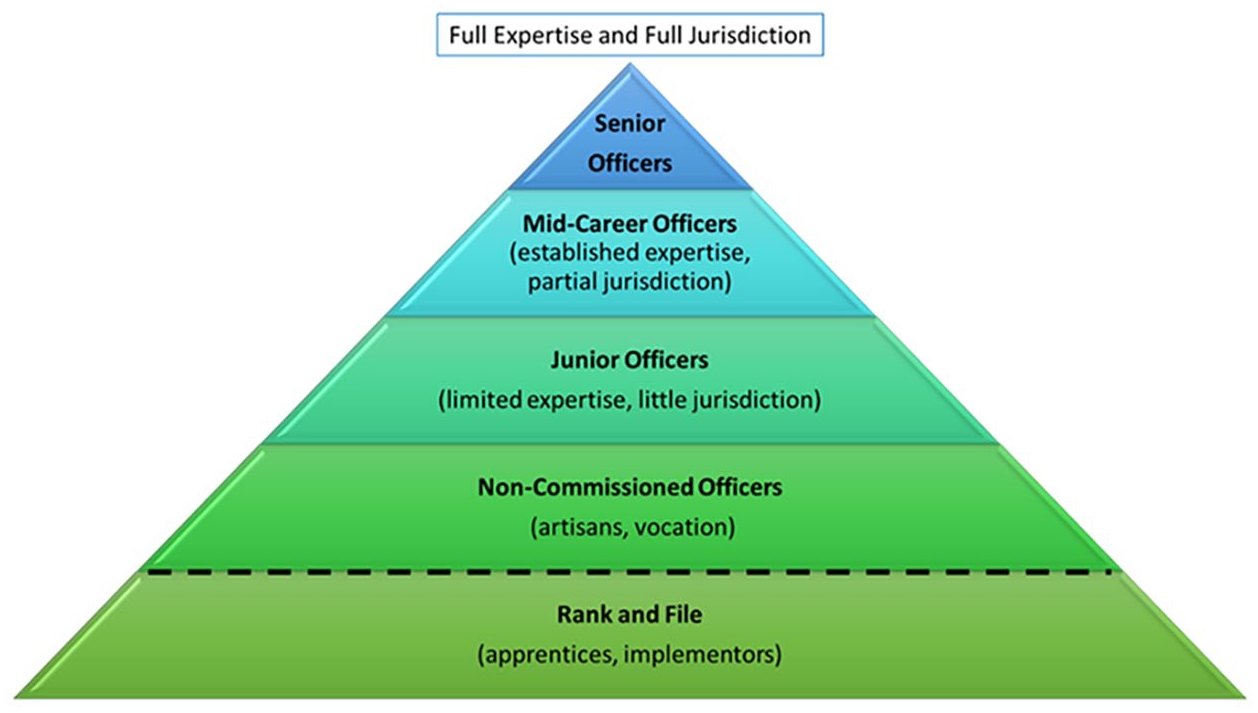
The Military Personnel Structure From the Military-as-Profession Perspective.
Figure 2 links each tier of PME to the officer pyramid and to the amount of jurisdiction that accompanies promotion. The sequence begins with military academies, precommissioning organizations whose graduates enter the officer corps with only limited authority, because the expertise gained is broad but still introductory. Officers who prove themselves at the junior level and accumulate field experience must then complete a command-and-staff course, the second PME tier that teaches operational art and the operational level of war; although the requirement is often informal, graduation has become the accepted gateway to mid-career status. After a further cycle of command and staff postings, selected mid-career officers attend a senior-level college (e.g., war college)—the final, common tier of PME. Possession of this credential is virtually obligatory for consideration for general rank, and with it, the officer gains the full professional jurisdiction exercised at the apex of the pyramid.
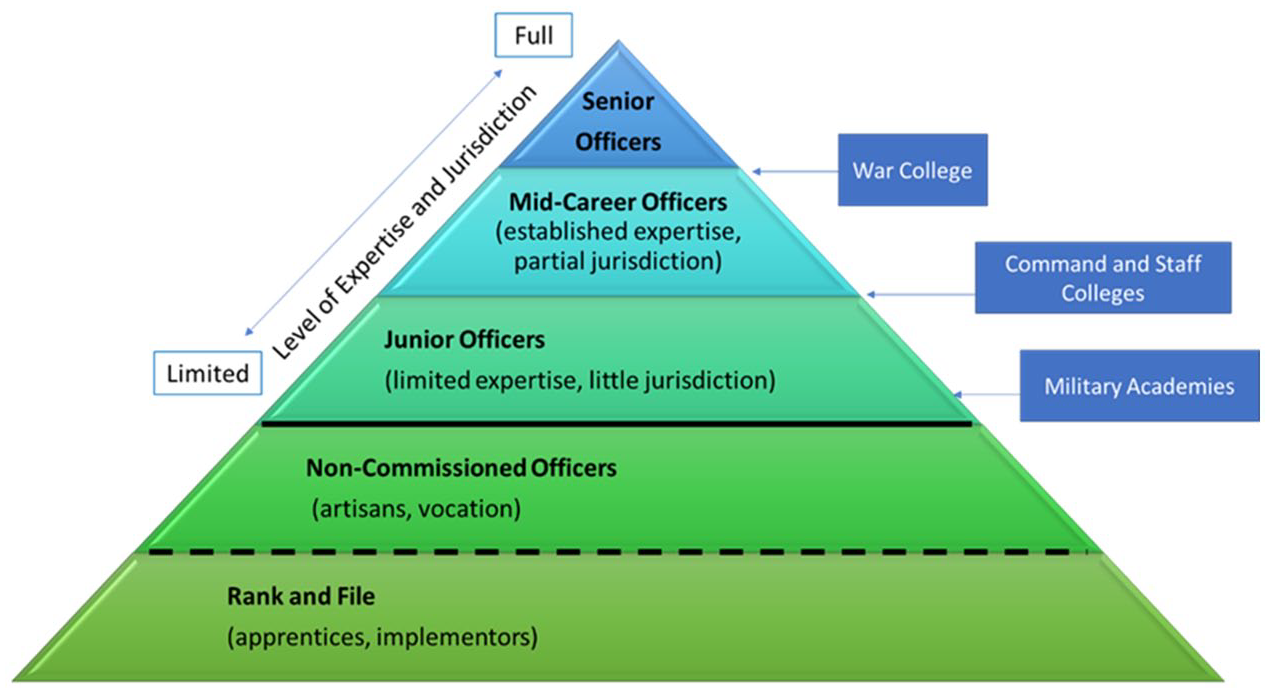
Military Education, Officer Level, and Professional Jurisdiction.
Historically, three successive staff-college models can be traced from the nineteenth century through the early post–Cold War era. Foot (2001) labels them Jena, Falklands, and Kosovo, titles that evoke the campaigns emblematic of each stage. Jena-type colleges were single-service and doctrine-bound, taught exclusively by uniformed faculty, and operated without external oversight. Falklands colleges still answered to their parent services but admitted civilian faculty members and widened their syllabi to joint operations. Kosovo colleges carried the evolution further, sharing governance with joint and civilian bodies, adopting interdisciplinary curricula, and relying chiefly on academically qualified faculty (Foot, 2001). The analysis that follows concentrates on the Kosovo model and its descendants (i.e., the National Defence University model of PME, see Libel, 2016), shifting attention from organizational form to the authority that defines PME: How far officers still control governance, curriculum, and faculty—and how much of that jurisdiction has already been surrendered?
The three terms discussed in this article require clarification. “Academization” denotes the deliberate alignment of PME programs with civilian higher education standards in content, academic credit structure, and quality assurance (Larsson, 2024). “Joint” refers strictly to inter-service collaboration—land, sea, air, space, and cyber forces operating within a shared doctrine—whereas any collaboration between military and civilian faculty members is identified explicitly as “academic–military relations.” Finally, “jurisdiction” follows Abbott’s (1988) sense of the profession’s recognized right to define, perform, and police its work. That jurisdiction has been progressively squeezed since the early 1990s by four converging forces. Multinational coalition operations compel common doctrine and joint training, so authority over learning objectives shifts from the services to joint and even multinational headquarters. Rapid technological complexity obliges colleges to bring in civilian scholars and engineers as faculty members, diluting the corps’ exclusive hold on professional knowledge. National higher education authorities impose academic accreditation rules, granting external academics a formal voice in curricular design and degree approval. Finally, a burgeoning private-security sector markets combat and advisory skills of its own, prompting defense ministries to consult or license these competitors and thereby eroding the military’s exclusive claim to mastery of organized violence (Heinecken, 2013; Libel, 2019).
Understanding how outside actors have come to share— and sometimes seize— authority over PME calls for an analytic lens that keeps institutions, 3 power, and time in the same frame. The “new institutionalism” literature meets that need by treating rules and decision-making routines as the structures through which actors pursue their ends (Hall & Taylor, 1996; Immergut, 2006). Of its several variants, historical institutionalism is especially relevant because it links long-term stability to the cumulative weight of past choices while keeping open the possibility of abrupt change when crises unsettle established arrangements (Steinmo, 2008).
Historical institutionalism portrays institutions as durable constellations of formal rules and informal routines that channel behavior along established “paths.” Early settlements structure the costs and benefits of later moves, so actors who master the prevailing rules often reinforce them (Pierson, 2000; Thelen, 1999). Path dependence, however, is not permanence. External shocks—wars, technological leaps, regulatory mandates—can reopen bargaining, and incremental reinterpretations of existing rules can cumulate until the underlying settlement looks markedly different. The analytical task, therefore, is to trace how such small adjustments, layered over time, gradually redraw the boundary of what any one group can claim to control.
Four mechanisms organize that task. A “critical juncture” is a brief moment of heightened contingency when normal veto points weaken, and large design choices become possible. “Layering” adds new rules or practices alongside older ones rather than replacing them outright. “Positive feedback” reinforces those additions, as each successful application raises the benefits of the new layer and the political cost of removal. Finally, “conversion” redirects existing structures toward new purposes without formally abolishing them (Mahoney & Thelen, 2010). Together these mechanisms clarify why some parts of an institution often change sooner and more thoroughly than deeper governance charters, and why organizations that face intense external scrutiny or cooperation pressures tend to travel furthest along the path of institutional transformation. Taken together, the military-as-profession perspective and the historical-institutionalist mechanisms supply both the yardstick for judging change and the roadmap for explaining it.
Method
To address the three research questions, the study compares governance, curriculum, and faculty composition in postcommissioning PME organizations across the United States and six close collaborators—Australia, France, Germany, Israel, Turkey, and the United Kingdom. 4 All maintain extensive security cooperation with Washington yet differ in political traditions, geographic settings, and security challenges. This controlled diversity permits assessment of the diffusion of U.S. doctrine and accreditation norms while still capturing cross-national variation.
Limiting the comparison to postcommissioning organizations avoids the wide variation in commissioning venues and focuses on tiers that gate promotion and therefore officer jurisdiction. Controlling this variation enables a meaningful comparative analysis by capturing differences in stakeholder involvement, curriculum structure, and the composition and selection of faculty. Governance reflects the diversity of external and internal stakeholder influences in different political and military systems. Curriculum categorization highlights the degree of alignment between military education and civilian academic standards. Faculty composition reveals the balance between military and civilian expertise within PME organizations. Analyzing these parameters from the late Cold War to the end of 2024 provides a historical perspective on how academic–military relations have evolved in response to geopolitical, organizational, and educational changes.
In regard to data sources, evidence for the classification comes from a mixed corpus of primary and secondary sources. Primary data include policy documents, curricula programs, organizational charts, and declassified materials obtained from PME organizations, defense ministries, and international defense organizations. These sources provide direct insights into institutional structures, pedagogical approaches, and governance models. Secondary data consist of published studies, conference proceedings, and expert analyses available in the public domain, which offer critical perspectives and contextualize primary findings. Cross-checking these materials provides the triangulation necessary for reliability. 5 Where possible, the authors sought verification from country experts familiar with the respective cases’ PME organizations.
Governance, curriculum, and faculty are treated as three qualitative indicators of officer jurisdiction, each classified by how much authority the officer corps retains or cedes to external actors. Each organization is classified at a late–Cold War baseline (≈ 1985–1991) and again at end-2024; observed shifts are then matched to one of four historical-institutionalist mechanisms—critical juncture, layering, positive feedback, or conversion. Comparing those coded trajectories across the seven cases explains why some systems reformed faster and further than others. Building upon Libel’s (2016) definition, governance is characterized as “the composition and identity of stakeholders involved in both external and internal governance.” External governance refers to stakeholders outside the PME organization, such as military headquarters or civilian higher education authorities, who influence policies and provide oversight. Internal governance pertains to decision-making within the PME organization itself, including leadership roles like the commandant or president and governance bodies such as faculty councils. Together, these governance structures determine the strategic direction of PME organizations and mediate the integration of military and academic priorities.
The governance categories described above reflect varying degrees of collaboration between military and civilian stakeholders. For example, fully military-controlled governance prioritizes military operational needs but risks excluding civilian expertise. Inclusive governance, on the contrary, fosters academic–military relations by integrating civilian perspectives into decision-making processes. Evidence for assessing governance includes organizational charts, governance policies, and records of stakeholder participation.
The curriculum is defined as “procedures for development, confirmation, contents and quality control of study programs (Libel, 2016).” This analysis does not focus on the specific contents of PME curricula but instead categorizes them into one of four types based on their relationship to academic accreditation. The four-category scheme enables a systematic assessment of how PME curricula balance military-specific education with academic integration. For example, stand-alone military curricula emphasize the development of operational skills exclusively for military purposes, while accredited curricula align PME organizations with civilian educational standards. Each category reflects varying degrees of collaboration between PME organizations and civilian higher education systems, with implications for governance and faculty composition.
Composition and selection of faculty is defined as “the recruitment, promotion and professional development procedures, composition (i.e., qualifications, civilian/military and size) of faculty (Libel, 2016).” 6 Faculty composition is influenced by both governance structures and curriculum requirements. For instance, curricula with academic accreditation often require faculty with advanced academic qualifications, including civilian professors. The related categories highlight how faculty composition reflects the balance between military and academic influences within PME organizations. Fully military faculty structures maintain operational focus but may lack academic rigor, while predominantly civilian faculty align closely with academic standards.
Findings
This section traces descriptive change in postcommissioning PME organizations across the United States and six allies—Australia, France, Germany, Israel, Turkey, and the United Kingdom—by examining how governance arrangements, curriculum models, and faculty composition have evolved from the early 1990s through 2024.
Governance
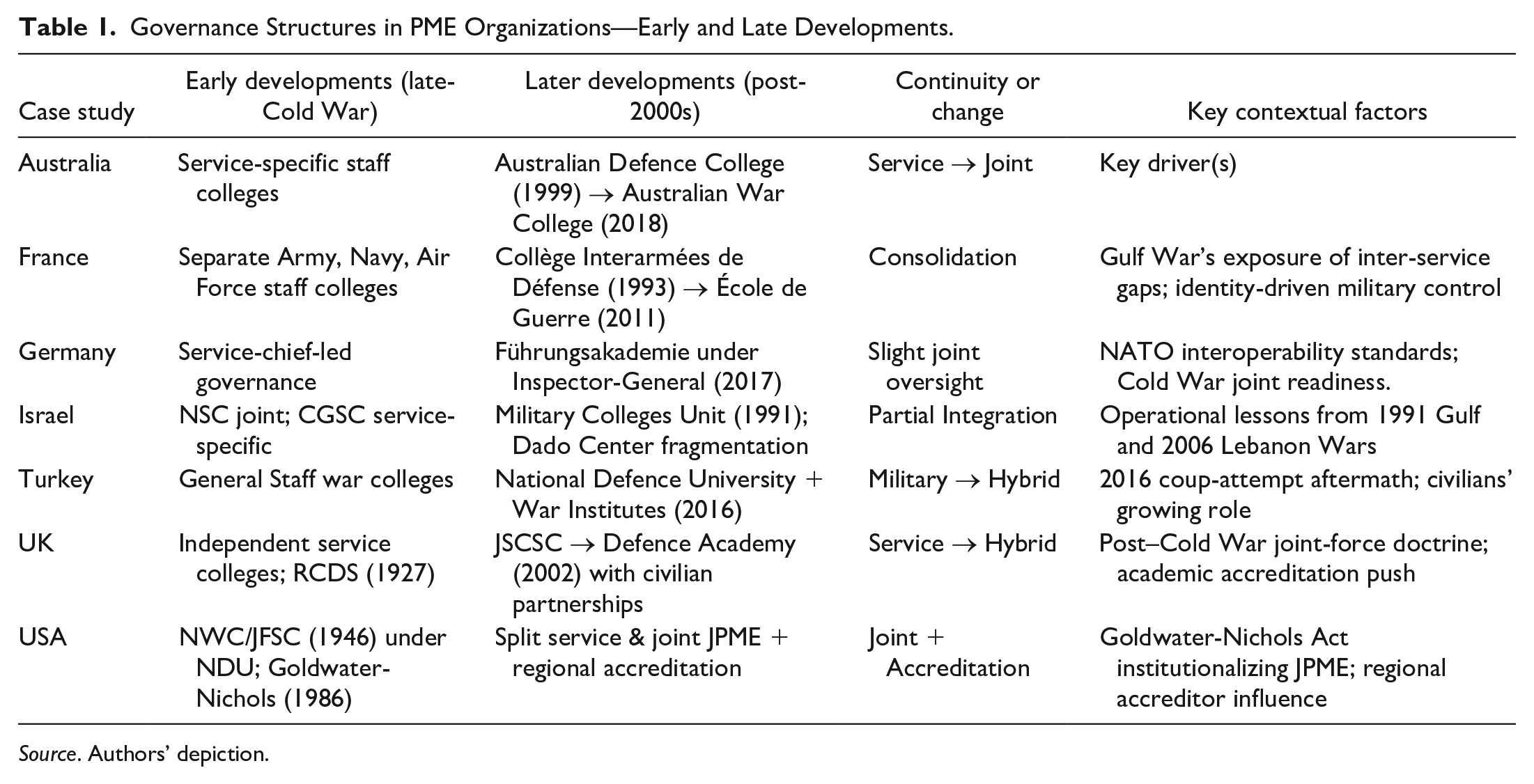
As Table 1 shows, Australian PME governance shifted from single-service command to a unified joint framework under the Australian Defence College. Critics during the 1980s identified shortcomings in the former governance model, particularly its failure to provide a disciplined and structured approach to understanding broader political and governmental issues, such as the political oversight of military operations (Cox & O’Neil, 2006, pp. 59–60). These critiques led to the establishment of the Australian Defence College (ADC) in 1999, which consolidated the governance of service-specific staff colleges under a unified framework. The single-service colleges were amalgamated into the Australian Command and Staff College (ACSC) in 2000, marking a transition toward joint governance (Libel, 2010c). Further reforms in 2018 restructured the ACSC into the Australian War College (AWC), which now delivers Joint Professional Military Education (JPME) at Levels 3 and 4. Level 3 is intended for the ranks between lieutenant colonels and brigadier generals, while Level 4 targets officers who hold the rank of brigadier, major-general, or lieutenant general (Australian Government [AuGov], 2022). The AWC reports directly to the ADC Commander, a two-star general, who reports to the Chief of Personnel at the Chief of Defence Force. This evolution reflects a significant change in governance, addressing lessons from the Gulf War (1991) that highlighted the operational importance of coordinated joint structures (Libel, 2010c; Watson, 2007).
Governance Structures in PME Organizations—Early and Late Developments.
Source. Authors’ depiction.
As Table 1 shows, French PME governance consolidated service-specific staff colleges into the Collège Interarmées de Défense (CID) in 1993 and the École de Guerre in 2011, remaining fully military-controlled under Direction de l’Enseignement Militaire Supérieur (DEMS). Deficiencies in joint operational capabilities revealed during the Gulf War prompted the consolidation of until then independent services’ staff colleges into the CID in 1993 (Reviers, 2017, p. 77). This organization was rebranded as the École de Guerre in 2011 to reflect its expanded mission. After this school, the Centre des Hautes Etudes Militaires (CHEM) represents the pinnacle of military education in France, offering strategic-level education in political-military affairs, operational readiness, and future preparedness. It operates under the direction of a general officer (Centre des Hautes Études Militaires [CHEM] Portal, 2025). Despite these structural reforms aimed at fostering jointness, governance remains firmly military-controlled under the DEMS, which was established in 2009 to centralize PME governance under the Chief of General Staff. Civilian faculty members may contribute academically, but ultimate decision-making authority rests with the military, reflecting a commitment to maintaining centralized control (MoD France, DEMS). As shown in Table 1, France’s governance model demonstrates continuity with gradual evolution, prioritizing centralized military authority while enhancing interservice collaboration. To put it briefly, the French military does seek academic accreditation but does not want to give up control of the PME, which is perceived as a matter of identity issue for many in the French military (Maire & Schmitt, 2022, p. 815). This situation exemplifies the ongoing concerns regarding the legitimacy of the professional status of military officers.
As Table 1 shows, German PME governance moved from chief-of-service control to the Inspector-General of the Bundeswehr in 2017, with continued military dominance and limited civilian academic input. Reforms following the Cold War brought the Führungsakademie der Bundeswehr under the Inspector-General of the Bundeswehr, who also receives guidance from the Ministry of Defence. Governance remains military-dominated, with decision-making centralized under the Inspector-General and academy commanders (Libel, 2016). The inclusion of civilian academics as faculty adds a layer of diversity, but governance extends only indirectly to civilian higher education authorities through a joint degree program with the Helmut-Schmidt-Universität/Universität der Bundeswehr Hamburg. These developments, as outlined in Table 1, reflect slight evolution rather than significant change, as Germany continues to prioritize military control while cautiously incorporating joint elements.
As Table 1 shows, Israeli PME governance consolidated the National Security College (NSC) and Command and General Staff College (CGSC) under the Military Colleges Unit in 1991, though later the Operational Theory Research Institute (OTRI) and the Dado Center for Interdisciplinary Military Studies reforms introduced a fragmented structure. The NSC has consistently functioned as an inter-service and interagency organization, enrolling students from the military, intelligence, and public service sectors. In contrast, the Command and General Staff College (CGSC) has remained a confederation of service-specific courses under a joint-level commander. The consolidation of the NSC and CGSC under the Military Colleges Unit in 1991 advanced governance integration, although the CGSC continued to offer service-independent courses until the introduction of a joint course for combat officers following the 2006 Second Lebanon War (Libel, 2010a, 2010c).
Simultaneously, the establishment of the Operational Research Theory Institute (OTRI) in the mid-1990s, later reorganized as the Dado Center for Interdisciplinary Military Studies, disrupted this consolidation. Although the center is co-located at the Glilot base alongside the two colleges and provides operational-level PME instruction in a concise format, it is administered by the General Staff’s Doctrine and Instruction Division (J7) rather than being integrated within the Military Colleges Unit. This administrative arrangement has contributed to a fragmented governance structure. As summarized in Table 1, these developments reflect a partial change influenced by the lessons of the 1991 Gulf War and the operational challenges encountered during the Second Lebanon War (Libel, 2010b, 2010c).
As Table 1 shows, Turkish PME governance shifted after the 2016 coup-attempt reforms from purely military control to a hybrid civilian–military model under the newly created defense university. Initially, service-specific staff colleges 7 operated under the General Staff since the early 20th century, without any civilian involvement. However, within this organizational framework, the joint headquarters functioned predominantly as a coordinating body rather than as a primary decision-maker. Single-service commands maintained considerable authority over both administrative operations and the development of curricula for staff colleges, facilitated by a network of administrative units specifically focused on officer education (Anonymous communication, January 12, 2024). Following the 2016 coup attempt, extensive reforms were introduced, including the establishment of a defense university governed by a civilian rector and the rebranding of service-specific staff colleges as War Institutes. These institutes now operate under joint governance, with general-ranked officers as directors in coordination with the civilian-led university senate. The civilian rector reports to the Minister of Defence, who plays a central role in approving student and faculty, further reinforcing centralized oversight (Milli Savunma Üniversitesi [MSÜ], 2019). As reflected in Table 1, these reforms signify a significant change in governance, transitioning from a fully military-controlled model to a structure with increased civilian oversight.
As Table 1 shows, British PME governance moved from separate service staff colleges to a unified Defence Academy under hybrid military–civilian oversight (Joint Services Command and Staff College [JSCSC] in 1998; Defence Academy in 2002; Libel, 2010c, 2016). The Defence Academy integrates academic partnerships with King’s College London and Cranfield University, creating a hybrid governance model that balances military leadership with civilian academic contributions. As Table 1 shows, this governance structure reflects a significant change, aligning operational and academic priorities to enhance PME effectiveness (Libel, 2016; Utting, 2009).
As presented in Table 1, American PME governance—formalized by the 1986 Goldwater–Nichols Act—now balances service-specific colleges and JPME under the Joint Chief of Staff’s J7 Directorate for Joint Force Development, with embedded academic accreditation. Together, these initiatives mandated that all services integrate JPME into their military colleges. Both service-controlled PME organizations and the National Defense University (NDU) retain responsibility for their respective educational activities. The JPME components of the PME organizations are overseen and accredited by the J7, thereby ensuring the standardization of JPME education and fostering a multifaceted governance structure. Since the 1970s, the respective regional higher education authorities of each military college have become part of the governance structure as the American PME organizations pursued and secured academic accreditation. Table 1 highlights this governance model’s evolution, driven by the need to balance military operational requirements with academic standards (Goldman et al., 2024; Keaney, 2002; Libel, 2010c).
Curriculum
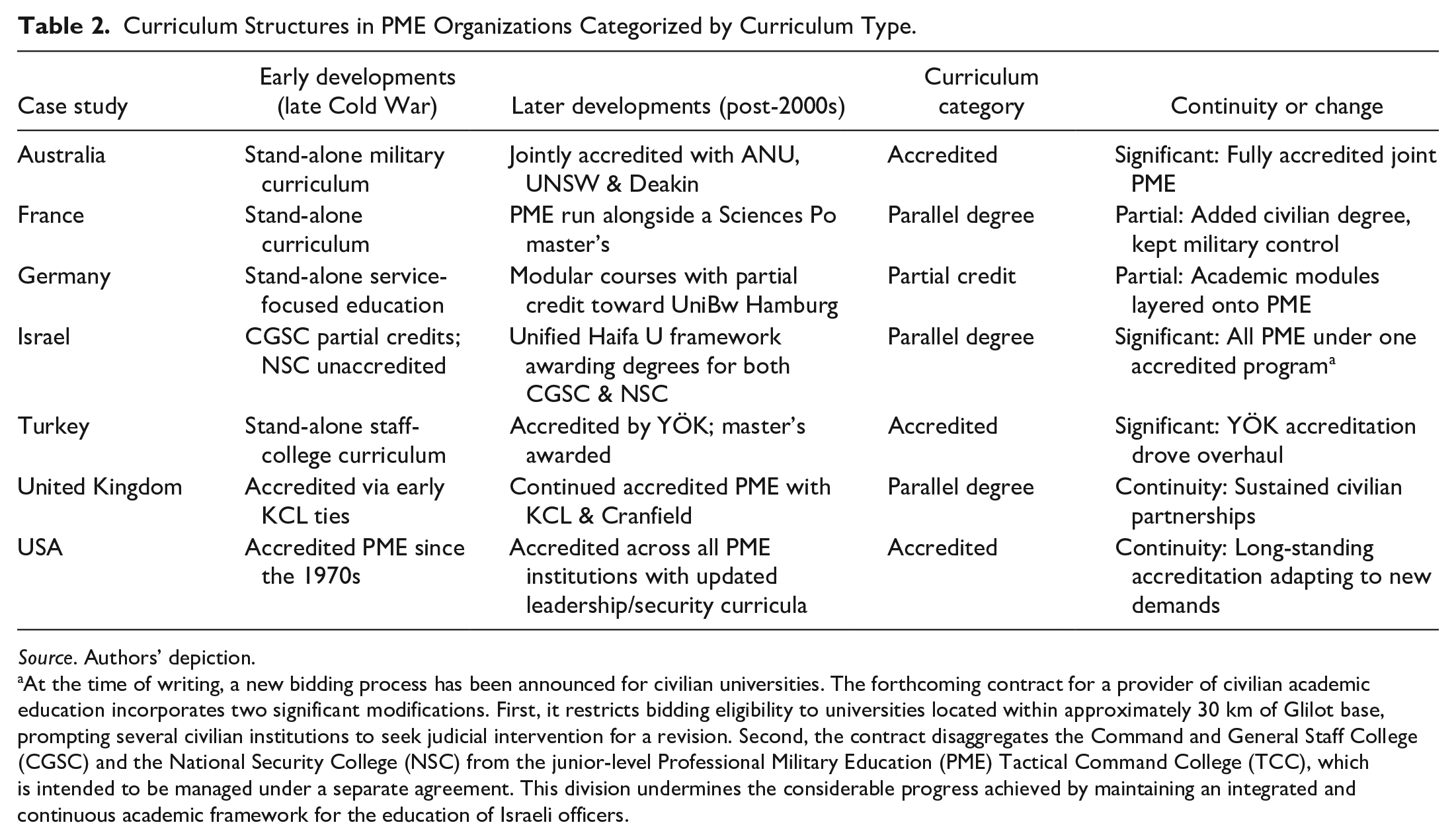
As shown in Table 2, Australia’s PME curriculum has evolved from a stand-alone military program to one fully accredited through partnerships with civilian universities such as the Australian National University (ANU), the University of New South Wales, and Deakin University. Early on, postcommissioning PME relied heavily on service-specific staff colleges with limited academic involvement (Libel, 2010c), 8 resulting in a lack of integration with civilian academic programs. However, since the early 2000s, partnerships with universities have embedded academic accreditation into PME. The majority of members attending the Australian Command and Staff Course (ACSC) and the Defence and Strategic Studies Course (DSSC) attain postgraduate qualifications. The transition to the Australian War College (AWC) and its exclusive partnership with Deakin University in 2023 highlights the shift toward academic rigor and joint operations education (MoD Australia, 2021; Smith & Bergin, 2012). The curriculum now reflects a fully accredited military–academic model.
Curriculum Structures in PME Organizations Categorized by Curriculum Type.
Source. Authors’ depiction.
At the time of writing, a new bidding process has been announced for civilian universities. The forthcoming contract for a provider of civilian academic education incorporates two significant modifications. First, it restricts bidding eligibility to universities located within approximately 30 km of Glilot base, prompting several civilian institutions to seek judicial intervention for a revision. Second, the contract disaggregates the Command and General Staff College (CGSC) and the National Security College (NSC) from the junior-level Professional Military Education (PME) Tactical Command College (TCC), which is intended to be managed under a separate agreement. This division undermines the considerable progress achieved by maintaining an integrated and continuous academic framework for the education of Israeli officers.
France offers a case of gradual change within PME curricula. During the late Cold War, French PME maintained a stand-alone military curriculum with some academic input from prominent civilian academics (Faivre, 1993). Post-1993 reforms marked by the establishment of the CID and its subsequent rebranding as the École de Guerre in 2011 introduced academic collaborations, including a master’s degree program in international relations with Sciences-Po Paris (Reviers, 2017). Civilian academics contribute to teaching and thesis supervision, emphasizing interdisciplinary perspectives. However, the military retains control of the overall curriculum, illustrating a partial transition toward the “military curriculum alongside an academic degree.”
As Table 2 presents, Germany’s PME added modular courses in subjects such as economics and political science—granting partial academic credit alongside its traditional service-focused instruction. During the Cold War, the Führungsakademie der Bundeswehr followed a stand-alone military curriculum focused on service-specific training. Post-1990s reforms brought modular courses emphasizing joint operations, economics, and political science. Initiatives aimed at integrating academic accreditation were unsuccessful, reflecting a partial unwillingness to involve civilian authorities—specifically, higher education accreditation bodies—in governance. Consequently, the curriculum remained predominantly military-focused (Libel, 2016). Recently, there has been a shift in this situation. A notable example is the Master of Arts in Military Leadership and International Security offered by the Helmut-Schmidt-Universität/Universität der Bundeswehr Hamburg in collaboration with the Führungsakademie. This program is designed for officers who have been accepted to the college’s General and Admiral’s Staff Service (LGAN) course, have successfully completed this program, or possess equivalent high-quality knowledge from other sources (The Helmut Schmidt University [HSU], 2025). Several of the LGAN’s modules are accredited as part of the degree’s curricula, constituting an add-on academic program to the military one (HSU, 2020, p. 5).
As shown in Table 2, Israel opted for an adds-on model in which its military curricula are complemented by academic degree programs. These are provided by the University of Haifa, which deliver master’s qualifications at both the NSC and CGSC. The origins of that arrangement date back to 1987, when the NSC introduced an add-on academic program by partnering with Haifa University to offer master’s degrees alongside its dedicated military curriculum (Libel, 2010c; Stern & Saltzman, 2023). In contrast, the Command and General Staff College (CGSC) initially collaborated with Tel Aviv University during the late 1970s to 1980s to offer partial academic credit, but subsequently reverted to a stand-alone military curriculum (Libel, 2010a, 2010c). Recent reforms have consolidated the academic education in the Military Colleges Unit under a single contract. To date, the University of Haifa has served as the exclusive academic provider (University of Haifa, 2019). The Dado Center’s PME activities are not included under this contract, as the Center is not part of the Military Colleges Unit; moreover, the brief duration of its course appears to preclude the awarding of academic credit. Consequently, Israel now falls within the “military curriculum alongside an academic degree” category.
As presented in Table 2, Turkey transformed its staff-college courses into accredited master’s programs following the Turkish Higher Education Council (YÖK) requirements, replacing its earlier stand-alone military syllabus. A decision in 1998 and later expanded in 2003 led to the academic accreditation of the staff colleges, now called War Institutes, by the YÖK and graduates of the school started to receive master’s degrees (Ateş, 2024). The establishment of a defense university in Turkey following the 2016 coup attempt further integrated civilian academics and increased the proportion of academic content in the PME curriculum. These developments exemplify a shift toward the “military curriculum with academic accreditation” category.
As shown in Table 2, the United Kingdom has maintained military–academic integration by expanding joint PME into the Defence Academy, partnered with King’s College London and Cranfield University for fully accredited curricula. This process began in 1998 with the establishment of the Joint Services Command and Staff College (JSCSC), which merged joint education with military–academic instruction by incorporating the Defence Studies Department (DSD) of Kings College as an integral component. A few years later, with the creation of the Defence Academy, this model was extended to all major colleges brought under its umbrella. Furthermore, the addition of Cranfield University as an academic provider alongside Kings College further reinforced this integrated approach. Overall, this model demonstrates continuity and progressive enhancement of academic partnerships over time (Libel, 2010c, 2016).
American PME has long been academically accredited, with both service mid- and senior-level colleges and the National Defense University awarding civilian-recognized degrees since the early 1990s, as shown in Table 2 (Watson, 2007, p. 16). Therefore, it is firmly positioned within the “military curriculum with academic accreditation” (Libel, 2010c). The continuity in the U.S. model demonstrates sustained integration of academic and military priorities, aligning PME with evolving defense and security challenges (Goldman et al., 2024; Watson, 2007).
Faculty Composition
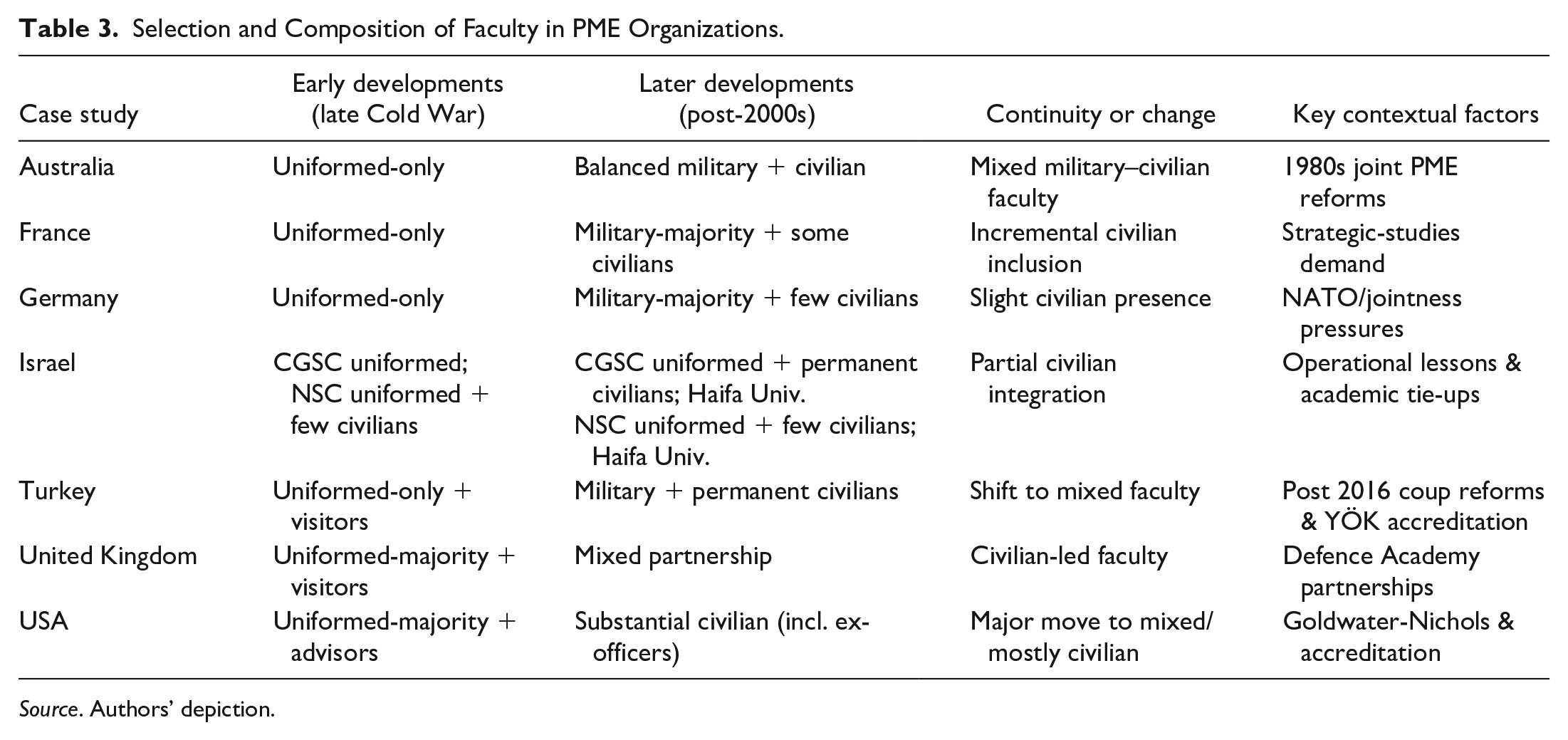
As shown in Table 3, Australia’s PME faculty shifted from predominantly uniformed officers in the late Cold War to a roughly equal blend of military and civilian faculty by 2024, reflecting joint-education reforms initiated after the Gulf War. The late Cold War era saw PME organizations staffed predominantly by military personnel, reflecting the service-specific focus of the time. However, reforms initiated in the 1980s emphasized the need for broader expertise, particularly in joint operations and strategic studies. The establishment of the Australian Defence College (ADC) and the subsequent inclusion of civilian academics in joint PME courses marked a significant shift to mixed faculty. Today, military expertise is complemented by civilian academic contributions, reflecting a deliberate effort to integrate diverse perspectives into PME (Cox & O’Neil, 2006, pp. 59–60; Libel, 2010c).
Selection and Composition of Faculty in PME Organizations.
Source. Authors’ depiction.
As shown in Table 3, France’s PME faculty evolved from an all-military corps in the late Cold War to one that now includes regular contributions from civilian professors—particularly in strategy and political-military affairs—while retaining a military majority. Incremental changes since the 1990s have introduced civilian academics into teaching roles at the École de Guerre, while military personnel continue to dominate faculty positions. This continuity with gradual evolution reflects France’s emphasis on maintaining military control over PME while incorporating limited civilian expertise to address the demands of modern operational studies (Reviers, 2017, p. 77). As outlined by Maire and Schmitt (2022, pp. 813–814), French PME organizations like the Ecole de Guerre and CHEM lack permanent civilian faculty, which limits teaching continuity and research engagement. This leads to a teaching style in French PME that prioritizes external guest lecturers and operational experience over in-depth conceptual analysis and critical thinking based on scientific literature.
As shown in Table 3, Germany’s PME faculty moved from exclusively Bundeswehr officers in the late Cold War to a small but growing cadre of in-house civilian lecturers by 2024, driven by modular course expansions and NATO interoperability standards. The inclusion of “in-house” civilian faculty members in military-related fields represents a modest shift. However, the faculty remains predominantly military, with civilian representation limited by institutional preferences for military-dominated governance (Libel, 2016). This reflects broader challenges in aligning PME institutions with civilian academic standards.
As presented in Table 3, in the late Cold War the Israel CGSC relied exclusively on uniformed instructors, while the NSC combined military faculty with a handful of civilian instructors seconded from intelligence agencies and the public service; by 2024, Haifa University offers parallel academic degree programs alongside both the NSC and CGSC military curricula, and the CGSC has supplemented its uniformed faculty with few permanent civilian academics (Libel, 2010c). The contribution of the NSC’s civilian instructors is constrained by high turnover; in recent years, only one retired senior officer has served for a prolonged period (Anonymous, personal communication, March 15, 2025). Overall, the influence of civilian instructors appears minor compared with that of the predominantly uniformed faculty. In addition, Haifa University plays a pivotal role in supplying civilian academic faculty who deliver instruction for the academic degrees offered at both the NSC and the CGSC (Libel, 2010c; Stern & Saltzman, 2023). This collaboration ensures that civilian expertise complements military instruction, albeit only in academic courses.
Reforms initiated following the Second Lebanon War further increased civilian academic involvement at the CGSC. As part of the establishment of a joint course for combat officers, several civilian academic instructors—primarily holding PhDs in disciplines such as military history or political science—were recruited to teach alongside military instructors, although they taught strictly within the military program (Libel, 2010a, 2010c; Tovy, 2024). 9 Meanwhile, the Dado Center’s staff includes a significant proportion of civilian scholars with PhDs who are integrated into its PME course. Overall, these partial changes in faculty composition reflect a broader trend in Israeli PME to leverage civilian academic expertise at strategic levels while retaining a strong military instructional presence in operational education, aligned with the Military-dominant category.
As presented in Table 3, Turkey’s PME faculty was predominantly composed of military officers at the end of the Cold War, with limited support from visiting professors. Following the defense university reforms implemented in 2016, the faculty evolved into a mixed structure of permanent civilian academics and military professionals by 2024 (Ateş, 2024; HarpAk, 1991, p. 58). With these reforms, a defense university was established that employs both military and civilian faculty, adopting a mixed faculty system. In contrast to previous years, civilian faculty members are now appointed to permanent positions at the War Institutes. This transformation is part of broader efforts to modernize PME by enhancing civilian oversight and fostering academic integration (MSÜ, 2019).
As shown in Table 3, the United Kingdom’s PME faculty shifted from service-only officers with occasional guest lectures in the late Cold War 10 to partnering military instructors with civilian academics from King’s College London and Cranfield University by 2024, under the Defence Academy framework. The establishment of these partnerships with King’s College London and Cranfield University transformed faculty composition, with civilian academics now conducting most of the teaching. Military instructors continue to provide operational expertise, creating a balanced model that integrates academic rigor with practical relevance (Libel, 2010c, 2016; Utting, 2009).
As shown in Table 3, U.S. PME faculty moved from mostly uniformed instructors with occasional civilian advisors in the late Cold War 11 to a balanced mix of civilian PhD holders and career officers by 2024. This change was driven by the Goldwater–Nichols Act, which emphasized professionalization and the integration of diverse expertise into PME (Keaney, 2002). It is essential to clarify a particular detail at this juncture. While there has indeed been an increase in the number of civilian academics within PME institutions in the United States, a closer examination reveals that a substantial portion of these individuals are retired military officers. 12 Consequently, distinguishing between civilian and military faculty becomes quite challenging. Nevertheless, it is fair to assert that the military–academic relationship has improved. This improvement can be attributed to the fact that many of these retired officers have obtained postgraduate degrees from civilian universities. Therefore, the growing emphasis on doctoral qualifications for teaching positions within military institutions reflects a form of indirect collaboration between the military and academia.
By tracing governance’s shift from service-specific chains of command to joint and multinational oversight, curricula’s evolution from stand-alone military instruction toward academic accreditation, and faculty rosters’ expansion from uniformly military to mixed military–civilian bodies, this section directly addresses the first research question: How governance arrangements, curriculum models, and faculty composition in postcommissioning PME institutions have evolved since the early 1990s? With those descriptive patterns established, the analysis now turns to the second research question—namely, which institutional mechanisms (critical junctures, layering, positive feedback, or conversion) best explain the varying pace and scope of reform across cases.
Discussion
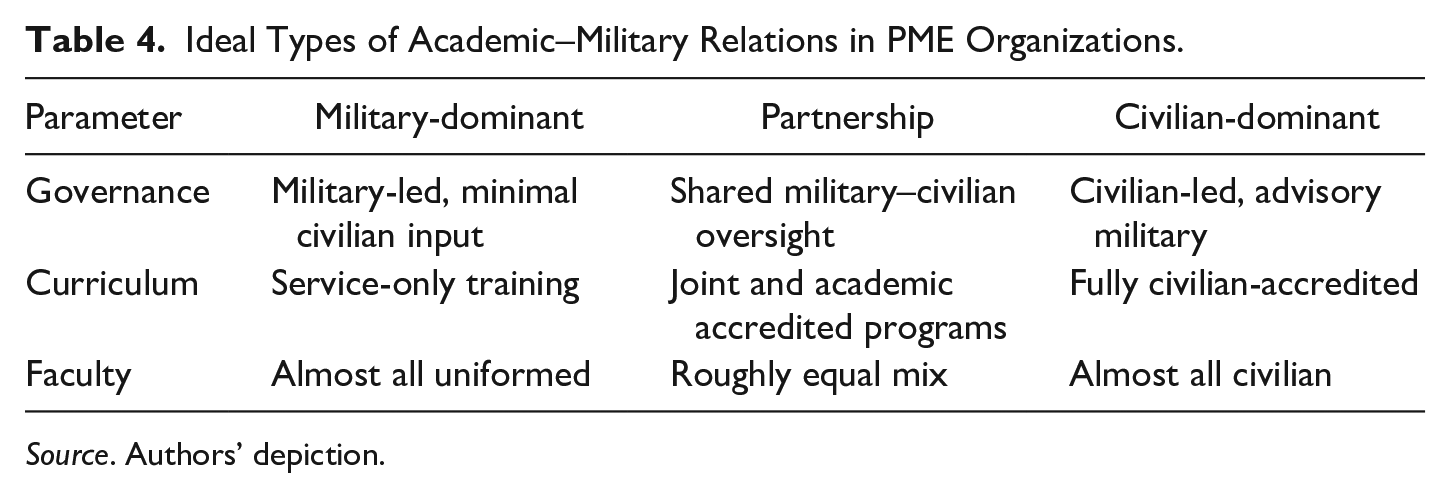
The descriptive patterns identified in governance, curricula, and faculty composition can be re-examined through a historical-institutionalist lens. Critical junctures—such as the 1991 Gulf War or the 2016 Turkish coup attempt—opened brief windows in which entrenched veto points weakened, and large institutional choices became possible. Subsequent layering added joint mandates or academic accreditation alongside older service-controlled rules; positive feedback then locked in these additions by rewarding officers and ministries that complied; and conversion redirected legacy colleges toward new civilian or multinational purposes without formally abolishing them. Taken together, these mechanisms funnel each PME system toward one of three recurrent settlements—military-dominant, partnership, or civilian-dominant—whose defining mixes of governance, curriculum, and faculty are summarized in Table 4.
Ideal Types of Academic–Military Relations in PME Organizations.
Source. Authors’ depiction.
Table 4 summarizes three ideal-type configurations shaped by the interplay of institutional mechanisms. In military-dominant systems—typically the product of early critical junctures that allowed single-service officer corps to lock in their prerogatives—governance, curriculum design, and faculty appointments remain firmly under military control, with civilian academics relegated to supporting roles. Partnership models emerge through successive layering and positive feedback, as joint headquarters and universities negotiate shared authority over PME: Officers and civilian stakeholders jointly set learning objectives, co-design syllabi, and co-select instructors. Finally, civilian-dominant systems reflect conversion processes that redirect accreditation and quality assurance functions toward national higher education authorities, so that civilian bodies assume primary responsibility for curricular approval and faculty hiring, leaving military oversight largely consultative. Each configuration embodies a distinct balance of power and helps explain why some PME systems have resisted change while others have embraced extensive academic–military integration.
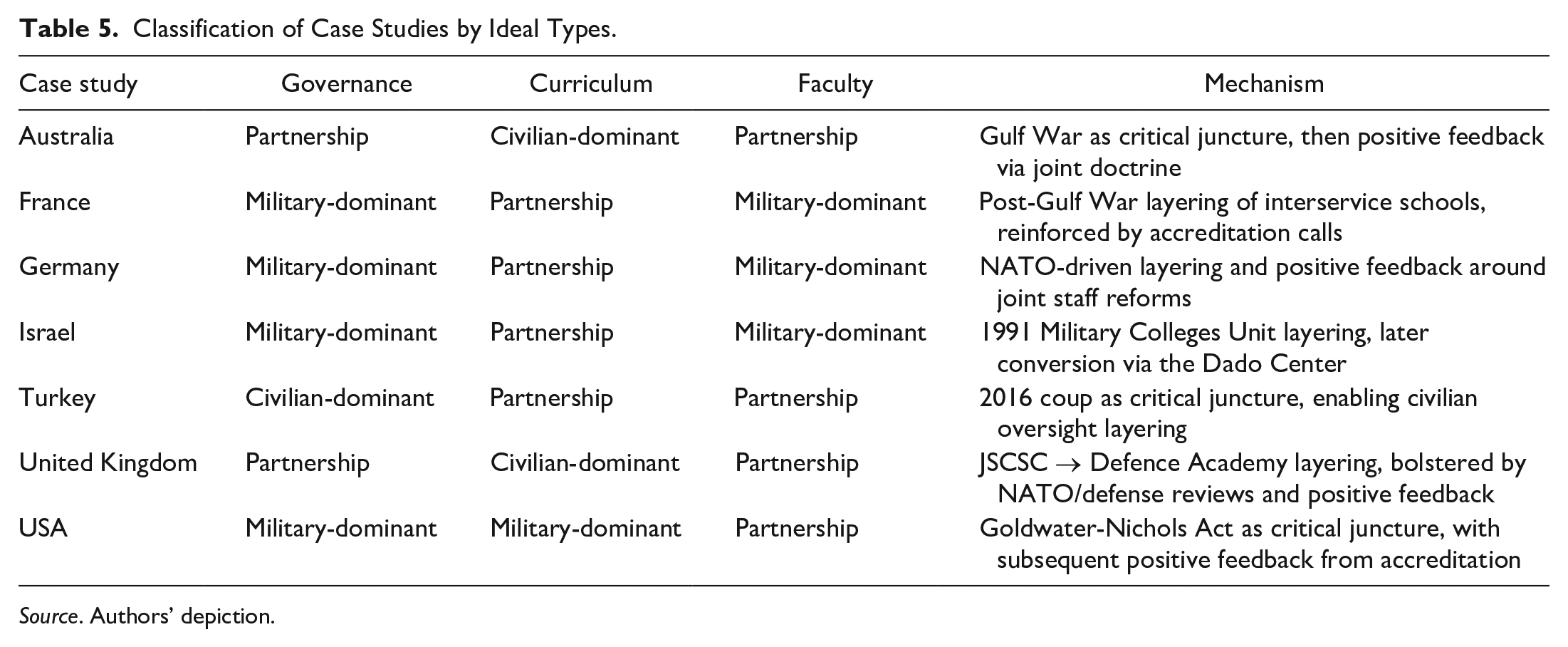
Table 5 assigns each country to one of these three types based on its governance, curriculum, and faculty configuration in 2024.
Classification of Case Studies by Ideal Types.
Source. Authors’ depiction.
Table 5 shows each PME organization’s configuration alongside the mechanism that propelled its reform. In Australia, the Gulf War opened a critical juncture for joint governance, and successive doctrine updates then reinforced that shift through positive feedback—first by establishing the Australian Defence College in 1999 to consolidate previously independent PME organizations, then by iterating its curriculum under civilian accreditation pressures. France’s staff colleges layered in interservice consolidation after the Gulf War (1993 CID; 2011 École de Guerre) and have since been sustained by national higher education authorities’ accreditation requirements. Germany followed NATO-led layering—from single-service chiefs to Inspector-General oversight in 2017—with positive feedback cementing incremental joint governance, even as full academic accreditation remains elusive.
In Israel, the 1991 creation of the Military Colleges Unit represented a first layer of joint, interagency coordination, but the later establishment of OTRI/Dado Center under J7 fractured PME governance rather than consolidating it—an illustrative case of conversion gone awry. Turkey’s post-2016 coup reforms acted as a critical juncture, dismantling old staff colleges and installing a civilian-governed National Defence University while preserving a military-led war-college curriculum. The United Kingdom’s merger into JSCSC (1998) and Defence Academy (2002) unfolded through layered reforms endorsed by NATO and national defense reviews, with positive feedback from academic partnerships cementing a partnership model. In the United States, the Goldwater–Nichols Act served as the defining critical juncture for joint PME governance, and ongoing regional accreditation demands supplied the positive feedback that sustained its military-dominant, yet academically accredited, PME system.
All seven PME systems have trended toward greater “academization,” aligning curricula and faculty credentials with civilian higher education norms. As Table 5 showed, these configurations map onto three ideal types—military-dominant, partnership, and civilian-dominant—each blending internal control and external influence in distinctive ways.
By shifting governance, curricula, and faculty beyond the single-service officer corps, PME organizations have both broadened officers’ expertise and eroded their exclusive claim to “management of organized violence.” Although interdisciplinarity strengthens adaptability, it also weakens the profession’s traditional jurisdiction over entry, schooling, and certification. These developments elevate civilian universities and accreditation bodies into what was once purely military turf. That development also transformed national higher education authorities into de facto actors in national security governance. The third question now asks how much of the officer corps’ jurisdiction over PME has been surrendered—and with what effect on its professional monopoly?
The ideal-type classification in Table 5 now permits a direct assessment of how much of the officer corps’ professional jurisdiction over PME has been ceded—and with it, the monopoly on managing organized violence. The historical-institutionalist lens shows that civilian-dominant systems emerged through critical junctures and conversion, partnership systems through layering and positive feedback, and military-dominant systems through conversion reinforced by feedback loops. Military-dominant configurations, therefore, illustrate only limited conversion; partnership configurations display layering that later positive feedback locked in; civilian-dominant outcomes combine decisive junctures with sweeping conversion—patterns that collectively vindicate the explanatory power of the historical-institutionalist framework. Abbott (1988) locates professional jurisdiction in three linked prerogatives—setting entry criteria, providing required schooling, and disciplining members—while Downes (1985) emphasizes the profession’s exclusive hold on its body of knowledge.
In military-dominant systems, these prerogatives remain firmly under officer control, even as accreditation and joint requirements nudge curriculum and faculty toward civilian collaboration. At the U.S. Command and General Staff College, for example, the Higher Learning Commission accredits the master’s degree, yet service chiefs still approve course content and promotion prerequisites. Partnership systems exhibit a more balanced division: Joint staffs and civilian universities co-determine syllabi and faculty selection, narrowing the corps’ sole claim to expertise. The United Kingdom’s JSCSC illustrates this balance, with King’s College academics co-designing modules while uniformed directors retain overall command. In civilian-dominant systems, external authorities now shape curriculum content and faculty appointments, leaving officers with only residual oversight of entry standards. Turkey is a clear example of this: The Higher Education Council (YÖK) accredits and approves the academic departments and diplomas of the War Institute, which is administered by a civilian-led university senate; officers still teach, but they no longer dominate. Four cases remain military-dominant, two have settled into partnership, and one has veered toward civilian-dominant governance of PME. The United States, France, Germany and Israel continue to control governance, set professional schooling, and certify mastery (Israel’s only civilian tie—Haifa University—offers parallel academic degrees without authority over military curricula or faculty). Australia and the United Kingdom exemplify partnership, sharing decision-making while reserving promotion standards to officers. Turkey illustrates civilian-dominant control. Following the reforms introduced after 2016, a defense university was established, led by a civilian rector and a university senate comprising a diverse group of civilians and military personnel. This structure oversees War Institutes, significantly reducing the traditional authority held by single services and military officers. Variation within each country—across individual schools, services, and historical episodes—nonetheless cautions against treating any national label as wholly uniform.
Across all seven systems, only a minority of PME prerogatives now rest solely with officers. Five have transferred at least one core function—most often schooling and faculty appointment—to joint or civilian actors. This diffusion of authority erodes the officer corps’ once-unassailable claim to monopolize the knowledge required to manage organized violence. Unless a new critical juncture reverses these trends, the profession faces a continuing shrinkage of its foundational jurisdiction, with profound implications for the legitimacy and autonomy of military decision-making. These shifts also foreshadow policy debates over how PME should balance academic rigor with professional self-governance and call for further study of how officers construct their identity when key elements of their education lie under civilian oversight.
Conclusion
The study has addressed three linked questions: (a) how governance, curricula, and faculty in postcommissioning PME organizations changed after the Cold War across Australia, France, Germany, Israel, Turkey, the United Kingdom, and the United States; (b) which historical-institutionalist mechanisms best explain national variation in that change; and (c) to what extent those shifts have ceded the officer corps’ professional jurisdiction—and with it, its monopoly on managing organized violence. Most of the seven cases now cluster in one of three ideal types—military-dominant, partnership, or civilian-dominant—and each end-state can be traced to a distinct combination of mechanisms. Military-dominant cases illustrate limited conversion reinforced by feedback loops, partnership cases trace layering followed by positive feedback, and civilian-dominant cases reflect critical junctures coupled with conversion. Furthermore, military-dominant countries keep most control, though accreditation rules force some civilian cooperation. Partnership models split authority, while civilian-dominant setups leave officers with only limited oversight. In Turkey, the Council of Higher Education approves War Institute programs, while officers still run day-to-day classes under the civilian-led university senate. France offers the opposite extreme: The École de Guerre reports to the military’s higher education directorate; civilian scholars advise, but generals approve every lesson plan.
Today, the United States, France, Germany, and Israel remain military-dominant; Australia and the United Kingdom share control; Turkey has moved toward civilian rule. Five of the seven cases have already handed at least one core PME task—usually curriculum design or faculty hiring—to joint or civilian bodies. As the profession’s knowledge spreads, so does uncertainty over who will manage organized violence. Barring a major shock, the officers’ jurisdiction will likely keep shrinking.
Looking ahead, the findings raise policy and research agendas. Staff-college cohorts remain small, creating risks of vested interests and insularity that warrant closer monitoring once external actors gain influence. Defense ministries must also weigh academic freedom against operational relevance, particularly within alliances such as NATO where doctrine diffuses rapidly. Officer identity is likely to evolve under sustained external oversight. Teaching methods and course selection represent an additional research frontier, especially as blended-learning platforms and civilian pedagogical standards permeate PME. Comparative work that applies the typology to other regions, investigates precommissioning organizations, or traces how officers internalize mixed civilian–military norms would sharpen understanding of a profession whose autonomy—and legitimacy—now rests on increasingly shared foundations.
Finally, the growing trend of academic accreditation for PME organizations is positioning national higher education authorities as actors in security governance— a role that has been largely overlooked in both scholarly literature and policy discussions. 13 These authorities, often lacking expertise in the military sphere, face challenges in maintaining academic freedom within PME organizations and partnerships with civilian universities. 14 In addition, their engagement in military education brings them under scrutiny, both domestically and internationally, particularly during periods of conflict. 15 This evolving role emphasizes the need for further investigation to understand its implications for civil–military relations, the autonomy of PME organizations, and the broader dynamics of collaboration between academic institutions and the military. It also calls for establishing collaboration between PME scholars and Higher Education experts, and integrating the former literature within the latter one.
Footnotes
Appendix
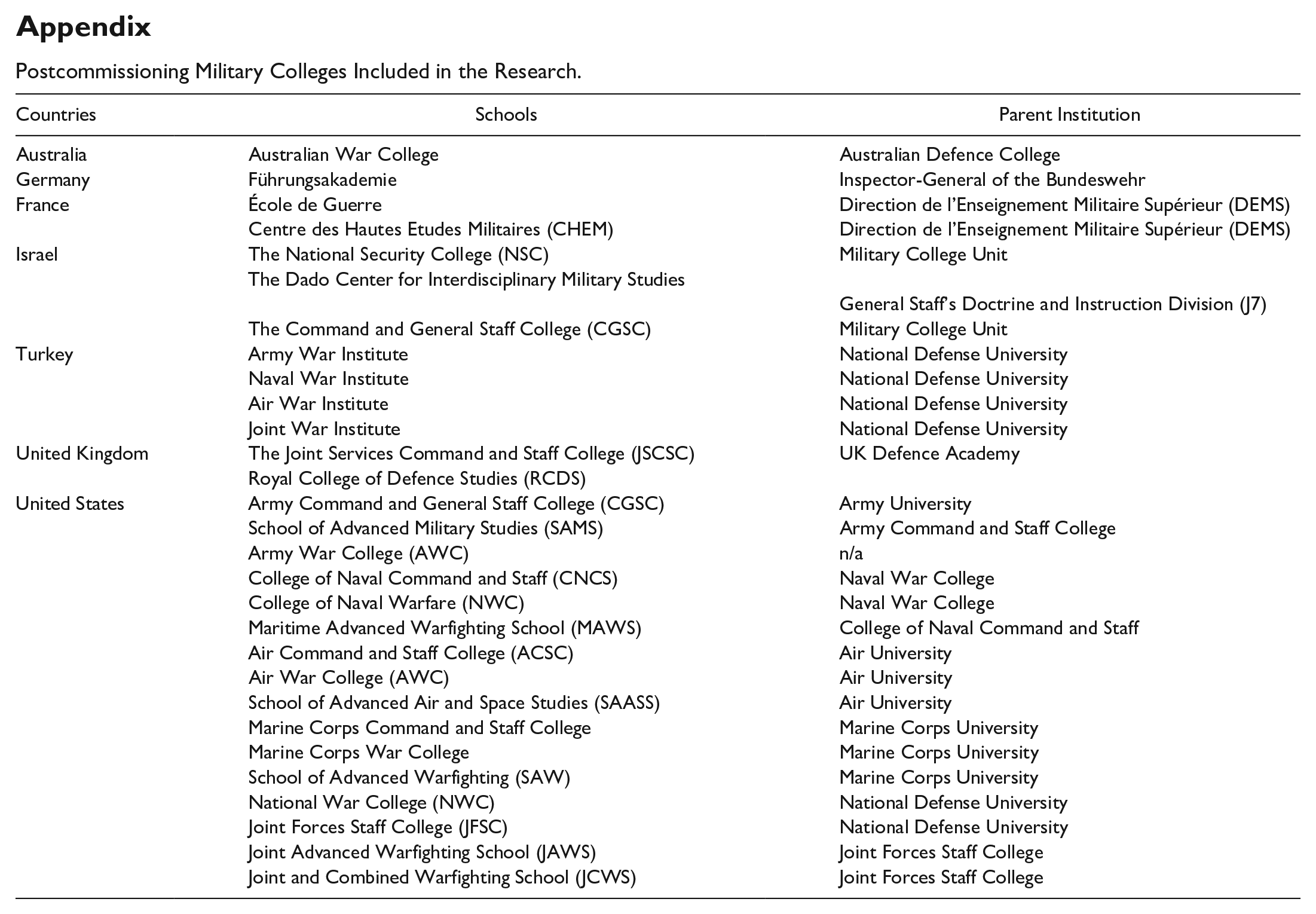
Postcommissioning Military Colleges Included in the Research.
| Countries | Schools | Parent Institution |
|---|---|---|
| Australia | Australian War College | Australian Defence College |
| Germany | Führungsakademie | Inspector-General of the Bundeswehr |
| France | École de Guerre | Direction de l’Enseignement Militaire Supérieur (DEMS) |
| Centre des Hautes Etudes Militaires (CHEM) | Direction de l’Enseignement Militaire Supérieur (DEMS) | |
| Israel | The National Security College (NSC) | Military College Unit |
| The Dado Center for Interdisciplinary Military Studies | ||
| General Staff’s Doctrine and Instruction Division (J7) | ||
| The Command and General Staff College (CGSC) | Military College Unit | |
| Turkey | Army War Institute | National Defense University |
| Naval War Institute | National Defense University | |
| Air War Institute | National Defense University | |
| Joint War Institute | National Defense University | |
| United Kingdom | The Joint Services Command and Staff College (JSCSC) | UK Defence Academy |
| Royal College of Defence Studies (RCDS) | ||
| United States | Army Command and General Staff College (CGSC) | Army University |
| School of Advanced Military Studies (SAMS) | Army Command and Staff College | |
| Army War College (AWC) | n/a | |
| College of Naval Command and Staff (CNCS) | Naval War College | |
| College of Naval Warfare (NWC) | Naval War College | |
| Maritime Advanced Warfighting School (MAWS) | College of Naval Command and Staff | |
| Air Command and Staff College (ACSC) | Air University | |
| Air War College (AWC) | Air University | |
| School of Advanced Air and Space Studies (SAASS) | Air University | |
| Marine Corps Command and Staff College | Marine Corps University | |
| Marine Corps War College | Marine Corps University | |
| School of Advanced Warfighting (SAW) | Marine Corps University | |
| National War College (NWC) | National Defense University | |
| Joint Forces Staff College (JFSC) | National Defense University | |
| Joint Advanced Warfighting School (JAWS) | Joint Forces Staff College | |
| Joint and Combined Warfighting School (JCWS) | Joint Forces Staff College |
Acknowledgements
An initial version of the conceptual framework and three of the case studies were presented by the first author at the Inter-University Seminar on Armed Forces and Society 2011 international conference. He is grateful for feedback from the panel members and Dr. Reuven Gal. In addition, some of the data used for the article in its current form was collected initially for his PhD dissertation and for his Marie Curie postdoctoral fellowship. Both authors are grateful to Duraid Jalili, Dan Krause, Richard Killian, Olivier Schmitt, Tal Tovy, John Hagen, and Catherine Carter for comments on earlier versions of the paper. The second author would also like to thank Jock Caskie for his insightful discussions on military profession and leadership. This article solely reflects the authors’ personal views, and, regarding the second author, does not represent the views of the Turkish National Defense University or the Ministry of Defense.
Declaration of Conflicting Interests
The authors declared no potential conflicts of interest with respect to the research, authorship, and/or publication of this article.
Funding
The authors disclosed receipt of the following financial support for the research, authorship, and/or publication of this article: Part of the data used for this article was initially collected for the first author PhD dissertation, which was supported by Bar Ilan University’s Presidential Doctoral Fellowships of Excellence, as well as for his Marie Curie postdoctoral project (Marie-Curie Actions FP7-PEOPLE-2010-IEF Grant No. 275456).
