



Abstract
This article analyzes the relationship between civil–military relations and professional military education (PME) in Türkiye before the 2016 coup attempt. Its main argument is that an effective PME system could not be realized due to the problematic nature of civil–military relations. The dominant role of the military in politics turned PME into a domain reserved solely for soldiers; however, this autonomy did not help the officer corps to create an effective PME system. Based on historical analyses, this article concludes that civil–military cooperation is necessary for developing a successful PME system, and it endorses Mukherjee’s integrated model. Moreover, it shows that civil–military cooperation for the development of PME is a requirement regardless of the nature of civil–military relations.
Keywords
In most countries that have solved the civil–military problems, professional military education (PME) is designed and implemented through a joint effort by civilians and soldiers. The United States is a significant example in this regard. Similarly, national defense universities, which have grown across Europe, are indicators of a similar kind of cooperation (Libel, 2016). Mukherjee (2018) also, based on the case of India, which has a firm civilian control of the military, explains that the intervention of well-intentioned and informed civilians who have a solid understanding of PME is necessary to develop an effective model. These examples can be called as the integration model, that is, civil–military cooperation for the planning and execution of the PME.
Contrary to the examples provided earlier, in countries where civil–military relations (CMR) are problematic, PME is under the sole control of the military. For instance, Pion-Berlin (1992) explores the situation in Latin American countries where PME was viewed as an area that the military wished to keep under its own control and acted with complete autonomy. Specifically, in Peru, Brazil, and Argentina, staff colleges offered courses to civilians and also hired civilian lecturers; however, they strictly controlled the selection of a few civilian teachers and enjoyed autonomy to decide and outline the content of the courses. Serra (2010) reveals a similar policy within the Spanish military, which strictly controlled PME through the curriculum that was exclusively administered by military teaching staff. Naturally, the first steps to transition included the change in curriculum and instructors. He highlights that “the area of education could not be a reserved domain of the armed forces.” These examples can be called as the isolation model for the implementation and planning of PME.
These two contrasting perspectives on PME—isolation versus integration—can be used to describe the experience of Türkiye, as the country has implemented both approaches. The pre-2016 era can be categorized as an isolation model. On the contrary, the current model corroborates the integration model voiced by Mukherjee (2018). In present-day Türkiye, all military schools have been assembled under the newly established National Defence University following the 2016 coup attempt. Thus, PME is under the responsibility of the mixed civilian and military experts. This model aims to establish and run the national defense university with civil–military cooperation, thus closing the civil–military gap.
Unlike the previous model, civilians are now included in the governance and decision-making processes under the new model. In addition, mixed civilian and military experts now develop the curriculum, admission process, and teaching methods. Moreover, courses such as sociology and CMR are taught by civilian faculty members. However, although the new system is theoretically seen as a more applicable and healthy system in the general context of CMR, it can be predicted that the new model will not be successful if the institutional practices of the PME continue the old habits. Therefore, this article aims to investigate the characteristics of the old PME system to provide insights into implementing the PME model currently being implemented in Türkiye.
The main argument of the article is that the imbalance of Turkish CMR also led to an imbalance in PME and compromised its essential qualities. In that period, the PME was seen as an area reserved for and under the control of the officer corps, in line with the autonomous and dominant role of the soldiers in politics. In addition, due to the usually high public trust in the army and the elitist nature of the civilian bureaucracy, which resembles the military elites, no one interfered in the internal affairs of the soldiers. Therefore, the planning, implementation, and, if necessary, modification of the PME was controlled only by the military. This isolated governance has led to the deterioration and loss of effectiveness of PME over time.
This general problem stemmed not only from the lack of proper CMR but also from institutional secrecy. However, here secrecy does not refer to the bureaucratic secrecy toward the outside world; instead, it relates to internal secrecy, which was adopted as a widespread practice in the military concerning PME. A caste-like elite group comprising general staff officers (GSO) or kurmay 1 had control over military education; therefore, the majority of officers had no say over PME. This situation was further complicated by the fact that the same elite group dominated CMR in Türkiye. Since Türkiye’s transition to multiparty rule, four coups (1960, 1971, 1980, and 1997) and three unsuccessful interventions (1962, 1963, and 2016) were primarily planned and implemented by this group. In this case, it is safe to claim that there was a vicious cycle. The elitist kurmay clique was a consequence of the PME, and the worsening of the PME was a cause of the kurmay clique that constantly intervened in politics, an area beyond their professionalism.
Based on historical analysis, this article provides several contributions to the Turkish CMR literature. First of all, despite the abundance of CMR research in Türkiye, only a few studies partially examine the relationship between CMR and PME (Akyaz, 2002; Celep, 2020; Uluçakar & Çağlar, 2016). This article contributes to the literature by focusing on the effectiveness of PME and its relationship with CMR. Second, it improves the dual model introduced by Mukherjee, helping to characterize an effective PME. These qualifications can be a guide, especially in countries that have just reached the balance in CMR. Finally, this article may contribute to building an effective PME system in countries that have newly established national defense universities.
This study seeks answers to the following questions. How did CMR affect PME in Türkiye before the 2016 coup attempt? What were the indicators of the shortcomings in the PME system? Which parameters have contributed to the deterioration of PME? What lessons can the new model take from the past? To answer these questions, the research design is structured as follows. First, essential qualities required to create an effective PME are discussed to develop parameters for an evaluation of the Turkish system. This is an extended version of Mukherjee’s model (2018, p. 480) and has been developed by analyzing the models applied in different periods and countries in the field of PME. Then a brief history of Turkish PME is given to form the basis for the next part, which analyzes how well it fits into the extended model. Finally, the impact of two interconnected factors, namely, the effects of troubled CMR as an external factor and the institutional secrecy as an internal factor, on PME will be examined.
Because of its graduates’ ability to affect CMR and the well-established and absolute position in the command echelon, this research concentrates exclusively on the Army Staff College. Thus, the term “military elites” refers to kurmays, the minority of officers who graduated from this school. The resources used in this study consist of several secondary sources on the PME system, archival documents, reports of military schools, parliamentary defense commission minutes, and memoirs of graduates.
“Designing an Effective System for PME”: An Extension
What are the characteristics of an effective PME? Mukherjee (2018, p. 480) posits that a model forming a civilian faculty and focusing on academic education constitutes an effective PME. However, the current study argues that these two characteristics alone do not suffice and puts forward the teaching methods, continuous education, and its ability to reach broad audiences as additional features. These characteristics are drawn from the various sources that investigate military education in different times and countries (Barnett, 1967, p. 19; Clemente, 1992, pp. 172–173; Hittle, 1961, p. 306; Kennedy & Neilson, 2002, pp. x–xi; White, 1989, pp. 186–187; Wilkinson, 1895, pp. 158–159; Winton, 2005, p. 9).
An effective PME is expected to provide academic education to prepare officers for an uncertain future rather than just technical training. The aim is to teach officers how to think rather than what to think and foster the development of sound judgment (Mukherjee, 2018, p. 477; Parkin, 2005, p. 3). Therefore, this study draws a clear distinction between education and training and examines the activities performed by officers, especially in the technical field, based on specific standards within the scope of military training. On the contrary, academic education encompasses courses that aim to nurture skills to cope with uncertainty along with abstract thinking and reasoning skills and prepare officers for the future (Masland & Radway, 1957, pp. 50–55).
The term uncertainty here does not only refer to the unknown future but also the nature of the military profession and battlefield. From this perspective, military training aims to give the officers ready-to-use solutions that show them how to act in various situations. For example, the options to be used in an ambush are clear, and the team commander’s ability to use which course of action in which situation can be acquired as a skill through military training. Similarly, hundreds of required actions against hundreds of cases have found their place in military manuals. However, the complex structure of the army and the fog of war always lead to a new situation that is not written in the manuals. In this case, ready-made solutions are often insufficient. Therefore, the officer needs an intellectual background that requires analytical and abstract thinking and sound judgment. This background can only be achieved through academic education. Thus, an effective PME system should be able to maintain the balance between academic education and military training.
This balanced model also needs to adopt teaching methods that prioritize critical thinking and the elimination of dogmas. Even if civilian faculty members who provide academic instruction in military schools are present, PME will suffer if the teaching methods do not encourage students to think critically and analytically. The open discussion environment in the classroom and the adoption of analytical and critical teaching methods by open-minded teaching staff receptive to criticism are essential components of PME.
Another characteristic, which is neatly extrapolated by Huntington (1957, pp. 13–14), involves the continuity of PME, which covers nearly one third of an officer’s career. Each rank and duty necessitates officers to adopt new ways of thinking, acquire further knowledge, and develop skills. Thus, staff colleges implement a three-tiered model to provide education to the greatest number of officers possible, although it is a challenging feature due to time and infrastructure restraints. In elitist systems, on the contrary, very few officers are educated, which, in turn, results in the risk of dividing the officer corps into subgroups, thus reducing cohesion. Because while a minority group has access to advanced education, the other group is deprived of the same. Therefore, ensuring continuity and reaching broad audiences emerge as fundamental characteristics and needs for PME. This study examines the effectiveness of the Turkish PME system and the role of CMR in light of the characteristics that are shown in Table 1.
Characteristics of an Effective PME.
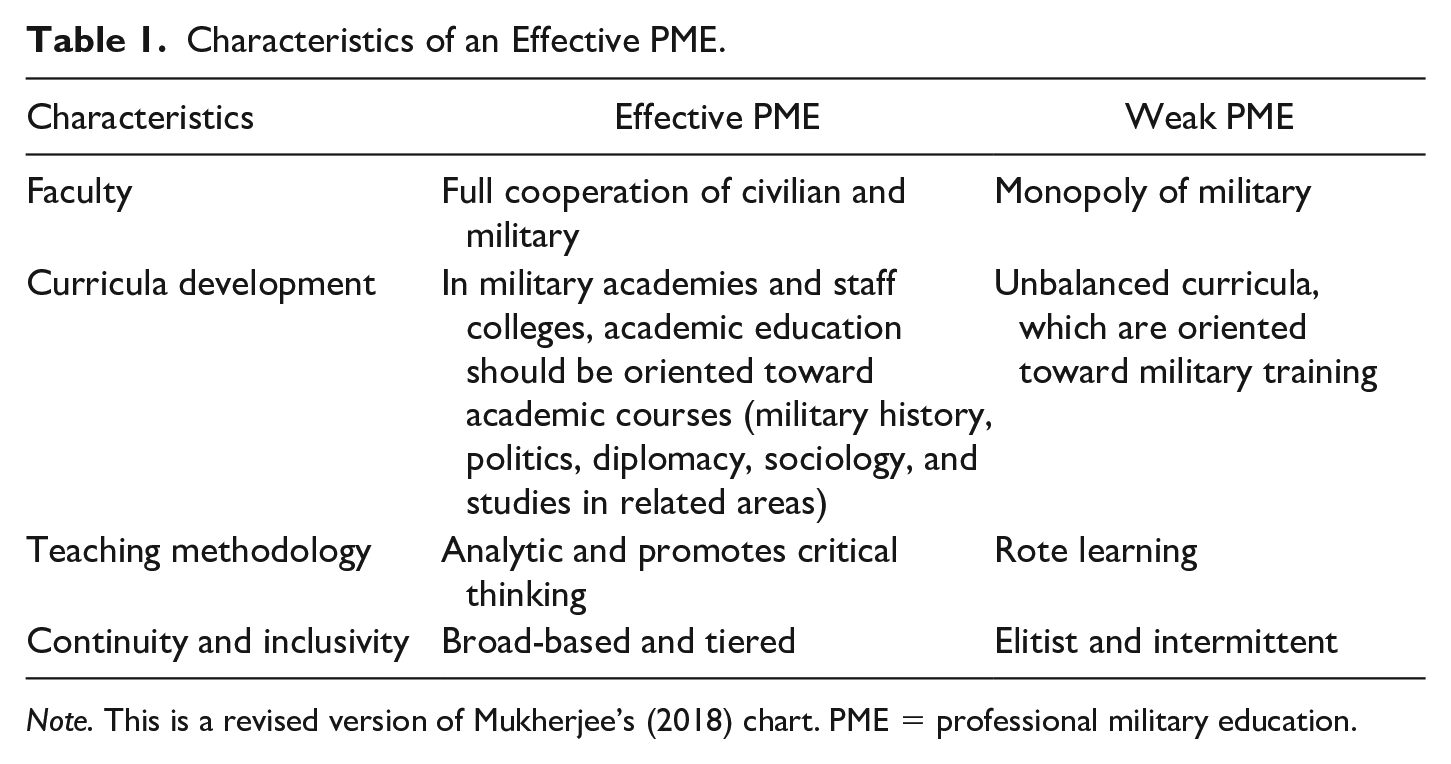
Note. This is a revised version of Mukherjee’s (2018) chart. PME = professional military education.
Brief History of the Turkish PME
The modern Turkish PME system started with the establishment of the Military Academy–Harbiye 2 in 1834 and the Staff College in 1845, both of which adopted the French system (İskora, 1966, p. 5). The prominent feature of the French system is the importance it assigns to theory-based academic education. Thus, a 2-year education period was planned for staff officers after their graduation from Harbiye, and both schools shared the same campus. The top 5% to 10% of the students directly enrolled in the Staff College without field experience. Emphasis was on academic education, which, in fact, was necessary. At the time, the literacy rate was low, 3 and most of the students who attended school had to start from scratch. The academic education dimension of the French system continued until the end of the 19th century.
However, as in other countries (Barnett, 1967), we see that the Ottoman PME system gradually evolved to resemble the German system from the 1870s onward. Functional changes began to be observed after 1883 when Colmar von der Goltz assumed office. After the painful defeat in the Russo-Turkish War, the duration of staff college education had already been increased to 3 years (İskora, 1966, p. 17). Although Goltz continued this practice, he emphasized the need for applied military lessons instead of a theory-oriented academic curriculum. His primary objective was to implement a program rich in technical courses. As a result, two different classes—one military and one academic—were created. Very few GSOs were educated, and they were taking up critical positions on a rotational basis. This group eventually emerged as an elite group in terms of their numbers and education.
The German influence on the Staff College continued until World War II. However, the victory of the allied countries triggered a transition to the American system, which was ensured through the Joint American Military Mission for Aid to Türkiye, which was established in 1947. The American delegation reduced the period of study from 3 years to 1 year. The officers would later be able to receive an additional year of education (HarpAk, 1991, p. 51; Özcan, 2010, p. 201). In other words, the Americans tried to implement their own model and envisaged a tiered model wherein, to promote specialization, they introduced operations and supply officer sections. However, these classes were combined in 1954, and the education period was extended to 2 years without interruption, a model that lasted until 2016.
In general, the Staff College has been a turning point in the careers of officers. This institution, which accepted just 7% of the entire strength of the officer corps, produced around 90% of the country’s generals and practically filled all crucial posts, including the vast majority of international missions, North Atlantic Treaty Organization (NATO), and attaché positions. Therefore, referring to them as the creme de la crème of the military or the military elite would not be erroneous. The requirements for entering the Staff College exams generally included being in one’s late 20s to early 30s and holding the rank of either lieutenant or captain. Therefore, the objective was to educate younger GSOs in comparison with their Western counterparts (Birand, 1986, p. 306). These officers followed a separate career path from other field officers and were subjected to a different appointment unit. This group, which constituted the command echelon, was also influential in CMR and was at the forefront of the military coups.
What Were the Problems of The Turkish PME?
Problem 1: Academic Education Versus Military Training
The most significant weakness of the Turkish PME was the disruption of the balance between academic education and military training. A comparison of the curricula from the past to the present confirms this observation. 4 In every wave of change, the curriculum was generally reoriented to military training by following the trend of the period. The only exception to this rule was perhaps the Ottoman period’s semi-engineering program. However, this practice, which aimed to meet the needs of civil public services, had gradually contributed to an increase in the rate of military courses in the curriculum with the establishment of civil engineering schools (Ergin, 1977, p. 357; Shaw & Shaw, 2002, p. 107; Uyar & Erickson, 2009, p. 151).
The Staff College curriculum primarily focused on the techniques and tactics of military branches, that is, artillery or communications’ tactics. There were no courses related to either the combined arms or strategic-level military studies. The only courses that touched the broad international political or diplomatic issues comprised political history and international law. The only course that had the word “strategic” in its title was strategic geography. Although sociology was added to the Staff College curriculum in 1929, it was just a conference (HarpAk, 1991). A similar example is the geopolitics course, which was not added to the curriculum until 1961. International relations, political science, and major-area courses were finally introduced to officers in the 1990s.
However, the rate of academic courses within the curriculum never exceeded 15%. For example, in 1945, the overall rate of academic courses, which only included law, history, and economics, was four percent. On the contrary, the rate of foreign language courses was 10%, whereas that of military courses was 86%. Although the percentage of academic courses increased in the 1970s, it remained at a relatively low level of 12%, primarily due to the decline in the share of foreign language courses. In other words, the ratio of more than 80% of military courses had actually been preserved. This practice had been consistent in the early 2000s, with a slight increase in the number of academic courses to 15%. Although the General Staff approved the curriculum, the sole authority of PME was the Staff College and there was no possibility for outsiders—military or civilian—to intervene as kurmays held crucial positions within the General Staff. Consequently, a curriculum of pure military training courses was developed, which reflected the military’s short-term orientation rather than an effective PME. Simply put, the Staff College disregarded the primary objective of PME, namely, to prepare officers for an unpredictable future environment by providing a broader view of operational and strategic challenges.
It is worth noting here that the selection of academic courses was also problematic at the Staff College. For instance, courses such as “creative thinking and use of brain,” “studying and learning,” “communication and the written expression,” “group work techniques,” and “the system analysis” were introduced to the curriculum. Nevertheless, these courses were directly related to the skills that should be gained at the undergraduate level. Staff College, on the other hand, made it mandatory for officers to pursue these courses with the rank of captain-major in their 30s. Moreover, additional problems were posed by the fact that the sources were generally obsolete, and it was difficult to track the recent literature. These problems highlight the lack of a scientific approach to the development of Turkish PME.
Problem 2: Teaching Methods
Although teaching methods are not a direct component of CMR, they are indirectly affected by them. As the faculty heavily consisted of military officers, usually previous Staff College graduates, a few civilian lecturers convening academic courses could not affect the teaching climate. The military was the sole decision-making body for the planning and implementation of the Turkish PME. In an ideal system, however, it would have been desirable for civilians to hold administrative positions.
As a result of the limited role played by civilian permanent faculty members and the lack of universal academic criteria, a closed-off school environment that is resistant to criticism emerged. This closed system was the military’s own preference; therefore, official documents mostly did not mention the problematic teaching methods. However, the memoirs of graduates plainly reveal this problem. The officer students were not allowed to criticize any aspect of the curriculum or complain about any issue or object to their teachers. They were expected to fully memorize the field manuals without posing any criticism. In addition, due to the high memorization load, students had to study for long hours. In fact, some students stated in their memoirs that they tried to stay awake to study hard by taking the medication administered to racehorses (Bölügiray, 2009, pp. 51–53; Seyhan, 1966, pp. 48–49; Yalman, 2014, pp. 116–117). To sum up, the Staff College was producing data-hoarders instead of open-minded officers with analytical thinking skills. As similar practices were implemented in the entrance exams (İskora, 1966, pp. 76–117), officers with advanced memorization skills, rather than those with advanced judgment skills, were successful. Due to the rote learning system, these officers were generally not open to personal and professional development. Another aspect of the improper teaching methods was that the extremely strict attitudes of teachers psychologically harmed students, thereby hindering the creation of a friendly environment within and outside the classroom. Common complaints in the memoirs indicate the absence of a nurturing environment for discussion in the classroom, strict and intolerant attitude of teachers who did not permit a critical approach (Akbaş, 2014; Karabekir, 2019; Küçük, 2008; Önal, 2006; Yalman, 2014; Yirmibeşoğlu, 1999). Although the official guidelines of the school required the establishment of a discussion environment within the classroom, opportunities for open communication between students and teachers and the freedom to express one’s views were not provided (HarpAk, 1991). After Türkiye joined NATO, officers who had studied at colleges abroad expressed their longing for the open discussion environment in their former schools. Bölügiray (2009), who offered great detail on the education of the Staff College in his memoir, explained that it was impossible to change this culture at the Turkish Staff College.
The methods used for tactical problem-solving in the Staff College are also important indicators of an effective PME. An imposed school solution has no place in such studies or doctrinal discussions. For example, there are no pre-prepared, ready-made solutions that students can memorize and rely on in the German system. Instead, the solution proposed by each student is separately discussed and perceived as a part of the next step. The fundamental aim is to cultivate students’ reasoning skills and encourage them to be open-minded. The American system has been criticized for implementing the exact opposite of this system (Barnett, 1967, pp. 33–34; Muth, 2011, p. 165, 172). In Türkiye, on the other hand, due to a rote-learning approach that strictly adhered to the school solution and field manual, tactical, and doctrinal discussions made students close-minded and instilled the habit of being resistant to change.
Problem 3: Continuous Education Throughout the Tenure of Officers’ Career
Officers are not independent professionals, as they are also members of the state bureaucracy. Thus, military expertise has two dimensions—“formal knowledge recognized as a common holding of military organizations, and professional knowledge (including a complementary skill set) which is each officer’s skill as a professional” (Libel, 2016, p. 14). Therefore, officers should be equipped with general values as well as the specific knowledge required by their specialized field. Consequently, a professional military organization will seek to cultivate expertise and instill it in its members for continuous improvement. Therefore, Libel states that, unlike other professional groups, officers have to receive advanced education. In other words, while receiving advanced education is optional in general, for example, in the field of medicine and law, it is nevertheless mandatory for officers. In fact, several countries strive to increase advanced education opportunities, that is, staff college education. However, advanced officer education, which Libel sees as a necessity, has always been a privilege granted to only a very small minority in the Turkish Army. This problem is a result of the country’s skewed internal dynamics as well as the influence of foreign military advisors. To better understand this, one must first consider the perception of education in society.
Frey (1965, p. 29) indicates that social discrimination in modern Türkiye stems from education. A large portion of society believes that individuals who graduate from the most acclaimed and prominent schools are the most reputable. However, this situation did not arise in modern Türkiye. It has existed since the last times of the Ottoman Empire and was transferred to Modern Türkiye, in particular, in reference to the military. To understand this phenomenon, one first must understand the struggle between the educated minority and the uneducated majority. When modern military schools produced their first graduates, these officers were not even allowed to command a unit by Alaylı (literally from the regiment). They could not access key positions due to obstructions or their low numbers. In other words, the struggle between aristocracy and educated commoners in the West manifested as a struggle between Mektepli (from the school) officers and uneducated Alaylı officers in the Ottoman Empire.
To illustrate, the ratio of educated officers was 15% at the end of the 19th century; therefore, a large number of officer positions were occupied by Alaylı. The total number of Mekteplis was only 1,600 out of 20,000 in the Ottoman army. Even worse, the number of kurmays corresponded to 132 (Uyar & Erickson, 2009, p. 177). It is the nature of the social relationships that when few educated officers are present among the uneducated majority, they form an educational elite group, even if they are not born as such. On top of that, only a handful of kurmays created an inner elite group (Akmeşe, 2005, p. 8, 20). In other words, at the end of the 19th century, the meaning of the word elite was synonymous with the limited number of educated officers, in particular, kurmays.
However, this elitism based on numbers, which first emerged due to the insufficient number of students, teachers, and schools, continued despite the development of better and improved educational infrastructure and facilities. The German mission headed by Goltz undoubtedly played a role to pin this elitism onto the Turkish PME system. Goltz’s model granted the best and most distinguished officers the right to become kurmays, which translated to approximately 20 or 30 students out of 1,000 (Uyar & Erickson, 2009, p. 208). Thus, this model enabled kurmays to work rotationally in certain positions, which, in turn, facilitated the formation of team spirit. This common experience was expected to allow kurmays to develop a unique and privileged team spirit and encourage them to support one another.
Moreover, unlike the educational framework in most countries, this education was administered through a single, long-term program. The term of uninterrupted education at the Staff College, during which officers were away from their primary duties, was never less than 2 years. Thus, instead of providing education depending on rank and duty requirements, long-term education was implemented as a fundamental principle. Nevertheless, the desired outcome was not achieved, as the limited number of GSOs were unable to fill key positions even in peacetime. Therefore, student quotas were frequently increased. Consequently, in contrast to Libel’s argument, availing advanced education continued to be a privilege, and not a right, in the Turkish army, which was confirmed by the statistical data.
The number of students admitted to the Staff College was increased from 15 to 40 at the beginning of the 20th century. The Army increased this number again before World War II from 40 to 60 per year for operational reasons. However, there were not sufficient number of kurmays to fill the required positions. Finally, in 1974, the annual quota was increased by almost 50% (Yurdabak, 1979). Brown (1989, p. 396) reports that although around 800 officers took the exams each year, roughly 60 officers were accepted. However, even this increase was insufficient, as the army only had 46 staff officers per 10,000 soldiers in 2011. 5 This made it evident that the Staff College remained an elitist institution. As a matter of fact, the Turkish Army Staff College graduated only around 6,000 officers in 167 years, which corresponds to 7% of the entire officer strength. This rate is the lowest among all NATO countries, even behind the German Staff College (BwCSC, 2021), which heavily influenced the Turkish military.
These aforementioned statistics prove that instead of serving as a university for the entire military and a think tank that generates military theory, the Staff College was transformed into an institution that provided a one-time, long-term education to a limited number of officers, thereby contributing to the formation of a clique. Civilians could not break this elitism due to fluctuating CMR. Moreover, civilian experts were not familiar with PME. In other words, the military hindered the education of large masses. The kurmays, as a separate caste, used their autonomy to create a privileged group instead of promoting professional development. The civilians had neither the control nor the skills to intervene.
Autonomous PME: No Civilians Allowed
Literature on the interventions of the Turkish military in political life and its causes and effects is abundant. 6 Thus, this study will not scrutinize this literature in detail. However, it is necessary to emphasize the side effects of CMR in the context of PME. One prominent example of this negative relationship was observed in the Ottoman period. During the reign of Abdulhamid II, although access to a heavily academic PME was provided to the officers, these officers were not allowed to improve their theoretical knowledge by applying military courses or undertaking drills, lest they use it against the sultan, who feared that he would be overthrown by a military coup, just like his uncle Abdulaziz had. That is to say, the nature of CMR reduced the quality of PME (Akmeşe, 2005, pp. 19–20; Altıparmak, 1983, p. 59; Yasamee, 1998, p. 92). There were similar assessments for the Republic era as well, although they are not well-evidenced and thoroughly investigated (Kurtcephe & Balcıoğlu, 1991, s. 219). However, it is certain that PME was solely reserved for the military in parallel to its dominant role in politics.
The Chief of General Staff, who directly reported to the Prime Minister, and his headquarters were influential not only in all military affairs but also in political matters such as shaping views related to international agreements (Narlı, 2000, pp. 118–9). The military’s seven direct and indirect interventions between 1960 and 2016 not only dominated political life but also prevented the potential civilian contribution to PME. An essential feature of these coups is that the kurmays were at the forefront in planning and implementation. For example, 32 of 38 members of the National Unity Committee (Milli Birlik Komitesi [MBK]), which carried out the 1960 coup, were Staff College graduates (Erkanlı, 1973). A similar feature continued in the subsequent military interventions, including the 2016 coup attempt. These interventions show that the kurmays did not hesitate to go beyond their professional area.
In addition to the independent nature of the General Staff, another factor was the independence of Staff College within the military. The Staff College was the sole planner of PME, and kurmays could make their own decisions. They faced no difficulties in implementing the desired changes, as staff college graduates held critical positions in the General Staff. The only challenge with respect to such issues was finding a formula that would meet the needs of all three services and nurture an environment conducive to reaching a consensus. Civilians had no impact on the decision-making process, and the only opportunity to do that was through the parliamentary subcommittees, whose members consisted of retired military officers and generals.
For example, in 1950, during the amendment of the article of Staff College education, all discussions were dominated by parliamentarians of military origin (T.B.M.M. Tutanak Dergisi, 1950). In these meetings, only one of the 18 members of the National Defense Committee was a civilian; however, this individual was a general’s spouse. The head of the committee was a general, and all other members were retired military officers. The number of MPs of military origin in the parliament was 69, which corresponds to approximately 14% of the parliament. At the time, the soldiers were still enjoying their victory in the War of Independence and the foundation of a new country, and they had the power to influence decisions not only in military matters but also in politics. As a result, it would have been implausible to anticipate the formation of laws surrounding the officer education system, which directly contradicted the views of the military.
During the parliamentary negotiations in 1971, which would lay the legal grounds for the education of staff officers, half of the committee members consisted of MPs with a military background. Moreover, this year also witnessed a peak in military intervention in politics, as the military issued the 1971 memorandum to the government. Yet again, soldiers dominated the discussions on the content of the law. During these meetings, it was unthinkable to expect serious scrutiny or the possibility of civilians introducing a regulation that was not already approved by the military. In fact, an MP of military origin clearly expressed this when he said, “I know the general tendency of our Senate. Generally, bills regarding the Armed Forces are approved without close inspection.” (Cumhuriyet Senatosu Tutanak Dergisi, 1975). In short, the civilians played no role in the PME matters, which was brought to notice by the soldiers. In fact, no such will and experience could be discerned.
During the amendments of the law of the Staff College in 1989, there was virtually no debate, and the bill was approved and submitted by the General Staff, that is, the kurmays. Again, the committee head was also a retired general (T.B.M.M. Tutanak Dergisi, 1989). This demonstrates that civilians had absolutely no voice regarding military issues. Given that the military had a voice in practically every subject in the years after the military coup of 1980, the opposite was inconceivable. As a result of this order, the Staff College continued to control its own future. PME’s legal norms were meticulously drafted and enforced by a small group of kurmays beyond civilian control.
Due to the lack of civilian control, political decision makers could not intervene in the Turkish PME. However, could societal and cultural factors be used as leverage to impact the improvement of military education? Three indicators should be investigated to answer this question. First, while an emerging new class with the weakening of feudalism in Western societies could design the state and the military according to its own social understanding, this process started from the end in Turkish society. First, a professional army tradition and state centralism were formed, while the bourgeoisie could not emerge in this process. Moreover, the great transformation experienced in the 1920s was realized, thanks to the army (Bozdemir, 1982, pp. 168–176). The founding role of the soldiers is confirmed by the high trust of society as well. This ratio was around 94% in 1997 (Esmer, 1999, p. 42). According to a study published in 2012 (Esmer, 2012), trust in the army started to decline in 2008 and finally reached 76%. However, although the trust in civilian institutions and the support for democracy have increased, the trust in the army was higher than in other institutions (Sarıgil, 2009, p. 711).
Second, in recent Turkish history, the events considered as successes were generally military operations—the War of Independence, the Korean War, the Cyprus Peace Operation, and, finally, the war against terrorism. This perception makes the army even more important as an institution for a society that has felt backwardness against the West for the last 300 years (Demirel, 2009, p. 358). Finally, the civilian bureaucracy also was a closed caste system consisting of civil servants who had undergone a certain education and were promoted almost only according to the criterion of seniority. Entry into the elitist bureaucracy at the higher echelons was possible only in exceptional circumstances (Heper, 1985, p. 70 and 75). This caste might be regarded as a mirror of the military elites in terms of cultural features. In this case, it could not be expected that internal practices of the military would be questioned by the society or the elitist civilian bureaucracy, which already respects and trusts the army. As the public support for political leadership was usually lower than the support for the military, it is safe to claim that the PME stayed purely at the hands of a few military officers.
After the 2016 coup attempt, there were measures to cut the military involvement in politics, and PME was also a part of the process upon establishing the National Defence University. However, this time, another dimension of CMR posed concerns. The second-generation problematic areas emerge at lower levels of CMR, primarily in countries that have recently established civilian control. As Cottey et al. (2002) mentioned, second-generation CMR are related to the shortcomings in parliamentary control, budget control, and the effective use of subcommittees, think tanks, media, and universities in the context of defense matters and debates on such issues. In a single study conducted on the second-generation problems in Türkiye, Yıldız (2014) argues that although civilian control has been established, it is still insufficient due to the lack of civilian expertise.
Yıldız made an accurate observation as there are no civilian experts who are familiar with broad military issues, let alone PME. For example, after the 2016 coup attempt, only a few civilian experts had knowledge about military schools and education programs. Thus, although the military was subject to civilian control in the context of power relations, the civilians did not possess the necessary expertise to transform the military. In other words, the problematic mainstream CMR that continued until 2016 pose second-generation problems at present. Although a defense university has been established, background issues such as interconnected curricula planning, the need to ensure the optimum balance between education and training remain unsolved, and further effort is required in this context in the long run.
However, one should also be careful when addressing the scale and scope of civilian intervention. Unexpected problems may arise in the intervention of ill-informed civilian experts who are unfamiliar with military affairs and act with ideological concerns. Indeed, it is possible to observe examples of the adverse impact of the civilian intervention on military education in Türkiye. For example, there were several staff officer candidates who were expelled from school for various reasons and later recalled due to the pressure of the political parties in the 1950s, when control over the military was relatively ensured (Seyhan, 1966, pp. 48–49). Moreover, in the same period, there were also instances when students who failed their classes were still allowed to proceed to the next grade due to political pressure (Bölügiray, 2009, p. 70; Büyüktuğrul, 2005, p. 811; Erçiş, 1999, p. 180). This practice affected the quality of education and revealed the shortcomings of the civilians. Instead of using the available means for the quality of education and proper, merit-based career management, ill-informed political figures used their power to recall expelled students back to school, which, in turn, resulted in complete distrust.
In Türkiye, where civilian control of the army is a relatively new phenomenon, it is evident that civilian experts who intervene and contribute to the PME should be well informed to build an effective system. A well-intentioned approach free of ideological concerns, as advocated by Mukherjee (2018), needs to be adopted for civilian intervention in the new PME system of Türkiye as well.
Autonomous PME: Only Inner Elites Allowed
Due to the factors that are presented in this article, PME purely remained a military matter. However, in this context, a critical question arises—Was it not possible to reach an effective PME through insiders’ intervention and contribution? Apparently, the self-declared military caste, namely, kurmays, did not allow such a process by limiting the advanced education opportunities to the rest of the officer corps. This limitation hindered the development of professional officer corps, which could have been achieved by an inclusive system. From this perspective, it was detrimental to the development of the profession of arms in Türkiye, as it did not fit the basic requirements of a typical profession.
Perlmutter (1977, p. 1) defines the profession as a position acquired through long-term education and training in a specialized field. Long-term and intensive education aims to maintain execution and success in accordance with the standards established by the institution or peers. In this respect, officership exhibits a typical professional feature, as modern military schools were established, and education was spread out throughout the officer’s entire career. Huntington (1957, p. 11) argues that specialization constitutes an essential characteristic of this profession. Officers reinforce their knowledge and expertise through many years of education and experience. However, this definition does not touch upon how the monopoly on specialized knowledge has to be preserved. At this point, the views of Downes (1985, pp. 147–8) are worth discussing. Although she identifies eight different qualifications related to the profession, it is necessary to consider the “monopoly of control on theoretical knowledge with a defined framework and the practical skills accompanying this knowledge.” According to Downes, the profession tries to maintain a monopoly on knowledge in several ways. It controls the recruitment and selection of professional candidates and tends to control the duration and content of education and training courses designed to equip individuals with professional knowledge and skills. The profession may also press for the recognition of the legal infrastructure of this monopoly, thereby enacting laws.
The efforts to maintain the monopoly mentioned by Downes highlight the activities carried out openly and transparently. Therefore, such a monopolization should be evaluated within the scope of a “legally privileged group,” as discussed by Weber et al. (1978, p. 342). The monopoly on Turkish PME was also granted by legal regulations. However, there is one more step to ensure that kurmays could secure their privileged caste and reinforce the monopoly not only against outsiders but also against insiders. This further step can be defined as an “administratively privileged group.” This kind of privilege was implemented by applying excessive secrecy on some of the PME-related regulations through simple administerial rules.
It is once again necessary to refer to Weber to shed light on the notion of secrecy. Weber argues that bureaucracies tend to conceal the information of their expertise to protect the superiority of their staff, thereby avoiding criticism on their own knowledge and actions (Gerth & Mills, 1995, p. 233). This secrecy is further reinforced when it comes to areas such as the military, which is a typical form of bureaucracy, and national security. Secrecy can be practiced on various levels, depending on the military operation underway and the nature of the information. However, the implementation of this secrecy in PME emerges as an exaggerated practice. To sum up, there are overt and covert ways for military officers to retain their expertise as a monopoly, and it would be no exaggeration to say that although the Turkish military adopted the legal way against civilians, it also implemented the second way, that is, the administrative one, within the military. This second way marks the area in which the Turkish military separates itself from other armies.
The first confidentiality practices related to PME came to the fore at the beginning of the 20th century. A reformist school commander introduced anonymous review to prevent favoritism (Karabekir, 2019, p. 177; Önal, 2006, pp. 99–109). In the following years, it was decided that the exam results of students would not be announced until the end of the semester to prevent a decline in performance (Bayar, 2006, p. 441). However, these well-intentioned practices were later exploited to implement additional secrecy for entrance exams. The admission exam questions and answers were not published. The complete list and scores of the successful candidates were not announced, and even the objections against the results were evaluated within the scope of confidentiality, which, in turn, led to the continuation of a separate caste within the military. 7
This secrecy continued in the educational framework, and it eventually became a standard for the graduates’ theses to be hidden from civilians, and it was made partially accessible to other officers within the military. These policies meant that kurmays were unwilling to be under the oversight of neither civilians nor their colleagues. Consequently, lack of oversight gave rise to concerns about the legitimacy of the exams and the reliability of the system. Thus, in essence, the military elites sought to ensure the continuity of the caste system by hiding information, which was one of the factors that undermined the reputation of the Staff College that should be at the pinnacle of military education institutes.
These abovementioned practices resulted in two separate cliques within the same profession, namely, the educated versus the semi-educated. Just as the officer corps did not share their expertise with the civilians, a separate group within the officer corps—kurmays—contributed to further secrecy by exploiting the privileges of military elites. The kurmays established an aristocracy based on strong solidarity toward the outside world and their colleagues to defend their rights. In addition, and perhaps, most importantly, all military coups were orchestrated by kurmays—a fact that is often overlooked in Turkish and English literature. One must admit that this situation was not born out of a deliberate or planned practice. In fact, it was the by-product of unchecked organizational regulations, which were not subject to civilian control and cooperation. The fact that kurmays were able to make decisions about their internal affairs at their discretion and the fact that such decisions were not even disclosed to their own members under the guise of “confidentiality” led to the formation of a select group, which had a monopoly on PME. This monopoly resulted in a gradual, unchecked, and inevitable disruption of the system. In short, the problems related to CMR paved the way for the internal autonomy of PME, which, in turn, contributed to its own corruption.
Conclusion
This article has argued that an imbalance in CMR has a negative impact on PME. Moreover, the absence of civilian control gives rise to a self-destructive outcome when the military designs and implements their own education. The public trust in the military and the elitist civilian bureaucracy were additional factors that indirectly hindered the civilian intervention or cooperation as they did not leave room for questioning the internal affairs of the military. As seen in the case of Türkiye, it was not possible to develop an effective PME without civilian intervention. Consequently, it has been observed that a balance was not achieved between academic education and military training, rote-learning methods were adopted, limited civilian faculty did not play a role in the governance, and a PME, which had to facilitate continuity and accessibility to large audiences, had not been established. The military was the sole authority, and they used the lack of civilian control not to develop their professional qualities but rather to gradually isolate themselves and create a group of elites by hiding behind a shield of secrecy.
The existence of the kurmay clique within the officer corps and their persistent beliefs to retain the status of advanced education as a privilege made the problem more profound, complex, and long-lasting. Furthermore, the core of the military intervention planners belonged to the same group. Therefore, it would not be an exaggeration to say that the lack of an effective PME system was one of the factors contributing to the coups. This situation alone shows that civilian intervention and contribution are necessary. The case of the Turkish Staff College demonstrates that the civilian intervention in PME proves to be a necessity regardless of the nature of CMR. India and Türkiye have differences when it concerns CMR; however, both militaries have faced problems in their PME. Thus, this article sets forth that regarding PME, the integration model should be a norm. No issue is now neither purely military nor civilian, and PME operates in this gray area. Therefore, an effective PME can only be achieved through civil–military partnership. In the case of Türkiye, it appears that the establishment of the National Defence University has facilitated an opportunity to achieve these characteristics. It is too early to predict what the outcomes will be. However, the past experiences provide lessons learned to build an effective PME system. In addition, introducing departments on defense-related issues in civil universities and cooperating with them will create an opportunity to solve the second-generation problems. The most important result of this cooperation may be the effective education of civilian and military experts, who would finally be able to understand and communicate with one another.
As the present study is the first of its kind to examine the role of CMR in shaping the Turkish PME, naturally, unresolved and uncovered issues continue to persist. For example, the opportunities created by the establishment of the National Defence University and the effectiveness of the current PME model can be addressed in further research. Finally, to solve the second-generation civil–military problems, the potential cooperation between the National Defence University and civilian institutions, as well as their involvement in military matters, deserves further examination.
Footnotes
Acknowledgements
I would like to thank Mesut Uyar, Gültekin Yıldız, Beyzanur Arslan, Adem Başpınar, and two anonymous reviewers for their helpful comments on earlier drafts of this article.
Author’s Note
This article solely reflects my personal views and does not represent the views of the Turkish National Defence University or the Ministry of National Defence.
Declaration of Conflicting Interests
The author declared no potential conflicts of interest with respect to the research, authorship, and/or publication of this article.
Funding
The author received no financial support for the research, authorship, and/or publication of this article.
