



Abstract
In countries that enclose disgruntled minorities linked to hostile powers through culture or location, defense planners face a Trojan horse dilemma. Can recruits from these groups be counted on to defend the state? This article is the first to examine the manpower policies chosen in response to this dilemma in Estonia, a small republic that inherited a large Russian population of Soviet-era settlers in 1991. It builds on historical records and recent opinion polls, which give cause for concern for Estonian defense planners contemplating the allegiance of Russian heritage soldiers. But elite interviews (N = 29) suggest that force professionalism and republican rhetoric obstruct fifth column fears from influencing manpower policies. Officers created institutions that permit recruits to prove themselves on merit while the republican citizenship discourse deterred politicians from singling out “ethnic soldiers”—thus facilitating integration.
In 2019, a court in Tallinn sentenced Deniss Metsavas, a staff officer in Estonia’s Defense Forces, to prison for handing state secrets to Russia. The trial caused a public uproar because Metsavas had been seen as a model of integration (Weiss, 2019). Born to Russian parents in a Russian-speaking enclave in Soviet Estonia, he became an Estonian citizen in 1995 and changed his surname from “Volin” to “Metsavas.” After entering military service, he soon climbed the ranks, earning praise in a state-sponsored book on “Officer success stories,” meant to showcase minorities’ contribution to national defense (Kopotin, 2015). Major Metsavas often spoke on TV donning his uniform, emphasizing the opportunities available to Russian-speakers in Estonia and criticizing Russia’s “fantasies” about compatriots needing its protection (Eesti Rahvusringhääling, 2018).
The exact motives behind his treason remain subject to speculation, 1 but the affair hit a raw nerve because it raised dormant doubts over the allegiance of Estonia’s Russians. Peled (1998, p. 1) refers to this as the “Trojan horse dilemma.” It exists in the minds of defense planners in multiethnic states, which enclose disgruntled minorities linked to hostile powers through culture or location. This article is the first to investigate the manpower policies chosen in response to the Trojan horse dilemma in Estonia. In 1991, the republic inherited a sizable Russian population of Soviet-era settlers—almost one in three residents—not accepted as part of the national fabric (Laitin, 1998). Could recruits from this marginalized group be relied on to defend Estonia’s independence?
Even though ethnic identities are social constructs, defense planners in divided societies ignore them at their own peril. Soldiers entertaining “ethnic” allegiances can prove less reliable, not least if expected to fight in fratricidal battles against their kin state (Enloe, 1980, p. 15). Israel has hence chosen to exclude citizens of Arab descent from its draft. A more common practice is to conscript widely but then “stack” soldiers of different backgrounds in different positions according to their political dependability (Allen & Brooks, 2023). This has been Russia’s tactic when recruiting “ethnic soldiers” into menial or dispensable roles—without inviting them to join the Slavic officer class (Driscoll et al., 2025). But divided armies where promotions occur on non-merit characteristics are known to exhibit weaker battlefield performance (Lyall, 2020).
Considering the corrosive effects of the Trojan horse dilemma, on societies in general and militaries in particular, it becomes important to shed light on the mechanisms alleviating fifth column fears. We can learn from Estonia in this respect. Despite a tense past and present signs of state disaffection among ethnic Russians, Estonia’s manpower policies are open to “all citizens, no matter their specifics,” to quote former Chief of Defense Martin Herem (2022). To explain this outcome, I point to the effects of force professionalism and republican rhetoric. Officers created shared institutions that permit recruits to prove themselves on merit while the republican citizenship discourse deterred politicians from singling out “ethnic soldiers.”
I unpack this argument in several steps. I first consult earlier research in search for theoretical priors and outline the methods and materials guiding the investigation. Next, I use historical records and opinion polls to reconstruct the expectations informing defense planners contemplating the “ethnic” allegiances of Estonia’s Russians. Using legal acts and elite interviews, I then demonstrate how officers and politicians ended up creating opportunities for Russian heritage soldiers to climb the ranks of the Estonian Defense Forces (EDF). A final section concludes with a discussion of the reported findings.
Ethnic Soldiers in Prior Research
As argued in Enloe’s (1980, p. 15) classic Ethnic Soldiers, state elites in divided societies, where groups have unequal access to power, “often have a clear notion of which ethnic groups are most reliable.” Decisions about whom to recruit and promote in the armed forces are based on “ethnic state security maps,” which reflects defense planners’ expectations “regarding the political dependability of various ethnic groups.” The “core” group, who owns the state, is seen as most reliable because of their vested interest in maintaining the status quo. 2 It is common to find commanding positions assigned to soldiers whose background make them part of this privileged in-group.
“Stacked” under them are recruits from marginalized “out-groups,” seen as less reliable (Allen & Brooks, 2023). Disaffected minorities residing “along sensitive frontiers” or “with ties to potential foreign state rivals” raise particular alarm on the social radar of defense planners (Enloe, 1980, pp. 13–15). Soldiers matching this profile often find themselves sent into battle as cannon-fodder or stuck in posts with dismal promotion prospects (Cavoli, 1998; Nassif, 2015). But such practices damage both social cohesion and battlefield performance. Ethnic discrimination undermines trust in the state and perceptions of fair burden-sharing among citizens, as well as intergroup cooperation and morale among soldiers (Levi, 1997, p. 19; Lyall, 2020, p. 56).
In prior research, scholars have identified two paths out of the Trojan horse dilemma. One strand of literature highlights the importance of force professionalism (Gaub, 2011; Huntington, 1957, pp. 7–18, p. 53; Peled, 1998). Because professional officers focus on enhancing the organization’s performance to defend the state against external threats it is essential for them to select soldiers based on merit; to do otherwise results in staffing inefficiencies and harms the esprit de corps. This functional impetus requires shared standards and transparent promotion procedures, which permit soldiers to prove themselves on merit and climb the ranks. Thus, if officers create professional institutions, then—according to this proposition—phased integration can begin.
Another strand of literature highlights the importance of political pressure, albeit in different forms. Since divide and rule strategies are antiquated remnants of empire, politicians often expect modern armies to serve as a “school for the nation” capable of turning reluctant recruits from different regions and classes into patriotic soldiers (Weber, 1976, pp. 292–302; Krebs, 2004). External threats might also enter the calculus. It is possible to ignore the functional inefficiencies arising from ethnic discrimination if the geopolitical environment is peaceful. But once tensions flare, it becomes essential to recruit more manpower and optimize usage thereof (Posen, 1984, p. 55; Krebs, 2005). According to these propositions, politicians might demand militaries to open their doors to out-groups either to facilitate nation-building or to resolve sudden staffing shortages.
However, minorities can add to this political pressure. To escape fifth column innuendo, some out-groups cultivate a reputation for service and sacrifice (Petersen, 1989). 3 Their invocation of a “blood debt” can generate dividends in republican democracies, where a national defense obligation forms part of the social contract. In these settings, ethnic soldiers are able to exert “rhetorical coercion” because it is not sustainable for politicians to refuse recognition and rights to groups liable for conscription and mobilization (Krebs, 2006, pp. 19–39). 4 According to this proposition, ethnic soldiers can contribute to a resolution of the Trojan horse dilemma through words and deeds that together send a credible signal of their commitment to national defense.
Methods and Materials
Adjudicating among these causal chains is difficult, in part because some theories make similar predictions, and in part because diagnostic evidence is indeterminate or outright inaccessible (Bennett, 2010). Nonetheless, the literature equips us with several clear predictions that help structure this investigation into Estonia’s manpower policies.
Because the Trojan horse dilemma afflicts countries that enclose disgruntled minorities linked to hostile powers through culture or location, the first empirical section consults historical records to track Estonia’s path thereto. I argue that defense planners in the interwar republic regarded Russian soldiers as suspect. Soviet rule did nothing but deepen intergroup distrust. Once Estonia re-gained independence in 1991, there was both a precedent and a potential for the continuation of Trojan horse fears.
Because defense planners scan the horizon for signs of sedition among transborder minorities with ties to hostile neighbors, the second empirical section consults opinion polls to examine the degree of state disaffection among Russians. I argue that their demotion into a marginalized out-group in 1991 left them estranged from Estonia. Despite linguistic integration and legal naturalization, attitudes among Estonia’s Russians raise concerns over their reliability in a conflict with Russia.
To be clear, these doubts “cannot be substantiated [. . .] through quotations from public documents or on-the record interviews” (Enloe, 1980, p. 16). Politicians and officers might hide misgivings about ethnic soldiers since such admissions can upset domestic constituencies and taint the image of the armed forces (Peled, 1998, pp. xiii–xiv). Since we cannot read the minds of Estonia’s defense planners, the preceding sections estimate their confidence in Russian heritage soldiers using historical records and opinion polls. Together, these sources offer a glimpse into decision-makers’ “fear of the future, lived through the past” (Lake & Rothchild, 1996, p. 43; Weingast, 1998).
Because intergroup distrust can be overcome if officers set up professional institutions, the third empirical section builds on semi-structured interviews with defense planners involved in the creation of force. I argue that tensions between Estonian officers inherited from the militaries of foreign states led to a search for common meritocratic criteria to guide staffing decisions. As predicted, these strengthened the esprit de corps and facilitated the integration of ethnic soldiers.
Because political pressure can cause militaries to open their doors to out-groups, the fourth empirical section utilizes the same set of interviews to investigate if manpower policies were subordinate to other agendas. But rules regulating access into the defense sector evolved without overt political interference. I attribute this to the effects of rhetorical entrapment because Estonia’s republican citizenship discourse discouraged politicians from endorsing solutions singling out ethnic soldiers. 5
Twenty-nine semi-structured interviews with elites selected through purposive sampling lend credence to these conclusions (Tansey, 2007). Their observations hold significant diagnostic value because these respondents possess firsthand knowledge about the formation of Estonia’s Defense Forces and its manpower policies. The modal interview took place face-to-face at different locations in Tallinn, transpired in English, and lasted for about 1 hour. 6 As a check on biases and omissions, which are to be expected in relation to this sensitive topic, 7 I triangulated information among respondents of different backgrounds and against legal acts and other open sources (Natow, 2019).
Burden of the Past
For defense planners, it is hard to know under what conditions ethnic out-groups can be trusted to bear arms. During episodes of state collapse or state creation, when political allegiances are uncertain and institutions are fragile, memories of the past often become the sole guide to the future (Lake & Rothchild, 1996; Rydgren, 2007; Weingast, 1998). To reconstruct the historical prism informing Estonian state elites, this section chronicles events leading up to the restoration of statehood in 1991.
For centuries, Estonia stood under Danish, German, Swedish, and Russian rule. Foreign overlords took most positions as governing elites, urban traders, and rural landowners, while Estonians dominated among the enserfed peasants. Nationalist ideas began to spread among the latter in the 1850s. In 1917, the Autonomous Governorate of Estonia formed. It brought Estonian lands together under a set of common political institutions, albeit still under the jurisdiction of the Russian Empire (Taagepera, 1993).
The leaders of this segment-state had to flee after the October Revolution but resurfaced in 1918 to issue the “Manifesto to the Peoples of Estonia.” The fledgling republic had to struggle to turn this declaration of independence into political fact. German troops overran Tallinn and transferred power to a commandant, who ruled until the termination of World War I, which put an end to the Kaiser’s plans for creating a Baltic Dukedom. Seizing the moment, Red Russian forces captured Narva, took Tartu, and marched on Tallinn. But the tide turned. Backing from an astonishing range of out-groups enabled Estonia’s Peoples Force and Estonia’s Defense League (EDL) to repulse the invasion. In 1920, Soviet Russia recognized the Republic of Estonia (Parrott, 2002).
A crisscross of ethnic groups and political interests clashed in this war. Estonian Red Riflemen fought against the republic, which received support from both foreign allies and domestic minorities. Finnish volunteers helped clear the northern coastline of Red forces, resulting in the recapture of Narva, and Ingrian soldiers chased them across the border in a bid to liberate Ingria. Even the White Russian Northern Corps partook in this offensive, albeit with the aim to take Petrograd. Once the Whites found themselves advancing alongside Ingrians’ intent on separating from—rather than restoring—the Russian Empire, this operation collapsed (Alenius, 2013). Further south, Latvian soldiers under Estonian command fought off first Red and then German forces.
In addition to these foreign allies, domestic minorities fought under the Estonian flag. Unlike Latvia’s Germans, who tried to resuscitate the Baltic Dukedom, Estonia’s Germans formed a volunteer battalion to defend the nascent republic. Their baptism of fire facilitated the ensuing integration of German nobles into the nation-state construct (Oismaa, 2011). Estonia’s Russians proved less reliable. Among the Russians mobilized in Tallinn “serious problems with loyalty” arose, culminating in defections (Kopotin, 2018, p. 54). Russians from the south-eastern districts bordering Russia clustered into the Panikovich battalion and the Kachanov battalion. The former consisted of mobilized peasants prone to resistance and desertion—the latter brought together volunteers fighting well, but for their homes rather than for Estonia (Kopotin, 2018, pp. 53–74).
After the war of independence, the state began to rid itself of the legacies of empire (Raun, 2012). Reval turned into Tallinn and Jurjev became Tartu, as Estonian placenames took hold. Citizens bearing foreign names adapted them to Estonian form and schools raised pupils literate in Estonian. The armed forces became a nationalizing agent (Kopotin, 2018, pp. 441–455). To exorcize the “Russian spirit” from its ranks, officers inherited from Imperial Russia were retired on grounds of not speaking the state language, thus permitting Estonian candidates to take over. Commanders appealed to nationalism to motivate soldiers and considered the mind-set of “aliens,” meaning ethnic out-groups, as problematic. 8 Trojan horse fears permeated Estonian defense planning. “Suspicious” ethnic Russians residing along the sensitive eastern border, next to their kin state, were either to be transported inland at gunpoint to avert desertions or “expended in the first battles” as cannon-fodder (Kopotin, 2018, pp. 255–273, p. 448).
After annexing Estonia in 1940, the Soviet Union transformed Estonia’s Peoples Force into the 22nd Territorial Rifle Corps. But neither the insertion of Russian deputies to monitor Estonian commanders, nor the use of political commissars to root out “anti-Soviet elements,” secured its allegiance (Kaasik, 2011). Soldiers from the corps deserted en masse after being sent into battle in 1941. Stalin sent residual Estonians to labor units in the rear, 9 but—desperate for manpower—soon set up the 8th Estonian Rifle Corps. It fought to dislodge the Nazi regime from Estonia. Ethnic units, wherein Estonian officers trained Estonian conscripts on Estonian soil, remained part of the Soviet forces after the re-occupation. Until 1956, when the Kremlin required that soldiers served in mixed units outside of their native republic (Cavoli, 1998, p. 38). Estonians seldom sought out a career in the Soviet officer corps because it required Russification. “Balts are perceived as politically unreliable” and subject to ethnic stacking in the Soviet armed forces, Rakowska-Harmstone (1986, p. 190) concludes.
Five decades of Soviet rule and Russification changed Estonia both in terms of form and fabric. Stalin transferred lands in the northeast (Jaanilinn/Ivangorod) and in the southeast (Petseri/Pechori) from the Estonian SSR to the Russian SFSR. Ethnic Russians settled in the rump republic in large numbers, reaching 30% of its population. Most of them never learnt Estonian but had superior career prospects and access to political power (Rannut, 2004). To reverse this internal colonialism, Estonians began pushing for ownership of the segment-state in the late-1980s, first declaring the SSR sovereign and then proclaiming the Republic of Estonia restored. The makers of modern Estonia, thus, conceive of the state—not as a successor to the (1940–1990) Estonian SSR but—as a legal continuation of the (1918–1940) interwar republic.
State Disaffection
Independence led to considerable consternation among Estonia’s Russians. Because the state defined itself as the continuation of the interwar republic, it restricted birthright citizenship to those who were citizens, or descendants of citizens, prior to the occupation in 1940. Half a million Soviet-era settlers—about a third of the population—hence ended up excluded from the fabric of the nation-state. Their choice stood between taking up Russian passports, registering as stateless aliens, or seeking naturalization into Estonia, which required passing a language test (Laitin, 1998).
Interpretations of this citizenship regime are polarized. State elites framed it in republican terms. Descendents of interwar Estonia were birthright citizens, irrespective of ethnic origin, and passports no longer recorded the latter (Järve & Poleshchuk, 2019; Pettai, 2007). But Russians perceived these policies as discrimination (The New York Times, 1992). The exclusion of Soviet-era settlers turned most Russians into illegal immigrants and enabled Estonians to reclaim ownership of the state and direct it to safeguard their “preservation [. . .] through the ages” (Riigi Teataja, 1992). Unless we see this status reversal as coincidental, it would appear that Estonian “state elites [. . .] conceive of politics and their own interests in ethnic terms far more often than they admit” (Enloe, 1980, p. ix).
Affection for the republic wore thin among minorities. Taagepera (1992, p. 126) estimates that one in four supported the restoration of Estonian independence in the 1991 referendum. Its realization soon left most Russians “powerless” (Ethnic Power Relations Atlas, 2021). In protest, Russians residing in the industrial towns of the northeast voted for regional self-determination of their own. However, turnout did not surpass 60% and state officials declared the referendum unconstitutional (Associated Press, 1993). Calls for sedition never caught on. Through the granting of citizenship for “special services” to the state, Estonian officials co-opted influential leaders of the Russian population (Park, 1994).
Despite comparing Estonia’s policies to “apartheid,” Russia refrained from inserting itself into the political process using force (Hill & Jewett, 1994, p. 18). In connection to the withdrawal of its troops in the first half of 1990s, about 100,000 Russians emigrated from Estonia. Those remaining obtained residence permits, thus opting into the republic, despite facing marginalization along several axes (Evans, 1998). Under international pressure to reduce the proportion of stateless residents, Estonian officials began to craft concerted policies to repair the social contract. 10
Since 2000, state action plans oblige government agencies to facilitate the integration of minorities (Pettai & Hallik, 2002). 11 The share of non-citizens in the population has fallen from 30% to 15%—split between holders of “alien’s passports” and citizens of Russia—and the share of minorities reporting aptitude in Estonian has risen from 14% to 46% (Pettai, 2021, p. 427). But success is far from uniform (Vihalemm et al., 2017). Language obstacles hold Russians back on the labor market, reinforce segregation, and nurture information bubbles (Berglund et al., 2022). The “biggest barrier” to integration is the “persistent lack of trust between Estonians and the Russian-speaking population,” an official report concludes (Voog et al., 2023, p. 10).
For defense planners in divided societies, it is essential to estimate the “political dependability of various ethnic groups” (Enloe, 1980, p. 15). In Estonia, this is done through the Public Opinion and National Defense polls, which are commissioned by and reported to the government (Kaitseministeerium, 2025). From its reports, we can trace attitudes in the general population of Estonians and minorities since 2000. Figure 1 reflects lasting intergroup differences in national defense attitudes across three critical items. In short, Estonians report a higher willingness to defend the republic, much higher support for NATO, and a much stronger disposition for seeing Russia as a threat.
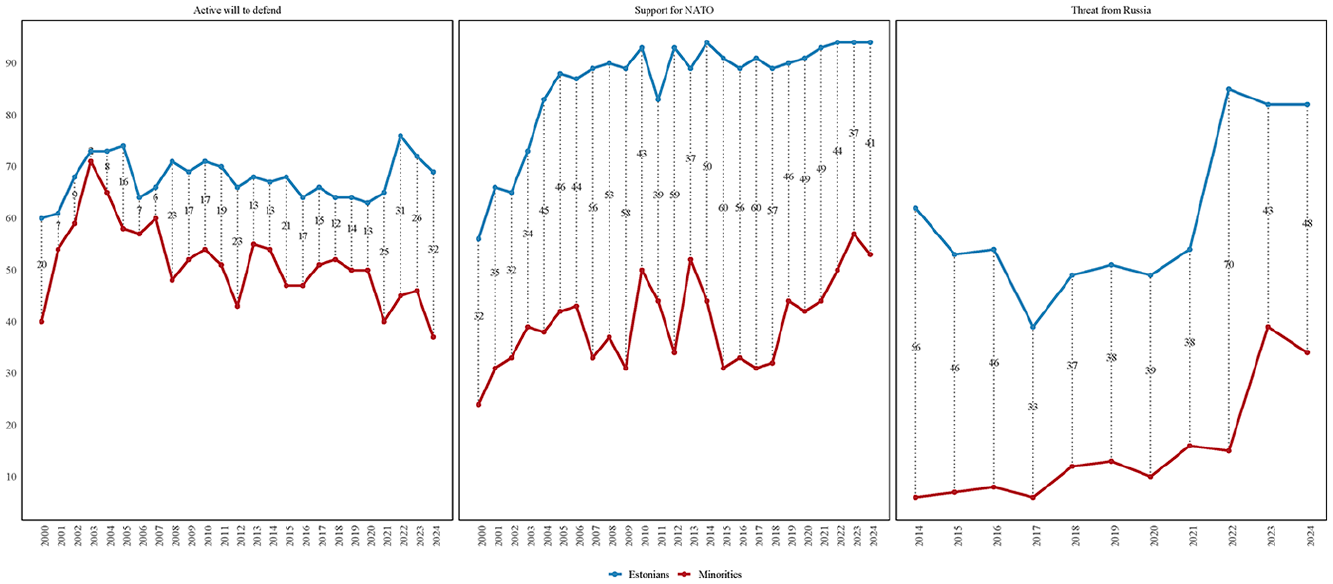
National Defense Attitudes, Percentage Differences Between Groups Over Time.
To the left, we see that minorities lag behind Estonians in terms of their readiness to “participate in defense activities” in case of “an armed attack against Estonia.” The mean deficit since 2000 is 16%. But notions of friends and foes differ even more. In the middle, we see that minorities fall further behind Estonians once asked about their support for NATO. The mean deficit since 2000 is 46%. To the right, we see that minorities also fall behind Estonians once asked about their perceptions of threat from Russia. The mean deficit since 2014 is 45%. Even though the share of minorities supportive of NATO and sensing a threat from Russia is rising, defense planners at the receiving end of these opinion polls are faced with concerning intergroup differences.
Whether public attitudes spill over into the barracks is up for debate. Militaries are often thought of as “total institutions,” secluded from their surrounding societies. But, in Estonia, defense planners adopted a conscription model that obliges all fit male citizens to undergo the draft and remain part of the reserve force until retirement (Rebas, 2014). 12 Citizens liable for mobilization might not leave their attitudes behind after donning the uniform. The most probable crisis is also one triggering the rift in Figure 1. Since the idea of non-alignment fell out of favor, NATO is the backstop of Estonia’s defense, but Russia has escalated its efforts to tie “compatriots” stranded in the “near abroad” closer to the motherland (CNA Corporation, 2015; Mölder, 2018, p. 3; Security Police of the Republic of Estonia, 2024).
If the clash comes to a head, then ethnic soldiers will be called up to fight for Estonia or its NATO allies against Russia—despite doubts over their reliability. This scenario bears all the observable hallmarks of a Trojan horse dilemma. However, our theoretical priors suggest that force professionalism and political pressure might cause defense planners to bank on ethnic soldiers. The next sections examine these factors.
Creation of Force
“Ethnic integration within the armed forces,” Peled (1998, p. 2) claims, “depends more on the military itself than on external pressures.” Professional officers should not make manpower decisions based on prejudice, which cause staffing inefficiencies and undercut cohesion. Using elite interviews, this section asks if Estonian officers set up a meritocratic order within which reliable and competent ethnic soldiers could get ahead.
It finds that officers did create professional institutions to guide manpower decisions, but the process lasted almost a decade. 13 After the Soviet collapse, Estonia had to build its force from the fragments of empire. EDL resurfaced in 1990, as a militia intent on restoring the interwar republic. Its members had little training but regarded themselves as more patriotic than officers inherited from the militaries of foreign states. Yet, the latter took up leading posts in EDF after its formation in 1991. Some left the disintegrating Soviet armed forces and others came back from careers in Western militaries. This led to tensions within the officer corps because service members raised as (a) dissident Estonians, (b) Soviet Estonians, and (c) exile Estonians had been socialized into different cultures.
Dissident Estonian officers emerged from EDL (Vares & Haab, 1993, p. 300). It refused to subordinate itself to the Estonian Supreme Soviet, or to the Estonian Supreme Council, as the parliament renamed itself after the first free elections in 1990. Instead, the militia swore allegiance to the government-in-exile, which conferred ranks to members of the EDL, including to Commander Kalle Eller, who became a colonel overnight. His militia placed border posts along the interwar frontier to protest Stalin’s transfer of lands from the Estonian SSR to the Russian SFSR, and protected buildings in Tallinn from anti-independence demonstrators and Soviet troops on critical occasions in 1990–1991. This contributed to the image of EDL as more patriotic than EDF, whose leading officers returned to Estonia after long careers in foreign uniforms.
EDF appeared on the order of the Estonian Supreme Council. In 1991, it appointed Ants Laaneots, a former colonel in the Soviet armed forces, as Chief of the General Staff. Other Soviet Estonian officers also started over in the EDF and seized commanding posts across all branches. Their expertise and experience in leading larger formations proved indispensable during the creation of force (Piirimäe, 2020). Yet, as a result of long periods stationed in other corners of the USSR, these returning officers appeared Russianized to some colleagues (Lange, 1995). 14 “At first, I was an outsider here,” Laaneots later reflected: “Imagine, some Soviet colonel arrives, speaks Estonian with a terrible accent. After all, I spent my childhood in Siberia, and then I was not in Estonia for 23 years! It was not easy” (Postimees, 2011). Laaneots found himself dismissed in 1994, but he reclaimed the mantle as Chief of the General Staff in 1997.
The first constitutional government, elected in 1992 on the promise to “Clean up the place!,” sought to limit the use of former Soviet officers as it feared importing malpractices like corruption and hazing. It therefore invited exile Estonians, who had accrued professional skills while serving in Western militaries, to rebuild EDF. A former colonel in the U.S. armed forces, Aleksander Einseln, stepped in as Chief of Defense in 1993. He had little confidence in Ants Laaneots and relied on exile Estonians to de-Sovietize EDF; a task deemed important to bolster its appeal among conscripts skeptical of superiors trained in the USSR (Rebas, 2022). 15
Cooperation problems arose as soldiers from these factions crossed paths. In the 1993 Pullapää crisis, a unit consisting of men from EDL even refused orders from “the red colonels” in EDF (Eesti Rahvusringhääling, 2020). Insubordination did not beget in-fighting, however. For all their disagreements, soldiers shared the goal of defending Estonia’s independence. Personal bonds inside the small circle of trained officers also enabled the creation of trust across factional lines. 16 For instance, while serving as Soviet war commissar in Tartu, Laaneots began to liaise with Johannes Kert from the regional branch of EDL, whom he later appointed as Commander of the Kuperjanov Battalion, 17 the first unit to form in EDF (Delfi, 2021). 18 This marked the start of a long-running practice of rotating officers between EDL and EDF, which helped mend the fracture. 19
As procedures for checking the reliability of active service members took shape, cohesion also strengthened. At first, Aleksander Einseln turned to the U.S. to screen former Soviet officers offering up their expertise, in all likelihood because the Intelligence Department of the General Staff (J2) stood under the control of personnel inherited from the USSR (Vaba Eestlane, 1993, p. 72). 20 After their departure, J2 took charge of screening active service members, but the Security Police (KAPO) later assumed some of its functions (Joks, 2007). J2 became limited to performing background checks, which decide access into the defense sector, but not vetting, which decide clearance to qualified positions or secret materials. 21 This procedure has fostered generalized trust among officers, even in the absence of personal interactions. 22
Another challenge consisted of pressing soldiers into a common professional mold. To start with, officers bestowed ranks according to foreign criteria had to have their merits validated. An attestation commission, which included members with different service experiences, 23 began to inspect incoming officers (Käskkiri, 1993/10). The latter sent a written account of their training and experience to the commission, whose members then interviewed the applicant about defense matters, but also about Estonian civics, before deciding what rank to confer. 24 These decisions soon gained acceptance inside EDF and lent credence to officers assuming commanding posts.
However, most cadets still received training at defense academies in the Nordic countries or elsewhere in the West. This complicated cooperation upon their return since graduates learned different competencies in different languages (Corum & Johanson, 2019). Despite the launch of an Academy of Security Sciences in Tallinn, which in 1992 began offering short courses to junior officers, EDF could not raise its own cadre of senior officers until the Estonian Defense College in 1998 and the Baltic Defense College in 1999 opened their doors. These institutions socialized the next generation of commanders into shared standards, aligned with NATO practices. 25
Furthermore, the relationship between officers and their civilian principals clarified. Because the constitution defined the president as supreme commander and gave parliament the right to appoint chief of defense, the latter could challenge the defense minister in case of disagreements. Leadership conflicts arose throughout the 1990s, 26 prompting one defense minister to lament that he “could issue only requests, not orders” (Lill, 2014, p. 180). However, discord faded after the turn of the millennium and disappeared altogether following constitutional amendments that clarified the subordination of the chief of defense to the defense minister (Riigi Teataja, 2011). 27
Taken together, these steps led to the creation of a force spared from politics and with a strong esprit de corps. Screening mechanisms ensured the reliability of active service members while transparent promotion procedures and shared training standards ensured their competence. Such militaries offer minorities possibilities to prove themselves on merit and climb the ranks; and can cause the professional ethos to supersede the ethnic factor inside the organization—“we only see green here.”
Manpower Policies
Another prediction centers on political pressure. Militaries might open their doors to ethnic soldiers to facilitate nation-building, to resolve staffing shortages arising from external threats, or because of campaigning from minorities. In each case, politicians are expected to subordinate manpower policies to other agendas. Using interviews, coupled with legal acts and transcripts from debates preceding their adoption, this section examines the justifications behind rules regulating access into the defense sector.
It finds scant support for the idea that manpower policies arose from political pressure of either kind. Instead, the republican citizenship discourse has defined the boundaries of (non) participation in EDF. Upon the restoration of independence, it left Soviet-era settlers ineligible to enlist before naturalizing, which required them to gain recognition as a permanent resident, take an oath to the state, and pass an Estonian language test. In effect, most Russians had to demonstrate their allegiance to the republic before entering its defense sector. But the path to citizenship stood open, except for those holding other passports or who had worked in the armed forces or intelligence services of a foreign state (Riigi Teataja, 1995a). Detecting them proved difficult, though. Since the Soviet regime left no personnel files behind, Estonia had to appeal to collaborators to “confess” to past misdeeds (Pettai & Pettai, 2014, p. 127; Riigi Teataja, 1995b). 28
Unlike the hoop tests facing Russians seeking to naturalize, these rules left most Estonians eligible to enter EDF without further ado. Holders of birthright citizenship could pick up Estonian uniforms even if possessing a second passport, 29 and despite having served in the armed forces of a foreign state, as in the case of Aleksander Einseln. State elites feared granting Soviet-era settlers access to the corridors of power, but justified these policies as an effort to restore ownership to Estonia’s pre-occupation citizens—and never as a tool for keeping ethnic Russians out of the defense forces. 30
In 1991, almost 10% of citizens had non-Estonian roots, often tracing their lineage to Tsarist officials or White émigrés. Some of them rushed to the republic’s defense, such as Boris Krolov, who restarted the EDL branch in Tapa and received a lieutenant’s rank from the government-in-exile in 1991 (Kaitse Kodu, 2003, p. 24). 31 Mindful of these intragroup differences, and to the risk of inviting allegations of discrimination, state elites refrained from singling out Russians when drafting manpower policies. 32 When asked about the omission of “ethnic features” from the 1994 Act on Defense Service, its author replied: “our law deals with Estonian citizens and only Estonian citizens” (Riigikogu, 1994). The final bill obliged citizens to protect “Estonia’s independence”—not “Estonian people”—as proposed in an earlier draft (Riigi Teataja, 1994). 33
Instead, state elites designated a small range of services to the former occupation regime as grounds for exclusion from EDF. Paragraph 42 banned Soviet agents, as well as political commissars and war commissars, 34 from pursuing a career in the organization. However, these lustration rules disappeared from later renditions of the Act on Defense Service (Riigi Teataja, 2000, 2012). Therein, state elites referred to present rather than past liabilities as cause for banishing soldiers from active service. It became forbidden to collect pensions from abroad, 35 thus forcing Soviet Estonian officers to choose between their income from Russia and their present contract.
None of these policies targeted Russians on account of their origin. In fact, ever more “ethnic soldiers” entered EDF. Due to ongoing naturalization among Soviet-era settlers and their children, the proportion of citizens of non-Estonian heritage almost doubled from 1991 to 2021. 36 The roster of persons liable for the national defense obligation hence became more heterogeneous. Burden-sharing also became more meritocratic after the creation of the Defense Resources Agency, which streamlined the process of registering, assessing, and selecting conscripts (Riigi Teataja, 2005). 37 About half of each male cohort tends to be drafted and estimates hold that around 20% of conscripts are of Russian origin—mirroring their share in the social contract. 38
Although not codified into policies, certain practices evolved to absorb Estonia’s Russian soldiers. To begin with, the Defense Resources Agency strove to disperse them between units. This custom developed at the request of commanding officers in north-eastern Estonia, who struggled to supervise units containing an outsized share of Russian-speakers. 39 To prevent segregation inside the units, commanding officers then made sure to create mixed living quarters in the barracks and “paired” Russian heritage conscripts not proficient in Estonian with bilingual buddies (Delfi, 2008). 40 Some units also offered language classes. 41 EDF later made these classes mandatory for conscripts struggling to communicate in the command language and also published a military dictionary to aid Russians-speakers during the draft (EDF, 2022; Eesti Rahvusringhääling, 2019).
Neither of these internal practices arose from overt political pressure. Estonia’s state integration plans do not foresee a role for EDF as a “school for the nation.” 42 Nor did Russian heritage soldiers ever coalesce as a collective to negotiate their service conditions. 43 Because diagnostic evidence is inaccessible, it is difficult to exclude the claim that geopolitical tensions cause covert pressure to accommodate ethnic soldiers.
What we can ascertain is that politicians are committed to casting a wide recruitment net. At the request of the defense minister, high schools began offering a national defense course in 2002 (Haridus- ja Teadusministeerium, 2016, p. 7). It soon reached more and more students, including those enrolled in Russian-language schools. 44 In 2012, the defense minister began funding an expert platform engaged in outreach toward Russian-speaking citizens approaching draft-eligible age. 45 It also sponsored publications to advertise minorities’ contribution to national defense (Kopotin, 2015). On top of this, the public broadcaster’s Russian-language television channel ran a series on life as a conscript in Estonia’s Defense Forces (ETV+, 2017).
The capture of Deniss Metsavas amounted to a litmus test of these manpower policies, based on the precept that glass ceilings are counterproductive since ethnic soldiers can be relied on. Far-right politicians called for “stricter controls” targeting Russian heritage soldiers, opening the prospect of ethnic stacking (Delfi, 2018). But Defense Minister Jüri Luik (2018) concluded that “without trust it is impossible to organize effective national defense. And we will continue to trust our people!” This means “all citizens, no matters their specifics [because] we can only be stronger when using all our resources and people,” according to the Chief of Defense (Herem, 2022).
Senior officers also profess their unanimous confidence in “our Russians” (Postimees, 2020). 46 While this can be dismissed as mere lip-service, conscripts of Russian heritage themselves refer to the draft as an “integration camp” thanks to the “professionalism of senior commanders” (Postimees, 2019). 47 Yet, the promotion likelihood of Russian-speaking conscripts do lag behind those of Estonian-speaking conscripts (Lillemäe et al., 2023, p. 262). This gap in vertical integration could be attributed to discrimination, which some minorities complain of, but it might just as well be a consequence of deficiencies in the command language or disinterest in pursuing training as squad leaders (Delfi, 2011; Hein, 2020; Kasearu, 2021).
Ripple effects from the war in Ukraine make it still harder to establish if state elites trust ethnic soldiers under all circumstances. Estonia’s Russians are “feeling cornered” (Krumm et al., 2023). State decisions to remove Soviet-era war memorials, revoke gun licenses from non-citizens, and phase out Russian-language schools might feed disaffection. It could spill over into the barracks and this risk can convince state elites that “certain conscripts will have to be watched more closely and/or socialized more strenuously” (Enloe, 1980, p. 51). But circumstances indicate otherwise. Despite the risk for defections along ethnic lines—as in Crimea in 2014 (Reuters, 2017)—the territorial defense unit in Narva remains staffed with soldiers of Russian heritage. 48
The lack of political pressure to subordinate manpower policies to other agendas is puzzling. I attribute this to rhetorical entrapment because adherence to Estonia’s republican citizenship discourse is holding back meddlesome politicians. Since the restoration of independence, their mantra has been that the state does not discriminate between citizens. Endorsing solutions that single out Russian heritage soldiers runs counter to the republican frame and deters debates common in other divided societies. 49
Conclusion
Did this article establish that Estonian defense planners count on Russian heritage soldiers to defend the state under all circumstances? Not quite. It is impossible to get into the minds of defense planners in countries which enclose disgruntled minorities linked to hostile powers through culture or location. Nonetheless, this article is the first to investigate the manpower policies chosen in response to the Trojan horse dilemma in Estonia. It did so using historical chronicles, opinion polls, legal documents, and N = 29 elite interviews conducted with participants in or observers of Estonia’s defense sector.
Although decision-makers in Estonia are reluctant to admit it, I argue that past patterns and recent developments give cause for concern when contemplating the allegiance of ethnic soldiers. Defense planners in interwar Estonia and in the USSR treated marginalized out-groups as unreliable. This precedent had a strong potential for continuation after 1991 because state disaffection ran deep among Russians. Opinion polls record lasting intergroup differences in national defense attitudes, which raise doubts over the political dependability of ethnic soldiers in a conflict with Russia.
But there is little to suggest that Estonian defense planners let dormant fifth column fears influence manpower policies. Prior research directed us to two possible explanations, force professionalism and political pressure. I found clear support for the former thesis. Estonian officers set up screening mechanisms to ensure the reliability of active service members as well as transparent promotion procedures and shared training standards to ensure their competence. Within this professional force, ethnic soldiers could prove themselves on merit and climb the ranks because “we only see green here.”
Evidence is less consistent with the thesis about political pressure. Estonia’s state integration plans did not task the defense forces to abet nation-building and Russian heritage soldiers never banded together to negotiate their terms of service. It is difficult to test the claim that external threats create covert pressure to integrate ethnic soldiers. But signs of overt interference are absent. Manpower policies left the door open to citizens regardless of “ethnic features” from the start. As the pool of recruits became more Russian over time, practices evolved inside the defense forces to absorb them.
Neither ongoing naturalization of Soviet-era settlers, Russia’s efforts to tie “compatriots” closer to the federation, nor its penchant for territorial revanchism has sparked much debate over Estonia’s Russian soldiers. I attribute this muted reaction to the effects of rhetorical entrapment. The same republican frame that first led to the exclusion of Russians qua non-citizens later led to their inclusion qua citizens. Politicians could not propose to single out ethnic soldiers without contradicting this norm, thus shielding the meritocratic order inside the defense forces from pressure.
Caveats abound. Pertinent data is—for good reason—restricted from public view. Piecing together information sufficient for arbitrating between competing interpretations is a challenge. Another limitation concerns the problem of generalizing. Estonia’s experience indicates that force professionalism and republican rhetoric can offer opportunities for ethnic soldiers to integrate. But future research must determine if findings from this small corner of the Baltics can “travel” to other divided societies.
Footnotes
Acknowledgements
I am indebted to the International Center for Defense and Security for hosting me in Tallinn, to Katarina Budrik for research assistance, and to David Sichinava for help with graphics. I wish to credit colleagues in Boston, Malmö, Stockholm, and Tartu, as well as the two anonymous reviewers, for useful feedback. All errors, of course, remain mine. I dedicate this paper to Sten Berglund (1947–2024).
Declaration of Conflicting Interests
The author declared no potential conflicts of interest with respect to the research, authorship, and/or publication of this article.
Funding
The author disclosed receipt of the following financial support for the research, authorship, and/or publication of this article: A stipend from the Sasakawa Young Leaders Fellowship Fund set this research in motion. I could pursue it thanks to a grant from the Foundation for Baltic and East European Studies for the project: “Conscription as Political Socialization in Divided Societies? Evidence from post-Soviet Estonia and post-independence Finland” (S2-20-0011). It has the consent of the Swedish Ethical Review Authority (2021-05494-01).
