



Abstract
The present research examined how military sexual misconduct (MSM) impacts the perceived experiences of unit cohesion in a sample of woman-identifying Canadian military Veterans. Semi-structured interviews were conducted with 13 veterans, asking questions about deployment-related factors (e.g., rewarding/challenging aspects). Although MSM was not explicitly probed for, it was widely discussed in relation to participants’ experiences of unit cohesion. Thematic analysis yielded three themes describing participants’ perceived feelings of unit cohesion—value, acceptance, and unity. In contexts where MSM was present, participants described feelings of being undermined, resulting in a degraded experience of unit cohesion. In contexts where MSM was absent, participants described value, acceptance, and unity as being improved, as well as an enhanced experience of unit cohesion. These findings provide an exploratory model by which to consider the impact of MSM on the gendered experience of unit cohesion.
Supreme Court Justice Marie Deschamps previously characterized Canadian Armed Forces (CAF) military environments as featuring a “sexualized culture . . . hostile to women and LGBTQ members, and conducive to more serious incidents of sexual harassment and assault” (Deschamps, 2015, p. i). She highlighted woman-identifying service persons’ lived experiences of military culture as starkly contrasting with the CAF’s professional conduct standards. Several years later, a new review conducted by Supreme Court Justice Louise Arbour (2022) substantiated these findings, suggesting that previous recommendations of even basic cultural improvements of increasing acceptance of service members from diverse lived experiences had yet to be achieved. It has been suggested that these harmful “systemic conditions” underscore challenges of militaristic efficiency and operational effectiveness within CAF culture (Kovitz, 2021).
Terminology
Importantly, this article acknowledges the responsible use of language relating to sexual orientation, gender identity, and intersections of both. Here, essential differences exist between the dimensions of sex (i.e., biological factors) and gender (e.g., masculine/feminine/transgender/agender) and are frequently confused, thereby diminishing the intricacies of individual experience (Callaghan, 2021). As such, this article follows Sex and Gender Equity in Research Guidelines (Heidari et al., 2016), utilizing the term “woman” or “woman-identifying” to describe service members who identify as women and “man” or “man-identifying” to describe service members who identify as men.
The term military sexual misconduct (MSM) describes a continuum of sexualized and sexually discriminatory behaviors, including “conduct of a sexual nature that causes or could cause harm to others, and that the person knew or ought reasonably to have known could cause harm” (Cotter, 2016; National Defence, 2019). These behaviors may include sexual assault (e.g., unwanted sexual touching, nonconsensual sexual activity), sexualized behaviors (e.g., harassment, sexual jokes, showing offensive sexual material) as well as sexually discriminatory behavior (e.g., insulting, mistreating, ignoring, devaluing, or excluding based on presumed sexual orientation or gender identity). MSM is an ongoing barrier to military inclusion (Breede & Davis, 2020; Davis, 1997, 2022; Holden & Davis, 2004). MSM-related experiences may contribute to a potentially hostile work environment (Hajizadeh et al., 2019), particularly for equity-deserving military personnel (e.g., woman-identifying individuals; Biskupski-Mujanovic, 2022; Cotter, 2016, 2019), who are more likely to be directly targeted (Hajizadeh et al., 2019). MSM behaviors may also stem from situational factors (e.g., being a minority in a group of primarily man-identifying individuals) or systemic factors (e.g., societal policies which disadvantage or create harmful barriers for equity-deserving personnel; Atlas Institute for Veterans and Families, 2024). Collectively, these behaviors undermine the foundations of cohesive military culture (Silins, 2026) within the CAF (Cotter, 2016; Deschamps, 2015), thereby imperiling the operational readiness of the Forces.
According to the Public Health Agency of Canada, MSM may result in an experiential outcome termed Military Sexual Trauma (MST), which includes any sexual or sexualized activity that occurs without the person’s consent, during their service [as a member of the CAF], and the physically or psychologically traumatic impacts of this activity on the affected person. The spectrum of MST can vary from small impact to severe disorders. (Heber et al., 2023)
These activities exist on a continuum in which the individual is either unable to or withholds consent for these activities, which include: coercive or threatening behavior, expectations of sexual experiences as part of workplace promoting decisions, unwanted sexual contact (e.g., touching, grabbing, sexual advances, or situations where capacity to consent is impaired), witnessing any sexualized activities (e.g., sexually offensive or pornographic material), or unwanted sexual activities or advances, or any sexual displays which contribute to an unwelcoming workplace environment (Heber et al., 2023).
Critically, MST is not a formal diagnosis but rather describes an experience that may contribute to the development of significant health challenges, including severe mental illness, post-traumatic stress disorder and other trauma-related disorders, psychotic disorders, and bipolar disorder (Bowersox et al., 2017; Grubaugh et al., 2011; Kessler et al., 2005; Sexton et al., 2017). The impact of MST on an individual can be devastating, and result in a range of emotional difficulties (e.g., anger, guilt, shame, rage, numbness, sadness, and depression); physical difficulties (e.g., physical injury and/or pain); and functional difficulties in the workplace (e.g., avoidance of work, difficulty meeting work-related expectations) and at home (e.g., spousal relationship and relationship with children; Heber et al., 2023). MST can also result in moral injury (Frankfurt et al., 2018), a distressing psychological response to betrayal by military leadership, or when forced to act in a manner that betrays their moral code (Litz et al., 2009). Too frequently, these issues go unaddressed, as many military members and Veterans avoid, prolong, or stop attending health services due to systemic barriers to treatment (e.g., lack of services for specific community members, such as the 2SLGBTQIA+ military community, confusion about how to access these supports) (Brown et al., 2024; Lopes et al., 2023; Monteith et al., 2020).
MSM and the Gendered Experience of Operational Deployment
The gendered impact of MSM in deployed contexts is complex. Research indicates that approximately 25% of woman-identifying members who had experienced MSM or MST note at least one event that occurred while deployed (Watins et al., 2017). Intersectional factors, including being woman-identifying, single, younger, and from an equity-deserving population (e.g., LGBTQ2SIA+ community, Indigenous community), meaningfully contribute to heightened rates of MSM in the CAF (Biskupski-Mujanovic, 2022; Castro et al., 2015; Hajizadeh et al., 2019; Kimerling et al., 2010; Mota et al., 2023; Tait, 2014). A 2022 survey of Canadian Armed Forces Regular Force members (Cotter & Burczycka, 2023) revealed that 67% reported witnessing or experiencing an MSM-related activity (i.e., sexualized behavior, or discrimination, based on gender, gender identity or sexual orientation) in the 12 months prior. Approximately twice as many women-identifying members (7.5%) as men-identifying members (2.8%) reported experiences of sexual assault. One-third (34%) of women-identifying members were the personal target of MSM-related behaviors, approximately twice as high as the rate of men-identifying members (16%). These figures likely underestimate actual rates of MSM as most incidents go unreported (Breslin et al., 2019), related to fears of professional repercussions, additional violence perpetration, being dismissed when coming forward or a lack of meaningful response, or fears of isolation and ostracism (Millegan et al., 2015; Mota et al., 2023; Rosellini et al., 2017; Watkins et al., 2017).
Like many militaries, the CAF was founded on a culture of militarized masculinity (Eichler, 2014; Whitworth, 2004). Historically, militaristic competency was measured against conformity to a hypermasculinized “warrior ethos” (i.e., toughness, competitiveness, bloodlust, coercion, and masculine authority) (Cockburn, 2010; Davis & McKee, 2004, p. 52; Hutchings, 2008). A hypermasculine identity was believed to be imperative in training effective soldiers (Connell, 2020; Wadham, 2017). These perceptions suggested that the most effective military units were composed of all heterosexual man-identifying members (Davis, 2022), simultaneously implying that the contribution of woman-identifying personnel’s service was inherently lesser (Bell et al., 2014). In this way, the understanding of effective militaristic cohesion (Lane, 2017) was obscured, contributing to myths of military masculinity as promoting effective unit cohesion (Howard & Prividera, 2006; Whitworth, 2004). These deeply embedded and concerning ideals maintain militaristic cultural standards of gender-based oppression and harassment (Callaghan, 2020; Wadham & Connor, 2023) and underscored the exclusion of women from active military service until the early 1990s (King, 2016). Today, they may be felt as an ongoing legacy that women-identifying CAF personnel may be unfairly subjected to and harmed by (Biskupski-Mujanovic, 2022; Breede & Davis, 2020; Cockburn, 2010; Kimerling et al., 2010; Lane, 2017).
Since then, although more women-identifying personnel have been integrated into a wider range and number of military roles, this legacy has been maintained but changed in form. For example, physical sex-based expectations of military effectiveness have become increasingly “androcentric” (i.e., gender-neutral; Lane, 2017, p. 20), as opposed to hyper-masculine. Notably, misguided attempts to combine the social constructs of gender (i.e., masculinity and femininity) may result in inadvertent harm, perpetuated through a process of assimilation (Alvesson & Billing, 2003). These conflated expectations endure in modern military culture (Basham, 2016; Lucero, 2018), contributing to misattributions of sex- and gender-based performance expectations (Deschamps, 2015) and reinforcing MSM-related discrimination (Bonnes & Tosto, 2023).
The CAF’s integration of women-identifying service members alongside man-identifying members in combat roles has been slow (McCristall & Baggaley, 2019). As of 2023, only 16% of total CAF Regular Forces members were woman-identifying personnel (Statistics Canada, 2023). Man-identifying members generally outnumber (and outrank) woman-identifying members in deployment contexts (Burns et al., 2014; Turchik & Wilson, 2010). As a result, women-identifying personnel’s gendered deployment experiences are negatively impacted, with less social support compared with man-identifying team members (Walsh et al., 2014), and fewer career advancement opportunities in male-dominated roles (i.e., pink seat; Reiffenstein, 2007). In cases of MSM, woman-identifying personnel may be forced to continue to serve alongside or depend on their perpetrators for survival (Dardis et al., 2018). They may intentionally distance themselves from their comrades (Cotter, 2019; Dardis et al., 2018) and distrust fellow unit members and superior officers (Kelly, 2021). Here, MSM contributes to declines in psychosocial functioning (Katz et al., 2007) as well as lower overall job satisfaction, organizational withdrawal, and declined perceptions of unit combat readiness and cohesiveness (Dickstein et al., 2010; Scott et al., 2014; Suris & Lind, 2008).
In a military context, unit cohesion describes the shared emotional bonds (e.g., belongingness; Charbonneau & Wood, 2018; Dion, 2000) and a shared purpose and commitment (Bartone et al., 2002), supporting unit cohesion while completing militaristic tasks and goals (Ahronson & Cameron, 2007; Britt & Oliver, 2013). Unit cohesion exists in both horizontal and vertical domains. While vertical cohesion is the trusted relationship between unit members and leadership (King, 2006; Van Epps, 2008), horizontal cohesion represents the bond, shared values, and sense of belonging among unit members (Breede & Davis, 2020; Meredith et al., 2011; Siebold, 2006; Van Epps, 2008). In the context of the present article, we focus on the dimension of horizontal cohesion. In deployment contexts, unit cohesion is critical and protective of soldiers’ mental health (Du Preez et al., 2012; Griffith, 2007; Jones et al., 2012). Regardless of stressor type (e.g., frontline combat, post-combat exposure to injured/deceased persons, and morally injurious events; Mondragon et al., 2015), cohesion promotes psychological resilience (Britt & Oliver, 2013) and coping capacity (Kirschner et al., 2018). Critically, the degree of perceived unit cohesiveness is imperative to impressions of mission success (deYoung, 2018), where greater unit cohesion positively contributes to feelings of group membership (Friedkin, 2004). MSM, however, ruptures the bonds of social cohesion among unit members, resulting in declines in individual and group perceptions of unit cohesion (Dickstein et al., 2010; Morris et al., 2014; Scott et al., 2014).
The present study is part of a broader study examining CAF woman-identifying military Veterans’ gendered experiences of operational deployment and unit cohesion. In the present study, 13 of 15 participants independently acknowledged (i.e., without direct probing in interview) experiences of MSM as negatively impacting their experiences of unit cohesion throughout their operational deployments. This phenomenon led to the conceptualization of the present article, that is, MSM, as a lens to better understand the gendered experiences of unit cohesion in operational deployments for woman-identifying military Veterans.
Method
Study Design
An initial overarching study examining the gendered experiences of woman-identifying Veterans was conducted. This initial study was comprised of 15 woman-identifying CAF veterans with at least one international deployment during their time in service. The mean age of participants was 52 (range: 38-67 years of age), and most were of European descent (n=12). All participants served in the Regular Force, and eight served as Reservists. Nine participants were senior officers (e.g., Major, Colonel). Their deployments spanned from the 1970s until 2020, with most taking voluntary release (n=9). Participants were recruited with purposive sampling through social media posts in a CAF servicewomen group (currently serving and those who had released) and through word of mouth. These posts read, Are you a female-identifying Veteran of CAF deployments? Although the CAF is actively recruiting for 25% female representation, little is known about women’s experiences during operational deployments. To better understand these experiences, we would like to talk to you about your deployment experiences. Please join us for a one-hour interview to “discuss your thoughts and experiences.”
Individuals interested in taking part then contacted the research team who then scheduled an interview with them. This study was approved by the Hamilton Integrated Research Ethics Board (#12577) of Hamilton Health Sciences and the Faculty of Health Sciences of McMaster University.
All interviews were conducted using Zoom video-conferencing platform (Personal Health Information Protection Act Compliant Zoom license). Informed consent was completed before the interview. Interviews were conducted using semi-structured question guides and audio recorded. All audio files were transcribed verbatim by a team member with expertise in transcription. Questions were open-ended and explored participants’ deployment experiences (e.g., rewarding and challenging aspects of their deployment experience). Interviews ranged from 37 to 68 min and averaged 54 min. They were conducted by three cisgendered heterosexual woman-identifying interviewers with graduate-level training, including Applied Social Psychology (PhD), Rehabilitation Medicine (PhD), and Public Issues Anthropology (Masters). These interviewers each possessed substantial training in trauma-informed and anti-oppressive research methods, as well as qualitative research and analysis.
No questions about MSM were explicitly probed in the interview protocol; however, given the open-ended nature of the question guide, self-described experiences of MSM emerged naturally within the context of participant’s responses to questions. Participants who independently endorsed experiences of MSM as impacting their deployments were coded as MSM present. In this case, 13 of 15 participants acknowledged experiences of MSM as impacting their gendered experiences of previous deployments. A secondary analysis of these 13 participants’ transcripts was conducted, specifically examining the role of MSM in mediating gendered deployment experiences as related to group cohesion, both in contexts where it was noted as present and when it was noted as absent.
Data Analysis
Data analysis for this study was performed in two steps. First, for the broader study, transcripts were coded inductively and then developed into a coding tree by three independent coders (A.B., H.M., and K.R.). Second, a separate analysis of the code relating to MSM was extracted and completed by a smaller group of researchers (A.B. and S.L.), utilizing the transcripts of participants (i.e., 13 participants total) who had acknowledged experiences of MSM’s absence and presence as impacting their gendered experiences of operational deployment. Two participants did not independently acknowledge any experiences of MSM and were excluded from the present analysis. Through immersion and reviewing the relevant data, three themes—value, acceptance, and unity—were identified to represent how these participants’ experience of MSM affected their experience of unit cohesion in the context of their operational deployments. These three themes were then considered in relation to the entire dataset, both in the context of experiences of how MSM’s presence negatively impacted gendered deployment experiences and instances of the absence of MSM positively impacted gendered deployment experiences.
Results
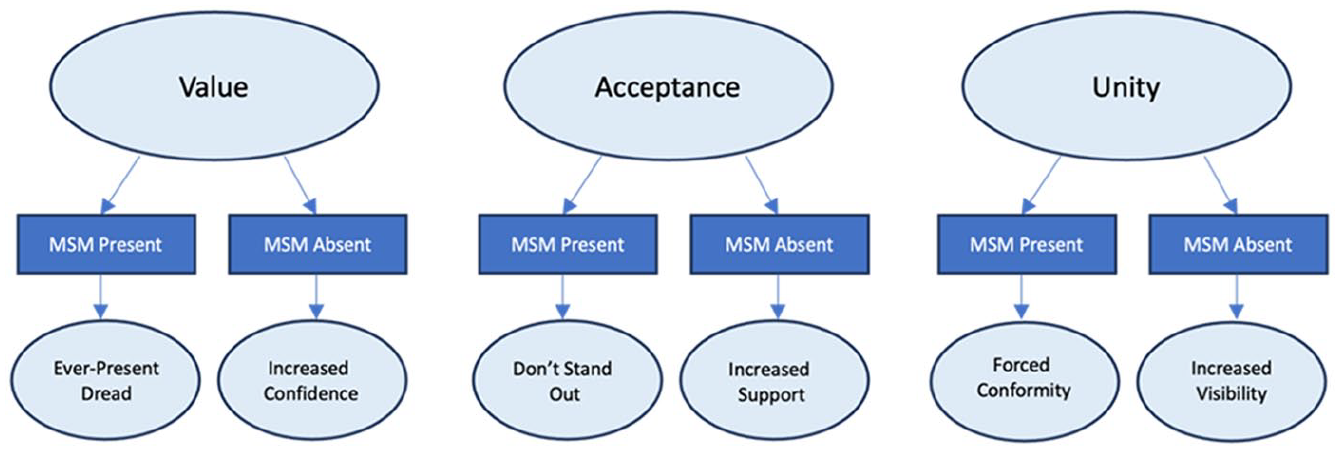
An analysis of observable themes within these interviews suggested three primary ways MSM relates to the gendered experience of unit cohesion, including its impact on feelings of value, acceptance, and unity. Participants described contrasting experiences of unit cohesion in their deployments related to experiences of MSM. Qualitative thematic analysis of these interviews indicated three primary themes, each with two subthemes, describing how woman-identifying service members experienced unit cohesion, in the context of MSM and in contexts in which MSM was absent. In the context of MSM, participants reported feeling decrements to unit cohesion, wherein they felt the contribution of their service was devalued, as well as that acceptance from group members was strained, and that their feelings of unity with group members were harmed. On the other hand, when MSM was absent from deployment experiences, reported experiences of unit cohesion were conserved and even bolstered. We provide an overview of the themes and subthemes observed in our Thematic Map. This section is followed by a detailed overview of the thematic analysis with illustrative quotes from participants.
Thematic Map
This thematic map displays the three major themes and their corresponding subthemes. Each theme is divided by two contextual descriptors of MSM’s impact on deployed experiences, contexts in which MSM was described as present, and contexts in which MSM was absent. Within these contexts, MSM’s absence was described as contributing to increased group cohesion, and, when present, as detracting from group cohesion. The first theme is Value, with subthemes Ever-Present Dread (MSM Present) and Increased Confidence (MSM Absent). The second theme is Acceptance, with subthemes Don’t Stand Out (MSM Present) and Increased Support (MSM Absent). The third theme is Unity, with subthemes of Forced Conformity (MSM Present) and Increased Visibility (MSM Absent).
Theme 1: Value
The first theme, Value, described how, in the context of unit cohesion, participants’ individual self-worth relates to the group’s shared value and contribution of service. It relates to a shared moral code and mutual accountability to a given military mission. Participants frequently connected the concept of trust, integrity and commitment in their descriptions of value.
In the context of MSM, value was described as diminishing feelings of individual fulfillment and detracting from group-level integrity. Such experiences included sexually discriminatory behaviors by peers or superiors (e.g., misogynistic and sexist language), undermining feelings of pride and security in the conduct of the group’s behavior. MSM-related behaviors resulted in participants feeling segregated or ostracized from the group, invoking adverse emotional states, such as feeling “at risk” or “in danger,” or simply a “lack of respect,” thus, undermining trust in fellow group members.
Participants described a conflicting set of emotions, whereby MSM threatened their sense of value and fulfillment in their military work: There was so much good about the military, it is such a great job and like if you know what you’re getting into and you really pay attention, but my God the second you put your guard down, I guarantee something will happen to you. (Participant 22)
However, in deployment scenarios where MSM was not acknowledged, participants reported feelings of value as being maintained. Participants could harness feelings of value and described increased integrity and connection to the group. As described by one participant, in the absence of MSM, the cultural context promoted a joint sense of competence and fulfillment: . . . So, I started working on that and sorting it out. And when they realized how organized I was, how well I could write, and put these things together, I actually became indispensable, and then, they realized that and I—the bonding was good . . . you have to show these basic things. Whoever you are, male, female, old, young, you have to show that you are competent . . . fit. . .a sense of humour. Those are the three things that, in the army, that will assist bonding. . . so, the feeling of accomplishment, of doing something hard and doing it well, and then, the bonding with the group, that was very satisfying (Participant 2).
Subtheme: Ever-Present Dread
One subtheme, Ever-Present Dread, describes the underlying fear that, simply by nature of identifying as a woman in a hypermasculine environment, the contribution of service, as part of their unit, was inherently lesser than that of a man-identifying individual. In being forced to cope in a potentially hostile environment due to MSM, participants described feeling a sense of dread.
Related to cultural expectations of gender roles, participants linked a sense of dread to be required to participate in roles which contrasted with their assigned rank or station. For example, participants reported being assigned to more traditionally “feminine” support roles (e.g., secretarial, or administrative tasks) which contradicted their training or expertise. These behaviors resulted in participants feeling undervalued, due to being unable to complete their duties, tasks or assignments in a manner commensurate with their training. Participants also reported MSM as contributing to awkward and sometimes hostile social situations. Participants described a generalized reluctance among man-identifying personnel to share physical space with them, compromising their feeling of being valued as equally important group members. For example, multiple participants relayed examples such as a lack of appropriate accommodation, or accessibility to private spaces to attend to hygiene, undermining their sense of value.
One participant highlighted the impact of leadership in contributing to these feelings of dread, wherein investigations of MSM-like behavior “terrified” fellow man-identifying group members, who then withdrew from woman-identifying personnel in the group. As a result, feelings of value in the group suffered. These misguided attempts to address MSM harmed the bonding among the unit and relationships became strained: Because. . .like someone sniffs. . .there might have been some impropriety . . . the new [superior officer] . . . was so hellbent to catch [sexual misconduct] violations, the [group members] were terrified . . . that anything they did would be misconstrued as an [MSM] offence . . .we ended up not going to shared gendered tents because the guys were terrified. (Participant 5)
Another participant described how, due to MSM prevalence in deployment culture, her value was lessened by her inability to use her “voice” to speak up against perceived injustice: It’s so pervasive. It’s so normal . . . when a woman does stand up and demand to be heard, “She is a bitch . . .” I can think of a dozen words. She’s the worst person on the planet. And she is the reason there’s no cohesion in that group. (Participant 22)
The link between MSM and a collective dread that prevented fellow man-identifying service members from openly acknowledging the value of fellow woman-identifying service members was shared by a participant: They were like no, we’re equal. Everybody is sort, everything’s equal, but that’s not equality, but they were afraid to sort of highlight that they might want a woman or to say that they would want a woman over a man. (Participant 24)
Related to the pervasiveness of MSM, participants described how a mutual tolerance of insensitive, discriminatory, and non-inclusive language resulted in a breakdown of social bonds which are integral to unit cohesion. In one case, a participant described her value as being lessened by group members’ use of sexist language, as well as sexually aggressive behavior: . . . there was a lot of name calling. . .the duty office next to my office would watch porn videos after duty hours. And they would turn it up really loud just because they knew I was in the office next door. (Participant 20)
Subtheme: Increased Confidence
In contrast to being devalued by MSM, participants reported feeling their value was preserved in contexts where MSM was absent. This value was related to increased confidence, as well as improved self-efficacy (i.e., ability to execute performance-dependent behaviors) and agency (i.e., ability to use intentional action to produce a desired effect). One participant described MSM’s absence as leading to feelings of “empower[ment]”: . . . it’s very empowering, so each person who’s deployed feels like they’re part—like they’re really contributing, like each person has some authority. And they have—they can exercise their agency, so that’s what’s powerful. (Participant 9)
Other participants spoke of confidence as connected to their being recognized for their contribution of service over time, or through their ability to inspire others. Several participants described increased confidence as augmenting the work of other woman-identifying personnel, or as supporting their successes: I already had built up my own reputation. And I’m being a one of [them], the first of, in many situations, it led them into allowing other women to do those things. (Participant 21).
Another participant shared the following: And women—women did shine, and when they did—when they shone, it was not seen as a fluke, it was seen as the norm, right? And I listened to these men talk about the [officer] who was so damn good. . .she just happened to be a woman, right? (Participant 2)
Theme 2: Acceptance
A second theme, Acceptance, represents the unconditional belonginess of group members, regardless of their personal values, orientation, or identity, fostering an environment of inclusivity among a team of individuals. Participants described acceptance as linked to improved experiences of unit cohesion, as well as being integral and protective against negative experiences of MSM. When MSM was present, it resulted in a perceived lack of acceptance and increased social tension within the group setting. As a result, participants needed to avoid “standing out,” just to cope, or to stay physically safe. Participants noted frustration, anger, confusion, and betrayal in such situations. Alternatively, when MSM was absent from a given deployment situation, participants highlighted how feelings of acceptance were maintained, leading them to feel supported and in cohesion with other group members.
Subtheme: Don’t Stand Out
Participants described attempting to preserve feelings of acceptance to cope with MSM in deployment contexts by conforming to hypermasculinized expectations of performative behavior to not “stand out.” If they did not sufficiently conform, they described feeling increasingly at risk of harassment or retaliation. To avoid standing out, some participants described overtly tailoring their behavior to try to protect against the risk of MSM: . . . the only way to survive at that time was this idea of being the same . . . just fitting in . . . demonstrating your competency in the way that everyone else did. (Participant 24)
Another participant described a context in which MSM forced the suppression of feminine characteristics (e.g., physical characteristics, behavior) to avoid “standing out”: . . .it was just one of those little army things. . .they don’t. . .think about the differences between men and women. . . their approach] was [to] just simply treat women as smaller men. . .Would just size down the uniforms and we should be good. . . though not so much. (Participant 9) . . .you can’t be girly and lead men, because men don’t respond to that—they hear their mothers, right, not happening. So, you got to find this way to lead that fits into the majority dynamic demographic. . . I never saw myself as a woman. . . what did I bring as a woman, I have no clue, you’d have to ask the guys.” (Participant 9)
Other participants described misogynistic and/or sexually discriminatory language as undermining communication within their group. Such experiences were described as contributing to deep emotional pain, related to the group refusal to treat them as “one of their own.” One participant described her frustration with inconsistent expectations and standards as hindering her experience of group acceptance: Why do we need to have different rules. . .treatment. . .and behaviour? why can’t I go to the field without [being] hit on by my own detachment commander, where everyone around me is drunk in the field? Why can’t I just be like everybody else? and you couldn’t, but I think it’s changed a lot. (Participant 1)
Subtheme: Increased Support
In contrast to feeling unaccepted by their group members in the context of MSM, in cases where MSM was absent, participants reported increased support and greater cohesiveness with their units. They described this support as relating to a sense of collective care and reciprocity among group members.
One participant appreciatively noted a deployment situation, where she felt accepted in the absence of expectations of hypermasculine conformity from group members. . .Like he did not give me the same kind of grief, or. . .try and box me into these stereotypical roles. . .he was like a brother in many ways. . . I was supported. (Participant 6)
Another participant described how, in the absence of MSM, she observed increased support through the attentiveness care of group members toward their fellow soldiers: . . .we care about our people, we put our people first. . .we’re always concerned about the wellbeing of our buddy to the left and buddy to the right. . . (Participant 9)
In describing the feeling of increased tenderness and care from team members another participant shared feeling more comfortable coming forward to seek out support: “I felt. . .a closeness with some people who maybe felt a little more comfortable coming and talking to the women particularly on that. . .tour. (Participant 24)
Theme 3: Unity
A third theme, Unity, implies intentional and collaborative solidarity (i.e., like-mindedness) among group members. In the context of MSM, participants described a lack of unity as being “isolating” (e.g., thwarted belongingness) due to their identity as a woman, which seemingly implied a lack of “fit[ting] in.” They described MSM as contributing to feeling invisible within the group dynamic, and ultimately, loneliness. However, in contexts where MSM was absent, participants described feeling integrated with group members, supporting increased feelings of connection not just with other group members, but also with local forces and communities. They linked feelings of unity to with a sense of assurance of their role in the group dynamic.
As stated by one participant, unity facilitated feelings of harmony and alliance, and allowed the individual strengths of each group member to support the larger group responsibility: Our military—the way that our military works—we’re so small, but we’re exceptionally agile and we delegate responsibility down. And that—it’s very empowering, so each person who’s deployed feels like they’re part—like they’re really contributing, like each person has some authority. And they have—they can exercise their agency, so that’s what’s powerful. Whereas I don’t think the [87] have the same kind of thing (Participant 9)
Subtheme: Forced Conformity
Participants frequently highlighted how MSM contributed to a detrimental lack of unity with fellow team members. To avoid MSM, participants felt forced to “conform” to implied or explicit hypermasculine standards of competence, behavior, and appearance. Oftentimes, despite conforming, participants were still not protected against the impacts of MSM.
As relayed by one participant, under the guise of routine checks on her military attire by a superior, she was exposed to daily experiences of MSM, which fellow man-identifying group members were not exposed to, resulting in a distinct sense of be ununified with her team: It was all about conforming you to a military way of living. Like you had to put nametags on everything you own, including your bra. . . it was insane. . . And the male instructors would check the tag every day. Make us take our shirt off and show it to them. I’m not joking, like the [things] they put us through was unreal (Participant 22)
Another participant connected her experience of MSM, and feeling ununified to unrealistic expectations of the “equality” or “sameness” of man and woman-identifying personnel in “prov[ing]” their militaristic competency: . . . the military has tried to integrate women based on the idea of everybody is the same . . . that you’ll be integrated. . . if you prove yourself and you are equal to a man or you do the same things. . .because it’s mostly been men, how they have proven themselves, how they’ve demonstrated their competencies. (Participant 24) Because I was a female and you know, basically there was going to be no give, when it came to being a woman. . . (Participant 25)
Other participants described a lack of unity as being linked to painful emotional outcomes of this unachievable standard (e.g., feeling “left out”) . . .women also don’t want to get left out, and if they’re not in with their section or whatever they feel very left out. . . (Participant 24”)
Another participant explained how, to cope, she conformed to expectations of hypermasculine communication (e.g., MSM-related jokes), undermining her sense of unity in her group: In the sense of you can—it’s, it’s really hard to explain unfortunately, but in the Military, we make, we make all these small little jokes all the time. And we think no—one’s—it’s not hurting anybody. It’s been done in the Military for the longest time. And, and so, I jumped on the bandwagon and, “OK. Well, this is not hurting anybody.” And then I find out later on it actually, it was, it was hurting people. There were three women on my deployment who pretty much hated the entire deployment for the whole six months, but they stuck it out and they jumped on it. (Participant 10).
Some participants painted a particularly stark image of the necessity of conformity in deployed contexts, describing it as being for the sake of “surviv[al],” to ward off unwanted sexual attention, or to protect their physical safety, in the absence of alternative solutions: . . . you need to extend yourself. . .you’ve got to become part of the team, . . . that’s the only way you’ll survive. . .to have someone looking out for your back, because you’re looking out for their back. So however, you do that, you’ve got to find the people that you connect with. . .and nurture those relationships. (Participant 9)
Subtheme: Increased Visibility
In contrast to feeling unintegrated, when MSM was absent from participants’ deployment experiences, they reported feeling “seen” and, thereby, a sense of inclusivity. With increased visibility, participants described a feeling of “ease” in how they related to their fellow unit members. They linked feeling integrated to a sense of increased pride in their military company, the purpose of their mission, and even how they related to the military as a whole. Finally, participants also described the positive impacts of visibility as being linked to the diversity within their unit, particularly of woman-identifying individuals.
One participant described the overwhelmingly “powerful” impact of being visibly integrated with her military company: . . .It’s so rewarding, you’re working hard, but you’re with all the people, like you’re with your brothers and sisters in arms, right. It’s an exceptionally powerful experience. . .our military does this really well. (Participant 9)
When woman-identifying personnel described the positive impacts of visibility, linking it to improved connection with fellow man-identifying unit members: I mean certainly there were men that I would relate to well . . . I felt like they would seek us women out. . .we kind of just hang out there all night. (Participant 24) . . . that you are competent, you have to show that you’re fit, you know, you have to show that you have a sense of humour. Those are the three things that, in the army, that will assist bonding. . .by the time I was getting ready to go home, they were very sad to see me go. (Participant 2)
One participant linked unity to increased diversity, whereby unit cohesion is improved by the inclusion of woman-identifying individuals, particularly in leadership roles: . . . the more diverse an organization is, the more predisposed it is to be open to different approaches to getting things done, and particularly the way in which women will get things done. And I think it’s very important for women to realize that women can lead as women. They don’t have to pretend to be guys. They don’t have to look at the way a man leads and say, “I should lead like that…” the harder you try to be someone else, the worse your outcome will be, eventually. Because you can’t sustain that, right? . . . So, never be afraid to be yourself, you know, and have confidence in your training and confidence in your experience. (Participant 2)
Discussion
This study provides insight into the experiences of unit cohesion among a group of female-identifying CAF members. Despite MSM not being probed for, 13 out of 15 participants in the broader study spontaneously indicated experiences of MSM in their operational deployments and linked it to degraded experiences of unit cohesion. Beyond the individual impacts on psychological and emotional well-being, the experience of MSM extends to diminishing their feelings of value, acceptance, and unity with other group members in the context of unit cohesion. Specifically, when feeling unvalued, participants expressed a sense of ever-present dread, in which hypermasculine standards lead to hostility among group members and declines in social bonding. When feeling unaccepted, participants described going to lengths to protect themselves against the risks of appearing “different.” They linked the disparate treatment of man-identifying personnel, as compared with themselves, to painful emotional outcomes. When feeling unintegrated, in the context of MSM, participants reported feeling “isolated” and invisible, leading to the perception that their risk of MSM was heightened. In the context of MSM, feelings of devaluation, as well as associated strains on acceptance and unity, prevented participants from feeling cohesive with their military units.
By contrast, when describing deployment situations where MSM was absent, participants reported that their feelings of value, acceptance and unity were preserved. These three emotional states were linked to improved experiences of unit cohesion. In MSM’s absence, participants indicated value as being related to increased confidence, allowing them to harness individual agency and “empower” the agency of others. In MSM’s absence, participants reported increased feelings of acceptance and, notably, support from fellow group members. Finally, in MSM’s absence, participants described an increased sense of unity with their unit, describing feeling “pride” in being “visible,” particularly among more diverse units. Thus, in the absence of MSM, participants felt the positive impacts of these three emotional states, bolstering their unit cohesion experience.
This study also highlights the unique pressures of operational deployment on the gendered impact of MSM. In the context of combat in operational deployments, wartime priorities undoubtedly shift the political status-quo (MacKenzie, 2012), “disrupt[ing] and produce[ing]. . .gender norms,” whereby deployed servicewomen are forced to “live up” to gender stereotypes, and men are “held hostage by the pressure to perform [to this standard]” (MacKenzie & Foster, 2017, p. 207). Davis (2013) previously described the historic CAF combat arms as being overly reliant on this perspective, whereby “women and men are different; men are strong, women are weak; women are protected, men protect women; women are emotionally unstable, men are more stable for fighting in war.” Indeed, many participants discussed these gendered challenges in relation to past service, including feeling unspoken pressure to “represent” a “masculine” identity to feel a part of their unit (Waruszynski & MacEachern, 2021; Waruszynski et al., 2019). Moreover, other roles that woman-identifying personnel may participate in while deployed, such as technical, logistical or support roles, are also negatively impacted by experiences of MSM. These critically important roles, which historically were held by men and not diminished in importance by hypermasculine rhetoric, are often denigrated by MSM as being “feminine” (i.e., not “manly” enough) and therefore “nonvital” (Lane, 2017, p. 473). This misattribution of gender-based roles undermines the importance and contribution of all roles of service, and relatedly, harms the overall mission purpose itself.
In this study, participants linked the hypermasculine military culture in deployment contexts to negative experiences of unit cohesion. They noted the costs associated with a lack of conformity to this standard as being linked to experiences of MSM. Indeed, some researchers have suggested that MSM is a cultural stratagem by which social cohesion of military groups is covertly undermined (Castro et al., 2015; Feitz & Nagel, 2008; Silins, 2026) but is also disproportionate in its impact, with woman-identifying service members “bear[ing] the brunt” (Biskupski-Mujanovic, 2022, p. 153). Participants spoke of a variety of barriers to cohesion, including a lack of acceptance by unit members, inconsistent and subjective performance standards, as well as a generally unwelcoming environment (Grady et al., 2018; Segal et al., 2016). Indeed, participants described feeling pressured to work “harder” to “prove” themselves as being as capable as fellow man-identifying unit members. Instead of being valued as an equally contributing soldier, participants described experiences akin to the concept of King’s concept of “honorary men” (King, 2016, p. 124).
Hyper-masculinized military ideals are embedded deeply in military culture (Lane, 2017; Taber, 2020; Yoder, 1991) and have historically emphasized the segregation of woman- and man-identifying individuals as being necessary for effective unit cohesion. These ideals are based on such doctrines as “heroic masculinity” (i.e., those qualities possessed by “traditionally” heroic men; Halberstam, 1998, p. 2) and “hegemonic masculinity” (i.e., the legitimization of men by the subordination of women; Taber, 2018, p. 105; Van Gilder, 2019). While these ideals are now recognized as misguided (Van Gilder, 2019), they are still present in the basic tenets of military culture globally. From the earliest stages of recruitment, woman-identifying service members may face being consigned to more stereotyped gender roles (e.g., emotional support; Welsh et al., 2019). The pervasiveness of MSM within military culture reinforces these standards. Traditionally, woman-identifying personnel described experiences of a loss of comradery, perceived competence, and a shared doctrine, contributing painful emotions of grief and loss (Castro et al., 2015; King, 2016, 2013; McCormack & Bennett, 2023). Indeed, our participants described historic expectations of hypermasculinity as being associated with complex feelings of betrayal, frustration, anger, disappointment, and sadness. By contrast, improved experiences of unit cohesion have been shown to support resilience (Britt & Oliver, 2013; McAndrew et al., 2017; Williams et al., 2016) and to protect against the impacts of PTSD (Du Preez et al., 2012; Jones et al., 2012; Ward et al., 2021), emphasizing the importance of the results of present study.
Participants noted the damage caused by unit members and superior officers failing to recognize how MSM impacted their deployment experiences. Indeed, by avoiding difficult conversations, or by “going along,” the harm MSM exacts on survivors is obscured (Callaghan, 2020). MSM survivors are often told to “forget about” their experience, are personally blamed, or suffer ongoing harassment as a form of retaliation after reporting (Mengeling et al., 2014). They may also experience institutional betrayal, whereby the larger institution of the military fails to protect against or commensurately respond to harm experienced by those it serves (Monteith et al., 2021; Smith & Freyd, 2014). Experiences of institutional betrayal are known to contribute to the onset and maintenance of moral injury (Frankfurt et al., 2018) and difficulty in reconciling the experience of trauma and subsequent recovery (Monteith et al., 2021). This relation between moral injury and MSM has been highlighted in a small number of recent publications, but knowledge concerning this relation remains in a nascent stage (Dougherty, 2021; Lopes et al., 2023; Yahalom et al., 2023).
In the present study, interview questions did not specifically query experiences of MSM. The degree to which participants spoke of MSM, however, points toward its pervasive and adverse impact across their operational deployments (Laws et al., 2016; Taber, 2005). This pattern may also have emerged in relation to increased conversations about MSM in Canadian military culture, as well as high-profile MSM-related events occurring during the period these interviews were conducted. Given that MSM is often underreported due to fear of negative consequences, this outcome may be viewed as somewhat unanticipated (Pershing, 2003). Indeed, many participants noted having “remain[ed] silent” after experiencing or having knowledge of MSM within their ranks for fear of reprisals. However, given increased coverage of MSM in the media in recent years, and recent attempts at reconciliation, it is not surprising that it emerged as part of these discussions. Seemingly, these interviews presented a safe opportunity for these service members to disclose and explore their experiences of MSM.
Connecting these themes—value, acceptance, and unity—to the previous definition of unit cohesion, together, they represent the foundational “bonds” (i.e., “respect, trust, confidence, and understanding”; Bartone et al., 2002; Charbonneau & Wood, 2018; Department of National Defence [DND], 2023; Dion, 2000; U. S. Army, 1983) of unit cohesion. In the context of MSM, they are either bolstered (MSM absent) or undermined (MSM present), mediating how participants’ ability to engage with fellow unit members in their military missions. In the context of this definition, the first theme, Value, relates to the bonds of “respect” and “confidence,” representing the foundation on which unit cohesion develops. Participants related value to self-perceived experiences of self-efficacy and agency, which “empowered” them in their roles. The second theme, acceptance, relates to the bonds of “trust” and “understanding,” which participants described as social support and belonging, acting as a glue to the bonds formed in the context of value. And finally, unity, the final theme, relates to the definition’s overarching concept of “mutual[ity],” in which the collaborative solidarity among group members firmly establishes these bonds within the group’s identity, in the form of a collective “will.” MSM, by undermining these critically important aspects of how unit cohesion is experienced, destabilizes the ability of group members to fulfill their military roles, and thus, undermines the purpose of military mission itself (Kovitz, 2021). By addressing MSM in military culture, integrated teams of woman- and man-identifying service members may experience improved unit cohesion in their operational deployments thus increasing the operational readiness of military forces as a whole.
Future Directions, Implications, and Limitations
A burgeoning area of research concerns the impact of MSM on deployed man-identifying service members. Existing research points to the critical implications of deployment-related factors on MSM health outcomes. Man-identifying service persons may experience MSM differently than woman-identifying individuals in deployment contexts. For example, man-identifying individuals experience sexual assault more often by more than one perpetrator (Morral et al., 2015), as opposed to a single perpetrator. They are also more likely to experience MSM off-base, as opposed to woman-identifying members who are more likely to experience MSM on-base (Cotter, 2019; Garrett, 2011). The risk of MSM is positively associated with the degree of combat exposure for deployed man-identifying service members (Barth et al., 2016). Future research should further explore contextual features of MSM in deployment contexts that may uniquely impact man-identifying personnel in deployment situations. Research could also examine whether man-identifying personnel experience similar emotional outcomes as woman-identifying personnel to MSM in the context of operational deployment and unit cohesion.
In this study, most experiences of MSM were based on participant’s deployments which took place before 2010. Since that time, significant changes have occurred within the CAF and Canadian society, including the now-discontinued Operation HONOR (Government of Canada, 2020). While Operation HONOR achieved some positive changes, such as increases in MSM-focused training and education (National Defence, 2019), these efforts have been criticized as insufficient in their scope (Taber, 2020) resulting in new initiatives aimed at addressing and reducing MSM within the CAF. These changes in the CAF could also be, in part, a reflection of the #MeToo movement (Alvinius & Holmberg, 2019), reflecting a societal call to reduce gender-based violence. Given organizational and societal shifts in military culture since these participants’ deployments, woman-identifying personnel may now have differing experiences of MSM. However, given the noted need for sustained change in CAF culture in matters of ongoing MSM (Arbour, 2022), it is probable at least a subset of these issues has persisted. Here, three behaviors have been highlighted as contributing to maintaining MSM in military culture: false “allyship” (i.e., bystander behavior), “willful blindness” (i.e., intentionally redirecting awareness) and “toxic masculinity” (i.e., hypermasculine behaviors that normalize MSM) (Callaghan, 2020). Instead of addressing MSM, they reinforce it, and notably, are in direct contrast with the CAF’s stated ethics (e.g., dignity of all persons) and values (e.g., integrity, inclusion; DND, 2023). Future research could also examine how gendered experiences of unit cohesion and MSM relate to the CAF’s stated ethics and values (i.e., Trusted to Serve). Finally, the characteristics of MSM’s absence and how it serves as a protective function in military culture represent an essential avenue for future research. For example, military policies that foster cultural contexts of inclusivity and nondiscriminatory behaviors (e.g., CAF ethics) may facilitate improvements in unit cohesion and, perhaps, decrease negative impacts of MSM-related behaviors.
Implications
The present research has important implications for understanding dimensions of gendered experiences of unit cohesion in the context of MSM. It outlined the complex cultural role MSM plays in undermining feelings of value, acceptance and unity in unit cohesion and provided examples of how, in MSM’s absence, feelings of value, acceptance, and unity are maintained and support effective unit cohesion; it also demonstrated how MSM’s presence undermines unit cohesion. These findings are uniquely suited to provide insights into cultural phenomena (Schein, 2010), such as the complex social role of MSM in CAF military culture. As stated by Davis (2022), the CAF’s purpose is supported by research examining “measures of member experiences, such as sexual misconduct” and developing an “understanding influences of the creation and sustainment of CAF culture and subcultures.” By outlining the nuanced cultural impact of MSM on equity-deserving person’s (i.e., woman-identifying military Veterans) experiences of unit cohesion (Davis, 2022), the present research directly supports the CAF’s aim to fully integrate women into all environments and military roles within the next 10-year period (Davis, 2022)
Limitations
While this study was not designed to probe into issues of MSM within the CAF, 86.6% of participants independently introduced unprompted discussions of MSM during interviews. It is possible that, due to a lack of MSM-related questions, only a limited scope of how MSM impacted participants’ operational deployment experiences was captured. As participants in this sample were woman-identifying individuals, it is unclear how man-identifying CAF veterans would respond to the questions posed in this study. Indeed, the gendered deployment experiences of Canadian man-identifying individuals in military culture (e.g., the role of male dominance and gender discrimination) are not yet well understood, representing an opportunity for future investigation. Also, while the results of this study are only directly generalizable to the experiences of the service members who participated in this study, the contextual themes identified within (i.e., value, acceptance, and unity) support those conclusions of the larger body of literature on gendered experiences of MSM and operational deployment.
Conclusion
In 2021, the Honorable Louise Arbor examined the inadequacy of the CAF’s response to gender-based impacts of ongoing MSM (Taber, 2018). Defense Minister Anita Anand responded, noting the CAF as having “failed to dedicate enough time, money and personnel to dealing with [MSM]” (Baily, 2021). Though time has passed, the CAF’s response has yet to adequately address the hypermasculine culture that maintains MSM’s harm on woman-identifying military personnel (Biskupski-Mujanovic, 2022; Eichler et al., 2022). The present study described the impact of MSM on the deployment experiences of woman-identifying service members and how it related to their perception of unit cohesion. Participants noted that, when MSM was present as part of their deployment experience, it devalued the contribution of their service and placed strains on feelings of acceptance and unity from unit members. In contrast, when MSM was absent from their deployment experience, they noted preserved feelings of value, acceptance and unity. Through such lived-experience research, ongoing initiatives examining the gendered experiences of MSM will help to inform efforts to address its negative impact on unit cohesion for all service persons.
Footnotes
Acknowledgements
Thank you to all participants who generously shared their time and stories as part of this study, as well as to women who are or were members of the CAF.
Declaration of Conflicting Interests
The authors declared no potential conflicts of interest with respect to the research, authorship, and/or publication of this article.
Funding
The authors disclosed receipt of the following financial support for the research, authorship, and/or publication of this article: This study received funding from a Mobilizing Insights in Defense and Security Targeted Engagement Grant. MC McKinnon reports funding from the Canadian Institute for Military and Veteran Health Research, Canadian Institutes of Health Research, Public Health Agency of Canada, True Patriot Love, Cowan Foundation, Homewood Research Institute, and Center of Excellence on Post-Traumatic Stress Disorder.
