




Abstract
Throughout history, military officers’ standing in society has been maintained through the establishment and reforming of military academies. Gradually infusing officer education with academic standards and scholarly ideals has helped secure the corps’ status as a legitimate profession. Drawing on Norbert Elias and Pierre Bourdieu, this article explores the “academization” of officer education in Sweden over 200 years. It finds that academization processes have been prominent in the military officer field, first, during 19th-century struggles to establish a state-organized educational system and war science discipline for the emerging profession, and second, during post-Cold War struggles to reinstate the military’s legitimacy and status by integrating officer education in the university sector. It argues that academic capital has been drawn on instrumentally in the officer field, as a means to endow the corps with a wider credibility and, more broadly, justify the existence of violent professions in peaceful societies.
The officer corps is at the heart of the military organization, and its basic education has played a key part historically in establishing a deep connection between states and their armed forces. By maintaining the formal education and professional upbringing of its military commanders, states have been able to ensure a homogeneous, effective, and loyal officer corps. Officers have in turn served as the critical link between the state and individual soldiers fighting for it and making up the larger military organization. At the same time, armed forces have relied on formal state-organized education, usually in the form of a military academy, for its officer corps to fully develop into the core profession it is today (see, e.g., Caforio, 2018). In short, officer education is central to the state’s monopoly of violence as well as to the military profession’s overall legitimacy and claims to expert knowledge (Burk, 2005). 1
Current military academies and basic officer education programs did not emerge out of nowhere but have all been established historically through various stages of “academization.” 2 Academization refers here to processes by which officer education has been gradually institutionalized and emerged as a formal system; for instance, by founding military academies, establishing their administrative structures, facilitating disciplines and bodies of scholarship pertaining to warfare, formalizing criteria for admittance and examination, appointing committees to ensure educational quality, and so on. Academization is not only infrastructural but also has to do with scholarly ideals. When the military intersects with the world of academic education, it must acknowledge the different conventions, rules, principles, values, and degrees associated with this field. For instance, parallel with the institutionalization of military academies, an expectation has emerged that the officer should hold an educated or learned status, like a “military academic” in possession of both a practical craft and a theoretical knowledge based on scholarship (Ydén, 2021, p. 175).
Expectations regarding the officer’s status and expert knowledge shift along with societal developments at large, which means, importantly, that academizing processes may come and go in phases throughout history. For instance, Burk (2005, p. 40) notes that compared to their counterparts during large parts of the 20th century, military professionals today must generally “work harder to define and defend the domain within which they work and to overcome public scepticism about the value of their expertise.” Continuously developing their educational system and military academies is one such crucial way for the officer profession to remain relevant and secure its legitimacy.
In this article, I look at the academization of military professionals through a historical exploration of officer education in Sweden. The Swedish military academy has a somewhat special history in how it is the oldest academy to remain in its original location, the Karlberg castle in Stockholm, since 1792. 3 It is also one of the most “peaceful” academies, as no armed conflict has taken place on Sweden’s current territory since the Finnish War against Russia in 1809, and as its last declared war was the Campaign against Norway in 1814. While unique in these respects, the Swedish military academy today also resembles its European counterparts to a large extent. As Libel (2018) as well as Caforio and colleagues (Caforio, 2000) have shown, most officer education programs have gone through similar processes of academization, especially since the 1990s. Selection procedures, teaching staff, curricula, course content, study forms, and the value of military diplomas have all come to increasingly resemble those of civilian higher education systems. Particularly the German, Swiss, and Romanian, as well as Dutch, Czech, Italian, and Swedish to some extent, officer educations have shown signs of convergence with conventional academic institutions (Caforio, 2000; pp. 13–14; see also Caforio, 1998). In recent years, however, Sweden has arguably continued the furthest down this path, as its officers’ program (for cadets at the pre-commissioning stage of their careers) is now fully integrated into the Swedish higher education sector and largely equivalent to any other “ordinary” 3-year university program.
How did Swedish military education end up in the university? In this article, I analyze the longue durée of Swedish basic officer education. I do so on the assumption that its academization is no recent phenomenon but a long historical process contingent on the officer corps’ constant interplay with the state and surrounding society. More specifically, I explore the hypothesis that military academies can be seen as extensions of what Norbert Elias (2000) called the “civilizing process”; that is, as part of the continuous regulation, legitimation, and normalization of the warrior class throughout history.
Based on this working hypothesis, I turn to the archives and use a conceptual framework based on Pierre Bourdieu (Bourdieu & Wacquant, 1992) to analyze specifically how this civilizing process seems to have unfolded through social struggles between actors who have all had stakes in the role and education of officers, but who have held different forms of “capital.” Viewing the Swedish officer corps as a field, I focus on how academic capital in particular has been mobilized by certain actors therein since the turn of the 18th century, when the officer corps started to be increasingly recognized as a legitimate profession.
The analysis shows that academization processes have been particularly prominent during two phases of struggle. The first phase began in the early 19th century when high-level military and civil servants sought to transform the recently founded Royal War Academy from a fostering institution for the noble classes into a state-led educational institution for the emerging military profession, culminating in the establishment of the Royal War College in 1863. This phase also included the parallel construction of an early “war science” discipline. The second and currently ongoing phase started around the end of Cold War when the state struggled to maintain the legitimacy and popular support of its large armed forces and officer corps (Berndtsson, 2021, p. 35). Here, academization processes involved the (re)centralization of officer education to the new Military Academy in 1999, the transfer of substantial authority to the higher education sector, and the struggle in the early 2000s to transform the new officers’ program into a university program generating a degree in its own subject: “war studies.”
The article finds that the academization of officer education in Sweden has coincided with periods of tension or crisis for the officer profession. When it has come into question, state and military officials have tended to introduce academic standards and scholarly ideals to endow the corps with increased credibility and make it “certified by science” (Burk, 2005, p. 49). As academic capital played a key role during both phases of struggle in strengthening the notion of an “educated” warrior class, it thus seems to possess the general quality of maintaining the social standing, status, and overall legitimacy of the officer corps, particularly in times when its societal value and relevance has been under question.
Here, I will insist that actors in the officer field have drawn instrumentally on academic capital, primarily as means to (re)establish the corps’ legitimacy as a profession. This challenges claims that officer education is about striking the “right balance” between academic/theoretical and military/practical knowledge. History suggests that the cultivation of warrior academics has never been an end goal in itself; rather, the academization of military education has been a consequence of power struggles in which scholarly ideals and academic conventions have been used as a resource for the maintenance of the officer corps and, more broadly, for legitimating the existence and role of violent professions in peaceful societies. These findings feed back into the hypothesis that the military academy has, at least in the case of Sweden, served as a civilizing institution.
The article proceeds with a review of military sociology literature on officer education, internationally and in Sweden. The section after that presents the central theoretical premise, method, and conceptual framework of the article. The two phases of academization are then analyzed, followed by the Conclusion section.
Military Sociology and Officer Education
This article contributes to a diverse body of scholarship in military sociology and beyond on officer education and military academies. Both Samuel P. Huntington (1957, p. 465) and Morris Janowitz (1960, pp. 127–131) were early to acknowledge the essential role of military academies for the fostering of certain officer values and gradual professionalization of the United States armed forces. Janowitz in particular viewed the military as an organization in constant change, whereby its professional requirements and norms tend to adapt in response to developments in surrounding society (Moskos, 1976, p. 58). Following Janowitz’s view on civil-military dynamics, others have analyzed changes in the military’s jurisdiction and expertise (Burk, 2005), organization and rationalization (Segal & Wechsler Segal, 1983), role in post-Cold War societies (Moskos et al., 2000; Tillberg, 2021), and leadership values (Holsting, 2017, 2021; see also Brænder & Holsting, 2022).
Bringing much-needed historical detail to the Janowitzian analysis of armed forces and society, Holsting’s (2021, p. 209) sociology of the Danish military is perhaps especially relevant for this article. He studies the longue durée of cadet education to show how traditionalistic values have been challenged over time and gradually replaced by new leadership ideals, arguing that far from leading to a “de-professionalization,” the military has always been capable of integrating new values into existing leadership styles without losing its professional status (Holsting, 2021, p. 227).
Central to this article is also scholarship on military academies as sites of social struggle and competing knowledge forms. A piece by Efflandt and Reed (2011) on the “warrior-scholar,” mapping the historical connections between the U.S. university sector and its service academies, points toward the wider debate on whether officer education should focus on practical/applied/military forms of knowledge or theoretical/abstract/civil knowledge (Caforio, 2018, p. 277). This tension reflects what Janowitz (1982, p. 520) referred to as the “engineering” versus the “enlightened” models of knowledge utilization in the military. Bakken’s (2020) account of the socio-educational environment at U.S. army academy West Point highlights similar tensions between conflicting values and knowledge forms among its civil and military constituents, whereby the former’s advocation for increased academic elements have been strongly opposed by the military leadership (see also the work of Betros, 2012).
Regarding such academization efforts, European officer education institutions have, in contrast, undergone a more or less concerted shift in the post-Cold War period toward increased integration with the university sector. The comparative work of Caforio and colleagues (Caforio, 1998, 2000) shows how different European military academies all became integrated with higher education to varying degree in the late 1990s and early 2000s. More recently, Libel (2018) has studied the emergence of a network of national defense universities in Europe; that is, civilian accredited universities of ministries of defense. Although focusing on post-commissioning (mid-career) officer education rather than basic officer education of cadets, his study shows the general trend in post-Cold War professional military education “to significantly improve the academic rigour of [the] curricula” of military academies and colleges: “Military colleges transformed slowly into postgraduate institutions offering graduate degrees in military, security, and defense studies. In turn, military academies were requested to improve the academic preparation given to cadets in anticipation of their future attendance of the reformed colleges” (Libel, 2018, p. 15). With regards to the latter, as mentioned, Sweden went further than other EU countries by fully integrating both post- and pre-commissioning officer education into its national defence university, eventually securing full accreditation and degree-awarding rights and converting its basic officer’s program into an “ordinary” university degree.
These developments of Sweden’s officer education since the late 1990s have been studied by Hedlund (2004, 2013), Weibull and Danielsson (2000), and Ledberg (2019), as well as addressed by Berndtsson (2021) and Ydén (2021) in a recent special issue of Scandinavian Military Studies. This work often repeats senior officers’ critique against academization and the academic world in general, including grievances that the current officer education “has caused the curriculum to diverge from professional practice” and become too “generic” (Ydén, 2021, p. 169) with too much focus on academic/theoretical knowledge “at the expense of practical (warfighting) skills” (Berndtsson, 2021, p. 43; see also Hedlund, 2004). Military professionals’ skepticism toward academia is indeed often couched in terms of a supposed need to strike a “balance” between academic elements and warfighting skills (Danielsson & Weibull, 2008).
What this scholarship omits, however, is a perspective that forefronts the struggles between different actors and knowledge forms in Swedish officer education. Studies also tend to lack the longer historical perspective of how and when competing knowledge forms have come to clash, something which the present article seeks to rectify. Here a longue durée perspective is needed, too, since historical scholarship on the Swedish military academy has been largely periodic and/or thematic, focusing on, for example, its pre-history in the 18th century (Sjöstrand, 1941), its first decades as an aristocratic youth school in the early 19th century (Larsson, 2005), its first decades as a vocational education and war college in the late 19th century (Bernström, 1988), or its 20th-century role as a disciplining institution (Borell, 2004).
It thus appears that the emergence and gradual academization of officer education, at least in Sweden, has been largely unexplored from a more comprehensive historical perspective. As I discuss below, this is no recent phenomenon pertaining only to the integration of officer education programs in the university sector during the 1990s and 2000s but should rather be traced back to when military academies were first established and pressured into becoming “proper” vocational education institutions based on academic conventions, which in many parts of Europe happened around the turn of the 18th century. In the following section, I therefore situate the emergence of officer education in the larger historical struggle that Norbert Elias called the “civilizing” of warrior societies from the Middle Ages until modern times. From this theoretical point of departure, I then develop a conceptual framework based on Bourdieu’s ideas of fields and capitals, focusing specifically on what constitutes “academic capital” and how its mobilization can be traced historically in the Swedish officer field.
Exploring the Civilizing Process With the Concepts of Field and Capital
Joseph Soeters has noted that the “classics” of sociology, and especially historical sociology, have been somewhat underutilized in the study of armed forces and society, which is surprising not least since many of its early influential thinkers “saw war and violence as key mechanisms of social change” (Soeters, 2018, p. 2). One such thinker was Norbert Elias who in his pivotal book The Civilizing Process saw the transformation of the warrior class as central for the development of European societies into modern states. While military sociologists tend to talk of “professionalization” (Moskos, 1976) or “rationalization” (Segal & Wechsler Segal, 1983) in terms of how the military has grown increasingly regulated in contemporary societies, Elias adopted a much longer historical perspective to discuss what he called “civilizing” of warriors, on both a structural and interpersonal level. From unconstrained, self-interested brutes during the Middle Ages, the warrior class became increasingly restrained and self-controlled as it grew dependent on powerful courts and local noble estates, and later, the emerging state apparatus (Soeters, 2018, p. 136). The emergence of royal courts no longer permitted “the coarser habits, the wilder, more uninhibited customs of medieval society with its warrior upper class”; instead, warriors had to become “softened, polished, and civilized” (Elias, 2000, p. 190). The pressures of courtly life, of vying for the favors of kings and queens, forced them to distinguish themselves and fight for opportunities with relatively peaceful means, gradually shaping their manners in line with a “courtly rationality” (Elias, 2000, p. 371).
Importantly, Elias saw this change of manners as inherently linked to the transformation of societies as a whole, from decentralized warrior societies into centralized modern states. The pacification of individuals ran parallel with the pacification of societies, in this regard. 4
As central government power expanded during the 17th and 18th centuries, more and more of its functions had to be differentiated from the “private” royal household and integrated into a “public” system of state administration with increasingly strict rules and laws. Much like how the king’s personal treasure transformed into the “national economy,” noble knights loyal to a particular house became part of a new officer corps serving the state (Elias, 2000, p. 193). Another royal function turned into a state organ was, by extension, the training of officers. In Sweden, for instance, the schooling of military commanders started out as private initiatives by noble houses or the king himself (e.g., the short-lived King Adolf Fredrik’s Cadet Corps, 1748–56) but became fully formalized as a state academy in the late 18th century (Ericson, 1992, pp. 17–21; Göransson, 1992b, p. 404). The depersonalization and centralization of the military function under the state, including the training of officers, was hence an important part of the civilizing of warriors into “rational courtiers” loyal to the state.
This altogether increased the interdependencies—both functional and institutional—between the state and the military. For the latter in particular, the state monopolization of violence not only meant a loss of autonomy and economic self-sufficiency for warriors but also imposed new needs to preserve their standing, status, and prestige. Hence, warriors joined the officer corps and remained close to the royal house because only this new life amid courtly society could ensure their “distinguished” membership in the upper classes, distanced from the rest of the society (Elias, 2000, pp. 392–395). With their status elevated to officers of the state, warriors were forced to suppress their violent dispositions developed since the Middle Ages and supplement them with enlightenment ideals during the 18th century.
As history shows, it was also during the late 18th and early 19th centuries that the earliest state-led military academies were established in Europe. It should therefore be justified to assume that the emergence of formal officer education became an important next step in the “civilizing” of warriors, for securing the corps’ role and status in a rapidly evolving society. Hence, the guiding premise for this analysis will be that military academies emerged as the new “civilizing” institutions in the late 18th and early 19th centuries, transforming the warrior class into the legitimate profession of serving as a military commander under the state.
To understand exactly how this happened in the case of Sweden, however, requires a method of exploration (Stebbins, 2001). Exploratory method is suitable when pursuing broad, open-ended, and relatively new lines of inquiry that call for flexibility and pragmatism. More flexibility does not mean less rigidity, although: As Stebbins (2001, p. 3) argues, exploration still needs to be a “purposive, systematic prearranged undertaking” to allow for discovery of some generalizations about social life and historical phenomena. To achieve this rigidity, a working hypothesis is introduced (Casula et al., 2021). Here, the working hypothesis is the summation of observations in existing literature (current officer education systems are products of long histories of emergence and struggle), and of the theoretical assumption stemming from Elias’ work (military academies’ role in furthering the civilizing process), and is formulated as follows: The military academy emerged as an institution for civilizing the warrior class, and the recent integration of officer education in the university sector is only the latest stage in this historical process.
This hypothesis enables a degree of comparison of an otherwise country-specific analysis, designing in some consistency in the study and inviting similar explorations of how civilizing processes and academizations of officer education have unfolded in other countries. Working hypotheses are also helpful in exploratory research precisely because they work for the academic investigation, that is, as guiding and to some extent provisional tools for further delimiting and specifying the study (Casula et al., 2021, p. 1708). They are not bound by relational expectations of causality but distinguished by flexibility to allow for selecting the most suitable conceptual framework and material for exploring the hypothesis and addressing the research problem it presents (Casula et al., 2021, p. 1714). Hence, the use of theory is abductive, moving from the assessment of an explicit major premise (the working hypothesis) to an inductive interpretative analysis of empirics (the history of Swedish officer education) with a conceptual framework, where the conclusions are unknown or only probable.
To explore empirically how Swedish officer education emerged since the turn of the 18th century, this conceptual framework needs to be able to account for why social practices and professions are organized the way they are today, and what kind of actors, interests, resources, and forms of power are brought into such historical struggles. This makes Pierre Bourdieu’s sociological approach a logical choice, not only because he was strongly inspired by Elias and also studied the emergence of bureaucratic states and their monopolization of means of power (Bourdieu, 2004; Bourdieu et al., 1994) but also because Bourdieu developed many of Elias’s concepts and introduced new ones such as field and capital.
The analysis of a field starts with empirical observation of which actors and relations make up a certain organized social practice, focusing on how the practice has been continuously under contestation and transformed by different interests and wills throughout history, and especially those of state authorities. Field struggles have structural and strategic features that are equally important to note (Bourdieu & Wacquant, 1992, pp. 7–11). Structurally, field analysis acknowledges that society is made up of multiple fields (the political, economic, bureaucratic, cultural fields, and so on) and that power is distributed unevenly among actors holding objectively different positions in these fields, some more favorable than others. This means that actors must act strategically and engage in power plays to improve or protect their positions in society. This centrally involves the use of capitals, which refers to the type of power and resources (material or immaterial) that an actor mobilizes in struggles. Actors can draw on a combination of capitals (e.g., social, cultural, economic, bureaucratic) to influence their position in the social order and to defend their field of practice in relation to others (Bourdieu, 1986). Of central concern in field analysis is “how and under what conditions individuals and groups employ strategies of capital accumulation, investment, and exchange of various kinds of capital to maintain or enhance their positions in the social world” (Swartz, 2013, p. 53 [emphasis added]). Here, it is important to note that capitals are valued differently in different fields and that their value shifts over time—just as how fields as such are constantly (re)forming in relation to each other in the larger social order. The attention to field transformations and the changing value of capitals over time makes field analysis highly suitable for historical analysis (Gorski, 2013).
The main field of interest for this article, then, is the officer field, where the core stake around which actors compete has been the role and standing of the military officers in society. The field perspective is highly applicable to the emergence of the corps and its educational system. With the formation of modern states and mass armies, the bureaucratic state field overtook and eventually subsumed the field of warriors, forcing some of them to enter into the new military officer field. Herein, resources other than violent capital were required, especially if warriors wanted to reach top positions and maintain their privileged status. They needed to accumulate social and cultural forms of capital as well (new manners, social relations, forms of education) to become recognized as officers of the state. As Elias showed, the value of being a warrior (in possession of violent capital) had generally decreased in society. The officer corps instead emerged as a field largely under state control where actors needed to partially replace warfighting skills and violent capital with other forms of capital. Here, the question becomes: What role did academic capital come to play in this process?
As a combination of social and cultural capital, I focus on academic capital in the analysis and its use in struggles concerning military officers’ overall standing in Swedish society. 5 How and when did certain actors mobilize academic capital, invest it in the officer field, and convert it into the authority to transform the corps? I identify moments of academic capital accumulation when actors in the Swedish officer field, with a particular stake in the operation of its military academies, sought to institutionalize officer education and shape it in line with the larger educational system, and when they made explicit use of academic ideals and values as the basis for their reformist arguments. In short, how did some actors seek to “academize” the corps? How were such moves opposed?
These questions concerning academic capital mobilization have been interpreted through a diverse archive documenting the emergence of officer education institutions from the late 18th century until today. 6 To capture some of the field’s structural aspects, the archive includes official regulatory and advisory documents concerning the establishment and reform of the military academy, such as legal statutes, committee reports, and public investigation reports. To capture some of its strategic aspects, it also includes texts by key military thinkers during the 19th century, published by the Swedish Academy of War Sciences, where the aim of early officer education is debated. Texts like the military academy’s own anniversary publications have also been consulted, along with other relevant secondary sources, to cover the larger developments and tendencies in Swedish officer education over the years. 7
In the archival material, I began by surveying the basic structural conditions of the military officer field. Here, periods of tensions and struggle started to emerge from the documents which demanded further study: periods when the corps’ legitimacy and status was under question and when its basic educational structure was an object of contestation and reform. This preliminary analysis pointed to two specific phases—one starting in the 1810s and lasting until the 1870s, another starting in the 1980s and still largely ongoing. These involved key reforms of the officer corps’ organization, especially of its educational institutions. I then studied key documents illuminating actor strategies during these two phases, including what the major educational reforms consisted of, how these were justified, and who promoted as well as opposed them. Here, of particular interest were remarks linking the corps’ professional status and standing to its educational quality. As this analysis showed, the two phases displayed striking similarities regarding the role that academic capital played in the transformations of officer education. These findings will now be presented and discussed.
The Academization of Officer Education in Sweden
Following the spread of enlightenment ideals and an overall increased belief in formal education during the 18th century, various specialized cadet schools became established in Sweden from the 1750s and onwards. At the time, state and military leaders across Europe had begun shifting their view on war(fare) from being an “art” to a “science” (Burk, 2005, p. 49; Ericson Wolke, 2007, p. 130). In Sweden, this was reflected by the formation of societies of “learned” officers, such as the Swedish Military Society in 1796. Later to become the Royal Swedish Academy of War Sciences in 1805, it has been described as the “greenhouse” for military thinking in Sweden (Ericson, 2004). 8 These early societies promoting a “war science” consisted almost exclusively of high-ranking officers rather than university scholars. Still, they served as an important source of legitimation for officers who were positioned close to the king and were seeking to push their “learned” views on war into the realm of government.
Indeed, it was military advisors to King Gustaf III who began drafting ideas during the 1780s to replace existing cadet schools with a central military academy in Stockholm. The king himself had very minor military education and had to be convinced to establish an academy to avoid Sweden from “falling behind” on the “knowledge side” of warfare (Sjöstrand, 1941, pp. 554–555). When the Royal War Academy (Kungliga Krigsakademien) was established at the Karlberg castle in Stockholm in 1792, it became the state’s first academy for basic officer training and a culmination of decades of political efforts toward professionalizing the officer corps (Sjöstrand, 1941, pp. 565–566). 9
However, as Esbjörn Larsson (2005) has shown, the Royal War Academy’s role during its first decades of existence was far from a professional military education in the contemporary sense. Rather, it resembled more of a “youth academy with military elements” (Larsson, 2005, p. 24) and almost exclusively housed children from noble families. Military topics were only taught in the “upper section” of the academy, whereas the “lower section” mainly contained education in elementary subjects such as language, mathematics, history, and so on to pupils as young as 11–13 years of age. A degree from Karlberg was not required for pursuing a military career, but until 1836, soldiers could simply rise through the ranks and acquire officer status without formal education. Hence, the opening of a war academy in 1792 should more appropriately be understood as only a first step in the consecration of state-organized officer education.
The first phase of academization rather started in the 1810s, when the war academy was under attack for its poor educational quality and for producing officers more suited for aristocratic lifestyles rather than a military career. The next subsection investigates the early academization of officer education in Sweden during the 19th century, including efforts to develop the war science discipline. The second subsection then proceeds with an analysis of late 20th-century efforts to integrate officer education in the university sector. Both subsections are introduced with timelines covering key moments during each phase of academization, including the points when the use of academic capital had notable effects on the officer field as a whole.
The First Phase of Academic Capital Mobilization: Formalizing Officer Education (1818–73)
The educational standard at the Karlberg war academy was subject to frequent debate after its founding, and especially so in the 1810s after the Swedish defeat in the Finnish War against Russia. 10 A state committee consisting of a government minister, three major generals, and the new state chancellor responsible for officer education was appointed in 1818 to prepare the first major educational reforms at the war academy. The committee concluded the following year that the teaching in both elementary and military subjects was poor, unsystematic, and expensive (Hörsell, 1992, pp. 57–61). Not only were military lessons old-fashioned and unorganized, they argued, but excessive hours were also spent on a range of elementary subjects criticized for being taught according to conservative aristocratic and priestly ideals rather than academic ones. For instance, instead of narrowing down elementary teaching to more militarily-applicable subjects like mathematics and physics, it involved a broad palette of subjects including painting, illustration, botany, and chemistry. The committee deemed the academy in need of a general shift from its currently “fostering” role to a more educational one focused on developing military professionals. As a result, the 1818 committee suggested reforms to impose a stricter educational organization at Karlberg in the following decade (Hörsell, 1992). This represents perhaps the first notable instance of the state converting academic capital to improve the standing of the officer corps (see Figure 1).
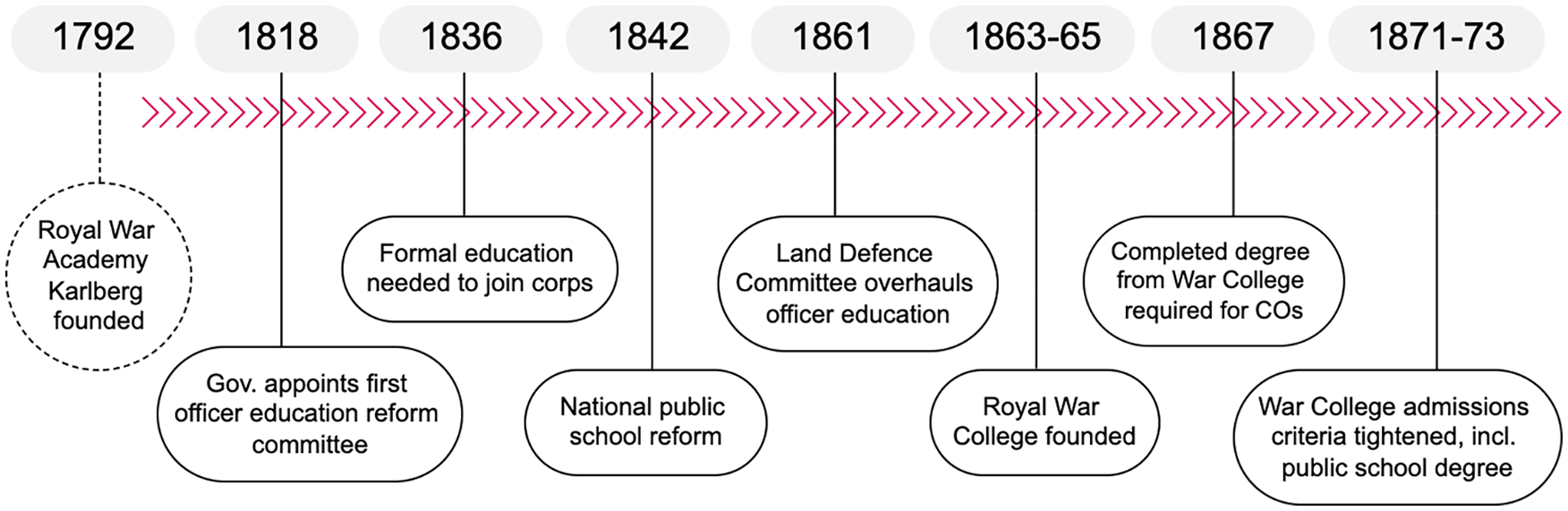
Timeline of Key Moments During the First Phase of Academization.
The issue at the time, reflecting broader societal struggles, was that the academy was largely based on aristocratic warrior ideals and tailored around the nobility’s interests, who held considerable influence over the officer corps and education, especially in the army branch. Military and government reformists wanted to break with the notion that Karlberg was an institution for the upbringing of noble elites and instead turn it into a “proper” war academy for the formal education of military officers. This required a clearer separation of subjects and for both civil and military topics to rest on a foundation of scientific and scholarly knowledge. During the 1820s, new reform ideas even involved hiring university professors at Karlberg, or replacing the war academy altogether with military faculties and military professors at regular universities (Hörsell, 1992, pp. 62–64). Although never implemented, these ideas clearly reflected the intentions at the time: to separate officer education from the aristocracy and to bring it closer to academic ideals and bureaucratic forms of educational regulation.
Indeed, debates among key military thinkers and senior officers in the 1820–40s revolved a lot around educational reforms as a means to raise the status of the corps to a legitimate profession under the state. In 1824, Johan Lefrén, army general and new governor of the war academy, wrote a report to the chancellor responsible for officer education, summarizing his views on the academy’s first 30 years. His report can be seen as reflecting the ongoing mobilization of academic capital at the time. While concerned about its current state, he was pleased with the path it had unlocked. He noted that it had been common in the previous century to tell noble youngsters who showed no interest in studies to choose the officer profession. In the military, “one seldom, almost never, saw a Master’s wreath” signaling academic achievements; rather, they had typically “despised and derided such signs of wit and knowledge” (Lefrén, 1824, pp. 69–70). Since the establishment of the war academy, however, he argued it was now impossible to suggest that the officer corps “lacked education or a sense for the value of the sciences” (Lefrén, 1824). His main concern was, therefore, that the academy was too weighed down by demands to provide elementary education—demands coming not only from the noble class but also from the fact that the public educational system was still underdeveloped. Only if elementary teaching was removed from Karlberg could the academy allocate more hours on the “war sciences” and focus on developing true “warrior academics” (Lefrén, 1824, p. 62).
Lefrén’s close companion Johan August Hazelius, teacher at the Higher Artillery School 11 and a central military thinker in Sweden during the 19th century, proposed to reform basic officer education more in line with a regular university (Hörsell, 1992, pp. 65–66). While being the secretary of the Academy of War Sciences, he wrote a series of texts for its journal in the 1840s which would reignite the debate over the alleged laxity and ineffectiveness of the teaching at Karlberg as well as the short-term “exam knowledge” acquired by cadets (KKrvA, 1843). Interestingly, these criticisms by Hazelius followed from a series of visits to military academies abroad between 1839 and 1841 where he had taken stock of the emerging 19th-century military intellectualism in Europe, following the likes of Clausewitz (KKrvA, 1843, 139–140). He maintained that the “fostering” role of the war academy was outdated, the remains of an aristocratic understanding of education, and had to be abandoned in favor of a purer military schooling along meritocratic logics, leading down “the path of the war sciences” with first commissioned officer rank as the goal (KKrvA, 1843, p. 178).
Parallel with these early academization efforts in the officer field, the mid-19th century represents the period when Sweden’s public school system, along with the rest of society, underwent significant bureaucratization and democratization—processes with which the fate of the war academy must be seen as directly related. Following a nationwide educational reform in 1842, the public school system developed during the 1850s to the extent that it could eventually begin to take over elementary subjects from the war academy (Hörsell, 1992, pp. 118–120). In line with the aristocracy’s general decline in power during the same period, the number of cadets from noble families had also gradually diminished at Karlberg. This opened a window where state officials could again use academic capital to prepare major structural reforms, this time toward establishing a public “war college” for officer education.
The government proceeded by appointing the Land Defence Committee (Lantförsvarskommittén) in 1861. Tasked to investigate the overall organization of Sweden’s defense, including its officer education, the committee noted that although the war academy had been important for initiating professionalization of the corps, it now needed to be replaced by a new military vocational school with meritocratic admissions criteria, open for all aspiring officers regardless of bloodline. This reform would subsume the profession as such in a larger bureaucratic educational system overseen by the state. Having obtained the natural sciences and humanities from the new public school system, cadets would enroll in the war college with a “broadened scope over the sciences and knowledge in general” and a “respect for the cultivation of the mind,” as put in the defense committee’s final report (Lantförsvarskommittén, 1865, p. 49). A military vocational school, it was believed, would break with old-fashioned noble warrior traditions and help cultivate the new generation of educated warrior academics called for by reformists since the early 19th century. It would continue to raise the standing of the officer corps into an educated, “civilized,” and increasingly legitimate line of work in its own right (see e.g., Elias, 2000, pp. 392–395).
An officer corps with a broad academic schooling was also justified by geopolitical conditions surrounding the Swedish military at the time (and still today, to some extent). The 1861 defense committee described how nations such as Russia, France, and the United Kingdom had not only millions more inhabitants than Sweden but also “perpetually open wounds,” as the committee put it, due to their frequent involvement in major conflicts (Lantförsvarskommittén, 1865, p. 50). Hence, they had both a greater need to amass standing armies with officers in permanent duty, and a greater population to draw from to educate soldiers and commanders in very specialized roles. Sweden, on the other hand, was a small state with a smaller population, at the time living a comparatively peaceful life far from these battlefields. It could not afford to have a permanent corps of specialists but rather required a system for educating academic officers with a broad competence and “general knowledge.” “One-sidedness is a costly matter,” the committee stated: “[Swedish officers] need to manage several kinds of jobs that abroad are differentiated . . . An officer must with us manage more, than to simply be a trooper. Our political household is so arranged” (Lantförsvarskommittén, 1865).
In 1863, the transformation of the war academy and regimental officer training schools into the new Royal War College (Kungliga Krigsskolan) began. After founding the college, the state further incorporated the officer corps as an integral part of its modern bureaucratic apparatus in the decade following. 12 First, in 1866, a permanent “military education commission” was formed to increase the government and military leadership’s control over the administration, quality, teaching staff, course content, and even course literature of the basic officer education at Karlberg, as well as of the higher, artillery, and specialist officer schools elsewhere in the country (SFS, 1866, p. 64: 4–6). In 1867, a completed degree from the war college specifically was then introduced as a requirement to serve as a commissioned officer. In 1871, a degree from at least 6 years of public schooling became an admissions requirement for officer education, and in 1873, admissions criteria were expanded further with a requirement of completed basic soldier training. Particularly the latter was deemed “revolutionary and new” since it made the war college into a de facto vocational school requiring at least some prior professional knowledge and experience (Hörsell, 1992, pp. 118–120).
During the 1860s–70s, Karlberg’s role hence ultimately shifted from a fostering to an academic institution, as cadet ages increased and elementary subjects were completely removed. Furthermore, with the requirement of a public school degree, officer aspirants from the nobility were forced into the state’s educational system as they could no longer use their cultural capital and family name as a means to gain admittance (Söderberg, 1992, pp. 242–249).
In the new war college organization, courses were rather evenly divided in terms of studying theory and conducting practical exercises and rested on a firm belief in academic schooling traditions as well as scientific and scholarly values. “War studies” became immediately established as one of the largest subjects on the curriculum. In the 1870s, it consisted of lessons in military organization, topology, and tactical theory and exercises (Söderberg, 1992, pp. 175–176). To support these subjects, the war college had compiled its own vast library of textbooks in the “war sciences”—books typically authored by previous or current teachers, i.e., senior-ranking officers (Söderberg, 1992, p. 246). War college instructors and other central military figures were also highly active in the Academy of War Sciences at the time, where debates flourished. Indeed, the second half of the 19th century has been described as the Swedish war sciences’ most intense period of development (Ericson Wolke, 2007; Ledberg, 2019, p. 56). It was a period when state and military officials drew heavily on academic capital to justify the expansion and development of officer education and of the corps more broadly. Here, the quasi-discipline of war science, which had been founded by practitioners themselves at the beginning of the century and still predominantly consisted of military elites rather than university scholars, could be used to legitimate and scientifically “verify,” or at least provide academic recognition to, the training of military professionals (see also the study by Berling, 2011).
During the 1880s, debates in the Swedish war sciences became particularly concentrated on the “balance” in officer education between, on the one hand, theoretical studies, which contained the most obvious traces to academic traditions and the established scholarly disciplines, and on the other, practical exercises which were based almost exclusively on acquired military experience and warrior craftmanship. The tendency in the debate was to strongly lament the lack of the latter.
Some writers defended existing elements of theoretical studies and connections to established sciences. Knut Gillis Bildt, an army general and later politician, argued that knowledge of war(fare) could not consist simply of what individual commanders had experienced in the field, but that a wider theoretical and academic perspective was needed, especially one with attention to military history (Bildt, 1885, p. 37). Lars H. Tingsten, a Karlberg teacher, the author of key textbooks in military tactics, and later a politician and minister of war, shared similar concerns about abandoning theoretical studies, but his concerns were far more instrumental: Academic elements were necessary mainly for the officer education (and profession) to maintain its “high status” in the eyes of the public (KKrvA, 1887, p. 184).
Other writers strongly criticized the extent of theoretical studies and conventional academic schooling at Karlberg, viewing it as an obstacle to developing military craftmanship. J. O. H. Nordensvan wrote that commander skills were insufficiently taught and that cadets were unable to instruct and lead troops after their education (KKrvA, 1887, p. 264). In a later text, Tingsten joined the emerging opposition calling for a larger focus on craftmanship and argued that military exercises were considerably hampered by the extensive mathematics courses and long “reading periods” when cadets were, as he saw it, “literally trapped inside,” bent over their books and drawing tables for 8 hours a day (KKrvA, 1888, p. 331).
These tendencies in war science debates during the late 1880s can be said to reflect a gradual devaluation of academic capital in the officer field, whereby the “usefulness” of academic studies in officer education was under attack. Indeed, during the 1890s, these debates were followed by reforms which would turn the war college into more of a straightforward practical vocational education. With academic capital diminishing in value, warrior ideals and practical fighting skills seemed to re-emerge as the central organizing form of capital in the field, shifting perceptions of the supposed role and aim of officer education.
A leading figure behind the 1890s reforms was, apart from Tingsten and other war college teachers at the time, its new director Gustaf Uggla. While reworking the school policy in 1893, he adjusted the existing allocation of hours significantly in favor of war studies and related subjects like weapons technology and fortification studies. Crucially, the college also shifted the forms of teaching within these subjects in favor of practical exercises: for example, shooting practice, company drills, instructing and leading units, and wargaming (Bernström, 1988, p. 233). As Bernström (1988) notes, change in the hour allocation and content of the education at this time “was a direct consequence either of the recommendations of the school director or a result of the discussions, mainly of internal character, held among officers who were at the school or closely associated with it” (p. 235). The broad shift in officer education from academic studies to training in military craftmanship can therefore be seen as initiated by actors from within the profession itself.
With military conscription for men introduced in 1901, the first decade of the new century saw no other radical shifts at the war college, but it continued its gradual progression to becoming more of a practically oriented vocational education with only minor elements of theoretical studies. Traditional academic schooling through reading classes, homework, and oral and written exams were gradually replaced by, for example, platoon and company field exercises. Subjects like war studies saw their links to the established sciences weakened as well, with teaching focusing less on theories and models of warfare and fortification and more on their conduct (Bernström, 1988, p. 237).
In conclusion, after around 100 years, basic officer education had contributed to a significant autonomization of the corps in relation to other fields in Sweden. Especially between the 1820s and 1870s, the officer field saw an influx of academic capital mobilized by high-level military and state officials in an effort to, as they saw it, modernize and “civilize” a corps deemed too attached to aristocratic warrior ideals (Elias, 2000). Having successfully established its standing as a legitimate, prestigious, and modern line of work, however, academic capital seemed to gradually lose its value. From the 1890s and onwards, the corps no longer required, at least to the same extent, academic capital to validate and legitimate its existence but could rely on its own “internal” practical logic. The officer corps had grown, especially in the eyes of the state, from formally uneducated to warrior academics, now capable of making their own decisions regarding its schooling. These decisions, it turned out, to a large extent concerned how to do away with the scientific, scholarly, and academic elements that had helped enable its consecration in the first place. Almost another 100 years would then come to pass before the military officer field entered another period of struggle, initiating a second phase of academic capital mobilization in the 1990s and 2000s.
The Second Phase of Academic Capital Mobilization: Cadets Enter the University (1983–2018)
During the first half of the 20th century, Sweden’s defense spending increased significantly with the outbreak of the first and especially the second World War. In their wake, however, in contrast to many other European states, Sweden continued building and expanding its national defense. During the Cold War, Sweden was one of the most armed countries in the world per capita and could mobilize up to 800,000 men. This required a correspondingly large officer corps, which meant that basic officer education grew in importance. A plethora of non-commissioned officer (NCO) and officer aspirant schools were set up across the country from the 1940s and onwards to supplement cadet training at Karlberg. War college courses continued to center on military craftmanship throughout the mid-20th century, with less time spent inside classrooms and more hours allocated for lessons on applied tactics, leading troops, and shooting practice (Göransson, 1992a, p. 339; Ledberg, 2019, p. 62).
Structurally, however, basic officer education remained more or less the same until the early 1980s. As Göransson (1992a, p. 340) notes, “. . . a cadet from the 1930s would recognise a lot at the war college in the 1980s.” The Social Democrat–led governments during these decades made some efforts to change its orientation to further democratize the corps, for example, by tabling a suggestion to include one semester of university studies as part of the officer education (Göransson, 1992a). This suggestion was immediately rejected, however. The value of academic capital was low in the Swedish officer field between the 1920s and 1980s. The corps had grown increasingly autonomous, much like warrior classes of past generations. Military defense was integral to how society operated during the Cold War, and the officer occupation had evolved into a core profession considered by most a perfectly normal and necessary job.
This was about to change with the end of the Cold War. In fact, the Swedish officer field started shifting already in 1983 when the armed forces’ order of command reform (NBO) was introduced. With it, the government sought to rationalize the military organization and gather all officer roles (including specialist/warrant officers and NCOs) in a single inflated officer category (yrkesofficer), assigning everyone the same three-fold role: to be a military “leader,” “practitioner,” and “instructor” (Hedlund, 2004, p. 29). The restructuring of the corps imposed by the NBO decision would come to have major implications for the officer education system since it, too, would need to adopt a similarly “generic” profile and prepare cadets from all service branches for the same three-fold officer role. 13 In anticipation of such government reforms, the armed forces headquarters turned again to the academic field for inspiration and started discussing during the late 1980s “ways of infusing university-based components into the system for professional military education” (Ydén, 2021, p. 167; see Figure 2).
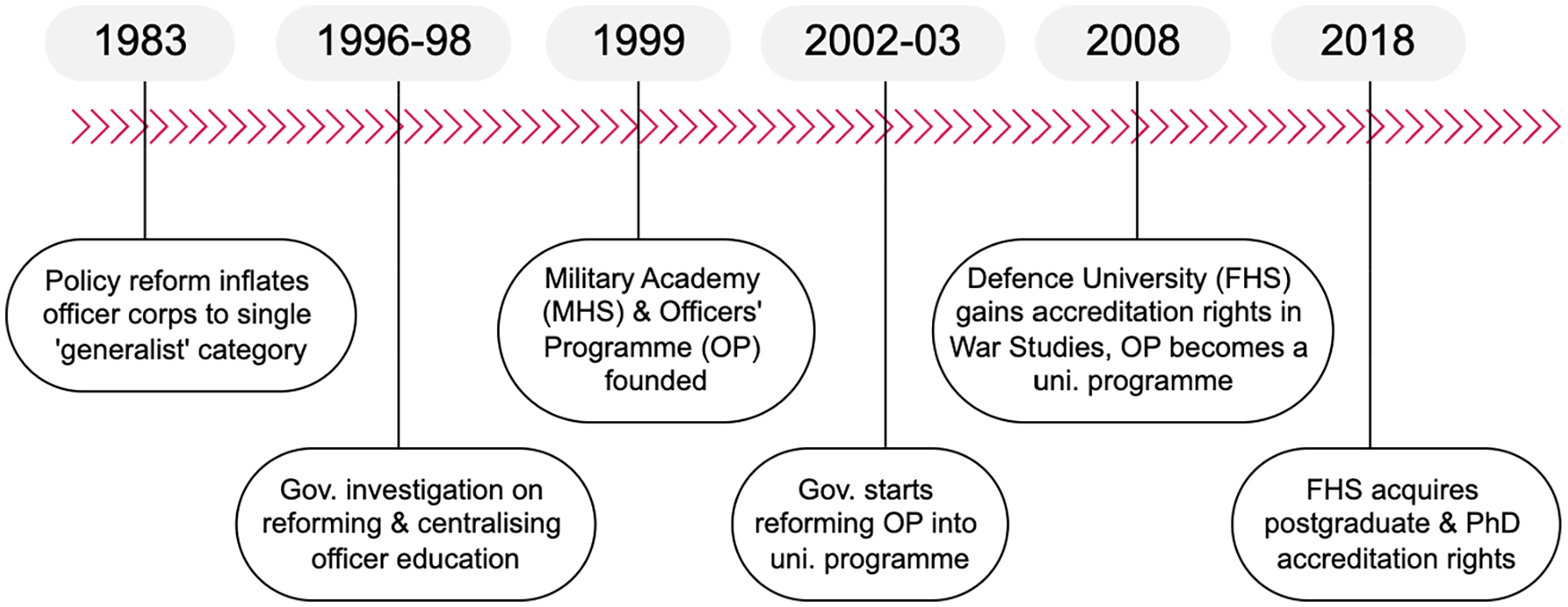
Timeline of Key Moments During the Second Phase of Academization.
The end of the Cold War then triggered a legitimacy crisis for the military profession broadly, furthering the discussions on officer education reforms. The mid-1990s defense bills and budget cuts drastically shrunk the Swedish armed forces and made it clear that the officer corps’ standing was now seriously under question. The government also decided that the new homogeneous officer corps, introduced with the 1983 order of command reform, was to be followed up with an equally rationalized educational system. Here, the first concrete step was taken by a public investigation committee appointed in 1996, which recommended replacing the war college and current branch schools with a new Military Academy (Militärhögskolan, MHS), a university-like higher institution with campuses at Karlberg and in two other Swedish cities.
The motives for rearranging basic officer education into a more cohesive institutional structure were in large part economic, but it was also supposed to benefit the “long-term professional development” of a broadly competent future officer (SOU, 1997, p. 7). This notion was fleshed out in the 1996 committee’s final report, in which focus shifted to the supposed qualitative and educational benefits of the new military academy. It outlined new demands on the officer corps expected in the new millennium. In addition to leading and training troops, demands included the ability to be “adaptable,” cooperate with civil actors, participate in missions abroad, use technological innovations, and be more environmentally conscious (SOU, 1998, pp. 16–19). This would require the corps to interact increasingly with the rest of the society. Hence, the committee recommended that the education should provide officers with a “thorough knowledge of societal conditions in a broad sense,” including a capacity to “quickly gather and process new information,” “actively cooperate with other people regardless of background,” and “communicate on various levels” in society (SOU, 1998, p. 20).
Here, parallels between the 1996 investigation and the 1861 committee preceding the establishment of the war college, discussed earlier, are striking. Both essentially called for a centralized educational system with closer state supervision and stronger connections to academic conventions. Both saw the need to produce future officers with a broad knowledge and “generalist” competence, suitable for a corps operating in relative peace. The ambition to create a generational shift from warrior craftsmen to broadly educated warrior academics had in this sense made a return in the 1990s. For instance, alongside now central war study topics like military tactics, the new officer education was recommended to introduce theoretically oriented academic subjects such as political science, security studies, international law, environmental studies, computer science, and economics (SOU, 1998, p. 28). Indeed, when the new military academy, MHS, was established in 1999, academization efforts that had been virtually abandoned in the early 20th century were effectively reinitiated.
While academization processes in the 1860s had led to the creation of a war college for vocational education, the strategy in the late 1990s was to connect MHS to the university sector and to have it provide “higher vocational education.” The formal title of this program, also launched in 1999, became the Officers’ Program, and it included course structures and examination criteria mirroring those elsewhere in Swedish higher education (Weibull & Danielsson, 2000; see also Björkman, 1999).
The link to the higher education sector was not merely semantical: the Swedish National Defense College (FHS, Försvarshögskolan, until then mainly responsible for post-commissioning officer education) was given the task to “coordinate” the officers’ program, conduct “quality control,” and ensure “coherence in the education,” much similar to the role of the 1866 military education commission (Ledberg, 2019, p. 93; SOU, 1998, p. 39). This connection was held as “significantly important” for the government’s intensions at the time to allow officer education to “approach society’s other higher education institutions” (SOU, 1998, p. 20; see also Libel, 2018, p. 15). The initial inclusion of elective special courses in, for example, political science, using teaching resources from civil universities, were particularly important for maintaining this link. Moreover, the 1996 committee mentioned that “[b]eing able to exhibit a uniform structure is essential for external stakeholders, observers, and decision makers to be able to understand the design and content of the military educational system” (SOU, 1998, p. 20). Put differently, the MHS officers’ program’s connections via FHS to the university sector were seen as a way to generate a broad public acceptance of the continued existence of officer education in the peaceful post-Cold War era. Indeed, academic capital was here again introduced to reinforce the profession’s legitimacy.
Both cadets and commanders at regiments receiving the new generation of officers in the early 2000s showed strong aversion toward the educational reforms, however—particularly toward the reintroduction of academic elements and theoretically oriented courses. Hedlund’s (2004) study includes a plethora of quotes illustrating this criticism and can be summarized as follows: The course content was deemed too abstract and aimed too high (e.g., the political/strategic rather than tactical level) (Hedlund, 2004, pp. 111, 119–121), collaboration with universities led to “culture clashes” and “confused” cadets (pp. 119–122), an academized system meant “chasing university credits” rather than practising warfighting skills and leading troops (pp. 115, 121–122), and so on. Elective special courses on non-military subjects, or so-called “civilian studies,” were particularly frowned upon, seen as encroaching on the development of their military know-how (pp. 112–116, 130). One officer even feared academization would risk attracting the “wrong people”; namely, people excellent at writing university essays but “incompetent practically” (Hedlund, 2004, p. 122; see also Danielsson & Weibull, 2008). Especially among receiving commanders, it seemed the new officers’ program simply did not correspond with their professional worldview. This illustrates how the academic capital reintroduced in the officer field in the late 1990s was initially rejected, rather than recognized.
Despite objections from within the profession, the government’s efforts to academize basic officer education proceeded in the 2000s. The government appointed another investigation committee in 2002 on how to further reform the officers’ program (SOU, 2003; see also René, 2018, pp. 46–51). Its final report recognized some of the grievances expressed by armed forces personnel but continued to insist that the Swedish military’s current role domestically and internationally required a broadly cultivated officer corps and that the primary means to reach such a status was an academic education. The idea, as Ydén (2021, p. 168) puts it, was that “academic qualifications would elevate the societal status of the officer corps, or at least preserve it in a society where an increasing number of occupations underwent university training.” Further academization, the government held, “was the only way the Swedish officer corps could ‘conquer their profession’” and maintain their status as a “proper” line of work (Ydén, 2021).
The report’s larger message seemed to be that the aim of officer education in the 2000s should be to develop military academics with a broad scholarly understanding of society, only partially concerned with warfighting. An officers’ “general competences” were to include an understanding of the military’s “role in a democratic society” and in “international relations,” the importance of “moral, ethics, values, equality, ethnic and religious diversity, and gender relations,” and more (SOU, 2003, pp. 44–50). The future officer was to resemble the ideal type of a well-educated citizen of globalized liberal society, and so the officers’ program needed to increasingly mirror civilian university programs. Here, the connections between military academization efforts and Elias’ (2000) civilizing process become perhaps the strongest.
For the officers’ program to operate more substantially like other university programs, the 2002 committee recommended that it should be based on its own scientific foundation and pool of knowledge (like, e.g., political science, law, economics). This required the study of war(fare) to be recognized as a formal subject in higher education. The government thus began revisiting efforts essentially started already in the 19th century to develop the “war sciences” into an academic discipline. FHS were tasked to lead this effort and struggled to convince higher education authorities about the scientific status of their subject until 2007, when they were given accreditation rights to grant university degrees in “war studies” (SFS, 2007). 14 With this decision, the officers’ program’s status evolved in 2008 from a vocational education for armed forces’ personnel to a full-fledged 3-year university program leading to a higher education degree—a status which made Swedish basic officer education unique in international comparison. 15
This shifted the field in a number of ways. First, it divided the authority over officer education between the ministries of defense and education, as well as between the military academy, MHS, and the still immature civilian university, FHS (later renamed the Swedish Defense University in English). A complex relationship of rivalry and co-dependency emerged, which still permeates the field. The armed forces could via MHS oversee only parts of the officers’ program, whereas FHS controlled the subjects and degrees constituting it. The armed forces here lost a significant amount of power over the education of their future officers, who in turn gained a dual status of cadets and students (Hedlund, 2013, p. 149). 16
Despite the fundamentally violent nature of the officer profession, its education now fell under the same higher education law as all other civilian university programs. This further increased the demands of the officer program’s “scientificity” (SOU, 2003, p. 73). Had the FHS decided to attach officer education to a neighboring and already established discipline when developing it into a university program, like political science or international relations, such demands had perhaps been difficult to meet. But by insisting on war studies as its core subject, and eventually becoming the only Swedish university offering such degrees, FHS gained unique power to construct, shape, and control its “own” discipline. The subject’s status was then cemented further in 2018, when FHS were granted degree accreditation rights at the postgraduate and PhD levels, giving them “full” university status (Ydén, 2018, pp. 57–59).
The “making official” in recent years of war studies as the central university degree for Swedish officer education can be seen as the culmination of the 200 years of academic capital mobilization analyzed in this article. Through various academizing moves—establishing a war college, fostering a discipline of war, and more recently, constructing a modern military academy and bringing cadets to the university—the state has managed to maintain a steady connection between itself and the officer corps as well as provided the latter with a certain degree of legitimacy and elevated status. After handing the officer corps the tools to become an established profession during the 19th century, the state has now, in the 21st century, effectively secured its standing for generations to come by making military education something generating university credits. Indeed, in what is perhaps one of the most “peaceful” countries in the world, the profession of violence has become fundamentally normalized: an ordinary job requiring an ordinary university education.
Conclusion
This article has added key empirical insights regarding the long history of officer education in Sweden. It has demonstrated how academization processes unfolded as well as resembled each other during two turbulent phases. Culminating first with the establishment of the war college in the mid-19th century, and second, with the integration of the military academy in the university sector at the turn of the 20th century, academic capital was mobilized and used in the officer field with a similar purpose during both phases: to defend the corps’ overall position in society and (re)establish its credibility as a “normal” job requiring a “proper” education. The same types of actors were involved in these struggles: on the one hand, warriors (coming first from the nobility, and later, from the profession itself), and on the other hand, state officials (high-level military strategists and civil servants at the heart of the government).
The findings provide insights beyond the Swedish historical context as well, particularly with regards to the role of academic capital in furthering what Elias called the civilizing of warriors. In fact, both phases of academization corresponded with periods of tension for the military profession, particularly in its relation to the state and broader society. Both in the 1810s and 1990s, the Swedish society was transitioning into periods without an immediate threat of war. This created room for assessing and reforming the corps and its educational system. The relative peacefulness also allowed the state and society to start questioning the very need for an extensive military organization and officer corps. Here, academic capital arose not as a replacement of violent capital, not as a way to dismantle the corps, but as a supplementary currency that could (re)establish its professional status and (re)generate public trust. Hence, academic capital can be vital as a way to reconnect the officer corps to the notion of a “common good.” It can contribute to transforming it from a private or internal matter to a public matter: for example, from aristocratic values to more “universal” academic conventions, from a career reserved for the nobility to a state-led profession integrated in the public school system. Similarly, during the post-Cold War phase, academic capital was crucial for negotiating the corps’ broader societal value and relevance in times of major reforms. During both phases, this was couched politically in terms of producing officers with a “generalist” competence. The key takeaway is that academic capital can serve the specific function of resolving crises in the officer field and help maintain the legitimacy of violent professions in peaceful societies. This feeds directly into the guiding hypothesis for this article: that military academies emerged as civilizing institutions that, at different points in history, could “tame” current generations of warriors by “academizing” them (Elias, 2000).
Another structural condition pushing academization processes pertains to the overall value of academic capital in society. In the decades leading up to the 1840s, Sweden’s public school system was being formalized, creating spillover effects in the officer field. Similarly, between the 1960s and 1980s, several practically oriented professions (e.g., doctors, psychologists, and police) saw their vocational educations gradually transferred to the university (Ydén, 2021, p. 167), paving the way for similar changes in officer education in the 1990s. This illustrates how academic capital has a certain exchange rate vis-à-vis other capitals: When strong, it can be opportunistically imported and used as authority in contexts otherwise less concerned with academic credentials.
Danielsson and Weibull (2008, p. 102) write that “finding an optimal balance between theoretical and practical education seems to have been a constant problem throughout [the history of] Swedish officer education.” I argue differently: The shifting value of academic capital illustrates its instrumental role. When the officer field had reached a certain level of autonomy and developed its own craftmanship around the turn of the 19th century, actors gradually did away with the academic elements initially wielded to establish its education and spur its professionalization in the first place. This suggests that the cultivation of warrior academics is not the end goal in itself. Scholarly ideals and academic conventions have rather been used as a means and resource for the maintenance of the corps. The instrumental use of academia is also seen through how academization processes are often resisted from within the profession. As discussed earlier, theoretical elements in officer education have been described throughout history as obstacles to producing true warriors. Yet, without a formal educational system and the associated academic conventions that come with it, the corps does not possess the fundamental legitimacy to practice its craft. This friction between a system of academic standards and the craft of warfighting (with the latter now increasingly dependent on the former) is still very much at play in the military academy and defense university today. Given Sweden’s major rearmament plans since 2015, intensified further following recent Russian aggressions and the NATO application in 2022, tensions concerning the aim and organization of officer education will only increase again. What is the future of an academized officer education in this new geopolitical milieu? To what extent, and if so with what effects, will academic capital become devalued again?
To conclude, the Swedish experience of its military academy’s role in furthering the civilizing process should be seen as an invitation to study other countries’ officer fields and the different capitals at play therein. How have academization processes unfolded elsewhere? The current trend in Europe of integrating officer education in defense colleges (Libel, 2018) indeed needs to be understood from a longer historical perspective, one that links military academies to the constant interplay and complex struggles between states and their militaries.
Footnotes
Acknowledgements
The author is grateful to Tua Sandman, Tyra Hertz, Alvina Hoffmann, and the two anonymous reviewers for their comments on earlier versions of this article.
Declaration of Conflicting Interests
The author declared no potential conflicts of interest with respect to the research, authorship, and/or publication of this article.
Funding
The author received no financial support for the research, authorship, and/or publication of this article.
