




Abstract
Since the start of the 21st century, drones are increasingly used for military purposes. There have been concerns that the work of drone pilots resembles a video game and it has been argued that drone pilots are less likely to develop mental health problems than other service members. Such an assumption could increase stigmatization but empirical research is lacking. For this explorative study, 11 respondents were interviewed. They were purposefully sampled from the United States, the Netherlands, and Israel because of their insight into the working environment of drone pilots. These respondents included scholars, a therapist, and military personnel. They suggested that drone pilots do face mental health problems because of their work and that due to their distance to the battlefield, stigmatization of these problems is more likely. These findings, however, are nuanced by differences across countries and units.
Over the last 20 years, new methods of warfare have been employed, which do not require the presence of “soldiers” on the front lines (Royakkers & van Est, 2010). One of these new methods of warfare is the Remotely Piloted Aircraft, commonly known as the drone (Valenzano et al., 2018). These drones are operated remotely by pilots to decrease the number of soldiers killed on the battlefield, to gain operational superiority, and to reduce traumatic stress among soldiers (Royakkers & van Est, 2010; Wall & Monahan, 2011). As drone pilots are not present in the actual war zone, but are stationed hundreds of miles away in a command post, their work is argued to be comparable to a video game as their kill is reduced to a click of a mouse, leading some to mistakenly argue that the psychological well-being of drone pilots cannot be negatively affected by their work (Asaro, 2013; Calhoun, 2011; Campo, 2015; Enemark, 2019).
Recent research questioned whether drone operators actually have less mental health problems. Drone pilots, for instance, reported suffering from burnout, post-traumatic stress disorder (PTSD), and moral injury (Bentley, 2018; Chappelle et al., 2014, 2019; Enemark, 2019; Henschke, 2019; Hijazi et al., 2017; Valenzano et al., 2018). In addition, research has indicated that the actual number of drone pilots suffering from these consequences might be higher than is being reported (Edney-Browne, 2017).
Like other branches of the military, drone pilots are faced with a masculine culture, in which any emotional weakness has to be hidden. The masculine culture emphasizes how service members, including drone pilots, should be mentally strong and self-less to promote the bond and trust between service members. Therefore, it has been argued that drone pilots are likely to downplay their psychological symptoms, or even deny having any at all, to uphold the role models propagated within military culture, and to avoid being stigmatized (Asaro, 2013).
The social stigma surrounding mental health problems in the military is not new and has been discussed widely in academic research (Greene-Shortridge et al., 2007; Sharp et al., 2015). That being said, most research investigating mental health problems focused on other branches in the military and the stigma surrounding mental health problems in drone pilots has been researched very little (Asaro, 2013; Edney-Browne, 2017; Holz, 2023). The limited studies that analyze the stigmatization of drone pilots suffering from mental health issues suggest that the perception of the drone pilot’s work as being less traumatic could potentially cause these pilots to face additional stigmatization when they develop mental health problems (Holz, 2023). There is, however, to our knowledge, no empirical research to date on the stigmatization of mental health problems in drone pilots. This exploratory study takes a step to fill this gap by analyzing to what extent and how drone pilots are stigmatized when they experience mental health issues because of their work. The study is conducted through interviews with respondents who have insight into the working environment of drone pilots.
An inductive approach was used. Respondents were selected by means of theoretical sampling (Nowell & Albrecht, 2018), meaning they were selected because they had insight into the elements that previous literature suggested were important determinants for the stigmatization of mental health problems in the military. The objective of the study was not to generalize our findings, but rather to provide empirically grounded interpretation of a phenomenon that previously had only been theorized. Relevant respondents in the current study were deemed to be a therapist, military personnel, and scholars, as they could provide information on the context in which a drone pilot operates, as is further explained in the “Method” section.
It will first be explained what the role of drone pilots in the military is. The section thereafter will analyze what mental health issues are likely to arise for drone pilots. Then, attention will be given to why mental health issues are often stigmatized in the military overall, before providing information about prevailing prejudices about the drone pilot profession. Thereafter, there will be a “Method” section explaining how the study was carried out. Finally, the factors influencing the stigmatization of the mental health problems of drone pilots will be discussed on the basis of the interviews.
Drone Pilots in the Military
Drones are still a fairly new phenomenon, and it was not until the start of the new millennium that we entered the era of remotely controlled military aircrafts (Royakkers & van Est, 2010). Since then, the technological advancements in the fields of computers, aviation, and satellite have made it possible for pilots of such drones to be an active participant in the conflict, while physically being away from the conflict zone (Chappelle et al., 2014; Royakkers & van Est, 2010; Wall & Monahan, 2011). In the present paragraph, the focus will be on the developments in the United States as they have been leading in the development and use of drones.
The most frequently used drones by the U.S. military are the MQ1-Predator and the MQ9-Reaper. They can fly between 12 and 22 hr and cover more than 1,110 km, and are, therefore, able to provide support to U.S. armed forces all around the globe. Furthermore, their ability to carry both cameras and missiles allows them to be used for both reconnaissance purposes and as weapons (Campo, 2015).
One of the most frequently carried out tasks of a drone pilot is that of reconnaissance (Chappelle et al., 2014; Wall & Monahan, 2011). During the War on Terror, a need arose to collect intel on terrorists and gather information on the regions in which they resided, for instance, in the Middle East (Wall & Monahan, 2011). Drone pilots got involved in tracking and targeting terrorists living there and the particularities of the conditions they were living in (Asaro, 2013; Chappelle et al., 2014; Wall & Monahan, 2011). Especially for the United States, the targeted killings of (suspected) terrorists became an often used method of both warfare and fighting terrorism since the start of the 21st century (Asaro, 2013; Wall & Monahan, 2011). The successful attack on Ayman al-Zawahiri, the Al Qaeda leader, on July 31, 2022, is an example thereof (Liptak et al., 2022). Over the years, targeted killings by the United States have increased in numbers. One of the reasons for this increase in drone killings is the changed view on what type of targets are considered acceptable to kill. Under the Obama administration (2009–2017), it was decided that the target no longer had to be a clearly identifiable and a known terrorist, but that suspicion of terrorism sufficed (Wall & Monahan, 2011).
The number of people needed to operate a drone varies depending on the mission or the drone, but usually the crew consists of the drone pilot, the sensor operator, the mission intelligence coordinator, and the intelligence analysts. The drone pilot is in command of the aircraft, and the one who eventually pulls the trigger, whereas the sensor operator is primarily in charge of the cameras, sensors, and the aiming of the weapons on the drone (Asaro, 2013).
When carrying out a drone strike, the sensor operator is operating the camera on the drone and aims the laser, so that the pilot can pull the trigger to release the missile from the drone. The sensor operator ensures that the missiles stay focused on the target as it descends (Enemark, 2019). The mission intelligence coordinator communicates with the intelligence analysts, who analyses the video footage collected by the drones and shares the information with the rest of the crew (Asaro, 2013). Hence, when talking about the tasks of the drone pilots, and the effects these tasks may have, it is important to take into account that these are in fact the tasks of an entire crew whom are all potentially affected by these acts.
The Psychological Consequences of Their Work for Drone Pilots
One of the most unique characteristics of the military is the “license to kill” (which according to international humanitarian law is limited to enemy combatants and others that pose a direct and imminent danger) (Campo, 2015). Even though these combat killings are legitimate, soldiers tend to feel remorse for what they have done, which in turn could lead to mental health problems such as PTSD, moral injury, depression, and anxiety (Bar & Ben-Ari, 2005; Campo, 2015; Grossman, 1995; Jones, 2006; Maguen et al, 2011; Molendijk, 2018). In addition to psychological issues as a result of direct engagement through killings, exposure to human suffering in a war context can have its negative psychological effects as well. Especially, when one does not have (sufficient) means to alleviate the suffering or is not allowed to intervene due to the missions objective (Molendijk, 2018).
One of the most important factors that makes the experience for drone pilots different from that of other soldiers is the distance between them and the battle zone (Asaro, 2013; Campo, 2015; Chappelle et al., 2014). Whereas soldiers are physically present on the battlefield, drone pilots can be stationed hundreds of miles away in a command post, operating the drone via a computer screen (Asaro, 2013; Campo, 2015). It has consequently been argued that their work is comparable to a video game (Campo, 2015; Enemark, 2019; Royakkers & van Est, 2010). Drone pilots see war through a computer screen, and, it has been argued, are actually just targeting blips on a screen by merely the click of a mouse, without being fully aware that these are human beings (Calhoun, 2011; Enemark, 2019; Royakkers & van Est, 2010). A report written by the United Nations also suggests this and has even sent out a warning along these lines stating: “because operators are based thousands of miles away from the battlefield, and undertake operations entirely through computer screens and remote audio feed, there is a risk of developing a ‘Playstation’ mentality to killing” (Alston, 2010, p. 25). As a result, some argued that drone pilots will not suffer substantial psychological impact (Royakkers & van Est, 2010). More recent literature challenged this assumption, arguing it is actually much harder for the drone pilot to kill as they know much more about a target than an ordinary soldier would. A drone pilot, especially those who operate from a safe distance, could be watching a target for several weeks before engaging in an attack. They could have been observing the target in their daily life, and then after the attack, the drone pilot often has to assess whether the target has been killed and whether any civilians were nearby (Asaro, 2013; Henschke, 2019; Hijazi et al., 2017; Power, 2013). This process could also include having to observe the funeral of the killed enemy, something which is not expected of combatants who are on the ground, and who typically leave the scene after their attack. Due to this intimacy, the drone pilot does not see their enemy as merely a blip on their screen, but as a human being whom they got to know (Henschke, 2019). Therefore, it has been suggested that drone pilots could very well experience even more emotional distress than is experienced by other soldiers (Asaro, 2013; Henschke, 2019) and the killings carried out by drone pilots thus should not be regarded as emotionless acts.
Furthermore, whereas soldiers go on deployment for several months, drone pilots go home after their shift has ended, leading to a sudden shift of moral permissions (Henschke, 2019). It has been suggested that exactly this sudden shift every day causes significant psychological problems for drone pilots (Asaro, 2013; Henschke, 2019; McCammon, 2017; Otto & Webber, 2013). Moreover, the drone pilots cannot talk to the people close to them, due to the often classified nature of their work, which in turn creates a barrier between them and their loved ones (Bentley, 2018; Hijazi et al., 2017).
In addition, drone pilots often feel that their killings are not fully justified. Whereas the soldier on the battlefield uses lethal force in an open fight against physical threats they experience, the drone pilot is engaging remotely, and loses this justification for engaging in lethal force. While the actions could still be justifiable, because the drone pilot is, for instance, protecting troops on the ground from being gunned down by a group of insurgents, this justification is not always experienced as such by the drone pilots (Pilkington, 2015).
It has been established that as a result of these features of their work, drone pilots experience multiple psychological problems (Asaro, 2013; Bentley, 2018; Chappelle et al., 2014; Henschke, 2019). The sudden shifts in moral rules every day when entering and leaving the job, the direct confrontation with the suffering of the family of a target they got to know, and the feeling that their killings are not justified could lead to the drone pilot experiencing “moral injury” (Bentley, 2018; Henschke, 2019). This injury encompasses feelings such as shame, guilt, or regret and is not limited to feelings of trauma (Bentley, 2018). Drone pilots, for instance, struggle with thoughts of whether the killing from afar is morally right, or if the target should be captured and put on a trial, ensuring his rights to a fair trial would be respected instead of being bombed (Bentley, 2018; Henschke, 2019).
In a letter to Barack Obama, former Airforce members emphasized that they suffered from PTSD as a result of being engaged in the killing of innocent people. They stated, We came to the realization that the innocent civilians we were killing only fueled the feelings of hatred that ignited terrorism and groups like ISIS, while also serving as a fundamental recruitment tool similar to Guantanamo Bay. This administration and its predecessors have built a drone program that is one of the most devastating driving forces for terrorism and destabilization around the world. When the guilt of our roles in facilitating this systematic loss of innocent life became too much, all of us succumbed to PTSD [. . .] (Bryant et al., n.d.)
When drone pilots suffer from PTSD (Asaro, 2013; Bentley, 2018; Chappelle et al., 2014), they frequently refer to having sleep problems or nightmares and some have been self-medicating through drugs and alcohol as a result. In addition, reports have been made that some have resorted to suicide (Bentley, 2018).
Stigma in the Military
Psychological problems in the military are likely still underreported because of the stigmatization of such problems (Sharp et al., 2015; Zeev et al., 2012). Numerous empirical studies have argued that the fear of being stigmatized for having psychological problems has been quite pervasive among those who are in the military (Greene-Shortridge et al., 2007; Langston et al., 2007; Sharp et al., 2015). As a result, many of the soldiers, who suffer mental health problems, refrain from reporting their psychological difficulties, nor do they seek professional help (Langston et al., 2007; Zeev et al., 2012).
Stigma
The definition of stigma is variable and vague (Besterman-Dahan et al., 2013). However, a stigma is most commonly considered as a “deeply discrediting” feature and those who are associated with the stigma are regarded as “tainted” (Besterman-Dahan et al., 2013; Goffman, 1968). It is not the characteristic itself that has to be regarded discrediting in nature, but it becomes discrediting when it is not expected to be present in a particular person. People can thus be stigmatized by their surroundings when they behave, act, or are different from what is expected from that person (Goffman, 1968). For an individual to also feel the stigma, it is essential that the same set of norms is upheld by both the individual and the group he or she is part of and that the individual is aware he or she is not living up to these norms (Goffman, 1968; Schnabel, 1978).
Stigma and Military Culture
In ancient as in modern times, mental illnesses have been stigmatized by the public, and those who suffer from the psychological problems have been seen as “of lesser value” (Arboleda-Flórez & Stuart, 2012; Couture & Penn, 2003; Greene-Shortridge et al., 2007). Within a military context, these general public beliefs about psychological problems are further amplified by the military culture (Greene-Shortridge et al., 2007; Hardison et al., 2017; Westphal & Convoy, 2015).
Military culture can be best defined as: “the sum total of all knowledge, beliefs, customs, habits, and capabilities acquired by service members [. . .] through membership in military organizations” (Westphal & Convoy, 2015, p. 3). In addition, values as courage, loyalty, selflessness, commitment to excellence, and stoicism are deemed important within the military culture (Besterman-Dahan et al., 2013; Bulmer & Eichler, 2017; Hurley, 2016; Smeulers & Grünfeld, 2011; Westphal & Convoy, 2015). In relation to these values, the trust in each other’s abilities is crucial as well (Besterman-Dahan et al., 2013; Zeev et al., 2012).
While the unique set of values within the military culture support those in the military in carrying out their jobs, and allows for the smooth conducting of operations in which personal boundaries can be transgressed, it is the same set of values that leads to the stigmatization of mental illness in soldiers (Westphal & Convoy, 2015).
Service members who suffer from psychological difficulties are in direct opposition of the military ethos which promotes, among other things, the psychological toughness of not showing any emotion (Besterman-Dahan et al., 2013; Westphal & Convoy, 2015). This in turn constitutes a discrepancy between what is expected and what is actually the situation, leading to the stigmatization of the service member. The result of this discrepancy between the reality and the expectations has led to service members oftentimes being regarded as weak and a failure, and the psychological problem can be perceived as cowardice or a character flaw (Besterman-Dahan et al., 2013).
In addition, the importance of being able to trust each other’s abilities and the need to be strong could lead to self-stigmatization. Those suffering from psychological difficulties in the military find it difficult to admit their team can no longer rely on them and that they are no longer “strong” (Besterman-Dahan et al., 2013; Kim et al., 2011). Hence, while the military culture aims to promote values that strengthen their service members and the bonds between them, helping service members to be able to carry out their job, it can also lead to service members disregarding mental health problems and this makes both them and the system vulnerable. The soldier could feel ashamed and weak as a result of the stigma attached to their psychological difficulties. Furthermore, the soldier might, for these reasons, not report their psychological problem or ask for mental health care, due to being scared of being demoted or discharged (Besterman-Dahan et al., 2013; Westphal & Convoy, 2015; Zeev et al., 2012).
Stigmatization of the Drone Pilot
Although the drone pilots are part of the military, the drone pilot profession itself is frequently talked about in a disparaging manner (Pilkington, 2015). Within the U.S. Air Force, being a pilot is considered prestigious, due to the physical and mentally demanding aspects of the job. Pilots have a special status within the military, and they wear the “flight wings” insignia, a distinguishing feature, on their uniform. When drones were first employed, a part of these manned aircrafts pilots switched to flying the unmanned aircrafts, and they were allowed to continue wearing their flight wings (Asaro, 2013).
For those who came into the Air Force without wings, there was little hope of acquiring these wings and the prestigious position related to wearing them. These drone pilots did not require the same demanding training as the pilots who fly manned aircrafts because they did not have to fly a “real plane.” The drone pilots were not present, or trained to be present, in the actual war zone, leading to the question whether they should be given the flight wings. The U.S. Air Force initially decided that these drone pilots should not be granted the wing insignia on their uniform. Several years later, the U.S. Air Force changed their stance and allowed the drone pilots to wear uniforms including the flight wing insignia. However, these wings differ in color from those flying manned vehicles (Asaro, 2013; Robinson, 2017). There are thus remarkable differences between drone pilots and other parts of the military which may affect the extent to which they may experience psychological distress and will be stigmatized because of it.
Method
Because the work of drone pilots is often classified, and because they are discouraged from discussing anything related to their work with others, including academics, we decided to conduct interviews with respondents who have insight into, and knowledge of, the environment in which the drone pilot finds himself or herself. Interviews were solicited from a broad sample of individuals from the academic and military community. Besides scholars, a therapist and military personnel were interviewed. Interviews were conducted to provide an empirically grounded interpretation of the extent to which and how drone pilots may be stigmatized for psychological difficulties that may arise because of their work.
Respondents were selected by means of theoretical sampling. Whereas random sampling aims to find representative data on a particular population, theoretical sampling focuses on obtaining data that is of theoretical relevance (Nowell & Albrecht, 2018). We sought out respondents that had knowledge on the psychological consequences of the work of drone pilots, knowledge on military culture, and the perception of the drone pilot profession therein. Each was asked how they thought military culture, and the perception of the drone pilot profession, affected the stigmatization of drone pilots who experience mental health problems.
A total of 39 respondents, from the United States, the Netherlands, and Israel, have been approached via e-mail, of which eight agreed to an interview, and an additional three were approached through snowballing, which totaled the number of interviewees to 11. Because the interviews were conducted in the midst of the COVID-19 pandemic, they took place online. The interview was preceded by the digital signing of the informed consent form. The form ensured the respondents’ anonymity and emphasized that no identifying information would be included in the article. Two respondents, Molendijk and Dekker, indicated they did not require anonymity, and the others will be referred to using a pseudonym that refers to the order in which the interviews took place (R1–11). An overview of the 11 respondents can be found in Figure 1.
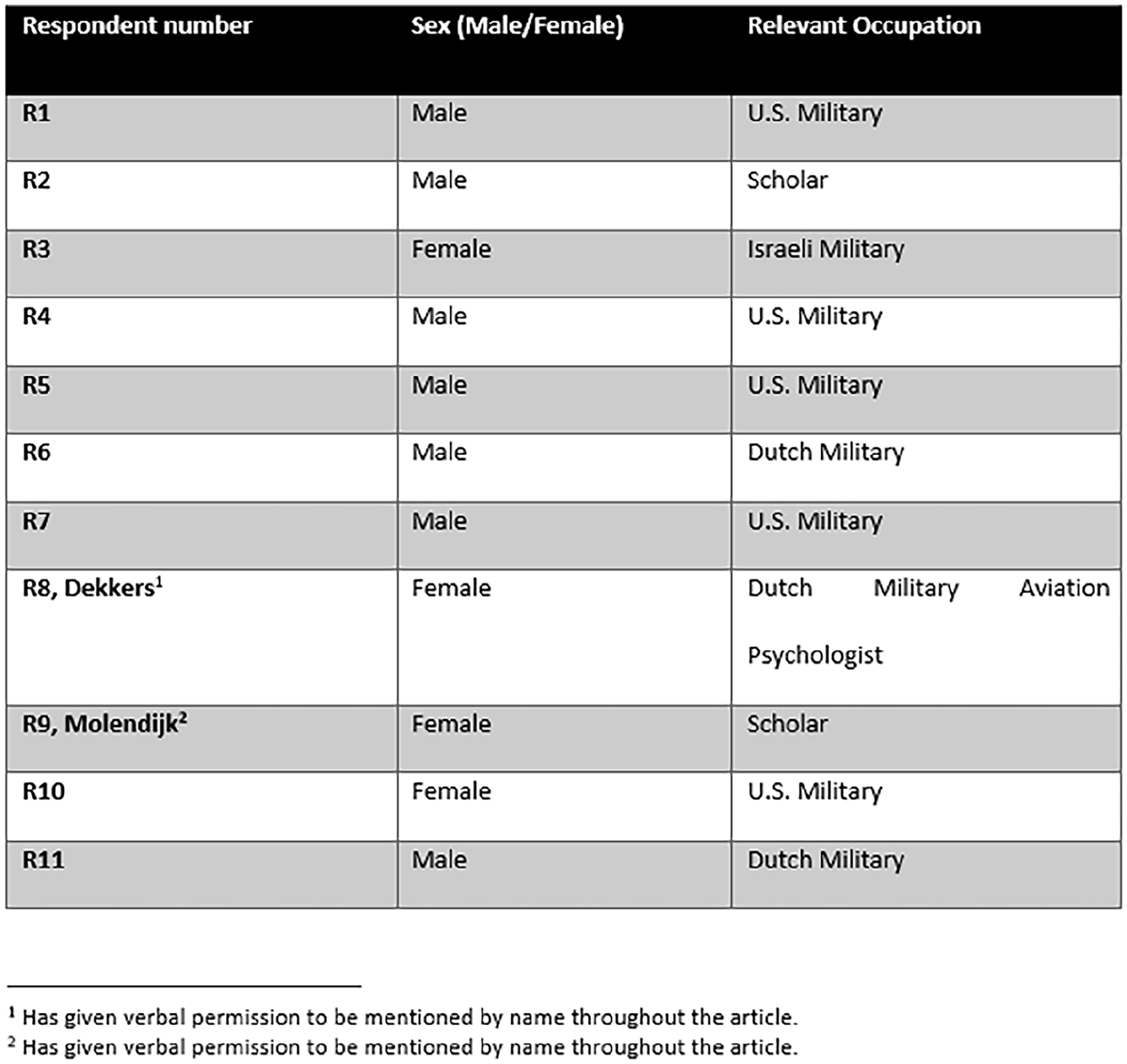
Respondent Information.
All of the respondents consented to being audiotaped, and conveyed an understanding of what the research entailed, and how the data from the interviews would be utilized. The semi-structured interviews entailed an introduction, rapport-building questions, discussion of the abovementioned topics, rounding-up questions, and a conclusion. At the end of the interview, each respondent was asked whether they wanted to add anything, or if they believed a certain topic still needed to be discussed. Subsequently, the researcher emphasized that respondents could always send an e-mail if they wanted to provide additional information, and it was asked whether they wished to read the study after it was finished. Out of the 11 respondents, everyone read the study, and Molendijk provided a further clarification of a specific concept.
Psychological Problems Experienced by Drone Pilots
The various interviews explored the psychological difficulties drone pilots may experience and the reasons for those problems. The interviews confirmed that drone pilots may suffer from mental health issues as a consequence of their work. In addition to consequences as a result of being involved in killings, as mentioned above, the respondents mentioned feelings of powerlessness play an important role (Dekkers R8; Molendijk R9; R10).
Respondent 10 described how she was in contact with a number of the marines on the ground, and formed connections with them, making it even harder when she was not able to intervene in the course of an attack: [. . .] You build a bond with them, and then sometimes in worst cases, you have to see what happens to them if you don’t get there in time for support. Or if they get attacked you have to watch and you can’t do anything. So that’s pretty traumatizing in itself sometimes. (R10, personal communication, June 17, 2021)
The same respondent described how powerless she felt on some occasions due to the drones oftentimes being asked to provide air support when a situation is already out of control: [. . .] with like Marines getting attacked, or something like this, or an IED [Improvised Explosive Device] has exploded and a tank is on fire. [. . .] There’s dead guys, dead soldiers on the ground, and you’re just like: “oh, fuck, I have to do something about this.” [. . .] So that kind of feeling of what if you would have been in that area a little bit earlier? (R10, personal communication, June 17, 2021)
Those operating drones that do not carry weaponry or those who are analyzing the video footage without being able to control the drone themselves are even more at risk of these feelings of powerlessness. In the Netherlands, for example, the MQ9 drone will be employed in the future, but will not be carrying weaponry at first. The operators behind these drones will thus be able to watch everything that happens, but have no way to intervene. Similarly, those analyzing the video footage have no way to exert control over the drone or what happens in the area, making them more prone to feelings of being powerless (Dekkers R8).
The Stigmatization of the Psychological Issues of Drone Pilots in the Military
Stigma and Military Culture
Our respondents confirmed that military culture celebrates loyalty, strength, and sacrifice and that mental illness is often perceived as incompatible with those values: You’re expected to be selfless, where you are willing to sacrifice for someone else. And I think that’s a big reason why you develop those bonds is because you have this trust with the people in your unit. That, you know, they’re willing to sacrifice for me, I’m willing to sacrifice for them. I think that’s the backbone, really. That’s like the biggest value in the in the military. (R1, personal communication, May 27, 2021) Everybody is equal in the Army’s eyes, in the sense that, nobody gives a damn about where you came from. All that’s irrelevant. It’s how do you perform. Do you have the back of the person next to you. That’s the stuff that’s ingrained in you. From the get go it is like, that person who wears the uniform next to you, that is your brother, that is your sister [. . .] (R4, personal communication, May 31, 2021).
Having mental illness can be seen as a breach of those expectations: [. . .] you’re psychologically weak because you’re suffering from the trauma, like you should be tough and just overcome this through will and strength. Yeah, they should just suck it up and get on with it. (R2, personal communication, May 28, 2021)
Mental illness thus has been argued to taint the bond between members of the military. Service members need to be able to trust each other and the others’ abilities. When someone is then suffering from mental health issues, the question arises whether that person is employable and can still be trusted (R1; Dekkers).
Stigmatization of the Profession and Mental Health
In addition to not living up to the values of the military, according to our respondents, drone pilots who experience mental health problems might experience additional stigmatization due to the uniqueness of, and lack of familiarity of outsiders with their job (R1; R2; R4; R7; R10). Our respondents indicated these resulted in what they called “a double weakness” where the distance should have protected the drone pilot from injury, but they were hurt nonetheless. This is compounded by the fact that very often there is not a concrete event that drone pilots can point to that helps to explain why they got injured.
The Double Weakness
As has been explained in previous paragraphs, there is common notion of the drone pilots not being regarded as “real pilots” (Asaro, 2013; Pilkington, 2015). Our respondents confirmed the stereotypes of the drone pilot profession overall, but stated that the stereotype is the basis of their jokes and it has no impact on the respect felt for these servicemen: I think the Air Force has the easiest jobs in all the military. We call them the chair force, because they sit in chairs all day. [. . .] this is jokingly, like I have a lot of respect for anyone in the military. When I call them chair force, it’s out of a friendly joking, but that’s like the attitude that we have towards them. Like, we’re the ones doing the real work. And they’re sitting in chairs flying drones with joysticks and stuff like that, but we’re out there in the real world doing the actual work. (R1, personal communication, May 27, 2021) So, the military is kind of like a family, so typically we make fun of each other, and we have our stereotypes for each other, but if anybody ever talks, about your brother or your sister—“no, I can only do that.” We’ll all bond together and mess somebody else up, and then go back to fight each other. [. . .] So typically, the Marines are the dumber of the branches, the ones who eat crayons, if you will, and the Navy, they’re just always out at sea, so I mean, they are non-existent, they’re not here physically. They are just out there. Then you have your Air Force, who are the brainiacs, the lazy ones if you will, the ones who are lavish and get a lot of the luxuries. (R7, personal communication, June 8, 2021)
Hence, while drone pilots are the topic of jokes because of their unique manner of engaging in war, they are likely not to be the only receivers of jokes within the military, and seemingly there is still mutual respect between the different branches. Nevertheless, the possibility exists that the jokes, even if they are spoken with an understanding of respect, might have a more profound impact.
One of the respondents explained this with the concept of “double weakness”: [. . .] You’re not really in combat, so you can’t really be injured. And then to say, well, I’m a drone pilot and I’ve been mentally injured through my work, like, you’re sort of doubly saying: “Yeah, I wasn’t really subject to injury, but I have these psychological injuries.” So it’s sort of a double weakness that you didn’t really put yourself at risk and now you’re claiming that you’re injured and you’re just you know, you’re just a big baby. (R2, personal communication, May 28, 2021)
Similarly to other service members, it is thus expected of drone pilots to uphold the military culture of being strong and masculine, and perhaps even more so, because they are not at risk of bodily harm. The respondent then continues to explain how the stigmatization of the double weakness is not merely a perception held by the peers, but actually also has the possibility of being internalized by the individual. The perception of the drone pilot who suffers from a mental health problem as being “weak” then becomes part of the personal identity of the drone pilot, and the possibility arises that the drone pilot believes others view him that way, even if they do not (R2).
Moreover, the lack of risk linked to not being in the war zone, and therefore not being subject to injury, has been argued to be grounds for stigmatization of mental health problems in drone pilots because other soldiers have had it worse: I would think that a soldier who has been in actual combat would have less respect for a drone pilot. If the soldier has been through real combat and is saying they’re fine, no mental health issues, which they might actually had, but they’re holding it in well, and the drone pilot, who has not seen real combat but has done it through a joystick in an office somewhere. I think there would definitely be a stigma where [soldiers are] like why are you claiming you have mental health issues when we’re the ones actually out there. (R1, personal communication, May 27, 2021) [. . .] They’re [the Marines] being shot at, mortars are being thrown at them all the time. So I think with that it was extremely difficult for them to have any sympathy for us, because we are obviously not in the kind of distress they are. At the end of the day, we still can go home and sleep in a comfortable bed, and not fear being killed in our sleep by a bomb [. . .] (R10, personal communication, June 17, 2021)
One of the Dutch respondents reinforced the existence of this argument among troops as well and explained how this phenomenon is not purely linked to drone pilots. He explained how even in World War II the people active on the fronts would consider those in relatively safe areas, such as those doing the administration, as cowards, and how there has always been a stigma toward those suffering psychological consequences while being further removed from the battlefield than others (R6).
Lack of Specific Events
Another factor which could affect the stigmatization of mental health problems is the presence of a specific event that led to the traumatization. A few respondents argued that mental health problems are better understood, and therefore less stigmatized, if a specific event caused the psychological issues (R1; R4; R5; R7; Dekkers R8; Molendijk R9). This allows the other service members to better understand the cause for the mental health problems and makes it clear how the experience differs from those not suffering psychological consequences.
In addition, the specific event is deemed necessary to rule out that the person is making it up as well. Respondents from the United States explained how psychological difficulties have been used by service members to get out of their deployment. When someone suffers from emotional problems and, for example, becomes suicidal, the U.S. military will not send or keep that person overseas. As a result, people have been using mental health problems to either prevent being deployed or be able to go home during deployment (R1; R5). The service member is then believed to quit on his unit just to be able to go back to his or her comfortable life back in the States, and as a result, the chances of stigmatization rise (R1).
In the case of the drone pilots, a specific event is often harder to pinpoint than it is for other service members present on the battlefield. Not being in the war zone leads to the belief in other service members that drone pilots could never experience such a special event, because they have not been in any danger themselves, creating further grounds for stigmatization (R1; R10). Hence, while the presence of a specific event when suffering mental health issues could lower the chances of stigmatization, lacking such an event could potentially increase the chances.
Nuances
When analyzing the stigmatization of drone pilots, the respondents indicated that it is important to take two factors into account that will shape the extent to which the drone pilot is stigmatized. First, they highlighted that there are important differences between countries. Second, they highlighted that drone pilots tend to be more stigmatized by soldiers outside of their own unit, while those within their unit tend to be more understanding.
Country Differences
Multiple respondents argued that the awareness of mental health issues within all military services has increased in recent years, possibly decreasing the intensity of the military culture and therefore stigmatization (R3; R6; Dekkers R8; R11). However, it was also noted that the awareness differs per country. The respondents from the United States and Israel seem to be more pessimistic about this change, with the respondent from Israel noting the following: It is not something that is very implemented. And I think that it’s something that is still a taboo, because it’s very hard for the army to say: “Okay, we’re fucking up people’s mind, and it’s our fault.” Like, it’s very hard to say: “It’s our fault. We take responsibility for a person’s mental health being destroyed. (R3, personal communication, May 31, 2021)
The respondents from the Netherlands were, however, more optimistic about this change. The Netherlands pays more attention to the mental health of those returning from deployment (R6; R11). R6 described how those coming back will have a conversation with their team and a psychologist on how they experienced their deployment and noted that each member will have a private conversation with a psychologist.
Specifically regarding the Dutch Air Force, R11 explained that there are multiple options to talk about situations or feelings which are bothering you. He explained how service members can have a conversation with a confidant in the department, or, if they find the confidant “too close to home,” they could speak to a pastor.
However, even though there is more attention to mental health problems in the Netherlands, the self-stigmatization is still a big problem. Molendijk (R9) explained the self-stigmatization in the Netherlands through the concept of double-bind messages. She describes how the military culture promotes how a service member needs to be strong, but that the military also expects a certain vulnerability and that mental health problems are shared. The service member then finds himself or herself in a dilemma. The result is then that there is a double-bind message on what is expected of the service member, meaning the service member has no other option besides failing: If they have a mental health problem and search for help, they are no longer strong, but if they do not find help, they are not a good service member because they have been taught to get help.
Differences Inside and Outside of the Unit
There also seems to be a difference in stigmatization inside the unit and outside the unit. While mental illnesses have the possibility to taint the brotherhood, within the Netherlands, both R6 and R11 described how it is precisely the brotherhood that makes the others understand. When a unit has been deployed and experienced horrible things together, they will have shared a lot with each other. As a result, the setting is more relaxed to talk about the psychological difficulties that are bothering them (R6; R11).
Specifically, in the case of the drone pilots, there is a better understanding of the effects of carrying out the job regardless of the distance between the war zone and their operating room (R10; R11). Respondent 10 explained how, if there would be someone who was struggling with the effects of the job, the unit would get together and be there for each other (R10). Similarly, the Dutch respondent explained how there is not merely focus on providing help through, for instance, appointing psychologists, but that he also would want his crew to come forward if they suffer from mental difficulties. He explained how he would rather help someone, and have them be supported, than have those working with drones to keep their mental illnesses to themselves, which could possibly have a negative effect on the missions (R11).
Hence, it can be argued that awareness of the characteristics of the job is an important factor that has lessened the chances of stigmatization within the drone pilot unit. However, even though there might be more awareness within the unit, stigmatization still arises. Respondent 10, for instance, also explained how her supervisors absolutely did not understand how their job could have a mental impact, and there was thus very little support coming from them (R10). In addition, while those in the unit perhaps understand what the other went through and how it could lead to psychological difficulties, those in other units perhaps do not. These service members only see the effects of the psychological difficulties, such as the service member having an anger attack, while not being aware of what caused the psychological difficulties (Molendijk R9). It can thus be argued that the psychological difficulties faced by drone pilots might face less stigma within the unit compared with the stigma imposed by service members from other units.
Conclusion
Previous research has provided extensive insights into the stigmatization of mental health issues in military organizations. Particularly the extent to which military culture promotes possible stigmatization has been studied in depth. There have, however, been few studies looking at the extent to which drone pilots are stigmatized and empirical insights have been lacking. This is particularly unfortunate because while originally it was thought drone pilots are less likely to suffer mental health problems because of their work, recent research has suggested their work might be more conducive to psychological injuries than originally thought. This explorative article has tried to offer an initial empirical analysis of the extent to which, and the manner in which, drone pilots are stigmatized when they experience mental health issues because of their work. While its findings should be considered indicative as the sample size is limited, our respondents confirmed that indeed military culture centers around values that make the stigmatization of mental health issues more likely and that the drone pilot profession itself is subjected to preconceived notions that can be seen as stigmatizing. Our respondents subsequently identified two elements that stem from the stigmatization of the drone pilot profession which further contributed to stigmatization of drone pilots with mental health issues. The fact that they are not present in the battlefield leads to a “double weakness” when they experience mental health issues and the lack of concrete events that mental health issues can be attributed to tends to worsen the stigma. Finally, they offered two important nuances: country differences seem to be at play in the extent of stigmatization, as well as the origin of the unit from which the stigmatization stems (Table 1).
Overview of the Respondents’ Contribution in Relation to the Existing Literature.
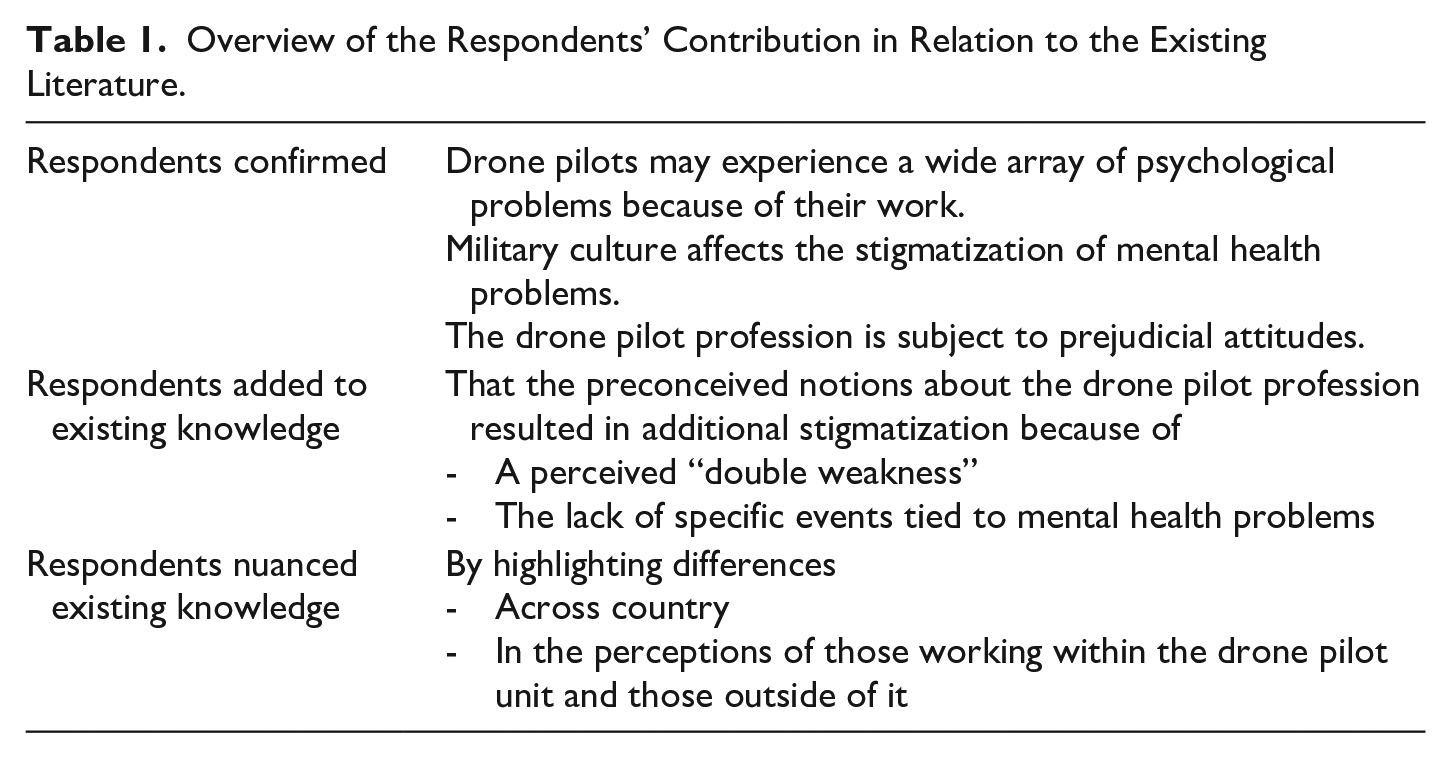
The factors that our respondents suggested underlie the stigmatization of the drone pilot profession thus seem to be rooted in the lack of awareness surrounding the drone pilot profession, and the ways in which drone pilots can be affected by their work. To find appropriate stigmatization reduction strategies, the findings thus suggest that further research should focus on the generalizability of these findings as well as to potential strategies to increase the awareness across military branches regarding the mentally challenging aspects of the drone pilot profession.
Footnotes
Declaration of Conflicting Interests
The authors declared no potential conflicts of interest with respect to the research, authorship, and/or publication of this article.
Funding
The authors received no financial support for the research, authorship, and/or publication of this article.
