



Abstract
A substantial number of soldiers develop moral injuries, yet just as many do not. Therefore, it is important to explore the question: How do military service members generally interpret and cope with moral challenges related to their profession? This article analyzes the accounts of 80 (former) soldiers, examining how they perceived their profession and the coping strategies they tend to use in the face of moral challenges. The findings show that they generally did not experience as much moral tension as one might expect. Yet, when they did, they used coping strategies of simplification, justification, and rationalization, including doing good, rules and instructions, reciprocity, numbing, and compartmentalization. This leads to a middle position between the view that military personnel never experience moral challenges and the position that they find violence actually highly problematic, with important implications for research on moral injury, trauma, and soldiers’ experience.
When a man on a motorbike keeps riding toward the base, ignoring warning shots, when exactly should you fire a shot aimed at him? When you see a local child being harmed, should you intervene and help, even against orders? When local combatants do not abide by any of the laws of war, why should you care about their rights?
The stories that military veterans relate are full of questions like these, revealing the circumstances under which soldiers have to operate and the moral challenges that may come with it. Increasingly, it has become clear that the mental dangers of military deployment lie not only in life-threatening situations, but also in exposure to morally critical situations. “Moral injury” is the relatively novel concept that describes the latter (Litz et al., 2009). The concept refers to the suffering caused by perpetrating, witnessing or falling victim to an act that violates one’s moral beliefs and expectations. Research on moral injury in soldiers is burgeoning (Frankfurt & Frazier, 2016; Griffin et al., 2019; Williamson et al., 2018), yet little is known about how and why soldiers do not develop moral injuries. This is remarkable given that while exposure to morally critical situations is relatively common for deployed soldiers, most soldiers do not develop mental health problems (cf. Rietveld, 2009; Wisco et al., 2017). So how do soldiers experience such situations?
Research on the soldiers’ deployment experiences generally assumes that soldiers draw extensively on coping strategies. One line of research argues that it requires intensive cognitive and bodily conditioning for most people to be overcome their moral inhibitions to violence. Cognitively, soldiers would use strategies of denial, deresponsibilization and justification strategies to reconstruct the use of force as acceptable conduct (e.g., Bandura, 1999; Bourke, 1999; Kimhi & Sagy, 2008; Mackmin, 2007). Another line of research focuses on how even intensive training cannot prevent feelings of guilt (Bica, 1999; Brock & Lettini, 2012; Gray, 1959; Grossman, 1995; Lifton, 1973). Some scholars suggest that lack of remorse after killing is the abnormal response (e.g., Bica, 1999; Grossman, 1995). This unaddressed discrepancy requires further investigation of how soldiers cope with potentially morally injurious situations, or at least try to.
This article examines this question, drawing on interviews with 80 Dutch veterans. In line with the Dutch formal definition of the term, “veteran” refers to any individual who has been deployed on a mission. They may or may not still be in active service. Different from most research on trauma and moral injury, the 80 veterans interviewed for this study purposefully spanned the entire spectrum of moral injury, ranging from veterans without any moral distress to veterans with severe and persistent mental health problems. For some of these veterans, reading the aforementioned deployment scenarios would bring back disturbing memories of the morally critical situations they had experienced themselves, which had wounded their minds. However, almost the opposite would be the case for at least as many others. They would raise their eyebrows at the stressful complexity implied by the scenarios, thinking to themselves that soldiers simply have to be able to cope.
Responses like these were typical, and were also articulated outside of the interviews in interactions with other veterans, for instance in workshops or conferences, or on visits at military units. While virtually all these veterans agreed that situations with major consequences might cause distress, some also insisted that they themselves found their job just as uncomplicated as other people found theirs. For instance, a military acquaintance who had served six tours and had often engaged in combat. “Do they never tell you they just like fighting?” he asked rhetorically, reminding the author of his excitement when he spoke about his deployments.
Similar attitudes could be observed in, for instance, military training sessions on ethics and stress. In one military ethics class in which experienced soldiers participated, the instructor began by jokingly saying what he knew many soldiers were thinking: “Oh God, are we going to talk about ethics?” During coffee breaks, the soldiers said that they found ethics education valuable, but about half of them were not that keen on it because either sitting in a classroom was not their favorite activity or they did not see the use of it. Although most of the skeptical soldiers had been deployed at least once and agreed that one can experience moral dilemmas on deployment, they said they did not see them as “real” dilemmas. “You already know what’s wrong and right,” they would say with a shrug. “You just use your common sense.”
Interestingly, all 80 veterans interviewed for this study recounted uncomplicatedness, including those who eventually developed severe problems that could be called moral injuries. Although most veterans who never developed distress still saw their profession as uncomplicated, for those who did develop moral injuries, this view belonged to the past. Their morally injurious experiences had irrevocably changed their perception of military practice. Yet, to gain comprehensive insight into moral injury, it is important to understand not only veterans’ changed perceptions, but also the perceptions they held before developing moral distress, which many veterans who did not develop problems still hold. The pre-distress memories of veterans who eventually developed distress and the stories of veterans who never did turned out to be remarkably similar.
This article explores the question: How do soldiers in general interpret and cope with potential moral challenges related to their profession? The accounts of the veterans interviewed offer insight into how they perceived their profession in general and into the coping strategies they tended to use in the face of moral challenges. As will become clear, they generally did not experience as much moral tension as one might expect. Yet, when they did, they used coping strategies of simplification, justification, and rationalization, including doing good, rules and instructions, reciprocity, numbing, and compartmentalization. These findings shed light on how soldiers usually prevent moral injury, or try to, and as such on why and when moral injury does arise.
Below, the concept of moral injury is discussed in relation to previous research on coping and moral conflict. Next, the research methods of the present study are explained, after which the research findings are presented, showing, first, how the veterans interviewed for this study understood their profession in general; second, how they interpreted and coped with specific experiences on deployment, and, third, how they made sense of their military experience in relation to civil life. On the basis of this discussion, their accounts are subsequently analyzed as ways to maneuver through moral tension, and as attempts to cope with potential challenges by relying on the belief that all situations are ultimately soluble. The article concludes with a reflection on the implications of these insights for theory on trauma and moral injury, and for our understanding of military experience and sensemaking. To ensure the anonymity of the participants, all names in this article are pseudonyms.
Military Practice and Moral Challenges
In 1994, psychiatrist Shay (1994) coined the term “moral injury.” In 2009, psychologists Litz and his colleagues (2009) were the first to systematically conceptualize the notion of moral injury. They developed a much-cited preliminary clinical model of moral injury upon which an increasing number of studies build their research (Frankfurt & Frazier, 2016; Griffin et al., 2019; Williamson et al., 2018). Although current models of post-traumatic stress disorder (PTSD) are generally based on the assumption that trauma-related suffering is rooted in exposure to life-threat and thus in fear responses, the concept of moral injury focuses on the emotional damage resulting from perpetrating, witnessing or falling victim to perceived moral transgressions. That is, while PTSD is about acts that violate one’s sense of safety, moral injury concerns acts that violate one’s sense of a just and meaningful world (Molendijk, 2021).
Moral injury, thus, is where ethical and psychological issues meet. As such, it partially falls outside the domain of mental disorder (Litz et al., 2009; MacLeish, 2018; Maguen & Litz, 2012). Facing moral challenges is a part of life and suffering pangs of conscience as a result of some challenges can even be considered even desirable, because it allows people to maintain their humanity and guides future behavior (Grimell & Nilsson, 2020). Moral pain should only be called a disorder in severe cases of pathological guilt, shame or anger (Litz & Kerig, 2019).
Nonetheless, most current research on moral injury strictly focus on clinical questions of psychometric assessment, diagnosis and treatment (e.g., Bryan et al., 2016; Currier et al., 2015; Litz et al., 2009; Yeterian et al., 2019). Even when gradual categories such as “moral frustration,” “moral distress,” and “moral injury” are distinguished, the emphasis remains on “clinically relevant degrees of transgressive experiences and impacts” (Litz & Kerig, 2019, p. 347). Non-clinical research on the moral and the non-pathological in moral injury is still scarce.
That said, although the concept of moral injury is relatively new, the phenomenon of moral injury, of course, is not. Much non-clinical literature exists on the stressors of war, implicitly exploring how soldiers deal with moral challenges. As stated, studies on this theme have often taken one of the two following approaches. One line of research argues that for “normal” people to be able to use force, intensive cognitive and bodily conditioning is required (e.g., Bandura, 1999; Bourke, 1999; Kimhi & Sagy, 2008; Mackmin, 2007). These studies argue that, although human beings are generally reluctant to violence, military training helps them to overcome their moral inhibitions to fighting and killing. Among other things, the training of drills, the creation of strong group cohesion and the conditioning of obedience to military superiors would produce a certain moral desensitization (Bourke, 1999; Mackmin, 2007). Military training would alter soldiers’ moral standards in favor of fighting, make them choose collective interests over individual ones and cause them to refrain from questioning orders (e.g., Bandura, 1999; Bourke, 1999; Kimhi & Sagy, 2008). Soldiers would be able to perceive violence as acceptable due to the power of coping strategies such as denial, deresponsibilization and justification (e.g., Bandura, 1999; Kimhi & Sagy, 2008; Mackmin, 2007).
Another line of research focuses on in many cases even such intensive training cannot prevent the emergence of feelings of guilt (Bica, 1999; Brock & Lettini, 2012; Gray, 1959; Grossman, 1995; Lifton, 1973). For some years after the Vietnam War, it was common to describe trauma as “a normal reaction to an abnormal event” (Meichenbaum, 2011, p. 325; Nash et al., 2009, p. 791). Both Grossman (1995) and Bica (1999), in fact, suggest that an absence of remorse after killing is the abnormal response. Grossman (1995) estimates that only 2% to 3% of all soldiers are capable of aggression without subsequent remorse, namely, the percentage of sociopaths that can be found in any male population. Likewise, Bica (1999, p. 88) explains the fact that some soldiers enjoy killing without developing feelings of guilt as “a previous psychological abnormality, or some uncanny ability for rationalization and pretense” and asserts that many soldiers develop profound feelings of guilt due to their participation in war.
So, research on trauma points to military violence as the source of experiences of distress, while studies about justification strategies bring forward these strategies as ways in which people prevent distress when inflicting harm on others. Despite their differences, these two lines of research thus also have something in common: they both assume that a soldier’s job in essence produces moral conflict in the soldier. This supposition also characterizes much research on moral injury, of which most is focused on the impact of combat and killing (Brock & Lettini, 2012; Frankfurt & Frazier, 2016; Litz et al., 2009; Meagher, 2014). In the light of prevailing societal taboos on fighting and killing (Algra et al., 2007; MacLeish, 2018), such an assumption makes sense. But what to make of the responses described in the introduction? What does it mean when soldiers deny that their profession is morally complicated, let alone problematic? Considered from the view that military practice essentially produces dissonance and conflict, soldiers’ denial is to be interpreted as a self-deceiving strategy (see e.g., Bandura, 1999; Bica, 1999; Grossman, 1995). However, that interpretation runs the risk of saying less about veterans’ moral beliefs than about those of the researchers studying veterans. Seriously examining soldiers’ accounts, then, requires a more open approach than one that readily reduces justifications to confirming evidence that military practice is morally distressing.
An important starting point for such a more open approach is an adequate conceptualization of morality. In much research on moral injury, people’s moral beliefs tend to be implicitly construed as an harmonious unity, as a coherent system of matching values and norms (Molendijk et al., 2018). However, ethical theory has demonstrated that people instead embody a complex total of multiple and potentially competing moral beliefs (Hitlin & Vaisey, 2013; Tessman, 2014; Zigon, 2008). People do not develop their moral beliefs in a social vacuum but through the socialization process of becoming members of communities. Communities provide assumptions and meanings through which people understand their experience and make moral judgments about what is acceptable and unacceptable conduct, creating a moral compass that guides their actions. Childhood constitutes an important period of moral socialization, yet the process of internalizing moral beliefs never stops. Interacting with others—including family, social institutions and society at large—a person continuously elaborates acquired values and norms, and adopts new ones (cf. Bandura, 1991; Hitlin & Vaisey, 2013; Zigon, 2008). Accordingly, a person’s moral compass is never an ordered, harmonious system but a “messy” total of moral beliefs and expectations.
At the same time, people are generally unaware of having multiple, potentially competing moral beliefs and of the fact they are continuously navigating tensions between them. Even though moral conflicts are a daily part of life, people live their lives without constantly experiencing conflict, by which they maintain an “illusion of wholeness” (Ewing, 1990). They think of themselves in terms of completeness, coherence and consistency, not in terms of fragmented, shifting selves (Ewing, 1990; Zigon, 2008). Ethical self-reflection only occurs in the case of major moral breakdowns (Zigon, 2008).
So how do soldiers experience the moral tensions of military practice? Their job involves witnessing and potentially using violence in dangerous circumstances. Although soldiers are instruments of the state who must adhere to political norms and legal rules, they also remain moral agents with personal values (Verweij et al., 2022). Even when they agree with all they are ordered to do, they remain members of a society in which different views prevail. While using and witnessing violence can become a “daily part of life” in the military world, in society, violence remains a taboo. Given that soldiers hold multiple moral commitments in high-impact contexts, it is not hard to imagine that they may experience distressing moral conflicts. But is this the case? How do soldiers interpret and cope with moral challenges related to their profession?
Research Methods
The aforementioned question was examined as part of an interdisciplinary research project on moral injury in soldiers. In this project, the grounded theory approach was employed, an inductive and iterative approach aimed at novel contributions to theory through the collection of theoretically relevant data (Charmaz, 2006).
The empirical study involved qualitative, semi-structured interviews with 80 Dutch veterans. As stated in the introduction, “veterans” refers to individuals who have been deployed on a mission and may or may not still be serving on active duty. In accordance with the grounded theory approach, the sampling method was theoretical sampling. Whereas random sampling is driven by the aim to collect data representative of a given population, theoretical sampling is used when seeking theoretically valuable data (Glaser & Strauss, 1967, p. 63). The purpose of the research project was to advance the understanding of moral injury in a way that includes a better understanding of how veterans may not develop moral injuries. Thus, the selected veterans spanned a continuum ranging from veterans without any mental health problems to veterans with severe and persistent moral struggles. Also, the sample included both combat veterans and peacekeeping veterans.
Specifically, interviews were conducted with 40 former Bosnia peacekeepers (deployed between 1994 and 1995 as members of Dutchbat, which were part of UNPROFOR, the United Nations Protection Force, a UN-led peacekeeping force in the former Yugoslavia) and 40 Afghanistan combat veterans (deployed between 2006 and 2010 as members of Task Force Uruzgan, which were part of ISAF, the International Security Assistance Force, a NATO-led force in Afghanistan). Between July 2016 and March 2017, 40 interviews (20 Bosnia veterans, 20 Afghanistan veterans) were conducted. The interviews followed a life story approach, only probing moral issues when they emerged in the respondent’s account. Also, 40 interviews (again 20 Bosnia veterans; 20 Afghanistan veterans) were selected from an existing database of interviews conducted by the Netherlands Veterans Institute as part of a life story initiative. The interviews of these samples were conducted between 2008 and 2014. These archived interviews were remarkably similar to the first 40 interviews. Although the interviewer often did not specifically inquire about morally loaden topics, these often emerged nevertheless. As such, these interviews also served the purpose of triangulation, providing accounts without the researcher specifically seeking data about moral dimensions of military practice.
Data coding and analysis was conducted with the qualitative data analysis program ATLAS.ti, following guidelines for interpretive grounded theory research (Charmaz, 2006). This means that the analysis occurred largely inductively. Initially, coding took place on the basis of the factors evoked by the interviewed veterans (e.g., “adrenaline,” “orders,” “it was him or me”) and the ways in which veterans interpreted the situation (e.g., right, wrong, non-moral). Veterans’ accounts were thus analyzed by focusing simultaneously on content (e.g., the situation and the factors involved in the situation) and meaning (e.g., evoking orders to justify a decision, or, conversely, to condemn a situation). This process resulted in codes such as “rules and instructions” and “moral distancing and numbing.” The focused coding phase involved grouping codes that had emerged in the initial coding phase into more abstract categories. Initially, it was attempted to distinguish between different values or value sets, but disentangling veterans’ accounts in this way turned out to be virtually impossible. For instance, it became clear that professional values such as obedience to “rules and instructions” were often also deeply personal values, while personal tendencies such as “moral distancing and numbing” were not always seen as contradictory to professionalism. Moreover, it became clear that disentangling veterans’ accounts like this would eliminate the multiplicity and complexity of some experiences, while a noticeable feature of many distressing experiences was this very multiplicity and complexity. Therefore, it was decided to group the emerging concepts from initial coding into categories such as “justifications and rationalizations” and “inconsistency in interpretations.” Finally, these categories were identified as coping mechanisms, specifically as ways of “making soldiering less complex,” and thus grouped these categories into a core category with this label. Table 1 shows the final results of this process.
How Soldiers Interpret and Cope With Moral Challenges: Coding Results.
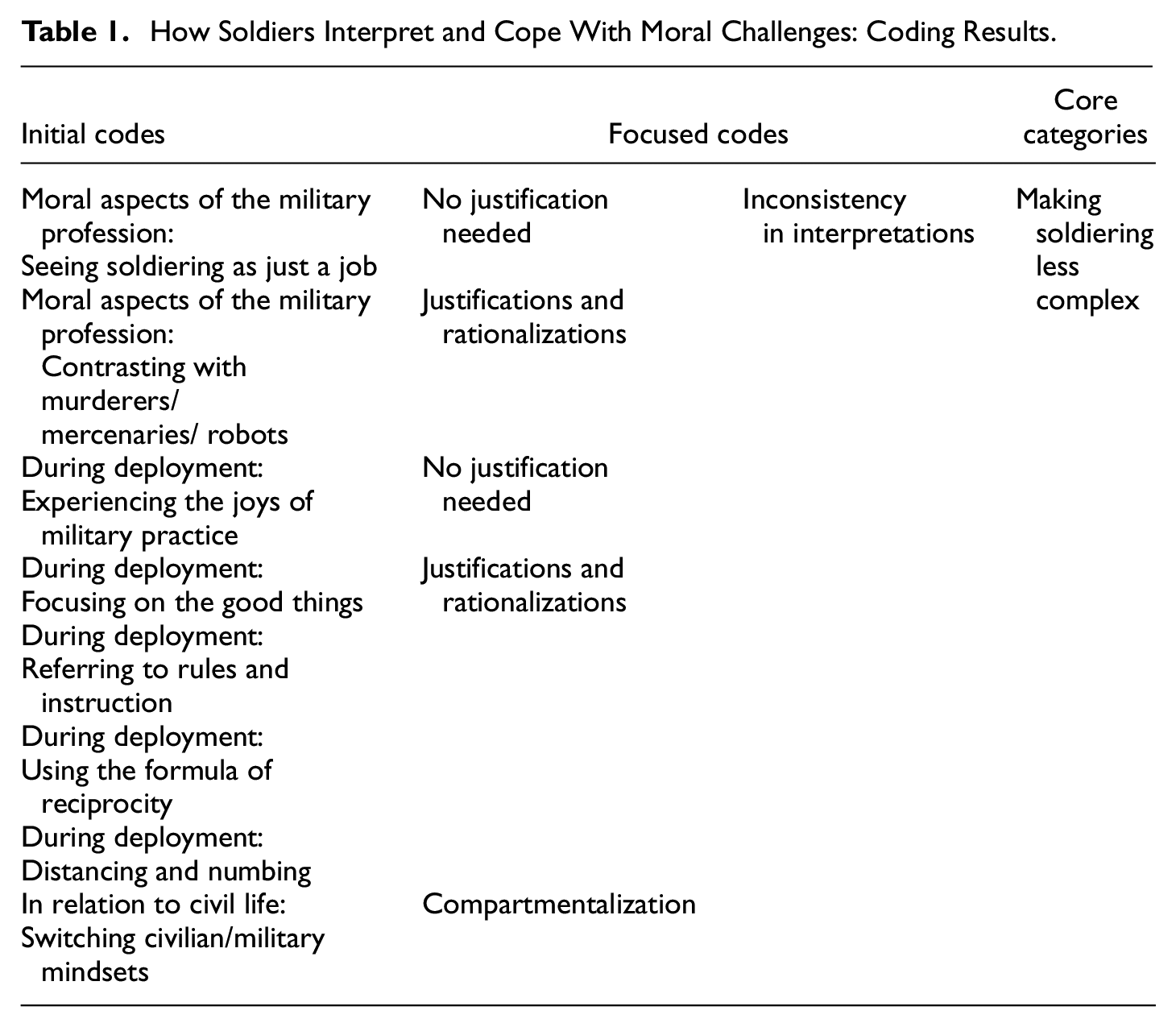
The following sections discuss the research findings, structured according to key themes that were identified: moral aspects of the military profession (including the themes “soldiering as just a job” and “contrasting with murderers/mercenaries/ robots”), moral challenges during deployment (including the themes “the joys of military practice,” “thinking of the good things,” “referring to rules and instructions,” “using the formula of reciprocity,” and “distancing and numbing”) and the military profession in relation to civil life (including the theme “switching civilian/military mindsets”).
Moral Aspects of the Military Profession
For about half of the veterans interviewed, it had always been quite obvious that their profession had a significant moral aspect. These veterans said that even if not their primary reason for joining the military, they expected and hoped they would be able “to help people” or at least “to do something useful” on their mission. At the same time, just as many veterans did not mention any altruistic motives and insisted they lacked any such motive. For instance, when inquired whether it mattered if the mission had “some kind of point,” these veterans would shrug in denial, clarifying that although they would have found it “a big plus” if the lives of the locals improved, it had not been a motive. They had joined the military because they liked sports and adventure, they said, not because they wanted to help people. Some veterans mockingly called my inquiries about goals or purposes “typically civilian questions” and joked that the military “should not be mistaken for an NGO.”
These two views were present among both former Bosnia peacekeepers and Afghanistan combat veterans. This is not as exceptional as it may seem. It has been well-documented that despite buzzwords like “serving the country,” most soldiers living in countries at peace do not see military service as heroic sacrifice. Contrary to common belief (Krebs & Ralston, 2022), few veterans are particularly concerned by abstract ideology. Their primary motives to serve are their affinity with sports, the attraction of comradeship, the benefits of a relatively good salary and free education opportunities (Bar & Ben-Ari, 2005; Bourke, 1999; Gibson & Abell, 2004).
Countless times, the veterans mentioned “putting my training into practice” when asked about their motivations for deployment. Then again, when asked whether they considered themselves comparable to mercenaries, they all denied this to be the case. Many veterans emphasized that “I am not a murderer” and that “I am not a robot.” The need to do so indicates that these veterans also saw their profession as morally significant. They were certainly not opposed to the use of force, but their statements suggest that they did need it to occur within a framework that gave them justification, and that they needed to see themselves as moral agents acting out of their own will and values. As long as this was the case, it seems, they did not find their job morally problematic.
Moreover, many veterans emphasized that overly idealistic expectations are actually dangerous. Former NCO Mushin, for instance, said, “When a new guy comes in and says ‘I want to help the local population’ we immediately say, ‘Fucker, you’d better not think like that, you’ll come back broken’.” As Mushin and others suggested, at the start of their career, many veterans had already learned that they should rid themselves of the ideal of helping others, as these were considered dangerous illusions. So, the lack of great ideals in soldiers can in part be understood as a preventive coping mechanism that paradoxically underscores the moral significance of a soldier’s job.
Challenges During Deployment
How do perceptions like these work in practice? Specifically, how do soldiers interpret and cope with events of tangible violence and suffering on deployment without developing distress? The section below disentangles the interpretations that featured most frequently in the accounts of the veterans interviewed.
The Joys of Military Practice: No Justification Needed?
Military talk stands out in its use of technical terms for manifestations of violence. “Troops in contact” and “kinetic action” refer to combat situations. “Use of force” is infliction of harm, and “to neutralize” or “take out,” specifically, is to wound or kill a person in the opposing party. “Friendly fire” or “blue on blue” is the accidental killing of a person in the own troops, and “collateral damage” means that civilians are unintentionally wounded and killed. The stories that veterans told were full of such technical military jargon. As these examples show, technical jargon not just describes and distinguishes particular phenomena, it also euphemizes them into non-emotional and non-moral issues (Bandura, 1999). Consequently, no justification is needed for these phenomena.
Generally, the veterans interviewed were matter-of-fact about their experiences. Consider the following anecdote:
We fought all day. And it was like, the spiral of violence grew tighter and tighter, and when the helicopters have to leave at one point to refill their tanks, there’s no air support anymore, things get risky, and everyone is then—when you’ve been fighting nine hours, nobody who’s not a combatant has any reason to be there. And so the guy running there, he might have just put down his weapon, or is just running to a weapon, he goes down too. Yeah, that’s the way it is.
In this anecdote, the veteran explained that he killed a man who he could not identify as a combatant with absolute certainty, meaning there is a small chance that the man was a civilian. The veteran is one of many who spoke about deployment events without offering extensive explanations. It is just “the way it is,” and “things like this can just happen,” they would say.
Although the veterans interviewed often employed a factual narrative style, at the same time their accounts were usually more “raw” and less “clean” than technical texts of military reports, for instance, would be. Many combat veterans, for instance, said that they got “a kick” out of engaging in combat:
I found it good, a very special feeling. Combat is just something that . . . you soar above yourself. You become like, if you’re past the fear, at one point, it’s something very unique. And something very . . . primal. Just, warrior, destruction. . . . You feel like some kind of god. You heard mortars slamming. We were like “fuuuck!” [laughs]. You’re going to get yourself amped up, like “we’re going to fuck them up!” . . . You can’t go and think, like “oh they have families too,” you know. . . . You just know what to do. You’re not scared of anything. Look, you’ve got to psych yourself up a bit. The last thing you want is for it to go wrong, that you hesitate, that you think: that’s a human being too. At that moment it’s him or me. You know, in the past we fought each other with swords. Man is just an animal, you know. You have to see yourself as an animal too.
Other scholars have also observed that military accounts are often filled with statements of joy rather than expressions of moral concern. World War II veterans turned philosopher Jesse Glenn Gray (1959, p. 28), for instance, notes that many soldiers are attracted by “the delight in seeing, the delight in comradeship, the delight in destruction.”Bourke (1999) and Bar and Ben-Ari (2005), too, argue that once soldiers overcome their resistance to fighting and killing, they often enjoy it. As Brænder (2016, p. 19) signals, soldiers coming home from war may “return wanting more.”
So, the veterans’ accounts were not just ridden with clean technical terminology, but with raw, emotional and dirty speech too. They described a confluence of antagonistic feelings, including fear, adrenaline and excitement. Yet, euphemistic technical talk and talk of the bizarre beauty of destruction have something important in common. They make moral questions look irrelevant, thus rendering justifications and rationalizations unnecessary. Such talk makes it possible to think and speak of military practice without justification or rationalization.
Justifications and Rationalizations
That said, in speaking of deployment events as “the way it is,” and as things that “can just happen,” veterans did more than merely describe their experience. They also made a statement, namely that one cannot and should not judge. However, as their distinction between murderers and killers reveals, this does not mean that they believed there is no morality in military action whatsoever, that “all is fair in love and war.” If they did, they would not have found moral explanations for their conduct. But just as often as they refrained from explanations, they did explain their conduct as right or excusable. There were four kinds of justifications and rationalizations that veterans frequently offered: doing good, rules and instructions, reciprocity and numbness.
Particularly veterans who hoped they would be able to help other people tended to give examples of how they had been able to “do good” on deployment. These examples, however, were always rather modest. They were very specific examples of how they had been able to do something good during their deployment, or declarations such as “I’ve been able to give at least one person a smile on his face.” Such statements suggest that “doing good” is not only satisfying in itself, but serves as compensation when bigger accomplishments are hard to identify.
Besides doing good, many veterans put forward rules and instructions to explain events. In line with other studies (e.g., Bourke, 1999; Grassiani, 2013; Kelman & Hamilton, 1989), rules and instructions in fact constituted the explanation most frequently offered. Veterans from all ranks frequently stated that “those were simply your drills,” they “just had to follow orders,” they were “bound by the Rules of Engagement,” and that their decisions were “dictated by the mandate.” Besides factually describing institutional constraint, statements like these served as a coping strategy. Take the following anecdote recounted by NCO Thijs:
We were on patrol, and then we heard colleagues had engaged in fire contact, and that we had to go there. And on our way there, we saw a woman with a small child, dead in her arms. She asked us for help, but we couldn’t help, because our prio was to go to that fire contact. So, yeah, you let a person stand there at the side of the road with a dead child. . . . I was the one who said . . . “Shouldn’t we do something?” [but my commander said,] “Our prio is to go there, so no, we can’t now.” Well, then there is nothing I can do, you know. At least, for myself, I said it.
Thijs had not found the situation easy, but he had been able to come to terms with it because he believed he had done all he could; he did not have the power and did not consider it his responsibility to do more than what he did.
Many veterans suggested that as long as they followed the rules and instructions, they could not be held responsible for their conduct, since they were not the ones who made the rules or issued the orders. Moreover, many expressed a belief in the rightness of adhering to rules and instructions, stating that even if one does not agree with a decision personally, obedience and conformity are still the right thing to do. So, often, when veterans used the rationale of rules and instructions, they did not deny their personal responsibility, but rather the opposite. Adhering to superiors’ instructions and “putting aside” one’s personal beliefs was regarded as their responsibility. Paradoxical as it may sound, they believed that an instrumental position—acting as an instrument of their organization and the state rather than out of their personal beliefs—was the soldiers’ moral responsibility.
Still, soldiering cannot always be as straightforward as following rules and instructions. Even when the rules and instructions are clear, they are always indefinite. For commanders, moreover, it is their very job to issue orders. 1 Hence, besides adherence, veterans often invoked the rationale of “it was him or me.” Unsurprisingly, veterans said this when talking about direct fire contact. Yet, some used it for other scenarios, extending “him or me” to “them versus us” (opponents versus colleagues), and beyond direct situations of “kill or be killed.” A field artillery veteran, for instance, used the phrase when speaking about operating a long-distance howitzer. “It’s him dead or me dead,” he said. “Well, that’s an easy choice for me. My colleagues asked for my support for a reason.” Although the veteran had been in no direct danger when operating the howitzer, he still used “him dead or me dead” to refer to the opponent versus the infantry colleagues he supported. So, soldiers used him-versus-me not only as a rule of survival but also as a formula of reciprocity, thus as a formula of fairness, of “doing unto the other as he would do to you.” 2
The final explanation that veterans offered for deployment events was emotional distance and “numbness.” They mentioned numbness, for instance, to rationalize negative or indifferent behavior to the local population. Most veterans recounted being initially affected by the poverty and suffering they saw, especially seeing children walking around barefoot and in dirty clothes. In the course of the mission, many veterans developed a kind of friendship with the children who hung around the observation posts. At the same time, many found themselves becoming indifferent—“numb”—to the local people’s suffering. Several veterans disclosed, for instance, that they had pushed away children begging for sweets, and openly ridiculed adults.
Both Bosnia and Afghanistan veterans mentioned this numbing process. In line with study findings on U.S. and Israeli soldiers (Grassiani, 2013; Lifton, 1973), the Dutch veterans said that their negative behavior to the population was because they had become desensitized to the pain of others. Interestingly, however, many veterans also gave desensitization as an example of good conduct. They related having deliberately “built a kind of shield around myself” because they needed it “to do my job.” Consider these words by Bosnia veteran Frank:
On social patrols, I didn’t go inside houses. I wanted to keep a distance, I didn’t want to bond too much with the people [because] that makes you weaker. I didn’t want to go and drink Slivovitz [local brandy] with them. You have to do your job.
Frank had fully experienced the infamous fall of Srebrenica. 3 He felt that because he had kept a distance throughout his mission, he had been able to stay alert and keep functioning.
Like Frank, many veterans saw emotional and moral detachment as professionalism. Indeed, this is what they had been taught in training, including phrases such as “you can switch off emotions.” Traditionally, soldiers are trained in “disciplining the emotions” (Bourke, 1998), and in being able to “suck up” feelings that may hinder them in performing well (Molendijk et al., 2016). This includes a process of self-distancing and to some extent even self-dehumanization, as is indicated by the names Dutch soldiers call themselves, such as “bodies” (lichamen) and “carcasses” (kadavers). As mentioned, soldiers teach themselves and each other to stay aware of the fact that they are “just instruments of the state.” Accordingly, many veterans linked emotional and moral detachment to professionalism. Some seemed to approach detachment as a goal in itself, others explained it as a way to prevent doubts and worries, and yet others (like Frank) seemed to see it as a way to be able to do what they thought was morally right: their “duty.”
The Military Profession in Relation to Civil Life
Although explanations such as following orders, reciprocity and numbness may work in a military belief system, they have little impact on potential tension between the military belief system and the beliefs soldiers have developed as civilians. In the civilian world, these justifications do not apply as they seem to do in the military. Violence and killing, specifically, are not as easily justified in a civilian setting as they are in a deployment area, both in legal and in moral terms. This raises the question of how soldiers deal with such cultural and moral differences. Why does war not produce aggressive individuals in general, and how can so many veterans re-adapt on their return from deployment?
A frequently offered answer to these questions is that soldiers draw a strict line between the civilian and military moral sphere (Berghaus & Cartagena, 2013; Bourke, 1999; De Swaan, 2015; Senger, 1985). Soldiers may even compartmentalize their military and civilian identities, keeping them in separate “compartments” of the self and act on each other only in distinct contexts. By not activating incompatible identities at the same time, they can maintain each one separately. Such psychological compartmentalization is often facilitated by social, institutional and political compartmentalization (Berghaus & Cartagena, 2013; De Swaan, 2015). For instance, it is not just soldiers but also the military organization and society at large that distinguish between “killing” and “murder” and between “using force” and “committing violence.”
The interviewed veterans’ accounts echo the notion of compartmentalization. In typical military parlance, veterans often said they “switched mindsets.” One veteran phrased it as follows: “I always kept in mind, what’s there is there and what’s here is here, period.” Many veterans said, “I just did my job” on deployment, and at home “I’m just a civilian.” In a military context, they did what their superiors told them without needing to fully understand the purpose of their assignments, while in a civilian context, they would rather engage in discussion before following orders blindly. In the field, they had brothers-in-arms for whom they would risk their lives and opponents they would shoot without hesitation, while at home, their world was far less dichotomous than a realm of friends and foes. On deployment, they may have acted negatively and even aggressively to the locals because “that’s just the way it is” over there, but at home, they would not act like that at all.
Meanwhile, many veterans emphasized that they did not find their job so extraordinary. They stressed that “it’s just a job,” and away from that job, they are simply civilians. 4 Sure, they added, some of their fellow civilians are opposed to the use of force, but don’t they have “the luxury of judging war from a safe distance because we take up that nasty job for them?” Don’t “we go to war so that others do not have to?”
Statements like these indicate that soldiers’ compartmentalized mindsets can actually justify one another. By declaring that they find war “just as nasty as civilians” do, soldiers are able to see the military job as more virtuous instead of less virtuous because it means that they are morally courageous for taking up the job. They are able to assert the presence of a yin/yang kind of balance, not only between soldiers and society but also within themselves. This allows them to justify soldiering, not despite the fact that soldiers are also non-violent civilians, but because of it. In this respect, considering themselves both soldiers and civilians makes it easier rather than harder for them to do their job.
Analysis: Maneuvering Through Tensions
How to interpret the ways in which the veterans made sense of the moral dimensions of their job? As discussed, most research on this topic tends to approach military practice as inherently ridden with moral conflict (Bandura, 1999; Bica, 1999; Brock & Lettini, 2012; Grossman, 1995; Meagher, 2014). The findings of the present study showed that although military practice certainly gives rise to tensions, it does not always produce as much conflict as one might expect given the circumstances in which soldiers operate. These findings led to a middle ground between the view that soldiers never experience moral challenges and the position that they find violence actually highly problematic.
Although the veterans interviewed sometimes drew a distinction between being a “soldier” and a “human being,” more often they did not. Instead, their stories revealed that having control over life and death may be not only disturbing but also pleasurable, and that military duties and values may simultaneously be personally felt commitments. Furthermore, insisting on following orders may not only mean refusing to accept responsibility but may also derive from a personal conviction that obedience is the right and responsible thing to do, and shutting oneself off to suffering in others may not always imply moral desensitization but may also be necessary to continue doing good work. Although the political objectives of a mission may not give soldiers a sense of purpose, they can compensate for this lack of purpose by focusing on military goals (doing one’s job) and personal goals (making at least one person smile and/ or putting one’s training into practice). Finally, while soldiers may experience dissonance between the military environment and society at large, they may also experience a sense of balance between the two.
That said, the stories of the veterans interviewed were not always consistent in their justifications, which suggests that although soldiering does not necessarily produce conflict, it is not altogether without tension either. In some cases, for instance, a veteran would invoke the rationale of rules and instructions as an absolute imperative overriding all other concerns (“we just have to do what we’re told”; “we’re simply bound by the rules of engagement”), while in other cases, the same veteran would easily set this commitment aside (giving food to locals “even though it was against the rules”; “nice that we’ve got international laws, but war has never been anything pretty”). In these cases, veterans presented themselves as either obedient soldiers, autonomous moral agents or humans with shortcomings pressured by the nastiness of war, not as all of these persons at one and the same time.
So, while the veterans’ accounts indicate that the various roles that soldiers assume (instrument/agent; civilian/soldier) are not incompatible by definition, the inconsistency in their accounts on the whole suggests that these roles do not always co-exist in harmony either (see also Kümmel, 2018; Op den Buijs et al., 2012). When roles do conflict, it seems, soldiers may respond by assuming one role and rejecting the others. By being inconsistent in this, they do not have to give up any of the roles. A flexible, sometimes inconsistent use of various justifications offers them a way to maneuver through the tensions they encounter when their multiple moral commitments turn out to be irreconcilable, without experiencing irresolvable conflict and without experiencing a loss of one of their self-perceptions.
As mentioned, people tend to see themselves and the world in terms of coherence. The fact that one does not—and cannot—always behave consistently appears to be an unpleasant fact, and people need to deny unpleasant facts in order to protect themselves (Ewing, 1990). That said, denial of tension may be particularly strong among soldiers, whom the military has taught to rely on a “can-do” attitude and perceive doubt, uncertainty and conflict as bad things (Soeters et al., 2006). That is, soldiers are taught to interpret situations such that they become uncomplicated and always soluble, while at the same time, they will have to deny that the very reason they adopt such an interpretation is because military situations are often complicated and without real solution.
Conclusion and Discussion
Soldiers are both service members and civilians, and both instruments and agents. As soldiers assume multiple roles with competing moral requirements, one might expect military practice to be defined by fundamental tensions. But is this really the case in the experience of soldiers? To answer this question, this study adopted a more open approach than the one that readily reduces justifications to evidence that soldiers actually find their job highly problematic. The veterans interviewed generally did not experience as much conflict as one might expect. Yet, this does not mean that they never felt tension, and when they did, they tended to resolve it by relying on the belief that all situations are ultimately uncomplicated and soluble. A flexible, sometimes inconsistent use of various unequivocal justifications enabled this.
In short, one could say, if one sees something as uncomplicated, it is uncomplicated. However, soldiers may also be confronted by events for which simple justifications turn out to be untenable, especially since military missions are becoming ever more complex. Present-day missions are often asymmetrical, not “fair play”; and in most situations, “kill or be killed” does not apply. Contemporary soldiers often have to work among and sometimes with civilians, while insurgents may disguise themselves as civilians and use civilians as cover, thus increasing the risk of non-combatant casualties. Furthermore, today’s soldiers often have to assume both combat and humanitarian roles. They may have to fight, build good relations with the local population, and engage in stabilization and reconstruction work, all in the same mission, and when these tasks conflict with one another, they may leave a soldier unsure of the right thing to do, and even of the right person to be. In other words, contemporary missions confront soldiers with many moral complexities that seem difficult to simplify and resolve. As shown elsewhere (Molendijk, 2018), when a soldier is confronted by a high-stakes situation that resists straightforward justifications, this may produce disorientating inner conflict. It could in fact well be that some of the clear-cut explanations quoted here were actually attempts to stifle latent inner conflicts, which may or may not have turned out successfully.
This has implications for how we examine moral injury and military trauma in general. As mentioned, most research on moral injury focuses only on combat soldiers, particularly on the moral impact of killing. The stories of former Bosnia peacekeepers and Afghanistan combat soldiers show that both combat and peacekeeping operations have the risk of producing moral injuries, because it is not just fighting and killing that may be experienced as morally transgressive. The killing of an armed opponent may be accommodated within existing frames of justification, while at the same time it may be powerlessness in the face of great injustices that disturb soldiers.
In general, while current studies on moral injury concentrate on straightforward moral transgressions (Frankfurt & Frazier, 2016), today’s soldiers face morally ambivalent situations that are not as easily resolved. They may experience moral dilemmas in which adhering to one value inevitably means the violations of another, being so morally overwhelmed that it produces moral detachment, and feelings of senselessness (see also Molendijk, 2018). This also means that the onset of moral injury may not always be the result of a soldier’s failure to apply certain coping strategies, as studies suggest (Hossain & Clatty, 2021) but also of the realization that their coping strategies have become untenable in the face of particularly critical realities.
Moreover, although current research on moral injury focuses only on isolated “events” (Frankfurt & Frazier, 2016; Griffin et al., 2019; Williamson et al., 2018), it seems important to expand the focus to the wider context that is an extricable part of the meaning a soldier attributes to an event (see also Molendijk, 2019). The stories of the veterans interviewed for this study were never only about specific events. Not one veteran invoked just the one disturbing event; there were always more. And when veterans described a disturbing event, they typically set them in the context of organizational and political decisions that caused the event and that determined the aftermath of the event, and they invoked the societal perceptions surrounding their deployment. For instance, they spoke about how the decision-making and instructions of their leaders led to the emergence of a particular moral dilemma, and about how media coverage back home fed their family and friends distorting narratives of their mission that alienated and isolated them from society. Together, all these elements shaped the meaning veterans attributed to each of these events, and it is the meaning of an event that does or does not make it disturbing. The situations that may injure soldiers, thus, are always about organization, political and societal factors as well. This insight, in fact, is what Shay (1994, 2002)—the “founding father” of moral injury—has always emphasized in his work on moral injury.
Finally, besides research on trauma, this study has implications for research on soldiers’ lived experience and military sensemaking more generally. When researchers hear soldiers making contradictory statements, they tend to try and resolve which one is sincere and which is false. Yet, as shown, paradoxical utterances may also be a logical reflection of the moral complexity of the military job, and should in such cases both be understood as genuine rather than that only one of several conflicting statements are taken as truly expressive of people’s experience. Therefore, researchers should be particularly aware of potential tendencies in themselves to readily approach contradictions in research data as kinks that need to be ironed out. When taking contradictions and other inconsistencies in soldiers’ stories seriously, it becomes possible to illuminate important aspects of soldiers’ experience and of the cultural and material systems in which their experience is embedded, which otherwise go unnoticed.
Footnotes
Acknowledgements
I thank Martin Elands of the Netherlands Veterans Institute for providing access to the institute’s interview collection. My PhD project formed the basis for this article. I thank my supervisors, Désirée Verweij, Eric-Hans Kramer and Willemijn Verkoren. Part of this article has been previously published in 2021 in Chapter 3 entitled “That’s Just the Way It is”: Uncomplicated Soldiering of my book Moral Injury and Soldiers in Conflict: Political Practices and Public Perception. It is reprinted with permission from Taylor and Francis.
Declaration of Conflicting Interests
The author declared no potential conflicts of interest with respect to the research, authorship, and/or publication of this article.
Funding
The author received no financial support for the research, authorship, and/or publication of this article.