




Abstract
One of the main tasks of the armed forces is to recruit and select future soldiers and to identify potential officers. However, these procedures may have a wider societal impact beyond the borders of the military organization itself. This study aims to examine how compatible assessments of military leadership potential are with those in the labor market. Using longitudinal data concerning a large cohort of Swedish males who underwent mustering during the early 1970s, we analyzed the association between officer suitability assessments and managerial role occupancy at age 50 to 55, while controlling for socio-demographic factors in childhood and adulthood. We found a high level of predictability, whereby those who were ranked highest were four times more likely to hold managerial positions than those with the lowest ranking. Results are discussed in relation to perceptions about leadership skills and possible institutional isomorphism between the armed forces and other societal organizations.
Keywords
The main objective of military organizations is to secure and protect the nation they serve. To fulfill this role, military organizations are highly dependent on human beings in various roles and functions. At the outset “the military relies on members of society to fill its ranks” and “the Army takes civilians and turns them into soldiers” (Shields, 2020, p. 8). The military is from this perspective a typical human service organization whose function is to not only change people (turn them into soldiers or officers) but also to process them and to confer public statuses on them (Hasenfeld, 1972). The main aim of mustering procedures is, for example, to determine who is fit for combat and who is potential officer material. Understanding the preconditions for fulfilling that task in the interplay between the military and its societal environment is therefore essential. Recruitment and retention difficulties in connection with downscaling or a switch from conscript to volunteer armies have contributed to a greater interest in “people issues” within army organizations in recent years (Alexandrou & Darby, 2006). Such issues are no less relevant in the military-society nexus. For example, bridging environment theory posits that military service may offer less-advantaged persons a chance to acquire skills and other resources that may facilitate transition to civilian life and promote socioeconomic attainment (Fredland & Little, 1985; Kleykamp, 2009). When universal conscription was reactivated in Sweden transferability of skills gained during basic training was highlighted, suggesting a conscious emphasis on the military’s role as human resource manager for society at large (Strand, 2023).
Apart from supplying a sufficient number of competent soldiers, one of the main objectives of military people-processing and -changing is to provide enough and suitable officers. Identifying and making good use of leadership material deserves particular attention within the broader topic of recruitment and retention, not least when recruitment bases shrink, turnover increases, and potentially all sectors in society are competing for the same staff—not least leaders (Cregård & Corin, 2019; Danielsson & Carlstedt, 2011; Percia David et al., 2019). This observation is a reminder of one of the fundamental issues within leadership research—namely whether leadership is basically a generic or a context-specific skill (Wasserman et al., 2010). The “management industry” sees leadership as the glue that binds organizations and catalyzes them to achieve success and leadership as largely generic. Military organizations obviously expect leadership to enhance warfighting functions (Fallesen et al., 2011). Historically, warfare and the military organizations created for that purpose have probably been the most “critical components in the early developments in the practice of leadership” (Grint, 2011, p. 4). It is fair to say that the military has been a source of taken-for-granted ideas about leadership in the wider society. Empirically, it has also been found that military leadership skills and experience often become assets in civilian contexts (Galily & Shimon, 2012; Kirchner & Akdere, 2017; Marshall-Mies et al., 2000).
The focus of this article is, however, not career- or life trajectories after transitioning into civilian life according to, for example, bridging environment theory. Rather, we seek to examine the implicit leadership theories within military and nonmilitary settings—that is, whether perceptions of leadership potential are the same, regardless of the context.
The analysis will depart from an institutionalist approach to organizations, whereby rationalistic accounts of organizational behavior are confronted by explanations of organizational embeddedness in larger cultural and political contexts. Without plunging into the possible distinctions between “old” and “new” institutionalism (Selznick, 1996), the main point is the focus on legitimacy as an organizational imperative. One of the basic tenets of institutional theory is how organizations facing similar challenges tend to respond in the same way. Over time, norms and rules evolve in the organizational environment which, in turn, limit their discretionary power and leave them in an “iron cage.” Within this broad approach, we will focus on isomorphism, that is, the process by which organizations in a field tend to take after each other to be recognized as legitimate. In their seminal work, DiMaggio and Powell (1983) identified three main driving forces behind this process; coercive (pressure to conform to external laws and mandates), normative (pressure to conform to professional standards), or mimetic (imitation of successful organizations’ structure or practices; DiMaggio & Powell, 1983). The more mature a field becomes, the more “infused” it becomes with taken-for-granted norms, ideas, and rules (Powell & DiMaggio, 1991).
Over the years, this theoretical approach has become quite “institutionalized” itself and has been studied in a wide array of contexts, including the armed forces (Coticchia & Moro, 2016; Wachholtz & Soeters, 2022) and highlighting a multitude of organizational structures and behaviors. These also include recruitment, selection, and training practices—within, as well as outside, the armed forces (Baker & French, 2018; Chapman et al., 2018; Segal & Ender, 2008). Isomorphism inherently focuses on similarity and convergence—whereby pressures toward divergence or organizational stalemate may easily be overlooked. Lack of clarity about the definition and measurement of conformity, as well as which organizational characteristics are being studied, have also led to a questioning of the empirical and theoretical validity of institutional theory in this regard (Ashworth et al., 2009). We therefore set out to study the proof of the pudding in one specific domain—that is, in actual selection or recruitment practices. As suggested by DiMaggio and Powell (1983), normative and mimetic pressures are not necessarily empirically distinguishable, and both involve managerial behaviors reflecting taken-for-granted assumptions rather than conscious strategic choices. Hence, we seek to study the possible mimetic pressure on nonmilitary organizations of a military perception of what constitutes a (good) leader.
Aim
The aim of this study is to examine whether perceptions of leadership skills in the armed forces and labor market organizations at large may be characterized by institutional isomorphism. That is, whether the historical influence of the armed forces in developing leadership ideals are institutionalized norms which other, nonmilitary, organizations tend to mimic—regardless of context and the task at hand. More specifically, we analyze how well valuations of army officer suitability in connection with mustering predict leadership role occupancy in working-life later in life, while controlling for individual and demographic factors in childhood and adulthood.
In this way, we seek to extend the literature on institutional isomorphism to include organizations that are not bound together in a certain field or industry, and that are separated temporally. Furthermore, our study contributes to leadership research by validating perceptions of leadership skills in early adulthood with actual leadership role occupancy in adulthood. We do this using a prospective design and following a large cohort over a long period of time. Studies of leadership emergence have otherwise largely been retrospective in character, based on small samples consisting of persons who already occupy a leadership position, thereby suffering from a selection bias. Finally, we reflect on potential drawbacks of such mimicking and the underlying generic approach to leadership.
Leadership Emergence and Assessment of Leadership Potential
The leadership potential literature has been described as a “hot mess” of conceptual and measurement issues with no consensus concerning the definition and assessment of leadership potential (Bouland-van Dam et al., 2021). Closely related to this issue is the perennial debate about whether leaders are born or made (Van Wart, 2003). Should we primarily focus on identifying “born” leaders, or on designing the best possible training and education programs for those who have a certain potential/interest for leadership roles? Are, then, assessments of leadership potential in one, specific, context applicable also in other settings? (Mumford et al., 2017). The latter is not only a theoretical issue, but also a question of whether we are overlooking leadership potential (Player et al., 2019).
Military leadership is characterized by the need to prepare for severe conditions, high uncertainty, and exposure to lethal force. Lack of leadership in uncertain situations may have dramatic consequences, and therefore a great deal of effort has been made to identify military-specific leadership skills and how to train leadership within this context (Hedlund, 2019; Meerits & Kivipõld, 2020; Wong et al., 2003). Leadership ideals may also differ substantially between organizational cultures and the task at hand, which means that the same characteristics may be perceived as more or less advantageous in different contexts (Swain & Korenman, 2018). However, all leadership is basically about influencing others to accomplish shared objectives. The armed forces’ need to fill the ranks of officers is shared by other organizations’ need for managers. The question is, however, whether the perceived necessary qualities and skills are the same. From an institutional point of view, external norms and pressures may lead to assessments of leadership potential based on prevailing norms in the environment rather than the organizational needs.
Our first research question is, then, whether judgments of leadership potential in a military context are valid even in other societal contexts, and over time, as manifested through actual leadership role occupancy. This may be translated into the following hypothesis:
Leadership emergence is generally related to individual and socio-demographic factors, such as cognitive capacity (IQ), personality, motivation, education, birth order, socio-economic status—as well as gender, body height, or facial appearance. Researchers have increasingly recognized the importance of adopting a life-course perspective in this regard (Liu et al., 2020; Zaccaro et al., 2018). Such factors are often consciously included in formal assessments of leadership potential—particularly those focusing on personality, IQ, behavioral competencies (Allen et al., 2014; Meerits & Kivipõld, 2020; Potočnik et al., 2021). Assessments may, however, also reflect perceptions about leadership potential or so-called implicit leadership theories held by decision-makers. These perceptions may also be shaped by gender stereotypes, timing, verbal and nonverbal cues, and informal perceptions of intelligence (Bruckmüller & Branscombe, 2010; Epitropaki et al., 2013; Rubin et al., 2002).
Intelligence is usually regarded as a foundational trait which is relatively stable over time and not context specific, and thereby a causal precursor to the development and expression of specific leadership capacities (Zaccaro et al., 2018). Testing cognitive capacity has therefore become increasingly common in recruitment and selection in general, particularly for leadership positions (Kaufman et al., 2022). Mustering procedures have also commonly included intelligence tests of some sort (Kennedy & Zillmer, 2012). Still, assessments may be subject to disparate situational demands and expectations whereby intelligence may play a varying role for leadership emergence at different stages of life. Our second research question is therefore whether foundational individual traits and socio-demographic background affect perception of leadership capacity in early and late adulthood in military as well as civilian contexts. We address this research question through the following hypotheses:
Physical stature and appearances are other individual traits commonly associated with ascription of leadership capacity. Body height has repeatedly been shown to have a positive effect on income, authority status, military rank, and so forth—particularly among men (Blaker et al., 2013; Lindqvist, 2011). Within a military setting, body height has a manifest significance for design of uniforms and other equipment, or monitoring the health and physical condition of army personnel. However, perception of leadership capability is related to the relative distribution of physical stature. Difference in average height between men and women also influences perception of leadership capability in a traditionally male organization such as the armed forces (Korenman et al., 2019). Although body height in childhood and adulthood are strongly correlated, growth patterns vary between individuals. Most people reach their full adult height around 16 to 19 years of age and relative differences generally persist thereafter. It is, then our contention that body height will not only affect the assessment of leadership capability in a military setting but also affect leadership emergence in other settings, later in life:
Distinguishing between leader-centric and leadership-centric approaches, Betta (2018) explains how the former focuses on individual traits and behaviors, while the latter addresses leadership as a social phenomenon involving social interactions, shared knowledge and experiences. Because the relationship between leaders and followers is fundamentally about exerting power, the question of social rank and social identities is inherent in all aspects of leadership emergence and practice (Ridgeway, 2003). One of the most important markers of social status in the Western world is related to the availability of resources and the freedom these provide. It has long been recognized that socioeconomic status—typically measures in terms of income, education, or occupational prestige—is one of the most consistent correlates of leadership emergence (Stogdill, 1948).
Childhood and adolescence are particularly important for the formation of identity, educational and career choices—and these are in turn heavily dependent on the socioeconomic status of the family of origin (Liu et al., 2020; Murphy & Johnson, 2011). Although intelligence and body height are also known to be associated with socioeconomic status, the latter is rarely a manifest factor in assessments of leadership capability. Rather, it is usually manifested indirectly through, for example, educational attainment (Barling et al., 2023). However, there is reason to believe that socioeconomic status has an independent impact on assessments of leadership capability, both in childhood and adulthood (Reitan & Stenberg, 2019):
Gendered expectation about employment, career aspirations and parenthood are known to be barriers toward leader emergence among women, especially during child-bearing years (Frear et al., 2019). Parenthood may however also be advantageous for both genders vis-à-vis career and formal leadership role occupancy. Or rather, being childless can be a drawback in this regard for men and women alike (Morgenroth et al., 2021). To capture the potential change in assessment of leadership potential between early adulthood (i.e., before childbearing) and late adulthood, we therefore also included parental status in our model. Given previous research in the area and our all-male sample, we posit the following:
Applying a life-course perspective, our model includes individual traits and socio-demographic characteristics in childhood and adulthood, as well as assessments of leadership capacity in early adulthood and actual leader role occupancy in late adulthood.
Method
Sample and Data
The sample and data in this study originate from the Project Metropolitan, initiated as a collaboration among Nordic capital cities in the 1960s. Its main aim was to study social mobility, conformity, and deviance in a life-course perspective. The Swedish Project Metropolitan covered all children who were born in 1953 and who were residing in the Stockholm Metropolitan area in 1963 (7,398 girls and 7,719 boys). Data were collected from the cohort members themselves, their parents/guardians (mainly mothers), and from registries. In 1966, when the cohort members were in the sixth grade, a survey was carried out in the classroom. The so-called School Survey included questions about future aspirations, hobbies, and participation in extracurricular activities, attitudes to school and education, friendship and home relations, as well tests of verbal, numerical, and spatial capacity (IQ). Data from this survey have been applied in numerous studies focusing on, for example, criminality, health and mortality, education and social mobility (Stenberg, 2018).
Survey and register data were collected until 1986, after which data were deidentified. In 2018/19, the data set was successfully matched with another anonymized longitudinal data set—Relink53—consisting of all persons born in 1953 and residing in Sweden in 1960, 1965, and/or 1968. This merged data set, called Stockholm Birth Cohort Multigenerational Study (SBC Multigen), includes registry data from the late 19th century to present. Of the original 15,117 cohort members 14,608 could be positively matched and thus included in the SBC Multigen (Almquist et al., 2020). 1
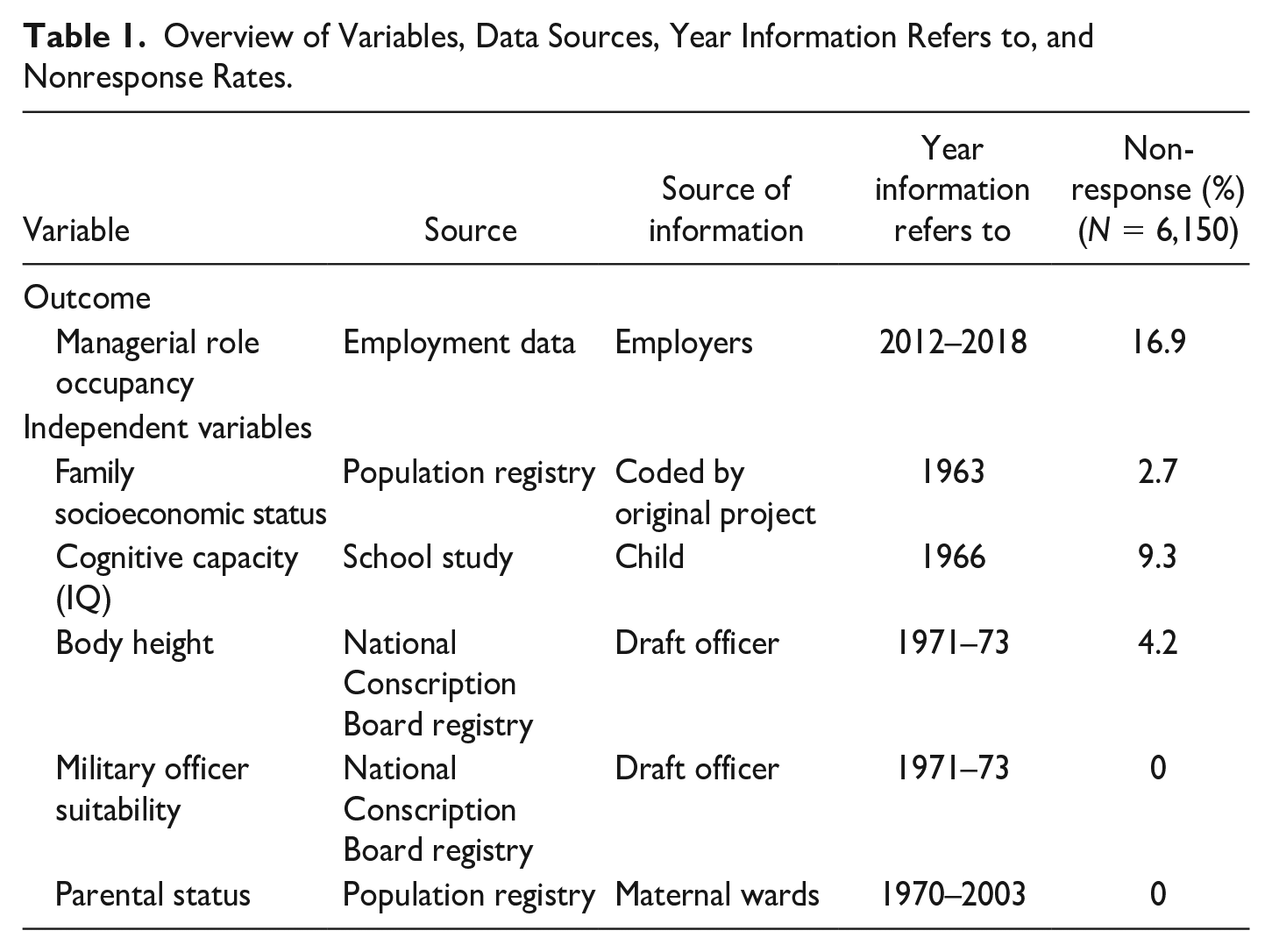
At the time, conscription was only open to men, so only male cohort members are included in our study. Moreover, we only included males who had mustered for military service, who were alive and residing in Sweden at the age of 55 (N = 6,150). The sources and time frames of the included variables, as well as nonresponse rates, are presented in Table 1. The variables are described in further detail below.
Overview of Variables, Data Sources, Year Information Refers to, and Nonresponse Rates.
Dependent Variable: Managerial Role Occupancy
When the original Project Metropolitan data were updated within the Relink project, access was provided to occupational data from Statistics Sweden. The registry is based on information from employers and follows international classifications. Managers are defined as having an overarching responsibility for the production or activity in an organization, or for a unit within this organization. Managers are generally responsible for and make decisions concerning (a) strategic and operative issues, (b) budgeting, and (c) recruitment, promotion and phasing out of staff, working environment, and so on. 2 Because the degree of independence varies, it is, however, not necessary to fulfill all three criteria to be classified as a manager in the registry. Leadership emergence in adulthood was, then, defined as managerial role occupancy at age 50 to 55. That is, whether the male cohort member was coded as having a managerial position in the employment registry during at least one year between the ages of 50 and 55.
Independent Variables
Socioeconomic status: The family’s socioeconomic status was measured as social class based on the father’s occupation in 1963 according to population registers and coded into five categories by the original project group. If information about the father was missing, or if the mother’s occupation was upper or upper-middle class and father’s occupation was working class, social class was based on the mother’s occupational status. More information on the coding is available in Codebook II. 3
Cognitive capacity: As part of the 1966 School Survey, the cohort members were asked to complete a verbal, spatial, and numerical test. Each test rendered a possible score of 0 to 40 points, and a total IQ-score of 120. In our sample, scores varied between 12 and 116.
Body height: We included body height as measured during mustering for military service. Values varied between 159 and 205 cm in our sample.
Military officer suitability: In connection with the mustering procedure, recruits were evaluated according to leadership capacity, more specifically suitability as a military officer. 4 Leadership qualities were assessed on a scale from 1 to 9, with 1 representing the lowest and 9 the highest values. According to the instructions evaluators were advised not to let intellectual capacity influence the judgment of other factors too greatly. In practice, however, inductees with a score of 4 or less on the preceding IQ-tests were generally not selected for assessment. These nonassessed individuals are coded with the value 0.
Parental status: Data on parental status were retrieved from population registries, that is, whether the cohort member had at least one registered offspring (regardless of the age of the child) when he was 50 years old.
Procedure
We first calculated the explanatory variables’ distribution across the dependent variable managerial role occupancy in late adulthood. Thereafter, we estimated the probability of holding a managerial position at the age of 50 to 55 through logistic regression. This is a suitable statistical method when the dependent variable is, as in this case, dichotomous. To test the nonlinear effect of cognitive capacity and body height, we also included the squared cognitive capacity (IQ) score and squared body height.
Results
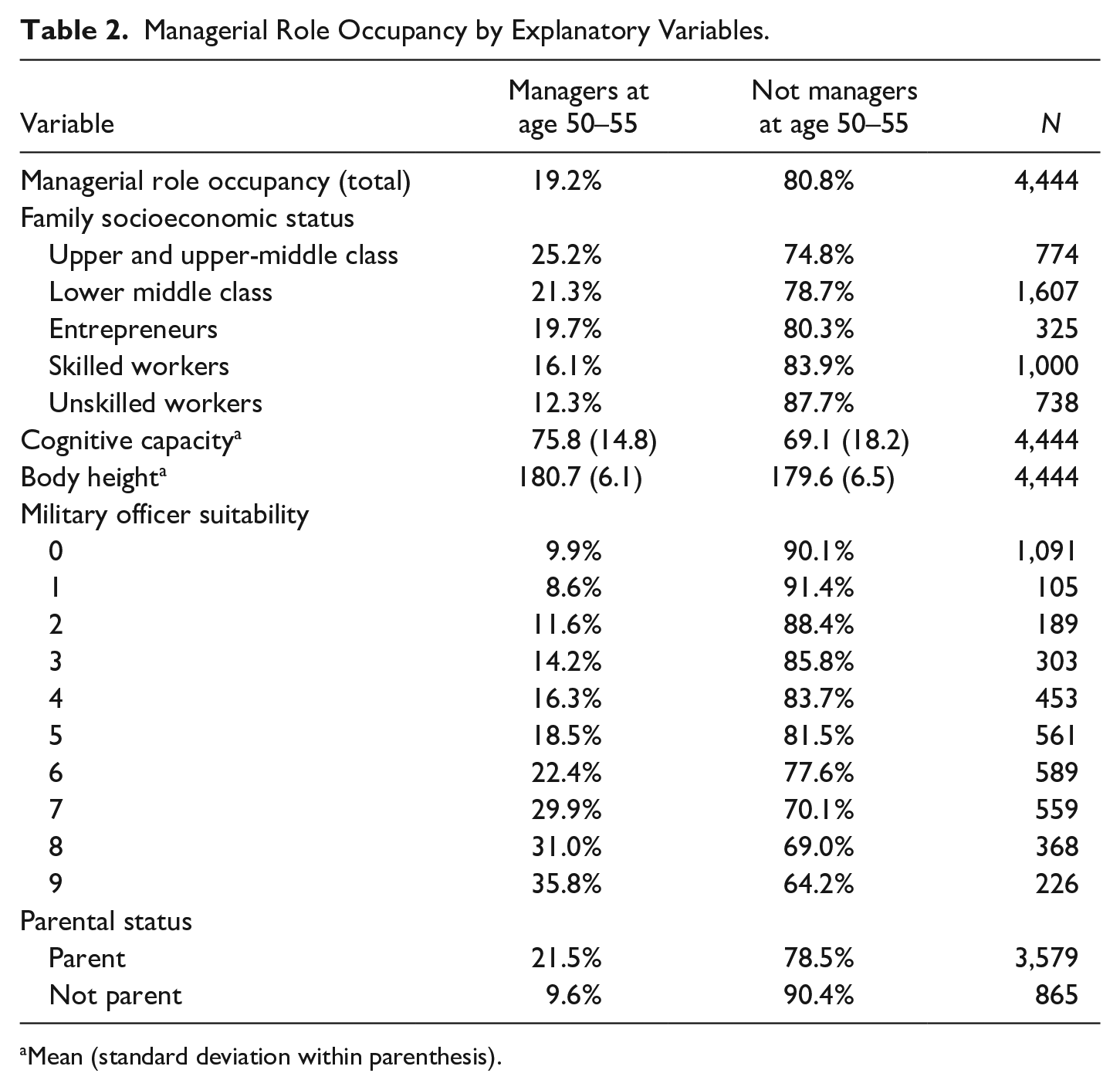
The distribution of variables according to managerial role occupancy in adulthood is presented in Table 2. As we can see almost every fifth cohort member included in the analysis held a managerial position in late adulthood. Our first hypothesis posited that there is a positive association between the assessment of leader capability in a military context in young adulthood and occupying a leadership position in working life in late adulthood. Moreover, there was a strong and linear association between the grades on the ratings of military officer suitability and the likelihood of holding a managerial position later in life. Over a third of those who scored the highest on officer capability held managerial positions in late adulthood. Corresponding proportions among those who received the lowest grades, including those who were not assessed at all, was around 10%.
Managerial Role Occupancy by Explanatory Variables.
Mean (standard deviation within parenthesis).
In line with hypothesis 2, we expected a strong and positive association between cognitive capacity in childhood and assessment of leadership capability/actual leadership role occupancy in early and late adulthood. As shown in Table 2, the average score on cognitive capacity in the sixth grade was a just over 78 points among those who became managers, compared to an average of 69 for those who did not hold managerial positions.
Apart from cognitive capacity, we expected to see a notable link between physical stature (body height) in early adulthood and leadership role occupancy in late adulthood (hypothesis 3). According to Table 2, managers were on average 1 cm taller when they mustered for military service compared to those who did not hold managerial positions.
Table 2 also reveals a strong and positive association between childhood socioeconomic status and the likelihood of holding a managerial position in late adulthood (hypothesis 4). Among those who came from upper and upper-middle-class families one in four were managers at the age of 50 to 55, compared to approximately one in 10 for men from families of unskilled workers.
Finally, Table 2 shows a significant difference regarding parenthood and likelihood of holding a managerial position (hypothesis 5). Approximately one in five of those who had children held a managerial position in adulthood, compared to around one in 10 among those who did not have children.
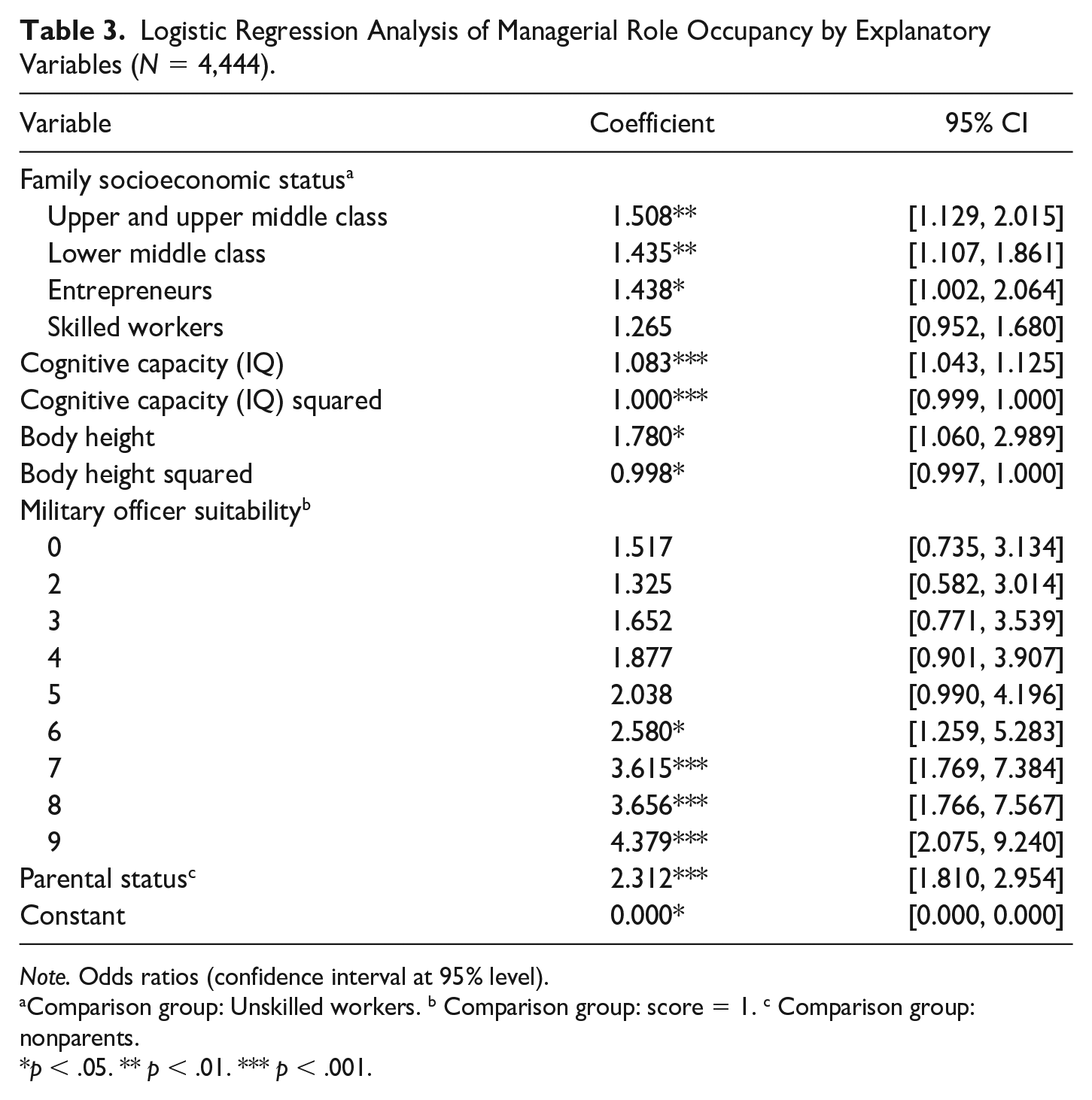
While Table 2 shows the bivariate relations between the independent variables and managerial role occupancy, respectively, all variables were then included in a logistic regression analysis. The results are presented as odds ratios in Table 3.
Logistic Regression Analysis of Managerial Role Occupancy by Explanatory Variables (N = 4,444).
Note. Odds ratios (confidence interval at 95% level).
Comparison group: Unskilled workers. b Comparison group: score = 1. c Comparison group: nonparents.
p < .05. ** p < .01. *** p < .001.
Once again, we see that the likelihood of becoming a manager in late adulthood was positively related to the assessment of military officer suitability (hypothesis 1). Based on comparisons with those who were assessed with the lowest score on the scale (1), there was a significantly higher probability of holding a managerial position if cohort members received a score of 6 or higher in connection with mustering for military service. For those who received the highest score (9), the likelihood of holding a managerial position in late adulthood was over four times higher compared to those who scored 1.
As could be expected, there was still a notable and significant impact of cognitive capacity in childhood and body height during mustering on the probability of holding a managerial position in late adulthood (hypotheses 2 and 3). The relationship between cognitive capacity (squared), body height (squared) and leadership emergence in adulthood showed a curvilinear pattern. In other words, the likelihood of becoming a manager decreased somewhat for the tallest cohort members and for cohort members with the highest scores on cognitive capacity. It should, however, be noted that the strength of this effect was very weak.
It can also be noted that the socioeconomic status of the family of origin still showed a clear and significant effect on the probability of holding a managerial position many decades later (hypothesis 4)—even after controlling for other explanatory variables. The most important distinction was between skilled/unskilled workers vis-à-vis the other classes. There were no statistically significant differences between the three upper classes.
Finally, Table 3 shows that the probability of holding a managerial position at age 50-55 was over twice as high for cohort members who had become fathers by the age of 50 compared to their childless peers (hypothesis 5).
Discussion
Recruitment and selection processes and methods are crucial in any organization, particularly in human service organizations. As one of the largest human service organizations in society, the armed forces have two main functions in war and in peace, that is, people-changing (turning civilians into soldiers and/or officers) and people-processing (recruiting, selecting, assessing humans vis-à-vis the task at hand). The latter is particularly salient in a conscription system, where enormous societal resources are spent on people-processing. Most of this “raw material” will continue on to nonmilitary employment or activity, with or without being subject to much “people-changing” (training). While the armed forces are highly dependent on societal developments (demographic changes, labor market development, attitudinal, and cultural trends), the opposite side of this relationship is also worth exploring. That is, in what way the people-processing that takes place in a military context is compatible with assessments of needs and skills in a civilian setting in the long-term perspective.
In this study, we have focused on selection and recruitment of leaders. Although widely debated, leadership is often considered a universal skill. As a social phenomenon, leadership is also highly dependent on perception of what constitutes leadership in various settings. Our results indicate that leadership potential is judged similarly in military and nonmilitary organizations, as well as over time. The assessment of officer suitability in connection with mustering seems to be well-adapted to the judgment of leadership potential in the labor market overall. This finding is not exceptional but suggests that most modern organizations are practicing the same leadership doctrines, reproducing stereotypes about what a leader looks like (even literally). Our results suggest that the perception of leadership potential in nonmilitary settings are still heavily influenced by leadership ideals originating from centuries of leadership practices related to warfare (Grint, 2011). These norms are also likely to be enhanced by a “management industry” where leadership is largely considered a generic phenomenon. However, the actual impact of this mimicking for the individual organization and how mimicking interacts with other coercive and/or normative pressures need to be studied with other methods and research designs focusing on the organizational level (Ashworth et al., 2009; Coticchia & Moro, 2016; Ledberg et al., 2022).
At this stage, we should point out that isomorphic processes do not leave organizations without any discretionary leeway. For example, around 10% of the cohort members who were not assessed at all, or who received very low scores on military officer suitability, did come to hold managerial positions later in life. This raises some questions about validity of IQ tests and the chosen cut-off point for further leadership assessment in the military. With universal conscription, some inductees may actively try to underachieve during mustering to be found unfit for service or avoid being perceived as officer material. Hence, some of those who were not assessed or who got a low score in our data set might in fact have been relatively creative and “entrepreneurial” which may have materialized in leadership positions later in life (Reid et al., 2018). However, such characteristics are may not be appreciated as leadership skills in a hierarchical organization like the armed forces. Despite obvious generic elements to leadership capacity and leadership emergence, there is a contextual dimension which cannot be overlooked (Vardiman et al., 2006).
We were also able to show that there is a strong social gradient in leadership emergence, in the sense that persons from a working-class background are significantly less likely to hold leadership positions later in life. It is also well-known that cognitive capacity is unevenly distributed between social classes. Socioeconomic status is also known to be related to reproductive behavior, although the patterns vary between, for example, preindustrial and postindustrialized societies. In many high-income societies, there seems to be a negative association between socioeconomic status and fertility. In other cases, patterns are fuzzy and vary between genders. Using Swedish conscription data and other registries, Kolk and Barclay (2019) found a clear and positive association between intelligence and later fertility among men. This finding fits well with other observations on the relationship between various status indicators and fertility in contemporary high-income societies. Parenthood is, along with cognitive capacity, an important element in perception of leadership qualities.
A similar study by Grönqvist and Lindqvist (2015) showed a strong positive association between having undergone officer training during Swedish military service and the likelihood of attaining a managerial position later in life. However, their study was restricted to those who actually underwent officer training and the selection of candidates for such training was likely to have been strongly related to organizational capacity and needs at the time. Moreover, they relied on IQ test results from mustering which means that officer capability assessment and selection for officer training were highly dependent on test results from the same selection procedure (endogeneity bias). In our study, cognitive capacity was retrieved from an independent point of observation many years prior to mustering, and the test results were not known to any of the parties. Furthermore, results of officer suitability assessments are not known to future employers while military officer training is often both visible and highlighted in recruitment and advancement processes.
Limitations
There are a number of limitations in our study which should be addressed. First, the definition of a managerial position in the occupational registry follows international standards and definitions, but the amount of leadership in terms of human relations exerted in such positions may obviously vary. This variable is also bound to reflect characteristics of the labor market and how work–life organizations are structured, for example, the proportion of managerial versus nonmanagerial positions in general.
Second, leadership is a broader concept than management, and the former may be exercised in many different contexts. Cohort members who did not hold formal management positions in work–life organizations may have had substantial leadership roles in, for example, the voluntary sector. This also applies to persons who are self-employed. These forms of leadership are not accounted for in this study.
Third, as with any longitudinal study with such a unique time frame, the generalizability of the study may be questioned. The cohort members in this study grew up in a society very different from contemporary Sweden, and they entered the labor market at a time of low unemployment and high economic growth. The probability that many of them were labor active and also came to hold managerial positions was probably large—not least because the cohort resided in the Stockholm metropolitan area where labor and career opportunities have been favorable compared to other parts of the country. The results may, then, also partly reflect the changing character of the labor market whereby managerial positions have become increasingly common.
Fourth, this study only includes males because conscription only applied to men at the time. We do not know whether assessment of officer capability predicts later leadership emergence for women as well. On the contrary, conscription was universal at the time which decreases the likelihood of selection bias in those who actually presented for mustering compared to the present situation.
Fifth, our measure of cognitive capacity stems from when the cohort members were 12 to 13 years old, attending the sixth grade. Although using a measure of IQ which is independent from the mustering context its validity may be questioned. Children and adolescents develop at a very different pace, and it is not given that the assessment from the sixth grade is valid some 67 years later. On the contrary, IQ measures have been found to be very stable over time (Marks, 2013).
Finally, our analysis does not take into consideration whether the cohort members actually received training as officers or other leadership training during military service, or thereafter. Hence, we are not able to say whether managerial role occupancy in adulthood reflects selection mechanisms earlier in life whereby those perceived to have leadership potential are offered opportunities to practice and develop these skills, which then increases the likelihood that they are perceived as competent leaders.
Conclusion
Assessing leadership potential is one of the main aims of mustering procedures in any military organization. Although this procedure seeks to measure task- or context-specific leadership skills (“military officer suitability”), we have with the help of a unique longitudinal data set shown that the judgments made in a military context are largely coherent with those made by other parts of the labor market many years on. The same implicit leadership theories developed through centuries of warfare continue to be reproduced as organizations seek legitimacy by mimicking institutional norms on what makes a suitable leader. These ideas may be cemented or altered by a growing managerial industry, which is likely to affect professional practices in military and nonmilitary organizations alike and the connectedness between them. A suggestion for future research would therefore be to examine how military leadership training and/or experience is seen from the receiving end outside a military context. In what way are perceptions of leadership potential and competence in a military setting applicable in other parts of society?
From a policy perspective, it should also be pointed out that a notable share of those who were not seen to be officer material during mustering did come to hold managerial positions later in life, suggesting that mustering procedures may have missed out on potential leaders. Alternatively, leadership is a skill that needs to mature and be developed in working life as well as through family life. We were, for example, able to demonstrate the “fatherhood” advantage vis-à-vis managerial role occupancy in adulthood. Leadership is indeed a relational skill which needs to be recognized. Receiving a high score on the officer capability test is one thing, but holding a managerial position later in life depends on many other circumstances. In the same vein, our results showed how perceptions of leadership qualities were related to sociodemographic factors. Cohort members from working-class families were much less likely to hold managerial positions later in life compared to those from middle- or upper-class families. Investigating how perceptions of leadership potential may be influenced by class cues, and how these interact with, for example, gender and ethnicity in today’s multicultural societies, is another issue which deserves further attention. As all other public agencies, the armed forces must adapt to societal norms to guarantee their legitimacy. Sometimes, through coercive pressure, but above all through normative pressures or plain mimicking.
Footnotes
Declaration of Conflicting Interests
The authors declared no potential conflicts of interest with respect to the research, authorship, and/or publication of this article.
Funding
The authors disclosed receipt of the following financial support for the research, authorship, and/or publication of this article: This research was made possible through funding by the Swedish Research Council for Health, Working Life and Welfare (Forte).
