



Abstract
This article reports the results of an empirical research design testing the relationship between a state’s use of conscription and the public’s level of political participation. Although few previous studies have investigated conscription’s influence on political levels in times of war, none have yet to analyze conscription’s impact on political participation during peacetime. We, therefore, study the relationship between voter turnout and military conscription using a global sample with the expectation that citizens in states that practice conscription will be more politically engaged during times of no conflict. We perform logistic regression models on a global sample (1982–2008) and find that those states that do practice conscription see their citizens participate in the electoral process at a higher level.
Conscription, or the compulsory enlistment of citizens into the armed forces, has long been a familiar practice in the international system. Autocracies and democracies alike have implemented this policy, requiring a period of military service for broad segments of their respective male populations. Although often differing in the levels of formality or terms of service, these policies today are typically thought to be employed by states with enduring, existential threats (Asal et al., 2017; Horowitz & Levendusky, 2011; Pfaffenzeller, 2010). Because it is a practice that explicitly creates a hierarchy in which the state exercises authority over some of its citizens, it poses any number of interesting challenges to contemporary thought regarding governance, civil and political rights, and what it means to be a citizen of a modern nation-state. Therefore, this article seeks to review the relationship between citizens with conscription policies and contemporary thought by analyzing states with conscription policies with 26 years of data between 1982 and 2008.
This article tests a familiar, but nonetheless anecdotal, expectation in which conscription leads to higher levels of civic efficacy (see, for instance, Dionne & Drogosz, 2002). Although conscription has been studied economically, militarily, and socially, few scholars (and none quantitatively to the best of the present authors’ knowledge) have tested whether a state’s ability to conscript its citizens into its armed forces has a reflexive effect on the use of these citizenship rights. Previous scholars have examined conscriptions’ effect on domestic politics in times of war (Choi & James, 2003; Horowitz & Levendusky, 2011; Vasquez, 2005), based on the knowledge that constituents become more politically engaged when political decision-making is directly related to their own interests (Elster, 1998; Mansbridge et al., 2010; Stigler, 1971), and have a clear cost or benefit for them (Denzau & Munger, 1986; Fordham & McKeown, 2003; Mahoney, 2007); of which conscription during wartime would be the former.
We ask whether military conscription boosts civic efficacy outside of conflict. This is a theoretically interesting proposition when one considers that throughout time definitions of citizenship have often formed the bedrock of conscription policies. To be recognized as a citizen of the state meant also being liable to serve in its time of need. In its more recent practice, the promise of greater enjoyment of, or wider access to, civil liberties has often been an inducement for would-be conscripts. Normatively, it is believed that service draws people closer to their nation and inspires a sense of patriotism. It has also been argued that conscription increases public interest in the armed forces, especially those that are eligible to be drafted (Bergan, 2009), and “meant that the people, not just the leaders, were important in deciding the outcomes of war” (Simon & Abdel-Moneim, 2011, p. 18). One’s personal obligation to serve, or having one’s close family, friends, or neighbors obliged to serve, would, it has been argued, also create a greater sense of political efficacy (see also Vasquez, 2005). Furthermore, the linkage of service to one’s citizenship and enjoyment of rights may create a sense of their having been “earned” as well as enjoyed.
This question is of increasing salience among some states. For instance, in 2018, France started to consider whether reviving a national policy of conscription might be necessary, and in 2019 began a trial national service program (Chrisafis, 2019; Noack, 2018). Following the escalation of Russian–Ukrainian fighting in February of 2022, Ukraine enacted a state of emergency declaration allowing it to restrict males between the ages of 18 and 60 from leaving in the event they would need to be called to service. Similarly, on the other side of conflict, Russia has been forced to entertain the possibility of using conscription to overcome a shortage of manpower (Jackson, 2022).
Although the Russian invasion of Ukraine has revived NATO, politicians who would weaken the alliance, like Donald Trump in the United States and France’s Marine Le Pen, remain competitive in domestic political competitions. A global trend of decreasing multilateralism and increasing bilateralism could encourage states to adopt more unilateral defense systems, including (re)introducing policies of conscription. For example, the rise of the Viktor Orban regime in Hungary, the victory of Jair Bolsonaro in Brazil, as well as the increased visibility of other populist leaders could place leaders in a future in which they would be going alone in the provision of their defense instead of investing in shared security institutions. Consequently, as the number of institutional allies shrinks and the potential points of conflict increase, so too does the need for a standing fighting force.
This article reports the results of the quantitative tests of conscription’s effect on voter turnout during non-war years, using the globally available data for the years between 1982 and 2008. We find that states with conscription policies have higher levels of electoral participation, suggesting that, yes, conscription policies can increase a sense of civic efficacy among citizens. When we control for the proximity of an enduring threat (short of war), the result is consistent, suggesting that an electorate is not merely responding to the potential costs they would bear if their state went to war. This article continues in four parts, beginning with a review of the relevant literature to our theory. After introducing the methods and data employed, we present our findings and analysis. Finally, we conclude with a summary of the project and suggestions for further areas of research in this area.
Theoretical Development
Conscription is a policy that requires the mandatory service of citizens, most commonly young men, in a state’s armed forces. The earliest form of conscription observed in most parts of the world emerged in the Feudal Ages. At that time, it was common for peasants to be impressed into the fighting force of, for example, an English lord for service to the Crown, or for every district to supply a quota of soldiers under the Qin in China, during times of conflict (Flynn, 1998, 2002). There was no formal expression of terms of service, nor was there any promise of monetary remuneration. This system was “primarily based on the . . . relation between the state’s central authority on the one hand, and feudal lords or tribal chiefs on the other” (Simon & Abdel-Moneim, 2011, p. 9, 11). Thus, conscription dealt with the relationship between those who held authority and those over whom they exercised it.
At that time, a government or potentate’s authority to force citizens or subjects to arms was never really in question: Authority was often believed granted by divine right and so too was one’s existence as a peasant the result of Providence. There were no rights to be earned, not in our contemporary sense in any event, although slave soldiers could often earn their freedom from bondage (Simon & Abdel-Moneim, 2011). However, the advance of economic systems, means, and modes of combat, as well as the concept of the state in political thought, would alter the practice of conscription.
Thomas Hobbes’ and John Locke’s respective contributions to our theoretical understanding of the state, work to highlight this aspect. Hobbes’ Leviathan and Locke’s Two Treatises of Government provide the foundations for our belief in the equality of people and a just government needing the consent of the governed. Whereas Hobbes believed a monarch was necessary to provide order, Locke argued that the equality of citizens meant there were no divinely endowed rulers. Although far from being the final word on the matter, this line of reasoning did inspire both the American and French revolutionaries and began to chip away at the infallibility of traditional sources of power; be they the monarchy or religious hierarchy. Concurrently, a state’s absolute power decreased as the concept of “rights” began to shift from medieval social status-oriented rights to an inherent individual right (Goodhart, 2016).
What effect this exerted on the practice of conscription can first be observed in France during the Napoleonic Wars. On the European continent, rivals France (Wolloch, 1986) and Prussia (Van Creveld, 1999) both used conscription to maintain the large fighting forces that would be necessary to prosecute a war between superpowers. Posen (1993) observes that the international environment increased the internal pressure to adopt a conscription system, even if the elites disapproved. The creation of conscription necessitated nationalism, which was introduced via the standardized education system. It is noted that nationalism increases the mobilization of the citizens and the viciousness of the war. This leads to an escalation of nationalist propaganda at the onset of war.
The practice of conscription by the French was of particular interest to English observers with whom they shared an enduring rivalry. These observers noted that to effectively practice conscription, it required an expansive administrative system that could both ensure an adequate number of conscripts were found and also keep enough citizens in the workforce to be economically productive (Balfour, 1867). Single men aged 20 to 25 were eligible to be drafted via lottery into the French army for up to 7 years (Simon & Abdel-Moneim, 2011), with the penalty for “the evasion of the liability for military service” at this time being the “forfeiture of civil rights” (Balfour, 1867, p. 235). In fact, the punishment for deserters was more severe, including death penalties, as desertions became more commonplace during the Napoleonic era (Forrest, 1989).
Conversely, a son born to foreign parents could earn French citizenship and “the enjoyment of . . . civil rights” provided he completed his obligation to serve (Balfour, 1867, p. 223). There were also several exemptions that began to emerge in the French policy, particularly for students at certain universities or seminaries. Far from exerting total control over its citizens, the French were finding it necessary to (a) increase the levels of formality in its practice of conscription, as well as (b) manipulate rights as either a reward or punishment for the fulfillment of one’s military obligations. As the 19th century advanced toward the 20th century, lotteries began to replace mass conscription, and the required time of service dramatically decreased. In the end, the cost of maintaining a large standing army while waging expensive wars became too costly for many states (Tilly, 1992).
As the First World War approached, nations like the United States and the United Kingdom, debated the necessity of conscription with many detractors arguing that it would turn “industrious producers into unprofitable consumers” (Copper, 1902, p. 103) and “tempt . . . young men and boys from gainful pursuits into illusive and expensive militarism” (Allen, 1916, p. 46). The state’s inherent power to require military service was now in doubt, and governments had to rethink their use of conscription. Arguments about where the line was drawn between a government and its ability to impress people for service to the state soon found parallel arguments in the realms of industry (Moulton, 1917) and taxation (Bullock, 1917).
There are two illustrative examples of how far states now needed to go in currying the support of its citizens for policies of conscription: The debate about Irish conscription in Lloyd George’s government (Ward, 1974), and the practice of conscription in French Guinea (Summers & Johnson, 1978). In the former case, it was believed that Irish Home Rule would be necessary to secure their participation in a policy of conscription. Although the government debated using force to bring the Irish to arms, Lloyd George’s government ultimately supported the linking of home rule to conscription. In the latter example, the French promised their Guinean subjects “rewards . . . of improved social and political status” (Summers & Johnson, 1978, p. 27). What this meant was the first opportunities for many French Guineans to enjoy rights like the freedom to express themselves. Although not a formal offer of autonomy to the extent of Lloyd George’s offer to Ireland, the French colonizers found themselves met with a new wave of labor and social unrest following the war as its subjects sought this autonomy.
Historian D.W. Brogan (1951), writing about British policies of conscription during World War I, noted,
[i]t is easy to forget now what an astonishing and outrageous innovation conscription was in Britain, how it shocked people who were not at all pacifist in doctrine and who were angered that anybody, whether he had conscientious objections or not, should be forced to fight. (p. 47)
A present-day historian has written that “[c]onscription was a highly novel and often unwelcome form of compulsion in a nation that still held ‘liberty’ to be one of its highest ideals” (Auerbach, 2007, p. 603). Far from being a natural right of liberal states, it had become an example of governmental excess. Thus, when Anthony Eden, as War Secretary in Winston Churchill’s first government, described the creation of what would become the Home Guard, he did so in terms of British citizens approaching the government to serve, and not the reverse (James, 1986).
Of course, World War II would bring conscription into practice at an unprecedented level for many states. In the United States, voluntary enlistment could not match what was required for a war being fought in two theaters. Conscription, as practiced then in the United States, had only been a familiar feature since World War I, with the historic practices of bounties and substitutes greatly reducing the number of potential conscripts (Perri, 2013). The acceptance by the U.S. electorate of conscription during World War II and the Korean War would be more complicated by the Vietnam War’s late stages. At this time, there was an overt recognition that “young men staring at the age of 18 [were] required to fight and die for their country, [and] it did not seem right to deprive them of their voting right” (Simon & Abdel-Moneim, 2011, p. 38). The passage of the 26th Amendment to the U.S. Constitution in 1971 would lower the legal voting age to 18 years, thus ensuring that those liable to serve would also be able to express themselves politically.
This question of service vis-à-vis the citizen and the state has largely continued to this day, with many more states abandoning these policies in favor of voluntary enlistment. Western European states have been decreasing the size of their armed forces since the 1970s while increasing their number of voluntary personnel due to the goals of the military changing to peacekeeping and peace enforcement. There are also many states with conscription policies that sit idle due to either no immediate existential threat, robust alliances, or the existence of a robust voluntary enlistment program that satisfies military needs (Haltiner, 1998). The Peoples’ Republic of China (PRC) falls into the latter category, with virtually dormant conscription policies (Kang, 2015). On one hand, China’s modernization efforts over the past two decades have encouraged the creation of a smaller force (Pollack, 2002). At the same time, Chinese citizens readily volunteer to enlist, especially encouraged by nationalism and the belief that China should use force, for example, in the event Taiwan would attempt to break away (Hao, 2005).
The arguments about conscription and the relationship between citizens and the state could be said to be one between the idea of “liberty” and “equality.” For instance, a state’s level of democracy is thought to influence its use of conscription status, but in what ways is still unclear. For example, some studies argue that democratic states are less likely to practice conscription since forcefully recruiting individuals into the armed forces inherently infringes upon citizens’ basic liberties (Pfaffenzeller, 2010). Still, others claim that democracies are more likely to employ conscription to ensure that all of their citizens share the equal burden of military duties as opposed to only a small portion of the population (Kane, 2005; Kriner & Shen, 2010; Wilson, 1995).
A state’s pursuing conscription has also been examined materially, and economic factors are also thought to affect states’ adoption of these policies. For instance, some studies argue that states employ conscription because conscripted armies are economically cheaper to manage than standing armies (Pfaffenzeller, 2010; Pincus, 2013). Alternatively, some scholars argue that maintaining conscripted forces is not only more expensive than voluntary forces (Oneal, 1992) but it also hurts the overall economic output of a nation by reducing available labor for production, harvest, etcetera (Poutvaara & Wagner, 2011). There is also evidence that the life spans of conscripted individuals are shorter than their non-conscripted peers, and so too is their economic contribution to the state (Conley & Heerwig, 2012; Grenet et al., 2011).
It is still the case that the most consistent explanations for a state’s use of conscription are security-based. There is a positive correlation between a state’s exposure to external threats and conscription levels (Asal et al., 2017; Horowitz & Levendusky, 2011; Pfaffenzeller, 2010). It is not surprising then that a state like South Korea would articulate such a threat (North Korea) in the constitutional justification for maintaining a policy of conscription. Conscription could be used to both maintain a fighting force and to create a power imbalance to one side’s advantage; it could be both a deterrent and a sign of a state’s credibility in committing to use force in its defense (Horowitz et al., 2017).
If a policy of conscription is to be present in a state, its citizens’ lives are certainly affected by it. Socially, young men and women in Israel and South Korea often see their period of service as a rite of passage. It becomes a shared part of the national experience across generational divides and sets them apart from non-nationals. It has also been suggested that conscription brings two often disparate groups—the armed forces and society—into a more “healthy” relationship (Simon & Abdel-Moneim, 2011, p. 18). Politically, previous studies have attempted to demonstrate the positive relationship between conscription and voter turnout through the “responsive political participation” argument. Proponents of responsive political participation claim that citizens become more politically engaged when they feel the need to respond to (vote for/against) policies that could endanger their personal interests (Campbell, 2003; Hastings et al., 2007); and such an argument might adequately explain why people become more politically engaged regarding these policies since the conscription system could not only intrude on a select number of citizens’ basic rights and liberties but also potentially risk their lives (Sears & Funk, 1990).
War, of course, is thought to be the most salient issue to potential voters, with some evidence that even those with little political inclination are drawn to the polls based on how a war progresses (Koch & Nicholson, 2016). If we consider that those who have a greater sense of efficacy in their vote (Matsusaka, 1995), as well as those who feel they are fully informed on the issues or candidates (Palfrey & Poole, 1987), will be more likely to turnout, we might suspect that conscripted soldiers on or headed to the “front” would certainly be at the polls in a time of war.
This was the theory behind Vasquez’s (2005) study that finds support for democracies that practice conscription being more sensitive to casualties than democracies that employ all-volunteer forces. Other scholars have found that parents of American men under high risk of being drafted in the Vietnam War displayed higher rates of voter turnout in the 1972 election; this was especially so if they had personally experienced war casualties in their localities (Davenport, 2015; Feaver & Gelpi, 2004; Gartner & Segura, 2000). Horowitz and Levendusky (2011) also find a measurable decrease in support for a conflict in communities that practice conscription, suggesting again that conscription does produce an effect on turnout in the context of conflict.
Outside of security crises and war, though, could we expect to see conscription positively influence political participation? Previous research has described how veterans generally demonstrate higher political participation than non-veterans (Blattman, 2009; Leal, 1999; Teigen, 2006), but these observations capture voluntary enlistees who we might already suspect of feeling like a stakeholder in their nation. For example, Erikson and Stoker (2011) demonstrated that people who were at risk of being drafted during the Vietnam War became more anti-war and left-leaning than before the establishment of the draft lottery system regardless of their party identifications. Plus, democratic states who have long-standing, stable institutions are less likely to employ conscription (Adam, 2012); in which case, those states whose citizens are liable for conscription are more likely to be found in weaker democracies, since the start. Furthermore, in examining Russia’s conscripted forces, the environment that these soldiers experience is far less likely to encourage civic engagement as opposed to criminal enterprise (Gresh, 2011).
We propose to test two hypotheses. The first is that conscription, in and of itself, would lead to higher levels of civic engagement. We operationalize that here with political participation, such that stated formally:
We suspect, in a state that conscripts its citizens, the public is more likely to pay attention to and be more involved in politics if they or loved ones may be conscripted. Furthermore, these potential conscripts and voters would have a greater sense of efficacy. However, we must also acknowledge that neither a conscripted soldier nor their family can vote where the opportunity does not exist. For this reason, we also condition the above expectation:
Method
To test the above hypotheses, we use a differenced measure of electoral participation as our dependent variable. As originally constituted, the Polyarchy Measure of Participation is a country-year reflection of the percent of the eligible population that participates electorally (Wilhelmsen, 2006). We have differenced the variable from 1 year to the next, creating a binary 1 for a year-to-year increase in voter turnout, and 0 otherwise, to address issues of autocorrelation that is common with time-series-cross-sectional data.
On the right-hand side of the models, we employ the Military Recruitment Dataset’s (Toronto, 2014) measure of conscription as our primary variable of interest. It is a dichotomous variable in which 1 identifies states that use conscription to populate their armed forces and 0 otherwise. According to Toronto (2014), to be counted as a state that practices conscription means that “individuals cannot say ‘no’ to military service” (3). This includes both legal and extra-legal practices. The data begins in approximately 1800 and contains over 11,000 observations with our models employing up to 135 states for 26 years, with an average of 16 years per state. When specifically considering the second stated hypothesis, we interact the Polity V Measure of Democracy (Marshall & Jaggers, 2018) with our key explanatory variable of military conscription. This measure scores and indexes states based on their system of government from a full autocracy (−10) to a full democracy (10).
Another aspect of our theory is about the mediating effect of the highest level of hostility a state experiences in each country-year. As discussed above, multiple scholars have found a correlation between states which practice conscription and political participation/outcomes during times of conflict. Here we ask if this effect is inherent to conscription, irrespective of a state’s experience with conflict. To ensure that we address this question, we include a control for a state’s highest level of hostility from the Correlates of War Project (Palmer et al., 2020). This measure is an index that runs from 1 (no militarized action) to 5 (war) for each country-year. We censor the cases of war (or all 5’s) from the model to only test conscription’s effect on turnout during non-war years.
The above literature suggests specific controls to include when modeling the relationship between conscription and political participation. We include a measure of a state’s military expenditures and measures of its respect for human rights, respectively. In the case of the former, we might suspect that a state, which has a higher level of military expenditure, has less need for conscription policies for two reasons. First, a high level of military expenditure may reflect its strong military power that actively deters hostile military actions from its neighbors, thereby making conscription policy less necessary in time of no conflict. A high level of military expenditure may also be reflective of its higher technical military quality that makes conscription, or increase in human quantity, less necessary. In the case of the latter, we might suspect that states which have stronger traditions of respecting the rights of individuals would likely be reluctant to engage in policies that could be seen as infringing on these rights. The military expenditure data are that of the Correlates of War project (Sarkees & Wayman, 2010). The Cingranelli and Richards (2010) human rights measure is included as the former is thought to be a better representation of a state’s physical integrity rights and the latter a better measure of expressive rights.
There are other state characteristics that could influence a state’s level of participation and the effect of conscription on said levels. Three common measures to get at these characteristics are the gross domestic product (GDP) per capita, the population, and the level of trade. High levels of trade and GDP per capita are expected to have a positive association with the dependent variable because an increase in economic growth and internationalization, or global trade connectivity, increases a nation’s political participation, often hand in hand with its increase in democratic, socioeconomic status, and education levels (Galston, 2001; Campbell, 2003; Willeck & Mendelberg, 2022). Conversely, higher levels of population are likely to have a negative association with the dependent variable as a higher population is known to decrease political participation (see generally Donnelly, 1999; Poe & Tate, 1994; Poe et al., 1999; van Houwelingen, 2017). The GDP per capita data comes from the Maddison Historical Statistics database (Bolt & van Zanden, 2020), the trade measures are taken from the World Development Indicators (World Bank, 2020), and the population data from the International Monetary Fund’s (2019) collection of representative statistics as reported by the Quality of Government project (Teorell et al., 2020). Each of these variables has been converted to their natural log to normalize their distribution and make their inclusion in these models appropriate.
One of the more robust findings in the political participation literature is that the greater one’s level of education, the more likely a person is to participate politically (Wolfinger & Rosenstone, 1980). Voters who feel informed or have an increased sense of efficacy are more likely to turnout (Matsusaka, 1995; Palfrey & Poole, 1987). Both characteristics are engendered by increased educational attainment. This finding is also temporally consistent, gaining support in recent research (Campbell & Niemi, 2016; Neundorf et al., 2016). To control for a state’s level of educational attainment, we employ the World Development Indicators’ (World Bank, 2020) measure of the percentage of the gross population with at least a primary education.
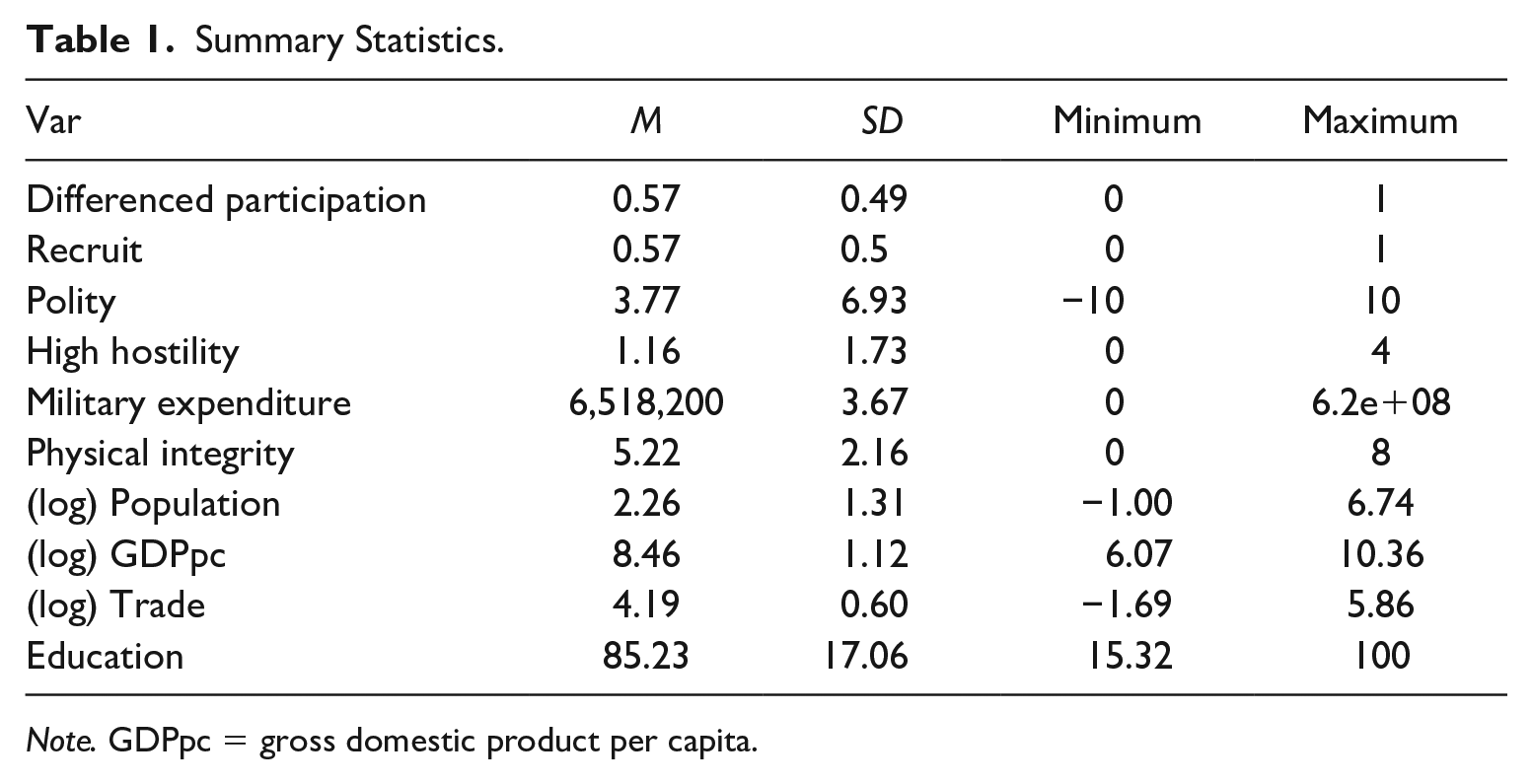
Finally, the model below includes robust standard errors clustered on year to address biases arising from heteroscedasticity. Cases were dropped where data were missing and the summary statistics for these measures are reported in Table 1.
Summary Statistics.
Note. GDPpc = gross domestic product per capita.
Analysis
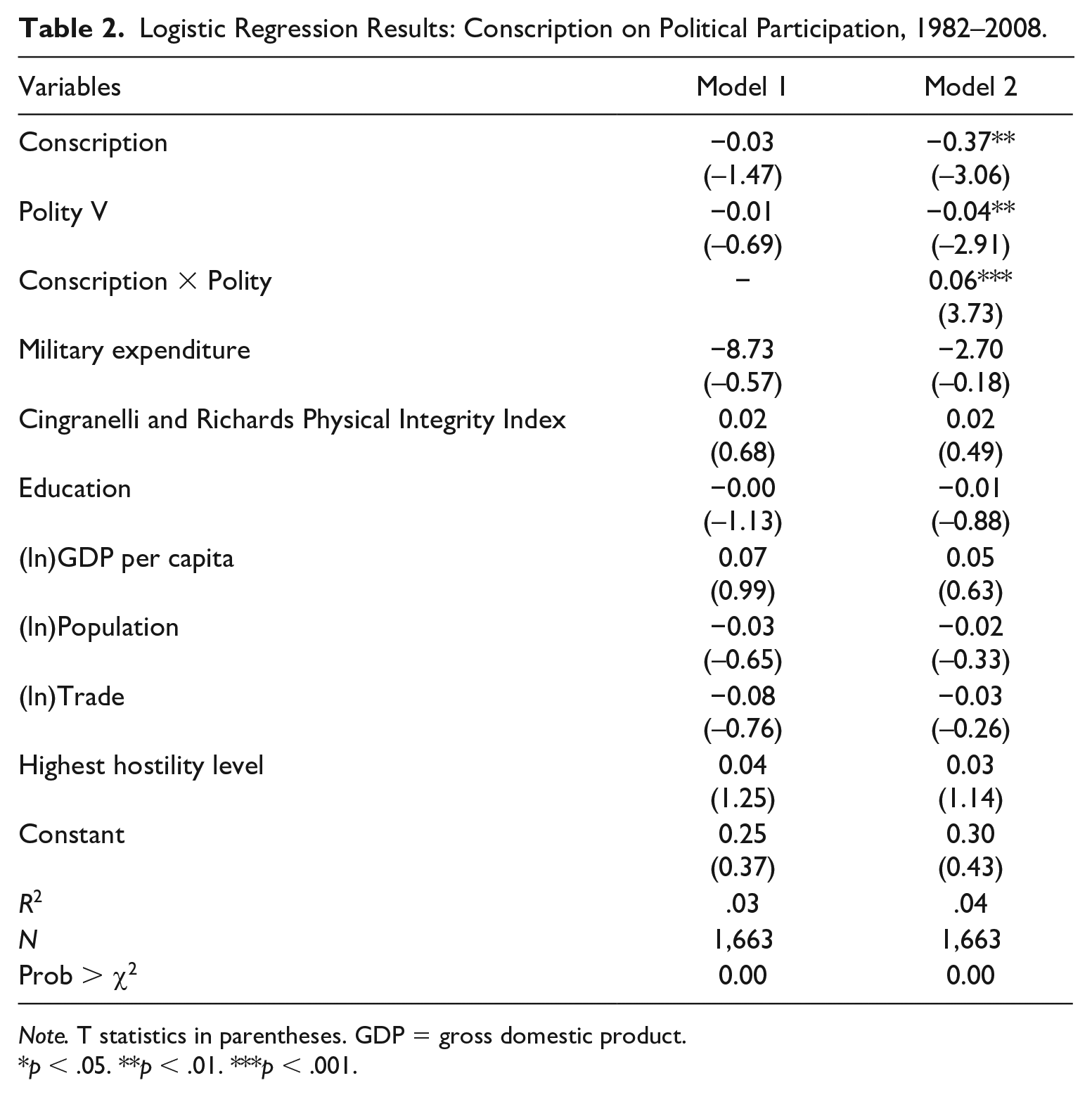
Table 2 reports the results of two logistic regression models 1 testing the two stated hypotheses, respectively. 2 Logistic regression models the probability of a binary outcome and are appropriate as our dependent variable is a binary 1 (increased electoral participation)—0 (no increase in electoral participation). The coefficients reported here are understood to be the logarithm of the odds ratio. In Model 1 testing Hypothesis 1, the coefficient for our key explanatory variable is negative and insignificant, indicating that states that practice conscription are not significantly more likely to have higher levels of electoral participation than other states. This does not support the stated hypothesis. Alternatively, when looking at the results for Model 2, the coefficient of the interaction of a state’s conscription policies on its level of democracy does reach the level 0.001 level of significance. This coefficient of 0.06 suggests that of those states that do practice conscription, the odds of having higher turnout are six times greater as the level of democracy increases, lending support to Hypothesis 2.
Logistic Regression Results: Conscription on Political Participation, 1982–2008.
Note. T statistics in parentheses. GDP = gross domestic product.
p < .05. **p < .01. ***p < .001.
The average marginal effects, visualized here in Figure 1, support that there is a non-zero, positive effect on the probability of an increase in voter participation.
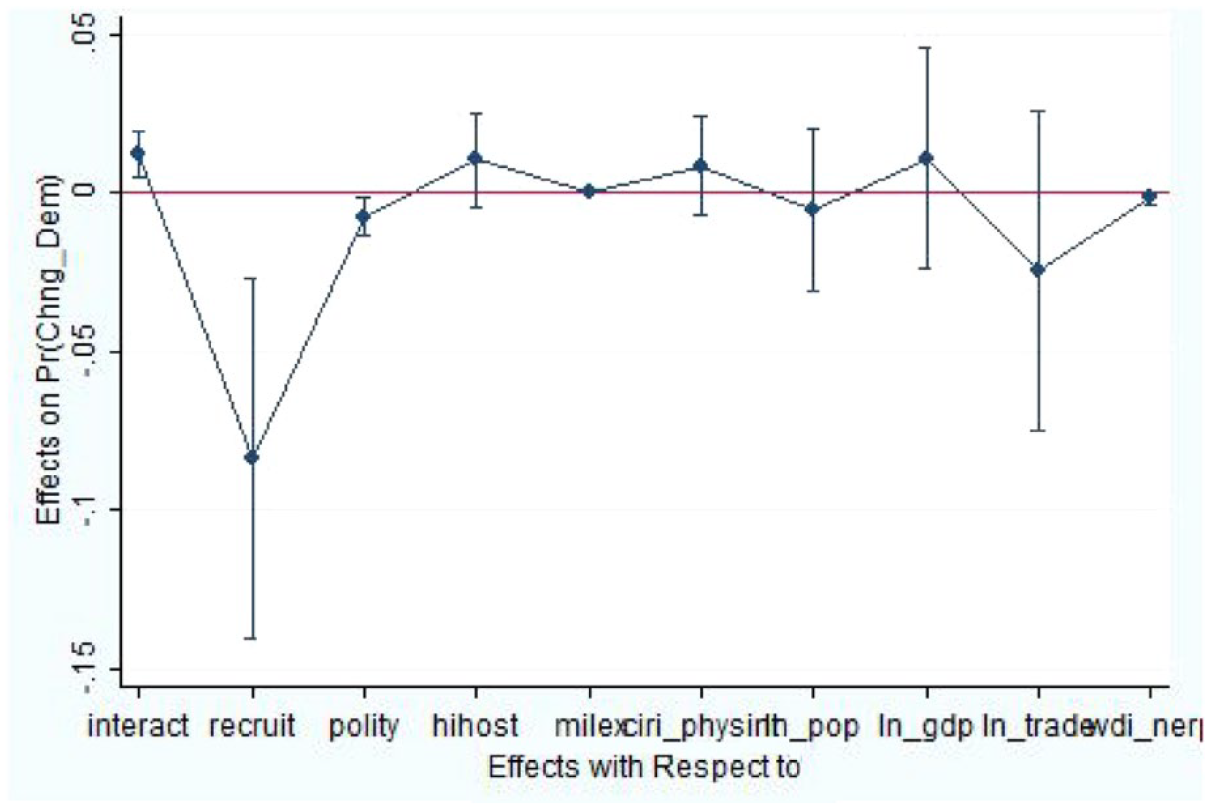
Average Marginal Effects: Model 2.
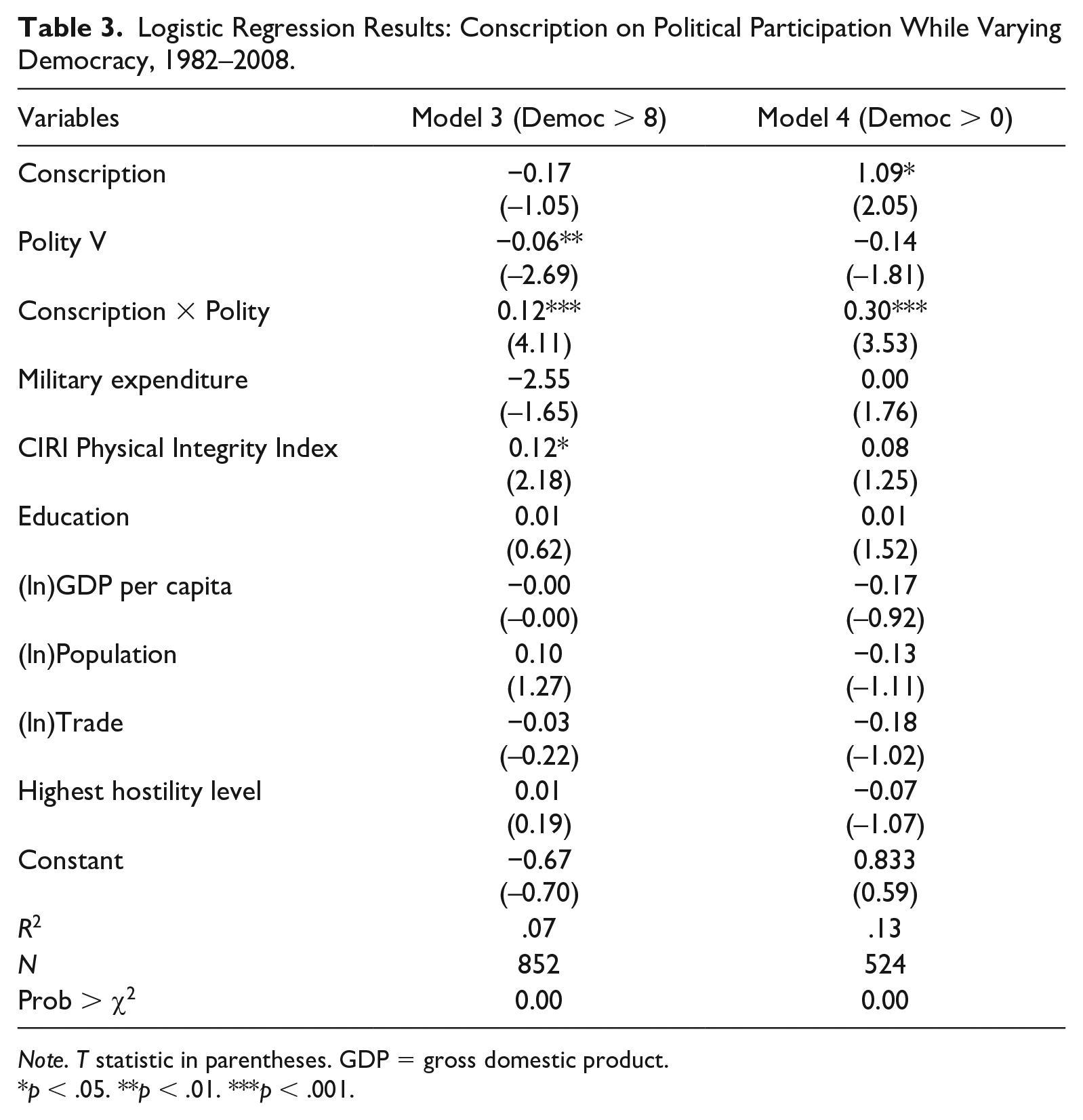
As suggested above, states with strong democratic institutions with higher levels of electoral participation, regardless of the presence of conscription policies, would challenge the results in Table 2. Would these results hold if we only tested less than full democracies? To investigate this, we ran the same model as above but censor the data to less than full democracies and autocracies. There is some disagreement as to what a “full” democracy is in relation to the Polity Measure of Democracy. Because the index runs from −10 (full autocracy) to 10 (full democracy), it seems that 0 is the bright line between democracies and autocracies (Adam, 2012). Although this may be true, it is more common for scholars to treat observations above zero as transitioning democracies and those at or above an eight as full democracies (see generally Bueno de Mesquita et al., 2005; Davenport, 2007; Davenport & Armstrong, 2004).
We test both levels in Model 3 (in which democracy is an eight or above) and Model 4 (democracy is a 0 or above), respectively, dropping observations that would be considered full democracies. In either case, the results reported in Table 3 are consistent with those above, suggesting that the support for Hypothesis 2 is not merely a result of undue influence on the model from full democracies.
Logistic Regression Results: Conscription on Political Participation While Varying Democracy, 1982–2008.
Note. T statistic in parentheses. GDP = gross domestic product.
p < .05. **p < .01. ***p < .001.
Because of the nature of our coefficients and the use of natural logs to normalize some variables as opposed to others, direct comparison of the coefficients is hazardous. We report the T statistic 3 from post-test analyses to further demonstrate the non-zero effect on voter turnout. The rule of thumb in interpreting a T statistic is that those that are ±2, or greater than two standard deviations from 0, demonstrate a non-zero effect. The T stat for our variable of interest is above 3.
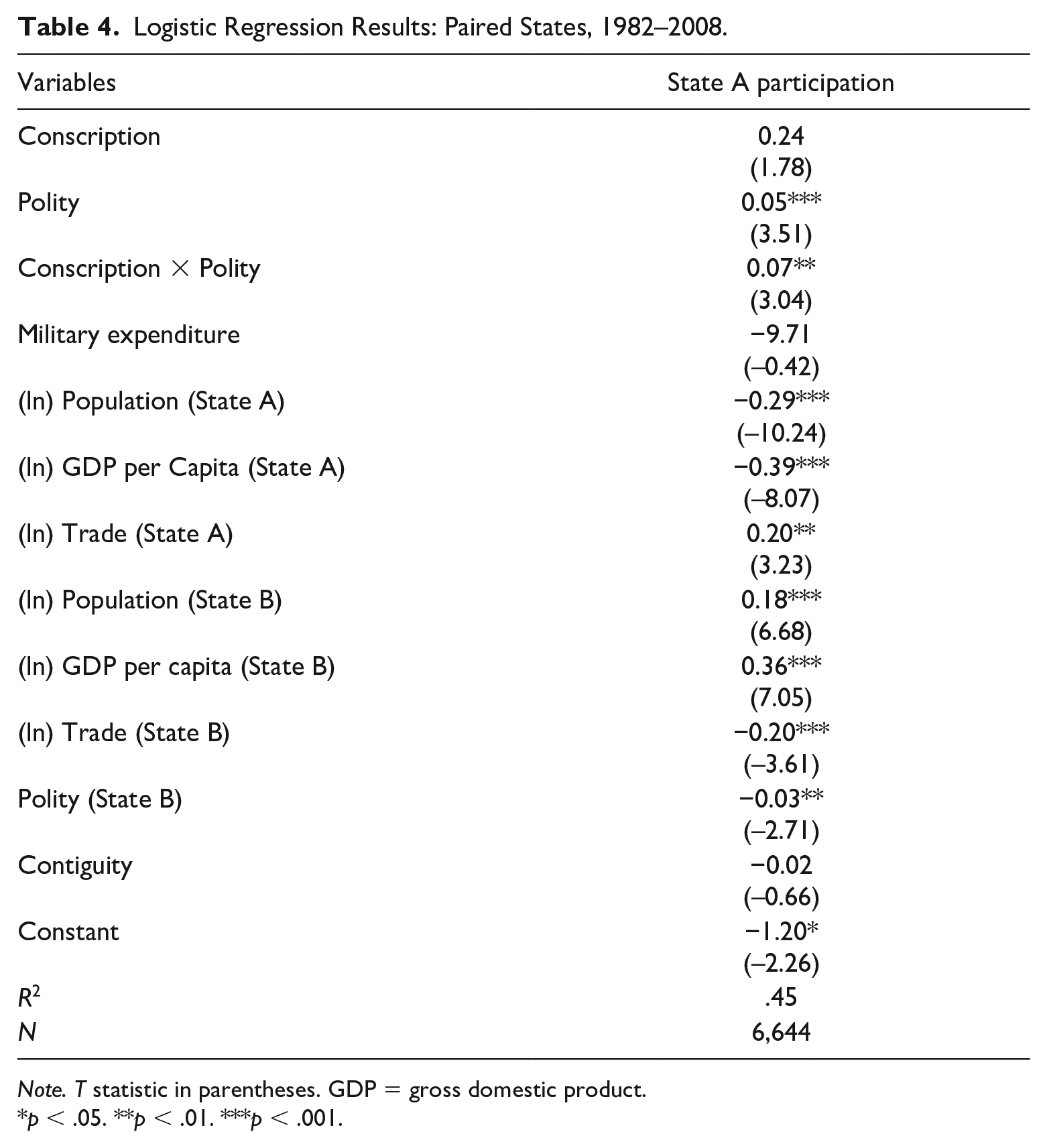
While controlling for a state’s hostility level gives us an indication of its aggressive behaviors, it tells us nothing of the level of aggressiveness of its peers. It may be that a state is a lone aggressor with no exogenous threats to speak of. In other words, what these models do not address is the existential threat, which we assume drives a state to employ a policy of conscription in the first place. If war or security crises do capture the attention of voters and drive them to the polls, might an enduring, proximate threat do that even in non-war years? Using the COW’s directed-dyadic data (Maoz et al., 2018), we retest the relationship in question, but now each state appears multiple times per year paired with other states.
Following Bremer (1992)’s work, the use of dyads, or paired states, as the unit of analysis in conflict studies has been common. Our unit of analysis remains the same (individual states), but each state in our dataset appears as both “defender” (State B) and “challenger” (State A) in the model, so it has a chance to both cause and experience the change in our dependent variable. Thus, we can control for both a state’s belligerence and its passivity in the international system, as well as that exhibited toward it by other states.
The newest control of interest here would be contiguity between two states, or how proximate the threat is, as measured by the Correlates of War Project’s Direct Contiguity Data (Stinnett et al., 2002). We also control for the familiar state characteristics of both states A and B as well. The results (Table 4) demonstrate that the interaction of conscription on a state’s level of democracy can have a positive effect on voter turnout, even when taking threat characteristics into account.
Logistic Regression Results: Paired States, 1982–2008.
Note. T statistic in parentheses. GDP = gross domestic product.
p < .05. **p < .01. ***p < .001.
Conclusion
Our findings suggest that there is indeed a positive relationship between conscription and voter turnout, conditioned on a state’s existing level of democracy. Although identifying a positive relationship between voter turnout and conscription on the global scale is an important finding, there remains quite a bit unsaid. For one thing, there is an inherent danger of theoretical tautology here. Our results should not be considered synonymous with normative ideals of patriotism, nationalism, or any other stronger or weaker feelings of pride or inherent support. If we examine the case of South Africa, the continuance of Apartheid and the use of the armed forces to uphold it, meant that many of those being conscripted were asked to support a system they did not believe in (Callister, 2007). Far from being wholly bought in, there were many who viewed their service as contrary to the values and mores they held.
What conclusion these findings do lend themselves to are those that relate to the citizen and the state. Long gone are the days of the state as pure leviathan, enforcing its will on its citizens or subjects. Although conscription policies have seemingly existed with the advent of the state and national political units, the characteristics have rapidly changed in the past century to such a degree that it is difficult to compare them to their progenitors from the 19th and early 20th centuries. Since the beginning of at least the 20th century, the want to conscript by governments has been met by a want of greater rights by citizens. States will have to negotiate with citizens and meet their demands for a policy of compulsory service. From the perspective of human rights scholars and advocates, this is likely to be interpreted as a positive sign: The state is, to some degree, fulfilling its obligation to recognize the individual and their autonomy.
Conversely, this could be interpreted as a troubling sign for states like South Korea and Israel, which maintain compulsory service systems, and those like France, which has entertained returning to such a system. What will citizens in the near and later term require for their service? The number and variety of exclusions from service have only ever increased, and the required time of service has certainly decreased from the 7 years France demanded in the 19th century. Will conscription, even if a practical solution to a state’s security threats, be a viable or welcomed solution by citizens? These are questions that scholars will need to address in the future.
Footnotes
Appendix
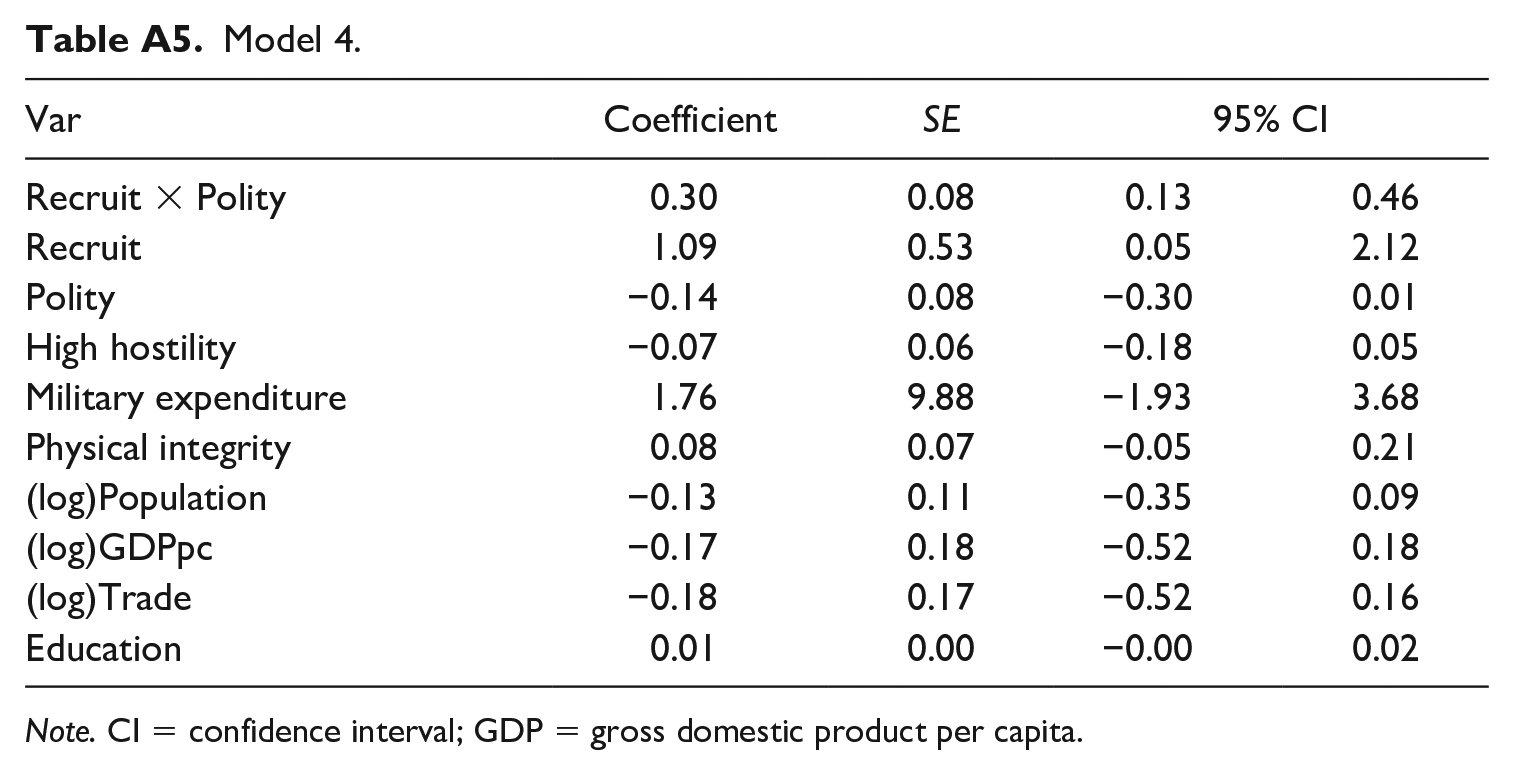
Model 4.
| Var | Coefficient | SE | 95% CI | |
|---|---|---|---|---|
| Recruit × Polity | 0.30 | 0.08 | 0.13 | 0.46 |
| Recruit | 1.09 | 0.53 | 0.05 | 2.12 |
| Polity | −0.14 | 0.08 | −0.30 | 0.01 |
| High hostility | −0.07 | 0.06 | −0.18 | 0.05 |
| Military expenditure | 1.76 | 9.88 | −1.93 | 3.68 |
| Physical integrity | 0.08 | 0.07 | −0.05 | 0.21 |
| (log)Population | −0.13 | 0.11 | −0.35 | 0.09 |
| (log)GDPpc | −0.17 | 0.18 | −0.52 | 0.18 |
| (log)Trade | −0.18 | 0.17 | −0.52 | 0.16 |
| Education | 0.01 | 0.00 | −0.00 | 0.02 |
Note. CI = confidence interval; GDP = gross domestic product per capita.
Declaration of Conflicting Interests
The authors declared no potential conflicts of interest with respect to the research, authorship, and/or publication of this article.
Funding
The authors received no financial support for the research, authorship, and/or publication of this article.