




Abstract
This article is concerned with narratives about the relation between the military and civilians. Narratives, dominant institutionalized discourses, influence how individuals learn by providing frames of reference which moderate the acquisition of new knowledge. Although the importance of narratives for institutional behavior has been recognized in the field of security studies, little attention has been paid to how they influence learning. This article presents a framework to analyze narratives in the context of learning based on the case of peace operations. Using qualitative case studies for theory-building, I argue that narratives on the closeness between the military and “the people” ease pressures to improve the military’s engagement with civilians and render peacekeepers less inclined to learn. All else equal, the absence of entrenched ideas about military–society relations facilitates the acquisition of new knowledge and skills in civil–military cooperation.
Keywords
Experts of the armed forces are familiar with stories about how particular militaries represent national stereotypes in their way of planning, behaving, and acting. If such stories are adopted by the military itself, they can be called institutional narratives, defined as dominant discourses that make sense of particular issues in specific ways. This article asks how narratives influence learning in the armed forces. Specifically, I focus on the case of civil–military cooperation in peace operations, understood as the mode in which the military and civilians interact with each other in the field (de Coning, 2016). Which role do narratives about civil–military cooperation play when it comes to whether and how the armed forces learn how to interact with civilian actors?
The idea that there are particular, national ways of military behavior is well established (Ruffa, 2018). Much of the literature that has followed this line of research has explained military peculiarities by reference to the concept of national culture, strategic culture, or military culture. Although military culture is substantially narrower than culture and strategic culture, it still is a fairly encompassing concept. Narratives, in turn, are issue-specific. Because they function as a single “ingredient” or expression of culture, knowing their precise effects allows gaining additional insights on military behavior and effectiveness, including learning.
The literature on military learning, change, reform, adaptation, and innovation has paid scant attention to narratives. 1 Instead, analyses have focused on the effects of strategy, operational necessity, technological innovation, the make-up of the military and the defense sector, competition for resources, external influences and culture (Avant, 1994; Farrell & Terriff, 2002; Posen, 1993). If we accept that narratives are a part, a particular expression of culture, it can be argued that a fair amount of scholars would agree that narratives co-constitute the intersubjective context that defines how leaders react to technological advances, operational problems, and other factors influencing innovation without, however, singling out what exactly the role of narratives is (Farrell, 1998a; Farrell & Terriff, 2002; Griffin, 2017, p. 200). Notwithstanding the disagreements about the relative importance of different drivers of military change, the literature is fairly unanimous in demonstrating that learning is a complex process simultaneously influenced by a number of factors. Instead of providing a comprehensive theory on learning, the contribution of this article lies with its focus on one particular factor that has largely been ignored, namely narratives.
Absent a feasible answer to the question of how narratives influence military learning, this study used a theory-building approach based on case studies. Original, qualitative data were obtained through a total of 98 interviews and 15 focus group discussions that were carried out in three countries: Uruguay, Indonesia, and Chile. The interpretive, theory-guided case analysis demonstrates that the militaries differ with respect to their dominant narratives on civil–military cooperation as well as their capacity to learn from peace operations. While the Uruguayan and Indonesian armed forces have well-established, positive narratives regarding their cooperative relationship with civilians and specifically ordinary people, no such narrative has existed in the case of the Chilean military. I argue that this facilitated learning in the latter case. Absent a pre-established narrative on civil–military cooperation, members of the Chilean military were more open to learn from peace operations and were also subject to comparatively stronger pressure to do so.
The findings are relevant for military effectiveness generally and in peace operations in particular. Military missions are successful if there is some degree of willingness to learn due to the impossibility to plan for all possible contingencies (Soeters, 2020, p. 63). Moreover, the changing nature of peace operations calls for the constant adaptation to new circumstances to implement mandates successfully (UN News, 2019).
I first discuss the literature on narratives in International Relations (IR) and their relevance for the study of the armed forces. After setting the analytical framework to assess the role of narratives in learning, the subsequent section presents the methodology, followed by the case studies. For each, I describe the narrative on civil–military cooperation, its origins, and the influence it had on learning from peace operations. The last section summarizes and concludes.
Narratives in International Politics and Their Relevance for Military Behavior and Learning
The study of narratives has a long-standing tradition across the humanities, social science, and cognitive science. Over the past two decades, in what has been called the “narrative turn” in the field of IR, narratives have received growing attention to explain state policies particularly in the area of security policy (Krebs, 2015; Subotić, 2016). These studies demonstrate how such stories “with meaning, characters, and a plotline” (Subotić, 2016, p. 10) are composed and mobilized, and how they enable and even enforce particular policy choices. The type of narratives IR scholars are interested in, however, are mostly media-propagated, national or transnational narratives about state identities or security environments that are shared by a wide range of actors. These studies fail to provide answers to the question of what narratives related to specific institutions, such as the military, do with the very institution.
The security studies field offers answers to this question, albeit indirectly. Security studies have dealt with narratives mostly as part of the broader concept of strategic culture or, in a narrower way, organizational culture. The term “narrative” does not always figure in the corresponding definitions of culture, such as Marcus’s, where organizational culture “is formed and constituted by discourses and narratives which are generally centred around key historical events, circumstances and individual personalities” (Marcus, 2019, p. 355, emphasis added). Farrell (1998a), whose work has been instrumental in developing approaches to military innovation and adaptation that privilege cultural factors, does not use the term narrative but refers to culture as made up of “beliefs, symbols, rituals and practices which give meaning to the activity of an organization” (p. 410; see also Terriff, 2006, p. 478). Although Farrell places considerable importance on norms, both as bearers and producers of culture (Farrell, 1998a, p. 410, 1998b, p. 78), it is plausible to argue that narratives play a role in his definition of culture in that they both express and constitute these cultural norms, beliefs, and symbols. After all, an institution’s identity and what makes it meaningful are social constructs that result from different means of social interaction, including narration (Johnston, 1995, pp. 58–59).
Studies on military innovation and adaptation have shown how military culture can both facilitate (Marcus, 2019) and hinder (Farrell, 1998b) desirable reform. While the field constitutes a rich source of theoretical constructs and empirical insights, the present analysis differs from existing studies in two regards. First, it disentangles the role of narratives from other culture-constituting factors. Studying culture is certainly worth in its own right, yet culture’s constitutive elements (symbols, rituals, beliefs, stories, . . .) are quite different individually. Second, unlike most of the literature that deals with the influence of intangible factors on military innovation/adaptation, my focus is not on decisions about how to fight and confront threats. While such momentous decisions about war are obviously relevant, they concern only a small part of military action in the post–Cold War scenario. Peace operations are not peacetime experiences, but they are still further away from war as they pose no inherent threat to the security of the contributing states. Peace operations therefore lack the character of urgency that pushes the stark choices of innovation or death (Terriff, 2006), which makes it a particularly suitable area to gain insights into military learning.
A Framework to Analyze the Role of Narratives in Learning
Narratives are “stories that people create to make sense of their lives and environments” (Autesserre, 2012, p. 206). They are not rational argumentations but resonate with individuals through the symbolic connotations embedded in their storylines (Miller, 2019, pp. 241–242). As such, narratives serve several important functions in social life (Patterson & Monroe, 1998), two of which are especially relevant here. First, narratives define groups. They tell a story of identity about a certain group “bound together by shared myths and languages which underscore the uniqueness of the community” (Bormann in Johnston, 1995, p. 58). Such creation of an in-group happens necessarily in relation to others. In this sense, narratives legitimize both the in-group members as well as their defining characteristics as represented in the narrative. Among different social groups, narratives are particularly important for “total institutions” (Goffman, 1961) such as the military, where the inside is clearly separated from the outside through the depersonalization and subsequent resocialization of its members. As Kier (1996, p. 202) writes, “few institutions devote as many resources to the assimilation of their members as does the military. The emphasis on ceremony and tradition, and the development of a common language and an esprit de corps, testify to the strength of the military’s organizational culture,” expressed and defined through narratives.
Second, narratives constitute and prescribe action. This is because narratives provide frames for perceiving and ultimately understanding the world around us, an interpretative means to make sense of the endless array of social experiences in everyday life (Patterson & Monroe, 1998, p. 319; Somers, 1994, p. 617). This cognitive capacity qua narratives provides us with orientation and thus with opportunities for action. Narratives enable, justify, and authorize specific practices that express notions of identity, while excluding others (Autesserre, 2012, pp. 206–207). In this sense, narratives establish how things ought to be, what is acceptable and valuable (Patterson & Monroe, 1998, pp. 320–321; Subotić, 2016, p. 612).
The group-creating and action-constituting functions of narratives have consequences for learning. If narratives legitimize actors’ actions regardless of whether these represent the best available option, those who can fall back on a strong, readily available narrative will feel a lesser need to legitimize their actions through positive outcomes that could be achieved by soliciting advise, copying best practices or correcting mistakes; in short, through learning. We can therefore expect that given a re-affirming narrative exists, there is less perceived pressure from the environment, including other actors and operational necessity, to learn. If, furthermore, narratives constitute action, the same actors have no need to look for other directions on how they ought to behave and to make sense of their doing. The narrative ensures cognitive coherence with their actions merely by membership of the group. For instance, if one belongs to a military that identifies itself and is recognized by others as characterized by superior communication skills, the possibility that they will be questioned is low because they themselves and their environment will simply presuppose that their engagement with civilians will be cooperative. The same narrative will also ensure that information about the actual mode of interaction with civilians will be perceived and processed selectively, thus upholding and reinforcing the narrative (Subotić, 2016, p. 612). Consequently, individuals who rely on an existing narrative are less open to alternative ideas about civil–military cooperation, which reduces their openness and hence their ability to learn. Militaries that lack a fixed narrative, on the contrary, have greater uncertainty, both cognitively and normatively. To reduce this uncertainty, they take in new information and tend to engage more actively with it to make sense of their doing, increasing thus the chances of learning.
While narratives communicate particular views of reality, they are not necessarily reflective of reality. Even if challenged, narratives tend to be sticky (Krebs, 2015) as they adapt and co-exist with other, competing narratives (Autesserre, 2012, p. 209). Therefore, a definitive answer to the question of whether the narratives studied here conform to the actual practices of the respective militaries is beyond the scope of this article. Likewise, I am not concerned about which narratives or styles of civil–military interaction are better. Instead, the article will identify the relevant narratives and where they come from to establish what consequences these had with regard to learning outcomes.
Method
As part of a larger project on military learning from peace operations, this research used a theory-building approach combining both an inductive and deductive logic based on qualitative case studies (Eisenhardt & Graebner, 2007; see also Bennett, 2004, p. 19). Inductively, the case studies revealed the relevance of narratives in the context of learning through interviews and focus group discussions. The subsequent, deductively oriented case analyses proceeded in a theory-guided manner probing the expected mechanisms of openness and pressure described above.
The field of civil–military cooperation in peace operations is most suitable to explore how narratives influence learning. Positioned at the intersection between military, political, and humanitarian action, peace operations are a multilateral policy area that provides the military with ample possibilities for the acquisition of new knowledge. In the area of civil–military interaction, in particular, peace operations demand skills not usually required for in national duties (de Coning, 2016).
Case Studies
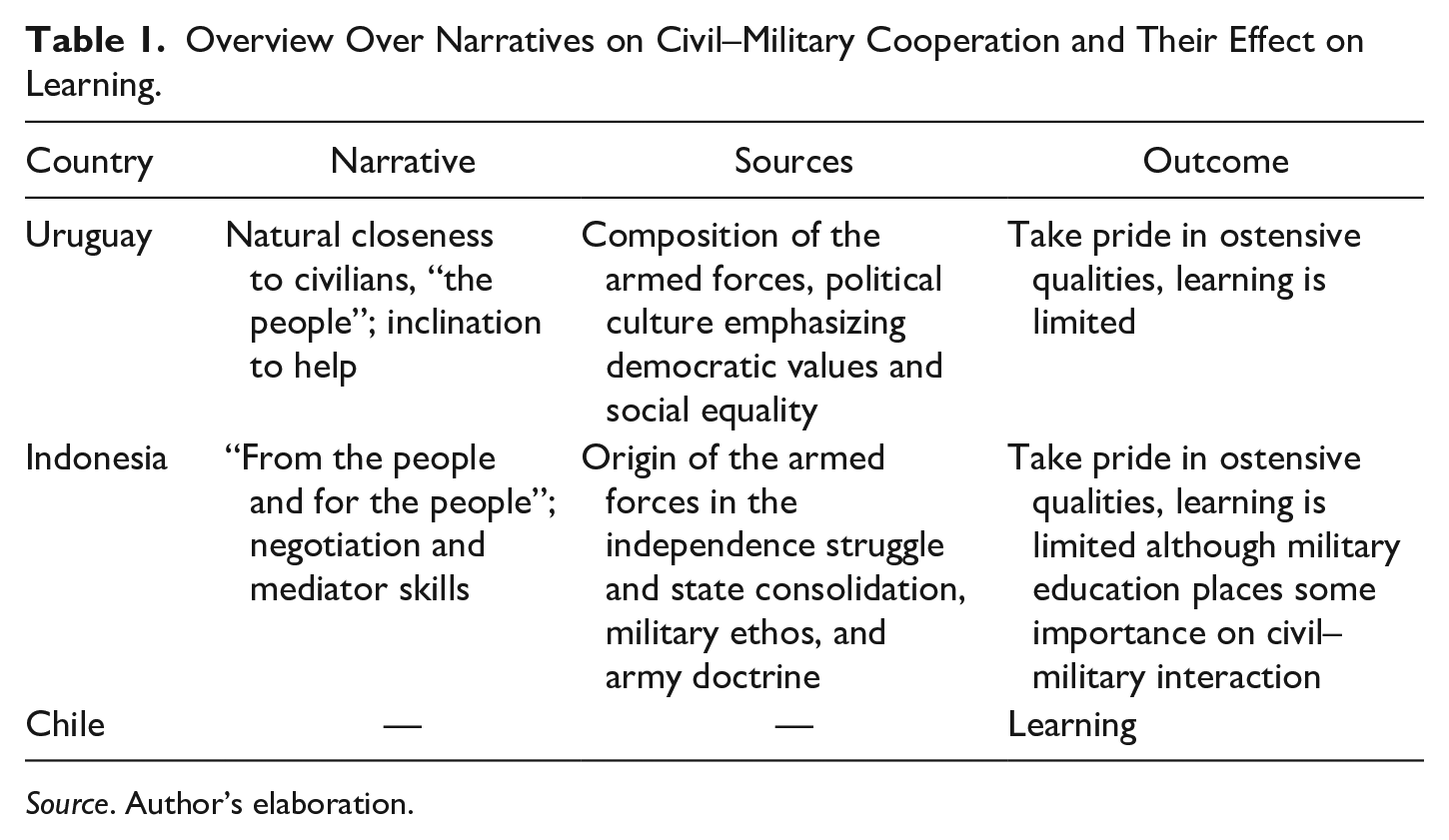
The three cases include two national militaries with an established narrative on civil–military relations (Uruguay and Indonesia) and one that lacks a comparable narrative (Chile). The contrast between positive cases where a narrative exists and a negative case without a narrative provides some control as to the role of narratives in learning even though this design is not able to determine the causal weight of narratives relative to other factors that influence learning. Still, it serves the goal of illustrating whether narratives have an effect in the first place. The inclusion of two positive cases instead of one increases confidence in the findings with regard to the mechanisms of openness and pressure. Table 1 summarizes the national narratives, their sources, and their impact on learning outcomes.
Overview Over Narratives on Civil–Military Cooperation and Their Effect on Learning.
Source. Author’s elaboration.
The three cases are comparable in that they are professional militaries that can be expected to respond to learning incentives if these enhance their institutional self-interest. All have participated in United Nations (UN) peace operations since their beginnings. In the post–Cold War period, Uruguay has had the longest sustained engagement at a significant level (see Figure 1). Indonesia, with about 75 times the population of Uruguay, has contributed the highest numbers in absolute terms in recent years. In the case of Chile, there was a significant, temporary increase between 2004 and 2017 that corresponded to the UN Stabilization Mission in Haiti (MINUSTAH), the only time the country deployed a large contingent over a sustained period.
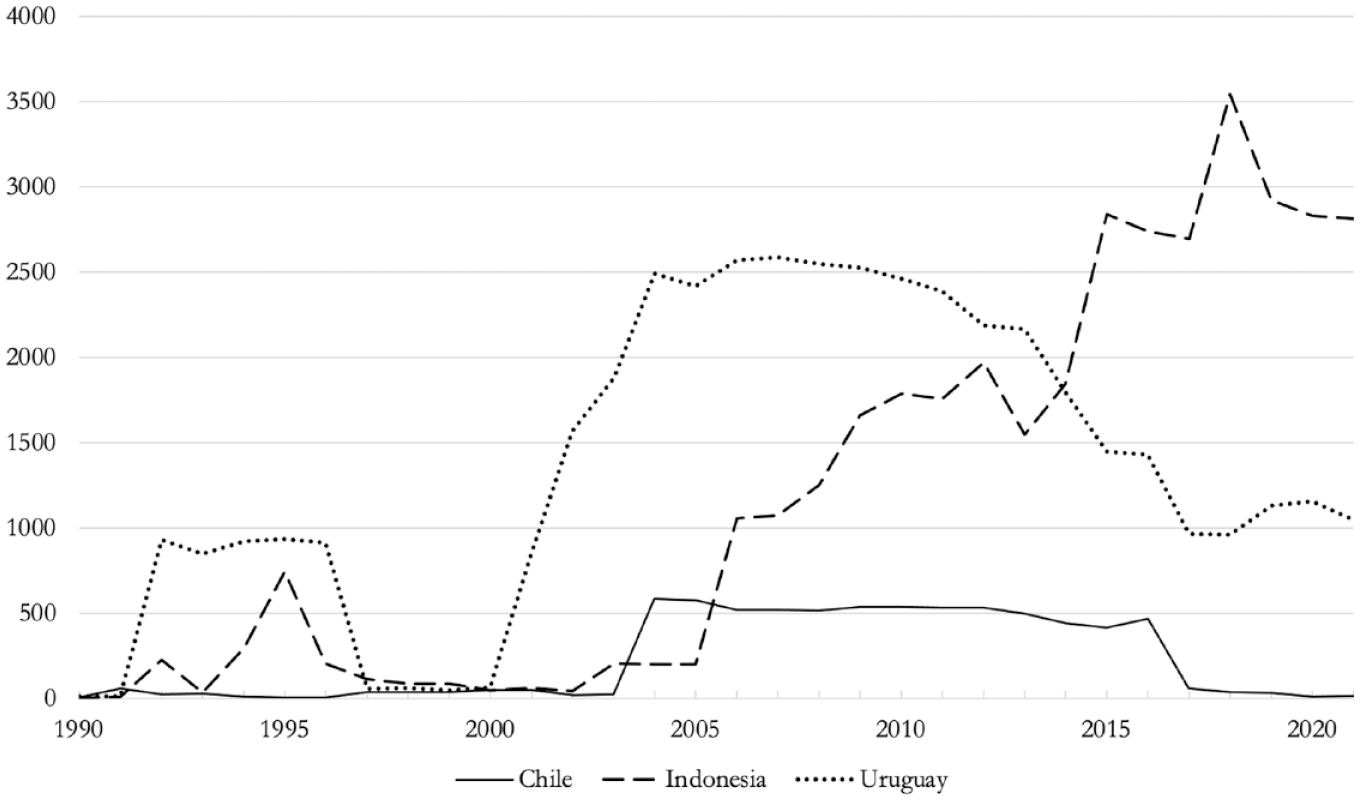
Contributions to UN Peace Operations by Country, 1990–2021.
Data
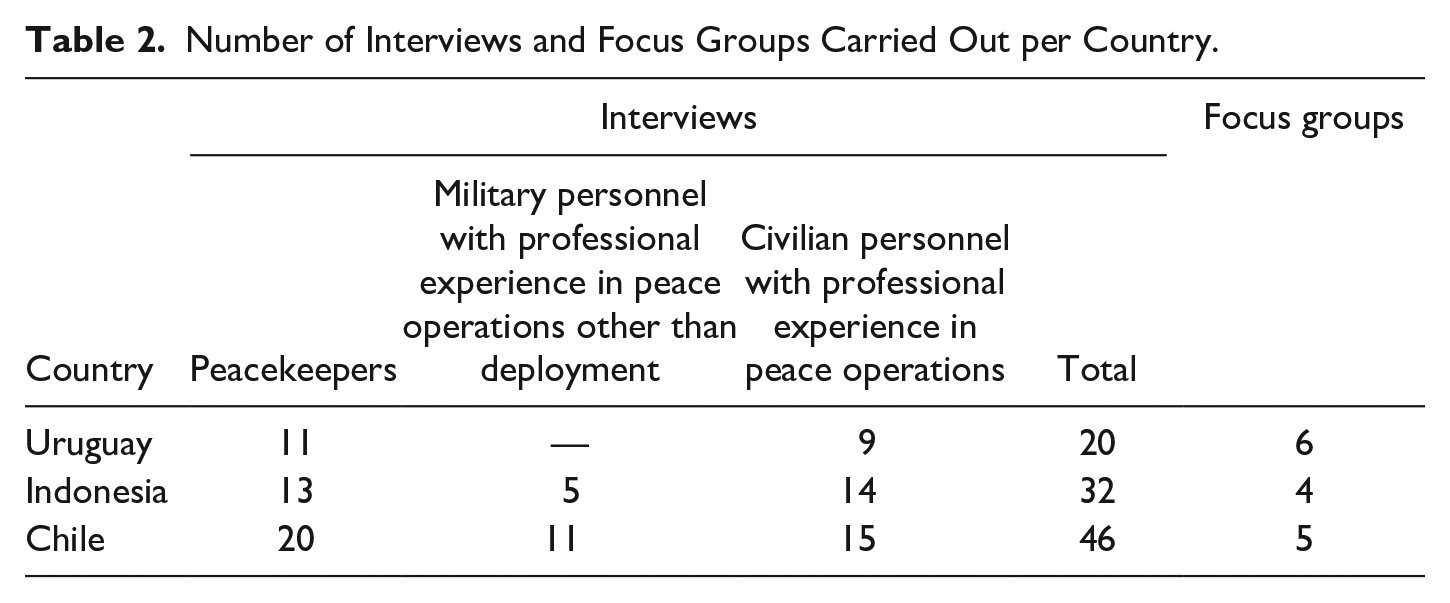
The study is based on sources from fieldwork in the three countries, complemented by secondary sources. Research in the field mainly comprised interviews and focus group discussions, which are well-established methods to learn about what people think they do (Bernard, 2011, p. 306). As such, they allow understanding how members of the military interpret their actions on their own terms, that is, potentially in the light of a national narrative. I conducted a total of 98 interviews, 44 with peacekeepers and 54 with military and civilian personnel involved in developing or implementing policies related to peace operations (see Table 2). Furthermore, in each country, I carried out between four and six focus group discussions, each involving between four and nine former peacekeepers of different ranks and services.
Number of Interviews and Focus Groups Carried Out per Country.
The interviews and focus groups in Uruguay and Chile were conducted in Spanish; those in Indonesia were held in English and were assisted by an interpreter. All interviews and focus groups were transcribed based on notes taken during the interaction. The translations in this article are my own.
The study made further use of a number of published testimonies, military publications and documents, and academic literature on the respective country’s experience with peace operation.
Operationalization and Data Analysis
To identify the effects of military narratives on learning, I built on existing theoretical insights on openness and pressure to guide the interpretation of the data. I did so by manually assigning codes to the relevant utterances in interview and focus group transcripts. The same codes were then used to identify relevant information in the publications gathered and to triangulate the data from the participatory methods. The codes were initially broadly defined (narrative, pressure, openness) and subsequently narrowed down, for instance, to identify the different aspects of a narrative or sources of pressure. I counted as evidence those claims stated by at least three different individuals (see Ruffa & Vennesson, 2014, p. 594).
The existence of a narrative was established based on two indicators according to the definition used. First, there had to be evidence that the narrative was widely shared within the military. Second, it needed to be represented in written materials such as military and non-military publications, which can be seen as an indicator for institutionalization.
An important part of a narrative is its origins. As Neumann (2008), writing on institutionalized discourses, states, “[i]n principle, the discourse will carry with it the ‘memory’ of its own genesis” (p. 71). To capture a narrative (for instance, the Uruguayan idiosyncrasy based on the composition of the armed forces and Uruguay’s egalitarian political culture), its representations by different individuals and sources did not have to be identical as long as they could be identified as belonging to the same narrative. For example, I identified the idea that the socio-economic background of Uruguayan soldiers shaped their professional behavior as part of the narrative of Uruguayan idiosyncrasy based on the following data: Claim 1: Uruguayan soldiers are from the lower-medium income class, they are emphatic with the locals and their needs, even if these might be different to their own. (Major, Army, Focus Group 4, Punta de Rieles, July 17, 2018) Claim 2: Uruguay’s great success in peace operations is because Uruguayans treat everyone the same. This is because our soldiers often come from poor backgrounds. (Interview with a Marine, Montevideo, July 13, 2018) Claim 3: The Air Force has 2,800 men and women of whom 36% have lived in poverty and of these, 11% in extreme poverty. This characteristic makes that we are more empathetic and receptive to the needs of the local population. (Lieutenant Colonel, Air Force, Focus Group 3, Montevideo, July 16, 2018)
Likewise, the absence of a narrative and the effects thereof in the case of Chile were evidenced based on the rule that the same claim had to be uttered by at least three individuals. For example, when accounting for positive experiences in relating to civilians, members of the Chilean military who participated in the study referred to contextual factors, which were different for most of them and indicate that the former peacekeepers had no readily available narrative to fall back on: Claim 1: My unit was well received [by the local population], but this depends, it was different [for the mission] in Cité Soleil, for example, where the imposition of peace implied costs [for the people living there]. (Interview with an Army Colonel, Santiago, May 11, 2018) Claim 2: [In MINUSTAH] Brazil was the collision force, heavily armed. Chile had a more humanitarian mission, which benefitted us a lot. The people perceived Chile as equal to assistance, like a friend. (NCO, Focus Group 1, Santiago, April 27, 2018) Claim 3: We arrived to replace the French in Haiti . . . after some time people realized that our position was not one of occupiers but of humanitarian aid, and that helped that they would open their doors to us. (Lieutenant Colonel, Army, Focus Group 3, Santiago, June 1, 2018) Claim 4: It was easy to establish relations with the local population in Bosnia . . . Chile was seen as having no interests in the region in contrast to the [participating] NATO countries. (Lieutenant Colonel, Army, Focus Group 3, Santiago, June 1, 2018)
To assess the working of openness and pressure to learn, the data were analyzed through an interpretive process of reconstructing learning experiences and of the role narratives played (or failed to play) in this context. The goal herein was to capture how, “by setting the scene, organizing events into a causal sequence, identifying and characterizing protagonists, and depicting the exchange among them,” the narrative created “a world of meaning” that influenced openness and pressure to learn (Krebs, 2015, p. 38). To gauge the extent of pressure on the military to learn, I focused on those data that gave indications about the self-perceived need to improve the military’s capacity to interact with civilians and about whether individuals felt that others expected them to improve. Moreover, I assessed whether the military’s relevant environment called for revisiting the military’s approach to interact with civilians through news reports and interviews with policy makers, among other. These data were condensed according to their respective codes and analyzed in relation to the existence or absence of a narrative.
The degree of openness toward learning about civil–military cooperation was assessed based on two types of data. On one hand, I analyzed statements regarding the importance of learning about and training civil–military interaction in peace operations. Only if preparation and training was recognized as relevant for the military in question, it was taken as an indicator of openness. On the other hand, I assessed how former peacekeepers reacted to questions about conflictive encounters with civilians. I classified those statements as indicators of openness to learn that directly or indirectly acknowledged shortcomings on part of the military. For instance, several of the Chilean research participants, who were generally more open to learn, reported experiences of successful civil–military interaction thanks to skills they had acquired through previous failures.
Narratives of Civil–Military Cooperation
This section presents the existing narratives on civil–military cooperation, their origins, and implications on the acquisition of new knowledge in the case of Uruguay, Indonesia, and Chile. The case studies will demonstrate that the idea that both the Uruguayan and Indonesian militaries are “naturally close” to the people led to less pressure and less openness for learning about engaging with civilians than it was the case in Chile. On its part, the Chilean military began emphasizing the importance of CIMIC 2 and was inclined to learn as it had no comparable narrative that could legitimize neglecting the relevance of being good at civil–military interaction in peace operations.
Uruguay
The Uruguayan armed forces are a positive case in which a narrative on civil–military interaction exists. Accordingly, the military is “naturally” prepared to enter in contact with the local population in the mission area and generally anxious to help. The narrative traces its origins from the composition of the armed forces and an egalitarian political culture that has emphasized social equality. As I shall demonstrate, this storyline has eased pressure on Uruguayan peacekeepers to improve their skills at interacting with civilians and, at the same time, rendered them less open to know about alternative strategies to relate to civilians.
When asked about the challenges of interacting with civilians, most members of the armed forces almost immediately referred to what they call the “Uruguayan idiosyncrasy,” “which has the effect that we are liked by the people” (Focus Group 6, NCO, Montevideo, July 13, 2018). This narrative highlights three central elements. First, an “inherent ability” to establish contact and communicate with local populations (Brown, 2017, pp. 68, 219), which, according to a Navy Captain, comes from an urge “to get along with everybody” (Focus Group 5, Montevideo, July 19, 2018). A Sergeant recalled from his deployment to the Democratic Republic of Congo (DRC), “the children received us throwing stones, but when we left, they cried. Uruguayans are like that, if we can play with the kids we will do so, for us a child is a child” (Focus Group 3, Punta de Rieles, July 17, 2018). According to the Army’s former Commander in Chief, UN officials too have openly recognized the characteristic that “Uruguayans always chat with the local population” (Manini Rios, 2017).
The second element is the capacity to ease tensions and act as mediators in conflict. Thus, an Army Colonel who had been deployed to the Sinai and the Congo affirmed, “when there is a conflict . . ., showing the Uruguayan flag is a symbol of calm for the population” (Focus Group 2, Montevideo, July 12, 2018). Third, the Uruguayan idiosyncrasy refers to the readiness to step in and help. This is epitomized in a sign at the entrance of a Uruguayan base in Goma in the eastern DRC, which reads, BN [Battalion] Uruguay, always present. This slogan refers to the readiness of Uruguayan peacekeepers to undertake operations that other countries deem too dangerous or inconvenient (see Brown, 2017, p. 85). At the same time, it implies that Uruguayan peacekeepers are always ready to assist the local population and that they do so “with pleasure, they don’t complain” (interview with a former Battalion Commander, Montevideo, July 19, 2018). As an Air Force Colonel explained, “the Uruguayan peacekeeper goes, without any ‘but’, they just go and do what needs to be done. Sometimes we might not even have the right material or adequate weapons, but that is compensated by goodwill” (Focus Group 3, Montevideo, July 16, 2018).
The Uruguayan idiosyncrasy is defined in juxtaposition to other contingents. A Non-Commissioned Officer explained that Uruguayan peacekeepers would always mingle with the people, “something that the French for example don’t do” (Focus Group 2, Montevideo, July 12, 2018). A Navy Captain recalled an accident in the DRC where an Asian contingent operating a hospital in the area failed to react, “so we did everything; verification, reporting, but first of all, react” (Focus Group 5, Montevideo, July 19, 2018). According to a Sergeant, “if people identify the peacekeeper as Uruguayan, they would treat them differently. We don’t know why, but we make ourselves being liked” (Focus Group 4, Punta de Rieles, July 17, 2018).
Most participants in the study expressed precise ideas about the reasons for the Uruguayans’ ostensive ease at interacting with civilians. On one hand, they emphasized the humble origins of those entering the military. As a Major in the Army explained, “Uruguayan soldiers are from the lower-medium income class, they are emphatic with the locals and their needs” (Focus Group 4, Punta de Rieles, July 17, 2018). This is why, according to a Marine, “Uruguayans treat everyone the same, because our soldiers often come from poor backgrounds” (interview, Montevideo, July 13, 2018).
On the other hand, the narrative establishes a link between the Uruguayan idiosyncrasy and the country’s egalitarian political culture, which contrasts with other Latin American societies that have historically been dominated by a semi-feudal ruling class, a powerful military cast, and the Catholic church (Real de Azúa, 1964, p. 20). Uruguay, in turn, experienced a modernization process in the early 20th century that established a strictly secular state, compulsory education free of charge, welfare benefits for the working class, and a military by and large subordinate to civilian authority. A strong, bipartisan party system that emerged in the mid-19th century depended on the support of the masses and ensured, for a long time, political stability through the incorporation of different social groups. The resulting ability to assimilate diverse elements of a society into a fairly unified political community has widely been cited as having informed the Uruguayan approach to peace operations. According to an Army Colonel, “the advantage of the Uruguayan peacekeeper is that they don’t come from a discriminatory society, they don’t have issues getting along with someone who is black, yellow or green” (interview, Montevideo, July 19, 2018). Another officer explained, here, the military is integrated into society . . . In Uruguay, the soldier paints classrooms and when they go on a mission in Haiti, they do the same there. People are darker and poorer, but the tasks and the type of exposure are the same. (Interview, Montevideo, July 12, 2018)
Due to Uruguay’s egalitarian political culture and the socio-economic background of its soldiers, the country’s approach toward civilians in peace operations is generally seen not necessarily as “better or worse,” but indeed as “different” (Brown, 2017, p. 219).
What effects did the narrative of Uruguayan idiosyncrasy have on the possibilities of improving civil–military interaction in peace operations? The two most important sources of pressure to learn are arguably the institution itself and its immediate environment. The military may have institutional incentives to learn due to the desire to improve its performance and remain relevant. However, given the strong institutionalization of the Uruguayan idiosyncrasy narrative, it is difficult to see impulses for innovation coming from the military itself. The National Peace Operations Training Institute (Escuela Nacional de Operaciones de Paz del Uruguay, ENOPU) places little importance on civil–military interaction but emphasizes other issues instead. The reaction of a retired Army Colonel when asked about the challenges of relating to civilians is illustrative of the lack of pressure inside the armed forces: “I have heard about CIMIC, but I know of no Uruguayan who would have problems with this,” he said, and further explained, “one can tell from experience that it is inconvenient to be on bad terms with others. Only a NATO country would do that . . . not try to establish good relations” (interview, Montevideo, July 11, 2018).
With regard to the military’s relevant environment in peace operations, the narrative is widely shared also among politicians and civilians in the defense sector. When asked about the relevance of peace operations training, a high-ranking Ministry of Defence official opined, the natural way of Uruguayan peacekeepers is to interact closely with local populations. This is because of where they come from. In Haiti and in the Congo, for instance, they collected money for children to attend school, because they couldn’t understand that school wasn’t for free, secular and obligatory for everyone, like it is in Uruguay. (Interview, Montevideo, July 13, 2018)
This view, which is highly unlikely to produce pressure toward changing the military’s approach, is shared across the political spectrum. A former member of the Senate’s Defence Commission and now Minister of Defence, Javier Garcia from the center-right Partido Blanco, claimed that “CIMIC was developed in Uruguay, the armed forces are more involved with subsidiary missions than with defence,” when asked whether he sees a necessity to strengthen civil–military coordination (interview, Montevideo, July 16, 2018). Another former observing member of the Commission and current Minister, Pablo Mieres from the center-left Partido Independiente, answered in a similar way: “The concept of CIMIC is firmly integrated within our military” (interview, Montevideo, July 17, 2018). The stability of the narrative forestalled external pressures to learn.
Apart from pressure, the narrative about Uruguay’s naturally successful civil–military cooperation has affected the military’s openness to learn from new experiences in training and in the field. On one hand, as the Uruguayan idiosyncrasy refers mainly to common people, other civilian actors such as humanitarian agencies, nongovernmental organizations (NGOs), and civilian superiors in the mission tended to be ignored when the issue of civil–military interaction was brought up in training. On the other hand, peacekeepers interpreted their experiences of interacting with civilians through the frame of the Uruguayan idiosyncrasy, meaning that the failure to establish cordial rapport was readily blamed on circumstantial factors or the civilians, rather than leading to the questioning of the military’s approach. While it may be argued that Uruguayan peacekeepers are effectively more skilled in relating to civilians than other militaries, when asked to reflect on how well their unit was prepared to do so, evidence from an online survey I implemented in 2018 suggests that there is some room for debate. Of a total of 572 respondents with experience in at least one peace operation, a majority of 51% agreed with the statement that their unit was well prepared to interact with the local population. However, considerably less (30%) replied that they “absolutely agreed.” 3
The fact that the narrative reduced pressure to learn and openness toward new experiences does not imply that Uruguayan peacekeepers have failed to learn from their experiences individually. Yet, being all else equal, the existence of the narrative meant that due to the powerful belief in the Uruguayan idiosyncrasy, the full potential for learning has not been exhausted.
Indonesia
As in the case of Uruguay, the Indonesian armed forces have an established narrative of civil–military cooperation that is upheld by both the military and the political elite. The narrative highlights Indonesian peacekeepers’ ostensive advantage to enter into contact with local populations and win their trust, turning them into successful mediators of conflict. The narrative links these abilities to the very identity of the Indonesian armed forces (Tentara Nasional Indonesia, TNI) by tracing them back to the country’s independence struggle and the military’s frequent interaction with civilians at home.
The narrative of Indonesia’s supposedly unique approach to engage with civilians emphasizes putting oneself on par with one’s counterpart, showing respect and engaging in dialogue rather than providing ready-made solutions (see also Alexandra, 2017, p. 41). Seeking first to “win the hearts and minds of the people,” as a former contingent commander put it (interview, Sentul, January 23, 2019), another former peacekeeper summarized the Indonesian practice as “heart-to-heart talk” where soldiers try to establish personal relationships with local civilians (Focus Group 1, Sentul, January 16, 2019). Not imposing solutions but seeking dialogue is contrasted to Western approaches and instead, Indonesians “discuss with the people” to find out “what best we can do for them” (interview with a Lieutenant Colonel, Jakarta, January 24, 2019).
Following the narrative, due to the military’s “natural inclination to get along well with civilians in their operational area” (Haseman & Lachica, 2009, p. 89), Indonesian peacekeepers have been able to gain the trust of warring factions in conflict situations. The so-called Garuda contingent’s successful engagement as mediators in the United Nations Transitional Authority in Cambodia (UNTAC) provides the backbone for this story line, as the mission marked the beginning of Indonesia’s gradual re-engagement with peace operations in 1992–1993. The country’s achievements in UNTAC have widely been cited as evidence for the Garuda contingent’s popularity among Cambodians (Alatas cited in Anwar, 2014, p. 195; Haseman & Lachica, 2009, p. 90; Jones, 2020, p. 94; Sebastian, 2006). Building on the established narrative, other experiences have been interpreted using the same frame, such as the fact that Indonesia has not suffered casualties in the mission in the Central African Republic (MINUSCA), where more than 160 peacekeepers have died from malicious acts since 2014 (UN Peacekeeping, 2022): “There was never an attack on Indonesian peacekeepers because they establish good relations with everyone. See, they have been invited by both Muslims and Christians to pray,” an Army Colonel explained (interview, Jakarta, January 25, 2019).
According to two U.S. observers, the Indonesian attitude toward civilians “does not come easily to regular troops” trained to fight war (Haseman & Lachica, 2009, p. 89). Instead, it is attributed to the armed forces’ foundational doctrine, which persists until today as part of the TNI’s identity. The military emerged from the Indonesian guerrilla struggle against Dutch colonialism in the second half of the 1940s, nurtured by the moral and material support of the people. This led the first commander of the Indonesian armed forces, General Soedirman, to invoke the metaphor of the military and the people like fish that cannot live without water (Rinakit, 2005, p. 15). The idea lived on in the form of two concepts.
First, the idea of unity between the military and the people has been enshrined in the concept of total people’s defense (sishankamrata), which has informed the country’s defense plans since independence. Total people’s defense works on the assumption that an external aggressor would be confronted through a guerrilla-type struggle on Indonesian territory given the country’s relative lack of conventional warfighting power. This requires the permanent ideological preparation of the people to support a potential military effort of guerrilla warfare. Second, the civilian–military unity principle has defined the military’s core functions since the creation of the Indonesian state. The Army in particular has been deeply involved with nation-building. During the authoritarian regime of Soeharto (1967–1998), it had the dual function (dwifungsi) of defense and internal security, on one hand, and a socio-political role as guardian of national stability, on the other (see Kingsbury, 2018, pp. 6–32). Dwifungsi, a “euphemism for military surveillance and control” (Honna, 2003, p. 3), found its practical expression in the territorial command structure. Resembling the civilian administrative divisions, through the territorial commands, the Army carried out a range of tasks including policy formulation and implementation.
Although dwifungsi and the socio-political role of the TNI were formally abolished after Soeharto’s fall in 1998, the belief that the armed forces are the ultimate guardian of the state has lived on (Honna, 2003; Sebastian et al., 2018). So has the territorial command structure, through which the military’s civic mission programs are implemented. In short, as a former Army Chief of Staff during the democratic period put it, community service “reflect[s] the Army’s identity as the army of Indonesian citizens” (Jakarta Post, 2017).
This identity has become an integral part of the narrative on the Indonesian way of civil–military interaction in peace operations where “the military is instinctually familiar with working with the people” (interview with a retired Army General, Jakarta, January 13, 2019). As early as in 1963, an armed forces publication referred to Indonesia’s participation in peace operations as the international dimension of the institution’s civic mission program (Alexandra, 2020). More recently, the TNI “translated [the peace operations concept of] CIMIC quickly into the territorial function,” although strictly speaking, the UN’s CIMIC concept refers to more than the military’s engagement in missions directed at the population, as a retired army general acknowledged (interview, Jakarta, January 13, 2019). In an online survey implemented with a battalion after its return from the UN mission in the DRC, the vast majority of more than 96% of the total 132 respondents agreed with the statement that “CIMIC is the same as territorial function,” with only 3% saying that “it is not quite the same” and one person indicating that “CIMIC has little or nothing to do with territorial function.” Therefore, from the Indonesian perspective, “interacting with the local population is not a challenge, it is a value the TNI brings into peacekeeping” (interview with a retired Army General, Jakarta, January 13, 2019).
Similar to the case of Uruguay, the established narrative of the Indonesian approach to peace operations had the net effect of lowering pressure to learn about civil–military engagement and limiting the armed forces’ openness to potentially new insights. However, as the narrative hinges on the TNI’s identity as a military of the people, some level of institutional pressure to comply with the idea can be observed. Put differently, the TNI has had incentives to learn about civil–military interaction in peace operations because conflictive modes of engagement would not only challenge the narrative of the Indonesian approach but also, and more importantly, the armed forces’ very identity.
Externally, there has been no pressure on the TNI to revise its approach as the narrative of Indonesian-style civil–military interaction in peace operations is generally accepted among bureaucrats, policy makers, and scholars. A senior member of the foreign service who had been deployed as a civilian peacekeeper in Lebanon affirmed, the Indonesian contingent could easily adjust to the UN peacekeeping doctrine since there are many similar programs in Indonesia where the armed forces interact with civilians . . . The Indonesian CIMIC approach could be perceived as different from the one of NATO member countries. (Leonard Hutabarat, written questionnaire, January 21, 2019)
Scholars have echoed the narrative of the Indonesian peacekeepers’ ability “to engage with the local population” in a relatively uncritical way and without citing concrete evidence (Jones, 2020, p. 6; see also Alexandra, 2017; Sebastian, 2006). At the Ministry of Foreign Affairs, an official suggested that the TNI had little need to prepare for CIMIC because “they know what it is when they see it” (interview, Jakarta, January 18, 2019). The narrative of the military’s closeness to the people is not completely uncontested given its historical baggage in legitimizing authoritarian practices during the Soeharto period. Some have been wary of the TNI’s involvement in implementing policies suspecting that it would serve the political purpose of demonstrating that it is good to have the military “around” (Sebastian et al., 2018, p. 53). However, even critics support the narrative holding that the military’s export of its civic mission approach has been positive (Anwar, 2014, p. 195). As foreign policy veteran and former Minister of External Affairs, Hassan Wirajuda, stated, “even during Soeharto’s time, Indonesian peacekeeping forces were known to be caring internationally although at home they violated human rights” (interview, Jakarta, January 17, 2019). Given that the narrative of the prevailing approach to civil–military engagement is widely accepted as a successful contribution to UN peace operations, it is easily explained why there has been no external pressure on the TNI to scrutinize its approach.
Interestingly, some pressure to learn has come from within the military itself. Because without the territorial function and its requirements of successful engagement with civilians the TNI “would face a big question mark” in terms of its identity (interview with a retired Army General, Jakarta, January 17, 2019), some importance has been placed on civil–military interaction in the preparation for peace operations. Several research participants pointed out that despite the TNI’s supposed ease in approaching civilians, different languages and customs represent a challenge that can be overcome only through learning from experience. Still, the issue of civil–military engagement has nevertheless been treated as merely one among other topics in peace operations training. CIMIC courses at the Peacekeeping Training Centre (Pusat Misi Pemeliharaan Perdamaian, PMPP) have mostly been organized by the U.S.-sponsored Global Peace Operations Initiative (GPOI), with the Indonesian view being that UN CIMIC places too much emphasis on procedures, “while in Indonesia, CIMIC is about the people. It is not a program, but a relation” (interviews with a PMPP officer, Sentul and Jakarta, January 2019). Hence, as long as the narrative of the successful Indonesian approach remains unchallenged, the military is unlikely to see substantive benefits in learning from the UN.
In terms of openness to learn, the narrative diminished the possibilities of acquiring new knowledge. Some officers recognized what they called an “ego problem” that led members of the military to assume a rather presumptuous attitude toward civilian staff in the mission “because you think you are military, you are the one who is trained and experienced” (interview with a PMPP officer, Sentul, January 15, 2019.) As the TNI “quickly links CIMIC to its domestic concept” (interview with a retired Army Officer, Jakarta, January 13, 2019), there has been a tendency that those elements of CIMIC that refer to military coordination with civilian staff at the UN, non-UN agencies, and NGOs get ignored. As discussed above, the overwhelming focus has instead been on the engagement with common people, and in this respect, the narrative has functioned as a shield against contradictory experiences at least in the domestic realm. For example, efforts to quell insurgencies such as in Aceh and Papua have often had limited success, despite the long-standing emphasis on total people’s defense and the TNI’s civic missions. Besides, the TNI has a history of human rights violations carrying into the post-Soeharto period that is difficult to reconcile with the narrative of civil–military unity. Given the resilience of the narrative in the face of obvious contradictions, it is likely that in the area of peace operations, openness to learn from alternative approaches of engaging with civilians has found its limits, too, once it required acknowledging shortcomings.
Chile
Unlike in Uruguay and Indonesia, the Chilean armed forces have no established narrative regarding their relation with civilian actors. When asked about their experiences in establishing contact with local populations and working with civilian agencies and NGOs, former peacekeepers gave three types of answers, all of which fall short of constituting a narrative. A first set of responses referred to an ostensive “Latin approach” that facilitated the interaction with civilians (Focus Group 3, June 1, 2018). Yet, this storyline invoking cultural traits is not widely shared nor can it be found in written form such as military publications. A second, more broadly disseminated idea is the one that Chilean peacekeepers have successfully interacted with civilians due to the military’s “professionalism” and the preparation they received as part of their pre-deployment training (see, for example, Ejército de Chile, 2004, p. 81). While professionalism in this context is broadly understood as the capacity to engage in both war and peace time operations, however, most military publications dealing with professionalism in terms of the institutional benefits and lessons learned from deploying peacekeepers do not even mention humanitarian tasks or other forms of engaging with civilians (see, for instance, Aimone, 2015; Neira Hernández, 2010). Barely institutionalized, the idea of civil–military cooperation as a result of military professionalism thus fails to meet the characteristics of a narrative.
A third group reported that previous experience in civil–military interaction in the context of national disasters made it easier for them to engage with civilians in peace operations. Although Chile is a country prone to earthquakes, tsunamis, and wildfires, however, it has no proper domestic concept or name for civil–military engagement in humanitarian aid and disaster relief missions. In the 2010s, the military developed the new doctrine Civil Affairs and Territorial Action (ACAT, Asuntos Civiles y Acción Territorial) on the relation between the armed forces and societal actors. But, although ACAT is an established element of the military’s joint operations since 2017, it is not part of what the armed forces see as their essential mission. In contrast to Indonesia, where civil–military interaction in peace operations could readily be linked to the armed forces’ domestic concept of territorial function, a retired Army General who had served as Deputy Force Commander in MINUSTAH made it clear that for the Chilean armed forces, the interaction with civilians at home is different to civil–military interaction in peace operations: “in the mission, the relationship is constant, not like in a natural disaster where you have 15 days of coordination and one knows that after that, it is over” (interview, Santiago, January 12, 2018).
Absent a narrative that would project civil–military coordination as something innate, the Chilean military adopted a rather technical-instrumentalist approach. Because the interaction with ordinary people brought them a positive image both in Haiti and at home, they found it a good thing to do. Thus, the research participants stressed the operational benefits from establishing links with Haitian citizens.
Unlike Uruguayan and Indonesian peacekeepers who explained successful civil–military interaction based on the respective national narrative, members of the Chilean military referred to contextual factors to account for positive experiences in relating to civilians. Conscious of the favorable conditions they found in Haiti, peacekeepers reported that Chile, unlike the Brazilian contingent leading the mission, had a “more humanitarian mission” which, in the opinion of a Non-Commissioned Officer, “benefitted us a lot. The people perceived Chile as equal to assistance, like a friend” (Focus Group 1, April 27, 2018). Similarly, a Lieutenant Colonel resorted to contextual factors rather than invoking a given military capacity when he explained that having replaced the French, “people realized that our position was not one of occupiers but of humanitarian aid, and that helped that they would open their doors to us” (Focus Group 3, Santiago, June 1, 2018). Former peacekeepers in Bosnia, too, cited the local circumstances instead of supposedly Chilean characteristics when reporting cooperative interactions with the local population. According to them, Chile was seen as having no interests in the region “in contrast to the [participating] NATO countries” (Focus Group 3, Santiago, June 1, 2018).
The absence of a narrative facilitated learning from peace operations as it increased both the openness of peacekeepers toward new knowledge and the pressure to learn. Note that the acquisition of new knowledge was limited to individual learning but failed to produce learning at the institutional level due to the absence of a critical mass of peacekeepers and the lack of formal learning mechanisms (see further Jenne, 2020). Learning is conditioned by a range of factors that are beyond the aim of this study. To support the argument presented here, it is sufficient to demonstrate that some degree of learning took place due to the absence of a firmly institutionalized story about civil–military interaction.
That practical learning took place at the individual level is clear from statements by former peacekeepers who reported that they improved their skills in interacting with civilians. A commanding officer in the Naval Infantry stated that “before [MINUSTAH] our behaviour was more violent. Now, we do our job in a more cordial and friendly way” (interview, Concón, August 31, 2018).
Learning through peace operations was facilitated through training and experience. During training, the absence of a narrative created openness to acquire new knowledge about an upcoming task that was not seen as something already mastered by the military. Hence, while in Uruguay and Indonesia, civil–military interaction was considered as just another element of pre-deployment training and did not receive special attention, in Chile, research participants highlighted that they had found the modules on civil–military interaction helpful for their deployment (Focus Group 4, Concón, August 31, 2018). Successful training was also cited in military publications as important to allow the Chilean personnel to “gain the trust of the Haitian people” (Kauer Tapia, 2006, p. 123), and Eduardo Aldunate, who led MINUSTAH as Deputy Force Commander during 2005–2006, observed that Chilean peacekeepers had “effectively learned something about civilian working culture” during pre-deployment training (interview, Santiago, February 16, 2018).
Just as learning from training, learning from experience, too, requires openness toward changing existing beliefs and habits that was facilitated by the absence of a narrative. The previous experiences Chilean peacekeepers referred to when accounting for their learning events with regard to civil–military interaction were prior experiences of peace operations and not, like in the Uruguayan and Indonesian cases, contemporary or historic experiences from domestic missions. Ultimately, openness meant that failures could be accepted more easily as they did not constitute a threat to the military’s self-image and identity. A Lieutenant Colonel, for instance, admitted that he had failed to build rapport with his interpreters as his “military culture clashed with the civilian one” (Focus Group 3, Santiago, June 1, 2018). Because the Chileans were free of any narrative’s burden that would place expectations on them, they often referred to circumstantial factors or even to “luck” as determinants of successful civil–military interaction (Focus Group 2, June 1, 2018).
Apart from openness, the absence of a narrative created pressure to build capacities and skills for civil–military interaction. The amount of pressure should not be overestimated, especially at the institutional level. Institutional learning from peace operations with regard to civil–military interaction was of secondary concern in the armed forces and therefore limited (Jenne, 2020). Nevertheless, it is possible to evidence a perceived necessity, “as a result of international requirements,” to generate at least some “administrative structures and regulation” for civil–military interaction (Maldonado Orozco & Rothkegel, 2010, p. 165). Thus, it was highlighted that to handle conflictive situations with local populations “proper troop education, full indoctrination, and comprehensive training according to UN standards are becoming increasingly important” (Di Nocera García & Benavente Cresta, 2007, p. 85). These and similar statements made no call to rely on supposedly innate traits or already existing military capacities.
Pressure to improve on civil–military interaction was further exercised by a few individual military leaders. One of them was a former contingent commander, who called for special consideration to be given to the utility of interacting with local populations and the provision of sufficient resources to carry out activities such as cultural and sports events (Carrasco González, 2005, p. 135), suggesting that Chile’s efforts in Haiti had fallen short of ideal.
From outside the military, pressure to learn has been generated in the civilian policy-circles involved in peace operations although it is certainly debatable how strongly the armed forces came to feel it. At the Ministry of Foreign Affairs, a high-ranking official stated, “The armed forces have to open up to interacting with civilians. They have always been isolated from society . . . their whole life is military” (interview with a high-ranking foreign policy official, Santiago, March 4, 2018). Another ministry official in charge of peace operations opined that there was still a necessity to deliver “solid training” in civil–military coordination (Riquelme Rivera, 2012, p. 100) and Mariano Fernández, former Minister of Foreign Affairs and Head of MINUSTAH, further underscored that a national effort was required to prepare peacekeeping personnel adequately. As Fernández emphasized, there is “an element of common sense in seeking to establish relations with the local population, but it is also part of [. . .] military preparation” (interview, Santiago, May 14, 2018).
Taken together, the Chilean case illustrates how the absence of an established storyline about the military’s successful interaction with civilian actors created openness and pressure, which facilitated learning from peace operations to a greater extent than it would have been the case had there been a narrative.
Conclusion
The literature on military learning, change, and innovation has only tangentially dealt with narratives. Such dominant stories people create to make sense of their being and surroundings have mostly been subsumed into the larger categories of organizational or military culture. I have argued here that analyzing narratives in their own right as one element or particular expression of culture has analytical benefits. Based on original insights from fieldwork in three countries, this study has demonstrated that the existence of reaffirming narratives affects military effectiveness in that it influences whether learning takes place. As such, it complements studies that show how particular military cultures facilitate or hinder reform with a generalizable understanding of the role narratives play in the context of learning.
The findings raise broader questions about the military’s beliefs regarding its effectiveness and the potential negative effects these beliefs have on its ability to improve. All else being equal, the existence of a narrative about civil–military cooperation in the case of the Uruguayan and Indonesian armed forces as opposed to the case of Chile reduced the possibilities for learning as it diminished both the openness toward and pressure to develop new knowledge from peace operations. Because the question of actual performance was beyond the scope of this article, the relation between what a narrative tells the military does and what the military effectively does may be addressed in future research. It might be true that Uruguayan and Indonesian peacekeepers have had a lesser need to learn about engaging with civilian actors than the Chileans. Nevertheless, as peacekeepers can hardly ever be prepared for everything, the findings presented here still demonstrate that narratives play a role for military performance and effectiveness through their influence on learning.
Footnotes
Acknowledgements
I thank David Curran, Ian Liebenberg, and Marién Duran for very valuable feedback on earlier versions of the manuscript.
Declaration of Conflicting Interests
The author declared no potential conflicts of interest with respect to the research, authorship, and/or publication of this article.
Funding
The author disclosed receipt of the following financial support for the research, authorship, and/or publication of this article: The research for this article was funded by the Chilean National Agency for Research and Development (ANID), Programa Fondecyt Regular 2021, Project No. 1210067.
