




Abstract
Under what conditions is the American public supportive of U.S. military intervention in foreign crises? We argue that the public assesses three key dimensions of an intervention: the motivation for an intervention, the form an intervention can take, and the tasks an intervention may be mandated to fulfill. Through a survey experiment, we test several hypotheses in the context of a potential U.S. military intervention in a civil war. Comparing different motivations, we find that the strategies (forms and mandates) matter much more for public support. Regardless of motivation, the American public is generally more supportive of multilateral forms of intervention and prefers mandates that focus on the protection of civilians and peaceful conflict resolution.
Introduction
In recent decades, the U.S. government has intervened or considered intervening militarily in places from Afghanistan, Iraq, Syria, Libya, to Venezuela, Haiti, and Ukraine (Barndollar, 2021; Cooper & Schmitt, 2022; Crowley et al., 2021; Ellsworth, 2019; Gallagher, 2022; Hof, 2021; Tisdal, 2009). In each case, U.S. leaders were confronted with the question of whether, how, and on what scale, to send troops. For the most part, the recent operations have been more limited in scope in comparison with the wars in Afghanistan and Iraq, and this appears to be in line with a majority of Americans’ views on such issues. Public opinion polls show that Americans have become weary of the two long wars and support U.S. troop withdrawal from Afghanistan (AP-NORC—Center for Public Affairs Research, 2021; Balz et al., 2021; Van Green & Doherty, 2021). Moreover, a review of available public opinion data on the current Russia–Ukraine war finds that more than three-quarters of Americans support sanctions against Russia, but well less than half support active U.S. military intervention in the war (Newport, 2022). Yet, other surveys also convey that Americans support maintaining a troop presence in the Middle East (Smeltz & Kafura, 2020), and a surprising recent poll also finds that, for the first time, just over half of Americans favor sending U.S. troops to defend Taiwan if China invades the island (Smeltz & Kafura, 2021). It thus remains unclear whether there are new trends in American public opinion with respect to U.S. military intervention, and the rise of social media since the early 2000s has also complicated the informational environment of the public by bringing them more awareness of foreign events.
Against this backdrop, we conducted a public opinion survey experiment to investigate the American public’s attitudes toward a military intervention along three dimensions: motivation, form, and mandate. We argue that these are different but related dimensions that encompass a decision to intervene; moreover, the literature suggests that public support for an operation may also be influenced by the way that these dimensions are combined (Eichenberg, 2005; Jentleson, 1992; Jentleson & Britton, 1998; Kreps & Maxey, 2018; Kull & Destler, 1999; Wallace, 2019). While significant knowledge has been accumulated on public opinion toward use of force, few existing studies have made the conceptual distinction between motivations and forms of intervention, and almost none separates mandates from the other two concepts. We believe that disentangling the three dimensions can help us more systematically investigate recent trends in public opinion toward use of force and compare our findings with those from the existing studies.
The baseline scenario of our survey experiment is a humanitarian crisis and a military intervention out of humanitarianism only. We then added two self-interested motivations to the baseline: a security interest and an economic interest (Choi, 2013; Choi & James, 2016; Eichenberg, 2005; Fordham, 2008b; Kreps & Maxey, 2018; Peceny, 1995). This generated three motivation scenarios in our survey: humanitarianism; humanitarianism and security interest; and humanitarianism and economic interest. Each of our respondents was randomly assigned to one of the three motivations. The design was informed by two facts: all U.S. military interventions since the end of the Cold War have been in part justified on humanitarian grounds (Maxey, 2020), and in the real world, the motivation for a military intervention is often a mixture of humanitarianism and the strategic interests of the interveners.
For forms of intervention, we considered unilateralism, allied actions, and UN peacekeeping—three of the most commonly seen military approaches to foreign policy challenges. It is worth noting that while the United States has not been known for sending a large number of troops to UN peacekeeping missions, the U.S. government has consistently been the largest financial supporter of UN peacekeeping and has played a pivotal role in generating support from other countries (Henke, 2016, 2017) In fact, reports by the U.S. Government Accountability Office (GAO, 2018) suggest that policymakers should view peacekeeping as a feasible option for responding to international crises. 1 Finally, we considered a range of mandates, or specific tasks, that an intervention may aim to accomplish: protect civilians, broker a peace deal, deploy advisors, engage in combat, and engage in peacebuilding. Although the list is not exhaustive, the options we included are commonly observed.
We find that regardless of the motivation, the American public is generally more supportive of multilateral forms of intervention and prefers mandates aimed at managing the negative impacts of existing conflicts. Although we also find that security implications for the United States are unique in drawing public support for unilateral actions and direct combat engagement, even in such cases, the public would prefer the United States to intervene through multilateral channels and for the scope of an intervention to be well short of engaging directly in war. We further discuss the implications from our findings in the conclusion.
Public Support for Military Intervention
A decision to use force is often extremely complex, as the purpose and need have to be balanced against available means and their effectiveness. A natural way to break down the decision problem, mimicking both the perspective of decision-makers and a public who evaluates such a decision, is by conceptually distinguishing between the motivation, form, and mandate of an intervention. Of the three dimensions, motivation, or the principal objective, is the most fundamental: it gives purpose to a costly undertaking and is an important determinant of the base level of public support for military actions (Eichenberg, 2005; Jentleson, 1992; Jentleson & Britton, 1998); however, particular forms and mandates are the strategies to serve the purpose. This theoretical framework that we propose and employ in the rest of the study follows a long tradition that sees the public as rational and reasoning, basing their support for a foreign policy on a cost-benefit analysis (Aldrich et al., 2006; Eichenberg, 2005; Gelpi et al., 2009; Jentleson, 1992; Jentleson & Britton, 1998; Larson, 1996). Moreover, our framework provides an easy correspondence between the three dimensions and the main determinants of public support for use of force found in the literature, and thus facilitates comparisons of our findings with those of the existing studies.
With regard to public support for military action, the existing studies have highlighted the principal objective of the effort, casualties, the prospects for success, multilateralism, and the perceived legitimacy of the action as important determinants of whether American citizens support a proposed action or not. Among these, the principal objective of the effort, which broadly corresponds to the motivation of an intervention in our framework, has been found to have the most explanatory power for public support (Eichenberg, 2005; Jentleson, 1992; Jentleson & Britton, 1998). Whether or not the motivation is seen as justified, or legitimate, may thus influence the support. In addition, significant scholarly attention has been devoted to understanding the impact of casualties on U.S. public support for an intervention, leading to a well-established finding that the effect may be conditional on how successful an intervention has been (Eichenberg, 2005; Gelpi et al., 2005, 2009) In other words, the public considers both the costs and the benefits from the outcome of an intervention, and naturally, the outcome is influenced by the forms and mandates chosen. Finally, our framework can speak directly to research that examines the role of multilateral forms of intervention in public support for the use of force, and engage the main arguments for why Americans may assign importance to multilateralism: burden-sharing, legitimacy of the action, and a useful second opinion about its merits (Eichenberg, 2005; Fang, 2008; Grieco et al., 2011; Wallace, 2019).
Researchers have also sought to unpack the channel through which citizens take in information about a potential foreign policy endeavor and process that information to form an opinion. A significant literature finds that citizens tend to be uninformed on specific issues and use elite cues when formulating an opinion (Feldman & Zaller, 1992; Holsti, 2004; Zaller, 1992). In addition, they appear to be more inclined to follow the views of partisan elites with whom they align or trust (Aldrich et al., 2006), and public support for military interventions is higher when political elites are in a consensus over the issue and lower when elites are divided over the matter (Berinsky, 2007, 2009). Others have shown that the expressed views of foreign elites as well as endorsements from international institutions can influence voters’ opinions toward or away from supporting an endeavor (Chapman & Reiter, 2004; Fang, 2008; Grieco et al., 2011; Hayes & Guardino, 2011; Recchia & Chu, 2021; Wallace, 2019). In contrast to this “top-down” view of public opinion formation, reflecting the influence of social media, more recent research shows that citizens are also strongly influenced by cues from their social peers (Kertzer & Zeitzoff, 2017). How various societal actors may wield influence over the beliefs of the public about foreign events is beyond the scope of this study; yet, given their beliefs, however formed, citizens can support or oppose a military intervention along the three dimensions that we outlined. Specifically, when presented with an intervention scenario, citizens can reason as to why an intervention is necessary, that is, what the motivation is; and, once the motivation is understood, assess whether the form and mandate are appropriate for a desired outcome.
Hypotheses: Motivations, Forms, and Mandates
In this section, we first review primary arguments for the motivations behind U.S. military intervention. We then identify the main forms and mandates of intervention that have been commonly employed and studied. These discussions lead to the hypotheses that our experimental design aims to test.
The existing literature has identified three main motivations for American use of force: national security, economic interests, and humanitarianism (Choi, 2013; Choi & James, 2016; Eichenberg, 2005; Fordham, 2008a; Jentleson & Britton, 1998; Kreps & Maxey, 2018; Peceny, 1995). Looking at data from nationally representative surveys, Eichenberg (2005) finds that the American public is generally most supportive of a U.S. military response if it is associated with the interest of national security. Similarly, Aldrich et al. (2006) highlight that, in the wake of the September 11 attacks, public opinion about U.S. military intervention was high and stable as a majority of the public viewed terrorism as a major threat to the United States (p. 493). Findings from more recent surveys show that the public remains highly concerned about terrorism (Eichenberg, 2009; Gramlich, 2018; LaFree et al., 2013). Taken together, these findings suggest that the use of military force by the United States will receive the greatest support from the public when it is motivated by concerns over national security, particularly terrorism.
U.S. policymakers have also justified increases in military engagement in other countries based on economic interests, such as the need to secure access to natural resources (Western, 2005). For instance, in response to domestic armed conflict in Nigeria, the U.S. government in 2006 justified increases in military assistance on the basis that “disruption of [oil] supply from Nigeria would represent a major blow to the oil security strategy of the U.S.” (U.S. Congress, 2006, p. 287). Other economic concerns that justify U.S. military activity include efforts to prevent vulnerability arising from economic interdependence (Russett & Nincic, 1976) and maintaining an open international economic order supported by American global activism (Fordham, 2008a). Compared with security frames, it is much less understood how the public feels about economic motivations for military intervention.
As an alternative to self-interested motivations, humanitarianism has received considerable attention as a motivation for U.S. use of force. Studies have shown that voters are generally supportive of U.S. military action for humanitarian purposes, especially with multilateral means (Eichenberg, 2005, p. 157; Hildebrandt et al., 2013; Jentleson & Britton, 1998; Kreps & Maxey, 2018; Kull & Destler, 1999; Malone, 2017). Moreover, it is found that UN endorsement as well as joint missions with other states increase public support for protecting civilians during such interventions (Wallace, 2019). Empirical evidence also suggests that U.S. presidents are particularly interested in framing a military intervention as founded, at least in large part, upon humanitarianism, including the War in Afghanistan, which might be because this motive adds support from significant domestic constituencies (Bush, 2001; Finnemore, 1996, 2003; Maxey, 2020).
These findings have greatly enhanced our understanding of American public opinion about the use of force. However, most of the public opinion polls or studies often juxtapose motivations and forms in their survey design instead of treating them as two different layers of decision-making process (Eichenberg, 2005; Jentleson & Britton, 1992, 1998), and few explicitly study mandates (Kreps & Maxey, 2018; Kreps, 2011; Tago, 2005; Wallace, 2019). Our survey design draws a clear distinction between the three concepts and allows us to analyze how different motivations separately affect support for forms and mandates. To begin, the design includes three motivation scenarios: humanitarianism, humanitarianism and security interest, and humanitarianism and economic interest. This design mimics the more recent real-world scenarios where humanitarianism has been an important part of the argument for a military intervention, and it allows us to tease out the added effects of security and economic interests. Given this departure from the research designs in the existing literature, we first compare public support for intervention across the three motivations.
Specifically, in line with the logic behind a robust empirical finding discussed above, we conjecture that public support for use of force is highest for the scenario where there is a national security component added to the humanitarian baseline, compared with the other two scenarios of motivations. However, we do not have a clear expectation as to whether the presence of an economic interest will lead to higher public support for use of force than a humanitarian motivation only. Therefore, our first hypothesis reads:
We now connect forms and mandates with the motivations and derive further hypotheses. The fact that leaders do not use force in every crisis suggests that they care about the costs and benefits of an intervention, and a successful intervention requires a careful assessment of available strategies beforehand, perhaps conditional on the motivation.
We consider three forms of intervention: unilateral action, allied action, and UN peacekeeping. These are commonly used forms of military intervention, differentiated by the degree of burden sharing, the breadth of global community representation, and the level of control the United States has over the action. Unilateralism increases the efficacy of U.S. actions but also imposes greater costs (Drezner, 2008; Kreps, 2011). Multilateralism allows for burden-sharing with other states and provides greater international legitimacy, but it imposes constraints on U.S. actions. Therefore, we expect the public to favor unilateralism and multilateralism more or less, depending on the circumstances.
We conjecture that unilateralism will attract more public support when issues relate directly to U.S. national security interests, in comparison with other motivations, while the public is more likely to support peacekeeping led by an organization such as the UN when the underlying motivation is humanitarianism only. Addressing a national security threat is primarily in the interest of the United States, and taking unilateral action to address such a concern gives the United States more control over the process and outcome, while the public is more willing to bear the corresponding costs to protect themselves. We further hypothesize that public support for unilateralism in the case of having an economic interest comes in second because protecting national economic interests may not be perceived to benefit all Americans similarly.
However, addressing a humanitarian crisis provides a global public good, so sharing the responsibility among multiple stakeholders might make intuitive sense to the American public. In particular, GAO (2018) estimates that it would be twice as costly for the United States to single-handedly conduct a peacekeeping operation comparable with the UN operation underway in the Central African Republic. The report also highlights clear trade-offs between the international legitimacy of UN-led operations and the potentially greater capacity of a U.S.-led intervention. An interesting question is: In the public’s mind, how does an allied action in response to a humanitarian crisis compare with UN peacekeeping? Our conjecture is that citizens would tend to view an allied response to a humanitarian crisis alone less favorably in comparison with an action such as peacekeeping led by an organization. 2 Even when operating within a coalition, such as that in the Iraq war, the United States often takes the driver’s seat, whereas peacekeeping through an international organization may be viewed as more suitable for purposes of broader burden-sharing and greater legitimacy. Our second and third hypotheses thus read the following:
Our last two hypotheses concern whether specific mandates for an intervention draw different levels of support conditional on motivations. By mandates, we mean the different tasks or courses of actions that an intervention aims to accomplish. As an example, depending on their mandate, UN peacekeepers may be tasked to: deploy to prevent the outbreak of conflict or the spill-over of conflict across borders; stabilize conflict situations after a ceasefire, to create an environment for the parties to reach a lasting peace agreement; assist in implementing comprehensive peace agreements; lead states or territories through a transition to stable government, based on democratic principles, good governance and economic development. (United Nations, n.d.)
The U.S.-led interventions in both Iraq and Afghanistan undertook many similar tasks as well.
We included in our experimental design the following mandates that are often observed in the real world and are appropriate for our hypothetical scenarios: protect civilians, broker a peace deal, deploy advisors and assist local factions, directly engage in combat, and engage in postconflict peacebuilding. It is worth noting that different mandates are seen as appropriate for differently motivated interventions. Among the five mandates, protecting civilians, brokering a peace deal, and engaging in peacebuilding are the most commonly seen mandates for humanitarian crises, as evidenced by the description of UN peacekeeping mandates. The other two—advising and assisting local factions, and engaging in combat—are more likely to be observed in self-interested interventions. Because our baseline scenario is a humanitarian crisis, and it is overlaid either with a national security interest or an economic interest in two additional scenarios, the mandates that we considered are relevant to all potential situations that may involve a military response from the United States.
Our hypotheses below regarding mandates are limited to what we could expect theoretically. First, we expect that when a national security threat is involved, the public would support the use of all necessary means to remove the threat, including directly engaging in combat, whereas they may not if the threat is to American economic interest or the situation is purely a humanitarian crisis. However, in the case of a security threat, we do not have clear expectations as to whether other, more limited, mandates would receive more support than direct combat; nevertheless, our design provides us with information on respondents’ reactions to all the mandates under different conditions. Second, for a purely humanitarian intervention, the nature of which is a global public good, concerns about cost-sharing and international legitimacy may lead the public to support more limited mandates. Therefore, we have the following two hypotheses regarding mandates:
Experimental Design
To test our hypotheses, we designed a survey experiment embedded in a public opinion survey. The survey has one control group and two treatment groups, corresponding to three motivations for a U.S. military intervention: humanitarianism (the control group), humanitarianism and security interests, and humanitarianism and economic interests. We randomly assigned respondents to one of the three groups.
3
Upon starting the survey, respondents read through an introductory statement and the following hypothetical scenario: Currently, there is an ongoing civil war in country A, which has resulted in a humanitarian crisis. Hundreds of civilians died and many more have lost their home and become refugees. [[None]/ In recent years, country A has served as a major source of natural resource exports to the United States./ In recent years, country A has noticed an increasing presence of terrorist groups that have threatened U.S. security interests.]
The mentioning of natural resource exports to the United States in addition to the humanitarian baseline was to convey the existence of economic interests between the country in conflict and the United States. Likewise, the mention of terrorist groups that threaten U.S. national security interests was intended to invoke concern over national security associated with the conflict. The baseline condition for comparison (represented by [None] in the above vignette) was the scenario describing the humanitarian crisis without either of these self-interests.
After reading the scenario, respondents were presented with three questions. The first question aimed to understand respondents’ levels of support for the form of involvement that the United States could take, given one of the above scenarios. It read as follows: To respond to the situation, the U.S. government faces a number of possible options. To what extent do you support or oppose each of the following policy options that the U.S. government could choose regarding the situation in country A?
The options were as follows: 4
Not get involved.
Unilateral intervention.
Intervene with a coalition of allies.
Participate in UN-authorized peacekeeping.
Respondents were asked to rank their level of support for each option on a 5-point scale: strongly support, support, neutral, oppose, and strongly oppose. This question provides the basis for the test of our first hypothesis: if the treatment effects were in line with our expectations, we expected to see that respondents in the terrorism treatment group were generally more supportive of options that explicitly mentioned intervention. This question also allowed us to evaluate the second and third hypotheses by comparing levels of support across the forms, for each motivation.
We then asked a follow-up question to provide additional insights into the reasoning behind respondents’ choices in the first question. Existing studies have proposed and examined several considerations behind American public support for military actions, such as the public’s aversion to casualties or the overall costs of such actions. They suggest that individuals may weigh several factors, so we asked respondents to articulate how they rank the multidimensional considerations behind their policy choices. The question reads, “Considering the policy options mentioned previously, in your view, what are the most important factors that should determine the United States’ response toward Country A?” Respondents were directed to rank the following options from most important to least important:
International legitimacy of the mission.
Success of the mission.
Timeliness of response.
Potential casualties of U.S. soldiers.
Financial costs.
With the exception of timeliness, the other rationales are often identified in the literature as influencing public support for military intervention. 5 We added timeliness to capture a significant difference between unilateral and multilateral actions, which is the delay caused by attempts to forge consensus among multiple actors, and by the need to obtain consent from the conflicting parties, as required by UN peacekeeping. As we argued earlier, unilateralism may imply higher costs but more efficiency in achieving goals, while multilateralism may imply lower cost and less U.S. control, and thus some loss of efficiency. Moreover, we separated casualties—the human costs of intervention—from the financial costs, as they may influence respondents’ choices differently. Such a distinction is rarely made in the literature, adding ambiguity to what “burden sharing” really means in the context of multilateral actions.
The third question allows us to test our final two hypotheses regarding mandates. The list of mandates below is not exhaustive, but it does include the ones that we observe most often in the real world. The question reads “To what extent do you support or oppose each of the following efforts by the United States if it becomes directly involved in the situation?” The options provided were as follows:
Protect civilians.
Broker a peace deal.
Deploy advisors and assist local factions.
Directly engage in combat. 6
Engage in postconflict peacebuilding.
In the remainder of the survey, we asked typical demographic questions. These included questions about education, income, occupation, race/ethnicity, gender, and location of residence. We also asked respondents about their party identification, interest in international affairs, media usage, and posted two questions that allowed us to gain a measure of respondents’ level of nationalism. Mean comparisons of these variables confirm that we achieved balance on important characteristics across the treatment and control groups. 7 The next section presents the main findings from the survey.
Results
The survey experiment was administered by Qualtrics in the United States in March and April 2018. The survey used quota sampling to achieve a representative sample. 8 A total of 5,690 solicitations were sent to the subject pool, yielding a random sample of 1,623 American adults. 9 In terms of the (self-reported) demographic characteristics, 48% of these respondents were under the age of 45, 50% were male, and 68% were White. Moreover, 69% identified as urban residents. About 38% of the respondents had annual incomes less than US$50,000 and 20% over US$100,000. In addition, 29% of the respondents self-identified with the Republican Party, while 39% identified with the Democratic Party. Finally, as many as 79% of the respondents answered that they are very or fairly interested in the United States’ international affairs.
After reading the introduction, each respondent was given the hypothetical scenario and the subsequent questions, as described in the previous section. Figure 1 presents the results for our first hypothesis. Recall that our first hypothesis anticipates that American public’s support for U.S. military intervention will be highest when the motivation includes a national security component, in comparison with an economic component or humanitarianism alone. 10 To gauge support for intervention, we calculated the average response across the two forms that would clearly involve U.S.-led military intervention—unilateral intervention and intervening with a coalition of allies. Under a pairwise difference in means test, there was a statistically significant higher level of support for intervention when a security interest was involved compared with the humanitarian baseline, with a difference of 6%. The difference in average support between the two scenarios involving a security interest or an economic interest was also significant and in the expected direction, with a similar difference of 6%. The results support our first hypothesis. In contrast, average support for intervention in the presence of an additional economic motivation was the same as the humanitarian-only condition. It is worth noting that support for intervention is well above a majority in all three conditions, suggesting that Americans are not averse to becoming involved in a crisis scenario as we presented.
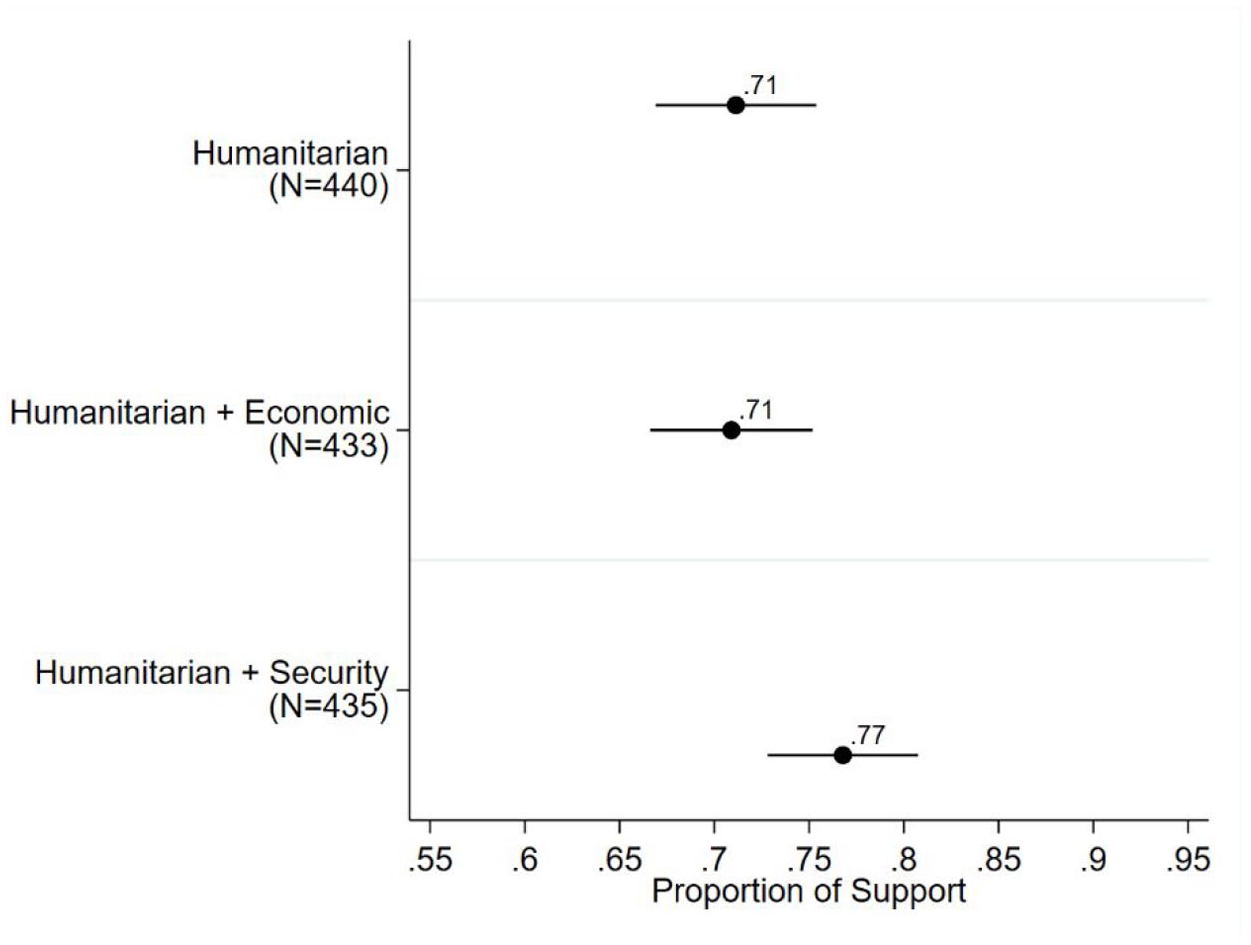
Average Level of Support for Military Intervention by Motivation, With 95% Confidence Intervals. Results From a Pairwise Difference in Means Test (t-Test).
Turning to our second and third hypotheses about support for different forms of intervention in relation to the motivations behind them, Figure 2 shows several interesting patterns. Support for unilateral actions—the least constrained and thus potentially most aggressive form of intervention—was highest among individuals who received the additional security motivation and the difference in the level of support from the other two scenarios is statistically significant. 11 This is consistent with part of our second hypothesis; however, the presence of an economic component did not make a difference in the support for unilateralism compared with the humanitarian baseline. Looking at support for allied actions across the motivations, support was again highest when there is a security motivation, but the difference from the other two motivations is not statistically significant. It suggests that the pattern shown in Figure 1 where there was a higher support for intervention under an added security concern was driven primarily by an increased support for unilateralism under such a condition. For the third hypothesis, we found that support for UN peacekeeping was slightly higher among those who received the humanitarian-only scenario, but the result is not statistically significant. In sum, conditional support based on specific motivations only occurred with unilateralism: when there is a national security interest involved, support for unilateralism increased.
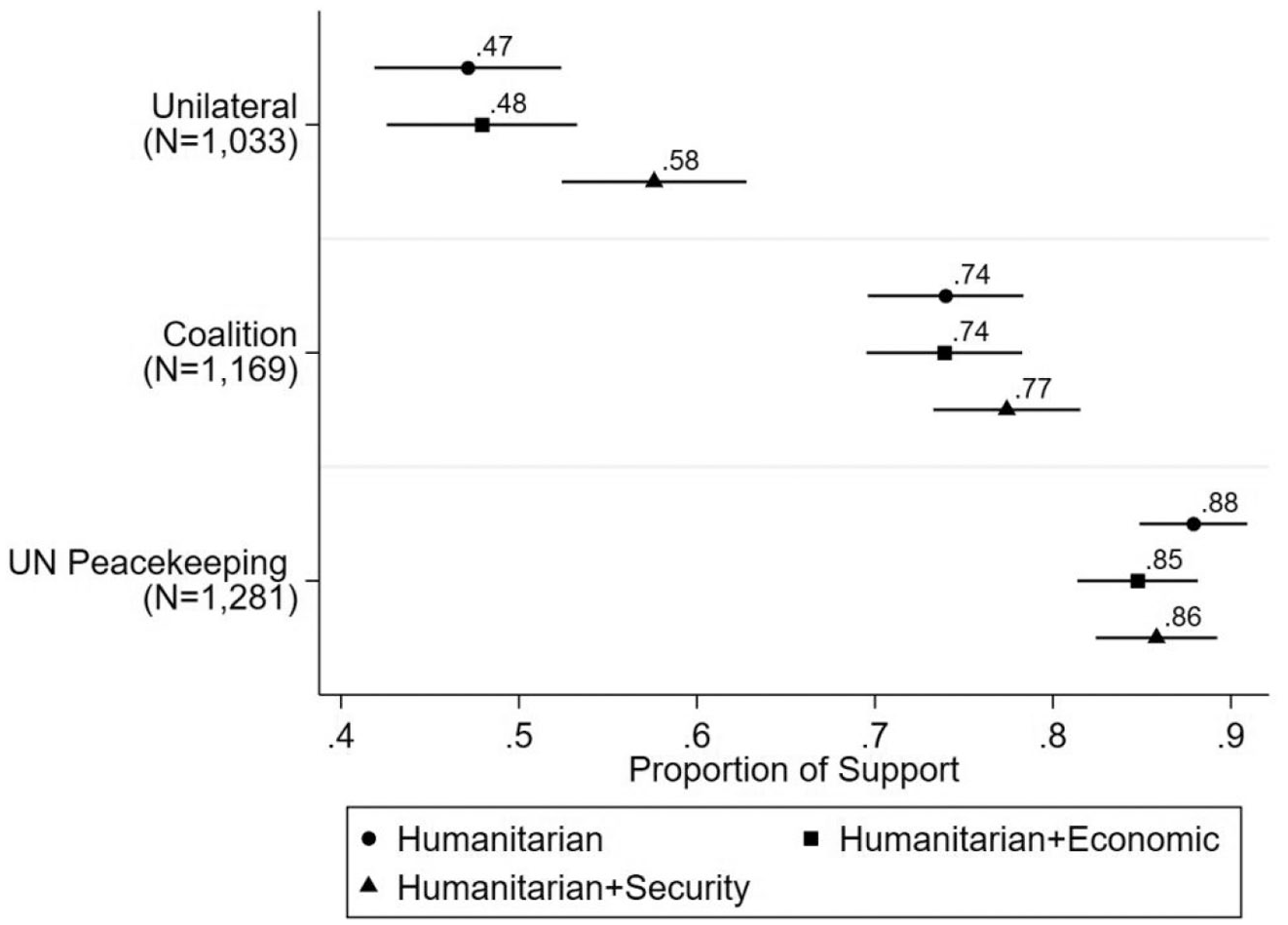
Average Level of Support for Unilateral Intervention, Intervening With Allies, and Participating in UN-Authorized Peacekeeping by Motivation, With 95% Confidence Intervals. Results From a Pairwise Difference in Means Test (t-Test).
Significantly, looking across different forms of intervention, we found that respondents in all three motivation groups showed considerably higher levels of support for the United States to build a coalition with allies (74%–77%), or to participate in a UN peacekeeping operation (85%–88%). It is clear that our respondents preferred for the United States to intervene through multilateral means. Moreover, across the treatment conditions, support for UN peacekeeping was 10 percentage points higher than intervening with allies, indicating an even stronger public preference for the United States to operate through an international organization. In contrast, the highest average support that unilateralism received was 58%. We know from existing studies that the American public prefers multilateral military actions over unilateralism in response to a humanitarian crisis; however, what stands out from our findings is that support for multilateralism remained significantly higher than unilateralism even if additional self-interests, whether national security or economic interests, were involved. Most surprisingly, while analyses and discussions of U.S. foreign policy tend to devote little attention to U.S. involvement in UN-led peacekeeping, the American public is more supportive of a response under the auspices and leadership of the UN than of opting for allied intervention.
What was driving these results? In particular, what motivated respondents’ preferences for military intervention through coalition building and UN peacekeeping over unilateral intervention, regardless of the underlying motivations? The answers to our follow-up question, which asked respondents to rank the factors that influenced their selections for the first question, help shed light on these questions. We disaggregated the respondents into mutually exclusive groups based on how they answered the first question and created bar charts to investigate their answers to the follow-up question. 12 We report the results from the four larger groups in Figure 3. 13 The four groups consist of those who supported only UN peacekeeping, supported both allied intervention and UN peacekeeping, supported all three forms of intervention, and supported only no involvement. Each bar chart depicts the number of respondents who indicated that their primary concern in determining whether to support each form of intervention was legitimacy, success, timeliness, casualties, or financial cost, respectively. For those who supported no involvement only, a plurality was concerned about casualties, which makes intuitive sense. For the rest of the groups that supported at least one form of intervention, a plurality chose legitimacy as their primary concern in each. In particular, the group that supported both UN peacekeeping and allied action, legitimacy had far more support as the primary consideration than the rest of the factors. These patterns are consistent with the finding in existing studies that citizens would tend to view multilateral options endorsed by the UN or a prominent regional organization such as the African Union as having greater legitimacy (Fang & Sun, 2019; Recchia & Chu, 2021; Tago & Ikeda, 2015; Wallace, 2019). In addition, the fact that legitimacy was a dominant primary concern for those who supported both intervening with allies and UN peacekeeping suggests that perhaps for many in this group these two forms of intervention play a similar role in conferring legitimacy and that is the reason that they supported both. Finally, neither success nor financial costs stood out as the dominant concern in respondents’ support for the multilateral options.
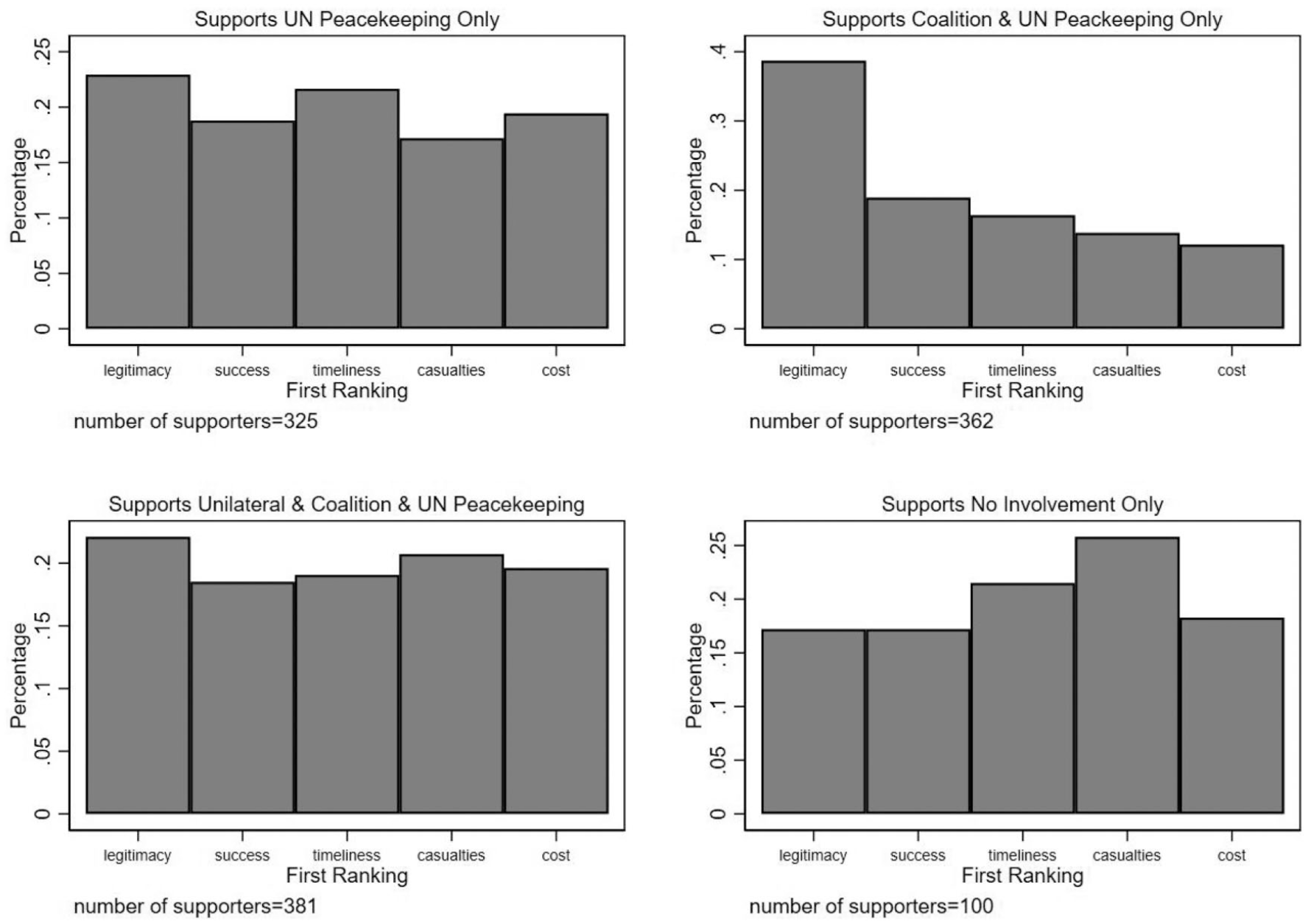
The Bar Charts Depict the Percentage of Respondents Who Indicated Legitimacy, Success, Timeliness, Casualties, or Financial Cost as Their Primary Concern, Respectively, in Determining Whether They Supported Each Form of Intervention.
Looking at those who opposed some forms of intervention, the patterns of reasoning complement what we found from supporters. Again, we highlight findings from larger groups. 14 Among those who indicated that they opposed unilateral intervention but were supportive (or neutral) with respect to allied intervention and peacekeeping, legitimacy was their dominant primary concern. In other words, a concern for lack of legitimacy may have hindered their support for unilateralism. Legitimacy was also the primary concern for the group that opposed both unilateral and allied intervention. For those who opposed UN peacekeeping but supported other forms of intervention, a plurality chose financial cost as the primary concern. Again, while multilateralism is often seen as a way of sharing burdens, many respondents did not apply this logic to UN peacekeeping. The result may be explained by UN peacekeeping operations having a reputation for being long and drawn-out missions and by the fact that the United States is already the largest financial contributor to UN peacekeeping, which has received some attention from major media sources.
Why might legitimacy be most prominent in respondents’ evaluations of the forms of intervention over other considerations, particularly among those who supported both forms of multilateralism? A military action having legitimacy means that other states perceive the action to be justified and appropriate (Voeten, 2005); this in turn can be beneficial to the state that takes the action for a number of reasons. It could mean that the action is less likely to be challenged by other states and more likely to gain their cooperation (Chapman & Reiter, 2004; Voeten, 2005); both factors can increase the likelihood of a good outcome, and thus the benefits, while reducing the costs. It could also mean that the state can maintain a good reputation for following international norms for intervention, and thus enjoy continued international support in its future endeavors as well in other foreign policy areas. Central to this concern for legitimacy is how international audiences view an intervention; if other countries join the action by forming a coalition with the United States, or if the UN leads the effort, then the multilateral forms signal approval by significant international actors.
Our third question aimed to gauge support for different possible mandates, given a particular motivation. The options ranged from more neutral conflict resolution tactics such as brokering a peace deal, to overt military tactics such as engaging in combat, to more long-term options such as peacebuilding. The results lend support to our fourth hypothesis. As the hypothesis anticipates, respondents were clearly more supportive of U.S. soldiers engaging directly in combat when security interests were involved. At 54%, the difference from other motivations is around 17% and is statistically significant. Moreover, support for engaging in combat under the security motivation was a majority.
Looking at the other possibilities (protecting civilians, deploying military advisors, brokering a peace deal, and peacebuilding), the level of support for each was significantly higher than engaging in combat across all motivations, including the one with a security interest component, so our final hypothesis was not supported. The options receiving the most support were protecting civilians and brokering a peace deal—nearly all respondents believed that the United States should strive to protect civilians and negotiate peace. Sending advisors and supporting peacebuilding also received over 80% support. Figure 4 displays these results. These findings suggest that U.S. citizens hold a strong preference for the U.S. government to take on an active role in managing and resolving conflicts without engaging directly in combat, even though security concerns would indeed raise their support for combat more than other motivations. These results are novel and somewhat surprising. Under the scenario that we presented, Americans only supported engaging in combat under very limited circumstances—namely, when there was a threat to national security. The surprising finding is in the high levels of support for all other options, regardless of motivation. It is clear that the respondents had a strong preference for the United States to become involved in the crisis scenario that we presented, but primarily with the aim of managing the immediate and short-term negative impacts of the conflict and resolving the dispute peacefully.
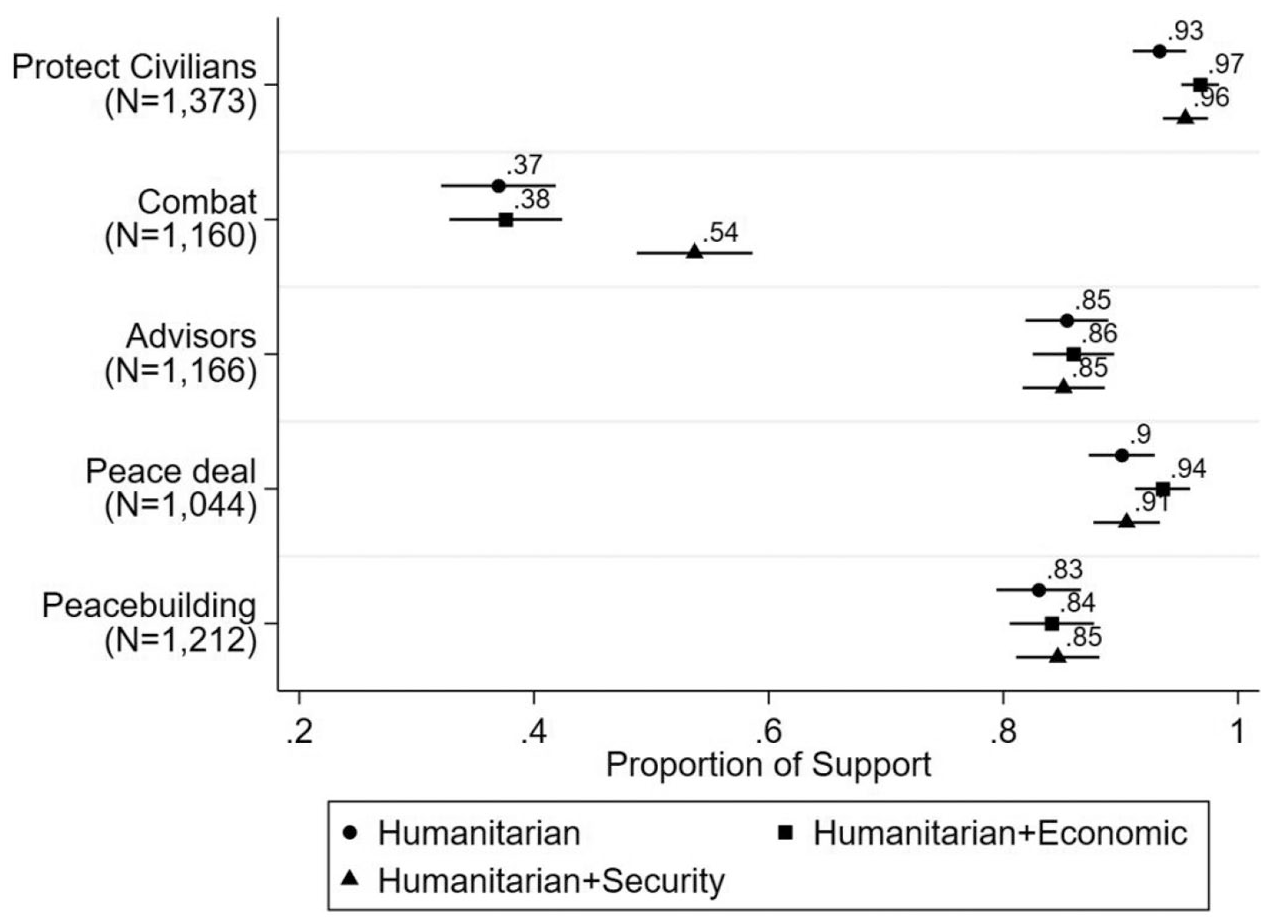
Average Support for Different Mandates by Motivation, With 95% Confidence Intervals. Results From a Two-Way Difference Means Test (t-Test).
Finally, our appendix reports results from logistic regressions where each of the dependent variables is dichotomous and takes on a value of one when respondents indicated that they supported an option from the first and third questions, i.e., the forms and mandates for intervention. For the independent variables, we included indicators for the treatments and the demographic questions. A few findings stand out from this analysis that are worth highlighting. For unilateralism, more educated individuals were significantly less likely to support this option, on the other hand, those who conveyed a higher degree of nationalism were more likely to support it. For building a coalition of allies, both those who indicated that they pay greater attention to international affairs and who were more nationalistic were more likely to support this form of involvement. For UN-led peacekeeping, only respondents identifying with the Republican Party were significantly less supportive than those who either identified with the Democratic Party or did not indicate one way or the other. Regarding mandates, individuals who conveyed that they pay greater attention to international affairs were more likely to support all types of mandates; females were more likely to support the protection of civilians and peacekeeping; nationalistic individuals were more likely to support engaging in combat and sending advisors; and those with lower education level were more likely to support combat.
Conclusion
Use of force remains one of the most frequently contemplated foreign policy tools for the United States (Schultz, 2017; Western, 2005). With its unique capability to take military actions across the globe, unilaterally or with coalition partners, a military option to address a crisis is always at the United States’ disposal. Thus, whether such pursuits are in line with the American public’s preferences and whether the American public can exercise meaningful constraints when they are not in line continue to be two of the most important foreign policy questions. This study has sought to answer the first question by providing a timely and nuanced understanding of the American public’s preferences about the use of force.
To do so, we developed a simple theoretical framework—focusing on motivation, form and mandate—to gauge public attitudes toward the use of force, and designed a public opinion survey experiment accordingly. This framework can be applied to another country’s context as well because it captures the main aspects of the decision-making problem regarding the use of force. 15 The results from implementing the design in the U.S. context show that when a foreign humanitarian crisis held implications for U.S. security interests, respondents were more supportive of some form of military intervention than if there were no such interests; this was also the only scenario where unilateralism received a clear majority of support. These findings help explain public support for the United States continuing, albeit on a smaller scale, military presence in the Middle East, and for limited military engagement in places such as Yemen, Sudan, and Syria. Yet, we also found that even in such cases, the public preferred a multilateral approach; in particular, UN peacekeeping consistently received the highest support followed by a still high level of support for allied actions. Finally, given a range of mandates, there was much higher support for those that are less aggressive than U.S. soldiers directly engaging in combat. Together, these findings suggest that the American public strongly favors multilateral use of force in all circumstances; moreover, they would prefer for the United States to reserve the use of the military to very limited circumstances.
In searching for the reasons behind respondents’ attitudes, we found that legitimacy was the primary concern for the respondents when they chose whether to support an intervention. This is consistent with the existing literature, but surprisingly, allied actions were seen by a plurality as just as good as UN peacekeeping in conferring legitimacy upon an intervention. Even more surprisingly, and departing from conventional wisdom, UN peacekeeping was seen as the most financially costly form of intervention among those who opposed it, even though scholars often associate multilateralism with cost sharing. Thus, concerns about financial costs did not seem to drive support for either coalition building or UN peacekeeping participation, while a concern for legitimacy clearly did. The key policy implication of these results is that the public would prefer the United States to work with allies in future military endeavors, which in turn raises the threshold for the decision to use force overseas.
A straightforward application of our research design to specific contexts can also yield insights into some of the most significant current and future conflict scenarios. As mentioned earlier, in the ongoing war, the American public’s willingness to support U.S. direct military intervention to defend Ukraine is low; however, large majorities support non-military actions, such as economic sanctions against Russia and sending weapons to Ukraine (Newport, 2022). These findings are consistent with our results. On his part, President Biden has made it clear from the beginning of the Russian invasion that the he would not send troops to Ukraine, but the United States would work closely with its NATO allies to respond to the crisis (Wolf, 2022). Another concerning scenario is a large-scale military conflict between the United States and China over Taiwan in the future (Buckley & Myers, 2021). One realistic course of events may be that Taiwan declares formal independence, and China attacks Taiwan militarily in response. Such a conflict will result in significant civilian casualties and if the United States decides to intervene, the U.S. president is likely to declare a humanitarian crisis, and explain to the American public that the United States bears responsibility to defend a democracy and protect the civilians on the island. In terms of instrumental considerations, the United States has significant economic interests in Taiwan as it is the world’s biggest supplier of the cutting-edge computer chips that are central to all high-tech industries worldwide (McKinney & Harris, 2021). This fits our second motivation scenario: humanitarianism and economic interest. For this scenario, our findings suggest that the American public will favor multilateralism over unilateralism, particularly out of a concern for legitimacy. Moreover, because there is no clear threat to U.S. national security in this scenario, our findings will suggest that the majority of U.S. public may support more limited options, such as protecting civilians, advising and assisting Taiwanese armed forces, and perhaps brokering a peace deal.
Despite the contributions from our study, we see several potential limitations to our findings and venues of future research. First, the baseline scenario in our survey design is a civil war, while much of the existing research on public opinion toward foreign policy focuses on interstate wars. Therefore, we need to exercise some caution in comparing our results with those in the literature, because we recognize that respondents may evaluate strategies differently based on different contexts. Second, and related to the first, we proxied security motivations by mentioning of terrorist groups that have threatened U.S. security interests. While this led to just above-majority support for unilateral intervention and combat, a more direct attack on U.S. assets, or a U.S. ally, may drive support for these options to be even higher. It would be interesting to incorporate the interstate and intrastate scenarios more explicitly in one experimental design in future research to compare the results from different security threats. Finally, unpacking the causal mechanisms for the finding that legitimacy was the primary concern driving the high level of support for multilateralism will be a natural extension of this research. Specifically, developing theoretical arguments for why respondents may care about legitimacy when deciding whether or not to support an intervention and empirically testing the arguments can shed light on how different multilateral forms of intervention may help address the legitimacy concerns.
Footnotes
Declaration of Conflicting Interests
The authors declared no potential conflicts of interest with respect to the research, authorship, and/or publication of this article.
Funding
The authors disclosed receipt of the following financial support for the research and/or authorship of this article: Rice University Social Science Research Institute provided financial support for this research.