



Abstract
This study interrogates the experiences of Nigerian troops in the war against Boko Haram. The paper’s contribution is bi-dimensional. First, it adds to the empirical literature on Boko Haram by analyzing the perspectives of rank-and-file troops. The study finds 10 forms of corruption affecting troops. These have contributed to the inability to defeat Boko Haram. Second, the paper adds to theoretical scholarship on civil–military relations and persistence of small wars. It challenges the bureaucratic-organizational model and the focus of civil–military relations theory on civilian control of the military. The study emphasizes the need to focus on the texture of the relationship between civilian and military leaders. The paper argues that the bureaucratic-organizational model has limited relevance to militaries in the postcolony and proposes a civilian–military leadership interest convergence thesis. The findings are relevant for understanding the spread of terrorism in sub-Saharan Africa and the persistence of small wars in non-Western, illiberal quasi-democratic societies.
Keywords
Boko Haram or Jama’atu Ahlis Suna Lidda’awati Wal Jihad (“the People Committed to the Prophet’s Teaching and Jihad”) has attracted tremendous scholarly attention in the last 10 years. 1 Scholars have focused on Boko Haram’s origins and ascendance (Onuoha, 2010), the interpellation of elites and the political process (Iyekekpolo, 2020), transnationalization of attacks (Cannon & Iyekekpolo, 2018), factionalization (Stoddard, 2019), gender performativity, particularly weaponization of young girls and post-menopausal women (Oriola, 2017), connections with previous jihadi collectivities (Aghedo, 2014) and dynamics of negotiations for release of captives (Obamamoye, 2018). Others have interrogated ensuing social issues such as human displacement (Abdulazeez & Oriola, 2018), the victimization of children by all sides in the armed conflict (Onapajo, 2020) and reasons for lack of international intervention (Mickler et al., 2019). Although there are a few studies on non-structural elements such as religious ideology (Gray & Adeakin, 2015) and framing (Abdulazeez & Oriola, 2018; Sändig, 2015), the literature is largely structuralist or macro-sociological in orientation.
There has been limited scholarly attempt to explore the perspectives of soldiers on the frontlines of the war against Boko Haram. Much of the available evidence regarding state forces emanate from three main sources. These are reports of human rights organizations such as Amnesty International (2015); media reports, which arguably focus on sensational aspects such as the “soldiers without enough weapons to fight jihadists (Ross, 2015)” and anonymous videos and confessional statements of Nigerian soldiers in particular regarding the poor welfare of troops. These sources provide important insights but do not obviate the need for analyses based on sociologically informed and non-sensationalized face-to-face in-depth interviews with soldiers deployed against Boko Haram. This is crucial in order to understand the experiences of frontline state forces and the ostensible intractability of the war.
This paper draws on the perspectives of Nigerian soldiers who have had at least one deployment in the war against Boko Haram to understand the persistence of the war. How do soldiers who have fought against Boko Haram make sense of their experiences? What can their experiences teach us about the persistence of the war against Boko Haram? What do these experiences speak to regarding the prevailing theoretical perspective—bureaucratic-organizational model—of persistence of small wars and civil–military relations theory? The paper’s contribution is twofold. First, it contributes to the empirical literature on Boko Haram by analyzing the perspectives of rank-and-file troops, who have been largely ignored by scholars. Second, the paper contributes to the theoretical scholarship by proposing a civilian–military leadership interest convergence thesis for understanding the persistence of small wars in an institutionally weak context. The paper is divided into five parts. The first part engages with civil–military relations theory and the bureaucratic-organizational model on the persistence of small wars. The second part provides a brief context for the study. The third part presents the data and methods of the study. Fourth, the findings and analysis section focuses on themes such as participants’ perceptions about Boko Haram, narratives about war experiences, corruption, cover-ups and military legitimacy. The conclusion explores the implications of the findings for the spread of terrorism in sub-Saharan Africa and the persistence of small wars in non-Western, illiberal quasi-democratic societies. The paper argues that the civilian–military interest convergence thesis is a more contextually appropriate approach for understanding the persistence of intra-state war in Africa and other developing regions.
Civilian–Military Relations Theory, the Bureaucratic-Organizational Model, and Persistence of Small Wars
This section engages briefly with two bodies of work. These are civilian–military relations theory and the bureaucratic-organizational model on persistence of small wars. The paper does not cover the vast volume of material. Rather, the analysis selects critical insights in the literature and foregrounds the civilian–military leadership interest convergence thesis proposed by the current study.
Civil–military relations have garnered tremendous scholarly attention particularly since Huntington’s The soldier and the state. Huntington engages with subjective and objective civilian control of the military. While objective control seeks to entrench an autonomous space for the military, which ensures a high degree of professionalism among the officer corps and subordination to legitimate civilian authority, subjective control makes the military susceptible to the whims of the state by limiting its resource base and political influence. Huntington’s theory articulates four conditions under which objective civilian control of the military can be optimized. These are (a) isolation from other parts of the social structure, (b) assigning the defense of society to military groups that are (c) indifferent to political ideologies and social values and (d) operate within a space concerned exclusively with “military imperatives” (Huntington, 1957; Travis, 2017, 397).
However, Huntington’s focus on control generally and objective control in particular has been severely criticized as inadequate for analyzing civil–military relations (Feaver, 2003) given its delineation of military and political domains (Rapp, 2015) although much contemporary scholarship still focuses on control (Herspring, 2005). There is growing recognition that focusing on civilian control of the military is too narrow. Besides, Huntington’s objective control idea arguably presupposes “moral neutrality” of the military (Travis, 2017, 398). Scholars of military ethics have engaged with the debate over whether the proper role of the military is to adhere to the Huntingtonian notion of “tool of the state” or exercise their moral agency (Coleman, 2009). Both have implications for trust within and in the military (Garb & Malešič, 2016).
Concordance theory provides another major strand of civil–military relations theory (Schiff, 1999). Schiff (1999) speaks to shared values and collaborative accommodation as critical factors that reduce military intervention. This presupposes that there is a degree of consensus among the elites (political and military) as well as the citizens on appropriate military conduct. Schiff’s approach is part of a broad culture-centered approach (Levy, 2012). However, this theory has limited application in postcolonial societies. For instance, there is a long history of military coups in Nigeria. Two former military heads of state have been elected to the position of president. Nonetheless, dispelling rumors of coups is one of the key roles of the public relations units of the army and defense headquarters (Premium Times, 2021; Omonobi, 2016). Many civilians in senior positions have been critical of the military’s performance in the ongoing war against terrorism and level of insecurity. For example, a Nigerian senator wept publicly on the floor of the Senate in April 2021 stating “A lot of billions of naira have been voted for security services. Nothing is coming out of it… Let’s shut down the National Assembly if we cannot save this country” (see Fadare, 2021). The point is that the idea of civil–military concordance is problematic in the face of imminent ruin of the state and society.
Bland (1999) offers a theory of shared responsibility, which bridges the gap inherent in exclusive focus on the military. The theory of shared responsibility emphasizes how ‘civil control of the military is managed and maintained through the sharing of responsibility for control between civilian leaders and military officers’ (Bland, 1999, 9). This theory makes two fundamental assumptions: (1) civilians outside the defense or military establishment are the legitimate actors for directing the actions of the military and (2) civilian control of the military is dynamic and therefore “susceptible to changing ideas, values, circumstances, issues and personalities and to the stresses of crises and war” (Bland, 1999, 10). This approach emphasizes “sharing” rather than “control.” Even in advanced democracies, military leaders typically play a major role in the military’s use of force and therefore determining whose influence is greater is objectively impossible (see Betts, 1991; Bacewich, 2008). As Bland (1999, 11) argues, “Theory should reflect this reality.”
This paper adopts the standpoint that “Political leaders and military leaders typically and universally share responsibility and are accountable for the decisions and consequential outcomes” (Bland: 1999, 11). Therefore, “Rather than civilian control, the more accurate and descriptive term is civilian direction of the military” (Bland, 1999, 19. Italics original). This paper highlights the dynamics of the relationship between military and civilian leaders, the shared responsibility in a postcolonial setting and how the military may be affected by close rapport between the top military echelon and civilian leaders. This paper departs from Bland (1999, 20) on the issue of the “interest of society,” which is taken for granted in the theory of shared responsibility. As demonstrated in this study, the interest of society or imminent ruin of the state may not be a major consideration of military and civilian leaders in the latter’s direction of the military.
The direction of the military is a crucial element in persistence of small wars (Randle, 1970; Quester, 1970; Chew, 2014). Halperin’s (1970) article, “War termination as a problem in civil-military relations,” is a defining work in mainstream thinking about the persistence of small wars. Halperin (1970) delineates three groups with divergent interests within the military. These groups are the (1) field commander, (2) the military services, and (3) the general staff in the national capital. Field commanders consider the war theater sacrosanct and victory achievable while the general staff perceive war termination from the perspective of guaranteeing the independence and growth of the military (Halperin, 1970). The general staff in the national capital are concerned with the national and international political contexts and therefore define their mission as a balancing act between the perspectives of the field commanders and civilians (Halperin, 1970). Halperin (1970) argues that the military will favor persistence of a small war, while the impetus and pressure to end the war will come from civilians.
By the 1980s, Halperin’s presuppositions regarding the military’s desire for small war persistence had developed into conventional thinking in war scholarship, security studies and international relations (Cochran, 2014). The prevailing perspective, the bureaucratic-organizational model, suggests that small wars are prolonged because of the military’s desire to maximize its influence, resources and relative autonomy (Cochran, 2014). This recognizes that the military establishment exercises significant agency in its relationship with civilian leaders (Abrahamsson, 1972). The policy priorities of the military brass may differ from those of civilian political leaders; therefore, military leaders may try to “manipulate the relationship so as to prevail in policy disputes” (Feaver, 2003, p. 57).
Overall, the bureaucratic-organizational model presupposes that (1) military leaders prefer persistence to termination of war; (2) political leaders are responsible for withdrawing from war in the absence of outright victory; (3) military leaders adopt the withdrawal option because of pressure from political leaders or by accepting the civilian standpoint; and (4) military leaders will adopt a withdrawal option prior to civilian leaders only when “political leadership’s war policy threatens the ruin of the state and its organs” (Cochran, 2014, p. 75).
Cochran (2014) problematizes the presumed preference of the military for persistence of small wars. He argues in favor of “an alternative model privileging the demands of institutional legitimacy as an analytically distinct and hierarchically superior basis of military leadership preferences” (p. 72). Cochran’s approach (2014, p. 79)—the “professional-institutional model of military leadership motives”—emphasizes the salience of institutional legitimacy vis-à-vis war termination or persistence. This approach recognizes the uniqueness of the military as both a bureaucratic organization and a highly legitimized institution. Cochran (2014) draws on empirical cases from the experiences of the French military in Algeria (1954–1962), Israel in Lebanon (1982–1985), and Portugal in the African territories (1961–1975) to demonstrate that (in the latter two cases) the military favored war termination over persistence prior to civilian leadership. In the case of Portugal, the military stunned both civilian leaders and the public by releasing a statement in 1974 calling for withdrawal from Africa. The political leadership refused to shift positions and was removed in a coup (Cochran, 2014). The military in this case was concerned about the humiliation and reputational damage they suffered because of the war.
Cochran’s focus on institutional legitimacy or “legitimacy motive” (2014, p. 88) is a fundamental caveat to the bureaucratic-organizational model and an important addition to the literature on persistence of small wars. However, both the bureaucratic-organizational model and the professional-institutional model of military leadership motives model are undergirded by certain assumptions that are far from universal. Five assumptions are identified in this paper. Four are relevant to the bureaucratic-organizational model while all five are relevant to the professional-institutional model of military leadership motives. The assumptions are as follows: 1. Both models presuppose a relatively unified or monochromatic military working toward a defined goal. Therefore, both models assume the military exists in a non-ethnic post-religious society. In other words, they underestimate divisions within and among various branches of the military as microcosms of the wider society. 2. Both models presuppose that political and military elites pursue national rather than personal (such as individual wealth accumulation) or sectional interests (e.g., for an ethnic, party, or religious group). 3. Both models fail to grapple with the contours of the conditions of underdevelopment, such as state fragility. They presuppose existence of a self-correcting, Weberian ideal-type state. This ignores the dynamics of the postcolony. 4. Both models underestimate divisions among the civilian population, their predispositions toward the belligerents and impact of propaganda on assessment of war. 5. The professional-institutional model of military leadership motives presupposes that institutional legitimacy is a priority or quality that is desired or appreciated in every political context.
This paper argues for engaging with the relationship between military and civilian leaders. This contributes to a literature that has largely focused on civilian control of the military. The relationship between military and civilian leaders is much more relevant in developing societies. The paper demonstrates that the bureaucratic-organizational model and the professional-institutional model of military leadership motives have limited utility in the postcolony—non-Western, illiberal, quasi-democratic contexts.
Context: The Nigerian Military
Studies of African militaries emerged in the 1960s following the first set of coup plots, which toppled several democratically elected governments in the newly independent states (Luckham, 1994). These studies initially focused on “democracy, professionalism and civilian control (p. 13)” of the military. This strand of scholarly works was followed by studies that explored the role of the military as an indispensable tool for the preservation of social order or the “manager of modernity (p. 14).” As coups and counter-coups ravaged several African states, scholars turned their attention to “praetorianism, political decay and political order (p. 15).” The concern of this body of work was the failure of several African states to develop Weberian ideal-type bureaucracies and interpellation of the military in the ethno-religious skirmishes that had begun to challenge social order (Decalo, 1976). These three strands of work were largely shaped by modernization paradigms (Luckham, 1994). Dependency theorists and Marxist oriented scholarly works challenged modernizationist orthodoxy with a focus on the political economy of the African state, its internal contradictions vis-à-vis its architectures and machineries of force, including the military, and the overarching role of external actors, particularly former colonial powers and their commercial interests (see Murray, 1966; Alavi, 1972; Falola & Ihonvbere, 1985; Agbese, 1991).
By the mid-1990s, attention had shifted to analyses of the risks posed by the military to the waves of democratization in Africa. Scholars attempted to understand the difficulty in subjecting the military to civilian control after decades of military authoritarian rule. Attention began to shift to the transformation of the military from the savior of social order to the destroyer of the fabric of society (see McGowan, 2005). Alexander Robin Luckman’s 1969 doctoral dissertation at the University of Chicago is one of the earliest and most comprehensive studies on the Nigerian military. Luckman’s two-volume dissertation was titled “The Nigerian military: A case study in institutional breakdown.” Luckman (1969, p. 1) notes in the introductory paragraph that: A military organization was created in Nigeria by the Colonial government which so far as practicable was modeled on the British army both in organizational format and in professional training. But less than six years after independence on January 15, 1966, a small group of army officers carried out a military coup against the civilian regime, thus violating the Sandhurst formula of the political neutrality of the military. What is more, the army then began to fragment and discipline to break down under pressure from the primordialisms of tribe and region…It is suggested that careful analysis of the process of fragmentation in the army will be a way of raising a number of more general issues.
2
Luckman’s conclusions remain relevant and instructive. Recent studies (Amao & Maiangwa, 2017; Onapajo, 2017; Onuoha, 2010) speak to similar themes.
Contemporary scholarship on the Nigerian military demonstrates six broad themes: First, the sociology of coups and counter-coups (prior to 1999) and the effects on the democratic process; second, the deployment of the military for internal operations and attendant human rights abuse of civilians; third, the engagement of the military in peacekeeping missions outside Nigeria; fourth, the prevalence of corruption in the military; fifth, scholars have also explored the impact of ethno-religious identities on the military’s professionalism and bureaucratic practice; and finally, the consequences of the stated factors on Nigeria’s development have also garnered attention.
Scholarly literature on the Nigerian military’s operations against Boko Haram is scanty. Amao and Maiangwa (2017) and Bappah (2016) are two of such studies. Amao and Maiangwa (2017) and Bappah (2016) explore the role of poor national leadership during the President Goodluck Jonathan administration (2010–2015), politics in the national security architecture and low level of military professionalism as critical factors responsible for the inability to defeat Boko Haram. Iwuoha (2019) draws on data from senior military officers and demonstrates that there is disjuncture between countries like Nigeria seeking support for counter-terrorism efforts and super-power supporters, such as the United States. Iwuoha (2019) argues that the support provided to countries such as Nigeria is often fragmented and not in tandem with expressed needs.
These studies make significant contributions to the literature. Nonetheless, the perspectives of troops on the frontlines in the war against Boko Haram are largely missing from the scholarly literature. The analysis of the implications of these perspectives for the theoretical literature on persistence of small wars also requires contemplation. This paper contributes to the literature by (1) engaging with the experiences of soldiers who have fought against Boko Haram, (2) why the war has continued for over 10 years, and (3) the implications of these experiences for theorizing the persistence of small wars in the postcolony.
Data and Methods
This paper is informed by an exploratory qualitative research approach. This approach focuses on “fexibility, pragmatism, and the particular, biographically specific interests of an investigator” (Maanen et al., 2001, p. v). Therefore, in addition to meaningful understanding of the phenomenon (i.e., the experiences of Nigerian soldiers in the war against Boko Haram), following Stebbins (Stebbins, 2001, p. 6), this paper focuses on “potential generalizations” that the data speak to that may help formulate theories. Nonetheless, any generalization within the paper is (1) limited in scope, (2) delimited by the data, and (3) lacks external validity. These are fundamental caveats to the arguments in this paper.
The study themes emerged from a grounded theoretical orientation. There are six major considerations in this regard. These are engaging in collection of data and analysis at the same time; developing categories and codes for the data rather than any “preconceived logically deduced hypotheses”; developing theory in the process of collecting and analyzing data; rigorous note-taking as a step between data coding and first draft writing; non-representative sampling and conducting the review of literature after independently analyzing primary data (Charmaz & Mitchell, 2001, p. 162; see also Glaser & Strauss, 1967). Coding occurred through close-reading of the interview transcripts. This was informed by keen awareness of the literature on civilian–military relations, persistence of small wars, the trajectory of the war against Boko Haram, and the broader socio-political context of the research problem. The thesis proposed in this paper comes from an effort to understand and make sense of the experiences narrated by the soldiers.
This paper derives from a larger research on terrorism, politics and human rights advocacy. Fieldwork was conducted in three Nigerian cities Abuja, Lagos and Maiduguri each year between 2015 and 2019. Apart from Maiduguri, where safety concerns limited fieldwork to 2 weeks over two field trips, data collection occurred between 5 and 12 weeks in the summer months of each year. The choice of the cities was informed by empirical considerations. Abuja is the location of all three branches of the military, the civilian bureaucracy and the defense headquarters. It is therefore the home base of many of the troops. Several soldiers who had served in the war against Boko Haram also resided in Lagos. Maiduguri’s choice was informed by its being the main war theater. The data analyzed in this paper mainly comes from interviews with soldiers conducted in 2018 although more than 170 persons participated in in-depth interviews and focus group discussions in the larger research. The larger study involved people liberated from Boko Haram captivity, human rights activists, and journalists, among others. Their views are crucial but are not directly relevant to the theme of this paper. Only interviews with soldiers are analyzed in this paper. Non-commissioned soldiers in the Nigerian Army were the focus of the 2018 fieldwork. The research did not seek to exclude troops from other branches of the armed forces involved in the war against Boko Haram but all 24 rank-and-file soldiers purposively selected and interviewed were from the army. They were all in active service during the 2018 interview process. Given that thousands of soldiers have been deployed in the war, 24 soldiers constitute a relatively small sample. Emphasis was on understanding the lived wartime experiences of a small number of soldiers rather than arriving at a representative sample.
Participants consented to being interviewed after receiving details of the research. Recruitment occurred through non-official channels. Official approval to interview soldiers was not requested from military authorities. Sources in the army noted three possible scenarios if approval was requested to interview troops. First, there were concerns that such approval would likely not be granted and second, if approval were granted, the interview process would be monitored by the authorities. Third, there were concerns that soldiers might censor themselves even if approval were granted and no direct monitoring occurred. Each of the scenarios would affect the level of critical insight participants would be willing to share because of fear of retaliation and concerns over the relationship between the research team and military authorities. This implies that the soldiers in this study took enormous risks by sharing their wartime experiences. Therefore, this increases the ethical responsibility as regards protection of privacy, anonymity, storage, and use of data. Pseudonyms are used to protect participants from retaliation. Consequently, potentially identifying information such as participants’ units, exact deployment years, location, names of comrades, or commanders mentioned in the interviews is omitted.
Participants’ Demographics.
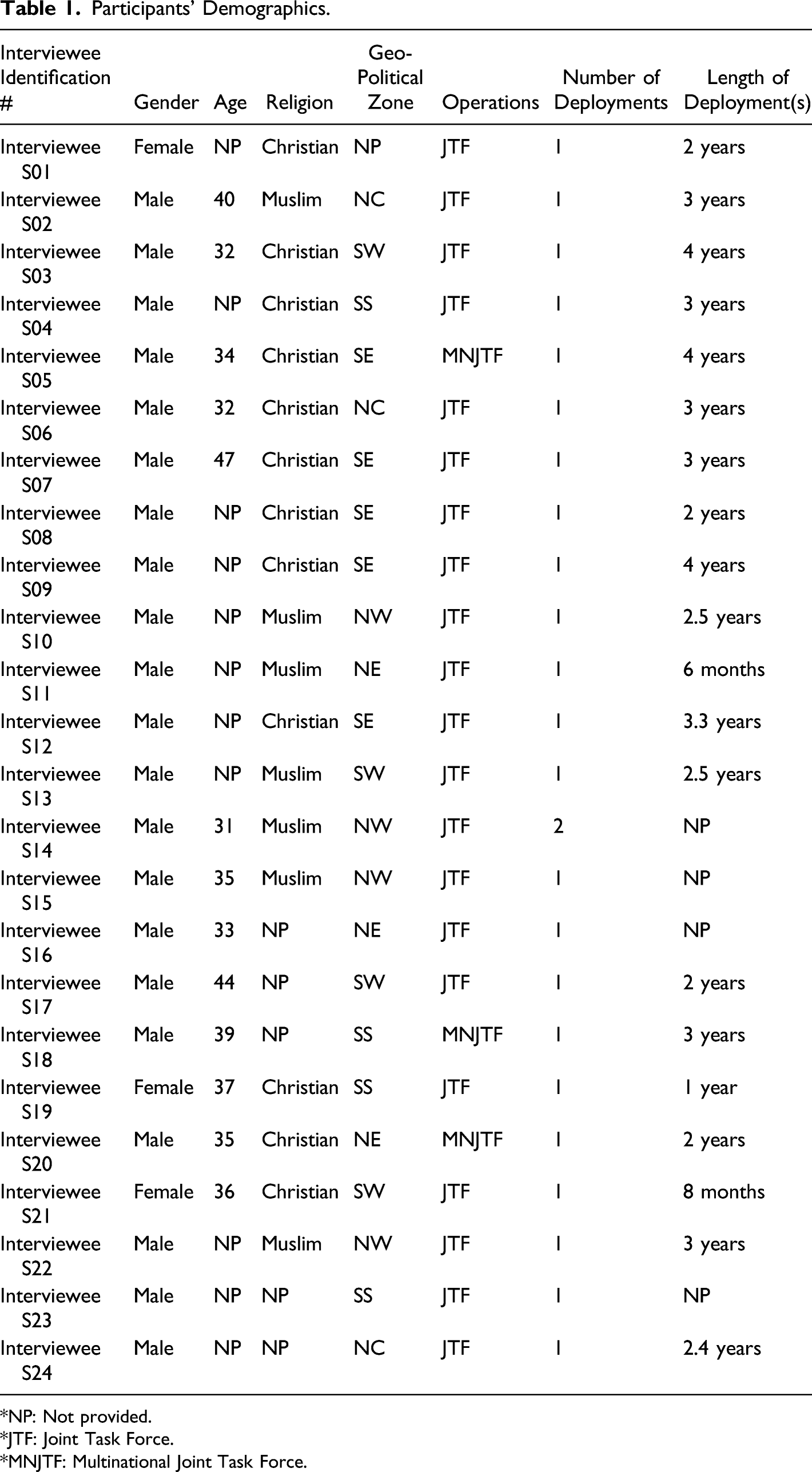
*NP: Not provided.
*JTF: Joint Task Force.
*MNJTF: Multinational Joint Task Force.
A semi-structured interview guide was used. The interview guide was developed through close monitoring of reports regarding the war against Boko Haram, welfare of troops, and informal interactions with members of the armed forces. Interviews were conducted using the English language. All interviewed soldiers spoke English with varying degrees of fluency. Quotes from participants are not edited to ensure they are given a voice. Questions posed to participants include the following: What challenges has the Nigerian army/military confronted in the process of fighting Boko Haram? Is the Nigerian army/military capable of winning the war against Boko Haram? How do you think the current crisis can be resolved? Follow-up questions were asked when appropriate.
Each interview lasted between 45 and 70 minutes. All interviews were recorded in two digital voice recorders for accuracy. Three of the participants (12.5%) served with the Multinational Joint Task Force (MNJTF). The MNJTF comprises troops from Nigeria, Cameroon, Chad, Benin and Niger. Twenty-one of the participants (87.5%) served within the Joint Task Force (JTF). The JTF is Nigeria’s military organization formed from the armed services to combat Boko Haram. Participants represent a broad spectrum of Nigeria: Thirteen participants (54.16%) are from southern Nigeria, 10 (41.66%) are from the North while one participant (4.16%) did not specify. Twelve of the participants identify as Christians (50%), Muslims make up 29.16% (seven participants), while 20.83% (five persons) provided no information about their religion. The study also draws on secondary data, particularly media and human rights NGOs reports, on the war against Boko Haram.
Encountering Boko Haram
Experiences of soldiers in war present “the view from the ground” (Sheehan-Dean, 2006) and may challenge official narratives. Scholarship on war-related experiences of soldiers covers a broad spectrum of areas such as battle experience (Carmichael 2016), daily routine (Cimbala, 2010), boredom (Laugesen, 2012), perception of the enemy (Porshneva, 2014), and engagement with enemy troops (Cimbala, 2010). These areas present different angles of and insight into a war. Experiences of soldiers in the war against Boko Haram provide insight into the persistence of the war and the inability of troops to defeat the terrorists. Boko Haram has been waging an asymmetric warfare (see Münkler, 2005) against the Nigerian state. Soldiers express frustrations about the peculiar texture of the war and its length. One soldier captures the perspectives of participants: Interviewer: What do you think is the reason behind the prolonged nature of this war? Why has it taken so long? Respondent: Nobody knows how the thing started… You can only know the day a war started you can never know when it will end. The only thing, the only advice I have is the government shouldn’t have allowed such thing to take so long before they intervene. That’s one of the problems that prolonged this fight.
3
The participant recognizes that the particular war has lasted longer than usual and appears to have no end in sight. Soldiers demonstrate awareness of the uniqueness of the war vis-à-vis their previous experiences, particularly in peacekeeping missions outside Nigeria. They are aware that ending a war with no delimited battlefields is challenging. While direct shootouts between troops and Boko Haram have generated headlines, some participants note the significance of widespread use of mines and ambush by Boko Haram. A soldier states “Boko Haram is good at laying ambush… it is terrible. They lay mines on the way and when the vehicles pass the mines will explode and Boko Haram will open fire.” 4 The diffuseness of the war theater in the Northeast has led to numerous deaths of troops.
The war is marked by infiltration of communities by Boko Haram and media and public backlash when soldiers execute operations designed to rout terrorists. The civilian-combatant dichotomy is blurred (Münkler, 2005). A participant highlights the conundrum encountered by soldiers: Interviewer: There have been media reports of unlawful detention of civilians indicating that soldiers are going into communities, arresting people on suspicions of being Boko Haram. What can you tell me about that? Respondent: In that case of unlawful detention, we don’t just go and attack people because even in those communities, we don’t fire the terrorists unless they open fire on us. That is why they have the opportunity to get some of our men down because they are not in uniform and you can’t identify who is a Boko Haram because the only way you can identify them is when they start firing at us and we know that these are Boko Haram. So, in that aspect of arresting them if we don’t have any information about them, we don’t go and make arrest.
5
A report by Amnesty International (2015a) demonstrates that Nigeria’s military forces extrajudicially killed 1200 persons, illegally arrested 20,000 young males and 7000 persons died due to conditions in military custody. However, participants believe the public, human rights organizations, and the media fail to appreciate the significance of comingling of Boko Haram members with rural communities and the risks posed to troops. They are miffed by the notion that they are killing innocent civilians. The relationship between Boko Haram and many communities makes the mission more difficult and leads to casualties among troops. Participants believe they have been measured in their use of force against Boko Haram suspects. They express frustrations at having to observe international conventions on warfare, which Boko Haram does not. They argue that that ultimately prolongs the war. One soldier argues: I always feel why wasting time with this people? You saw the evidence. You saw them detaching IED from their bodies and you say you are not convinced. These people, having known the type of law we are operating, based on maybe all this international war (convention)… There was a good intelligence that they are harbouring there… You ask the women “where are they?” They say they are not here. Nobody like that is here. For you to move one step and they start attacking you and bombarding you. So, those type of people are aiding and abetting. But the military will not listen to you. They’ll say ‘don’t do it’ especially my commanding officer. He was always ‘don’t touch any of their property. Don’t destroy it. That is why I said from the beginning that we don’t use maximum force. I’ve fought on two fronts…on the border with Cameroon. We’ll be going on joint patrol, joint patrol with Cameroon forces. If you fight with Cameroon forces, you’ll like to fight because Cameroon will destroy even if it’s a baby that’s born to them. Cameroon forces will kill. They will not stop. Animals, they will destroy but the Nigerian troops, they don’t do that in Nigerian Army. If you try it, you’ll be court martialed. Maybe that is why the war is prolonged.
6
The participant suggests that the war is prolonged because Nigerian troops are committed to international war conventions. However, observance of such international conventions varies by unit and leadership. One participant notes that the fact that some communities harbor terrorists “is the reason why when we get to a village you will decide that let’s finish all of them because they are among.”
7
The restrictions placed on state forces vis-à-vis the manner in which terrorists operate irks troops (Cassese, 2004). This is compounded by the disproportionate use of force by Boko Haram against soldiers. The arsenal of Boko Haram is a major shock to participants. Participants believe Boko Haram’s willingness to deploy any kind of force without regard for human lives is a major advantage to terrorists. One soldier notes that Boko Haram used: Anti-Aircraft (AA) on human beings which even the army did not even have. We were not using them but the so called Boko Haram or what do you call them. That is what they were using. Understand? How can people they call untrained hoodlums, people they call them names can be able to chase away a brigade?
Soldiers killed in battle also regularly receive undignified treatment: Boko Haram routinely pours acid on the corpses of soldiers. 8
Participants also note the diverse and international nature of the war: They came across suspects they were convinced were not Nigerians. One soldier argues, “when you see somebody that’s not a Nigerian, when you see him you’ll know. So, they are not only Nigerians because most of them when we arrested them, they don’t even know where they are.” 9 Participants noted the presence of French-speaking individuals (West Africans and Arabs) among Boko Haram operatives. This lends credence to the transnational nature of Boko Haram (Cannon & Iyekekpolo, 2018).
Boko Haram uses a hybridized weaponization strategy: sophisticated technological equipment and tools made from indigenous knowledge ensconced in cultural beliefs and practices, particularly voodoo. The indigenous tools are often on display in confrontation with Boko Haram. For instance, one participant notes how a “man jumped up and hit himself on the ground for him to disappear, but he was not able to disappear. So, one of our soldiers said that particular man is among them that is why he wanted to disappear.”
10
Another soldier explains how: We’ll be firing them and they’ll be firing us. People will be falling down but they’ll be coming more with force. They’ll be matching themselves to go and die. You know that they have already brainwashed them to go and die. Sometimes when they have a leader among them, he will come out with one white handkerchief or anything. Maybe their juju (voodoo) or what they believe in. And you’ll be firing him and he’ll be doing like this (waving the handkerchief). He’ll be coming and you’ll be firing him and the man will be coming. Bullets will not touch him.
11
The level of fanaticism and willingness to die displayed by Boko Haram fighters shocks the troops. They recognize that this is not a regular warfare. The use of voodoo by Boko Haram is fascinating given its initial objective was the introduction of a puritanical version of Sharia law and rid Islam of impurities.
Perceptions about Boko Haram
Frontline troops’ perceptions of the enemy constitute an important barometer for understanding their conduct in war. Such perceptions provide a window into how soldiers view their mission, role in the war theater and the essence of their efforts. While the attitudes of non-commissioned rank-and-file troops toward the enemy (and overall war strategy) are largely overlooked in the hierarchical structure of the military, recent experiences indicate a growing realization that generals ought to consider the perspectives of soldiers under their command. For example, a former commander of US forces in Afghanistan, General David Petraeus, suggests the need to avoid viewing battlefield decision-making as the exclusive preserve of generals (see Mirra, 2013). Mirra (2013, p. 453) argues that while “soldiers’ views of war are not the final, authoritative verdict…their interpretation of the conflict may…hold strategic implications for the researcher…(and) should be included in a complex matrix of interpretation to broaden…understanding of the enemy.” Soldiers in Mirra’s study demonstrated a more robust and nuanced understanding of the complexity, texture and subtleties of the war in Afghanistan than the official narrative of the US government. Soldiers’ experiences may also teach them to reinforce, modify or totally change their perceptions of the enemy. One US soldier in Afghanistan experienced a total change of perspective: “I know what the Afghan farmer is going through. I started feeling like I was the terrorist … I couldn’t shake the feeling that I was a terrorist in a larger terrorist organization ...What our officials say makes no sense. The real enemy in Afghanistan is the US (cited in Mirra, 2013, p. 460).”
Such complete change in orientation is not always the case. For example, Pakistani soldiers involved in the war against terror, believed the war was “perfectly justified” and considered themselves “lucky” to be part of the war contingent (Shah, 2012, p. 21). There is an important spatial/jurisdictional distinction. The Pakistani soldiers in Shah’s study fought within the jurisdiction of their homeland and believed that the enemy had foreign support, was multinational and aimed to destroy Pakistan (Shah, 2012). US soldiers in Mirra’s study, on the other hand, were on foreign soil and over time began to garner experiences that challenged the narratives communicated by US officials regarding the supposed fanaticism and other stereotypes of the enemy (Mirra, 2013). Nonetheless, cognitive biases might have influenced perceptions and experiences in both cases (see Silverstein & Flamenbaum, 1989).
What are the perceptions of Nigerian soldiers about Boko Haram? How do these perceptions influence how they treat Boko Haram members? How does treatment of Boko Haram members contribute to persistence of the war? Participants are unanimous on a number of points. First, participants are convinced that neither the troops nor Boko Haram members know what Boko Haram is fighting for. One participant notes that Boko Haram is “one useless thing. They are ignorant… They just formed a group and kill innocent people… We don’t actually know what they are fighting for.” 12 Some Boko Haram members who were arrested also often claimed not to know the essence of their struggle although that might be a deliberate strategy to avoid harsh consequences in military custody. Some suspects however seemed genuinely tired of the atrocities of the organization and provided vital intelligence that assisted military operations. 13 The inability of Boko Haram suspects to articulate what they are fighting for is a major consternation to state forces. Some had served in the Niger Delta in the oil-related political violence. They believe Niger Delta insurgents had specific objectives, but Boko Haram is a different beast.
Second, Boko Haram operatives are perceived as abnormally violent and the most deadly terrorists in the world. Participants were asked “What does Boko Haram mean to you?” One soldier argues: Violent. They are very violent if I have to describe them. The ways of their reason are not normal. Because if they are normal, I don’t see any reason why a human being will dress up and carry suicide bombs inside a car and went and hit a hard object. The thing will explode and nobody will come out. A normal human being cannot do that.
14
There is a consensus among participants that even by terrorist standards, Boko Haram is excessively and unnecessarily violent and deploys spectacular and atrocious means to kill. One participant notes, “[T]errorists or whatever are not supposed to carry something like RPG to kill one person. You are not to carry something like AA (anti-aircraft missile) to fire somebody… But them, they will use it on one person.” 15 Therefore, many participants doubt the humanity of Boko Haram members. One soldier argues, “I don’t think they are human beings.” 16
These perceptions shape the manner in which troops deal with Boko Haram suspects and their families. Soldiers consider the families of Boko Haram members unworthy of any form of compassion given the brutality meted to troops. Participants wonder why they have to expend their food and water supplies on children and wives of people who are engaged in gruesome killing of soldiers.
17
Participants also believe that summary execution of Boko Haram suspects is fully justified. One soldier argues that if she were presented with someone who is part of Boko Haram: I would be the first person that will kill that person because they used to slaughter soldiers. They kill. All the soldiers they’ve been killing nobody says anything but if they capture them and keep them in the camp then those activists will start making noise. But what about the soldiers they’ve been killing for years?
18
The perspective is influenced by the fact that all the participants had lost friends and colleagues in the war and often under gruesome circumstances. Overall, participants consider captured Boko Haram suspects and their families fair game. This speaks to the factors undergirding troops’ maltreatment of Boko Haram suspects and their families. The soldiers believe any form of violence against Boko Haram is justified. The narratives suggest that despite factual and verified reports of widespread abuse, torture and killing of Boko Haram suspects and detainment of their families, there are military commanders who insist that soldiers adhere to conventions of war. Such commanders do so often at the risk of incurring the wrath of their soldiers and undermining their own authority. 19
There are indications that the perceptions of Boko Haram have translated into actual maltreatment from the warfront to the legal process. For example, there are reports of Boko Haram suspects shot to death shortly after being taken into military custody (BBC, 2014); thousands of children have been detained on suspicions of membership of Boko Haram (Human Rights Watch, 2019) without recourse to their status as minors. Some of the children detained by the military claim they were subjected to sexual assault while “Boko Haram treated us better” (Paquette, 2019). These experiences make such children multi-layered victims of all sides in the conflict (Onapajo, 2020). Thousands of Boko Haram suspects have also been secretly tried in military facilities (Burke, 2017). These trials are widely considered deeply “flawed” (Human Rights Watch, 2018).
The situation creates a cyclical pattern of brutality on both sides. This contributes to the persistence of the war. It creates “injustice stories” (Demant & De Graaf, 2010, p. 409) for Boko Haram. “(J)ihadists need stories of injustice and repression to convince themselves and others of the legitimacy of the battle and to keep their supporters motivated and loyal” (Demant & De Graaf, 2010, p. 409). There is consensus in the literature that state repression, particularly the assassination of Boko Haram founder, Mohammed Yusuf and hundreds of his followers in 2009, played a major role in the ascendance of Boko Haram (Gray & Adeakin, 2015). An analysis of Boko Haram’s ideations demonstrates that incidents of maltreatment provide ingredients for an injustice master frame (Oriola & Akinola, 2018). Boko Haram uses this frame in four interrelated ways. These are to challenge the reputation of Boko Haram as violent and irrational; present the Nigerian state as the aggressor and killer of innocent Islamic preachers; present to the Ummah that Boko Haram’s attacks are meant to avenge the deaths of Muslims and generate public sympathy (Oriola & Akinola, 2018, p. 608). This frame and the human rights violations undergirding it aid the recruitment efforts of Boko Haram, motivate the followers, and prolong the war.
Corruption and the War against Boko Haram
Militaries in the developing world, particularly in African states, are reputed for endemic corruption although defense corruption in Africa involves comparatively smaller sums of money than in countries such as Russia, France, and Italy (Szeftel, 2000; see also Pyman et al., 2009). Nonetheless, corruption in Africa is much more damaging to socio-economic development and political stability than elsewhere (Szeftel, 2000). There are multiple avenues for corruption in military procurement (Gupta et al., 2001). The arms market is a major hub of corruption (Transparency International, 2002). The arms market is estimated to constitute less than 1% of global trade but contributes 50% of corrupt deals (US Department of Commerce, 2000; see also Willett, 2009, p. 346). For instance, up to 15% of money spent on weapons is estimated to be bribe payments (Tanzi, 1998). Such kickbacks and commissions are estimated to be worth $20 billion per annum (Transparency International, 2002). The arms, defense, and military sector ranked 10th out of 19 sectors in Transparency International’s 2002 Bribe Payers Index (Transparency International, 2002). Sectors such as Banking and Finance, Transportation and storage and telecommunications did better in the rankings.
Corruption in the Nigerian military has often been treated as non-textured and monochromatic. In reality, corruption primarily benefits a small number of well-placed senior officers and civilian leaders. How does corruption affect Nigeria’s frontline troops in the war against terrorism? There is consensus among participants regarding corruption in the war against Boko Haram. There are 10 major avenues of corruption in the war against Boko Haram. These include: (1) inflation of the number of soldiers at various military locations in the Northeast, (2) food and water supply rackets, (3) non-procurement of uniforms, other clothing and boots, (4) graft in provision of arms and ammunition, (5) provision of sub-standard accommodation in the war theater, (6) illegal deduction of soldiers’ allowances, and (7) irregular payment of allowances. Others are (8) corruption in transportation of troops, particularly in reporting for deployment and upon exiting the theater, (9) civilian influence on military postings, and (10) graft in the release of Boko Haram suspects.
Soldiers indicate that some MNJTF troops withdrew from fighting in support of Nigeria because of corruption of senior officers.
20
One participant captures the views of participants: “The corruption is too much. The cheating is much.”
21
All participants believe their welfare and the general conduct of the war are being negatively impacted by corruption. In particular, participants demonstrate serious dissatisfaction with their allowances and frequency of payment, food and other supplies. Participants describe the allowance as “poor” and “not steady.”
22
There is a four to 5-month interval between payments of allowances in some cases. Soldiers also routinely use part of their allowances to buy items like water. They spend an inordinate amount of time sourcing for water and food to supplement what they are being served. Supplies are sometimes interrupted when comrades conveying them are ambushed. Lives of troops bearing supplies have been lost because of ground rather than aerial delivery of supplies. Soldiers therefore go hungry when such attacks occur. These issues constitute a major source of frustration for the troops and affect morale and combat readiness.
23
Troops invariably compare their experiences in the war against Boko Haram with their conditions of service in peacekeeping missions outside Nigeria. One soldier notes: I’ve mingled with soldiers from different countries and I’ve seen how they kit them. Their kit is different from our own. They give them what they need – uniform, boots, hand bag and Camo bag. They give them all these. When the soldier is well fed, there is no bagger that can oppose you but when you are hungry, how can you fight the enemy? The water we are drinking is the swamp water but now they are sinking borehole everywhere. But when we advance, the bore hole cannot move with us. So, we need to have a means of the supply for the water and the food. If I’m well fed and watered, I can fight till tomorrow because they’re baggers. They are not trained like soldiers. I am trained. They say they have weapons but they cannot handle the weapons.
24
Most of the participants bought uniforms from their salaries despite budgetary allocations for such supplies. One soldier notes: We buy uniform… The camo (camouflage uniform) issue they give, the Navy/Air force issue their personnel but Army they buy. We are buying this Desert Camo ₦16,000 to ₦18,000. If I remove that from my salary which is ₦59,000 to buy one uniform, how much I’m I left with?
25
Racketeering in relation to numbers of deployed troops is a significant source of corruption. Participants believe the number of troops on the ground is inflated in order to embezzle allowances of fictitious soldiers or personnel who are not at the theater. One participant argues “Where they are supposed to deploy 200 soldiers, they will deploy 50 there and then Boko Haram will come in thousands with heavy weapons. What will 50 soldiers do to more than a thousand?” 26 These issues have contributed to desertions, resignations and early retirement from the army (Ogundipe, 2020).
Cases of missing funds have contributed to low morale among troops and poor performance in the war against terrorism in Nigeria. President Muhammadu Buhari approved $1 billion (US) from Nigeria’s excess crude oil account to purchase arms to fight against terrorism in April 2018 (Tukur 2018). Three years later, the service chiefs were replaced
27
and the fate of the arms fund became a source of political theater between civilian and military leaders. Babagana Monguno, Nigeria’s national security adviser and retired major general informed the BBC (Hausa Service) in March 2021: The President has done his best by approving huge sums of money for the purchase of weapons, but the weapons were not bought, they are not here. Now, he has appointed new service chiefs, hopefully, they will devise some ways… I’m not saying the former service chiefs diverted the money, but the money is missing. We don’t know how, and nobody knows for now. I believe Mr President will investigate where the money went (cited in Premium Times, 2021).
Although Monguno walked back his comment apparently “under pressure” (The Punch, 2021), a House of Representatives committee established to probe the missing funds invited the new Chief of Army Staff, Lt. General Ibrahim Attahiru, to explain what happened to the funds. General Attahiru provided a written executive summary but refused to answer follow up questions. He told the House of Representatives “Issues of arms procurement that you so demand to know were done by specific individuals, I will rather you call these individuals to explain to you very specific issues the general explanation is contained in this report” (Channels Television, 2021).
Nonetheless, President Buhari submitted the names of the four service chiefs during whose tenure the arms funds were disbursed, as ambassadorial nominees. The Nigerian Senate confirmed the four former service chiefs as ambassadors in February 2021 despite huge public outcry. This is interesting because besides the lingering arms fund issue, the Senate on at least three occasions had passed a resolution asking the president to remove the service chiefs and “replace them with new ones with fresh ideas and solutions” (Iroanusi, 2020).
One of new ambassadors, former Chief of Army Staff (COAS), Lt. General Tukur Buratai, issued a statement indicating that no arms funds got lost during his tenure and asked interested parties to direct all inquiries to the Ministry of Defence (The Cable, 2021). Buratai’s successor as COAS, General Attahiru, died in a plane crash on 22 May 2021. Neither civilian nor military leaders, such as General Attahiru’s successor, have indicated any interest to probe the missing arms fund. 28
The $1 billion arms fund episode is distinct from a previous arms scandal—“Dasukigate”—uncovered by an audit committee established by the Buhari administration to examine arms procurement in Nigeria’s defense sector from 2007 to 2015. 29 The committee revealed in December 2015 that former National Security Adviser (NSA), Colonel Sambo Dasuki (rtd), 30 had illicitly disbursed $2.1 billion. Those who allegedly shared the arms funds cut across politics, media, military, traditional institutions and the clergy. The scandal allegedly began from the president, who appeared to have approved the funds without oversight for purposes of winning the 2015 general election. Categories of persons charged with receiving the arms money included 17 serving and retired senior military officers. 31 The arms procurement corruption also involved high-ranking civil servants. 32 Ten of the 12 indicted civil servants were from the Ministry of Defence.
In both arms funds corruption cases, military and civilian leaders worked together to siphon funds intended to prosecute the same war—the war against Boko Haram. Career civil servants who either actively participated or kept mum assisted them. What is important is not merely the scale of the missing funds. The most significant elements are the fact that (1) troops fared badly in the war, (2) the military bureaucracy’s legitimacy was questioned due to poor welfare of troops, and (3) the national interest was jettisoned in favor of elite interests. These issues have brought Nigeria to the brink of ruin. A report by Transparency International supports the findings of this study: Nigeria’s corrupt elites have profited from conflict; with oil prices at a record low, defence has provided new and lucrative opportunities for the country’s corrupt kleptocrats. Former military chiefs have stolen as much as US $15 billion – a sum equivalent to half of Nigeria’s foreign currency reserves – through fraudulent arms procurement deals. Defence sector corruption in Nigeria has enabled the political elite to accumulate and distribute political patronage. Longstanding military exceptionalism meanwhile, has justified weak and compromised oversight of security-related spending and excessive secrecy (Anderson & Page, 2017, p. 1).
The report finds a link between defense corruption and persistence of the war against Boko Haram. The war against Boko Haram is “stubbornly underresourced” and “front line operations hampered by equipment, materiel, and pay shortages… These shortages undoubtedly cost lives. Military sources have privately blamed the suspected deaths of 83 soldiers in an October 2016 Boko Haram ambush, directly on equipment shortfalls and low morale resulting from an uptick in corruption among Army leaders” (Anderson & Page, 2017, p. 13).
Casualties, Cover-ups, and Military Legitimacy
The bureaucratic-organizational model presupposes that the imminent ruin of the state will compel military leaders to favor war termination while the professional-institutional model emphasizes that military leaders will favor termination of a small war when the legitimacy of the military is at stake. These assumptions must be questioned, particularly in small intra-state war in the postcolony. Military leaders are not always concerned with the credibility or legitimacy of the military establishment. A Reuters report notes that between June 2018 and September 2019, independent estimates of Nigeria’s military casualties were “at anywhere from hundreds of soldiers to in excess of 1000. The military has not released casualty figures but denies that many soldiers have been killed (Carsten, 2019).” The response of the military authorities to casualties sustained has two patterns. First, military authorities routinely underestimate casualty figures. The extent of the effort to cover up real casualty figures appears immense. For example, 136 soldiers died in an attack in which Boko Haram fired multiple anti-aircraft missiles on ground troops but the authorities announced that only eight soldiers died. 33 While recounting experiences, particularly in war may involve issues relating to memory and distortion (see Mirra, 2013), the soldier who noted this particular discrepancy was in a medical unit, which treated the injured and retrieved dead bodies after the attack. Several of their colleagues corroborated the soldier’s account in relation to underestimation of military casualties. As one participant argues, “We that were in medical (unit) know everything about the number of people that died and those that were wounded.” 34
Second, military authorities often elect to not acknowledge the deaths of non-commissioned soldiers killed in attacks widely reported by the media. Only the deaths of commissioned officers (usually one or two) killed in each widely reported attack are acknowledged. Rank-and-file soldiers killed in such attacks often remain anonymous and unsung. For instance, in September 2020, the Nigerian media reported that troops were “furious” that three soldiers 35 killed in an ambush in which one Colonel Dahiru Bako died “were not recognized nor given any respect or befitting burial” (Sahara Reporters, 2020). The report notes “authorities continually alienate their subordinates and fail to show patriotic examples in leadership” through failure to officially acknowledge and reveal the identities of fallen soldiers (Sahara Reporters, 2020). Soldiers perceive the underestimation of military casualties and failure to acknowledge fallen rank-and-file troops as a sign of disrespect and an indication that their colleagues died for a country that does not appreciate their sacrifice. These issues challenge the legitimacy and credibility of the military leadership and affect the morale of troops.
Soldiers are surprised that those willing to lay down their lives for the country are being treated shabbily—in life and death. One soldier argues, “If you don’t pay attention to your security forces, why are you in governance?”
36
The troops are not convinced that the government and military leaders are committed to winning the war against Boko Haram. The soldiers are grateful for professional development training, exposure and the opportunity to serve their country. They acknowledge that missions within and outside Nigeria have allowed them to experience other spaces and cultures that they would otherwise never know. However, their experiences in the war against Boko Haram have led to regrets about their career choice. A participant notes: The army is not a place to be. It’s not encouraging. The job could have been the best job in this country. There is nothing in this life that one can hold on to. If you have the opportunity to serve a country like this, at least you should have something that can keep you moving without looking back but those things are not there.
37
The soldiers interviewed in the study do not believe in the mission to defeat Boko Haram even though they had all completed at least one deployment in the theater. They question the legitimacy of the military and its bureaucratic process. One participant captures the perspective of soldiers interviewed in the study: The integrity of the system is no longer there…If you don’t belong to their own group, their own caucus, you can never become GOC (General Officer Commanding) of anywhere. So, that’s why you see people were dying at that period because the more we die, the more money they make
38
The soldiers believe the war against Boko Haram has become moneymaking machinery, the patronage in deployment has sacrificed merit to the detriment of winning the war, and the death of soldiers is profitable to military leaders.
Civilian and military leaders began to focus on maintaining appearances as the war dragged on. Two major patterns emerged. First, civilian and military leaders began to claim that Boko Haram had been defeated. Second, military and civilian leaders espoused a conspiracy theory suggesting that foreign entities, especially global partners and media and human rights organizations did not want Nigeria to win the war against Boko Haram.
For example, President Buhari declared in December 2015 that Nigeria had “technically won the war” against Boko Haram (BBC, 2015). The president’s public declaration became a regular multiple-year script played by military and political leaders as civilian casualties topped 350,000 people (Reuters, 2021). Lt. General Buratai, who was Chief of Army Staff, maintained in 2019 that Boko Haram “has since been defeated but the Nigerian military is now fighting an international criminal gang known as Islamic State of West Africa Province (ISWAP) (Premium Times, 2019).” Civilian and military leaders also attempt to sidestep responsibility by blaming other entities for the failure to defeat Boko Haram. Information minister, Lai Mohammed, for instance, argued in 2020 that “Terrorists use media and publicity as oxygen… It is not that the government is not doing enough (Ufuoma, 2020).” Mohammed also blamed global partners for the inability to procure weapons to fight Boko Haram although public debate had in fact shifted to the embezzlement of funds intended for arms and ammunition. Military leaders appeared fixated on human rights organizations who had investigated human rights abuses in the war. Buratai, for example, noted that “We also had pressures from International Organizations including Amnesty International who also found fault in anything we do… I believe they have a hidden agenda which is best known to them by reporting falsehood against Nigerian military.”
Conditions in the war theater worsened while civilian and military leaders blamed the media, global partners and other governmental entities. Some non-commissioned soldiers began to express their grievances on social media. One soldier posted a video claiming the army had abandoned them in the bush. He lamented: It shall not be well with the army (authorities), army has sold all of us. Look at the way the army (authorities) are suffering us (sic), it shall not be well with them… Buratai, it shall not be well with you for life. Buratai, you shall not know peace anymore (Sahara Reporters, 2020).
Some senior military officers also began to express publicly their discontent. For example, Major General Olusegun Adeniyi, commander of Nigerian Army’s Operation Lafiya Dole, the counter-terrorism command in the northeast, appeared in a battlefield video addressed to Lt. General Buratai, the COAS, in March 2020 complaining about “poor equipment after an attack by Boko Haram terrorists left dozens of soldiers dead” (Adebayo, 2020). He claimed his “men were outgunned and ambushed while on an operation” (Sahara Reporters, 2020). Adeniyi had previously received official commendation for his heroic conduct in the war. He was court-marshalled and demoted for the leaked video (Haruna, 2020). It appeared Adeniyi departed from the script.
Conclusion: The civilian–military Leadership Interest Convergence Thesis
The persistence of the war against Boko Haram in Nigeria, a non-Western, illiberal quasi-democratic society, is an example of how the national interest and the bureaucratic interests of the military are sabotaged in favor of personal interests of political and military leaders. Charrad (2001) draws on Geertz’s (1963) concept of “old societies and new states” in her comparative analysis of Tunisia, Morocco, and Algeria. Charrad argues that the “important similarity among many old societies and new states is that loyalties and foci of solidarity rested with the collectivities themselves rather than with nation-wide institutions” (Charrad, 2001, p. 17). These collectivities include ethnic and religious groups. Such collectivities facilitate camaraderie, elite circulation and navigation of bureaucracies through informal ties, familial connections and friendships. The civilian–military leadership interest convergence thesis is useful for understanding persistence of small wars in developing societies marked by weak institutions, history of colonialism by foreign powers, prolonged economic depression, high poverty rates and other factors generally associated with conditions of underdevelopment. This approach unpacks the dynamics of the relationship between civilian and military leaders in such settings.
The main premise of the civilian–military leadership interest convergence thesis is that civilian and military leaders will favor directly or indirectly persistence of a small war. There are five propositions in the civilian–military leadership interest convergence thesis. 1. Military leaders function as partisan loyalists, who owe their position to the instrumentalization of political party affiliation and geographic, religious, and/or ethnic affinity with key actors of the government in power. 2. Civilian leaders utilize a small war to control the national purse, maintain power through diversion of war funds to win elections, suppress opposition and personal enrichment while military leaders use the war to advance their careers, amass wealth, and guarantee their post-service life. 3. Civilian and military leaders focus on maintaining appearances rather than winning the war as their interests converge. 4. The more protracted and unwinnable the war becomes, the more noticeable the symmetry in the publicly expressed perspectives of civilian and military leaders. 5. The national interest and military legitimacy are not major considerations for both civilian and military leaders.
Officers selected by civilian leaders to lead the military are not necessarily the best and the brightest despite availability of objective criteria, such as performance in missions. In countries like Nigeria, selection of military leaders is an existential matter given the history of coups and counter-coups. Major religious and ethnic divisions exacerbate the situation. There are also geographic considerations given the delicate North–South dichotomy in Nigeria. Therefore, officers appointed to military leadership positions are products of cutthroat dog-eat-dog politics in the efforts of civilian leaders to appoint only those they can trust (i.e., mainly from an in-group) while ensuring a delicate geographic balance to foster a modicum of national unity. For example, 29 army generals were “approved to proceed on terminal leave” when a subordinate officer, Major General Farouk Yahaya, was appointed as COAS in May 2021 (Ayitogo, 2021). This continued a pervasive pattern of selecting officers from a particular section of the country to lead security agencies despite significant loss of human power due to mass retirements and resignations accompanying such appointments. 39 Such was the public concern in relation to the war against Boko Haram and insecurity in Nigeria that Olusegun Obasanjo, a former president and retired army general, publicly criticized his former army colleague, President Buhari’s appointments as “nepotic deployment bordering on clannishness… to the detriment of the nation (Bakare, 2018).”
Besides, the two arms funds scandals analyzed earlier support the proposition that civilian leaders utilize a small war to control the national purse, maintain power through diversion of war funds to win elections, suppress opposition and personal enrichment while military leaders use the war to advance their careers, amass wealth and guarantee their post-service life. The (1) disbursement of the Dasukigate funds among military and civilian leaders during the Jonathan administration as well as miscellaneous civil society actors in an attempt to (2) win the 2015 presidential election and (3) the refusal of the Buhari administration to probe the $1 billion arms fund and (4) the reluctance to remove under-performing service chiefs while (5) promptly appointing them to ambassadorial positions arguably suggest a symbiotic relationship aimed to advance the careers of civilian and military leaders.
In addition, the civilian–military script centered on Boko Haram’s “technical defeat” and discourses around international conspiracy to make the military fail in its mission arguably demonstrate that both sets of actors were concerned mainly with maintaining appearances. Rather than diverge on the war, civilian and military leaders reached greater rapprochement as the war deteriorated. The tenure of the service chiefs lasted nearly 6 years (2015–2021) following several elongations approved by the president despite multiple resolutions by elected lawmakers to remove them. The New York Times reported that “when… Mr. Buhari ousted all four of the country’s military chiefs, many Nigerians breathed a collective sigh of relief. But others said that nearly six years into his tenure, it was too little, too late” (Maclean & Alfa, 2021). The curious nature of the bureaucratic process involved in military appointments was evident in the fact that the new COAS (Major General Ibrahim Attahiru) had been removed previously from a command position in the war theater due to incompetence (BBC, 2017). He succeeded the same officer (Lt. General Buratai) who removed him in 2017. Therefore, the military rarely gets leaders who are the most qualified or competent from the officer corps. While much of civil–military relations theory emphasizes control, the dynamics of the relationship between civilian and military leaders and direction of the military are more crucial in a postcolonial setting. To be clear, the deployment of war funds, failure to hold officials to account, dynamics of military appointments, civilian and military leaders’ rhetoric in the face of empirical realities in the war theater suggest that the national interest and military legitimacy are not major considerations for both civilian and military leaders in this particular case. Consequently, the bureaucratic-organizational model and the professional-institutional model of military leadership motive arguably have limited relevance outside Western militaries and their wars.
Scholarly analyses of the performance of state forces in the war against Boko Haram (Iwuoha, 2019) have been meager and sporadic despite significant media attention. There are several reasons for scholarly reticence on the matter. The issue may seem too “obvious” as problems in relation to corruption, poor welfare of troops and obsolete equipment, among others are already in the public domain. Military officers and troops are not easily accessible research participants. Besides, where access is granted, researchers may consider conducting research in a war theater too dangerous to justify to themselves, their families and/or research ethics board. Nonetheless, engagement with the experiences of frontline troops is crucial particularly when a conventional army, one of the largest in Africa, underperforms against a relatively less-powerful opponent. The situations calls for analyses of what has gone wrong and lessons that may be learned (Bacewich, 2008).
This paper explores the experiences and perspectives of rank-and-file soldiers deployed in the war against Boko Haram. It complements the macro-sociological focus of much of existing literature. This directs attention to frontline troops, who are crucial to defeating terrorism but are often ignored due to their relatively limited authority in the chain of command.
There is a need to take seriously the fact that in some contexts the dynamics of the relationship between military and civilian leaders may jeopardize the interest of society and lead the state to probable ruin. The study challenges the bureaucratic-organization model, which is arguably hegemonic in scholarly discourses on persistence of small wars (Halperin, 1970). The model attributes the persistence of small wars to the desire of the military to increase its influence, resources and relative autonomy from the grip of civilian leadership (Cochran, 2014). This fails to put into cognizance the salience of political context, the nature of the state, strength of institutions and objectives of civilian and military well-placed individuals vis-à-vis organizational goals. Nigeria’s war against Boko Haram has not been a great war for its military from the perspective of the bureaucratic-organization model. Even if resources and influence have increased, as the bureaucratic-organization model suggests, it is not being felt by troops at the trenches. The evidence suggests that the war has damaged Nigeria’s politico-military system and the army’s bureaucracy in particular in the eyes of the troops. The paper articulates 10 forms of corruption within the army in the war against Boko Haram. The corrupt practices demoralize the troops and contribute to the persistence of the war.
Participants believe their sacrifices have been largely unappreciated by the government and the people who are not resident in the affected areas. The perspectives of soldiers suggest that serious organizational problems within the military establishment are hampering efforts to defeat Boko Haram in Nigeria. The study finds that all 24 participants have immediate plans to leave the army. This is shaped by welfare problems of troops in the war and the treatment of families of soldiers who have died. These issues should be a source of concern to military authorities given the shortage of troops and deployment of soldiers to at least 30 of Nigeria’s 36 states primarily for basic policing duties. While the Nigerian army authorities have suspended voluntary exit due to large numbers of resignations, retirements, and desertions (Ogundipe, 2020), the welfare of troops who remain ought to be a major priority. This will help to improve morale and encourage potential recruits to join the military.
The mission in Northeast Nigeria is complicated by the limited governmental presence in many of the villages and therefore irrelevance of government in the lives of the people. A participant notes that in several communities, the people, “[D]on’t know anything about the government” and troops were treated “as if you have come to disturb them.” A change in such societal attitudes requires more than a kinetic approach. This suggests that ultimately the war against Boko Haram must be multi-pronged. It must involve major social development projects to endear the people to the government.
The perception and treatment of Boko Haram suspects by soldiers is arguably antithetical to winning the war. It alienates the public, rationalizes Boko Haram’s attacks to its sympathizers, and contributes to Boko Haram propaganda and recruitment efforts. These issues arguably prolong the war. This finding speaks to the need to enhance stronger professionalism and ethical conduct among state forces in the war.
Boko Haram’s use of anti-Islamic tools, particularly voodoo, contradicts its creed and essence. Such discoveries by troops can be utilized to challenge the narratives of Boko Haram in the ideational battleground. The porous land borders arguably contribute to the involvement of international actors in the ranks of Boko Haram. This international dimension of the conflict—in terms of training, funding and personnel—requires serious governmental response.
Finally, Mickler et al. (2019) articulate the reasons for lack of international intervention in Nigeria’s Boko Haram conflict despite its seriousness at a period of foreign intervention in other West African countries. Mickler et al. (2019) argue that Nigeria’s status as a regional power and global player despite being a “weak state” has prevented international intervention at the African Union and UN levels. This serves a dual antinomic purpose. On the one hand, it means there is unlikely to be any foreign intervention that may exacerbate the conflict due to misaligned national interests. On the other hand, it also means Nigeria has to draw on its own capacity to win the war. This is only possible through a well-resourced, motivated, and reasonably contented army. This study finds that such an army does not currently exist in Nigeria. This poses a great risk to Nigeria and other countries in the Lake Chad Basin in the war against terrorism.
Footnotes
Acknowledgments
The author appreciates officers and soldiers of the Nigerian armed forces who shared their experiences and perspectives. Thanks to three anonymous reviewers and the editor-in-chief, Patricia M. Shields, for their insightful comments.
Declaration of Conflicting Interests
The author(s) declared no potential conflicts of interest with respect to the research, authorship, and/or publication of this article.
Funding
The author(s) disclosed receipt of the following financial support for the research, authorship, and/or publication of this article: Funding for this study was made possible by a grant from the University of Alberta General Research Fund (2018).
