




Abstract
This article examines urban conflict agreements, which are agreements between ordering actors addressing specifically urban areas affected by armed conflict. Drawing on and contributing to the literature on the urbanisation of conflict, it makes two contributions, first offering a new conceptualisation of urban conflict agreements, and second offering a theorisation of them through developing a typology. The article argues that urban conflict agreements which incorporate a greater number of participants in their processes and contain more comprehensive governance provisions are expected to demonstrate greater durability in their order-making processes than those agreements which do not incorporate all relevant actors in their processes, or which do not include comprehensive governance provisions. The article builds on a deductive and inductive methodology to identify four types of urban conflict agreements – non-settlements, political unsettlements, partial settlements and political settlements – and offers illustrative cases to indicate their unique characteristics.
Introduction
If armed conflict is becoming more urban, how are these conflicts being addressed through negotiation processes? While there seems to be increasing attention to the repercussions of armed conflict in urban areas spread across current conflict regions, such as Kharkiv (Ukraine), El Fasher (Sudan), Gaza (Palestine) and Mandalay (Myanmar), scholars have begun to question whether this increased focus on urban areas, or the ‘urban bias’ (Kalyvas, 2004), has resulted in a measurable increase in the urbanisation of armed conflict (Elfversson and Höglund, 2021), beyond its specific impact on these urban areas (Kaldor and Sassen, 2020).
Given the large number of urban areas affected by armed conflict, this article focuses on the efforts made to resolve, halt, mitigate or manage such conflicts in these areas. To this end, I introduce the concept of urban conflict agreements. These are agreements negotiated by ordering actors that specifically relate to urban areas and address the conditions of armed conflict in these areas. They are not subservient to peace processes that occur at ‘higher’ levels, whether intra- or inter-state. The conceptualisation of urban conflict agreements responds directly to previous scholars’ calls to nuance disaggregated efforts of conflict resolution (Adhikari et al., 2025) in an era of fragmented and internationalised armed conflicts. This contributes to recent efforts to further nuance the different types of local agreements (Bell and Wise, 2022b) by offering insight into agreements at the urban level.
As with all types of peace agreements, urban conflict agreements differ from one another in their scope. To develop a theory comprising a typology that can categorise these agreements, I deductively establish two dimensions by which they can be classified: process inclusion and governance provisions. These dimensions interact dynamically, allowing the typology to serve not only as a classification tool but also as a foundation for theorising the scope of urban conflict agreements. While extensive research explains the durability of national and international peace agreements (see Druckman and Wagner, 2019), this article makes three distinct contributions. First, it extends the emerging literature on local agreements by explaining why such agreements may prove durable after their signing (Elfversson and Nilsson, 2022; Majid et al., 2025; Mari Tripp et al., 2024). Unlike the broader findings on higher-level agreements, the dimensions identified in this article emphasise the spatial dynamics that define urban conflict agreements. Second, the typology captures specific outcomes – illustrated by the four types of urban conflict agreements – that cannot be fully explained or compared with intra- or inter-state agreements. Thus, even when scholars use similar dimensions to analyse intra- or inter-state processes, the context of urban areas produces distinct patterns. The article could thereby inform policy on how to support efforts to negotiate urban conflict agreements amidst urban armed conflict. Third, urban conflict agreements often involve multiple actors rather than just two opposing parties, making the challenge of achieving inclusive participation fundamentally different from that in typical inter-state or national peace processes, where prior data suggests the predominance of bilateral negotiations (Duursma et al., 2025).
Based on an assessment of 49 urban conflict agreements negotiated between 1990 and 2024 in 13 countries across four regions worldwide, I inductively operationalise these types to constitute the typology presented in the article: non-settlements, political unsettlements, partial settlements and political settlements. In this article, I examine urban conflict agreements in the context of armed conflict, where the use of armed force between two parties results in at least 25 battle-related deaths in a calendar year, as defined by the Uppsala Conflict Data Programme (UCDP; Davies et al., 2025). While the context of urban conflict agreements does not contribute to the broader discussion of the diversification of violence in cities (Pavoni and Tulumello, 2020), it does contribute to the deconstruction of the wider phenomenon of the urbanisation of conflict and possible responses to it by actors within urban areas (Beall et al., 2013; Berutti and Wennmann, 2025). 1
The article is divided into six sections. First, it puts forward a new conceptualisation about urban conflict agreements. Second, it suggests two dimensions upon which these agreements can be categorised. Third, the methodology is briefly elaborated upon. Fourth, I present the theory behind the offered typology. Fifth, I discuss the initial patterns identified and the evolutionary processes of the agreements. Finally, I summarise the findings and suggest ways in which future research could further develop the research agenda.
Conceptualising urban conflict agreements
Urban conflict agreements are defined as those agreements which are specifically negotiated for urban areas by ordering actors. They address contemporary armed conflicts in their specific urbanisation and are not monolithic in their relationship to agreements that occur at ‘higher’ levels. With efforts conceptualising local agreements (see Bell and Wise, 2022b), we face a real deficit of theories of the concept of urban conflict agreements. This section provides a detailed examination of the four elements that constitute the conceptualisation of urban conflict agreements – (1) urban space, (2) the urbanisation of armed conflict, (3) agreements beyond and below the reach of the state and (4) ordering actors – distinguishing these agreements from other agreement types.
Urban space
The definition of urban conflict agreements is determined by their urban geography and spatial delimitations. This article distinguishes and differentiates urban conflict agreements within their spatial configuration, setting them apart from agreements at other levels, whether these be sub-national, national or international.
Urban areas are then specific and defining for urban conflict agreements, as they are distinct in their geographical scale from other agreements. Despite the heterogeneity amongst urban areas in terms of size and population, they are distinguished by a higher population density compared to their surrounding non-urban areas (Ritchie et al., 2024). Yet, this article does not apply a fixed numerical threshold to define what constitutes an urban area, as population density data are difficult to standardise across conflict contexts. Even previous studies seeking to capture a numerical threshold capture that there is no unified understanding of urban areas (Trémolières et al., 2023; Weeks, 2010). Given the absence of a universal definition of what constitutes an urban area, this article adopts a working definition for urban areas that includes any geographically bounded space that is more densely populated and exhibits a continuous built environment relative to its surroundings, and that has experienced armed conflict between 1990 and 2024. This approach reflects the empirical diversity of urban spaces in which conflict-related agreements are negotiated, as seen in the list of cases used in this article (see Supplemental Appendix), ranging from large urban areas such as Tripoli (Libya), which is a city with more than 1 million inhabitants, to smaller urban areas, such as in Syria with the example of Hazano.
As is indicated by the literature on post-war cities, urban areas are frequently characterised by their composition of diverse populations, thereby facilitating intimate connections between different groups (Gusic, 2022), which could either accelerate animosity between one another or serve as points of interaction – whether in markets, public squares or other spaces. As such, the ‘urban’ in urban conflict agreements dictates where these agreements happen, areas defined by their high population density and limited geographical territory. For instance, an urban conflict agreement in Sabha, Libya, is significantly different in terms of both scope and geographical locality compared to an agreement between actors in the two Afghan regions of Kandahar and Helmand or an agreement between Israel and Egypt.
Beyond defining where these agreements happen, the ‘urban’ also is indicative of the scope of these agreements. As such, it is evident that the primary function of urban conflict agreements is not to provide a finite resolution to an intra-state armed conflict, nor to attempt to offer a conflict resolution for an inter-state armed conflict. Conversely, the objective of urban conflict agreements is to delimit the urban area concerned from the armed conflict. In this sense, the aim is to isolate the area by halting, mitigating, managing or resolving the conflict between the actors involved. Urban conflict agreements are distinguished by their limited geographical scope and direct connection to the identity of the urban space.
Conflict in urban areas
Although armed conflict in urban areas is not a new phenomenon, as evidenced by various historical battles fought over urban areas (Tilly, 1989) – from Carthage in the Punic Wars to Jerusalem during the Middle Ages to European cities during the Renaissance – armed conflict today is increasingly defined by its internationalisation, the fragmentation of conflict parties and the alleged urbanisation of these armed conflicts. While the aspects of the internationalisation of armed conflict and the fragmentation of conflict parties have been discussed at length elsewhere (Davies et al., 2025), it is worth highlighting that these dynamics encompass conflicts between opposing forces and state actors, as well as the emergence of novel forms of armed conflict, as for example with organised criminal violence, which ‘often surges in marginalised neighbourhoods or slums emerging from rapid urbanisation’ (Davies et al., 2024: 680). Against this backdrop, debates have emerged over the extent to which contemporary warfare is truly becoming more urban in nature.
According to several scholars, the growing global significance of urban areas lies in their role as distinctive settings where armed conflict increasingly unfolds (Beall et al., 2013; King, 2025; Moser and McIlwaine, 2014). Yet recent quantitative analyses challenge the hypothesis that armed conflict is becoming more urban in proportion, suggesting that the number of conflicts affecting urban areas has not necessarily risen, or that such a trend applies only to a limited set of cases (Dorward, 2024; Elfversson and Höglund, 2021; Trémolières et al., 2023). Despite these divergent findings, scholars widely recognise that when armed conflict occurs in cities, its consequences are distinct and profound.
Urban areas warrant separate consideration because they concentrate political, economic and symbolic power. They host key institutions of governance and command, making them strategic objectives for warring parties and sites of high symbolic value (Goodfellow and Jackman, 2023). The recent military takeover in Khartoum by the Sudanese army from the Rapid Support Forces exemplifies this, as control over the capital signified a decisive political and symbolic victory (Mureithi, 2025). Cities also embody social and cultural diversity, encompassing heterogeneous communities whose coexistence can both mitigate and intensify conflict dynamics (Gusic, 2020).
Moreover, urban armed conflict has a disproportionate impact on infrastructure and civilian life. The destruction of road networks and of transportation hubs such as airports and harbours and the erection of barriers that divide neighbourhoods exacerbate humanitarian suffering and disrupt the functioning of urban systems. Analysis from the International Committee of the Red Cross demonstrates that such conflicts affect not only the human dimension of cities but also the critical lifelines of their infrastructure (Zeitoun et al., 2015). Thereby, as recent examples capture, from El Fasher (Sudan) to Gaza City (Palestine; Gritten, 2025; Mohdin and Ahmed, 2025), urban armed conflict has negative consequences on civilians that can reach a far greater extent compared to rural areas.
As a result, urban areas often emerge as both flashpoints and arenas of contemporary armed conflict, reflecting in microcosm the fragmentation and internationalisation observed at the national level (Uzonyi and Koren, 2024). Armed conflict has become increasingly fragmented and internationalised, and it has also had clear ramifications for urban areas, including the stronger effect on affected populations and the destruction of the built environment, thereby being distinct from armed conflict in non-urban areas, irrespective of whether there is a quantitative increase in the urbanisation of armed conflict. Consequently, urban conflict agreements are designed to directly address the specific challenges faced by urban areas, focussing on the needs of these contexts rather than on addressing armed conflict in its entirety.
Agreements beyond the realm of the state
Whilst the extant literature presents state weakness, or the lack of state authority, mainly in non-urban areas (see Müller-Crepon et al., 2021), it is important to consider that this may also be the case in urban areas. While capitals frequently remain in the hands of the incumbent government in the wake of recent armed conflicts – from Damascus (Syria) to Bogotá (Colombia) – armed conflict in urban areas that are not capitals often results in a reconfiguration of how authority in urban areas is manifested. It is important to note that conditions of armed conflict in urban areas put national governments under enormous stress, often leaving them unable to meet the needs of their populations (Justino, 2022). In such circumstances, non-state actors, and in particular non-state armed groups (NSAGs), are increasingly urbanising and seeking to exert influence or control over urban areas in conflict-affected settings (see Uzonyi and Reeder, 2024). These actors perceive these environments as favourable and utilise them to contest, undermine or clash with state authorities, who, in numerous instances, demonstrate an absence from these urban areas. A recent publication indicates that ‘urban areas provide them [NSAGs] with recruits, funding, services and supplies’ (Stewart and Edeline, 2023). Hence, contentious governance characterises urban areas, particularly where the state is seeing its authority waning in light of the armed conflict (Davis, 2010). It is evident that the dynamics inherent in the urbanisation of armed conflict give rise to a situation in which the state is no longer the sole dominant actor with the capacity to initiate negotiation processes for agreements concerning armed conflict.
Furthermore, given that urban conflict agreements are limited to urban areas, the consequences of this are also significant for a shift away from the centrality of the state and its authorities. While some urban conflict agreements may be linked, through actors, to processes happening beyond the scope of the urban conflict agreement, whether that be at intra- or inter-state peace processes, the main objective of urban conflict agreements is to provide specific solutions to regulate, halt, manage or resolve armed conflict in urban areas. Urban conflict agreements do not attempt to be of service to higher processes of negotiations, or to have a larger scope than the urban area concerned. Drawing upon the findings from the armed conflict in Libya (Bell et al., 2021: 5; the Libyan carousel), it becomes evident that there might be distinct impacts that agreements at the urban level exert on processes at ‘higher’ levels or vice versa. The findings from the Libyan case indicate that the relationship can be disruptive, reinforcing the significance of urban conflict agreements and agreements at the national or inter-state level, or ameliorating armed conflict at ‘higher’ levels. Consequently, the establishment of urban conflict agreements should not be regarded as a mere means to a greater end, such as the promotion of peace at the national level. Instead, these agreements are to be considered as ends in themselves, given their capacity to resolve, halt, mitigate or manage armed conflict in urban settings.
Ordering actors in urban areas
When analysing actors, I draw on civil war research (Glawion, 2020; Waterman and Worrall, 2020; Worrall, 2017) and place ordering actors at the centre of urban conflict agreements. Ordering actors are understood as ‘the main contenders of power’ within a given urban area affected by armed conflict (Bell and Pospisil, 2017: 579). Their defining feature is their capacity to establish, maintain or disrupt an urban conflict agreement, which links them to broader debates on power and authority (Bell et al., 2021).
The number and composition of ordering actors vary across urban areas that are affected by armed conflict, reflecting differences in how power and authority are organised within these spaces. Ordering actors are identified empirically in this study based on evidence of their ability to influence conflict trajectories, whether through coercive, social or political means, rather than on the assumption that all such actors are necessarily represented in each agreement. Thus, the inclusion of two actors in an agreement does not imply that no other ordering actors exist. Instead, it reflects which actors were sufficiently powerful or recognised at that moment to shape the negotiation of an urban conflict agreement.
Coercion constitutes the most commonly defining characteristic associated with ordering. Actors that wield coercive force can use violence to destabilise existing power configurations and influence the terms of engagement with either conflict or trajectories that seek to halt, mitigate, manage or end it (Khan, 2018; Tadros and Allouche, 2017). Thereby, coercive capacities can ‘seriously disrupt, unsettle, or overturn’ any order (Kelsall, 2018: 665), making the actors with these capacities central for any urban conflict agreements. In Kenya, for example, militias and gangs have repeatedly obstructed conflict resolution during periods of post-election violence (Schuberth, 2018), illustrating how coercive ordering actors can hinder negotiation and implementation processes. Yet, at the same time, the conflict in Sudan illustrates the reverse, notably the importance of the Rapid Support Forces’ coercive capacities (D’Agoôt, 2025) and, therefore, the importance of involving them in any possible ordering process.
Other actors exercise ordering power through social or political capital. Social capital enables actors to mobilise support through networks, kinship or community structures to pursue their objectives (Jackson et al., 2022: 8). Political capital, in turn, derives from authority linked to parties, ethnic or religious affiliations or other forms of collective mobilisation, allowing actors to exert influence over conflict dynamics (Jackson et al., 2022: 8). For instance, Tuareg councils of elders in Libya draw on deeply rooted social structures and their ability to mobilise members, establishing themselves as ordering actors in local conflict negotiations (Molenaar et al., 2019: 50). Considering that I later demonstrate the role of civil society actors in a specific type of urban conflict agreement, they can also qualify as ordering actors where they command sufficient social or political capital to shape negotiations or outcomes. Their inclusion or exclusion therefore depends on their effective ordering capacity, not on their status as civil society.
In sum, ordering actors are those who hold and exercise coercive, social or political capacities, which in return makes them ordering and relevant for the establishment, maintenance or disruption of urban conflict agreements. Their number and identity vary across contexts, reflecting each urban area’s distinctive configuration of power. As suggested by previous articulations then, ‘order is understood less as a dyad and more as a dynamic ecosystem of layered interactions’ (Waterman and Worrall, 2020: 576).
The present article focuses on urban conflict agreements by building on the four components central to the conceptualisation of them: (1) urban space, (2) the urbanisation of armed conflict, (3) agreements beyond and below the reach of the state and (4) ordering actors. This focus reveals the agency of actors operating in urban areas and illustrates the multi-scalar and often hybrid character of such agreements. This conceptualisation of urban conflict agreements thus provides a novel lens through which to develop a classification and theoretical framework for these agreements. Equally it demonstrates that urban conflict agreements should be understood as a separate set of local agreements (Bell et al., 2021) or as distinct from intra- and inter-state peace agreements (see Bell, 2008). Cognisant of the different stages that agreements resemble (Bell and Wise, 2022a) – from pre-negotiation to comprehensive agreements – and the differences between them, urban conflict agreements come in the form of different stages, thereby also affecting the scope of their types.
Classifying urban conflict agreements
To inform the typology, the article builds deductively upon previous scholars, identifying two dimensions that inform the typology: process inclusion and governance provisions.
Process inclusion means that ordering actors actively participate in formalising an urban conflict agreement. If at least one ordering actor is absent, I consider the agreement exclusive. Although this sets a high bar, I build upon previous findings in the literature, which argue that negotiations that see the inclusion of all relevant actors are more durable compared to those that exclude at least some relevant actors (Elfversson and Nilsson, 2022; Nilsson, 2012). Therefore, I expect process inclusion to enhance the legitimacy and durability of urban conflict agreements. In contrast, excluding key ordering actors likely would lead to instability, fragility or renewed conflict. Two of the cases identified below demonstrate that there are only two ordering actors present in the armed conflicts they operate in. In such contexts, where there are only two ordering actors, achieving process inclusion is easier than in those with multiple ordering actors.
While scholars and practitioners do not fully agree on what inclusion entails in practice, scholars broadly recognise that ‘a significant proportion of contemporary violent conflicts are rooted in group-based grievances around exclusion that forge deep-seated feelings of injustice and unfairness’ (United Nations and World Bank, 2018: 7). In discussing process inclusion, I follow the previous distinction between horizontal and vertical inclusion (Rocha Menocal, 2020). Horizontal inclusion refers to the participation of ordering actors – state or non-state, wielding either coercive or non-coercive (social or political) capital – in negotiation or decision-making processes. Vertical inclusion, in contrast, concerns the participation of the broader constituencies these actors represent, such as community or tribal members. In this article, process inclusion focuses on horizontal inclusion, that is, the involvement of ordering actors within a given urban area.
Zooming specifically into urban areas, Somali cities illustrate why process inclusion matters as a dimension for classifying urban conflict agreements. These cities are frequently governed through ‘mono-clan’ structures (Menkhaus and Adawe, 2019: 39). When other clans – who also qualify as ordering actors in the Somali context – are excluded (horizontal exclusion), these arrangements produce exclusionary and ultimately illegitimate power structures. Building upon the literature cited, this dimension provides insights into the effects that process inclusion has on the durability or fragility of urban conflict agreements, while indicating that these agreements are often multi-actor agreements, distinct from actors in intra- and inter-state negotiations.
Governance provisions specify the substantive content of an urban conflict agreement – that is, how ordering actors agree to regulate and deliver public goods and services in contested cities. These provisions define the ‘rules of the game’ (Cohen, 1980) that ordering actors negotiate to govern urban areas after reaching an agreement. Some agreements include only minimal governance provisions, focussing narrowly, including only on the cessation of hostilities. These agreements with minimalist governance provisions tend to serve the interests of ordering actors without extending governance to the broader urban population. In contrast, agreements with maximal governance provisions establish more comprehensive frameworks, allowing for example for power-sharing mechanisms, access to services for the general population or inclusive security arrangements. Therefore, there are agreements that have a ‘stronger’ or more ‘robust’ (maximal) set of governance provisions than others (minimal governance provisions).
Scholars evaluated the various factors that lead to the success of peace negotiations by looking at the stability and durability of agreements after being signed (see Druckman and Wagner, 2019). According to these scholars, when agreement provisions are ‘stronger’, then the durability of agreements is said to be more likely than in those agreements that see incompatibilities between the parties unaddressed (see Cox, 2020; Fortna, 2003). Therefore, building upon these scholars, the content of these urban conflict agreements is relevant for the duration that these agreements have, with agreements with maximalist governance provisions expected to be more durable than those with minimalist governance provisions. It is important to acknowledge that no agreement is static, and that the provisions of agreements may evolve and thereby change the scope and type of an agreement (Hoffman and Bercovitch, 2011: 421). The dimension of ‘governance provisions’ has the potential to broaden our understanding of the consolidation of ordering actors through conflict resolution (Hafez et al., 2024), with specific attention to urban specificities described above. Hereby, insights can be gained into the depth of urban conflict agreements and what incompatibilities between conflict parties they address, and can offer insights into order-making processes in urban areas, which differ from those at the national level.
These two dimensions capture the dual nature of urban conflict agreements by focussing on process inclusion and the strength or depth of governance provisions. I considered alternative dimensions but excluded them. For example, I dismissed the level of violence reduction as it only reflects an outcome without capturing how the agreement was negotiated (process inclusion) or what it contains (governance provisions). I also ruled out third-party involvement, which is a common metric in national peace agreements, because few urban conflict agreements include external actors in the negotiation process, making this dimension less relevant across cases. These alternatives would have focussed either on outcomes or on dimensions that lack consistency across the data. In contrast, the two selected dimensions offer a rigorous classification of urban conflict agreements accounting for both the political dynamics (process inclusion) and the substantive content (governance provisions) of these agreements, providing a more robust explanation for variation in their outcomes.
These two dimensions interact interdependently, producing distinct outcomes depending on how they align. Comprehensive process inclusion tends to produce stronger and broader governance provisions because it requires all relevant actors to negotiate and accommodate each other’s core demands. When every ordering actor is engaged in negotiations, the need to secure agreement across diverse interests encourages a more extensive set of governance measures, as has been the case in Colombia’s peace agreement (Bramsen and Strömbom, 2025). However, if participants’ commitment to the process is uncertain – especially in the early stages – parties may initially settle for a narrower scope of governance provisions until mutual commitment becomes clear (see below the ‘Partial settlements’ section). Accordingly, I argue that urban conflict agreements with comprehensive inclusion also entail more maximalist governance provisions. When urban conflict agreements exclude even one ordering actor, they typically adopt a narrower governance agenda. Aware that exclusion can trigger conflict relapse (Cunningham, 2016: 11), or viewing the agreement as only a temporary tactical measure, the remaining ordering actors avoid negotiating the underlying incompatibilities. Instead, they settle on the lowest common denominator, often merely a cessation of hostilities.
Governance provisions also influence whether excluded actors accept or resist the negotiated outcome. When agreements focus only on low-stakes arrangements such as temporary ceasefires, excluded actors have little incentive to challenge them. These agreements are by design temporary and aspirationally modest; they aim merely to halt violence rather than to resolve the underlying incompatibilities between the conflict parties. Because they avoid establishing a durable political order, but in fact may become sticky at one point, such agreements are easily contested during implementation. However, when agreements include maximal governance provisions, which define longer-term power and resource-sharing frameworks, excluded actors have strong incentives to contest the settlement. Expansive provisions raise the stakes of exclusion, which may prompt excluded actors to contest the agreement or motivate those in power to broaden inclusion in future phases. In such cases, the coalition of included actors may attempt to co-opt or offer buy-in to those previously excluded, to prevent further conflict.
Methodology
This article develops a theory of urban conflict agreements by combining deductive and inductive reasoning. Deductively, drawing on the peace and conflict studies literature, I identify two key dimensions (see above) – process inclusion and governance provisions – that structure the typology. These dimensions are well established in existing scholarship but are here applied to the novel context of urban conflict agreements. Inductively, I analyse the empirical set of agreements collected for this article and identify the specific elements within these agreements that capture the two dimensions. This analysis enables me to categorise and operationalise the two dimensions to identify inductively four distinct types of urban conflict agreements, which are presented below. The observed variation across these types provides the starting point for refining the typology and constitutes the article’s central contribution. This approach then follows previous indications that ‘theory and evidence exist in an endogenous feedback relationship in which our grasp of each is informed by the other’ (Blagden, 2016: 197). While the article does not seek to test how these types affect the durability of agreements – a task for future research – its core contribution is the conceptualisation of the urban conflict agreement and the theorisation of the different types through this typology.
The unit of analysis of this article is the urban conflict agreement. The cases that the article relies on are taken from the PA-X Local Peace Agreements Dataset (Bell et al., 2025b), hereafter PA-X Local, covering 367 agreements from 1990 until 2024. Therein, PA-X Local differentiates based on the geographical nature of the local between four types of local agreements: (1) regional, (2) city, (3) smaller and (4) other (Bell et al., 2025a: 15). The classification of PA-X Local classifies those agreements as city agreements, which in their geographical area represent a ‘[m]etropolitan settlement, including small cities and towns’ (Bell et al., 2025a: 15). The definition of urban conflict agreement presented above thereby fits neatly with the cases to be found within this subset of agreements of PA-X Local. A list of the 49 agreements is found in the Supplemental Appendix.
To briefly describe the corpus of the 49 cases, they are found in 13 countries spreading across the following regions: (1) Africa (excluding MENA), (2) Asia and the Pacific, (3) Europe and Eurasia and (4) the Middle East and Nord Africa (MENA). The following types of ordering actors have been inductively classified in the agreements: (1) NSAGs, (2) customary authorities, (3) national state representatives, (4) urban representatives, (5) international peacekeeping forces and (6) non-governmental organisations. Equally, specifically on the dimensions of governance provisions, the following provisions were identified: (1) regulation of security and justice, (2) regulation of freedom of movement and (3) access to and regulation of essential urban resources such as water, electricity and food. Of the 49 urban conflict agreements that I examined, 37 focussed on security and justice, 35 on freedom of movement and six on urban resources.
From these 49 agreements, I used the coding provided by PA-X Local on these agreements to supplement case summaries that I collected on each of the 49 cases. For the case summaries, I additionally consulted various documents through a saturation approach, including reports from international organisations, international non-governmental organisations, international and local news articles, memoires on specific negotiation processes and policy reports. Data saturation refers to the point in qualitative research at which no new information or themes emerge from data analysis, indicating that additional data collection is unlikely to generate novel insights (Faulkner and Trotter, 2017). The case summaries include information on the armed conflict that these parties negotiate on, the conflict parties negotiating the urban conflict agreement and the themes that were negotiated in each urban conflict agreement.
This article has several limitations, despite efforts to mitigate them. First, because it relies on agreements documented in PA-X Local, it captures only publicly available and official urban conflict agreements that are reported on (Bell et al., 2025a: 2). This inevitably omits many informal arrangements, particularly those emerging in contexts of urban violence not classified as armed conflict by the UCDP. Such agreements – like truces between gangs, militias or organised criminal networks (van der Borgh and Savenije, 2019) – increasingly shape urban order, given these actors’ growing presence in urban conflicts (Davies et al., 2024), yet they fall outside the dataset on which this article builds. While, in theory, I could situate such agreements within the typology developed here, I deliberately refrain from doing so, as they are not part of the PA-X data underpinning the analysis. Including them without systematic data on the agreements could distort the representation of ordering actors and processes of inclusion, yet in reverse, not representing them in the typology might underrepresent certain ordering actors in my conceptualisation of urban conflict agreements. Future research should, therefore, seek to integrate these informal arrangements to extend the typology beyond the scope of armed conflict and allow for the inclusion of such actors as gangs or organised criminal groups. Second, although I triangulated multiple sources to build the case summaries, there is a risk that the same narratives and events are repeatedly reported across those sources while others remain undocumented. This asymmetry may lead to either over- or under-reporting of actors or forms of participation, which in turn could influence the classification of agreements along the two core dimensions of process inclusion and governance provisions. Third, while this article makes an initial attempt to identify patterns across the evaluated cases, comprehensive data on governance provisions in these urban areas remain lacking. Even the Armed Conflict Location & Event Data Project (ACLED) dataset (Raleigh et al., 2023) – used here to gain a preliminary sense of the durability of urban conflict agreements – contains biases (Öberg and Yilmaz, 2025). Accordingly, the theoretical contribution advanced in this article should be further explored and critically examined in future research. These limitations do not invalidate the theorisation efforts constructing the typology, but they highlight that the patterns identified here reflect the universe of cases that is reflective of the publicly available and documented urban conflict agreements. Future research could extend the analysis to less visible forms of urban ordering and develop complementary data to capture agreements, which are omitted in this article.
Theorising urban conflict agreements
The resulting typology (Table 1), derived from the two dimensions described above – process inclusion and governance provisions – yields four ideal types of urban conflict agreements. Non-settlements refer to arrangements where minimal governance provisions are made by a non-inclusive set of actors. Political unsettlements reflect situations where a subset of actors attempts to institutionalise deep governance reforms without broader buy-in. Partial settlements feature inclusive processes but minimal governance outputs. Finally, political settlements capture the fullest realisation of the urban conflict agreement’s potential: broad inclusion matched with expansive governance reform, marking a potential shift towards a durable and legitimate order. It is important to note that political settlements may encompass all ordering actors and may extend to a maximal scope of governance provisions, yet they may nevertheless remain predatory. Actors involved may not be necessarily bound to a social contract with the general population, whilst they are upholding a similar contract between all the ordering actors. Consequently, even in circumstances where all relevant ordering actors are included alongside maximal governance provisions, such an agreement may be enforced coercively upon the population. As findings from the Democratic Republic of Congo demonstrate, such agreements can be used ‘to shape the political system to serve their own ends, often to the detriment of’ the general population (Perera, 2017: 629). For this to be the case, the coalition of ordering actors must not be representative of the wider population, or powerful enough to enforce its urban conflict agreement on the general population. This may result in friction, predation and instability. Hence, political settlements are not a panacea.
Typology of urban conflict agreements.

Non-settlements
Non-settlements constitute urban conflict agreements that exclude at least one key ordering actor, often several, and contain only minimal governance provisions. These agreements typically arise in contexts marked by sharp power asymmetries, where dominant actors impose their preferences on weaker counterparts who lack the capacity to influence negotiations. Because non-settlements exclude ordering actors, they lack legitimacy and remain susceptible to contestation – sometimes violently – by those left out. Yet, since these agreements address narrow, usually tactical concerns such as ceasefires or truces, they offer limited incentives for immediate armed resistance. Their restricted scope and exclusionary nature, however, undermine their institutional durability, often leading to fragmentation and renewed conflict. I therefore suggest that these agreements can be understood to be less durable than other urban conflict agreements, as I propose that they are challenged when they seem to be too exclusive or when those who are forming them will no longer see the benefit of them.
The Sabha Ceasefire Statement (Libya), signed on 5 July 2018, is one example of an urban conflict agreement that could be classified as a non-settlement (Sabha Ceasefire Statement, 2018). In south-western Libya, the city experienced a resurgence in armed conflict between the Tebu and the Awlad Suleiman factions. The escalation of hostilities between them resulted in a unilateral declaration by the Tebu Tribal Council, thereby excluding the opposition forces, namely the Alwad Suleiman, who are the other ordering actor of the urban area. It is evident that the agreement is exclusionary in nature and solely aims to establish a ceasefire in Sabha. Furthermore, the agreement is found to be minimal in its governance provisions, offering only a cessation of hostilities from the Tebu people, yet since this is a unilateral statement, the opposition to it, the Alwad Suleiman, is not bound by it. Consequently, the agreement in question can be categorised as a non-settlement, a document that was signed by only one ordering actor who sought to thereby gain the upper hand in Sabha with a limited threshold of governance provisions.
Political unsettlement
Urban conflict agreements as political unsettlements exclude at least one ordering actor while simultaneously establishing a wide-ranging set of governance provisions. Dominant coalitions often use these agreements to entrench their authority and consolidate power. In other instances, marginal actors construct political unsettlements between themselves to signal their relevance or appeal to more powerful actors for recognition, which would be even more vulnerable to collapse or non-implementation. By institutionalising governance arrangements that go beyond mere ceasefires, including security, justice or public services, they raise the political and economic stakes. Excluded actors, denied access to governance and resources, find strong incentives to contest the agreement, frequently through violence. While political unsettlements may achieve a certain degree of institutionalisation, their exclusionary nature undermines legitimacy and fuels volatility. Therefore, I suggest that when these agreements are durable, they are enforced or imposed by the ordering actors. Instead, when these agreements are fragile, I would anticipate that those ordering actors excluded from them contest them.
This understanding of the political unsettlement then builds on previous definitions, which state that political unsettlements arise from transitional arrangements that are unsatisfactory and chaotic (Bell and Pospisil, 2017). This is because they institutionalise disagreement between parties regarding the outcomes of the agreement in situations of armed violence. While Bell and Pospisil apply the concept of political unsettlement to intra-state armed conflicts, such as the Dayton Agreement in Bosnia or the Darfur negotiations in Sudan, some characteristics remain relevant to urban conflict agreements, while others do not.
Firstly, political unsettlements embrace a solution that solves as much as contains the previous conflict. Secondly, the configuration of ordering actors may, in some cases, become permanent rather than being ‘a way-stage en route to’ a more comprehensive agreement (Bell and Pospisil, 2017: 585). This requires the ordering actors to be strong enough to enforce their agreement on any opposition parties. Consequently, political unsettlements can witness levels of armed violence against opposition groups. Thirdly, these agreements often only include ordering actors rather than civil society actors. Fourthly, political unsettlements are fluid, and their duration may be short or long. Yet, some characteristics remain inapplicable to the urban context. Urban conflict agreements are not exclusively configured by global–local interactions. Equally, the authors place similar emphasis on the role of the state, which, in the case of urban conflict agreements, is neither given nor required.
The Meranao Peace Declaration on Marawi City (Philippines) was signed on 31 December 2017 in response to the Marawi Siege and serves as an example (Meranao Peace Declaration, 2017). It followed an armed conflict between the government of the Philippines and the NSAGs Abu Sayyaf and the Maute Group. It was signed by customary authorities, but excludes the Task Force Bangon Marawi, which was an inter-agency initiative of the Filipino government, the provincial government and external third parties. Consequently, the agreement can be regarded as exclusionary. The agreement itself incorporates several governance provisions, including the provision of welfare and the development of social infrastructure reconstruction, as well as the establishment of an independent commission to oversee the counting and repatriation of housing and property rights to their respective owners. Nevertheless, when considered as a whole, the urban conflict agreement, which was established by the customary authorities and which only encompasses an ordering actor, appears to be exclusionary of multiple ordering actors. However, the agreement does include a substantial amount of governance provisions. This urban conflict agreement, which is a unilateral declaration by the customary authorities regarding the more powerful ordering actors, is indicative of a highly unstable and fragile political unsettlement.
Partial settlements
Partial settlements include all relevant ordering actors but limit their ambition to a minimal set of governance provisions. Such agreements often arise when ordering actors seek to build trust through modest steps – including prisoner exchanges or humanitarian access – without addressing more contentious political questions. Because they secure the buy-in of all ordering actors, partial settlements carry greater legitimacy than exclusionary alternatives. They may also serve as important foundations for future negotiations, especially in dynamic urban environments where actor configurations change frequently. However, their limited scope may expose them to fragility: if parties demand more comprehensive governance but fail to reach consensus, the agreement may break down. Even so, partial settlements provide a crucial opening for stabilisation and enable the gradual development of more durable arrangements.
One example of this is the Galkayo City Ceasefire Agreement (Somalia), signed on 2 December 2015 (Galkayo City Ceasefire, 2015). The agreement addressed the armed conflict between Puntland and the Galmudug Interim Administration (GIA). These two areas are each governed by one leading clan, with Galkayo representing the epicentre of the conflict between these two clans. According to the International Crisis Group (Khalif and Yusuf, 2015), ‘The Darod […] dominate Galkayo’s Puntland-administered north, the Hawiye […] dominate the GIA-ruled south’. The agreement itself was mediated by a significant number of high-level mediators, including former Prime Minister of Somalia Omar Abdirashid Ali Sharmarke, alongside various international third parties. The agreement is inclusive, as it includes the two ordering actors – the Darod and Hawiye clans. Equally, the parties agreed in the agreement only to a minimum level of governance provisions. The agreement, inter alia, provides for a cessation of hostilities through a ceasefire. It establishes a committee to be established by the federal government to oversee the implementation of the agreement. Consequently, the present agreement can be regarded as a confidence-building measure by two parties who have a history of frequent conflict. It is evident that the agreement, in its present form, encompasses all the ordering actors. However, it is notable that the scope of governance provisions is minimal. Hence, the agreement can be considered a partial settlement.
Political settlements
Political settlements, by being inclusive and comprehensive in terms of governance provisions, represent ‘a formal […] agreement between different ordering actors that creates rules for a viable political and economic order and that is enforced by the ordering actors with respect to a specific population, territory, or economy’ (Berutti and Wennmann, 2025: 160). They bring all ordering actors to the table and establish broad governance provisions that institutionalise rules for political and economic order. They create adaptable arrangements that support long-term stability while allowing for renegotiation as conditions change. Their inclusivity reinforces legitimacy and reduces the likelihood of violent contestation, able to stabilise urban areas but also to generate ripple effects beyond urban areas, potentially facilitating service delivery beyond them, as urban areas are often where there are transportation hubs or where energy infrastructure is based, and transforming these areas into relative safe havens during wider conflict. Their success, however, depends on the continued commitment of all actors and the capacity of the settlement to evolve over time. When implemented effectively, political settlements offer the strongest foundation for lasting urban order.
One example of such an agreement is the Accord de Paix de Bangassou (Central African Republic), signed on 9 April 2018. The agreement follows a period of intense conflict between the Muslim and Christian communities from May 2017. Due to the escalating levels of violence, the entire Muslim community in the area sought refuge at the Bangassou Cathedral. This agreement, akin to the Galkayo agreement, was facilitated by high-level mediators, notably led by Cardinal Dieudonné Nzapalainga and Imam Omar Kobine Layam, with support from the UN MINUSCA. This agreement extends beyond these ordering actors to encompass various civil society organisations. It also establishes a comprehensive framework for governance provisions, encompassing measures beyond the cessation of violence, including the assurance of freedom of movement for humanitarian workers and the general population, the establishment of a humanitarian corridor, the commitment of the parties to enhance the delivery of health and education services and the dismantlement of checkpoints in Bangassou and along the town’s primary roads. Therefore, the incorporation of all ordering actors served to enhance the agreement’s perceived legitimacy, particularly considering the inclusion of actors beyond the designated ordering actors. Conversely, the maximalist provisions of governance rendered the content of this urban conflict agreement more comprehensive, thereby transforming the urban armed conflict in Bangassou into a political settlement, which is indicative of stability and order.
Discussion
While the central value of this article lies in its conceptual and theoretical insights, I also identify a preliminary pattern evident in three of the four cases – Galkayo being the exception. This observation should, however, be treated with caution and warrants further investigation through future quantitative research.
Across the four cases, ACLED data show significant reductions in violent incidents and fatalities after urban conflict agreements were signed, with one exception. In Sabha (2018), for example, incidents declined by 57.8% (from 256 to 108) and fatalities by 84.9% (from 445 to 67) in the five years after the agreement was signed, compared to the five years prior. Marawi (2017) experienced an even steeper drop: events decreased by 86.5% (from 185 to 25) and fatalities by 99.4% (from 1165 to seven) in the period after the agreement compared to the period before the agreement. Similarly, Bangassou (2018) recorded a 58.8% decline in events (from 51 to 21) and an 80.9% reduction in fatalities (from 209 to 40) following the agreement, compared to the period prior to it. However, Galkayo (2015) presents a more complex picture: although violent events fell by 40.5% (from 417 to 248), fatalities increased by 26.5% (from 359 to 454). This suggests that, although the frequency of violence declined, its lethality may have intensified, and that the parties involved may have challenged the agreement at times.
As I anticipated above, the presence of an urban conflict agreement as a political settlement does not represent a panacea, as this initial data on Bangassou suggest. Anecdotal evidence provides that through the agreement the ordering actors consolidated and institutionalised their authority. Notably, the Central African Republic’s former Prime Minister argued that: Bangassou has become a model city. It reminds us that peace and reconciliation are not only achieved at the national level but also at the local level. This momentum must continue and spread to other localities in the country. The peace caravan should inspire other prefectures. (Dumay and Carstens, 2025; MINUSCA, 2019)
In practice, the distinction between types of urban conflict agreement is not fixed but rather offers room for transitions from one type to another. It is therefore essential to delineate the evolutionary possibilities of such agreements. Agreements can evolve based on the following four mechanisms (see Figure 1).
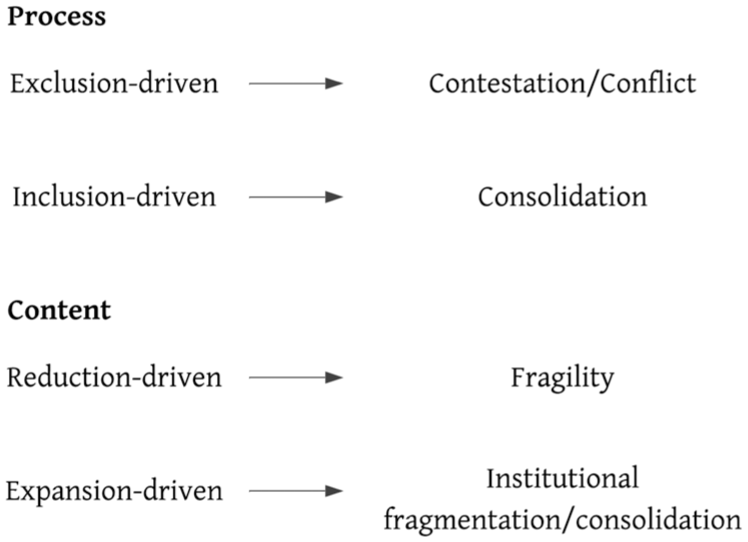
Mechanisms driving the evolution of urban conflict agreements.
Firstly, urban conflict agreements can undergo exclusion-driven evolution, which would affect the inclusion process of such agreements. For example, if we consider a partial settlement where all ordering actors are present, as in the case of the Galkayo City Ceasefire agreement, an exclusion-driven process would occur if a new ordering actor entered the scene but said actor remained excluded from the agreement. Alternatively, it could be caused by the expulsion of at least one ordering actor from the governing coalition. I argue that exclusion-driven evolution would contribute to contestation or even conflict from the ordering actors that are not part of the partial settlement. As such, exclusion-driven evolutions are likely to lead to conflict relapse. In the case of a partial settlement, I suggest this transition would lead into an evolution into a non-settlement, or becoming a political unsettlement, depending on whether the content of the urban conflict agreement expanded.
Secondly, urban conflict agreements can undergo inclusion-driven transformations. This may be achieved through the incorporation of new actors in urban areas affected by armed conflict, or by including actors that have previously been excluded. In the event of a political unsettlement, as exemplified by the Meranao Peace Declaration, the ordering actors not included in the initial agreement, namely the Task Force Bangon Marawi, the provincial government and external agencies, would be incorporated into the agreement. I argue that such an evolution would lead to horizontal inclusion, while leading to a more legitimate consolidation of authority over the order-making process in each urban area. Equally, I also anticipate that inclusion-driven evolution may provide for co-optation, whereby stronger ordering actors force their opponents to accept the agreement. Thereby, inclusion-driven evolutions could provide for the transformation into agreements that are stickier or longer lasting. In the case of the agreement on Marawi City, such a transformation would result in a partial settlement or a political settlement, depending on whether the content of the agreement is also maintained or reduced.
Thirdly, urban conflict agreements can evolve through reduction-driven processes. The reduction of the scope of content in urban conflict agreements may be attributed to the discordance between the actors previously engaged in the regulation of governance provisions. If we take the Accord de Paix de Bangassou, a reduction of the content of the agreement would result in a less comprehensive agreement. This may mean that the ordering actors involved may not be content anymore with the scope of the agreement and could subsequently seek to manipulate such transformation in their favour. The reduction in the institutionalisation of an urban conflict agreement can thereby lead to an increased fragility of an agreement, with lower stakes at play, and ordering actors may be inclined to challenge such an agreement. Such an evolution may also have negative effects on the durability of an urban conflict agreement. Reduction-driven evolution then shows that when actors are ordered, the strength of an agreement is reduced, and it becomes more susceptible to external or internal challenges. The transformation of political settlements under such conditions depends on inclusivity being maintained amongst the relevant ordering actors. Without such inclusivity, the settlements may devolve into a non-settlement rather than a partial one.
Finally, urban conflict agreements can also evolve through expansion-driven processes. The expansion of the content of urban conflict agreements would be precipitated by the perception of the ordering actors involved that the previous agreement lacked comprehensiveness and that sufficient trust existed between the actors to expand its scope and conditions. In the event of a non-settlement, as evidenced by the Sabha Ceasefire Statement, the Tebu Tribal Council would expand the scope of the ceasefire beyond the mere cessation of hostilities. In this and other cases then, I argue that expansion-driven evolutions lead to the consolidation of either exclusive or comprehensive agreements. In the case of agreements such as the Sabha agreement, where there remains exclusion of an ordering actor, such an evolution would be subject to a transformation into a state of political uncertainty, likely to be challenged by the left-out ordering actors. In other cases, when agreements are already inclusive, and they see a transformation through expansion-driven processes, then I anticipate that these agreements become more consolidated and less likely to relapse into conflict.
Conclusion
This article examines the understudied phenomenon of urban conflict agreements, which are defined as agreements between ordering actors that specifically address urban areas affected by armed conflict. The article makes two key contributions, both conceptual and theoretical.
Firstly, this article introduces the concept of urban conflict agreements, which are a distinct category of agreements designed to resolve and end armed conflicts, as opposed to agreements at the intra- or inter-state level. This distinction is based on the identification of four key characteristics of the concept. Urban conflict agreements are defined by their location in urban spaces. The defining urban characteristics of these areas – high population density and their built environment – provide these agreements with a unique geographical limitation, contributing to recent urban studies research (Abello Colak et al., 2023). Furthermore, as armed conflict becomes increasingly urbanised, beyond ongoing trends of fragmentation and internationalisation, urban conflict agreements directly address the needs of urban areas affected by armed conflict (Beall et al., 2013). As they are limited to urban areas, these agreements are not subject to negotiation processes at higher levels, be they intra- or inter-state negotiations. Indeed, state authorities often face competition in these spaces from non-state armed actors who engage in these agreements. Finally, these agreements are composed of ordering actors who can establish, maintain or disrupt them.
Secondly, to construct the theory of these conflicts, I inductively operationalised four types of urban conflict agreement by deductively selecting two dimensions capable of classifying such agreements – process inclusion and governance provisions – and assessing 49 cases of these agreements in 13 countries between 1990 and 2024. The theorisation of these agreements suggests that those with stronger content and that are inclusive of all ordering actors are more likely to be durable. I illustrated these four types using cases from four different countries, Libya, the Philippines, Somalia and the Central African Republic, demonstrating that even after an agreement has been formed, it can evolve over time depending on whether it is driven by exclusion, inclusion, reduction or expansion.
There is ample scope for future research on the urbanisation of armed conflict and efforts to resolve it through urban conflict agreements. Firstly, quantitative research can further develop, test and challenge the theory presented here. This may then be able to provide robust and generalisable hypotheses and patterns. On the other hand, qualitative research could examine the data on the agreements themselves in more detail, identifying the actors and their methods for resolving armed conflict in urban areas. Alternatively, it could delve into specific cases to gain further insight into their urban conflict agreements.
Supplemental Material
sj-docx-1-usj-10.1177_00420980251400646 – Supplemental material for From non-settlement to political settlement: The types of urban conflict agreement
Supplemental material, sj-docx-1-usj-10.1177_00420980251400646 for From non-settlement to political settlement: The types of urban conflict agreement by Emilian Berutti in Urban Studies
Supplemental Material
sj-docx-2-usj-10.1177_00420980251400646 – Supplemental material for From non-settlement to political settlement: The types of urban conflict agreement
Supplemental material, sj-docx-2-usj-10.1177_00420980251400646 for From non-settlement to political settlement: The types of urban conflict agreement by Emilian Berutti in Urban Studies
Footnotes
Acknowledgements
I am grateful to Deen Sharp and the three anonymous reviewers for their valuable guidance, which significantly improved this article. I also wish to thank Christiana Parreira, Keith Krause and Allard Duursma for their continuous support and insightful feedback throughout the development of this work. I would like to thank the organisers and participants of Swisspeace’s workshop, titled ‘International Peacemaking at a Crossroads? Rethinking Peace Processes in a Changing World’, which took place on 19 and 20 May 2025 in Basel, Switzerland. Finally, I thank the participants of the EUI-IHEID workshop held in Fiesole on 27 and 28 March 2025 and the CCDP Seminar at the Geneva Graduate Institute on 22 May 2025 for their constructive comments and suggestions.

Funding
The author received no financial support for the research, authorship, and/or publication of this article.
Declaration of conflicting interests
The author declared no potential conflicts of interest with respect to the research, authorship, and/or publication of this article.
Supplemental material
Supplemental material for this article is available online.
Notes
References
Supplementary Material
Please find the following supplemental material available below.
For Open Access articles published under a Creative Commons License, all supplemental material carries the same license as the article it is associated with.
For non-Open Access articles published, all supplemental material carries a non-exclusive license, and permission requests for re-use of supplemental material or any part of supplemental material shall be sent directly to the copyright owner as specified in the copyright notice associated with the article.
