



Abstract
This article analyzes civil–military relations and the issue of civilian control through the lens of new managerialism. It illustrates that the means and mechanisms applied by governments to govern the military actually shape its organization and affect its functions in ways not always acknowledged in the civil–military debate. We start by illustrating the gradual introduction of management reforms to the Swedish Armed Forces and the growing focus on audit and evaluation. The article thereafter analyzes the consequences of these managerialist trends for the most central installation of the armed forces–its headquarters. It further exemplifies how such trends affect the work of professionals at the military units. In conclusion, managerialist reforms have not only changed the structure of the organization and the relationship between core and support functions but have also placed limits on the influence of professional judgment.
Analyzing Changes in Civilian Control of the Armed Forces
This article analyzes the shifting patterns of civilian control of the Swedish military in the past decades. It investigates the specific means and methods applied by the political leadership to govern the military headquarters and the effect thereof on the organization and work of this powerful military institution. Civilian control is a central issue within civil–military relations, and this study corresponds well to the dominating aim in this field, that is, “to explain how civilian control over the military is established and maintained (Burk, 2002, p. 7; see also Bland, 2001; Feaver, 1999). Yet the present study differs from traditional ways of analyzing democratic civilian control. By applying tools and methods from studies on new managerialism in other parts of the public sector, we suggest an alternative operationalization of key concepts and a different level of analysis. Our systematic study of changes in civilian control that appear incremental in the daily work at the Swedish military headquarters reveals profound long-term effects on the organization and its working methods; effects that also have consequences for professional work at the military units. Thus, by broadening the approach to the important question of how democracies govern their militaries and with what consequences, this study contributes to the civil–military field. At the heart of democratic civil–military relations, just as in the study of other public agencies, lies the fundamental principal-agency problem of delegation. That is, how to make sure that central government agencies implement policy efficiently and in accordance with political intentions. This is generally portrayed as the ambition to achieve both civilian control and military effectiveness on the battlefield (Huntington, 1957; Feaver, 2003). This study addresses the control–effectiveness relationship from a different perspective. We argue that both the means of civilian control and the idea of military effectiveness have become more multifaceted in the past decades, and therefore, an alternative approach is beneficial. Many European states saw the improved security situation of the post-Cold War period as an opportunity to halt spiraling defense costs and cut back on their standing forces (Christiansson, 2020; King, 2010; Petersson, 2011). As the threat to state survival vanished, defense spending was “normalized” and made subject to greater political and managerial control, just as other parts of the public sector (Dandeker, 1994; Norheim-Martinsen, 2016).
Following these insights, this study places civilian control of the Swedish Armed Forces headquarters (SAF HQ) in the context of the overall changes in the governance of central government agencies in Europe and the many rounds of public administration reform during the past decades (Hammerschmid et al., 2016; Pollitt & Bouckaert, 2017). There are indeed studies that argue that the military can be studied as a public bureaucracy among others (Norheim-Martinsen, 2016; Soeters et al., 2010). Yet few, if any, systematic studies apply this approach when analyzing changes in, and consequences of, civilian control, which points to an interesting research gap.
This article analyzes what increased managerialist governance of the SAF HQ has entailed in the years 1998–2018, and what consequences it has had for this organization. As the head of the military bureaucracy, changes to the HQ also affect the work conditions for commanders at the military units, which we illustrate as well. We approach the relationship between civilian control and military effectiveness in a peacetime, bureaucratic setting, outside the realm of strategic decision-making regarding the application of force. One good reason for doing so is that the “normalization” of the defense sector in the past decades has increased the importance of cost efficiency, which at large is a peacetime measurement. Another is that the SAF HQ is the key body in charge of military strategy and the overall development of the armed forces, in peace as well as in war. Any peacetime consequences of new managerialism on this organization will also affect how it functions in crisis or war. Our point of departure is thus that peacetime changes to the internal structure, and work methods of the headquarters also affect the substance and quality of the armed forces’ core activities in ways seldom taken into account.
The study poses the following overarching, and interrelated, research questions to meet the stated research aims: To what extent has the armed forces been the subject of extensive monitoring, evaluation, and audit? How has the government’s performance management scheme developed over time? To what extent have new forms of governance had effects on the internal organization of the armed forces’ headquarters?
The article begins with an introduction to previous research on civilian control and contemporary public management ideals. This presents an analytical framework to capture how the government’s steering of the SAF has organizational implications at the agency level. Thereafter, the research design is outlined and the data presented, followed by the results of the empirical study. Methodological choices and the data sources are described in detail in the Appendix. The conclusions summarize our main findings and contributions.
Civilian Control as a Case of Public Management of the Armed Forces
As mentioned, a key assumption within civil–military relations is that the government needs to strike a balance between political control and military effectiveness. Too much civilian interference in military affairs risks undermining the achievement of military goals, while too little civilian control may cause the military to act contrary to the political will and thus create a problem for democracy. A classical debate within civil–military relations revolves around the scope of civilian control. Here, the question is whether military effectiveness is best achieved by delegating decision-making power to the military in areas of its expertise (Desch, 2007; Huntington, 1957; Yingling, 2007) or rather by strengthening the political involvement and integrating the military into civilian policymaking (Cohen, 2001; Janowitz, 1960; Schiff, 1995).
Many of these studies analyze the relative civil–military influence in strategic decision-making related to war and conflict and its effects for actual outcomes. Thus, as pointed out by Taylor (2012), previous studies generally focus on policy and operations, whereas the management domain generally has been neglected.
Civil–military scholars have also been more devoted to the normative aspects of control, including military professionalism and culture that contribute to placing the military firmly under civilian control (Huntington, 1957; Janowitz, 1960), than to concrete methods used to control it. Since laws and regulations only keep the military under civilian control as long as it abides by them, they are not necessarily the mechanisms that explain subordination (Feaver, 1999). This may explain why instrumental control mechanisms such as directives, commissions, and regulations have received less attention—they simply hold too little explanatory power for the research question in focus. Yet, as Feaver (1996) points out, internal control is a function of external, instrumental decisions, which is why the latter also deserves attention. Furthermore, our purpose is not to investigate whether civilian control has improved or deteriorated over past decades, but rather to analyze the effects of different forms of control on the military. Feaver has shown that political leaders apply a varying set of mechanisms to monitor the military, including less intrusive mechanisms such as civilian involvement in selection and screening of military candidates, as well as highly intrusive ones such as civilian intervention into military operational decisions (Feaver 2003). This study connects to central tenets of Feaver’s 2003 study. Yet his ambition was to explain how “civilian institutions are able to impose their will on their more powerful military agents” (p. 1), whereas the focus here is to analyze how the overarching logic and the concrete mechanisms of external control actually shape the military organization.
Civil–military relations scholars generally do not study public management reforms as manifestations of change in civilian control of the military. Previous research has therefore not fully acknowledged the intentional or unintentional formative effects they have on the military organization. Just as other public agencies, military organizations in the Western hemisphere have been affected by different waves of public management reform, and managerialist practices have long been used within the military, especially in the US (Waring, 1991). During World War II, for example, the US military incorporated ideas and practices from the Harvard Business School, and “applied quantitative managerial techniques designed to measure, account for and manage the logic and practices of warmaking “(McCann, 2017, p. 494). In the 1960s, the paradigm of economism made its way into the US military establishment, and quantitative and statistical methods became key to calculate and measure military effectiveness (Shields, 1993). Sweden similarly adopted a new system for planning and financing in the 1970s, which was developed based on the US model (Agrell, 2011, p. 49). The application of business techniques to improve (economic) efficiency, and other reforms associated with what later became known as New Public Management (NPM), is thus not a new phenomenon to the military. Yet NPM is a rather unprecise concept, encompassing a bundle of diverse practices, such as military performance measurement and management by results (Soeters et al., 2010), or military outsourcing and the use of private military security companies (Avant, 2005; Berndtsson, 2014; Heinecken, 2013). The degree of implemenation also varies greatly across a large number of states (Pollitt & Bouckaert, 2017, p. 6). So, even if previous studies on NPM reforms and their consequences tend to agree that management practices are well established within the military and that micromanagement has increased, few systematic studies confirm such claims. In this article, where civil–military relations are in focus, we look specifically on what is known in the literature as new mangerialism, which is further elaborated upon in the next section. These techniques take a specific interest in large-scale adoption of managerial ideas, external audits, and performance management across central government agencies and can thus shed light on how civilian control has developed over time, and with what consequences for the military organization. To do so, it is necessary to dissect the last decades’ management reforms and their effects.
New Modes of Governance–The Managerial State
Fueled by the financial crisis and growing expenses for the welfare state, the public sector in Western societies has been the target for extensive public management reforms since the 1980s (Cohen et al., 1999; Hood, 1991; Pollitt, 1990). The claimed ambition of these reforms has been to reduce government costs and to improve quality (Hood & Dixon, 2015). They embody the NPM movement and involve a bundle of major changes, including privatization and contracting out, marketization of services still inside the public sector, and stronger performance management and manageralization (Hood, 1991; Pollitt, 2016).
Diefenbach points out that the NPM reform movement has been both radical and total in its scope and intensity since being introduced into all public service sectors (Diefenbach, 2009, cf. Kirkpatrick et al., 2005). The core idea has been that business practices and market orientation can improve the performance of public organizations, which is referred to as new managerialism (Diefenbach, 2009; Kirkpatrick et al., 2005). Characteristics of “new managerialism” include changing the focus from rules to results and emphasizing the primacy of management above all other activities (Frederickson, 2005). Hence, “new managerialism” is associated with new kinds of imposed external accountability, including the widespread use of performance indicators and league tables, target setting, benchmarking, and performance management (Kirkpatrick & Lucio, 1995; Power, 1999). In theory, comprehensively measuring and monitoring crucial aspects of organizational and individual performance is thought to lead to increased efficiency, productivity, quality, and higher performance, and motivation. Because of explicit targets, performance indicators, measurement, and control systems, management can be grounded in “facts” and have a rational basis (Diefenbach, 2009; Power, 1999). More “objective” measures of an organization’s performance will also further allow for greater transparency and accountability.
The shift from central regulation and detailed instructions to decentralization, market solutions, and ex-post controls has increased the demand for oversight and inspection of the public sector to such an extent that Power (1999) claimed we were facing an “audit society.” Power argues that making organizations auditable leads to the measurability of activities becoming more important than the actual activities carried out in the organizations. This leads to lower levels of efficiency, deprofessionalization and mistrust, and resistance among public employees (Bevan & Hood, 2006; Pentland, 2000; Power, 1999). Yet extensive procedures for (managerial) quality control not only curb professional autonomy but also tend to increase overhead costs (Hood & Peters, 2004). One reason is that top management tends to expand support functions and systems for management control, which in itself restructures the balance between core activities and support functions within an organization (Ahlbäck Öberg & Bringselius, 2015; Boyne & Meier, 2013). Thus, empirical studies display widespread evidence for swelling tides of bureaucracy because of new NPM structures and processes (Hall, 2012; Hood & Dixon, 2015; Kirkpatrick et al., 2005). Yet, in spite of these extensive critiques by both academics and practitioners, the seemingly dysfunctional and value-subverting practices of accounting and auditing persist and continue to expand (Power, 2019; Pollitt, 2016). It could, however, be added that benefits from NPM reforms and principles such as transparency–for example, through increased audit systems–have also been identified, but the success depends on the administrative, political, and policy context in which reforms take place (Lapuente & Van de Walle, 2020; Peters & Pierre, 2020).
In many European states, central elements of the penetration of NPM have been the introduction of performance management and the escalation of public policy evaluation and audit. Power (1999) notes that the audit trail, as a process, not only produces auditable accounts but is also a logic that is formative of organizational actors’ dispositions to reproduce those accounts. A fair assumption would thus be that these reforms also have had an impact on the structuring of the civil–military relationship within a state.
Based on the insights from the above literature review regarding the effects of public management reform on the civilian parts of the public sector, we focus on three interrelated developments when studying how and to what extent contemporary public management reforms have influenced the armed forces. We pose the following three research questions: To what extent has the armed forces been the subject of extensive monitoring, evaluation, and audit (“the audit society”) by external actors? How has the government’s performance management scheme developed over time (e.g., how much, and how detailed, performance information is requested over time)? To what extent have new forms of governance affected the internal organization of the armed forces’ headquarters, such as in the expansion of support functions and its work processes?
Research Design and Methodology
From the 1990s, Sweden was a zealous follower of NPM reforms (Hood, 1996; Pollitt & Bouckaert, 2017), which makes it an excellent research context to analyze contemporary managerial reforms. In the comparative literature, Sweden is described as a “modernizer” in terms of NPM’s penetration into the public sector, which stands for an emphasis put on managerial and user-responsive strategies rather than competition, marketization, and privatization strategies (Pollitt & Bouckaert, 2017). Hence, Sweden has embraced most of NPM’s ideas and practices, especially the management-oriented part of NPM and particularly the various ideas about steering control (Greve et al., 2016; Sundström, 2006). As illustrated next, however, the implementation of these reforms within the SAF was not without problems.
Civilian Control and Managerial Reforms of the SAF–Introducing the Case
In comparison with the influence of other central government agencies in their respective policy area, the Swedish military bureaucracy traditionally had a greater impact over the creation and implementation of defense policy (Goldmann, 1981). In the late 1980s, the Swedish government implemented a management by results system to strengthen the steering capacity of the government vis-à-vis its agencies and to prevent the expanded public sector from further growth (Sundström, 2016, p. 317–318). This also included the defense sector, and the aim was to increase productivity by implementing a new command philosophy and delegated decision-making (SOU 1996:98, p. 38). A major inquiry into the governing and steering of the SAF (LEMO-utredningen) was commissioned in the early 1990s, which later resulted in a merger of several defense agencies into one single agency in 1994—the Swedish Armed Forces. Yet this did not solve the steering problems, and a follow-up inquiry conducted in 1996 concluded that the merger into one single agency had in fact transferred power over military affairs from the government and parliament to the supreme commander, a military general (SOU 1996:98; p. 62). The report further stated that the defense sector “has a powerful impact over its ‘own affairs” (SOU 1996:98, p. 19) and that result measurements regarding capability and productivity were lacking (SOU 1996:98, p. 11).
The empirical analysis in this article takes 1998 as its starting year. By then, it was clear that further efforts to increase government control were needed. In 1998, the newly established agency also undertook the first reforms of its headquarters (Försvarsmakten, 2016). In addition to the general administrative trends in the Swedish central government bureaucracy, the improved security situation in Europe in the 1990s contributed to a “normalization” of security and defense matters and opened the door to major cuts to defense spending. 1 Yet these cuts failed to bring about the anticipated cost reductions (Hedin, 2011), and the SAF came to face even growing demands of effectiveness and productivity in the first decade of the new millennium (Ydén & Hasselbladh, 2010).
Although the managerialist trends in the central government administration affected the military later than other central government agencies, our analysis of the period 1998–2018 shows that the SAF gradually became subject to growing demands regarding reporting back, audits and government inquiries. Yet despite these efforts to increase influence and political control, the SAF has remained a “challenge to the state” (Riksrevisionen, 2014).
The empirical analysis starts by addressing the first question and investigates in what ways the armed forces have been the subject of extensive monitoring, evaluation, and audit by external actors during the last two decades. It relies on a wide range of written sources, and investigates the scope of audits and reports, by other government agencies, targeting the SAF. This lays the ground for the succeeding in-depth analysis of the performance management schemes that the SAF has been subjected to during the same period, which provides an answer to the second research question. For this part, we use the government’s appropriation directives (regleringsbrev), issued annually to each central government agency, as well as government commissions and inquiries. 2 Compared to civilian control mechanisms such as laws and regulations, budget allocations, and appointments, which shape the military organization in a more direct manner, the formative element of monitoring and auditing is somewhat less obvious. This corresponds to what Feaver (2003, p. 84) labels “police patrol monitoring,” which he refers to as the second most intrusive mechanism of civilian oversight. It includes investigations into the armed forces with the objective of controlling its activities, which generally requires intrusive reporting back by the military.
The last part of our analysis investigates concurring organizational developments within the SAF HQ in order to answer the third research question. The assumption is that civilian control mechanisms have a formative effect on the military organization. Given that the internal governance of the armed forces shapes the substance and quality of its core activities, this question deserves attention. Data for this part have been retrieved from an annually published reference book containing the organization and employees of the whole central government sector (Sveriges statskalender) and documents presenting internal procedures within the SAF HQ. The final part of the analysis section exemplifies how new managerialism has affected the work of the organization, also beyond the SAF HQ. Here, we look specifically at personnel management given its centrality for professional work.
Analysis and Findings
As stated above, the development of new modes of civilian control of the SAF is analyzed in two steps. We begin by addressing the first two research questions. First, we investigate the development of monitoring, evaluation, and audit of the SAF by external government agencies between 1998 and 2018. We thereafter look at the development of the government’s performance management scheme in the same period. The second part of the analysis deals specifically with the third research question, and thus looks closely at the formative effects that this kind of civilian control has had on the organization of the SAF HQ and its work processes. This illustrates the usefulness of approaching civilian control at the level of impact, rather than at a more overarching level related to certain specific strategic or operational decisions, common in previous studies.
Civilian control by external agencies
Government agencies with the sole purpose of overseeing other government agencies clearly gained ground in the end of the 1990s and 2000s as NPM reforms were implemented. The Swedish government and parliament audit and investigate the SAF through the National Audit Office (RiR), the Swedish National Financial Management Authority (ESV), and the Swedish Agency for Public Management (Statskontoret). The National Audit Office was created in 2003 after a merger of the National Audit Bureau (RRV) and the Parliamentary Auditors (Riksdagens revisorer) (Ahlbäck Öberg & Bringselius, 2015). The Swedish National Financial Management Authority, in turn, was established as a central government agency in 1998. The Swedish Agency for Public Management has existed for almost 400 years, but since 2006, it has focused solely on inquiries. In addition, the SAF is also subject to government-commissioned inquiries.
Between 1998 and 2018, the National Audit Office (RiR) and its two predecessors published 35 performance (efficiency) audit reports targeting the SAF (from 2005 accessed via www.riksrevisionen.se). The Swedish National Financial Management Authority (ESV) conducted its first investigation of the SAF in 2005 and has published six audit reports up to 2018. Although fewer in number, the reports of these investigations have often been highly critical of the (financial) management of the SAF (see e.g. Ekonomistyrningsverket, 2008), and they have generally provoked far-reaching managerial changes in the SAF organization (Försvarsmakten, 2019a).
Moreover, between 1998 and 2018, the investigations conducted by the Swedish Agency for Public Management generated at least 13 reports (see Statskontoret.se). These examined to what extent political intentions had been met, and what remaining shortcomings required further attention, in relation to, for example, the introduction of a network-centric warfare (Statskontoret, 2007), the introduction of an integrated business system, PRIO (Statskontoret, 2010), and reforms to defense logistics (Statskontoret, 2015).
The Swedish government also appoints commissioned inquiries, especially as part of the legislation process. The results of these are published as Swedish Government Official Reports (SOU). Inquiries commissioned (primarily) by the Ministry for Defense often require involvement of the SAF, and their results have a bearing on the organization and its work processes. Between 1998 and 2018, the Ministry for Defense commissioned as many as 93 inquiries (see sou.gov.se)
All these audits and investigations require active involvement of the SAF, for example, by providing data, answering questions, or commenting on draft reports. Financial and performance audits, evaluations, and investigations generally highlight shortcomings in, and challenges to, efficient government steering and make suggestions for improvement. As such, the auditing government agency anticipates some kind of reaction, which points to both the indirect and direct formative nature of such audits and evaluations. Aside from demanding attention from large numbers of staff, the monitoring and audits of the SAF also demand a new form of organization tailored to meet the needs for reporting back (Power, 2019). As such, they have generated administrative systems and contributed to a growing bureaucratization of the organization. In summary, it is clear that the SAF, from its merger into one single central government agency in 1994, has been subject to extensive monitoring, evaluation, and audit by multiple external actors and that this has provoked changes to the organization to meet these demands. Later in this text, a case study of the introduction of the business system PRIO illustrates a growing bureaucratization and shows how systems adopted to meet external demands affect how work is conducted. However, before introducing that particular case, we make an in-depth analysis of how the government has targeted the SAF by performance management schemes with the aim of answering the second research question.
Government control by performance management
Performance management is certainly an integrated part of the idea of the audit society. However, this particular results control is especially suited for an analysis, since the introduction of the management-by-results system has been a central public management reform in Sweden (Ahlbäck Öberg & Wockelberg, 2021; Sundström, 2006). Unlike the external monitoring and evaluation presented earlier, performance management is a yearly employed governmental steering mechanism, incorporated in the annual budget process through specific directives known as appropriation directives. According to the Swedish Ministry of Finance, “the [appropriation directive] is one of the most important instruments for the government to control central government agencies with the purpose of reaching the political goals” (Finansdepartementet, 2002, p. 3). As such, they are at the center of operative civil–military relations in Sweden. Swedish ministries use these documents not only to define performance objectives but also to instruct agencies to perform various tasks and to display the financial conditions for the agency’s coming year. Since requests for performance information are clearly identifiable examples of ex-post controls, their frequency in the annual appropriation directives provides an overview of the performance management trend in the SAF. Figure 1 is an illustration of how the number of performance information requests present in the appropriation directives has developed between 1998 and 2018. In the early 2000s, the number of requests for performance information grew from 69 in the year 2000 to 125 in 2005, which resulted in a reform in 2009 (Wockelberg & Ahlbäck Öberg, 2021), after which the number of requests dropped significantly. Number of government requests for performance information from the SAF, 1998–2018 (appropriation directives 1998–2018).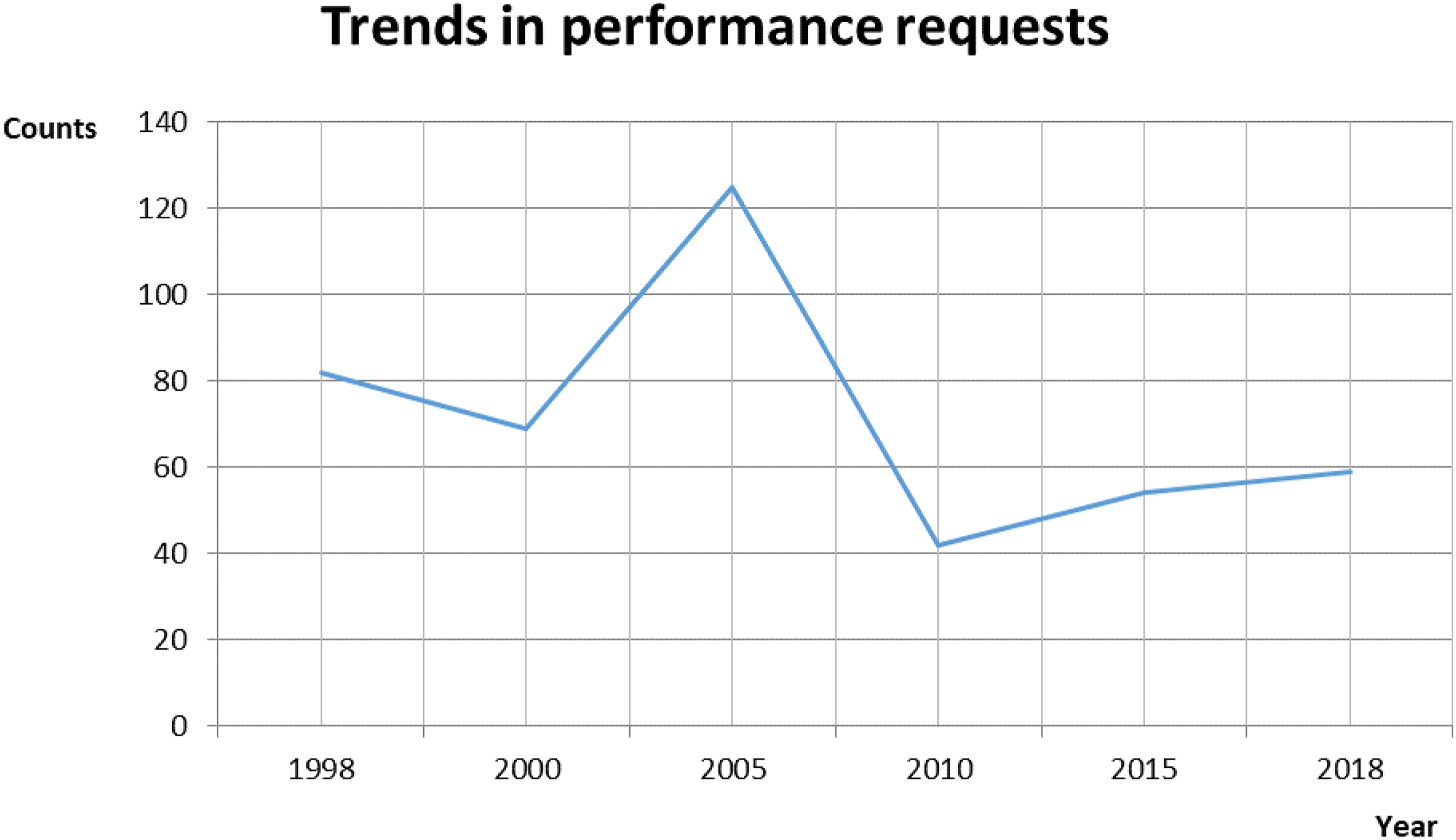
Yet this downward trend ceased and the number of requests for performance information increased steadily from 2010 to 2018. Interestingly, from 2010 onward, requests started appearing in other parts of the appropriation directives and not only under the designated heading “goals and performance information requests” (Regleringsbrev för Försvarsmakten, 2000–2018). For example, in 2010, the requests in the section “goals and performance information requests” amounted to only eleven. Yet when analyzing the appropriation directive as a whole, and also including requests in other sections, the actual number turned out to be 42, that is, almost four times as many (Regleringsbrev för budgetåret 2010 avseende Försvarsmakten, 2010). The Swedish National Audit Office has acknowledged this development and concludes that the number of requests and demands placed on SAF are extensive and that handling them requires a significant amount of the agency’s personnel resources (RiR, 2014).
The total number of performance information requests gives an important but rather blunt measurement related to the audit society, as a decrease in quantity does not necessarily equal a decrease in government control. Fewer requests can, for example, be counteracted by—in qualitative terms—more demanding and detailed requests (Wockelberg & Ahlbäck Öberg, 2021). A careful reading of the appropriation directives suggests that this is indeed the case.
Detailed information requests come with instructions regarding, for example, not only what but also how performance results should be reported. This includes demanding, for example, that the SAF explains any assumptions underlying their analyses, and that the directives determine how specific comparisons should be conducted, and whether performance should be reported back using quantitative and/or qualitative means. Detailed requests for performance information require the SAF to motivate any suggestions it puts forward, and they specify what needs to be reported in relation to specific tasks. Reporting regarding military operational capability can serve as an example. This daunting task includes accounting for comprehensive goal fulfillment in relation to each operational capability, goal fulfillment for each partial operational function, ability to meet deadlines, factors affecting freedom of action negatively, and what plan the SAF has for dealing with possible shortcomings. The appropriation directive also gives instructions on exactly how this should be reported. In this particular case, the evaluation and conclusions should be presented in absolute terms with no reference to the current global security situation (Regleringsbrev för budgetåret 2005 avseende Försvarsmakten, 2005).
3
As illustrated in Figure 2, such detailed requests for performance information in some years amount to more than 50 percent of the total number of requests. From 2015 onward, the graph also illustrates a clear trend toward more detailed requests from the government. Number of performance requests with a high level of detail as percentage of total, 1998–2018 (appropriations directives 1998–2018).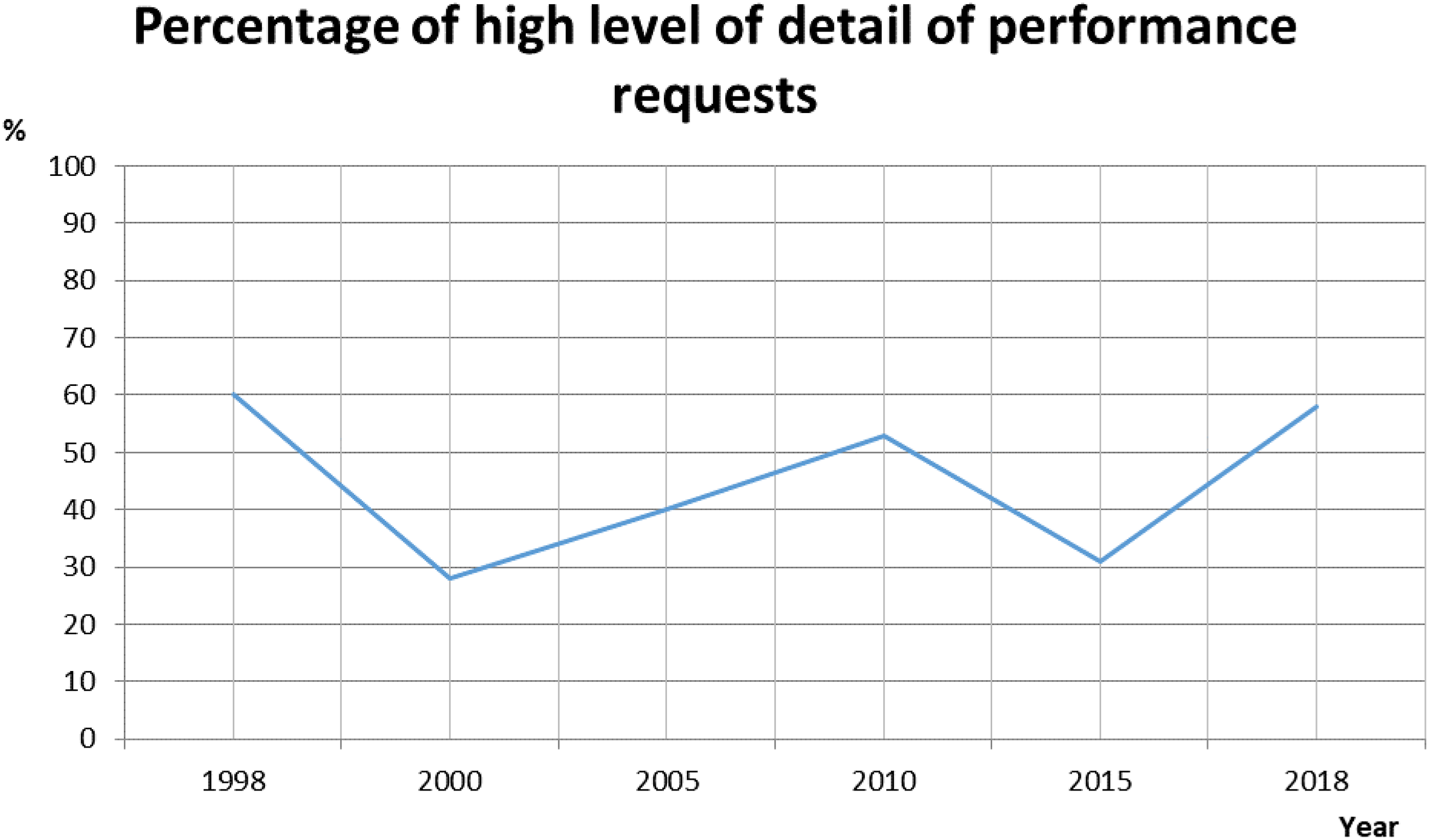
This demand for detailed performance information targets all areas; from flight time to gender equality. Instructions that specify not only what but also how to report contain a dimension of government control that restricts the agency’s own professional considerations on how best to report the type of information that is requested. Hence, it is in opposition to the very idea of “management by objectives,” or mission command, to use military lingua franca.
The request for more detailed reporting has been observed both within and outside the military. The former Director General of the SAF, Peter Sandwall, suggested that the government steering of the SAF is especially detailed (Sandwall, 2019). Similarly, the Swedish Agency for Public Administration points out the increasing attention devoted to quantifiable performance management indicators that are easy to measure (Statskontoret, 2018). To reach comprehensive conclusions about variations in performance information demands from the government, it is necessary to investigate if the drop in requests within appropriation directives, noticeable after 2005 (see Figure 1), has correlated with an increasing number of special commissions. We therefore mapped the special commissions included in the appropriation directives and those coming to the agency directly from the government. Figure 3 shows that the total number of commissions given by the government to the SAF rises steadily after 2010, which coincides with the reduction in performance information demands in Figure 1 above. It can also be observed that it is especially the commissions given in the appropriation directives that are increasing. Hence, regardless of the number of performance information requests has decreased, the total amount of information requested by the political leadership, and its level of detail, has in fact grown in the investigated period. Number of government commissions given to the SAF, 1998–2018. Source: Appropriation directives to the SAF 1998–2018 and the registrar’s office at the Government Offices.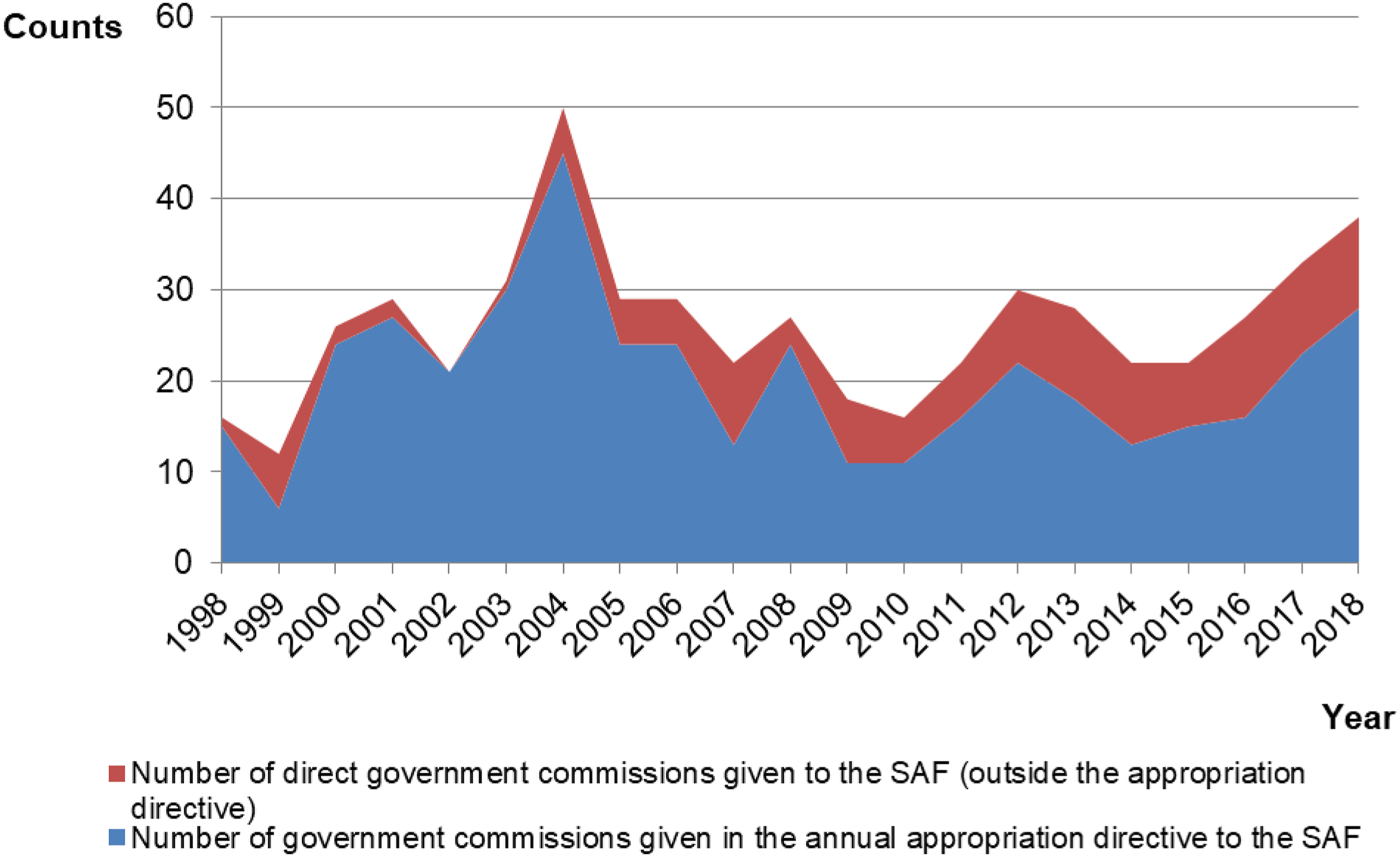
The extensive and detailed demands outlined above also affect the agency’s organization. At the very least, the demands on reporting require the agency to have a structure and personnel designated to meet those demands. At the SAF HQ, a number of employees at every section devote considerable working hours toward the annual report, which is a continuous process that goes on throughout the year. Given the large number of performance measurements that requires addressing, it is not surprising that the annual reports to government, in which the SAF reports back on the demands placed on it in appropriation directives and through commissions, are extensive documents. Their scope and intrusiveness mean that these demands also fall into Feaver’s (2003) category of police patrol monitoring, and they are accordingly seen as the second most intrusive mechanism of civilian oversight.
In summary, the first part of the analysis illustrates that efforts were taken to increase political control over the SAF as a way to reduce costs and increase efficiency between 1998 and 2018. It became thoroughly permeated by the audit society and subject to an increasing number of audits. It appears that the number of requests for performance information drops in the middle of the investigated period, yet the analysis shows that the required quantifiable indicators are still extensive, and that the detailed report requirements have in fact increased. In the next part of the analysis, we turn to the third research question and ask to what extent these forms of governance have affected the internal organization of the armed forces’ headquarters.
The Organizational and Managerial Changes in the SAF HQ
It is hardly surprising that government demands on cost efficiency and rationality, accompanied by budget cuts, have had a formative effect on the SAF HQ. The purpose of the next part of the analysis is to analyze how these political demands have shaped the SAF HQ in terms of the relationship between the core activities traditionally related to the military profession and administrative support functions related to managerialism. Overall, the SAF has been responsive toward the imposed management methods and demands on higher financial accountability. Ydén (2008) suggests that this is illustrative of a search for legitimacy symptomatic to the military’s struggle with its raison d’être following the end of the Cold War.
The reorganizations of the SAF headquarters
As mentioned, the SAF was established as a single central government agency under the Supreme Commander in 1994, after a merger of several previously independent government agencies, including the different service branches. Since this first major organizational overhaul, the headquarters reorganized in 1998, 2000, 2003, 2005, 2007, 2010, 2012, 2014, and in 2016 (Försvarsmakten, 2019b). The extent of these reorganizations varied, but they all changed the layout of the organization and the internal relationships between functions. The changes nevertheless were most far-reaching in the years 1998–2005 and in 2016 (Försvarsmakten, 2019b). Government steering characterized by managerialist methods has thus provoked, or at least coincided with, almost biannual reorganizations of the SAF HQ, which has changed relations between core and support functions, resulting in considerable centralization.
Centralization of administrative support functions
Centralization, understood as an increase in the size of supportive administrative functions, is one unexpected side effect of managerialism (Courpasson, 2000; Diefenbach, 2009; Hall, 2012). As the administrative head of the SAF, the HQ itself can be used as an illustration. Despite the major reductions in military staff and bases in the 1990s and 2000s, the size of the military headquarters did not experience corresponding cuts. Between 1998 and 2007, the number of staff remained rather constant at around 700 persons, and it thereafter increased to reach more than 1000 persons between 2008 and 2014 (Sveriges statskalender, 1876–2015). In 2015, the number dropped to just under 900, yet in 2021, the SAF HQ counts 1200 staff members according to the SAF homepage (data were missing for 2016–2019). Large fluctuations from one year to another are likely due to decisions to move units back and forth in the military organizational hierarchy. Yet in the past decades, there has been a lingering civil–military consensus that the headquarters have become too large for the downsized Swedish military organization (Expressen.se & TT, 2003; Pettersson, 2011; Försvarsmakten, 2016).
This increase in the size of administrative bodies in relation to core function is one obvious indication of a centralization of managerial bureaucratic functions, as is illustrated below through the example of the so-called HR transformation. Yet, equally important to size is the hierarchical placement of these administrative units within the organization, as this illustrates how much weight they have in relation to other functions. Within the SAF HQ, evidence of centralization can be seen in the hierarchical rise of administrative functions such as human resources, communication, finance, and law. We analyzed these four administrative functions from the perspective of their organizational status between 1998 and 2019 (data from 2018 were missing) Figure 4 captures their migration upward in the military organization. Since 2016, these administrative functions have all been part of the highest strategic decision-making body of the SAF HQ, that is, the Defense Staff (Ledningsstaben). Thus, in 2019, six out of nine departments within the Defense Staff were of an administrative and supporting character (organizational chart provided by the SAF, 2019). This can be compared to the year 2000, when the organizational body corresponding to the Defense Staff (Operationsledningen) contained five departments that all held functions closely related the core tasks of the SAF, such as military strategy, operational planning, task force, and preparedness and training (Sveriges statskalender, 2000). The internal placement of administrative functions within SAF HQ. Darker blue indicates a position higher up in the decision-making units of the organization. Sources: Organizational charts provided by the Swedish Armed Forces.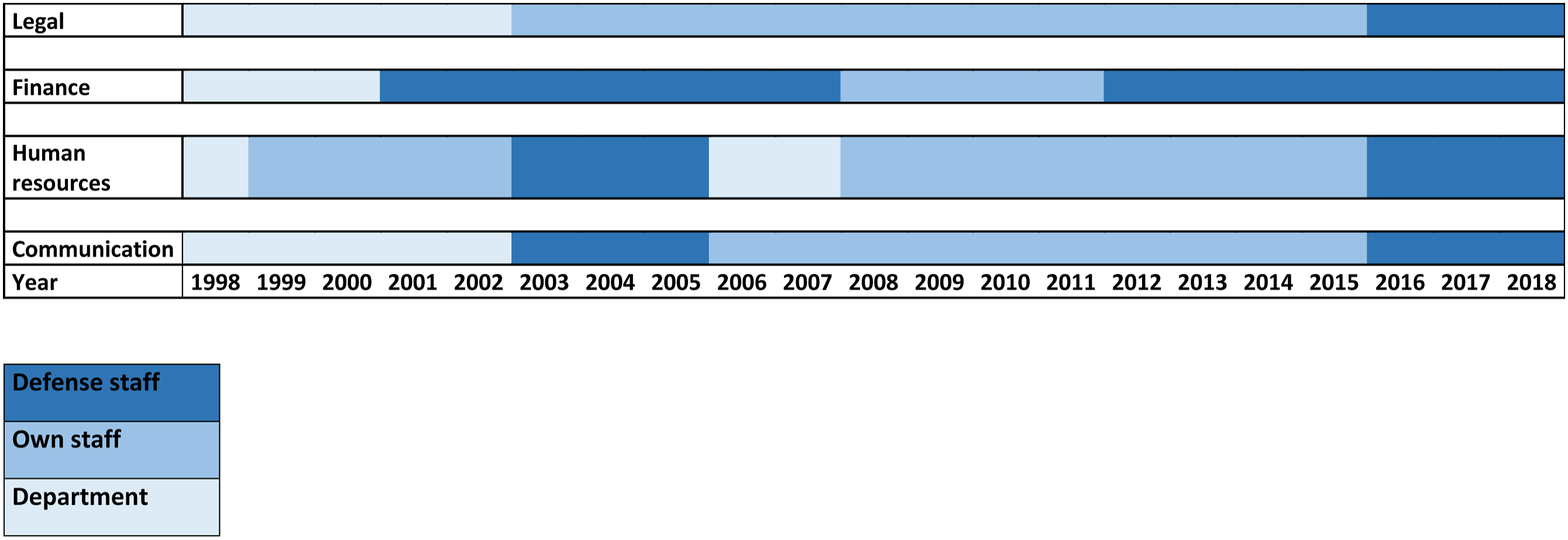
Even if periods of centralization have been followed by decentralization, the overall organizational journey for each administrative function shows a clear trend of centralization. The supportive functions show the same centralizing trajectory from being departments within a staff, to having their own staff, and to finally moving up into the highest decision-making body of the organization.
The centralization of administration is also visible in the compilation of the central management group of the SAF. In 1998–2000, none of the administrative functions was part of central management. In 2005, the financial director and the chief legal adviser were included in the central management. In 2006, the personnel director was included, and the following year saw the inclusion of the fourth administrative function, the information director. The obvious centralization regarding the supportive administrative functions at the SAF HQ is expected, given the implementation of managerial modes of governance. This usually also comes with an influx of people with competences other than those connected to an agency’s core operations and tasks. Overall, this is also the case within the SAF, yet with some peculiar deviations. When the support functions were first introduced into central management of the SAF, none of these positions were held by officers. Yet, since 2016 the personnel director has been an officer, and since 2018 this has also been the case for the communications director. These results are contrary to theoretical expectations. One possible explanation is that akin to the notion of the “general manager,” which is central to the idea of managerialism, the Swedish officer corps see themselves as generalists, that is, they can be leaders in any organization or area of operations.
Former Director General Sandwall (2019), 4 explained the overall centralization that is apparent in the data above by reference to needed reforms of the SAF. He suggested that encompassing reforms have required “at times heavy handed treatment of the internal organization,” which required a clearly centralized leadership. He further highlighted that also the internal governance of the armed forces, from central levels to the units, schools, and centers, has become centralized, detailed, and fragmented (Sandwall, 2019, p. 226).
Effects on Personnel Management in the SAF
The analysis above illustrates that the attempts to increase effectiveness in the SAF HQ have led to an emphasis on administrative functions. The work of these administrative functions has required centralized systems for administration and control. The underlying logic is almost exclusively based on arguments of increased efficiency, but has come to frame and limit the professional work in the SAF HQ as well as in other parts of the organization, thus changing the overarching logic of how and why core functions are conducted. The introduction of the SAP business system, 5 called PRIO, within the armed forces serves as an illustration of this trend.
In the early 2000s, it was clear that several years of major organizational cuts within the SAF had not generated the anticipated cost reductions (SOU 2005:96). At the SAF HQ, the costs for administration remained more or less constant between 1997 and 2004, and the relative personnel costs had in fact increased (SOU 2005:96), which is expected given the size of the HQ as discussed earlier. Internal investigations had also concluded that too many staff members were working with personnel-related issues within the SAF (Thilander, 2013). In 2004, the Swedish Defense Commission 6 therefore suggested a 40 percent reduction to the central leadership of the SAF, which would save 250 million SEK (Försvarsberedningen, 2004). This compelled the SAF to find strategies to handle the personnel situation, and in 2006, it initiated a transformation of the human resources (HR) area by establishing a common HR support and service function for the civilian and military staff in the entire military. The decision in 2009 to move from a conscription-based system to an all-volunteer force also placed new demands on the HR function.
The HR transformation rested on ideas of both centralization and decentralization. Administrative tasks were to be centralized and referred to the new HR Centrum, whereas HR work at the units was to focus on strategic, long-term personnel work. At the same time, employer responsibility was decentralized to lower-level line managers, who were to handle general staff issues locally by using the all-encompassing business system PRIO (Thilander, 2013). 7 This administrative system was thus a precondition for the success of the HR transformation (Försvarsmakten, 2013b).
Internal evaluations of the HR transformation by the SAF in 2013 and again in 2020 concluded that it did not reduce costs and not the number of HR staff. Nor did efficiency appear to have increased. In 2012, only 12 percent of the employees found that PRIO facilitated their work (Sundgren, 2012). More recent staff evaluations reveal that the administrative support systems, including PRIO, are still not seen as well functioning (FM VIND, 2019, 2018). Partly due to the incompatibility of the SAP business system (PRIO), the administrative burden of line managers at the battalion and platoon levels increased. A survey of these officers, conducted in 2012, illustrated that time previously spent on soldier education and training was now spent on administrative tasks. Almost half of the respondents also expressed that they did not possess the right competence for shouldering employee responsibility (Försvarsmakten, 2013b).
The decentralization of staff-related issues to line managers who do not have the time, or the right qualifications, has also generated a growing number of specialized HR functions. Thus, the strivings for uniformity to increase efficiency have, on the contrary, created greater fragmentation (Thilander, 2013). The report from 2020 indicates that line managers within military units still perceive the administrative burden as too high, and the problems that were identified in 2013 still remain (Försvarsmakten, 2020).
The evaluation of the HR transformation illustrates that the integrated system PRIO did not sufficiently support, for example, recruitment processes, and that this increased the administrative burden for commanders. Some tasks also had to be executed twice, first, manually at the units, and then electronically at the HR Centrum (Försvarsmakten 2020), thus duplicating work and increasing the risk of mistakes. This is in stark contrast to the intentions of PRIO.
The SAF introduced this system to support and develop both the core and the military support functions (referred to as external and internal efficiency, respectively) (Försvarsmakten, 2013a, p. 1–2). In this context, the definition of military core functions deserves attention. That core functions encompass support for the planning and evaluation of military operational capability appears logical. However, military core functions are also described as to deliver high-quality external reports to parliament and budget authorities, including provision of fast and efficient analytical work for government and parliament. It is evident from this description that the integrated PRIO system had outspoken formative ambitions. Aside from streamlining administrative processes, the system also shaped the conditions for important core tasks of the organization. It is hard to make a comprehensive analysis of these formative effects, but several empirical examples serve to illustrate this point. As mentioned, perhaps the most significant overall change that PRIO provoked has been the increased administration for the military profession. Instead of spending their time training soldiers, they devote a greater share of their time behind the desk reporting in PRIO (Emanuelsson, 2013; Thilander, 2013). The rigidness of the system also hampers the ability of the professionals to decide how certain tasks should be executed. The evaluations from 2013 and 2020 highlighted, for example, that the very construction of PRIO pegged tasks to certain hierarchical positions, which actually disabled managers from deciding for themselves what tasks should be performed by whom (Försvarsmakten, 2020). In effect, this infringes on the ability to lead and distribute work, which is central to professional work. Similarly, PRIO decided, at least in the first years after its introduction, the scope and content of line manager responsibility regarding personnel matters (Thilander, 2013). Another shortcoming regarding the ability to plan and execute professional work is that PRIO also determines the number of staff that can work in each respective unit. This has made it difficult to take on new missions, since it prevents managers from temporarily increasing the work force to manage busy periods (Pettersson, 2011). Yet the formative element of PRIO appears to have been both anticipated and welcomed by the SAF: PRIO is however a lot more than a new IT solution. The Armed Forces has not initiated the introduction of PRIO based on an understanding that “well-functioning processes and adaptable members of staff will be given a new system for IT support.” PRIO encompasses so much more than this and affects the processes, conduct of work, rules and regulations, IT infrastructure, organization, and not the least, the members of staff (Försvarsmakten, 2013a).
Conclusions
This study has highlighted important trends in civilian control of the Swedish military headquarters during the past decades. The analysis of civil–military relations through the lens of public management reform has generated conclusions regarding consequences of these reforms for the most central organization of the SAF. Instead of studying decisions regarding military strategy or the conduct of military operations by investigating the respective decision-making power of political and military leaders, this study illustrates the benefits of approaching civilian control as the sum of concrete political efforts to govern the military organization. This alternative approach reveals wide-reaching, yet incremental, changes to the military regarding the scope and content of political control, the relationship between core and administrative functions, and work processes at different hierarchical levels that a study of the civil–military dialogue would have missed.
Our study took as its starting-point findings from research on the administrative reform processes that have swept public administrations in many Western states the past decades. The aim was to investigate the meaning of these reforms for the military organization, and we posed the following research questions: To what extent has the armed forces been the subject of extensive monitoring, evaluation, and audit? How has the government’s performance management scheme developed over time? To what extent have new forms of governance had effects on the internal organization of the armed forces’ headquarters?
We show that the SAF HQ indeed became target of the audit culture in the investigated period and that it has followed general public management reforms within the entire public sector. Its organization has also adapted to meet the increasing administrative demands from external actors. Our study shows that adapting to current management ideas is not just a matter of accomplishing greater efficiency; rather, it is a powerful tool to alter the type of expertise perceived as important within an organization. For the armed forces’ legitimacy, an adequate civilian control of the military is important and serves a crucial democratic purpose. However, the issue at hand is when the administrative function advances to become the main activity instead of the support function it was set out to be. In addition to this observation—based on scope—changing to a more management-oriented organization also means that values and norms carried by the profession become less at the fore. Paradoxically, the result may not only be less scope for professionalism in carrying out the core activity but also less efficiency and quality due to increasing administrative burdens (Diefenbach, 2009; Forsell & Westerberg Ivarsson, 2014).
It is hard to determine cause and effect regarding the expansion of managerialism, on the one hand, and organizational changes, on the other (Hall, 2012). However, this study shows, in great detail, that the expansion of managerial practices and ideas came to reshape the most central installation of the military organization, which is an important contribution. An additional finding, that goes beyond the research questions that guided the research, is how the advancement of administrative functions in some areas is counteracted by military officers being appointed to the top positions of these staffs, even seemingly without a background within the actual area. Today (2021), both the Director of Communications and the Director of Personnel are high-ranking officers. What we empirically locate in this part is a common idea about the generic (professional) leadership that is both carried by the managerial ideology and also cultivated within the self-image of the officers’ corps. Yet this is an issue that requires further study before any definite conclusions can be drawn.
Contrary to claims that argue that the NPM movement is radical in scope and intensity (Diefenbach, 2009), we show that the overall fundamental advancement of the managerial agenda at the organizational level is actually implemented incrementally. The introduction of administrative systems, such as the business system PRIO, illustrated how managerialism not only increased the administrative work of commanders but also reduced their influence over the distribution of work among members of staff, which runs counter to professional ideals. Strivings for uniformity and streamlining similarly hamper the exercise of professional judgment. Given that leadership skills often are taken as a key characteristic of the officer profession, the introduction of business practices with the purpose of streamlining is counterintuitive. Sweden is far from unique when it comes to the adoption of new managerialist trends, and the results of this study may be a useful starting point for studies of civil–military relations and civilian control in other democracies. The results of this study are also policy relevant. Military spending has increased in many European states in the recent years (SIPRI, n.d.), often as a respone to a perceived new Russian assertiveness. Yet if these resources are spent on expensive and ineffective administrative systems, or on an ever-growing internal bureaucracy, the actual military outcome of these efforts may be smaller than anticipated.
Supplemental Material
sj-pdf-1-afs-10.1177_0095327X211034908 – Supplemental Material for Managerialism and the Military: Consequences for the Swedish Armed Forces
Supplemental Material, sj-pdf-1-afs-10.1177_0095327X211034908 for Managerialism and the Military: Consequences for the Swedish Armed Forces by Sofia K. Ledberg, Shirin Ahlbäck Öberg and Emma Björnehed in Armed Forces & Society
Footnotes
Acknowledgments
The authors wish to thank the participants of the War Studies seminar at the Swedish Defense University for insightful comments and suggestions, as well as the three reviewers who provided constructive feedback that clearly improved the manuscript.
Declaration of Conflicting Interests
The author(s) declared no potential conflicts of interest with respect to the research, authorship, and/or publication of this article.
Funding
The author(s) disclosed receipt of the following financial support for the research, authorship, and/or publication of this article: This work was supported by the Marcus and Marianne Wallenberg’s Foundation grant number MMW 2016.0037.

Supplemental Material
Supplemental material for this article is available online.
Notes
Author Biographies
References
Supplementary Material
Please find the following supplemental material available below.
For Open Access articles published under a Creative Commons License, all supplemental material carries the same license as the article it is associated with.
For non-Open Access articles published, all supplemental material carries a non-exclusive license, and permission requests for re-use of supplemental material or any part of supplemental material shall be sent directly to the copyright owner as specified in the copyright notice associated with the article.
