




Abstract
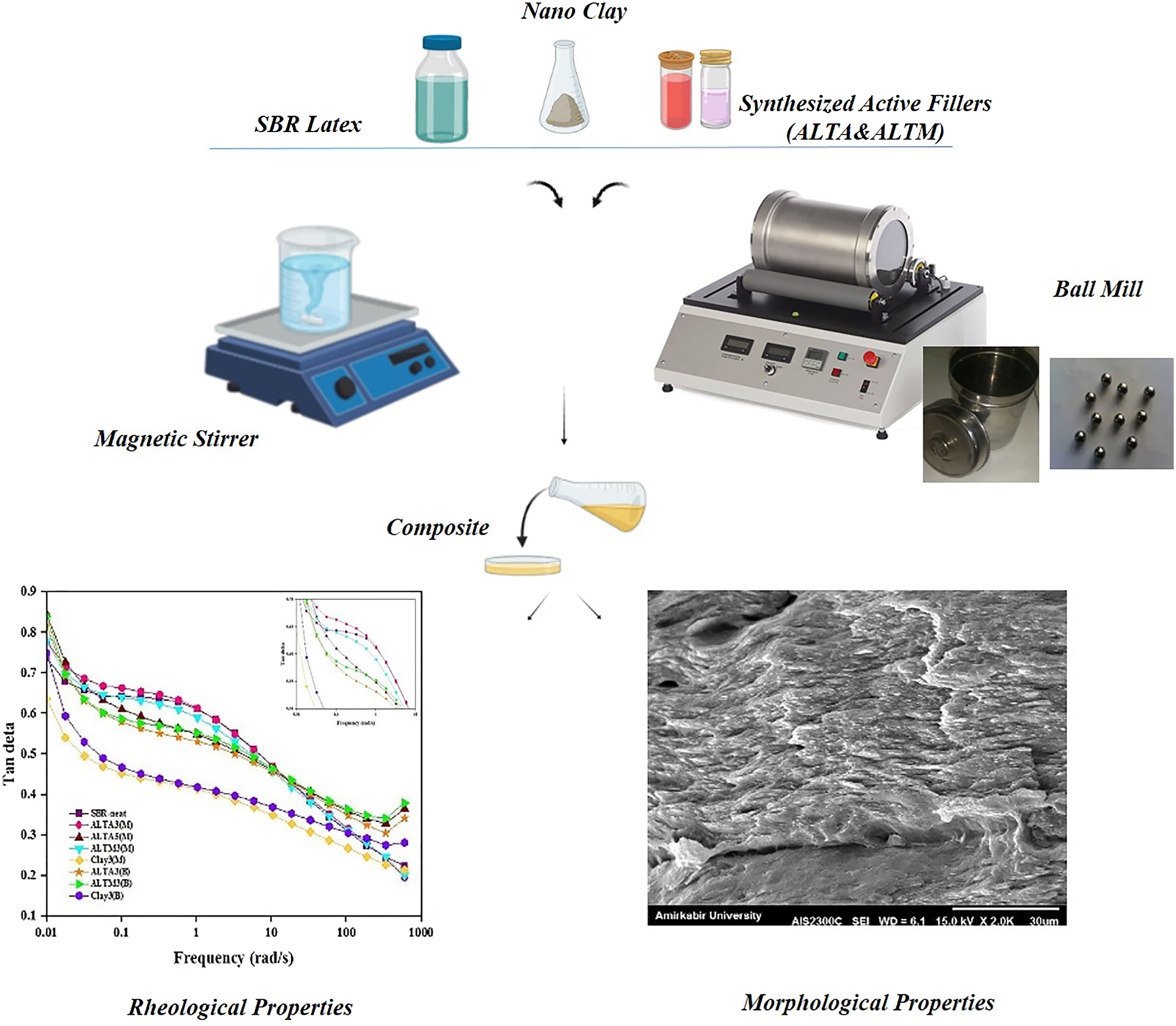
Organic salts of aluminum triacrylate (ALTA) and aluminum trimethacrylate (ALTM) known as active fillers were made through a two-step synthesis and identified using Fourier Transform Infrared spectroscopy (FTIR). The resulting salts and a modified nanoclay (Cloisite 15A) were prepared in the form of slurry and mixed with the styrene-butadiene rubber (SBR) latex. The morphological and rheological properties of the composites were evaluated as a function of type, concentration of filler, and the preparation method of filler slurries, i.e. using magnetic stirrer and ball mill. The morphological investigations by Scanning Electron Microscope (SEM) images presented that ball milling led to finer size and more uniform distribution of fillers in the composites. The rheological measurements of composites containing ball milled ALTA and ALTM clearly exhibited significant improvement in storage modulus being comparable to that of clay. The complex viscosity showed a Power law behavior with an index about n = 0.23-0.25 for ball milled ALTA and ALTM being quite lower than that of magnetic stirred (n = 0.36) facilitating the processing of composites at high shear rates. The tan δ measurements displayed that ball milled active fillers have lower viscous behavior compared to magnetic stirred counterparts at medium frequencies offering higher elastic properties for polymers. The startup experiment indicated that composites loaded with ball milled active fillers presented higher elastic properties than those containing magnetic stirred active fillers.
Get full access to this article
View all access options for this article.